Laws changing too slowly: disability rights advocate
David Lepofsky calls out ‘lack of leadership’ from provincial government
SHAUNA MATTHEWS, STAFF
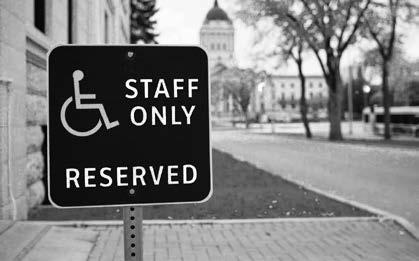
Disability rights advocate David Lepofsky spoke at a talk hosted by Barrier-Free Manitoba at the Millennium Library Oct. 4 where he criticized the provincial government for lagging behind when bringing accessibility standards into law.
Lepofsky, who also spoke to law students at Robson Hall earlier in the day, is a lawyer who has worked to ensure the inclusion of equal rights for persons with disabilities through the Canadian Charter of Rights and Freedoms.
He campaigned for the passing of the Accessibility for Ontarians with Disabilities Act (AODA) in 2005 and is currently advocating for the Accessible Canada Act, or Bill C-81, which is making its way through parliament.
In his talk, Lepofsky covered the lack of enforcement of the Accessibility for Manitobans Act (AMA) as well as provided his recommendations for the countrywide Bill C-81.
The AMA was passed in 2013, but the province has yet to make significant progress with the law. Of the five accessibility standards, only one has been passed into law, and two are currently under development.
The customer service accessibility standard, which has been passed into law, requires all Manitoba businesses and non-profit organizations to meet the customer service standard by Nov. 1, 2018.
The requirements state businesses must provide certain standards to customers, including training staff on accessible customer service and allowing assistive devices.
The two accessibility standards under development address barriers involved in employee recruitment and hiring, and barriers surrounding the giving and receiving of
information.
Lepofsky said the Manitoban law, along with the work done by other provinces, served as a model for the federal Bill C-81.
“Like we’ve said to the federal government, you know, what we’re recommending be in this bill comes from learning what the provinces have done well and what they haven’t done well,” he said.
Lepofsky called out Manitoba specifically for its lacklustre response to accessibility legislation.
“A lot of what we’re recommending to the feds is because of weaknesses we’ve seen in Ontario and in Manitoba,” he said.
“So the Manitoba legislation lets them make standards, but doesn’t set timelines, so we’re running into the same problems.
"Certainly, enforcement is independent of the government, and that’s a problem.”
Lepofsky added that the slow implementation and lack of enforcement of the AMA are major problems of the act.
He also questioned if premier Brian Pallister had set the implementation of the AMA as a priority for the province.
“We think it’s systemically been a lack of leadership from the top — in other words, in a big government, the premier gives priorities to their ministers,” he said.
“They issue mandate letters. And if they say, do more of ‘X’, they’ll do more of ‘X.’ And if they know that that will make a difference, that their premiers set a priority for them, that will help. One of the questions in Manitoba is ‘Has the premier set this as a priority for the minister responsible for this?’ And that’s one of the problems.”
Bill C-81 just passed its second reading Sept. 26, but Lepofsky said he believes the law is still weak in its current state.
Local rockers Silence Kit release new EP
Some of the weaknesses Leopofsky identified are the lack of deadlines, enforcement remaining independent of the government and too many loopholes, issues also present in the Manitoban law.
Lepofsky, along with the AODA Alliance, published a brief with recommendations for amendments to Bill C-81 last month.
The listed recommendations include putting forth measures to ensure federal elections are accessible to voters with disabilities and for the federal government to address “special responsibilities” with regard to Indigenous people with disabilities.
Social media has been an important tool for Lepofsky in raising awareness and campaigning for disability rights.
“It’s also been really effective for people to spread the word and it’s also been really effective to reach the media,” Lepofsky said.
“What we’ve found is increasingly that stories about barriers percolate up from social media to conventional media.”
The AODA Alliance began using the #aodafail hashtag to bring public attention to the barriers faced by persons with disabilities in Ontario. Lepofsky suggested starting an #amafail thread in Manitoba to bring attention to the barriers many Manitobans with disabilities still face.
“Somebody will be using the Toronto Transit Commission in Toronto, and they’ll find the subway station they use has an elevator that’s out of service, and it’s going to be four months until the darn elevator is fixed,” he said.
“So they start broadcasting it as an AODA fail tweet on Twitter, and then we retweet it, and the next thing you know a reporter follows us or checks the stuff out [and] covers the story.”
QUINCY HOUDAYER, STAFF
Local grunge/alt rock band Silence Kit gave an explosive performance as the band released its new EP “Kitty Kitty” at the Good Will Social Club Friday.
PHOTO BY QUINCY HOUDAYER
Quarter of Manitobans dealing with mental illness
Lead author of recent study says actual number is ‘undoubtedly higher’
DAVID ZIRANGEY, STAFF
Astudy conducted by the Manitoba Centre for Health Policy has found that 28 per cent of Manitoban adults have been diagnosed with at least one mental illness.
The study, titled Mental Illness
Among Adult Manitobans, found the most prevalent illnesses, mood and anxiety disorders, were diagnosed in 23 per cent of adults. The second most prevalent, substance use disorders, was diagnosed in six per cent of adults.
of community health sciences at the college of medicine, said she believes the number is lower than the actual number of people living with mental illness in Manitoba.
“The actual prevalence of mental
by doctors or nurse practitioners. We don’t have data for people who seek help from professionals such as psychologists and social workers. We also know that many people with mental disorders never seek treatment.”
“I would like to see students feel more open to attending workshops and groups when it’s an appropriate fit” — David Ness, director, Student Counselling Centre
disorders is undoubtedly higher,” said Chartier in a media release.
Mariette Chartier, the study’s lead author and assistant professor
“The figure of 28 per cent only represents adults who were diagnosed
Another reason the study results may underestimate mental illness among adults, Chartier explained, is that it found that young adults aged 18 to 24 did not have higher rates than other age groups.
“When we survey entire populations and go house to house and do
surveys,” Chartier said in an interview, “usually the younger populations do have higher rates [...] and I didn’t find this in the study. So it speaks to, I think, what we found in this study is for sure an underestimate.”
Chartier said young adults in the study may still be reluctant to speak to their family doctor but may speak with other support groups.
Cartier’s study did not gather data from school counsellors, psychologists and social workers.
U of M mental health services
Surveys like these can more clearly illuminate the prevalence of mental illness in local subgroups.
In a 2014 report by the U of M Campus Mental Health Strategy, titled Success Through Wellness, a survey of 560 students found that 25 per cent of students of students reported seeing one or more of a counsellor, therapist or psychologist for mental health support services.
The report also found that 30 per cent of surveyed undergraduate students said they would not seek help from a mental health professional if they were dealing with a problem.
U of M students report seeking campus counselling and health services at the rate of half the national average, with only 7.4 per cent of students saying they had sought campusbased help.
Over the past few years, the U of M has worked to advance mental health initiatives, including the launch of the Champions for Mental Health group in 2014. The group is comprised of stakeholders from the university, including students, staff and faculty.
The Success Through Wellness report
made over 60 recommendations to the group. The Champions for Mental Health group’s implementation report is expected to be made public by the end of this term.
The student counselling centre on campus offers confidential services including counselling, workshop groups and career planning services.
Director David Ness encouraged students to keep an open mind when seeking mental health support and coping strategies.
“I would like to see students feel more open to attending workshops and groups when it’s an appropriate fit,” said Ness.
“There is a resistance to that, which I understand.”
One challenges Ness said he faces is that students often come in wanting specifically one-on-one counselling. While this might be appropriate for some circumstances, other challenges are better managed in group sessions.
“Some difficulties, like a lot of anxiety difficulties are best treated — research says — by groups,” Ness said, “because you get to help others, you get to hear others’ stories. "It’s normalizing. It’s really quite a powerful experience when you feel safe.”
“We have a learning to cope series that addresses procrastination, perfectionism, exam stress, all the topics that, as you know, students can have some challenges with,” he said.
These workshops are held multiple days a week.
“Students can come in here right now and go to a workshop this afternoon or tomorrow [...] No registration, and we’ve never turned people away from them,” Ness said.
Indigenous prof critical of U of M land acknowledgement
Speaker raises issue with Traditional Territories Acknowledgement in lecture
TY BRASS, STAFF
Indigenous U of M professor Laara Fitznor expressed concern with the U of M’s Traditional Territories Acknowledgement during a lecture Oct. 4. Fitznor, an associate professor at the U of M’s Faculty of Education, has been teaching Aboriginal and Indigenous education at the university since 2003.
She said that within that time, she has had to consider her own position in academia with regard to the U of M Traditional Territories Acknowledgement.
“I’m happy that the land acknowledgment was done,” said Fitznor during the lecture.
“That’s why I should bring to your attention that the [Canadian Association of University Teachers] has been working long and hard with Indigenous scholars to start putting
forward recognition and wording that recognizes territorial acknowledgment, something that Indigenous peoples have always done.”
The acknowledgment is read at school events and is meant to show the university’s commitment to creating a supportive learning environment for Indigenous people, while recognizing the harm caused to Indigenous people by settlers in the past.
“We’re at the era where the recognition of those past wrongs is happening, and that we’re going to try to reshape those institutions in some form,” said Fitznor.
“Those acknowledgments of the land is one way but that’s just words.”
of M's Indigenous Scholars Speaker Series.
Both lectures have raised concerns about the university's approach to reconciliation efforts. On Sept. 20, Barry Lavallee hosted a lecture in which he called for U of M president David Barnard to step down.
When I read it, I said, ‘This is not me.’ Beause they’re saying ‘I’m sorry’ to you, and I’m reading it, do I say ‘I’m sorry’ to myself?“ Laara Fitznor, professor
In an interview, Fitznor reiterated that while she supported the usage of the Traditional Territories Acknowledgement, it is not without issues.
The hour-long lecture was titled Indigenous Education and Understanding our “Positionalities” for Bridging “our Worlds” for Reconciliatory Efforts
This is the second lecture in the U
Fitznor also spoke about the need to understand ourselves within the multiple contexts we each inhabit such as race, class and gender.
The talk explored how reconciliatory efforts require us to see different perspectives, both of others and ourselves.
Fitznor delved into her own life for examples. She explained how her multiple
names — her legal name, her Cree name and a name given to her by Anishinaabe elders — show an example of her place in multiple different worlds, and how her heritage has encouraged her to consider her own positions in relation to issues facing Indigenous people.
Fitznor said her position as an educator at the U of M was part of why she was critical of the acknowledgment’s wording.
“When I read it, I said ‘This is not me’ because they’re saying ‘I’m sorry’ to you, and I’m reading it — do I say ‘I’m sorry’ to myself?” said Fitznor.
“If you read it, you know, ‘We admit to all the wrongs that were done,’ well, I don’t admit to all the wrongs that were done to myself.”
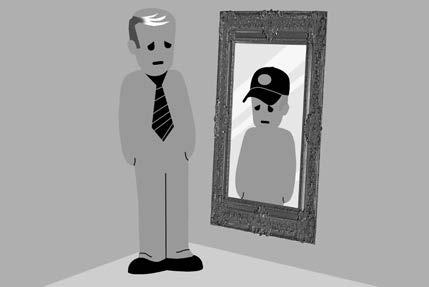
GRAPHIC BY EVAN TREMBLAY
U-Pass negotiations in beginning stages
Three-year contract ends May 2019
MALAK ABAS, STAFF
As the end of the three-year U-Pass contract nears, Winnipeg Transit has requested to begin negotiations with UMSU.
UMSU’s current U-Pass contract will expire in May 2019, which UMSU president Jakob Sanderson called an “exciting opportunity.”
“I know there’s a lot of students that have experienced some issues with the U-Pass in the first iteration,” Sanderson said.
“And so we’re looking forward to addressing those.”
The U-Pass came to fruition following a fall 2014 referendum where UMSU members voted in favour of the mandatory pass for full-time students.
It was later approved by City Council in March 2015. The program began for students in September of 2016.
According to Sanderson, Winnipeg Transit recently requested the city pick up negotiations with the student unions involved in the U-Pass, which currently includes UMSU and the University of Winnipeg Students’ Association (UWSA).
Students under the Red River College Students’ Association (RRCSA) voted to accept the U-Pass after a referendum in early 2018, but currently does not have a U-Pass system, despite the RRCSA website listing the implementation date as “tentatively” September 2018. If negotiations are approved by all parties, the RRCSA would join UMSU and UWSA for the 2019-2020 year.
While Sanderson said negotiations will not fully commence until nearer to the end of 2018, he added Winnipeg Transit “certainly” is aware of UMSU’s negotiation requests.
UMSU’s requests include a wider range of opt-out eligibility.
Sanderson referenced students in the St. Vital Perimeter South and Maples areas of the city who have limited access to public transit but are ineligible to opt-out of the U-Pass because they are technically within city limits.
“We’re going to say either the entire city limits needs to be expanded into the transit service area, or until such time as that is addressed, it can’t be opt-outs only for people outside the
Let it snow
city limits,” he said.
“It needs to be opt-outs for people outside the transit service area. Because it doesn’t make sense for someone to pay for the U-Pass if they literally can’t use it. But that’s the unfortunate reality of what we’re locked in to.”
UMSU also plans to push for additional routes and buses in negotiations.
“We would obviously prefer for there to be bus routes expanded to all areas of the city,” he said.
“We also would like to see more convenient bus routes, because currently there’s some students — especially sort of on the north side of the city — where while they can bus to the university they don’t want to, because it’s such a long bus track. So we’re hoping that with completion of rapid transit and with some more bus routes that that can be alleviated.”
Sanderson added that while UMSU was told by Winnipeg Transit during the original negotiations that there would be more buses to accommodate the expected influx of students taking public transit, this has not happened.
He also noted that according to a survey conducted by UMSU, there has been a reported nearly 20 per cent increase in people who now use the U-Pass compared to those who bought passes before the universal pass was made available.
“We would hope to see a similar rise in the amount of buses. We haven’t seen that yet,” Sanderson said.
According to the current contract, if negotiations are not completed by 2019, the current contract will roll over for one additional year.
Sanderson stressed that regardless of how negotiations turn out, there will be a U-Pass available to U of M students in the 2019-20 school year.
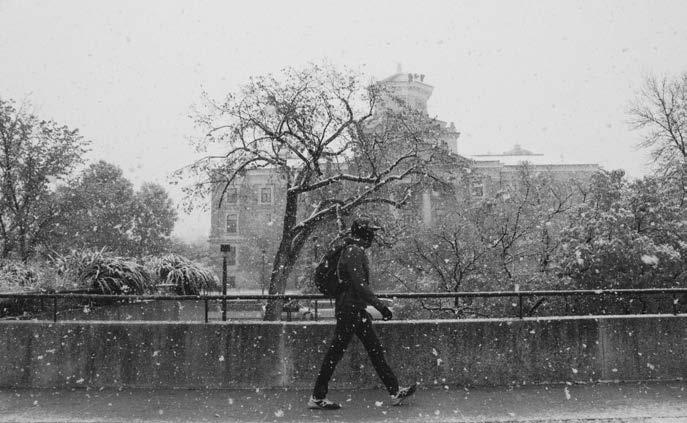
TANVIR AHMED, VOLUNTEER
Winter returned to the U of M Fort Garry campus with a heavy, wet snowfall last week.