UMFA rally highlights major concerns of faculty members
Staff and students show continued support for UMFA strike mandate
M embers of the University of Manitoba Faculty Association (UMFA) and a group of supportive students held an information picket in front of the administrative building Friday.
The rally came two days after the association representing professors, researchers, and librarians set a Nov. 1 deadline to reach a new collective agreement with the U of M.
Earlier this month, UMFA members voted overwhelmingly in favour of a strike mandate, with more than 85 per cent of ballots returned supporting the motion.
UMFA president Mark Hudson opened the rally with a speech reiterating the union’s priorities, including competitive pay, more collegial governance, and controls on the use of performance indicators, which he said the university has failed to address.
In September, the university presented the association with a fouryear settlement offer, which included a seven per cent salary increase. Including existing annual increases and proposed competitive salary bumps to address specific areas of need, the average UMFA member’s salary increase would be closer to 17.5 per cent.
UMFA responded with a one year proposal, which included an average 6.9 per cent salary increase.
The union also rejected an expedited one-year, salary-only offer before negotiations began in the spring.
Following the rally, Hudson said the strike mandate was the only way to persuade the university to address the association's concerns after six months of bargaining.
“We have been bargaining since May. We have had the same set of concerns on the table since then,” he said.
“As it has been the case in past bargaining rounds, we felt that the only way to move things forward at the table was to ask for a strike mandate from our members.”
Hudson, who has worked at the U of M since 2009, said working conditions for faculty members have deteriorated during his tenure at the university.
“The biggest issues that we hear from all of our members is that their workloads are rising and rising,” he said, pointing to a teaching load increase of more than 30 per cent for instructors in the faculty of arts.
Hudson said this has negatively impacted the U of M’s quality of education, as interactions between students and professors have become increasingly limited. As such, students, more than professors, are most affected.
Update on negotiations
Negotiations between the association and the university are ongoing and Hudson said he is hopeful for a positive outcome.
"It's always a process of give and
take, but the hope is that a strong strike mandate and a show of support like we had here today gets the university back to the table of bargaining seriously," he said
U of M spokesperson John Danakas disagreed that a strike is called for and said the university remains committed to reaching a deal without classroom disruption.
“The university recognizes how challenging the impact on students a labour action can be, and does not agree that a labour action is necessary,” he said in an email, noting administration has agreed to pursue mediation.
“The university wants to see bargaining with UMFA resolved, and with no negative impact on students.”
Hudson said that while a bargaining session was abruptly cancelled last Wednesday, he remains hopeful the two sides can come together at the table.
“Our hope is that, going forward, that they are at the table regularly between now and our strike deadline – that they are taking our priorities seriously,” he said.
Students weigh in
Harshvir Bali , a fifth year anthropology student who supports the strike mandate, said he hopes the university deals with the issue in a timely fashion because students have a stake.
“At the end of the day, what's more important: making money or provid-
ing quality education for students,” he said. “I'm graduating next year so I have no reason to be supporting the strike but I really do care about the quality of education for future students.”
Bali added that cutting costs has had negative impacts on the university’s quality of education, especially when compared to other Canadian universities.
Jonah Olsen , a student from the University of Manitoba Student Action Network (UMSAN) also expressed his support for the strike
UMSU students with disabilities service group in limbo
O SHO SAMU el Adet U nji, staff
More than a year after the University of Manitoba Students’ Union (UMSU) approved the creation of a service group for students living with disabilities, advocates say they are still waiting to see results.
UMSU council approved the creation of the service group at one of its meetings in September 2015. However, beyond setting aside space and collecting applications for the coordinator position over the summer, former UMSU students living with disabilities representative and current Arts Student Body Council member Andy Fenwick said little progress has been made.
“Stalling the group is also stalling crucial services like peer-to-peer support and financial workshops, and stalling the ability to advertise to members and recruit members,” Fenwick said.
“UMSU needs to hire a coordi-
nator and furnish the Accessibility Centre so it can start planning events, recruiting students, and flourishing as a student service group,” he said.
With UMSU Accessibility Awareness Week scheduled for the week of Nov. 28 , Fenwick said the council is missing an opportunity to have the centre play a pivotal role in the week’s events.
“The Accessibility Centre should’ve been operational by this point so it could have advertised services and [hosted] an event, but with the coordinator still not hired, the chances of being able to have that are very slim,” he said.
“It’s actually pretty [unintentionally] disrespectful when I see the Accessibility Centre logo being advertised, or when they say they have it as a student service group, because they don’t at all – it’s just an empty, locked room.”
Overcoming obstacles
In June, UMSU council approved spending more than $6,480 to paint, remove carpet, and improve accessibility to a room in the Helen Glass Centre that will serve as the group’s home.
A job posting to hire a coordinator for the centre closed June 17. However, UMSU’s vice-president advocacy Dara Hallock said the union’s executive is looking at restructuring how its community and service centres operate, which has held up the hiring process.
“There are many inefficiencies within the currently established community groups that we are looking to resolve,” she said. “We feel it would be irresponsible to open the centre without any real formal preparations or with the potential of having to modify the centre’s structure after the opening.”
There are currently five UMSU
community representative positions and three service groups: the Womyn’s Centre, the Rainbow Pride Mosaic, and the Aboriginal Students’ Association. In addition to the accessibility centre, UMSU council is looking at creating a community group for international students.
Hallock said that while the motion to approve the accessibility centre was initially passed last fall, the previous UMSU council did little toward making the centre a reality. She said the new executive wants to put everything in place for the centre to take on an impactful role in campus activities.
mandate.
“I would say that what they are fighting for affects us far more greatly than a strike would,” he said.
“The issues that UMFA is fighting for are the same issues that we should be fighting for as students. It is our education that is on the line here and the academic integrity of the university.”
“This executive team would like to see very active community centres – ones who are collaborating with UMSU on advocacy campaigns, on events and programming, and ones that offer tangible resources to students, in addition to the safe space,” she said.
“We felt it was appropriate to do our due diligence and follow a proper procedure for opening the accessibility centre. This may take more time than originally anticipated by the individuals who first proposed the motion to council, but we feel this will ultimately result in a better community group and centre for the students who need it most.”
Hallock said she would still like to see the centre open for Accessibility Awareness Week.
photo by Megan Colwell
PC government introduces new mandatory sexual assault policy legislation
After rejecting Bill 204, PCs broaden scope of legislation in new bill
l evi G A rber, staff
The Progressive Conservative provincial government has introduced new mandatory sexual assault policy legislation for Manitoban universities and colleges after striking down similar legislation only a week before.
The Sexual Violence Awareness and Protection Act, also known as Bill 15, was introduced in the legislature by Rochelle Squires, minister of sport, culture, heritage, and status of women on Oct. 12.
The introduction of Bill 15 comes after the government voted down a similar sexual assault policy bill –known as Bill 204 – that was introduced by New Democratic Party MLA for Fort Rouge and education critic Wab Kinew.
Bill 204 would have required public post-secondary education institutions in Manitoba to develop sexual violence and harassment policies and demanded the universities and colleges disclose sexual assaults on their campuses. The bill also would have ensured that these policies be developed with adequate student consultation.
Bill 204 was voted down in controversy after two male NDP MLAs were accused of singling out and shouting at female PC members, shaming them for opposing the bill.
“A broader bill”
The new legislation is fartherreaching and more comprehensive than Bill 204, insisted Ian Wishart, minister of education and training and the bill’s sponsor.
“This is a broader bill than anything that’s been brought forward before and I think that the breadth
is valuable” he said.
Besides including all of what the previous Bill 204 called for, Bill 15 also stipulates that the post-secondary institutions in question raise awareness of sexual violence through the use of social media.
“A student is a student and we wanted to make sure that they were protected in any place they might be” – Ian Wishart, minister of education and training
The bill also includes a clear definition of the term “sexual violence,” based on the definition that has been used in other provinces and past court cases, a definition that Bill 204 lacked.
The new bill also encompasses private post-secondary educational institutions such as financial and bible schools, in addition to public universities, colleges, and vocational schools.
“We want to make sure that students feel safe on whatever campus they’re on,” said Wishart. “We didn’t really see that there was much difference between university campuses and colleges and even private school.”
“A student is a student and we wanted to make sure that they were protected in any place they might be.”
Speculation of the bill
Kinew said he is not convinced an entirely new act of legislation was necessary.
“Keep in mind, they could have accomplished those changes just by amending 204, with relatively straightforward amendments,” he said.
Explaining why they did not amend the original bill, Wishart said “it is awkward to take a bill and write in a lot of new things in it.”
“It’s the definitions that often drive the whole bill and we changed a lot of the definitions to get them aligned with other provinces,” he said. “It was much easier to go back and do it this way and it makes for a better bill.”
Kinew also said that he has reservations about some details of the new legislation, which goes to committee for public hearings this week.
He pointed to two parts of the bill that he says can do with amendments.
Bill 15 uses the Criminal Code of Canada’s official definition of “consent,” which Kinew said might not be enough.
“What I’ve heard from student leaders is that for them [consent] is more than just using the criminal code definition, it’s about using the ‘yes means yes’ standard of consent,” he said. “I think potentially there’s an amendment to introduce that.”
The Criminal Code of Canada defines consent as “the voluntary agreement of the complainant to engage in the sexual activity.”
The “yes means yes” – or “affirmative consent” – standard refers to a revised and more comprehensive definition of consent in the United
States and Canada than previously determined by the law.
In 2014, the state of California adopted a law requiring post-secondary educational institutions to create sexual assault policies that abide by the principles of affirmative consent, defining consent as “voluntary, affirmative, conscious agreement to engage in sexual activity, that can be revoked at any time.”
“We’re very happy to see legislation being put forward and we’re looking forward to working with the government to improve our campuses and make them safer for students” – Tanjit Nagra, UMSU president
Kinew also pointed out that although Bill 15 includes a line indicating that the mandatory policies must be developed with cultural sensitivity in mind, there is no clear definition of the term.
“I’m sure everyone will use ‘cultural sensitivity’ in a good way, but it would be good to have a definition there, just so that there’s no kind of loophole created,” he said.
Despite these reservations, Kinew
made it clear that he and his party will support the bill.
U of M’s sexual assault policy
The University of Manitoba passed its own standalone sexual assault and harassment policy in June.
“We believe firmly that the issue of sexual harassment, assault, and violence is a critical one for our society and our campus community,” said the U of M’s vice-provost (students) Susan Gottheil said in an email.
On whether Bill 15 will mean that the university will need to revise its policy, Gottheil said, “We are waiting to see what the detailed regulations that will accompany Bill 15 stipulate before evaluating whether or not there is a need to amend our own policy.”
University of Manitoba Students’ Union (UMSU) president Tanjit Nagra said that UMSU supports the new legislation.
“We’re very happy to see legislation being put forward and we’re looking forward to working with the government to improve our campuses and make them safer for students,” she said.
Following committee, the Sexual Violence Awareness and Protection Act will go to a third and final vote in the legislature.
When asked if he feels that this bill will succeed in reducing the number of sexual assault and harassment cases on and off post-secondary campuses, Wishart said, “There’s no bill that can be absolute in its ability to prevent anything, but certainly people will be far more aware of the consequences.”
photo by levi garber
Student-led UMSU motion calls for universal parking pass
The University of Manitoba Students’ Union (UMSU) was presented with a proposal to create a universal parking pass for undergraduate students at its regular council meeting Sept. 28.
Haben Gabir, a science student at the U of M, forwarded the motion calling for a universal parking program, branded a U-parking pass.
Gabir’s motion describes a parking pass regime that would start at $130 per term, subsidized by all U of M students enrolled in six of more credit hours in a semester. The program’s costs would not extend to students living within a yet-to-bedetermined walking distance from campus or enrolled in less than the six credit hours.
Currently, a full-year parking permit for commuter students – those not living in residence on campus – is $560. Students must register in the summer. Once available spaces fill up, hopefuls are relegated to a waitlist.
Gabir’s motion also calls for a carpool registry, which she said would help manage environmental impacts and traffic congestion.
“I feel very strongly about these issues,” she said, “but given the number of students that drive – and will continue to drive – to the university, if an incentive to carpool was created, this is another way that we can improve the environment around the university.”
Gabir compared the parking initiative to the U-Pass, a universal bus pass program every UMSU member pays into, saying the carpool initiative
will go further toward managing the number the number of students who must drive to campus and cannot rely on transit.
“Given the number of students that drive and will continue to drive to the university, if an incentive to carpool was created, this is another way that we can improve the environment around the university” –Haben Gabir
"I feel doing that is a very restrictive policy to force students to pay into, especially when many students have external obligations," she said.
Gabir said she worries about cost increases to the U-Pass over time, citing institutions like the University of Alberta and Grant MacEwan University, both in Edmonton, which saw the cost of a universal pass nearly double from $81 in 2007 to the current $162.50 after the city’s transit ridership increased dramatically.
“ My biggest concern is that once the U-Pass contract has been put in place, Winnipeg Transit will raise
costs like we’ve seen in Edmonton and try to have their cake and eat it too,” she said.
UMSU president Tanjit Nagra said she is interested in exploring the possibility of a universal parking pass but noted the amount of available spaces could restrict the program’s reach.
“As someone that drives to campus I’m interested in seeing the feasibility of it,” she said.
“Unfortunately, there are not enough parking spaces in comparison to registered students, so this could
be problematic. Whereas if we take a look at the U-Pass – it promotes sustainability with the use of public transportation and transit is accessible to most students living inside of Winnipeg.”
Gabir maintained that she believes the pass is feasible and will achieve similar goals as the U-Pass.
“A goal of the U-Pass program was to make transportation to the university more affordable,” she said.
“This is something that the U-parking pass does as well by reducing the cost of a parking pass for students that
drive. A goal of the U-Pass program was to create a better campus environment – the U-parking pass does this as well by creating an incentive to carpool, which is both green and helps to reduce congestion.”
The motion has been sent to UMSU’s members services committee, where it is expected to be reviewed this week.
Mumps on Fort Garry campus
G A rett Willi AMS , staff
M
anitoba health officials are urging University of Manitoba students to take care after a number of students have been diagnosed with mumps.
The province’s chief provincial public health officer reported last week that nine cases have been reported in the province since Sept. 1. The majority of the cases are students of the Fort Garry campus and most patients were not hospitalized.
The province reported the number is nearly double the typical four or five cases seen in Manitoba a year.
University spokesperson John Danakas told media last week at least four cases were confirmed and the students have been isolated. Two were confirmed to be Bison football players.
Danakas said this week the situation at the U of M is stabilizing but cautioned anybody with suspected symptoms to visit a physician, which he said is especially important given the virus’s long incubation period.
Mumps can be spread to others from two-to-three days before and four-to-five days after symptoms appear, according to a provincial release. Some people infected with
mumps may not have any symptoms at all, but can still spread the virus to other people.
Symptoms include swollen and tender salivary glands on one or both sides of the face, fever, headaches, and muscle aches. Less common symptoms include swollen and tender testicles in teenage and adult males.
The virus can be passed on to others when an infected person passes fluids from the mouth and nose to another by sharing drinks, food or cigarettes; by kissing; or by coughing or sneezing within a few feet of another person.
Winnipeg Regional Health Authority public health officials are investigating each case and identifying contacts. Where appropriate, people will be offered immunization.
Individuals with mumps will be asked to restrict their contact with others to reduce the possible spread of mumps.
UMSU passes motion to oppose disproportionate international student fee hikes
l evi G A rber, staff
The University of Manitoba Students’ Union (UMSU) adopted a motion at its regularly scheduled council meeting on Oct. 12 committing to advocate for international students should the provincial government decide to hike tuition fees.
Motion 297, introduced by the UMSU executive, comes after recent double-digit percentage tuition increases for international students at the University of Manitoba, while tuition for domestic students has remained frosen or rose at the rate of inflation for over a decade under the former NDP government.
The motion calls for the provincial government and U of M board of governors to lock any future hikes in international student fees to the same rate as domestic students.
An amendment to the motion stipulating that UMSU also oppose tuition hikes for all students, international and domestic alike, was also introduced and adopted at the meeting.
UMSU president Tanjit Nagra voiced her concern over the trend of tuition hikes, saying, “If we look at what happened with the budget approval by the board of governors back in the summer session of 2015, it was voted in favour to increase international student tuition by
about 15-17 per cent, depending on which faculty you were in.”
“That set a lot of students back,” she said.
“It’s
important that the university must not use the international students as cash cows to boost their new capital” – Saif Baloch, CFS-MB international students’ commissioner
The motion also comes at a time when the Progressive Conservative provincial government is hinting at raising tuition fees across the board.
In an interview with the CBC earlier this month, minister of education and training Ian Wishart said, “[Manitoban universities are] considered a deal, especially by foreign students. So we have to keep those things in mind, but we also have to make sure post-secondary institutions have sustainable fund-
University of Winnipeg student executives, director detained outside Parliament in anti-pipeline demonstration
Cr A i G Ad O lp H e, staff
Two executives and one director from the University of Winnipeg Students’ Association (UWSA) were among a group of young people detained for trespassing in Ottawa today while participating in an antipipeline demonstration on Parliament Hill.
UWSA president Kevin Settee, UWSA vice-president external affairs Sadie-Phoenix Lavoie , and UWSA business and economics director Mitchell van Ineveld were among the roughly 200 young people – primarily from surrounding regions including Ottawa, Waterloo and Montreal – participating in a demonstration protesting the expansion of a Kinder Morgan pipeline. Ninetynine of the protestors were detained
and given trespass warnings .
In videos from the event, a group of protestors can be seen chanting and holding signs with messages such as ‘climate leaders don’t build pipelines’ while another group of protestors hopped a police barricade with officers waiting to escort them away one by one.
According to van Ineveld, protestors were told that if they crossed a certain point they would be arrested. Those who were detained were searched, handcuffed, and walked away from the protest. Before they were released, they were advised they would be arrested for mischief if they returned .
“We had an idea we might be arrested, but we didn’t know for sure,”
Settee said when reached in Ottawa. “The officers were saying we’re going to be charged with mischief, but we just got a trespassing charge.”
“We had an idea we might be arrested, but we didn’t know for sure” – Kevin Settee, UWSA president
Settee said the demonstration was organized to pressure the federal government to hold to promises made
during the 2015 campaign.
“A lot of people are here right now, standing up, trying to get Justin Trudeau to stick to his word on [...] a nation-to-nation relationship and keeping his promises that he got elected on,” he said. “But more importantly, Kinder Morgan, the pipeline, that’s going to be going through pretty soon and we don’t want him to accept it.”
“We want him to protect the land and the water.”
In a video recorded by Lavoie, van Ineveld spoke about the experience after being released.
“I think we got our message across,” he said in the video. “Trudeau can’t ignore us now. A hundred people got arrested on Parliament Hill because
ing arrangements. And that means we have to review where we sit.”
Canadian Federation of Students–Manitoba (CFS-MB) international students’ commissioner Saif Baloch told the Manitoban that the motion passed by UMSU is a positive step for the union, calling it a “crucial stepping stone.”
“It’s important that the university must not use the international students as cash cows to boost their new capital,” he said. “International students have been exploited with inflated fees and little support.”
On the amendment to oppose all tuition hikes for both international and domestic students, Nagra said, “Given the recent comments about removing the tuition cap, it’s a concern to us and also what could happen to funding to post-secondary in general.”
The UMSU executives are scheduled to meet with Wishart at the legislature on Oct. 31. “This is the first time we’re really getting the opportunity to sit down with the minister with just our executive team and talk about UMSU and our members and what issues there are at the U of M for undergraduate students,” said Nagra.
he won’t commit to rejecting this pipeline. So, I think we’re going to see some real progress. I’m optimistic.”
Niki Ashton, the NDP MP for Churchill-Keewatinook Aski , posted a message to Facebook in the morning commenting on Settee and Lavoie’s arrest.
“Disgusted that such an act of peaceful protest on Parliament Hill would be punished,” Ashton said. “I used to see this stuff under the Harper government; looks like Trudeau has the same approach. I'll be raising this with those in charge of security on the Hill. ”
Editor-In-Chief: Craig Adolphe
Contact: Editor@themanitoban.com / 474.6770
A message to U of M students from UMFA president Mark Hudson
You may have heard some rumblings around the University of Manitoba about the possibility of a strike by UMFA (University of Manitoba Faculty Association), which is the union of full-time professors, instructors, and librarians at the U of M. I’m writing to you today to explain why UMFA took a strike vote and what the results of that vote mean for students.
UMFA has been in negotiations with the administration since May. We’ve offered a set of proposals in negotiations that are important not only for our members, but for education at the U of M and for students. So far, the administration’s responses to those proposals have not addressed our concerns about the direction and integrity of the university. That’s why we needed to see if our members saw these concerns as serious enough to contemplate striking. 85.6 per cent of our voters said “yes.” However, professors, instructors, and librarians do not take the issue of a strike lightly because it does have serious consequences for the university community as a whole.
Why are UMFA members even talking about a strike?
First, a high strike vote does not necessarily mean that there will be
a strike. Negotiations are ongoing, and we have every hope that UMFA and the administration will reach an agreement. We will give negotiations every possible chance to succeed. We don’t want to go on strike; we would much rather be getting on with our research and teaching. But sometimes, if you want to defend something deeply valuable to you, you have
That’s what we are bargaining for: limits on the extent to which our workloads can be unilaterally increased
to take a determined stand.
What’s so important that we would contemplate a strike? In short, your university. You and your families place a trust in the U of M – and in UMFA members – when you enrol. We are fighting to ensure that trust is honoured.
What’s on the table?
Let’s take a look at the key relationship that makes a university what
it is: that between a faculty member and a student. How does bargaining impact that relationship?
Surveys show that academics already work about 60 hours a week. We enjoy our work, but as more and more of it – especially administrative tasks, but also more and larger classes – is heaped up, we have less time to dedicate to each student. If administrators are allowed to crank up our workloads without limit, we’ll be encouraged to treat students like factory outputs, rather than as humans and partners in learning. I don’t want to be that professor, and neither do my colleagues. We want the time required to teach well, to engage with students in discussion and debate, and to share our ideas and hear yours. That’s what we are bargaining for: limits on the extent to which our workloads can be unilaterally increased.
Similarly, if faculty are heavily evaluated – for things like tenure, or promotion, or how much of the budget our programs get – on the basis of “Performance Indicators” (PIs) like how many papers we publish, how often other people cite those papers, or how prestigious the journals we publish in are, our efforts will have to turn increasingly toward improving those PIs. Survival will depend upon
Letter to the editor
RE:
it, even though such metrics are not reliable indicators of faculty quality.
While there are many casualties of such a system, among the first will be students. We are bargaining to put limits on a system that encourages us to hustle you out of our offices, for the fear that if we don’t get our citation counts up, we’ll be hung out to dry. We’re not averse to being evaluated. But we will fight to make sure it’s fair, and that it doesn’t discourage real engagement with students.
Then there’s money, which is all you’re likely to hear about in the media. These previously mentioned issues, which are absolutely central to negotiations, will get swept aside by most reporters and by administration. Fair workloads and fair assessment are major issues for UMFA. But the reality is that the U of M does not offer competitive salaries. We are dead last among comparable Canadian universities.
At the University of Saskatchewan, you would get just over $18,000 more a year as an assistant professor than you would here.
A gap that big is seriously bad news for bringing in, keeping, and developing original, passionate, and responsive researchers and teachers. It needs to be addressed, and bargaining is the moment in which that can
"Why Manitobans should care about the Dakota Access Pipeline"
Iagree with columnist Shaden Abusaleh almost 100 per cent. My only criticism of this insightful article is the car culture reference to us being an eight-hour drive away from Standing Rock. Please think about distance without only thinking of car travel. Some of us don't drive!
We have to get away from fossil fuel dependency if we truly want
to end oil pipeline building and big oil production. We have to boycott petroleum as much as we can and to do so we have to change our minds and our language: move away from common references that assume driving is normal and acceptable. We need to call for a movement against the dominance of car culture much like the movement which
defeated the common acceptance of smoking. We need to start literally protesting with our feet instead of going to gas stations and filling up on the product we're fighting. We have to call for an end to automobile advertising, push for labels on new cars warning about the dangers of auto-dependency including speed, crashes, injuries, pollution, and cli-
mate change. We need a movement which actively shames the commonality of single occupant vehicle use. We need higher taxes on gasoline to discourage idling and driving and to help subsidize more and cheaper mass transit.
Let's think long and hard about how ineffective protesting big oil is without the muscle of our collective
happen. You want great teachers. We are bargaining to be able to get them and keep them.
Education needs defenders Education is under attack on a lot of fronts. In Manitoba, one of those is the increase in tuition that has been threatened for next year. The U of M administration has asked for this in the past. UMFA opposes it. Access to university should not be dictated by your income, but by your willingness and ability to rise to university’s intellectual challenges and opportunities. However, the integrity of a university, and the quality of learning that takes place there, can also be eroded from the inside, in all of the ways I’ve laid out in this letter. UMFA – whose members know this university inside and out – sees the signs of such erosion. A strike is a serious thing, but so is your education. We don’t take either lightly. We only contemplate the first because we are worried about the second .
MarkHudson UMFA president
boycotting of the product of the pipeline!
Let's have a movement against private automobiles.
Tim Brandt
UMFA is supporting students in its strike mandate
S HA den Ab USA le H , staff
As most of the student body already knows, the University of Manitoba Faculty Association (UMFA) – the union of full-time professors, researchers, and librarians at the University of Manitoba – has overwhelmingly voted to hold a strike in response to our administration’s failure to address concerns regarding the direction and integrity of the university.
Universities are an important institution as they are the centre for research, innovation, and growth; most importantly, universities transform people’s lives through knowledge and education. Universities are among the key driving forces behind the development and progress of individuals and societies, and a compromise to the quality of education that a university provides to its student body has critical repercussions.
Sadly, this is what is currently happening at the University of Manitoba, as our administration has been prioritizing style over substance and a quality of education we can be proud of. This is what should leave us most worried.
A call for a strike is a very serious thing. It is disruptive, anxietyinducing, and leaves students as the ultimate victims. But a strike would not have been considered had our professors, researchers, and librarians not believed that the value of our education and degrees were at stake.
UMFA’s main concerns are the evaluation processes that professors are currently subject to, their increasingly heavy workload, and salaries. These issues have direct implications for the quality of our education and
how we interact with our professors.
Currently, faculty members are being evaluated through performance indicators which include tracking the number of papers a professor publishes and the number of citations that each of those papers receive. The important work that faculty members take part in to enhance the quality of our education, such as taking time to prepare for classes and talking to students, becomes invisible as professors’ work become commodified. Not only does valuable teaching work go unrecognized, but additionally, the quality of their scholarship becomes invisible as they will not be assessed on the soundness and quality of the research they produce, but instead by the quantity.
This matters to students because if professors are just being evaluated based on the number of research papers they produce and the citations they get, professors are forced to prioritize getting those numbers up over dialogue and interaction with students. This is the heart and soul of our education, but if they refuse to play the numbers game, they will likely not get promoted or could fail to secure enough funding for their programs.
At the strike information picket, UMFA claimed that, since last year, professorial workload has increased by approximately 30 per cent. This means larger classes and more students to teach, increased administrative tasks, and greater research expectations placed on faculty.
As workload piles up, our professors are further incentivized to limit the amount of time they spend with
any student and therefore keep their doors closed. This is unfair both for us in terms of our education and for our professors who have dedicated their lives to their careers.
A strike would not have been considered had our professors, instructors, and librarians not believed that the value of our education and degrees were at stake
Then there is UMFA’s fight for higher salaries, which is the top issue that the union is being criticized for. However, as it stands, the University of Manitoba is not offering competitive salaries and this means the university will be unable to attract top candidates who can offer high quality research and education. We go to university expecting to be taught by top scholars, and the only way this is done is if our university offers salaries that are competitive to other universities in Canada.
University revenues have not fallen; our university is capable of offering better salaries because while our professors, researchers, and librarians are at the absolute bottom
salary tier among comparable institutions in Canada, the University of Manitoba’s president, David Barnard, is among the top earners.
I have seen students sitting on the floor during lectures because of the high demand for certain courses that are constantly at maximum capacity. The quality of our education is being threatened and our degrees are at risk; we should definitely not take this lightly. We need to reach out to our administration and president Barnard and demand a fair settlement, because as UMFA president
Mark Hudson put it during last Friday’s information picket, it is not a strike that is wanted, but a settlement, a solution, an agreement. At the heart of our education is the engagement and dialogue we have with our professors. My fear is if our university continues the trajectory it has set, the quality of our education will diminish and we will lose a lot of what is great about this university.
Students need to get off the sideline
As a third year student, only one aspect of university life concerns me: the quality of education.
The budget cuts of the 2015-2016 year have had a negative impact on the quality of education. It is increasingly difficult to schedule time to speak privately with my professors, as they are not only consumed by their increased workload.
UMFA claims to be negotiating in the interests of staff and students against the obstacles of administrative budget cuts. But what exactly are the interests that students value most at the U of M? And who represents the common student? The University of Manitoba Students’ Union (UMSU) has provided little information to students regarding the cuts and UMFA’s initiatives. Where is our student union in all of this? If they are not actively putting forward our cause, then where is our money going? These were the questions marinating in my mind on the way to the
Oct. 21 UMFA information picket.
Absent at the information picket, it appears UMSU has been failing to actively insert itself in the debate, waiting for further information before addressing the student population. This embodies the lack of relationship between faculty and students and further suggests UMFA and UMSU have been failing to properly communicate with each other.
The majority of the crowd at the picket was not students. The student reaction (other than a minority which marched with UMFA) was primarily to watch from the sidelines and snap a few photos. Do students not care about the future of their education at the U of M? Or have they been denied an honest account of how administration has reacted in response to UMFA?
It can be argued that the students’ lack of interest can be attributed to a biased account of the struggle presented in the media. Media outlets
have so far broken down the struggle to a matter of UMFA’s desire for a wage increase. The result of this is that student-faculty unity has been factionalized. By emphasizing wage negotiations in their coverage, the media has unwillingly or not painted UMFA as selfish.
By emphasizing wage negotiations in their coverage, the media has unwillingly or not painted UMFA as selfish
The megaphone declared that UMFA wishes to “restore the relationship between faculty and students.” But this is increasingly difficult in the climate of organiz-
ing a strike. The lack of successful negotiation between UMFA and the administration has left the students in the dark as to what they should expect. While UMFA praises students demonstrating on their behalf, the fight against budget cuts exemplifies a further factionalized campus. There is a lack of common values among students, and if the deteriorating quality of our education cannot unify students, we will be the ones to suffer.
I have had enough with wages, ad campaigns, arguments about infrastructure, and bent truths. There is only one consensual conclusion from UMFA and student reactions to the budget cuts. The University of Manitoba needs more transparency. I do not claim to represent U of M student values. Students’ values are a complicated matter (as are UMFA members’) and representing them accurately is a difficult task. But that
is beside the point. Will UMFA’s rallying call to “restore the relationship between faculty and students” stimulate student mobilization? Or will our opportunity be lost by cause of mainstream media framing? By any account, students and our union need to step up to the challenge.
photo by Megan Colwell
Comment Editor: Shawn Garbutt
UMFA demands ring hollow
j ere M i AH kO pp, staff
By refusing to accept the administration’s latest collective bargaining offer, University of Manitoba Faculty Association (UMFA) has left students wondering whether there will be a massive strike disrupting our academic schedules.
It is important to recognize throughout this process that UMFA is just doing their job. It is a political entity that exists to achieve the best possible working environment for its members. If this type of organization doesn’t fight with the metaphorical ‘man’ every few years, fairly soon unionized staff will wonder why part of their salary is being siphoned off with every paycheque. As a union, it’s hard to justify your existence if you do not achieve some measurable results or at least fight pretty darn hard for them. The success of these labour skirmishes, however, often relies on maintaining moral high ground and public support.
In this latest round of bargaining, UMFA is right to challenge the administration’s authority when it comes to academic freedom on campus, but the absurdity of UMFA’s
financial demands undermine any other reasonable positions. The university has offered a seven per cent wage increase over a four-year period. That comes out to 17.5 per cent on average when existing annual increases and proposed competitve salary bumps are accounted for.
UMFA has responded by asking for a total increase of 6.9 per cent in a one-year deal, which would send both parties back to the bargaining table in March.
I know, I couldn’t believe it either. UMFA defends this ambitious position by saying that their salaries are low relative to the other 14 research intensive universities in Canada. This should be obvious to everyone, considering that our tuition is literally the third lowest amongst these schools. There is always going to be a correlation between the revenue generated at a university and what staff members are paid. What UMFA conveniently fails to mention is that the U of M spends more on instruction as a percentage of the total budget than the majority of other U15 schools. Staffing costs are propor-
tional to total university revenue and rely on expenditure ratios similar to that of any other private or public institution.
That is why UMFA’s collective bargaining demands ring hollow. If their salary and benefits were raised at the rate that they are asking for, the university’s operational budget would see unrealistic increases and jeopardize the financial stability of the school.
While on paper UMFA claims to support financial accessibility for students, they bargain for wage and benefit increases that would force budget cuts or tuition hikes to make ends meet. UMFA has stood in staunch opposition to these outcomes for years, yet their position at the bargaining table says otherwise.
If
UMFA is going
to
take a strong ideological stance on how the U of M should be positioned in the marketplace, its messaging should reflect financial realities
These contradictory aims only serve to confuse the U of M community. We need leadership on important narratives concerning the institution’s direction and future. Academia and the financial questions therein deserve more than political
soundbites – they require nuance and thorough debate. If UMFA is going to take a strong ideological stance on how the U of M should be positioned in the marketplace, its messaging should reflect financial realities. It is simultaneously reasonable to either argue that tuition should be kept low with lower staffing costs or that tuition should be raised allowing for more competitive salaries. It is unreasonable, however, to argue for some Frankenstein hybrid of these positions that ignores basic economics. You cannot have your cake and eat it too.
UMFA has argued that there is a surplus of money being stashed away in contingency funds, carryover budget lines, and allocations to capital projects. This simplistic view ignores both standard accounting practices and the real needs of the university. On a campus of this size and age, there is a huge demand for capital spending both for new, competitive facilities and upgrades to aging infrastructure. Obsolete learning environments are extremely detrimental to the academic learning of students. We cannot have classes that are completely outdated at best and a health hazard at worst; the deferred maintenance budget alone is estimated at over $300 million. How are we expected to recruit top talent at the U of M if there is asbestos in the walls and heating systems that do not work?
Our UMFA staff occupy vital societal roles and deserve to be compensated fairly. Currently, if you build your career at the University of Manitoba as a librarian, instructor, lecturer, or professor, you receive topof-the-line benefits and can earn up to
$85,000-$155,000 depending on your position. This job involves teaching and researching subjects that you are passionate about in one of the best workplace environments possible. There is always room for improvement, but the U of M is a consistent recipient of top employer awards and provides a good quality of life for employees.
It is unreasonable, however, to argue for some Frankenstein hybrid of these positions that ignores basic economics. You cannot have your cake and eat it too
In order to create and maintain public support, UMFA will have to convince the community that they are being unfairly treated in the context of national academic standards, economic trends, and budgeting realities. So if there is a major disruption to the student schedule which impacts classes, exams, breaks, and graduations, they shouldn’t expect much sympathy.
Winnipeg needs an evidence-based approach to cycling infrastructure
Z ACH Flei SH er, staff
For cities in western Canada, Calgary seems to have taken the lead on innovative urban planning. After extensive consultation, Calgary moved forward with an innovative pilot project in which they built four separated cycle tracks in their downtown in a very short time period. The idea behind this project was that instead of pursuing a piecemeal approach, the best way to build and sustain ridership was to create an entire downtown network of cycling paths. Such an approach was augmented by the fact that the lanes would be up for renewal per a vote by city council at a later date, essentially allowing the city to take back the lanes if the pilot didn’t work.
The results from the pilot were exceptional as they found that they broke ridership records. Three per cent of Calgarians in 2016 who
worked downtown were cycling to work, compared to 1.9 per cent in 2010. The city of Calgary also found that increased investments in public transit alongside cycling infrastructure means that 59 per cent of peak morning trips are now made sustainably. The kicker of all of this is that Calgary not only made the necessary investments, but they also installed automatic sensors in order to collect sound data on the number of cyclists utilizing the pilot project. You may be asking yourself how this applies to Winnipeg and why does it matter? Well, Winnipeg doesn’t actively monitor the numbers for cyclists in our core areas, which
means that advocacy groups have to pick up the slack with volunteers. Ultimately, while we can applaud those efforts, they are less desirable than professionally gathered data that
feelings and emotions often cloud our judgement, instead of a rational and evidence-based approach.
The city of Calgary also found that increased investments in public transit alongside cycling infrastructure means that 59 per cent of peak morning trips are now made sustainably
provides a compelling case in favour or expanding cycling infrastructure. As advocates, we are making these arguments based on our passion for the topic, rather than being able to flesh out an argument based on actual recorded demand. One of the biggest issues that cycling, or any civic advocacy project, faces is that our
When we’re talking about the highly politicized and divisive cycling debate, it often turns out that both sides of the argument are guilty of this. This was evident with the ridiculousness exhibited by last summer’s debate over Winnipeg’s cycling and pedestrian strategy. For example, councillor Russ Wyatt launched a tirade on the city’s pro cycling strategy, allegedly claiming Winnipeg’s fixation on the issue is because of “the dictatorship of the tweeting class.” Unfortunately, preconceived notions from both sides of the
debate ruled the day. At the end of it, city council voted for a lacklustre 20-year strategy to expand our existing network, but didn’t approve any mechanism to properly account for how their changes would affect the ridership overall.
As a proud cyclist, I’d love to say that we should build bike lanes and infrastructure across this city so as to create a system that would properly connect neighbourhoods. But when it boils down to it, I’d much rather see our politicians and our public provided with the real numbers and evidence to properly make decisions for all of us, rather than continuing this heated pattern of emotional debate.
Tuition will rise in Manitoba; the question is how much
There is room for idealism and pragmatism in discussions of tuition fees
j e SS e b l AC k MA n
The Progressive Conservative provincial government has shown it is open to changing the legislation that maintains tuition increases for post-secondary institutions at or below the rate of inflation. This change should not come as a surprise since the PCs campaigned on balancing the budget and never made clear their stance on post-secondary policy.
Long before news broke of impending deregulation in October, members of the student movement have come forward in favour of free tuition. Advocates for this policy have depicted education as a tool for overcoming poverty and a right all people should have access to.
They’re not wrong.
The rising cost of tuition comes from cuts in government spending that coincide with cuts in personal income tax for the wealthiest members of society, businesses, and corporations. This foregone tax revenue also impacts the funding – or lack thereof – for healthcare, infrastruc-
ture, childcare, and other vital social services.
Alternatively, changing bad public policy, such as tax rebates for graduates and student loans, may not cover the entire cost of tuition, but it could fund a tuition freeze. According to Alex Usher, arguably Canada’s leading post-secondary commentator, tax rebates result in many students who graduate on time receiving more money that they paid in tuition. By inference, this is a drain on the system. Further, the loans are expensive to administer and cost the province in bad debt. On top of this, both methods leave people who do not graduate behind their peers.
Free tuition in Canada is an ideal worth fighting for. Unfortunately, here in Manitoba eliminating tuition fees might seem to fit within the current political landscape. Political pragmatists, seeing a government overwhelmingly elected on a campaign built on cutting spending, may sense futility. Why lobby for
free tuition, something growing at the margins of mainstream political discourse, when more middle ground solutions could gain greater public support?
Taking aim at realistic goal, while keeping in mind an ideal solution, builds a strong movement. The drive for free tuition is not yet mainstream, but protecting affordability is. A unified lobbying front to maintain the Protecting Affordability for University Students Act, the legislation that regulates tuition, would make denying that much more pragmatic demand very challenging for the government.
Rather than dismissing a demand as far out in left field, the government would be forced to contend with a significantly less divisive idea. It is highly unlikely that more people are in favour of free tuition than keeping Manitoba’s university tuition relatively affordable. Affordability in Manitoba, albeit far from universal, has lead to enrollment not being
a huge issue for public institutions.
Protecting the Affordability Act enshrines the predictability of tuition rates. When tuition is deregulated and consequently rises, many people may defer entering schools, thereby delaying entering the workforce at a higher pay scale and eating away years of their highest earning potential at the end of their careers. Some students who are in the middle of their studies will be left high and dry, partway through a program without the resources to complete their studies.
Indigenous students will further feel the squeeze. The federal liberals have failed to contribute more money to the already underfunded Post-Secondary Student Support Program as promised during their election campaign. With little help from federal programs, higher provincial tuition fees will mean the already underfunded program will help even fewer Indigenous students. Let’s face it, Manitoba’s New
Democratic Party ended their own tuition freeze and cut corporate taxes substantially. There is no reason to believe the PCs will adopt free tuition, but affordability is a realistic and reasonable expectation. That’s what precisely what the Canadian Federation of Students’ Nov. 2 Day of Action at the Manitoba Legislature is all about.
We must keep the Affordability Act intact. Don’t discard your revolutionary flags, for the days of an earnest fight for free tuition in Manitoba will return. But the days of fighting for affordable, high-quality public education are here now.
Jesse Blackman is a former vicepresident of the University of Winnipeg Students’ Association.
Teaching machines to learn
Your guide to what may be our future robot overlords
d eli CA l eb O e-M CG OWA n, staff
Most“introduction to psychology” students would be familiar with the importance of computers in the history of cognitive psychology, or the study of human mental processing. From the beginning of computer science, engineers have been working to equip machines with human abilities. Computers actually inherited their name from a human profession, foreshadowing their profound impact on eliminating the need for human labour.
The first computers were people who earned their living by working as human calculators. From 1935 to 1970, female computers provided essential contributions to the scientific community by processing data for what would later become NASA. In fact, the highly anticipated upcoming movie Hidden Figures is actually based on a few of these women.
Times changed, and thanks to the automatization of mathematical operations with the invention of (non-human) computers, computer scientists have since become more ambitious in their efforts to artificially emulate mental functions. The idea seems like a fantasy straight out of a Philip K. Dick novel – how do we program computers to perform what were once seen as solely biological, and often only human, functions?
Although humans have had an advantage in comprehending sensory inputs, such as speech and visual information, scientists are trying to develop computers that exceed human perception in performing
various tasks, such as recognizing faces, identifying sounds, and processing written language.
The first step to designing biologically inspired computers is a basic understanding of the brain’s structure. Mental activity and behaviour result from electrical communication between neurons. According to work by neuroscientists, as summarized by the American National Institute of Health, a network of neurons, or neural network, can strengthen, terminate, or form entirely new intercellular connections, enabling our brains to modify themselves as we acquire new memories.
The first step to designing biologically inspired computers is a basic understanding of the brain’s structure
This response to experience is, on a very basic level, what enables humans to develop highly refined pattern recognition skills. This is where the ambitious achievements of the biological-acting computer come to a screeching halt. Regardless of how many times they run, traditional computer programs cannot improve themselves without revisions from human programmers. Unlike fixed
software, human students can learn without needing a teacher to directly reprogram their neural connections. This is why it would be necessary to create an artificial neuron network for the machine. Neural networks, when built by man, are meant to simulate being able to learn from experience.
The CIRP Encyclopedia of Production Engineering explains how artificial neural networks enable machine learning – the ability of software to self-correct error between actual and desired outputs, much like the purpose of actual human neural networks. The encyclopedia adds, “artificial neural network algorithms attempt to abstract this complexity and focus on what may hypothetically matter most from an information processing point of view.”
Mathematically capturing how neural networks change with experience allows for the achievement of what Microsoft defines as the three kinds of machine learning: supervised, unsupervised, and reinforcement.
When given a set of data, supervised learning allows machines to infer relationships between separate inputs. In facial recognition, this type of learning allows a machine to recognize the same person’s face in many different images. We can easily recognize our friends in photographs despite changes to their clothing, hairstyle, or facial expression, but this ability is highly complex and difficult to simulate with computers.
Unsupervised learning requires machines to organize randomly
ordered data into a coherent pattern. If you imagine throwing a deck of cards onto the floor and sorting them into sensible categories, that is the kind of ability that unsupervised machine learning enables computers to do.
Computers are only just beginning to realize their potential to learn from experience and apply knowledge in helpful ways.
Reinforcement-based learning is similar to how people expect rewards for good behaviour and punishments for bad decisions. It encourages machines to repeat desired responses to inputs and discourages inappropriate responses. Depending on the more specific type of cognitive ability that a programmer wants to simulate, these three types of machine learning each generate a diverse variety of neural networks.
Such innovations have the potential to benefit current applications of artificial intelligence. Anyone who has talked with Siri, looked at Google Street View, or checked lists of recommended products on Amazon already has personal experience with machine learning algorithms.
Although she can be frustrating at times, Siri does a decent job at recognizing human speech. Google Street View now has the capacity to read house numbers, which is useful when people are trying to pair addresses with images of buildings. Amazon uses past shopping habits and ratings of products to infer a user’s preferences and suggest related items. These are fairly routine mental abilities for humans, but computers are only just beginning to realize their potential to learn from experience and apply knowledge in helpful ways.
The same basic principles behind these technologies are enabling some people to entrust machine learning with more critical jobs. For example, IBM’s Watson is an artificial intelligence system that earned credibility for defeating the human champions in the trivia gameshow Jeopardy! Watson is now finding ideal treatments for cancer patients by processing the contents of thousands of medical studies, though IBM is quick to reassure everyone that the medical professionals who work with Watson will still be doing “most of the thinking.”
While Watson can use its capacity to process a massive amount of data to make statements about what the best courses of treatment might be, that ability cannot replace the expertise of a human cancer specialist. Whereas systems like Watson are designed only to play a supportive role in medical treatment and other human decision-making tasks, other applications of artificial intelligence do threaten to make human labour obsolete in some contexts – and it doesn’t always have a positive effect on human beings. If Google’s selfdriving cars become practical for widespread use, professional truck drivers and taxi drivers may be the next victims of automatization.
How can human drivers compete with the natural advantage that computing systems have in processing speed? How can human drivers compete with an automated system that does not require any rest? It is clear that technology will continue to bring radical changes in the way we all live.
Although new technologies are designed to help, big changes never occur without some negative results. Addressing developments in machine learning requires us to consider not only the benefits, but also the potential social costs that will arise from outsourcing complex tasks and higher mental functions to our digital helpers.
photo by aldo rios
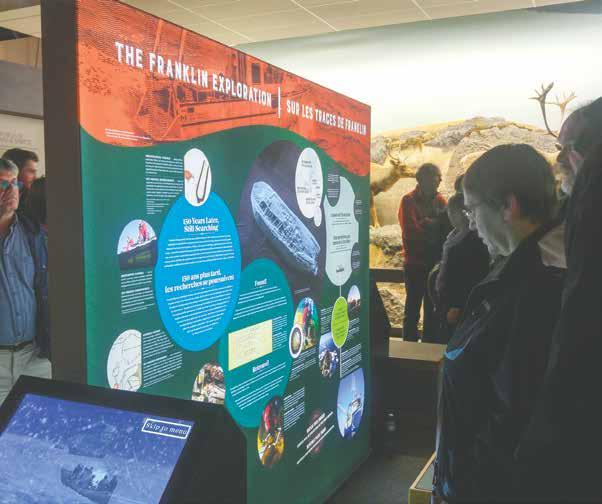
Underwater archaeologist visits Winnipeg to talk about discoveries of the HMS Erebus and HMS Terror
C HA ntelle dU b O i S , staff
O
n Oct. 20, the Manitoba Museum invited Marc-André Bernier, manager of underwater archaeology at Parks Canada, to give a presentation on the archeology of the wrecks of HMS Erebus and HMS Terror. Bernier’s presentation drew in a full crowd at the event, filling every seat in the auditorium.
Both HMS Erebus and HMS Terror were part of the Franklin expedition in 1845. Led by Captain Sir John Franklin of the Royal British Navy, the expedition’s purpose was to explore the Arctic and map the undiscovered portion of the Northwest Passage.
“We’ll rewrite the whole story”
– Marc-André Bernier, manager of underwater archaeology, Parks Canada
In 1848, it was determined that the expedition had gone missing, and HMS Investigator and HMS Enterprise were sent to search for the missing ships. However, neither of the ships were able to locate the expedition, and the HMS Investigator became trapped in ice and had to be abandoned.
The crew of the HMS Investigator became the first Europeans to cross the Northwest Passage. Its purpose in doing so, however, was to reach other expedition ships for rescue. The wreck of HMS Investigator was discovered in 2010 on Banks Island.
While the overall understanding
is that the Franklin Expeditions had become lost – and that the crew perished in the hostile conditions of the arctic, turning to cannibalism to try and survive – discovery of the wrecks help historians piece together a more detailed story on what went wrong. By discovering both wrecks, Bernier says, “we’ll rewrite the whole story.”
Underwater archaeology
In Oct. 2014, it was announced that the wreck of HMS Erebus had been discovered in the Wilmot and Crampton Bay. The ship was discovered further south than the original site that it was thought to have been abandoned, which raises questions on whether or not some of the crew had returned to the ship, or if it had drifted on its own.
As a country abundant with lakes, rivers, and surrounded by three oceans, it is no surprise that underwater ruins hold a considerable amount of valuable Canadian history. Underwater archaeology involves complex and novel techniques to carry out fieldwork, as the submerged environment presents unique challenges.
Parks Canada has had its own underwater archaeology division since 1964. One of the main challenges that Canadian archaeology expeditions face in the Arctic is the limited time range in which searches can be conducted due to ice.
Bernier did note that climate change has increased the time available to search Canada’s Arctic, since the water remains open much longer now, but at a cost. While less ice sheet formation has given his team more time to search for wrecks, it has put the HMS Erebus at risk of further damage due to prolonged exposure to underwater elements.
Finding HMS Erebus and HMS Terror
In 2008, the Government of Canada partnered with multiple organizations to conduct the first search for the original expedition ships. The search for the ships not only involved the use of skilled divers and sophisticated sonar equipment to search the arctic floor, but also cooperated with Inuit people who include one of the ships in their oral history.
Very recently, on Sept. 3, 2016, it was announced that HMS Terror was
discovered off of Terror Bay of King William Island. The discovery was assisted by an Inuk crewmember on an Arctic Research Foundation vessel who had recalled seeing a ship mast sticking out of the water six years prior.
One of the important pieces of information that Bernier’s team had in identifying the ships was the ship plans for the ship’s original build, as well as the modifications that were made for when they set sail to explore.
Sonar scans of the discovered
wrecks were compared to ship plans, which matched up and helped with a positive identification. Other imaging techniques and scans are currently being used to help investigators develop diving plans.
Further investigation to the site of HMS Terror is still underway, but the HMS Erebus has so far proven to be abundant in artifacts.
photo by Chantelle dubois
CoMiC
Local artist’s music video makes it to Vimeo Staff Picks list
eM eli A FOU rnier, staff
M usic videos are usually regarded as mere commercial endeavors. While they often are, this is not the case with Forever, the new music video by Winnipeg artist AudioOpera (whose real name is Graeme Barrett).
Codirected by Barrett and Stedman, Forever stars Kevin McDonald of The Kids in the Hall, and tells a story of the story of a divorced dad-type who, after finding a mysterious business card on his car windshield, goes on a short journey of self-discovery. This brief journey gives a bittersweet and sarcastic glimpse into the sad realities post-divorce males must face while navigating loneliness in 2016.
The video, which was released in September, has been featured on MuchMusic TV and been awarded a Vimeo Staff Pick. This kind of acclaim has not only expanded AudioOpera’s fanbase but also his musical credibility and Stedman’s videography.
View counts do not always validate the essence and peculiarity of music videos such as AudioOpera’s. By making it to television, onto the Vimeo Staff Pick list, and having been featured on a number of top music blogsites, Forever has gone through some of the most vigorous selection filters.
Being listed on the Vimeo Staff Pick means the music video is not
just a follow-up to a song but a short film piece in its own right. With their directorial efforts being recognized by Vimeo and MuchMusic TV, AudioOpera and Stedman will be hoping to use their platforms to raise funding for more films.
“ We are not living off of our art by any means, but it is a nice validation of what we have been doing and committing all our time to,” AudioOpera said.
AudioOpera is a Winnipeg artist signed to the New York City-based record label Noise Collective. As the name of the label suggests, its artists produce associative music using found sounds. Instead of using premade samples in their songs, Noise
Collective’s artists use field recordings – recordings of sounds like kicking a door, the blowing wind, the slamming of a trash can – and manipulate them to become elements of a song, like a kick drum, a keyboard track, or synths.
AudioOpera’s new EP, Flying From The River, was created this way. He incorporated some guitar into the EP for cohesiveness, and added vocals for a humanizing touch.
Most of his music is melancholic, somber, and with an otherworldly feel. This pairs well with the overall tone and style of the Forever video. Stedman and AudioOpera wanted to create their own world within Winnipeg, and give the video a desert
sci-fi, desolate feel. Winnipeg has many odd old buildings, nooks and crannies, and open planes of space, which enabled the directors to set an eerie, mysterious tone to their film. There is a sense of isolation that permeates the video, evoking the theme of loneliness explored through the narrative.
This kind of acclaim has not only expanded AudioOpera’s fanbase but also affirmed his musical credibility and Stedman’s videography
AudioOpera does not create music and videos for financial compensation. He releases all of his music for free online, or on a pay-what-you-can basis. AudioOpera wants his listeners to enjoy his music and help spread the word about his work. He will be touring with Hot Sugar, the producer and founder of Noise Collective, in 2017.
AudioOpera’s newest EP, Flying From The River, is available for streaming on Soundcloud. The EP will be available for free digital download in the near future. CDs will also be available for purchase. Visit his Facebook page for more details: www.facebook.com/ AudioOpera
photo provided by avery stedMan
U of M student raises diabetes awareness with new book
Olivi A Mi CHA lCZU k, staff
University of Manitoba fine arts student Rachel Shead has just published her book Type 1der Woman. The book expounds on Shead’s personal experiences as a person who had been diagnosed with type 1 diabetes and how she coped with it.
“My book intentionally focuses on females simply because I feel the world could use more heroines [...] and because of my personal experience,” Shead said.
Shead’s new book focuses on a type 1 diabetic heroine. She wanted to create a story that little girls could read and enjoy that was more inclusive. That being said, Type 1der Woman is a good read for anyone regardless of their gender.
“Sure, we have Wonder Woman and Supergirl but my [protagonist] is dealing with diabetes and this makes her a very personable character.”
Type 1 diabetes is currently an incurable condition in which the pancreas produces little to no insulin. Insulin is a hormone that is needed to allow sugar to enter the cells to produce energy. Although type 1 diabetes appears during childhood and
adolescence, it is also common for to emerge in in adults as well. With proper treatment, people are able to manage their diabetes and live longer and healthier lives.
“The irony is that the protagonist becomes her own superhero, thanks to her newfound bravery and strength from living with diabetes” – Rachel Shead, author of Type 1der Woman
“The irony is that the protagonist becomes her own superhero, thanks to her newfound bravery and strength from living with diabetes,” Shead said.
“She is meant to be a role model for diabetics, as well as an informative figure for those who do not know about diabetes, or want to know what it is like.”
Shead was diagnosed with diabetes at the age of 9. Her book is more than just an informative guide for diabetics and people who are interested in learning about the disease – it is a tale of strength and perseverance.
“My diabetes has heavily impacted my life but, above all, it has helped me grow into a tough-skinned, brave, and intelligent person,” Shead said.
“Taking needles everyday has toughened me, made me stronger, and educated me on how to take care of myself in a way most people do not.”
With the World Diabetes Day coming up on Nov. 14, Shead hopes that her book will aid in the efforts to create more awareness about diabetes.
“Like any other disease, it is important to raise awareness about diabetes because living with diabetes can be challenging from time to time.”
photo by Miguel yetMan
The Curious Incident of The Dog in the Night opens at the Royal MTC
Local coproduction creates awareness about autism
F
rom Oct. 19 to Nov. 12, Winnipeg’s Royal Manitoba Theatre Company (MTC) will be showcasing a thriller murder mystery play titled The Curious Incident of The Dog in the Night.
The play, which is based on Mark Haddon’s novel of the same title , is a coproduction with Edmonton’s Citadel Theatre. Adapted by Simon Stephens, The Curious Incident of The Dog in the Night premiered in Edmonton and Winnipeg’s performance marks the play’s second showcase in Canada.
The adaptation follows the adven-
tures and misadventures of 15-yearold Christopher Boone. Boone is a remarkably gifted boy who has a unique perspective of the world around him and his interpretation of events does not always bode well for him. When accused of killing his neighbor’s dog, he is forced to come out of his comfort zone and embark on a personal investigation. Essentially, Boone is autistic, but this is neither mentioned in the original novel nor the play. However, the production is orchestrated in a way to create some more awareness about autism. He is played by University of
Alberta alumnus Edmund Stapleton.
Before taking on the role, Stapleton spent a great deal of time doing all the necessary research and preparations needed to play a complex character like Christopher Boone.
“The story is from Christopher’s perspective. Everything you see is kind of filtered through how Christopher sees the world,” Stapleton told the Manitoban
“I did a lot of research into autism and autism spectrum disorder. Even though the book never mentions that Christopher has ASD, it is easy to kind of put all his challenges together and his exceptional way of seeing the world and come up with that.”
Stapleton relishes the opportunity to present the play to Winnipeggers and highlight the importance of creating awareness about autism through the production.
“The show takes place in Swindon, which is just outside of London [United Kingdom], so it is a pretty big center but it is not the capital. In a way, Winnipeg is kind of like Swindon. It has its own uniqueness. So, I think Winnipeggers would see that similarity.”
“Also, I think it is a story that is very important. Many people have
Dalnavert Museum’s Halloween tour explores Victorians’ obsession with death
Olivi A Mi CHA lCZU k, staff
F
rom Oct. 27 to 30, the Dalnavert Museum will be hosting its second annual Dalnavert After Dark candlelit tours. The theme of this year’s edition is “Obsessed: Victorians and The Macabre” and the tours highlight themes of death, sorrow, and monomania.
Program coordinator Charlene Van Buekenhout explained that this year’s theme is based on the Victorians’ obsession with the dead and the preservation of their memories. For Victorians, the idea of not being remembered was more tragic than death itself.
“When Prince Consort Albert died, Queen Victoria went into a prolonged period of mourning. Four decades, in fact, and during this time she wore entirely black, and her mourning rituals became fairly trendy amongst Victorians. She had a plaster cast made of Albert's hand which she had buried with her when she died,” Van Buekenhout said.
“Things like death memorabilia became more in vogue. Death
masks, hair wreaths, and hair jewelry were popular ways to remember the dearly departed. Death photography became popular as well with live members of the family posed with the deceased. These photographs often appear as though the dead person is sitting up and holding their loved ones’ hands, with their eyes open as though they were alive.”
For Victorians, the idea of not being remembered was more tragic than death itself
“One of the peculiar things about the Victorians and why they were drawn to the macabre, or why we think of them as being macabre, is that this age of great invention and technological advances clashed with some of their values and tradi-
tions.said Van Buekenhout.
Other forms of Victorian art, including literature, will be included in the tour. Edgar Allan Poe was one of the most famous writers of the 19th century to delve into the realm of devotion and psychological obsession. The Dalnavert After Dark tour will feature two excerpts from his famous stories ‘The Raven’ and ‘Berenice.’
This tour is self-guided and not a typical haunted house where people jump out at you and scare you, though Van Buekenhout said she can’t promise the ghosts of the museum will abide by those rules.
“The house is dark and don't be fooled, it is very scary just by itself in the dark. Visitors should expect to be frightened by their own imaginations. What is important is to lean into the darkness, listen to the stories, and engage with the installations,” said Van Buekenhout.
“We hope to instill a fun sense of fear that sometimes is hard for adults to get during these kid-centred Halloween seasons.”
a connection with autism. Autism was only first diagnosed in the 80s so it is relatively new and we are still discovering a lot more about it. So, it is good to have a play and a story that can create more awareness about it.”
The production is directed by Winnipeg-based director Heidi Malazdrewich, who has spent some time teaching theatre at the University of Manitoba and University of Winnipeg. Its cast members consist of thespians who are either based in Alberta or Manitoba. Amongst the Manitobans are Terri Cherniack (as Mrs. Alexander), Beverly Ndukwu (as Punk Girl) and Cherissa Richards (as Siobhan).
University of Manitoba alumni Terri Cherniack has featured in several productions at the Royal Manitoba Theatre Company and is excited to take part in the Winnipeg production of the play. For her, being able to learn new accents during rehearsals is her favorite part of the production.
“I love accent work,” Cherniack said. “I spent a lot of time during the summer learning accents. Our dialects coach has all these tapes and recordings of Swindon accents and learning these accents helped me
to understand my character and her affection towards Christopher.”
Beverly Ndukwu, a fellow Winnipegger, highlights the opportunity to be able to work with a talented cast in her hometown as a blessing. She believes Winnipeggers would relate to some of Boone’s struggles and challenges and gain new perspective of the world – a notion Stapleton agrees with.
“By the end of the play, you start to see the world the way Christopher does. You’ll see the world differently,” said Stapleton.
The Curious Incident of The Dog in the Night is playing at the Royal Manitoba Theatre Company (174 Market Avenue) from Oct. 19 to Nov. 12. Tickets start at $26.50 plus GST. For showtimes and ticket information, call the Royal MTC office at 204-942-6537 or visit www.royalmtc.ca
Ninth-ranked Manitoba sweeps weekend series against Regina Cougars
Bisons move to 6-0 and sit atop the Canada West Standings
jASO n pCHA jek, staff
After starting the season 4-0 on the road, the University of Manitoba Bison women’s hockey team returned to Wayne Fleming Arena for their season opening series against Regina where they dominated the Cougars 5-1 on Thursday and 7-1 on Friday.
Thursday Manitoba cruised to a 5-1 victory to open up their season at home. The Bisons got on the board first, as Venla Hovi set up Jordyn Zacharias in front after a battle in the corner. Zacharias was initially stopped by Cougar netminder Jane Kish, but got on the puck
during the ensuing scramble, banging in her first of the year at 11:02 of the first.
A minute later, the Cougars came up the ice on a 3-on-1 to tie the game. Kylee Kupper snuck a pass by a diving Bison defender, setting up Lilla Carpenter-Boesch for the easy tap-in goal. Bison goalie Rachel Dyck slid across to try and make the save, but gave up her first goal of the season.
Manitoba regained the lead off a slap shot from the right faceoff dot, which went under Kish’s right pad.
The goal was Charity Price’s first of the year, with the assists coming from Lauryn Keen and Alexandra
Anderson. Anderson almost extended the lead in the final minute, beating Kish blocker side, but couldn’t beat the post.
In the second, the Bisons gained a two-goal margin after the Cougars gave the Bisons a 5-on-3 power play advantage. Hovi would get the helper again, with Courtlyn Oswald scoring the power play marker, for her first goal of the season, at 8:48.
Manitoba went on to add two more goals, Alana Serhan’s first of the year and Keen’s fifth, taking the home opener with a dominant 5-1 victory.
Eight different Bison players found their names on the score sheet by the end of the game, which speaks to the depth in the Bison lineup.
“Depth is huge when you’re missing your top two forwards, who are a threat every time they’re out there,” head coach Jon Rempel said post game. “They went out there and moved it around. It’s how we have to play.”
Friday
The Bisons were back in action Friday night, taking on a reinvigorated Cougars team. The physicality of the last game carried through to the second game of the weekend,
with both sides clashing from puck drop to the final buzzer with the Bisons ending up on top 7-1.
“Depth is huge when you’re missing your top two forwards, who are a threat every time they’re out there” – Jon Rempel, Bison women’s hockey head coach
The Bisons got on the board just three minutes in thanks to Nicole Carswell. Erin Kucheravy broke into the Cougars’ zone, feeding a pass to the slot where Carswell was able to tip it over the shoulder of Cougars goalie Kish.
Near the end of the first period, Hovi put the Bisons up by two with her second of the year. A shot by Alanna Sharman went wide, but was scooped up by Jayden Skoleski who tucked a pass behind her to a waiting Hovi.
Bison men’s hockey team bounces back in Regina
The herd registered a pair of wins in road series against the Cougars
ryA n Stelter, staff
This weekend, the University of Manitoba Bison men’s hockey team went out to Regina to play a two-game series against the Cougars. The Bisons won comfortably on Friday by a score of 5-1, and finished the weekend off with a 6-3 win on Saturday.
The Bisons are now 2-2 on the year and sit in a three-way tie for fourth in the Canada West.
Friday
The Bisons and Cougars were in a deadlock until five minutes left in the second period, when Shaq Merasty scored off a feed from Justin Augert. The herd added three more goals in the third from Augert, Brett Stovin, and Quinton Lisoway.
Captain Jordan DePape returned after missing the first two games against Mount Royal with an injury. He registered an assist in the win. Byron Spriggs stood tall for the
Bisons in between the pipes, making 37 saves against the Cougars.
“Augert stayed hot with another goal and everyone played their roles well. Timely goals and a solid work ethic was a strength for us this weekend”
– Brett Stovin, Bisons assistant captain
It was a penalty-filled affair, as both teams committed a combined 30 minutes in penalties. Neither team
was able to capitalize on the power play, with the Bisons going 0-for-4 and Regina going 0-for-3.
Stovin talked postgame about what he thought helped turn the tide in the Bisons favour after a strong start from the Cougars.
“The Cougars came out hard and were taking it to us, but one key moment tilted the ice away from us. Partway through the first on the penalty kill, Warren Callis and Joel Schreyer had numerous blocked shots energizing the bench,” he said.
“From there, the line of Remi Laurencelle, Merasty, and Augert took the game over and led the way. Spriggs made some big saves when we needed him.”
Saturday
Manitoba kept on rolling on Saturday with a convincing 6-3 win. Three second period goals were enough to keep the Cougars at bay
and finish the sweep. The Cougars opened up the scoring on the power play through JJ Coleshaw seven minutes into the game. The Bisons responded with a power play goal of their own via the stick of Brad Bowles, his first goal as a Bison.
The Bisons scored two more power play goals in the second from Rene Hunter and Stovin, going into the second intermission up 4-1. Regina gave Manitoba a bit of a scare in the third by scoring a pair of goals to draw within one goal. Augert scored his second goal of the weekend with five minutes remaining and Callis got an empty-netter to seal the deal.
Augert was hot all weekend, registering four points on the weekend and through four games he has five points (4G, 1A). Stovin was also big in the pair of wins; from not getting on the score sheet against Mount Royal last weekend, he turned it around and scored two goals and chipped in with
In the second, the Bisons extended their lead again, this time off the stick of Erica Rieder. Forward Keen took the puck low into the Cougars’ corner, passed it to the slot, and then a quick one-timer by Rieder beat Kish low glove side to give the Bisons a 3-0 lead.
Goals from Cassandra Taylor, Aheridan Oswald, Serhan, and Kucheravy would provide security, as the Bisons cruised to a 7-1 victory.
Regina’s lone goal came courtesy of Kylie Gavelin, who was able to tuck in a power play goal off a feed from Jaycee Magwood.
Dyck continued to shine in the Manitoba net, making a number of key stops. This included two brilliant saves in tight on the penalty kill late in the first, and a glove save off a Regina breakaway in the third.
“I’m going to go game to game,” Rempel said of his goaltending tandem. “It depends on the situation, who we’re playing, and who’d be the best fit. Rachel is on top of her game right now. We could’ve won with [Schubert], but Rachel is on a mission.”
The Bisons head back out on the road next weekend to play the UBC Thunderbirds on Oct. 28-29.
three assists.
Stovin commented postgame about the Bisons’ in their two game series over the weekend.
“It was a solid team effort throughout the weekend. With the injury bug hitting us on the back end we relied on Friesen and me to play defense along with some line juggling up front in the final game of the weekend, but we found some quick chemistry,” he said.
“Spriggs played another solid game [in goal], Augert stayed hot with another goal, and everyone played their roles well. Timely goals and a solid work ethic was a strength for us this weekend.”
The Bisons are at home to play the UBC Thunderbirds on Oct.28-29 at the Wayne Fleming Arena.
photo by sara bulloCh
Bisons keep playoff hopes alive with overtime victory
Manitoba comes out on top against Alberta in longest-ever Canada West football game
k ellen tA ni GUCH i, staff
O
n Saturday, the University of Manitoba Bison football team beat the Alberta Golden Bears 67-59 in an unbelievable game that is the second highest scoring game in Canada West history. After seven overtime sessions, each team recorded over 600 offensive yards in a game the Bisons needed to win to give them any chance at the playoffs.
In the first quarter, both teams were unsuccessful on their opening drives but the Golden Bears made no mistakes on their second drive. They began at their own 12-yard line, and with a combination of runs by Ed Ilnicki and throws from quarterback Ben Kopczynski, they marched down the field. The drive ended with an 11-yard touchdown pass from Kopczynski to receiver Tylor Henry.
Henry had a monster day for the home team, as he caught 19 passes for 298 yards, the second most in Canada West History.
On the ensuing Bisons drive, they were unable to get anything going as it ended with a loss of nine yards resulting in a safety. Following that would be a couple of short drives for each side, and it was 9-0 Golden Bears after the first quarter.
The Bisons began the second
quarter with a bang, as quarterback Theo Deezar threw a 44-yard bomb to wideout Marquise Thompson for a touchdown, putting up the first points of the game for the herd. On the Golden Bears’ first drive of the quarter, Ilnicki fumbled the ball and was recovered by Bisons defender Jayden McKoy at the Alberta 19-yard line. The Bisons offence was unable to convert the turnover into points, as Deezar threw one of his two interceptions on the day.
In the final five minutes of the half, the Bisons put together an impressive drive resulting in a Cam Fox twoyard touchdown run. The Golden Bears put together a scoring drive with 37 seconds left on the clock in the second half. The drive resulted in a one-yard touchdown run by the Bears quarterback, as they took an 18-15 lead into the half.
After Bisons kicker Brad Mikoluff opened the scoring in the second half, the Golden Bears put together another quick and short drive ending with Kopczynski’s second one-yard touchdown run of the game. The Bisons answered a couple possessions later when Alex Christie found a big gaping hole, taking it 28 yards to the end zone. Both teams added a field
goal, making the score 28-28 at the end of regulation.
This game needed overtime, and each team scored a touchdown on their first possession. The Bisons opened it up with a play-action touchdown pass to Fox, and the Golden Bears followed with a short touchdown pass to Adam Zajdel, his first of the season. The teams exchanged field goals on their second possessions. Next, the Bisons again opened with a touchdown pass from Deezar to Riley Harrison, and the Golden Bears responded with a 12-yard touchdown catch to Rocky Borrelli. It was in the fourth overtime sessions that things got interesting. After the Golden Bears opened with a touchdown, they successfully made a surprise two-point conversion. This would force the Bisons to get a touchdown and a two-point conversion or the game would be over, and that is exactly what the Bisons did. After scoring a touchdown, they ran a flea flicker play that resulted in quarterback Deezar catching the two-point conversion to keep the game alive. The next two sessions resulted in the teams exchanging field goals, making the score 59-59.
The herd opened the seventh ses-
Earning their wings
sion with another touchdown reception by Harrison. This time it was the Bisons who were successful on a two-point conversion, forcing the Golden Bears to repeat. They failed as Kopczynski was intercepted by Tanner Hamade, sealing the deal for the Bisons with a score of 67-59.
Jets rookies are ready to make their presence felt in the big league this season
jASO n pCHA jek, staff
S
ince the Jets moved back to Winnipeg, fans have consistently been told about the future of the club. Analysts, reporters, and other general managers have marvelled at the stable of talent the Jets have been able to procure and develop over the past six years. However, it wasn’t until last year that we finally began to see the fruits of that labour.
Nikolaj Ehlers made the jump to the pros, seeming like he would light the rookie scoring race on fire alongside Connor McDavid, Artemi Panarin and Jack Eichel, but an eye injury cut that dream short. Likewise, a fantastic end to the season for Mark Scheifele began to confirm to Jets fans, and the hockey world at large, that he was going to be that cornerstone centre every team covets. This year continued that push as three new talents – and one familiar one –grabbed their spot in the lineup.
Patrik Laine
Last season: Tappara (SM-liiga) 46 games played, 17 goals, 16 assists, 33 points
Compared to Alex Ovechkin for his skill, size, and booming one-timer,
Laine has begun to impress early in the season. This year’s second-overall draft selection was practically gifted to the Jets, as they were not supposed to draft that high at this year’s draft lottery. His first NHL goal was a perfect display of his shooting ability, when he rifled a shot past coverage and to the top corner, making the post sing. He followed this up a few days later with his first career hattrick, including a laser of a shot for the overtime winner. Laine has already shown he can be that gamechanging force, just like Ovechkin. With his physical maturity and elite finishing ability, the World Championship MVP seems to be fitting in just fine with the boys at the MTS Centre.
known commodity to Jets fans. He’s been the heir apparent to Ondrej Pavelec since he was drafted, and after a short tour of duty last year with the Jets before being sent down, he has seemingly stolen his throne. Days before the season began, news broke that Pavelec would be sent to play with the Moose, opening the door for Hellebuyck to take the starter job. His numbers are less than
Mike Richter award, given to the top NCAA goaltender, which doesn’t hurt his resume.
Kyle Connor
Last season: University of Michigan (NCAA) 38 GP, 35 G, 36 A, 71 Pts
Connor has yet to hit his stride with the big club – only recording a single assist in his first four games – but if you’re looking for a sleeper pick for the Calder this season, he is it
Comparable to Ben Bishop due to his size and skill, Hellebuyck is a
stellar to start the year, but his great play last year for both the Moose and the Jets can give fans hope that it’s just the nerves and a little rust. In an interview with Hockey Central, Jets manager Kevin Cheveldayoff noted that he’s not closing the door on Pavelec’s return, but for the time being it’s Hellebuyck’s job to lose. He was also the winner of the inaugural
While not as hyped up as Laine, Connor should still give Jets fans cause to be excited. He has great hands and a nose for the net, which is great for a Jets team looking for players to score in clutch situations. The Michigan-born winger is making his Jets debut in the shadow of Laine, but the 71 points he put up in 38 games for the University of Michigan Wolverines last year is an impressive feat. In his freshman (and only) season with the Wolverines he was held pointless in only three games all year, and received a nomination for the Hobey Baker Award. He has yet to hit his stride with the big club – only
recording a single assist in his first four games – but if you’re looking for a sleeper pick for the Calder this season, Connor is it.
Josh Morrissey
Last season: Manitoba Moose (AHL) 57 GP, 3 G, 22 A, 22 Pts Morrissey is perhaps the biggest question mark when it comes to the Jets’ rookies. In his professional debut last season, Morrissey struggled to find his game early with the Moose. However, with Jacob Trouba still holding out on signing any type of a contract with the Jets, it is the young Alberta native’s turn to make his mark on the team. Point production has been slow for the young defenceman, but he is still a promising talent all the same. Once he gained a footing with the Moose, Morrissey was able to step up play in his end, taking on much larger opponents and showing his puck moving ability. Look for him to do the same as he transitions to the NHL, and to be on the top pairing in years to come.
The Bisons will host the Regina Rams in their final regular season game on Saturday, Oct. 29, at Investors Group Field.
photo by Chantal zdan
New era for university sports
The CIS renamed to U Sports, new logo unveiled
ryA n Stelter, staff
Canadian Interuniversity Sport (CIS) has rebranded itself as U Sports. The CIS name had been in existence since 2001. The ‘U’ is meant to stand for “United, Unbeatable, Unsurpassed” but surprisingly not “University.” The ‘U’ is recognizable in both French and English, so they will not need a different acronym for the French language portion of the CIS (SIC in French).
U Sports announced this during a press conference on Oct. 20 that
was streamed live all over Canada.
The timing of it seems odd, as the winter sport season is already a couple weeks old, with the fall sport season winding down.
Along with a brand new name, U Sports also got a shiny new logo. The logo is meant to emulate the many block letter logos found on university team jerseys. The maple leaf goes back to the CIAU days from the 1980s.
“This is a landmark day for us. Effective today, we are U Sports,”
said Graham Brown, the CEO of U Sports, in a press release. “This is an important step towards a total transformation of our organization which started almost a year ago.”
The brand was born from the minds at Hulse and Durrell, which has also helped rebrand the Canadian Olympic Committee, Swimming Canada, Curling Canada, and Equestrian Canada.
university sports and our future in U Sports,” Gene Muller said in a press release. Muller is the director of athletics and recreation in the faculty of kinesiology and recreation management at the University of Manitoba.
“The work put in by Hulse &
U Sports governs 12,000 student athletes, 500 coaches, 56 universities, 21 national championships, and 12 sports across Canada.
U Sports governs 12,000 student athletes, 500 coaches, 56 universities, 21 national championships, and 12 sports across Canada
“It needed to be different than anything that had been tried before in the organization’s 100-year history. But, at the core, it was essential that everyone understands this brand,” said Hulse & Durrell partner Ben Hulse in a press release.
U Sports has also gone ahead and changed their social media to the new logo and by early next year, a brand new website will be ready to go.
“The University of Manitoba Bisons are excited about contributing towards the success of Canadian
Durrell on the U Sports launch should be commended as they created a modern impact that is in perfect sync with the current transformation of our national body to provide the best possible experience for our student-athletes and university teams across Canada.”
CIAU Central was the first name of Canada’s university athletics governing body in 1906. The Canadian Interuniversity Athletic Union (CIAU) was put into place in 1961. In 2001, it was changed to CIS and today it is now U Sports.
Bison women’s soccer earn playoff berth after weekend split
k ellen tA ni GUCH i, staff
This weekend, the University of Manitoba Bison women’s soccer team played two games against the UBC Thunderbirds and Victoria Vikes. They lost a heartbreaker 2-1 to the Thunderbirds, but beat the Vikes 2-0 and got themselves a playoff berth for the 2016 Canada West playoffs.
Saturday
On Saturday, the Bisons fell victim to a late game-winning goal, losing 2-1 to UBC. The Bisons came into this final weekend of the regular season in a close playoff battle for the last two spots in the conference. This was not how they wanted to start, especially with being so close to earning a point before giving up the late goal.
In the first half, the Thunderbirds had plenty of chances with Bison
goalkeeper Maddie Wilford saving seven shots. The Thunderbirds finally broke through in the 43rd minute, with a goal from forward Jasmin Dhanda. Wilford had no chance to make the save with Dhanda placing the ball perfectly in the top left corner for her 10th of the season. The Thunderbirds took a 1-0 lead heading into halftime.
Early in the second half, Bison midfielder Sara Schur had a chance to even the game for the Bisons. She was able to get around the UBC keeper for a shot on the open net, but it was blocked by a Thunderbird defender.
The Bisons came out much more aggressive in the second half, as they were in the offensive third more often than in the first half. The Bisons evened up the score in the 76th
minute with Alanna Shaw capitalizing on a cross from fullback Sara MacLennan for the forward’s first goal of the season.
“It felt good to tie up the game, scored my first goal this season, so that was exciting,” said Shaw postgame. “Sara [MacLennan] crossed the ball in and I kind of got a touch and the centre back was right on me, and I turned and volleyed it into the net.”
The Bisons gave up a heart-breaking goal in the 85th minute, as the box was crowded and Thunderbird forward Shayla Chorney scored her fourth of the season as she pushed the ball passed Bison keeper Wilford, to give her team the 2-1 lead, and ultimately the win.
Head coach Vanessa Martinez Lagunas was proud of her team after the game, and said they just need to work on the little things for their final game.
“We just need to keep working in those small milliseconds, and be focused for the whole time,” she said.
Although the Bisons lost the game late, Shaw believes that her team can keep their momentum going into their final game.
“Definitely feel like we have the momentum, and especially me, I got the first goal, let’s keep it going,” Shaw explained post-game.
Sunday
On Sunday, the Bisons defeated the Victoria Vikes in what was a must-win game for the herd. This is the first time since 2009 that the Bisons have beaten the Vikes in regular season action. With the win, the Bisons are now locked into the final playoff spot and play their first playoff game next weekend.
“Scoring in the last home game that I
played in for the Bisons was really icing on the cake” – Selina Speranza, Bisons winger
The two teams were feeling each other out to begin the game, and it wasn’t until the 38th minute that rookie midfielder Hailey Lavarias scored her first goal of her young Bisons career. The goal came on a nice pass from Alanna Shaw, and Lavarias took a shot from way out and placed the ball perfectly in the top corner to give the Bisons a 1-0 lead. The Bisons held that lead heading into halftime.
Martinez Lagunas spoke postgame about how important it was
This rebranding will not affect the four conferences of U Sports: the Canada West University Athletics Association (CWUAA), Ontario University Athletics (OUA), Atlantic University Sport (AUS), and the Quebec Student Sport Federation (RSEQ).
U Sports will hope to reach a bigger audience in Canada with this rebranding, and help give the exposure to the student-athletes that deserve it.
to hold the lead in the second half of games.
“There were two other games where we were leading, and we let the lead go,” she said. “We need to make sure we learned our lesson and we need to manage the game properly.”
The Vikes came out more aggressive in the second half. Wilford had to make one of her seven saves on the day on a point-blank shot midway through the second half but was able to punch out the rebound. In the 88th minute, Bison midfielder Chelsea Dubiel sent the ball down the field to senior Speranza, who was too fast for the Vikes defenders and was able to get it past the goalie to add an insurance goal.
Speranza spoke postgame about her final home game as a Bison and the upcoming game against Calgary.
“Scoring in the last home game that I played in for the Bisons was really icing on the cake,” she said.
“We’ve played [Calgary] before so we know what we have to work on, especially with our defense and attack,” she said. “We played good against them last time, so I think we have a chance against them this weekend.”
The Bisons will return to action on Oct. 29 as they travel to Calgary to begin their playoff run against the Dinos.
photo by Miguel yetMan
graphiC provided by u sports
A nostalgic weekend at the University of Manitoba
Past, present, and future clash at NHL’s Heritage Classic
ryA n Stelter, staff
This weekend, Winnipeg played host to the 2016 Heritage Classic held right on campus at Investors Group Field (IGF). The Heritage Classic included an alumni game between retired players of both the Winnipeg Jets and Edmonton Oilers on Saturday, and had their regular season game held on Sunday.
The event had a unique dynamic to it, as both the Jets and Oilers used to play in the Smythe division in the 1980s. They played each other numerous times in the playoffs, with the Oilers coming out on top every time. Both teams are now rebuilding with some bright futures ahead of them and will hope to bring the rivalry from days gone by.
Throwback Saturday
Many students were not around for Jets 1.0, to see the likes of Dale Hawerchuk and Wayne Gretzky grace the ice at the old Winnipeg Arena. Saturday allowed for young fans to see the legends their parents raved about. Although they were not in peak physical condition like they were in the glory days, it was a treat to watch.
“The incredible passion that can be found across Canada, it doesn’t matter where you go or what rink you stop off at and I think Winnipeg is just another reminder of that” – Mark Messier, six-time Stanley Cup champion
The alumni game on Saturday sent us back to the days where Twitter and analytics never existed, and reminded us of the times we were out there skating, emulating our favourite hockey heroes.
It was a nostalgic afternoon, as the Jets and Oilers alumni resumed their rivalry, with the Jets skating out onto the ice to the tune of “Jump” by Van Halen. Rousing receptions for the likes of Gretzky, Ryan Smyth, Teemu Selanne, and Hawerchuk rang through the raucous 31,317 fans at IGF as they were introduced.
“The crowd was excellent, it was superb,” Smyth said after the game. “It was a great atmosphere, awesome to see the fan support the Jets have. It’s nice to see hockey back in Winnipeg.”
Gretzky’s first shift was about 30 seconds long, and Smyth looked as
if he could still skate with the young guns in the NHL. Selanne was by far the best player on the ice and he got the Jets on the board first, to the delight of the Jets fans after a nifty penalty shot goal.
“It was amazing to see the fans. I’ve always had a great relationship with the fans and people here,” Selanne said. “I knew I was going to score too.”
In typical Jets fashion, they let their large lead slip away, as six-time Stanley Cup champ Mark Messier found his shooting gloves and scored two goals to bring the scores level after two periods of play.
“When I saw Mess go out and score two goals like he did, I was thinking he could still play out there,” Gretzky said laughing.
As if it was scripted, a day after receiving the key to Winnipeg, Selanne scored the winning goal on a penalty shot to give the Jets alumni a 6-5 win. A scoreline that makes it look like it was played in 1986.
Hawerchuk, one of Winnipeg’s most beloved sons, talked about the experience after the game and what it means to Winnipeg to have strong alumni.
“Our fans got what they wanted today,” he said. “I think with any great franchise you need to have strong alumni, and let’s not forget, for 16 years here there were no alumni here.”
Messier summed it up best when he was asked about what the atmosphere was like at IGF on Saturday afternoon.
“The incredible passion that can be
found across Canada, doesn’t matter where you go or what rink you stop off at and I think Winnipeg is just another reminder of that,” he said. “Days like today transcends the game into bigger than itself.”
Sunday, sunny Sunday
If Saturday was a blast from the past for many fans, Sunday was an indication of the future, with both the Oilers and Jets trending upwards with some exciting young talents such as Connor McDavid and Patrik Laine.
The Oilers played the spoilers on Sunday, however, as they ran out with a 3-0 win. Not the result the fans would have liked to see on such a special occasion.
“It was nice to get out there and play the game,” Oilers forward Milan Lucic said postgame. “It makes it that much more of an experience when you go out and win the game.”
There was a lengthy delay due to the sun – yes, you read that right: a delay to an outdoor hockey game in Winnipeg because of the sun. NHL organizers did not think Winnipeg was all that sunny, as they pushed puck drop until the sun was lower in the sky.
“I went out before the game and I could tell that the game was probably going to be delayed,” Oilers goalie Cam Talbot said postgame. “It wasn’t out of the realm of possibilities when it did happen.”
When the puck finally dropped, it was a balmy 10 degree October day at IGF, and the two teams were roaring
to play as the big hits came early and often in the first period.
With all the stars on the ice for both teams, it was fourth liner Mark Letestu who put the Oilers up 1-0 on a shorthanded breakaway. The Oilers added insult to injury when McDavid got in on a 2-on-1 with Darnell Nurse, who was dashing out of the penalty box and put home a one-timer top shelf over Connor Hellebuyck.
“Especially for the city of Winnipeg, right from the gala, straight through, lots of enthusiasm, enjoyment, and overall it was a spectacular week” – Paul Maurice, head coach of the Winnipeg Jets
Zack Kassian grabbed his second point of the night after Laine had the puck stripped off of him by Ryan Nugent-Hopkins in the middle of his own end. Benoit Pouliot made a beautiful behind-the-back pass to Kassian, and he made no mistake, firing high short side on Hellebuyck.
The 33,240 fans at IGF grew more subdued as the Oilers were up 3-0 on their hometown Jets after 40 min-
utes of play. The orange-tinted sky seemed to taunt the Jets fans, as they struggled to mount any type of comeback against the orange-clad team from Edmonton. With five minutes to go, the crowd at IGF started to file for the exits and suddenly the chants of “Go Jets go” turned into “Let’s go Oilers.”
Despite the loss, Jets head coach Paul Maurice hopes that fans and players don’t look back on this event with negativity.
“It was such a spectacular week here,” he said. “Especially for the city of Winnipeg, right from the gala, straight through, lots of enthusiasm, enjoyment, and overall it was a spectacular week and the event of our team, but the game was a tough one.”
Oilers head coach Todd McClellan, coaching his second outdoor game, said that it was a special night for everyone and commended the city for putting on this event.
“Tonight’s a night full of memories for both teams, win or lose,” he said. “You have something you’re going to talk to your kids about, your family. These games are important for the fans, for the league, and for the game in general.”
This weekend was a link to the past that many Jets fans were searching for. For so long, hockey fans in this city have missed their alumni and that connection to the glory days of the first edition of the Jets.