


Colton McKillop, staff
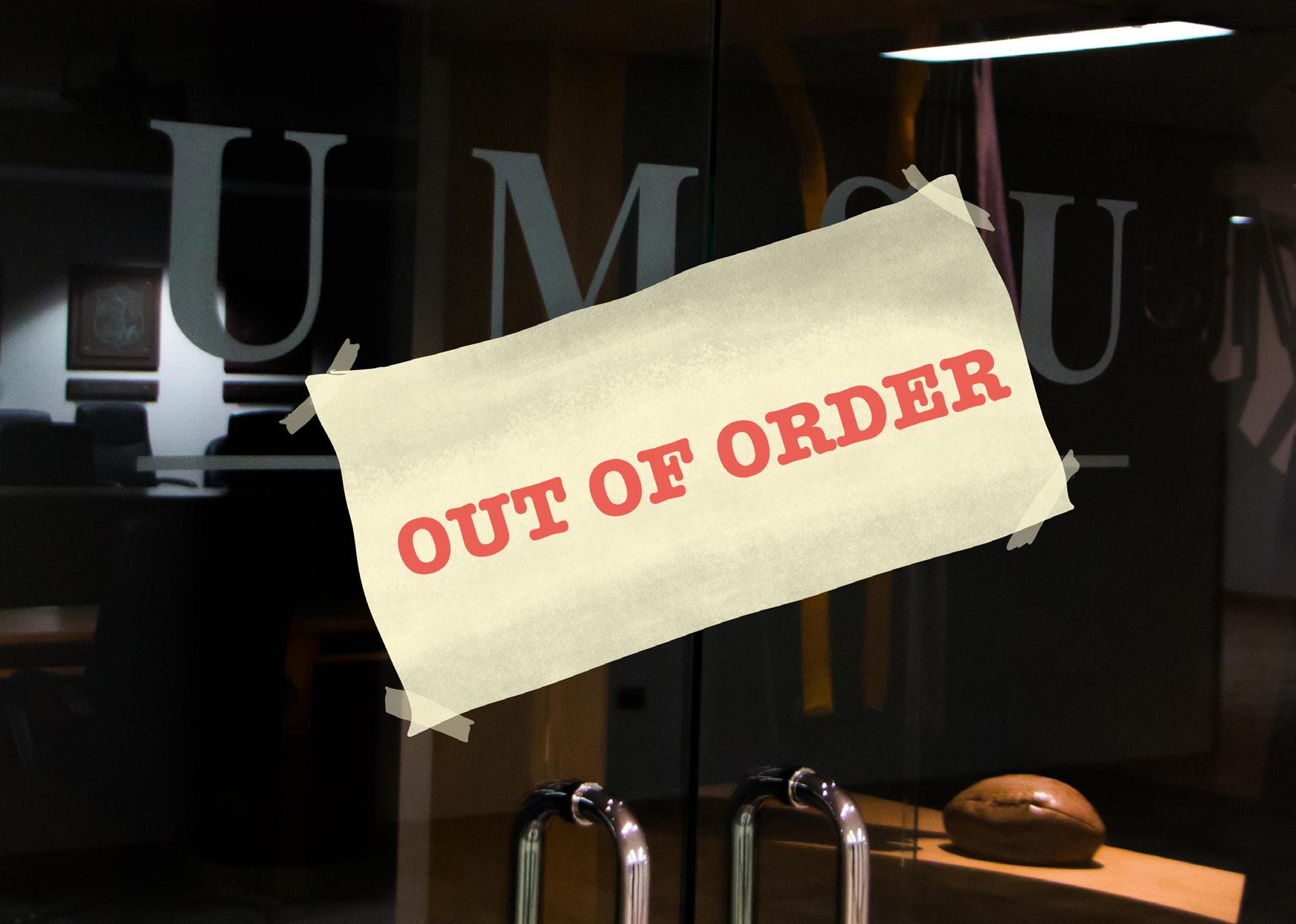
During a nearly four hour special UMSU board meeting last Thursday featuring what UMSU president Jaron Rykiss called a “very heated, emotional” debate, a motion to hold a revote for the position of UMSU president was ruled out of order.
This is the second time a motion to hold a revote for presidential election was ruled out of order. The first was moved by the UMSU chief returning officer (CRO) at an emergency meeting held on March 13 following the disqualification of presidential candidate Justin Langan.
At 2 p.m. on March 8, Langan was disqualified from the race. That same day at 11:17 p.m., Langan submitted an appeal of his disqualification to the judicial board. A hearing took place on March 9 at 6:15 p.m.
The judicial board chose to take a break until the next day following its meeting with Langan to include a third board member in order to reach a unanimous decision. At the time, the judicial board only had three members due to the recent resignation of four individuals.
The judicial board upheld Langan’s disqualification and informed the CRO at 3:20 p.m. on March 10. An email was sent to students announcing the ruling with only 45 minutes left to vote in the election. Langan received 22.1 per cent of the vote.
A petition to hold a second board meeting concerning a revote gathered 50 signatures, including numerous student group leaders, UMSU board members and representatives. Langan and presidential candidates Roleen Alarab and Victoria Romero — who altogether received 67.1 per cent of the presidential votes — also signed the petition.
The petition argued that the judicial board failed to schedule a meeting for Langan within the required timeframe, did not have enough
members to reach quorum and failed to announce its decision by the required deadline.
At the meeting, judicial board member Elbethel Masresha gave a presentation explaining the judicial board’s view. Masresha asserted that the judicial board had a total of 24 hours after the end of the initial meeting with Langan to make its decision, explaining that the election manual stipulates it may call a recess of 12 hours and must announce a decision within 12 hours of the end of the meeting — meaning, according to Masresha, that the board would have had to announce its decision by 6:15 p.m. on March 10. The judicial board issued its decision at 3:20 p.m. on March 10.
Masresha cited a section of the election manual stating that all rulings from the judicial board should be “final and binding,” and that there is no appealing its decision on an appeal.
Masresha disputed the argument that the judicial board did not have quorum, saying that quorum was “not applicable in this situation,” as points 26 and 27 of section seven of the UMSU Governance and Operations Manual — which specify that the judicial board must have six members present in order to reach quorum for a hearing — are in reference to hearings for complaints against UMSU executives or board and committee members, as well as appeals regarding those complaints.
She claimed that the entire board did not have to be present for the hearing as it was “an information gathering hearing and not a setting where any motion or formal decisions are made.”
There is no definition of an “information gathering hearing” in UMSU’s governing documents.
Masresha also referenced sections of Robert’s Rules of Order — a guidebook for parliamentary procedure used by UMSU — which states that quorum shall be defined as the majority of board members, unless a different quorum is provided by other governing documents. She pointed out that the elections manual does not stipulate quorum for complaints or appeals.
UMSU’s bylaws state that the bylaws themselves are given precedence over the union’s Governance and Operations Manual, Robert’s Rules of Order and the Election Manual. UMSU’s bylaws state that quorum for the judicial board must be six members, and that “no action of a governing body shall have any force or effect in the absence of quorum.”
The bylaws also specify that the Governance and Operations Manual supersedes the Election Manual. The former stipulates that the judicial board must have no fewer than eight members.
The judicial board decided not to overturn the CRO’s decision to disqualify Langan and counted votes for him as
abstentions.
Masresha said that the board did not consider this issue to have the potential to void the results of the election, but viewed it as a decision regarding a violation from an individual campaign that “lacked integrity.”
The judicial board’s presentation was followed by a question period which lasted for over an hour.
Nathan Dueck, who attended the meeting as a student-at-large, argued that the meeting with Langan to hear his appeal and the meeting the next day to make a decision should be considered two separate meetings.
Masresha explained that the judicial board chose to take a break until the next day to include a third member of the judicial board in order to reach a unanimous decision. She acknowledged that she “didn’t explicitly call a recess” or motion for one at the end of the meeting with Langan on March 9.
Dueck argues for a revote
Dueck, who was involved in
the effort to gather signatures to hold the special board meeting and drafted the motion to hold a revote, also gave a presentation laying out the case for holding a revote.
In his presentation, Dueck referenced sections of the UMSU Elections Manual which state that an election, or part of an election, may be declared void if there is a “serious contravention of the election” resulting in an outcome that “could not reasonably be deemed to indicate the actual preference of the voters.”
“It doesn’t mean there has to be a bomb threat,” Dueck argued. “It doesn’t mean there has to be ballots stuffed.”
“It just means that something happened that was so remarkable that it calls into question who actually won.”
He pointed out that the elections manual also stipulates that if a violation may result in a voiding of the election, any appeal hearing concerning that violation must be held within 12 hours of receiving the appeal.
All bets are off
EDITOR-IN-CHIEF ? editor@themanitoban.com
Gillian Brown
BUSINESS MANAGER ? accounts@themanitoban.com
Dhruv Patel
ADVERTISING CO-ORDINATOR ? ads@themanitoban.com
Richard Plant
MANAGING EDITOR ? me@themanitoban.com
Grace Anne Paizen
COPY DESK ? copy@themanitoban.com
Ezra Taves (ed.)
Morgan Heck
NEWS DESK ? news@themanitoban.com
Colton McKillop (ed.)
vacant (ed.)
Kasey Pashe
Ashley Puchniak
Alicia Rose
RESEARCH & TECHNOLOGY DESK ? research@themanitoban.com
Elah Ajene (ed.)
Robert Moshe Thompson
COMMENT DESK ? comment@themanitoban.com
Sarah Cohen (ed.)
Braden Bristow
Dina Hamid
ARTS & CULTURE DESK ? arts@themanitoban.com
Alex Braun (ed.)
Damien Davis
Jessie Krahn
SPORTS DESK ? sports@themanitoban.com
Joshua Brandt (ed.)
Quinn Mayhew
PHOTO DESK ? photo@themanitoban.com
Ebunoluwa Akinbo (ed.)
Faith Peters
DESIGN DESK ? design@themanitoban.com
Matthew Doering (ed.)
Taeran An
GRAPHICS DESK ? graphics@themanitoban.com
Dallin Chicoine (ed.)
Jenna Solomon
AUDIO DESK ? audio@themanitoban.com
Harmatpreet Brar (ed.)
SOCIAL MEDIA DESK ? social@themanitoban.com
Jory Thomas (ed.)
Violet Baker
VOLUNTEERS THIS ISSUE ?
David Camfield, Angela Kuchison
Julia Smith, Nathan Dueck
VOLUNTEER STAFF ? Lucas Gomes, Matthew Merkel
interested in volunteering? email me@themanitoban.com today!

109 HElEN GlASS BUilDiNG
UNiVErSiTY OF MANiTOBA
WiNNipEG, MB 204. 474. 6535
The Manitoban is the official student newspaper of the University of Manitoba. It is published monthly during the summer and each week of regular classes during the academic year by the Manitoban Newspaper Publications Corporation.
The Manitoban is an independent and democratic student organization, open to participation from all students. It exists to serve its readers as students and citizens.
The Manitoban is a member of the Canadian University Press, and our journalistic standards can be found on the Manitoban’s website.
The newspaper’s primary mandate is to report fairly and objectively on issues and events of importance and interest to the students of the University of Manitoba, to provide an open forum for the free expression and exchange of opinions and ideas and to stimulate meaningful debate on issues that affect or would otherwise be of interest to the student body and/ or society in general. The Manitoban serves as a training ground for students interested in any aspect of journalism.
Students and other interested parties are invited to contribute to any section of the newspaper. Please contact the appropriate editor for submission guidelines.
The Manitoban reserves the right to edit all submissions and will not publish any material deemed by its Editorial Board to be discriminatory, racist, sexist, homophobic or transphobic, ableist or libellous.
Opinions expressed in letters and articles are solely those of the authors. Editorials in the Manitoban are signed and represent the opinions of the writer(s), not necessarily those of the Manitoban staff, Editorial Board or the publisher.
A “volunteer staff” member is defined as a person who has had three volunteer articles, photographs or pieces of art of reasonable length and/ or substance published in the current publishing year of the Manitoban.
Any individual who qualifies as a volunteer staff member must be voted in by a majority vote at a Manitoban editorial board meeting. Elected representatives and non-students may be excluded from holding votes as volunteer staff members in accordance with the Manitoban Constitution.
All contents are ©2023 and may not be reprinted without the express written permission of the Editor-in-Chief.






Correction
Bisons swim in Speedo Western Canadian championship, March 22, 2023
The article incorrectly stated that Megan Mozill was the only swimmer to receive a medal at the 2023 Speedo Western Canadian championship. Mozill in fact received two medals at the event, a bronze in both the women’s 100-metre and 200-metre backstroke, while fellow swimmers Kelsey Fillion received a silver in the women’s 100-metre freestyle and Andriy Usan received a bronze in the men’s 100-metre butterfly.
Alicia Rose, staff
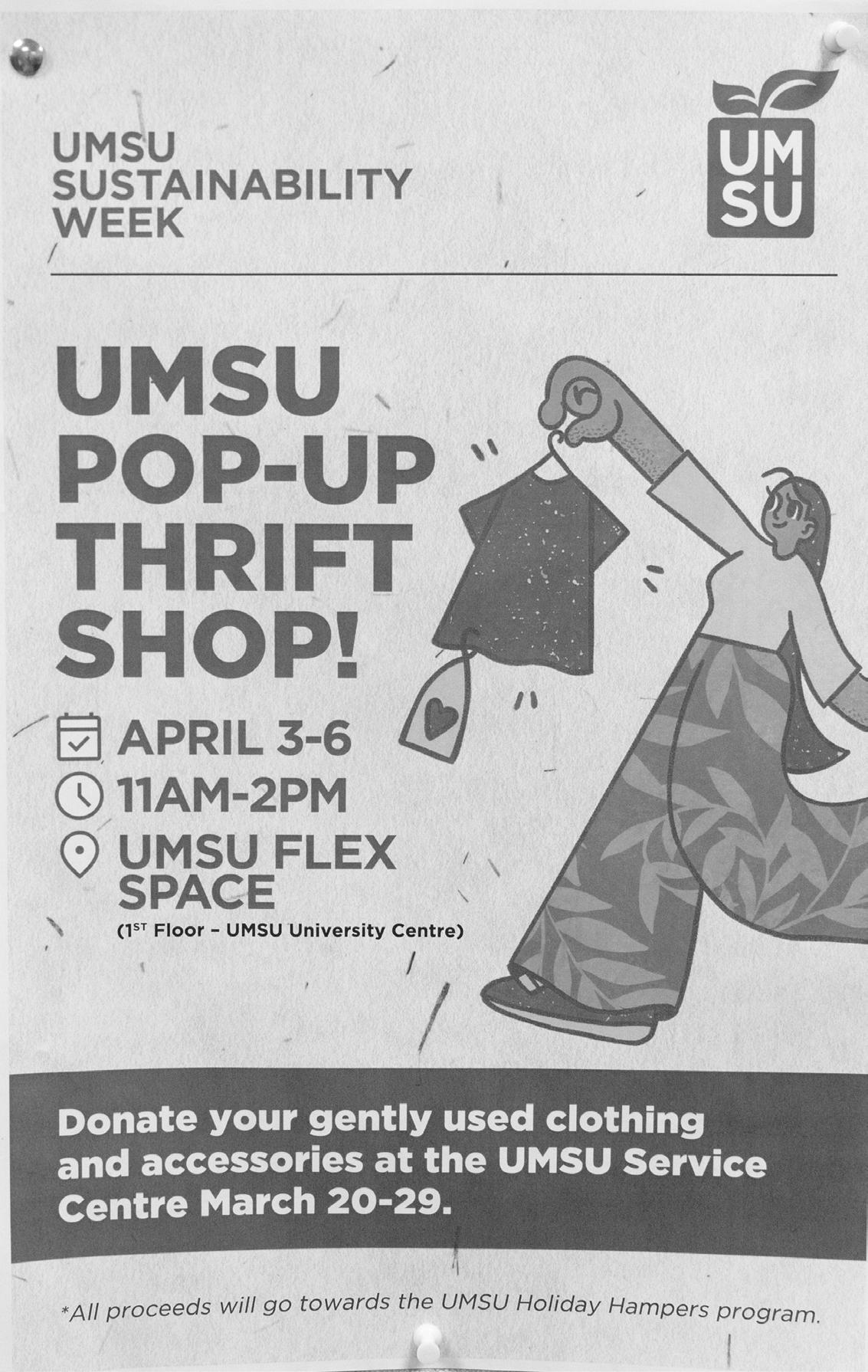
As part of its Sustainability Week, the University of Manitoba Students’ Union (UMSU) will be hosting the Reuse Rewind Remix, a social in support of sustainability. The goal, according to UMSU vice-president community engagement
union’s sustainability initiative, where it will be selling used clothing and accessories donated by the U of M community.
Ratel said that the goal for the thrift pop-up is to “reduce,
our spaces, and we want to give something towards the future,” she said.
“We are the caretakers of our spaces, and we want to give something towards the future”
— Elishia Ratel, UMSU vice-president community engagement
Elishia Ratel, is to “give a new life” to outfits that attendees may have only worn once or twice.
According to Ratel, the event is all about bringing awareness and reducing waste when it comes to clothing.
She said that the event was created while exploring creative ways to incorporate the idea of sustainability into UMSU’s events and socials.
The idea for the Reuse Rewind Remix stemmed from the thought that people often buy Halloween costumes, sports jerseys, grad outfits or other clothes that may have limited use or are not worn often.
The event takes place after UMSU’s Pop-Up Thrift Up event, another part of the
reuse, recycle.”
“Living on Treaty 1 territory, it’s really important for us to focus on how we care for the land in our personal ways, as well as globally,” she said.
Ratel added that we need to work at “taking these practices into our everyday life, with taking a look at our consumption of single-use products and reducing that, as well as being able to reuse items and shopping sustainably for those items so that they have longevity in our lives.”
An important part of fashion sustainability for Ratel is making sure “that we’re not just constantly using and throwing away.”
“We are the caretakers of
Ratel pointed out that reusing items can be more affordable for students compared to buying one-use items, since they do not have to continue to buy, and that by using items multiple times, the environment is better off.
Money received from the Pop-Up Thrift Up event will be put toward the UMSU Holiday Hampers program.
Reuse Rewind Remix will take place on April 6 at VW Social Club from 9 p.m. to 1 a.m., and will cost $5 to attend. Those attending must be 18 or older with a government issued ID, and must not be intoxicated when entering.
The Pop-Up Thrift Up is on at the UMSU Flex Space in University Centre from April 3 to 6, 11 a.m. to 2 p.m. each day.
news@themanitoban.com
Alicia Rose, staff
In response to anti-abortion groups on campus, the Women’s Centre at the University of Manitoba, alongside Justice for Women Manitoba and the Arts Student Body Council, held an alternative “pro-choice initiative.”
On March 29, the Women’s Centre took to Instagram to inform students of its initiative and to clarify that it would not be a counter-protest, citing “negative experiences in the past” as one reason why.
“We feel that it is too big of a risk for our students’ mental health,” the Instagram post read.
This marks a change from the centre’s counter-protest in the fall, where its members and supporters gathered across from the anti-abortion group.
“I didn’t want to do that again,” she said. “I felt like it put the mental health of our students at risk.”
To provide support to students, the Women’s Centre was open on Wednesday from 1 p.m. to 5:30 p.m., Thursday from 10 a.m. to 4 p.m. and on Friday from 1 p.m. to 5 p.m.
Yasay said that holding the initiative at the Women’s Centre was a way to demonstrate that “there is a presence on campus that is here for you and does support your right to choose whatever it is that is best for your body.”
During this time, the Women’s Centre provided resources to students, as well as material for students to use to write their own messages and statements about their bodily autonomy and the right to choose.
UMSU women’s representative Christine Yasay explained that at the fall counter-protest, those who opposed the right to choose would come to debate about the matter, and that counter-protestors “essentially had to debate why we should have rights, which is a very uncomfortable and emotionally tolling thing to do.”
Yasay said she hopes the Women’s Centre can work alongside the U of M administration to ensure that misinformation regarding abortion is not being spread on campus. At present, signs displayed on campus state that the group protesting abortion is allowed on university grounds in the name of “the free exchange of ideas, freedom of expression and academic freedom.”
“I’m not quite sure what will happen next, but I do think it’s really important that the mental health and the well-being of our students are put first,” Yasay said.
Clèche Kokolo, vice-president of external affairs for the Women’s Centre, said that the initiative came about by listening to the community’s concerns and seeing the need for a safe space where community members could receive support.
She said that the centre “really went further” than other initiatives.
“We extended the different

safe space, we partnered up with different organizations, we extended the Women’s Centre hours to really make ourselves accessible to the community during this week of protests,” she said. Compared to the fall counter-protest, Kokolo said that the focus of this effort was to ensure that students who may be affected by the protests
“had a place to go.”
“It was just an approach that allowed people to do what they felt [was] best for them,” she said.
news@themanitoban.com
Kasey Pashe, staff
The University of Manitoba Indigenous Students’ Association (UMISA) held the sixth annual Miskofest on Saturday, March 25. Miskofest is a celebration of the campus community’s Indigenous cultures.
Due to COVID-19, Miskofest has been held online for the past few years. This was the first year Miskofest was held in person since the beginning of the pandemic. UMISA co-president Alicia Rae Kubrakovich and the UMISA council had been planning for Miskofest since the beginning of the Winter term. Despite some initial concerns about attendance numbers coming back from being online, Kubrakovich said that the event had an “amazing turnout.”
“I’m grateful for the community coming together and supporting us as a student
group and as Indigenous students,” Kubrakovich said.
Performances at the event included powwow dancers from the Flett-Roulette family, who have been dancing and teaching for seven years. Dreyden and Jordan Flett-Roulette gave a demonstration of the grass dance. Other dances include old style jingle dancing and fancy shawl dance.
Another special segment included a performance from Métis jiggers Felicia Morrisseau and Ashley Dawn, along with master of the jig Ryan Richard.
UMISA also hosted a silent auction taking in non-perishable food items and hygiene products to be donated to the North Point Douglas Women’s Centre in exchange for tickets. All prizes and gifts were in support of Indigenous artists and businesses. The Aki-
Colton McKillop, staff
The University of Manitoba Graduate Students’ Association (UMGSA) election results are in, with Christopher Yendt, a PhD student in the faculty of education who ran unopposed, returning as president with 85 per cent of the vote. He has served two terms as the association’s vice-president finance and three terms as president.
Yendt ran on a platform of addressing financial issues that graduate students face, enhancing safety on campus, developing a strategic plan for the UMGSA and “advancing graduate student interests through meaningful partnerships.”
Candidate for vice-president academic and PhD chemistry student Hanieh Rezasoltani defeated master ’s student in business administration Porus Rana with 63 per cent of votes cast.
The position of vice-president services and support went to Timilehin Oluwajuyitan, a PhD student of food
science who secured 63 per cent of the vote over master’s in business administration student Shivam Sabharwal’s 37 per cent.
Master’s in business administration student Julie Xue narrowly defeated master’s of landscape architecture student Nazi Yaghoobian with 51 per cent to Yaghoobian’s 49 per cent — a margin of 9 votes.
The race for senator had four candidates vying for the two positions — PhD student in electrical and computer engineering Armin Aghajani, master’s student in education, curriculum teaching and learning Rowshan Ara Lubna, master’s student in natural resources management Uche Nwankwo and master ’s in business administration student Mir Towseef.
Nwankwo secured one of the positions with 45 per cent of the vote, while Aghajani won the second with 41 per cent.

ing Onji Foundation provided funding for the giveaway prizes.
Five bags and boxes full of non-perishable food and hygiene products were collected for donation.
“Within the Indigenous community, giving back is a big thing,” Kubrakovich said.
“It was really nice to see that people came with all their donations.”
Ivana Yellowback, co-host of Eagle Vision and the Aboriginal Peoples Television Network’s 7th Gen, was invited to MC Miskofest.The Indigenous community market featured Indigenous-owned businesses, including Fire Spirit Creations, Pinesīs Beadwork, Ikwe Creations, Mama Wolfe’s Home Spices and more. Student groups such as the Arts Student Body Council and the Science Students’ Association had booths set up at the event.
Kubrakovich highlighted the fact that most of the businesses that set up booths were student-led and that event organizers wanted to have Indigenous student businesses and student groups attend to promote their hard work.
Miskofest concluded with a community dinner served by local Indigenous restaurant Feast. Soups and bannock were provided for the dancers, volunteers and all those in attendance. Kubrakovich said that by the end of the event, “everybody was up and just vibing and making friends.”“It’s kind of a mingling thing too,” she said. “You make friends that last forever.”
Kubrakovich also emphasized the importance of Indigenous youth participation in the community.
“With all the Knowledge
Keepers kind of passing away, it’s time for us to take on that responsibility as young Indigenous leaders, young Indigenous youth to pave the way again for the next seven generations ahead,” she said.
Kubrakovich hopes for Miskofest to continue well into the future.
UMISA will be collaborating with the Métis University Students’ Association (MUSA) and UM Métis to bring together the Indigenous community with the Learn to Red River Jig workshop. The event will be held Thursday, April 6 at 113 Helen Glass Centre for Nursing.
More information can be found at @umisacouncil on Instagram.
news@themanitoban.com
CRO delivers report to board, suggests reforms
Colton McKillop, staff
Following the chief returning officer’s (CRO) report on the election to the University of Manitoba Students’ Union (UMSU) board of directors, the board voted to ratify the election results.
In a board meeting last Thursday, March 30, CRO Erin Robert presented her report on the 2023 UMSU election, including an analysis of the budget made available for the election. She pointed out that many candidates felt the $400 offered to them by the budget was not adequate to address their campaign costs.
Robert noted that the aboli-
tion of slates led to an increase in candidates for this year’s UMSU general election, which featured 24 candidates. She also pointed to an increase in interest in the election since the COVID-19 pandemic began.
She noted the heavy workload and overtime hours required for the CRO and recommended for next election that UMSU hire one sooner in the year to help compensate for this, as well as recommended an overhaul of the CRO position and the salary offered.
Robert recommended the governance committee “con-
tinue to restructure the election,” with suggestions such as ranked ballots. She also recommended more oversight of the judicial board as she argued “this board has quite a bit of power in the election process,” and suggested an update of the complaints process.
news@themanitoban.com
< Cont’d from front page
Dueck argued that since students voted for Langan while the judicial board made its decision, the election could not be said to represent the will of the voters. Langan received 912 votes, significantly more than the margin between winning candidate Tracy Karuhogo and runner-up Victoria Romero. Karuhogo won by a margin of 16 votes.
Dueck pointed out that Robert’s Rules of Order state that calling a recess requires a motion and argued that since the judicial board failed to put one forward, it should have announced its decision within 12 hours of the end of its meeting with Langan.
“I also want to say that in contrast to some other perspectives, I’m a lot more concerned about the voters who voted for Justin on Friday, the voters who voted for Justin not knowing the outcome of the appeal, assuming that they were voting for a legitimate candidate who could have won the election,” Dueck said.
He called on UMSU to hold a simple revote of the presidential election without campaigning.
“I think that we owe it not
just to the students, but to the candidates, to give whoever wins a mandate that is not blemished by allegations of procedural conventions that were not followed,” Dueck said.
Following both presentations and close to an hour of questions after Dueck’s argument, interim board of directors chair Lauren Slegers ruled the motion to hold a revote out of order.
The chair said that she waited until after the presentations to declare the motion out of order because the UMSU Governance and Operations Manual stipulates that the chair may only do so once all presented motions are brought to the board. She said that she wanted to ensure that both sides were given an opportunity to make their case before the board and allow for discussion.
Slegers further explained that the motion was ruled out of order because the UMSU bylaws state that the decisions and actions of the judicial board cannot be overturned by any other UMSU governing body.
UMSU governance committee chairperson Ivan Nuñez Gamez called a point of order objecting to this statement, reasoning that the judicial board did not have quorum to make its decision — a point to which Slegers declined to respond.
Slegers also argued that the Election Manual states that only the judicial board has the ability to void an election. Slegers made the case that even if the judicial board did not have quorum, it did not invalidate the entire election and said that UMSU’s legal counsel had been consulted on her decision.
Following an appeal of chair’s ruling, members of the board and attendees of the meeting were given half an hour to voice their support or opposition to the decision.
Some expressed dismay that the chair was refusing to allow a vote on an issue brought before the board a second time.
Some of those supporting the chair’s ruling argued that she was correct in her interpretation that the judicial board’s decision could not be overruled and expressed concern about the precedent it
would set if it was. Some also made the point that although the lack of clarity in UMSU’s governing documents is less than ideal, the way to prevent similar situations in the future is to change the documents themselves, and that the debate was merely going around in circles.
Senior stick of the Manitoba Medical Students’ Association Anthony Wightman had the last word in the discussion before the vote. He disputed the argument that fixing the bylaws is something that should wait until next election.
“Alternately, you could do that now,” he said.
Following discussion, the board voted by a simple majority to rule the motion to hold a revote out of order.
After the vote, Rykiss said that there are “always going to be situations where people aren’t happy with an outcome.”
“What I will say, though, is if a system’s bylaws are broken, that means it’s on the system to fix them,” he said.
“If we can’t get these bylaws amended before the end of the year, then I strongly urge whoever is the next president that they work on making sure that
the bylaws are ironclad.”
Dueck said that, in his opinion, “calling a revote and fixing the rules are not mutually exclusive options.”
“I absolutely support the clarification of these rules, but I don’t think that supporting clarification means that you shouldn’t interpret these imperfect rules that are on the books to the best of our ability, and I don’t believe that those rules were interpreted correctly during this past election,” he said.
Rykiss said that even though UMSU’s mission is to support students and make sure they are heard, the union is “not allowed to go outside the scope of what [its] bylaws say.”
He reiterated that the bylaws should be changed so that a similar scenario cannot occur in the future. He added that, though some may be unhappy with the results of the meeting, “at the end of the day, student leaders did vote.”
“They may not have voted on the exact motion that they wanted to vote on, but people voted,” he said.
news@themanitoban.com


Robert Moshe Thompson, staff
Electrical engineering is a field that can be applied in a variety of areas, such as sustainable technology and health sciences.
U of M professor of electrical and computer engineering Douglas Thomson researches the development of electronic sensors for many purposes.
One of his projects uses the sensors to analyze cells. The sensors can measure the electrical properties of cells to monitor changes in their physiology.
ous a cell is can be tracked by observing electrical changes. There are also some electrical changes linked to the activation of white blood cells when they encounter infections.
Thomson and his team aim to develop a device that can test a cell’s electrical prop-
the drug can result in the protein not being in its proper shape. The incorrect protein folding can prevent the drug from activating. Electric cell monitors can be used to optimize protein production by calculating the ideal extraction time.
“It has to be a real collaboration”
— Douglas Thomson, U of M professor of electrical engineering
erties at a relatively low cost with a short turnaround time.
Because ions conduct electricity, engineers can use electrical methods to track cell ion contents. If they observe that a cell’s ion content has dropped significantly, they can declare that cell to be non-viable.
The same methods can be used to determine how cancerous a cell may be. Cells can be cancerous to different degrees, and how cancer-
Being able to analyze cells is important for the development of biomedicine. Several new drugs are produced by cells, particularly those used to treat cancer.
Biomanufacturers will modify a cell to make it produce a given drug. The production process is somewhat delicate because the drug must be extracted at the right time.
Waiting too long to harvest
Another type of electronic sensor that Thomson researches is used for the structural monitoring of bridges. These sensors can detect damage such as cracks and corrosion.
Some age-related changes in bridges are difficult to completely observe with the naked eye, so a sensor can assist in the monitoring process.
Because infrastructure is involved, Thomson works with civil engineers. Civil engineers have a deeper knowledge of structures such as bridges than electrical engineers.
“It has to be a real collaboration,” Thomson said. “You have to talk with them about what you’re going to do and what they need.”
Building conditions are an area of difference between the two fields. Electrical engineers generally research in laboratory settings where temperature and humidity are controlled.
Civil engineers, on the other hand, must prepare their inventions to withstand the elements, including extreme temperatures.
“I think there’s as much distance between electrical engineering and civil engineering as there is between electrical engineering and microbiology,” Thomson said.
Another reason that Thomson collaborates with others is that his projects of interest are often user-oriented. This means that he has to have more correspondence with the people who will be using his research.
For bridges, Thomson and
his team must work with governments to comply with regulations.
Some engineering students participate in Thomson’s research, particularly in the area of hardware development. Having students work in the development process teaches them skills that are applicable anywhere in engineering.
Thomson encourages students who are interested in this field to engage in research that will help them develop transferable engineering skills.
“Work on projects that are going to give you a little bit [of a] broader experience base so that your options are not very narrow when you graduate,” he said.
“You never know where you’re going to work.”
Elah Ajene, staff
O
n March 11, 2020, the World Health Organization declared COVID-19 a pandemic.
With over 761 million reported cases and a series of nation-wide lockdowns in the past three years, the trajectory of the COVID-19 pandemic has prompted researchers to attempt to determine when and how it will end.
Among these researchers is University of Oxford professor of global history of medicine Erica Charters, whose work examines the relationship between disease and society.
The University of Oxford’s multidisciplinary project titled “How Epidemics End,” led by Charters, examines past epidemics and how societies determine when an epidemic ends.
On March 20, Charters spoke at the University of Manitoba’s 2022-23 Robin Connor Lectureship in the History and Philosophy of Science, sharing some of the project’s findings.
“The project takes a kind of macro, or what I might call, a bird’s eye view of epidemics and of research on epidemics across time and across places, as well as across disciplines,” she said.
According to Charters, epidemics have three types of endings — the medical end of disease, the political end that is characterized by the end of regulations and crisis and the social end, when things return to normal.
These three distinct ends overlap one another and may conflict with each other, depending on what factors are examined and deemed most important.

appear in the historian’s narrative.
In other words, its disappearance from the text showed that the epidemic had reached its end.
“In many ways, this silence is fundamental to the very
A is a good example of a continuing illness that grows to become an epidemic before falling to endemic, or “acceptable,” levels of disease.
“The end process is a very messy process”
— Erica Charters, University of Oxford professor of global history of medicine
“Whereas the declaration of an outbreak of an epidemic suggests a neatly defined period of emergency, the end process is a very messy process,” Charters explained.
While researching past epidemics, Charters found that the way epidemics end is not often focused on. She explained that epidemics across history have followed an “arc of social drama,” eventually “drifting towards closure.”
As an example, she described ancient historian Thucydides’s account of the 430 BCE plague of Athens.
After recounting the symptoms and deaths, as well as the economic, social and political disruption caused by the plague, the disease ceases to
definition of the end of an epidemic,” Charters said. “After all, an epidemic is a crisis, not only a biological crisis, but also a social and political crisis during which time society’s attention is focused on this urgent problem of disease and the drama of its unfolding.”
To Charters, the end of an epidemic is when society’s attention is redirected elsewhere and “no longer focused on the crisis of disease.”
Charters pointed out that most epidemics in the past, from the 19th century cholera epidemics to the 2009 H1N1 influenza pandemic, were declared to have ended despite continuing disease.
She added that Influenza
She explained that because different groups and interests have different ideas of what an “acceptable” level of disease is, “the end process is not only about pathogens, but most fundamentally about what to measure.”
Charters noted that the end period of epidemics reveals how dependent we are on information and data, but pointed out that “it also raises profound questions as to what we measure and what we don’t measure when collecting this information, as well as who collects this information and how that shapes our understanding of the outbreak, as well as the end.”
Another concept that plays a role in the end process is time, as lessons learned from previous epidemics are often applied to the future.
“Re-envisioning the future is a way to analyze and understand the past epidemic, and thereby, as part of the end pro-
cess, we attempt to restore human agency into society’s relationship with disease,”
Charters said.
Across history, most pandemics have ended in different places at different times.
For instance, the second plague pandemic blended into the third plague pandemic in many parts of the world, despite the disease diminishing in Europe.
Charters explained that this demonstrates how “depending on what is measured and what is used as evidence, the end of an epidemic can stretch in many different directions.”
She highlighted that HIV/ AIDS is not considered an epidemic in the Global North, as it has become manageable due to medical breakthroughs, but that for those around the world living in unstable political and economic conditions without reliable access to care, the epidemic is not over.
Overall, Charters described an epidemic’s end as asynchronous and occurring when society reconnects.
Charters said that the complicated ending process of an epidemic is a reminder that epidemics are also moral crises.
said.
Charters explained that one of the things historians and anthropologists are drawn to when studying disease is the “ingenious human ability to go back and retrospectively reinterpret the epidemic.”
“We understand disease differently at the end stage,” Charters said. “If in the outbreak stage we can channel that end-stage understanding of disease, it might help us to reframe and rethink our longterm approach to managing disease.”
She added that examining epidemic endings enables one to see epidemics as a continuous process.
“The messy process of ending demonstrates that epidemics should not be visualized as a great series of individual and self-contained events that disrupt society’s natural trajectory, but instead as continuous waves that interact both with one another and with society,” she said.
“They test the limits of social cohesion and trust,” she research@themanitoban.com
Dallin Chicoine, staff
Arctic life. An experience unique in and of itself, yet, not entirely different from that of southern Canadian living.
As the Arctic provides a highly niche climate to live and work in, I thought it might be worthwhile to provide insight to the South on what a typical day in Iqaluit, Nvt. might look like for me.
6:30 a.m. — wake up
During this time, I like to enjoy a shot of espresso and ponder the vast landscape of frozen tundra seen through my window as I prepare for the workday.
Depending on the time of year, I may wake to sheer darkness or blazing sunlight.
7:45 a.m. — head to the office
To get to the office, few modes of transportation are readily available. You can drive, take a cab or walk. If you wish to brave the cold, I highly recommend that you bundle up well. As many full-time Nunavut dwellers will inform you, we just went through one of the longest cold snaps in recent years, consistently reaching temperatures as low as -49 C from January to March.

8 a.m. to 5 p.m. — workday
On the grind, I work away at the numerous projects I am involved with as a facility planner for the government of Nunavut. Much of my time is spent on the computer or in meetings, with outings to sites taking place on occasion.
When taking breaks, I like to visit other facilities within the large Astro Hill building complex such as the Caribrew Café, where I am greeted by many friendly, and now familiar, faces on the daily.

I await the dawn of a new day with eagerness, looking forward to seeing what new experiences the arctic will have to offer
5 p.m. — end of the day
Alas, the end of the workday has arrived. Depending on the day, I might take part in a few different activities before having dinner and winding down.
Groceries: Arctic Ventures and Northmart are the two main grocery facilities in town. Throughout my stay, I have grown to admire the appallingly high prices of the commodities they have on display.
Gym: If my grocery supply is in order, perhaps I will make my way down to the Aquatic Centre, Iqaluit’s newest and foremost gym facility. I like to take part in cardio, weightlifting and swimming. Though, anything regarding fitness is within arm’s reach.
Theatre: The Astro Theatre is the only movie theatre in town. It has two screens that play a wide variety of film genres to accommodate the many diverse preferences of the community. Just recently, it hosted the Nunavut International Film Festival, which put on a wide variety of Inuit and Arctic-made films of varying lengths and genres. I enjoy taking in a film or two per week depending on what is playing.
Pub: The Storehouse serves as a community staple. It is a fantastic place to meet locals and other people in the same situation as you. Everyone has a story, and most are willing to share their experiences over a drink or two.
11:59 p.m. – end of the end of the day



Dina Hamid, staff
The beauty industry profits from creating a culture of insecurity and dissatisfaction with our appearance, so that it can continue to exploit people’s insecurities by creating a demand for beauty products and services that promise to “fix” flaws or imperfections.
The global beauty industry generates $722.6 billion in revenue as it attempts to bring its consumers one step closer to the idealistic beauty standard. The industry uses ads, social media and magazines to portray and uphold an elusive ideal of beauty that is unattainable for most people.
Studies cited by Bradley University have found that increased media exposure to images of the ideal thin person leads to an increase in body dissatisfaction and lower self-esteem in women. Further research into the effects of mass media on body image found that 69 per cent of elementary school girls who read magazines are influenced by the body ideal, so much so
that 47 per cent of those were convinced to lose weight.
Although there isn’t as much research on male body image, reports still show that media exposure increases body dissatisfaction in males and is linked to a desire to be muscular. I would think that media exposure would also be a factor in why more than 90 per cent of men experience body dissatisfaction and hold negative feelings and thoughts about themselves or their bodies.
This all goes to show that the media is a driving force in the maintenance and upkeep of beauty standards. When we continue to consume media, whether it be watching Netflix, shuffling through magazines, going to the movies or simply scrolling through social media, we are met with people who resemble these ideals.
Due to our constant consumption of idealized beauty and how easy it is to compare ourselves to others, media serves as a daily reminder of our shortcomings when it
comes to meeting beauty standards. This can then breed further a sense of inadequacy and insecurity in people.
Yet, beauty ideals are so unobtainable that even the people whose physical traits serve as the blueprint for these standards don’t feel like they are enough.
A golden ratio-based measure of beauty done by a cosmetic surgeon referred to supermodel Bella Hadid as the most beautiful woman in the world. Despite this, Hadid has been very candid about her body image issues, insecurities and struggles with eating disorders. She even admitted to getting a nose job at 14.
All of this indicates that beauty standards may not be created to be attained, but rather to be chased after. In a capitalist society, to be insecure is to be in a constant state of being that is receptive to making a purchase. Insecurities serve as a currency in a universal market that is equipped with endless products and regimens promising to be the answer.
The industry supplies insecurities and then builds demand for products that will improve or enhance one’s appearance. Meaning, if you have wrinkles and look your age, you are targeted to buy anti-aging creams and serums. If you are not skinny, then you are encouraged by celebrities and influencers to buy weight loss supplements, weight loss tea and other creations for supposed rapid weight loss.
However, what isn’t disclosed is that these industries do not care about helping you rid yourself of your insecurities. In fact, it’s quite the opposite. As long as people stay insecure, there is money to be made.
The demand for products and solutions is so lucrative that the global beauty and personal care market is predicted to expand by just over three per cent annually until 2027.
ing disorders and body dysmorphic disorder.
According to a survey conducted by the Dove Self-Esteem Project, 72 per cent of girls feel pressured to be beautiful while only four per cent of women globally think they are beautiful. This finding further demonstrates the negative effects that unrealistic standards have on girls and women’s self-esteem and mental health.
Despite the negative consequences that beauty standards have, it is in the beauty industry’s best interest to uphold and constantly change beauty standards to keep all of us in an endless cycle of insecurities, ensuring maximum profits are made from our desire to be attractive. Our best method of protection is to push back against beauty standards and realize we are simply being sold products, not worth or beauty.
Nevertheless, our fixation on beauty can have a lot of negative effects, including anxiety, depression, eatcomment@themanitoban.com
David Camfield, Angela Kuchison and Julia Smith, UMFA COVID-19 committee
This past month marked three years since the World Health Organization declared COVID-19 a pandemic. Most public health restrictions have ended, and most governments are acting like the virus is nothing to worry about.
Unfortunately, COVID19 continues to pose a significant health risk, even for people who are up to date with their booster shots. Getting COVID-19 more than once significantly increases the risk of severe symptoms. It also increases the chances of ending up with Long COVID — symptoms that persist for three months or more.
We know that respiratory viruses that spread via airborne transmission, like the one that causes COVID-19, linger in the air. Contaminated air from an infected person can remain in a space well after the person has left. Many ventilation systems recirculate indoor air.
At the University of Manitoba, we spend a lot of time studying and working indoors. Many of our classrooms and lecture theatres lack win-
dows. Some rooms have windows that are bolted shut and so can’t be opened to increase the amount of outdoor air.
We don’t know the ventilation air exchange rate in many indoor spaces on our campuses. However, we can use carbon dioxide (CO2) monitors to get an indication of how well-ventilated a space is. A CO2 reading below 800 parts per million (ppm) is considered well-ventilated when it comes to preventing the spread of airborne viruses. A reading over 800 ppm indicates that the indoor air isn’t being exchanged with enough outdoor air.
So how can we protect ourselves and members of our community?
Wear masks and upgrade ventilation systems to ensure that the air we breathe is as clean as possible.
Studies show that wearing a well-fitting, high-quality mask reduces the risk of potential exposure to and transmission of airborne viruses on campus. Wearing masks helps everyone in the U of M community stay healthy.
Additionally, high quality filters that remove particles suspended in the air can help reduce virus transmission indoors. Many buildings on U of M campuses use MERV-8 filters. These filters are effective at removing dust, pollen and mold, but not smaller particles such as fine dust, bacteria and viruses. U of M needs to upgrade ventilation systems on our campuses and install filters rated at MERV-13 or higher.
To keep our campuses safe and accessible to everyone in our community, including folks who are at higher risk of adverse effects from COVID-19, we need to ensure that the air we breathe is as clean as possible. This is why the University of Manitoba Faculty Association is calling on U of M administration to improve the ventilation systems on campus and to continue to require the wearing of high-quality masks.
Wearing masks and upgrading ventilation systems will improve the air we breathe and reduce the transmission of COVID-19 and other airborne viruses. This

makes everyone safer. That’s good for all of us, but especially for the many people in our community who are at higher risk of serious consequences from a COVID-19 infection.
To learn more about how masks and clean air can help make the U of M a safe space to learn and work, check out the #SafeAirUM tag on social media.
David Camfield, Angela Kuchison and Julia Smith are members of the COVID-19 subcommittee of the University of Manitoba Faculty Association’s Organizing and Communications Committee.
comment@themanitoban.com



Nathan Dueck, volunteer
Shortly before the special board meeting to discuss the recent University of Manitoba Students’ Union (UMSU) elections on March 30, a student asked me how I knew Victoria Romero, the runner-up. To her surprise, I said that I had only met her for the first time a few minutes earlier.
The student then said that they had heard I was close with her, and that they thought this was the reason I was trying to call for a revote — to make Romero president instead of president-elect Tracy Karuhogo. They had also heard that I was keen to remove the president-elect from her position due to my personal opposition to her.
These ascribed relationships and motivations for my actions were news to me. Prior to the election, I barely knew any of the candidates and didn’t have a strong preference between them. To the extent that I did have my own opinions about the race, I
thought that Tracy was a solid choice.
On the first day of voting, a friend of mine texted me asking who he should vote for.
I responded, “both Roleen [Alarab] and Tracy are good for Pres. I think Tracy will win, so I voted for Roleen because I appreciated the campaign Roleen put on, and want to support efforts like that.”
In other words, while I wasn’t exactly a campaign volunteer-level supporter of Tracy, I certainly wasn’t an opponent of hers either.
I even put one of her posters up in Robson Hall, although I would have done the same for any candidate who asked. I was grateful to all of them for putting their names forward and giving students a number of credible options to vote for.
The rumours I’ve heard about my motivations for pressing for a revote don’t make sense given my actions during and after the election. But the rumours do make sense if one considers student politics to be a zero-sum
game, in which one participant’s gain always comes at the direct expense of another.
If student politics is a zerosum game, then my questioning of whether an election was conducted properly would have been done at the expense of the president-elect, and to the benefit of the runner-up.
In this scenario, those of us who pushed for a revote must have done so because we were for the runner-up and against the president-elect. To those who view student politics this way, it becomes impossible to imagine that one might be motivated to call for a revote simply because they care about election integrity.
I don’t feel particularly victimized by these rumours, but I do think it’s worth suggesting that they began because of a toxic culture in UMSU politics, in which everyone is assumed to be either for or against the various individuals involved.
It goes without saying that this culture can discourage students who might otherwise make excellent student
At this point, are we all commies and fascists?
Braden Bristow, staff
If you follow politics, even on a surface level, you have probably seen someone attack a political figure such as Prime Minister Justin Trudeau or federal NDP leader Jagmeet Singh for being “socialist” or a “fascist.”
Sometimes figures like these two are labelled as a socialist or fascist simultaneously by unknowledgeable people on social media. Leader of the Conservative Party of Canada Pierre Poilievre even claimed that Trudeau has a socialist agenda.
However, none of these people using these terms take the time to explain what socialism or fascism is, and how these political figures fit those definitions. Given how often the terms are used interchangeably, you might think that they are all the same concept, or even that liberalism is the same thing as socialism.
First, let’s define these terms, and then let’s explain how it really does not make sense when people refer to Trudeau or Singh with these terms.
Socialism is effectively a form of government or social organization in which there

is collective ownership of the means of creation and distribution of goods. The basic tenet of socialism is that there is public rather than private ownership of goods. Therefore, a “socialist” is someone who follows this ideology. Fascism, however, is a totally different ideology. Fascism involves an all-powerful

leaders from getting involved. Good leaders don’t look at every development as something that will help them at the direct expense of others. Instead, they try to work collaboratively and support or oppose ideas, rather than the people who bring them forward.
Unfortunately, I’ve yet to see much of this approach in my experiences with UMSU as a student this past year.
I’m not sure how to change this culture, but I hope that when issues come up in the
future, they’re addressed with more focus on policy and less on personality.
As an incoming member of the UMSU board of directors, I hope to encourage this shift in the coming months. And I hope that students hold me and the other board members to this standard as we work with a president who, as I’ve always believed, is a good choice for the job.
comment@themanitoban.com
government characterized by nationalism and headed by a dictator who exerts complete control over society, economy and the political sphere.
Now, according to Pierre Poilievre, Trudeau has an apparent socialist agenda. So, let’s compare the platform of the Liberal Party of Canada, which Trudeau leads, with our
definition of socialism.
While there is mention of supporting workers and businesses, there is not a single word of putting the means of production into the hands of the workers. If Trudeau and the Liberal party truly were socialists and wanted collective ownership for all, it is highly unlikely that supporting businesses as they currently are would be within their interests.
While the Liberal party might not be socialist, let’s see if it is fascist.
Once again, scouring the party’s platform reveals not a single word regarding an interest in centralizing power within their party. In fact, part of its platform is “an equal Canada, for everyone.” Further, the Liberal party states that it is dedicated to positioning Canada as a more equal and fair society. So, it would seem that either the Liberal party is the first fascist party to be oriented toward equality, or it simply is not fascist.
At no point in this article am I endorsing the party’s policies, Justin Trudeau or even contemporary liberalism. Rather, my point is that terms like socialist, commun-
ist and fascist cannot reasonably be applied to Justin Trudeau.
I am not stating that the Liberal Party of Canada has never engaged in political overreach or any other form of political failure. But if you are going to critique political figures, use terms that apply to them. As it stands, terms like socialist and fascist have been reduced to buzzwords to describe any political behaviour that someone dislikes.
If someone like Trudeau adopted policies relating to collective ownership it would, in my opinion, benefit Canadian society and would genuinely be socialist. But as it stands, the many people who refer to Trudeau or any number of non-socialist politicians as socialist are just wrong. Political terms are loaded with meaning, and it’s your responsibility as a citizen to understand those meanings. We should not just attack people with any political buzzword that comes to us in a moment of rage.
comment@themanitoban.com

Jessie Krahn, staff
Iwrite about food in the Manitoban’s Arts & Culture section. I like sharing good food with others. Knowing that so many people are involved in the process, whether it be growing ingredients, preparing dishes or creating recipes, makes me feel placed in humankind. Food is social.
I have avoided writing on food served at the U of M until now because there is no way for me to talk about most of it without moral remorse.
In April of 2014, the University of Manitoba signed a 10-year contract with food services giant Aramark. The deal renewed Aramark’s twodecade-long exclusive rights to manage and operate campus food services, with the exception of UMSU-owned food vendors like Degrees, IQ’s and GPA’s, and the food services handled by St. John’s and St. Paul’s Colleges.
The company’s involvement in our culinary culture is barely advertised, barring their copyright watermark on the campus Dining Services website. That is alarming, because Aramark has regularly been at the centre of controversy in the nine years since the contract was finalized.
The company has served less than appropriate servings sizes and food crawling with maggots to incarcerated people, and some have been inspired to organize hunger strikes against the company to protest the quality of their food.
Aramark has also been embroiled in scandals and swimming in lawsuits as some of its employees have been alleged to have been smuggling drugs into prisons and accused of engaging in human trafficking. The company’s website has a page assuring readers that Aramark is “focused on ensuring that slavery and human trafficking does not occur within its UK business.”
This is a deeply concerning thing for a food services company to include on their website.
I was not aware of Aramark’s role in curbing hunger on campus until a friend told me. From conversations I have had with friends and colleagues, I suspect most students are not aware either.

suitable steward for this particular aspect of campus life is unconscionable.
This isn’t a person with a checkered past, this is a corporation that has been ordered to courts over hundreds of thousands of dollars in sexual harassment lawsuits.
The U of M’s contract with Aramark is set to expire in April 2024, just one year from now, and there must be something students can do to ensure Aramark does not have
cino from IQ’s like the conscientious adult you are. The line is always too long anyway.
Unfortunately, I think the problems with Aramark’s business model are part and parcel of market economies.
To limit your action to buying better and feel-good consumerism is to accept that the market has solutions to offer you in the first place. Unless we can imagine solutions that exist outside the market, we are always going to be governed by it.
Make sure the next generation of students does not lose this information
a place on our campus.
That aspects of university life have been privatized at all is a problem, and the fact that the U of M sees Aramark as a
There is some comfort in the idea of voting with your wallet, in ignoring the Elizabeth Dafoe Library Starbucks and patting yourself on the back for buying your Frappuc-
There is no way we can buy our way around the ludicrous contract our university has with Aramark. The problem is that we just act complacent when our institutions auction off basic necessities like food and education to private companies helmed by fat cats solely
concerned with better earnings calls.
The world as it is now is not inevitable, though.
Students who will be here when that contract expires must take action against Aramark’s near-monopolistic hold on the U of M’s food culture.
One harrowing 2015 feature piece in the Manitoban describes students dreaming of this contract’s expiry date as a chance to move to a campus food system that is locally sourced. In 2019, the Manitoban ran a comment article pointing out the U of W’s food services system is a living example of the community-oriented one we could have had.
Do what your predecessors did and talk to your peers. Student populations change completely every few years, so knowledge about how the uni-
versity works can easily be lost between generations.
Get to know the people around you, find students who care, try to win over the ones who don’t and work together to build up some sort of vocal and visible opposition to the campus food culture we have. Make sure the next generation of students does not lose this information.
When April 2024 arrives, someone here has to care about keeping these central elements of student life out of the hands of profiteers with singular goals of plumping up their revenues. When the time comes, will you let Aramark have its cake and eat it too?
comment@themanitoban.com
Lucas Gomes, volunteer staff
In late April 2022, I submitted a last-minute application to study abroad. Today, I write from my dorm room desk in Belgium.
I was longing for a change of environment as I became burnt out from the six-monthlong Winnipeg winter. In a “what’s the worst that can happen?” Hail Mary attempt, I landed the opportunity to study here at Ghent University.
Not much thought went into my decision to apply. Speaking candidly, a mere glance and scroll on Google Images was the only contributing factor to my location preferences: Melbourne, Australia, Nijmegen, Netherlands and my actual destination of Ghent, Belgium.
Wrapped in gothic cathedrals, tied with a bow of canals and townhouses, Ghent is a gift for everyone to enjoy.
The city and culture come with certain differences compared to Canada.
Ghent’s rapid development occurred in the 12th century, a time when urban designers didn’t account for the invention of combustion engine cars. The narrow streets and infrastructure density contribute to one of the city’s greatest characteristics — people bike everywhere, from campuses to nightclubs.
The structure of academics in Belgium is a refreshing change. Each class at Ghent University has one three-hour lecture per week, giving students sufficient preparation time.
Midterms do not exist in most classes. Your grade is determined largely by a final exam, and partially, in some classes, an undemanding group project and participation.
Rather than fill a discussion post with jargon and paraphrased textbook excerpts, participation here is focused
/ Jenna Solomon / staff

on enhancing the student’s self-involvement, often in the form of finding news articles relating to in-class concepts.
As for the difficulty level, I may be an unreliable source for comparison. I not-sowisely enrolled in three masters-level courses out of my five. The topics lured me in, and luckily my interest in the subject matter outweighs the intensive reading preparation.
Exchange is an excellent way to study subjects you otherwise wouldn’t, and from a different perspective. My personal favourite has been global energy politics. Given the ongoing Russian invasion of Ukraine, Europe has been battling an energy crisis, which is fascinating to learn about from Europeans themselves.
For those who care to indulge, I’d be remiss not to boast about the nightlife in Belgium. Ghent is a lively stu-
dent city. Less than two blocks from my dormitory, there is a street spanning just under a kilometre crammed with clubs, late-night shops and bars.
The city is revered for its techno scene. Just last weekend, I attended Kompass, a techno club in a formerly abandoned warehouse that hosts DJs for an all-night party. The few times I’ve been, I was met by daylight as I left the events. Considering the proximity of neighbouring countries, exchange abroad offers the unique opportunity to travel on weekends. The broad train network and inexpensive flights enable cheap weekend escapades to coveted locations. Next week I’ll be visiting Lisbon, Portugal, and the week after, the southwest coast of Italy.
Mentioned among concerns regarding student exchange is going alone. I am
here to disprove this rhetoric. I came knowing nobody, but within two weeks I had become friends with everyone on my floor.
While desiring a change of environment was the motivation for my choice to apply, there were other contributing factors. Fulfilling a master’s degree internationally is something I’ve long considered during my bachelor’s, and exchange is a temporary test drive of this possibility.
The application period for exchange during Winter 2024 closes April 30. Available locations span four continents.
This time next year, you could be living in Germany, Spain, Australia, Japan or France to name a few.
The application involves an essay and the submission of two reference letters.
The essay, as I interpreted, is an opportunity to show who you are, not an evaluation of
your intelligence or vocabulary. It involves a response to three prompt questions, such as explaining a previous cross-cultural experience. I wrote about the underwhelming Parisian public bathrooms — a hole drilled through the concrete ground. A rather liberal use of the word “urinal.”
This was not my most luxurious experience, but a way to show how I experience cultural differences of all kinds. While it may be daunting, I would urge all to apply.
For more information, visit the student exchange program page on the university’s website, https://umanitoba. ca/international/student-exchange-program.
comment@themanitoban.com

Sarah Cohen, staff
B
ack in October and November of 2022, I wrote a couple of articles about wellknown musician and influencer Kanye West, legally known as Ye. In the first of these articles, titled “Ye’s deleted tweet glimpse of his antisemitism,” I argued that a series of social media posts from Ye would result in antisemitic violence and hate.
Ye basically threatened war against Jews and people in the comments sections of his posts were eating it up, using the influencer’s statements as justification for their own antisemitic ideas and actions.
The second article, which I called “The demise of Kanye West,” further proved my argument. On one hand, Ye was let go from brand deals and his management company but on the other, hate groups were using his name in antisemitic actions. For example, a hate group hung a sign over a busy freeway that read, “Kanye is right about the Jews.”
I, unwillingly, turned on post notifications for Ye so that I could catch anything that edged on discriminatory before it could be deleted. While I did not receive a notification for months, I was quick to screenshot his post and caption last week Saturday at 12:46 a.m. CST.
Pictured was the movie poster for 21 Jump Street starring Jonah Hill and Channing Tatum. The photo’s caption read, “Watching Jonah Hill in 21 Jump street made me like Jewish people again[.] No one should take anger against one or two individuals and transform that into hatred for millions of innocent people[.] No

Christian can be labeled antisemite knowing Jesus is Jew[.] Thank you Jonah Hill I love you.”
It is lovely to know that simply watching Jonah Hill can end antisemitic hate in a man. The comments section was shyer than I expected, with only a few swastikas and instances of hate speech toward Jews.
However, what are the odds that Ye’s post will actually stop anyone who holds these sentiments from voicing, pro -
It is lovely to know that simply watching Jonah Hill can end antisemitic hate in a man
moting or acting on anti-Jewish hatred?
There has been a rise in antisemitism over the past few months. The Anti-Def-
amation League reported that 2022 saw a 36 per cent increase in antisemitic acts across the U.S., and the most instances of antisemitic hate since the group began tracking them in the late ’70s.
That’s scary.
I see the states as a sort of a “big sibling” to the rest of the world in the sense that, if the states can do it, we can
too. With the increased antisemitism and the rise in fascist-driven legislation in the U.S. that appears to be aimed at eradicating anyone who doesn’t fit whatever “Christian values” may be, why is it surprising that hate for any other is also continual?
No amount of celebrity apologies can make that go away. If people have deeprooted hatred and just one person says it’s okay, then what is holding anyone back?
Even the number of swastikas I’ve seen drawn in sharpie on bus benches or carved into random objects around Winnipeg makes me question my safety as a Jewish person in this city. The few but echoing antisemitic sentiments I hear around campus make me wonder if I should feel secure wearing my Magen David. I’d like to be proudly Jewish, but that’s a scary idea right now.
Ye made a big mistake that is not so easily reversible and came with plenty of consequences. As followers of any big personality, it is important to recognize when enough is enough and do what you can to take that platform away. Don’t get me wrong, a Jonah Hill movie can fix a lot about a bad day, but a centuries-long hatred of a people is far from an easy fix. Understand that words mean things and actions mean things too. Make the world a place where we can all coexist.
comment@themanitoban.com






If you shrank the Solar System to the size of Texas, the Houston metro area would be smaller than a grasshopper in Dallas.





To complete Sudoku, fill the board by entering numbers 1 to 9 such that each row, column and 3x3 box contains every number uniquely
In Hidato, fill the board by continuing the chain of numbers from 1 to 100 moving any direction or diagonally to the next number.
In Straits, like Sudoku, no single number can repeat in any row or column. But rows and columns are divided by black squares into compartments. These need to be filled in with numbers that complete a “straight.” A straight is a set of numbers with no gaps but can be in any order, eg [4,2,3,5]. Clues in black cells remove that number as an option in that row and column and are not part of any straight. Glance at the solution to see how “straights” are formed.


like Str8ts check out our books, iPhone/iPad Apps and much more on our store.
Damien Davis, staff

Your symbol for the week is a Safety Pin. Years of keeping everything “just so” are catching up with you. A glance over your shoulder shows a figure getting closer to you with each passing day. Nobody seems to notice its shadowy complexion or its desire for your embrace. The more you neglect time for yourself, the closer it gets. Sometimes we are our own omens.
Your symbol for the week is a Perfume Bottle. Nighttime has been hard for you lately. You spend most nights dazzled by the lights and heavy music of any dance floor that’ll take you. The fragrance you wear every night smells like cigarettes to strangers and home to you. If you want to sleep through the night, spray some on your pillowcase. You’ll dream of summertime and family dinners.


Your symbol for the week is an Anchor. Who are you letting pull you under the sea foam? What knots have they got around your wrists and ankles and why haven’t you broken free yet? Sometimes when we seek out comfort we end up in the most dangerous places, but this is a prison of your own making. No more games, Libra. Liberate yourself.
Your symbol for the week is Wind. When you were a child, you used to have dreams about waking up with wings of some kind. I can’t tell you what that means for your future but let me acknowledge how you felt back then. I saw your eyes focus on the treetops as the harshest winds joined us that summer, and while we all fled, you smiled.

Your symbol for the week is a Whisker. The echoes of our past don’t always appear to us as grand realizations. Sometimes, they appear as simple and mundane as something left behind when no one was watching. Pluck the remnants from the hardwood floor and place them in your journal. It is always better to celebrate and remember than mourn and forget.


Your symbol for the week is a Pearl. You’re convinced that the pursuit of a goal is what you were made for — your flesh and bone carved and curved toward the end of the line, slouching in the direction of purpose. What would a life without diving for pearls be like? Why don’t you climb out of the bathtub and face the sunlight. Find out for yourself how sweet a day with nothing in it is.
Toby the Bison, staff
Dear Toby,
Yesterday, I saw my recent ex on a date at the university campus. The breakup was really messy and he did much more wrong than I did, but still my stomach dropped and my heart started racing. I’ve gone on dates since our breakup, but I’ve done everything in my power to avoid any chance of running into him when I’m with other people. I hate that even though he hurt me so much, I still felt the way I did when I saw him with another girl. Is it okay to feel like that? What should I do?
Help,
Hurt Ex

Your symbol for the week is a Rabbit’s Foot. You’ve made it to where you are completely on your own and have never once complained about it, only proudly exclaimed it. However, we both know you have your superstitions, your rituals and your trinkets that you use to make it through the week. There’s nothing wrong with needing a little extra help. You don’t need to face it all alone.
Your symbol for the week is a Dried Flower. All things come to pass, but there is such a comfort in that, don’t you think? You can never be the same person forever — we are destined to change. From the colour of our hair to the core of our beings, we cannot control time. But you can rise to meet it. You can choose the direction and you can choose to hang the dead plants on the walls as a reminder of beauty rather than fear.
Dear Hurt Ex, I’m sorry to hear that you had to go through all of that, but I would like to let you know that the way you are feeling is totally normal. Even if your ex hurt you in the end, it does not nullify or invalidate the memories and love you had for him at some point in the past. It also just sucks to see someone who you liked, or even loved, on a date with someone else, so believe me, you aren’t alone in your feelings.
I would suggest not actively trying to avoid him, since avoidance is only a short-term fix and does not address the uncomfortable emotions you sometimes need to sit with in order to move on. Obviously, you don’t have to have a conversation
Your symbol for the week is a Cemetery. The stones speak to you in ways that others simply haven’t. One could assume the worst of them, but they regale you with tales of adventures and romances, of victories and losses. You know better than anyone that the lessons from those who have passed on are the most important ones of all. Share them.


Your symbol for the week is a Blanket. The comfort of home is never a wrong thing to yearn for, but know that home can be anywhere. It can be a dorm, the front seat of a truck, a field or a movie theatre. Home is wherever you decide it is, and you will always be supported in that decision.
with him or do anything you don’t feel ready to do, but don’t avoid those awkward scenarios, since they might help you to feel more at ease about the situation and him. That way, the next time you see him alone or with another girl, you won’t be as devastated.
So, continue to have fun and go on dates. Now that you know he is busy living his life, live yours unapologetically too.
You’ve got this!
Best of luck, Toby the Bison
To ask Toby a question, email comment@themanitoban.com
Your symbol for the week is a Tire. Something that goes unnoticed until it’s needed. Be it on the side of a highway or safely in the garage of your childhood home, sometimes you feel invisible until you’re wanted. This isn’t true but it can be a hard feeling to combat — it’s just finals season. You’re so close to the freedom of summer and this will all feel like a dream in no time.


Your symbol for the week is a Radio. Are you there? Can you hear me? Between the airwaves, the signals and the hum and buzz of electricity rattling in your skull, I imagine it’s not easy to focus on making it out of this semester alive, but you’re so close! Tune into the playlist you’ve got planned for this summer and let the other things fade out.

Alex Braun, staff
Before recording his debut full-length album, Kris Ulrich wasn’t sure that he would ever make another record.
“I was kind of caught between two roles of like being a side person and playing guitar for other people a lot,” Ulrich said. “I think throughout the pandemic too, I just felt so creatively tapped, like I just didn’t feel like I had a direction.”
Out of this period of confusion and fear came Big in the USA, an album of widescreen, synth-laden heartland rock and pop full of heartfelt reflections on days gone by and hopes for the future.
“I feel like at the time, I was writing it to tell myself that, you know, that things eventually would work out,” Ulrich said.
To bring himself out of his writing slump, Ulrich had to find a new angle to work from.
“Every time I want to make something new, I kind of need to find a new instrument or
something that inspires me,” he explained.
For Big in the USA, the piece of gear that inspired him was a drum machine, which led to a shift in his writing process.
“For a lot of the time I was writing on acoustic guitar, just me and acoustic guitar, and that’s how I would write songs,” he said.
“When I got the drum machine and I eventually got a synthesizer too, I started jamming with myself in a way, like having a drumbeat going and having a synth pad going and then I’d play bass along to it or I’d play acoustic along to it, and it felt more like I was writing a certain mood instead of writing a song.”
You can feel the impact of this new style of writing in the music. Ulrich introduces a whole new world of textures into his production, bringing to mind ’80s Bruce Springsteen and bands like the War On Drugs in its mix of dusty Americana songwriting and glossy, cinematic production.
“There is kind of a Manitoba
sound, I think,” Ulrich said, referring to a lineage of folk rock set out by Neil Young. “I think that these songs still, they have that maybe at their core, but I think that the production is a lot more adventurous than I’ve ever done before.”
Ulrich also credits his friend Kieran, who goes by the name francis rae in his own work, with inspiring the new sound after his work on the demo for the opening track, “Friends on the Internet.”
“I sent it to my friend Kieran, and he didn’t say anything but just sent back a version of it with like 26 tracks he had built onto it, and I was just blown away,” Ulrich explained. “I was like, whoa, this is so cool. Once he did that, it kind of steered the record in a direction.”
The record was co-produced and co-mixed with Boy Golden, and Ulrich also shouted out his friends Field Guide and Slow Spirit for helping out in the writing stages. Despite its hard gestation

“I think it’s the first time I’ve made something where I don’t have any hesitations about it, I’m just super excited about it,” he said. “I don’t wish anything was different.”
arts@themanitoban.com
Damien Davis, staff
From March 27 to 31, Rainbow Pride Centre (RPC) collaborated with the School of Fine Arts Students Association (SOFASA) to create and curate Outward, a 2SLGBTQIA+ art exhibition showcasing queer art.
Alex Rana and Adhara Nayar, co-presidents of Rainbow Pride Centre and 2SLGBTQIA+ representatives for UMSU and the Arts Student Body Council respectively, knew that they wanted to collaborate with different faculty associations this year. The two had met up with Lauren McNaughton and Earl Sinajon, 2SLGBTQIA+ co-representatives for SOFASA, to talk about working together on a project.
“We were originally discussing different projects we could do for a joint SOFASA and RPC collab,” McNaughton explained.
McNaughton added that during meetings the group considered the possibility of putting on an art exhibition, and “using it as a way for members of other faculties as well to be able to represent themselves in their art,
especially since a lot of times they’re not given the opportunity to.”
There are obstacles with running an exhibition like this for the first time in any scenario, but for Outward, Rana, Nayar and McNaughton faced a diverse set of challenges.
The UMSU Flex Space where the show took place did not allow nails or screws to be used in placing artworks, forcing those involved to use command strips and hooks instead. However, through trial and error the team man-
aged to accommodate the needs of artists to the best of its ability.
Additionally, there was some initial concern regarding how much interest the idea for the show would generate.
“It was definitely a nervous first few days when we opened submissions because we weren’t sure how many we were going to get, if we were going to get enough people interested in submitting their work or if we were even going to be able to fill the room,
but we were pretty lucky,” McNaughton said.
“By the time we were closing, we got around 20 people [who] submitted.”
Despite the nervous start, having an art exhibition for 2SLGBTQIA+ students to showcase their work created a general sense of excitement and joy for all those involved.
“We had our reception this past Saturday [March 25] and it turned out really well,” Rana said. “We had a good turnout.”
“There were some of the artists there and they brought
friends or family and it seemed like everybody was glad to see their art up and in an exhibit, too, specifically for queer artists.”
The representatives expressed a desire for the exhibition to be a recurring event, and the collaboration is something that they would like to keep going as well. They emphasized their gratitude to all the students involved, and to UMSU who provided the space.
“Thanks to all the students, the artists who submitted their work because obviously we could not have done it without them, and we’re really glad they were willing to share that with us and with the university,” Rana said.
For information on future RPC events this term, like its Pride & Sexuality pin fundraiser happening on April 4 and 6, you can find RPC on Instagram @rpc_umsu or visit RPC’s community lounge on campus in 180 Helen Glass Centre for Nursing.
arts@themanitoban.com

Jessie Krahn, staff
T
he philosopher Walter Benjamin wrote in celebration of the flâneur, the wandering person of leisure in urban spaces. Flâneurs soak their cities in, stroll around, see the sights and maybe park themselves at a café to people-watch while appreciating a delicious pastry.
Leisure is within your reach as the end of the semester fast approaches. Take some time to wander, step off the beaten path and visit Aburi Sushi, a small and underrated restaurant tucked into a strip near Confusion Corner on Pembina highway.
Start off with the gyoza if only to appreciate Aburi’s gyoza dipping sauce. Most gyoza sauces are made with vinegar and soy, but Aburi spins its recipe with sesame seeds for a distinctively nutty twist. Scallions scattered on the gyoza make the whole dish run the spectrum from tangy to sweet and savoury.
The restaurant is a sushi spot in Winnipeg that serves Osaka-style sushi or box sushi. Like the name suggests, this style of sushi is pressed in a box — giving the pieces a distinctive cubic shape — as opposed to being handpressed like nigiri or rolled in seaweed like maki.
From Aburi’s Osaka-style sushi selection, go for the Aburi shrimp sushi. It is served with a small piece of fried egg at its centre and a slice of shrimp cut open and laid flat on top of the rice. What makes the recipe even more unique is the addition of lime zest, as well as the way the dish is served with a few sprouts tossed on top.
The flavours are bright and colourful with faint smoky undertones from the shrimp. Like so many other things on Aburi’s menu, the shrimp sushi has a pleasant range of textures from the shrimp’s chewiness to the sprouts’ fibrous crunch.
The way Aburi garnishes sushi is memorable and unlike almost any other sushi place I have visited in Winnipeg. Also from its Osaka-style sushi menu, the spicy tuna salmon mix sushi and salmon pro both come with slices of jalapeño peppers on top.
Western sushi restaurants often drench their spicy dishes in hot mayonnaise to the obliteration of all other flavours. Aburi’s use of jalapeño is conservative and does not wash away the rest of the dish’s identity.
Aburi’s sushi rolls are no less extravagant. The baked seafood roll is one of my per-


sonal favourites. A cucumber and scallop maki is topped with shredded imitation crab mixed in a mildly spicy sauce, mango salsa and sesame seeds.
These rolls are summery and full of surprises — a little sweet and fruity from the mango salsa, while also a little savoury from the sesame. You have to take some time to meditate with the baked seafood roll and uncover all of its secrets.
Saving room for dessert will not be easy for those eager to explore Aburi’s menu, but working in the white magma vanilla or black magma chocolate ice cream balls is essential. These are not normal desserts. They are transformative experiences. The ice cream balls are deep
fried, which is not the oxymoronic anomaly it sounds like. First, a ball of ice cream is frozen until solid, wrapped in a layer of cake and once again stored in the freezer until the outer layer is also frozen. Once cooled, the cake-ice cream ball is dipped in tempura batter and deep fried.
Aburi plops this decadence onto a small milk chocolate puddle, adorns it with whipped cream, drizzles the whole dish with dark chocolate, sprinkles mint flakes on the whipped cream and adds a chocolate truffle on top as a finishing touch.
The result will elevate you. These desserts taste like you might imagine those sumptuous indulgences set on display in chocolatiers’ windows do as you longingly pass them by.
Unfortunately, Aburi’s prices can be prohibitively expensive, with some eightpiece orders of sushi almost hitting $15 in price. The restaurant does offer buy-one-getone half-off deals on Mondays and Wednesdays for those wanting to treat themselves without breaking the bank.
Otherwise, this place might be better saved for special occasions, such as a postexam celebration.
world.
When you eat, let flavours roll around your tongue. Chew a little longer to feel how the textures evolve and let the temperature of the thing change. Eating should be an experience that you linger in. Wander around your city, take a seat, eat well and watch Winnipeg go by.
Aburi Sushi is located at 311 Pembina Hwy., for hours of operation, visit aburi-sushi. com.
Aburi is a gem buried in Winnipeg’s span of suburbia that is easily missed by those who only experience the city from the perspective of their cars. The restaurant’s quality rewards embracing your inner contemplative and sentimental flâneur, the part of you that finds treasure by allowing yourself to just walk in the arts@themanitoban.com




Joshua Brandt, staff
Sports betting in Canada has become remarkably common place. As of 2021, through the ratification of Bill C-218, Canada legalized single-game sports betting, shifting the immense and illegal cash-flow to a government regulated cash-flow.
There are certainly economic pros to this, for the government can increase income without taxing its citizens. However, there are also serious concerns about the impressionability of youth and the potential future consequences of unifying sports and sports betting.
The demographic of 17-year-olds to those in their mid-twenties is already generally associated with the highest involvement in gambling, due to newly found independence, the desire to find oneself and attractive factors like risk and adventure seeking.
According to department of sociology and criminology professor Jason D. Edgerton, who has conducted extensive research on the topic of gambling, most of the time, “it’s a transitory thing,” meaning youth and young adults usually grow out of the habit.
Nonetheless, with the advent of online betting, one of the concerns shrouding sports gambling, and which may lead to pathological gambling, is its sheer prevalence and accessibility.
“You can’t watch TV, especially if you watch TSN or Sportsnet,” Edgerton said, “you’re just bombarded by all these online betting platforms with former sports celebrities and athletes telling you this is the place to bet.”
Aside from the ads sports programs air, the Canadian sports media industry itself has also become saturated

with betting content, including a breakdown of odds during the intermissions of Hockey Night in Canada games.
One is left to wonder what the possible consequences of a generation of kids growing up watching the intertwining of sports and sports gambling may be.
Further, it is not even difficult to sign up for an online gambling site. All one needs is a debit card and the nerve to lie about their age.
it’s just sports betting, and you know about sports.’”
Edgerton notes, too, that the social stigmas surrounding gambling have been demolished, and now that the government is involved, it makes the whole sports gambling scene much more normalized as well.
And as people gamble
it the sports betting that lead to that?’ or is it that the fact that, in general, people with gambling problems tend to engage in more diverse kinds of gambling activities?”
Sorting out these discrepancies will take some time, as the prevalence of sports betting in Canada is still novel.
“Live-in-play betting seems particularly risky to me”
Nonetheless, “live-in-play betting seems particularly risky to me,” Edgerton added.
— Jason D. Edgerton, professor in the department of sociology and criminology
Yet another problem sports gamblers may face is succumbing to the illusion of control as they chase a sense of mastery, with advertisers playing on potential sports bettors’ egos.
“A lot of the advertising that targets sports bettors focuses on reduced risk, saying ‘it’s not as risky, you’re a sports fan, it’s not that risky,’” Edgerton explained. “‘We give you the odds, you watch it, pay attention — it’s a game of skill.’”
“’It’s not regular gambling,
online at home, as opposed to the archaic way of getting up and going to a casino, the likelihood of them consuming alcohol while they gamble also increases, which would impact their ability to think rationally about the decisions they’re making.
Edgerton points to the correlation that sports bettors, particularly online sports bettors, have an increased chance of having a gambling problem.
However, Edgerton also notes that “the question is: ‘is
“People get into ‘the zone,’ right? Where you’re gambling and gambling and you lose track of time and how much money you’ve spent.”
It seems online gambling facilitates entry into “the zone” quite neatly, for people can bet on any game from anywhere there’s an internet connection. And when the game’s not on, the commercials are laced with sports gambling content too, so there’s no escaping it.
Moreover, the constant repetition of in-play-betting may severely affect those who already have problems with
compulsivity and self-control as well, rendering them even more vulnerable to addiction.
Ultimately, sports gambling has become ubiquitous, but the potential consequences of its influx into the mainstream sports world cannot be known for many years because it is still so new.
However, as the government of Canada has embraced sports gambling, and it’s here to stay, at least for now, its task is to find ways of making it more responsible.
According to Edgerton, some of the best tactics people can use to avoid developing harmful gambling habits is to set time limits, monetary limits and to not chase losses, meaning, don’t think the next bet will win it all back.
“‘Next hand’s going to win, or next pull’s going to get it for me,’ you say, ‘no, that’s my budget, I’m out,’” Edgerton explained.
“That idea, like I said, [of] breaking up that flow of being in ‘the zone’ where you’re not paying attention to the outside world.”
sports@themanitoban.com

AQuinn Mayhew, staff
s Bison sports wraps up this year, there have been both ups and downs. Overall, however, the herd experienced more ups. In this article, we recognize some of the accolades hard-working Bison athletes have achieved in the 2022-23 season.
To begin enumerating the lists of achievements the herd has accomplished, we must first acknowledge all the hardworking athletes that have participated this year in Bison athletics and thank them for their dedication for which many were already recognized at the annual Brown and Gold Banquet, which took place on April 1.
With so many amazing candidates to acknowledge from a multitude of different sports, it was a difficult task to pick the female rookie of the year. But, ultimately, no one comes to mind faster than volleyball player Raya Surinx, who ended up winning female rookie of the year.
Surinx helped lead the women’s volleyball team to a Canada West conference (CanWest) bronze medal and to the U-Sports championship in Vancouver, B.C., where her squad finished fourth.
Another coveted award was male rookie of the year, which went to Simon Hildebrandt. Hildebrandt, who stands at six-foot-nine, wasn’t shy on height or points during his scintillating rookie year, averaging 16.8 per game.
Hildebrandt was part of the men’s basketball team in a season where the squad finished first in the CanWest standings, had a hard fought semifinal berth in the playoffs and set a new school regular season wins record since joining the CanWest conference.
At the Brown and Gold
awards ceremony, the anxiety was mounting as we got closer to the most anticipated awards of the evening — namely, Female Athlete of the Year and Male Athlete of the Year.
These two awards go only to the most skilled, dedicated, driven and hardworking athletes. And on the female side, the athlete who encompasses all those excellent qualities is none other than track and field superstar Madisson Lawerence.
Lawrence more than displayed her athletic talent throughout this past year’s track and field season. She came in first in the pentathlon in the CanWest championship and topped it off with a matching first place finish in the U-Sports championship.
The Male Athlete of the year award went to AK Gassama.
Gassama is known as being determined, compassionate and motivated according to those who know him. To boot, Gassama also finished with 761 receiving yards. In short, he is the perfect example of a high character, premier athlete.
Gassama was a star receiver on the football team this season and also played a significant factor in the herd clinching a spot in the Hardy Cup playoffs back in November.
The swim team also had a myriad of standout performances this year. Not least, Andriy Usan’s 100-metre butterfly third place finish and Kelsey Fillion’s second place finish in the 100-metre free at the Speedo Western Canadian championship.
Graduating swimmer Dora Modrcin also played a big part in the swim team’s success. She was a complete asset to varsity athletics and will certainly be missed as she moves
on from swimming.
Modrcin took the time to look back on her varsity career — a career in which she overcame mental health issues.
“Overall, I feel like it was really good,” she said. “I was able to reach all the goals I had.”
When asked what her most memorable race was, Modrcin said, “definitely my 50-[metre butter]fly. I never expected to medal in that at any point in my career.” Modrcin recently won the silver medal in the 50-metre fly at the 2023 U-Sports championship.
Concerning the swim team coaching staff, Modrcin later went on to say, “overall, I just think that [head coach] Vlastimil [Cerny] and [assistant coach] Craig [McCormick] have created a really good environment together for the team, and if they keep doing what they’re doing, and going with the team spirit we built this year, I think the team in general will make a lot of progress.”
Ultimately, Bison athletics looks to be in good hands for the next season after all sorts of feats this year, from the women’s soccer team hosting their first-ever home playoff game back in October, to Bisons fifth-year golfers Stefan Lavallee and Cameron McIntyre both finishing in the top twenty at the CanWest championship after a hardfought season.
The various returning athletes who adorn the brown and gold will be champing at the bit to represent the U of M once again.
sports@themanitoban.com
@ Los Angeles Kings
@ San Jose Sharks
Detroit Red Wings @ Jets
New Jersey Devils @ Jets
Calgary Flames @ Jets
Nashville Predators @ Jets
San Jose Sharks @ Jets
Jets @ Minnesota Wild
Jets @ Colorado Avalanche
* All times CDT

“Overall, I feel like it was really good. I was able to reach all the goals I had”
— Dora Modrcin, member of the swim team