Event will showcase Indigenous history and culture
Kasey Pashe, staff
The University of Manitoba Indigenous Students’ Association (UMISA) held its first planning committee meeting for the sixth annual Miskofest event on Jan. 20. The committee will meet multiple times throughout the months leading up to the event, which will be held on Mar. 31 and will be followed by a feast held at Migizii Agamik.
Miskofest began in 2018 and is a celebration of the Indigenous cultures on campus. Past events have included powwow dancers, drummers, Métis jigging and Inuit throat singing, among other fun activities that display the variety of Indigenous cultures on Treaty 1 territory at the U of M campus.
The Miskofest planning committee meeting was hosted by UMISA co-president and Arts Student Body Council assistant women’s
representative Alicia Rae Kubrakovich.
Kubrakovich explained that the event is an important opportunity to represent Indigenous students and communities on campus.
“Often you see there isn’t a lot of representation when it comes to these spaces,” she said, adding that the event is about “creating that safe space for Indigenous students to see themselves within this institution, but then also to show this institution that we’re still here and we’re not leaving.”
The vision of Miskofest is to create a sense of belonging for Indigenous students who experience discrimination and culture shock or isolation due to relocation. The event will showcase Indigenous gifts and talents in a welcoming atmosphere.
The sixth annual Miskofest will be back in person for the first time since the beginning of the pandemic. UMISA
invites all U of M students, faculty and staff to attend Miskofest and to learn from Indigenous culture.
Kubrakovich also called upon all Indigenous students, student groups, faculty and staff who would like to help showcase Indigenous talent and history on campus to join the planning committee for the event.
“I do invite all Indigenous students on campus that are looking to get involved and don’t know where to start, and also open it up to other Indigenous student groups that maybe don’t have that Indigenous representation that’s needed on their council,” Kubrakovich said.
UMISA as an association aims to support students at the U of M in a traditional way while providing a welcoming environment that encourages students to get involved. UMISA also provides leadership and access to knowledge
“I do invite all Indigenous students on campus that are looking to get involved”
— Alicia Rae Kubrakovich, UMISA co-president
about political, social, economic, environmental and cultural issues to students.
The next Miskofest planning committee meeting will be held the UMISA lounge in room 113 of the Helen Glass Centre for Nursing on Feb. 3 at 2 p.m. Times and dates for future meetings are posted on UMISA’s Instagram and Facebook pages
The UMISA Lounge is open Monday through Friday, with hours posted across UMISA’s social media platforms. The lounge provides a safe space to study and gather with
fellow Indigenous students.
The lounge is also the location of other cultural activities hosted throughout the year, such as a free drop-in headdress workshop happening Feb. 16. UMISA also provides a smudge-friendly space on U of M campus.
news@themanitoban.com
UMSU Get Involved campaign highlights student clubs
Clubs gather in University Centre to connect with students
Alicia Rose, staff
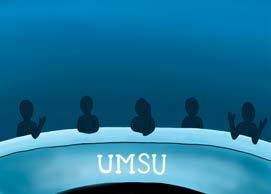
Student clubs gathered in University Centre last week as the University of Manitoba Students’ Union held its winter Get Involved campaign Jan. 23 to 24 and Jan. 26 to 27.
UMSU vice-president student life Tracy Karuhogo explained that the Get Involved campaign was created to help students learn about opportunities to participate in campus activities.
Karuhogo said that the Get Involved campaign last week focused on student clubs and associations. She said that there was a significant increase in the number of clubs and associations that participated in tabling compared to the fall semester’s Get Involved campaign.
She said that the campaign is normally held during the first few weeks of a new term because students tend to look for communities and groups to join before becoming set in a routine, and before their coursework intensifies.
Karuhogo said that student engagement and interest in the event throughout the week was good, as many students approached tables, asked questions and signed up for various clubs.
During the fall semester Get Involved campaign, clubs were set up outside around the Duckworth Quad. After receiving feedback from clubs, the winter event was moved to the inside of University Centre to help increase student-club interaction.
Karuhogo noted the wide variety of clubs for students at the U of M focusing on culture, hobbies, faculty-specific issues and more. She added that students can start their own clubs if there are none that currently support their interests.
She encourages all students to participate in life on campus through student clubs.
“Joining clubs definitely exposes you to new cultures, new friends, new skills and it definitely builds your CV, so I would encourage students to get involved,” she said.
The University of Manitoba Filipino Students’ Association (UMFSA) was one of the many clubs tabling in University Centre during last week’s event.
Sebastian Dio, a member of UMFSA, described the club as a place for students to get to know each other in a relaxed environment.
He explained that each of the club’s monthly events are typically centred around Filipino culture. Some of the activities they have held in the past include bowling and movie nights.
Dio said that the Get Involved campaign helped promote UMFSA, as many students approached its booth and asked questions about the
“Joining clubs definitely exposes you to new cultures, new friends, new skills and it definitely builds your CV”
— Tracy Karuhogo, UMSU vice-president student life
club and its activities.
UMPremed, a club for undergraduate students who are planning to pursue medicine in the future, also tabled in the recent Get Involved campaign.
Mercy Arowolo, the club’s director of communications, said that the club aims to
provide its members with information about the journey toward medical school through activities such as orientations and presentations from students already studying medicine.
The University of Manitoba Chinese Students and Scholars Association was also among the clubs tabling last week.
Jiahao Zou, the group’s media and promotion director, described the club as a
place for Chinese students to build community and get to know each other. Zou said that studying in a foreign country as an international student can be difficult, and so creating a sense of community can help improve students’ lives and their studies.
Since the return of in-person classes, clubs have been able to resume activities and hold social events. According to UMSU’s website, there are currently 50 clubs recognized by UMSU for students to participate in.
news@themanitoban.com
photo / Faith Peters / staff
UMSU board meeting Jan. 26
Motions for exec eligibility, St. Paul’s voting rights, executive board reports discussed
TMatthew Merkel, staff
he UMSU governance committee and a representative of the St. Paul’s College Students’ Association (SPCSA) each put forward a motion at UMSU’s board of directors meeting Jan. 26.
The motion from the governance committee proposed changes to UMSU’s governance and operations manual that would see the rules surrounding the eligibility of UMSU executives reworded.
Under the new wording, an executive must be an UMSU member for the entire duration of their term in office, and must be a student in any U of M faculty or school for at least one semester between September and April.
If an UMSU executive does not fulfil these rules, the executive must receive approval from the board of directors to keep their position.
The governance committee also made an amendment to the elections manual, stipulating that to run in an election, a person must be both
an UMSU member and a student. The previous wording only specified that a candidate needed to be an UMSU member.
Both the amendment and motion were carried by the board of directors.
As for the second motion, the SPCSA is currently a non-voting member of the board of directors. A representative of the association filed a motion at the meeting to regain voting privileges. The motion is currently being reviewed by the governance committee.
When it came time for the executives to present their reports, UMSU president Jaron Rykiss opted not to read his at the UMSU board meeting. Other than this meeting, Rykiss has read his report at every board meeting since May. This past meeting’s president’s report was later posted online to UMSU’s website.
In the written report, Rykiss shared that he was in talks with other schools across Can-
ada to learn more about how to improve the board of directors’ ability to remove an executive from their position if they are not doing their job. According to Rykiss, this will be presented to the governance committee once it is ready.
The report also discussed future meetings with the Manitoban to discuss a “sustainability concern” regarding paper waste, and the Arts Student Body Council (ASBC) to discuss issues regarding missing funds. He said he is working with ASBC leadership and U of M security services to ensure that the matter is handled properly.
He also outlined a meeting he had with the U of M strategic plan committee. Rykiss said that diversity, equity and inclusion, as well as the implementation of micro-credential programs at the university were discussed.
UMSU vice-president advocacy Victoria Romero did not attend the meeting, but her report was posted online as
well.
Romero’s report discussed the implementation of menstrual product disposal bins in the men’s change room of the Active Living Centre. The report said the bins will be installed in the coming weeks.
“This is incredibly important as the assumption that only people using the female washroom will need these disposal bins is discriminatory in many ways,” Romero wrote.
that she is planning naloxone training dates for UMSU board members, associations and clubs. Naloxone is a drug that works to temporarily and rapidly reverse the effects of opioid overdoses.
UMSU vice-president finance and operations Brook Rivard shared that the UMSU audit has been approved, and will be posted online soon.
Romero also reported news@themanitoban.com
UMSU creates racialized student representative position
New position will represent racialized groups, vote on UMSU board
Ashley Puchniak, staff
UMSU recently passed a motion to create a new community representative position. The racialized community representative will represent all racialized students at the U of M, and will be a voting member on the UMSU board of directors. Students can run for the position in the upcoming UMSU election.
According to UMSU governance chairperson Ivan Nuñez Gamez, the position was created to give racialized students a voice. This position has been in the works since October, and has involved consultation with UMSU executives and community representatives, as well as the broader student community Nuñez Gamez explained that creating the new role was not a simple decision. The motion was debated heavily by the UMSU board of directors.
represent multiple different cultural groups at the U of M simultaneously. Nuñez Gamez said in response to this concern that each community representative is now required to form a team of individuals from the community they represent to assist them.
He added that representatives could also create committees within their communities to ensure that specific groups are supported.
Some UMSU board members were also concerned
that the new position will help to represent and support racialized students who are biracial, or who are not Indigenous or Black.
Additionally, Nuñez Gamez hopes that the racialized community representative will be able to collaborate with both the Black and Indigenous students’ representatives.
However, he believes that it is important for these community representative positions to remain distinct.
“We’re trying to move forward, not backwards”
— Ivan Nuñez Gamez, UMSU governance chairperson
about where funding for the racialized community representative position would come from.
He said that the three communities have very different racialized experiences, and that combining the three groups into one would not be the right step.
“We’re trying to move forward, not backwards,” he said.
UMSU vice-president advocacy Victoria Romero said that she is proud and excited that the racialized community representative position was created. She believes that the position will advance representation and equal opportunity at the U of M. Romero noted that this position is just one step in the direction of inclusion and change.
He said that some board members were hesitant to create a position that would
However, Nuñez Gamez said that funding this position would not add any extra student fees or remove funding from other representatives’ budgets, but that the funding would come from UMSU capital expenses. Nuñez Gamez explained
Nuñez Gamez explained that a lounge will be assigned to the racialized representative that can act as a safe space for the community. He also hopes to see more cultural and heritage programming for the U of M’s Latino, Filipino and South Asian communities.
“Creating an opportunity for representation is a good thing,” she said.
“I would rather have a racialized representative position than not [have] one at all.”
As someone who identifies as Latino, Romero feels that her community is often excluded or left out, some-
thing that she sees affect other racialized communities as well. She believes the new position will work toward creating a student government that fully represents the U of M’s diverse student body. Romero said that passing the motion was “crucial in both creating a safe and welcoming space for everyone, […] as well as providing the necessary opportunity for all groups and communities to be involved in the decisions made that will impact them.”
with files from Matthew Merkel
news@themanitoban.com
photo / Ebunoluwa Akinbo / staff
graphic / Jenna Solomon / staff
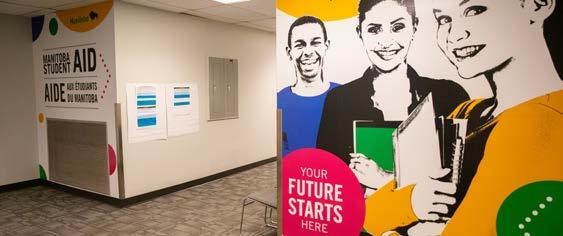
Student aid delays continue for yet another semester
Uncertainty about students’ finances causes at least one student to drop out
Colton McKillop, staff
ome post-secondary
S
students in Manitoba have said that they are still facing funding delays and difficulties contacting Manitoba Student Aid (MSA), including one student who was forced to drop out after waiting months for her funds.
Krysten Johnson, a former counselling student at the University of Manitoba, told 680 CJOB that she applied for funding near the start of September.
She said she was informed that she would face delays due to changes in the student aid system, and that she paid much of her tuition with her credit card while she awaited funds.
Johnson said the next time she heard from MSA was in mid-December, when she was told that her application had been approved and that she would receive her funds after Dec. 15. She claims the money never arrived.
She said that she was told on Dec. 23 that her case was being reviewed. She added that she was unable to reach the MSA office despite numerous phone calls and emails, and that the MSA website has crashed every time she has tried to view her application.
The Manitoban was unable to secure an interview with Johnson.
Other students have also faced difficulties trying to contact MSA or access its website.
Fortune Eboh, deputy chairperson for the Canadian Federation of Students Manitoba and University of Winnipeg environmental studies student, called Johnson’s story “very sad” and related it to his own experiences of facing delays, website crashes and uncertainty about the status of his funds.
“It was a situation whereby I had to constantly follow up with my school to let them know that this was a prob -
lem,” he said.
“And at some point, I had to deal with financing it on my own while I was waiting for them to kick in.”
“It seems to be an every-semester issue right now and that has placed students under so much duress”
Eboh pointed out that these issues have been present for numerous semesters.
— Fortune Eboh, deputy chairperson of Canadian Federation of Students Manitoba
“ We expected that they are aware of these challenges and they might have put these measures in place to help tackle some of these problems,” he said, “ but it seems to be an every-semester issue right now and that has placed students under so much duress.”
He pointed out that students need funds to help them pay not just for tuition, but for basic life expenses such as rent, child care, food, transportation and accessibility needs.
Last summer, the Manitoba government announced that the province’s student aid program would be integrated with the federal aid system to “streamline and simplify” the administration of funds.
Existing provincial loans
will be administered by MSA until April, when the National Student Loans Service Centre (NSLSC) will assume control. Students will then only have to take out one loan and make a single monthly payment, rather than the two separate provincial and federal payments required under the current system.
Five other provinces — British Columbia, New Brunswick, Newfoundland and Labrador, Ontario and Saskatchewan — have incorporated their provincial loan programs into the NSLSC since 2001. These transitions faced minimal disruption.
In contrast, Manitoban students have had trouble securing funds or getting in contact with MSA consistently throughout this year, facing long delays and dropped calls.
Eboh said that the government needs to “revamp” the student aid system and fix the MSA website so it can handle the amount of traffic it receives.
Minister of Advanced Education, Skills and Immigration Jon Reyes declined a request for an interview, but spokesperson for the minister Brant Batters provided a written statement.
“As of January 27, 2023 Manitoba Student Aid has received over 18,900 applications from Manitobans pursuing post-secondary education and 18,524 of these applications have been assessed, which is equivalent to over 97 per cent of all applications received,” the statement read.
The statement explained that “assessed” could refer to applications that require further action from the student to be processed, have been assigned a date for disbursement or that have been completed by students who have already received funds.
The government did not
specify how many applications fit into each of these three categories, but said that MSA has resolved the majority of its system issues, and has hired additional staff and authorized overtime to deal with the backlog.
The statement also said that student aid is “meant to supplement, not replace, a student’s own resources,” and encouraged students to talk to their schools if they have concerns regarding tuition deadlines.
“Student aid funding is not intended to fund all living expenses, all tuition, books and supplies,” it read.
Eboh argued that the Progressive Conservative government’s lifting of the tuition cap created an increased need for student aid, which he called “an essential service” for students who face barriers to higher education.
“It is completely unacceptable that the students who are facing the most barriers to access college or university do not have the support in place to help them succeed this term,” he said.
news@themanitoban.com
photo / Ebunoluwa Akinbo / staff
Research & Technology
Assistant professor uses biomaterials in construction
Takes conceptual approach in modern day architecture
Elah Ajene, staff
Nature is resilient.
The natural world has the ability to self-renew, self-repair and maintain function despite disturbances.
Biomimetic designs draw abstract lessons from nature and use them as a source of inspiration in various systems.
This is the foundation of U of M assistant professor in the faculty of architecture Mercedes Garcia-Holguera’s research.
“We are trying to learn from nature,” she said.
Garcia-Holguera began experimenting using biomaterials during the COVID19 pandemic, focusing on two specific biological sources — mycelium, a network of fungal fibres, and bacterial cellulose, a biomaterial synthesized by bacteria — in developing materials for architectural projects in construction.
She said that the goal of the research is to reduce the environmental impact of buildings, explaining that, regarding the environment, “buildings are responsible for a huge amount of our problems.”
“We as designers need to take responsibility for that,” she said.
A substantial challenge, in which biomaterials could serve as a potential solution, is the high cost and inaccessibility of construction materials in remote Northern communities.
One of the things Garcia-Holguera focuses on in her testing is whether biomaterials can be grown in non-specialized and less controlled environments, outside of the laboratory. This could potentially tackle the housing crisis experienced in remote communities.
“If we can grow those materials in those conditions, it is more reasonable to think that we will be able to grow
them in these remote communities and the people in these communities will be able to grow these materials themselves,” she said.
The mycelium-based materials, for instance, are grown in a standard non-controlled space at the Fort Garry campus.
Using a two-stage growth process, Garcia-Holguera and her team inoculate agricultural or industrial waste products like sawdust and straw with mycelium. This inoculated mix is allowed to grow in a humidity-controlled bag, until it is fully colonized by the mycelium.
The substrate is then transferred to a mould, where it grows for a few weeks before it is subsequently oven-dried to become ready for use.
Unlike mycelium, the bacterial cellulose materials have a different growth process which Garcia-Holguera described as resembling the fermentation process of kombucha.
According to Garcia-Holguera, both mycelium and bacterial cellulose materials have significant potential for improved environmental performance when compared to traditional materials used in present-day construction.
Mycelium based materials integrate industrial waste such as sawdust, as well as agricultural waste products such as hemp or straw, which are abundant in the province.
Not only does this recycle waste products, but these new materials are biodegradable and less harmful to the environment when degraded. They also require much less energy in production than materials like steel or concrete.
Past research shows that these products have insulating potential and good compression strength, making them a viable substitute for traditional construction
/ Faith Peters / staff
materials like bricks.
On the other hand, Garcia-Holguera believes that bacterial cellulose material has great potential as a tensile element and could be used to replace materials like cables and ropes.
Although minimal research has been conducted regarding the architectural applications of bacterial cellulose material, Garcia-Holguera and her team are testing how these materials perform in the weather conditions of both Winnipeg and Churchill, Man.
“Our expectations back then, when we put the samples out, was that the samples will be destroyed or broken very quickly, but that is not what we are seeing,” she explained.
“They are maintaining their integrity. They are able to negotiate with the environment, like humidity and chan-
ges in temperature.”
Currently, the team is developing a three-metre dome using larger panels derived from bacterial cellulose.
“The conditions and the exposition to the weather will be much more drastic, and we will be able to see if still at a larger scale, these materials will still behave well,” Garcia-Holguera said.
An important aspect of Garcia-Holguera’s research involves changing the general public mindset that buildings are permanent structures intended to last as long as possible. Rather, by using biomaterials in designing buildings, certain building elements can be maintained on a regular basis.
To Garcia-Holguera, this concept is more attuned to natural cycles and how ecosystems renew seasonally.
Garcia-Holguera said that
the next step in her team’s research will involve increasing the scale of the biomaterials used in their projects.
The team is planning to create a shelter-like prototype within the next year to test the weathering performance and hypothermal and mechanical properties of the biomaterials in the Manitoba climate.
Garcia-Holguera emphasized the importance of student participation and collaboration in her research.
“The work that we do, it’s impossible to do without the students,” she said. “The students are key.”
“You need a team, and you need a team that is passionate.”
research@themanitoban.com
photo
Highlights global interest in antimicrobial reviews
< Cont’d from front page
These articles are cited by a diverse audience which can include university or industry researchers, clinicians and even governments.
Some of their most cited articles are extensive reviews of specific antibiotics. Zhanel said that the exhaustive nature of these reviews deters some scientists from writing them.
“You’re putting in a bunch of authors together, and people are working together and there are countless figures and tables,” Zhanel said.
“I think the world doesn’t really want to write those themselves because they just take an extraordinary amount of time.”
However, Zhanel is committed to writing antibiotic reviews for interested individuals.
Each year, Zhanel and Schweizer select an anti-
microbial that they feel could be promising in patient treatment.
These medications are not on the market and have not yet been approved by regulating government bodies, such as Health Canada or the U.S. Food and Drug Administration.
Over the summer, they hire a pharmacy student in their third or fourth year of university. The student must be familiar with various topics such as chemistry and microbiology.
That student then works with Zhanel, Schweizer and a team of eight to 10 researchers who each specialize in a different area.
The investigation takes a minimum of six months, and is then published in the scientific journal Drugs
Since the antibiotics are still experimental, the published review is often the most extensive investigation on the product.
“You work really hard, you have a lot of fun along the way, you publish a bunch of papers, then all of a sudden something like this happens”
— George Zhanel, U of M medical microbiology professor
The reviews are then read and cited by any researcher interested in antibiotics.
A popular article of Zhanel and Schweizer’s was focused on reviewing hybrid antibiotics, which combine two types of antibiotics into one product.
Although Zhanel and Schweizer do not actively seek out articles that cite their research, they said that they are often pleased with the way other researchers have understood their work.
Schweizer said that sometimes, the way another scientist uses his articles makes him see his own work in a different light.
Zhanel said that he loves seeing when students in developing countries are interested in his articles.
Many universities may lack access to the online libraries that are available at the U of M, so students from those universities sometimes ask Zhanel for a PDF of one of his works.
These students often go on to cite Zhanel’s work in their own publications.
Zhanel also keeps up with specific researchers whose work he finds interesting. Every month or so, he searches
through online journals to see what those researchers were currently working on.
Although there are aspects of Schweizer and Zhanel’s articles that might make them more likely to be widely cited, Zhanel said the high reference rates are not a predictable phenomenon.
“I don’t think anyone says, ‘I’m going to go with the goal of being the most cited researcher,’” Zhanel said. “I
don’t think that really happens, and I don’t think that’s a goal.”
“You work really hard, you have a lot of fun along the way, you publish a bunch of papers, then all of a sudden something like this happens.”
research@themanitoban.com
photo / Ebunoluwa Akinbo / staff
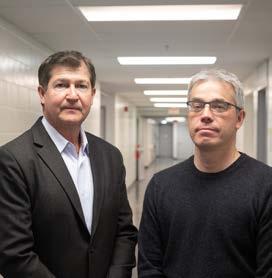
Left: George G. Zhanel, Right: Frank Schweizer.
Military booths at U of M conflict with university values
Military antithetical to post-secondary education’s commitment to pluralism
SColton McKillop, staff
tudents walking through University Centre two weeks ago would have seen a number of U of M career fair stands advertising jobs in various public and private sector industries.
Nestled among the runof-the-mill, boring employers such as Boeing Canada, the Canada Revenue Agency and PepsiCo Foods Canada was a recruitment booth for the Canadian Armed Forces (CAF).
Alongside the typical brochures, the CAF’s stand featured a display of decommissioned explosive devices and a rocket launcher — an attraction sure to appeal to the type of young people who know the names of all the weapons featured in Call of Duty by heart.
Regular readers may notice that this is the second article to take a stand against military recruitment in universities. They might be wondering — why write another opinion piece about the military booths? Didn’t we already hear about how their exploitative recruiters target young people with promises of free education? Do writers at the Manitoban just have an axe to grind against our boys in uniform?
Well, I raise this issue not simply to reiterate these same arguments or because I’m some radical pacifist who is against the very idea of the military. I am, but that’s a separate issue entirely.
I find it necessary to continue to hammer this point home for a more fundamental reason: the military is diametrically opposed to the values represented by
an institution of higher education. Namely, the commitment to peaceful resolution of differences through reason and debate, as opposed to violence.
People make a lot out of the idea that universities should be hallowed sanctuaries of free speech. Often these debates become overblown media spectacles that exaggerate the alleged threat posed by “the left” to the sanctity of free speech, such as Jordan Peterson’s fearmongering about supposed “compelled speech,” or Conservative party leader Pierre Poilievre’s pledge to withhold federal grants from universities that fail to meet his standard for upholding free speech.
While this media discourse about free speech can often be vapid and hollow, we should not lose sight of the truth. Universities must remain committed to the ideal that humans, as thinking creatures, can resolve our differences peacefully and arrive at the truth through a careful process of comparing and contrasting opposing viewpoints. Contrast this ideal with a simple, time-honoured observation: truth is the first casualty in war.
It is a well-known fact that in times of war, free speech, dissent and open debate are stifled. Examples of this include Canada’s suppression of “objectionable speech” via the War Measures Act dur-
ing the First World War, the use of the United States’ Espionage Act around the same time for a similar purpose or laws passed amid the hysteria of the War on Terror — such as the PATRIOT Act — all of which suppress free speech.
The military is not an institution that easily co-exists with the idea that opposing viewpoints can come to a peaceful resolution. Take the tensions between the United States and Iran over the latter’s potential nuclear weapons program as an example.
This diplomatic crisis that had already been peacefully resolved by former U.S. president Barack Obama’s deal with the country in 2016 was complicated by the sabre-rattling of high-ranking military officials from both countries who never supported it. Efforts for peace were ultimately undermined completely when former president Donald Trump backed out of the deal in 2018.
President Joe Biden’s efforts to resurrect the deal have been challenged by a group of 46 retired generals and admirals, who signed an open letter expressing opposition to renewing any kind of peace agreement with Iran.
Nationalism and militarism breed exactly the kind of groupthink mentality that degrades our ability to find common ground and see the validity in other people’s perspectives. Throw in recent scandals regarding white supremacists and rampant sexual misconduct within the CAF’s ranks, and it’s clear that the armed forces as an organization does not respect the pluralism that
universities thrive upon.
At least we can comfort ourselves with the knowledge that military recruiters are hardly effective. In a recent poll, 79 per cent of Canadians said they were unlikely to consider a career in the air force or the army, while 83 per cent said they were unlikely to consider joining the navy.
The CAF is dealing with a recruitment crisis. Rather than adding a planned 5,000 troops to its ranks, the army is facing a shortage of over 10,000 trained members. About one in 10 positions are currently unoccupied.
Few Canadians want to join the military, but many born into lower-income families may not see another viable option to get affordable education. As last week’s comment piece pointed out, the recruitment brochures highlight the CAF’s commitment to pay for the post-secondary education of many recruits.
Maybe instead of allowing our universities to facilitate the military’s exploitation of the poorest members of our society, we should offer post-secondary education free of charge. Our education system’s values of striving for an egalitarian society that offers upward mobility and a space for free expression are consistent with both opposition to militarism and with providing free university.
Even if we accept, for the sake of argument, that our nations will always need a military, it seems reasonable to expect the schools committed
to teaching our young people the value of thoughtful debate to not allow institutions centred on violence to lure students in with flashy displays and the promise of financial security.
Instead, universities wash their hands clean of the whole moral issue, treating the military as just another organization looking for employees, rather than an arm of the state looking for more recruits willing to be sent into dangerous conflicts across the world.
Maybe this is too much to ask from universities. As establishments deeply interconnected with the network of government institutions and organizations that generally make up the status quo, perhaps a bland neutrality bias and a “both sides” approach is all we should expect.
If that is the case, however, then comparing the actual role of universities to the ideals they claim to stand for leaves a lot to be desired. It is not sedition for universities to recognize the serious disconnect between the aims of higher education and the aims of the military, and to strive to maintain a degree of separation between the two.
editor@themanitoban.com
UMSU EXECUTIVE OFFICE HOURS (Winter 2023)
February 8 & 9th | 11am-2pm | University Centre
Would you love to perform your cultural dance or show off your cultural wear in the fashion show at our multicultural event on campus?
Scan the QR Code to register! Deadline February 1st @ 11:59pm
Friday, February 3rd | 9pm-1am VW Social Club
My experience being trans, queer, brown
Intersectionality is at the core of the story I’m in
Aahan Rajput, volunteer
People pass away with their stories, or they are written out of them.
On Aug. 2, 1987, Winnipeg held its first Pride march. A fact less known is that some people wore paper bags on their heads during the march to hide their identities because they feared discrimination.
This fear still exists. To avoid being subjected to extreme violence and targeted physical assault, many queer folks still need to conceal their identities.
We are often beaten, tortured and sexually abused. Other times, we’re left alone after a series of jokes and personal comments with eye rolls and disgust. Well, the law says that I have rights and protection against discrimination and hate crimes. But do I? Or do I need to make a choice between being safe and being myself?
As a transmasculine person, I sometimes wonder if it is seen as appropriate for me to dress feminine and hold hands with someone of the same gender in a straight-centric area.
When a feminine presenting person comes out as bisexual, their sexual orientation is often dismissed and assumed as straight.
However, if it’s a masculine presenting person, their sexual orientation is often generalized and seen as gay. Patriarchal misogyny depicts anything slightly feminine as weak and bad.
Growing up in an Indian household, there were certain societal expectations placed on me. I had to be a good Hindu girl, making sure I didn’t deviate from the path of God while following all the proper social cues. I knew when to laugh and talk, how to act around elders and listened to everything they asked me to.
On the other hand, white gay privilege widely exists in Canada. Coming to a new
country, I hoped to live as myself — a transmasculine queer person.
The pressure as an international student of letting down a whole community is massive. There are many references to queerness existing in ancient India and its scriptures. But it is easy for people to pick and choose things to satisfy their own beliefs.
I come from a different upbringing and culture, making me “unrelatable” to many people in the queer community. Due to societal norms and my background, I’ve felt disadvantaged by racism, classism and a difference in
wealth. Have you ever seen a dating profile with a “no chocolate, no curry, no rice, no spice” bio? Or declarations like, “if I were gay, I’d date you”? Bisexual, transgender and non-binary people are still very hypersexualized.
I have been constantly told to keep my emotions to myself. It seemed normal because I was exposed to potential exploitation by others around me when I expressed my weakness. So, it only makes sense that I grew up thinking that being aggressive and aloof equalled being “masculine.”
I struggled to accept myself
and those around me because of internalized homophobia and toxic masculinity. I lacked the words to explain how I felt.
My culture only has a few queer words, and all of them carry years of oppression and negative connotations.
Black and brown trans women had a significant role in the founding of the current Pride movement. Up until very recently, white gay cis men dominated the popular representation of the 2SLGBTQIA+ community.
Trans and non-binary folks are sometimes kept away from the community. Our experiences overlap, but can
be very different. Reclaiming my intersectionality and accepting my experiences is important for me. So, I’m here to say: I’m trans, queer and brown.
People come to Winnipeg with different dreams and ambitions, hoping to truly express themselves. They deserve to share their stories of grief and pain, happiness and joy, love and hate. No one should have that taken away because of their identity.
comment@themanitoban.com
graphic / Dallin Chicoine / staff
What Blackness is
Examining the multi-faceted nature of Blackness and its misconceptions
Dina Hamid, staff
Growing up, people have always been “hush-hush” when talking about Blackness. I would observe people doing mental and verbal gymnastics in order to avoid using the “B” word — Black. This was always confusing and strange to me as a Black kid. Why wouldn’t you say just Black? Why wouldn’t you acknowledge that I’m Black? Why did you just call that woman “chocolate mocha?”
Although I could tell that most of the time people avoided mentioning my race in order to avoid alienating me, in reality it did much worse. It made it feel like there was something wrong with Blackness, or that it was an evil taboo that shouldn’t be talked about, like Voldemort. This is a trend I’ve seen for most of my life. The mention of the “B” word has people shifting in their chairs, holding their breath and producing a tense silence in the air as they anxiously wait to see
which way the conversation will go.
Due to the hesitation and apprehension when talking about Blackness, a lot of people don’t really know what it is. Instead, people form their ideas about what Blackness is through rigid media portrayals in which Blackness is typically centred through the American lens, and is very limited in its depictions of its muses.
Because of this, there are a lot of misconceptions about what Blackness is. I know, because most of my life I have been dealing with the repercussions. People think that Blackness looks, talks and operates in a single way, and that everything that deviates from that idea must not be “Black.”
This belief is why I have had to fend off many inquiries about why I sound and talk “white.” It’s people believing that embracing Blackness or saying “Black Lives Matter” is radical or political, which is just sad.
I realize talking about Blackness makes a lot of people uncomfortable, but I haven’t been comfortable most of my life, so call it reparations. For the rest of Black History Month I will be talking about it. And if you are uncomfortable, ask yourself why. So, then, what is Blackness?
It is hearing, “I’m glad I’m not the only Black person.”
It is a reason to smile when you see a group of Black people you don’t know being unapologetically themselves and having fun.
It is spending nights crying and grieving the deaths of distant strangers that resemble your family and friends.
It is like shedding a layer of your protective armour to feel comfortable being yourself when you speak to someone who looks like you.
It is hating your hair only to grow up and love it.
It is realizing that those experiences you had as a kid that made you feel small were racism, but you didn’t have
the knowledge or language back then to identify them for what they were.
It is that look you and your friend gave each other after someone said something ignorant.
It is constantly being watched and gawked at.
It is choosing to keep your mouth shut to not ruffle any feathers and be labelled the “angry Black woman.”
It is choosing to speak up and to accept being labelled an “angry Black woman.”
It is creating and adhering to your own beauty standards.
It is learning to embrace your culture and heritage despite being told you shouldn’t.
It is watching the world grow to accept and respect people who look like you.
It is having a connection anywhere you go and being accepted with open arms.
It is the sign of relief and comfort of spotting someone with the same hue as you in a sea of people that don’t look like you.
It is using humour and laughter to make light of the daily instances of microaggression and bigotry.
It is not having to change the way you talk, censor yourself or tone yourself down to make other people uncomfortable.
It is being seen and unseen simultaneously.
It is having to write “people” when I really mean white people and non-Black people of colour in order to not offend anyone, and to have people hear my argument before they stop listening.
It is joy, pain, strength, hope, struggle, pride, shame, power, understanding, resilience, laughter and love. It is a commodity, it is complex, it is a sisterhood, a brotherhood, a togetherness. It is community, it is family, it is simply existing in your black skin.
comment@themanitoban.com
The forbidden forest of consumerism
We should not financially support people that have a record of hate
Braden Bristow, staff
W
ithin the world of video games, Hogwarts Legacy is already on pace to be a top seller when it releases later this month. While there has been quite a bit of hype for this game, it has also caused a fair amount of controversy. In my opinion, this controversy is not unreasonable.
The game is set within the Wizarding World of Harry Potter. The franchise was famously — now infamously — established by controversial author J.K. Rowling.
Rowling has made numerous transphobic statements, attacking transgender activism by implying that it hurts women, referring to trans people as their assigned gender at birth rather than the gender they are and pushing an anti-transgender narrative.
Needless to say, Rowling’s statements are incorrect, gross and harmful. Because of these statements, many feel that it is wrong to buy or platform Hogwarts Legacy While not involved in the pro-
duction of the game directly, Rowling holds the publishing rights for the Wizarding World and will profit from the game. So, whether gamers like it or not, buying this game results in financially supporting a transphobe. And yes, you have a moral responsibility to know that. By supporting people or companies who harm others, we deem their behaviour to be acceptable.
While Rowling is bad enough, there are more extreme scenarios of this as well.
For example, the United States Department of Labor has reported that within Ghana and Côte d’Ivoire — countries that supply nearly 60 per cent of all cocoa around the world — there are 1.56 million child labourers involved in cocoa production. In 2019, representatives from Hershey, Nestlé and Mars could not guarantee that the chocolate their companies sold was
made without child labour.
This raises the question of whether even buying a chocolate bar means that you are supporting the exploitation of children.
My answer to that question is yes. You are voting with your wallet when you buy products from a corrupt company. While it can be difficult to live a moral life financially, we all have a responsibility to make an effort to understand and do better.
Naturally, there are certain situations where we can never really know if a person or company is engaging in bad practice. But when we do know or have a strong suspicion, we should seriously con-
our joke. Tell them to knock it off and explain why what they said was wrong, but we need to pick our battles.
Nobody is perfect, but there is a major difference between ignorance and targeted hate or exploitation. Rowling, for example, is engaging in targeted hate against a marginalized group of people, and the chocolate industry is benefitting from the mass exploitation of children.
We always have a choice in what we allow and encourage
sider not supporting that person or company.
However, I am not saying that people need to cut off contact with a family member because they made an off-col-
I may not be looked to as being in a position of moral authority, and I probably should not be. However, I do know that supporting transphobia, as well as child labour and slavery, is wholly wrong. It would be easy to say that regardless of what we do, these characters will continue to profit.
While this may be true, it is a deflective statement.
We always have a choice in what we allow and encourage.
We might not always make the best choices. It may be
that, no matter what we do with our money, we are supporting some kind of bad actor or outright villain, but we can try to make better choices.
If you are a fan of chocolate but feel uncomfortable with slavery — as you should — then there are groups such as Slave Free Chocolate that encourage more ethical practice and suggest ethical chocolate companies to support.
Also, if you enjoy young adult adventure books but refuse to support Rowling, Rick Riordan, known for his Percy Jackson series, is a great author whose books feature a few 2SLGBTQIA+ characters. It is unreasonable to expect everyone to entirely detach from capitalism, but people should do what they can to engage in more ethical forms of consumption.
comment@themanitoban.com
The right to bear (life-ending) arms
Have we become desensitized to mass shootings?
Sarah Cohen, staff
The headline read, “10 dead, 10 injured in Southern California mass shooting.” Yet, I read it with the same emotion I might have if it were any other headline.
The Jan. 21 shooting in Monterey Park, Calif. now has a death toll of 11. NPR reported on another mass shooting just two days after that in Half Moon Bay, Calif., noting that 18 people had died and 10 were injured within three days across California from the shootings.
In a 2015 report, the U.S. Congressional Research Service defined a mass shooting as an incident where four or more individuals are murdered using a firearm. In the 29 days of 2023 that have passed before I wrote this, there have been more than 40 incidents in the U.S. where misuse of a firearm left at least four people injured or dead.
The thing that has been keeping me up at night is that every time I read a headline
including “mass shooting,” I don’t feel what I think I should feel, no matter how close to home the tragedy may be.
I question what I should be feeling anyways. Shock? Surprise? Heartache, sadness, anger? When faced with one mass shooting after another, I feel nothing significant.
I am going to chalk this up to the psychological process of desensitization. When we consistently experience similar events, our emotional response to them lessens over time.
When I was just becoming aware of the world around me and my place in it, hearing about mass shootings in schools, movie theatres, grocery stores and the most mundane locations did make me angry and sad, but above all, anxious. But now, that anxiety is both at its peak and nearly dissolved.
me wonder if there will ever be an event that pushes me back to those emotions. It may be that only a mass shooting where I have direct ties to the location, a victim or the offender will do it.
That part of it is so frustrating. No part of me wants to be desensitized to innocent people being killed.
It is not as if there is no opposition to the States’ lack of control on guns. Groups like March For Our Lives and Moms Demand Action have been advocating for stricter gun laws for years. Nothing
mass shooters have had firearms that were purchased or obtained legally. That means that even with the different gun laws that different states have, you can still easily purchase a firearm, sometimes with there being no record.
You could literally buy a gun in one state where it is legal to buy it and drive across a state line, entering a state where you cannot buy that gun legally, and have a gun in your possession without anyone ever knowing. The loopholes are endless.
No part of me wants to be desensitized to innocent people being killed
too notable has come from that action, and as long as the U.S. Supreme Court upholds the second amendment — which I think will be forever — there will never be a decrease in mass gun violence.
This desensitization makes
As of now, 77 per cent of
people will interpret laws such as the Second Amendment to fit their ideals or wants. It’s hard to tear a die-hard “freedom-seeker” from their gun. I don’t see the U.S. government doing anything about mass shootings other than offering thoughts and prayers. And I don’t see the country ever passing a gun control law federally that actually contributes to saving lives. Unless the government somehow accomplishes this, citizens of the nation will continue to become desensitized to extremely tragic mass shootings that are increasingly commonplace.
As for the Second Amendment, it reads, “a well-regulated Militia, being necessary to the security of a free State, the right of the people to keep and bear Arms, shall not be infringed.” While this makes complete sense in the context of 1791 when it was written, it does not make sense anymore. We live in an era where comment@themanitoban.com
graphic / Jenna Solomon / staff
To complete Sudoku, fill the board by entering numbers 1 to 9 such that each row, column and 3x3 box contains every number uniquely
In Hidato, fill the board by continuing the chain of numbers from 1 to 100 moving any direction or diagonally to the next number.
In Straits, like Sudoku, no single number can repeat in any row or column. But rows and columns are divided by black squares into compartments. These need to be filled in with numbers that complete a “straight.” A straight is a set of numbers with no gaps but can be in any order, eg [4,2,3,5]. Clues in black cells remove that number as an option in that row and column and are not part of any straight. Glance at the solution to see how “straights” are formed.
Sudoku
Puzzle by Syndicated Puzzles
Hidato
Puzzle by M.J.D. Doering
Straights Puzzle by Syndicated Puzzles
Horoscopes for the week of Feb. 1
Zodiac tips for surviving life at the U of M
Damien Davis, staff
ARIES
Your tarot card for the week is the Devil. The real enemy of your happiness is you. When you’ve tangled your horns with another‘s and night falls, how do you justify the violence you’ve put yourself through? This card reminds you that the last stages of freedom are dependent on you. Lick the salt from your wounds and choose happiness. Return to your roots of passion. It’ll be useful for what‘s waiting for you next week.
TAURUS
Your tarot card for the week is the Magician. With the taste of earth and the aroma of frankincense, this week you’ve found yourself in tune with what has always been at your core — nature and magic. This week is the week for manifestation, for romanticization and for remembering that the most important things in life aren’t just material, but spiritual as well. Winter has its beauty, so put on your skates and slip onto the university’s rink.
GEMINI
LEO
Your tarot card for the week is the Moon. Are you afraid, dear Leo? Lions may not howl at the moon, but you‘ve found yourself looking upwards late into the night trying to ease the anxiety. This card is here to remind you that it’s alright to be afraid, as long as it doesn’t stop you from doing what needs to be done. Cowardly lions can become brave. Take comfort in your ability to bounce back, and know that next week will be easier on you. You simply have to be courageous, something you’ve been all along.
VIRGO
SAGITTARIUS
Your tarot card for the week is the High Priestess. With the moon at a waxing gibbous and in your sign, Geminis of all kinds will be experiencing a deeper connection with the divine feminine this week. This card foretells a transformation of confidence, beauty, power, wrath and royalty. People tend to underestimate Aphrodite, but this week you’ll be the reason they shouldn’t. Be sure to glance in the mirrors a minute longer than normal. Make sure you and your twin are on the same page. Betrayal can come from a close source.
CANCER
Your tarot card for the week is the Chariot. You’ve been hearing waves crashing in your sleep. In the corner of your eye while passing through the basement of Tier, you could’ve sworn you saw marine life crawling out from the lockers. This card reminds you to focus on staying true to yourself this week. Sacrificing the best parts of yourself for others is a dishonour to what you have inherited — the willpower of a warrior. The sea is weeping for you, Cancer. Your brothers and sisters encourage you through this card. You are going to be okay.
’Toban
Tips
Fiancé on the run
Dear Toby,
I have been engaged for two years, yet I find myself wanting to leave my fiancé. He is obnoxious, rude and the spark is gone. He doesn’t flush, he refuses to clean up after himself — it’s like living with a toddler. However, my parents love him so much he is pretty much part of the family. Sometimes I wonder if they love him more than me. Our wedding is meant to be this summer. I feel the walls closing in. What do
Your tarot card for the week is the Hanged Man. You’ve been stalling, and the stars can see that. Perhaps you have your reasons. You’re worried that the choices you make won’t have the best outcomes. But if you’ve thought carefully and put all this time and effort into cautious meticulous plan ning, this card asks you — why hesi tate? Seek out new perspectives if you find yourself dulled by your own patterns of thinking. If you ask the stars for advice, as your kin they will be compelled to answer. Sometimes, we have to take leaps, even if we’re uncertain.
LIBRA
Your tarot card for the week is the Wheel of Fortune. The scales have become heavy. You’ve found yourself wondering about the cycles of life. If everything is a circle, what’s the point? Nobody can tell us what the purpose of life is, but this card asks you: have you forgotten the joy that comes with waking up to a brand new day with nothing in it, yours for the planning? Put down the weight of the world, Libra. Your mother is the goddess of justice. Let her take over so you may enjoy the taste of honey and dates
SCORPIO
Your tarot card for the week is Temperance. Poison spills from your lips. There are constellations in your eyes, and this week you feel drunk on indulgence. This card reminds you of moderation. You are a romantic at heart, but without moderation you risk putting everything you’ve worked hard for in jeopardy. When temptation strikes, remember the fable of the scorpion and the frog, and treat it as scripture. Your ability to dream is your strength, but make focus another.
I do to get out of this? Should we attend counselling, or should I just run?
Thanks, Bride-to-be
Dear Bride-to-be,
It may be best to sit and have a conversation with your fiancé. If the way that he is acting is pushing you to want to run, the first thing you should do is talk to him. However, if the spark is gone, it may be a sign that the relation-
Your tarot card for the week is Death. Be not afraid, archer. This is not a death of self, but a death of your past. This card asks you to throw your old devices, habits and fears into the hearth and accept what the fates have been trying to show you. While this is a journey that is taken alone, bring your tokens with you. The gifts that your loved ones have given you will remind you that while every living thing has only themselves, we can choose to be in a community of life and love. Aim your arrow inwards. Take out the old and release the new.
CAPRICORN
Your tarot card for the week is the Sun. It’s time to let loose the inner child that has been rattling the cage of your heart. No matter how silly it may seem, honouring the dreams, hopes, wishes and goals of a younger self is important work. They are the one who carried you this far, who prayed for your success, your happiness. This card asks you to take out time for that small version of you who kicks their feet on the bleachers, waiting for their turn on the field. There are lessons to be learned, and who better to teach you than the original version of you?
AQUARIUS
Your tarot card for the week is Justice. Are you seeking the truth still? You are a constellation difficult but not impossible to find, much like fairness and honesty in a world that can feel unkind. This week, consult with Libra. Together, you two can map out a way to reach your goals earnestly while being true to who you are. The first truth you should seek is whether or not you are being just to yourself, not just those around you. Martyrdom is not for the faint of heart.
PISCES
Your tarot card is the Emperor. This card represents leadership. It’s time to take up the mantle and inherit the authority and responsibilities that come with this phase of your life. You’ve done the work; your calloused hands will glide through the obstacles that you may face when the crown is placed upon your head. Your constellation is two fish connected by ribbon, so while you will always have a tie to responsibility, never forget to hold yourself to the waters as well. How do you keep your relationships happy and stable if you yourself are neither? Take care, Pisces. New things are coming.
ship is coming to an end. No matter how your parents feel about him, they should understand that your happiness is most important. In situations like this, consider your well-being before anything else. Marriage is a long-term decision and when it’s the right person, you’ll know.
Best of luck, Toby the Bison
To ask Toby a question, email comment@themanitoban.com
Drew Hayden Taylor on power of Indigenous humour
Sidney Warhaft 2023 Lecture brings prolific writer to U of M
Jessie Krahn, staff
rolific playwright
PDrew Hayden Taylor addressed a full house at the John J. Conklin Theatre on Jan. 19 as the department of English, theatre, film & media’s (ETFM) 2023 Sidney Warhaft Memorial lecturer.
The event began with associate professor Lucas Tromly presenting the Professor Sidney Warhaft Memorial Award for best master’s thesis to recent ETFM grad Kerri Woloszyn.
ETFM professor Warren Cariou introduced Taylor by enumerating the playwright’s accomplishments and accolades. Cariou noted Taylor’s “remarkably generative imagination,” his “wonderfully trickster-ish sense of humour” and his history of uplifting “emerging Indigenous writers and theatre artists.”
Taylor’s talk tracked his career from his home in Curve Lake First Nation to his present-day world-renown as he continues “spreading the gospel of Native literature.”
Taylor explained in the lecture that his earliest childhood memories are papered with stories, literature and his yearning to absorb them, even before he knew how to read.
“Every book I read was a passport,” he said.
But while Taylor’s interest in storytelling grew, he was unsure about what doors lay open for him as an artist. He noted that First Nations people only gained the federal vote in 1960 — just two years before he was born — and explained that because of the historical disenfranchisement of Indigenous peoples, as well as the lack of any Indigenous literature in his school, he did not know whether Indigenous people were even allowed to write.
Taylor also spoke of a harsh lesson he learned from his elders — creative writing is not a lucrative field for most people.
“My mother looked at me with a very forlorn look and said, and I quote, ‘why do you want to be a writer? It’s not going to get you anywhere,’” he explained.
Taylor then shared that, after spending some time in university developing his journalistic writing abilities, he became increasingly aware of a dearth of Indigenous scriptwriters, even on projects that were telling Indigenous stories.
It was in that gap that Taylor found an opportunity to contribute his perspective as an Indigenous person to the world of television.
Taylor explained that his breakout writing role for television was fuelled by his desire to rectify that lack of Indigenous representation, as well as a general need for paid work. After sending story ideas to a network on a whim, one of Taylor’s pitches was accepted for an episode of The Beachcombers
Running parallel to his career was what Taylor called “the contemporary Native literary renaissance” of the late ’80s and early ’90s. The movement included writers like Jeannette Armstrong, Lee Maracle and Maria Campbell.
Amidst this booming interest in Indigenous stories,
Taylor expressed his hesitancy about the overall creative landscape that was taking shape. He explained that a large majority of Indigenous narratives were “dark, depressing, bleak, sad and angry.”
“Most of the characters were either oppressed, depressed or suppressed,” he said.
Taylor described this
development as a necessary step that Indigenous artists had to take to begin a collective convalescence from colonial violence, racism, the residential school system and the “dysfunctional aspects” those structures produced.
Taylor then explained that while telling these kinds of grim stories was “a cathartic thing,” he felt that an over-representation of these types of stories in his milieu did not reflect the varied textures of real Indigenous peoples’ lives, including his own.
“I would look at my mother, and my mother was a very vivacious woman with a great sense of humour and I wasn’t seeing her in a lot of this literature,” he said.
“Maybe [The] Rez Sisters, but other than that, our life was not doom and gloom.”
In fostering his own creative voice, Taylor described his realization that humour was also a necessary step to healing.
“I wanted to take it to the next step and deal with the potential power of humour as a healing medium,” he explained.
“I knew the power of Indigenous humour, I know the humour that existed in most Native communities.”
Taylor pulled on that power very early in his career. When his first comedy play premiered, the audience of mostly white people was silent. Taylor recalled a small group of Indigenous people laughing raucously. Their joy was infectious, and soon the entire theatre joined in.
Taylor suspected that white audience members were unsure of laughing even at Indigenous comedic narratives because Indigenous people had been through so much.
With his plays translated into multiple languages and his career veering into novel writing and feature film directing, Taylor’s story is a tes-
tament to the global resonances in Indigenous stories. Taylor ended his talk with an energetic remark on the many diverse genres and mediums that Indigenous storytellers are now working with. Money matters came up repeatedly in Taylor’s lecture. Regardless of the artist’s passion or talent, financial support frees him up to be able to create. Taylor’s career also serves as a reminder that many potentially prolific, storied artists are buried in bills to pay, and are one creative lottery away from connecting with audiences around the world.
For more information about Drew Hayden Taylor’s work, visit https://www.drewhaydentaylor.com/.
arts@themanitoban.com
photo
‘Skinamarink’ is worth the hype
Micro-budget Edmonton horror film is as strange as it is scary
Alex Braun staff
How was your childhood? Did you ever lie awake at night in bed, watching shadows crawl across your walls?
Did you zone out staring at the ceiling as patterns appeared in its texture? Did you ever feel like the night was never going to end, that your parents would never come home or that the world was slipping away around you and you would never be able to leave your house?
If you answered yes to any of these questions, then Skinamarink might deeply unsettle you too.
Skinamarink is the directorial debut of Edmontonian Kyle Edward Ball, who crowdfunded and filmed the movie on a budget of only US$15,000. After screenings at a couple of film festivals, the movie leaked and began circulating online, drawing rapturous
praise on various social media platforms for terrifying viewers.
The film had previously secured a distribution deal through Shudder and IFC Midnight, but its viral success propelled Skinamarink to be shown across North America and gross over US$1 million so far — a remarkable achievement for such a DIY film.
The movie follows two children through a seemingly endless night in their suburban home. Their parents are nowhere to be found, the windows have disappeared and their television is on the fritz. This is all the plot summary I can offer. Not out of fear of
relation by replicating the existential confusion of being a child, alone and without comfort in the world.
The movie was shot in Ball’s own childhood home, and it takes place entirely in the dark. You rarely see people’s faces and you never see anybody talk.
Most shots are static images of blank walls and ceilings. The rare snippets of dialogue largely come from the two children, who whisper short phrases in the dark to each other over the sounds of old cartoons on the television.
It is something you will have never experienced before
spoiling the film, but because there is not much more plot to speak of.
Skinamarink is instead a sort of audiovisual experiential piece, evoking fear and
Ball overlaid the whole thing with an uncanny film distortion filter so intense that it borders on psychedelic. It’s like rubbing your eyes so hard that you see lights for the whole movie.
Skinamarink was one of the most unnerving, terrifying experiences I have had in recent memory. It reduced
me to a scared child and tapped into fears that I had not thought of in years. But it is also a very hard movie to watch.
I cannot overstate how strange it is, and audience reaction has, understandably, been polarized. It has a lot more in common with Eraserhead or Inland Empire than it does with other low-budget horror hits like Paranormal Activity
This is a movie best experienced alone and in the dark, with as few distractions as possible. It is unbelievably slow for the first hour and requires a lot of patience.
A musical cinema seance to die for
Love You to Death raises the dead at the Park Theatre Feb. 16
Damien Davis, staff
A musical cinema seance of mystique and mystery will haunt the halls of the Park Theatre on Feb. 16 for any couples, or solo necromancers, brave enough to attend.
Love You to Death is an event organized by photographer Joey Senft and illustrator GMB Chomichuk, who, together, plan to bring different art forms back to life and provide an evening full of romance, decay and themed beverages provided by Sookram’s Brewing Company.
The duo picked three famous old films — Metropolis, Nosferatu and Bride of Frankenstein — for the event
“We’ve chopped them up, re-edited them, I directed them down to 20-minute sets, basically a short film that could then have its soundtrack played live by a set of musicians,” Chomichuk said.
The musicians performing, from four different Winnipeg bands and communities, will each be embodying one of the characters from the film to bring a live voice to these movies.
And in order to raise the dead, a seance is required.
“People who arrive at the
event are going to be asked to choose a [tarot] card, and that card is going to contain some element of fate that is going to guide them through the rest of the event,” Chomichuk explained.
The event also advertises the appearance of an undead special guest that attendees will have the opportunity to get a portrait with, known as The Chalice. Chomichuk highlighted that the event is intended to be interactive.
“The night is set up to be
— short film, visit a monster, watch another short film with live music, visit the seance, short film with music, visit the monster,” he said. “People can move around and explore it, it’s not something where you just sit and just passively let happen and then Instagram your friends.”
“This is something where if you’re not there, you missed out, and there’s really no way to explain how it all happened unless you’re there to walk through it.”
Senft, who also does social media work for the Park Theatre, said that one inspiration for Love You to Death came from seeing how the Park Theatre hosted an event where Goblin performed the Suspiria soundtrack. However, despite both events having films and live music, that’s essentially where their similarities end.
Love You to Death will have three sets of musical and visual stories, each separated by a break that will feature other
The reward for that patience is not entirely pleasant either — like I said, you might feel like a scared child. But it is something you will have never experienced before, and that’s a rare enough thing these days that I think it warrants celebration.
Skinamarink will screen at the Dave Barber Cinematheque from Feb. 17 to 19, and will be coming to the Shudder streaming service later in 2023.
arts@themanitoban.com
activities to participate in.
There’s, in a way, three intermissions, [in] which we’ve included some fun participation events, the seance and the monster portrait that you can participate in,” Chomichuk said.
“You’re not just sitting around waiting for the movie to start again. You can feel like a part of something bigger.”
This desire to create an event unlike any other is seen in both Senft and Chomichuk’s hopes for Love You to Death’s end result. Senft said that she wants the event to bring out a “totally different audience.”
Chomichuk hopes that Love You to Death provides attendees with a sense of mystery.
“I want them to be surprised by what they discover at our event,” he said.
Love You to Death will take place at the Park Theatre Feb. 16. Tickets are $20 in advance, and doors open at 7 p.m.
Herd victorious in two-game series against MacEwan Griffins
Quinn Mayhew, staff
On Jan. 28, the herd wrapped up a quick two-game series against the MacEwan University Griffins in two exciting games as the end of the Canada West (CanWest) season, and the end of the women’s basketball team’s season, approaches.
Saturday evening was a chance for the women’s team to continue their one game winning streak. In the game the day before, the Bisons triumphed 65-51. The U of M tipped off the first quarter with a blazing start. Possibly because the Griffins were short handed with only eight players available.
quarter.
Brothers continued to be a huge asset for the Bisons, scoring 15 points, grabbing six rebounds and notching an assist as well. She was also pivotal in helping seal the win for the U of M. Not to overshadow Lauren Bartlett, however, who scored 12 points and
16-year-old record for the most assists with 11 in one game to cap off a phenomenal performance.
Bartlett also broke the 16-year-old record for the most assists with 11 in one game
grabbed seven rebounds, also helping cement the win for the Bisons.
Saturday night’s game was a big success for the women’s team, who beat the MacEwan Griffins 73-56. Ultimately, the Bisons started off strong and kept that momentum going, tightening up their iron clad defence even more as the game progressed.
Despite being short handed, the Griffins managed to hang on throughout the game. MacEwan managed to narrow the deficit during the fourth quarter, outscoring the herd 23-11. Ultimately, however, the Bisons hung on, winning the game 65-51.
Even though the Griffins managed to hold on throughout the game, this did nothing to stop the Bisons offence. One of the high scorers at Friday’s game was Keziah Brothers, who started the game strong, collecting five points and four rebounds in the first
The herd was looking to carry its electric momentum from Friday night’s game to Saturday, and started off strong in the first quarter. The Bisons forced turnovers throughout the game, tightened their defence and didn’t rush their own shots.
U of M point guard Lauren Bartlett was otherworldly in Saturday’s win. She recorded her first career triple double, with 10 steals, 16 points and 11 assists.
Bartlett continued to impress throughout the game, achieving a career best, but also managing to make program history by recording the fifth triple double in Bison program history.
Bartlett also broke the
As the U of M tightened up its defence and gained momentum, the Griffins did the opposite. MacEwan struggled in the last few quarters, unable to match the lively energy the Bisons were exuding on and off the court.
The U of M is now on a twogame winning streak and currently ranks number 14 in the CanWest standings.
The herd’s next two games are against school rival University of Winnipeg Wesmen at home Feb. 3 and on the road Feb. 4.
On Friday, Jan. 21, the U of M men’s hockey team suffered a humiliating 7-1 loss to the Trinity Western University (TWU) Spartans. A team that, as Bisons head coach Mike Sirant stated, “[relishes] playing the role of spoilers.”
The pain of the loss was heightened, as TWU currently sits at the bottom of the Canada West Conference (CanWest) standings, eliminated from playoff contention.
The Bisons, on the other hand, are in a desperate battle with two other schools — the University of Regina and MacEwan University — for the sixth and final playoff spot in CanWest.
Sirant acknowledges that the Bisons’ “goal from the beginning of the season was to make playoffs.” Despite the loss, he believes “we still control our own destiny.”
The previous night’s ignominious loss meant that on Saturday, Jan. 28, the Bisons needed to show up to keep their playoff hopes alive. And, in a wild game featuring 13 goals scored, the herd prevailed 7-6.
In the win, the Bisons had some big performances from forwards Hayden Ostir and Brett Davis. Ostir pocketed two power-play goals, while CanWest ninth leading scorer, Davis, contributed one goal and one assist. Both looked fluid and dangerous at all times when the pair were on the ice.
Last weekend’s series against TWU was also Davis’s first games back with the Bisons after recently winning a gold medal with Team Canada at the FISU World University Games, in which he led the tournament in goals with seven, and finished second in scoring with 12 points.
When asked about Davis, Sirant described him as a, “very smart player [who] really understands the game.”
“He can make tremendous set ups for his teammates, and he can score himself,” he added.
Sirant thinks Davis’s international success is also “making the players in our program better with his drive and determination.” But Sirant was also quick to praise Davis’s individual accomplishment, saying, “we’re extremely proud of Brett and how well he represented the Bisons […] to win a gold medal, it’s every hockey player’s dream.”
As the season winds down, Saturday’s win will keep the herd in the playoff race.
Although, it will play two very difficult series against the first place University of Calgary Dinos (U of C) and the second place University of Alberta Golden Bears in the coming weeks. The team must win at least one game against either university to qualify for the playoffs.
The Bisons are now 8-152-1 on the season after the series against Trinity. The team is trenched in seventh place, one point behind Regina for the last playoff spot.
“I believe our team is better than our record indicates,” Sirant said. “We faced some adversity this year, mostly being long term injuries to key players, but that happens in the game of hockey. Teams get injuries, we don’t use it as an excuse, and we have a ‘next man up’ mentality.”
In Sirant’s final year behind the Bisons’ bench, he admits, “the Bisons are used to being in the playoffs. It’s been very, very, very few times where they haven’t made the playoffs. So, for me, it’s an expectation.”
Nevertheless, to get to the playoffs, he believes the team must play “for each other and with desperation.”
Women’s hockey
The women’s hockey team also faced Trinity this weekend, playing in Langley, B.C. The team competed hard, playing two extremely tight games, both of which ended in overtime.
On Friday, Jan. 27, the herd lost a heartbreaker 2-1 in overtime. The team rebounded on Saturday, Jan. 28, however, paying the Spartans back with a 3-2 overtime win of their own.
Bison forward Ashley Keller scored the winning goal, cutting into the middle of the ice and snapping a shot past the blocker of Trinity’s goalie.
Collecting a sole win, the herd stayed in seventh place in the CanWest standings, trailing Trinity for the final playoff spot by three points.
The herd does have two games in hand on Trinity, however. Down the stretch, it looks as if these two teams will duke it out for the final playoff spot.
Assistant coach Jordy Zacharias, a U of M alumna and former captain of the women’s hockey team, said, “every game from here on out […] something’s going to be on the line.”
Bison briefs
Joshua Brandt, staff
Bisons men’s basketball
The U of M men’s basketball team thumped the MacEwan University Griffins over the weekend. On Friday, Jan. 27 the herd won 91-58, and on Saturday, Jan 28, it won 88-57. Forward Jonam Kazadi was the Bisons’ leading scorer on Friday, dropping 16 points, while second year guard Daren Watts led the way on Saturday, with a career high 17 points. Meanwhile, Bison guard Mason Kraus shared the wealth, dishing out 8 assists on Friday and 6 more on Saturday.
In sweeping MacEwan, the men’s basketball team improved its record to 15-1. The Bisons continue to lead the Canada West Conference standings. The University of Victoria Vikes remain in second, sporting a 14-2 record. The herd also currently sits number eight nationally in the U-Sports men’s basketball rankings.
As a part of the Duckworth Challenge, the team’s next two games are against its crosstown rival, the University of Winnipeg Wesmen. In what should be two spirited tilts, the herd will play at home Friday, Feb. 3 and on the road Saturday, Feb. 4.
Bisons track and field
In fact, Zacharias acknowledged that things certainly haven’t come easy for the team this season.
“This year we’ve had to fight and claw for every game and every win,” she said.
The women’s hockey team started the season with a difficult matchup against the first place University of British Columbia Thunder Birds, but Zacharias feels “like we’ve been growing ever since.”
The team is aiming to get the majority of points over the next two weekends to build momentum before the playoffs. With four games left in the season, three points out of a playoff spot, the Bisons’ chances of making it are still favourable.
“I would be really proud if our girls were able to get in and just play their hearts out,” Zacharias said.
The University of Manitoba men’s hockey team will play a series against the Dinos in Calgary this weekend, while the women’s team will host the U of C at Wayne Fleming Arena.
sports@themanitoban.com
The Bisons’ track and field team was in North Dakota, USA over the weekend, participating in the UND Open at the University of North Dakota.
Bison fourth-year Max Speiser displayed outstanding allround athleticism, winning the men’s heptathlon with a combined score of 4,858.
In the individual events, Manitoba’s Dawson Mann was swiftest in the men’s 600 metre race, finishing in first place with a time of 1:18.25.
The team’s next meet is the Jim Daly Bison Classic, beginning Friday, Feb. 3 in Winnipeg.