



CMatthew Merkel, staff required — for a family size of one will increase from $25,000 to $40,000.
hanges to Canada’s Student and Apprentice Loan programs were recently announced by the Government of Canada, including more flexible student loan repayment plans.
Minister of Employment, Workforce Development and Disability Inclusion, Carla Qualtrough, announced that as of Nov. 1, the zero-payment income threshold — the annual income needed before student loan repayment is
This threshold will be further increased based on family size. The cap on monthly payments will also be lowered from 20 per cent to 10 per cent of a person’s household income.
The federal government projects that these changes will positively affect 180,000 people yearly.
Two days later, more changes to Canadian student loans were announced.
As part of the federal government’s 2022 Fall Economic Statement, Canadian Deputy Prime Minister and Minister of Finance, Chrystia Freeland, introduced a new program that will permanently eliminate interest on the federal portion of all Canada Student and Canada Apprentice Loans, including those already being paid off.
The new program is set to begin in April.
According to Jesse Hajer, assistant professor in economics and labour studies at the University of Manitoba, student loan programs are meant to improve access to education and public services. He said that these programs are a response to the private mar-
ket, which governments feel inadequately meets the needs of the public.
One of the federal government’s goals in eliminating interest from Canadian student loans is to help ease the burden of paying them off.
Hajer said that accumulated debt can have a variety of impacts on individuals, such as preventing them from purchasing a home, starting a family or enjoying life after university. It can also shape one’s choice in career path.
“If you have to take on a huge amount of student debt to become a lawyer for example, the type of jobs you’re willing to take on as a practising lawyer once you finish your program may be limited
to those that pay very high salary or high wage,” he said. Hajer also added that having a lot of debt in a population reduces the amount of money available to be spent, which reduces demand in the economy.
Although the Liberal government outlined the need for this program in its election platform, Hajer thinks that the pressure of inflation and the rising cost of living, as well as student loan forgiveness programs in the United States, helped influence the timing of the government’s recent announcement.
He is confident that these changes will help keep more money in people’s pockets, though he added that the average Canadian student is only expected to save $410 per year.
However, Hajer believes that there are other options that would be more beneficial to students and the economy. He pointed to countries in Europe that use a model offering higher education for little to no tuition, and that offer financial supports that make university near-universally accessible.
With tuition fees that have quickly risen past the rate of inflation, as well as a model based on the premise that students should pay for most of their education through tuition fees, Hajer stated that Canada has moved further away from what other countries are doing. He believes there is a strong case to be made for low-barrier, accessible education.
He emphasized that even if tuition were free, many students would still need to work, which could affect their learning.
“If we want to have a high-productivity, high-wage economy, we need more people succeeding in post-secondary education,” Hajer said.
“That means people not only going to university, but having the resources while they’re at university and college to succeed. So, not having to work a full-time job while going to school to make ends meet.
“I think we need to take a step back and really look at supporting students in a more fulsome way.”
news@themanitoban.com
Bisons make a splash in
Swim team attends championship
Clean up after yourself, ya filthy animals!

Jory Thomas, staff
As we move further into November, I still find myself thinking of summer.
I think back to the heat, the feeling of relaxation and, most importantly, no school.
Lately, there’s another thing that I’ve thinking about — my summer jobs.
Most students have worked a job during the summer. Whether you worked as a camp counsellor or in an office, you probably have some good memories of your summer job. You might even have parents who, before the summer even began, told you that your job would “make you memories that last a lifetime!”
This past summer, I had two jobs that left lasting impressions on me.
One of these jobs was at The Forks, where I worked at a shop called Planet Pantry. There, I helped customers fill jars with our bulk products and educated them on how they could be more sustainable in their everyday lives.
Yes, I made great mem-
ories, but I also learned about the harsh impacts of climate change, and how we as a society aren’t doing enough to fight against it.
I also worked as a landscaper and garbage remover for KD Landscaping. Every day, I went to work at or before 5 a.m., where I picked up garbage, watered flowers and occasionally mowed grass. I loved my job, and I took pride
in making things look beautiful and neat.
However, picking up garbage almost every day made me sick and tired of litter. Before work, I would pray that there wouldn’t be any garbage to clean up that day. Sadly, this was never the case.
In every neighbourhood we went to, there was all sorts of garbage lying around, like ripped up papers and fast food packaging to paper cups and scraps of metal. Multiple people littered right in front of me, throwing wrappers on the ground knowing that I
would pick them up. Even the flowers I watered every day were sometimes torn out and thrown on the ground.
I picked up every cigarette butt and every tiny piece of plastic, knowing that later in the day the ground would be dirty once again. Although I was disgusted by the litter I gathered every day, I found the work rewarding and I was dedicated to making the prop-
erties we cleaned litter-free. All summer, garbage haunted me, and it became my mission during and outside of work to pick up litter. I felt bad, not only for the Earth riddled with garbage, but also for the workers like myself who cleaned up trash every day. A part of me hoped that if I picked up garbage in public, maybe others would follow my example. Eventually the summer came to an end and I began to look forward to going to university in-person, where I thought I wouldn’t have to
constantly pick up trash. I thought the university would be clean. After all, decent university folks don’t litter!
Boy was I wrong.
I have no idea what campus looked like pre-pandemic, but this year I see garbage everywhere.
I get off the bus to see masks blowing in the wind and papers crumpled on the ground. I step in cigarettes and banana peels as I make my way to University Centre.
People even litter inside. I leave at the end of the day and food is left out on tables, with receipts from the cafeteria scattered on the floor.
I thought I could take a break from picking up litter, but I find myself trying to pick up garbage at school, even if I have no time.
Before, I used to brag that my generation doesn’t litter, but I can’t say that anymore. Have we gotten to the point where we just don’t care?
I know what it feels like to pick up garbage for a living. It can be exhausting and tedi-
ous. Even though workers get paid to clean, we shouldn’t be throwing our garbage on the ground just because it’s someone’s job to pick it up. I feel for the staff that have to do this every day, and I know it never gets better.
The University of Manitoba has multiple sustainability strategies in place to help reduce our impact on the environment, but it is also up to us to help keep our campus and rest of the city sustainable and clean.
So, if you’re reading this, please don’t litter. Don’t rely on staff or other people to clean up your mess. If one garbage can is full, go to another one. If your peers litter, tell them to pick up after themselves. It is so simple and easy to avoid littering, and if we work together we can combat this issue.






can find more help, tips and hints at www.str8ts.com






Plugging in my phone is a pain, so I got one with a 100lb battery, and when it runs out of charge every few years I just upgrade.
To complete Sudoku, fill the board by entering numbers 1 to 9 such that each row, column and 3x3 box contains every number uniquely
In Hidato, fill the board by continuing the chain of numbers from 1 to 100 moving any direction or diagonally to the next number.

In Straits, like Sudoku, no single number can repeat in any row or column. But rows and columns are divided by black squares into compartments. These need to be filled in with numbers that complete a “straight.” A straight is a set of numbers with no gaps but can be in any order, eg [4,2,3,5]. Clues in black cells remove that number as an option in that row and column and are not part of any straight. Glance at the solution to see how “straights” are formed.


visit www.sudokuwiki.org
If you like Str8ts check out our books, iPhone/iPad Apps and much more on our store.
Jessie Krahn, staff
As winter creeps up and the cold sets in, finding the energy to make things can be a tall order. Creative writers in Manitoba may look to U of M’s fall writer-in-residence at the Center for Creative Writing and Oral Culture to provide a burst of motivation to get cracking.
The fall writer-in-residence, Jacob Scheier, is a poet and essayist with a broad range of interests. Scheier’s most recent poetry collection Is This Scary? explores mental and physical illness. The poems are often autobiographical, drawing from Scheier’s own experiences with illness.
Scheier said his poetry reaches toward “colloquial, conversational and talky” styles which are accessible to mainstream audiences, rather than the rarefied feel of traditional lyrical poetry.
When asked to describe his style, Scheier said, “it doesn’t feel alienating in that it’s [not] this high diction, high art, modernist T.S. Eliot whatever kind of object that might make one feel they’re not welcome to read it unless they have a PhD in English literature or something like that.”
At the same time, Scheier draws influence from authors who incorporated autobiographical elements into their work like Sylvia Plath, Robert Lowell and Anne Sexton.
“They were breaking at the time a taboo in writing about their autobiographical experiences about mental illness, and psychiatric institution in particular,” he said.
Much as Plath’s poetry contrasted lively rhymes with the uncomfortable realities of mental illness, Scheier’s poetry in Is This Scary? playfully subverts conventions while grappling with
the pains of depression. The poems chronicle a struggle with depression, including an episode which led him to a psychiatric ward in Toronto, Ont.
One poem in Scheier’s collection, “Dear Sam, This Isn’t a Suicide Note” shows the poet-speaker developing a strong bond with a fellow resident in a psychiatric ward. The speaker and his friend intellectualize about suicide and their illnesses, and eventually the speaker admits to hoping his companion never resorts to that option.
At once sorrowful and funny, Scheier’s speaker pokes fun at himself and sheds tears often in the same verse.
As a secular Jewish person, Scheier said a self-deprecating, tongue-in-cheek humour comes through in his poems, evocative of a “rich tradition” of similar humour in Jewish culture.
The title of one of Scheier’s poems, “Palinopsia Song or Ode to Some Fucking Bird,” is an irreverent reference to the poet John Keats’s “Ode to a Nightingale.” The poem shows the multiple and sometimes clashing influences behind Scheier’s work.
“It’s hard to think of something, at least in literature, as far removed from a kind of self-deprecating Jewish humour than the Romantic poetry — like capital ‘r’ Romantic poetry — and this awe in the face of the sublime, while I’m also writing very much about the everyday monotony of the depression,” Scheier said.

realities of mental illness, which many people are not used to, so that they can “stay within the discomfort,” Scheier explained.
intentions.
For writers who are still looking to take their first step, Scheier said that figuring out whether they want to write for themselves or for an audience is important.
“I think the reading is crucial” — Jacob Scheier, fall 2022 writer-in-residence at the U of M
“So, the contrast is very deliberate as well as being an homage.”
Humour is especially important for exploring the
Concerning writers in the U of M community or throughout Winnipeg seeking guidance, Scheier said that he aims to advise writers on how to improve, and to point out strengths in their writing.
“I ask people to send me their work a little ahead of time, a sampling of their work, and try to ascertain as best I can the intent, the intention, and then make some notes,” he said.
In working with writers he hopes to give critiques which help people to realize their
“If you don’t have a compulsive desire, which for some reason I have and other published poets have, to really see your poems in print, really do almost anything else with your life, because it’s a strangely competitive world with no money in it,” he said.
Ultimately, Scheier emphasized that reading a lot and reading widely is crucial for developing one’s style, including works from the literary canon and outside of it.
“Read contemporary writers who are BIPOC, queer writ-
ers and so on, writers with disabilities, as well as understanding the tradition that they are ultimately writing out of and having some kind of dialogue with,” Scheier advised.
“There’s some quote out there about, ‘one needs to read 500 poems before they can write one,’ and that general idea I think is useful. I don’t think you need to write 500 poems, but I think the reading is crucial.”
Members of the Manitoban writing community can book a free virtual consultation with Jacob Scheier by emailing ccwocwir@umanitoba.ca. He will be in residence until Dec. 16.
arts@themanitoban.com

Alex Braun,
staff
4/5 stars
What do you think about when you go for a walk? For me, a walk is how I make sense of things, the time when I reflect and sort through my life. Meadows captures this feeling of quiet reflection on its album walking music
Isiah Schellenberg has long been a presence in the Winnipeg indie scene, fronting the bands Notme and Brite. His songwriting and voice are instantly recognizable — hypnotizing, emotional and simple, taking cues from lo-fi heroes like Elliott Smith and Alex G.
walking music are ambient, lo-fi folk taken to its most intimate, with barely strummed guitars, cozy synth pads and near-whispered vocals. It is a cozy sound, perfect for a long Winnipeg winter and a long walk in the snow Opening track “525” envelops the listener in blankets of guitar and spoken word samples while Schellenberg’s catatonic voice drifts in and out,
Third track “Gemini” is a gorgeous little pop song, with a chorus that sees Schellenberg exploring his underutilized falsetto range, lifted by chiming guitars and a cozy pad of synth.
Rounding out the album’s excellent opening sequence is “late spring,” which marks the point where momentum on the album slows slightly.
Meadows has delivered yet another great collection of songs only meadows could write
The 11 tracks present on
murmuring a simple melody. Following up is “viper,” a depressive meditation on familial strife and inherited sadness, with a defeated refrain of “the guilt runs through my blood.”
After the short interlude “leaving,” we get “fumble,” a pretty but kind of slight song, reminiscent of Canadian private press great Lewis Baloue and a re-recorded, slightly expanded version of “honey tea” from meadows’ previous album, wild flower. The instrumental title track is quite lovely though, and the

added texture from the layers of field recordings makes it an atmospheric and engrossing listen.
Ninth track “flowers” is a winding, rambling song with a bit of a ’60s psychedelic vibe, bringing a little burst of energy to the record. Meanwhile, proceeding song “try” is a bit flat and depressing, lacking dynamics.
Jessie Krahn, staff
Winnipeg’s restaurant scene has drastically shifted in the past three years. Even though some of the city’s signature watering holes could not weather hard times even before the pandemic, some eateries promise to stave off a diner’s drought.
Filling in the gap left by the old Pembina Village Restaurant at 333 Pembina Highway, Next Stop Café brings Iranian and Western fusion food to the fore at breakfast, lunch and dinner.
Next Stop’s breakfast menu, available until 3 p.m., features a range of familiar egg dishes and omelettes with an assortment of sides. While the breakfasts have been a hit with everyone I have brought to the café, a little more diversity outside of just eggs would make the restaurant an ideal morning haunt.
The lunch and dinner menus are expansive, with kebabs, wraps and a broad range of burgers. The hot dog burger and the chicken burger showcase Next Stop’s versatile offerings and high quality. Many of the burgers come with a tart “secret” sauce and the restaurant’s logo branded into the buns for a little fun flair.
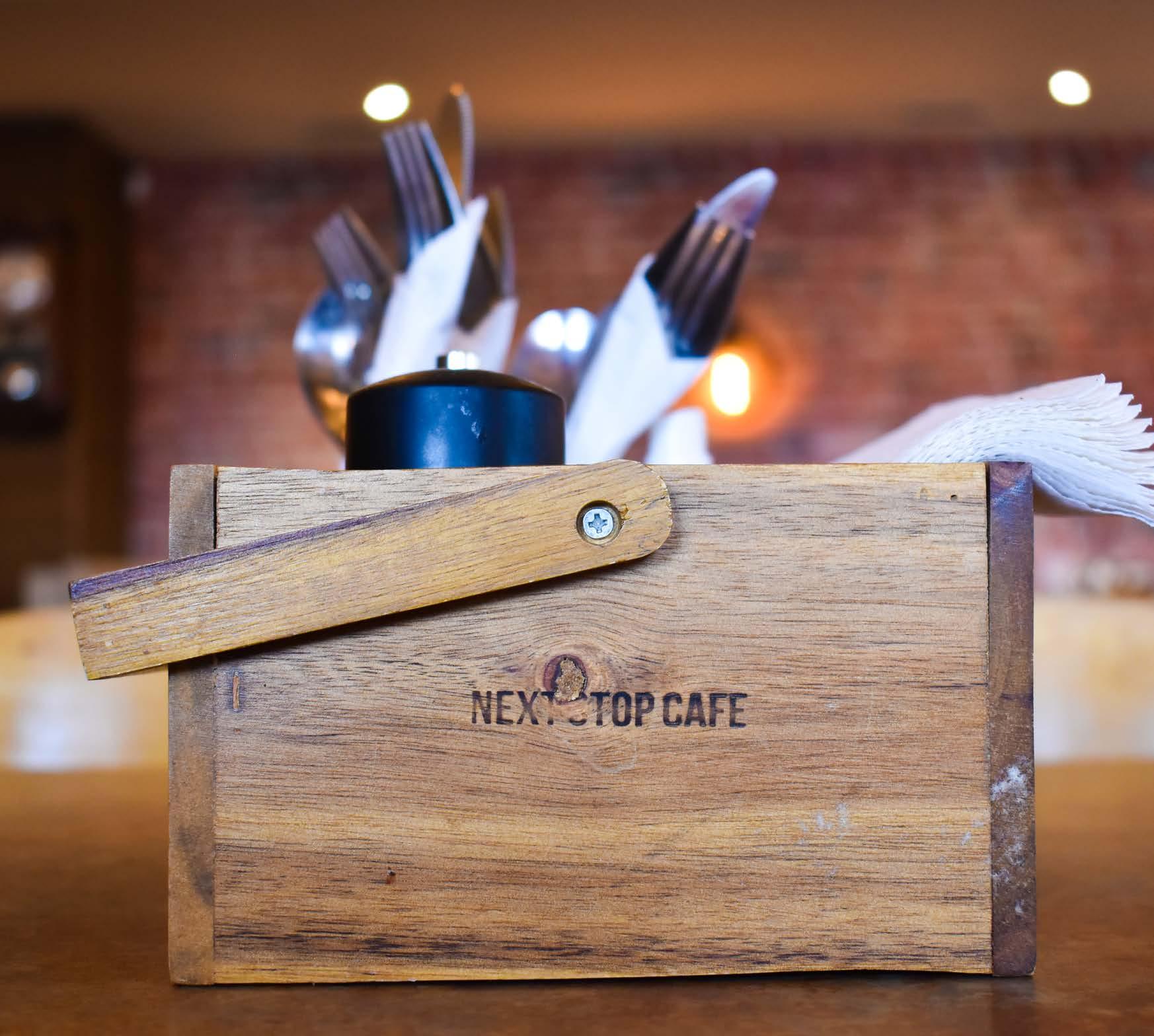
Next Stop’s felafel wrap is always a favourite with the company I bring along. Aside from these savoury selections, the cafe’s dessert menu shines, particularly their monumental milkshake menu. Each iteration is sweet and creamy without tasting artificial. The list features reliable standbys like chocolate
But closing track “wither” is a great one. The song and arrangement are barebones — vocals and one guitar track, no chorus, no bridge, just verses and a repeated guitar riff — but it is gorgeous. Schellenberg sings in this low, raspy range with so much texture and depth, and the melody has a perfect melancholy.
Meadows has delivered yet another great collection of songs only meadows could write. Any fan of indie and lo-fi should seriously consider walking music to soundtrack their next stroll.
Walking Music is available on major streaming services.
arts@themanitoban.com
which is served retaining the very fine grinds used in the brewing process. Next Stop serves the drink with a small shot of water and a sweet to rinse your mouth and counter the bitterness.
The staff are very friendly and anticipate questions before they are asked.
One recent addition to Next Stop’s staff is a tray-carrying, singing kitty-shaped robot. The robot’s front has a screen showing emoticon faces to match the tone of its songs.
What is initially a cute and quirky novelty on first encounter, the robot starts to wear thin with each subsequent visit, as it causes an excited uproar among new customers every time it rolls out of the kitchen.
Overall, Next Stop has a tasty range of filling dishes that are great as a morning boost or a cap on a long day.
Next Stop Café is open from 9:30 a.m. to 10 p.m. weekdays and 9 a.m. to 10 p.m. on Saturdays and Sundays.
or strawberry milkshakes, but its more experimental sesame banana, pistachio, saffron and tiramisu flavours are equally satisfying.
Next Stop’s felafel wrap is always a favourite with the company I bring along
After my tours through Next Stop’s offerings I always caffeinate with the restaurant’s unique selection of coffees. The café is one of few places in the city that serves Turkish coffee, a type of unfiltered coffee
arts@themanitoban.com
Damien Davis, staff
R eturning for its 13th year, Warming Huts v.2023: An Arts + Architecture Competition on Ice revealed its winners, invited artists and the first participants in its new high-school component on Nov. 10.
The competition and invitations involved artists designing new warming huts for placement along the Forks’s Nestaweya River Trail on the Red and Assiniboine rivers.
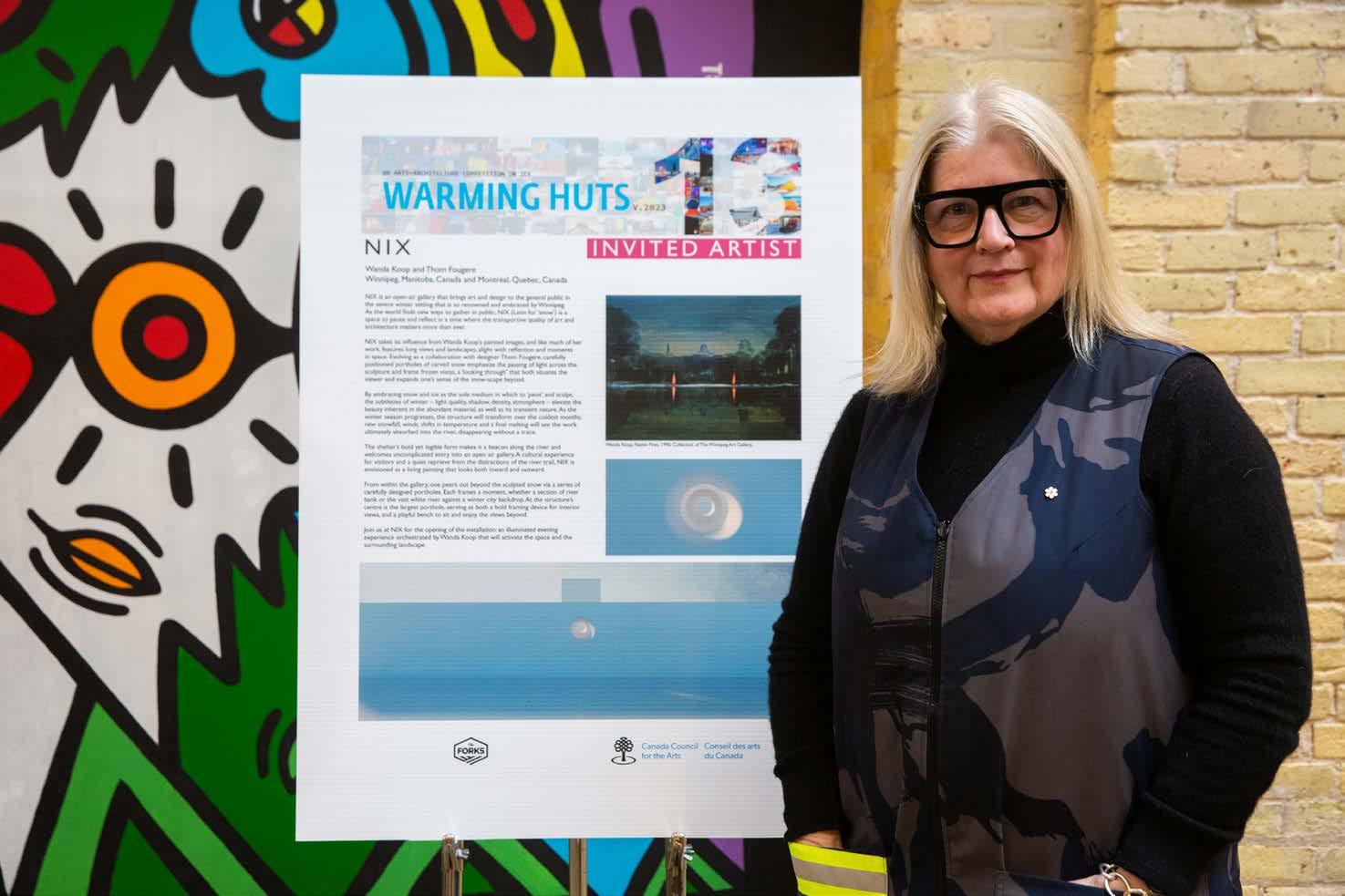
The winning huts this year are “Hayspace” by Philipp Gmür and Hugh Taylor, “Curtain” by Alejandro Felix and Fang Cui and “Meanwhile We Still Dream” by Lindo Jia and Jaymon Diaz.
Mira (Mimi) Locher, dean of the U of M faculty of architecture, said in a press statement that “the faculty of architecture is very excited to be part of the warming hut tradition again this year.”
Locher said that this year’s project “will engage the community in structures that emerge from the frozen river
Jason Hare, manager of the U of M’s digital fabrication lab known as the FABLab, told the Manitoban that the faculty of architecture always has a spot in the exhibition held for it and its entries. The opportunity is passed around and a written internal submission is sent to the faculty.
Explaining the origins of
the design side.’”
Hare explained that the design was inspired by Winnipeg’s accumulation of snow, and that the team recalled childhood memories of snowpiled hills with “waves coming off them.” The space itself will interact with falling and blowing snow, shaping the snow into mounds with fencing.
“The faculty of architecture is very excited to be part of the warming tradition” — Mira (Mimi) Locher, dean of the faculty of architecture
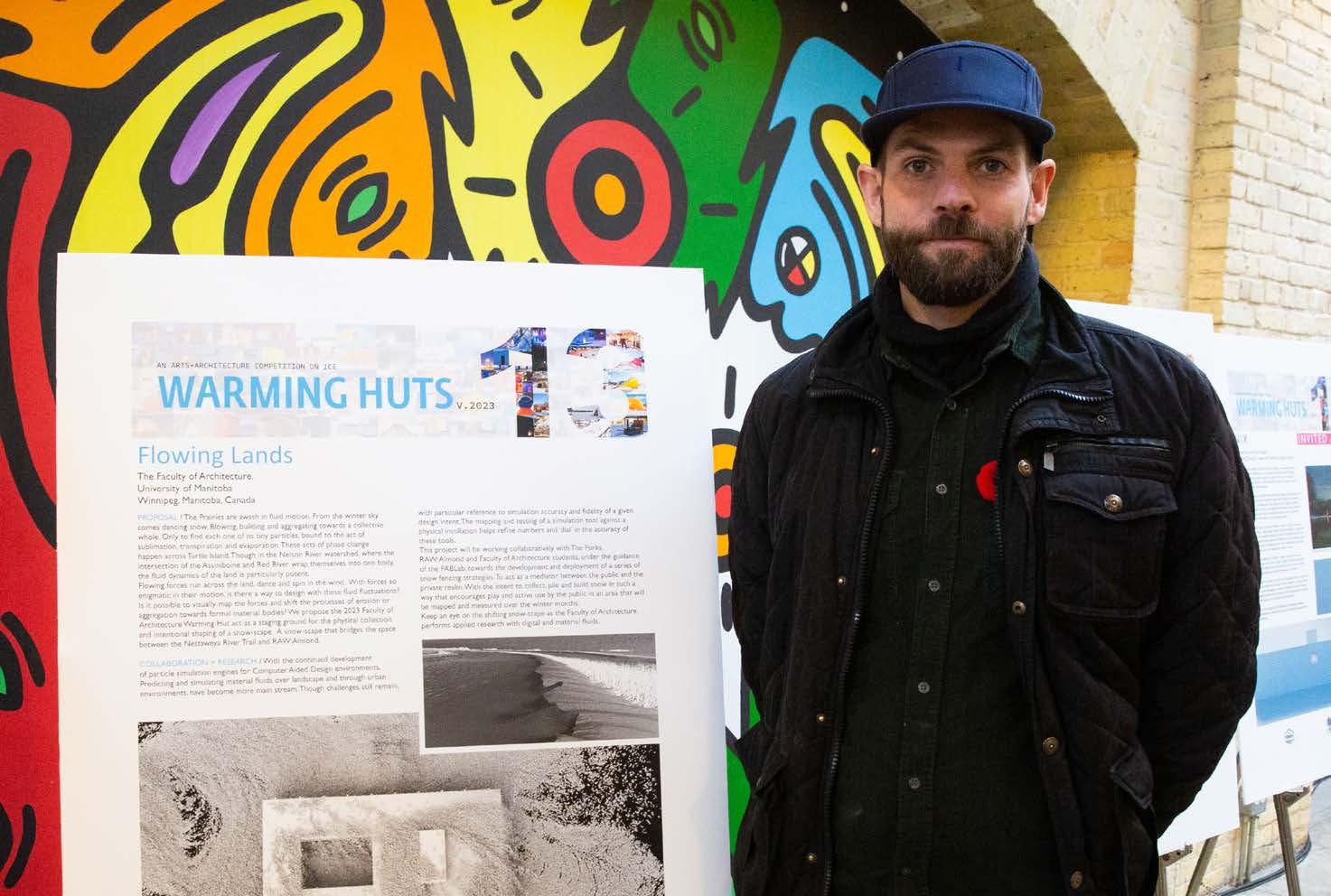
Among the huts designed by invited artists was the U of M’s faculty of architecture submission, “Flowing Lands.”
and intersect with the wind to capture the dancing snow that falls from the winter sky,” adding that “the resulting snowscape will be a playground for the public, and the shifting forms will be the subject of continuous study for our team.”
this year’s design, Hare said, “we were doing some internal research of flow simulations through digital models, and as we were doing that we were starting to realize, ‘Oh, this would be good if we could test it at a really large scale and get students involved in


The question that the team came across was, “can we use this simulation tool to attempt to simulate bigger snow collection agents?” he said.
“Then we would perform that on the river and we’d actually be monitoring it all winter. So that’s what we’re going to do, we’re going to be recording the information of the snow collecting, and then matching against the simulation to see if we can draw it in tighter together.”
Hare added that beyond the technical aspects of the hut, the spirit of the structure would lie in creating a snow fence that would shape snow in an interesting way, with the intention that kids and their families would feel encouraged to play on the resulting snow piles.
“If mystery could come into it, that’d be even better,” he said.
Hare said that as a child, everything feels “so titanic and magical,” and he hopes there will be a level of play and magic that individuals feel while interacting with the structure.
The warming huts will be finished and out on the river trail by the end of January.
arts@themanitoban.com




TKatie Kirkwood staff
he Bisons cross country team’s season came to a close with the U Sports Championships this past weekend.
The team kicked off the season in early September, with great running times in the Bisons Time Trial, including top five finishes from Amy Klippenstein, Angela Kroeker and Hailee Morisseau, who all went on to compete in the U Sports Championships.
On Sept. 30, the cross country team competed in the Roy Griak Invitational held in Minneapolis, Minn., where three of the herd made it into the top 50.
In the men’s 8k event, Justin Kroeker placed 46th, while in the women’s 6k, Klippenstein placed 36th and Angela Kroeker placed 45th.
Following this event, the Bisons made their way to Calgary for the Stewart Cup. The herd killed this event with great placing, and pushed the Bisons into the Canada West Championships.
In the men’s race, Justin Kroeker placed first with a time of 25:06. Following
shortly after, Calvin Reimer crossed the finish line in third place with a time of 25:29.
The women’s event saw great times from Morisseau, who placed seventh with a time of 30:47, and Angela Kroeker, who placed 13th. Klippenstein finished off her race in 22nd place, with a time of 33:56.
At the Chris McCubbins Provincial Championships that took place the following Saturday, Noah Fillion qualified for the Canada West Championships, posting a time of 27:44 in the 8k.
The Canada West Championships were hosted by Trinity Western University in Langley, B.C. on a course that had diverse terrain, ranging from grass to gravel. The course also featured a hill, making the race that much more challenging.
Despite coach Claude Berube wanting to finish somewhere in the top 25 to 30, the runners still placed well with a majority in the top 50.
Reimer had a great run, placing 30th, Justin Kroeker placed 41st and Noah Fil-
lion placed 64th. The women’s team placed well too, with Angela Kroeker placing 36th and Morisseau placing 38th.
To finish off the season, the herd hopped on a plane and headed east to compete in the U Sports Championships this past Saturday, Nov. 12. The event was hosted by Dalhousie University in Halifax, N.S.
The day of the race was windy, cold and wet. Spectators could be seen wearing rain ponchos over their jackets, hats and mitts.
The U of M sent four competitors — Klippenstein, Angela Kroeker, Morisseau and Reimer.
The Bisons’ best placings were held by Morisseau, who placed 56th out of 150, and Kroeker, who placed 67th. Klippenstein placed 86th while Reimer placed 102nd.
It was a respectful conclusion to a good season and cross country fans are sure to be looking forward to seeing where next season will take the herd.
sports@themanitoban.com

Alberta Pandas @ Bisons
Nov. 4 — Final: 69 – 64
Alberta Pandas @ Bisons Nov. 5 — Final: 79 – 55
Bisons @ Fraser Valley Cascades Nov. 11 — Final: 54 – 84
Bisons @ Fraser Valley Cascades Nov. 12 — Final: 58 – 69
Alberta Pandas @ Bisons
Alberta Pandas @ Bisons
Bisons @ Calgary Dinos
Bisons @ Calgary Dinos
Bisons @ MacEwan Griffins
Nov. 4 — Final: 5 – 0
Nov. 5 — Final: 3 – 2
Nov. 11 — Final: 0 – 4
Nov. 12 — Final: 5 – 4 / OT
Nov. 18 — 8 p.m.
Bisons @ MacEwan Griffins Nov. 19 — 4 p.m.
U of M Bisons — Women’s Volleyball
Bisons @ UBC Okanagan Heat Nov. 4 — Final: 0 – 3
Bisons @ UBC Okanagan Heat Nov. 5 — Final: 1 – 3
Brandon Bobcats @ Bisons Nov. 18 — 6 p.m.
Brandon Bobcats @ Bisons Nov. 19 — 5 p.m.
of M Bisons — Men’s Basketball
Alberta Golden Bears @ Bisons Nov. 4 — Final: 81 – 100
Alberta Golden Bears @ Bisons Nov. 5 — Final: 88 – 93 / 2OT
Bisons @ Fraser Valley Cascades Nov. 11 — Final: 73 – 61
Bisons @ Fraser Valley Cascades Nov. 12 — Final: 92 – 53
U of M Bisons — Men’s Football
Conference Playoffs – Hardy Cup Semifinal:
Bisons @ Saskatchewan Huskies Nov. 5 — Final: 9 – 37
U of M Bisons — Men’s Hockey
Bisons @ Alberta Golden Bears Nov. 4 — Final: 1 – 7
Bisons @ Alberta Golden Bears Nov. 5 — Final: 1 – 7
Calgary Dinos @ Bisons Nov. 11 — Final:
Calgary Dinos @ Bisons Nov. 12 — Final: 4
MacEwan Griffins @ Bisons Nov. 18 — 7 p.m.
MacEwan Griffins @ Bisons Nov. 19 — 2 p.m.
Winnipeg Blue Bombers



TQuinn Mayhew, staff
he U of M Bisons swim team took on the 2022 Odlum Brown Colleges Cup on Nov. 5 and 6, where it both triumphed and fell short of expectations.
With Kelsey Wog aging out of varsity swimming, the team had a difficult time earning points in events that would have been easily monopolized by Wog in this year’s Colleges Cup.
Last year with Wog racking up points, the U of M ranked fifth in the U Sports results tally for the months of November and December. After the recent results from this year’s Colleges Cup, the swim team ranks seventh, falling two spots from last year’s results.
Even without Wog competing, the team prevailed, with a total of five podium finishes accomplished by Dora Modrcin, Megan Mozill and the women’s 4x50 freestyle relay team.
Modrcin medalled in both the 50-metre backstroke and 50-metre butterfly, coming in first in the backstroke with a time of 28.03.
Mozill swept up two of the other podium finishes, coming in second place for both the 100 and 200-metre backstroke.
The herd continued to roll into podium finishes with the women’s 4x50 freestyle relay, in which Hannah Schanel, Kelsey Fillion, Georgia Pengilly and Modrcin placed third.
With the women’s portion of the swim team keeping the U of M in the upper tier of the U Sports rankings, the men’s side struggled with the highest men’s squad finish as eighth place in the 4x50 freestyle relay, and Carson Beggs finishing ninth place in the 100-metre breaststroke as the highest men’s individual finish.
With the results of the Colleges Cup meet still fresh, the Bisons hosted the Bisons Sprint IM Invitational on Nov. 12.
The meet yielded impressive results, with five first place finishes — from Modrcin, Fillion and Brayden Stacey — and many members of the team achieving personal bests.
One of the many feats from the weekend included Andriy Usan taking off time of his 100-metre individual medley, finishing with a time of 1:03.93 and coming in sixth.
Another notable performance came from Cameryn Carlos, who finished third in the 50-metre butterfly.
The recent individual personal bests the herd is achieving could potentially put pressure on them to perform well in upcoming meets.
With the Canada West Championships at the end of November, the expectations for the new rookies seem to be mounting under the high accomplishments the team’s
veterans keep achieving.
While the women of the team achieved all the podium finishes and made up most of the points, the men have some big shoes to fill in the upcoming championships of the season if they want to contribute to the U of M’s U Sports rankings. The next meet for the herd
are the Canada West Championships which will be held from Nov. 25 to 27. With all the momentum and spirit that is building, fans can hope that the swim team will continue to achieve podium finishes.
sports@themanitoban.com

Bisons basketball
Both Bisons basketball teams kicked off their regular seasons on Nov. 4 and 5.
The men’s team started the season off strong, handing the University of Alberta Golden Bears squad its first regular season loss in over a year.
The game was an eventful one with the teams neck and neck up until the last quarter, where the Bisons took control of the game and never lost the lead to the Golden Bears, trampling Alberta 10081. Impressively, five of the Bisons players scored points in the double digits, Elijah Lostracco leading the team with 24 points.
The second game was a double-overtime thriller, the Bisons defeating the Golden Bears 93-88. It was first-year
Simon Hildebrandt who put up a great fight at the end of the game, making both free throws near the end of second overtime to secure a Manitoba 90-88 lead. With strong defence from Isaac Miller-Jose, the Bisons came together to finish the game triumphantly with a five point 93-88 win.
Unfortunately, the women’s team did not have such a successful weekend, with both games ending in a loss.
The first game against the University of Alberta Pandas was intense. The game was close up until the fourth quarter when Alberta pulled ahead by 15 points. Although, with strong efforts from Lauren Bartlett and Autumn Agar, the Bisons were able to narrow the lead, finishing off the game only five points behind
the Pandas, 69-64.
The women’s team struggled throughout their second game of the weekend. As each quarter passed, Alberta continued to pull ahead, with a halftime score of 38-28. Despite the growing point gap, Manitoba never stopped trying and continued to put up a good fight. The Pandas won game two 79-55.
This last weekend, the men’s team trampled over the University of the Fraser Valley Cascades 73-61 and 92-53, respectively. The women’s team lost their two games against the Cascades 84-54 and 69-58.
— Katie Kirkwood, staff
Bisons football
The U of M Bisons football team fell short in a blus-
tery Snow Bowl against the Saskatchewan Huskies in the Hardy Cup semifinal game Nov. 5.
A rematch of last year’s Hardy Cup final, the Huskies triumphed over the Bisons 37-9.
The snowy conditions were the largest factor in the game, where field position became king.
The herd only had two points in the first half off a Saskatchewan safety, while the Huskies walked into halftime with a 26-2 lead.
In the early minutes of the second half, Manitoba came to life with Bison defensive lineman Collin Kornelson intercepting the ball off a tip from fellow defensive lineman Tristan Francis.
Three plays later, on a daring third and eight from the
Saskatchewan 30-yard line, quarterback Des Catellier threw for a touchdown to receiver De Shawn Le Jour, cutting the Saskatchewan lead to three possessions after a Niko DiFonte extra point.
However, the Bisons comeback would stop there, only winning the third quarter on the lone touchdown drive of the game. The Huskies would go on to put up another 11 unanswered points in the fourth, securing their place in the Hardy Cup final.
The silver lining of the herd’s season is Catellier becoming the Bisons all-time passing leader.
— Grace Anne Paizen, staff
sports@themanitoban.com