RESEARCH & TECHNOLOGY DESK ? research@themanitoban.com
Elah Ajene (ed.)
COMMENT DESK ? comment@themanitoban.com vacant
ARTS & CULTURE DESK ? arts@themanitoban.com
Alex Braun (ed.)
SPORTS DESK ? sports@themanitoban.com
Kieran Light (ed.)
PHOTO DESK ? photo@themanitoban.com
Ebunoluwa Akinbo (ed.)
DESIGN DESK ? design@themanitoban.com
Matthew Doering (ed.)
GRAPHICS DESK ? graphics@themanitoban.com
Dallin Chicoine (ed.)
AUDIO DESK ? audio@themanitoban.com
Harmatpreet Brar (ed.)
SOCIAL MEDIA DESK ? social@themanitoban.com
Jory Thomas (ed.)
VOLUNTEERS THIS ISSUE ?
VOLUNTEER STAFF ?
interested in volunteering? email me@themanitoban.com today!
109 HELEN GLASS BUILDING
UNIVERSITY OF MANITOBA
WINNIPEG, MB
204. 474. 6535
The Manitoban is the official student newspaper of the University of Manitoba. It is published monthly during the summer and each week of regular classes during the academic year by the Manitoban Newspaper Publications Corporation.
The Manitoban is an independent and democratic student organization, open to participation from all students. It exists to serve its readers as students and citizens.
The Manitoban is a member of the Canadian University Press, and our journalistic standards can be found online at toban.news/jsp.
The newspaper’s primary mandate is to report fairly and objectively on issues and events of importance and interest to the students of the University of Manitoba, to provide an open forum for the free expression and exchange of opinions and ideas and to stimulate meaningful debate on issues that affect or would otherwise be of interest to the student body and/ or society in general. The Manitoban serves as a training ground for students interested in any aspect of journalism.
Students and other interested parties are invited to contribute to any section of the newspaper. Please contact the appropriate editor for submission guidelines.
The Manitoban reserves the right to edit all submissions and will not publish any material deemed by its Editorial Board to be discriminatory, racist, sexist, homophobic or trans-phobic, ableist or libellous.
Opinions expressed in letters and articles are solely those of the authors. Editorials in the Manitoban are signed and represent the opinions of the writer(s), not necessarily those of the Manitoban staff, Editorial Board or the publisher.
A “volunteer staff” member is defined as a person who has had three volunteer articles, photographs or pieces of art of reasonable length and/ or substance published in the current publishing year of the Manitoban.
Any individual who qualifies as a volunteer staff member must be voted in by a majority vote at a Manitoban editorial board meeting. Elected representatives and non-students may be excluded from holding votes as volunteer staff members in accordance with the Manitoban Constitution.
Approximately one in eight cisgender women will be diagnosed with breast cancer at some point in their life.
In 2020 alone, over 2 million were diagnosed with breast cancer and 685,000 died from the disease. In the past five years, there were 7.8 million people living with breast cancer, making it one of the most prevalent types of cancer worldwide.
The impact of breast cancer is a growing issue, prompting research organizations to encourage independent academic research projects with the aim of ensuring a better future for affected individuals. This has brought about increased breast cancer innovations in recent decades.
Among those leading innovative research to enhance our understanding of breast cancer development is Yvonne Myal, University of Manitoba professor and associate head in the department of pathology, as well as senior scientist at CancerCare Manitoba Research Institute.
The bulk of Myal’s studies focus on the prolactin-inducible protein (PIP) — a small secreted protein found in tissues within the body, including the breasts. She worked on this research for several years as a graduate student at the University of Manitoba.
According to Myal, high levels of PIP are found within the breast, and PIP is overproduced in benign breast cystic disease. She noted that evidence of PIP is found in up to 90 per cent of breast cancers
“It seemed to be associated with abnormalities and it must play a role in breast cancer,” she said.
Myal has been involved in pioneering work on this secretory protein, including cloning the PIP gene, identifying its chromosomal position and generating the first genetically modified mouse models used in studying the PIP gene.
Her lab studies have determined that PIP plays some immune defence roles within the body.
Myal explained that PIP is being used clinically in identifying breast cancer cells that have spread through the body.
According to Myal, previous studies suggested that the presence of PIP in the early stages of breast cancer was a good thing, as tumours were more responsive to treatment.
However, she pointed out that it works differently when found in metastatic cancer, possibly serving another
“Collaboration is key to success and moving ahead with research answers”
— Yvonne Myal, senior scientist at CancerCare Manitoba Research Institute
function.
“It’s like a double-edged sword, in that it’s protective in the early stages of breast cancer development, but in the later stages when there is metastasis, it seemed to be facilitating the progression,” Myal said.
Claudin-1 and small breast epithelial mucin (SBEM) — both associated with breast cancer — are two additional molecules Myal has focused on in her research career.
Myal’s current research focuses on using mice models to understand PIP involvement in triple-negative breast cancer — an aggressive form of breast cancer that accounts for 15 to 25 per cent of all breast
cancers. Those diagnosed with triple-negative breast cancer on average survive for about 10 months post-diagnosis
“These cancers are hard to treat,” she said. “They are resistant to current treatment and chemotherapy.”
When using these models in mice with a normal immune response, Myal explained that “in the tumours that express PIP, their growth is delayed compared to the tumours that, our control, do not express PIP.”
“In the immunocompetent mice, when we check the metastasis in the lungs, the presence of PIP seemed to make the tumours more
aggressive and more metastatic,” she added.
On the other hand, when looking at mice with compromised immune systems, Myal found that it makes no difference.
“This is important information, because we’re trying to find out what works in the metastatic state and how we can, as researchers, identify those things that would lead to clinical enhancement and treatment,” she said.
Research — facilitating the further expansion of breast cancer research.
“I have many collaborators,” Myal said. “Collaboration is key to success and moving ahead with research answers.”
Myal has also mentored many students who have gone on to work across a wide range of professions.
“You see me, but I represent a team,” she said. “I truly believe in teamwork, I truly believe in mentorship.”
Myal’s work currently is funded by organizations such as the National Sciences and Engineering Research Council of Canada, the Cancer Research Society and the Canadian Institutes of Health research@themanitoban.com
graphic / Dallin
Chicoine / staff
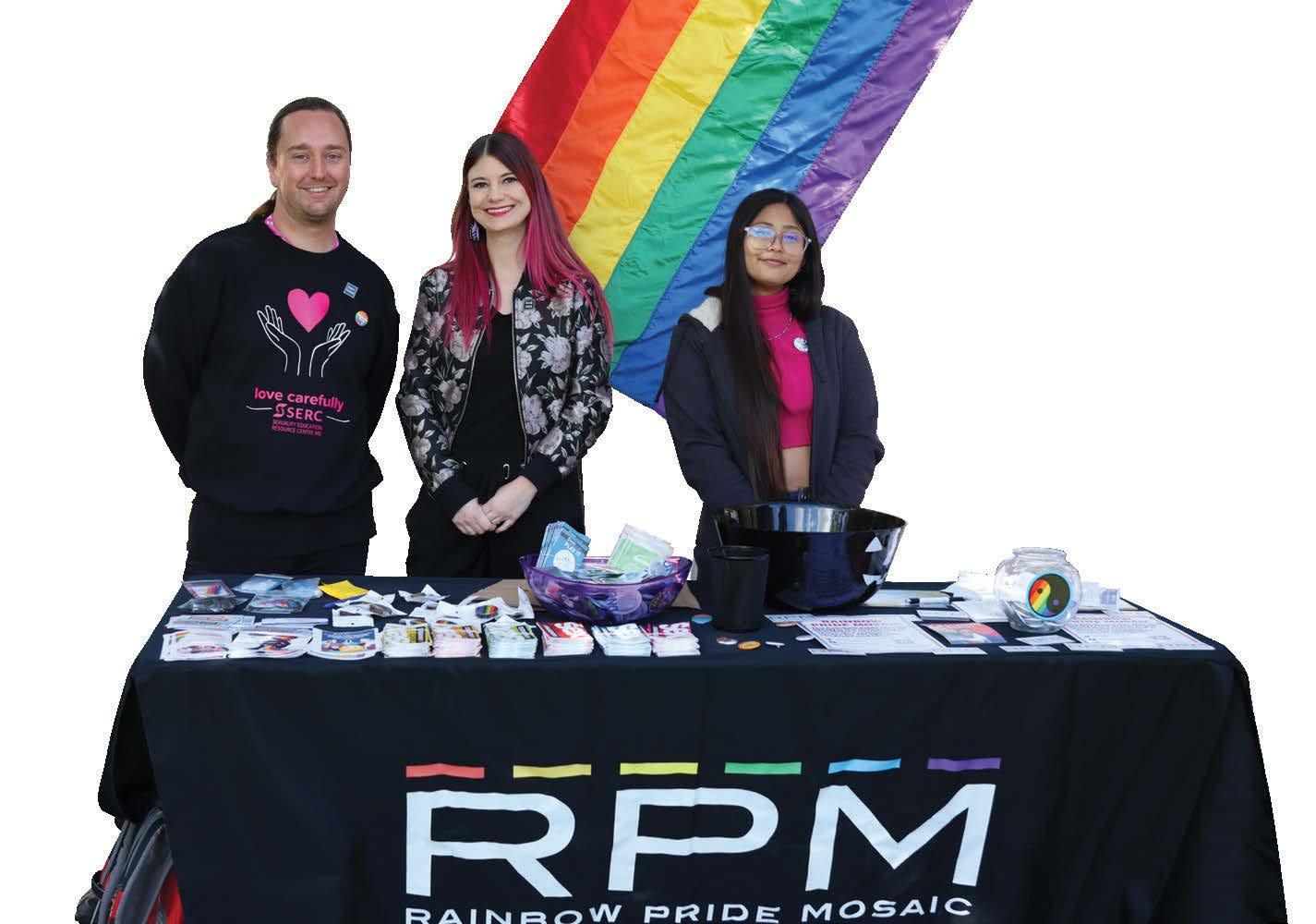
Your voice matters! Communities are intended to provide students an opportunity to connect with people of a common identity at large. Join various community groups such as the 2SLGBTQIA+, International, Black, Accessibility and Indigenous students! Each month community assemblies are held for you to come together and voice your opinions on all matters related to campus life. Have an impact on inclusivity, safe spaces, and empowerment on your campus!
Student Clubs are intended to provide opportunities for individuals with common interests to participate in a variety of activities. Clubs are formed, organized, and governed by volunteer University of Manitoba students under the requirements established by certain policy holders. For this reason, UMSU offers supports to recognized student groups and communities with office spaces, equipment rentals, meeting space, funding, and more.
Arts & Culture >
’Toban turntable
TDJ — ‘SPF INFINI 2’
Alex Braun, staff
4/5 Stars
TDJ is the pseudonym of Montreal-based producer and artist Geneviève Ryan-Martel. Specializing in a retro brand of Eurodance and trance, her music is glossy but nostalgic in a sort of eerie, hypnagogic way.
Despite the music’s high tempos and rave-friendly structure, there’s a throughline of real melancholy. She cites the influence of Tiësto and Taking Back Sunday in the same breath, if you catch my drift.
To my mind, TDJ is part of the long lineage of internet-y electronic music that explores how the information age has flattened time and genre boundaries, leaving us in an eternal state of nostalgia for pasts that never existed, and free to combine influence in idiosyncratic ways.
Recently, TDJ has worked
in series. First, in her numbered self-titled EPs, recently collected as TDJ123, and now with her second audio/visual DJ mix in the SPF INFINI series.
It’s a summery title evoking endless time under the sun, but one that has a strange connotation when applied to this mix.
The set itself is an intoxicating, high energy, nocturnal assortment that runs the gamut from trance to Italo-tinted hyperpop, to downtempo balladry to sharp techno. The bulk of the material consists of tracks and collaborations from TDJ herself, alongside mixed tracks from artists from around the world.
The visualizer meanwhile is a grotesque parody of a social media collab house. Set in Tulum, Mexico, we see TDJ performing for and hanging out with a group of comedically disfigured plastic surgery victims who constantly
film themselves pouting and posing for their phone cameras.
It’s a sweaty, gross, hyperreal spectacle — like watching Love Island while having a terrible acid trip.
The film mixes the twisted aesthetics of TikTok-reality with a hip y2k retrofuturism — a motif that I think is often misappropriated these days — but one that TDJ nails in her music. It conjures a lost, shiny future of endless parties and pre-9/11 American innocence.
Standout tracks like the fknsyd collab “Blow Away (In My Arms)” and “Sway (The Places She Goes) (Vocal Trance Mix)” have a weightlessness to them, with airy synths floating above the pounding trance beats.
Other tracks like “Saw Love” and “Future4000” have a hyper, semi-ironic Eurodance sleaze factor. The mix is remarkably consistent while remaining engaging and emo -
tional throughout, navigating BPM and vibe shifts with ease.
TDJ’s SPF INFINI 2 is available on major streaming services. The video can be viewed
UMFM show spotlight: The Sample Set
on Youtube, or purchased as a DVD at tdjmusic.bandcamp. com
arts@themanitoban.com
Host Ambrose Moncrieffe presents a history and defence of sample-based hip-hop
Alex Braun, staff
Campus radio host Ambrose Moncrieffe is big into audio and digging under the surface of the music he loves. His show The Sample Set, which airs Thursdays at 11 p.m. on 101.5 UMFM, is a mix of sample-based hip-hop that goes into the samples themselves.
“What I’m pursuing currently is becoming an audio engineer or somebody who works within the audio field,” Moncrieffe said.
But beyond just showing listeners how hip-hop production works, Moncrieffe is also trying to present a sort of history of hip-hop itself.
“Hip-hop started as somebody taking records from a different genre and playing them in a manner that almost created a new genre, similar to
reggae or whatever else producers spun.
Recent episodes featured tracks from legends like A Tribe Called Quest, The Avalanches, DJ Premier and The Alchemist that mixed with music from Ohio Players, Isaac Hayes and The Gap Band.
“That’s something that I like to express on my show is that hip hop is a sample based genre”
— Ambrose Moncrieffe, host of The Sample Set on UMFM
“Stemming from that, I am a nerd in terms of audio.”
“I like making music, I like making beats and I also just like everything to do with audio. So when I’m watching movies or listening to music, I’m always kind of listening to the dynamics of the audio,” he continued.
“I just like to hear how things are done.”
Keeping with Moncrieffe’s audio obsessiveness, the show’s production value is quite high, featuring admirably smooth transitions.
drum and bass and things of this nature,” he explained.
“Something that I like to express on my show is that hip-hop is a sample-based genre, no matter if it’s new hip-hop, old hip-hop, whatever sort of hip-hop.”
Genre-wise, The Sample Set features lots of old school boom bap music, along with newer tracks that share the sensibility. But alongside these tracks are the songs that went into their production, meaning the show features a healthy dose of funk, soul,
Though the show’s concept of musical dissection may make it sound dry, the show itself is above all else a vibey mix of classic rap and thrift store gems.
Moncrieffe hopes the show will help demystify and destigmatize a longheld belief among music fans about sampling.
“There’s a stigma unfortunately that sampling’s lazy, because people say, ‘well, you lack creativity musically,’ that’s why you’re sampling” he said.
“But when you really analyze the art, which I do on my show, you can see that it’s actually very intricate and very difficult to sample music.”
Moncrieffe acknowledged that “there are lazy ways to
sample, where you just literally grab a quick chop from a soul record and throw it on some drums and call it a day.”
But Moncrieffe sees the art of flipping a sample as “people that are carefully choosing sections of art, to stitch them together and create a whole other art piece.”
Much in the same way, episodes of The Sample Set weave together rap songs and their sample-sources to create a recontextualized work that
frames the music in a new light.
The Sample Set airs Thursdays at 11 p.m. on 101.5 UMFM, and an archive of past episodes can be found at https://umfm.com/programming/shows/the-sample-set
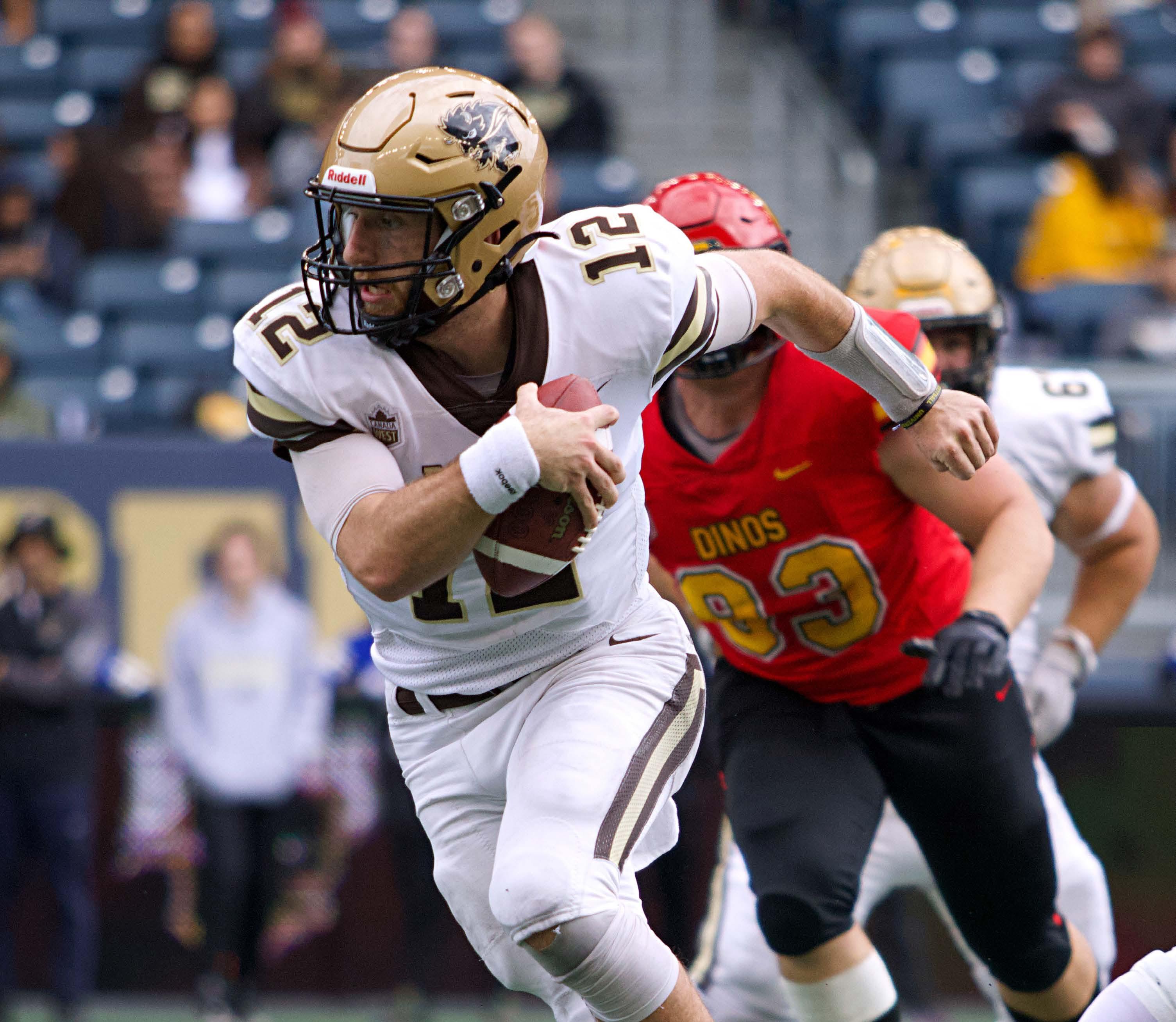
toba Bisons football team hosted the University of Calgary Dinos on Sept. 24.
Coming off a much-needed win against the University of British Columbia Thunderbirds, the Bisons trampled the Dinos, this time primarily using their rushing attack.
The run game was led in force by second-year running back Breydon Stubbs with 169 rushing yards out of the team total 352 rushing yards. Alongside his yardage, Stubbs notched his first touchdown of the year.
The game itself started out with a 48-yard return by Bison kick returner Kai Madsen, followed by a 17-yard rush by Stubbs. But it was the second
quarter that truly started the action.
After three punts at the start of the second quarter, a barrage of points soon followed. The Bisons scored their second field goal of the night to put them up 6-0, and the Dinos responded with a field goal of their own.
for the Bisons.
While the Bisons were forced to punt after the safety, they rebounded with an interception from linebacker Dolan Hills. The Bisons capitalized off the Dinos’ turnover with
The second half began with five punts from both sides.
The game’s score was meteoric for the Bisons and gave them a second straight win, as well as their second win of the season
The Bisons soon added to their lead with a nine-play, 75-yard drive resulting in a touchdown. An extra point later, the score was 13-3 for the Bisons.
The next drive by the Dinos was a disastrous series of penalties that culminated in a safety and another two points
a touchdown from De Shawn Le Jour putting themselves in a comfortable 22-3 lead over Calgary.
The Bisons would finish the half with a Niko DiFonte 30-yard field goal that brought the score to 25-3 for the home side.
The Dinos notched a single point, making the score 25-4 and marking their first answered point since the 10:10 mark in the second quarter. Three drives later, the Bisons once again found themselves in the end zone following an eight-play, 81-yard series capped off by a Jackson Tachinski goal line push, upping the Bisons lead to 32-4.
In the fourth quarter, the Bisons tacked onto the score with a second touchdown from Tachinski, pushing the score to 39-4.
The Bisons would later close off the game by way of an eight-yard touchdown rush from Tachinski. The final score was 46-4.
This game’s score was meteoric for the Bisons and gave them a second straight win, as well as their second win of the season.
While the Bisons lost this last weekend 43-22 to the Saskatchewan Huskies, they will have this fabulous win against the Dinos as motivation for the future.
The Bisons’ next game is a rematch with the UBC Thunderbirds in Vancouver on Oct. 15.
sports@themanitoban.com
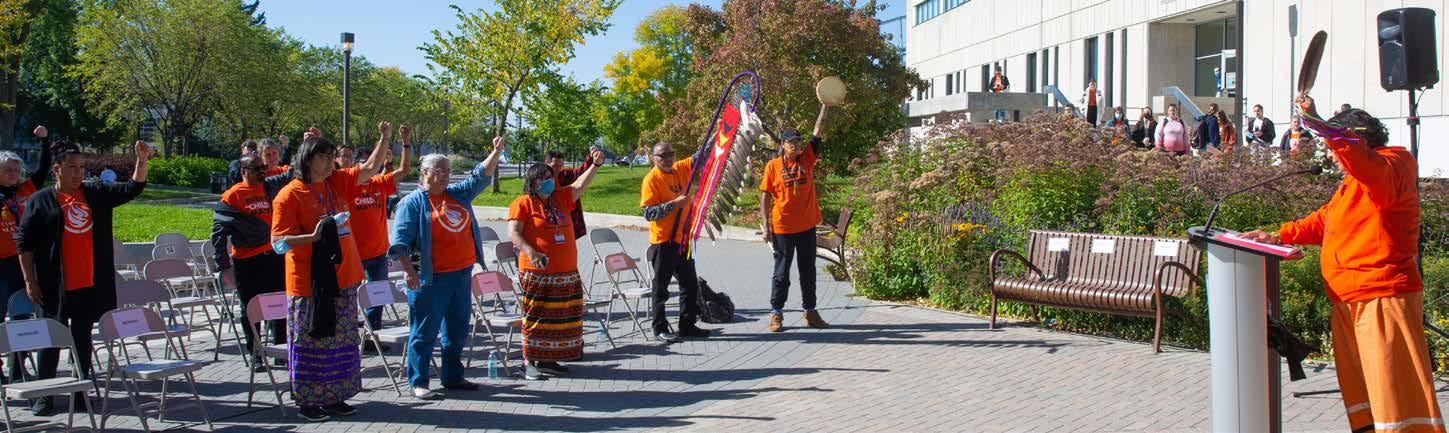
Orange Shirt Day on campus
Ebunoluwa Akinbo, staff
Every 30th of September
in Canada is set aside as the National Day for Truth and Reconciliation, also known as Orange Shirt Day. This day recognizes the survivors of residential schools, the children who didn’t survive residential schools and the past harms and unjust treatment of Indigenous people in Canada.
The process of reconciliation was made official in Canada in 2008, when the Truth and Reconciliation Commission was launched to not only record the effects of residential schools on Indigenous peoples, but also to permanently establish reconciliation efforts across Canada.
The Nursing Students’
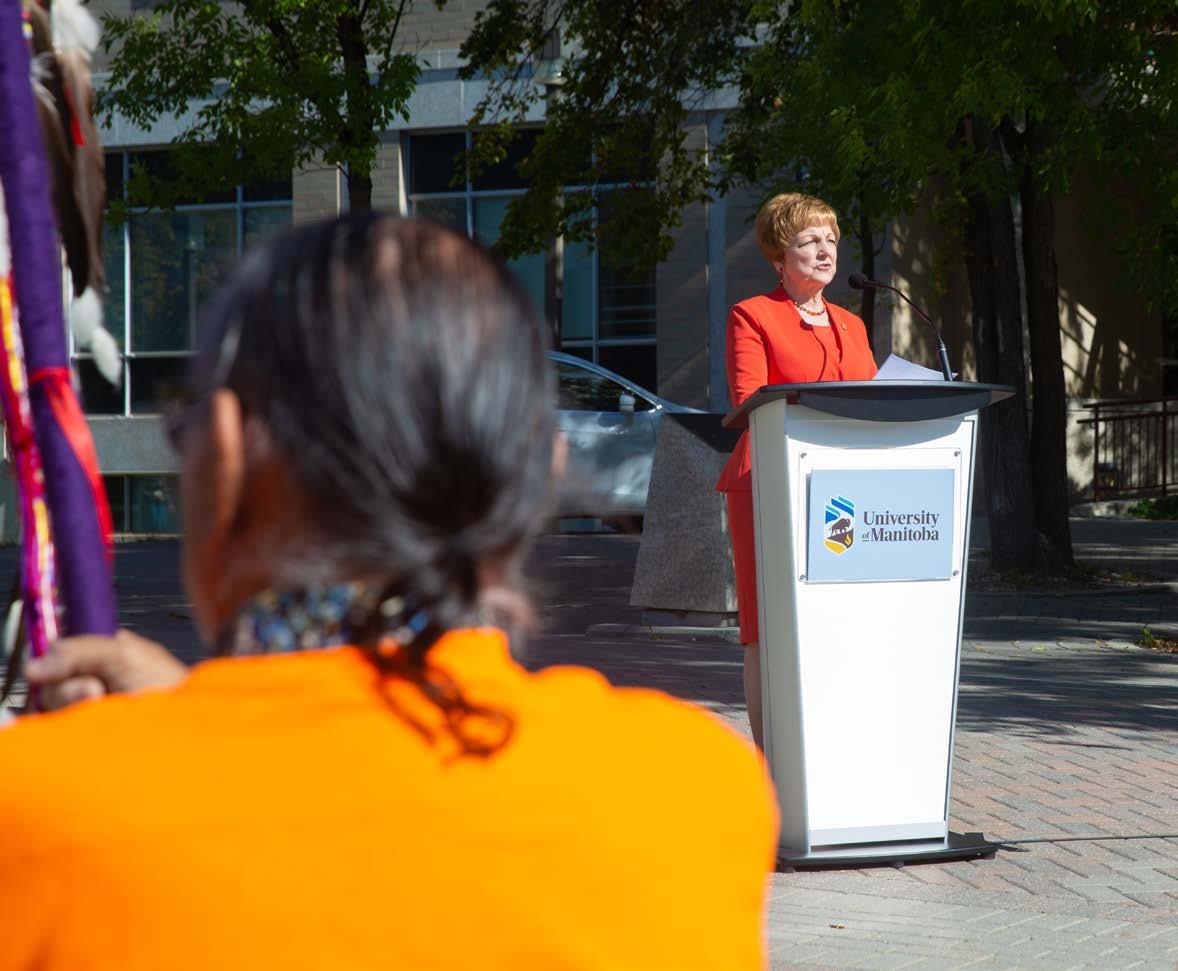
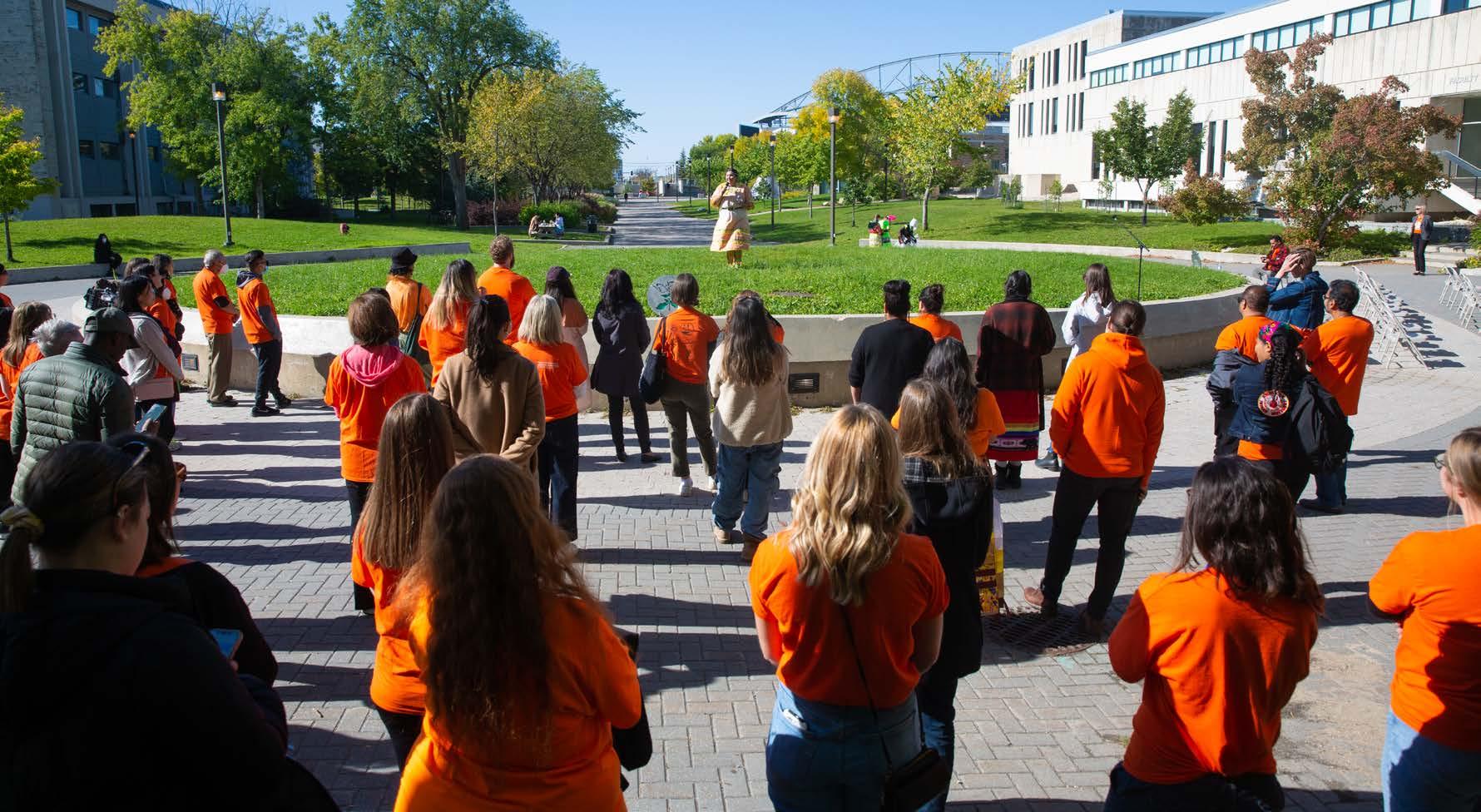
Association (NSA) hosted its annual Orange Shirt Day walk event in recognition of Truth and Reconciliation Day. The event was held on Sept. 29.
According to nursing student and president of the NSA Vivian Umeohabike, it is important for nursing students to be involved in reconciliation so that they can better practice holistic care when healing Indigenous people.
Umeohabike, who is an international student from Nigeria, emphasized that it is important for international students to be aware of the land they are on to learn about Indigenous people’s history.