since 1914

Another round
Fourth dose becomes available

Petty poetry
New book influenced by late musician



Two worlds
Stefanson losing grip on pandemic’s reality
Taking his talents to south Winnipeg
Hildebrandt joins Bisons basketball










since 1914
Fourth dose becomes available
Petty poetry
New book influenced by late musician
Stefanson losing grip on pandemic’s reality
Taking his talents to south Winnipeg
Hildebrandt joins Bisons basketball
Lucas Edmond, staff
Airbnb is often hailed as one of the first technology platforms to revolutionize the hospitality sector, by giving homeowners the ability to share their property when they are away. For cities, home-sharing platforms like Airbnb, in their ideal form, are a win-win scenario: families that leave their properties in the winter or for vacations are replaced with tourists to support local businesses and maintain regular density levels. But the popular home-sharing app is producing shortages in the housing market and inflating the long-term rental market for locals.
Due to this concern, Winnipeg’s municipal government is considering regulating its short-term rental market. At the beginning of 2016, Airbnb listed just 478 Winnipeg properties on its platform, but today, the app has 1,104 active rentals in the Winnipeg area. In the eyes of tenants competing with profit-hungry landlords for the most affordable rent, that’s 1,104 properties that could have brought down their rent. If every dollar counts in today’s economy, every property certainly does, too.
Although Winnipeg is far from the tourist attraction other Canadian cities like Toronto, Vancouver or Montreal are, the city council is taking note of the increasingly worrying problem that short-term rentals pose to metropolitan areas. Airbnb markets itself as a middleman that brings tourists to neighbourhoods that don’t have the hospitality infrastructure to host them. As a result, the app claims it draws billions of dollars to local businesses that regularly wouldn’t get a piece of the tourist industry’s pie. However, this ignores the prices locals are paying to have an array of hosts in their neighbourhood, and it also makes the blanket assumption that all Airbnb hosts are locals renting out their only property.
In reality, the corporate world has tapped into the home-sharing profit stream and many of them aren’t locals. This is creating a manic gentrification gold-rush in large Canadian cities. Corporate bodies and landlords are buying up properties for the sole purpose of marketing them on shortterm rental platforms.
For example, approximately 600,000 of the 1.1 million Airbnb listings in the U.S. are owned by hosts that have multiple properties advertised on Airbnb. Further, 600,000 listings are advertised for longer than six months each year, indicating that these properties are commercialized. Due to this heavy commercialization, local revenue is being lost, not gained.
Critics have called this commercialization process the “Airbnb effect.” The more houses that are pulled from the long-term rental market, the more
local tenants are paying for rents. This growth continues until locals a gradually priced out of their neighbourhoods.
chance for the rich to get richer, which will subsequently make the poor poorer. To ensure Airbnb is managed by locals for the benefit of locals,
Finally, since platforms have the data and capacity to regulate the previous suggestions with a simple algorithm, Winnipeg should make them responsible for limiting accounts and listings.
Although Airbnb and other

Although Airbnb and other home-sharing platforms have the potential to do a lot of good for the city, unchecked and unregulated Airbnbs are a loophole for landlords who don’t want to deal with the long-term rental market’s red tape
U.S. showed “a one per cent increase in Airbnb listings is causally associated with a 0.018 per cent increase in rental rates and a 0.026 per cent increase in house prices.” Although these numbers appear small, the study noted that Airbnb’s average yearly growth rate is roughly 44 per cent.
Winnipeg must curb corporate incursions into home-sharing platforms before it becomes a victim of commercialization like other major North American cities. Home-sharing is a great idea, but when unregulated it is a
Winnipeg should implement a “one host, one rental” policy. Landlords shouldn’t be able to buy up properties to market them on short-term home-sharing platforms — this does nothing but encourage gentrification.
Further, the number of days hosts are permitted to rent their property out should be limited to incentivize locals to rent out their primary residences — this will have the added benefit of discouraging commercialization, considering it places a cap on profit margins that are likely much slimmer than long-term rental markets.
home-sharing platforms have the potential to do a lot of good for the city, unchecked and unregulated Airbnbs are a loophole for landlords who don’t want to deal with the long-term rental market’s red tape, which cities and provinces have established to protect tenants from fundamentally predatory and unproductive landlords. Winnipeg is better off with no Airbnb if the alternative is an unregulated Airbnb.
comment@themanitoban.com
Grace Paizen, staff
The relationship between music and poetry spans centuries.
Posing a “chicken or the egg”-like dilemma for the world of the arts, it is nearly impossible to imagine one without the other, particularly considering how the two forms influence and imitate each other.
In her debut collection of poetry, Indigenous-American author and former University of Manitoba student Michelle Lietz creatively intertwines these two artistic worlds.
Occasionally Petty — debuting April 21 and published by the independent, Winnipeg-based At Bay Press — is a selection of poems set to the songs of late singer-songwriter Tom Petty.
Lietz described the collection as “memory-based storytelling” with poems “inspired by the music of Tom Petty in some way, some manner.”
In fact, “every poem starts with a Tom Petty song,” Lietz said.
Lietz described the inspiration as coming from having “vibed with Tom and his music since pretty much the day [she] was born,” stating that “it was always there, it was just always there.”
“I was 10 years old going into the music store being all like, ‘Hey, can I get the new Tom Petty album?’ and there’s some 20-year-old who’s like, ‘How old are you? How do you know who this person is?’” she said.
Petty’s music “was constant,” she continued.
“Even from when I was a kid, he had a solid discography that I was already, early, introduced to that I had to work with, but he kept putting music out as I was growing up and I kept listening to it.”
Though it may sound like a potentially upbeat musical romp through Petty’s songs, the themes of the collection revolve around grief and relationships.
“It’s a little hard to tell people that my inspiration was grief,” Lietz said.
“I was in mourning and the only way that I felt like I could express the depth of that grief was through poetry.”
And with Petty’s soundtrack as a companion, his music “became more relevant to me as I grew older, and I heard the same songs in different ways as the years went on.”
Since Petty’s songs are often a type of narrative storytelling, Lietz believed that was why her poetry and his songs paired so well together.
“With this kind of project, my poetry and Petty’s songs just clicked together because I was able to tell my own story in a way that I know was at least partially encouraged by the kinds of ways that he would tell stories in music,” Lietz said.
This synthesis of storytelling between Lietz and Petty creates “a lot of subtext” and “a lot of intentional building that most people might not see immediately.”
In fact, Lietz knows “it would be a very rare person who truly understood all of the book, because there are parts that are just for certain kinds of ears [...] people that know how to hear it.”
“I flat out say that multiple times in my book in different ways, but you know, it’s poetry, people don’t always think that you mean what you’re saying,” Lietz said.
Beneath this subtext lies Lietz’s “emphasis on gratitude, but in the way that finding gratitude can be a journey.”
Though the journey of finding gratitude through processing grief and mourning is a heavy theme, there are moments of levity in the collection as well, as there can be moments of humour and laughter in the process of grief.
“There’s a lot of nerdy jokes that people might not get, I’m okay with it,” Lietz said.
“Some of them are Star Trek jokes and others are William Carlos Williams jokes.”
By the end of Lietz’s collection, the poet hopes “that it helps in some way for someone,” particularly those going through mourning.
“I would like it to be helpful in the
ARTS & CULTURE
Alex Braun, staff
4/5 stars
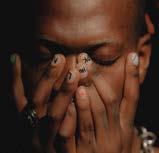
Pierre Kwenders, born José Louis Modabi, has spent nearly all of the past decade breaking down borders in music. The result is a heady mix of genres and languages, incorporating rumba, electronic, hip hop and R&B. Born in Kinshasa, the capital of the Democratic Republic of the Congo, Kwenders founded the Montreal Afrofuturist artistic collective Moonshine in 2014, promoting “lunar-based events” and releasing a series of mixtapes that brought the sounds of Africa’s booming electronic scene to Canadian clubs.
Kwenders’s new project, José Louis and the Paradox of Love, is similarly ambitious and wide-ranging. Recorded with a worldwide array of
collaborators over the course of four years, the album is dizzyingly eclectic but grounded in very personal issues of love and connection. The album’s title references Kwenders’s birth name, establishing a direct connection to the stories told in these songs. As someone who speaks only one of the five languages sung on the record, these themes are a bit beyond me.
Language, though, is no barrier to the music here. The epic opener “L.E.S (Liberté Égalité Sagacité)” is a hardpounding slab of techno-fied rumba. Beginning with an acidic bassline filled out by some hypnotizing hand drums, the track slowly builds into a rousing toast from Kwenders, expounding the titular values — an Africanized take on the French revolutionary motto which replaces “fraternité” with “sagacité,” a term coined by Ivorian singer Douk Saga
— before giving way to a more chilledout back half, which features Arcade Fire singer Win Butler crooning the mantra “this brotherhood is no good,” once again discrediting the revolutionary value of fraternity. Chiming highlife guitars join the party but they’re oddly off-key, adding to the dark vibe of the track.
Lead single “Papa Wemba” is a smooth but overwhelming track with layers of horns, synths, guitars and strings swirling around the pounding beat and Kwenders’s low, seductive half-spoken vocal. It’s a sound both romantically sweeping and strangely aggressive, showing that even on one of the album’s most immediately catchy tracks, Kwenders is still interested in packing as much as he can into his music.
José Louis and the Paradox of Love is difficult to summarize. With its 13 tracks, it covers a lot of musical ground drawn from various genres
photo / At Bay Press / provided

world,” Lietz said.
In our modern world, where so much grief is constant and many of us are in some process of mourning — whether it be the loss of the pre-pandemic world, or the atrocities committed both here in Canada and around the world — Occasionally Petty has the potential to be a therapeutic soundtrack of poetry.
Michelle Leitz’s debut poetry collection Occasionally Petty will be available at major retailers on April 21.
arts@themanitoban.com
and cultures, yet Kwenders delivers a deeply ambitious, inclusive, exciting and dense project worthy of time and attention.
Pierre Kwenders’s new album José Louis and the Paradox of Love will be available April 29.
arts@themanitoban.com