RESEARCH & TECHNOLOGY DESK ? research@themanitoban.com
Michael Campbell (ed.)
Emma Rempel
COMMENT DESK ? comment@themanitoban.com
Lucas Edmond (ed.)
Ivan Nuñez Gamez
ARTS & CULTURE DESK ? arts@themanitoban.com
Shaylyn Maharaj-Poliah (ed.)
Alex Braun
Zoë LeBrun
Grace Paizen
SPORTS DESK ? sports@themanitoban.com
Matthew Merkel (ed.)
Isaiah Wagner
PHOTO DESK ? photo@themanitoban.com
Basel Abdelaziz (ed.)
Mohammad Arsalan Saeed
DESIGN DESK ? design@themanitoban.com
Matthew Doering (ed.)
Mikaela Warkentin
GRAPHICS DESK ? graphics@themanitoban.com
Dallin Chicoine (ed.)
Marina Djurdjevic
AUDIO DESK ? audio@themanitoban.com
Josh Wesey (ed.)
SOCIAL MEDIA DESK ? social@themanitoban.com
Molly Smyth (ed.)
Audra Ashley
VOLUNTEERS THIS ISSUE ?
VOLUNTEER STAFF ? Emily Unrau-Poetker
interested in volunteering? email me@themanitoban.com today!
THEMANITOBAN.COM
109 HELEN GLASS BUILDING
UNIVERSITY OF MANITOBA
WINNIPEG, MB
204. 474. 6535
The Manitoban is the official student newspaper of the University of Manitoba. It is published monthly during the summer and each week of regular classes during the academic year by the Manitoban Newspaper Publications Corporation.
The Manitoban is an independent and democratic student organization, open to participation from all students. It exists to serve its readers as students and citizens.
The Manitoban is a member of the Canadian University Press, and our journalistic standards can be found online at toban.news/jsp.
The newspaper’s primary mandate is to report fairly and objectively on issues and events of importance and interest to the students of the University of Manitoba, to provide an open forum for the free expression and exchange of opinions and ideas and to stimulate meaningful debate on issues that affect or would otherwise be of interest to the student body and/ or society in general. The Manitoban serves as a training ground for students interested in any aspect of journalism.
Students and other interested parties are invited to contribute to any section of the newspaper. Please contact the appropriate editor for submission guidelines.
The Manitoban reserves the right to edit all submissions and will not publish any material deemed by its Editorial Board to be discriminatory, racist, sexist, homophobic or trans-phobic, ableist or libellous.
Opinions expressed in letters and articles are solely those of the authors. Editorials in the Manitoban are signed and represent the opinions of the writer(s), not necessarily those of the Manitoban staff, Editorial Board or the publisher.
A “volunteer staff” member is defined as a person who has had three volunteer articles, photographs or pieces of art of reasonable length and/ or substance published in the current publishing year of the Manitoban.
Any individual who qualifies as a volunteer staff member must be voted in by a majority vote at a Manitoban editorial board meeting. Elected representatives and non-students may be excluded from holding votes as volunteer staff members in accordance with the Manitoban Constitution.
Health and Wellness plans harm reduction workshops
The Health and Wellness Office at the University of Manitoba is offering three free harm reduction workshops this month, available to staff, faculty and students.
These workshops, hosted through Zoom, aim to show that a harm reduction model is needed to reduce potential harm related to substance use and sex, working from the view that accepting and understanding the fact that activities related to substance use and sex will occur in our society helps to reduce the potential harms associated with those activities.
The first workshop, offered Feb. 1, was titled “Overdose Recognition and Response Training.”
“This workshop was prepared to provide students, staff and faculty with an opportunity to learn more about how to recognize an overdose as well as steps that can be taken in the community to prevent or avoid further harm,” a representative from the Health and Wellness Office said in a written statement.
“During this workshop, participants can expect to learn what an overdose is, what a stimulant and opioid/ depressant overdose may look like and how they can respond.”
Workshops on “Enhancing the Holidays Through Harm Reduction” and “Enhancing the Exam Season Through Harm Reduction” are being held on Feb. 8 and Feb. 15 respectively,
staff
from 5 p.m. to 6:30 p.m.
Both workshops are offered through the U of M’s Student Counselling Centre alongside the Health and Wellness Office.
The “Enhancing the Holidays Through Harm Reduction” workshop explores responsible approaches to alcohol consumption. It also provides insights on various way to create boundaries with loved ones during holidays such as Valentine’s Day.
The final workshop offered is called “Enhancing the Exam Season Through Harm Reduction” and offers routes to manage generalized anxiety as well as stress-related anxiety. It also identifies coping strategies for stress as well as tips for preparing for exams.
“The purpose of these workshops are to provide students with an opportunity to learn more about the harm reduction principles and how to apply it into their everyday lives,” wrote the Health and Wellness Office.
“We understand the holiday seasons and exam periods can be two stressful timeframes for students. Because of this, we wanted to tailor these presentations to represent these two situations.”
More information about these workshops can be found online through the university’s Health and Wellness Office.
“We understand the holiday seasons and exam periods can be two stressful timeframes for students. Because of this, we wanted to tailor these presentations to represent these two situations” — Health and Wellness Office
Ancient fingerprints dispel gender labour division
RESEARCH
Michael Campbell, staff
Fingerprints identified on ancient pottery have called into question our assumptions about gender roles in ancient cultures. It was previously a widely held belief that in hunter-gatherer societies, men hunted and women gathered. A University of Manitoba researcher has recently added another piece of evidence indicating ancient humans cared less about gender and more about community.
Kent Fowler, associate professor in the department of anthropology, presented his research in the Centre for Social Science Research and Policy’s social science speakers series on Feb. 3 via Zoom.
Fowler’s primary research looks at remnants of precolonial African kingdoms. This interest led him to discover a group of researchers doing anthropological work with fingerprints.
“Out of these questions that I have about the identity of artisans and how crafts organization plays out in different parts of the world at different times has come this constant nagging question about how […] we know who the people [were] who made this,” Fowler said.
“And so, for about 20 years, I’ve been monitoring this very bizarre fringy sort of research that’s been happening on fingerprints, hoping that someday […] we would be able to really use this to say something interesting.”
Researcher finds men and children made ancient pottery, too “Actually, what we end up finding is [that] men and women and kids are all touching these things”
Fowler and his co-authors have used fingerprint identification to determine the sex and age of individuals involved in making pottery. From this, they have broken down some of the expectations of gender roles in ancient social life.
Over the past two centuries, dactylography — the study of fingerprints — has enhanced researchers’ ability to identify individuals from objects they once interacted with.
Dactylography emerged in the late 19th century and was quickly adopted by law enforcement agencies as a means to identify criminal suspects. Fingerprint research has been used by archeologists since the 1960s to distinguish individuals and since the 1990s to identify the demographics of individuals leaving prints on pottery, sculptures and other clay objects.
Despite progress in the field coming intermittently, new progress has been made in distinguishing between the sexes and, to a lesser degree, in determining the age of individuals.
Sexual dimorphism in humans — or the fact that males and females have different bodily features — allows anthropologists to gain insight into ancient civilizations. In fingerprints,
males tend to have lower ridge density than females. This means that, in a given area, the average male’s fingerprint would appear to have fewer lines creating the characteristic loops, arches and whorls than a female’s print would.
Ridge breadth grows larger with age until hands stop growing after puberty. However, because ridge breadth varies by finger, age estimates are treated as a mid-point of a fiveyear estimate. This means ages could be off by 2.5 years in either direction.
Fingerprints cure into clay pottery, forming a lasting impression of the ridge density and breadth of the individual working the clay. This provides insight into who was involved in producing pottery and hints at how labour was divided in ancient social groups.
“I’ve studied economics and gender is always part of understanding labour,” Fowler said.
— Kent Fowler, anthropology professor
Researchers expected to discover female fingerprints in the majority of cases. This follows from a potentially false understanding that, in hunter-gatherer societies, men were more likely to hunt and women were more likely to gather. Recently, there has been a growing body of evidence challenging a theorized gender divide.
Fowler indicated in these social groups there were likely people who were better at completing important tasks and, irrespective of gender, those who were better at the tasks would be needed to complete them.
Fowler and his co-authors found that, in some cases, the majority of pottery was made by men. This finding destabilizes the theory that making pottery was an inherently gendered activity. By contrast, it is an inherently communal activity.
“Actually, what we end up finding is [that] men and women and kids are all touching these things,” Fowler said.
“You have a window of time of about 30 minutes […] before this thing dries. That means those people’s hands were on that […] They’re all there. They’re all handling it.”
What is most striking to Fowler is that these objects retain insights into how they were made and handled by people long ago.
“And to my mind, if you think about it, that is something you can use to seriously teleport yourself into the back, deep into the past […] and it just really breathes this kind of real life into this thing,” Fowler said.
research@themanitoban.com
photo / Kent Fowler / provided
TOB AN the MANI
’Toban cornertable
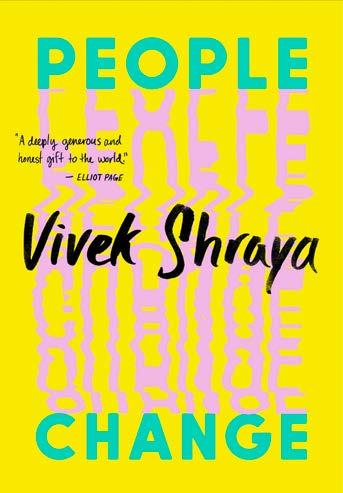
Review: Vivek Shraya — ‘People Change’
ARTS & CULTURE
Grace Paizen, staff
Famed playwright Oscar Wilde once said if you give a man a mask, “he’ll tell you the truth.” Multidisciplinary artist Vivek Shraya’s latest book People Change emphasizes that the mask itself brings out the inner truth of an individual.
A semi-autobiography, Shraya challenges the modern concept of reinvention, asking why “being broken [is] the mother of reinvention,” when reinvention can “predate [...] trauma,” as “change is inevitable and constant” and should not be done in “fear, resignation, or even victimhood.”
Instead, Shraya believes we should “seek out change, crave it, conjure it, worship it.”
Wielding her academic training, Shraya analyzes how change and transformation has been cast as “duplicity or fraud” in western culture, particularly by those presenting a feminine identity.
Shraya uses the “popular trope in mainstream media [of] the image of a trans woman gazing at herself in a mirror, applying makeup” to lament that “The message this trope conveys to the audience is that the trans woman’s identity is something she puts on, and that she isn’t herself — rather, she’s really a he — before this act of maquillage.”
Instead, her book offers an alternate reading of these oft-perpetuated themes, that transformation is the discovery of our “true selves [...] lying dormant, waiting to be unleashed,”
more frightening than fluidity.”
A story of her own transgender identity and a meditation on the transformation of queer identities, Shraya takes on the concept of reinvention, particularly when viewed in a queer light “as an act of survival.”
Shraya writes, “Queer people learn to hide ourselves at a young age through mastering performance.”
The concept of renaming and dressing is also dissected as “sometimes the only way to change culture is to reinvent yourself.”
“When you’re not a man,” Shraya writes, “your appearance is never neutral. Even a white dress shirt is political.”
Filled with masterful new conceptions of identity, Shraya’s writing revolutionizes how we think about how we construct ourselves.
In one of the more radical arguments in the text, Shraya states that “every time I present a new version of myself, those around me are also called upon to change,” revealing that change and transformation are daily tasks between family and friends as our individual selves are reinvented through our own perceptions and our experiences.
With death as a theme sprinkled throughout the text, Shraya also hypothesizes that “reinvention requires both a kind of death and a desire to keep living” — with each death of a part of our identity, a rebirth
going to get out.”
In fact, Shraya intersects suicidal ideation and death of identity as part
“Marginalized bodies continually shed parts of ourselves in order to weather the disasters of oppression”
— Vivek Shraya, author
in contrast to the “concealment” portrayed in these narratives.
Moreover, Shraya argues transformation is “the opportunity to express multiplicity” — to undermine hegemonic systems, as “the marginalized individual is systematically concretized into an identity [...] as a restraint, because there’s nothing
of a new presentation of ourselves is born.
Importantly, Shraya points to the fact that death is a part of the queer identity as her own “early experiences of homophobia had already sown the seed of suicide [...] One way or another, it wasn’t safe for me to stick around. One way or another, I was
of the queer experience, asserting that “Marginalized bodies continually shed parts of ourselves in order to weather the disasters of oppression.”
By emphasizing these intersections between all our versions of identity — gender, sexual orientation, dress and naming — People Change offers a radical undertaking of how the
narrative of identity has been perpetuated in western culture, offering some solutions and posing difficult questions of how western culture can firmly shift the idea of reinvention into the positive.
An eloquent and short text, People Change is a must-read for those struggling with identity in our current world of identity crisis.
People Change is available at major retailers.
arts@themanitoban.com
image / Penguin Random House Canada / provided
TOB AN the MANI
Cliff Eyland’s library of work
Retrospective highlights the multiplicity of his artistic practice
ARTS & CULTURE
Zoë LeBrun, staff
For young artists, Cliff Eyland has always held somewhat of a legendary status.
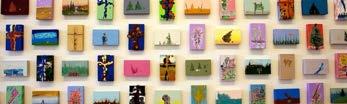
As a nationally recognized painter, school of art professor, writer and curator, Eyland was a prominent member of Winnipeg’s art community throughout his career. He is likely best known to the average Winnipegger for his installation of miniature paintings at the Millennium Library.
Luckily for those who have yet to appreciate the vast scope of Eyland’s career, the Winnipeg Art Gallery (WAG) is now exhibiting Cliff Eyland: Library of Babel — A Retrospective.
Curated by one of Eyland’s longtime collaborators, Robert B. Epp, Library of Babel was initially planned in concert with Eyland but transformed into a memorial celebration of Eyland and his life’s work after his passing in May 2020.
The extensive show features work from all periods of Eyland’s career, representing a cross-section of his artistic practice and other work within Winnipeg’s art community. Containing over 1,000 artworks — mainly the file-card-sized paintings Eyland is likely best known for
— Library of Babel was inspired by a short story of the same name by Jorge Luis Borges and emphasizes Eyland’s preoccupation with libraries as vast conceptual spaces while highlighting his innovative perspectives of art.
Other materials include drawings, photographs, digital prints, exhibition posters, videos and other archival materials. These collectively provide a window into Eyland’s artistic practice and his personal life, highlighting his personality and outlook on life and art through the common themes of his work.
Like many exhibition spaces, entering Library of Babel felt something like stepping out of one’s own mind and into the brain of another. The feeling was especially evident in this exhibition — there was an immediate energy you could sense in the air of the gallery space which seemed to be emanating from Eyland’s imaginative and lively paintings.
When we step into an institution like the WAG, there is often a sense of order when it comes to painting installations — each work hangs on a wall separate from its companions, with enough room to breathe so as to not
impede the viewer’s ability to appreciate the works next to it. However, this sensibility was upended in the most refreshing way in Library of Babel.
Organized chaos reigned throughout the show, with hundreds of small paintings hung in a variety of formations across the gallery walls, creating different rhythms throughout the space.
Crucifix formations — such as the installation “Crucifix (Homage to Gauguin)” — hung over the viewer imposingly on some walls, whereas enormous grids of paintings created a sense of stability as you peered up at this wall of closely packed works in installations such as “Librarians, Books and Clouds.” Grids of paintings were also found mounted on separate walls, which created a larger frame around these works. This formation was present in a personal favourite installation, “63 File Card Paintings on a White Wall,” a series of paintings assembled in 2019.
There are so many paintings encompassed within Library of Babel that it is difficult to pick out just a few individual ones as highlights. Rather, these works grab your attention in a Gestaltian manner, leaving you to
dive deeper into each installation and investigate individual works as you discover them.
Overall, what is so fantastic about Library of Babel is how clearly it demonstrates Eyland’s dedication to art. The works included in this exhibition reflect a lifetime of enthusiasm and experimentation, displaying a wide range of techniques indicative of his ever-evolving practice.
His mixed media pieces were particularly striking, pushing the boundaries of what a painting can be by incorporating writing, drawing and found materials into these works. Although much of Eyland’s work is small, Library of Babel allows us to see the world as Eyland did — with an imaginative, critical and joyful view of the world around us.
You can visit Cliff Eyland: Library of Babel — A Retrospective at the Winnipeg Art Gallery until May 15.
arts@themanitoban.com
Bisons men’s hockey eliminated from playoff contention
Graduating captain Keaton Jameson has great series
SPORTS Isaiah Wagner, staff
The University of Manitoba Bisons men’s hockey team has lost its chance at a Canada West playoff spot after two losses to the University of Regina Cougars last weekend, with the team going 0-4 on Friday and 3-6 on Saturday.
After a rough-and-tumble season, the Bisons were unable to muster a late drive to capture one of the six playoff spots.
Saturday remained a special night for the seniors with it being their last game at home. The seniors were celebrated for their accomplishments with the school and their team throughout the years.
Keaton Jameson highlighted the weekend with a three-assist game on Saturday. However, despite the achievement, the team didn’t have the weekend it had hoped for.
“We definitely did not have the weekend series that we wanted to have,” Jameson said.
“We had to win both games and we did not do that. I think our biggest problem was our defensive play. You’re not going to win too many games when letting in six and four goals.”
When looking back on the season, there were definitely some highs and lows for the squad. The biggest accomplishment of the season was the back-to-back win at home in a battle with the MacEwan Griffins. The team really stepped up in front of the home crowd and played their hearts out.
On-the-ice highlights are always a great accomplishment, but sometimes it is much more than that.
“The highlight of our season is definitely the group of guys that we have in our locker room,” Jameson said.
“We may have not did what we want to do on the ice, but the bonding between teammates has been great.”
This was the final home series for the Bisons.
The team will travel to Saskatchewan to battle the University of Saskatchewan
Huskies on Feb. 11 and 12 in a back-toback season-ending clash.
sports@themanitoban.com
photo / Isaiah Wagner / staff
AN the MANI
Huskies prey on Bisons
U of M basketball teams lost final home games of Canada West season
SPORTS Matthew Merkel, staff
The University of Manitoba Bisons men’s and women’s basketball teams hosted the University of Saskatchewan Huskies in a two-game series this past weekend. Unfortunately for the herd, the Huskies were dominant, winning both games and spoiling the Bisons’ final home stand of the Canada West regular season.
On Friday night, the Huskies women’s team came out strong, leading by 10 points within the first five minutes of the game. Bisons Autumn Agar, Deidre Bartlett and Lauren Bartlett responded with four points each in the half. Outpacing the Bisons, the Huskies were led by guard Carly Ahlstrom. The third-year player put up 17 points in the first half, leading the Huskies to a 43-22 lead at halftime.
In the third, the Huskies continued to dominate, putting up 27 points in the quarter. Trailing by 30 points heading into the fourth, the Bisons were still shut down by the Huskies’ defence. Without enough time to mount a comeback, the Bisons fell 94-50 to the eastern division leaders.
Speaking on her team’s dominant win, Ahlstrom said it was her team’s goal to have a dominant weekend in preparation for the upcoming Canada West playoff tournament.
“I think that our team had some goals going into this weekend,” said Ahlstrom.
“We’ve still got some big competition ahead so we’re just making sure that we’re doing the little things now in preparation and hopefully we can play our best when it matters most.”
Saturday marked the final home game Taylor Randall and Deidre Bartlett would play as Bisons. Prior to tip-off, fifth-year Randall was excited to play her final game in front of the Investors Group Athletic Centre crowd and work on her team’s game in preparation for the Canada West playoff tournament in March.
“It feels really special. I’m super excited to just go out and have some fun and just kind of take it all in,” said Randall.
“I think we’ve worked really hard all season and not every game has gone our way, but we know we have the pieces and we know that when we play good, we can compete against any team.”
The Bisons made a much more concerted effort in game two. After finishing down by 11 at the end of the first quarter, the Bisons began to rally in the second. Randall drained a pair of threes and Lauren Bartlett notched four points, helping close on the Huskies lead. Down by two heading into the fourth, the Bisons continued to hammer away at the Huskies’ defence. With less than a minute left,
Agar laid a bucket in for the herd to make it a one-possession game. After a time-out, the Bisons had the ball on offence with less than 30 seconds on the clock. Unfortunately, the herd was unable to capitalize, missing two chances in a row and subsequently turning the ball over to hand the Huskies the final game of the weekend 58-55. Randall scored a team-high of 16 points, making the most of her final home game as a Bison.
On the men’s side, Friday night’s game was a back-and-forth affair. The first quarter saw both teams trading buckets, with the Huskies leading by three after 10 minutes. Appearing a bit out of sync in the first quarter, the Bisons’ offence began to click in the second. Leading the charge for the herd were Risto Zimbakov — who hit three shots from beyond the arc — and James Wagner, who added eight points and two rebounds to help give the Bisons an eight-point lead at the end of the quarter.
Each team kept pace with the other in the third, with the Bisons leading by four heading into the fourth. Although the herd attempted to increase its lead, the Huskies’ defence did its best to shut the team down. On the other side of the court, Huskie guard Marquavian Stephens caught fire, knocking down a three and going hard in the paint to lay one in and tie the game. After teammate Emmanuel Akintunde scored on a fast break to give the Huskies the lead, Stephens scored on all nine of his free throws in the quarter, giving Stephens a teamhigh of 25 points on the night and the Huskies a 66-61 win.
Prior to tip-off the following day, graduating Bison players Zimbakov, Cameron O’Hara, Keiran Zziwa and James Wagner were all honoured as they were also playing their final Bison home games.
Once the game started, Zimbakov got the herd off to a good start, draining three threes early to get the offence rolling. However, the Huskies quickly took over the game, stealing momentum and the lead from the Bisons. The Huskies limited the herd to four more points in the quarter and put up 24 of its own. The team continued its torrential pace in the second, scoring at will and gaining a 22-point lead with less than four minutes left, its largest of the game. In the second half, Bisons Zziwa and Wagner attempted to close the lead, but the Huskies continued to score at will, winning a fast-paced game 83-68.
The Bisons women’s and men’s teams’ next two games are against the Brandon University Bobcats Feb. 11 and 18, the final two matches of the Canada West regular season.
photos / Matthew Merkel / staff
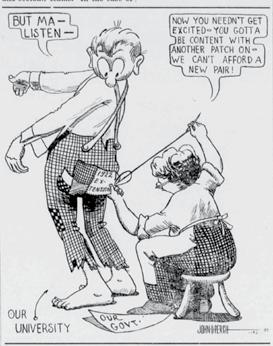
I don’t know whether the “Don’t repeat the claim in the headline debunking it” thing works or not, but it definitely makes reading the news weird.
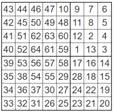
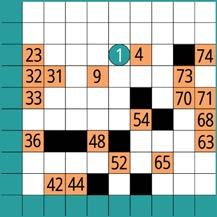
–Like Sudoku, no single number can repeat in any row or column. But... rows and columns are divided by black compartments. These need to be filled in with numbers that complete a ‘straight’. A straight is a set of numbers with no gaps but can be in any order, eg [4,2,3,5]. Clues in black cells remove that number as an option in that row and column, and are not part of any straight. Glance at the solution to see how ‘straights’ are formed.
For many strategies, hints and tips, visit www.sudokuwiki.org If you like Str8ts check out our books, iPhone/iPad Apps and much more on our store.
G. De Sanctis. 183?. Esemplare di alfabeti diversi fregiati di fiori, di animali e di altri ornati. Naples.