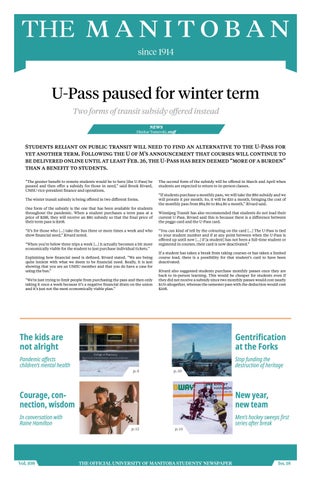
U-Pass paused for winter term
Two forms of transit subsidy offered instead
NEWS
Dimitar Tomovski, staff
Students reliant on public transit will need to find an alternative to the U-Pass for yet another term. Following the U of M’s announcement that courses will continue to be delivered online until at least Feb. 26, the U-Pass has been deemed “more of a burden” than a benefit to students.
“The greater benefit to remote students would be to have [the U-Pass] be paused and then offer a subsidy for those in need,” said Brook Rivard, UMSU vice-president finance and operations.
The winter transit subsidy is being offered in two different forms.
One form of the subsidy is the one that has been available for students throughout the pandemic. When a student purchases a term pass at a price of $288, they will receive an $80 subsidy so that the final price of their term pass is $208.
“It’s for those who […] take the bus three or more times a week and who show financial need,” Rivard noted.
“When you’re below three trips a week […] it actually becomes a bit more economically viable for the student to just purchase individual tickets.”
Explaining how financial need is defined, Rivard stated, “We are being quite lenient with what we deem to be financial need. Really, it is just showing that you are an UMSU member and that you do have a case for using the bus.”
“We’re just trying to limit people from purchasing the pass and then only taking it once a week because it’s a negative financial drain on the union and it’s just not the most economically viable plan.”
The kids are not alright
Pandemic affects children’s mental health

The second form of the subsidy will be offered in March and April when students are expected to return to in-person classes.
“If students purchase a monthly pass, we will take the $80 subsidy and we will prorate it per month. So, it will be $20 a month, bringing the cost of the monthly pass from $84.80 to $64.80 a month,” Rivard said.
Winnipeg Transit has also recommended that students do not load their current U-Pass. Rivard said this is because there is a difference between the peggo card and the U-Pass card.
“You can kind of tell by the colouring on the card […] The U-Pass is tied to your student number and if at any point between when the U-Pass is offered up until now […] if [a student] has not been a full-time student or registered in courses, their card is now deactivated.”
If a student has taken a break from taking courses or has taken a limited course load, there is a possibility for that student’s card to have been deactivated.
Rivard also suggested students purchase monthly passes once they are back to in-person learning. This would be cheaper for students even if they did not receive a subsidy since two monthly passes would cost nearly $170 altogether, whereas the semester pass with the deduction would cost $208.

Stop funding the destruction of heritage Courage,
In conversation with Raine Hamilton


NDP proposes plan for return to in-person learning
Five-point plan includes increased PPE, ventilation
NEWS Dimitar Tomovski, staff
The Manitoba NDP released a statement Jan. 10 calling on the PC government to adopt “measures to make schools safer and ease the burden of at-home learning” on families, and proposed five solutions the provincial government could implement to help families manage the delay to in-person learning.
The party proposes the government dedicate a benefit to help parents cover the costs of learning from home, provide more rapid tests and high-quality masks to teachers and students, increase investments to upgrade school facilities such as ventilation systems in classrooms, publicly release infection data to parents so that they could assess the risk for their children and invest in sick-pay coverage, mental health counsellors and substitute teachers to help deal with staffing shortages.
Provincial NDP leader Wab Kinew
noted that although many are eager for students to return to in-person learning, it needs to be done safely.
“We all want to see kids back in the classroom, but it has to be safe,” said Kinew in a press release.
“Government should be focused on doing whatever is possible to help kids succeed at home and at school, but the [PCs] are putting their political fortunes ahead of Manitoba families.”
In response to the NDP’s statement, Education Minister and PC MLA Cliff Cullen said the provincial government is continuing to invest in schools to ensure that students can safely return to in-person learning on Jan. 17, 2022.
Cullen said the provincial government has invested over $63 million to ensure that classrooms will be safe for students to return to.
In response to the NDP’s proposal for a benefit to fund learning from home,
investment
Cullen replied that, “[s]ince early in the pandemic, school divisions have been able to access the safe schools fund to ensure all students have access to technology where needed.”
Cullen said 500,000 rapid tests have already been provided for all students in kindergarten to Grade 6.
In addition to these rapid tests, Cullen said the provincial government continues to provide schools with PPE. Teachers and staff are required to wear medical masks, while well-fitting face masks with three layers are recommended for students.
According to Cullen, a $6.8 million school ventilation fund has been established in addition to $45 million allocated to schools for expenditures related to COVID-19.
Meanwhile, students and staff are eligible for confirmatory PCR testing and confirmed cases will continue to be posted on the Government of Manitoba’s COVID-19 dashboard. Finally, Cullen said $30 million of safe schools funds have been distributed
by school divisions to address impacts to learning, mental health and well-being. This includes hiring additional teachers, educational assistants and clinicians.
An additional $1 million has been reserved to fund additional mental health supports.
news@themanitoban.com
Niki Ashton echoes First Nations’ calls for military aid
Multiple reserves in partial or full lockdown
financial aid for the reserve.
Niki Ashton, NDP MP for Churchill-Keewatinook
Aski, echoed some Manitoba First Nations’ calls for military support on reserves overwhelmed by rising COVID-19 cases.
In Manitoba, approximately 10 First Nations are in at least partial lockdown, and many are struggling as increasing numbers of children and support workers are getting sick.
Ashton suggested the armed forces could assist with operating checkpoints, delivering food and providing more nurses.
“In these First Nations, a lockdown means you can’t leave your house,” she said.
“So, somebody has to bring groceries, somebody has to bring medication for people who are sick with COVID, somebody has to check up on people on a regular basis […] to see what they need. In these communities, they have so few front-line workers to go around, so […] the few people that were still doing the work were getting very overwhelmed and that’s what the community kept saying.”
Ashton said she has contacted the minister of Indigenous services and minister of defence, and although they have made no commitment to
send military aid, they have committed to sending more “front-line resources.”
“But this was only after [a significant portion] of the community was already infected and there were concerns that it was going to spread further,” she said.
“The call for the military […] basically shook the federal government up and they realized that they needed to respond to the community in a much more substantive way and ultimately they did. Of course, we are not out of the woods yet, we know that cases are going up in other communities across the region and I have heard from leaders who’ve said […] if things do get out of hand, [they] may need more help, including the military’s support.”
Reserves in other provinces have recently received military assistance.
Bearskin Lake First Nation in Ontario has faced a state of emergency since the end of December as at least 200 of the 400 people living there have been infected.
On Jan. 8, after repeated calls for military intervention, the federal government sent four Canadian Armed Forces members to assess the situation and Indigenous Services Canada reportedly allotted $1.2 million in
However, residents of the community say they are “disappointed” by the response.
“Our community was anxiously waiting for help, and we were comforted by the thought that Canada would step in to provide us with much-needed physical and moral support. In the end, however, this help has been minimal,” said Bearskin Lake Chief Lefty Kamenawatamin in a statement.
Ashton said it’s “very concerning” that Bearskin Lake did not receive sufficient support.
“This is not a public relations campaign,” she said.
“When communities during a public emergency are calling for help, they need help, they know best what’s happening on the ground. It’s very cynical of the government to, first of all, take a number of days to respond and only respond when public pressure was significant and then to respond with fewer people on the ground than what was needed.”
Ashton said “the military has played a key role” in many reserves throughout the pandemic.
“But what we’ve seen in this wave is the government has been more reticent to respond and to respond appropriately,” she said.

The military’s health resources are already spread thin with defence department spokesman Daniel Le Bouthillier saying the Canadian Forces Health Services’ “strength has decreased to the point where it can only fill 60 per cent of its mandated tasks.”
According to the Manitoba First Nations COVID-19 pandemic response coordination team, more than 75 per cent of First Nations in Manitoba have active cases of COVID-19 as of Jan. 11 and one quarter of all hospitalizations were Indigenous people as of Jan. 6.
news@themanitoban.com
photo / Basel Abdelaziz / staff
NEWS Colton McKillop, staff
TOB AN the MANI
A politicized union is an engaged union
Bureaucracy and technocracy drive UMSU’s chronic engagement woes
EDITORIAL
As we wait for the University of Manitoba Students’ Union’s (UMSU) governance committee to announce its decision about whether to grant community representatives the right to vote on union decisions, I have been reflecting on some longstanding issues I have noticed while reporting on the union.
The debate around extending the vote seems to revolve around one question: do we want a representative union, or do we want a so-called efficient union?
The question is a red herring. We need to be asking: of whom is the union representative? Efficiency toward what end? However, we don’t really need to be asking any of these questions seeing as the governance committee has already made its decision for us, we just don’t know what it is yet.
Unsurprisingly, it has become apparent that not even our elected board is trusted with proposing changes to governing documents. As UMSU president Brendan Scott made clear both during debate at a meeting Jan. 6 and in a subsequent interview, it is expected of representatives to simply provide yes-or-no answers to questions presented by bureaucrats.
It’s exactly this issue that gets to the heart of significant issues that define the union. It is clear UMSU has been positioned above and apart from its members, driving chronically low engagement and limiting the ability of the union to push for meaningful change.
Students as a group are hard to pin down in terms of their interests for relatively obvious demographic reasons. The student body is made up of people across national, class, racial, gender, religious and political lines, making consensus about any issue beyond the lowest common denominator practically impossible.
So, what is a union that is supposed to represent and advance the interests of the student body left with? The lowest common denominator centres on providing services, social events, neutral-appearing equity, diversity and inclusion commitments and feeble approaches to advocacy.
To give a few examples, most people can agree they would rather have insurance than not, pay less tuition rather than more, access certain services on campus rather than off and so on. In terms of politics, this can take the form of advocating for amendments to anti-student legislation rather than opposing the legislation outright.
In other words, our union functions through a willingness — even a desire — to play the game, to challenge
power within the boundaries of what that power has deemed acceptable. Change rarely comes from engaging power on the terms it sets for itself.
To give credit where credit is due, the Manitoba Alliance of Post-Secondary Students (MAPSS) — of which UMSU is a member — was able to lobby Minister of Advanced Education, Skills and Immigration Wayne Ewasko to amend Bill 33 to exclude student fees from being controlled by the provincial government. However, one has to ask why our union played the game rather than join the chorus of voices that fully opposed the legislation.
While advocacy efforts may be effective in some ways, restricting union political activity to different forms of lobbying is extremely limited in regard to what it can achieve beyond raising the profiles of our executive committee.
out at meetings and allow for faster decision-making, but this will only entrench the bureaucratic and technocratic character of the union, further reducing engagement.
Instead of reforming the board, the
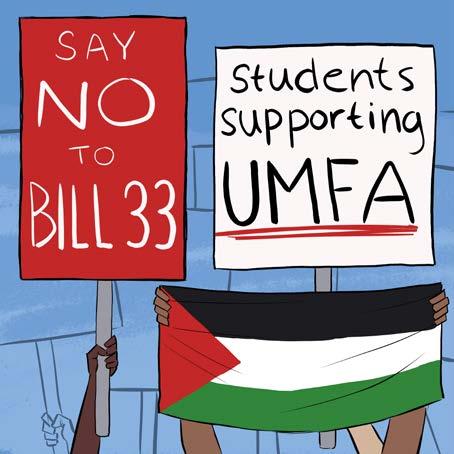
U of M students have seen inspiring examples of grassroots organizing and the potential to mobilize students this academic year. For example, Students Supporting UMFA — now the Student Solidarity Collective — put invaluable pressure on the administration and
union should take measures to facilitate grassroots-level engagement. Executives and board members should foster ties to members through participation.
What happens if you ask the minister nicely to consider alternatives to whatever the issue of the day is and they simply say no? Disregarding pearl clutching over hurting relationships with those in power, the obvious answer is to mobilize students to protest, disrupt and to actually wield the power that comes from our numbers — the power our leaders are supposed to represent.
But right from the outset, this possibility is closed off by the fact that the union has been reduced to the lowest common denominator, that many students likely view it simply as a combination of an event promoter and service provider.
I suspect the union is not only standing apart from and above its membership — now it seems it is doing its best to stand apart from and above its own board.
The smaller board size may give more room for members to spread
Such measures could include workshops to train students in organizing, provision of funds for materials and activities, creating space for more direct input into ongoing advocacy efforts and placing more emphasis on engagement with students rather than waiting for students to engage with the union.
Over time, if successful, it is likely groups will arise that have opposing interests. However, this should not be a concern seeing as, if anything, it would likely render visible already existing tensions on campus and provide an avenue for change driven by UMSU’s internal struggles.
It is critical the union pursues goals beyond what is immediately facing them. It is one thing to react to developments from the government or to policy changes within the university and another to be concretely building toward goals such as free tuition.
government amid the longest strike in U of M history. Further, the informal coalition of Palestinian students and their allies fought and won a statement of solidarity on a campus that’s been historically hostile to pro-Palestinian organizing. Beyond this, they created space — in a traditionally repetitive student discourse — to examine the internal biases of the union.
Kudos to those who have dared to struggle and triumphed this year.
UMSU has a lot of potential to not only revitalize itself through its own politicization, but it has the opportunity to create an institutional environment from which students will go out into society armed with concrete experience in organizing for their interests.
graphic / Marina Djurdjevic/ staff words / Cam Cannon / staff
TOB AN the MANI
Stop development projects at the Forks
Heritage site continues to be erased by gentrification
COMMENT
Lucas Edmond, staff
The Railside at the Forks development started construction work in August 2021, following the announcement of the project in 2013. The development is planned to include housing, community and business spaces where two parking lots sandwiched between the CN rail line and Israel Asper Way are currently situated. The plots of land are being divided into two communities called Railside North and Railside South.
The reason the project took so long to get going after its announcement was primarily due to financial constraints and bylaws. Finances improved for the Forks’ development after the provincial government opted to renounce $11.9 million worth of property taxes in 2019 to help stimulate the undertaking. Following this decision, in 2020, the City of Winnipeg offered the project $7.9 million in rebate-based subsidies.
After financial support was offered, vice-president of strategic initiatives for the Forks Clare MacKay noted that developers “will be looking at archeology, we’ll be looking at geothermal. Those are the first steps we are taking.”
The Forks hosts one of Manitoba’s largest archeological sites and, following the excavation of the area where the Canadian Museum for Human Rights (CMHR) now sits, archaeologists described it as one of the most important, too. The Forks has been a meeting place for Indigenous people for over 6,000 years and is now a nationally recognized historic and heritage site. As such, between 2008 and 2012, the developers of the CMHR were required to excavate the area in conjunction with the laws laid out by Manitoba’s Heritage Resources Act (MHRA). The act notes an adequate sample of the site is required before construction above those sites. Although the CMHR followed provincial guidelines, only three per cent of the site was excavated.
The site re-confirmed the significance of the Forks to Indigenous history, but it also produced evidence for what is known to have been a massive peace treaty event for Indigenous groups approximately 700 years ago. Scholars who have studied the area suggest nearly 10,000 Indigenous people, spanning from areas as far as southern Minnesota, northwestern Ontario and northern Manitoba, assembled at the Forks to establish peace during a period of climate and resource instability.

During the dig, more than 400,000 artifacts were uncovered. The CMHR confidently used this fact to appropriate the site’s significance. In a news release, the museum claims to have completed the “largest block archaeological excavation ever conducted in Manitoba.” Keep in mind that the CMHR only excavated three per cent of the site, meaning 97 per cent and millions of pieces of culturally significant materials could have been destroyed by the CMHR’s construction or permanently lost due to its massive foundation. To make matters worse, the CMHR conducted the dig with an underfunded and understaffed team — only three people were hired despite 15 being recommended.
Renowned local archeologist and curator emeritus at the Manitoba Museum Leigh Syms called the project “a pathetically inadequate sample and it’s certainly in no way representative of what’s there. And there’s great, great gaps in knowledge that we will never have in terms of First Nations at the Forks.”
This all could have been avoided if the CMHR listened to Indigenous stakeholders and archeologists’ advice, but Sid Kroeker — an archaeologist hired by the CMHR — noted his
recommendations were “as futile as King Canute railing against the tide.”
The CMHR reportedly went on to violate heritage permits.
Not only was a museum of disproportionately western ideas of human rights built on Indigenous land, it also took part in an overt act of Indigenous erasure and cultural genocide. It is a horrific irony that a museum displaying the tenets of an idea intended to prevent rights abuses has destroyed one of the most significant cultural sites in Manitoba.
What’s worse, the museum initially refused to recognize Canada’s treatment of Indigenous people as cultural genocide in the years before the release of the Truth and Reconciliation Commission’s report naming it as such. As a result, many Indigenous rights activists continue to boycott the museum.
The handling of the CMHR’s construction and mandate provides testimony for the fact that development programs at the Forks are often accompanied by inadequate attention to Indigenous needs and history.
The Railside at the Forks project is once again sacrificing important Indigenous history for the purposes of
Not only was a museum of disproportionately western ideas of human rights built on Indigenous land, it also took part in an overt act of Indigenous erasure and cultural genocide
settler ambitions and gentrification.
Although the results of the dig have not been made public, Railside at the Forks claims to have followed the purportedly “rigorous” guidelines required by the MHRA. These standards were the same ones many archaeologists described as wildly inadequate during the excavation of the land now beneath the CMHR.
Both the development of the CMHR and Railside at the Forks have cumulatively cost municipal, provincial and federal governments hundreds of millions of dollars in tax revenue. Meanwhile, Indigenous groups have received nothing in return for the erasure of their legacies and the theft of their land.
If the City of Winnipeg and the provincial government truly have any concern for reconciliation, development programs must come to a halt and the revenues dedicated to them should be redistributed to help combat the genocide of Indigenous people in Canada. Although shrouded in self-congratulatory arrogance, there is nothing to be proud about when it comes to the developments and archeology taking place at the Forks. By supporting their operation, our governments have been complicit in the erasure of Indigenous heritage.
comment@themanitoban.com
photo / Basel Abdelaziz / staff
TOB AN the MANI
The courage it takes to change worlds
In
conversation with Raine Hamilton about the inspiration for third LP
ARTS
& CULTURE
Zoë LeBrun, staff
Music has been always been a part of Raine Hamilton’s life. They began violin at a young age and were inspired by an early appearance by Yo-Yo Ma on Sesame Street to make music their lifelong pursuit.
“My parents met in a rock and roll band in Winnipeg in the ’70s,” Hamilton said.
“I grew up with the soundtrack of my dad honing songs and perfecting his songwriting all the time.”
This eventually led them to study medieval musicology at the University of Manitoba. Since graduating, Hamilton has blended their love of chamber music with folk to create music that is warm, heartfelt and ethereal — a genre known as chamber folk.
“It is, I think, just a really true representation of myself, musically,” Hamilton said.
“I have the songwriting tradition that I learned from my family, I have this chamber music tradition that started with Sesame Street and ended with a music degree, and those sounds just really belong in me, you know — I find belonging there.”
Hamilton’s first two albums, Past Your Past and Night Sky, allowed them to hone their skills in this unique genre. Their latest album Brave Land will be released later this week.
“Now that I have three albums, it’s really interesting for me to look back
the mountains was at the Banff Centre on creative residency […] I can really learn from those mountains there, and things that showed up for me was like, how courageous that land felt to me,” Hamilton said.



“This is land moving from the realm of the land, into the realm of the sky, and so many things about that strike me, one is that that is a courageous thing […] and the worlds that it connects are so beautiful because it’s connecting this earthly world and what feels to
“Most of the music that we hear in dominant culture in North America is with this one set of rules, but there’s a whole history that led to the emergence of those rules, and so they are not the only rules”
— Raine Hamilton, musician
and see kind of the trajectory of it, and I totally see artistic growth,” Hamilton said.
Hamilton was inspired to write Brave Land while touring and completing creative residencies in mountainous landscapes.
“A large span of time that I spent in
me like a different realm of existing, like the earthly and the ethereal, the earthly and spiritual.
“That reflects a lot of how I experience my life and my body, that I am an earthbound spirit […] Here are these mountains showing me you can connect two worlds, showing me reach, showing me courage.”
photos / What’s The Story / provided

Brave Land possesses this courage, speaking straight from the heart and drawing emotions as large and strong as the mountains Hamilton was inspired by. The concept album stands as a testament not only to the genre, but also to Hamilton’s performance and composition skills, knowledge of music theory and history, unique perspectives on landscape, music, art and those who create it.
Regarding their writing process, Hamilton stated Brave Land is their most intentional album yet.
“With the earlier work, it was more like the album emerged […] and then with this one it’s more like I could see the space that it would occupy,” they said.
Hamilton also became more experimental with their compositions and lyrics on Brave Land, completely integrating early music theory with contemporary folk music.
Two songs illustrate this best: “Mountain Henge” is built off a two-line phrase common to early music and written in what’s known as the Dorian mode, and the song “Dominae Sanctae” is written entirely in Latin.
“The harmonic tools that existed [in the medieval and Renaissance periods] are different than what people figured out and chose and use now, or used in later periods of classical music,” Hamilton said.
“Most of the music that we hear in dominant culture in North America is with this one set of rules, but there’s a whole history that led to the emergence of those rules, and so they are not the only rules. That was really eye-opening for me, and I guess ear-opening for me, to really be
steeped in other sets of rules, and that informs a lot of my harmonic choices.”
Hamilton’s creative process also involves two other musicians — Natanielle Felicitas on cello and Quintin Bart on the double bass.
“We’ve been collaborators for a good while now,” said Hamilton.
“I really value this long-term collaboration, because it lets us get deep, deep into the woods of the thing […] I think it’s safe for me to speak for everyone that we found [Brave Land] a really creatively satisfying experience, and [were] just able to get more complex, more experimental.”
Hamilton’s personal favourite track on Brave Land is “Over the Mountain,” which they wrote about being at the Banff Centre and the relationship between art and artist.
“There must just be, you know, the spirit of art, or a muse, or something really gathered [t]here, and that’s what’s described in that song. We hear these different works of art finding their artists, finding their maker and choosing them,” Hamilton said.
“A lot of times, that’s what art process feels like to me — I can feel it when I am gifted something.”
Raine Hamilton’s latest release Brave Land will be available Jan. 21. For more information, music and merchandise, please visit rainehamilton.com.
arts@themanitoban.com