




photo


EDITOR-IN-CHIEF ? editor@themanitoban.com
Ty Brass
BUSINESS MANAGER ? accounts@themanitoban.com
Cindy Nguyen
ADVERTISING CO-ORDINATOR ? ads@themanitoban.com
Diego Castro
MANAGING EDITOR ? me@themanitoban.com
Sarah Doran
COPY DESK ? copy@themanitoban.com
Ursula Chojko-Bolec (ed.)
NEWS DESK ? news@themanitoban.com
Cam Cannon, Liam Forrester (eds.)
Colton McKillop
RESEARCH & TECHNOLOGY DESK ? research@themanitoban.com
Michael Campbell (ed.)
COMMENT DESK ? comment@themanitoban.com
Lucas Edmond (ed.)
Ivan Nuñez Gamez
ARTS & CULTURE DESK ? arts@themanitoban.com
Shaylyn Maharaj-Poliah (ed.)
Zoë LeBrun
Grace Paizen
SPORTS DESK ? sports@themanitoban.com
Matthew Merkel (ed.)
Isaiah Wagner
PHOTO DESK ? photo@themanitoban.com
Basel Abdelaziz (ed.) Mohammad Arsalan Saeed
DESIGN DESK ? design@themanitoban.com
Matthew Doering (ed.)
Mikaela Warkentin
GRAPHICS DESK ? graphics@themanitoban.com
Dallin Chicoine (ed.)
AUDIO DESK ? audio@themanitoban.com applications open, see themanitoban.com/jobs
SOCIAL MEDIA DESK ? social@themanitoban.com
Jalene Moman (ed.)
VOLUNTEERS THIS ISSUE ?
VOLUNTEER STAFF ? Emily Unrau-Poetker
interested in volunteering? email me@themanitoban.com today!
109 HELEN GLASS BUILDING
UNIVERSITY OF MANITOBA WINNIPEG, MB
204. 474. 6535
The Manitoban is the official student newspaper of the University of Manitoba. It is published monthly during the summer and each week of regular classes during the academic year by the Manitoban Newspaper Publications Corporation.
The Manitoban is an independent and democratic student organization, open to participation from all students. It exists to serve its readers as students and citizens.
The Manitoban is a member of the Canadian University Press, and our journalistic standards can be found online at toban.news/jsp.
The newspaper’s primary mandate is to report fairly and objectively on issues and events of importance and interest to the students of the University of Manitoba, to provide an open forum for the free expression and exchange of opinions and ideas and to stimulate meaningful debate on issues that affect or would otherwise be of interest to the student body and/ or society in general. The Manitoban serves as a training ground for students interested in any aspect of journalism.
Students and other interested parties are invited to contribute to any section of the newspaper. Please contact the appropriate editor for submission guidelines.
The Manitoban reserves the right to edit all submissions and will not publish any material deemed by its Editorial Board to be discriminatory, racist, sexist, homophobic or trans-phobic, ableist or libellous.
Opinions expressed in letters and articles are solely those of the authors. Editorials in the Manitoban are signed and represent the opinions of the writer(s), not necessarily those of the Manitoban staff, Editorial Board or the publisher.
A “volunteer staff” member is defined as a person who has had three volunteer articles, photographs or pieces of art of reasonable length and/ or substance published in the current publishing year of the Manitoban.
Any individual who qualifies as a volunteer staff member must be voted in by a majority vote at a Manitoban editorial board meeting. Elected representatives and non-students may be excluded from holding votes as volunteer staff members in accordance with the Manitoban Constitution.
All contents are ©2021 and may not be reprinted without the express written permission of the Editor-in-Chief.







NEWS Cam Cannon, staff
As part of its Manitoba Skills Workshop 2021, the Canadian Federation of Students Manitoba hosted a webinar entitled “Demanding Better: A Progressive Discussion on Education in Manitoba” on Sept. 22.
The webinar featured presentations from the federation’s national deputy chairperson Wesam AbdElhamid Mohamed, provincial federation’s graduate students’ commissioner Dane Monkman and Winnipeg School Division (WSD) trustee Jennifer Chen.
The panel began with a presentation from Chen, in which she discussed the current state of K to 12 education in the province.
Chen began her presentation by remarking on how different it is in Canada, where we have open elections, right down to the level of school boards — as opposed to her experiences in China, where she was born. She then spoke about Bill 64 and what it would mean for democracy in education.
“Bill 64 told us that we should never take democracy for granted,” said Chen.
The controversial Bill 64 was rescinded from the legislature earlier this month after months of pushback from educators, parents and activists. If passed, the legislation would have dissolved the province’s democratically elected school boards and centralized power in the education minister’s office.
Chen then turned to discussing the provincial government’s plan to phase out education property taxes — a move that would see a loss of $900 million in revenues annually if fully implemented.
“We know those decisions come from the provincial government and that these decisions will ultimately undermine our education system,” she said.
“So, what does [a] funding decrease actually mean to working people and families?”
She said the WSD receives less than 60 per cent of its operating funding directly from the province, the remaining 40 per cent coming from property taxes.
That 40 per cent represents funding toward nutrition programs, reading recovery, inclusive education, mental health programs, Indigenous education and newcomer support.
Due to cuts to funding, she also mentioned that the WSD had to cut its crossing guard program.
“I believe funding for education should come from the government and not in the shape of fees,” she said.
Next, Monkman discussed post-secondary education in Manitoba, paying special attention to the provincial government’s strategy to implement what is known popularly as the Tennessee model of education, in which funding of institutions becomes linked to meeting performance standards.
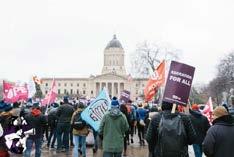
The model “focuses on metrics such as graduation rates and number of degrees awarded,” he said.
The provincial government has “announced four high-level objectives: […] anticipate skills needed for the future, align education and training to labour market needs and help students succeed now and in the future, foster entrepreneurial and innovative skills and grow, attract and retain talent,” he said.
“These four objectives that they’ve identified all fall under a larger issue that we see in policies coming out of this government, which is that they’re all ideological aims of the Conservative government — cutting services, cutting Crown corporations, pushing for small government, smaller budgets and buddying up with industry, aiming to privatize public goods.”
He highlighted the consistent cuts to funding for post-secondary education amid rising tuition — which included ending access to the provincial health-care plan for international students and the Manitoba Tuition Fee Income Tax Rebate, which would have provided a rebate for 60 per cent of tuition after graduation for those who stayed to work in the province.
Monkman referred to the overall approach of the provincial government as “austerity” and “kicking away
“Bill 64 told us that we should never take democracy for granted” — Jennifer Chen, WSD trustee
Monkman referred to the overall approach of the provincial government as “austerity” and “kicking away the ladder”
the ladder.”
Mohamed then presented on post-secondary education across the country, focusing on performance-based funding.
Echoing Monkman, Mohamed defined performance-based funding as tying the funding of post-secondary institutions to performance metrics, however these metrics vary between jurisdictions.
“In Ontario, we see metrics like graduate employment earnings, experiential learning, skills and competencies, graduate employment rate, graduation rate, the economic impact, faculty compensation […] the list, it goes on,” he said.
He explained that since the COVID-19 pandemic began, Alberta, Saskatchewan, Manitoba and New Brunswick have announced plans to transition to performance-based funding for universities, with Ontario delaying the implementation of its plan.
In November 2020, University of Manitoba professors of economics Robert Chernomas and Ian Hudson penned an op-ed in the Winnipeg Free Press denouncing the strategy as one which would create a “red state” type of situation in Manitoba.
Mohamed raised concerns that performance-based funding will reduce the quality of education that students receive, using the example of graduate students being pushed to graduate sooner — even if they do not feel they are ready or their work will stand up — because it would help improve the metrics for the institution.
He also expressed concerns about the casualization of faculty — moving away from tenured professors to contracted instructors — and a shrinking job market for graduates.
He also pointed out that while performance-based funding may result in defunding the arts and humanities, arts graduates tend to earn more in the long run than science graduates.
“We had a very clear stance. We want to see provincial governments suspending current plans to introduce performance-based funding and not tie the public funding to any sort of metrics,” he said.
“With that I’m going to conclude performance-based funding is bad.”
photo / Canadian Federation of Students / provided news@themanitoban.com
NEWS Cam Cannon, staff
UMSU held its latest board of directors meeting Sept. 23.
The Canadian Federation of Students — Manitoba delivered its annual presentation to the UMSU board of directors, providing an overview of the organization and the services it offers as well as recent victories won.
Highlighted were the victories won against the Ontario government’s Student Choice Initiative, which was struck down by courts earlier this year.
“The Ontario government tried to put forward legislation that would strip student unions of their democratic autonomy […] and essentially make it easier for the government to decide institutional and student unions fees and costs,” explained federation chairperson Alexandra Koslock.
Students were also encouraged to attend the provincial federation’s annual general meeting, which is expected to take place in late October or early November.
“You may as well, you never know. It’s better to apply and be rejected than not apply [when] you could’ve gotten some stuff.”
In late November 2020 the UMSU board of directors voted 28-1 to begin the work of leaving the federation.
UMSU president Brendan Scott announced the union has reached an agreement with Winnipeg Transit regarding the U-Pass with some “odds and ends” remaining to be sorted out, including the length of the contract. He said the contract will be signed “in the coming days.”
UMSU vice-president finance and operations Brook Rivard also said UMSU will be continuing its transit subsidy program.
The program gives a rebate to students who purchase a semester pass — which costs $283 — to bring the cost back in line with the regular cost of the U-Pass program, which is $202.
To qualify, students must demonstrate financial need as well as have at least one in-person class on campus. Rivard said financial need will be demonstrated on a “case by case” basis.
“If you’re sitting there and wondering ‘Oh, do I have financial need or not,’ apply,” Rivard said.
Ari Glikman, an UMSU student-atlarge, moved to introduce a new “unified statement of solidarity.” The motion — 0521 — was seconded by Commerce Students’ Association representative Kimberly Nicolasora and has been referred to the executive committee.
The motion highlights that “Canadian Jews remain the most targeted minority group for reported hate crimes,” and that “Israeli, Jewish, Muslim, Palestinian and other civilians are in no way responsible for the actions of Hamas, the Israeli government or the Palestinian Authority.”
“Be it resolved that the University of Manitoba release a statement showing their solidarity and support towards all students, staff and faculty at the University of Manitoba impacted by recent events in the Middle-East,” the motion concluded.
At its Sept. 9 meeting, the UMSU board of directors voted in favour of passing a motion to create a statement of solidarity with Palestinian students rather than issuing a “blanket” statement represented by motion

0520, introduced by the executive committee.
At that earlier meeting, UMSU executives were criticized as taking an “All Lives Matter” approach for putting forward an alternative motion that was similar to the new motion 0521 in that it was intended to be a statement in support of all students impacted by crises in the Middle East.
UMSU annual members’ survey now live
It was also announced the annual UMSU member survey has now been launched.
The survey can be filled out at www. surveymonkey.com/r/MC3MDN5.
news@themanitoban.com
“I feel a little frustrated because I am not comfortable around people who don’t wear masks,” she said.
The U of M Active Living Centre (ALC) has updated its COVID-19 policy. Effective Sept. 23, participants are allowed to remove their mask while exercising at their own workout space.
Simon Wang, the U of M’s director of sport and recreation facilities, welcomes the change.
“We’ve actually been hearing from our students, staff and members in general about requesting to not [wear] a mask while they’re engaged in activity, because that was in line with the most current public health orders,” he said.
“We had requested to change that through the COVID recovery steering committee. We recently heard back that that was approved from the provost, and we were certainly happy to hear that.”
Students like Jessica Ritchie are happy to be exercising without masks once again.
“Removing the mask mandate while
working out has made my experience a lot better at the gym,” Ritchie explained.“I […] feel like I can fully breathe.”
Public health orders announced at the end of August require all Manitobans wear face masks in indoor public spaces unless they are engaged in sports or exercise.
Previously, the ALC’s policy required participants to wear a mask at all times, including while exercising.
Under the old policy, members complained they found it difficult to exercise and breathe properly while wearing a mask.
“Personally, I get really warm while running on the treadmill and my glasses start to fog,” Ritchie said.
“It’s a hazard not being able to see out of my glasses.”
Some members like U of M student Colleen Soriano are uncomfortable with the policy change.
Ritchie says she feels safe with the precautions being taken by the ALC.
“Everyone should be screening themselves before going to the gym, plus they require your vaccine card proof in order to get in,” she said.
“So everyone there should be fully vaccinated and not symptomatic. All of the equipment is spread out nicely, so you’re not directly beside someone.”
For students like Soriano, however, this isn’t enough.
“I know that only fully vaccinated people are allowed to use the ALC, but that doesn’t mean an individual who is fully vaxxed does not have COVID,” Soriano said.
“They could have COVID and be asymptomatic and spread the virus to others at [the] ALC.”
Additionally, Soriano expressed concerns about enforcement, saying she has seen some members not

wearing masks while not engaged in exercise.
Wang said the ALC has staff throughout the building tasked with ensuring compliance, but relies on an “educational approach” and uses outright enforcement of the policy as “a last resort.”
Wang pointed out other fitness centres in Manitoba had already instituted similar policies in accordance with changes to public health orders.
“For the most part, people have been very [respectful] of the health and safety protocols.”
Four panelists bring in-depth perspectives to federal election
NEWS Liam Forrester, staff
The Liberal Party of Canada’s minority Parliament remains virtually unchanged after the Sept. 20 general election increased its share of seats by two, from 157 in 2019 to 159.
The Conservative Party of Canada correspondingly lost two seats from 121 in 2019 to 119 in 2021, and with an increase of one seat the New Democratic Party climbed from 24 seats in 2019 to 25 seats in 2021.
In Winnipeg’s eight federal ridings, the election was even less eventful. Not a single seat changed hands from 2019.
While the outcome of the election appeared uneventful, the U of M’s post-election panel titled “What happened? 2021 Federal Election Debrief” dug into the underlying political trends that impacted the race.
The first panellist to speak, adjunct political studies professor and St. Paul’s College rector Christopher Adams, analyzed the accuracy of the polls in the days leading up to the election. According to Adams, the number of publicly available national polls in the final two days before the election had doubled from seven in 2019 to 14 in 2021.
The day before the election, Adams found six polls and determined that they were largely accurate.
“The difference in terms of […] assessing the Liberal support in the country ranged from as low as zero difference to the actual outcome […] up to three points difference,” Adams said.
“So, I think the answer to the question ‘Were the polls accurate in this election?’ the answer is yes.”
Interestingly, Adams observed a relationship between the sampling methods used and higher predicted support for the People’s Party of Canada (PPC).
“The interview mode of some of these polls really did seem to be linked to whether PPC was high in popularity or not,” he said.
The second panellist, political studies professor Royce Koop, described the disparity between the popular vote and the allocation of seats.
For context, in 2019, the Liberals received roughly 33 per cent of the popular vote but secured just over 46 per cent of the seats in both elections.
“[In 2019] government is formed […] with about [one-third] of the votes cast. A lot of us saw that result and said, ‘Wow, how much lower can we go? This must be the lowest a party can get to form a government,’” Koop said.
“Well, no — 2021 comes along and we see another minority with a very low share of the vote […] and, of course, this raises important normative and democratic consequences. These are single-party governments that are being formed with [roughly a third] of the votes cast. The electoral system is not falling apart, it’s not malfunctioning, it’s working the way it’s supposed to work.”
Koop explained the disparity is tied to vote efficiency. A party’s votes are efficient when it yields “the highest number of seats from the lowest number of votes.”
“The Liberal party is […] winning seats on a marginal basis, the Conservatives have a lot more landslides, and this, by the way, is what leads to this result that we saw,” Koop said.
“Even if you win by one or two votes, you still win the entire seat.”
As a consequence, the Liberal position has become extremely “precarious.”
“If you think about a party [whose] ability to form a government is based on a relatively small number of seats where the margin is low, it’s not going to take that much,” Koop explained.
“You just move a few votes in a few constituencies [and] there could be big seat losses for the Liberals.”
The third panellist, political studies professor Kiera Ladner, explained the election’s significance to Indigenous communities.
While Ladner counts this election as successful — though not as successful as 2015 — she is concerned about the decline of the Indigenous vote in this election.
“The electoral system is not falling apart, it’s not malfunctioning, it’s working the way it’s supposed to work” — Royce Koop, professor of political studies

“While we see the success, we also see the Indigenous vote going down from an all-time high in 2015,” she said.
“We see some really significant voting issues, perhaps relating to the Indigenous vote going down, perhaps the cause of the Indigenous vote going down.”
Ladner went on to describe the voting problems in the Kenora, Ont. riding. In 2019, the riding was decided by less than 1,200 votes. Voter card errors and a lack of polling stations in three First Nations communities could have limited 1,600 electors from voting, thereby deciding the race.
Ladner concluded by discussing the election’s emphasis on reconciliation and the tension between Indigenous and non-Indigenous perspectives on reconciliation.
“We’re going to continue to speak two different languages,” Ladner said.
“We’re going to continue to speak, really, as two different nations, and how do we reconcile that in the House, where we’re confined by parties.”
The final panellist, Susan Prentice — a professor of sociology and the Duff Roblin professor of government — focused on how child care played into the race.
Prentice began by describing how the pandemic revealed a “care crisis” in Canada.
“The degree to which a formal economy rests on a foundation of care became more visible,” Prentice said.
Prentice expressed disappointment with the “impoverished” level of discussion surrounding child care, but remained grateful for the defeat of the Conservative child-care plan.
“I think the discussion was remarkably constrained and confined,” Prentice said.
“As important as the Liberals’ proposals are — they’re the most comprehensive interventions we’ve seen yet in Canadian history — it’s not yet the move to public services and an end to a market model that many advocates in social policy had been calling for.”
news@themanitoban.com
NEWS Liam Forrester, staff
For conservative Manitobans, election season is not over yet.
The Progressive Conservative (PC) leadership race between Heather Stefanson and Shelly Glover will be decided on Oct. 30. For Glover, it looks to be a fight against the PC establishment just as much as a race against Stefanson.
“There are people in the party that decided that what was needed was a coronation [of] a competent new leader and a lot of the rules reflected that,” explained political studies professor Royce Koop.
“I think Shelly Glover is correct in some of her criticisms of this.”
Glover served as a police officer for 28 years and spent over seven years as a member of Parliament. She served as both a minister of the Crown and as the regional minister for Manitoba.
Glover condemned the “exclusive” nature of the race and the lack of media events like debates and forums. She alleged to be running out of a desire to challenge Stefanson and give the PC membership the opportunity to make their preferences known.
“We continue to push for forums because […] the other team got to
make the rules,” Glover said.
“The way they’ve set it up is there are no opportunities for members to actually hear us speak. None. We get to speak on [Oct. 30] after the votes are already in and counted. I keep pushing for forums or debates so that people can hear us speak.”
“This has been orchestrated for some time, this coronation, that’s my belief.”
Tuxedo MLA and 20-year veteran of Manitoba politics Heather Stefanson is considered the favourite to win in some circles after securing the majority of the PC caucus’ support by the time she announced her candidacy in August.
While her party backing is strong, her leadership bid remains tied to the highly unpopular former government led by Brian Pallister.
“I’m not sure the policies are really that different between them […] both are centre-right politicians in the Manitoba tradition,” said Koop.
“The burden is really on Glover to find issues [and] draw distinctions between her and Stefanson.”
Glover, however, sees herself as
distinct in her experience and her capacity to represent parts of the party that Stefanson may not be able to reach.
“We differ in the fact that I speak French, I’m Métis. She’s […] Caucasian [and] doesn’t speak French, so there’s a lot of comparisons that are automatic when you look at us that are different, but I think my experience is much more diversified,” Glover said.
“[Stefanson] represents a fairly wealthy city riding and she’s never really represented any rural communities, as far as I know.”
Should Glover become leader, governing may prove to be an uphill battle. She will have to win a seat in a byelection to sit in chambers with the rest of her party, and even then, faces a caucus that could be hostile to her leadership.
Glover remains unfazed by the possibility.
“If the establishment steps in to further orchestrate or manipulate things that seem to be very important in democracies, then I’m sorry, I’m going to have to go around them,” she said.
While the Manitoban was unable to secure an interview with Stefanson, a campaign spokesperson stated the following:

“Heather made the decision to run for leader after Brian Pallister announced his intention to resign. The PC Party of Manitoba’s executive council met to agree on the parameters of the race; this consists of over 100 members. The official candidates were decided through the PC Party’s independent leadership committee. Heather is excited to be an official candidate and is ready to prove to Manitobans that she’s ready to take the party into a new, positive and collaborative direction.”
news@themanitoban.com

to set an international example
Michael Campbell, staff
Brenda Gunn, professor in the faculty of law, has been appointed to the position of academic and research director at the National Centre for Truth and Reconciliation (NCTR). Gunn started her five-year term with the NCTR on Sept. 1, 2021 after being promoted to full professor in the faculty of law earlier this year.
Gunn’s role as academic and research director is to provide leadership and oversight to researchers and to ensure that the collaborative research projects are conducted with respect and dignity to survivors.
“Part of my job is to continue to engage in research to meet those objectives of truth and reconciliation,” Gunn said.
“I really hope in this position that I have the ability to connect with and work with Indigenous communities and Indigenous peoples in Canada as well.”
Gunn also said she hopes to be able to reconnect with partner organizations to provide leadership and coordination on truth and reconciliation research and to establish international connections.
“Residential schools wasn’t just something that happened in Canada,” Gunn said.
“There are similar schooling type of situations in many countries with Indigenous peoples, some of whom are working through various Truth and Reconciliation-type processes.”
Gunn began her career as an assistant professor in the faculty of law in 2009. Her research has focused on implementing the United Nations Declaration on the Rights of Indigenous Peoples (UNDRIP) building up to the development of a handbook outlining UNDRIP and its relevance in Canada. Gunn has also delivered workshops, lectures and written articles about the implementation of UNDRIP in Canada as a reconciling mechanism.
“My research has focused more on the reconciliation aspect of truth and
reconciliation,” Gunn said.
“I spend a lot of time at the [United Nations (UN)], in UN meetings. Both Indigenous-specific mechanisms, but also participating in […] Canada’s periodic reviews under various human rights treaties.”
The UN universal periodic review is a mechanism which involves a review of all member countries. Each country declares the actions that they have taken to remedy human rights abuses as outlined in various international treaties.
During the 2021 election campaign, the Liberal Party of Canada promised $60 million in funding for the NCTR. The bulk of the funding would go to the construction of a new home for the NCTR. Currently, the NCTR is located in Chancellor’s Hall on Dysart Road, which previously served as a residence for the president of the University of Manitoba.
“It was always intended that this building would be a temporary home,” Gunn said.
“And so, a priority has always been a new building that is built for the purpose of the National Centre for Truth and Reconciliation that creates a space for survivors and communities to come together.”
The new building — which is expected to include an international learning lodge and reflection space — is anticipated to cost more than the $60 million pledge from the Liberals.
The campaign also pledged an additional $5 million per year for the next five years in operational support. Gunn hopes this pledged operational funding would allow the NCTR to directly fund research projects instead of relying on external funding support.
“The current structure requires me to identify funding opportunities to support the research, whereas an increase to our baseline funding may allow us to dedicate specific funds to engage in research and not be dependent on that project-by-project
“My research has focused more on the reconciliation aspect of truth and reconciliation”
— Brenda Gunn, NCTR academic and research director

approach,” Gunn said.
While all research costs money, research into residential schools has additional costs to conduct the research respectfully and ethically. Expenses can include investing in the community to ensure their capacity to engage in research with the NCTR, supporting partner organizations conducting similar research and hiring community coordinators to work with survivors.
Operational funding could also support the NCTR in hosting additional events like the week’s worth of events surrounding the National Day for Truth and Reconciliation.
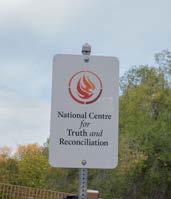
“We really hope that this National Day for Truth and Reconciliation provides a moment to reflect on the harms inflicted by colonialism and residential schools that were, for a very long time, out of sight and out of mind,” Gunn said.
The NCTR has scheduled five days of events during Truth and Reconciliation Week for the general public to immerse themselves in accomplishments of reconciliation and the work that remains to be done.
“I think reconciliation means youth are happy and healthy that are grounded in their culture and are secure in their living, and we no longer see [youth] suicide,” Gunn said.
“Youth suicide is one of the biggest issues facing youth. I want to see our youth having the full opportunities that living in Canada is meant to provide.”
Truth and Reconciliation Week events can be accessed online at NCTR.ca.
research@themanitoban.com
Despite contributing to province, international students
Manitoba has a large population of international students enrolled in post-secondary institutions including the University of Manitoba, University of Winnipeg and Red River College. In 2018, Manitoba was home to 18,725 students from more than 100 countries. According to the most recent statistics released by the government of Manitoba, these students contributed more than $400 million to the provincial economy.
Although the pandemic was difficult for all Manitobans, it was extremely devastating for international students who were struggling with the academic challenges, health-care concerns and uncertainty. Relying on the province and their post-secondary institution as their main source of support, international students in Manitoba, including myself, have expressed their frustration and disappointment with the lack of support received throughout the pandemic.
Many international students rely on the limited hours they are permitted to work in Canada and the pandemic made matters even more complicated for them. Immigration, Refugees and Citizenship Canada restricts the number of hours international students are eligible to work to a maximum of 20 hours per week. The lack of employment in the province made it difficult for those with restricted hours to be able to find a job since employers would rather hire people with more flexibility. These restrictions created a huge financial burden for those struggling to get through university away from their home.
Although the Canadian government did provide financial support programs for employees who lost their employment as a result of the pandemic, international students did not meet the criteria. To be eligible for the Canada Emergency Response Benefit, individuals had to have earned an income of at least $5,000 in 2019 or in the 12 months prior to the date of their application. Meeting this criteria was extremely difficult for international students who were only able to work 20 hours per week. Further, some international students arrived in Canada just before lockdowns and were not able to find employment or apply to any government program to help them financially.
The province of Manitoba did not announce any program to support international students despite their contributions to the economy.

In the fall of 2018, the government of Manitoba decided to discontinue universal health care for international students and made it the responsibility of post-secondary institutions to provide them with insurance plans. In addition to the extra costs added to their tuition fees, discontinuing health-care coverage for international students made things substantially more complicated during COVID-19.
Up until this July, Manitobans were only eligible to receive a vaccination card if they had a Manitoba health card. Unfortunately, this was not the case for international students since the fall of 2018. So, although the alternative health insurance provided basic coverage for international students, it restricted their eligibility for vaccine cards.
Beyond this, international students were expected to travel to Canada two weeks before classes started to quarantine. During this period, they weren’t eligible for insurance, placing unnecessary financial burdens on students and leaving them in a precarious position should they get sick or injured.
Freedom of movement between countries has been a significant burden for international students. Their need to move between Canada and their home countries to see their families and handle unforeseen issues has been a common struggle.
For example, on April 22, 2021 a travel ban on flights coming from India was introduced in Canada. The decision left Indian international students unable to easily travel back and forth from Canada. This uncertainty made the decision to travel extremely difficult for international students. Additionally, in 2020, international students were faced with the precarious decision to leave Canada and be denied re-entry. Many students were isolated from their home and advised that if they didn’t demonstrate a necessity to enter Canada they would have to stay home.
Furthermore, the travel restrictions made it challenging for new students abroad to enroll in post-secondary institution in Canada. The uncertainty stemming from COVID-19 provoked a drop in the enrollment rates in the 2020-21 academic year.
lack support graphic / Dallin Chicoine / staff words / Basel Abdelaziz / staff
The shift to online learning raised various concerns about the quality of education international students received and continue to receive.
Although international students make great contributions to the province on all levels, they have faced significant obstacles during unprecedented times. The conditions could be significantly better if the province provides more support. The government of Manitoba should consider directing more resources toward improving on the conditions of international students in Manitoba to help them through the pandemic with less uncertainty and stress. Although we have been saying “we are all in this together,” this lack of support gives the impression international students are going through the pandemic alone.









COMMENT
Lucas Edmond, staff
Public concern about the abuse of Haitian migrants surfaced last week after images of United States border patrol agents were released. The images displayed white men on horseback chasing and corralling the migrants as though they were cattle. The photographs were horrifically similar to slavery era paintings and served as a suitable visualization of the racism and white supremacy that persists on the continent.
U.S. Department of Homeland Security secretary Alejandro Mayorkas recognized the inhumanity of the spectacle at a news conference.
“We know that those images painfully conjured up the worst elements of our nation’s ongoing battle against systemic racism,” he said.
Migrant Haitians appeared on the U.S.-Mexico border fleeing decades of economic turmoil, ecological disasters and the recent assassination of president Jovenel Moïse. So far, approximately 30,000 migrants have appeared at the border, but only a fraction — roughly 12,000 — will be eligible to seek asylum. Reports from last year’s asylum claims indicate only 22 per cent of Haitian cases for asylum were approved, indicating a majority of desperate migrant travellers may be sent home. Thousands have reportedly already been flown back to Haiti under
President Joe Biden’s orders after he used Donald Trump-era legislation as legal justification.
While pundits continue to condemn the U.S.’s poor management of the humanitarian crisis, little attention is being paid to Canada’s role in migration policy. Historically, Canada has had a free ride regarding migration policy criticism. Many Canadians assume the country’s geographic proximity to the U.S. serves as a buffer from the issues in the south. However, Canada has extremely strict migrant policies that influence key decisions as to how many will be eligible for asylum.

In essence, most asylum seekers cannot show up on the border and apply for refugee status — they must be hand-selected from a distance by government bureaucrats. This ultimately saves Canada from the politically charged spectacles the U.S. is currently dealing with and insulates it from criticism.
Canadian citizens tend to see Canada as an immigration-friendly nation. Prime Minister Justin Trudeau often uses the phrase “Diversity is Canada’s strength” in campaigns to promote the welcoming of migrants fleeing various global conflicts. However, discourses on immigration in Canada rarely include criticism of the STCA.
challenged the final decision in the Federal Court of Appeal in April 2021 and overturned the decision.
The federal government’s unwillingness to cooperate with the court makes clear Trudeau’s political declarations about Canada’s diversity are nothing more than an empty platitude. Although the image of border patrol agents pushing migrants from desperate shanty towns situated on the edge of the border into deserts is absent in


In 1988, the Immigration Act of 1976 was amended to include a policy known as the safe third country clause. The clause effectively denied migrants the ability to seek asylum should they enter Canada through a country deemed safe. Following Safe Third Country Agreement (STCA) which established this policy on both sides of the border. Considering Canada only shares accessible borders with the U.S., this policy effectively established Canada as a nation virtually impenetrable to migrants seeking asylum from political persecution.
From 2016 to 2020, at least 4,400 asylum seekers entering from the U.S. border have been

rejected by Canadian officials. In 2020, a coalition of civil society groups like Amnesty International, the Canadian Council for Refugees and the Canadian Council of Churches took on the STCA in court and won.
The Federal Court ruled the STCA is unconstitutional, claiming the policy violated section seven of the Canadian Charter of Rights and Freedoms, which stipulates the government must ensure the “life, liberty and security” of everyone while adhering to the charter’s fundamental principles of justice. The court also concluded the U.S. was no longer deemed a safe country for refugees seeking asylum. However, the federal government
Canadian political imagination, the invisible parapets the government has erected to enclose Canada have a role to play in the humanitarian crisis.
The federal government is complicit with the systemic abuse of refugees seeking asylum in North America. Canada is a nation of silent demagogues and invisible border walls — just because the U.S.’s migration policy is louder and more visible doesn’t mean Canada has more ethical policy tools. To improve the crisis in the south, Canadians must direct their judgement internally.
Despite similar results, new Parliament will bring major changes to power dynamics
COMMENT
Ivan Nuñez Gamez, staff
Justin Trudeau has been re-elected for his third consecutive term after a snap election heavily criticized by the public. Trudeau will face an uphill battle in Parliament with yet another minority government very similar to the one he was working with previously. This has left pundits wondering if this was nothing but a $612-million cabinet re-shuffle. In the meantime, Erin O’Toole and Annamie Paul’s futures as leaders are on the tightrope after disappointing election results caused their caucuses to lose key seats.
Despite the fact that early polls heavily favoured the Liberal party, the party’s campaign trail quickly became a battleground with the Conservative party, which gained support rapidly. What was a comfortable lead quickly became a tight race after Trudeau failed to explain why the election was called. Instead, Trudeau filled the gaps with wedge issues on matters all major parties sup ported, and these attempts at distraction turned the election into nothing more than a re-run of 2019. Nonetheless, Trudeau described these results as a “clear mandate” from Canadians to continue working on a post-pandemic response.
Trudeau might not be going anywhere anytime soon, but the election results reflect the discontent of Canadians following the snap election. The Liberals were not the only party that fell short of achieving its electoral goals — in fact, no party got what they wanted.
Leader of the New Democratic Party (NDP) Jagmeet Singh aimed to form the first NDP federal government, but only increased his seat count by one member of Parliament. Further, Bloc Québécois leader Yves-François Blanchet fell short of his 40-seat goal. Despite such low improvement that resulted from expensive campaigning, senior party officials and supporters from their respective parties are expected to continue supporting Singh and Blanchet for at least another two years. On the other hand, O’Toole and Paul might not be facing the same fate.
well in Atlantic Canada, Conservative support fell by roughly 14 per cent in Alberta — a Conservative stronghold. This was likely due to the lack of a coherent pandemic response from the current United Conservative Party Premier Jason Kenney.
Conservatives were also affected by the rise in support for the People’s Party of Canada (PPC), whose “social-conservative” proposals against pandemic mandates and pro-conversion therapy stance tilted certain voters to the far right. Despite not winning any seats in the House of Commons, the PPC vote split played a tie-breaking role that allowed the Liberals to win certain
tain future as members of the Conservative party are calling for a leadership review.
O’Toole has argued the review will allow the party to evaluate its flaws after decreasing its seat count by two MPs. However, one question for the Conservatives remains: was moving to the centre the right path?
On the other hand, Paul — whose campaign was filled with controversy from the start — ended up fourth in her Toronto Centre riding. The Green party, which was blooming under Elizabeth May’s leadership, regressed to only two MPs. Prior to the election, Paul hinted she did not want to remain as party leader even if elected and said she campaigned locally to avoid influencing certain ridings
MP crossed the aisle to become a Liberal earlier this year. After a disastrous outcome, many have questioned the relevance of the Green party, whose brand primarily focuses on the climate emergency which has been recognized by all the main parties.
As the newly elected parliamentarians head back to Ottawa, the Liberals have a long list of campaign promises to fulfill and they can’t do it without support from opposition parties. Trudeau, who branded his party as the only viable progressive option, will have to schmooze with the NDP or Bloc Québécois to turn his promises into action.
Singh promised in his concession speech to continue pushing for the expansion of health care to include dental services, the creation of universal pharmacare, an end to for-profit long-term care and viable solutions for the housing crisis. The NDP has also vowed to continue fighting to provide Indigenous communities like Neskantaga with clean water — a promise Trudeau failed to keep after his victory in 2015.

Was moving to the centre the right path?
O’Toole and his centrist campaign were able to win the popular vote for the Conservative party but unable to translate that support into parliamentary seats. Despite doing considerably
While Blanchet and the Bloc Québécois have said they’ll support anything that benefits Quebec, they have tended to support progressive policies that emphasize taxing high-income earners and support environmental protection.
This means we can expect the Liberals to swing more to the left in this Parliament.
On the other hand, O’Toole said he will fight for unity and will be putting Canada first while leading his caucus. He also emphasized rebranding the Conservative party. However, the Conservative party is facing an uphill battle with the uncertain future of its centrist leader and lack of allies inside Parliament to make significant contributions.
With big promises to keep on the housing crisis, reconciliation, the climate emergency and a post-pandemic recovery, parliamentarians should be more than busy. The policy determined in this Parliament will be a threshold moment in history.
graphic / Dallin Chicoine / staff comment@themanitoban.com
ARTS & CULTURE
Zoë LeBrun, staff

Since the early days of the internet, the web has been the birthplace of great bands and musicians. One of the latest is hopscotchbattlescars, a local fourpiece mathcore band that isn’t afraid to mix politics and humour in heavy tunes. The Manitoban sat down with the members of hopscotchbattlescars to discuss their origins as well as their debut EP and upcoming show.
In September 2020, just before Manitoba’s second wave of COVID-19 sent the city into quarantine, hopscotchbattlescars began with just two members — Wyatt King on drums and co-lead vocals and Simone on guitar and co-lead vocals.
Despite being stuck in lockdown, King and Simone didn’t let distance keep them from writing and recording music. Similar to bands creating music in DIY scenes in the early 2000s who used the internet to share their music, hopscotchbattlescars used new social media platforms such as TikTok, Instagram and YouTube to write music and further their reach.
“We developed the project by writing, recording and releasing songs from our respective homes, sending audio files and voice memos back and forth in order to put songs together,” King said.
“The process of writing over Facebook Messenger is strange. It’s kind of like each of us have half of a different puzzle and we are forcing them together into one.”
arts@themanitoban.com Local
The band released three singles this way and recruited two new members in 2021: Jude Zeglinski on guitar and
Erik Stokes on bass guitar and backing vocals.
With musical influences such as SeeYouSpaceCowboy, Kaonashi, the Callous Daoboys, MouthBreather, Protest the Hero and Ed Gein, the band’s music is fueled by an eclectic set of interests and is best described by the metal subgenre mathcore.
“Mathcore is a genre that blends elements and sounds of hardcore and metalcore with the mindset of free jazz,” King explained.
What this leaves listeners with is a heavy sound that incorporates a variety of vocal, drum and guitar styles from many genres. Mathcore is also inherently juxtapositional and is often characterized by contrasting sections of technical precision and chaos, which hopscotchbattlescars layers into their music with skill.
“We each are pulling from such a vast pool of influences,” King said.
“I don’t always want the changes between sections to be logical. I love the jarring nature of starting a song with an intense black metal-esque blast beat with shrieking vocals and wailing tremolo guitars and then immediately switching into a disco beat with sass vocals and syncopated panic chords.”
Another impact on the band’s sound has been their experience as an “internet band.”
“We are honestly all too young to have any real nostalgia for [the] Myspace age, but we all have a lot of love for those bands,” King said.
“We are also really into this new crop of bands that are bringing back these ‘Myspace sounds’ […] because of how they are working these flavours into more modern styles of mathcore and noise.”
“It’s kind of like each of us have half of a different puzzle and we are forcing them together into one” — Wyatt King, drums and vocals
The band employs juxtaposition in terms of lyrical content as well. Although they are an explicitly political band, they often use humour as a way to get their message across.
“In our lyrics we are often covering heavy topics such as homophobia, transphobia, bigotry, corruption, climate issues, class issues [and] race
issues,” King said.
“For me, it’s about striking that balance, where I am talking about serious subject matter, but adding in some silly stuff so it isn’t just full-out depressing.”
The band is set to release its debut EP first name hopscotch, last name battlescars on Oct. 15. The EP consists of four brand-new tracks which discuss broad topics such as cancel culture, commercial fishing and anonymous hate, to name just a few.
The day following the EP release, Oct. 16, hopscotchbattlescars will be playing a show at Bulldog Pizza alongside other emerging local musicians GLADLY, Lowlife, Poodle Paddle and SLEECH.
“It’s not for people who are genre-elitist or close-minded,” King said.
“It’s just kind of a showcase of what Winnipeg has been doing in the last two years.”
& CULTURE
Grace Paizen, staff

mastery of the artform.
After an election season as tumultuous as it was apathetic, the question of where Canada goes from here remains unanswered, particularly in how the country faces evergrowing economic, housing and climate crises.
Serendipitously, award-winning Canadian rapper and arts-scene darling Shad’s sixth studio album TAO offers a sounding board that speaks back to the disenfranchised younger generations, particularly of the millennial variety.
From tracks like “GOD,” which addresses the capitalistic hellscape we “didn’t want to play” but were forced into by birth, to “Work,” centring around the precarious “looking for a job” current way of life in the “maybe I’ll sleep when I’m deceased” gig economy, to “Slot Machines” and its perceptive take on how our world is run by screens and advertising “selling us addictions,” TAO quickly becomes a millennial anthem of all that was promised but never came.
There’s something about upbeat music with dark lyrics, and Shad plugs humour into the mature themes to take the edge off — crowing “only chalet we going to is Swiss” in the song “Black Averageness.”
Eclectically melodical, the record is held together by the intertwining ideas of 21st-century challenges and how they are interconnected to promised lands of the past.
Regardless of bouncing between music and television in his career, Shad’s rapping remains impeccable — his rhymes, rhythm and timing showcase his veteran talent and
Most powerfully, the opening track sets the tone for the rest of the album by questioning what happened in the past that has brought us to this point of uncertainty in history, and how this history is being addressed now. In the first few lines of “Out of Touch,” Shad asks, “Who’s speaking Canada’s truth?” which is the very quandary Canada as a country has been grappling with for years.
A short album by today’s standards, clocking in at 38 minutes, TAO may leave the listener wanting more dissection of our current political landscape. However, with such precise brevity and idea-packed songs, each of the 12 tracks have weight, which is an impressive feat in the current landscape of lengthy albums with repetitive choruses.
Nicknamed after Taoism, which teaches that humans should live in balance with the universe, Shad’s TAO is the perfect record for the current self-reflexive era we as humans are entering, or rather, have already entered as humanity is already living through the climate disaster.
The takeaway from the album seems to be of hope, to explore the vitriol of the past and to see what good can be made out of the dark world we live in moving forward.
Want us to review your album? Email us at arts@themanitoban. com!

The University of Manitoba Bisons football team had not played a game in front of their loyal fans since Oct. 19, 2019 due to the COVID-19 outbreak cancelling the 2020 season .
That all changed on Sept. 25, 2021 as the herd faced off against the University of Regina Rams in the highly-anticipated start to the 2021 season. The Bisons came away with a 21-17 win after a great game of football played. The team started off slow but put up a second-half shutout to pursue the victory.
Going into a new season is often fun, but the feeling about the first time playing in front of fans after a long absence makes second-year defensive lineman Collin Kornelson excited.
“I think this opener is one of the most important games of the year,” Kornelson said. “It really sets the tone for the rest of the season and I think […] everyone is excited to be playing in front of their friends and family for the first time in two years.”
It is also a big game for players like Kornelson who will be playing their first game as a Bison.
“For myself, this is a big game,” Kornelson said.
“It’s my first time starting in a regular-season game at university level, so I am excited and nervous but more so happy to be competitively playing the sport I love.”
Although at its core football is all fun and games, at this level it is taken seriously by the teams involved, with preparation and focus being key to victory. The Bisons had a plan going into this matchup with the Rams.
“To beat the Rams, it’s simple,” Kornelson said.
“We just have to do our jobs to keep [Rams quarterback Josh Donnelly]
in the pocket because he likes to run and ultimately hit them harder than they hit us and get some points on the board.”
“Preparing for the Rams and the rest of the season has been all about knowing the playbook from front to back, knowing your job on every play,” Kornelson said.
“For the past two years, we’ve been drilling [the] playbook through walkthroughs and film sessions.”
Kornelson and his teammates underwent much adversity on the way to their first win of the 2021 season. Thanks to his coaches, Kornelson said he and his teammates were given the resources needed to be prepared for the 2021 season.
“Here in Manitoba, we were definitely at a disadvantage in terms of training as a team compared to other provinces because of how strict our COVID guidelines have been for the past two years,” Kornelson said.
“With that being said, our coaching staff did a great job of doing whatever they could to ensure we’d be able to train and get out on the field as soon as regulations permitted it.”
Overall, the Bisons definitely look prepared to start the season. Hard work pays off, and the team showed it on Saturday. With a win under their belt, it is great to kick off the first game at home undefeated.
The Bisons are back in action Oct. 1 with a matchup against the University of Alberta Golden Bears in Edmonton, Alta., then back at home Oct. 16 for a tough battle against the University of Calgary Dinos.
OCTOBER 7, 10, 14, 17, 24 • 7 PM–11 PM OCTOBER 21, 28, 31 • 7 PM–12 AM
OCTOBER 8, 9, 15, 16 • 6:30 PM–12 AM OCTOBER 22, 23, 29, 30 • 6:30 PM–12:30 AM
FRIDAYS & SATURDAYS — $45/PERSON THURSDAYS & SUNDAYS — SAVE $5/PERSON + UNLIMITED RE-ENTRY!
Come into our haunted corridors where you’ll encounter scenes straight out of your worst nightmares. Or linger outside with your fellow scaredy-pants, where there will be food trucks and photo ops.
Each of our four mazes varies in length from 8–12 minutes, while taking years off your life. Plan for 2 to 3 hours for the full experience. Sorry, no costumes allowed.
Expect fog, strobe lights, special effects and more than 100 costumed actors. Our cast will never make physical contact with Heebie Jeebies guests.
See these creatures and more, in flesh and bone and all their grisly, gory glory!

INTENSE MAZES – ONE PRICE


Bisons
SPORTS Matthew Merkel, staff
The Bisons women’s hockey team rounded out its exhibition schedule Sunday afternoon with a clean win against the St. Mary’s Academy (SMA) Flames Prep hockey team.
In the first period, the Flames quickly came out strong by getting onto the powerplay and firing a couple shots at the U of M net. However, the Bisons would not be phased, killing off the penalty and going on the attack. Generating pressure down low, Kate Gregoire would slip one past Flames goalie Jordyn Espenell. Espenell would continue to be busy, as the Bisons put up 14 shots in the period. With two and a half minutes left in the frame, Bisons defenceman Hanna Bailey would float a shot from the ringette line over the shoulder of a screened Espenell to put the Bisons up 2-0.
In the second, Bailey would continue helping the Bisons on the offensive end. Early on in the period, Bailey would find second-year forward Molly Kunnas in front, where she would tuck a quick feed shortside.
final exhibition game of the season “I think teams are going to have trouble playing against us this year”
Halfway through the frame, SMA switched goalies, bringing J’Anne Colbow into the Flames’ net, where she would immediately be peppered by Bison forwards. Gregoire would bring the bulk of the offence for the Bisons. The St. Mary’s graduate had more than five glorious chances in front for the Bisons before finally burying a Katie Chatyrbok centring pass top shelf.
The Bisons would continue to add to the scoreboard in the third, as Jena Barscello would make it 5-0, firing from the slot, and 6-0 thanks to a Megan Neduzak tip in front. The Flames would fail to generate any offence for the rest of the game, being shutout by U of M goalie Emily Shippam and the rest of the Bisons.
Thanks to her two goals and consistent offence applied to the Flames’ net, Gregoire was awarded first star of the game. Gregoire and the rest of the Bison forwards dominated the Flames’ zone, helping keep the puck in their end, preventing any attack on the Bison goal.
Bisons goalie Kimberley Davidson was impressed with how her team performed. The Kamloops, B.C. native is excited to get her U-Sports career started after her first year was put on hold due to the pandemic.
“It feels so good to be back,” said Davidson.
“I’m in my second year and, you know, last year because of COVID we didn’t really get a first year, so it’s good to be back and full throttle for the season.
“I think they’re looking really sharp,

— Jon Rempel, Bisons women’s hockey head coach

really fresh. [We] got some good plays going and I think we’re going to look good for the season.”
This year’s edition of the women’s hockey team has looked promising throughout the preseason. The Bisons won a three-game series 2-1 against the Team Manitoba female hockey team, a group comprised of the best female players in the province under the age of 18.
The Bisons’ next matchup saw the herd play a two-game weekend series against the University of Regina Cougars in Russel, Man., where they won both games 3-1.
Bisons head coach Jon Rempel has been happy with his team’s progression throughout the preseason.
“Team [Manitoba] is a lot of young kids that can really skate, so I thought we controlled the play for most of that weekend,” Rempel said.
“We had one off period in the second period of game two where we kind
of got away from things that we had been doing, but even that game we controlled a lot of the play. I liked a lot of the things I saw for the first game action in, you know, 16, 17, 18 [or] 19 months for some of our players.
“I thought some of the things we had done in practice were showing up. Transition play was very good, exits [and] entries very good. That’s a lot of the stuff we’ve been working on, some offensive zone concepts, really good, too. The physicality wasn’t really where I wanted it [to be], but I think that was getting better by the end of the weekend.”
Leading up to their first Canada West competition in two years, Rempel is confident in his group and will be looking forward to seeing them step up and become one of toughest teams to play against in Canada West.
“I think we did a really, really good job of recruiting,” Rempel said.
“We’ve really solidified our depth, we’ve solidified our ability to create
healthy competition in our lineup. We’ve gotten bigger, I think we’ve gotten way stronger, I think we play way more aggressively than a couple of years ago, for sure.”
“I think we’ve had a good start and I think we’re learning and we’re growing as a group and there’s some things happening. We had a long way to go, but coming out of a situation like everyone’s coming out of, I think anything is on the table and I see us as having some opportunities to do some things and to put some teams on their heels a little bit.”
“I think teams are going to have trouble playing against us this year. I do really firmly believe that.”
The Bisons open the Canada West season Oct. 15 at home against the University of Calgary Dinos.
sports@themanitoban.com


How to beat Str8ts –Like Sudoku, no single number can repeat in any row or column. But... rows and columns are divided by black squares into compartments. These need to be filled in with numbers that complete a ‘straight’. A straight is a set of numbers with no gaps but can be in any order, eg [4,2,3,5]. Clues in black cells remove that number as an option in that row and column, and are not part of any straight. Glance at the solution to see how ‘straights’ are formed.
How to beat Str8ts –Like Sudoku, no single number can repeat in any row or column. But... rows and columns are divided by black squares into compartments. These need to be filled in with numbers that complete a ‘straight’. A straight is a set of numbers with no gaps but can be in any order, eg [4,2,3,5]. Clues in black cells remove that number as an option in that row and column, and are not part of any straight. Glance at the solution to see how ‘straights’ are formed.



For many strategies, hints and tips, visit www.sudokuwiki.org
If you like Str8ts check out our books, iPhone/iPad Apps and much more on our