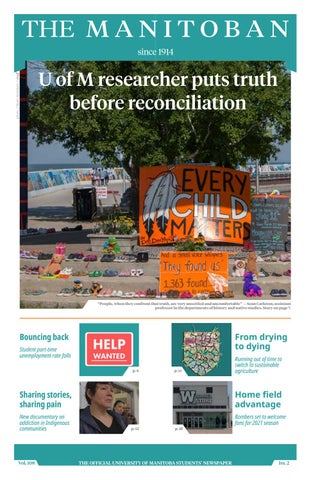
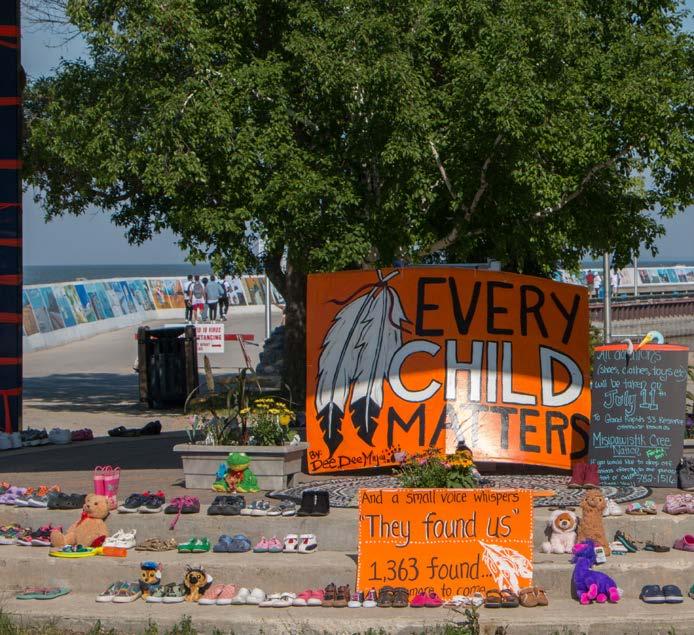
U of M researcher puts truth before reconciliation
Bouncing back
Student part-time unemployment rate falls
Sharing stories, sharing pain
New documentary on addiction in Indigenous communities
Running out of time to switch to sustainable agriculture
“People, when they confront that truth, are very unsettled and uncomfortable” — Sean Carleton, assistant professor in the departments of history and native studies. Story on page 7.
TOB AN the MANI
EDITOR-IN-CHIEF ? editor@themanitoban.com
Ty Brass
BUSINESS MANAGER ? accounts@themanitoban.com
Cindy Nguyen
ADVERTISING CO-ORDINATOR ? ads@themanitoban.com
Diego Castro
MANAGING EDITOR ? me@themanitoban.com
Sarah Doran
COPY DESK ? copy@themanitoban.com
Ursula Chojko-Bolec (ed.)
NEWS DESK ? news@themanitoban.com
Cam Cannon, Liam Forrester (eds.)
RESEARCH & TECHNOLOGY DESK ? research@themanitoban.com
Michael Campbell (ed.)
COMMENT DESK ? comment@themanitoban.com
Lucas Edmond (ed.)
ARTS & CULTURE DESK ? arts@themanitoban.com
Shaylyn Maharaj-Poliah (ed.)
SPORTS DESK ? sports@themanitoban.com
Matthew Merkel (ed.)
PHOTO DESK ? photo@themanitoban.com
Basel Abdelaziz (ed.)
DESIGN DESK ? design@themanitoban.com
Matthew Doering (ed.)
GRAPHICS DESK ? graphics@themanitoban.com
Dallin Chicoine (ed.)
AUDIO DESK ? audio@themanitoban.com applications open, see toban.news/jobs
VIDEO DESK ? video@themanitoban.com applications open, see toban.news/jobs
SOCIAL MEDIA DESK ? social@themanitoban.com
Jalene Moman (ed.)
VOLUNTEERS THIS ISSUE ?
Zoë LeBrun
VOLUNTEER STAFF ?
interested in volunteering? email me@themanitoban.com today!
THEMANITOBAN.COM
109 HELEN GLASS BUILDING
UNIVERSITY OF MANITOBA
WINNIPEG, MB
204. 474. 6535
The Manitoban is the official student newspaper of the University of Manitoba. It is published monthly during the summer and each week of regular classes during the academic year by the Manitoban Newspaper Publications Corporation.
The Manitoban is an independent and democratic student organization, open to participation from all students. It exists to serve its readers as students and citizens.
The Manitoban is a member of the Canadian University Press, and our journalistic standards can be found online at toban.news/jsp.
The newspaper’s primary mandate is to report fairly and objectively on issues and events of importance and interest to the students of the University of Manitoba, to provide an open forum for the free expression and exchange of opinions and ideas and to stimulate meaningful debate on issues that affect or would otherwise be of interest to the student body and/ or society in general. The Manitoban serves as a training ground for students interested in any aspect of journalism.
Students and other interested parties are invited to contribute to any section of the newspaper. Please contact the appropriate editor for submission guidelines.
The Manitoban reserves the right to edit all submissions and will not publish any material deemed by its Editorial Board to be discriminatory, racist, sexist, homophobic or trans-phobic, ableist or libellous.
Opinions expressed in letters and articles are solely those of the authors. Editorials in the Manitoban are signed and represent the opinions of the writer(s), not necessarily those of the Manitoban staff, Editorial Board or the publisher.
A “volunteer staff” member is defined as a person who has had three volunteer articles, photographs or pieces of art of reasonable length and/ or substance published in the current publishing year of the Manitoban.
Any individual who qualifies as a volunteer staff member must be voted in by a majority vote at a Manitoban editorial board meeting. Elected representatives and non-students may be excluded from holding votes as volunteer staff members in accordance with the Manitoban Constitution.
Mass grave sites confirmed at the site of Kuper Island School
On July 12, the Penelakut Tribe announced the discovery of over 160 undocumented, unmarked graves at the site of the former Kuper Island School. The school operated as part of the residential school system from the late 1880s to 1975 on Penelakut Island, a part of Penelakut Tribe’s territory in B.C.’s Southern Gulf Islands.
The find brings the total of recent discoveries to over 1,000 unmarked graves across Canada.
The Kuper Island School was funded by the Canadian government and operated by the Roman Catholic church until 1969 when the government assumed direct control. The school persisted until 1975 when it was officially shut down, and the building was demolished in the 1980s. Approximately 150,000 Indigenous children were sent to residential schools where sexual and physical abuse was rampant.
The National Centre for Truth and Reconciliation (NCTR) has identified 120 of the children who perished attending the Kuper Island School. According to the NCTR, an 1896 survey found that 107 out of 264 former students had died.
In brief July news
UNIFOR 3007 agrees to roll over collective agreement to 2022
UNIFOR 3007 — the union representing employees of the University of Manitoba working in operations, maintenance, dining services and residence — has reached an agreement to extend their current agreement with the university to April 2022.
Added to the agreement was an $800 “Covid Special Recognition Payment” to be disbursed to eligible employees this month. Those on long-term disability or who were laid off at the time of ratification — June 17 — are ineligible for the payment.
The payment is in line with the university’s agreement with the University of Manitoba Faculty Association (UMFA), which is 1.6 per cent of average annual UNIFOR employee wage.
Further, the union has negotiated for parking passes to be offered to members at a rate no more than UMFA’s. Currently, rates are set at $10 per month due to low traffic on campus, although this rate will be reviewed at the end of August.
The union’s agreement with the university has been in effect since 2017.
Tataskweyak Cree Nation declares state of emergency
In the wake of recent deaths and self-harmrelated injuries, on July 14 Tataskweyak Cree Nation declared a state of emergency for the community of Split Lake, located approximately 140 kilometres northeast of Thompson, Man.
“I am extremely saddened to hear about the situation in Tataskweyak Cree Nation,” said Grand Chief Garrison Settee in a press release. “My thoughts are with the community as they grapple with another loss of a young person due to suicide.” Nine youth have died of suicide in the community over the last 14 months, four of which occurred in the last two months.
Tataskweyak Cree Nation is calling on agencies including Health Canada, Indigenous Services Canada, the provincial government and the RCMP for additional support for mental health care and long-term solutions.
“We have reached a breaking point and our community is under crisis with alcohol and drugs contributing to it,” reads a July 14 press release from the nation.
words / Cam Cannon and Liam Forrester / staff
news@themanitoban.com
TOB AN the MANI
Rady faculty win community outreach award for COVID response
The 2020 Dr. and Mrs. Ralph Campbell Outreach Award was presented earlier this month to Jason Kindrachuk, an assistant professor in viral pathogenesis with the department of medical microbiology, and Melanie MacKinnon, executive director, Indigenous Health Services for Ongomiizwin health services.
The award, issued annually since 1982, is usually presented each fall to a University of Manitoba staff member who has been nominated by their peers, university alumni or members of the community for showing “particularly meritorious service in outreach activities” through their academic positions. This year, it was presented to two members of the Rady faculty of health sciences for their work supporting the COVID-19 public health response.
Kindrachuk also holds the position of Canada Research Chair for molecular pathogenesis of emerging and re-emerging viruses. There, Kindrachuk studies the biological mechanisms by which viruses infect the body with the goal of developing new treatment strategies.
He has provided reliable insight into the public health response for Manitobans through his media appearances, delivering scientific expertise to the public throughout the COVID-19 pandemic.
Melanie MacKinnon is a highly influential health advocate who has served many roles across Canada where she has helped craft regional and national program mandates for over 20 years.
She has served as the executive director of Ongomiizwin health services — formerly the J. A. Hildes Northern Medical Unit — since 2011. Before her directorship, MacKinnon worked as the president of the Aboriginal Nurses Manitoba Inc., sat on the board of directors for Palliative Manitoba and the board of the Aboriginal Health and Wellness
Centre.
MacKinnon accepted a part-time position as senior health advisor to the Grand Chief of the Assembly of Manitoba Chiefs in 2017, where she negotiates matters of self government related to health for communities throughout Manitoba.
MacKinnon has led the charge in developing and implementing a network of rapid response teams for Indigenous communities throughout Manitoba to combat the spread of COVID-19. Using surveillance data,
the rapid response teams can identify and respond to outbreaks in Manitoba First Nation communities. The teams, coordinated by MacKinnon through Ongomiizwin health services, deliver a local pandemic response that can manage outbreaks in a culturally respectful manner tailored to the communities they serve.
news@themanitoban.com
Newly-appointed Lagimodiere embroiled in controversy
“It was the express intent of residential schools to kill the Indian in the child. It is not cultural relativism, it is not revisionist history for us to say that that was wrong.”
Newly sworn-in Minister of Indigenous Reconciliation and Northern Relations Alan Lagimodiere stated in a July 15 press conference that “the residential school system was designed to take Indigenous children and give them the skills and abilities they would need to fit into society as it moved forward.”
Moments later, New Democratic Party and opposition leader Wab Kinew approached the stand to challenge Lagimodiere. “I’ve listened to the stories of the survivors and I cannot accept you saying what you just said about residential schools,” Kinew said.
In a Twitter post hours later, Lagimodiere claimed he “misspoke” during the press conference. He formally apologized for his statements the following day.
A few hours after Lagimodiere backtracked online, the Manitoba PC Caucus tweeted the following:
“We are all committed to meaningful progress on reconciliation. The political showmanship of storming into someone else’s press conference to bully a minister who was sworn in only 10 minutes earlier does nothing to advance that reconciliation.”
Within the hour, the tweet had been deleted.
Among the hundreds of subsequent replies, Grand Chief Arlen Dumas of the Assembly of Manitoba Chiefs expressed his support for Kinew’s actions and stated that “It is unacceptable to continually disparage First Nations in the most hurtful ways during these times of grieving and suffering over the [Indian residential school] system and the graves of our children.”
Manitoba’s Liberal Party leader Dougald Lamont also condemned Lagimodiere’s comments.
“It is shocking for a minister to go up there and run his mouth, say a bunch of things that are frankly ignorant, while he is being appointed minister of reconciliation,” said Lamont.
Lamont added that the province’s record on Indigenous issues “has been among the worst in Canada.”
“We talk about residential schools, we talk about the past, but we’re not actually willing to talk about the truly terrible things […] that happened
in the last 20 years and continue to happen right now,” he said. “And as long as we refuse to acknowledge the truth about those issues, we’re not going to see justice and we’re not going to see reconciliation.”
Lamont elaborated further, “When you see a homeless Indigenous person, […] chances are they were involved in [Chilwd and Family Services], and chances are their money was taken from them by the Manitoba government.”
photo / Basel Abdelaziz / staff
NEWS Liam Forrester, staff
The Progressive Conservative Party of Manitoba (PC) is facing public backlash over its recent handling of inappropriate comments made by cabinet ministers and Premier Brian Pallister.
TOB AN the MANI
Vaccine passports exclude international students
Provincial spokesperson says to expect announcement in coming weeks
NEWS Cam Cannon, staff
As Manitoba continues to rapidly hit vaccination-rate milestones laid out in the 4-32-One Great Summer reopening plan, public health orders are being eased and more privileges extended to those with Manitoba health cards and two doses of COVID-19 vaccine, yet international students remain left out.
On July 17, the province moved into the second phase of the reopening plan, hitting the Aug. 2 milestone of at least 75 per cent of Manitobans aged 12 and up having their first dose of a vaccine and at least 50 per cent of those aged 12 and up having their second dose on July 6.
“We are close to achieving all of our vaccination milestones ahead of schedule,” said Manitoba Premier Brian Pallister in a press release July 14. “Now we just need that extra effort by every Manitoban not yet vaccinated to roll up your sleeve and push us across the finish line.”
As of July 18, 77.5 per cent of Manitobans aged 12 and up have received at least one dose, while 61.7 per cent have received two. The final milestone, set for Sept. 6, is to have 80 per cent of eligible Manitobans with their first dose and 75 per cent with their second.
With the new easing of restrictions, many facilities are now able to open at 50 per cent capacity, indoor gatherings at private residences are capped at five people plus household members, walk-ins are permitted for personal care services such as haircuts and cultural and religious facilities may operate at 50 per cent capacity or 150 people indoors, whichever is lower.
New privileges for those who are fully immunized include being able to visit movie theatres, bingo halls, casinos, museums and galleries, all open at 50 per cent capacity.
In 2018, international students in Manitoba lost the universal health care coverage brought in by the NDP government in 2012. It was hoped that the government would see savings of around $3.1 million from ending the program.
With this change, international students also lost their access to Manitoba health cards — a requirement for receiving a vaccine card in order to demonstrate proof of full immunity — which leaves these privileges inaccessible to international students.
Students vaccinated in the province can request vaccination records, although it is unclear if these records will be accepted as an alternative to the vaccine card.
University of Manitoba International
Students Organization president Towani Mutale said in an email July 16 that members of her organization have raised concerns about access to such vaccination records.
Mutale said that some students have received their records as soon as eight days after requesting them and some are still waiting after two weeks.
“There are also questions about the validity of the record, especially in comparison to the vaccine passport,” she said.
She also voiced a lack of information for international students beyond being given instructions on how to request that record.
A provincial spokesperson said in an email that work is being done to develop a solution for people vaccinated in the province without Manitoba health cards and that an announcement will be made in the coming weeks.
Callum Morrison, an international student at the University of Manitoba, has been self-advocating around this issue, contacting university administration, MLAs and student unions.
“[The provincial government] hasn’t given us any sense of a timeline,” he
said of the current situation for international students. “We don’t know what that timeline is, is it something that could be next week? Is it going to take another month? Are they finalizing it?”
For Morrison, this goes beyond access to privileges in a pandemic — it is a question of international students’ right to health care.
He cited recent cases of international students in Manitoba receiving massive medical bills — in one case, well over $100,000 — as being indicative of a much larger issue with how health care for international students is handled in the province.
“It’s the realities of asking people to rely on a business for their health care,” he said. “It could’ve been anyone.”
Morrison pointed out that commenters online were saying that it would have been worse had the student been in the U.S. — a bar in terms of health care that he sees as unacceptably low.
“There’s a lot of people in Manitoba who don’t seem to really respect international students and seem to see us as both leeches and incredibly rich,” he said. “If I was exceedingly wealthy, I don’t think I’d be at school anyway.”
In his own recent experiences, the lack of a Manitoba health card has led to much confusion over accessing health care services.
In one instance, he was initially told at a doctor’s office that his insurance would be direct billed. After driving a long distance home, he was called and asked to come back to pay for the services up front. By the time he returned to pay his bill — driving a cumulative 225 kilometres between the two trips through rural Manitoba — the clinic had closed.
“A lot of international students don’t have access to a vehicle,” he said. “It does make even accessing health care they’re paying for more difficult.”
“I believe we have a great case for international students getting health care and I believe we have a great case for something like vaccination cards,” he said.
“We just have to keep at it […] dripping water could eventually dissolve limestone.”
graphic / Dallin Chicoine / staff
TOB AN the MANI
Canada adds over 230,000 jobs as restrictions ease
Growth mainly in part-time service industry, positions sees wages rise
NEWS Cam Cannon, staff
The June Labour Force Survey, released by Statistics Canada July 9, shows that June saw an increase of 230,000 part-time jobs and a 7.1 per cent average increase in wages across all sectors compared with June 2019.
According to the survey, labour market conditions are improving for students aged 20 to 24. In May, the unemployment rate for this demographic was 24.1 per cent compared with the 13 per cent pre-pandemic average for May. In June, the unemployment rate fell to 11.5 per cent, closer to the June average of 9.8 per cent from 2014 through 2019.
The youth participation rate — the percentage of youths either employed or actively looking for employment — increased by 4.1 per cent.
Accommodation and food services also saw its highest increase in jobs since July 2020. In June, the average wage in this sector was $17.35 per hour, an increase of 6.2 per cent from 2019.
While cooks saw an increase of 6.2 per cent, food counter attendants and kitchen helpers saw a 6 per cent increase and food and beverage servers saw almost no change.
Amid this, some business owners and
lobby groups have recently claimed Canada is facing a labour shortage due to factors like needing to compete with enhanced unemployment benefits.
Robert Chernomas, an economics professor at the University of Manitoba, dismissed these claims as “a trivial business-oriented right-wing view of things.”
“The [government] never raised minimum wages anywhere near the real wage maintenance required and now the market is doing it,” he said.
“After 40 years of wage stagnation or decline, wage growth, some would argue, is a good thing.”
“What’s happening […] in the short run is a reckoning of wages and productivity,” he said.
Since 1976, labour productivity has greatly increased while wages have largely stagnated. Income inequality has also grown dramatically over the same period.
Dan Hawkins, the owner of Shorty’s Pizza in the Winnipeg neighbourhood West Broadway, said he did not have any particular difficulty finding employees when he opened the restaurant in late June.
“We had been putting out ads for
a while in anticipation of it being difficult, [hearing] stories about how difficult it is to find people right now,” he said. “We got ahead of it a little bit, I guess.”
He added that he is “definitely having difficulty” with the Shorty’s location in Hamilton, Ont.
“The wage expectations have shifted with […] individuals who kind of have a pick of where they want to go or whatever motivates them, as well as many options,” he said. “Another big one is a lot of people want part-time only, which means you have to bring more people into the mix and that’s more training and more variability in the scheduling.”
Chernomas said there are a few potential bottlenecks causing increased competition for employees — leading to potential difficulty finding workers and the need to pay higher wages, at least in the near future.
These include whether employers were keeping people on payroll or laying them off throughout the public health restrictions and whether workers feel safe going back to work.
“People got sick disproportionately because employers […] were not taking proper safety measures,” he said, citing the higher incidences of COVID-19 in the meat packing industry as an example.
Mourning residential school victims
A third consideration is the availability of care for family members — both children and the elderly who may need care.
“I think there is certainly a short-run phenomenon going on here that will work its way through,” he said. “There’s a large vacancy rate but there’s also still a lot of people not working.”
He suspects that the participation rate — the amount of people willing to work, the available supply of labour — will grow as wages grow.
“Do I think there’s a long-term labour shortage? I doubt it very much,” he said.
With a “rise in [publicly funded] daycare [and], safe workplaces, better working conditions, raise [in] wages, it’ll disappear.”
news@themanitoban.com
Protestors tore down a statue of Queen Victoria at the provincial legislature July 1 during a march in memory of unmarked graves found on former residential school sites.
TOB AN the MANI
The historical precedent for residential school denialism
U of M professor on evolution of public narrative of Indigenous genocide
RESEARCH & TECHNOLOGY
Michael Campbell, staff
In June 2021, Sean Carleton, assistant professor in the departments of history and Native studies, published an article about former Canadian senator Lynn Beyak’s denialism of the atrocities that took place in residential schools. In the weeks since Carleton’s publication, denialism of the harms that took place at residential schools have come to the forefront of our cultural attention.
Recent comments made by Manitoba Premier Brian Pallister, as well as the resulting resignation of the Indigenous and northern relations minster and the denialist comments made by the incumbent minister have made understanding the scholarship underlying residential school denialism imperative to a society prioritizing reconciliation.
Carleton’s research looks at the history of settler colonialism and Indian residential schools, specifically in British Columbia, while also considering the context of western Canada.
“One of the things that I kept coming up against in my own research,” Carleton said, “[which focuses on] the late 19th and early 20th centuries, is how officials at the time engaged in practices almost […] to deliberately present the system in the best possible light to see it through a humanitarian lens.”
“They were saying things like […] these [schools] are well intentioned. There may be some children who are dying, there may be some spread of disease, but overall, and this is a quote from one of the Department of Indian Affairs officials, that the ‘investment was worth it overall.’”
Carleton’s research has tracked the discourse of denialism, including public discourse discrediting Indigenous voices that have raised concerns about the practices of residential schools since the early 1880s.
“All of the problems were well known,” Carleton said, “even in the Department of Indian Affairs.”
“Open public records [showed] deaths, disease, accidents, large-scale resistance by students and parents — from running away, to boycotting, to even trying to burn down the school, sometimes successfully — and how officials responded to all of that in a way that tried to minimize, discredit, downplay and deny [in order] to keep the system going as a tool of
settler colonialism and Canadian nation-building.”
“Senator Lynn Beyak was sort of […] a cause célèbre for residential school denialism. She was the public face of it.”
Beyak was launched into infamy when she asserted a desire to measure the “good, as well as the bad, of residential schools,” that people focus on the “bad” for political reasons and that “the Truth and Reconciliation Report was not as balanced as it should be.” Later, she dedicated space on her senate website to catalogue letters from Canadians who agreed with her denialist understanding of residential schools, including derogatory statements about Indigenous peoples.
“If I can sum it up for you,” Carleton said, “denialism is an attack on putting truth before reconciliation. If the goal is to put truth before reconciliation, denialism is trying to prevent us from doing that.”
In his research, Carleton finds residential school denialism among politicians, academics, in news outlets and online. “I think we need to really grapple with the fact that denialism speaks to people across
political spectrums,” Carleton said.
“It’s not just a right-wing issue […] I think it is sort of a defensive mechanism for a lot of non-Indigenous people who, upon learning the truth, that […] Canada was created through these nefarious policies, including the genocidal residential school system. People, when they confront that truth, are very unsettled and uncomfortable.”
Carleton explains that “there are a variety of tools at our disposal” for confronting denialists. “My job as an instructor is to be balanced […] My job is not to teach people what to think. It’s how to [...] think about everything critically.”
While Carleton aims to produce useful scholarship in the disciplines of history and Indigenous studies, his role as a self-described public intellectual requires a different focus.
“[I] use the work that I do to engage in public dialogue,” Carleton said. “Whether that’s writing op-eds for the Globe and Mail or other avenues that I’ve written for. I see Twitter as an extension of that public-facing work.”
On Twitter, Carleton has been very vocal about his disagreement with denialist statements made by elected officials in the provincial government.
Recently, Pallister commented on the July 1 demonstrations at the Manitoba Legislative Building which resulted in the toppling of the Queen Victoria and the Queen Elizabeth II statues.
Pallister was criticized, in part, for stating, “The people who came here to
this country, before it was a country and since, didn’t come here to destroy anything. They came here to build. They came to build better.”
In response, Carleton said that one of the things talked about in his introductory courses in both history and Native studies is understanding that “settler colonialism is fundamentally predicated on building by destroying. It is about […] undercutting Indigenous lifeways that root them in the land and the resources, moving [Indigenous peoples] to small reserves to open up the land for settlement to build.”
Carleton said the premier’s comments “[allow] a lot of Manitobans who are feeling pretty uncomfortable over the last couple of weeks [to] say, ‘Yeah, we didn’t come here to destroy, we came here to build.’” This rationalization allows Manitobans to avoid undertaking meaningful efforts to “establish more reciprocal relations.”
“[Reconciliation] requires a rethinking of our history and our relations to Indigenous people in the present,” Carleton said. “If you listen to Murray Sinclair, he said that reconciliation is a generational project — it’s not going to happen overnight.”
“My personal philosophy has been that most people, I think, want the truth. They want to understand [and] they want to be part of the solution. They want to work toward reconciliation and actually figure out how to strengthen relations.
“I see that in my students, to be honest. I draw that inspiration from them.”
research@themanitoban.com
TOB AN the MANI
Pallister’s racism is becoming increasingly apparent
Distasteful comments during press conference warrants resignation EDITORIAL
The famed poet T. S. Eliot once remarked that April is the cruelest month, but the recent spate of comments on residential schools and Canadian history by the Progressive Conservative Party of Manitoba puts forward a compelling argument that it should be July instead.
On July 7, Premier Brian Pallister opened a press conference with mention of the toppling of two statues on legislative grounds during a July 1 march in memory of residential school victims. Over 1,000 graves had been discovered on or near residential school sites around the country, sparking widespread mourning and a national push to cancel Canada Day celebrations.
During the press conference, Pallister made a series of appalling statements, most notably that “The people who came here to this country, before it was a country and since, didn’t come here to destroy anything, they came here to build.” A week later, he doubled down, saying he stood by his comments and told Manitobans to reread his comments with “an objective heart and mind” despite the resignation of Eileen Clarke — the provincial Indigenous and northern relations minister — a few days earlier.
Clarke later released a statement saying her decision was due, in part, to her voice not being heard in cabinet. While the release never explicitly mentioned Pallister or his comments, it made reference to constituents across the province upset with a perceived lack of representation and noted that “Inappropriate words and actions can be very damaging.”
Clarke’s
replacement, Alan Lagimodiere, caused another uproar — just minutes after being sworn in on July 15 — when he said residential schools were intended to teach Indigenous children skills to fit into society. He also articulated that he believed administrators “thought they were doing the right thing.”
Unlike Pallister, Lagimodiere apologized for his comments via Twitter a few hours later and a press release the next day. That did not stop the official Manitoba PC caucus Twitter account from releasing a tweet condemning Wab Kinew, who interrupted Lagimodiere’s press conference to hold him accountable for his statements.
“We are all committed to meaningful progress on reconciliation,” the now-deleted tweet read. “The political showmanship of storming into someone else’s press conference to bully a minister who was sworn in only 10 minutes earlier does nothing to advance that reconciliation.”
that European settlers moved to what is now Canada with the express purpose of expanding white imperial control. Hundreds of thousands of historical government documents depict a blatantly racist attitude toward Indigenous nations and discuss plans for total assimilation into the dominant white Anglo-Saxon Protestant society. The last residential school closed in 1996, only 25 years ago, and the Truth and Reconciliation Commission of Canada and the National Centre for Truth and Reconciliation have spent over a decade collecting evidence and testimony of the horrors perpetrated by residential schools.
This is not new knowledge. There is no excuse for continuing to pretend other narratives are accurate. At best, the PCs, under Pallister, have shown themselves to be jaw-droppingly ignorant and at least 50 years out of date. At worst, they appear deliberately malicious toward the community they claim to serve.
One might call the situation a comedy of errors if it were even remotely amusing.
Pallister and Lagimodiere’s comments reflect a delusional view of Canadian history — one which upholds white supremacy and genocide as unintentional. The most cursory glance through any reputable history textbook — with which Pallister should be familiar, given how often he talks about his past as a teacher — is enough to demonstrate
Even if Pallister and Lagimodiere’s comments could be taken in good faith, which they should not be, the broader context of the quotes makes the situation even more unforgivable.
Of all the times to publicly repeat racist, genocidal misinformation about residential schools and Indigenous history, it is mind boggling that Pallister and Lagimodiere saw fit to do so in response to nationwide protests and memorials for deceased children. In Manitoba alone, 104 potential graves have been identified near the grounds of the former residential school in Brandon. How can any Indigenous communities in Manitoba trust the PCs after receiving this kind of response?
Though Pallister has repeatedly defended his efforts toward reconciliation — all the while doubling down on his statements — his and his minister’s behaviour reflects a party that can’t even be trusted to pay lip service to Manitoba’s Indigenous populations without adding insult to already grievous injury. With voters waiting patiently for the next election set for 2023, one can only hope that at some point the PCs will develop a moral compass and force Pallister to resign. Until then, efforts toward reconciliation in Manitoba will be pointless with him at the helm.
graphic / Dallin Chicoine / staff words / Sarah Doran / staff
TOB AN the MANI
The quiet history of Manitoba’s colonial namesakes
Wolseley an infamous colonial cog internationally, neighbourhood must be renamed
COMMENT
Lucas Edmond, staff
Following the toppling of two statues commemorating Queen Victoria and Queen Elizabeth II at the Manitoba Legislature on July 1, Métis activist group Red River Echoes drew attention to the fact that one of Winnipeg’s central neighbourhoods commemorates a dark period in Métis history and colonial dispossession writ large.
Wolseley — occupying the space sandwiched between Portage Avenue, the Assiniboine River and Maryland Street — is named after Col. Garnet Wolseley, who is known locally for his leadership of the Red River Expedition. The expedition was sent to supposedly tide over Manitoba’s transition to confederacy following the Red River rebellion. However, many Métis communities remember this expedition as the “Reign of Terror” — a name meant to draw parallels to the bloody tyranny of upper-class governance during the French Revolution just a century earlier.
Pamphlets about Col. Wolseley’s legacy in Manitoba were distributed throughout the neighbourhood last month. One line read, “He personally incited racism, violence, murder and displacement when his troops arrived here.” What is usually read in gradeschool history books as a patriotic expedition was truly a militia made up of hundreds of Anglo-Protestant settlers bent on avenging the execution of Thomas Scott — a radical Orangeman who opposed Métis sovereignty and Louis Riel’s leadership.
Further, Col. Wolseley was a crucial player in watering down Indigenous influence and promoting then-prime
minister John A. Macdonald’s project of colonial expansion westward via the settlement of Anglo-Canadians.
Not only were Métis populations in Manitoba terrorized and brought under military occupation during this period, but the militia’s presence stimulated settlement. By the summer of 1870, it wasn’t just water funnelling into one of Canada’s largest flood plains. Just decades after Col. Wolseley established Canadian troops on Métis soil, white settlers began composing a majority population and diluting the Métis population’s social and political influence over their home region.
For Métis populations that didn’t leave during the Reign of Terror, rape, lynching and dispossession — motivated by ethnic and religious divides — defined their introduction into confederacy.
Although a shameful face of Manitoba’s introduction to Canada, Col. Wolseley’s name also rings a sour bell for several Indigenous populations around the world. From Egypt to India, Crimea to Burma and China to South Africa, Col. Wolseley participated in and led military campaigns designed to eradicate threats to Britain’s imperial interests.
Having his name plastered on the streets of Winnipeg is not only an insult to Métis popu -
lations locally, but to dispossessed populations globally. Indeed, he was a central cog in the violence that permeated through colonial thinking and structures.
Col. Wolseley’s international reputation runs deep and his imperial influence as a key figure in the British military has played such a significant role that many of his historic interventions continue to influence the contemporary state of geopolitics. His time spent in the military has linked global processes around the world with British economic exploitation — likely one of the most radical being the suppression of the Egyptian ‘Urabi Rebellion in the 1880s.
Following the American Civil War, cotton exports from the United States dropped significantly and created a massive demand for a new primary cotton source in British mills. Within Britain’s colonial metropoles, over 500,000 individuals became unemployed, redefining the 1860s as a “cotton drought.” In this same period, British capital investments flooded Egypt to stimulate cotton production, increasing Egyptian exports five-fold. Nearly 40 per cent of all arable land in lower Egypt was converted to sustain the new and heavy demand for cotton. Although the drought stimulated investment in Egyptian infrastructure and cotton exports, it also established a volatile plantation economy linking each Egyptian peasant directly to the dictates of western politicians, venture capitalists and bankers far away.
interest rates from western bankers. The ultimate effect was the liquidation of Egyptian assets into western hands. This period in history is famed for the financial seizure of the Suez Canal — currently one of the largest and most profitable shipping routes in the world — to stave off national bankruptcy. The massive land dispossession witnessed in this period culminated in mass resentment of British financial imperialism and motivated a peasant uprising known as the ‘Urabi Rebellion.
Fearing the loss of control over the financial system in Egypt, the British invaded. It was Col. Wolseley that led the campaign against the ‘Urabi Rebellion and defeated the national uprising on Sept. 13, 1882, seizing control of the Suez Canal and subsequently all of Egypt. Col. Wolseley’s influence would establish a 74-year colonial occupation of Egypt.
Just like the colonial occupation of Egypt, Col. Wolseley stole and desecrated Indigenous land in Manitoba, too.
If Canada is to reconcile these injustices, colonial namesakes must be removed and Indigenous roots restored.
Following the reintroduction of the U.S. into the global economy, the price of cotton plummeted and forced producers to default on loans taken out with heavy
Whether it was settler colonialism in Manitoba or financial colonialism and imperialism in Egypt, Col. Wolseley was a force that proliferated unimaginable suffering and dispossession globally. His name has no place in Winnipeg’s streets.
comment@themanitoban.com
graphic / Dallin Chicoine / staff
Drought signals need for sustainable agriculture
Climate
challenges lie ahead, but governments can reduce risks by investing in food
COMMENT
Lucas Edmond, staff
As Winnipeggers funnel into airconditioned buildings to stave off record-breaking heatwaves, Manitoba’s farmers are facing a much deeper crisis.
For avid small talkers who love to discuss the weather, the low river and empty floodways during flood season were the first indications that Manitoba was going to have a summer of extreme conditions. Then the aphids appeared — a small insect that thrives in hot, dry weather — lathering Winnipeg’s canopy with sticky gunk. Finally, reality of the drought’s devastation struck when the West Coast of North America erupted in flames following a heatwave that stretched across several borders earlier this summer.
On July 5, just days after the heatwave, St. Laurent, Man. declared an agricultural state of disaster as potential crop yields continued to dwindle in the face of high aridity and soil exhaustion. Armstrong, Man. was the second rural municipality to declare a state of agricultural disaster on July 9, but it is likely not the last.
As Manitoba’s farmers fight to stay afloat with the support of only 40 per cent of Manitoba’s natural rainfall, a grasshopper infestation — produced by the dry conditions — has begun eating away at the limited vegetables, grains and oats farmers have managed to grow.
Due to the heat and the grasshoppers, a significant portion of crops that are often recycled as feed for cattle have been lost. Many farmers are being forced to cut their losses and sell their herds. Some have decided to prematurely cut their crops to bundle their feed in order to keep their livestock through the winter — forcing them to lose large portions of their annual incomes.
The ecological disaster and its consequential financial impact has stimulated discussions with the provincial government about financial aid to keep the province’s large agricultural sector healthy. However, subsidies for lost incomes should go a step further.
Although droughts have been prevalent across North America throughout the 21st century, this year is shaping up to be the driest in the last century. Record-breaking heat and inconsistent rain due to global warming — compounded by exhaustive industrial agriculture — are destroying the soils, stripping them of nutrients at a rate incomparable to any other period in modern history. Humanity and our methods of production, accumulation and distribution has spurned a new geological epoch now visibly discernable in the stratigraphic record. If the weather continues to become increasingly unpredictable due to our ecological impacts, then something must be done to create
a more sustainable and predictable agricultural sector.
The provincial government should take time to consider the benefits of establishing a fund dedicated to farmers who want to transition their efforts away from the unsustainable methods of industrial monoculture cropping that have proven to be unstable during this perilous drought. Although much more expensive and labour intensive, permaculture cropping adopts a land management system dedicated to farming based on a balanced ecosystem that can thrive through tough environmental conditions without the assistance of expensive and detrimental inputs of herbicide, pesticide and artificial fertilizer.
In other words, instead of planting one cash crop that is easy to harvest but tough on the environment, the agricultural sector should look toward planting crops and vegetation that mutually complement each other in
Monoculture industrial farmers typically try to avoid using pesticides due to their damaging effects on the ecosystems that surround their plots. However, if the dry conditions and the infestations persist, many farmers — without the capacity to produce natural solutions to the crisis — may have to bite the bullet to protect their livelihood in the short term.
As many biologists from around the world have concluded, killing back pests with artificial products stunts local ecology and the environment’s natural ability to balance itself. Using pesticides kills off vital food sources for various predators, thus unintentionally killing various other species and reproducing the conditions for much worse infestations in the future. Destroying biodiversity is exactly what farmers need to avoid during these periods of agricultural crisis.
By adapting to living with pests and
drought, farmers will be investing in the longevity of their yields while simultaneously reducing their industrial emissions. Transitioning into a labour-intensive permaculture system will be a crucial step in making the future of the planet green, but the transition must start with incentives and funding from federal and provincial coffers.
Fundamentally, it is up to farmers to make their decisions in conjunction with government bodies. However, the world is not fixing itself, and sustainable agriculture is a good first step at mitigating the public calamities that lie ahead.
their ecological contexts.
graphic / Dallin Chicoine / staff
TOB AN the MANI
An exploration of history, identity and culture
Winnipeg-based filmmakers discuss what it means to be Jewish in Manitoba
ARTS & CULTURE
Shaylyn Maharaj-Poliah, staff
Local filmmaker and U of M alumna Sara Bulloch is premiering her latest short documentary film, Ma Nishma Manitoba, at the 21st annual Gimli Film Festival (GFF). Codirected with fellow Winnipeg-based filmmaker Johanna Reimer-Henteleff, Ma Nishma Manitoba is an honest and intimate exploration of what it means to be a Jewish person in Manitoba. Bulloch and Reimer-Henteleff examine their own experiences with those of other Jewish Manitobans using interviews, illustrations and stop-motion animation.
Ma Nishma Manitoba is part of a new collection of short films titled Friendly Manitoba. The literal Hebrew translation of the documentary’s title “Ma Nishma” is “What do you hear?” which is a common greeting used to ask “What’s new?”. Originally commissioned by the GFF in late 2019, the octet of films showcases the province’s diversity told through the perspectives of various local filmmakers.
The 43-minute film provides many perspectives of the Jewish identity, as told by both directors and their numerous subjects ranging from a rabbi, an artist, an Israeli immigrant and more. Each person’s experiences are supplemented by family photos
and archived news articles relating to each topic of conversation.
The information presented is plentiful and fast-paced, moving seamlessly from general Jewish experiences to more specific accounts, such as fulfilling mandatory military service abroad and attending the Winnipeg Hebrew Free School, the building which is now a Manitoba historical site. The documentary provides the perfect balance of history, lived experience and storytelling.
The directors bring their viewers into the film by contextualizing historical images with present-day footage. This is achieved by using match cuts of historical photos of Winnipeg and their modern counterparts. This provides a holistic, educational and thorough approach to the subject matter as exemplified by their onscreen definitions of words that their audiences might not be familiar with, such as “Shabbat,” “sukkah,” “mensch” and others.
The film is playful, but it does not shy away from some of the more serious issues faced by the Jewish community. Bulloch and Reimer-Henteleff make space to discuss the history of antisemitism in Manitoba and racism within the Jewish community. They
also make a point to touch on the ongoing conflict between Israel and Palestine and tackle all these issues carefully, gracefully and respectfully.
Just before the credits roll, Bulloch and Reimer-Henteleff briefly speak on their experience creating the piece.
“I’m just grateful that we did this,” said Bulloch.
“It’s definitely a reconnection point for me,” said Reimer-Henteleff. “It’s nice to be able to be a part of a project that maybe someone can learn something [from], either about themselves or about the community and maybe help someone feel less alone so they feel more welcome to open up to someone.”
Bulloch concurred.
“And it can apply to so many cultural groups.”
At its core, Ma Nishma Manitoba is a film about connectedness, history, family, community and identity. It is about finding who you are through your culture and finding things within your culture that resonate with you.
Ma Nishma Manitoba is available to view for free until July 25 on gimlifilm.com.
arts@themanitoban.com
Moving forward with understanding and empathy
New documentary film examines substance use among Indigenous people
ARTS & CULTURE
Shaylyn Maharaj-Poliah, staff
Kímmapiiyipitssini: The Meaning of Empathy, the debut work from Seen Through Woman Productions, is currently screening at the 2021 Gimli Film Festival (GFF). Written and directed by Blackfoot and Sámi filmmaker ElleMáijá Tailfeathers and co-produced by the National Film Board of Canada, the documentary paints an intimate picture of the fentanyl crisis that has plagued the Kainai First Nation in southern Alberta since 2014. It shows the steps being taken to help heal the community and change their approaches to addiction and recovery.
Prior to its showing at the GFF, Kímmapiiyipitssini: The Meaning of Empathy generated a buzz at the 2021 Hot Docs Canadian International Documentary Festival in Toronto, Ont. and the DOXA Documentary Film Festival in Vancouver, B.C., being the recipient of three awards between the two festivals, including the Colin Low Award for Best Canadian Director.
Candidly, but delicately, the documentary profiles members of the community who are struggling with substance abuse as well as frontline
workers and medical professionals — like Esther Tailfeathers, the director’s mother — who are actively implementing harm reduction strategies to save lives.
The film is narrated by director Tailfeathers, who eloquently makes the correlation between settler colonialism, generational trauma and the use of harmful substances, including alcohol and inhalants. She also describes the pushback from people in the cities who believe in abstinence programs over harm-reduction initiatives like supervised injection sites.
While Kímmapiiyipitssini: The Meaning of Empathy is a slow-moving film, the pacing is not detrimental to its quality. In fact, it provides the space for reflection on the part of the viewer.
This is not an easy film to watch, but it is a necessary one. Despite the heavy subject matter, Tailfeathers approaches these subjects gently, tactfully and without judgment. By examining Canada’s legacy of trauma and the ongoing effects of historical injustices, she invites her audience to
begin to understand the struggles that Indigenous people face.
In light of the recent, tragic discoveries uncovered at several residential schools across the country, this understanding is even more critical and urgent in supporting the healing of the pain and suffering of colonialism which continues to impact lives today.
The film’s tone is reflected in its title — “kímmapiiyipitssini” is a Blackfoot word that means “giving kindness to each other.” The film shows that treating addiction through empathy, compassion, kindness and
understanding puts humanity first and provides hope for the future.
Kímmapiiyipitssini: The Meaning of Empathy is available to view on gimlifilm.com.
arts@themanitoban.com
photo / Sara Bulloch / provided
photo / NFBC / provided
TOB AN the MANI
Culture is not a monolith
The co-directors of Ma Nishma Manitoba on collaboration, culture and COVID-19
ARTS & CULTURE
Zoë LeBrun, volunteer
This year’s Gimli Film Festival is premiering many fantastic films by local creators, and one of them is Ma Nishma Manitoba Codirected by Sara Bulloch and Johanna Reimer-Henteleff, Ma Nishma Manitoba explores contemporary Jewish identity and history within Manitoba through interviews with members of Winnipeg’s Jewish community as well as the co-directors’ personal experiences.
Both Bulloch and Reimer-Henteleff have backgrounds in film, but from differing perspectives — Bulloch studied film while attending the Asper School of Business at the University of Manitoba and ReimerHenteleff studied fine art at OCAD University prior to entering the film industry. The two began collaborating on Ma Nishma Manitoba with a grant through the Gimli Film Festival in 2019.
Coming from interfaith backgrounds, which include Judaism, Bulloch and Reimer-Henteleff wanted to use this project as an opportunity to explore not only their own senses of identity, but that of other Jewish Manitobans. Ultimately, Ma Nishma Manitoba underscores the diversity of cultural and religious practices surrounding Judaism in a contemporary world.
“We wanted to try to get a decent amount of different experiences just in terms of background and stuff, which was definitely a challenge,” Reimer-Henteleff said. “I don’t want people to view Jews as a monolith.”
In conversation, the co-directors also mentioned that there were groups
they wanted to represent more in Ma Nishma Manitoba, such as Jewish people of colour and individuals from orthodox communities.
Similar to the wide range of experiences Ma Nishma Manitoba attempted to capture, the film’s alliterative title carries multiple meanings, which play on the film’s documentary nature and Jewish religious practice simultaneously.
“Ma Nishma” is a Hebrew phrase Bulloch stumbled upon while doing research for the film, which is most commonly translated to “What’s new?” in English. Reimer-Henteleff said, “[‘Ma Nishma’ is] very close to ‘Mah Nishtanah,’ which [are] the four questions in Passover […] I like that connection between the two, that little moment of religiosity, but not exactly. It’s a little bit off and a little bit more fun.”
Debra-Jean Creelman — ‘Threshold’
ARTS & CULTURE
harmonic foundation of the album.
filming of Ma Nishma Manitoba was also heavily impacted by COVID19’s arrival in Manitoba. Filming during the pandemic became a challenge for Bulloch and ReimerHenteleff to conquer as public health restrictions impacted their ability to conduct interviews.
Bulloch said, “Initially, it was supposed to be a six-month timeline [to film], but because of the COVID pandemic it ended up being a year and a half.”
“There was one particular month where three of our interviews got cancelled,” Reimer-Henteleff said. “COVID-19] made it just a lot more stressful [but] I’m proud that we persevered and got through it and got it finished though, despite all that.”
Ma Nishma Manitoba’s co-directors concluded with messages of
encouragement to anyone who may be interested in exploring their own cultures.
“Doing your own version of this feels really nice to learn more and just kind of feel a bit more connected with it in your own way,” said Bulloch.
Reimer-Henteleff agreed.
“Especially if [the] culture that you’re in has been through some kind of assimilation, you lose so much of that without even knowing […] you never know what you might find out.”
Ma Nishma Manitoba is available to view for free on gimlifilm.com until July 25.
arts@themanitoban.com
It is not often that the true intensity of an album sneaks up on you, but Debra-Jean Creelman’s Threshold, released earlier this month, takes you by surprise. Composed primarily of voice and string instruments, Threshold is simultaneously moving and unsettling.
Creelman, a Vancouver-based musician and former member of Canadian indie-rock band Mother Mother, used Threshold to reconnect with her strengths as a vocalist and explore the truths of human experience. Creelman’s music-writing process for Threshold hinged on her voice, with strings providing the
The focus on Creelman’s vocal talents are evident from the moment you press play on Threshold. The record’s surreal energy immediately captures and holds your attention, and Creelman’s mesmerizing voice is both the anchor and driving force of the album.
The foundational importance of these vocals — not just to the songs that make up Threshold but to Creelman’s writing process overall — is evident throughout the album’s entirety. While each instrumental accompaniment within is beautiful, it is Creelman’s ethereal vocals and ingenious layering that structure the record’s compelling energy and unique sound.
Threshold is described as “a body of work on the brink of catharsis,” which comes through in each of its multi-layered tracks despite the album’s lack of a distinct narrative — Creelman’s vulnerability shines throughout the record, emphasized by the swell of strings and vocals that carry you as the album’s intensity builds, reaching its zenith with “Animal” and “Body is Breathing.” These tracks, situated near the end of the album, contain multiple vocal layers which create a frenetic energy, pulling you in and spinning you around in their auditory undertow before leaving you metaphorically gasping for air as the album comes to a close.
image / Killbeat Music / provided
Zoë LeBrun, volunteer arts@themanitoban.com
With Threshold’s escalating harmonic tensions, emotional intensity and beautifully haunting crescendos, it is clear that Creelman caught her songwriting stride and has created a work that is both enjoyable in its sound
and thought-provoking in its content
— Threshold is an album reminiscent of a psychological thriller with a twist ending you don’t want to miss.
Want us to review your album? Email us at arts@themanitoban.com!
The
photo
/ Sara Bulloch / provided
4/5 stars
TOB AN the MANI
Canada West commits to athletic schedule
Change of format helps athletes return to competition
SPORTS Matthew Merkel, staff
Canada West has released all regular season and championship schedules for the 2021-22 academic year. Not only is this a victory for athletes, but also U-Sports athletic programs, who have suffered setbacks during the pandemic.
The announcement comes nearly a year after U-Sports and Canada West both announced the cancellation of all summer championships. As the academic year progressed, all fall and winter semester sports would also be cancelled due to the danger of the COVID-19 virus.
While there were rumours that some sports would be able to return to play under a bubble system, or even a more condensed schedule, nothing came to fruition.
Unfortunately for some student-athletes, this meant that their U-Sports careers had come to an end with little in the way of fanfare. In the case of the U of M Bisons volleyball team — who were set to host the 2020 national championships — the cancellation of that event and the subsequent destruction of the next year’s schedule had not only robbed athletes
of a once-in-a-lifetime opportunity to compete for a Canadian title, but also an entire year of their athletic lives.
A year later, U-Sports and Canada West are much more prepared for any incoming complications brought on by the pandemic. U-Sports has utilized the increased resources and research into COVID-19 available to them, helping create a comprehensive schedule that emphasizes athletes competing against rival schools close in vicinity to their own. Using this format, Canada West aims to mitigate the risk of infection to its members and the public brought on by cross-border travel.
For example, the Bisons soccer team will play a slightly reduced schedule against teams from Manitoba and Saskatchewan, as opposed to the usual format that has them playing against teams from all four western provinces.
In a statement, Canada West managing director Rocky Olfert praised members of the conference for their contribution to the schedule.
“Ultimately, I commend our membership for showing their commitment
to playing a Canada West schedule, providing an opportunity for programs to compete at conference championships and ensuring that our student-athletes are able to appropriately prepare to vie for national titles with the approval of these alternate formats,” Olfert said.
Nicole Davis of the Bisons women’s soccer team feels reassured by the release of Canada West’s schedule.
It’s nice and comforting to know that there will be a season this year since this time last year there was a lot of uncertainty and then ultimately sadness when it was confirmed that our 2020 season was going to be cancelled,” Davis said.
The women’s soccer team will also be the first program out of the U of M to begin its regular season.
As restrictions remain stringent, the Bisons coaching staff has found creative ways to help prepare their team for this unusual season.
“Normally for preseason, our team travels to Regina or the U.S to play exhibition games before our university league starts,” Davis said. “We do this to get a feel for how our team plays together and see what we need to improve on to be ready for our
competitive season. Due to COVID, we were limited [in] traveling, so to prepare for this upcoming season our team is participating in the Winnipeg Women’s Soccer League. We will be using these local games throughout the summer to help us transition into our competitive season, which will be very beneficial as many of us couldn’t play a game of competitive soccer [for] a while due to COVID.”
The release of Canada West’s 2021 schedule is a sign this downtrodden era in Canadian sports is coming to an end. For student-athletes like Davis, the opportunity to step back on the pitch alongside her teammates makes the wait worth it.
“I feel very confident in my team to do well this season,” said Davis. “We could definitely go far in the playoffs and maybe even compete in U-Sports nationals.”
“Now that my team has experienced what it’s like to not have a season, we appreciate the opportunity to play and represent the Bisons even more. My team and I are ready to make the most of this upcoming season.”
sports@themanitoban.com
AN the MANI
Bombers’ Miller overseeing return of fans to IG Field
On July 14, Premier Brian Pallister and top provincial doctor Brent Roussin announced new COVID-19 restrictions for Manitoba starting July 17, the most exciting of which, for many sports fans across the city, is that the Winnipeg Blue Bombers will be allowed an audience at 100 per cent capacity for its home opener on Aug. 5.
This was a significant win for the Winnipeg football club. After winning the Grey Cup in 2019, the club was robbed of the opportunity to defend its title after the COVID-19 pandemic forced the Canadian Football League (CFL) to cancel its 2020 season.
Due to the pandemic, the league and its teams suffered significant financial setbacks, with the league itself reportedly losing over $60 million.
This season is expected to look very different. More vaccines are entering the arms of Canadians, and an increase in resources available to teams has helped make possible a CFL season that emphasizes safety just as much as the product on the field.
For the Bombers, president and chief executive officer (CEO) Wade Miller is overseeing the preparation for this unique season. The 48-year-old Miller — a former player himself — explained that Bomber players will undergo strict measures in order to make this upcoming season possible.
“For the players, which we call tier one, they’re in a CFL health and safety protocol for the year,” he said. “That means reduced interactions with people outside of people in that tier one. They go through COVID testing twice a week, so […] very little interaction with people right now during training camp, other than the people on the team.”
Miller says fully immunized fans will also see some changes when they return to IG Field on Aug. 5. The
Bombers have made some adjustments to concessions, kiosks and staffing to make the fan experience a safe one.
“You know, it’s not [going to] look a ton different,” Miller said. “It’s [going to] be the first time we’re all back together, but there will be more sanitization going on with additional staff that are […] cleaning any high touch-point surfaces, […] less concession equipment, less kiosks on the concourse, so we’ve taken a few of those away, opened it up. There won’t be tailgating this year, so those are the basic changes.”
Bringing fans back to IG Field was imperative for the CFL and the Bombers. Consultation with Manitoba Public Health was ongoing throughout the pandemic to make sure that seats were filled. Miller detailed the importance of this relationship in garnering ticket sales for the club.
“We’ve been having ongoing discussions pretty well since COVID started, so we’ve worked together to get to a place where you bring fans back to the stands,” he said.
“We’re a gate-driven league, so we need fans in the stands and that’s what we’ve been able to get to across this country now, which is how we’re getting back on the field this year.”
Miller understands the toll the pandemic has had on players and coaches. After watching the first couple weeks of the Bombers’ training camp, he is proud of how the team has handled the situation and is confident that the club will be prepared to defend its Grey Cup title.
“It’s a testament to our players and coaches,” he said. “It doesn’t look like our team has missed a beat for being off as long as we were.”
“We have most of our veterans back and it looks like a great start to training camp, so we’re off to a good start.”
Miller spent 11 seasons with the Bombers. He is a two-time CFL east division all-star as well as the all-time CFL leader in special team tackles. In 2011, he was inducted into the Winnipeg Football Club Hall of Fame. Along with his outstanding football career, Miller is also the president and CEO of Winnipeg’s soccer team Valour FC, as well as the co-founder of multiple Winnipeg businesses including Pinnacle Staffing and Elite Sports Injury.
Before his professional career, Miller was a student-athlete with the U of M Bisons football team, as well as a member of the U of M wrestling team. Miller gives credit to the time he spent at the University of Manitoba
for helping prepare him for success in football and business.
“I played two sports [which] taught me a lot, both the team sport and individual sport in wrestling at the university as well, so dedication, commitment and I think that would be the biggest part of that,” he said.
“I had to balance a lot of different things with playing two sports and getting a great education at the same time.”
IG Field is located on the U of M’s Fort Garry campus, giving the U of M Bisons football team the opportunity to train in a professional facility. Miller explained that the proximity to a professional organization is a great thing for the Bisons, displaying the close relationship between the CFL and U-Sports.
“I don’t think the two football clubs, being the Winnipeg Football Club and the Bisons, could be much closer when we share a stadium, and [the Bisons] have their workout facility and everything right in IG Field. That’s a great step for U-Sports to be a part in that and to be in a professional environment like IG Field.”
As the Blue Bombers continue their ongoing training camp in lead up to the home opener in August, Miller will be overseeing the on-field product and the safe return of fully immunized fans. IG Field will serve as a sign that the worst of the pandemic may be in the past, and that a return to normalcy is hopefully not far in the distant future.