THE M A N I T O B A N


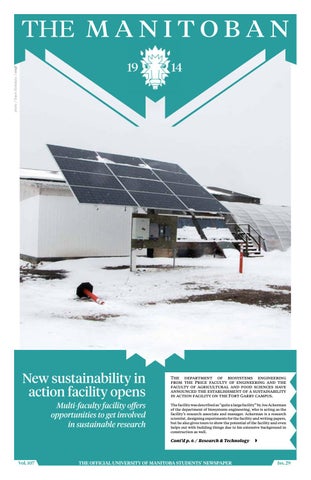
The department of biosystems engineering from the Price faculty of engineering and the faculty of agricultural and food sciences have announced the establishment of a sustainability in action facility on the Fort Garry campus.
The facility was described as “quite a large facility” by Joe Ackerman of the department of biosystems engineering, who is acting as the facility’s research associate and manager. Ackerman is a research scientist, designing experiments for the facility and writing papers, but he also gives tours to show the potential of the facility and even helps out with building things due to his extensive background in construction as well.
Cont’d p. 6 / Research & Technology >

and citizens. The Manitoban is a member of the Canadian University Press, and our journalistic standards can be found online at toban.news/jsp
The newspaper’s primary mandate is to report fairly and objectively on issues and events of importance and interest to the students of the University of Manitoba, to provide an open forum for the free expression and exchange of opinions and ideas and to stimulate meaningful debate on issues that affect or would otherwise be of interest to the student body and/or society in general. The Manitoban serves as a training ground for students interested in any aspect of journalism.
Students and other interested parties are invited to contribute to any section of the newspaper. Please contact the appropriate editor for submission guidelines. The Manitoban reserves the right to edit all submissions and will not publish any material deemed by its editorial board to be discriminatory, racist, sexist, homophobic or trans-phobic, ableist or libellous. Opinions expressed in letters and articles are solely those of the authors. Editorials in the Manitoban are signed and represent the opinions of the writer(s), not necessarily those of the Manitoban staff, Editorial Board or the publisher.
A “volunteer staff” member is defined as a person who has had three volunteer articles, photographs or pieces of art of reasonable length and/or substance published in the current publishing year of the Manitoban. Any individual who qualifies must be voted in by a majority vote at a Manitoban editorial board meeting. Elected representatives and non-students may be excluded from holding votes as volunteer staff members in accordance with the Manitoban Constitution. All contents are ©2021 and may not be reprinted without the express written permission of the Editor-in-Chief.
COPY DESK ? copy@themanitoban.com
Ursula Chojko-Bolec (ed.)
Aldin Sabic
NEWS DESK ? news@themanitoban.com
Gillian Brown (ed.)
Cam Cannon (ed.)
Damien Davis
Colton McKillop
RESEARCH & TECH DESK ? research@themanitoban.com
Sarah Doran (ed.)
Kunal Rajpal
COMMENT DESK ? comment@themanitoban.com
Lucas Edmond (ed.)
Liam Forrester
Grace Gyolai
ARTS & CULTURE DESK ? arts@themanitoban.com
Shaylyn Maharaj-Poliah (ed.)
Kaelen Bell
Zoë LeBrun
SPORTS DESK ? sports@themanitoban.com
Isaiah Wagner (ed.)
Matthew Merkel
Last day of classes for the winter semester
Start of final exam period
PHOTO DESK ? photo@themanitoban.com
Alex Decebal-Cuza (ed.)
Basel Abdelaziz
DESIGN DESK ? design@themanitoban.com
Joshua Wesey (ed.)
Mikaela Warkentin
GRAPHICS DESK ? graphics@themanitoban.com
Jenelle McCann (ed.)
Dallin Chicoine
AUDIO DESK ? audio@themanitoban.com
Tino Hove (ed.)
Tawana Matizanadzo
VIDEO DESK ? video@themanitoban.com
Jesse Boily (ed.)
Arsalan Saeed
SOCIAL MEDIA DESK ? social@themanitoban.com
Colin Ijebor (ed.)
Jalene Moman
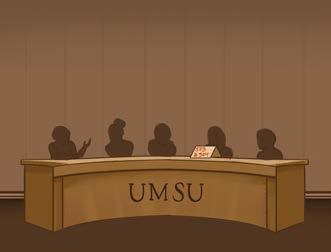
At its latest meeting April 8, the University of Manitoba Students’ Union (UMSU) released details of next year’s budget.
Major items highlighted included plans to update the UMSU space in UMSU University Centre (UC), replace the HVAC system and upgrade club spaces.
“The UC capital project is updating the UMSU space in UC to fit the needs of today’s students,” said Brendan Scott, UMSU vice-president of finance and operations, and UMSU president-elect. “The goal is to create the following spaces: [a] Studentcare health and dental office, [a] student businesses start up space, [a] multipurpose flex space for clubs, [an] updated digital print centre [and a] larger dental clinic.”
According to Scott, UMSU has budgeted $400,000 to renovate the UC building.
The new HVAC system will cost around $40,000, with costs split between the university administration and UMSU.
A proposal requesting an expanded dental space in UC is currently in progress. The new space would be roughly twice as large as the previous clinic, which had an operating capacity of four chairs.
“Our goal is to double the size of the dental space and have eight to 10 operating chairs,” he said. “Currently we are working with the U of M faculty of dentistry in creating [a request
for proposals] to have a new dentist occupy the space, [requesting] that U of M students operate in the space and [that] direct billing is offered to U of M students that have procedures in the space.”
“Very exciting stuff, we hope to [have] it fully operational by September 2022,” he said.
According to Scott, this year presented particular challenges in designing the budget, given the uncertainties caused by the COVID-19 pandemic.
“The general focus of this budget is to address the difficulties that students and the union face during this pandemic,” he said. “When creating a budget, one must make the best estimates under specific assumptions.”
“The assumption that guides this budget the most is that normal operations cannot commence until September 2022,” he continued. “This is why UMSU businesses are not budgeted for with the exception of the Service Centre and GPA’s.”
He made clear that it’s possible some businesses may open partway through the year, but “because we can’t say with 100 per cent certainty that they will open, we do not budget for them.”
Scott also highlighted funds being allocated for UMSU to join the Canadian Alliance of Student Associations (CASA).
“This was added by executive committee once it was confirmed we would be
going to referendum on the matter,” he explained. “This was added with the knowledge that the budget could be amended at the board level if the CASA question was to fail, [as it is] easier to remove money than to add money.”
The UMSU board estimated it will receive $150,000 from the endowment fund toward UMSU’s governance budget and wage subsidies totalling over $670,000.
“The endowment fund and wage subsidies are extra forms of income that aid in the operation of UMSU while we cannot fully operate,” Scott said. “They allow us to operate the Service Centre and GPA’s even when we’re not allowed to be fully operational and students are not in person for classes.”
“In essence, every year the endowment
fund helps us with funding, now with [COVID-19] the wage subsidy allows us to keep UMSU staff working.”
The budget has been approved by the executive and finance committees of UMSU.
On April 9, Manitoba Minister of Advanced Education, Skills and Immigration Wayne Ewasko announced that Bill 33, the Advanced Education Administration Amendment Act, will be amended to re-define what “student fees” are.
On March 11, the minister tweeted that the bill will exclude fees set by student unions and associations.
The amendment will exclude fees set by student unions and associations such as UMSU from ministerial control. The bill would still enable the minister to set guidelines for fees collected by post-secondary institutions such as tuition, recreation and technology fees.
In recent weeks there was controversy around the bill raised by organizations such as the Canadian Federation of Students Manitoba and the Manitoba
Organization of Faculty Associations (MOFA).
Concerns centred around the bill’s alleged similarities to the Ontario government’s failed Student Choice Initiative, which made some student fees optional — including ones that funded student clubs, newspapers and food banks. The result was a widespread loss of funding for student unions and associations as well as student media.
The initiative was struck down in court in 2019. In a Nov. 22, 2019 statement, the Ontario branch of the federation referred to the initiative as “a clear attack on student organizing on campuses.”
Ewasko referred to the allegations of similarities to Ontario’s Student Choice Initiative as “categorically false,” on Twitter on March 11.
The amendment to Bill 33 was promised to the Manitoba Alliance of Post-Secondary Students (MAPSS) in early March but both the federation and MOFA continued to raise concerns that although the promise was in writing in a letter, it was not yet reflected in the language of the bill.
According to the minister’s press release, the bill will “allow the minister to protect students from overly large tuition and student fee increases,” to ensure post-secondary education remains affordable.
In 2017, the Progressive Conservative majority government lifted the cap on tuition hikes to five per cent annually plus inflation. Tuition at the U of M will increase an average of 3.75 per cent this year, for the third year in a row.
In April 2020, universities were asked by the provincial government to find ways to save 10, 20 and 30 per cent of their budgets. This was accompanied by a cut to operating grants for
Board members were given three weeks to review the budget and generate questions before the next meeting when the budget will be debated and voted on. universities.
This year’s provincial budget also shows there was a further cut to funding for post-secondary institutions in the province — making this the fourth year in a row that cuts have been made.
“Students should know the purpose of Bill 33 is to help Manitoba students continue to enjoy the lowest university and college tuition rates in Western Canada,” said Ewasko.
The National Centre for Truth and Reconciliation (NCTR) has made changes to its website and database and has plans to continue evolving with projects, including a new building that the U of M has committed to assist in building.
The centre’s new executive director, Stephanie Scott, explained that the NCTR was created to preserve the memory of Canada’s residential school system “not just for a few years, but forever.”
The NCTR is home to all statements, documents and other materials that were gathered by the Truth and Reconciliation Commission of Canada (TRC).
“It’s home for survivors of residential schools, their families and everyone affected by the residential schools,” she said.
Scott emphasized that the centre belongs not only to Indigenous people, but to all Canadians.
Key to educating Canadians on residential schools are the documents and physical information that the NCTR has in its possession. To assist in this as well as further the progress of preserving the history of residential schools, the NCTR released its database with a new open-source model.
“We’ve gone open-source because that allows us to get out of the proprietary trap of having to pay for licenses on a regular basis,” NCTR head archivist Raymond Frogner explained.
According to Frogner, this model also gives the centre better control over the data structure it uses.
This allows them to not only work on the system, but build off of it as well, creating the ability for them to initiate projects, one example being an app that would allow survivors to log on to the database, find photographs of the residential schools they attended and add their own descriptions to them in a collaborative preservation of the history.
The biggest “hurdle” with the archives, said Frogner, had been attempting to bring some form of consistency to the data so the database can be better structured and used for research. He pointed out that due to the frequent litigation with the history of residential schools, a focus is placed on item level and the individual documents in regards to the archive.
In the context of the archival system, Frogner said that people will point out that the record management used for the archives is a European model, very unlike any way that Indigenous knowledge systems might be used to organize information.
The database’s usage of Indigenous
knowledge systems “should be thought of as a first step in a very longterm engagement with Indigenous communities, to try and bring their world views and perspectives on this knowledge into how the records are explored, discovered and used,” he said.
“Having moved on to this opensourced system with the potentials of engagement that it holds that brings us long term to incorporating Indigenous world views and values into how the records are kept and used.”
This past December on the fifth anniversary of the final report of the TRC, a commissioner’s statement was released in which they stated that they were concerned by the “slow and uneven pace of implementation of the Calls to Action.”
“Truth, reconciliation and healing are matters of urgency.”
Scott echoed this sentiment and explained that NCTR had worked with the former commissioners for the anniversary and that coming back together to amplify that was a partnership done in regard to the respect of survivors.
“We were hearing time and time again that we’re losing survivors every day and it’s absolutely critical and important that the Calls to Action are addressed, so that survivors can see some kind of reconciliation in their lifetime.”
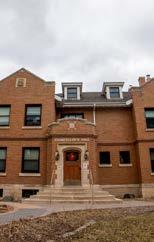
Scott said that in her experience with the U of M over the past five years, there has been an incredible movement and change, though there is still a way to go.
“We’re not yet at reconciliation,” she said. “It’s going to take decades upon decades to continue that work and complete it, but there is an urgency, and the time is now.”
news@themanitoban.com
Two motions were passed at last week’s University of Manitoba Students’ Union (UMSU) meeting. One approving the abolition of slates in student elections, and a motion to formally adopt the International Holocaust Remembrance Alliance’s (IHRA) definition of anti-Semitism.
Motion 0503 abolished the slate system and requires candidates to run independently in UMSU elections going forward.
“The conversation surrounding the abolition of slates did start a couple of years back,” UMSU president Jelynn Dela Cruz said. “As a result, back in the fall we brought forward a preliminary motion.”
“At that board of directors meeting in the fall, […] a majority did approve the abolition of slates.”
However, there was some debate regarding this motion, and UMSU vice-president community engagement Tino Dogo raised concerns.
While he said he respects the choice
made by the board, he disagreed with the decision to abolish slates.
He worries that individual candidates will have difficulty engaging the student body and this will result in lower turnout or fewer candidates.
Dogo said he thought the proposed training programs to assist potential candidates are a “good place to start,” but suggested they should begin sooner — in September or perhaps even summer, to give students more time to learn about the process.
Motion 0504 approved UMSU’s adoption of the IHRA definition of anti-Semitism.
UMSU vice-president-elect advocacy Emily Kalo, who brought the motion forward, said the measure is necessary to protect the University of Manitoba’s Jewish students, who face anti-Semitism on campus.
“For Jewish students, each semester is preceded by heightened anxiety about returning to campus and classrooms where we may be at risk,” she said.
“The Jewish community is thus a distinct and significant cultural community within the University of Manitoba, that UMSU is constitutionally bound to support, protect and defend, just as they are with all other marginalized communities.”
The IHRA definition is controversial however, as critics have argued that it can be too easily used to tar critics of Israeli-state policy as anti-Semitic.
Harold Shuster, chair of the Winnipeg chapter of Independent Jewish Voices, expressed concern that adopting the IHRA definition could discourage people from talking openly about the Israel-Palestine conflict.
“[The definition] has a number of listed examples of what could be seen as anti-Semitism,” Shuster explained. “So our concern is that the examples that the IHRA gives as what could be seen as anti-Semitic is really a screen to protect Israel from legitimate criticism and to shut down and deny the
Palestinian narrative.”
“The IHRA definition of anti-Semitism, through its examples, tries to make criticism of Israel anti-Semitic.”
Seven of the 11 examples of anti-Semitic rhetoric listed in the IHRA definition mention Israel.
Kalo considered these concerns to be overblown, saying, “the IHRA definition explicitly states [that] ‘criticism of Israel similar to that leveled against any other country cannot be regarded as [anti-Semitic].’”
Shuster pointed out that numerous speakers, including renowned activist Angela Davis, have been barred from speaking at planned events after the IHRA definition was used to accuse them of anti-Semitism for criticism of Israel. Controversies such as these, in his words, “send a chill through academia.”
news@themanitoban.com
UMSU members voted “yes” on all four questions posed in the referendum which ran from April 7 to 9.
The questions of adopting Studentcare’s legal protection program, joining the Manitoba Alliance of Post-Secondary Students (MAPSS) and joining the Canadian Alliance of Student Associations (CASA) were all binding, with the question of continuing the U-Pass program being non-binding.
Voter turnout was 2,558 voters out of a possible 24,735 — 10.3 per cent. Turnout for the recent UMSU general election was almost double that at 20.4 per cent, or 5,045 out of 24,735 possible voters.
“I am very pleased and more than excited to see that students voted ‘yes’ to all four referendum questions,” said UMSU president-elect Brendan Scott.
Students overwhelmingly voted yes — 79.3 per cent — on the question of adopting Studentcare’s legal protection program at the price of $28 per student which can be opted-out of.
The program offers lawyers for housing, employment and academic disputes as well as up to $1,000 in experts’ fees per year. Also offered is access to a legal helpline which would provide “expert advice” on all legal situations.
On the question of whether to join the newly created MAPSS at no additional cost to students, 87.7 per cent of UMSU members voted “yes.” Scott said that since there is no additional cost, formally joining MAPSS is “pretty much already taken care of.”
UMSU has already participated in campaigns and advocacy work through MAPSS including recent advocacy around Bill 33 — the controversial Advanced Education Administration Amendment Act.
In late 2020, MAPSS also participated in a lobbying week in which the group met with ministers and other stakeholders culminating in a request from provincial Minister of Finance Scott Fielding to produce a budget proposal.
The next question was regarding UMSU officially joining CASA at no additional cost to students. UMSU members overwhelmingly voted “yes” with 86.6 per cent.
In 2018, then-UMSU president Jakob Sanderson endorsed joining CASA as an alternative to the Canadian

Earlier this year, the UMSU board of directors voted to discontinue membership in the federation — for the second time in two years.
UMSU still needs to get a petition signed by 15 per cent of UMSU’s membership, then hold a referendum on the question of leaving the federation before finally ratifying the results with the national body of the federation.
Concerns regarding the possibility of a lawsuit arising from attempts to leave the federation — earlier in the 2010s, UMSU was embroiled in a lawsuit with the federation over ownership of a website and withheld feeds, in 2016 UMSU was ordered to pay close to $1 million — have been assuaged by the president of the federation’s Manitoba branch Brenden Gali, stating earlier this year that the federation is not interested in legal action against student organizations.
“Ultimately, […] when student organizations and national organizations feud, nobody wins,” he told the Manitoban in January.
“Being able to officially join MAPSS and CASA will better aid UMSU in our advocacy efforts,” said Scott.
UMSU members narrowly voted in favour of the non-binding question on whether to continue the U-Pass program at the cost of $208 per semester per student. The result was 67 per cent voting “yes” against 33 per cent voting “no.”
The plebiscite was put to a vote “to gauge [students’] desire for this new U-Pass rate,” according to the UMSU website. Last year a referendum to continue the U-Pass at the cost of $160.75 per semester was approved before the City of Winnipeg sought to cut the program altogether.
Due to the COVID-19 pandemic, the U-Pass was not active this last year. Scott said that work will begin on implementing the decision next winter semester, although gaining approval from the UMSU board of directors will be done before that.
“It’s great to know that the [U-Pass] program is still wanted by students even at its increased price,” said Scott. “We look forward to signing a new […] contract now knowing that it is desired.”
“I am also pleased by the amount of students that voted in the referendum, as we near the end of the semester it is nice to see the engagement on these important matters.”
NEWS
Gillian Brown, staff
The U of M food bank has long been a reliable resource for students facing financial challenges, and since the onset of the COVID-19 pandemic, it has been of even greater help to students than usual.
According to Jane Lastra, associate registrar and director of financial aid and awards, there has been a substantial increase in the food bank’s use in the past year. She attributed the heightened utilization of the food bank to the financial circumstances students have been left in since the beginning of the pandemic, such as “loss of income [and] loss of part-time
work opportunities for students.”
In a typical year, the food bank would be available in-person to students, but the unprecedented circumstances required an adaptation of its operation.
The food bank is currently working with a remote delivery model adopted in March 2020, the initial campus closure, by the U of M along with UMSU, UMGSA, student affairs and local grocery Food Fare to provide same-day delivery to students from Monday to Friday at no charge to the student.
Food bank hampers provide students
& TECHNOLOGY
Kunal Rajpal, staff
In addition, two co-op students, one from mechanical and one from biosystems engineering, are also employed by the facility. They are currently working on integrating existing solar energy systems.
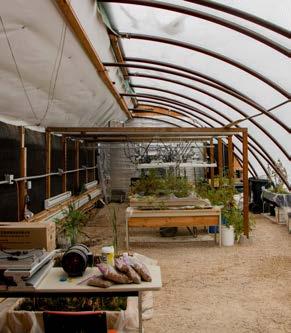
The facility is the largest strawbale building in all of Western Canada and its mission is to provide all members of the University of Manitoba community with the opportunity to participate in sustainable experimentation. It is being supported by the NSERC chair in design engineering, the university’s office of sustainability, a faculty of agriculture endowment fund and BioTalent Canada.
Located just to the west of campus, the site was used by the department of biosystems engineering for about 15 years for doing research in alternative building techniques and insulation.
Ackerman said the team is at an “organizational stage” where the facility’s main mission is to improve and promote sustainability content by offering access to hands-on learning opportunities in renewable energy, innovative food production systems, sustainable building practices and utilization of waste biomass. A further goal is to enable the U of M to participate in public education and outreach regarding sustainability issues.
For example, Ackerman hopes to launch project demonstrations to demonstrate emerging sustainable technology, especially as several renewable energy systems are already available on the property.
“There’s a lot of completed projects [in the facility] that produce good data, but the facility now aims to use those and go further with it,” he said.
Solar energy is a particular strength.
“There are five different kinds of solar energy systems which are each taking a different aspect of solar energy, some passive and some active, some
with non-perishable items to offset grocery costs, and they then have the opportunity to use that saved money to buy their own perishables.
Since the closing of campus, the food bank has raised approximately $60,000 through fundraising to support its operation.
Along with the remote availability of the food bank, the university has increased financial support for students in the form of bursaries and COVID-19 relief funds, in total amounting to a $9 million increase in financial support from the year prior.
“There’s so many barriers to success for students, financial, personal, academic,” Lastra said.
“Every student has the right to wake up and have enough food on-hand to nourish themselves […] and we need to remove the barrier.”
staff
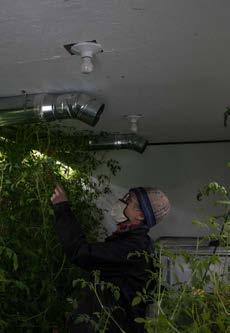
heat pumps,” Ackerman explained.
“So we are integrating all those together, bringing them all together so we can glean data off of them and make them available so people can plug projects into them with some alteration of some kind.”
Ackerman said the faculty of architecture is currently using facility space to test different organic mediums that could be used as building material. By making blocks out of materials such as fungi, the resulting object weight is very low and the blocks may even be fireproof.
“That’s exactly what this facility wants to encourage,” he said.
“We give a site for that, like it’s a bit of a workshop sort of space. We have tools, we have floor space, we’ve got a couple of buildings.”
To make the site more friendly and welcoming for people interested in learning about novel sustainable tech, the department of landscape
news@themanitoban.com
architecture with the department of biosystems engineering have also announced a design competition to update the facility.
“We have opened up this design competition for inspiration from people,” Ackerman said.
The competition is open to any architecture student, and there is a total of $7,000 in prizes up for grabs.
Ackerman said the COVID-19 pandemic is “probably the biggest limitation” the new facility is facing but pointed out even something as simple as face masks has sparked inspiration for researchers.
“We’re working on a project to utilize face masks, and we’re working with the idea of they can be integrated as a structural fiber into low-temperature asphalt by basically collecting the masks and pulling them apart,” Ackerman said.
The office of sustainability is helping by installing mask disposal locations
around campus to collect used masks.
Projects like face mask fibers are just one example of what the sustainability in action facility can do once it is fully up and running.
“All of the things that have been tried here are very forward-thinking and sort of alternative energy and conservation and better building techniques, and local design, and using the same local materials,” Ackerman said.
“None of that is growing old — it’s actually becoming more and more important as we go on, and so [the goal] is to use these [current projects] as demonstrations and also to pave the way forward for new ideas to come through.”
Sarah Doran, staff
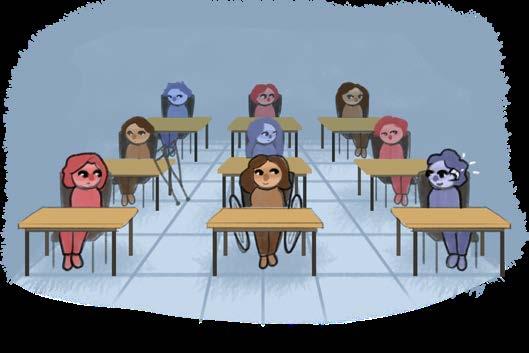
A book co-edited by University of Manitoba associate professor Nancy Hansen was recently released in paperback. Titled The Routledge History of Disability, the book discusses the ways disabilities and people with disabilities have been represented and treated across the world from the age of antiquity up to the modern day.
Hansen, who is also the director of the U of M’s master’s program in disability studies, said the book is an exciting opportunity to create a more diverse understanding of disability.
“So often in disability history and disability issues, there seems to be a North American, western European approach to everything,” she said.
“But myself and the other editors, we try to get a more global perspective on the whole disability history phenomenon, and culturally too, I think was really important — there are different cultural perspectives with regard to disability.”
Two of the book’s three editors have disabilities, and all three editors of another of Hansen’s recent projects, Untold Stories: A Canadian Disability History Reader, are disabled.
“It’s exciting that disabled people are having more of a say in the perspective of how disability is presented, to provide a broader, wider, more complete context of lived experience with disability,” Hansen said.
“We’re putting disability back into the historical landscape.”
One billion people worldwide experience some form of disability. In Canada, 13.7 per cent of the population lives with a disability and one in 10 working-age Canadians is disabled. As “the world’s largest minority,” Hansen said, allowing disabled voices to take their place in expressing their own history has an important effect similar to that of supporting any other minority.
“I think that it’s important to recognize that the level of disadvantage
/ Jenelle McCann / staff
experienced by many people with disability, by many disabled people, has historical roots,” Hansen said.
“It’s not simply as a result of disability. There has been a sort of historical displacement or historical erasure of disability for a long time, and our understanding of disability right now is based on the last 150 years […] Even though it’s been present, the value of the presence of disability has not always been recognized.”
The U of M’s master’s in disability studies features a course in disability history, which Hansen says is constantly evolving. From year to year, it covers time periods ranging from disability in ancient history to how the COVID-19 pandemic is affecting disabled populations, as well as topics like Indigenous perspectives on disability and physician-assisted suicide.
“We cover right from the earliest times to the present day and look at connections and intersections with other parts of history that we may think we know, but really putting disability back into the picture again,” Hansen said.
“Many of the historical figures that we recognize have some form of disability, but that element of their biography is often removed, I think, in a way that a lot of traditional historians have kind of left that disability element out because it appears they think that touching on the disability somehow detracts from the significance of what these people have accomplished.”
Despite considerable recent work in the field, Hansen’s specialty is not actually history, but rather human geography, or the study of how humans interact with their environment and each other in specific areas and places. Hansen explained the field acts as a useful framework to understand what disability means in various contexts.
“Regardless of what type of disability or impairment that an individual has, space, place and time always factors in because we’re always working within a non-disabled time frame, there’s a certain expectation of the way things are done, or the manner in which things are done, or the time it takes to do something,” she said.
“So, looking at space, place and time enables one to put a magnifying glass on to what’s actually happening here.”
Above all, however, Hansen’s passion is creating space for disability to be acknowledged and supported in all academic fields and all areas of life.
“Nobody is just one thing,” Hansen said.
“We’ve got to get beyond siloing stuff and recognize that disability is intertwined with a whole lot of other elements, right, and marginalization can occur on various levels at the same time, and inclusion can happen on various levels at the same time.
“So, I think it’s really important [that] what disability studies does is expect disability, because whether or not it’s recognized, it’s present.”
research@themanitoban.com
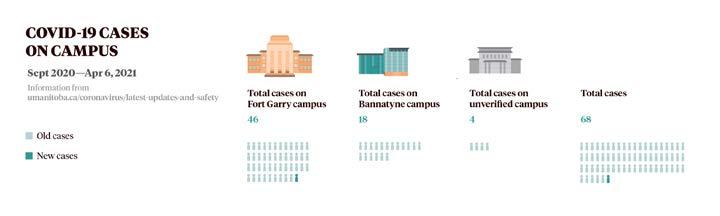
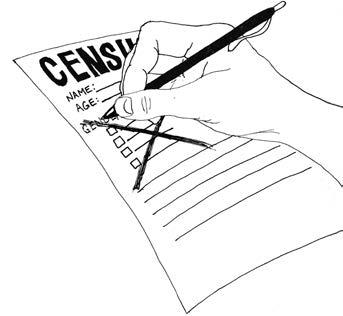
Recent years have exposed the prevalence of transphobic violence. Hate crimes such as targeted murders, discrimination in housing and employment and state legislation prohibiting access to lifesaving forms of health care continues to afflict the transgender community with radically disastrous costs.
According to a 2015 survey published by the National Center for Transgender Equality, transgender people in the U.S. experience shockingly extreme violence. Nearly half of respondents that partook in the study reported verbal harassment, around one in 10 reported being physically attacked and nearly half were sexually assaulted in their lifetime. Further, 65 per cent reported having experienced homelessness and more than half reported intimate partner violence at some point in their lives. A study from the Mental Health Commission of Canada reported 67 per cent of transgender people pre-transition experienced suicidal thoughts. In contrast, only about 3 per cent felt suicidal after a medical transition.
Recent discriminatory efforts have been aimed at preventing youth from accessing puberty blockers — a class of drugs that delay the onset of puberty by preventing the production of the hormones like estrogen and testosterone.
The Provincial Health Services Authority of B.C. deems the treatment safe, and there is a reliable medical consensus that asserts puberty blockers are safe medications for gender-nonconforming people.
Despite the fact that medical knowledge has been produced within trusted health services, on April 6 the Arkansas state legislature voted overwhelmingly to overturn Governor Asa Hutchinson’s veto of a law that would ban the use of gender-affirming health care, including puberty blockers, for people experiencing gender dysphoria in transgender and non-binary youth.
Similarly, in December 2020, courts in the U.K. also ruled that those under the age of 16 are not able to give the kind of informed consent required to get this type of treatment.
These efforts have been accompanied by a hate-fuelled hysteria over an imagined LGBTTQ* agenda that imperils the status quo nuclear family by attempting to sever biological sex from gender thereby encouraging children to engage in an inaccurate imagination of what transgenderism is to people who don’t conform to gendered constructs.
“To reduce children to genderless unicorns simply awaiting hormonal guidance from within piles absurdity upon absurdity,” Ben Shapiro wrote in a December 2020 op-ed in the Lowell Sun intended to defend gender reveal parties from the left.
“Joe Biden has openly stated that an [eight-year-old] can decide on his transgenderism […] Elizabeth Warren infamously stated that she would have a [nine-year-old] transgender child screen her secretary of education nominee.”
Right-wing media outlets such as the Daily Wire — which Shapiro happens to be a founder and former editor-inchief of — as well as the conservative media outlet PragerU continue to push the idea that this style of health care is purportedly dangerous for youth while also pathologizing trans identities as sprouting from mental illness and trauma.
This type of discourse leads into questioning whether young people can even know if they are transgender. Since this is not a treatise on the philosophical underpinnings of gender, I’ll just side-step it for now — but the answer is yes, they can.
Trying to pin down an age at which a person begins to know themselves truly is a ridiculous pursuit that only distracts from what’s at hand — actually existing transgender youth being denied legitimate medical care.
Even anecdotally, some of my older family members — who often find themselves subject to what has been termed the “right-wing outrage machine” on social media sites such as YouTube and Facebook — have repeated this narrative.
Clearly, the political right is dead set on waging a culture war over the health-care system.
The result of these attacks on these communities is markedly increased violence against tran sgender and non-binary people. This violence is both structural and personal. It is structural due to the fact that these populations are denied health care, and is personal considering the physical violence and harassment that these discourses precipitate.
All this comes on the heels of a year
which saw so much violence against transgender and gender-nonconforming people that the Human Rights Campaign declared it an epidemic in the U.S.
In an average year, transgender people experience disproportionately more violence and discrimination than cisgender groups — especially if a transgender person’s position intersects with other factors such as socioeconomic class and race that increase risk.
Even then, citing concerns such as a lack of evidence of safety compared to the potential risks to justify denying this type of health care to youth is bizarre and hypocritical.
This issue is a political question over whether transgender and non-binary people have a right to exist — it is not a question of science.
Puberty blockers are also used to treat precocious puberty — a condition in which children before the ages of eight or nine begin experiencing puberty. Such concerns about the safety or effectiveness of the treatment have not been raised in the same way as it has for transgender and non-binary youth.
All of this is despite the fact that adverse effects of the conditions going untreated largely remain the same — social ostracization leading to mental health issues such as depression, anxiety and substance abuse.
The so-called “risks” of taking puberty blockers are largely uniform for both people experiencing precocious puberty and transgender youth — but, it is worth repeating, no such hysteria exists around its use for treating precocious puberty.
Again, this is not about legitimate concerns over the safety of the treatment, it is about allowing transgender and non-binary youth to live their lives meaningfully.
An important aspect of this issue is
that patriarchy, and its embodiment in the nuclear family, demands that the father hold power over other family members.
Transitioning to another gender — or refusing to partake in gendered constructs in general — violates this power structure, and it is most acute when it comes to transgender youth — allowing youth to transition is an exercise of their own bodily autonomy against the very structures which cement the authority of the father.
No wonder, then, that the political right takes transgenderism as an attack on family structures.
Of course, puberty blockers are not a magic-bullet solution to marginalization and violence against transgender, non-binary and gender-nonconforming people. Yet the fact of the matter is that these treatments save lives. The fact of the matter is that many of us realize our genders do not match the social expectations placed on us because of our biological sex before reaching adulthood — I certainly realized I was non-binary around the age of 16.
I often wonder if I had access to high-quality education on sex and gender, would I have realized earlier? Would it have been easier to accept my identity and break away from patriarchal ways of seeing the world? Would access to these medicines have made my mental health problems more manageable earlier on?
COMMENT
Grace Gyolai, staff
Following the launch of Manitoba’s vaccine rollout, there might be a glimmer of hope heading into the summer months. Although our circumstances feel largely the same, we are inhabiting a world after 13 months of sacrifice, resolve and innovation.
When COVID-19 is made a product of history, the art made in reflection of these current times will be there to remind us and future generations what living during the pandemic was like — the struggles, loss and sacrifice will be best articulated through the medium of art. But, over the past year, artists and performers have been forced to adapt to circumstances that disproportionately affected them.
The public benefits from the art scene in so many direct ways. Not only does the arts sector account for roughly $1.5 billion of the provincial economy, but it also brings communities together, improves quality of life and promotes expression.
After being starved of the social interaction we never planned on missing — when we needed the relatability and beauty of art most — beloved events such as the Winnipeg Folk Festival are being cancelled or postponed.
In recognition of the hardships that art organizations and artists have felt during the pandemic, the provincial government promised $6 million to the arts and culture sustainability funds that were recently established for the losses the art scene took throughout COVID-19.
The funding has been designed to help arts and heritage organizations recover from the profound challenges they have faced, and these organizations are eligible regardless of any funding they had already potentially received. The money will be managed and facilitated by the Manitoba Arts Council and Manitoba Film and Music.
Museums, community arts, festivals, publishing, artists and musical groups, among others, are supposedly eligible to receive a piece of the new fund, although the exact requirements and application details are not outlined yet.
These provincial supports are necessary and reflect some acknowledgement that the arts need financial investment, but there is still a fear persisting in the arts community that individual artists, who lack the conventional supports gained by working for a company, will be forgotten when the funding is dispersed.
The gross domestic product of the arts sector in Canada dropped by 62 per cent since last year and labour in arts declined 36.6 per cent in 2020.
Individual creatives and artists have been impacted the most by this deterioration of revenue and
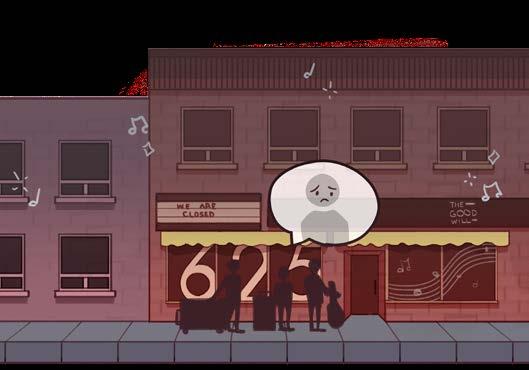
the uncertainty COVID-19 carries.
Many of these artists joined the near 280,000 Manitobans who applied for the Canada Emergency Response Benefit (CERB), but when the Canada Recovery Benefit (CRB) — an extension of the CERB — ends in September, and if public restrictions are still in place, many independent artists may be forced to confront the aftermath of widespread cancellations and loss of revenue on their own.
While it’s important to recognize that artists need support during the pandemic, it must also be noted that artists have been advocating for appropriate wages and financial assistance long before the pandemic. They rely on unreliable short-term contracts year round and do not always quality for employment insurance.
After receiving the CERB, some artists realized that their typical monthly income was less than the $2,000 per month that CERB provided. This has inspired a conversation surrounding artists’ compensation post-COVID.
Since the launch of the CERB and following awareness of the dismal wages some workers receive, the concept of a basic income guarantee has gained traction — a policy that suggests everyone should make a
minimum income regardless of their circumstances.
In terms of the art industry, directors, CEOs and other leaders from arts councils across Canada — including the Winnipeg Arts Council, Toronto Arts Council and Conseil des Arts de Montréal — wrote an editorial to the Globe and Mail calling for systematic change in Canada’s art scene.
Part of their demands included a federally based basic income guarantee for artists designed to ensure they are treated with the same rights and securities of workers. This type of benefit plan would ensure that artists can create works we all enjoy while also being able to sustain themselves financially.
The fact that artists and other freelance workers do not get reliable or fair compensation for their valuable work is alarming and highlights society’s bias toward traditional forms of labour.
Imagine quarantining without music, movies, art and other creative content. Consider how much value and meaning arts and culture bring to our collective existence. The world would be much worse off without the comforts of creativity.
With continued advocacy and pressure placed on the government, perhaps artists will be able to create and engage with the community while also having a basic safety net that can make up for lack of paid sick leave and other typical benefits.
Community members should also evaluate our own ability to support local arts and culture organizations. The extensive conversation surrounding support for local businesses must be extended to local art and artists.
Winnipeg is known for its vibrant art scene, but following the aftermath of COVID-19 it’s time to repay the artists and organizations we love and cherish.
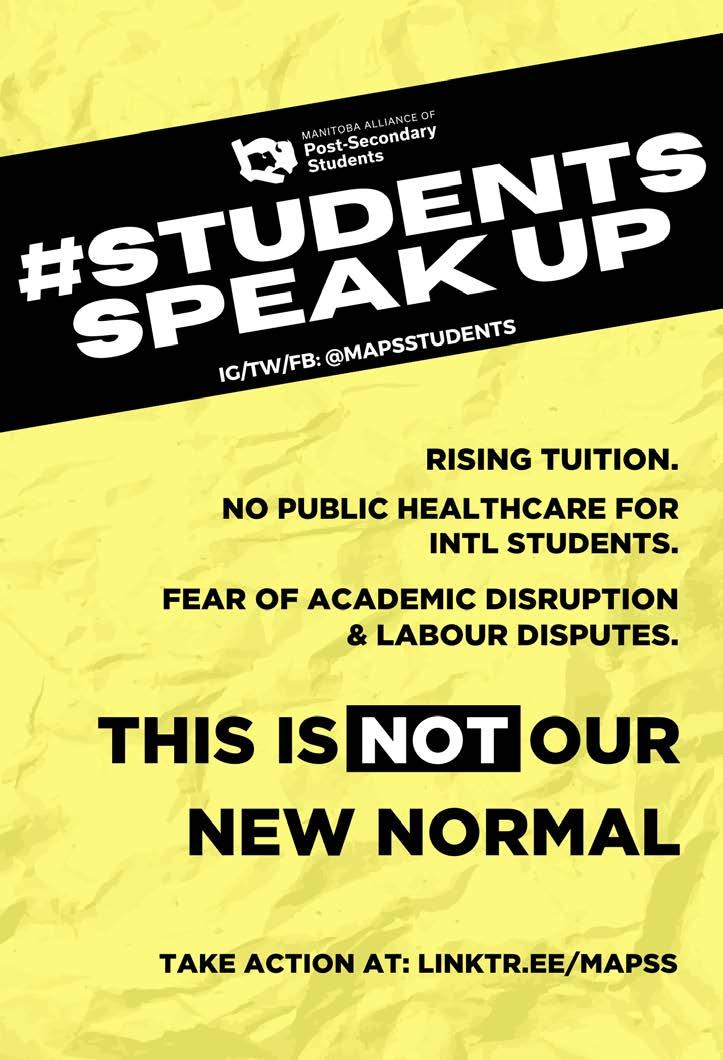
‘The real impact of Bill 33 is that tuition will increase for students’
This past year has been a tough one, there’s no doubt about it. Students have faced unthinkable challenges throughout this pandemic with such a drastic shift to virtual learning last spring. As the official opposition critic for advanced education and skills, and a University of Manitoba alumnus, I am in awe of the determination and hard work I have seen from students at the U of M.
However, as many of you are aware, the move to online learning hasn’t been the only challenge faced by university and college students.
As students lost jobs, struggled with bills and worried about their health, Brian Pallister’s government decided to make it even harder to get by. Since the beginning of the pandemic, tuition alone at the U of M has risen over seven per cent.
This is a direct result of yearly funding cuts to post-secondary education that the provincial government has implemented every year since they took power in 2016.
On top of this, the Advanced Education Administration Amendment Act, Bill 33, was introduced into the legislature this past fall. Bill 33 gives the Minister of Advanced Education, Skills and Immigration Wayne Ewasko the power to force institutions to raise student fees and tuition with the stroke of a pen.
Without consultation, without talking with faculty, staff or students first, this government has decided to strip them of their autonomy. The minister can cut funding to universities and use tuition fees as a way to partially fill in the gap. Putting more pressure on students and making university less accessible.
The real impact of Bill 33 is that tuition will increase for students, universities will become less accessible for Manitobans and it will threaten the autonomy of our post-secondary institutions.
Though Minister Ewasko will now present an amendment at committee to exclude the fees set by student unions, this is simply too little, too late.
Ewasko had ample opportunity to consult with student representatives in good faith while drafting Bill 33 — instead, the legislation was rushed, poorly written and, as a result, has increased the anxieties of student leaders across the province. Bill 33 needs to be scrapped, not amended.
Direct control over tuition fees and student fees in the hands of the minister means further cuts to provincial funding for post-secondary institutions.
This was made perfectly clear when the Progressive Conservative (PC) government announced a

nearly-$9-million funding cut to universities and colleges in the 2021 provincial budget. Tuition has already increased by roughly 18 per cent over the past four years and at the rate the PC government is currently increasing tuition, in another four years the average tuition in Manitoba will be roughly $1,000 higher than today. How can Minister Ewasko justify taking more money out of the pockets of struggling students?
Much of my focus has been on preventing Bill 33 from passing because its intentions are clear; much like what we’ve just seen with the K to 12 education plan, this government wants to concentrate its power at the cabinet table.
If you want to have your voices heard about Bill 33, you can speak at the public committee hearing on this bill. The public committee meeting is set for Tuesday, April 13 at 6 p.m. Please contact my office directly at Jamie. Moses@yourmanitoba.ca and we can assist you with registering for the committee meeting.
Our New Democratic Party team will continue to defend students and post-secondary education in Manitoba.
We will keep fighting to freeze tuition, restore international student health-care coverage and preserve the autonomy of Manitoba’s post-secondary institutions.
If you have any questions about Bill 33 or would like to share your concerns, please feel free to get in touch with me by email at Jamie.Moses@yourmanitoba.ca or by phone at 204-219-5407.
— Jamie Moses MLA for St. Vital Critic for Economic Development and Jobs Critic for Advanced Education and Skills
letters@themanitoban.com
Liam R. Forrester, staff
Despite my best efforts to stay healthy this past year, I fell ill over the Easter weekend. While my symptoms were not related to COVID-19, I did my due diligence. I reported my illness to my employers, stayed home, got tested, saw a doctor and recovered. I followed the rules.
Unfortunately, there were some Canadians this Easter weekend who were not so cautious.
During its Sunday services, the Christian Church of Morden willfully broke health orders. The church announced its intentions in a now-deleted post which stated, “After much deliberation, prayer and scriptural direction, we have come to the conclusion that we can no longer comply with the restrictions imposed on us by the government of Manitoba. Live stream services are no substitute for personal fellowship.”
The statement went on to argue that the church is divinely appointed to the task of providing support to the community and equipping them for a “practical Christian life.” What is strange about the church’s statement is that it does not provide any reasoning as to why this work must violate health orders.
Contrary to what the Morden church implies, in-person Easter services do not necessarily violate health restrictions. Both the World Health Organization and Manitoba’s own guidelines provide a myriad of reasonable suggestions for carrying out in-person services. Taking the service outdoors is one obvious solution. Conducting multiple small services throughout the day with the appropriate sanitization and social distancing is another.
I can understand some degree of reluctance to comply with health orders, as there are some that mandate changes to how services and rituals are conducted. For instance, the health orders recommend that attendees do not handle communal objects or offer food or drink like communion, except for in pre-packaged individual portions. This changes how rituals must be conducted. However, religious groups can embrace the changes and come up with creative solutions
/ Dallin Chicoine / staff
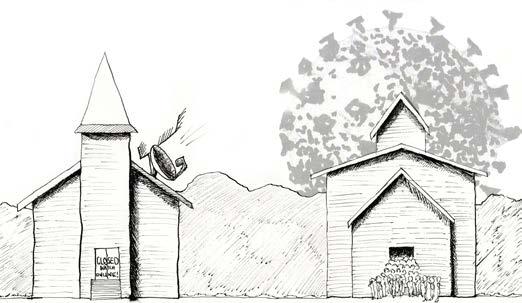
that safely honour their faith.
Thankfully, there are many churches that embraced these challenges and have come up with creative ways to host services in COVID-conscious ways. Take, for instance, the St. Thomas Anglican Church, which kept its Sunday service below the 25 per cent capacity and hosted a safe parade mostly from the distance of the congregation’s cars.
Unfortunately, some in religious communities have been quick to criticize efforts to promote safety measures amidst the pandemic — possibly contributing to the reluctance in some communities to take the necessary measures outside of the church, as well.
When Pastor John van Sloten of Marda Loop Church in Calgary, Alta. wrote a clear theological justification for mask-wearing last fall, the church’s Facebook page was inundated with furious, conspiracy ladened comments. Congregants at Calgary’s Journey Church began to spread the widely debunked Plandemic video and repeat QAnon conspiracy talking points. The pervasiveness of these conspiracy theories had moderates in Journey Church concerned about the possibility of fracturing their communities.
If these groups in Calgary are any
indication, faith groups permeated by similar highly vocal conspiracy theorists risk backlash for enforcing public health orders. This can increase hesitancy when it comes to doing what is necessary to protect their communities. That hesitancy will cost lives.
What ought to cause more concern for religious liberty than changes to rituals and services is the unequal application of these restrictions between groups. Quebec set a bad precedent last year by allowing restrictions to be lifted for Christmas celebrations but maintained restrictions during Hanukkah. The reactions from Quebec’s Jewish communities ranged from outrage at this flagrant privileging of one faith over another to confusion as to why restrictions were being lifted at all.
Those in Quebec that questioned this decision have a point. The problem is that religious gatherings, like restaurants and bars, are known hotspots for COVID-19 transmission.
For example, St. Michael’s Ukrainian Catholic Church in Sarto, Man. saw a significant 10-case outbreak March 12. Chief provincial public health officer Dr. Brent Roussin commented at the time that “We know where people gather, especially for prolonged times, we’re going to see outbreaks and clusters.” This particular outbreak was also linked to other outbreaks at faith-based gatherings. The very

next day, public health orders to allow household groups to remove their masks in church while observing the social distancing requirements and not singing went into effect.
Additional care must be taken to keep religious gatherings safe. Additional care, in cases like the Christian Church of Morden, is not being taken.
Manitoba does not yet know what consequences the Easter weekend will hold. Dr. Roussin claims that an accurate case count will be available after two COVID-19 incubation cycles — about four weeks. Will spring break and Easter push Manitoba into its third wave? Only time will tell. In the meantime, every member of every community, faith-based or otherwise, must remain cautious. With vaccine initiatives speeding up, Manitobans are so close to seeing the light at the end of the tunnel.
comment@themanitoban.com

COMMENT Lucas Edmond, staff
From the 19th century to the contemporary period, nature has been presented as harmonious and passive while placing it at odds with humanity, which is pervasively presented as disturbing and dominant. This view has overwhelmed environmental discourses.
This dualism was first articulated by Enlightenment-inspired thinkers such as Jean-Jacques Rousseau, Johann Wolfgang von Goethe and Henry David Thoreau who ascribed humanity, and its assumed natural propensity toward linear progressive growth, short-sightedness and greed, against the bounties of an imagined natural world based in moderation — an image of the natural environment that parallels the garden of Eden. However, this dualism has been adopted by many environmental activists and conservation biologists as an inherent truth, pitting humans against the forces of nature.
Early environmentalists like George Perkins Marsh — often referred to as “the Prophet of Conservation” — pervasively pushed this dualism in their work. “Man is everywhere a disturbing agent. Wherever [they] plant [their] foot, the harmonies of nature are turned to discords,” Marsh said in his popular book Man and Nature
This line of thinking has been married to earlier theorizations of demographic growth and ecological self-destruction. Thomas Malthus — an early-modern classical economist — theorized in the late 18th century that populations were largely restricted by the carrying capacity of the land. If human activity outpaced this carrying capacity via overpopulation, mass death through famine, disease and ecological ruin would bring the population back down to a sustainable level.
Malthus was unfortunate enough to have published his work directly before the Industrial Revolution which precipitated a population boom never before seen in human history. As a result, his work was largely written off, until, of course, environmental degradation became a concern.
Malthusianism was re-articulated by Paul Ehrlich at the service of environmentalism — 11 years before the world’s first climate summit — in his book The Population Bomb, which argued that geometric population growth would inevitably outpace the finite resources of the world and would lead to a myriad of social problems.
Ehrlich’s introduction to the book opens his discussion about overpopulation with his experiences roaming the streets of Delhi, describing the city as “hellish” and painting it as overrode with people whose desires, and very existence, would lead to the destruction of a pristine and
/ Dallin

unperturbed nature. The irony and violence behind Ehrlich’s example is that Delhi’s population sat at a meager 2.8 million people at the time — roughly one-third of the size of New York in the same decade.
Ehrlich’s book brings into context an alarming trend within Malthusianinspired anxieties about overpopulation — concerns about population growth are largely fuelled, in many instances, by racism and classism. Malthus himself was an articulated aporophobe — someone with a fear of poor people —and consistently used his work on population science to rationalize inequality and exclude poor populations from welfare and support.
Yet, despite this concerning history of racism within the overpopulation stream of the environmental movement, population growth has been pushed as a central concern for those who understand individual consumerism and increasing affluence as the primary causal factor for global warming.
The problem is, their arguments lay in the assumption that there is a scarcity of resources and that the world’s poorest people cannot rise to the standards of living popular in colonial metropoles without risking the wholesale destruction of the planet — placing the onus of responsibility on individuals, especially racialized
individuals, instead of systemic inequality. In essence, it looks at the parts of the whole while ignoring the whole itself.
But where did this idea that individuals are responsible for the destruction of the planet come from? After all, as of 2017, 100 companies are responsible for 71 per cent of carbon emissions. Focusing on the consumer seems like a suitable bailout for a system that functions through inequality and exploitation.
Interestingly, the idea of the carbon footprint — which is worked out by multiplying variables such as population, affluence and technology — was popularized in 2004 by British Petroleum.
Sound suspect? It is.
By atomizing responsibility, focus is shifted toward a misanthropic conversation about population growth and individuals as opposed to methods of resource distribution and systemic inequality. It reproduces the early-Enlightenment trope that humanity is, by its nature, the environment’s antithesis. And it cements the notion that capitalism, and the inequality it perpetuates, is natural, too — feeding violent racism that materializes in hate crimes such as the El Paso, Texas and Christchurch, New Zealand shootings which were carried out by self-proclaimed eco-fascists.
The painful irony of all this is that a lot of these anxieties about population are unconsciously disseminated by self-avowed progressive environmentalists. For example, in an article published by the Guardian criticizing the Population Matters charity and Jane Goodall — a famous primatologist — for driving population-centred speeches at the World Economic Forum in Davos, Switzerland, while hypocritically appearing in an advertisement for British Airways the previous year, columnist George Monbiot humorously responded to the cringy scene saying, “I doubt that any of those who nodded and clapped were thinking, ‘Yes, I urgently need to disappear.’”
Although in some cases well-intended, environmentalists need to ditch their focus on population and individuals and divert their concerns toward the systemic driver of global warming. Capitalism and its precondition for constant economic growth and unequal modes of resource distribution is the problem, not people.
Zoë LeBrun, staff
This week, University of Manitoba Press is releasing
Authorized Heritage: Place, Memory, and Historic Sites in Prairie Canada by public historian and University of Manitoba alumnus Robert Coutts, the editor of the journal, Prairie History. In addition, he has also authored and co-authored many other books, articles and reviews in journals in Canada, the United States and Great Britain.
In Authorized Heritage, Coutts uses his three decades of experience working with Parks Canada to examine the colonial history of commemoration at Canada’s heritage sites. Further, he explores how governments have controlled what is and is not considered heritage across history.
Coutts’s analysis draws primarily from government documents and records, through which he argues that the narratives of heritage so familiar to us today were almost always centred around colonial perspectives
rather than actively and appropriately engaging in Indigenous perspectives about historical events and places. Coutts highlights how these views of Indigenous people across Canada are often in conflict or confront the historical conventions of the colonial histories. Continuing this thread, Coutts also argues that these heritage sites should be considered through and represent “the fluid cultural perspectives that should define the shifting ground of heritage space” rather than focusing on just one narrative.
Throughout Authorized Heritage, Coutts explores how the process of commemoration can reflect social and cultural perspectives of the privileged. The book also discusses how examinations of these events are rarely intersectional — rendering aspects of life such as class, gender and sexuality as separate from heritage discourse.
Various topics discussed in Authorized Heritage include the landscapes of

memory in Canada’s prairies, the construction of authenticity, contested spaces and much more. Authorized Heritage speaks to a vital part of understanding not just our national heritage overall, but the importance of considering these heritages and varying views on them from many different perspectives.
Authorized Heritage: Place, Memory,
Shaylyn Maharaj- Poliah, staff
Post-Democracy, a commissioned work from two-time Governor General’s Award finalist Hannah Moscovitch is receiving a digital debut. The production is proudly presented by Winnipeg’s Prairie Theatre Exchange (PTE) and filmed for the screen by Ice River Films. The show was shot and rehearsed entirely during the COVID-19 pandemic with proper health restrictions in place to ensure everyone’s health and safety.
The story focuses on the upper crust of society — those corporate executives in the “C-suite.” In the play, the chief executive officer (CEO) of a nameless company is on a business trip with his inner circle to close a major deal when a scandal breaks back home. Over the course of the hour-long show, damaging secrets come to light and each character reveals who they are in the dark.
The play is recommended for mature audiences and rightfully so — it deals with some incredibly sensitive themes and it is an uncomfortable show to watch. Moments of levity are few and far between and the characters are all different brands of terrible people, causing the story to sometimes drag and making it hard to root for anyone. Compounded by
the story ending with a pessimistic, glass-half-empty anecdote of nothing changing or getting better and these factors lead straight to darkness-induced audience apathy.
Although the play paints all of the characters with the same negative, privileged brush that places themselves above others, the four Winnipeg-based actors breathe life into these characters with standout performances. Arne MacPherson is stern and aloof in the role of Bill, the company’s CEO, while Stephanie Sy is passionate and commands the audience’s attention as Bill’s daughter and chief financial officer, Justine. Her performance is powerful, especially upon learning of her father’s secret toward the end of the play. Kristian Jordan’s Lee is unapologetically horrible from the outset — with a tendency to purposefully talk over Justine and his preoccupation with closing the deal above all else. His character only gets worse, but his acting remains stellar throughout. Finally, though she spends the least time on stage, Shannon’s feelings of shock and betrayal before her final exit are palpable and impactful due to Alicia Johnston’s engaging portrayal.
Post-Democracy was directed by PTE’s

artistic director, Thomas Morgan Jones. In his director’s notes, he said the production purposefully utilizes “the language of film” to control what the audience sees throughout the play. In this way, “creating theatre felt so familiar and at the same time, completely new.”
Jones also had the added challenge of staging the show in a way that accommodated health and safety protocols, such as social distancing. “We staged the production for physical distancing while choosing a design that still supported the story,” he said. “We used the restrictions as artistic invitations to inspire our work.”
He is speaking, of course, of Brian Perchaluk’s set, which facilitated this
ARTS & CULTURE
Kaelen Bell, staff
The hardest part of studying isn’t trying to learn the material in front of you. It’s trying to ignore everything else — that the entirety of the internet is just a click away, that your room is suddenly looking a little too messy, that the light above you might be flickering — the nonsense of every day becomes abruptly and undeniably interesting the second you crack your laptop or shuffle your papers. Though there are different strokes for different folks, music usually makes for reliable blinders when the world beyond the study desk starts beckoning. However, there’s a trick to the perfect study music — it needs to be unobtrusive and cyclical, something that you can lose yourself in, the kind of music that draws the world in close rather than cracks it open wider.
There’s no scientific basis for this argument — well, there probably is, but we’re going with our guts here — only a decade and a half of stressed experimentation and endless nights spent skipping through playlists and YouTube queues in search of distraction-obliterating sonic salves. The music that best cultivates an environment of focus is usually wordless and
soft, music that toes the line between ambience and pop-minded earworm, the stuff that comes and goes without much fanfare and feels like it could play on forever. Think lo-fi hip-hop beats with a bit more intention.
Mort Garson’s joyous music for plants, Mary Lattimore’s sparkling harp odysseys, SUSS’s cosmic country and Cassandra Jenkins’s wordless float through the park all find themselves on this playlist, a collection of mostly instrumental songs to melt your surroundings and ease your spirit. There are some numbers that up the tempo slightly — John Fahey’s timeless “Sligo River Blues” or Kelly Lee Owens’s burbling “Jeanette” — a necessary rise and fall that keeps the peace without letting you fall asleep. There’s no real guarantee that this playlist will help you ace your exams, but at the very least it might provide a sense of calm, a moisturizing lotion for your crispy, end-of-year brain.
Plantasia — Mort Garson, Mother Earth’s Plantasia
October Song, Pt.II — Lightning Bug, October Song
Chicoine / staff
graphic / Dallin
by providing each actor with a raised, square platform to occupy during their time onstage. Not only is it an innovative, sleek and modern set, but it also has the added bonus of being safe in these unprecedented times.
Prairie Theatre Exchange’s virtual production of Hannah Moscovitch’s Post-Democracy is available for viewing until April 25. To learn more about the show and for ticketing information, please visit pte.mb.ca.
arts@themanitoban.com

Dungtitled (in A major) —Stars of the Lid, And Their Refinement of the Decline
Abusey Junction — KOKOROKO, KOKOROKO
Akina — Keith Secola, Circle
Mexican Dream — Piero Piccioni, Colpo Rovente, Red Hot Shot (The Original Complete Motion Picture Soundtrack)
Wawa By The Ocean — Mary Lattimore, Collected Pieces
Home — SUSS, Promise
Sligo River Blues — John Fahey, Blind Joe Death
A Little Lost — Arthur
Jeanette — Kelly Lee Owens, Inner Song
Vanity — Mica Levi, Jackie OST
DLP 1.1 — William Basinski, The Disintegration Loops
arts@themanitoban.com
Zoë LeBrun, staff
Are you missing live comedy and need to laugh? Look no further than Mouth Beef by Canadian sketch comedy group HUNKS. HUNKS is comprised of Rory Fallis, Matt Nightingale and U of M theatre program alumni Tim Gray and Dana Smith. The quartet has been working on producing its debut comedy album, Mouth Beef, over the course of the last six years. The group utilized the pandemic to focus on finalizing the album as well as renewing the related podcast, called the HUNKS Podcast.
Mouth Beef was officially released to the public on April 1 — a fitting release date for a comedy album — and is a hilarious roller coaster ride of sketches that covers a wide range of topics, such as dancing’s relation to success and sexiness, foursomes, escape rooms, newfound religions and more. HUNKS approaches these subjects with fun, enthusiasm and reckless abandon without tiptoeing around the darker material.
As the album was recorded prior to the COVID-19 pandemic and subsequent lockdowns, Mouth Beef was recorded
completely live, meaning that as you listen to the album you can also hear the laughter of audience members as they watch the scenes unfolding onstage. Considering that there have been limits on social gatherings for so long now, to hear real laughter from a crowd is an uplifting and refreshing experience.
Now, if HUNKS is a sketch comedy group, then how do they translate their sketches to an album format with no visuals? The answer is with grace and skill. What is so great about Mouth Beef in this regard is that the strong characterizations, voice acting and special effects on behalf of HUNKS members is so good that the lack of visual information didn’t impact understanding of what was taking place onstage or the sketch narratives at all. The listening experience of this album is so vivid and well done that it is easy to envision exactly what each sketch looks like, and none of the jokes fall flat.
What is particularly interesting about the flow of Mouth Beef is how HUNKS is able to take some of its sketches and work these narratives into the
image / HUNKS / provided

album in a staggered fashion, such as in “A Praying Mantis at Mardi Gras,” “Hemorrhaging Blood All over Yogen Früz” and “Coming in on a Landing.” This gives the album the sense of a television channel with multiple shows and commercials popping in and out of consciousness throughout.
With short and stellar sketches, Mouth Beef is packed full of joyful moments, achieving the perfect balance of light and dark humour with a passion that
& CULTURE
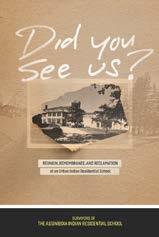
Even as residential school survivors come forward to shed a bold, brave light on the atrocities they have experienced, it is all too easy to turn a blind eye to this era of Canada’s history. The survivors of the Assiniboia Indian Residential School, located in the River Heights neighborhood of Winnipeg, Man., have deftly addressed this tendency toward disregard in the questioning title given to a new collection of their stories, Did You See Us?, published by University of Manitoba Press.
Reading through this collection of stories, it is surprising to learn that the survivors of Assiniboia found it to be a relatively peaceful experience. Students were well-fed, treated with dignity and allowed unexpected freedoms. There was no trace of the violence and abuse that we now know was pervasive across the residential school system.
Assiniboia was, by all accounts, a safe and calm place when compared to other institutions where many students were incarcerated. However, as this collection decisively declares, it was still a residential school — a tool of an assimilatory system, actively participating in cultural genocide.
Reading more deeply through the
survivors’ stories, strong undercurrents of loneliness, separation from family, loss of culture and loss of community are palpable. Regardless of the care taken in attending to the physical well-being of the students at Assiniboia, their emotional, psychological and spiritual needs were not fulfilled. The severing of all ties to their families, communities and cultural identity, and the indoctrination into Catholicism had devastating effects.
For some, the enormity of these traumas resulted in untimely deaths, mourned to this day by their surviving classmates. In others, it strengthened their resolve to return to their communities and work to preserve their culture, language and traditional ways. Others still, such as former national chief of the assembly of First Nations Phil Fontaine and Senator Mary Jane McCallum, worked to make a difference for Indigenous people in Canada on a national level.
Did You See Us? is a thoughtfully constructed, well-informed, true historical narrative. This collection tells the stories of the survivors who lived at Assiniboia during the residential and hostel years, shares the perspectives of the school’s staff and the residents of neighbouring River Heights and presents relevant articles
is evident in carefully constructed storylines and attention to detail.
Mouth Beef can be purchased through Apple Music, HUNKS’ official website or listened to for free via Spotify.
arts@themanitoban.com
‘Did You See Us?’
and artifacts alongside records from the school itself.
In doing this, the survivors, along with the collection’s editor, sociology and criminology professor Andrew Woolford, paint a comprehensive picture of Assiniboia. This collection expertly holds the positive experiences the survivors had at Assiniboia in necessary tension with the inherently insidious intentions and effects of the residential school system.
Assiniboia Indian Residential School was in operation from 1958 through 1973. All but one of its buildings were torn down to make way for a Royal Canadian Mounted Police building in the 1980s. There is a certain irony to the present use of the only remaining Assiniboia campus building as the Canadian Centre for Child Protection. However, as stated in Did You See Us?, “we must do more to protect children,” and perhaps this is a part of that “more.”
The subtitle of this collection, Reunion, Remembrance, and Reclamation at an Urban Indian Residential School, speaks to the work the survivors do through their non-profit foundation, the Assiniboia Residential School Legacy Group. This group has held many reunions for the survivors of Assiniboia, inviting former staff and members of the community to join them for times of sharing, community building and remembrance. In this,
in many other ways, they seek
and press on toward a better future.
arts@themanitoban.com





SPORTS Isaiah Wagner, staff
The Manitoba Moose went into the 2020-21 season in hopes of making the playoffs in the Canadian Division. The division consists of all Canadian teams with the top four of each division making the American Hockey League (AHL) playoffs.
The Moose currently have a 10-11-2 record and sit second overall in the division but are only one point out of a third and fourth-place tie.
Due to COVID-19, the team has played most of its home games out of the Bell MTS Iceplex, with the Winnipeg Jets playing at Bell MTS Place.
The change has given the Moose its own home to play in this year instead of sharing a rink with the Jets. This is a change that could bode well for the team because they may feel more comfortable having their own rink to play in.
The team is led by Nathan Todd and Cole Perfetti on the front end. Todd has 17 points on the season, while Perfetti has 14.
Perfetti was the Jets’s first-round draft pick at the 2020 National Hockey League (NHL) draft. He has very high expectations being a top prospect who will make his debut with the Jets within the next few years.
When Perfetti was asked about how he felt his first 20 games in the AHL went during a post-game interview uploaded to the Manitoba Moose’s YouTube channel, he said he is taking it as a learning experience.

“There’s lots to learn,” Perfetti said. “Every game I’ve gotten better, I find. I find that I’m learning every game. Little things, here and there, on the wall, on the power play, five on five, in all three zones in all different situations, [I’m] experiencing new things and learning from it.”
The Moose were led on the back end by Jets prospect Ville Heinola. He was the Jets’s first-round draft pick in the 2019 NHL draft and has the potential to be a top defenceman for the team one day.
Heinola has 10 points in 16 games for the Moose and is coming off his World Junior Championship bronze medal finish. In that tournament, he was
also named an all-star and a top-three player on his Finland team.
It is a surprise to many that Heinola did not make the Jets this year, but a year to grow in the AHL with the Moose may do the young Finnish defenceman some good.
The Moose have some big games coming up on its schedule, including a five-game stand against the Stockton Heat. This will be a crucial series for the team as both are fighting for that second place in the division.
The Moose then end off the season with games against the Toronto Marlies and the Belleville Senators, both of which are also crucial games
for playoff order.
If all goes well, the team will look to be in the playoffs once again and it is all due to great play from its rookies.
The Moose may lose some players if they are called up to the big leagues to play with the Jets, but the team has the talent and the depth to overcome that adversity and go for a deep playoff run.
sports@themanitoban.com

SPORTS Matthew Merkel, staff
The beginning of the COVID-19 pandemic in early 2020 brought the entire globe to a standstill. Global markets, schools and businesses were closed to the public. In Manitoba, U of M students began the unconventional transition to online studies mid-way through the winter semester.
As public health began to take priority over sports worldwide, professional stadiums and local arenas became empty.
The National U-Sports volleyball championship scheduled for March 13 to 15, 2020 was cancelled the day before teams were scheduled to begin competition, a huge blow for the men’s volleyball team.
As the spring and summer months unfolded, it became clear that it would be extremely difficult to hold sports games under safe conditions. However, the safety challenges of COVID-19 were properly addressed by the National Hockey League (NHL) and National Basketball Association (NBA) when the two leagues created the first-ever bubbles for their end of seasons and playoffs.
As sport facilities and athletes began to reintroduce themselves to each other and COVID-19 cases in Manitoba dropped, the potential for athletics in 2021 began to look promising.
Yet, an imminent second wave of COVID-19 loomed in the distance. With this danger ahead of Canadians, the Canadian Football League cancelled its season, ending hopes of a prospective IG Field bubble in Winnipeg.
Heading into fall, the potential for sports in Manitoba was looking grim. U-Sports had cancelled nearly all competitions, the NHL season was delayed and minor sports were facing increasing uncertainty.
October brought hope. Manitoban hockey leagues from junior to minor were underway and Bison athletes were safely practicing their craft.
Yet, the second wave proved to be too much for the sports landscape.
U-Sports and Canada West cancelled all winter sports championships, hockey across the province was shut down and fitness facilities and public gyms were closed as the provincial government enacted code-red restrictions.
During the winter break, the IIHF World Junior Championship gave Manitobans something to cheer for. With the help of Winnipeg Ice forward Peyton Krebs and Jets prospect Cole Perfetti, Team Canada finished second in the Edmonton bubble.
U of M athletes also found something to celebrate during those dark winter months. A school-record 145 Bisons were named Academic AllCanadians, highlighted by U-Sports female athlete of the year, swimmer Kelsey Wog.
Heading into the new year, there was optimism that sports in the province would make a return in 2021.
The Winnipeg Jets returned to the ice at Bell MTS Place for the first time in 10 months.
Although the return of the Jets and
professional sports in North America would help keep Manitobans preoccupied, athletes and coaches yearned for a return to their respective sports.
Hockey players in the province would unfortunately face another obstacle. Junior leagues, AAA hockey and minor hockey were all forced to cancel their seasons in February.
Despite these setbacks, winter athletes would find success in Alberta. Kerri Einarson and her team out of the Gimli Curling Club would win their second consecutive national championship at the Scotties Tournament of Hearts inside Curling Canada’s Calgary Bubble.
Team Zacharias, comprised largely of U of M students, would also compete at the Scotties for the first time.
With the win, Einarson and her team will now represent Canada at the next Olympic games. Einarson would also go on to win the national mixed doubles competition a month later with teammate Brad Gushue.
As public health officials, doctors and nurses slowly contained the spread of COVID-19, vaccinations began to roll out in the province. Thanks to their efforts, Manitobans were granted a return to fitness facilities and gyms.
Coaches and athletes were able to convene under safe conditions and teammates would be able to see each other face to face for the first time in months. Bison athletics also commenced in a setting that was not virtual for the first time in 2021.
In Saskatchewan, the Brandon Wheat Kings and Winnipeg Ice would begin
play in the Western Hockey League’s (WHL) East Division Regina bubble. The return to competition gave WHL players the opportunity to showcase their talents to professional teams and Canadian universities.
The Winnipeg Blue Bombers and the Winnipeg Goldeyes are preparing to play seasons at home for the first time in nearly two years.
Yet, there is still uncertainty in the air. Variants of the novel coronavirus have begun to circulate in the province and around the country. For a full return to sport in the province, citizens will need to continue to be vigilant and mindful that if they wish for life to return to the way it was prior to the pandemic, they need to work together.
Throughout the pandemic, the resilience of Manitobans has been on full display. From strict social distancing measures, prolonged isolation, discrimination, financial uncertainty and, for too many, the loss of loved ones, the last year has taken a toll on Manitobans mentally and physically.
The year 2021 will likely be just as challenging as 2020 was for many Manitobans. Thanks to the adversities faced by members of the U of M community and the rest of the province, the lessons learned during the last year will not only help guide athletes to future success, but the rest of the province as well.
sports@themanitoban.com