



and citizens. The Manitoban is a member of the Canadian University Press, and our journalistic standards can be found online at toban.news/jsp
The newspaper’s primary mandate is to report fairly and objectively on issues and events of importance and interest to the students of the University of Manitoba, to provide an open forum for the free expression and exchange of opinions and ideas and to stimulate meaningful debate on issues that affect or would otherwise be of interest to the student body and/or society in general. The Manitoban serves as a training ground for students interested in any aspect of journalism.
Students and other interested parties are invited to contribute to any section of the newspaper. Please contact the appropriate editor for submission guidelines. The Manitoban reserves the right to edit all submissions and will not publish any material deemed by its editorial board to be discriminatory, racist, sexist, homophobic or trans-phobic, ableist or libellous. Opinions expressed in letters and articles are solely those of the authors. Editorials in the Manitoban are signed and represent the opinions of the writer(s), not necessarily those of the Manitoban staff, Editorial Board or the publisher.
A “volunteer staff” member is defined as a person who has had three volunteer articles, photographs or pieces of art of reasonable length and/or substance published in the current publishing year of the Manitoban. Any individual who qualifies must be voted in by a majority vote at a Manitoban editorial board meeting. Elected representatives and non-students may be excluded from holding votes as volunteer staff members in accordance with the Manitoban Constitution. All contents are ©2021 and may not be reprinted without the express written permission of the Editor-in-Chief.
COPY DESK ? copy@themanitoban.com
Ursula Chojko-Bolec (ed.)
Aldin Sabic
NEWS DESK ? news@themanitoban.com
Gillian Brown (ed.)
Cam Cannon (ed.)
Damien Davis
Colton McKillop
RESEARCH & TECH DESK ? research@themanitoban.com
Sarah Doran (ed.)
Kunal Rajpal
COMMENT DESK ? comment@themanitoban.com
Lucas Edmond (ed.)
Liam Forrester
Grace Gyolai
ARTS & CULTURE DESK ? arts@themanitoban.com
Shaylyn Maharaj-Poliah (ed.)
Kaelen Bell
Zoë LeBrun
SPORTS DESK ? sports@themanitoban.com
Isaiah Wagner (ed.)
Matthew Merkel
Last day of classes for the winter semester
Start of final exam period
PHOTO DESK ? photo@themanitoban.com
Alex Decebal-Cuza (ed.)
Basel Abdelaziz
DESIGN DESK ? design@themanitoban.com
Joshua Wesey (ed.)
Mikaela Warkentin
GRAPHICS DESK ? graphics@themanitoban.com
Jenelle McCann (ed.)
Dallin Chicoine
AUDIO DESK ? audio@themanitoban.com
Tino Hove (ed.)
Tawana Matizanadzo
VIDEO DESK ? video@themanitoban.com
Jesse Boily (ed.)
Arsalan Saeed
SOCIAL MEDIA DESK ? social@themanitoban.com
Colin Ijebor (ed.)
Jalene Moman
The University of Manitoba board of governors approved the appointment of Naomi Andrew to the position of vicepresident (administration) at a meeting on March 23.
Andrew has worked with the University of Manitoba for 18 years in a variety of roles, including general counsel, associate vice-president (fair practices and legal affairs) and as acting vice-president (administration) during the fall of 2020. Prior to joining the U of M in 2003, she worked for a Winnipeg law firm practicing commercial law.
She has also served on numerous other U of M committees, including the university information technology committee and UM properties board. She co-founded and serves as director for the National GC Network’s BIPOC Lawyers Leading the Way, a non-profit created to foster equity, diversity and inclusion (EDI) in the legal profession.
She expressed her commitment to implementing the recommendations of the university’s Path Forward
NEWS Colton McKillop, staff NEWS Damien Davis, staff
report regarding sexual assault and harassment. Andrew serves on the path forward committee, an effort to combat sexual violence on campus.
In her new role, Andrew highlighted student engagement and consultation, accessibility and policies of EDI as some of her top priorities.
“I think it’s not enough just to be accessible,” she said.
“I think people need to thrive, and there needs to be the opportunity for everyone to meet their full potential.”
She said the administration had allocated $150,000 in the budget for accessibility co-ordinators to service “the growing number of students registered with Student Accessibility Services.”
Andrew said that one of her goals to help ensure EDI is to establish a “dedicated position” to monitor the issue. She also said she thought it was important for the university to develop an explicit anti-racism strategy.

“A lot of the things we heard from the community is that […] EDI is not enough. There has to be a dedicated anti-racism strategy,” she said.
She said developing a strategy is “a priority for the president, and that is something that the [VP (administration)] will be working on along with the [VP (Indigenous)].”
Andrew said the administration had allocated $250,000 in the budget for EDI.
She also emphasized the importance of quality technology services, especially during the pandemic when students are primarily learning virtually.
The administration, she said, is “always looking one step ahead to ensure that we have appropriate IT infrastructure to support some of the projects coming out of the provost’s office around the learning experience.”
news@themanitoban.com
The National Centre for Truth and Reconciliation (NCTR) released its new website and archive database last week, providing Canadians with a resource that can aid in reconciliation and the preservation of Indigenous history.
The NCTR, hosted by the University of Manitoba, is a Canada-wide organization home to documents, statements and other materials gathered by the Truth and Reconciliation Commission of Canada (TRC). Incorporating Indigenous perspectives, values, laws and protocols, the NCTR aims to educate Canadians on the injustices inflicted on Indigenous nations through preserving the memory of residential schools and other injustices faced by Indigenous peoples.
The centre was established in 2014 following the recommendations of the TRC, and since then has “played a critical role in preserving the record of the residential school system and honouring survivors” who have shared their stories.
The new system will provide survivors and the public with the ability to search schools, dates, statements and other archives like photos and acts of reconciliation.
The web-based platform is “open
source,” meaning that the commission can continue to develop its own systems for plans that align with its mandate. It also allows the centre to continue decolonizing the archives while still incorporating and honouring Indigenous languages in its records.
In a statement, Stephanie Scott, newly appointed executive director of the NCTR, said she hopes that the database can work to inspire Canadians to “learn the truth and start or continue our shared journey for reconciliation.”
The TRC’s Calls to Action report emphasizes the importance of preserving the history of injustices that came as a result of residential schools as an important step in the process of reconciliation. The TRC released the report in 2015, where it declared that in order to keep that process going, these calls to action need to be met.
In December of 2020, the TRC commissioners “reconvened for the first time in five years” and released a statement voicing their concerns of the “slow and uneven pace of implementation of the calls to action.”
The meeting, they said, was because “this sense of urgency, purpose and unity must be renewed.”
The report acknowledged that,

though there have been some initiatives toward reconciliation following the report, there have been signs of political regress in different provinces regarding the public education curriculums.
“This is not only a barrier to reconciliation,” the statement reads, “it is also an attack on the truth.”
The commissioners also said that since the onset of the pandemic, they have been reminded of how “systemic racism in the health-care system puts Indigenous peoples at risk.”
“We are also acutely aware that the profound inequalities facing Indigenous peoples have made the
risks from COVID-19 that much greater and more urgent.”
“In this context, we are calling on federal, provincial and territorial governments, and indeed all Canadians, to renew their commitments and redouble their efforts toward reconciliation and healing.”
NEWS Colton McKillop, staff
Last month, the federal government enlisted the help of the Indigenous Institute of Health and Healing at the University of Manitoba’s Rady faculty of health sciences in the vaccine rollout for Manitoba’s First Nations communities.
In early March, the federal government requested that Ongomiizwin, the Indigenous Institute of Health and Healing at the Rady faculty, lead the rollout of the vaccine in Manitoba’s 63 First Nations communities.
“Throughout the course of the pandemic, Ongomiizwin [and the] Rady faculty of health sciences have been working with the First Nations [COVID-19] pandemic response co-ordination team,” said Melanie MacKinnon, a Cree nurse who serves as leader of Ongomiizwin and as executive director of Indigenous Health Services at U of M.
MacKinnon said Ongomiizwin had spent the past year building connections “between the federal and provincial governments to ensure that First Nation communities didn’t fall through any program, service or resource gaps in the response to COVID-19.”
In collaboration with the federal government, Ongomiizwin’s goal is to deliver both doses of the Moderna vaccine to 50,000 people in 100 days, including 21 northern communities that are near the First Nations by July 15.
MacKinnon explained that in northern and rural communities which face “greater logistical challenges” due to their geography or limited health-care staff and resources, “Ongomiizwin will play a role in […] providing clinical experts and vaccinators to enhance the local and partner health teams.”
“In many of these communities, we are the physician or nurse specialist provider and a trusted clinical partner,” she said.
“In the northern or the nursing station

context, the local primary care nurses have other responsibilities in public health as well as primary care and responding to [emergency] care.”
Working with the local health workforce in northern communities allows faster vaccination in higher volumes “so that we don’t take time and resources away from everyday health care needs,” she continued.
The Rady faculty assisted in rolling out the first doses of the Pfizer vaccine given to Manitobans back in December 2020. The faculty has been actively engaged in the fight against COVID-19, from sourcing and supplying equipment for testing to, as of December 2020, having two new potential vaccines under development.
The faculty will also be conducting two studies to contribute to research on COVID-19 with funding assistance from the Canadian Institutes of
Health Research.
The studies will focus on the efficacy of home monitoring technology in COVID-19 patients with advanced chronic kidney disease and the effects of the pandemic on families with immunocompromised children.
MacKinnon said it became obvious to both the provincial and federal government that “for [the] vaccine rollout, First Nations needed to continue […] in a leadership role, just like we did in supporting the government and associated health authorities in outbreak management.”
She referenced Ongomiizwin’s role in co-ordinating rapid response teams with the Manitoba First Nations pandemic response co-ordination team to contain COVID-19 outbreaks. Rapid response teams have been utilized more than 60 times since the onset of the pandemic.
The move is seen by some as a step forward in First Nations’ autonomy in health care.
“The experience over the past year to date, with both provincial and federal governments, has been a collaborative effort that […] is unprecedented,” she said.
“In the next years and decades to come, we hope to see a real shift in First Nations-designed and led health programs and services […] because we’ve proven we can do it.”
news@themanitoban.com
Kunal Rajpal, staff
The University of Manitoba anthropology students’ association (UMASA) is holding its annual conference in conjunction with the University of Winnipeg anthropology students association. The twoday conference, running from April 30 to May 1, is being held entirely online.
Madelaine Ricard, the undergraduate vice-president for UMASA, explained the conference theme of decolonizing and radicalizing anthropology.
“Basically, what that entails is looking into the discipline [and] […] how colonialism has impacted it in history and right now in modern times,” said Ricard.
“And then looking to the future — how we can work to decolonize it, what kind of research is going on right now that is involved in that, and other aspects of that.
“So, that’s really exciting, especially during this current moment with all the political landscape of race inequality and things like that.”
The keynote speaker at the conference will be Warren Clarke, a PhD candidate at Carleton University in Ontario. He is pursuing a doctorate in sociology with a specialization in political economy. His research interests include youth cultures, gentrification, race and anti-colonialism.
The conference will include various talks from other speakers, touching upon the topics of decolonization and radicalization, including some faculty participation.
It will also feature a special panel featuring faculty members, graduate and undergraduate students about how COVID-19 has impacted research in anthropology. There will be a few presentations followed by open discussion in the panel.
Ricard said the goal is to help students get some practice with academic presentations.
“Basically, we just want to have a forum where students can present, experience a conference, and have that experience for the future for other

conferences [...] in their professional life,” Ricard said.
UMASA has organized a student conference nearly every year since its inception, with the exception of last year, when they were unable to do so due to COVID-19. This year’s entirely online conference is a new format, which came with some challenges.
The virtual conference is being held through Zoom and Gather, a platform designed to facilitate better virtual interactions. Gather is similar to Zoom but allows for multiple conversations rather than one main discussion.
“It’s a room where people can go in [and] they have a little avatar — kind of like proximity chat, they can go up to each other and talk,” Ricard explained.
“There’s time dedicated to it for people to just talk to each other, get to know each other, make contacts, network and things like that.”
Ricard said working with the University of Winnipeg group has been helpful in planning the conference.
“It has been great, they’ve done a lot,” she said.
“They hosted a speed conference, like a lightning conference, back in February, I believe, and their experience with that has kind of helped us to inform how an electronically-given conference will be — different challenges with using Zoom, how to keep Zoom-bombers from coming into the Zoom and just memeing or interrupting the conference.
“Their insight into that has been really valuable.”
A major problem for organizers has been advertising, with the two student groups relying on social media and email campaigns. To combat this, the organizers are trying to advertise to members of the general public with
an interest in anthropology rather than just academics.
“We’re really trying our best, but of course [there are] limitations,” Ricard said.
“We can’t go and put posters [in] places, really — I mean, we could, but there wouldn’t be too many people on campus to see them […] We’re lucky our keynote speaker has been perfectly willing to share posters, electronic posters and things like that, so that will be good.
“We also have a lot of support from the faculty with sending emails and stuff like that, so we do have a lot of support, but it always comes with its unique challenges.”
research@themanitoban.com

NEWS
Following a lengthy process, Joshua Regasa was convicted of assaulting fellow student Amira Tekle in a November 2019 incident in IQ’s Cafe and Billiards on the U of M Fort Garry campus. Regasa is awaiting sentencing on June 25.
As Tekle retells the story, the two began conversation in September 2019, where they exchanged telephone numbers. Prior to the physical confrontation where Regasa became increasingly aggressive and punched her in the face, resulting in “non-trivial injuries” that “took time to heal,” wrote the judge in the March appeal, Regasa had previously shown “anger towards the complainant both verbally and through disturbing text messages.”
Regasa was acquitted last July, and Tekle began an appeal process that resulted in the conviction.
Following the incident, Regasa remained in IQ’s with U of M security services who promptly arrived at the scene, where Tekle remained as she waited for the police and her parents.
He was released on a promise to appear in court on Dec. 17, 2019, banned from campus and placed under a peace bond which banned him from any contact or communication with Tekle,
and from going “within 200 metres of [her] place of residence, work, worship or any place [she] may be.”
The university informed her two weeks after the assault that he had a class at the same floor and time in the Tier building.
“It was some time after the incident, and I was not aware of that at all which was very unsettling to me,” Tekle said.
She also said she was not informed if or when Regasa would be returning to campus.
University spokesperson Myrrhanda Novak said that though she could not comment on a specific case,
“the university’s STATIS (Student/ Staff Threat Assessment Triage, Intervention and Support) team will assist and support community members, and take all necessary action.”
Novak also said that information is given to the victim as permitted by privacy legislations.
After the fact, Tekle’s concern was not with security services, but with the U of M’s response to the incident.
In such a matter involving police and security services, Novak said the university is no longer involved in the legal process when the matter is brought to the police.
“They’ve been aware of it since the beginning,” Tekle said.
For Tekle, it’s “absurd” that the university did not take Regasa’s discipline into its own hands, and that she had to initiate the non-academic disciplinary process, even though it happened on university property.
NEWS
The U of M president’s task force on equity, diversity and inclusion (EDI) presented its final report to the university board of governors at its March 23 meeting.
The task force was established in October 2019 by former U of M president David Barnard to develop understandings on what EDI is and how best to implement its principles at the university.
Members of the task force included U of M vice-provost (academic affairs) Diane Hiebert-Murphy, UMSU president Jelynn Dela Cruz, University of Manitoba Indigenous Students’ Association co-president Alicia Kubrakovich, UMGSA vice-president finance and administration Cody Ross and UMGSA vice-president academic Tanjit Nagra alongside other faculty members and staff.
The final report and its recommendations were initially expected to be presented in September 2020 but were not due to delays related to the COVID-19 pandemic.
“I am very appreciative to the members of the task force for their
work on preparing this report, including extensive community consultations,” said U of M president Michael Benarroch in a statement. “Implementing the report will be another critical step in the progress we are making together on equity, diversity and inclusion throughout the university.”
The task force made eight recommendations in its report: the creation of an administrative structure to ensure development of leadership toward EDI goals; ensuring that EDI is central to the U of M’s strategic and other plans; developing methods of assessing progress on such goals; developing plans to increase diversity among students, staff and faculty in an equitable manner; centralizing planning to support accessibility goals; creating a plan to build awareness of and support for EDI among the U of M community; taking measures to enhance the integration of EDI within academic programs and academic staff and developing a plan to promote inclusion and safety at the university.
“We are committed to promoting awareness and understanding of

[EDI], and to advancing these principles within [the U of M’s] mission of teaching and learning, research and scholarship and service,” the conclusion of the report reads. “We are committed to building a learning and working environment where differences are valued and respected, where inequities and barriers to full participation are identified and eliminated and where all students, staff and faculty feel a sense of safety, support and belonging.”
In January of this year, the UMSU board of directors unanimously voted to create an EDI working group that is expected to present a report at the end of the current semester. news@themanitoban.com
news@themanitoban.com

Become a highly-valued member of the Canadian tax community. Join Canada’s most comprehensive English-speaking program for the development of tax professionals. O ered through the University of Waterloo at our downtown Toronto classrooms.






the
As beautiful weather slowly settles in, more and more Winnipeggers are emerging from their homes in hope of finally getting some warm, fresh air that doesn’t sting the lungs. After a tedious year of being cooped up inside, we’re likely to see many people with an outdoorsy itch. But, even as the COVID-19 pandemic wanes, social distancing remains a priority, and not everybody has a private yard. Public green spaces offer a great avenue for people to enjoy the weather while maintaining social distance.
For some, this means driving out of town to explore provincial parks such as Birds Hill Provincial Park. For others, it means heading to neighbourhood parks, like Assiniboine Park in western Winnipeg, or St. Vital Park, just across the Red River from campus. But not every neighbourhood has easy access to a park, and even then, parks in more densely populated areas of the city are often smaller with fewer amenities. For many locals, particularly in the inner city, daily access to green space often comes in the form of the city’s boulevard trees.
The Winnipeg Free Press reported last week that, in February, Manitoba Hydro was responsible for cutting down about 200 healthy trees in Wolseley without consulting local residents. Ongoing city-wide efforts to combat Dutch elm disease, which involve removing 8,000 American elms and 2,700 ashes, have also seen a marked reduction in Winnipeg’s urban greenery.
Apart from chainsaw noise and disruption to local landscapes, Winnipeg’s war on trees is a distressing trend of the city’s urban planning strategy. Multiple advocacy groups have taken initiative to defend Winnipeg’s urban canopy. Non-profits like Trees Winnipeg and Trees Please Winnipeg — which consist of a collection of resident associations and neighbourhood organizations — have taken issue with the municipality’s tendency to chop the canopy that defines part of Winnipeg’s identity.
The COVID-19 pandemic has forced most of us to reflect on how we use the spaces in our homes. Comfort has become equally as important as aesthetic appeal, and the meteoric rise of do-it-yourself interior design over various lockdowns is no coincidence.
Why, then, should we not apply the same concept to our neighbourhoods? The city regularly signs off on allowing developers to construct an endless swath of overpriced apartment complexes, but what about the environment around those complexes? A neighbourhood is not defined purely by its buildings and green spaces like parks, trees, public gardens and grasslands are essential to urban appeal.
This is a chance for Winnipeg to think about what kind of urban landscape it wants to have. Cutting down the

city’s trees may be more cost-effective here and now, but in the long run it makes Winnipeg visually unappealing, causes damage to the physical environment and dramatically handicaps health.
Multiple studies have demonstrated that access to green space comes with a plethora of benefits such as increased air and water quality, improved life expectancy, lower traffic noise and reducing the urban heat island effect, which occurs when man-made structures absorb and reflect more heat than their natural surroundings causing higher temperatures.
A 2019 study from Denmark’s Aarhus University found that childhood exposure to green space reduces the risk for developing a number of psychiatric disorders later in life, particularly mood disorders, depression, neurotic behaviour and stress-related issues. According to the study, people who grew up with access to minimal green space were up to 55 per cent more likely to develop disorders like
depression, anxiety and substance abuse.
Another study funded by the World Health Organization (WHO) reported green spaces in cities consistently reduce premature death. If vegetation increases incrementally by 0.1 per cent within a 500-metre range of someone’s residence, the WHO study states premature mortality rates reduce by approximately four per cent.
Still, other researchers have discovered that people in urban neighbourhoods with green spaces are more likely to interact with their neighbours, creating a more socially cohesive community which, in turn, promotes better public health and local engagement.
The science is clear — investing in green space is overwhelmingly beneficial for not only the community but also the city’s infrastructure. With COVID-19 pushing Winnipeg, Manitoba and Canada to re-examine
aspects of life we previously took for granted, now is the perfect opportunity to shift the way our city thinks about its urban ecology.
It’s not easy being green, but as the effects of global warming become increasingly severe, Winnipeg’s municipal leadership needs to prove its citizens are worth the effort.
slowly but surely making higher education
Grace Gyolai, staff
When it was first announced that the 2020-21 academic year would be held remotely it did not come as a surprise for many students. The novelty and uncertainty of COVID-19 still hung over the heads of Manitobans. However, around that same time, the U of M announced that there would be a tuition increase as well, leaving many students feeling overwhelmed and powerless.
Now, the U of M is raising tuition 3.75 per cent again in hopes of filling a $5.9 million revenue gap left by provincial budget cuts. However, the rise in tuition is not a flat rate — students’ tuition in dentistry or engineering will only increase one per cent compared to students in the faculty of arts or the faculty of education, whose tuition will increase five per cent.
Both the province and university have historically justified tuition hikes by claiming it increases the competitiveness and notoriety of the university.
Raising tuition rates may increase the university’s revenue, but it also forces students to face the brunt of the burden, and the source of the problem is decreased provincial funding.
Take what has happened in the U.S. as a warning. From the late 1980s to 2018 the college board cited a 213 per cent increase in tuition for public schools and a 129 per cent increase for private schools. This is largely due to decreased state funding forcing tuition to fill the missing gaps in the system’s budget.
While Canadians have also seen steady increases in tuition since the 1990s, the average yearly cost of university for domestic undergraduate students in Canada sits at around $6,500 compared to approximately $26,290 in public U.S. universities. These differences, however, do not mean Canadian students do not face financial hardships.
A report commissioned by the Canadian Centre for Policy Alternatives found after reviewing literature from various nations within the Organization for Economic Co-operative Development (OECD) — an intergovernmental development organization — that increasing tuition fees is detrimental to the enrolment rates of low-income students.
Enrolment, overall, does not seem to be influenced by incremental changes in tuition. Rather, students with less economic mobility are disproportionately affected by fee escalations.
Because of the pandemic, students are experiencing financial and educational challenges across the board, but not everyone is being impacted equally. Some students live in cramped spaces or difficult learning environments. There are also students who do not have access to computers or even Internet in their home.

Data from the Canadian Radiotelevision and Telecommunications Commission shows that, as of 2017, 99 per cent of Canadians with stable incomes have Internet access at home. In juxtaposition, only 69 per cent of Canadians from less affluent backgrounds have access to Internet in their homes.
Any students enrolled in classes at the U of M who do not have Internet at home are forced to find new ways to study, as well as having to either shoulder the cost of Internet or drop out of school.
Considering the sacrifices many students made to pay for tuition the decrease in available services may have been a deal breaker for many students struggling to make ends meet.
Multiple studies published in 2020 found that students from wealthier backgrounds have adapted to the struggles of online learning simply because they have more supports that are conducive to academic success in this new environment.
Further, student employment has fallen due to COVID-19. In Manitoba, the highest rates of unemployment are among workers in the age range of 15 to 24 and women over the age of 25.
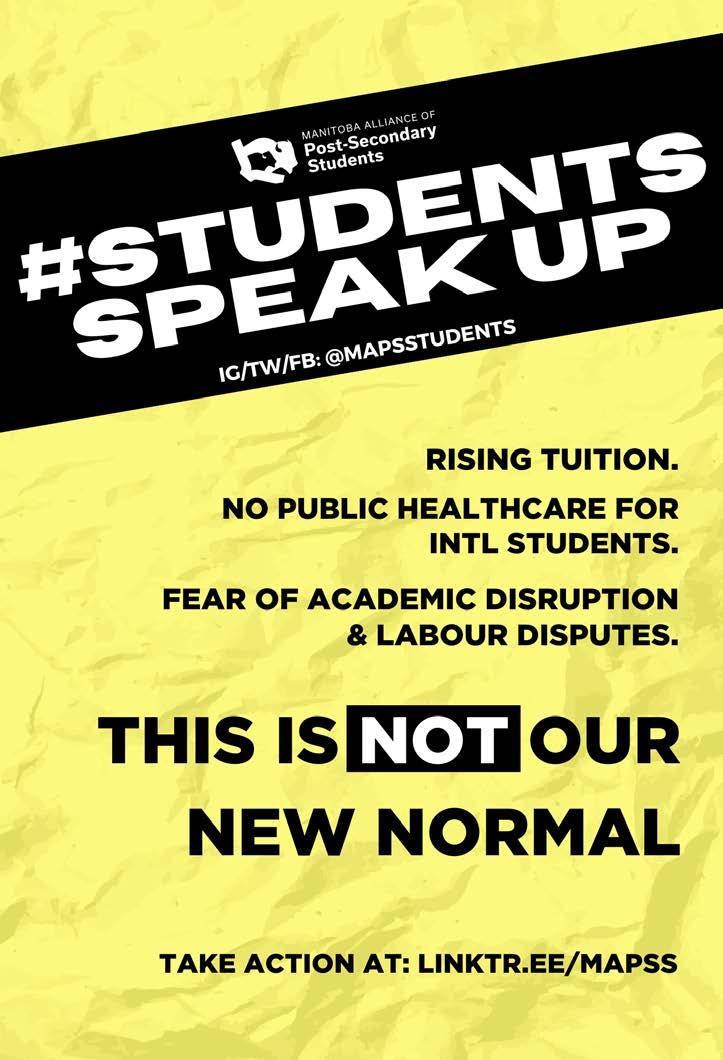
Responding to the U of M’s 2020-21 budget, UMSU president Jelynn Dela Cruz declared that the repeated cuts to education and tuition hikes should not be considered the university’s new normal.
The only solace for students struggling to make ends meet is increased funding in the 2021-22 budget for those with the highest need. The U of M will set aside $1 million for student assistance funding as well as $1.2 million to improve online capacities for digital learning.
The university is also allocating just under $850,000 to libraries, but it is imperative some of that funding increases access to free digital textbooks to increase accessibility.
Since students are being forced to pay more tuition despite the unprecedented difficulty of the past year, we need to see real concrete support
both financially and through better services from the university.
The U of M is setting students’ standards and expectations for the upcoming year extremely high by raising tuition costs, and we ought to see a visible difference in academic and financial supports relative to preceding years under these financial conditions.
COMMENT
Lucas Edmond, staff
As the world descends deeper into the digital information age, audiences of historical literature, newspapers and other printed mediums continue to decline. Despite this, printed graphic novels appear to touch base with new-age readerships in a way that printed literature is failing to. Graphic novels regularly appear in bestseller lists, and not simply fictional graphic novels, either — graphic history has become a key component of public history initiatives.
Popular graphic histories such as Maus: A Survivor’s Tale and Palestine are award-winning graphic histories with intricate narratives about complicated historical events that encourage readers’ critical literacy in an accessible way — something that the disenchanting prose of ivory tower academia rarely manages to do. This point was driven home when the renowned social theorist Edward Said wrote the foreword for the second edition of Joe Sacco’s Palestine saying, “With the exception of one or two novelists and poets, no one has ever rendered this terrible state of affairs better than Joe Sacco.”
All of this considered, it is extremely exciting news to hear Sean Carleton — an Indigenous studies and history professor at the University of Manitoba — will be working in collaboration with the native studies department, the National Centre for Truth and Reconciliation (NCTR) and the University of Manitoba Press to author a graphic history about the residential school system. Even better, the partners in the project are planning to incorporate the graphic novel in K to 12 curriculums.
Not only is this a means to expand the lacking public school history curriculum about the injustices of Indigenous populations’ ongoing struggle with cultural genocide and dispossession, but it provides an avenue for educators to place kids with developing literacy skills in what can seem to be ethereal historical contexts to the untrained eye. Without the proper critical training, grade school history is usually considered a game of memorizing dates and events, but this couldn’t be further from the truth. Historical storytelling is a radically political act with a multitude of forms and progressive ends — this project must not be filtered out by the
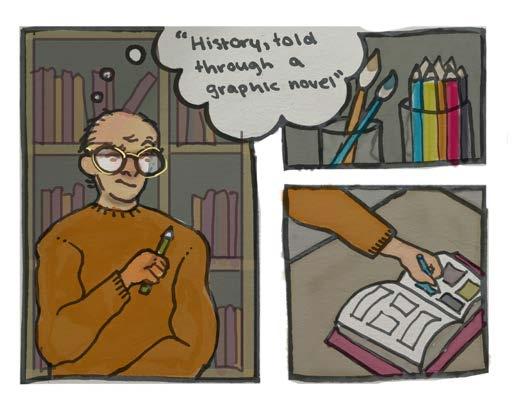
education system.
Public curriculums regularly neutralize historical narratives that are potentially uncomfortable for white settlers to read or damaging to national reputation. However, Carleton noted in an interview with UM Today News that this will not be the case in his work. Displaying the truth behind Canada’s history of cultural genocide will precede the privileged discourses that surround reconciliation — truth must be discerned before any form of reconciliation is possible.
Critical graphic novels provide a step forward in fostering empathy and, hopefully, discontent about the ongoing dispossession of Indigenous people in Canada. Visual aid provides students the capacity to understand contexts with greater detail at a fraction of the complexity. The popular adage “a picture is worth a thousand words” rings particularly true with graphic history.
Further, graphic texts summon a flexible mode of doing history which allows authors to depict the past in inarticulable fashions. Personification hands part of the narrative to the reader — a control that can be difficult to hold with written word — and encourages a critical playfulness with the ambiguous images’ artists incorporate in their work, allowing students to step beyond uncritical grade school history. This abets readers to engage with the politics of memory.
For example, Drawn to Change: Graphic Histories of Working-Class Struggle — a collaborative work organized and edited by the Graphic History Collective — displays Canada’s labour history by using the silenced voices and forgotten faces of working-class people. The project provides a compelling depiction of the violent suppression of the labour movement and the agency of people who pushed for systemic change against overwhelming structural constraints. While the dialogue in the
comic is relatively simple, the images give context to the challenges working people faced and continue to face.
Drawn to Change dislodges the common belief that history is alienated from the present and future and instead “asks people to ‘dream of what might be’ […] to work collectively with others to bring about positive social change” — a request that requires connection, sympathy and solidarity that images help cultivate.
Graphic history is an avenue to change the complexity of academic history into a progressively more accessible tool of pedagogy. Historians take note, the image is a key part of the future of historical education.
comment@themanitoban.com

Liam R. Forrester, staff
An evaluation released by the Simon Fraser University’s (SFU) school of resource and environmental management has concluded that there is no likely scenario where the Trans Mountain Expansion Project (TMEP) would result in a net benefit and should be shelved. In fact, the overall project is predicted to cost the federal government $11.9 billion total and is estimated to cost $6.8 billion to complete the halffinished construction.
The TMEP is an addition to the existing 1,150-kilometre Trans Mountain Pipeline that runs from Strathcona County, Alta. to Burnaby, B.C. The project was approved in June 2019 after the federal government purchased the pipeline from Kinder Morgan (KM) for $4.5 billion. KM sold the line due to concerns about increasing project risk. The TMEP is projected to more than double the Trans Mountain Pipeline’s capacity.
That extra capacity is actually part of the problem. The SFU evaluation states, “One of the primary reasons that TMEP would result in a large net cost to Canada is because building TMEP would create excess pipeline capacity.” While some excess capacity can be desirable, the analysis goes on to explain that building TMEP would divert oil from existing lines reducing revenue for those lines, increase tolls for oil producers to cover costs and result in less taxable income for the government to collect from the industry.
Worse still, construction costs more than doubled from the initial estimate of $5.4 billion in 2013 to the current estimate of $12.6 billion.
Industry experts dispute the SFU evaluation’s findings and claim that oil is almost back to pre-pandemic demand. Despite concerns about lower taxable revenue, oil advocates claim the current pipeline capacity is constraining oil industry growth. However, the Canada Energy Regulator’s (CER) own projection that considers trends in climate regulation shows that, regardless of demand, the oil available for export will remain well below pipeline capacity for the next 30 years.
If the SFU study is right, then it is

no wonder the Justin Trudeau-led government has kept the TMX project finances so opaque. The SFU evaluation points out that the public has still not been provided with a cost-benefit analysis of the 2018 pipeline purchase. The government evaluations that are available, like the 2016 and 2019 National Energy Board evaluations, omit critical facts and considerations like excess capacity costs, evaluations of alternate pipeline options, supply and demand analysis and failing to update their economic considerations from 2016 in their 2019 report.
Now, Canada is looking at a $11.9 billion estimated cost for infrastructure that likely cannot be put to effective use. But does Canada have a viable alternative to oil? Yes, in fact.
Take Alberta’s pre-existing hydrogen sector, for instance. Hydrogen is a clean fuel that can be produced by upgrading existing natural gas. Natural gas refinement is the cheapest and most efficient hydrogen production method. Fortunately, Canada is among the world’s top five natural gas producers with Alberta accounting
for two-thirds of that production.
While it may seem counterintuitive to rely on natural gas for a carbon-free future, hydrogen can be produced through other means like electrolysis — passing electricity through water. This method is more costly than natural gas, but those costs are expected to decline by 30 per cent by 2025, ensuring there is a future for this technology.
Hydrogen reactions in fuel cells produce only water and electricity as byproducts. Hydrogen fuel cells have flexible applications like running vehicles that regular electricity simply cannot. Heavy freight, long-haul and public transit require more power than commuter cars. The batteries powering electric vehicles simply cannot handle the required energy output.
Beyond this, the matter of rare-earth mineral extraction and responsible disposal continues to plague electric vehicles and their unwarranted reputation for being environmentally friendly. Many of the elements
necessary to produce the batteries used in electric vehicles rely on environmentally-damaging extraction techniques. Once burnt out, only five per cent of electric car batteries in the U.S. get recycled. All this is not to say that the electric vehicle industry is completely untenable, merely that it has gaps that hydrogen can successfully fill.
Even if Canada takes the $11.9 billion hit, there is a growing market for our hydrogen. By 2050, the hydrogen industry could be generating US$2.5 trillion per year on top of producing 30 million jobs for Canadians. The opportunity for clean energy is here, all we have to do is reach out and take it.
comment@themanitoban.com

Kaelen Bell, staff
The merits of institutional, award-based recognition will likely be debated until the sun explodes. Grammy awards can be affirming legacy-builders for the next generation of culture-shifting pop behemoths and encouraging symbols of gratitude for deserved records. However, more often than not, the Grammys are more about outdated, tone-deaf industry standards of respectability and popularity, an archaic institution that feels incapable of keeping a tab on pop culture’s constant mutations.
So, it is refreshing to let your guard down momentarily and revel in something like the Canadian Folk Music Awards (CFMAs), a place that seems to better understand its music and audience, and a chance to reward artists that are peripheral to the mainstream rather than confirming what has already been cemented by streams, charts and late-night TV appearances. The frequently
underappreciated Basia Bulat is nominated in three categories — contemporary album of the year, contemporary singer of the year and English songwriter(s) of the year — for her spellbinding fifth record Are You in Love? while Catherine MacLellan is nominated in multiple categories for 2019’s COYOTE
While well-deserved, these cross-category nominations reveal an issue in classification that plagues award programs big and small. As has been a topic of conversation surrounding the Grammys for years — clumsily addressed by a series of category redefinitions last year — artists of colour are most often relegated to genre-specific boxes while broad appeal artists are able to cover wider categorical ground, resulting in multiple nominations and multiple wins. The rule isn’t set in stone — Indigenous artists Riit and Leela Gilday are nominated in more than one category and Manitoba’s William

Prince is nominated in almost every major category — but it is still up for debate whether these cultural or identity-based categories, like the confusingly broad “world album of the year,” serve to include or isolate.
Still, this year’s CFMAs do a better job than most at providing a wide range of artists in both sound and exposure. William Prince continues his climb to greater recognition for last year’s beautiful Reliever, lion-voiced Crystal Shawanda is nominated for the fiery Church House Blues and OKAN’s florid jazz-fusion Sombras is up for world album of the year. Again, definitions and categories become confusing — whether every album nominated this year can even
be called “folk” is unlikely, but it is still a welcome crop of artists largely absent from the popular Canadian music scene at large. The show is, of course, being livestreamed, and will feature performances from multiple nominees — hopefully, by the next time it happens in person, we will all have figured out a better way to name and reward the music we love.
The Canadian Folk Music Awards will take place April 10 and 11 at 8:00 p.m. ET and will be accessible “online, worldwide and free of charge” on Facebook and YouTube. For more information, please visit folkawards. ca.
arts@themanitoban.com
ARTS & CULTURE
Zoë LeBrun, staff
On March 25, the Winnipeg Art Gallery’s new Inuit art centre, Qaumajuq, opened with two event-filled nights. This opening featured a tour of the new facilities, entertainment from local dancers and musicians and a ceremonial blessing of Qaumajuq in preparation for the welcoming of its future visitors.
Now officially open to the public, audiences can view INUA, Qaumajuq’s inaugural show. The exhibit is curated by an all-Inuit team including Heather Igloliorte, Krista Ulujuk Zawadski, Kablusiak and Asinnajaq. The quartet represents the four regions of Inuit Nunangat, the homeland of Inuit in Canada.
The exhibition’s title has two central meanings: the first is that it is a word for “spirit” or “life force” across various Arctic dialects. Its second meaning is an acronym for the phrase “Inuit Nunangat Ungammuaktut Atautikkut,” or “Inuit Moving Forward Together.” This acronym reflects “the [curators’] vision for Qaumajuq as a site where Inuit from throughout Inuit Nunangat can, together, collectively gather, share, be inspired by previous generations and create new pathways forward in Inuit art.”
INUA displays work from over 90 artists working in many different mediums from all across Canada, as well as Alaska and Greenland. Visitors to INUA can expect to see
dynamic and cohesive integration of intergenerational artworks to create programming that “highlights a long continuity of Inuit artistry and innovation both through the artworks and the exhibition design.”
Filled with paintings, sculptures, ready-mades, drawings, installations and much more, there is something for everyone to enjoy at INUA. Additionally, with the large skylights and undulating walls, the gallery space itself was a wonder to behold. Its curved walls brought a refreshing energy and flow into the traditional art gallery and provided a unique place for mediums such as wall hangings and tapestries.
One of the highlights is immediately visible upon entering the gallery — a set of four large embroidery pieces titled “Four Seasons of the Tundra: Fall, Winter, Spring, Summer” by Ruth Qaulluaryuk. These beautiful abstract embroidery works are full of movement and intricate detail. These works also possessed a strong sense of emotion due to their colour palettes that automatically invoked the physical sensations brought on by each of the seasons these works represented.
Some other standout pieces from INUA are Megan Kyak-Monteith’s stop-motion animations, titled “Whale Hunt: I Think Everyone is Here” and “Large Feast on a Bed of Cardboard.” These

entertaining videos, made with oil pastel and paints, are fascinating to watch and full of life.
Finally, there is “Iluani/Silami (It’s Full of Stars)” by Glenn Gear. This large installation, which consisted of a shipping container, paint, sound and video projection created a dark and quiet space for viewers to sit in away from the bustle of the crowds filling the rest of the gallery. Contrary to the industrial qualities that the work’s exterior presents, inside “Iluani/ Silami (It’s Full of Stars)” is a soothing presence, filled with the sound of waves and a video that mirrored the black and white line art painted on its interior walls between clips of the Canadian landscape.
These works, along with the rest of the exhibit, serve as a beautiful reminder that Inuit art is not an artifact of the past and that its
contemporary manifestations are a passionate, driving force in Canada’s current art world. Additionally, after such a tumultuous year of gallery closures and postponed exhibitions, Qaumajuq’s opening and INUA’s expression of the joy, healing and storytelling that can be found in art could not have come at a better time. INUA feels like one of the first steps of many into the next, more inclusive chapter of Winnipeg’s art history and a much-needed breath of fresh air.
INUA will be available to view at Qaumajuq until December 2021. For more information, please visit wag.ca.
arts@themanitoban.com
ARTS
& CULTURE
Shaylyn Maharaj- Poliah, staff
The University of Manitoba’s theatre program is gearing up for performances of Poof! by Pulitzer Prize-winning playwright Lynn Nottage. This is the program’s second Lunch B.H.A.G.G. show — the first was a production of Friedrich Dürrenmatt’s Conversation at Night with a Despised Character, which occurred back in February.
In a normal year, the series of one-act, student-directed plays would traditionally contain five different shows, all performed at lunch hour with a single evening performance. Audiences have the option of bringing food and having lunch at the performances. However, with the pandemic situation, the Lunch B.H.A.G.G. series is occurring virtually.
Poof! is about housewife Loureen, who has inadvertently caused her abusive husband to spontaneously combust into a pile of ashes, and her friend, Florence, who is there to help her work through the tragedy and imagine a life without him.
The play is directed by a duo of passionate second-year theatre students, Sadie Kornovski and Jonalyn Basconcillo. While the script was originally chosen by Bill Kerr, an associate professor in the department of English, theatre, film and media, the pair fell in love with it on the first read and were drawn to the peculiar concept.
“Because Poof! is a dark comedy, […] touches on very real and heavy issues such as domestic violence and abuse [and] also has wild circumstances
such as spontaneous combustion, it will likely have the audience wondering if they’re supposed to laugh or grimace,” said Kornovski.
As with the theatre program’s recent mainstage production of Zoom Lens by Debbie Patterson, all aspects of Poof! are currently taking place online. Auditions were held in early March and involved prospective actors submitting recorded monologues to the directors for consideration.
“Despite there being no chance for us to see [the actors] perform different parts of the script like there may have been for a live audition, the virtual auditions allowed us to view their videos over as many times as necessary before making our decision,” said Kornovski.
“I would say [the auditions] went really well and one of the hardest things was who to choose for the role[s] because everyone who auditioned was so good,” said Basconcillo.
As for holding rehearsals over Zoom, Kornovski said it is “a unique and challenging experience.”
Basconcillo said that “[virtual] rehearsals are different from in-person rehearsal[s] because of space and what is available for our actors, which becomes a really fun process of collaborating on what kind of space they have since everyone is not in the same space, unlike in-person [rehearsals] where we are all in the same space.”
For Kornovski and Basconcillo, this is their first time directing a theatrical
Les Shirley — ‘Forever Is Now’
ARTS & CULTURE
Kaelen Bell, staff
Les Shirley understands energy — its power, its movement, when to blow it up and pull it back, the invigorating force of music that snakes like snapping wires. The Montreal trio’s debut LP, Forever is Now, moves like Thin Lizzy spent the summer at pop-music bootcamp — tight, instantly hummable rock songs that trade equally in scuzz and sheen, a glittering brick sent flying through a shop window.
From the skipping riff that introduces opener “Fuck It I’m In Love,” the band is in immediate overdrive. Every song is spring-coiled and relentless, airtight blasts of hair-shaking fervor that never trip into indulgent showboating — even frontperson
Raphaëlle Chouinard’s solos are economical, skidding and twirling before careening out of frame just in time. The band pulls inspiration from turn-of-the-’80s power-pop — the unsophisticated joy of ’70s garage filtered through clean, spacious production from Simon Kearney and Marc Chartrain that scrubs away most of the fuzz in favour of crisp clarity. The sand-blasted production mostly works wonders in highlighting the trio’s taut playing, but an air of anemia nearly sneaks in at times, and some experiments — like the sudden autotune toward the end of “23” — are more distracting than bold.
Chouinard sings with a chin-jutting bravado, a frontperson with a winking grip on rock-star posturing — the queer come-on of “Courtney” or confident abandon of “Fuck It I’m In Love”

production of any kind — let alone with another person — and the experience has been “both daunting and exhilarating.”
“While there’s the benefits of being able to move comfortably in your own space, there’s also a definite buffer between the actors that makes it harder for them to find chemistry between each other, as well as the issue of finding ways to match props that both actors interact with, matching their lighting and the obvious fear of technology completely failing at the most inconvenient of times,” said Kornovski.
“It helps that I’m not the [only] one pulling the strings […] [Basconcillo] always has excellent ideas to bounce off of, and we pull the weight of rehearsals and planning as equals. Our production team is also incredible and always on their A-game, and I’m very grateful to have them working on the show.”
“It feels great having to work with amazing and talented people on this play and I’m excited about
everything,” said Basconcillo.
When asked about what they expect audiences to take away from Poof!, Basconcillo said, “I think the ways this play will resonate with our audiences is how [it] goes into the character’s problems and dealing with domestic abuse.”
Kornovski concurred.
“My hope is that after viewing, people will take a moment to reflect on how often victims of domestic violence are silenced, brushed off and ignored, and, hopefully, they will find ways to be better allies to those in need.”
You can catch UM Theatre’s production of Poof! on April 16 at 7:30 p.m. and April 17 at noon. For more information, stay tuned to the program’s social media channels.
arts@themanitoban.com
are full of eyes-ablaze swagger, while relative slow burn “1994” moves with the guarded, cool honesty of Chrissie Hynde. Where Les Shirley differs from a band like the Pretenders is in its commitment to a singular sound — there are no reggae detours a la “Private Life” or sprawling epics like “Lovers of Today,” the trio choosing instead to stretch its rambunctious pop-rock into as many shapes as possible. The one semi-exception is the shimmery acoustic Pascale Picard-duet “Pick Up The Phone,” a quiet inversion of driving, compact melodies that lets the dust settle just enough for them to kick it up immediately with the safefor-radio edit of “Fuck It I’m In Love,” “Forget It I’m In Love (Radio Edit).”
The choice to include this radiofriendly version feels like a throwback and a hint at Les Shirley’s ambitions — the group’s music has all the serotonin-triggering thrills of iron-clad radio pop, and the trio seems capable

image / Les Shirley / provided of aiming for the same kind of reach. With a record as fun and ferocious as Forever Is Now, you would be foolish to doubt them.
arts@themanitoban.com
SPORTS Isaiah Wagner, staff
The Winnipeg Jets are going into the 2020-21 National Hockey League (NHL) trade deadline with a buyer’s mentality.
Sitting third overall in the Scotia North division, the team is looking to add to its already great team.
The NHL trade deadline takes place on April 12 this year and should be a busy day around the league.
In past seasons the Jets have looked to add at the centre position with the additions of Paul Stastny, Kevin Hayes and Cody Eakin.
This season, the Jets are set with its top three being Mark Scheifele, Pierre-Luc Dubois and Adam Lowry. This gives the team an advantage at the centre-ice position over most teams in the league.
A good championship team usually starts with the defence and this season that is exactly what the Jets need to improve on.
With a great goalie in Connor Hellebuyck, it is important to give him some help and limit some shots.
Some players that are available around the league include David Savard, Jamie Oleksiak and Vince Dunn.
Savard is one of the most sought-after players going into this year’s deadline. The 30-year-old defenceman only has a total of six points this season.
If he is put in the right situation on the right team, he has the ability to put up more points.
He has a total of almost 600 games of NHL experience which could be very beneficial for the Jets in a long playoff run.
Savard should be the number one priority, but a player like Oleksiak should also do well on a Jets team.
The 6-7 defenceman is 28-years-old and is in the prime of his career. He has a total of eight points so far this season and could provide some offence and defence for a talented Jets team.
The Toronto native could also bring a little bit up toughness to the blue line along with Logan Stanley.
Oleksiak is a great player, but ultimately will cost less than Savard, which could be a more beneficial option.
Dunn is not to be overlooked as an option because he is only 24 and could be on the Jets’ blue line for years to come.
He has 12 points so far this season and has a little bit of grit to his game. He may be the most offensive out of the three players mentioned, but will cost more due to his young age.
He is a great option for a Jets team who could use a little bit more youth on its blue line.
photo / Basel Abdelaziz / staff

All three of these players would be beneficial additions to the squad and it is no doubt that the Jets will be looking to potentially add one of them.
If they do end up trading for a defenceman, it is between Tucker Poolman and Stanley on which player would ultimately exit the lineup.
Stanley has given reason to stay, so it is more likely that Poolman would be the one that gets scratched.
Although that is a disappointment, it
is great to have depth when going into the playoffs. Many games played and the intensity that occurs is something that could draw players out of the lineup for a game or games at a time.
Deadline day will be a fun and interesting day for any hockey fan. Especially if your team is going for the Stanley Cup.
sports@themanitoban.com

SPORTS Matthew Merkel, staff
Due to the COVID-19 pandemic, the Winnipeg Goldeyes were unable to play the 2020 season in Shaw Park. The Goldeyes are the only Canadian team in the American Association, and with the border being closed for the majority of the pandemic, the fish were forced to play its home schedule in Fargo, North Dakota.
A year later, owner Sam Katz and his organization are in a similar situation. Although the Goldeyes are scheduled to have its home opener on May 18, the emergence of COVID-19 variants in the province and the threat of a third wave have put that date into question. If the team and its opponents are unable to cross the border, then no games will be played at Shaw Park.
With this uncertainty looming, the team is taking a proactive approach. Multiple plans are in place to ensure that the Goldeyes have a place to play, whether it be in Winnipeg or the United States. No matter where the Goldeyes call home, the team will be aiming to improve on the previous season.
Playing a condensed schedule, with half of the 12-team American Association choosing to sit out the season, the Goldeyes finished fourth.
The fish played just below a .500 winning percentage, acquiring only 29 wins and 31 losses. While the club was first place for the majority of the summer, an 11-game losing streak at the tail end of the Goldeyes’ campaign derailed its season and hopes of playing in the playoffs.
Although 2020 was overall a mediocre season statistically for the Goldeyes, the team was still a very competitive team, something the rest of the American Association took notice of.
Thanks to the club’s excellent performance for the majority of the summer, manager Rick Forney was awarded American Association manager of the year.
Forney has been with the club since 2006, leading the team to
championships in 2012, 2016 and 2017.
And 2021 has been no different. The fish manager has made numerous roster moves since the end of last summer.
Making a return to the mound for the fish are pitchers John Gorman, Nate Antone, Jose Jose and lefty Mitchell Lambson. Outfielder Logan Hill, infielder Kevin Lachance and American Association all-star first baseman Kyle Martin are also making a return to the fish for the 2021 season.
The Goldeyes will have plenty of new faces this summer, too. On the mound, the Goldeyes added loads of talent.
Right-handers Christian James and Justin Watland make the move to independent baseball after both playing “A” ball previously.
Left-handed pitcher Ken Frosch returns to the American Association for the first time in two years after winning a championship with the St. Paul Saints in 2019.
Out of the Houston Astros’ organization, right-hander Joey Gonzalez makes his return to pitching professionally for the first time since 2019.
Chicago native Cory Thompson is a converted pitcher out of the Cincinnati Reds organization. Entering his eighth year professionally, Thompson will be making his debut in independent ball.
The fish have also improved offensively. Outfielder Jay Gonzalez comes to the fish from the Can-Am League, where he finished 10th in batting average and fifth in on base percentage.
Lucas Herbert comes from the Arizona Diamondbacks’ minor league system. Over four levels of the Diamondbacks’ system, the 24-year-old hit a combined .311 with 14 RBI in 20 games.
Former Pacific Association MVP Raul Navarro comes to Winnipeg after gaining experience on the Diamondbacks Triple A team in Reno, Nev.
photo / Alexander Decebal-Cuza / staff

Dakota Conners also spent time in the Pacific Association. During his rookie season in 2019, he appeared in 54 games and averaged .302 at bat.
In the infield, Alexis Pantoja, Alfonso Reda and Zack Costello will bolster the Goldeyes’ depth chart.
The biggest signing by Forney this off-season is former Major League pitcher Ryan Dull. Dull spent five seasons in the majors with the Oakland Athletics, New York Yankees and Toronto Blue Jays compiling a 4.31 ERA and 170 strikeouts in 171.1 innings. Dull last pitched in 2019 and is slated to relieve for the fish.
The American Association will also look slightly different this year. The Goldeyes’ archrivals the St. Paul Saints have left the league to become the Triple-A affiliate for the Minnesota Twins.
Replacing the Saints are the Kane County Cougars. Playing out of suburban Chicago, the Cougars have been operating for 29 years and have averaged 430,331 fans per season in “A” ball. The Houston Apollos will serve as a travelling team, bringing the league back to 12 teams.
With so many new faces, the 2021 season will look a lot different for the Goldeyes.
Forney will be hard at work to make sure his club is able to build off of last year’s season and hopefully qualify for the playoffs this time around. Whether Forney’s efforts will be displayed inside the walls of Shaw Park this summer, however, still remains to be seen.
sports@themanitoban.com