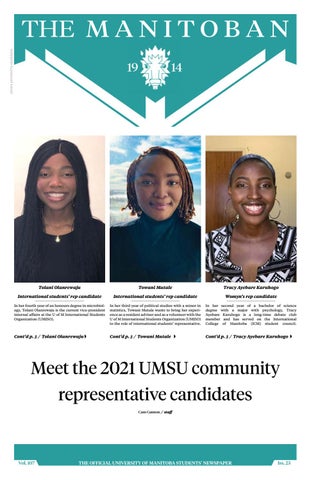
In her fourth year of an honours degree in microbiology, Tolani Olanrewaju is the current vice-president internal affairs at the U of M International Students Organization (UMISO).
Cont’d p. 3 / Tolani Olanrewaju >
International students’ rep candidate
In her third year of political studies with a minor in statistics, Towani Mutale wants to bring her experience as a resident adviser and as a volunteer with the U of M International Students Organization (UMISO) to the role of international students’ representative.
Cont’d p. 3 / Towani Mutale >
Womyn’s rep candidate
In her second year of a bachelor of science degree with a major with psychology, Tracy Ayebare Karuhogo is a long-time debate club member and has served on the International College of Manitoba (ICM) student council.
p. 3
Cam Cannon / staff
Tolani Olanrewaju
Towani Mutale
Tracy Ayebare Karuhogo
Cont’d
/ Tracy Ayebare Karuhogo >
TOB AN the MANI
a member of the Canadian University Press, and our journalistic standards can be found online at toban.news/jsp
The newspaper’s primary mandate is to report fairly and objectively on issues and events of importance and interest to the students of the University of Manitoba, to provide an open forum for the free expression and exchange of opinions and ideas and to stimulate meaningful debate on issues that affect or would otherwise be of interest to the student body and/or society in general. The Manitoban serves as a training ground for students interested in any aspect of journalism.
Students and other interested parties are invited to contribute to any section of the newspaper. Please contact the appropriate editor for submission guidelines. The Manitoban reserves the right to edit all submissions and will not publish any material deemed by its editorial board to be discriminatory, racist, sexist, homophobic or trans-phobic, ableist or libellous. Opinions expressed in letters and articles are solely those of the authors. Editorials in the Manitoban are signed and represent the opinions of the writer(s), not necessarily those of the Manitoban staff, Editorial Board or the publisher.
A “volunteer staff” member is defined as a person who has had three volunteer articles, photographs or pieces of art of reasonable length and/or substance published in the current publishing year of the Manitoban. Any individual who qualifies must be voted in by a majority vote at a Manitoban editorial board meeting. Elected representatives and non-students may be excluded from holding votes as volunteer staff members in accordance with the Manitoban Constitution.
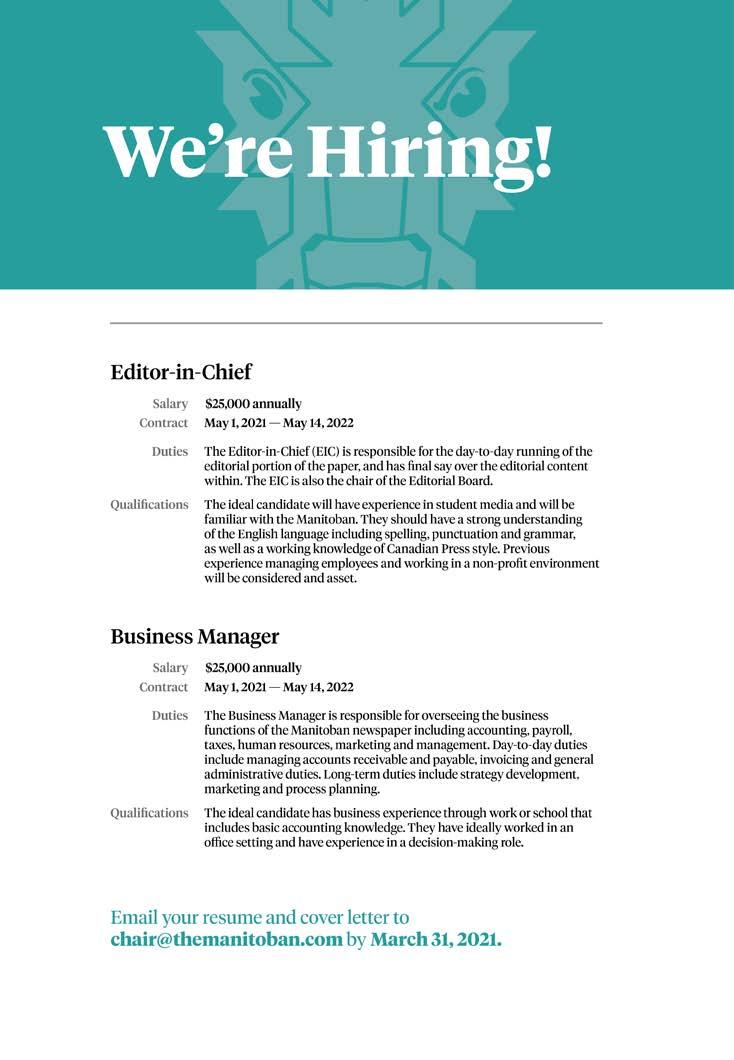
Closing date for Manitoban executive applications; toban.news/jobs
COPY DESK ? copy@themanitoban.com
Ursula Chojko-Bolec (ed.)
Aldin Sabic
NEWS DESK ? news@themanitoban.com
Gillian Brown (ed.)
Cam Cannon (ed.)
Damien Davis
Colton McKillop
RESEARCH & TECH DESK ? research@themanitoban.com
Sarah Doran (ed.)
Kunal Rajpal
COMMENT DESK ? comment@themanitoban.com
Lucas Edmond (ed.)
Liam Forrester
Grace Gyolai
ARTS & CULTURE DESK ? arts@themanitoban.com
Shaylyn Maharaj-Poliah (ed.)
Kaelen Bell
Zoë LeBrun
SPORTS DESK ? sports@themanitoban.com
Isaiah Wagner (ed.)
Matthew Merkel
UMSU voting period /
UMSU voting period / UMSU meeting / Skype / 6:30pm
UMGSA election campaign period begins
UMGSA election voting period begins (9am)
UMGSA election voting period ends (5pm)
UMGSA meeting / Skype / 5:30pm
PHOTO DESK ? photo@themanitoban.com
Alex Decebal-Cuza (ed.)
Basel Abdelaziz
DESIGN DESK ? design@themanitoban.com
Joshua Wesey (ed.)
Mikaela Warkentin
GRAPHICS DESK ? graphics@themanitoban.com
Jenelle McCann (ed.)
Dallin Chicoine
AUDIO DESK ? audio@themanitoban.com
Tino Hove (ed.)
Tawana Matizanadzo
VIDEO DESK ? video@themanitoban.com
Jesse Boily (ed.)
Arsalan Saeed
SOCIAL MEDIA DESK ? social@themanitoban.com
Colin Ijebor (ed.)
Jalene Moman
MANI
Final 2020-21 UWSA executive member resigns as association plans election reforms
NEWS Gillian Brown, staff
Nearly a year has passed since the beginning of the controversy surrounding the 2020-21 University of Winnipeg Students’ Association (UWSA) election season, and as of Jan. 27, vice-president of student affairs Melanie William has resigned from her position on the executive board, following the resignations of her fellow executive members Jibril Hussein and Breanna Belisle.
William cited an experience and a workplace environment that “has been nothing short of traumatic” as part of the reason for her resignation, a sentiment shared by Hussein and Belisle.
“This workplace perpetuates an environment that actively causes harm to those within it,” she wrote in her resignation letter.
“I challenge the UWSA to rectify its wrongs, and ensure all students at the UWSA are treated equally, regardless of how they identify with their political affiliations.”
She wrote that the organization “is not ready to change as ideological pressure is rooted so deeply within the UWSA that it blatantly disregards and fails those who it claims to protect.”
William did not respond to requests for comment.
In the association’s statement regarding William’s resignation, they acknowledged the experiences that the former executives shared, and committed to “doing more to prioritize students’ well-being and safety over institutional expectations.”
The statement also referred to the “oppression and harassment” in the community, “online or offline.”
In Hussein’s resignation letter, he said “violent threats” were sent to the executive board and to himself on and off campus. This past summer, former executives on the 2019-20 UWSA board Mahlet Cuff and Noelle Sagher shared their experiences of harassment and intimidation on the basis of their race and gender during election season.
As a response to the outburst of accusations of racism, intimidation and harassment against the association, the association plans to “address institutional racism at the UWSA” by reviewing and reforming election processes along with issues management processes and safer space policies, a pledge that the association made back in August.
In the meantime, while U of M’s UMSU election campaigns have begun, UWSA’s elections will be postponed a month to allow for work on changes to the electoral process and the campaign period is set to begin
Meet the 2021 UMSU community representative candidates
> Tolani Olanrewaju cont’d from front page
She has also served as a students’ program assistant at the U of M’s International Centre, an orientation volunteer and a mentor with the new student peer mentoring program.
“Before [joining] UMISO, I really didn’t have a lot of connection and interaction with international students,” she said. “Being a part of UMISO really exposed me to just being able to meet a lot of international students and interact with them and just being able to hear their stories and organize events.”
Olanrewaju recognizes that currently, engagement with UMSU from students is generally low. To boost student involvement in UMSU activities, she plans to introduce incentives — such as prize giveaways — and “challenges.”
For Olanrewaju, one of the most important aspects of the international students’ community is feeling support by the community — many international students rely on their connections here at the U of M.
“A lot of international students are here in Canada without their families, and what they do have to rely on are the relationships that they have formed,” she said, adding that a key component of this is having a strong representative to advocate for them.
Olanrewaju also plans to advocate for implementing a week to highlight international students, advocating for more mental health supports for international students and fighting for less synchronous sessions of online learning, recognizing that not all international students are studying in Canada and face issues due to being in different time zones.
“Not all international students are from rich homes,” she said. “That [perception is] really not true for a lot of people, and I [think] having [an international students’ week] really lets people be able to really see what international students bring.”
> Towani Mutale cont’d from front page
For Mutale, a highlight of her experience volunteering with UMISO was the conversation nights the organization hosted.
Through these experiences, Mutale said she has “learned to listen to people.”
“Because we all have very different experiences, I’ve learned what different international students are like and I’ve also learned how to work with people,” she said.
In addition, Mutale said her experience has taught her resourcefulness and how to ensure things get done — how to lead a group.
Among priorities for Mutale are adding days dedicated to international students to UMSU’s annual mental health week — which this past year was extended to a month.
Mutale would like to also work closely with the UMSU executive toward establishing a “more flexible” fee payment schedule for international students.
She would also like to get students engaged by hosting more events.
“If you’re having, say, one event once in a while and [students] don’t even hear about it, how are they going to show up for the next one?”
“This year has been very, very hard, so I plan to go into this role giving it as much energy as I can because I believe that the role can only work if I’m willing to put in work,” she said. “Inasmuch as it’s not a paid role, I feel like I should attach to it the same amount of seriousness as I would if it were a paid role.”
“I would like to leave […] the university at least knowing that there’s something that I’ve done, something that I’ve affected,” she said.
March 22.
Further details of UWSA’s election reform plans were voted on at the Feb. 24 meeting and will be made available this week.
The association declined the opportunity for an interview.
news@themanitoban.com
> Tracy Ayebare Karuhogo cont’d from front page
“Not only women who are […] cisgender, I mean anyone who identifies as a woman,” she said. “Even the [transgender women], even the people who identify as women who are lesbian or bisexual […] I want them to feel like they’re not outside [of] the community.”
Karuhogo also wants to take steps to combat sexual harassment on campus. She raised concerns about the university taking an approach that requires survivors of sexual violence to disclose their experiences to the administration for data collection purposes. She would like to see survivors have more control over their information and be given the choice of how their data is used.
Mental health supports are another priority for Karuhogo. She views the available supports on campus as inadequate to serve women on campus as a community and would like to see them expanded. She also wants to see more women in STEM courses and assist in making those traditionally male-dominated fields more welcoming to women.
“The one way to bring women together is for them to know each other,” she said. “When people know each other, the knowledge about the resources is covered […] knowledge about who can help you, or who can do this for you is through knowing another person.”
photo / Basel Abdelaziz / staff
TOB AN the MANI
U of M’s Bangladeshi community shaken by tragedies
So
far in 2021, four international students have passed away suddenly
NEWS Damien Davis, staff
Three international students from the U of M Bangladeshi community died in a car crash on Highway 7, seven kilometres south of Arborg, Man. on Feb. 18.
The students’ names are Risul Badhon, Al Numan Aditta and Aranoor Azad Chowdhury.
The students were returning from a trip to see the northern lights when they collided head-on with another vehicle. The driver of the other vehicle was a woman in her 50s who had serious but non-life-threatening injuries.
“They were really close to all of us in the Bangladesh community, we have very few students on campus but we’re really tight and we’re pretty close to each other,” University of Manitoba Bangladeshi Students’ Association (UMBSA) president Tahbit Dewan, explained. “Personally, they were really good friends of mine.”
Chowdhury was a third-year science student, Badhon was an Asper student and Aditta was in agribusiness.
Dewan commented on their group dynamic noting that Chowdhury played soccer in their community and was good at it, Badhon and Dewan got into the Asper School of Business together and Aditta, the oldest of the three, was known as a great cook.
The UMBSA, as well as the University of Manitoba Muslim Students’
Association (MSA), are not only mourning the deaths of these three men, but also the death of another student, Sami Uzzaman, who went missing on Jan. 9 and was found dead Jan. 27.
Dewan explained that they had been looking for him for nearly two weeks and that he was a point of contact with the family during that time.
“It has been very stressful for me personally but for all the community and when we found his body, we were all in shock,” he said. “It was a mess.”
“The police had to do all the postmortem and then we buried him in Transcona, his family couldn’t see him for the last time. Unfortunately, due to COVID, we couldn’t send the body home because it was taking too long, and in our religion, in Islam, its suggested to bury the deceased as soon as possible,” he explained.
“International students, we don’t have our family here right? So, we consider the student community to be a family,” said Abdul Ahad, president of the MSA.
Ahad explained how he truly feels that they were all brothers, Uzzaman and the men from the crash, and that they could answer each other’s calls and share their struggles together.
“So, from an emotional standpoint it’s really really hard to imagine that actually happened,” he said.
Dewan added that when Uzzaman was missing, UMBSA made a post about it on Instagram and had reached out to UMSU via tagging them on the post but received no response at that time.
“When Sami went missing and was found deceased, UMSU didn’t even release any statement, they didn’t recognize that something happened,” said Dewan, noting that for the deaths of the three students in the crash, UMSU acknowledged Uzzaman in its social media post about the crash — opting to combine the news together in its statement.
“I felt like it was necessary, and they should have acknowledged it when it happened and not after another
incident had happened,” Dewan said. “So, I’d say it was really disheartening and everyone in the community noticed it, that UMSU didn’t say anything about it or put out a statement or anything.”
By press time, UMSU had not yet responded to requests for comment.
news@themanitoban.com
Province releases post-secondary education plan
Goal is to ensure ‘the right people at the right time with the right skills’
leaders in each faculty.
The Manitoba government is asking colleges and universities to emphasize employable skills, talent and knowledge in order to assist the economic recovery from COVID-19.
In early February, the province released a three-year plan entitled “Manitoba’s Skills, Talent and Knowledge Strategy.”
Advanced Education, Skills and Immigration Minister Wayne Ewasko said the government has been engaged in hundreds of consultations with stakeholders for more than a year.
The report recommends the province take steps including tying tuition to labour market demand, modifying the province’s program approval process, employing an outcomes-based funding model and reorganizing programs that oversaturate the labour market.
Ewasko said the strategy is intended
to ensure that businesses would be able to hire “the right people at the right time with the right skills.”
“It’s been a major challenge regarding competitiveness and growth here in Manitoba,” he continued.
“The strategy recognizes the need for a range of skills, from highly advanced knowledge workers, to critical thinkers with durable skills to specific technical and occupational skills and of course general workers with basic skills.”
“This includes the humanities, social sciences and arts programs.”
U of M president Michael Benarroch said the university had “received a mandate letter from the government [in January 2020] asking us to align with labour market needs and to work with industry.”
In his position as president, Benarroch said that one of his achievements has been collaborating with industry
However, Scott Forbes, president of the Manitoba Organization of Faculty Associations, says that faculty associations were not consulted. He said that the province’s plan “lacks information.”
“I’m not sure our government fully appreciates how universities work and what they are supposed to do,” he told the Winnipeg Free Press
He criticized the proposed policy of connecting tuition with the demands of the labour market, arguing that universities should not be narrowly focused on preparing students for careers, but should also emphasize academic pursuits.
Manitoba Liberal Party leader Dougald Lamont and the NDP’s advanced education and skills critic Jamie Moses have also been critical of the plan, specifically aspects such as tying programming to labour market demands and implementing outcome-based funding models.
Lamont accused the Manitoba
government of “undermining and defunding post-secondary institutions” for ideological reasons.
In response to these criticisms, Ewasko said he believes he has “walked the talk for many many years already, being an educator myself, also being in opposition as the critic for advanced education and education itself, and now being the minister [of advanced education, skills and immigration].
“I strongly believe in working with absolutely everyone and I’m proud to be part of a government that is accountable to the taxpayers.”
photo / Tahbit
Dewan / provided
U of M prof leads project analyzing dried fish social economy
Eight teams across six countries analyze consumption, gender division
RESEARCH & TECHNOLOGY
Sarah Doran, staff
University of Manitoba anthropology professor Derek Johnson is at the helm of a long-term project studying the social economy of dried fish.
Dried Fish Matters is composed of eight teams across India, Sri Lanka, Thailand, Bangladesh, Cambodia and Myanmar, with ties to local universities, governments and advocacy groups as well as other collaborators around the globe, including other U of M professors. The project is funded by a seven-year Social Sciences and Research Council of Canada (SSHRC) partnership grant, which allows academics to work with government and community partners.
Johnson saw a gap in research and policy regarding dried fish and its importance in many populations and economies.
“Historically, fish drying was the only way that you could actually distribute fish over long distances, so prior to refrigeration and freezing technologies, this is the only way that people in hinterland areas would have had access to fish,” he explained.
“It’s also important at the present because fish are extremely nutritious. They are chock-full of a range of nutrients that we as humans require ― they have protein, but they also have a range of vitamins, micronutrients, fatty acids, which are all essential for human health […] Fish drying has the added advantage that it reduces the weight of the fish, and therefore they’re all the more easy to transport. It also concentrates the nutrients.”
In addition to the geographic teams gathering data in each location, the project involves an interdisciplinary analysis team branching over three thematic focus areas to put the data into context.
“It’s not just the nutritional contribution that dried fish make, but it’s also the economic, cultural, social contributions the dried fish make,” Johnson said.
“We’re trying to broadly come to an understanding of how dried fish help to bring people together around a variety of different qualities of this particular product.”
The first and largest thematic group brings together economists, sociologists, anthropologists and geographers to study the social economy of dried fish.
“This is looking at broad social science questions around the complexity of human engagements with dried fish,” Johnson explained.
“So, economic issues, but also how economic relationships around dried fish are deeply shaped by geographical difference, cultural difference, gender as well, as a key aspect of their research.”
He explained a particular interest is the division of labour between genders when it comes to dried fish, with men often catching the fish and women processing.
The second group focuses more on food and nutrition security, with topics such as variation in consumption trends and the cultural perceptions surrounding nutritional values of dried fish.
“Again, there’s a strong gender component there,” Johnson said.
“We’re looking to see, for example, do men and women consume similar quantities of fish on a daily or monthly basis? Do children get equal access to fish as do adults? And then extrapolating from those kinds of analyses to see whether subsets of populations are getting the full nutritional benefits from fish consumption [that] they could, and whether there are inequalities in fish consumption between different population segments.”
The third group deals with policy and governance, adapting the project’s findings into more accessible formats so community organizers, policymakers and politicians can take data and analysis into account.
Johnson initially grew interested in fisheries through a government
placement in rural New Brunswick, where fishing was one of the key economic activities. He returned to the area for his master’s research on historical evolution in how people made a living, getting to know the rhythms of life in fisheries.
During his PhD and postdoctoral studies, Johnson ventured a little further from home, doing research on fishing in coastal India. He realized a number of academics were simultaneously working on projects focused on fish and nutrition security all over the world. This led to the recent Small Fish Seminar on Feb. 15 and 16, at which Dried Fish Matters appeared alongside groups focusing on Indonesia, Africa and other regions.
“There’s a growing argument that small fish in particular have a really crucial role to play in nutrition security globally,” Johnson said.
“Particularly for poor populations, particularly for children, particularly for pregnant and lactating women, small fish are demonstrably really, really important because of the micronutrients that they provide.”
The COVID-19 pandemic presented a logistical nightmare for Johnson and the rest of the Dried Fish Matters team. Almost all the local teams were about to begin fieldwork when
restrictions hit, which meant results were delayed by a minimum of five months. In addition, the industry and social chains suffered dramatically, with fishers unable to actually fish in addition to caught fish being wasted due to not getting to markets.
With research timelines uncertain and no way to hold in-person meetings like the group was used to, Johnson decided to call an all-project Zoom meeting despite some uncertainty about how effective virtual communication might be.
“It was eye-opening, how successful it was,” Johnson said.
“There was this, from my point of view, completely unexpected immediacy to the meeting […] We immediately got down to work and started planning the response to the whole [COVID-19] disruption of the research, and that actually kicked off a regular series of meetings that we’ve had at the project level, at the research team levelff and working group level that I feel like have really revolutionized the project.
“We now have an intensity of communication in the project that we just didn’t have previously, and it’s given a real new energy to the project.”
photo / Derek Johnson / provided
TOB AN the MANI
Forum condemns surveillance software for assessment
Concerns raised over bias, ideology of software development and test design
RESERACH & TECHNOLOGY
Kunal Rajpal, staff
Schools went remote last March with little preparation or warning, and both students and professors alike were thrown into the disarray of online classes. As a consequence, many institutions have been forced to substitute in-person invigilators with exam surveillance software such as the Respondus lockdown browser. The faculty of education hosted an online forum titled “Surveillance software is not the answer: Evaluation in higher education” on Feb. 24 to discuss this issue.
The forum addressed the ethical and practical issues surrounding the use of testing software. Shannon Moore, an assistant professor in the faculty of education, moderated the forum.
“The tools we use to assess should not encourage a culture of distrust and erode the relationships between teachers and students,” she said.
“The tools we use should not place student privacy at risk, subject students to commodification and data surveillance, penalize student for socioeconomic factors, perpetuate racism or regulate exceptionalities.”
Kristin Smith, UMSU vice-president advocacy, started the forum by talking about student concerns regarding surveillance software.
“When [we] use e-proctoring, students’ futures, students’ well-being and their relationship with faculty are at stake,” she said.
Surveillance software like Respondus browser act as a virtual invigilator to students and “flag” any suspicious activity, which might even include looking away from your screen for just a moment.
“My mother walks in the room and some of the sound cuts out. How can we be certain she wasn’t assisting me on a question?” Smith gave as an example.
“That not only provides a sense of anxiety to the student but additional layers for the professor to have to go look at and analyze.”
The use of this type of software brings more firmly into focus long-standing questions about the validity, fairness and equity of assessment practices.
Smith also compared an in-person environment to the current virtual environment.
“Students aren’t looking for an easy way out,” she said.
“There are actual issues that are unique to the e-proctoring environment that simply don’t manifest when we look at the in-person environment […] Their professors will have the full context with regards to the testing environment, so false flags become very unlikely [in person].”
Smith said some statistics have shown false positivity rates “upwards of 40 per cent” and emphasized the extra stress these risks place on students.
“Students are consistently mentally preoccupied with keeping their body movements and environment consistent to avoid these ‘flags,’” she said.
She also spoke about the difference between potential false positives in in-person and remote events.
“The standard used in these cases is a balance of probabilities which tends to work decently well when you’re looking at in-person evidence and testimonials, but when you’re basing your assumption on a flag that might be false and you’re already operating in an environment where academic dishonesty is up, the likelihood that a student might be found falsely guilty, so to speak, goes up,” she said.
Acting head of the U of M’s philosophy department Neil McArthur added, “This software is a lot better at recognizing the behaviour of white people and sometimes it just won’t simply recognize people with dark skin.”
“It won’t allow them to write the exam and so I think that can amplify, understandably, the anxiety of students.”
He added that surveillance software often privileges students with specific remote learning conditions.
graphic / Dallin Chicoine / staff
“It isn’t just there’s going to be a lot of false flags, the fact is the false flags are going to come up with, overwhelmingly, students who already have vulnerabilities, who are already for various reasons perhaps uncomfortable in the educational environment, who are already facing challenges,” McArthur said.
“So, I think that’s really important to emphasize. It also would differentially impact students who don’t have the fancy technology setups, students who are under-resourced, students who don’t have private rooms.”
McArthur also touched a bit on privacy concerns.
“These are technology corporations and technology corporations tell us that they’re always going to protect our privacy and we’ve just seen again and again that they don’t,” he said.
Fred Zinn, associate director of digital learning at University of Massachusetts Amherst’s college of education, spoke more about the issues stemming from programmers themselves.
“Biases by the people who create these tools feeds into the false flags,” he said.
“So, it’s not even just about false flags, it’s the bias of the person who designed the test.”
Like Smith, he discussed the stress students can feel due to the possibility of false flags.
“There’s something called stereotype threat, which means if you’re from a marginalized group [...] you are aware of the false flags you can give off and you are more likely to give off those false flags when you know you’re being observed,” Zinn said.
He raised an important question about the practices surveillance software in education are promoting.
“You’re literally training student to comply, training students not to question,” Zinn said.
“Is that really what we want to teach?”
research@themanitoban.com
TOB AN the MANI
Online UMSU elections pose difficulties for voters
Virtual campaigns threaten students’ ability to discern popularity from leadership EDITORIAL
Student governance is a staple in many academic institutions.
For both undergraduate and graduate students, student governance has served as a way for students to gain valuable leadership experience and spearhead initiatives that benefit their peers. This year, the University of Manitoba is at the cusp of one of the most interesting iterations of student government elections in the history of student advocacy. With the campus closed, students do not have the same opportunity to meet candidates face to face or to get to know those who seek to represent them beyond the virtual world on social media.
As a former candidate, this is a worrying experience as I saw the vicious culture within the student election process first-hand. Within the election process, candidates can face everything from a range of malicious allegations to the vandalism of candidate campaign materials. This kind of behaviour is a lot easier to perpetrate online with the use of fake accounts.
The 2010 UMSU election serves as a particularly glaring example of how out of hand student elections can get. Adam Cousins, an UMSU presidential candidate in 2009, was followed through the U of M tunnels and assaulted after being accused of ripping down and defacing election posters. Cousins rejected the accusation. But, nonetheless, physical assault over election materials is grotesque.
In addition to this, my own experience being disqualified in the 2020 elections after being accused of acting “aggressively” toward a volunteer over a roll of tape shows how hyper-political these student elections are. I was reinstated into the campaign three days later following the judicial review’s decision to overturn the office of the chief returning officer decision to disqualify me.
We must have public witnesses to events who are outside the campaign in order to have fair proceedings in elections that often become politically heated. Otherwise, candidates could be subjected to biased smear campaigns without supporting evidence or an appropriate defence.
When students do not have the opportunity to speak to candidates face to face, it is easy for these actions and smear campaigns to influence our judgment. Further, it makes it harder for the candidates to show us who they really are. A social media post does not fully display the character of a candidate. We cannot see their expression nor emotion through the myopic lens of a phone camera.
Some may argue that this helps us vote based on the merit of the candidate’s policies as we cannot be wooed by their charm. This is a fair argument to make, but it also means that the election has the potential to turn into a popularity contest — whoever has
more social media followers is more likely to win.
It is the role of the candidates to communicate to all students in an effective manner. In the absence of in-person interaction we risk ruling out students that do not have access to social media or choose not to participate in the online world.
Additionally, leadership goes beyond popularity. It is a state of being. Students need to be able to believe and relate to candidates and their message. But, how can students relate to an appearingly perfect campaign that is purely virtual? Social media usually fails to depict imperfection.
This could disadvantage students’ ability to relate to candidates, but it could also benefit candidates in their ability to hide potentially damaging shortcomings regarding their leadership capacity. With current voter apathy at the U of M — roughly 27.7 per cent voter turnout in 2020 — it is difficult to believe that a purely digital campaign bodes well for the student body.
To my fellow students: we must vote. Further, we must vote diligently. Reject the damage social media politics could do to the electoral process. Read candidates’ plans and delve into their ability to execute on proposed agendas. Whether students
are fond of the candidate or not, we must acknowledge that a student’s vote is a student’s seat at the table.
graphic / Dallin Chicoine / staff
words / Tino Hove / staff
TOB AN the MANI
Spectre of hydro’s privatization haunting Manitoba
Legislation protecting Manitoba Hydro from sale is no reason to get comfortable
COMMENT
Lucas Edmond, staff
Manitoba’s New Democratic Party (NDP) acquired a recording of Manitoba Hydro’s chief operating officer Jay Grewal comparing Manitoba’s publicly owned crown corporation to the telecommunications company Manitoba Telecom Services (MTS). Since then, the NDP has been sounding the alarm for potential privatization. Why might comparisons to MTS indicate potential privatization? Prior to 1996, MTS was a crown corporation, too. That is, until then-premier Gary Filmon sold it to private interests.
Manitobans can be somewhat relieved to know that the Progressive Conservative Party of Manitoba (PC) cannot legally privatize Manitoba Hydro without a majority vote from a public referendum. Thanks to the Manitoba Hydro Amendment Act — passed in 2001 by the provincial NDP government — citizens of Manitoba must consent to the sale of their crown corporation.
So, what exactly is the NDP worried about? Full-blown privatization concerns might be grasping at straws in this case, but the party is not entirely wrong to be concerned and the PCs are undoubtedly interested in the corporation’s sale. Although the radically market-oriented PCs cannot fully privatize the company, that doesn’t mean they can’t sell off pieces of the corporation and important subsidiaries that Manitoba Hydro owns. Beyond this, it does not prevent the PCs from introducing corrosive legislation that can be a detriment to the corporation, its public image and recipients of Manitoba Hydro’s services.
In October, the province sold off Manitoba Hydro’s profitable 40 per cent stake in the electrical engineering
consulting firm Teshmont. It also froze the operations of Manitoba Hydro International — which provided significant revenues to the provincial corporation — and has its eyes set on selling off Manitoba Hydro Telecom.
Recently, Manitoba Hydro reported less than ideal financial returns from the last fiscal year — unsurprising news given its poor management. It seems as though everything the province can be doing wrong to ensure the impairment of the crown corporation, it is.
The Economic Review of Bipole III and Keeyask Report was released Feb. 26 indicating that the two transmission lines inflated Manitoba Hydro’s debt three-fold over 15 years. The reports criticized the former NDP government for not providing enough engagement or accountability in the project and claimed the former government overestimated projected energy exports leading to the incurred debts. However, NDP hydro critic Adrien Sala asserted that the report was completed in bad faith by the former conservative premier of Saskatchewan Brad Wall.
What is concerning about the reports’ authorship is that Wall has a history of privatizing state subsidiaries and keeping these dealings relatively quiet. Over a decade after his administration, it was revealed that he sold over $1.1 billion in publicly owned assets, costing over 1,200 public sector jobs. Sounds pretty familiar.
Sala claimed that the report will likely be used “as a pretence for further privatization and raising rates for Manitobans.” This process has by and large already begun. On April 15, as most Manitobans were sitting in their homes shocked by the first wave
of COVID-19, the PC-led government tried to ram through Bill 44, the Public Utilities Ratepayer Protection and Regulatory Reform Act, feigning the global health emergency as an excuse. But the act had nothing to do with the crisis facing Manitobans. The legislation would have applied broad changes to the Public Utility Board (PUB) — which oversees Manitoba Hydro policy in the interest of the public, checking and balancing the power of the provincial government — allowing the government to change hydro rates without the consent of the PUB.
The NDP effectively blocked Bill 44 and forced it to be subjected to a second reading as it lacked proper debate from Manitobans. As a result, the NDP convinced the PCs to deal with only COVID-related legislation during the initial lockdowns. But this did not last long.
In November, the provincial government introduced Bill 2, also known as the Budget Implementation and Tax Statutes Amendment Act, which unilaterally raised hydro rates at a flat rate without the oversight of the PUB. The flat rate means off-reserve residents are facing a 2.9 per cent increase in rates whereas on-reserve residents are witnessing a massive 9.6 per cent increase. As the Globe and Mail wrote, if inflated rates as large as those occurring on reserves were applied to the bills of Winnipeg residents “there would be a revolt — and rightly so.”
But what does raising rates have to do with privatization? As noted, the PCs are selling off profitable subsidiaries owned by Manitoba Hydro. The PCs and Grewal assert it is due to a desire to focus on the core of the corporation and provide electricity to Manitobans. However, this is likely a smokescreen for the PC party’s desire to reduce the number of assets they have to govern and, in the meantime, reduce the
size of government by letting private enterprises fill the vacuum. What will be left is a shell of Manitoba Hydro. In order to function at capacity, raised hydro rates will likely have to fill the revenue void.
The sale of pieces of the crown corporation will likely sabotage its functionality and place the burden of the costs on the shoulders of Manitobans. Considering the PCs have few avenues to privatize the hydro electric corporation, applying austerity can fuel a privatization discourse in favour of the PC party’s interests should they decide to call a referendum.
I expect that the PCs will likely peddle a rhetoric about the inefficiency of state assets in favour of private competition to drive down surging hydro prices in the coming months. If the PCs take this likely route, do not be fooled — the privatization of Manitoba Hydro would hurt all Manitobans. The PCs are playing politics with peoples’ hydro bills, and its intention is to profit from it.
comment@themanitoban.com
graphic / Jenelle McCann / staff
Pet owners responsible for the well-being of breeds
As pet ownership is redefined, let’s ensure the genetic health of our animals
COMMENT
Grace Gyolai, staff
Veganism is a fast-growing trend, growing 500 per cent in the U.S. since 2014. Many people are making the decision to become vegan or vegetarian due to animal rights abuses in the farming industry.
As an increasing number of people continue to consider their role in the mistreatment and consumption of animals, we should also consider the ethics of our emotional relationships with house pets.
It’s a recent phenomenon for people who have pets to consider them as part of their family — before the 20th century, pets were mostly kept as working animals and were regarded for their pragmatic value.
Later in the 20th century, when households started to have more disposable income, pets became more desirable, but they were still considered accessories and were seen as replaceable.
However, in the contemporary world, pets are often thought of as full-fledged members of the family — some people even report liking their pet more than their partner.
If our pets really are part of the family, is it right for us to consider and treat them as products for consumption?
Beyond the fact that humans exercise so much control over these animals, most pet ownership also perpetuates the old practice of inbreeding dogs for selective traits.
The pet breeding industry has led to severe and chronic health conditions for some breeds that contribute to a lower quality of life.
For instance, over 90 per cent of bulldogs are born by caesarean section, a procedure where a surgeon must cut into the mother’s womb to remove the pup. Due to the puppies’ humongous heads, they can’t fit through the birth canal. Once the dogs are born they are genetically susceptible to skeletal issues, eye problems and serious breathing difficulty.
Because of the complications these dogs endure, their lives — an average lifespan of six years — also tend to be expensive due to medical costs.
The expenses lead to bulldogs being abandoned and placed in shelters where, in the U.S., over one million dogs and cats are euthanized each year.
Humans have a responsibility to reduce the suffering of these animals, and to ensure that the animals we have spent time domesticating are healthy and safe.
Funding and preserving an industry that places profit above happiness and health only makes matters worse for many breeds as well as the tens of millions of dogs already in shelters or on the streets.
Despite the fact that our incessant inbreeding of “man’s best friend” harms them physically, a majority of people get their pets from breeders who may not be reputable even if they passed inspection.
Perhaps human obsession with purebred dogs or the fun of owning a puppy stems from a lack of understanding — what appears harmless at first can be extremely negative in the long term.
Our lack of regard for the irresponsible pet industry indicates that some people primarily consider how happy a new pet will make them before considering their own ability to provide a fulfilling life to another animal dispossessed by the pet industry who needs a home.
There is a plethora of breeds and species already in shelters that need adoption. Adopting from local animal shelters should be prioritized
over supporting damaging breeding industries in moral pet ownership and a requirement in order to fix the problems our practices created.
Before making the trip to find a new best friend, deep research on the types of animals and breeds that fit lifestyles best is essential. People should be asking whether or not they have the financial and emotional ability to introduce another life into theirs.
Any breeders that are operating also need to be forced to put the health of breeds, and animals at large, first.
Peoples’ ridged breed standards should not be driving our pets into a state of genetic dysfunction. By identifying dysfunctional genes caused by selective breeding and banning the practice, these effects can be eliminated in the next generation. This change cannot occur without pressure from pet owners who support
inbreeding.
By considering our individual roles in the perpetuation of the inhumane breeding industry and recognizing the intrinsic value of the pets we forcibly — and hopefully lovingly — bring into our lives, we can ensure our furry members of the family are given the best lives possible.
graphic / Dallin Chicoine / staff
Recent minimum sentence reform inadequate
Liberals
undo a number
of minimum sentence
charges but leave too many intact
COMMENT
Liam R. Forrester, staff
On the morning of Feb. 18, Attorney General David Lametti introduced Bill C-22 into the House of Commons. Bill C-22 will amend the Criminal Code and the Controlled Drugs and Substances Act. The focus of the bill is to repeal 20 drug and firearm-related mandatory minimum sentences and provide alternatives to criminal charges when offenders are not deemed a public safety threat.
The bill repeals all six of the existing mandatory minimums under the Controlled Drugs and Substances Act including cases of possession, trafficking and production of illicit substances.
The amendments proposed in Bill C-22 are part of an effort by Justin Trudeau’s government to address systemic inequities in the justice system.
Mandatory minimums directly contribute to the disproportionate incarceration of Black and Indigenous people in Canada. Department of Justice statistics estimate that in 2020, 30 per cent of federal inmates were Indigenous while only representing five per cent of the total adult population. From 2018-2019, Black people made up 7.2 per cent of federal inmates but only three per cent of the Canadian population. More damning, the federal government indicated that the number of Indigenous federal offenders sentenced to serve a mandatory minimum has almost doubled in the past decade. Furthermore, roughly 39 per cent of Black inmates and 20 per cent of Indigenous prisoners in federal prisons are serving sentences dictated by mandatory minimums.
The bill has received a mixed response.
Canada’s New Democratic Party leader Jagmeet Singh criticized the bill for its half-hearted approach. “While there are positive steps in this bill, it’s very disappointing not to see them take the opportunity to right a historic wrong by failing to include expungements and by failing to actually decriminalize drugs,” said Singh in a statement. “Today, the Liberals could have made a huge difference by erasing criminal records
graphic / Dallin Chicoine / staff
for simple marijuana possession.”
However, Alberta’s Justice Minister Kaycee Madu derided the bill for its treatment of gun crime. “Removing tough, mandatory penalties for actual gun crimes undermines the very minority communities that are so often victimized by brazen gun violence,” he said in a statement for Global News. “I also find it disingenuous for Ottawa to exploit a genuine issue like systemic racism to push through their soft-on-crime bills.”
Minister Madu is employing a bit of conservative rhetoric with his “softon-crime” jab. The exact rhetoric that got the justice system into this mandatory mess in the Harper era.
During its nine-year hold on federal power, Harper’s conservative administration heavily expanded the list of mandatory minimum sentences. In 2004, two years before the Harper government, 24 federal offences carried mandatory minimum sentences. In 2015, the last year of Harper’s administration, that number had tripled. 72 federal offences were subjected to mandatory minimums, due in large part to the Safe Streets and Communities Act
The Safe Streets and Communities
Act was an attempt at enacting that coveted tough-on-crime, law-and-order legislation. It ended up imposing many of the mandatory minimums for drug offences that Bill C-22 is repealing.
Recognizing the harm these mandatory minimums were causing, the courts fought back. In 2015, the Supreme Court declared two mandatory minimums for firearm offences cruel. The Court voted in favour of striking down the mandatory minimums by a six-three margin. A drug-related minimum was repealed in 2016 by the same margin on the grounds that it violated the Charter of Rights and Freedoms. Lower courts have also attempted to mitigate the damage caused by minimums by ruling against various other sentencing edicts.
Although Bill C-22 is a solid step forward, there are still significant pitfalls in the legislation. For instance, sharp-eyed observers will note that the reform leaves 52 offences with mandatory minimums in place. Not even a third of the total minimum offences have been scrapped.
When it comes down to it, mandatory minimums do not make for good criminal justice policy. They are
there to make Canadians feel like the government is “tough on crime” and promote confidence in the justice system. Even when these policies were being drafted, data and experts indicated that mandatory minimums are not proven to reduce crime. What they do accomplish is locking up a disproportionate number of offenders who would be better delt with through almost any other means. Mandatory minimums clog up the court system by reducing the ability to negotiate plea deals. Trials back up as more people try and avoid automatic jail sentences.
Fortunately, for proponents of mandatory minimums, it was never about crafting rational criminal justice policy. Mandatory minimums are an expression of anger, of contempt for the lives of those who commit crimes and a lack of empathy for their humanity.
While Bill C-22 seems like a step in the right direction, it is inadequate in the wake of almost a decade of harmful and increasingly punitive criminal justice policy.
comment@themanitoban.com
AN the MANI
’Toban cornertable
Libby Jeffrey — ‘Babybytes: Becoming a Mom as the World Locked Down’
ARTS & CULTURE
Zoë LeBrun, staff
Babybytes: Becoming a Mom as the World Locked Down by local writer Libby Jeffrey presents a unique perspective on taking the first steps into pregnancy, childbirth and motherhood during the tumultuous onset of COVID-19. With Winnipeg creating a familiar backdrop for Jeffrey’s first published book, she explores the life-consuming changes that occur after childbirth, the ups and downs in a newborn’s first nine months of life and the increased isolation that comes with becoming a mother, particularly during a global pandemic.
While she has always had an interest in writing, Babybytes reflects Jeffrey’s first venture into using it as a tool for creative expression and reflection.
Jeffrey began writing this set of poetry after joining a writing group as a creative outlet, where she took inspiration from her recent experiences and explored them through writing. As such, Babybytes explores many themes and concepts that are encompassed by the many changes
that accompany motherhood.
Through her use of anecdotes, shortform poems and prose, we come to see and understand this emotional part of her life in great detail. This intimate perspective does not shy away from the harsh realities of motherhood, yet still exalts its transformative aspects and the beauty of everyday life as a new mom with humour and heart.
Some of these themes include the drastic social changes that accompany becoming a mother as well as the loss and recovery of her autonomy. Most directly explored in her prose piece “In Between,” Jeffrey speaks about the isolation that comes with motherhood since taking care of a newborn can be life-consuming, especially when you are unable to see others due to lockdown restrictions. In this same work, as well as in poems like “High Time,” Jeffrey lets us in on her healing processes — both physical and mental — and how she was able to come to terms and appreciate their effects.
The baton passes on
Another prominent theme in Babybytes is recognizing the impact that her mother and grandmother had on her childhood and how they are still impacting her life today through writing, support and the understanding of the maternal experience.
Through Jeffrey’s prose, poetry and reflection, we come to understand her thought process and changing points of view toward motherhood intimately. Jeffrey details various aspects of her life before, during and after her pregnancy, baring even the most painful and vulnerable aspects of this experience alongside the humour and warmth that comes along with becoming a parent.
In this way, Jeffrey has skillfully embodied her experiences through the written word, and it truly feels like we are catching glimpses of her and her newborn son’s life in short bursts that have been carefully and lovingly crafted to preserve their most intrinsic and poignant qualities.
Overall, Babybytes presents us with a time capsule of this transformative period of her life, but with the added context of COVID-19’s impacts on
Winnipeg. Jeffrey’s endearing and heartwarming writing presents a unique perspective on universally maternal experiences and questions and provides the audience with snippets of these life-changing events with a realism that is grounded in hope.
arts@themanitoban.com
The Mountaintop delivers message of hope for everyone regardless of creed or colour
ARTS & CULTURE
Shaylyn Maharaj- Poliah, staff
Though the Royal Manitoba Theatre Centre (RMTC) still can’t open its doors to the public due to current public health orders, the RMTC is more than happy to welcome online audiences to its latest virtual production of Katori Hall’s The Mountaintop
Performed on the RMTC mainstage and captured for the screen by Frank Digital, a local video production company, the play is set on a dark and stormy night in the year 1968. The evening before his assassination, civil rights leader Martin Luther King Jr. is alone in his room at the Lorraine Motel, restless and desperate for a cup of coffee and a cigarette. He is visited by a maid, Camae, and the two engage in small talk that soon takes a turn for the introspective and reveals shocking truths.
The intimate set, constructed by Brian Perchaluk, successfully transports the audience through both time and space — the functioning black-and-white television, vintage telephone, the lights from the hotel marquee outside King’s window and superb costuming courtesy of Rachel Forbes all work to ensure maximum immersion.
The play features local actor and U of M alumnus Ray Strachan in the role of King at his most vulnerable. By
showing the preacher’s bold courage and quiet fear, Strachan’s performance removes the veneer of King as a saintly American icon with the reminder that he was just as human and imperfect as any of us — that he is no God, that he was just a man conquering his fears to do what was right.
Cherissa Richards as Camae is a tourde-force in her delivery of not one, but two of the play’s most memorable monologues — the first about looking to the future and the second about a devastating event in her past. Able to stand foot-to-foot with King and then some, Camae is a perfect deconstruction, and then subversion, of the manic pixie dream girl.
The play, at least in the beginning, relies on the dark comedy of King’s impending assassination but, with the spectre of death literally looming closer, it makes the trivial things King does — like telling his daughter to relay a message to his wife on the phone — all the more sombre and poignant.
Hugh Conacher’s lighting design is both subtle and explosive and his video work in the play’s later phase is chilling and effective without being distracting. In the play’s last moments, superimposed over the set is a montage of both ordinary and prominent Black figures who carried
King’s baton over the last 50 years and made a difference in the advancement of civil rights, both in life and in death.
And when King sees America’s first Black president? Cue the waterworks.
The show is brilliantly directed by RMTC’s associate artistic director and Winnipeg’s own Audrey Dwyer who, along with writer Hall and actor Richards, is a proud woman bringing a strong voice for gender equality. With Black Lives Matter and the #MeToo movement, this struggle for equality remains painfully relevant today.
The ending’s starry lighting and simple, elevated podium highlight Strachan, with his powerful cadence delivering King’s words, and will simply leave you speechless.
The Mountaintop is, in a word, transcendent. The company outdid
themselves with this production and came through with the type of theatre that, after this lengthy drought brought on by COVID-19, completely satisfies and will keep you so until the doors open again.
The play reminds us that “love is the most radical weapon there is” and encourages us all to pick up the baton and pass it along.
The Mountaintop is available to view online until March 14. For ticketing and viewing information, please visit royalmtc.ca.
arts@themanitoban.com
TOB AN the MANI
’Toban turntable
ARTS & CULTURE
Kaelen Bell, staff
Ariel Posen — ‘Headway’
3.5/5 stars
In 2019, Music Radar readers ranked Ariel Posen among the top 10 guitar players of 2019. The list contained exactly one woman and the male choices were questionable, but it was a fun bit of recognition all the same — proof that the Manitoba guitarist was making waves. The site described Posen as a “player who puts the song first” based on the strength of his 2019 debut How Long. His follow-up record, the hazy Headway, tends to put the song first, too — though this time around, it sometimes feels like a crutch rather than a boon.
While his textural and inventive guitar playing is frequently remarkable — crunching like gravel one moment and dripping like molten silver the next — the shape-shifting solos and tumbling asides are often the only point of interest in songs that sometimes feel leached of any real passion. There is a curious lack of heat to Headway — songs like would-be sex jam “Coming Back” feel neutered, like all the sweat and fervour have been sealed beneath plastic. When the song does finally ignite, it is once again thanks to Posen’s guitar work, though even that solo feels like obvious shorthand for eruptive desire. Perhaps the friction
A fresh take on a timeless classic
between his comfortable writing and exploratory playing is the point, but it sometimes feels like Posen is grappling with two paths and usually choosing the one most travelled.
The record has a lot going for it. Posen’s writing is as sturdy as can be, a homely blend of country and R&B-laced roots-rock that feels considered and lived-in. “Carry Me Home” is an immediate highlight, the sort of understated head-bobber that Posen excels at, coppery wires of guitar unspooling across a love song that relies on warmth rather than an attempt at desperate yearning. Posen works wonders again on the underwater funk-lite of “I’ll Be Finding You,” a song that combines some of his more interesting impulses into a heart-tugging swirl. In fact, the back half of the record feels like Posen letting go of the traditional rock sensibilities of its first set of songs, discovering richer textures and bolder sounds.
Posen clearly has the chops — should he allow his writing to follow the electrifying whims of his guitar playing more often, there is no telling where he will go.
Ariel Posen’s latest album, Headway, will be available March 5.
Alex Southey — ‘And the Country Stirred’
4/5 stars
Alex Southey’s And the Country Stirred opens on a soured dream. “Caught You On the Throat” moves like some nebulous threat, the kind of sideways vision found at the crossroads of wakefulness and sleep. An ambling haze that crescendos on a fog of strings, drones and horns, it’s a fitting introduction to Southey’s bruised world. And the Country Stirred is a spectral place, where moments of light are made even more dazzling for the shadows that surround them.
Woven together from acoustic guitar, strings, drone and piano, the largely percussion-less record feels like a series of deconstructed epics, grand monuments that’ve gone to dust. The beautiful “Rosie,” rising from the gloom of “Caught You On the Throat,” is a deeply yearning love song carried Southey’s keening vocals. Capable of both a husky hollowness and climbing falsetto, his voice is the guiding light through these dense thickets of song, swooping and diving through the arrangements with ease. The mood is consistent throughout and, while he is adept at maintaining darkness without tipping into melodrama, the successive dirges begin to feel heavy.
The closest he comes to upbeat is “The Victor’s Bell,” a comparatively sunny strummer that belies its steely lyrics that grapple with notions of success and hardship and the promise of God. For the most part,
however, the record retains its opaque darkness and, as instruments pile atop each other, there are moments of unintended friction. Southey’s ambitiously stacked vocal harmonies and swaths of strings and drone don’t always quite meld, most notably on the one-two punch of “On the Dance Floor” and “Friends and Dinner.” Still, the way the strings saw and squiggle atop one another is stirring — even if they sometimes slip, you are glad he made the attempt.
When he gets it right, the results are heart-stopping. The silvery strings that open “She Prefers Halifax” are pure cinema, blooming and breaking apart as the song circles its lost love. It is in that track’s balancing act between melody and dissonance — heard again on the bellowing climax of “Kids” — that Southey sounds most at home, where wildness is tempered with precision and light can peek through the darkness. And the Country Stirred is an individual accomplishment. It is the kind of record whose minor missteps feel part of a grander whole, whose story is too complicated for clean lines and easy answers.
The Royal Winnipeg Ballet offers a pandemic-friendly version of Tchaikovsky’s tragic love story
Zoë LeBrun, staff
Canada’s Royal Winnipeg Ballet (RWB) is renowned for its high-quality performances exhibiting style, grace, versatility and technical excellence. Its 81st season will continue to showcase these traits through its next offering, Visions of Swan Lake — an updated take on the classic ballet, Swan Lake, that will explore contemporary dance in a new light and on a new platform.
As with performances of The Nutcracker back in December, audience members will be able to appreciate one of ballet’s most famous works digitally, bringing them closer to the performance than ever before. In partnership with the Winnipeg Symphony Orchestra (WSO), the music in Visions of Swan Lake was recorded in accordance with public health orders at the Centennial Concert Hall. RWB’s artistic director André Lewis is excited about its continued collaboration with the orchestra.
“We are thrilled to be presenting with the [WSO] again, a partnership that will elevate the viewing experience and demonstrate the resilience and mutual support of Winnipeg’s arts organizations,” Lewis said in a press release.
The RWB’s reimagination of its past productions of Swan Lake, originally staged by Galina Yordanova, maintains tradition in many ways by building off Tchaikovsky’s celebrated score and adapting the iconic choreography. However, Visions of Swan Lake has been modernized to be more cohesive with the video format in order to give viewers a world-class ballet experience from the comfort and safety of their own homes.
arts@themanitoban.com
The revamped version of Swan Lake revives it through this new digital lens, finding revolutionary ways to retell this classic story for the contemporary age. Complete with a fantastical
set of costumes, masks and Swan Lake’s most legendary scenes, Visions of Swan Lake provides audiences with a unique take on this renowned ballet and allows them to enjoy this intimate and dynamic work from a new perspective at the level of quality audiences have come to expect from the RWB.
To produce the video portion of Visions of Swan Lake, the RWB worked in collaboration with local video production company Frank Digital and filmed the performances under strict public health guidelines. The company is excited to explore this new, versatile delivery format that allows viewers to appreciate Winnipeg’s artistry, music and performance from anywhere in the world, while working to ensure a safe return to the stage when it is possible to do so.
The RWB’s six virtual performances of Visions of Swan Lake will also be accompanied by an array of additional programming to complement the shows. This programming includes pre-show interviews and messages from those involved in the show and live post-show Q&As with André Lewis, RWB’s associate artistic director Tara Birtwhistle and the performers.
Visions of Swan Lake runs from March 5 to March 14 and tickets can be purchased online for $40. Patrons can view their chosen performance up to 24 hours after the designated start time.
For more information on RWB’s Visions of Swan Lake, check out www. rwb.org.
arts@themanitoban.com
image / the Royal Winnipeg Ballet / provided
ARTS & CULTURE
TOB AN the MANI
Manitobans return to sport under rolled back COVID-19 restrictions
SPORTS Matthew Merkel, staff
On Feb. 9, Manitoba’s chief provincial public health officer, Brent Roussin, announced new additional relaxed restrictions for the Province of Manitoba.
While the province remains under code red protocol, restaurants, places of worship, tattoo parlours, libraries, museums and art galleries were able to open for the first time since November. While a 25 per cent capacity limit was implemented for these businesses, it offered owners and patrons a chance to begin a return to normalcy not experienced since the fall.
There were also many restrictions lifted in the fitness community. Gyms were able to open at 25 per cent capacity and personal one-on-one training was given the green light to resume. Indoor recreational facilities including gymnastics studios, martial arts studios and hockey rinks were also able to open at 25 per cent capacity with one-on-one coaching.
Outdoor hockey rinks were also permitted to let teams hold practices and even play games against opposing clubs, barring approval by Hockey Manitoba.
The reaction from gym-goers and athletes toward the lighter restrictions has been generally positive. Although the health and safety of Manitobans was the number one priority for the fitness community, mental health advocates have cited the risks involved with shutting down gyms, isolation and what a lack of exercise can do to one’s psyche.
Thankfully, Manitobans experiencing these types of issues were given the opportunity to safely return to sport.
One Manitoban who was extremely excited for the lighter restrictions was Andy Kollar, manager and head instructor of the Ice Lab, a hockey goaltending school owned by True
North Sports and Development.
Kollar minded the net for four years with the University of North Dakota before embarking on a three-year professional career. Returning home to Winnipeg with his family, Kollar was then hired to implement his goaltending knowledge at the Ice Lab.
With years of experience playing and coaching young and old goalies, Kollar understands the impact not participating in one’s sport and a lack of exercise can have on young athletes’ health.
“It has affected my students both mentally and physically,” Kollar said. “We work on positive habits [and] creating proper mechanics of movement through repetition. So, not being able to train on a regular basis has set back the progress we have been working on physically. Mentally not being able to do something you love was hard, too. This is an outlet for a lot of kids to come and gain confidence.”
Specializing in one-on-one coaching for young goaltenders, the Ice Lab had the credentials to fit into the province’s lighter restrictions and was one of the few fitness facilities that was granted the opportunity to return to operation.
“The reaction I see from our side of it is ‘relief,’ ‘happiness, ‘weight lifted’,” says Kollar. “You can see on the kids’ face a sense of normalcy has been given back. It’s more than a game we create here. It’s a safe place to come and feel like you’re accomplishing something no matter what age or level you are at.”
With the recent cancellation by Hockey Winnipeg of all minor hockey leagues, and the Manitoba Junior Hockey League and Manitoba Major Junior Hockey League also cancelling
the remainder of their seasons, one-on-one coaching facilities have become the only place for young hockey players to be able to work on their craft indoors.
However, the great outdoors has also become a new space for coaches and players to gather. Thanks to the new restrictions, some of Kollar’s students from the Ice Lab have gotten the opportunity to see their friends and play the game they love under safe conditions.
“I have heard of many teams booking ice at the outdoor rinks since it’s been allowed,” Kollar said. “I know many parents and kids that have been waiting a long time to be able to go back and be a part of their teams they really missed.”
“The fact that these kids are getting a chance to see their friends again in a setting that doesn’t include FaceTime, Zoom, [Microsoft] Teams [...] it’s a big deal.”
All fitness facilities need approval by the province to open and allow athletes to participate in activity. Without this approval and a number of safety protocols implemented by facilities like the Ice Lab, a return to sport would not be possible.
“We do screening at the entrance, we have [placed] hand sanitizers in every nook and cranny of the building, we have implemented a mandatory face mask rule on and off the ice,” Kollar said. “Mandatory distancing while in the building are some of the procedures off the top of my head.”
As COVID-19 numbers in Manitoba continue to fall and the provincial government’s vaccine rollout plan has just begun, athletes and gym-goers will surely be hoping for even more opportunities to return to sport, and hope that safety precautions will prevent COVID-19 from closing fitness facilities in the future.
Kollar knows that is a real possibility and reminds his students to focus on the positives and what they can control in the present.
“Put everything you can into that moment,” Kollar said. “You never know when it will be taken away from you.”
sports@themanitoban.com
Warm reception to reopening of Active Living Centre
of a screen for their classes, and it’s no surprise that many students are ecstatic about the ALC’s reopening.
relieving sentiment for students who may have been on the fence about going to the ALC due to COVID-19.
Physical fitness is a fundamental consideration when regarding a person’s overall health, and today, gyms are key to it.
On Feb. 12, the COVID-19 pandemic restrictions changed for the better with the allowing of gyms to reopen at 25 per cent capacity.
Fortunately for students, this included the University of Manitoba’s Active Living Centre (ALC), which opened on Feb. 16.
Some of them include the fact that you can only book a time slot two days in advance, a mask must always be in use, you must clean and disinfect your equipment after use and locker rooms and showers will remain closed.
The ALC is a great place for students to go for a workout, go for a jog or even just a stretch to allow them to get out of the house and take their mind off of their studies for a short period of time.
One such student is active ALCattendee Adam Guercio.
Guercio took the time to discuss how the ALC and its staff have been doing while following protocols.
“Overall, the gym has been following protocols very well,” Guercio said.
Going back to a gym after a long time of sitting at home and trying to get in a workout with no machines or equipment must feel nice.
It is very tough to find the motivation to workout at home due to all the distractions around you, but when at a gym, you are focused on one thing and one thing only.
Cont’d p. 16 / U of M > SPORTS Isaiah Wagner, staff
Although open, there are some strict rules that must need to be followed.
With the closing of the ALC due to the pandemic, many students lost their primary way of staying active while also being forced to sit in front
“Whether it be social distancing, wearing of a mask, cleaning of a machine after use or even using hand sanitizer during your workout, they are doing a great job enforcing it.”
Guercio spoke positively, surely a
graphic / Jenelle McCann / staff
TOB AN the MANI
U of M student discusses the change
> Cont’d from p. 15
“Going back to the gym has felt amazing,” Guercio said. “Since the pandemic, all of my workouts have been done at home and having the freedom to use machines and free weights has been a great feeling.”
“I am greatly looking forward for the pandemic to be over,” he said. “The
gym is a great place to catch up with people and to socialize. It is something that many people look forward to when stepping into the facility.”
While gyms are now reopened across the province, restrictions remain in place. Not all gym-goers, Guercio included, are satisfied with every restriction.
“One thing I would like to change would be the fact that a mask must be worn during your exercise,” Guercio said. “It is very tough to breathe and I hope that the government makes that change.”
Overall, with the pandemic starting to slow down, the ALC should remain open for the rest of the year and so forth. It is something that many
Launch your path to success MASTER OF TAXATION
Become a highly-valued member of the Canadian tax community. Join Canada’s most comprehensive English-speaking program for the development of tax professionals. O ered through the University of Waterloo at our downtown Toronto classrooms.