




Manitoban is a member of the Canadian University Press, and our journalistic standards can be found online at toban.news/jsp
The newspaper’s primary mandate is to report fairly and objectively on issues and events of importance and interest to the students of the University of Manitoba, to provide an open forum for the free expression and exchange of opinions and ideas and to stimulate meaningful debate on issues that affect or would otherwise be of interest to the student body and/or society in general. The Manitoban serves as a training ground for students interested in any aspect of journalism.
Students and other interested parties are invited to contribute to any section of the newspaper. Please contact the appropriate editor for submission guidelines. The Manitoban reserves the right to edit all submissions and will not publish any material deemed by its editorial board to be discriminatory, racist, sexist, homophobic or trans-phobic, ableist or libellous. Opinions expressed in letters and articles are solely those of the authors. Editorials in the Manitoban are signed and represent the opinions of the writer(s), not necessarily those of the Manitoban staff, Editorial Board or the publisher.
A “volunteer staff” member is defined as a person who has had three volunteer articles, photographs or pieces of art of reasonable length and/or substance published in the current publishing year of the Manitoban. Any individual who qualifies must be voted in by a majority vote at a Manitoban editorial board meeting. Elected representatives and non-students may be excluded from holding votes as volunteer staff members in accordance with the Manitoban Constitution.
All contents are ©2021 and may not be reprinted without the express written permission of the Editor-in-Chief.
UMSU meeting / Skype / 6:30pm
UMSU election nomination deadline / 5:00pm
UMSU meeting / Skype / 6:30pm
UMGSA election nomination deadline / 4:00pm
UMGSA meeting / Skype / 5:30pm
UMSU meeting / Skype / 6:30pm
UMSU election campaign period begins
COPY DESK ? copy@themanitoban.com
Ursula Chojko-Bolec (ed.)
Aldin Sabic
NEWS DESK ? news@themanitoban.com
Gillian Brown (ed.)
Cam Cannon (ed.)
Damien Davis
Colton McKillop
RESEARCH & TECH DESK ? research@themanitoban.com
Sarah Doran (ed.)
Kunal Rajpal
COMMENT DESK ? comment@themanitoban.com
Lucas Edmond (ed.)
Liam Forrester
Grace Gyolai
ARTS & CULTURE DESK ? arts@themanitoban.com
Shaylyn Maharaj-Poliah (ed.)
Kaelen Bell
Zoë LeBrun
SPORTS DESK ? sports@themanitoban.com
Isaiah Wagner (ed.)
Matthew Merkel
PHOTO DESK ? photo@themanitoban.com
Alex Decebal-Cuza (ed.)
Basel Abdelaziz
DESIGN DESK ? design@themanitoban.com
Joshua Wesey (ed.)
Mikaela Warkentin
GRAPHICS DESK ? graphics@themanitoban.com
Jenelle McCann (ed.)
Dallin Chicoine
AUDIO DESK ? audio@themanitoban.com
Tino Hove (ed.)
Tawana Matizanadzo
VIDEO DESK ? video@themanitoban.com
Jesse Boily (ed.)
Arsalan Saeed
SOCIAL MEDIA DESK ? social@themanitoban.com
Colin Ijebor (ed.)
Jalene Moman
NEWS
Colton McKillop, staff
The University of Manitoba Students’ Union (UMSU) presented several proposed changes to sexual violence prevention policies at the Feb. 11 board meeting.
These changes are prompted by recommendations in the Path Forward report, which aims to review potential actions that the university can take to combat sexual violence on campus.
Three of the report’s recommendations concerned the suggested banning of any intimate relationships between students and academic staff.
UMSU vice-president advocacy Kristin Smith serves on an advisory committee assigned to develop mechanisms and a draft policy regarding intimate relationships between academic staff and students.
The advisory committee has requested a legal review from a third party to determine if the university has the authority to impose such a ban.
The committee has also debated whether it should endorse a ban or the requirement of both parties to disclose the relationship to the university administration.
“Right now, the university committee looking at implementing this potential ban on intimate relationships has not developed any sort of draft policy yet,” Smith said.
“It’s very much in the brainstorming phase.”
Smith plans to consult the Policy Review Working Group, which deals with changes in university policy, in order to inform the advisory committee’s draft policy.
A committee was also formed to discuss the proposed policy of mandatory disclosure of sexual assault claims.
This policy would require all staff and faculty to report any incident of sexual violence disclosed to them by a student to the university administration.
This policy was intended to track occurrences of sexual assault on campus, including names of perpetrators and frequency of incidents.
However, Savannah Szocs, vice-president student life and UMSU’s representative on the sexual violence steering committee and a related working group, pointed out flaws in this approach.
“The idea of mandatory disclosures completely goes against everything that is survivor-centred,” Szocs said at the latest UMSU meeting.
“It involves reporting and sharing the survivor’s story without their consent, not to mention the fact that they likely trusted that staff or faculty member and now they’ll feel even
graphic / Jenelle McCann / staff

more isolated.”
Szocs drew attention to the fact that coming forward is difficult for survivors and argued that it is vital to maintain confidentiality as long as no laws are violated and no one is at risk.
She expressed concern that this measure would “obliterate the amount of disclosures made by survivors on campus,” explaining that if survivors are not allowed to maintain their privacy and control over their story, they may not feel comfortable disclosing the incident to anyone associated with the university.
“The entire idea that surrounds creating a culture of consent on campus is about giving power and control back to survivors,” Szocs said.
“They’ve had that control taken away from them. We want to give them all of the control and all of the choices and options and resources [that] we can.”
news@themanitoban.com
NEWS
Colton McKillop, staff
At the most recent UMSU board meeting Feb. 11, the board outlined the approach that the Manitoba Alliance of Post-Secondary Students (MAPSS) will take in lobbying the members of the Manitoba legislature regarding Bill 33. UMSU vice-president advocacy Kristin Smith explained that MAPSS has decided to strategically lobby for an amendment that would exclude funds collected from representative student groups such as UMSU from the broad definition of student fees targeted by the bill.
“The hard truth is that [Bill 33] is going to pass,” Smith said.
“We need to have an approach to the bill that actually achieves something meaningful.”
If passed, amendments to the bill will grant the minister of advanced education, skills and immigration the authority to “issue guidelines in respect of a tuition fee or fee set by a university board” according to the bill
itself. It would also allow the minister to control whether a particular student fee is mandatory and set maximum limits. If the minister decides that a school’s fees are overpriced, the institution’s grants may be deducted by an amount equivalent to the overcharge.
“It’s kind of a frightening bill because there’s no way to really tell what the practical effect will be,” Smith explained.
“It gives a lot of power over to the minister.”
“The fact of the matter is that it is a little bit of an interference in the autonomous governance of an external organization [such as] UMSU,” she continued. “We view it as quite invasive […] for example, I would be frightened that the Manitoban would be one to get cut, or [101.5 UMFM] or health and dental.”
Although MAPSS did not expect any success in preventing the legislation entirely, questions were raised about the bill’s credibility and the possibility
Amy Fernando, volunteer
Since the onset of the COVID-19 pandemic, Manitoba pets have been in high demand, and several Manitoba shelters have reported an increase in pet adoptions.
From Manitoba Underdogs Rescue, volunteer Lindsay Gillanders noted the “extremely high” adoption rates. She reported a particularly high demand for dogs and puppies.
“We very rarely actually have dogs available because they go so quickly,” said Gillanders.
Megan Peters, a volunteer at Manitoba Mutts Dog Rescue, described a similar story. Several months ago, the rescue experienced its highest number of adoptions since 2012.
“The puppies in particular, and kittens, they go up for adoption and have seven to 10 applications within the first half hour.”
of a more robust legal challenge in the future.
“I think there’s definitely a chance to challenge it later on, that door remains open,” Smith said.
“When we talk about the credibility or the legality of the bill, we’re basically drawing an analogy to [the student choice initiative] in Ontario […] [where] courts ruled that the government’s actions interfered with the autonomous governance of not only the university but between the university and the third party.”
“So, if it’s anything like that, it’s probably going to be used as […] a veiled attempt to provide student savings when there are much more efficient and less harmful ways to do that,” she said.
The student choice initiative in Ontario was unanimously voted down in 2019 because it was “not authorized by law” and was not compatible with the autonomy of universities.
Cont’d p. 4 / MAPSS >
The rescue has also seen a rise of applications for new foster requests.
The demand in Manitoba reflects a broader trend of adopting during the pandemic.
Shannon Paille, operations coordinator for the City of Winnipeg’s Animal Services Agency, largely attributes being “dog-crazy” to the pandemic’s stay-at-home restrictions.
“Everybody being home, you’ve got time to adopt, you’ve got time to put in some extra training,” said Paille. In her opinion, people are better able to “commit that time and energy resource” during the pandemic.
However, this new desire for pets does not always correspond to new adoptions.
The Winnipeg Humane Society has seen less adoptions when compared the previous year.
Cont’d p. 4 / Pet adoption >
NEWS Damien Davis, staff
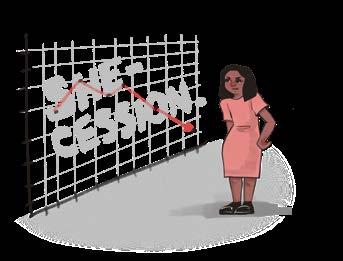
In Canada, economists are seeing a trend of women seemingly bearing the brunt of job loss in what people are calling the “she-cession.”
Morneau Shepell, a human resources services and technology company that aims to assist with employees’ mental, physical, financial and social well-being, released its new financial well-being index report in January.
The report examines Canadians’ financial well-being through a variety of demographics, areas and industries, and revealed a decline in financial health of Canadians since the pandemic started, with a noteworthy difference between those identifying as women and those identifying as men.
This has resulted in what many are calling a “she-cession,” a title to describe the recession due to COVID-19 and the demonstration of the substantially lowered need for typically female-dominated areas of employment such as the child-care, hotel and restaurant sectors.
Idan Shlesinger, president of retirement solutions and executive vice-president at Morneau Shepell, explained that the company had been conducting a mental health index for a couple of years prior to the financial well-being index, which tracks the overall mental health of working Canadians in order to determine the challenges they are facing.
“Consistently, what we’ve been seeing is that the biggest driver of mental
health challenges and stress for Canadians has been financial uncertainty,” said Shlesinger.
Despite the report’s release amid a global pandemic where individual health is expected to be a major stressor, Shlesinger said the biggest challenge for most has been financial.
He said that one of the differences they are seeing is the financial health between men and women during the pandemic.
“I’ve heard the term ‘she-cession’ before, but the notion that women do seem to be struggling more from a financial standpoint than men are is coming through loud and clear and, interestingly, it’s coming through across every parameter.”
Susan Prentice, professor in the department of sociology and criminology and Duff Roblin professor of government, described the “she-cession” as a “clever little piece of wording” that discusses the “disproportionate effect” on Canadian women in general — and mothers in particular — due to the recession.
Prentice explained that, compared to other economic recessions that economists have generally witnessed, this one differs essentially because “the employment rate in most recessions higher for men than it is for women.”
“In this economy, women tend to do more of the kinds of jobs that have gotten lost during the recession,” she said.
> Cont’d from p. 3
Lenore Hume, communications strategist at the organization, attributes this to the decision to switch to appointment-only adoptions at the start of the pandemic.
“Even though it seems like there’s a high demand for adoption throughout the pandemic because people are at home [and] they’re realizing they have time for animals […] we’re not seeing that through the numbers,” Hume said.
In other cases, the increase in adoptions has also led to concerns about increased surrenders.
Gillanders noted that Manitoba Underdogs Rescue has had the same concerns.
“With a lot of adoptions also comes a lot of people realizing that they’ve made an error,” she said. “They didn’t think it through properly and are looking to return the dog.”
“We saw in three weeks the same number of dogs returned as we normally see in a year.”
She noted that COVID-19 has limited opportunities for dog training which may contribute to increased behavioural issues and, ultimately, higher returns.
In fact, these animals may experience unique behavioural challenges.
Susanna Kilty, program director of the Pawsh Dog Training Academy, believes that the increased time spent with family may pose some issues for newly adopted pets.
“Going forward, this may pose problems in the form of separation anxiety issues, which can manifest in destructive behaviours and a dog under stress,” she explained.
“As well, the dog may already show some problematic behaviours because people are unable to expose their pets to ‘normal’ stimuli because of health restrictions and social distancing.”
However, for Gillanders and her new dog Dot, adopting during the pandemic was a “good decision.”
“Having so much love around all the time helps me to deal with the
graphic / Jenelle McCann / staff
Prentice believes that although the recession began during pandemic, all of the elements were “in place to be tripped” before then.
“Occupational segregation has been a permanent feature of the Canadian labour market, and so has a wage gap, and so has enduring inequality in care work,” she said.
“I think that it was easy for employers and governments and experts […] to just take for granted that women and men do different kinds of work and take on different kinds of responsibilities for family and children.”
Prentice hopes that the awareness about the “problematic” disparities in gender and intersectionality that contributed to the recession will be able to “change our political and economic

isolation that COVID-19 has lumped on my life,” she said.
“She brings me so much joy that is a real bright spot when I’m cut off from most of my loved ones.”
conversation,” and, ideally, will lead to a national child-care system in Canada.
Prentice said she has “heard promises made for decades.” However, upon hearing federal Minister of Finance Chrystia Freeland present her fall economic update that included plans for a Canada-wide child-care system, she saw some hope.
“I got a little lump in my throat and I thought, maybe this is finally the time when Canada makes these changes that we’ve needed to do for so long, and COVID just has finally, maybe, been the tipping point.”
news@themanitoban.com
> Cont’d from p. 3
The policy led to a widespread decline in funding for student groups and services across Ontario, with schools like Brock University in St. Catharines, Ont. losing nearly half a million dollars. According to Smith, Wayne Ewasko, minister of advanced education, skills and immigration, invited MAPSS to a private bill briefing three weeks ago, but Smith said that MAPSS had reached out twice since then and received no response. She said that with the bill’s second reading approaching, the alliance “can’t really afford to wait around much longer.” If the Progressive Conservative Party of Manitoba is unwilling to compromise, MAPSS is willing to reach out to opposition parties and launch a campaign to sway public opinion.
“We would really appreciate the opportunity to talk it out first,” Smith said. “But if they’re not going to provide us that opportunity, we have to continue conducting our business in the best interest of students.”
news@themanitoban.com

Judith Oviosun — The New UMSU (Independent)
A fourth-year human nutritional sciences student, Judith Oviosun is currently the UMSU womyn’s representative and president of the University of Manitoba Nigerian Students’ Association. She has also served as vice-chair of UMSU’s judicial board, the selections committee and as vicepresident of Alpha Gamma Delta.
Oviosun wants to use her experience as a student leader to create opportunities for student engagement and take steps to connect the UMSU community representatives to their communities.
She also wants to get the union into position to respond quickly to students’ needs rather than, as she put it, “keeping silent until the last minute.”
At the top of the agenda for Oviosun is keeping lines of communication open with marginalized communities on campus and advocating for affordable tuition.
“As an international student, I have been on the bitter end of most policies regarding student fees,” she said.
“I would find ways to reduce them and also make international students feel welcome on campus and online as well.”
These priorities also include pushing for the university to adopt the use of open educational resources (OERs) — alleviating the burden of purchasing
textbooks and other resources traditionally sold to students — as well as conducting work on mental health education and awareness.
“Buying a textbook that is worth $300 at a time, it’s a decision between ‘Should I eat?’ or ‘Should I put this money into […] buying a textbook?’” she said, making reference to the higher tuition rates paid by international students and their recent loss of health care coverage which have both increased the financial burdens of education.
She would also build on work started this year, creating a paid chair position for UMSU’s equity, diversity and inclusion working group to ensure its success.
“As a Black woman in politics, it is very hard for us to put ourselves out there, because sometimes there’s just […] mistrust within people […] the representation is very low,” she said. “I only decided to run because I’ve seen two other Black women do it […] if they hadn’t done it, I would not have thought of the fact that I would be able to represent UMSU at large.”
Regarding UMSU’s membership in external organizations, Oviosun would continue the work being done in terms of maintaining a relationship with Undergraduates of Canadian Research-Intensive Universities.
“UMSU needs a new voice that is relatable and understands students’ needs, a leader who is not afraid to have the hard conversations and will not be bullied into settling for less than what students deserve,” she said.

Brendan Scott — Renew UMSU
Running as part of the Renew UMSU slate, current UMSU vice-president finance and operations (VPFO) Brendan Scott wants to take his years of experience in student life to the role of president, reworking UMSU to prepare for a post-COVID-19 world. Finishing up extended education with plans to study dentistry, Scott has spent time as the sports representative, vicestick and senior stick at St. Paul’s College. He has also previously held the position of UMSU director for the Science Students’ Association.
According to Scott, through his experience in the VPFO role he has “definitely learned where this union can spend its finances the best.”
He said that when COVID-19 hit this year, UMSU was unprepared to shift to primarily delivering programming online due to public health orders. With a year of experience on UMSU’s executive team during the pandemic, Scott said he and his slate now know what the main expenditures were throughout the year and where to direct resources going forward.
A major aspect of Scott’s platform is his plan to focus on ensuring that UMSU is ready to provide a great campus experience post-pandemic. Toward these ends, Scott intends to renovate UMSU University Centre — shaping it to “fit the needs of today’s students” — and improve and renovate club spaces.
As part of these updates, he is planning for a larger Studentcare office, bringing back an updated digital print and design centre and bringing back the dental clinic with larger capacity and direct billing to the UMSU dental plan — this time in collaboration with the U of M’s college of dentistry, with students working in the clinic.
Scott also wants to push for OERs to be adopted by the university — shifting away from textbooks and the bookstore, citing concerns over the sustainability of the amount of paper that goes into producing the thousands of textbooks used by students every year. He also wants to open up a student business start-up space to be inexpensively leased for a month at a time to student businesses .
Scott plans to continue the work of leaving the Canadian Federation of Students that was initiated by the UMSU board of directors earlier in the academic year.
“It’s about advocating for [students] no matter if its COVID or not, to external organizations, to the province, the city, making sure that they’re not preyed upon, because students are the most vulnerable people that we have,” he said. “That’s why the union is so good to have […] collectively, you’re stronger than you are individually.”
NEWS Cam Cannon, staff

Currently in his first year of political studies, Justin Langan is a celebrated activist and journalist.
In 2020, he was recognized as one of Canada’s top 25 environmentalists under 25 by the Starfish Canada and also received the CBC Manitoba Future 40 Under 40 award. He also received the Sharon Johnston Champion Mental Health Award for his mental health activism.
Since 2015, Langan has also served on the Manitoba Métis Federation’s (MMF) provincial youth advisory committee and northwest youth advisory committee. He is currently vice-chair of the MMF’s provincial youth advisory committee.
As VPSL, Langan would work toward changing the way students are treated at the university, acting as a strong voice for student rights and ensuring that student voices are “heard and echoed at the very top of the executive.”
“Why elect the same thing that hasn’t been working? It’s time for a change, it’s time to put students first,” he said.
image provided / Riley Shannon

Langan’s priorities are bringing his experience in mental health advocacy — including with the MMF and federal government — to improve existing supports.
“I will push for more communication from the administration as to why students are paying for unknown fees and fees for services they can’t access,” he said, making reference to the fact that he is a student learning from Swan River, Man. with poor internet connection and the inability to access most facilities.
He also wants to revitalize student life, drive up engagement with the union and improve communication with student groups.
“I shouldn’t be the only one showing up [to community assemblies], I’m in my first year,” he said. “I’ve had to look how to be involved, it should be shared to me, how I can become involved.”
“I’m gay and Métis, I know how crucial and important representation is, [how important] consultation, meaningful consultation is,” he said.
“Don’t just hope for a better student life, vote for it.”
A fifth-year student in the faculty of science, majoring in biodiversity and evolutionary biology, Savannah Szocs is the current VPSL.
Beginning as the Club Condo manager for the Resident Students’ Association Council (RSAC) then moving on to working as secretary for the Arthur V. Mauro Students’ Association, Szocs is an experienced student leader.
For three years, she worked with Justice for Women Manitoba, starting out as a consent culture workshop facilitator and then moving on to the executive assistant role and leading consent culture workshops for student associations.
With UMSU, Szocs has been the VPSL and in that role sat on 17 different committees including UMSU’s sexual violence steering committee.
“For me, one of the biggest priorities is the sexual violence issue that exists on our campus,” she said. “I feel like a little progress is being made but unfortunately it doesn’t contribute much to the overall big picture of the issue.”
“I think that it’s time someone really put in the time, effort and dedication into really creating change within that area.”
Szocs plans to advocate for the U of M to adopt a more survivor-centric approach to dealing with instances of sexual assault. This would include pushing for the adoption of anonymous online reporting.
In the last year, Szocs has worked at administering UMSU’s hardship fund — a fund available for members who are experiencing pandemic-related financial hardship — which saw unprecedented demand in the face of the COVID-19 pandemic. If elected, she plans to work to expand the hardship fund in the coming year.
“The core aspect of the VPSL role is first and foremost to be an approachable, accessible and engaged member of the U of M community and to be able and willing to form connections with as many students as possible, lend a listening ear to any student who voices a concern,” she said. “It’s also so important that you exist for the students and use their voice within the position.”
ASBC — which he also plans to expand for UMSU.

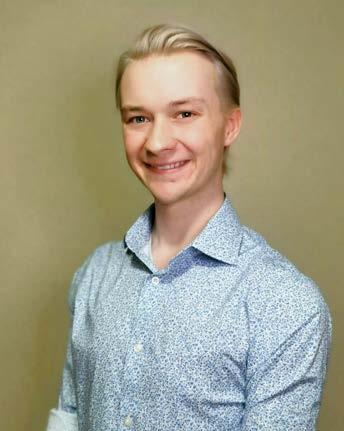
In his fourth year of studies in mechanical engineering, Brook Rivard has been the director of finance for the Resident Students’ Association Council (RSAC) and the Arts Student Body Council (ASBC), treasurer for the U of M Model United Nations Club, as well as treasurer for the UM Anime Club.
He was also previously a resident adviser on campus.
While working as the director of finance for RSAC, Rivard played a role in changing the constitution of the council and reduced the number of positions on the council to “more accurately represent the needs of students.”
“With residence councils […] you actually do get a bursary,” he said. “I felt that minimizing the amount of money that goes into just paying the council would help benefit actually throwing events and planning for students to actually help them.”
He is also currently working toward participatory budget planning with
Rivard’s priorities are in enhancing the transparency of UMSU and connecting with students.
Toward these ends, he wants to model UMSU’s disclosures after that of the Waterloo Undergraduate Student Association (WUSA).
Annually, WUSA releases an approximately 74-page report on its financials which includes a clear overview of where money was spent and why, including many pages of definitions to make the report more accessible.
For Rivard, the most pressing issue to be addressed by UMSU is the “disconnect” between the union and its members.
“You can see it on the student side, by [...] the lack of engagement with this election cycle,” he said. “There’s really no reason that it should be an incumbent slate and three independents. You would really hope for more representation from students, more choices for people, not only having three positions be contested.”
In her second year of studies in computer science, Mehrnaz Sadrol has gained leadership experience through high school and into university.
In high school, Sadrol served as both the treasurer and president of her school’s student union. She also co-founded a charity which assists in building elementary schools throughout the country.
“I learned how to plan a budget and how to raise money [for] events and how to help students,” she said. “And not only students in my own school.”
She has served as the president of the U of M Iranian Students’ Association and currently serves on the UMSU finance committee.
Through her experience on the finance committee, she has developed a working knowledge of UMSU operations and has also connected with the staff.
Sadrol is passionate about helping
students and getting them more involved in university activities. As such, she wants to expand the participatory budget process and get students more involved in financial decision-making for the union.
She also plans to create a more accessible health and dental plan for students.
For UMSU businesses, Sadrol also would like to promote sustainability practices, including “eliminating plastic products, reducing waste, using more recyclable and compostable materials” to achieve sustainability goals.
Cont’d p. 8 / Candidate >

In her third year of studies in the faculty of science, Emily Kalo is a psychology major with a minor in management.
Kalo has served as women’s representative for the Science Students’ Association (SSA) and was elected as an SSA representative at the U of M senate.
In her first year at the university, she co-founded the U of M student club Students Supporting Israel and has served as president ever since.
She plans to play an active role in guiding students, listening to their issues and giving concrete answers to their concerns.
Her priorities would be to establish an equity, diversity and inclusion (EDI) student panel to foster dialogue and hold the university administration accountable. She would also like to expand hardship funding.
“Advocacy has always been a passion point for me, it’s something I really pride myself on,” she said. “I’m not fearful to be a strong voice for the things I do believe in and because of that I’ve spent a lot of time advancing my public speaking skills and debate skills to ensure that not only I can eloquently [put forth] my own point, but that I can see both sides to a debate and critically analyze.”

In his fourth year of studies in biological sciences with a minor in political science, Tino Dogo is UMSU’s current vice-president community engagement.
In the last year, Dogo participated in the creation of the U of M Black Students Union (UMBSU) striving to create safe spaces for Black students on campus.
He would like to use another term as vice-president community engagement to continue the work he has done this past year in building a sustainable UMSU.
“With everything kind of ‘dead,’ I like to say, we have a very unique opportunity to restart UMSU with sustainability at top of mind,” he said.
He would also like to focus on creating resources that would be available for new students to ease the transition from high school to university.
Dogo would also like to address declining engagement with the union by reforming the chief returning officer’s office to make the position full-time so that UMSU elections are promoted beginning in September.
“If we want students to understand, or at least engage with the union, they need to have an understanding of what the union does and how it operates,” he said. “So, really providing those opportunities where students can learn more about what the union does.”
& TECHNOLOGY
Sarah Doran, staff
The fourth installment of the University of Manitoba’s faculty of agricultural and food sciences conversation series covered questions of Indigenous engagement and leadership in science on Feb. 17. Faculty associate dean Annemieke Farenhorst moderated the panel, while assistant professor Kyle Bobiwash of the faculty’s department of entomology joined Emily Missyabit McAuley and Erica Oberndorfer of Agriculture and Agri-Food Canada as panellists.
Bobiwash, a member of Mississauga First Nation, opened the panel with a short discussion on infrastructural issues behind the struggles Indigenous communities face, including lack of meaningful control over conservation efforts.
“I think despite the progress that has been made, that we’re making as a society or as a field in general science, we’re just at the beginning of getting over this colonial hangover,” Bobiwash said.
He argued that scientists should consider themselves intercultural representatives, even though the field may not traditionally see itself that way.
“I think we need to be thankful that Indigenous communities themselves still see institutions based on western education models as a way to the future, despite their contributions to continued colonialism,” Bobiwash said.
“In my opinion, as such, we have a duty no matter what our field is to contribute to bigger societal change.”
McAuley, a member of Lake Manitoba First Nation, was recently appointed as director of Agriculture and AgriFoods Canada’s Indigenous science liaison office as well as its Indigenous STEM research cluster.
She described her own experiences as a graduate student surrounded by non-Indigenous colleagues and mentors who weren’t capable of offering the kind of support she needed, including conflicting pressures from western academic life and Indigenous personal life.
“When we talk about Indigenous leadership in science, something that I’ve explored professionally over the last couple of years is really initiating and bringing about that internal organizational culture change that’s really needed to bring new voices and new minds into a system that [were] never included in the development of that system,” McAuley said.
In her current role, she encounters many well-meaning groups wanting to increase Indigenous engagement, but suggested they often prioritize the wrong thing.
“You need to be engaging internally

with your existing Indigenous employees and making your department more welcoming, or your organization more welcoming […] and building those relationships before you can even start to think about engaging externally,” McAuley said.
“A lot of what we’ve done is to really build in those culturally appropriate supports and be able to offer those supports in both worlds to Indigenous employees that need them.”
Oberndorfer, a non-Indigenous scientist working in Goose Bay, N.L. as a cultural botanist for Agriculture and Agri-Food Canada, spoke about her evolving understanding of what community engagement can be. She described her work connecting with the local Inuit community in Makkovik through presentations and events.
“I’m not knocking these kinds of engagements at all, of course, first of all because things like this are super fun and also because there are these shared experiences through which people get to know each other, and the basis for forming deeper ties,” Oberndorfer said.
“But more often than not, in this kind of example of engagement, control is with the researcher. It’s unidirectional and outward — essentially, I thought I would be engaging others.”
Oberndorfer said the longer she spent working with the community, the more she realized she was learning from them more than they were from her.
“[Indigenous engagement] isn’t an outward-facing tool to be wielded and controlled by non-resident
researchers in trying to engage into this community in one’s work,” she said.
“Engagement is something that hopefully, over time, works on non-Indigenous scientists like me as a lifelong path toward actively practicing those commitments and growing more together in the process.”
The panel discussed the fundamental disconnect between researchers used to academic environments and remote Indigenous communities who may not have access to clean water or reliable utilities.
“For decades, we’ve really ignored these problems, and there’s not a lot of good solutions for them,” Bobiwash said.
“So, not only do we have to kind of reconcile those ideas of what we consider to be the most important issues and how to tackle them, we also have to make this realization that we live in very different worlds. Being able to share and self-actualize some of that information is really important, because until somebody sees you as actually understanding them right there, there’s not really a reason for you to do this.”
McAuley agreed, pointing out that Canada and other nations have a long history of gathering information in Indigenous communities, then processing data for their own academic use without sharing with the community.
“It’s about a different way of thinking about, ‘How do we do our research and how do we identify shared research priorities’ but also, ‘Where are we along that continuum of
relationship-building and trying to address some of those issues together in a way that makes sense for each specific situation’ too,” she said.
The panel also discussed the role reconciliation has to play in the academic world. Bobiwash pointed out that Canada is likely not even capable of true decolonization anymore, while Oberndorfer said Indigenous populations have not had the chance to heal before a real attempt can be made on Canada’s part.
“I think when we think about reconciliation or decolonization, the western perception is that we need to think about those long-term goals and where we’re trying to get to,” McAuley said.
“From my experience […] it’s about finding a new way to walk together and to understand each other. When we start understanding those Indigenous worldviews and that Indigenous science is just as valid as western science […] we can start to act in a different way and start to invite and make space for those voices and those worldviews that are different.”
“I think we’re often very solutions-oriented and endpoint-oriented instead of maybe being more process-oriented,” Oberndorfer agreed.
“We’re working on what the answer is before we know really what the question is.”
Kunal Rajpal, staff
Researchers at the University of Manitoba, in close collaboration with Indigenous partners, have developed a mobile application to assist Indigenous communities with the current pandemic.
Available on Android and iOS, the COVID-19 Indigenous app aims to aid local community leaders and health directors who are working toward helping Indigenous communities in the pandemic by gathering concrete data from the participants.
The app is part of a larger research project named Kitatipithitamak Mithwayawin, which loosely translates from Cree to “hold ownership and control over the health and well-being of our own.”
The app was developed with the help of Evan Chamakese of Saskatchewan’s Pelican Lake First Nation, who acted as the digital health outreach co-ordinator, and U of M assistant chemistry professor Myrle Ballard, who is from Lake St. Martin First Nation in Manitoba.
“We wanted an app specifically for Indigenous peoples,” Ballard said.
“It’s an app where Indigenous peoples can use it within their communities to capture their own data, real-time data regarding the people within their communities.”
The app collects the data of participants via an embedded questionnaire that reflects on impacts from COVID-19.
Ballard regarded the app as “unique,” explaining that no one outside a given local community will have access to the provided data without the community’s express permission.
“The community leaders — for example, the community health director or the community health manager — will be the [ones] responsible for administering the data coming in,” Ballard said.
“They will be the only ones that will be able to see their community members’ data […] The people living within the community of Winnipeg, the [community] managers will only have access to the people living in Winnipeg, whereas the people living in [Brandon, Man.] will have their own data.”
The app has been in development since the fall and was launched for public use in early February. It took about four to five months to develop, during which team the team worked “very closely” with the developers.
“Its longevity is good because they will be able to use the app for different health stats that they want to capture within their communities,” Ballard explained.
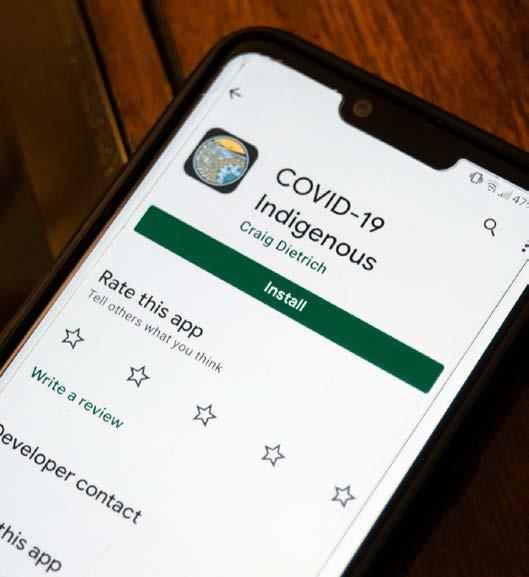
The app was constructed to meet the diverse needs of Indigenous communities and gives the participants full control over their own data.
“Right now, Indigenous communities have no way of capturing their own data,” Ballard said.
“They rely on outside sources for their data. For example, they’re relying on the government, or also the provincial government, but sometimes they can’t access that because the various levels of government consider that data confidential.”
Ballard also spoke about the app’s potential for connecting members of the community during an isolating experience.
“Just filling out the questionnaire is a form of sharing of what they are experiencing [...] that’s kind of a release,” she said.
Participants can share their feelings and experience using video, audio or writing. The real-time data collected will aid local health directors in
advocating for the right policies and implementing effective programming for their communities.
“There’s different things on the questionnaire, different questions they’re asked [that] are very relevant to making informed decisions for the community,” Ballard said.
The app is a step toward giving the members of Indigenous communities a voice and to support and promote health and wellness within the communities, while giving them data sovereignty. Furthermore, it also gives access to cultural content created by Indigenous staff involved with COVID-19, which ranges from video content to infographics and pictures.
However, the project came with significant hurdles.
“A lot of First Nations are in remote locations,” Ballard explained.
“They don’t have the infrastructure, they don’t have the cell towers. A lot of communities don’t have cell phone service […] What we did is […] we are
giving them mobile devices where they can log in to the app.”
The app also functions offline, where it will wait until getting an internet connection to upload questionnaires filled offline. Users also have the option to download cultural content to be viewed later.
The result is an app created to protect Indigenous health, both mental and physical, while keeping information at every step of the gathering and analysis process out of non-community hands.
“We don’t collect the data,” Ballard emphasized.
“The data is theirs.”






An odd personal effect of my current COVID-19-related circumstances is a budding interest in history that I had never expected to gain. During lockdown, I became fascinated by the origins of the novel coronavirus and other pandemics in humanity’s recent history. Being stuck at home has created time and space to learn a lot about history and enjoy it genuinely for the first time in my life.
The pandemic has also brought my friends together through video games in a very awesome way. It was during my time gaming and reading about history that I learned video games could be an amazing way to teach and preserve history, culture and so much more through amazing environmental design and scene setting.
When playing Tom Clancy’s The Division 2 — a role-playing, third-person shooting game about the world being ravaged by a viral pandemic that caused it to descend into turmoil, with various factions fighting for control of a decimated Washington, D.C. — I came to understand the subtle ways video games can provide interesting history lessons.
This may sound like a stretch seeing as the storyline is purely fictional, but as I was playing this game with my girlfriend the plot led us into a building called the Museum of Native Peoples, a location modelled after a real-life counterpart. The walls were detailed with writeups and dioramas about Indigenous cultures and their significances, histories and origins.
These dioramas included pictures of people that related to each of these cultures like the Northeastern Woodlands with images of Pauline Johnson — also known by her Mohawk name, Tekahionwake — or the Indigenous peoples of the Northwest Coast and Anotklosh, the former chief of the Taku people.
Reading these writeups and learning about history while immersed within the narrative of the video game provided a lesson. The fictional post-apocalyptic world threatened these pieces of history and posed its potential loss in this fight for survival. Even in the midst of the world’s fictional collapse, peoples’ histories and stories mattered.
For a moment, the space I was in stopped being a digital gaming environment and transformed into an educational one — a space of enlightenment. And it was not just the diagrams that caused this but the sacred figurines that were shattered across the re-imagined environment of the museum’s room.
This educational dynamic is likely what the video game developers had in mind and I grew a deep appreciation for it. The developers chose to add these details into the environment instead of opting to fill the space with fictional jargon or simply

the aftermath of a wrecked museum. Using video games and digital platforms with spaces like this one can be used to teach history and immerse it in amazing fictional timelines. Video games offer a new approach to learning from an interactive platform.
For example, in 2010 I browsed the software Encarta, an educational software made for kids to teach about history, wildlife and culture.
One of my favorite moments included in the software was a 3D virtual remake of Abu Simbel. Encarta provided an immersive interaction with digital remakes of historical sites allowing users to walk around and learn about things like Egyptian architecture.
Staring in awe at the height of ancient structures with a digital remake is much more educational than simply looking at a picture in a textbook. Instead, in digital platforms, history becomes a surreal, visceral and personified experience.
Another example is how I have been recently watching a lot of Second World War-related content and I learnt a lot about Iwo Jima and the battle between U.S. Marines and the Imperial Army of Japan in early 1945.
I loved watching history documentaries on this, but playing Battlefield 5 and taking part in an amphibious assault took my experience and fascination to another level because
of the level of immersion that can’t be matched by other mediums. Video games have the potential to be amazing tools to teach about the past.
The interactive dynamics combined with the knowledge of historians could illuminate the lifeways of both recent and distant ancestors.
Lucas Edmond, staff
Arguably no other figure in Canadian history has received as much attention and contention as Louis Riel. The historical literature surrounding his life and death has become so abundant that its study now revolves around reviews of primary research. And perhaps this is necessary. Riel exists in a rather polarizing position influencing biases with nearly every aspect of his political and social life.
In Manitoba, his story has been adopted patriotically in service of national narratives and he is celebrated as the province’s founder who led it into confederacy. To the federal government, he is legally still considered a “rebel” and has yet to be pardoned for the purported treason he was executed for in 1885. To many Métis populations, he is seen as a land defender who resisted the colonial annexation of the Saskatchewan Valley and Red River Settlements. And to Québécois and other FrenchCanadian populations, Riel is remembered as a defender of Catholic and Francophone traditions from the encroachment of Anglo-Protestant settlers moving west. His existence as a political leader embodied a diverse layer of ethno-cultural tensions that endured during Riel’s lifetime and persist today.
There are contradicting claims that romanticize his life in the narrative of unity, but also division.
So, which version of this Riel is true? A tricky question that stresses the importance of context. Of course, like most things, it depends who is asked.
Riel was born in the Red River Settlement — in an area now formally known as St. Boniface — in 1844. In 1869, the Hudson Bay Company (HBC) sold Rupert’s Land — a large chunk of land formally controlled by the crown of Britain — to the newly formed Dominion of Canada. But no residents of the area were consulted about the sale.
With the threat of Canadian annexation of Métis land and the fear of Anglo-Canadian settlers overwhelming Métis social, cultural and political autonomy, Riel spear-headed the Red River Resistance. Initially, this resistance stopped surveyors who were plotting land for their expropriation. But Riel and the movement later seized Upper Fort Garry from the HBC and established a provisional government called the Métis National Committee (MNC) which declared its opposition to Canadian autonomy.
Convoys of Canadian representatives were then sent to the fort to negotiate with the newly established government. Riel agreed to discuss confederation after significant deliberation. Afterward, the MNC set out to draft rights and conditions which the settlement and Métis representatives would demand before entering into an agreement.
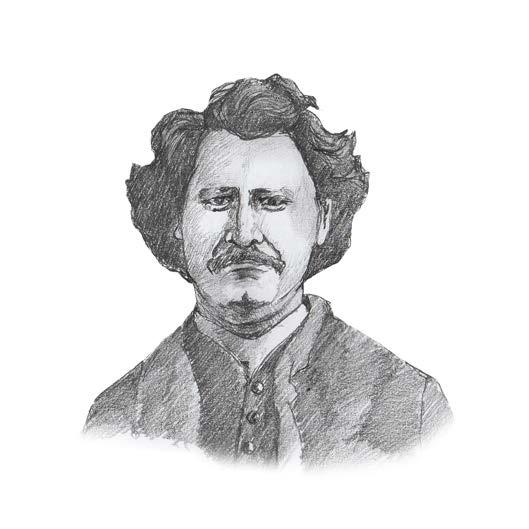
As the MNC was drafting a bill of rights, Protestant settlers rallied to oppose the provisional government. In fear of retaliation from Anglosettlers, the Métis arrested the group. Thomas Scott, an insurgent Irish-Protestant who was one of the leaders of the attack on the MNC, was executed by Riel for treason.
Although the MNC and Canadian governments remained rather impartial about Scott’s execution initially, news of the event inflamed Protestants in Ontario. What had been a regionally defined movement then escalated ethnic and racial attacks on Riel’s status as a Métis man across the dominion. Canada’s Lt.-Col. George Taylor Denison III famously called for Riel’s lynching as a crowd cheered on his sentiments. Similar ethnically charged attacks on Riel’s character filled news outlets and escalated public outrage.
Months later in 1870, representatives of both the MNC and Canadian government reached an agreement which was adopted as the Manitoba Act. The legislation launched Manitoba into Canadian confederacy in exchange for ensured Métis land, federal subsidies, a recognition of the province as bilingual, a French and Catholic
education system and four seats in parliament.
However, the tensions that arose from Scott’s execution had not subsided with this agreement. In the summer of 1870, a military expedition was sent from the Canadian capital as an “errand of peace.” Protestant radicals were encouraged to join the journey west. When Riel discovered the group had plans to lynch him, he fled south to seek asylum in the United States.
Besides a brief time spent in Montreal after suffering from a panic attack, Riel carried out his days in the northern U.S. until he was asked to aid a Métis resistance in the Saskatchewan Valley in 1884.
Upset by agricultural conditions, not having access to the new cross-continental railway and not having ensured title over their land, Métis groups in this region united to petition the Canadian government about their concerns. But the government was not interested in listening. Starting on March 18, 1885 a five-month battle known as the North-West Resistance proceeded until Riel and the Métis militia surrendered their fight.
Riel was then arrested, tried for
treason and hung on Nov. 16, 1885.
Post-execution, Riel suffered from a difficult reputation as a “traitor” that persisted for a great length of time. It was only recently that he was adopted as a modern figure of Manitoban confederacy. But, at that, does this new nationalist narrative fit Riel’s story and beliefs? Not particularly. Métis scholars often refute this romantically patriotic view of Riel which fits politically charged ideations.
Were it possible to ask Riel how he would like to be remembered, I think it would be safe to assume Métis historians are right to refute public narratives of nationalism. Riel had Métis interests in mind before all else and brought the defence of the Métis settlements to his grave. His history must be repatriated and celebrated as such.
COMMENT Grace Gyolai, staff
The beauty industry grows and evolves constantly with trends emerging and disappearing year by year. Colourful sparkle and the “no-makeup makeup look” can be the vogue simultaneously, allowing for creative self-expression. But this industry, worth over $500 billion globally, has a history of exploiting self-image and self-esteem.
As women continue to push back against patriarchal objectification and take back our autonomy and freedom of choice, the option to use makeup is also inherently feminist.
In fact, women who wear lots of makeup are perceived as less moral and somehow less human while women who wear a “professional” amount of makeup are seen as capable and reliable.
This double standard means choosing to wear a full face of makeup or none at all. However, both are empowering choices that challenge many traditional standards of femininity. The point is autonomy of the choices women make, not what others think they should do.
The issues I have with makeup come from the predatory advertisements and the so-called “standards” the beauty industry perpetuates. The industry itself remains largely anti-feminist at its core.
Before the internet, the media still had ways of persuading buyers.
Prior to the 1960s and 1970s, advertisements focused on the subservient roles that women were confined to through their marriages and home lives, but with the second wave of feminism followed a shift in advertisement. Women were usually depicted in advertisements as thin, pale, successful and independent.
While this change in ad presentation came from a progressive place, the trend of attempting to convince women they were inadequate without a certain product persisted. And it still perpetuated an impossible standard for many women to meet.
Advertisements in recent decades walk a thin line between objectification and dehumanization with the over-sexualization of women.
In advertisements geared toward men or women, it is not uncommon to see half-naked models in provocative positions with the actual product almost disguised in the photo — think Calvin Klein billboards or nearly any perfume commercial.
The messaging in these hypersexual ads becomes about — you guessed it — sex, or the sex you could be having if you bought the product. All at the expense of autonomous feminine identity and individuality.
The blatant and belligerent
graphic / Dallin Chicoine / staff
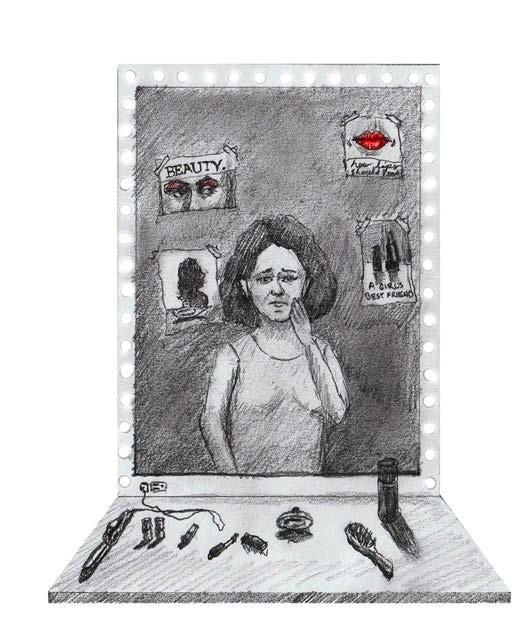
sexualization of women, mixed with the impossible beauty standards, generate the perfect formula for greedy beauty companies.
The ads we see lead to compensatory consumption where individuals feel threatened by the unattainable standards they are surrounded by and compensate for this perceived scarcity by purchasing the products that are meticulously positioned as the solution to their problem.
After decades of being forced to compare each other to perfect ideals of beauty, a study published by the Journal of Consumer Research found that just seeing an ad of a beauty enhancing product alone will elicit a negative psychological response.
It is this vicious cycle which creates insecurity for profit that must change.
I know that brands and the businesses behind them will always need advertisements in some form, but they should not be degrading or exclusionary to the average woman’s
appearance.
Some brands like Fenty Beauty and Sephora are taking steps to include diversity in their advertisements and more are likely to follow, but even inclusive ads that are widening the definition of who is considered beautiful in society still rely on the message that we should all strive to be more beautiful and buy so-called beauty defining products.
There are no ad campaigns that can truly be inclusive of every type of person. Surely, there will always be people who feel as though they are not considered beautiful or at least that they are not represented in ads that claim to be inclusive to everyone.
Beauty companies need to get creative and stop selling the narrative that we all need to look a certain way to have worth.
Yes, we need to increase all kinds of diversity in beauty advertisements in order for the industry to align with the modern definition of holistic
feminism, but to achieve true inclusivity and freedom of choice they need to stop obsessing over subjective and damaging definitions of beauty.
Brands need to focus their campaigns on acceptance instead of forcing everyone to consider their own beauty in comparison to unattainable beauty trends.
The desire to feel beautiful traps consumers in a cycle of self-critical thought. If beauty brands can promote self-worth and the freedom of expression instead of trying to define beauty, maybe we can finally make the feminist decision to wear makeup while also knowing the industry we are funding is not working in opposition to those very values.
A grim look at the public inquiry into anti-Alberta energy campaigns
Liam R. Forrester, staff
The process of investigating the public inquiry into antiAlberta energy campaigns feels like a Where’s Waldo crossed with a traffic accident. It takes some effort to sort through the clutter and the longer I reviewed the reports the more grim they became. The following is an attempt to relay those details in something resembling a cogent narrative.
Launched in July 2019, the inquiry was initiated by the government of Alberta as part of a campaign promise by Jason Kenney. The inquiry has been mandated to investigate the foreign funding of green energy campaigns deliberately targeting Alberta’s oil and gas sector.
Since its launch, the inquiry has had its deadline extended by almost a year. Originally due July 2, 2020, it would go on to receive several extensions and a budget increase from $2.5 million to $3.5 million. Two days before its Jan. 31 deadline, the inquiry received its third, and hopefully final, extension to May 31, 2021.
The inquiry’s commissioner Steve Allan justified the extension, claiming it allowed them to receive responses from groups under investigation and complete its engagements. Ecojustice, an environmental law charity, is one such group attempting to respond to the inquiry. However, they opted to respond in court.
The charity filed a legal challenge in November 2019. Ecojustice claims that the inquiry is a biased, politically motivated distraction that exceeds provincial jurisdiction and should be struck down. Ecojustice lawyer Barry Robinson claims that the inquiry was funded to intimidate other organizations and may be used to deny them charitable status.
So, is the inquiry biased and politically motivated? We cannot know for sure until the final report is released, but documents released by
the commissioner paint a worrying picture. It looks to be going off the rails.
The commissioner made several reports publicly available on Jan. 13. Included were highly controversial reports prepared by T. L. Nemeth and Barry Cooper. Just like the rest of the inquiry, the problems with these reports are multifaceted and bizarre.
Barry Cooper is a University of Calgary (UC) political science professor with a long history of climate change denialism. In 2008, an internal audit at the UC revealed that Cooper had used donations from two research accounts at the school to pay expenses for the Friends of Science — a climate skeptic group with connections to the Conservative Party of Canada.
The contents of the Cooper report are par for the course for climate skeptics. Cooper’s report continues to display his climate change denialism with statements about “the growing scientific skepticism regarding the so-called consensus view regarding anthropogenic climate change.” This statement indicates a massive oversight at best, and deliberate misinformation at worst. Scientific consensus on human-induced climate change has been growing for years. This is not up for debate anymore.
However, if climate change denialism is not concerning enough, things take an even more baseless turn. After vaguely claiming that environmental philanthropies are Marxist and First Nations peoples are revolutionary agents, he then makes the baseless claim that environmentalists will self-radicalize like white supremacists or Al Qaeda. “A second thing one may anticipate is a growth in what, in the field of terrorism studies, is called self-radicalization,” he said. “For law enforcement and counter-terrorism authorities, self-radicalization leading to ‘lone wolf’ attacks is a major new challenge.” He concludes by stating, “There is no reason to think
that a similar dynamic does not have the same effect on environmental radicals.”
After implying that environmentalists are likely to radicalize like terrorists, Cooper claims that he actually means radicalization makes it hard to talk policy with them. Inquiry spokesperson Alan Boras gave exact figures on the cost for Cooper’s report. Taxpayers shelled out $6,125 for this.
Nemeth, on the other hand, is a historian, whose massive 133-page report and 96-page supplement make additional wild accusations about a global movement to engineer a “Great Transformation” or “Great Reset” and redistribute wealth through clean energy programs.
Nemeth is explicitly referencing a known conspiracy theory in her work. Like all the best modern conspiracies, the “Great Transformation” and “Great Reset” are only vaguely based in reality and provide a general narrative that implies different things to different people.
The most recent instantiation of this conspiracy theory is loosely based on a World Economic Forum plan of the same name to recover from the economic effects of the COVID-19 pandemic and work toward greater sustainability. The actual “Great Reset” — as outlined by the World Economic Forum — basically amounts to better coordination between various sectors of the economy and additional international cooperation.
The conspiracy claims that the pandemic had been orchestrated by various world leaders to seize control of the world economy. Conspiracy theorists note this would result in the utter destruction of the western economy and a more equitable distribution of global resources.
Nemeth’s report, although never mentioning COVID-19, echoes many of these conspiracies. She claims that all agencies supporting an energy transition are targeting western industrial capitalism in the hopes of leveling
Chicoine / staff
/

living standards internationally thereby lowering the quality of life in Canada. Nemeth received $27,840 for her research.
One of the major outspoken critics in this whole mess is Martin Olszynski, an associate professor in environmental law with the UC who was granted standing in the inquiry. His submission outlines how Cooper and Nemeth are academic examples of climate change denialism and conspiracy theorists.
Olszynski later attempted to have Sandy Garossino’s article “A databased dismantling of Jason Kenney’s foreign-funding conspiracy theory” — a professionally researched debunking of the entire premise of the inquiry — circulated to the other inquiry participants. A few weeks later, commissioner Allan declined to include the article stating that his decision was not “biased” and would not result in a “deficiency” in the inquiry.
If commissioner Allan manages to get his circus of a report in on time, the public can expect it to be available sometime in the summer as Alberta’s minister of energy must publish the report within 90 days of the deadline. I for one am looking forward to delving into the offal of the completed report to see what gory details it contains.
comment@themanitoban.com
Anti-Black racism cannot be a fad. That was the theme of a forum UM Black Alliance (UMBA) that was hosted on Feb. 18 as part of Black History Month events, and it’s a thesis that rings profoundly true.
I encourage everyone to participate in events being hosted throughout Black History Month, and to learn about the Black experience in Canada and beyond. When I was an undergraduate student, I was open and eager to learn more about the experiences of others, but I was not always sure how. I view the opportunities available to students today with some envy, and I hope each member of our university
community will see value in pursuing them. Education is a crucial step to unravelling the complex challenges we must face together.
Supporting this work at the University of Manitoba is one of my highest priorities, and the president’s task force on equity, diversity and inclusion is completing an action plan — informed by our community — that will transform our campus in the coming years.
One significant change took place in August 2020 when the U of M’s Rady faculty of health sciences passed the first anti-racism policy of any faculty or post-secondary institution
in Canada: Disruption of all Forms of Racism. Developed with the office of equity, diversity and inclusion anti-racism working group, this policy, in brief, defines the many forms racism can manifest and sets out the responsibilities and expectations for eliminating expressions of racism on our campus.
And recently, the U of M released an important document: Upholding the Principles of Equity, Diversity, and Inclusion During COVID-19 This handbook will help to cultivate awareness about how COVID-19 has disproportionately affected diverse communities, and it will act as a resource guide to help connect people to university and community supports.
I’m proud of our community at the U of M for continuing to dismantle racist structures, creating a more equitable, diverse and inclusive campus. Let’s keep this momentum going; there is still more we need to do together. Creating an inclusive, diverse and equitable campus is not a fad.
Michael Benarroch U of M president and vice-chancellor
Kaelen Bell, staff
CEvin Key thought he knew Stanley Park. Having grown up next to the famous 1,001-acre parkland, the 60-year-old Skinny Puppy founder spent countless summer days riding bikes, eating ice cream and getting high among the towering trees. The land had a pull on him, and would reappear frequently in his work — Skinny Puppy’s influential 1990 record Too Dark Park is a reference to Stanley Park, and many of the legendary industrial band’s album covers were taken in or around the area.
It was a place of discovery and growth — formative in the truest sense — but looking back, Key describes a strangeness that he could never reconcile. He says he would sometimes stumble upon “energies and things [he] couldn’t really explain,” a rush of feeling that would warp his familiar surroundings. It would be decades before that feeling would clarify, and more time still before Key would shape it into song.
Xwáýxway, Key’s fifth solo record, is a sonic ode to the Indigenous village site that stood in what is now called Stanley Park. A gathering site and home-base for Squamish, TsleilWaututh and Musqueam peoples, Xwáýxway was the missing piece to Key’s understanding of the park. He had always felt something there and, now, he had a name for it.
“I haven’t had a chance to visit there since really learning,” said Key — who now lives in California — so, he decided to connect in a different way.
The record is a document of discovery, transmuting Key’s decades of harsh noise and industrial experimentation into a seasick pop patchwork of glitch and fuzz. Created following the successive loss of collaborators Dwayne Goettel and Phil Western, Key describes the record as an act of historical and personal restoration.
“[COVID-19] hit and I realized that it may be a good time to slow down and really just feel some music, and try and heal through devoting time to something,” he said, “so, really, this album was almost therapy.”
Xwáýxway features a smattering of guest spots from lyricists and vocalists, including Key’s the Tear Garden bandmate Edward Ka-Spel on “Nightflower” and “Watching You.”
“I’ve never been a lyricist, so for me it’s always been about the music speaking,” Key said. “I’ve been lucky enough to be able to work with some very talented vocalists, and it becomes more special when you share a genuine connection with a person, so that when the words are added it opens the door to a deeper journey.”
way’
ARTS & CULTURE
Kaelen Bell, staff
3.5/5 stars
Skinny Puppy was the originator. Like the first fish to crawl from the swamp and onto the earth, its caustic sound was one of the original links in an evolutionary chain that would birth the likes of NIN, Death Grips, Grimes and Crystal Castles, among dozens of other gothic industrial electro-heads. They never made it quite as big as their progeny, with limited airplay and a decidedly more underground approach. Still, the music of cEvin Key and Nivek Ogre is everywhere, seeping and splattering in unexpected corners of popular music.
Skinny Puppy is prolific, but multi-instrumentalist, composer and producer Key has been pumping out music at a breakneck pace for almost 40 years, spreading his twisted gospel across a variety of solo and collaborative projects. His latest solo effort however, the twitching Xwáýxway, is something a bit different. It may not sound too far removed from Key’s previous work — creeping samples, clattering beats and a hazy sense of
dread appear in abundance — but its deeply personal, specifically cultural messaging is a newer frontier.
The record is named for the lost Indigenous village site of Xwáýxway, which stood on the land we now call Stanley Park in Vancouver, B.C. Key spent his childhood exploring the vast parkland and has said that he always felt a strange spiritual pull, something inexplicable, among the ancient trees and tides Xwáýxway is his ode to this lost piece of heritage, an exploration of Key’s own Indigenous ancestry and a wrestling match between hope and defeat.
It is immediate from opener “Thirteen” that this record isn’t interested in breaking new sonic ground — it operates in a distinctly late ’80s to mid-’90s pallet, all sickly colours and brooding atmosphere. However, Key’s decades of innovation and boundary-pushing are felt in the textures. There is no question that he knows what he’s doing, that the dread comes as naturally as breathing. Former the Tear Garden bandmate Edward Ka-Spel appears on highlight
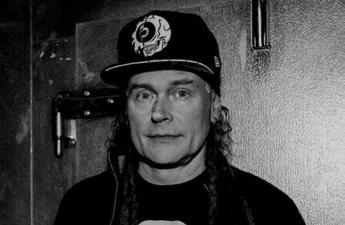
The musical language shared on Xwáýxway is heavy and shadowy, conjuring decades of spirituality and historical loss. However, it’s shot through with a sense of hope, a feeling of connectivity and discovery that colours even the record’s darkest corners.
“‘Resonance’ is really the closest I can come to expressing my innermost sadness, but sadness that has a sense of optimism,” he said. “I think I have always been overly optimistic, but this piece is really a soul-baring piece, and so it has that kind of deeper meaning.”
The entire record feels like Key baring his glitching, singular soul, and it’s a testament to his commitment to exploration that he’s still making
music so rich in history and spirit 40 years on.
Still, on Xwáýxway, Key seems more interested in telling a story that isn’t his — the story of the lost place that whispered to him so many years ago, the story of “a 3,000 year old village called Xwáýxway that once stood there — its history rubbed out by colonialization.”
“The next time I visit,” said Key, “I know that I will have a greater understanding of what I’m feeling.”
arts@themanitoban.com
image / Looters and Artoffact Records / provided

“Night Flower,” while IAMX provides vocals on the haunting “Anger is an Acid.” These two guest-vocals are particularly solid, but some of Xwáýxway’s best moments — like the smoulder of “Thunderbird” — come when Key is left to his own devices, translating his stories through pure
sound. Key’s days of shaping the nasty sounds of the future may be over, but by mutating the music of his past, he is still telling vital stories.
arts@themanitoban.com
ARTS & CULTURE
Zoë LeBrun, staff

Small gatherings, one of the latest exhibitions on display at the PLATFORM centre for Photographic and Digital Arts, has an aura of sanctity about it. Featuring new work by Anishinaabe artist Jaime Black and Kinonjeoshtegon First Nations artist Brandy Bjarnason Bloxom, small gatherings focuses on collective culture and the relationships between the artists, the land and each other.
Upon entering small gatherings, there is a sense of warmth, intimacy and life that emanates from the works displayed.
Bloxom’s works are displayed in the first section of the gallery facing the entrance, with Black’s on the opposite side of the room. While it might have been nice to see work from both artists mingling with one another, the choice to hang the works this way is successful — particularly for Black’s work, which is arranged to create an effective seasonal narrative.
At the back of the first gallery is an entrance leading to a smaller, dimmed room with vaguely human silhouettes covering the walls and a clay pot sitting in the middle of the floor. This intriguing installation, created by Black, is called home, body/ home, land, and gives the impression that one has entered a sacred space.
Made during a ceremonial-like performance, Black created a video of home, body/home, land’s creation, which is available on PLATFORM’s website to view. The installation also features the only image in the entire exhibition of Black and Bloxom physically together.
Dozens of readings could be taken from this work, but ultimately, home, body/home, land provides the viewer with a captivating and thought-provoking perspective on our connection to the land, its histories and questions of authorship that have been often raised in art history.
As for Bloxom’s work, her use of colour and negative space suggests the idea of individuals being a part of the grander workings of nature and it truly feels as if her photographs are taking viewers on a journey, culminating with her work earth, wind, fire.
Earth, wind, fire is particularly impactful due to its balanced asymmetry and vivid colour palette. This striking image depicts an Indigenous woman standing in a field wearing a red dress that is on fire and conjures a strong emotional pull, especially considering how it echoes Black’s earlier work with the REDress project.
While the concept of a woman in a flaming dress might sound like an upsetting image at first, Bloxom said that earth, wind, fire is ultimately a ceremony of remembrance and renewal, and certainly, it feels more like a celebration of healing than a depiction of violence.
However, one of the most powerful pieces in small gatherings is casting, a large print by Black that depicted a white dress submerged in dark, swirling water. It is amazing how the dress falls into abstraction on approach and its movement creates the illusion of staring into real, churning waters.
Additionally, this work stands out
because it perfectly encompasses one of the narratives that Black discusses in small gatherings — a healing journey rooted in the elements which finds resolution in the cleansing waters of the land we depend on to survive.
Both Bloxom and Black spoke about their experience collaborating with one another for small gatherings in a transcendent way, and this energy pervades the gallery space.
“Being in these difficult times with restrictions made this work challenging but at the same time our art just found each other and speaks the same language without us being together physically,” Bloxom said. “Even though we were apart, you can see the interaction, beauty and connection with the land and each other in these ‘small gathering’ days.”
As a viewer, the connection between these artists is evident in the beautiful echoing of their work throughout the exhibition — while walking through the gallery, it feels as if their artworks are having a deeply meaningful conversation with one another, particularly with photographs from both artists such as living memory I, II, III and leaving my mark, which utilize dual prints and impressions of faces and bodies on the landscape.
Bloxom is a self-taught artist mainly working in digital photography. Inspired by her First Nations background, Bloxom’s art practice explores her relationship to nature as well as her own positionality.
All of Bloxom’s photographs in small gatherings are self-portraits that she
began when COVID-19 touched down in Canada and she was forced into isolation.
Bloxom said, “I needed an artistic outlet and found that hard without a subject. So, I became that, and it became an emotionally vulnerable space to share with the world.”
“My heritage has and will always be part of my art,” she said. “It is my healing journey given to me by the creator and my duty as an artist to share these stories and connections in this language form I was given.”
Black is a self-taught interdisciplinary artist who also explores positionality. Her practice is “grounded in an understanding of the body and the land as sources of cultural and spiritual knowledge” as well as the relationships between them.
“I’m playing with the idea of absence and presence,” Black said. “One of the really important themes is reconnecting with the land as a way of healing […] women relearning the traditional stories from the land and the sacred spaces is what’s going to heal us and move us forward.”
Small gatherings will be on display at PLATFORM Centre until March 6, 2021. You can book an appointment to visit the gallery in person, or view images of the exhibition on platformgallery.org.
Shaylyn Maharaj-Poliah, staff
It has been almost a year since Winnipeggers were able to set foot inside a theatre and experience the magic of live performance. The wait could be even longer still, but never fear: One Trunk Theatre and Prairie Theatre Exchange (PTE) are bringing the theatre to you, safely and entirely free of charge, thanks to funding from Safe at Home Manitoba.
One Trunk Theatre is launching its Knock Knock Ginger Series, which provides an opportunity for Winnipeggers to enjoy a free live performance in a physically distant manner. Performers commute directly to people’s homes with all the materials necessary to mount an original small-scale show. Plays are performed without sound outside of audience members’ homes.
One Trunk Theatre is no stranger to innovative theatre practices as the company is known for pushing the boundaries of the craft. They have collaborated with chefs, dancers, graphic novelists and, in their most recent pre-pandemic show, live horses.
True to One Trunk Theatre’s vision of challenging the perception of theatre, the company’s artistic producer, Andraea Sartison, believes that the new COVID-19 restrictions provide a unique opportunity to embrace a new kind of actor-audience relationship “that [cannot] be replicated through streaming or the digitization of art.”
In a statement, Sartison said, “we are thrilled to present a safe and
creative way for theatre to continue in a strange time, and for audiences to experience the magic of live performance — something that has become a rare delicacy since the pandemic hit.”
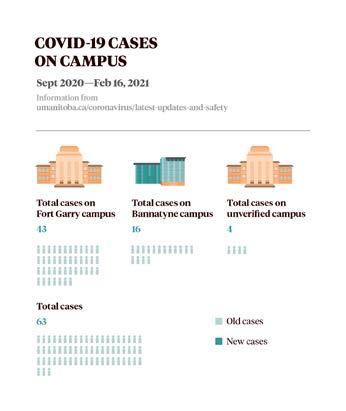
Performance bookings run five days a week from Wednesday through Sunday and occur twice nightly — once from 5 p.m. to 6 p.m. and again from 7 p.m. to 8 p.m. The shows promise to be family friendly and run for 10 to 15 minutes in length. Bookings are currently sold out, but an additional week of performances will be added in April for the St. Boniface area. Performances can be booked online for free through One Trunk Theatre’s website.
For those who prefer a quieter, more solitary night, PTE has just the ticket in the form of its recorded audio drama series, Winnipeg Stories Featuring new, original work from three local playwrights, the recordings contain contemplations of the city and explores what home means to each of them.
Jo MacDonald’s offering, Winn nipi, explores Winnipeg’s relationship with water. This includes the rivers that run through the city and their importance to the city’s history as well as its future. The audio drama was directed by Katie German and features Rosanna Deerchild.
Written and performed by Liam Zarrillo and directed by Stephanie Sy, The Green Building looks at human relationships with the architecture in our city and with space itself.
In a similar vein, Ellen Peterson’s Stories Houses Tell is told from the point of view of an elderly woman without much time left, who muses about buildings and houses that are nowhere except for her memories now. Maggie Nagle plays the role of
the protagonist while Hazel Venzon directs.
The collection is short and sweet, with each audio recording running for about 10 to 15 minutes, and will be available to access for free on PTE’s website until March 31.
Thomas Morgan Jones, PTE’s artistic director, said in a recent release that these works were actually commissioned about a year ago, but they are now given shape, a platform and an audience.
“These audio stories are perfect to enjoy at this time of year, and at this time in the pandemic,” he said. “When I listen to them, it feels like I have a visitor in my home sharing a story with me over tea.”
For more information on One Trunk Theatre’s Knock Knock Ginger Series, please visit onetrunktheatre.com. To learn more about Prairie Theatre Exchange’s Winnipeg Stories, go to pte. mb.ca.
arts@themanitoban.com
SPORTS Isaiah Wagner, staff
The Winnipeg Jets came into the 2020-21 season with very high expectations. Younger players such as Nikolaj Ehlers, Neal Pionk and Kyle Connor are heading toward their prime and this pushes the Jets into the win-now window.
The team made a few moves in the off-season, acquiring Paul Stastny in a trade with the Vegas Golden Knights and the signing of Derek Forbort and Trevor Lewis.
The Jets also made a blockbuster trade in-season that sent Patrik Laine and Jack Roslovic to the Columbus Blue Jackets in exchange for PierreLuc Dubois. Although Dubois has not played many games for the squad so far, it was still a trade that shook up both teams.
The Jets are playing in the all-Canadian division and have had a very impressive start to the season. A record of 9-5-1 in the first 15 games gives the team one of the top-four positions in the North Division and a chance at a playoff spot after the 56-game season.
No one has been more impressive this year for the Jets than alternate captain Mark Scheifele. He has 21 points in 15
games, which puts him closer to the top of all the league in scoring. He has truly become the team’s best offensive player.
Another great player for the squad has been Pionk, as he has 12 points in 15 games as a defenceman. He has a shut-down ability that allows him to be on the ice against the other team’s top players and also during big moments.
Connor Hellebuyck holds a 7-4-1 record, playing 12 of the club’s first 15 games, and has shown that he could potentially repeat his 2019-20 Vezina-winning season. The previous fifth-round draft pick has proven to be one of the best players to strap up the pads in the league.
So, what do the Jets need to do to become better throughout the rest of the season? The answer is simple: defend better. The team’s defence has been a question mark for both this year and last year and it is time to fix that.
A couple of players that could be acquired in a trade to help this out is Rasmus Ristolainen from the Buffalo Sabres or Mattias Ekholm from the Nashville Predators. Both of these
players are great defencemen who can impact a game in all three zones of the ice.
The Jets could sacrifice its 2021 firstround draft pick and a player such as Sami Niku or Logan Stanley to acquire one of these defencemen. A high price to pay, but one that may be necessary if the Jets want to make a run for the Stanley Cup.
The Jets have many big games coming up this season that could put the team at the top of the standings or push it down to the bottom.
The first is the three-game away road trip against the Toronto Maple Leafs in March. The Leafs have been one of the most impressive teams so far this season and the Jets will look to make a run at the number one team in the league.
The second is the three out of four games against the Ottawa Senators in the last leg of the season. The Senators are last in its division this year and the Jets cannot afford to give up points against a team like that.
As the season rolls on, every game will be an important one for the club. A win is two points in the standings that the Jets can not afford to lose in a season like this.

Scott, Harris some of the most successful athletes in the province’s history
SPORTS Matthew Merkel, staff
Black History Month is an incredibly important time for the Black community. It is a time to reflect on the past and strive for a better future.
In a statement penned by Enny Odeleye, the University of Manitoba Black Students Union (UMBSU) articulated the importance of Black History Month to the Black community.
“February is Black History Month, a time to reflect on the stories, experiences and accomplishments of Canada’s Black community,” Odeleye wrote. “It is essential to recognize Black leaders and athletes’ achievements because it shows that greatness can come from Black people out of our province. It encourages Black youth to step up and chase their dreams. That they, too, can do it and break down barriers. It sheds light on the creativity, authenticity, work ethic and power that Black people hold.”
Ryan Reaves, Desiree Scott and Andrew Harris are all examples of Black athletes that have made history and continue to lead a legacy of Black excellence in Manitoba.
After Reaves had a posterior cruciate ligament (PCL) injury derail his football career, it became apparent that hockey would be his sport of choice from there on out. Reaves was drafted 36th overall by the Brandon Wheat Kings in the 2002 Western Hockey League bantam draft, but ended up playing for the St. John’sRavenscourt School Eagles in the 2003-04 season. He then made the jump from high school hockey to the WHL.
Reaves starred for the Wheat Kings for three seasons, racking up 316 penalty minutes. He then played in the minors for four seasons, where he established himself as one of the toughest players in all of professional hockey. After four seasons of solely minor-league hockey, Reaves joined the St. Louis

Blues organization.
In the 2010-11 season, Reaves made the St. Louis Blues roster and has remained in the NHL ever since. His punishing checks and ability to drop the gloves have cemented him as the toughest player in the NHL. Now, he plays for the Vegas Golden Knights, a team that continues to be a force in its division and regular contender for the Stanley Cup.
Born and raised in Winnipeg, Desiree Scott joined the University of Manitoba in 2005, emerging as one of the top players in the country winning the Canada West rookie of the year that season. Scott would be named a Canada West all-star numerous times in her four years with the Bisons and an All-Canadian in her final two years.
In 2010, Scott made her debut for the Canadian national team at the Cyprus Women’s Cup. She also played in the 2011 FIFA Women’s World Cup.
Scott has emerged as one of the top
midfielders in the world. In 2016, she helped lead team Canada to another Olympic bronze medal.
Andrew Harris was a gifted athlete from a young age. After years of playing high school football, Harris was recruited to the play junior football for the Vancouver Island Raiders. With the Raiders, Harris captured three national titles and destroyed multiple provincial and national junior records. He also won a number of awards, including most outstanding junior football player in 2009. Harris joined the BC Lions practice roster later that year.
In 2011, Harris helped lead the Lions to a Grey Cup victory over his hometown Winnipeg Blue Bombers. Harris was named most outstanding Canadian for that game as well.
After seven seasons with Lions where he continued to rewrite the CFL record book, Harris returned to Manitoba signing with the Winnipeg Blue Bombers.
For these athletes, the work continues. All three continue to set an example for Black athletes across the province.
The UMBSU shares a similar stance. Black history continues to be important not only in February, but everyday beyond Feb. 28 as well.
“Black history is not just history for us because many of us are still experiencing the impacts of intergenerational trauma,” Odeleye wrote. “It is a time for us to teach people that it is a privilege for them to learn about our history instead of having to experience it and deal with it your whole life. It goes beyond a time for us to remember the past and fixate our time on the present and how we can fix the issues at hand and make tomorrow a better place for Black people. It is not a trend or a movement but rather a lifestyle that we all need to be living and making a conscious effort to change.”
sports@themanitoban.com