



of
during the academic year by the Manitoban Newspaper Publications Corporation. The Manitoban is an independent and democratic student organization, open to participation from all students. It exists to serve its readers as students and citizens. The Manitoban is a member of the Canadian University Press, and our journalistic standards can be found online at toban.news/jsp
The newspaper’s primary mandate is to report fairly and objectively on issues and events of importance and interest to the students of the University of Manitoba, to provide an open forum for the free expression and exchange of opinions and ideas and to stimulate meaningful debate on issues that affect or would otherwise be of interest to the student body and/or society in general. The Manitoban serves as a training ground for students interested in any aspect of journalism.
Students and other interested parties are invited to contribute to any section of the newspaper. Please contact the appropriate editor for submission guidelines. The Manitoban reserves the right to edit all submissions and will not publish any material deemed by its editorial board to be discriminatory, racist, sexist, homophobic or trans-phobic, ableist or libellous. Opinions expressed in letters and articles are solely those of the authors. Editorials in the Manitoban are signed and represent the opinions of the writer(s), not necessarily those of the Manitoban staff, Editorial Board or the publisher.
A “volunteer staff” member is defined as a person who has had three volunteer articles, photographs or pieces of art of reasonable length and/or substance published in the current publishing year of the Manitoban. Any individual who qualifies must be voted in by a majority vote at a Manitoban editorial board meeting. Elected representatives and non-students may be excluded from holding votes as volunteer staff members in accordance with the Manitoban Constitution.
All contents are ©2021 and may not be reprinted without the express written permission of the Editor-in-Chief.
UMGSA meeting / Skype / 5:30pm The McGill Tribune Journalism and Media Conference/ 3-7pm EST facebook.com/events/840550056796516/ Continues on Jan. 28
A conversation with N. Korean Refugees / 7:00pm / eventbrite.ca/e/mhrsapresents-a-conversation-with-north-korean-refugees-tickets-135634363031
UMSU meeting / Skype / 6:30pm
COPY
/ copy@themanitoban.com
Ursula Chojko-Bolec (ed.)
Aldin Sabic
NEWS DESK / news@themanitoban.com
Gillian Brown (ed.)
Cam Cannon (ed.)
Damien Davis
RESEARCH & TECH DESK / research@themanitoban.com
Sarah Doran (ed.)
Kunal Rajpal
COMMENT DESK / comment@themanitoban.com
Lucas Edmond (ed.)
Grace Gyolai
ARTS & CULTURE DESK / arts@themanitoban.com
Shaylyn Maharaj-Poliah (ed.)
Kaelen Bell
Zoë LeBrun
SPORTS DESK / sports@themanitoban.com
Isaiah Wagner (ed.)
Matthew Merkel
PHOTO DESK / photo@themanitoban.com
Alexander Decebal-Cuza (ed.)
Basel Abdelaziz
DESIGN DESK / design@themanitoban.com
Joshua Wesey (ed.)
Mikaela Warkentin
GRAPHICS DESK / graphics@themanitoban.com
Jenelle McCann (ed.)
Dallin Chicoine
AUDIO DESK / audio@themanitoban.com
Tino Hove (ed.)
Tawana Matizanadzo
VIDEO DESK / video@themanitoban.com
Jesse Boily (ed.)
Arsalan Saeed
SOCIAL MEDIA DESK / social@themanitoban.com
Colin Ijebor (ed.)
Jalene Moman
NEWS Gillian Brown, staff
Out of any city in Canada, Winnipeg has the largest Indigenous population, and the University of Manitoba has been home to the National Centre for Truth and Reconciliation (NCTR) for roughly six years. In light of this, earlier this academic year the U of M instituted an Indigenous course requirement (ICR) for students in the faculty of arts, effective fall 2021 for students incoming to the faculty of arts.
U of M’s institution follows other Canadian universities — the University of Winnipeg, Trent University, Laurentian University and Lakehead University — that approved ICRs in 2016 and 2017.
While U of M’s requirement applies only to new students in the faculty of arts, the U of W’s applies to all new undergraduate students.
The ICR is one of the recommendations of the U of M Indigenous senior leadership’s (ISL) 2019 report, which outlined five main areas of improvement for the university and 29 individual recommendations aimed at “acknowledging and dismantling structures, policies and procedures that have been identified as barriers for Indigenous faculty, staff and students.”

According to associate professor Niigaan Sinclair, the new Indigenous course requirement is “a good step, but only one step” on the path to reconciliation and Indigenous self-determination.
Though more education is better, Sinclair said “I don’t think it’s going to change some of the major problems around reconciliation, which are [that] land continues to not be returned from Canada, there’s more children who are moved into the child welfare system, there’s a lack of recognition of Indigenous languages, there’s over-incarceration of Indigenous men and women in prisons.”
Sinclair is set to teach NATV 1200, NATV 1220 and NATV 1240, three introductory courses in the native studies department that qualify for the ICR.
This past December was the first time in five years that the three commissioners of the NCTR’s truth and reconciliation commission met to express their “concern about the slow and uneven pace of implementation” of the centre’s 94 calls to action to acknowledge Canada’s history of residential schools and promote efforts of reconciliation.
Cont’d p. 6 ? It’s a challenge >
This week, the U of M will join the conversation on mental health with Bell Let’s Talk.
From its origins in September 2010, the Bell Let’s Talk initiative began as a simple conversation about Canadians’ mental health and has now turned into a major initiative focused on raising awareness on mental health.
Having participated in Bell Let’s Talk before, the U of M is planning various virtual events, adapted to life during a pandemic.
The conversation about mental health is more of a continuation for the U of M. Back in October, UMSU changed its annual mental health week to a mental health month to account for the high rate of reported mental health concerns. According to UMSU president Jelynn Dela Cruz at the time, mental health services on campus saw an “exponential influx in demand.”
There are a variety of resources on campus for students to access during this time. One resource continuing to be available through all of remote learning is the student counselling centre (SCC).
Despite student reports of increased stress during remote learning and an
ongoing increase in the demand for one-on-one counselling over the past years, director of the SCC David Ness reported that, at least for the centre, there has been a decrease in students utilizing counselling resources.
While demand is still high according to Ness, the numbers have sunk from past years.
Ness speculated that the reasoning behind the decrease may have to do with many different factors, one of them being a preference for in-person counselling.
His other concern is that students may not have a secure or private location at home to contact the SCC and have a counselling session.
With an in-person session, Ness noted there is no risk of anyone overhearing them or coming into the room.
According to Dela Cruz, across Canada, on-campus mental health resources have remained fairly consistent throughout the pandemic, but in the case of direct campus-linked resources at the U of M, students are turning more to mental health resources off-campus that are more convenient to them.
With regard to the Bell Let’s Talk

initiative, Ness said, “I think any initiative […] that helps destigmatize mental health and encourages people to seek assistance is fabulous.”
“We know that in the not-too-distant past, people stayed very silent with this, so I think that in that way it’s really good.”
Some virtual events happening this week include a wellness sharing circle, a resilience workshop and a healthy U live Instagram event.
More information on how to register for and attend these events and their dates can be found at this link.
NEWS Damien Davis, staff
The master of human rights student association (MHRSA) is hosting a virtual panel on Jan. 28 featuring three North Korean refugees sharing stories about life in the Democratic People’s Republic of Korea (DPRK) and how they came to be refugees living Seoul, South Korea.
Speakers at the event include the refugees associated with Freedom Speakers International (FSI) — a non-profit organization formerly known as the Teach North Korean Refugees (TNKR) — as well as two of the organization’s co-founders. According to FSI’s official Facebook group, the organization is intended to “empower North Korean refugees to find their own voice and path through education, advocacy and support.”
The organization also offers free English language lessons to refugees from North Korea. Associate professor at Sophia University and former Harvard law fellow Sandra Fahy is set to chair the virtual event and give a keynote address discussing the possibility of reconciliation between North and South Korea.
Assistant professor of history at the U of M Jeong Min Kim will be discussing the history of relations between the two countries. Michael Campbell, a first-year graduate student in the master of human rights program at the U of M, has a history with FSI that goes beyond assisting in planning the panel.
Campbell completed his undergraduate degree in English at the U of M in 2019 before moving to South Korea with the aim of teaching English to elementary school students.
During this time, Campbell was looking for volunteer experiences and knew of someone who had done volunteering with FSI — at the time known as Teach North Korean Refugees — where Campbell would volunteer from October 2019 to January 2020.
Campbell had to return home to Manitoba due to COVID-19, teaching online rather than in person.
“Over the summer, I had a lot of time to think coming into the master of human rights program and I thought that it would be really wonderful to bring the lived experience of North Korean refugees to this program,” Campbell said. He also noted that he had spoken to the program director, Kjell Anderson, on one of his first days of the program, explained his idea and was told it was a great idea, to which Campbell began reaching out to other students to collaborate.
news@themanitoban.com
Cont’d p. 4 ? Refugees >
Kunal Rajpal, staff
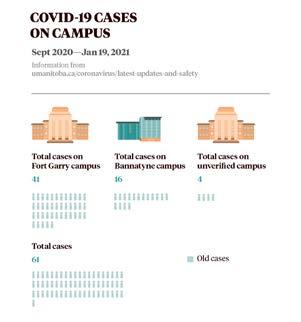
After nearly one year of the COVID-19 pandemic, various vaccines and other forms of treatment have seen remarkable development. On Jan. 19, the University of Manitoba’s Café Scientifique hosted a talk with several members of the Max Rady college of medicine to discuss vaccine progress and logistics.
The panel was hosted by Thomas Murooka, an assistant professor in immunology and medical microbiology. Panelists included Jason Kindrachuk, an assistant professor in viral pathogenesis; Kelly MacDonald, head of the infectious diseases section and a professor in the medicine, microbiology and immunology departments and Deanna Santer, an assistant professor in immunology.
Kindrachuk spoke about the possible origins of the virus and our current understanding of how it spreads.
“Based on the [genome] sequence, it looks like it actually emerged from bats,” he said.
“We are still waiting for that concrete piece of information to tell us specifically that is the case.”
He also explained that studies on coronavirus and similar infectious agents are relatively new.
“From 1960 to up until 2002, there wasn’t a lot of interest in [coronaviruses],” Kindrachuk said.
“It was simply about the fact that [coronaviruses] seemed to cause cold-like illnesses.”
In 2002, the coronavirus causing severe acute respiratory syndrome — known as SARS-CoV — sparked an outbreak around the world and subsequently medical interest in the virus.
> Cont’d from p.3
“The idea was to put three North Korean refugees with vastly different experiences together and then to see where they agree, where they disagree, their thoughts about the regime, their thoughts on South Korea,” Campbell said.
He went on to say the focus of the event is “twofold.”
“There is a lot of […] misinformation I think about North Korean refugees, but there are also […] contradictory truths about North Korean refugees.”
“Ultimately, what we understand is the fact [...] that the majority of transmission we see is likely occurring in the pre-symptomatic period,” Kindrachuk said.
He defined this as the period where the host does not yet know they have been infected and has not yet developed symptoms, a window of roughly five days.
“We think that the majority of transmission is occurring probably through both very tiny aerosols [...] but also droplets that are little bit larger and tend to be released when we cough or when we sneeze.”
Santer briefly described why some patients are able to fight off the infection and others are unable to. A key aspect is interferons — proteins that act as part of the body’s natural defences by alerting the immune system when invading cells have appeared.
“You really need early interferon response,” Santer said.
“If that happens [...] you’ll have a decrease in the viral load, the interferons will actually inhibit the virus, and those will tend to be the people who don’t have severe disease.
“But now we are encountering people, subsets of people, that actually don’t have this interferon response for various reasons. In that case, the virus will just keep replicating, be uncontrolled and, unfortunately, those are the patients that are being hospitalized.”
Scientists have been able to produce interferons as part of a treatment process for other diseases, notably cancer. Santer is working on clinical trials in hopes of using a similar strategy to treat COVID-19.
“If we actually give interferons soon as we can early in the disease, that could help dampen the amount of virus that’s there, [and] hopefully quicken the clearance of the virus and prevent severe disease,” she said.
MacDonald debunked some of the common myths surrounding COVID-19 and its vaccines and briefly reviewed some of the vaccines that have been approved as well as their efficacy and their safety profiles.
“The vaccines [...] were developed very quickly, and people may wonder why that is,” she said.
“Part of it is that the biotech sector in the last 20 years is like information technology was in the ’80s and the ’90s. It has progressed in ways that we can’t imagine — we have the capability today to make vaccines that we didn’t have 40 years ago.”
She also touched upon the testing process of the two approved vaccines in Canada, calling it a “very exhaustive testing process.”
“These vaccines have been tested on 80,000 people between the two trials of the two vaccines that are now licensed in Canada,” she said.
“Eighty thousand people who have been carefully followed for every sign that they could possibly get — every ache, every pain, every rash, every headache.”
MacDonald also discussed the difference between using RNA in vaccines and genetic modification.
“RNA is just like giving a protein because what it does is it feeds your own system, the machinery to make a protein for you,” MacDonald said.
“It’s actually a cheaper way for your body to manufacture a protein. So, in fact, we’re not changing your genetic code. It’s not genetically modified anything.”
She went on to explain how the vaccines actually work.
“Your body makes proteins from RNA all the time, and what it does here is it makes proteins from RNA you’ve injected,” Macdonald said.
“It presents this protein to your immune cell, which gobbles it up and presents it for an immune response. It’s that simple.”
Three vaccines have been licensed worldwide. Two of them are available in Canada: the Pfizer and Moderna, both of which MacDonald said are “95 to 98 per cent effective.” She also spoke about concerns regarding the contents of the two vaccines and whether they contain elements like fetal cells or bovine serum, which can be a religious or ethical concern for some.
“I can assure you that none of these things are in these vaccines,” MacDonald said.
“In fact, that’s one of the reasons that these RNA vaccines are cost-effective, and that’s one of the reasons we’ve been able to manufacture these in large quantities so quickly.”
When asked about what future vaccines might look like in terms of efficiency and effectiveness, the panel emphasized the competence of the two already available.
“We’ll see a greater variety of vaccines, so I don’t think we’ll necessarily see a greater quality of vaccines,” MacDonald said.
“We have vaccines that are greater than 90 per cent effective in the first go around. One can hardly improve upon that.”
research@themanitoban.com


NEWS Cam Cannon, staff
“Confusing” experiences with onboarding for student nurses hired by Shared Health underscore recurring concerns over the provincial government’s COVID-19 rollout plan.
A student nurse, who spoke with the Manitoban on the condition of anonymity due to fear of losing their current job and jeopardizing future employment, was hired by Shared Health at the beginning of January as an immunizer.
According to the student nurse, the process of applying for the position and getting to the point of signing up for shifts was full of confusion arising from miscommunications
and, at times, conflicting information received from Shared Health — the organization that, according to its website, “leads the planning and co-ordinates the integration of patient-centred clinical and preventative health services across Manitoba.”
In one instance, the student nurse was asked to begin signing up for shifts despite it being unclear what positions they were hired for, and despite it being unclear whether the student nurse was required to take a course on vaccine administration from Red River College (RRC) before beginning
work.
After some initial confusion over being asked to sign up for shifts, the student nurse was told over the phone by Shared Health that they would not require the RRC course, but the next day received an email from RRC about not having registered for the course.
“So, I called back to Shared Health and I said ‘OK, do I need this course? I want confirmation,’ and they said it’s optional, I don’t need to take the course,” the student nurse said.
“But if I hadn’t called Shared Health, I would’ve just assumed I had to take the course. Nobody reached out to me to tell me it was optional.”
In another instance, important onboarding documents containing sensitive information were emailed to the wrong student.
This was an error which, if the student who received the documents failed to realize the error and reached out to the intended recipient, would have rendered the student nurse unable to start employment and take shifts.
They described their experiences as “very, very frustrating” which at times left them wanting to “give up.”
“I felt very stupid […] calling different people, emailing different people every day and having them tell me, ‘Be patient, I’m not the person to call about this, you have to wait for information to come to you,’” they said.
“I felt like I was irritating everybody but also […] the questions I was asking were important and necessary for me to fill out the paperwork.”
a new layer of bureaucracy has been introduced to Manitoba’s health-care system since the 1997 when the Gary Filmon-led Progressive Conservatives formed government and created regional health authorities such as the Winnipeg Regional Health Authority (WRHA).
For St. Boniface MLA and leader of the Manitoba Liberal Party Dougald Lamont, the added bureaucracy poses issues for democracy and accountability when it comes to health care in the province.
“This is anti-democratic but it’s also part of the reason why our health care system is so broken,” he said.
According to Lamont, each layer of bureaucracy created takes away decision-making that could have been made at the community level or by elected officials. It places responsibility for health care in the province on a bureaucracy that does not answer to communities or elected officials.
“The [Progressive Conservatives] and the [New Democratic Party of Canada] have created a health care system that’s a black box,” he said.
“We don’t get to look into what’s happening, we don’t get to ask questions, we don’t get answers, and these are the people […] that are actually spending over $6 billion a year. It’s incredible.”
The provincial department of health, seniors and active living was allocated approximately $6.3 billion in the 2020-21 provincial budget, up about $100 million dollars from the previous year’s budget.
Lamont explained that as an MLA he is able to directly ask questions of the heads of crown corporations like Manitoba Liquor and Lotteries but is not able to do the same with the chairman of the board of the WRHA or Shared Health.

Last week, the Winnipeg Free Press reported that the vaccine “super site” located at the RBC Convention Centre in Winnipeg was “so disorganized” that a volunteer dentist quit “in disgust.”
Vaccination efforts are being overseen by Shared Health.
Shared Health was created by the provincial government in 2018 as a part of Manitoba’s “health system transformation” — a series of health-care reforms undertaken by the provincial government which have been met with criticism by the province’s opposition politicians.
This was the first time

He said that even when requesting information “you end up getting a runaround […] so you’ll ask the RHA and they’ll say, ‘Well, ask Shared Health’ and Shared Health will say, ‘Ask the health department.’”
“Ultimately, I hope that there will be reports [on the vaccine rollout], there will be inquiries into this, but what we have to hope for and count on is actually people in the system speaking up and being willing to speak up and tell the truth and be whistleblowers.”
At press time, Shared Health had not responded to request for comment.
Red River College’s (RRC) new condensed training programs are aimed at tackling shortages in Manitoba’s education workforce due to the COVID-19 pandemic.
A staffing shortage in Manitoba’s classrooms has been acknowledged by the provincial government. Schools have reported challenges in staffing both larger, socially-distanced in-person classrooms and remote-learning environments.
Current educators have taken on these and additional responsibilities, such as ensuring students are physically distancing and wearing face masks.
Manitoba Teachers’ Society (MTS) president James Bedford described the situation as “very challenging and hugely workload-intensive for teachers.”
He noted that though Grade 12 provincial exams have been suspended, there has been little done to accommodate the extra workloads.
“We’re doing all this stuff on the fly,” Bedford said. “So, are people exhausted? Yeah, they’re exhausted. Are they frustrated because we’re having to go along and make interpretations of public health orders? Yeah […] it’s tough.”
Alan Campbell, president of the Manitoba School Boards Association, noted that within schools, “instructional resources such as teachers and educational assistants remain in
highest demand.”
“In some instances, self-isolation precautions also take staff away from their regular duties,” Campbell said. “This means that substitute and casual staff levels have also increased considerably in order for school divisions to mitigate any disruption to student learning.”
In collaboration with the Manitoba Association of School Superintendents and funded by the provincial government, RRC has developed condensed programs intended to address this need for temporary educators.
Two tuition-free, instructor-led courses are set to begin Jan. 25. They aim to quickly train new school division hires to take on roles within the classroom through online training offered in both English and French.
The educational assistant essentials training focuses on providing educational assistant training to candidates.
The basic classroom skills for limited teaching permit holders training is intended to train non-teacher candidates to fulfill the role of classroom teacher. Hiring non-teachers to fulfil teaching roles through limited teaching permits is a well-established practice that has preceded COVID-19.
However, Aileen Najduch, RRC’s executive director of community and student services, said that there is still an important distinction between conventional training and RRC’s condensed programs.
graphic / Jenelle McCann / staff
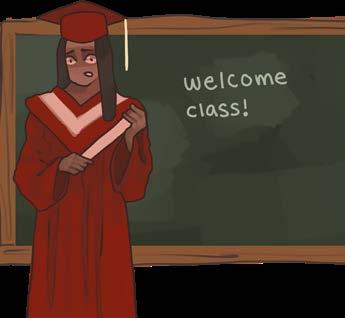
“We are clearly saying these are uncertified teachers during unusual times,” said Najduch. “The authority that they are given is time-limited and special authority. They are not regular teachers.”
Instead, according to Campbell, the programs are intended to “help meet an acute need during a challenging period caused by a virus that will hopefully see its end sometime later this year,” and that they will be good for this year.
He believes staffing shortages within the school system will continue for some time, noting that a proportion of teachers have indicated a desire to
leave the profession and hopes these condensed RRC programs may be entry points for future teachers.
“Will this open the door for some of these individuals to say ‘Hey, I think I’d like to pursue an education degree. I’d like to become a professional teacher’? If that happens, I think that’s a great thing.”
‘It’s a challenge worth taking on, and very important for the University of Manitoba’
> Cont’d from p.3
The U of M’s 2019 ISL report aims to address some of those calls to action, specifically number 57, which calls upon governments to educate public servants on the history of Indigenous people in Canada.
The ICR initiative was headed in part by Cary Miller, associate professor and Native studies department head.
Miller’s aim for the requirement is that it will help to address call to action 57, to educate especially those making decisions at the governmental level in the history of colonialism past what the provincial kindergarten to Grade 12 curriculum teaches.
Miller said that when trying to tell the history of North America “in the absence of Indigenous people and negotiations with Indigenous people, you are creating a false narrative.”
“We have to be working from the same set of facts,” she said.
“If we’re not working from the same set of facts, how do we even begin a conversation? […] A set of facts can
give you false information simply by what is omitted in that set of facts as much as the actual falsification.”
Courses that qualify for the ICR will teach at least 80 per cent of Indigenous content in the class and will require at least 50 per cent of assigned readings and other materials to be by Indigenous creators.
The course must also satisfy two of the following content requirements: containing content educating on Indigenous ways of knowing, Indigenous theory and methodology, Indigenous legal status or contemporary Indigenous survival/ resilience.
“This is kind of a way to make sure that there is a common base,” said Miller.
Educating public servants specifically when working in northern Manitoba was a concern for Miller.
Especially with fly-in communities, Miller noted that “while our sovereignty is very significant and very important in reservation communities, in cities, general legislation of all
kinds is going to impact our people.”
Though implementing the ICR is a step that the department has been hoping to take for years, concerns for the department remain about faculty resources.
Professor in the department of Native studies Peter Kulchyski expressed his worries about the overworking of the faculty that already exists and the resources that are already spread thin.
The faculty sees itself as a researchbased department, and Kulchyski emphasized the importance of maintaining graduate efforts so that the number of Indigenous professors and academics can increase and more are able to both teach and work in organizations across Canada.
If properly resourced, Kulchyski believes that the ICR can assist this, but if not, it may make it much more difficult for both graduate teaching and the faculty’s own “non-teaching” endeavours, both in research and in urban and rural communities.
“It would be a lie to say that it doesn’t pose challenges at the kind of teaching in a classroom level,” he said, “but it’s a challenge worth taking on, and very important for the University of Manitoba to take on.”
On the other hand, “it’s unfortunate, to a certain extent, that it comes to [a mandatory course].”
According to the ISL’s report, next steps and recommendations for addressing the colonial structures within the U of M include enhancing the capacity for Indigenous people in leadership positions, development of a reconciliation action plan, clarifying plans and achieving equitable outcomes for Indigenous people, building a campus community and changes to governance and administrative infrastructure to “weave us all together.”
news@themanitoban.com news@themanitoban.com
The Manitoba provincial government has announced incoming cuts to funding for nursery school programs, effective July 1, 2021. The announcement was made by the province’s Early Learning and Childcare program in a letter to the directors of nursery programs dated Jan. 18, 2021.
The cut will eliminate the enhanced operating grant for nursery schools — an operating grant for publicly funded non-profit early education centres which allowed them to offer nursery school services for $5 a day.
Under the old enhanced grant, publicly funded nursery programs would normally receive $4,180 per licensed space in a program. That will be reduced to $2,090 per licensed space, and only if they are at 10 sessions per week.
According to Manitoba New Democratic Party MLA Adrien Sala, the cut places 70 nursery programs in financial risk, meaning that Manitobans could be facing the loss of thousands of nursery school spots provincewide.
Currently, Manitoba has 162 publicly funded nursery schools.
The letter which announced the cuts also mentioned that the regular operating grant will receive a boost, but some advocates do not think it is nearly enough to make up for the lost funding to already “severely underfunded” programs.
Laura Burla, an advocate with Childcare is Essential, said that the program she runs is facing at least a $50,000 shortfall in funding as a result of the cuts.
“When your annual operating budget is only $120,000, that’s a pretty massive cut,” she said. “My centre alone has to fundraise $20,000 a year just to pay our expenses, and that’s with the current [enhanced] operating grant, before it’s slashed in half.”
“In the announcement letter […] it stated that [the] board of directors [of nursery programs], which we’re all governed by, […] can choose to raise our parent fees as a solution to financial hardships we might face,” she said going on to explain the fees could go up to as much as $10.40 per day.
Raising parent fees would be “effectively making it impossible for a huge demographic of Manitoba families to access any early learning and childcare supports,” Burla explained. “Even though it seems like it’s not much, that extra $5 [is] a big impact for them.”
Burla explained that many families who make use of nursery programs “don’t necessarily need it for child care or school.”
“That could be because they have identified additional support needs
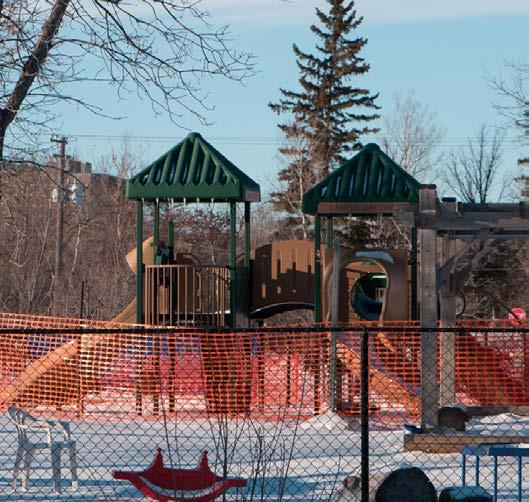
and that early intervention could make a huge difference. It could be because they have undiagnosed additional support needs and that’s a first step toward a diagnosis. It could be to support the family in addictions recovery or mental health supports,” she said.
“These enhanced nursery centres aren’t just Winnipeg, they’re across the province and a lot of them are in communities that are child-care deserts to begin with,” she said. “The loss of something like an enhanced nursery school for these small communities, that’s devastating.”
In July 2020, Childcare is Essential launched a petition which garnered 3,577 signatures calling for increased funding instead of cuts to the childcare sector.
The ‘she-cession’ and austerity
Burla said that based on the fact that accounting firm KPMG was hired by the province to find savings as well as the government’s track record, this is just the beginning of austerity policy being enacted in the child-care sector.
“There is a push toward privatization from our provincial government and I don’t think the majority of Manitobans understand what that will mean for
them specifically, moving forward,” she said. “This isn’t just about nursery schools — this is about our entire sector.”
“Our current provincial government has been attacking publicly funded child care since they got into office,” said Sala, citing the operational funding freeze for nursery schools that has been in place for the last four years.
Sala also stated that the provincial government is currently working on changing legislation to allow for-profit private nursery centres — mostly run out of homes — to access public funds as well as lift the cap on parent fees for newly created nursery spaces.
“This decision and the decision to move toward an increasing role of privatization in child care itself is ignoring the realities of the ‘she-cession’ and the economic challenges that women especially are facing and the exaggerated impacts they are facing as a result of [COVID-19],” he said.
For Corinne Mason, Brandon University associate professor of gender and women’s studies and sociology, who is also a parent, the current trajectory of child care in the province is “offensive.”
“We’ve seen over and over again the ways in which women are getting pushed out of the economy and back
into the home to do child rearing […] or double duty,” she said. “Women are just getting hit on every side during the pandemic.”
Mason explained that when child care is unaffordable or unavailable, it’s often women in heterosexual families that leave their jobs to do child rearing at home.
Referencing the “feminization of labour,” she also argued that most of the lowest paid, most precarious jobs are often taken by women and are in sectors where women are expected to “naturally” perform well — for example, teaching, child care, housekeeping, nursing and food service.
Combined with the gender wage gap, it paints a picture of an economy in which women are hit disproportionately hard by crises such as the COVID-19 pandemic.
In December, the U.S. economy saw a net loss of 140,000 jobs — women accounting for 100 per cent of the losses.
“Many people might find it ironic, even amusing, that a news organization that, as with any other major news outlet, is alerted to significant stories by sources who are granted anonymity, would be surprised and indignant that one of its own employees used the same technique to give a story about the CBC to another news outlet,” wrote arbitrator Lorne Slotnick in the decision of a CBC controversy earlier this month.
“I am one of those people,” Slotnick continued in the Jan. 12 decision.
I, too, am one of those people. As the Manitoban is in the process of developing our own journalistic standards to provide a framework to guide decision-making, it is important to compare how the more controversial applications of other newsrooms’ standards are applied to better understand our own.
Following Don Cherry’s infamous “you people” rant on Hockey Night in Canada in November 2019, Ahmar Khan — then in a temporary reporter position with the CBC — tweeted an opinionated response which CBC management asked Khan to take down. But it was not that alleged violation of the CBC’s social media policy for posting a passionate opinion on Twitter that resulted in his termination. Khan ultimately did remove the tweet, but not before unsuccessfully arguing how the selective application of CBC’s standards and policies were silencing the corporation’s journalists of colour.
Khan’s troubles escalated after this exchange. Khan’s tweet was later quoted in a Toronto Sun article, which noted Khan’s affiliation with the CBC. This ultimately sparked a pyre of hate mail through which Khan reported feeling unsupported by management. According to Slotnick’s report, following this incident Khan reached out to Canadaland and Maclean’s to start a “discussion […] about race and the CBC,” explicitly noting he would do the interview “as long as it doesn’t implicate [him].”
It was at the end of November 2019 that Khan’s colleague Austin Grabish took a shared laptop off of Khan’s desk and discovered, after searching Khan’s Twitter and WhatsApp accounts that had not been closed, Khan’s communication with the other media outlets. The search also led to screenshots of Khan’s usage of a homophobic slur from a WhatsApp message prior to Khan’s employment with the CBC. Selective cropping resulted in a screenshot to imply that Khan had said their boss “looks real nice.” Further, private messages were dug out that expressed Khan’s frustration with the broadcasting corporation’s policies and management. Despite Grabish sending the edited screenshots to their boss, Melanie
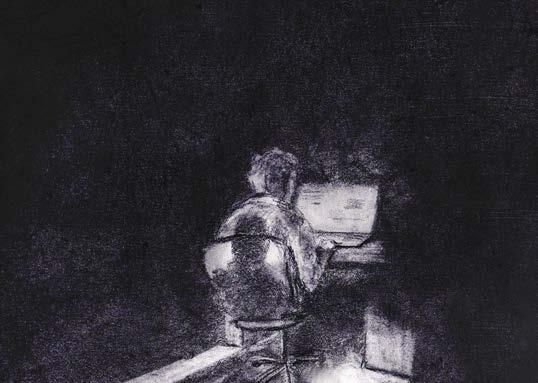
Verhaeghe, she had not seen the accurate, unedited versions of the messages — in context and with dates — prior to Khan’s arbitration hearing.
Khan was terminated from his position in early December 2019 for the use of a homophobic slur, for the remarks made regarding management and for communicating with other news outlets regarding the CBC’s handling of their order for Khan to delete his Don Cherry tweet.
Slotnick’s decision mentioned that in the first matter, “this exchange of nonsensical messages among a group of 10 friends, none of them a CBC employee, predated Mr. Khan’s employment with the CBC and had nothing to do with his job.” Khan claimed that the slur was not used in a hateful manner but rather that he was mocking the very use of the word after his friends and himself came across a gregarious group from Surrey, B.C. and Brampton, Ont. Whether Khan’s alibi is true or not is unknowable — however, the messages still pre-dated his employment. In reference to the second matter, Slotnick concluded that “if employees could lose their jobs for privately criticizing their bosses — even if in crude terms — this country would be facing a severe labour shortage.” And in the third matter, Slotnick expressed that the communication between Grabish and Verhaeghe “suggest[s] a somewhat enthusiastic plan to cause trouble for an employee who was viewed by some fellow employees as a problem” and that “the grounds cited by the employer for Mr. Khan’s termination amounted to, at most, a minor indiscretion, and are far overshadowed by the breach of his privacy that enabled the employer to discover those activities.”
Slotnick ruled that Khan should be
returned to his position for the four months that were left in his contract or compensated for those four months if he declines the position. However, crucial questions and lessons remain unanswered.
Grabish has claimed that he was obliged, under the CBC’s code of conduct, to gather the screenshots and forward them to management. What is clear from the corporation’s journalistic standards and practices is that the “use of production techniques is consistent with factual accuracy and fairness in our reporting.” Is it the letter or the spirit of the policy that is best followed?
Grabish’s manipulation of the evidence he brought to management could very well raise significant concerns about his integrity as a reporter at the CBC. Further, management’s failure to rigorously fact check this evidence before terminating Khan is cause for concern. At best, this story displays insufficient oversight, but at worst it should raise questions about journalistic standards within one of Canada’s most touted newsrooms.
Being able to protect confidential sources is how news organizations are able to hear about, look into and bring issues of public interest to the fore.
As Slotnick wrote, Khan’s “actions have caused no harm to the CBC” and “were motivated by a desire to spur discussion of an important public issue.” That is the very purpose for which confidentiality is enshrined in journalistic standards. Allowing “people with important information to come forward and expose matters of public interest” is of crucial importance. Exposing individuals who have chosen to remain anonymous is a direct contradiction of this very principle. How is trust built? And once built, how is it maintained with
a readership and an audience? How is it eroded?
Of greater embarrassment to the CBC and its reputation should be the delay in revisiting and revising the standards their employees say are silencing them. Christine Genier, then-host of the CBC radio show Yukon Morning in Whitehorse, Yukon resigned in June, saying “We get told that it takes time to move a ship […] but it is costing us bodies.” In June 2020, the CBC’s editor-in-chief, Brodie Fenlon, wrote in a blog post that the CBC will be “looking at the [journalistic standards and practices] through the prism of inclusivity.”
Regardless of whether it is in light of, in response to or merely after Khan’s allegations that the corporation’s policies were selectively applied to silence his opinions, the standards and practices will be revisited. The unfortunate part is that it took so long to do so. As Fenlon wrote in June: “Can our journalists be active citizens of the world without compromising their objectivity?”
There are many questions to mull — these few may be among them. Not present is how to invade the privacy of your colleagues and employees.

Instagram Contest Runs: January 25 - February 5, 2021
• Traditional Frosty Snowman
• Most Creative/Original Snowman
• Funniest Snowman
To enter our contest, send us your photo submission, student #, full name, & contact info incase you win by February 2, 2021 @ 4 PM! umsumarketing1@gmail.com
UMSU
As the temperatures drop and families sit in quarantine, the homeless community needs us more than ever
COMMENT
Grace Gyolai, staff
This year’s winter has been something of a dream for many Winnipeggers, with temperatures remaining surprisingly high considering the morbid report earlier in the year that predicted a gruesome winter. But as the wind chill dipped below -25 C this week, we were quickly reminded of frigid winters past.
For many Manitobans, cold days require some extra layers, plugging in the car or maybe avoiding any extra trips outside, but for those experiencing homelessness, the freezing winter makes daily life dangerous and even life-threatening.
People living without a home or a safe place to sleep face the same extreme conditions each year, but this winter, virtually all of the public spaces they might have popped into to warm up are closed due to COVID-19.
Our community members who have nowhere to go during the winter months of the COVID-19 pandemic are in dire need of the basic human right to safe shelter.
As temperatures decrease, it’s important that all Winnipeggers consider what they can do as individuals that could ease the struggle of our community members living without a home. It’s also crucial we understand and advocate for new measures our government must take to continue the fight for affordable shelter for all.
On a municipal level, an active community organization dedicated to easing the difficulties of homelessness is already taking place. For example, in June 2019, the city of Winnipeg committed to working with several stakeholders across the city, including organizations such as End
Homelessness Winnipeg.
The goal of the group is to address unsheltered homelessness and encampments in the city. One of the first measures implemented was to redirect 311 calls about encampments and unsheltered people to the organization Main Street Project.
In adopting this strategy, the police are only called in emergencies. All other calls pertaining to encampments or people with no shelter are directed to individuals trained to educate individuals about various stigmas surrounding homelessness.
Efforts to connect unsheltered people to their community have also been made. Policies like this are important in developing person-centred supports for homelessness designed to focus on the needs of individuals experiencing homelessness.
Beyond these measures, community organizers have called on the various levels of government to adopt more strategies in their efforts to ameliorate homelessness.
To end homelessness, prevention is an essential step. There are many transitional periods of a person’s life that may make them vulnerable to homelessness. For example, discharge from a hospital or treatment facility, release from prison or ageing out of the foster care system can leave individuals with no place to go but the streets.
There need to be systems in place that identify people who are at high risk of becoming homeless and provide those people access to a full range of housing options.
In order to assign proper living spaces
to people who are in these transition periods or already living without a home, the provincial government needs to increase the supply of affordable housing.
For housing to be considered affordable, the household should spend no more than 30 per cent of their total income on rent. However, individuals receiving employment and income assistance usually spend roughly 87 per cent of their income on rent in Winnipeg.
Due to this crisis, there is an increasingly long waitlist for access to Manitoba Housing. The Progressive Conservative-led Manitoba government, however, have decreased the number of households available while also cutting funds for the Rent Assist program. This has ultimately forced many Manitobans with insufficient incomes into the inflated private housing market, thereby making housing unaffordable. Increasing rates of homelessness in the province is likely a symptom of these negligent policies.
The provincial government needs to focus on making housing affordable in the private sector while also increasing public housing to meet demand.
By doing this, Winnipeg will be able to develop a “housing first model” — giving people somewhere safe to live first and providing treatment once they have the stability of a home — which protects people from ongoing homelessness.
On an individual level, there are many organizations that Manitobans can donate their time or resources to.
Due to ongoing colonial violence, 80 per cent of people experiencing homelessness in Winnipeg identify as First Nations — donating to organizations like Aboriginal Health and Wellness Centre of Winnipeg can help

combat Indigenous homelessness and equitably distribute support for the damage caused by settler colonialism.
From volunteering to financial contributions, there are many ways Manitobans can get involved in fighting homelessness in Winnipeg. It’s vital for the health of individual members and the community at large that we continue to address homelessness.
As we continue to bear the cold and windy winter, remember that not everyone has a safe, warm and dry place to reside and escape to. We all have a responsibility as members of a community to consider the living conditions of our neighbours and support them in their struggles no matter the context.
comment@themanitoban.com
In October, the provincial government adopted the Labour Relations Amendment Act (LRA), which made it easier for employers to fire striking workers and has done away with a clause that forced thirdparty arbitration in the event that strikers and employers do not mutually agree on fair terms themselves. This has effectively promoted unfaithful bargaining and has made labour negotiations in Manitoba a messy affair. Although all unions in Manitoba are feeling the pressure brought on by these amendments, one union stands unequivocally threatened — the Manitoba Teachers’ Society (MTS).
Although many of the amended clauses in the LRA will not directly affect labour relations in education — as teachers’ bargaining rights are protected under the Public Schools Act (PSA) — one clause should worry the MTS; an amendment to clause (a) of subsection 56(1) of the LRA grants the Manitoba Labour Board power to replace members of the MTS’s bargaining unit.
This ultimately gives the provincial government legal sway, potentially granting them the power to influence the outcome of collective bargaining should they desire. The provincial government should not have, by any means, influence on the unit that they are disputing with. These
amendments represent a fundamental attack on the MTS’s right to self-represent themselves in the bargaining process.
Beyond the LRA, the province also made damaging amendments to the PSA. A notable amendment to the PSA is the province’s adoption of centralized provincial negotiations. This means that the old model of separate bargaining units per school division will be scrapped for a totalizing contract that applies to every teacher in Manitoba. Under regular circumstances, provincial negotiations would hand over a great deal of political leverage to the MTS. However, because the union forfeited their right to strike in 1956, and due to the LRA’s recent clause detailing the right to overturn entire bargaining units, the adoption of a single-tier
negotiating system underlines an increasingly precarious environment for educators and their associated union. A great deal of control is available to the province should it require. And another new clause suggests that the province likely will.
Bargaining agreements must now take into consideration the economic context of the province before demanding improved contracts. This open-ended-clause provides the province with the option of perpetual exceptionalism when it comes to managing labour disputes. In other words, if the Progressive Conservativeled Manitoba government doesn’t want to pay their labourers’ inflated wages, just cry “bad economy.”
Cont’d p. 11 / Manitoba >
‘Asking others if they need help can be one of the most meaningful acts of compassion’
I remain incredibly proud of the resilience of our students.
Thank you for diligently continuing with your studies as we work to support the best possible student experience in a remote setting. You should all be tremendously proud of yourselves and your continued accomplishments.
For almost a year, you have been learning remotely because your health, safety and well-being guide all our policy decisions. That is why the University of Manitoba has decided that the summer term of 2021 will also be delivered, primarily, remotely. This is the right decision for our community right now, but that doesn’t mean it’s an easy one.
As we approach Bell Let’s Talk Day on Jan. 28, I am thinking of all of you and of how dramatically your university experience has changed. From my own university experiences, and as a father of two recent university graduates, I empathize with the vulnerability and struggle that often accompanies academic life. And
when COVID-19 entered the equation, all our usual stresses were amplified.
If you see someone in distress, or if you feel — even to the slightest degree — that you want to speak to someone, reach out today. Please. Asking for help is one of the strongest things we can do, and asking others if they need help can be one of the most meaningful acts of compassion. Our Student Counselling Centre is there to help, and U of M’s Success Through Wellness program offers an array of resources that continue to expand. This year, for instance, the Student Counselling Centre hired three new counsellors and one intake and triage specialist.
In April of 2020, one of our faculty members, Roberta Woodgate, a Canada Research Chair in Child and Family Engagement in Health Research and Healthcare, said something in a UM Today story that stuck with me. She said, “Many people assume anxiety is not a real thing […] But it is very real, and it’s not something you ‘just get over with.’”

During this time, such anxiety may stem from a difficult financial situation. To help, the U of M will offer an additional intake for student bursaries this winter term. Thanks to this support and the generosity of U of M alumni and donors, an additional $4 million in bursary support will be made available to provide immediate financial assistance to over 5,000 U of M students. Please apply if it will help you.
I’m proud of how we are adapting as a community. I’m proud of how resilient U of M students have proven themselves to be. I hope you are proud of yourselves.
Let us be mindful of each other and
encourage each other to seek out ways to maintain positive mental health no matter where you are currently studying.
Let’s stay connected. Let’s talk.
Join the conversation:
#BellLetsTalk
#umanitoba
#umstudent
Michael Benarroch, U of M president and vice-chancellor
letters@themanitoban.com
> Cont’d from p. 10
This may be the beginning of a more fractured attempt at repressing union agency after the province’s Public Service Sustainability Act (PSSA) — an act that froze the wages of over 120,000 public sector workers — flopped in June due to its unconstitutional restriction of workers’ right to associate with a union and hence fulfill its main political goal: to bargain for workers’ wages, rights and safety.
The Progressive Conservatives appear to be desperate after the PSSA was deemed unconstitutional. The government noted its anxiety that province-wide strikes may occur during the perilous crisis of COVID-19. Considering
this, it doesn’t seem out of line to correlate this anxiety, the striking down of the PSSA and the government’s most recent efforts to strip the agency from one of Manitoba’s largest unions to a new fractured attack on the ability of unions to bargain in the first place.
Earlier this summer, Liberal Party of Manitoba leader Dougald Lamont suggested Manitoba schools might expect to see some privatization of our valued public education system. During a webinar with prominent U.S. charter school advocates, Betsy DeVos and Ted Cruz, then-education minister Kelvin Goertzen enthusiastically
supported market “choice” in the discussion — rhetoric often used to mask politicians’ desire to privatize public assets.
This development from the summer taken in the context of the recent amendments to the LRA and PSA, while fully immersed in speculation, are still worrisome developments that the MTS must be cognizant of.
Just how far is the government willing to go to balance Manitoba’s budget? Could the MTS be the first line of attack for the provin -
cial government in a longer effort to dismantle Manitoba’s public education system?
Only time will tell, but the MTS is in a particularly vulnerable position after forfeiting their right to strike, and in cynical terms, their only tactical avenue of leverage in labour disputes.
Zoë LeBrun, staff
Psycho Goreman is everything you would expect it to be based on its title — shocking, gory, horrific — and yet it’s so much more than your run-of-themill horror flick, delivering elements of sci-fi, comedy and family drama.
Written and directed by Steven Kostanski, Psycho Goreman is not defined by the horror genre’s overused tropes and shallow character archetypes, as its lack of one distinct genre allows for more expansive world-building and character development. However, this fact alone is not what makes Psycho Goreman great — the level of intelligence and apt sense of timing with which Kostanski navigated the lines between these vastly different genres makes Psycho Goreman feel so self-aware.
Psycho Goreman follows siblings Luke, played by Owen Myre, and Mimi, played by Nita-Josee Hanna,
who accidentally resurrect an evil force from outer space in their backyard. Despite this creature’s desire to destroy the world as we know it, Mimi and Luke gain control of him, leaving this powerful entity at their mercy. When the news of this awakening reaches the rest of the galaxy, events unfold that leave the fate of the universe in the balance.
Despite the violence and gore peppered throughout Psycho Goreman, there’s ultimately a strange charm about the movie, which has much to do with its setting — a fictional Manitoban town called Spengler Springs.
Due to this unique setting, Psycho Goreman gives off a sense of realism not seen in many films — it contained the landscapes and experiences of what many Canadian kids know well. From seeing Psycho Goreman’s young characters playing in the mud to the forest scenes that look like they were shot at Birds Hill Provincial Park, it was refreshing to see a film embrace
With song titles like “Maid Marian’s Toast” and “Only Here For A Haircut,” Toronto band Kiwi Jr.’s Cooler Returns taps into a particular strain of nostalgia for the slightly punky, vaguely twee and wildly sincere indie rock that dominated the mid-2000s blogosphere. Jeremy Gaudet’s animated vocals lack any of the sombre detachment that has dominated the last decade, and the band’s sound — a glitter ball of ’60s beach pop and itchy, ramshackle altrock — feels beamed in from a BIRP playlist circa 2009.
That’s not to say it sounds like pastiche. Kiwi Jr.’s performance feels genuine and impassioned, a natural progression of a recognizable sound rather than a soulless textural or aesthetic homage. If anything, it ignites a rose-tinted longing for the awestruck and adventurous indie scene of yore. “Tyler” opens the record with chiming guitars and birdcalls of feedback, jaunty piano and a descending choir flitting between surging chords. Kiwi Jr.’s sound is broad and smeared, but these 13 tracks are often more complex than they appear at first blush.
A clear disciple of Stephen Malkmus, Gaudet’s lyrics combine jittery impressionism with daily detritus — landlords and rent, jobs and student debt, Super Bowl Sunday and undecided voters — capturing a feverish vision of life in the newly minted 2020s that carries some pointed social commentary. His writing is rich with specifics, too — Toronto may not have much legitimate cool cred left, but that doesn’t stop Kiwi Jr. from
the Canadian landscape, setting it apart from many other movies that choose to set their narratives in generic American towns.
Another highlight of Psycho Goreman is its soundtrack, which makes one recall films of the late ’80s and ’90s that Kostanski was inspired by while writing Psycho Goreman, increasing the immersive effect. Its rock and roll tracks, in particular, honed the story’s powerful and chaotic energy to a fine point, adding dimension to the film in a way that made it feel as if the score and visuals could never have been separate entities in the first place.
Above all, though, what makes Psycho Goreman such a stand-out movie is that at no point could I predict what would happen next. Once again, this is where that careful thought put into Psycho Goreman from start to finish is most clear and where Kostanski’s dedication to filmmaking is most evident.
Just when I thought I had Psycho Goreman figured out, something would come out of left field to
colouring the record with a refreshing regionality, from gentrification and skyrocketing rent to crying at the Dufferin Mall.
Cooler Returns is a record in constant motion, with no ballads or interludes to trip up the momentum. While the tempo may not vary much, the band has enough hooks and good ideas — like the twinkling keys that dance behind “Only Here for a Haircut” or the way Brian Murphy’s guitar plays against the chorus melody of “Norma Jean’s Jacket” — to stave off the feeling that you’re hearing the same song 13 times. It’s less dense and more cleanly produced than last year’s Football Money, a more clarified vision of the band with a tad more sparkle and a tad more space. Kiwi Jr. may sound familiar but, in Gaudet, they have a frontman with a genuine point of view and more than a few things to say — and in the increasingly faceless world of modern alternative music, that’s no small thing.

completely upend my expectations of what was yet to come — characters found ways to surprise me, its action scenes were glorious spectacles to break up the simplicity of small-town suburbia and punchlines landed at just the right moments in order to remain fun and light-hearted without overshadowing the film’s more serious aspects.
You can catch Psycho Goreman via iTunes, Video on Demand or rent it through Winnipeg’s own Cinematheque.
arts@themanitoban.com
For each new musical form, there will be those who embody it and those who pick up whatever scraps are left. Every supernova lets a thousand little stars shine through in its wake, but a new musical movement has appeared in recent years — a sound that seems home only to little stars, shining through a nebula that never really existed. It is the kind of music that dissipates on impact, the sound of lowercase tracklists, of e-boy TikToks and endless Spotify playlists. It’s a bit of Mac Demarco jangle, a bit of Tame Impala synthpop, some ’90s Pacific North West twee and a heaping helping of lo-fi hip-hop beats to study to. It’s the youth music of the internet: a dizzying mix of conflicting influences that usually manages to choke out most of the colour and excitement.
However, there are the select few who manage to mould this diaphanous, faceless sound into something deeper. Clairo was the first to catch real traction — following a rough start, her debut album Immunity hinted at something fierce broiling beneath all the faded colours. Now, 20-year-old Londoner Arlo Parks arrives — aided by Clairo herself on the shimmering “Green Eyes” — with Collapsed in Sunbeams, a beautifully crafted debut that reveals a trove of potential.
Parks’s music leans toward the funky, soulful end of the spectrum, influenced by the Internet and Sade and more concerned with trip-hop rhythms and organic warmth. The dry horns that blow across “Hurt” are sophisticated and tasteful in

a way that feels considered rather than dull, pillowing Parks’s cool, conversational delivery. “Black Dog” is another immediate highlight, along with “Caroline,” which is perhaps the burliest arrangement on a light-as-air record.
Parks’s lyrics are lush and specific and hint at world-weariness and a cerebral sort of romanticism. Fruits often appear, symbols of sexuality and youth, but Parks rarely lets the poetics overstay their welcome — reality usually comes peeking through to disrupt the hazy afternoons. Sometimes, though, Parks’s age reveals itself — despite its Radiohead-esque guitar, tight drums and lovely chorus, “Eugene” is failed by its endlessly recycled references to cigarettes, purple lips and Sylvia Plath. Still, Parks’s debut is more or less a winner, and it marks the arrival of an artist able to translate emptiness into something more.
Arlo Parks’s debut album, Collapsed in Sunbeams, will be available Jan. 29.
Zoë LeBrun, staff
Steven Kostanski has been interested in movies his whole life, so it should come as no surprise that the film industry is where he has built his career. Most recently, Kostanski’s love for film has culminated in the release of Psycho Goreman, which he wrote and directed.
Psycho Goreman follows siblings Luke and Mimi as they gain control of an ancient alien warlord, straddling the lines between horror, sci-fi and comedy without being confined by any of the genres’ tropes. Kostanski avoids sticking to one genre and traditional clichés in order to create more engaging narratives.
“I like taking the audience on that roller coaster of not being able to predict what the arc of the movie is going to be,” he said.
Kostanski’s ventures into moviemaking first began with creating his own stop-motion animated films in his youth.
“As a kid, I was always into movies, monsters and makeup effects,” he said, “so, obviously, I wanted to make my own creatures […] That gave me a taste for filmmaking and also creating creatures and special effects and things at a very rudimentary level.”
Following high school, Kostanski apprenticed with makeup effect legend Doug Morrow in Winnipeg and, eventually, made his way to Toronto, Ont. where he alternates between directing and doing makeup effects for various programs.
Kostanski’s dedication to these various realms of the film industry is evident in Psycho Goreman, as he made its stop-motion animation sequences and some of the creature effects on top of his roles as writer and director. However, the film also speaks to what Kostanski believes are collective childhood experiences.

“The movie itself is kind of inspired by my experiences as a kid, like watching movies that maybe I shouldn’t have been watching that were a little more adult,” he said.
“As a kid, you have trouble reconciling those things because it’s like, ‘Well this part is fun, and this part is scaring the shit out of me’ […], so I wanted to somehow capture that vibe and that energy that those experiences had for me by making a movie that’s like a kids’ movie that’s very adult at the same time […] that delivers the fun, fantasy stuff that feels great to watch but then also the brutal realism of the violence and the situations that […] counterbalance the fun.”
While filming Psycho Goreman, Kostanski explained that one of the biggest challenges they faced was the rainy weather, as it made shooting difficult for everyone involved and didn’t line up with his original vision for the film.
“I wanted it to be kind of an E.T. scenario where it’d be nice and sunny,

and we’d have nice sunsets and things, just a very [...] traditional small-town vibe, but it rained […] almost every day except for one,” he said.
“It was a thing that stressed me out at first, and it was certainly a logistical problem while shooting,” he added. However, this turn of events ended up working out in their favour.
“I really like the look of [the film] in this kind of drizzly, rainy world, because you never see that in movies. […] It’s a vibe that’s not what we were hoping to get, but it ended up being the right choice.”
Kostanski emphasized this further, saying, “It’s not the idyllic suburbia — this is like [a] rainy, dreary […] backyard with just two kids running around using their imaginations, which feels way more real and way more relatable.”
Although Psycho Goreman’s creation was mostly unaffected by the onset of the COVID-19 pandemic, its release
is another story. The film’s world premiere, which was scheduled for March 2020, was unable to occur and now, its full release into theatres is completely online while restrictions are in place.
“For me, it’s the most satisfying sitting in a theatre, watching the finished movie with an audience because you’re seeing all the pieces line up and you’re seeing it in the ideal scenario,” he said. “That’s been one of the many downsides to this pandemic is not being able to really have that experience.”
Psycho Goreman is currently available to stream on Video on Demand, iTunes and through Winnipeg’s own Cinematheque.
arts@themanitoban.com



Manitoba’s restriction on the sale of “non-essential” items was lifted January 23, with shoppers across the province lining up for purchases they’ve been unable to make since November.
SPORTS Isaiah Wagner, staff
The Bisons women’s soccer team finished the 2019 season with a 9-6-1 record. In 2017, the team finished 5-10-3 and in 2018 finished 6-5-4. After an improvement every year, the Bisons will be looking to make that record even better during the 2021 season.
With no sports for the rest of the 2021 winter semester due to the COVID-19 pandemic, Bisons sports teams have to start to focus on the next season, whenever that shall be.
The Bisons started by recruiting eight players for the fall 2021 season. Some of those players include Tessa Albi, Iris Bjornson and Tabata Bravo.
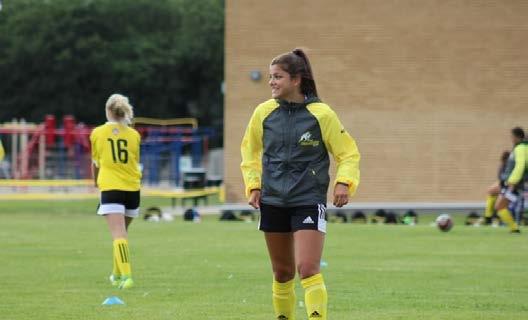
Out of those players, arguably the most notable is forward and winger Camila Goldsztein.
Goldsztein previously played for the Force of the St. Charles Soccer Association and attended Grant Park High School.
As a Winnipegger, you always want to represent your hometown university in whichever sport it may be and that is exactly what Goldsztein did.
“I was always interested in attending the University of Manitoba and being a part of the Bisons,” Goldsztein said. “I then reached out to [head coach Vanessa Martinez Lagunas] and she invited me to an ID camp where she was able to watch me play.”
“Not long after [Martinez Lagunas] reached out to me, we had a meeting with herself and [assistant coach Miguel Velazquez Cantu] and they offered me a spot on the team.”
Every player has a tough time deciding where they want to pursue their talent at the university level. In Goldsztein’s case, she was set on the U of M.
“I chose the Bisons because I love the mentality that all the girls have and coaches on the team have,” Goldsztein said. “They are always wanting to improve and achieve more as a team.”
Goldsztein said Martinez Lagunas is “one of the best qualified coaches and I think she can help me achieve my goals and get me to where I want to be.”
Bisons soccer fans are in for a treat when they get to see Goldsztein suit up for the squad. The player loves to create offence and score goals.

“I think my biggest strength as a player is my ability to use my speed in order to attack fast, as well as my willingness to attack defenders and [my] eye for goal,” Goldsztein said.
Goldsztein’s scoring could be a huge positive for the Bisons, as the team lost 1-0 in last year’s quarter-final game to the Calgary Dinos.
COVID-19 has impacted the world and everyone in it differently. Goldsztein said that although the pandemic has “definitely impacted my training,” she has taken the lockdown and used it as a positive.
“If it wasn’t for [COVID-19], I’d be on the field six days a week and in the gym five days a week,” she said.
“However, it did not stop me from working hard at home. I am still working out every day to stay in shape as well as doing some ball work, so when we get going, I’ll be ready.”
Bison fans should be excited for what Goldsztein could bring to the field next year and in return, she feels the same.
“I’m super excited and grateful for this opportunity,” Goldsztein said. “I’m going to do everything possible to help achieve success on the team.”
sports@themanitoban.com

SPORTS Matthew Merkel, staff
When the New Orleans Saints were knocked out of the 2020 NFL playoffs by the Tampa Bay Buccaneers, it marked a possible end of an era for Louisiana football.
As 42-year-old Saints quarterback Drew Brees answered questions from reporters, it became apparent that game may have been among the last downs of football Brees would ever play.
With roughly 15 of his 20 years in the NFL played for the Saints, Brees’s impact on New Orleans, La. extends beyond football. Not only did he help lead the Saints to a Super Bowl, but he was also an important figure in the city of New Orleans. Brees and his family helped set up multiple charitable foundations to improve post-hurricane-Katrina Louisiana.
The potential loss of Brees signals the beginning of an era in Saints football, where rebuilding and developing for future success may become priority over winning games in the present.
However, the Saints still maintain strong talent on both sides of the ball. One example of this is defensive tackle David Onyemata.
Since being selected by the Saints in round four in 2016, Onyemata has worked his way to becoming one of the most important members of the Saints’ defensive line.
After a quiet rookie season, Onyemata made his mark in 2017 racking up 38 total tackles and two sacks while playing in 16 games.
By 2019, he had become a stalwart up front for the Saints, starting in all 15 games he played.

After the season, his performance on the field was rewarded by the Saints when he signed a three-year, US$27 million contract with the team.
This season, the former member of the U of M Bisons football team had a career year, putting up 42 total tackles, six-and-a-half sacks and one interception.
While Onyemata’s numbers with the Saints are extremely impressive, it is his time playing for the herd that helped launch his career.
Onyemata came to the University of Manitoba not for athletic success, but rather academic. He had never played in a football game.
However, after a fellow international student had decided to try out for the Bisons football team, Onyemata decided to give the game of football a
After meeting with Bisons head coach Brian Dobie, Onyemata tried out for the team. He made the team and spent the season learning the game of football and developing the skills necessary to succeed at the university level.
After a quiet first year playing for the Bisons, Onyemata was shot out of a cannon in his sophomore season. Starting all 11 games, Onyemata racked up 53 tackles.
Over the next two years, not only would Onyemata solidify himself as a force for the Bisons, but as one of the top football players in all of Canada.
After his time at the U of M, Onyemata was regarded as the top prospect for the CFL draft and a likely NFL draft pick.
While he garnered interest from many NFL teams in his draft year, it wasn’t until the East-West Shrine Game that the New Orleans Saints knew Onyemata would fit in well with their program.
The rest is history for Onyemata and the New Orleans Saints. Now, the Saints will look toward veterans like Onyemata to help lead the team through the next few years.
Whether Drew Brees returns as quarterback or the Saints enter a rebuild, New Orleans knows that Onyemata will remain a force on the defensive line.
sports@themanitoban.com