THE M A N I T O B A N


U of M assistant professor part of project researching ‘bro culture’
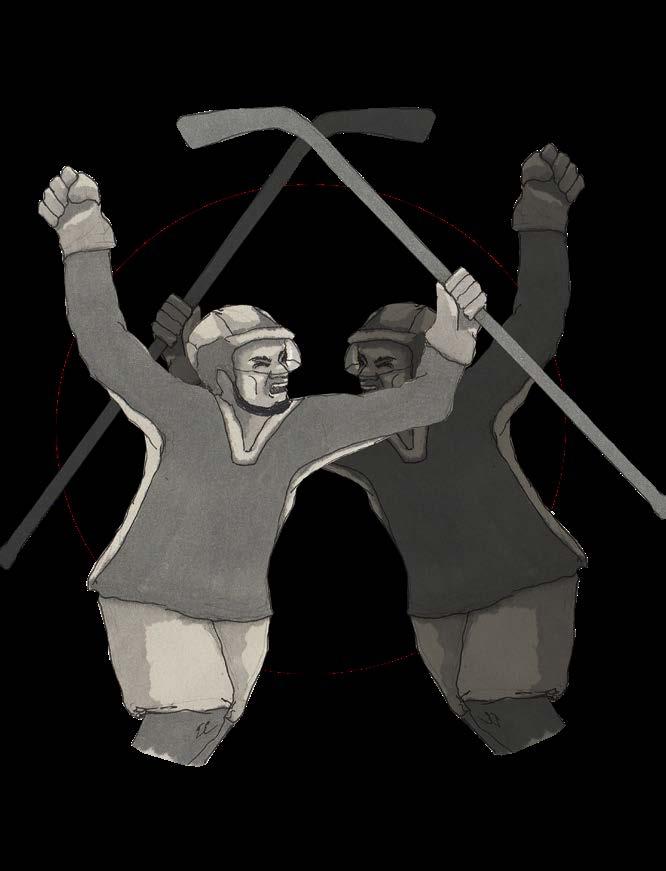
Three education professors from multiple universities have joined to study hypermasculine culture within elite men’s hockey and what current and former players do to combat it. Assistant professor Tim Skuce of Brandon University leads the project, joined by Concordia University of Edmonton assistant professor Teresa Fowler and U of M assistant professor Shannon Moore. The project is supported by the Brandon University Research Committee.
Skuce’s motivation for this research was his discomfort at the behaviour of other players he witnessed during his own time as a player. He explained that their project is aimed at the “forms of resistance to these hypermasculine traits” that are associated with the sport. — Cont’d p. 14 / ‘The way’

All contents are ©2021 and may not be reprinted without the express written permission of the Editor-in-Chief. Front page graphic :
is an independent and democratic student organization, open to participation from all students. It exists to serve its readers as students and citizens. The Manitoban is a member of the Canadian University Press, and our journalistic standards can be found online at toban.news/jsp
The newspaper’s primary mandate is to report fairly and objectively on issues and events of importance and interest to the students of the University of Manitoba, to provide an open forum for the free expression and exchange of opinions and ideas and to stimulate meaningful debate on issues that affect or would otherwise be of interest to the student body and/or society in general. The Manitoban serves as a training ground for students interested in any aspect of journalism.
Students and other interested parties are invited to contribute to any section of the newspaper. Please contact the appropriate editor for submission guidelines. The Manitoban reserves the right to edit all submissions and will not publish any material deemed by its editorial board to be discriminatory, racist, sexist, homophobic or trans-phobic, ableist or libellous. Opinions expressed in letters and articles are solely those of the authors. Editorials in the Manitoban are signed and represent the opinions of the writer(s), not necessarily those of the Manitoban staff, Editorial Board or the publisher.
A “volunteer staff” member is defined as a person who has had three volunteer articles, photographs or pieces of art of reasonable length and/or substance published in the current publishing year of the Manitoban. Any individual who qualifies must be voted in by a majority vote at a Manitoban editorial board meeting. Elected representatives and non-students may be excluded from holding votes as volunteer staff members in accordance with the Manitoban Constitution.
UMGSA meeting / Skype / 5:30pm
A conversation with N. Korean Refugees / 7:00pm / eventbrite.ca/e/mhrsapresents-a-conversation-with-north-korean-refugees-tickets-135634363031
The McGill Tribune Journalism and Media Conference/ 3-7pm EST facebook.com/events/840550056796516/ Continues on Jan. 28
UMSU meeting / Skype / 6:30pm
EDITOR-IN-CHIEF / Matthew Doering editor@themanitoban.com
COPY DESK / copy@themanitoban.com
Ursula Chojko-Bolec (ed.)
Aldin Sabic
NEWS DESK / news@themanitoban.com
Gillian Brown (ed.)
Cameron Cannon (ed.)
Damien Davis
RESEARCH & TECH DESK / research@themanitoban.com
Sarah Doran (ed.)
Kunal Rajpal
COMMENT DESK / comment@themanitoban.com
Lucas Edmond (ed.)
Grace Gyolai
ARTS & CULTURE DESK / arts@themanitoban.com
Shaylyn Maharaj-Poliah (ed.)
Kaelen Bell
Zoë LeBrun
SPORTS DESK / sports@themanitoban.com
Isaiah Wagner (ed.)
Matthew Merkel
PHOTO DESK / photo@themanitoban.com
Alex Decebal-Cuza (ed.)
Basel Abdelaziz
DESIGN DESK / design@themanitoban.com
Joshua Wesey (ed.)
Mikaela Warkentin
GRAPHICS DESK / graphics@themanitoban.com
Jenelle McCann (ed.)
Dallin Chicoine
AUDIO DESK / audio@themanitoban.com
Tino Hove (ed.)
Tawana Matizanadzo
VIDEO DESK / video@themanitoban.com
Jesse Boily (ed.)
Arsalan Saeed
SOCIAL MEDIA DESK / social@themanitoban.com
Colin Ijebor (ed.)
Jalene Moman
Students raised concerns over the uncertainty of the U of M Graduate Students’ Association’s (UMGSA) December 2020 annual general meeting (AGM) after discovering that despite being listed as a member of the Canadian Federation of Students on the federation’s website, the UMGSA has had a fraught relationship with the federation for the last 20 years.
Graduate students in attendance at the AGM were confused as to where the money the UMGSA was collecting as “federation fees” was going.
It was revealed at the AGM that hundreds of thousands of dollars in membership fees are being held in the association’s external relations fund for potential future legal issues and disputes with the federation until the federation concedes that UMGSA is not a member or the matter is settled in court.
The UMGSA has collected but not paid membership dues for at least the last six years.
It has been noted that the federation is notoriously difficult to leave, and in the past, student union members
have had many difficulties when attempting to, which has often led to lawsuits over unpaid membership fees.
The UMGSA maintains that it is not affiliated with or a member of the federation despite this and has done so since an investigation into the validity of its membership in 2012.
In 2012, UMGSA research assistant Liz Gonsalves discovered documents in the association’s archives housed at the federation’s Manitoba branch offices which sparked a discussion on whether the UMGSA was a member of the federation at all due to the signature of the then-treasurer Vinod Varadharajan on the membership contract in 2001, instead of that of the association’s president.
Gonsalves revealed her findings on Feb. 2, 2012, to the UMGSA at the AGM, following which they passed a motion to hold the membership fees they would otherwise have paid to the federation’s national and provincial bodies.
That October, a special general meeting was held where the
then-executive of the UMGSA claimed the federation was neither communicating nor providing information on the status of their membership.
At that meeting, members received Gonsalves’s report, which was sent out weeks prior to make sure members knew what was going on before voting.
The then-president of the UMGSA, Rotimi Ojo, was quoted at the time in the Manitoban, saying “we are not members, and that’s how we’re going to stay,” in regard to the result of the vote.
Now, the dispute between the UMGSA and the Canadian Federation of Students is ongoing despite over six years of alleged inactivity, according to lawyer Gordon Howorth.
Howorth said the federation has refused to share background information and legal documents, which, in addition to UMGSA’s little knowledge on the issue, has resulted in a lack of awareness among students, evidenced by the confusion raised at the previous AGM from students who had no knowledge of it.
The upcoming UMSU elections slated for early March will run according to the same rules as last year, as the changes which would see the abolition of the slate system approved by the UMSU board of directors back in early October have yet to be implemented. As such, in the upcoming elections, candidates will be able to run for executive positions either as individuals or as slates rather than be restricted to running individually.
UMSU president Jelynn Dela Cruz explained to the UMSU board of directors at its Jan. 14 meeting that “due to a deadline being missed, the upcoming UMSU elections […] will be unfortunately operating along the slate system.”
“Although that doesn’t take off the table the fact that [the motion abolishing the slate system] will be present in the omnibus […] at the end of this term, and those changes will be implemented and set in stone,” she continued.
According to UMSU vice-president finance and operations Brendan Scott, the UMSU governance committee over which he presides — that was tasked by the UMSU board of directors with implementing approved changes
this year that include the abolition of the slate system and significant reforms to the structure of UMSU — is running two weeks behind schedule.
Scott explained that the delays are the result of timelines being tighter than expected. Before policy changes can be made at UMSU, they must first be approved by the board of directors, which in some cases then tasks the governance committee with implementation. After the governance committee has completed its work — which includes drafting the wording to go into the UMSU bylaws — the proposed bylaws are sent off to lawyers for approval then taken back to the governance committee that then presents the bylaws to the board of directors for final approval.
“We’re two weeks late on what we planned to do […] in the end, the major impact it will have is just two weeks less of being able to tell people that there’s a board election,” said Scott.
“We still will be able to implement the board changes in time for a board election, but we are two weeks late on our timeline,” he added.
According to the new changes, the UMSU board of directors is to be elected in a separate election taking place one week after the elections of

UMSU representatives and executives.
Formerly, the UMSU board of directors was made up of UMSU representatives and executives. Once the changes have been implemented, the board will be made up of 11 members to be elected in the board election.
“The [UMSU board of directors] was under the impression that this year would have been a trial year […] that many would have had access to through the internet,” said Dela Cruz.
Nearly a year has passed since U of M classes first went remote, and in-person classes still seem as far away as ever. On Jan. 13, university president Michael Benarroch announced that courses this summer will be taught primarily remotely.
Chair of the COVID-19 recovery steering committee Todd Mondor cites provincial vaccination uncertainty as the reason for the holdback on resumption of on-campus learning.
Even in the case that Manitoba restrictions loosen, “a lot will depend on how the vaccination program rolls out, and it’s very hard to predict at this point,” said Mondor.
“University students are not likely to be prioritized for the vaccination, and so it seems quite uncertain whether or not our students will be vaccinated by the time next fall rolls around.”
As with past semesters, a small number of classes will be taught in person and requests for permission for in-person instruction will be submitted to the steering committee.
To be granted permission, the course must not be able to conduct in any other way and it must be a program requirement or “one of a small set of electives,” said Mondor.
A course will also fit the criteria if not offering it would have “a significant negative effect on students being able to progress through their program.”
This January, 10 days were designated to conduct the necessary on-campus labs for the fall semester, resulting in an especially late beginning for this winter’s classes.
Registration for summer courses opens on April 5, and registration access times will be made available in Aurora on March 29.
Going into this semester, the Fort Garry bookstore is currently open for limited in-person shopping and pick-up options. Services offered by the student counselling centre are being offered remotely, and the University Centre pharmacy, postal outlet and optician have reopened as of Jan. 5 and are operating at limited capacity.
Changes to the faculty of science progression requirements were approved for implementation fall semester 2021 by the U of M senate at its Jan. 6 meeting.
According to a report presented by the senate committee on instruction and evaluation to the senate, the changes include the introduction of academic probation status for the faculty as well as a shift to a GPA-based model rather than an “F” count model.
Under the new rules, a minimum degree GPA of 2.0 will be set — the equivalent of a “C” grade average in terms of letter grades.
Students with 12 to 23 credit hours who do not meet the 2.0 GPA requirement will receive an academic warning. Those with more than 24 credit hours completed will be placed on probation.
After being placed on probation, students must achieve a minimum of a 2.0 term GPA for every term until they achieve a 2.0-degree GPA. If students do not achieve the minimum GPA, they will be placed on academic suspension for one year. Students placed on academic suspension a second time will be suspended for five years.
During the senate meeting, UMSU vice-president advocacy Kristin Smith raised concerns along with others that the practice of giving fiveyear suspensions may be too harsh.
According to faculty of science undergraduate program co-ordinator Christine Adams, the decision to set second suspensions at five years was “carefully considered.”
“Basically, what it came down to was it needed to be […] a significant period of time […] given that this was the second time [an academic suspension] happened […] give them time to reflect, build personal resources […] sort of giving them that time to consider and carry out what they might need to do to come back and be successful,” she said.
After students return from suspension, they will have the option to “pick up where they left off, or they can start afresh,” said Adams.
Currently, the faculty of science’s regulations around academic suspension is to put students on a one-year academic suspension if they accumulate a total of 36 credit hours of “F” grades.
“What we were finding was students had completed a number of courses, successfully or not, before they were being officially suspended. Because we did not have any formal assessment strategies that took place before that informally […] but were finding it was so late by the time they were connecting with advising that sometimes […] it was just too late,” said Adams.
Adams explained that the new GPA-based model allows for early intervention and is expected to enable students to better navigate times of academic difficulty.
After 12 credit hours have been completed, students will be assessed according to their GPAs and receive one of four designations: suspension, probation, warning or having met the assessment minimum.
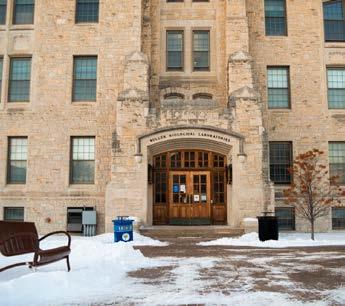
“Right now, we don’t have a probation category […] what happens is a student is either in good standing or suspended,” said Adams. “A student could have accumulated 33 credit hours, and they look at their transcript, and there’s no indication to them […] there’s nothing formalized which indicates [to a student that they may need academic help].”
“Going forward […] the idea would be to officially do an assessment of students, so they are not only intuitively knowing that they are in difficulty but actually having that other piece of information available to them,” Adams continued.
Members of the Science Students’ Association were unavailable to comment.
FROM P. 1
Canadian Federation of Students Manitoba (CFS-MB) president Brenden Gali said he is aware that sometimes student associations and unions contest their membership in the federation and withhold membership fees which, in the past, has resulted in legal action.
Gali also stated that the federation has records of the referendum in which the UMGSA voted to certify as a member.
“For us, that’s definitely not [the direction] that we want to go in,” he said. “Ultimately, […] when student organizations and national organizations feud, nobody wins.”
“If it comes down to maintaining that relationship [with the UMGSA], we will just listen to what the overall students want,” he added, explaining that this
also applies to any outstanding fees the UMGSA may owe the federation.
In 2012, the UMGSA voted to declare itself as neither a member of the federation or in affiliation with it.
Since 2008, a number of student associations and unions have been caught up in lawsuits following attempts to leave the federation or contest their membership status. Affected student unions include the Cape Breton University Students’ Union — which in 2015 was made to pay $400,000 to the federation after losing the lawsuit.
Howorth said, in his opinion, “it’s very unlikely that [the federation] will even take a run at [the UMGSA] in facing the murky background,” along with the fact that the dispute is nearing its statute of limitations.
A motion was passed to further investigate the external relations fund, aiming to create an action plan to be presented at next year’s meeting.
UMGSA president Silvia Sekander maintains that “UMGSA is not a member of [the federation].”
FROM P. 3
“Democratic governance reform, when done right, is a complex process that requires a lot of input from a lot of people. There are a lot of moving parts, and sometimes when the process hasn’t worked out as planned […] it takes an outside perspective to add clarity to where things broke down.”
“It’s up to the board to review where things necessarily broke down and the timeline, if that was the expectation to have things done by the […] general election,” she added.
“As UMSU president, I am totally committed to supporting the board in whatever they may need in that process.”
words/ Damien Davis/ staff
Students’ Association and then-UMGSA vice-president finance and administration Cody Ross.
The UMSU board of directors unanimously passed a motion creating a new Equity, Diversity and Inclusion (EDI) working group at its Jan. 14 meeting. According to the motion, the newly created working group is tasked with compiling recommendations on equity, diversity and inclusion that will arise from discussions among members of “designated [UMSU] communities.”
The group is intended to serve as a safe space for those who self-identify as members of equity-seeking groups to come together and discuss EDIrelated issues related to UMSU and the U of M.
The voting membership of the group will include the UMSU Indigenous, Womyn’s, LGBTTQ* and international students’ representatives, as well as UMSU representatives tasked with an EDI purview and any student who self-identifies as a member of an equity-seeking group.
Providing motivation for the creation of the working group, UMSU president Jelynn Dela Cruz told the UMSU board of directors that “we are students at an institution of higher learning, and while we’re pointing our fingers at those outside forces like the province [and] even the university […] it’s important that we look at what we
After months of students voicing difficulties brought by the fall’s remote learning, the U of M senate approved a version of the student senate caucus’ proposed alternate grading scheme at its Dec 2 meeting.
Students now officially have the opportunity to exclude the grades from either one fall and one winter course or one course spanning both semesters from their GPA, and have until May 17 to make their decision.
According to Todd Mondor, chair of the COVID-19 recovery steering committee, having the option to exclude the grade from the GPA can work to “protect [students] from negative consequences of a low grade.”
The benefit of this grading scheme, Mondor said, will allow students to maintain a higher GPA to protect them from being dropped from a program that has a minimum GPA requirement.
In addition to protection from program probation or suspension, the adjusted GPA will also assist students who are on performance-based bursaries and scholarships.
[…] have right in front of us.”
After the motion passed, Dela Cruz congratulated the UMSU board of directors, referring to the creation of the EDI working group as “momentous.”
“I’m really hoping that towards the end of this term, we’ll be able to provide a really strong report for folks and a compilation of the feedback that is generated as a result of this motion,” she said.
The move comes following the release of a confidential preliminary report from the president’s task force on EDI, which was created by former U of M president David Barnard in October 2019.
The task force was expected to provide its final report and recommendations on EDI issues by September 2020 but had to pause consultation sessions with university faculty, students and staff in March due to the COVID-19 pandemic.
Student membership in the task force included Jelynn Dela Cruz, who at the time was UMSU vice-president student life; Alicia Kubrakovich, co-president of the Indigenous
“Through the experience of that task force and hearing the conversations that were happening […] actively participating and learning more about what resources are where and what gaps exist,” said Dela Cruz. “I think that it only drew a stronger correlation and a stronger drive towards seeing what’s in our direct control.”
She continued, “there are certain items that we absolutely need to consider when we advocated for equity, diversity and inclusion at a wider scale. We need to absolutely consider and look inside first and see if internally within the organization, within the groups that are under our direct control, are we doing everything we can to advance equity, diversity and inclusion?”
Citing her own experiences as a woman of colour in student leadership, Dela Cruz explained that from her social position, barriers to entry included the fact that those in leadership did not resemble herself, the effects of intergenerational trauma, a “self-doubt that’s been ingrained and socialized into your very being” as well as the daunting nature of trying to navigate systems she was not familiar with.
“All of these things combined pose very intersectional issues that require
intersectional solutions,” she said.
Dela Cruz pointed to the fact that she ran against two other women of colour in the 2020 UMSU election as “something to celebrate,” but explained that there is still more work to be done in terms of “consistency, the long run and [ensuring] that we don’t take any steps […] backwards.”
She explained that there is more that can be done in terms of “not only executive positions, but the board level, in our hiring procedures […] as that trickles down to student leadership roles as well.”
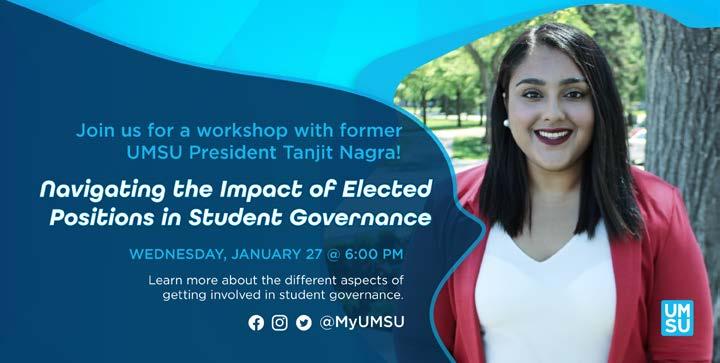
Dela Cruz also said that UMSU, in collaboration with a group called Stride, is offering a workshop on Jan. 20, which is meant to be “bringing attention to breaking down barriers to getting into positions of leadership.”
“Even if you’re self-doubting […] definitely attend, because you never know what the right words and the right experiences and the right stories being shared might do for your own confidence and your own empowerment to run in an election.”
words/ Cam Cannon/ staff
At the same time, the faculty of science has proposed a change in its progression regulations.
If the proposal submitted to the senate is approved, rather than using a number of “F” grade credit hours to determine academic probation and suspension, the faculty will switch to a GPA-based model.
All letter grades will stay on the student’s transcript and will be used to satisfy prerequisites for program progressions or admission into other programs where the GPA is not the deciding factor.
All grades are eligible to be excluded except for those that are under disciplinary investigation and have a discipline (DISC) notation.
Overall, caucus co-chair and UMSU vice-president advocacy Kristin Smith counts this as a win.
When the caucus first put forth their proposal, Smith reported that the senate was “ready to […] vote it down.”
The scheme was whittled down to the GPA grade exclusion “so as not to lose any opportunity for students to have a

The original proposal to senate by the student senate caucus included a pass/fail option which would take a letter grade off a transcript completely, which was not approved. However, Smith assured students that the “door isn’t closed” for its approval.
Though other universities in Canada and the U.S. have implemented pass/ fail grading options for students, the University of Manitoba is the only institution to have approved an option for grade exclusion aside from the U of W who followed in the U of M’s footsteps last spring.
Pass/fail schemes are “a much more established practice,” said Smith, “and we’d like to reopen that conversation with the university and see whether they’re open to discussing the matter again.”
words/ Gillian Brown/ staff

Commissioner alleges ‘serious systemic concerns’
The University of Winnipeg Students’ Association’s (UWSA) executive board has seen an embezzlement accusation, multiple resignations and racism allegations over the past year. On Sunday, another departure was announced.
Former chief elections commissioner Shenal Fernando sent an email confirming receipt of the board’s decision — an email also sent to the Manitoban — and alleging that, as a racial minority, the process in which allegations were made against her and the circumstances under which she was asked to leave the position pressed “serious systemic concerns.”
The email does not disclose what allegations were made against her.
Fernando claimed she was not involved in the decision or included in the meeting where the decision was made to end the association’s relationship with her, “leaving me defenceless,” she wrote.
“It is clear that the UWSA is currently heading down a dictatorship and a rampage for revenge and/or passing the buck [rather] than taking responsibility as to post-election events.
“It is a pity that staff such as yourself are left with little to no influence in such circumstances.”
She was warned of a meeting reviewing her performance by chief operating officer Karolya Vargscarr, who was not present in the closed session on Jan. 12.
On Jan. 14, Fernando was notified by Vargscarr that the board of directors “passed a motion to end its relationship” with Fernando.
Fernando is not the first former employee of the UWSA to accuse the association of systemic racism upon resignation. When former president Jibril Hussein resigned, he claimed that “the association is racist” in his resignation letter and called the association the “most toxic” work environment he had experienced.
Former vice-president external affairs on the same slate Breanna Belisle backed Hussein’s claims in her own resignation letter.
Prior to her resignation, the UWSA announced that it was in a process to review its elections process to create a safer, more supportive space for Black, Indigenous and people of
colour (BIPOC).
The UWSA declined a request for an interview and plans to release more information on its election process changes later in the week.
words/ Gillian Brown/ staff
University of Manitoba assistant professor Paul Durkin is part of an ongoing project studying the environment in which early ancestors of humans lived. The project focuses on the Ewass Oldupa site in Olduvai Gorge, Tanzania, a well-known archaeological site particularly famous for being the first place where traces of stone tool culture was discovered.
In 1959 and 1960, Homo habilis fossils were discovered at Olduvai, becoming the oldest known member of the Homo genus, to which modern-day humans belong.
Homo habilis, as well as the modern-day Homo sapiens and the more ancient but less closely related Australopithecus genus, is a type of hominin. Previously, this group of humans and immediate ancestors were known as hominids, but that definition has now been expanded to include great apes, like chimpanzees and gorillas and their ancestors.
At Ewass Oldupa, an interdisciplinary team is excavating deposits of stone tools in order to figure out where and how they might have been used as humans began to evolve.
Durkin, a sedimentologist in the Clayton H. Riddell faculty of environment, earth and resources department of geological sciences, is one of the project’s geologists and is tasked with helping identify markers of environmental change and analyzing growth patterns in the soil around tool deposits.
“What [makes] this find unique is it’s kind of sandwiched between volcanic events,” Durkin explained.
“So, there’s a fairly significant volcanic event below the discovery interval, and we can get an age date on that — and this is something that would have kind of blanketed the whole area with a big mass flow out of a volcano.
“And then we see that the hominins have moved in quite quickly after that, as vegetation started to develop and river systems were developing on this new deposit.
“That’s where we find the earliest record of some of these tools. And then successive smaller volcanic eruptions, that are mostly just ash that have come out of adjacent volcanoes, we can get an age on those, so that provides the bracket for the lower end of the age and then the upper end […] We have a good idea that it’s about two million years old.”
Durkin was invited to join the project by lead researcher Julio Mercader while doing postdoctoral work at the University of Calgary. He spent time
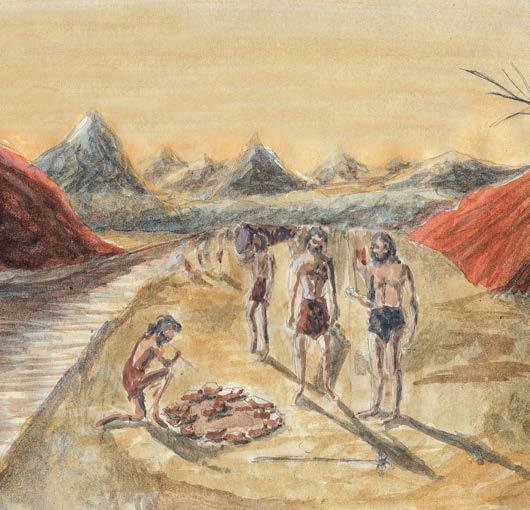
at Ewass Oldupa during the 2018 and 2019 fieldwork seasons, though the COVID-19 pandemic prevented him from travelling last summer.
“There’s still a lot more work to do, other areas to test some of these hypotheses that we’ve identified on this first site,” he said.
“For example, we see that next to riverbed deposits, we tend to find a lot of artifacts. So, can we trace where those deposits might be and find them elsewhere to excavate there as well?”
Geological analysis is often the method used to figure out the age of buried specimens rather than anthropological or biological methods. Durkin said that while this type of work was new to him as a sedimentologist, his involvement is a good example of the variety of researchers studying the area.
Though the project lead is at a Canadian university, Durkin is proud of the effort made to collaborate with local experts and scientists on research that directly affects their home.
“There’s Tanzanian co-authors, and even some of the local Maasai scholars that we’ve been able to help sponsor and get into programs at the University of Dar es Salaam in Tanzania as well,” he said.
“So that’s the other side of it, too — trying to improve our inclusion and not just be strictly Western scientists going over to Africa, the way that maybe things were done in the past.”
The researchers also partnered with local Tanzanian television host and YouTuber Masoud Kipanya to create a video about their work. It has sections in both English and Swahili so both local and international populations can learn more about what the team is doing in Olduvai.
As interdisciplinary research becomes more and more common across the social science and humanities disciplines, Durkin is hopeful that in the future, projects like this one will help lead to discoveries that would previously have been impossible.
“In terms of our approach here, it is unique to have this wide range of different disciplines all combining to resolve this one site,” Durkin said.
“Lots of different approaches to holistically get a good sense of what the environment was like — not just based on geology, not just based on biology, but integrating all of that and working together.”
words/ Sarah Doran/ staff
The UMSU board of directors passed a motion on Nov. 26 to pursue independence from the Canadian Federation of Students. Having voted 28-1 in favour of leaving, UMSU will now attempt to collect signatures from 15 per cent of the student body in order to hold a referendum on the matter. Then, UMSU must try to convince the student body to vote in favour of leaving.
One might expect that a 28-1 majority vote by a board made up of representatives from across the student body would be an adequate prerequisite for UMSU severing ties with an external organization. Unfortunately, the federation’s laws require organizations to hold a referendum of their members in order to leave. But even if their laws did not do so, UMSU is required by the 2018 amendment to the UMSU Act — the union’s governing document — to consult the student body via referendum to leave an organization. The act states that a referendum must be held for any UMSU fee increases above the rate of inflation and to reaffirm membership in external organizations every two years.
Should UMSU succeed in leaving the federation, the membership fees collected by UMSU from students could not be reallocated without yet another referendum.
Assuming UMSU holds a referendum to leave the federation either this year or next year, and follows up with a referendum to reallocate the fees, then together, along with last February’s U-Pass referendum, the University of Manitoba will have had three referendums in three academic years. Along with UMSU’s yearly elections, undergraduate students will have been asked to engage with the student government on six occasions in three years.
The UMSU Act’s requirement of a referendum in these instances makes what could be accomplished in a single meeting by the board of directors into a months-long ordeal requiring signature gathering, an information campaign and a voting period. At best, it’s wildly inefficient, and at worst, it’s paralyzing the very union that is elected to make these kinds of decisions in the first place.
UMSU’s reliance on direct democracy is somewhat understandable given its board structure — it’s made up of 56 members who each represent a council or faculty. Members of the board that are affiliated with different councils and faculties are naturally more, and sometimes only, interested in serving the needs of their respective groups. At times, this board structure seems nearly as unengaged as the student body at-large. For example, the recent vote on federation membership, an issue that has been important to UMSU

administrations for years, received just 29 board members’ votes.
Fortunately, UMSU has recognized these issues and is currently exploring a restructuring process that could be the first step toward a much more effective student government. The restructuring is set to reduce the number of seats on the board to 11, and board members will be elected by the student body rather than selected by councils and faculties. There is also a tightening of the rules around meeting absences and the use of voting proxies. UMSU representatives from faculties and councils will continue to exist should these changes occur, but they will not be members of the board. This will allow them to continue speaking on the behalf of their councils or faculties without disrupting crucial student body decisions.
Another particularly interesting change to be implemented is the elimination of slates from UMSU elections. Internal UMSU debates indicate a concern about reduced voter turnout, but it will hopefully result in a government chosen by the most engaged and informed members of the student
electorate. This may signal a shift from UMSU’s futile focus on attempts to increase student engagement and toward implementing a more engaged and responsible board.
In a perfect world, students would have the time and inclination to be highly engaged in student politics. Unfortunately, voter turnout in recent years shows a level of apathy among students that does not lend itself to the direct democracy that the UMSU Act requires the union to engage in. It’s difficult to expect that this apathy toward student politics can be changed, especially considering most students only spend four years of their lives at the university.
Although it sounds cynical, the most effective way forward is to ask for bare-minimum participation from students to maintain the democratic nature of UMSU — yearly elections to a board that has the power to make decisions.
An amendment to the UMSU Act would require efforts to lobby the U of M’s board of governors and the provincial government. It would be a long process, but it would result in an
UMSU that is unfettered in its ability to act in the interests of its students.
The upcoming changes to UMSU are a significant step toward ensuring a responsible student government. The next step should be to work toward an amendment to the UMSU Act that will give that student government the capacity to properly govern.
graphic/ Jenelle McCann/ staff
words/ Ty Brass/ staff

Knowing how to navigate the digital world is a key skill in every field today
When hundreds of Donald Trump’s most extreme supporters attacked the U.S. Capitol, the world saw just how deeply some believed the 2020 presidential election had been stolen from Trump. These individuals were so confident in the idea that their democracy was in jeopardy that they were willing to attack the heart of the U.S. government.
Seeing the event unfold, I couldn’t help but wonder what would be different if the general public were able to accurately identify truth from calculated lies.
Living in the age of information, there are endless articles, opinions and resources available, but with a growing pool of information comes a necessity for an increasingly critical public.
If we are not able to tell valid evidence from falsified claims, large sections of society will continue to be led astray by predatory leaders and organizations alike. For this reason, it should be the responsibility of educational institutions like the University of Manitoba to teach their students data literacy.
Data literacy, or the ability to derive meaningful information from data, is a relatively new concept but exists in unison with older fields like media and digital literacy.
In an ideal world, everyone would be able to come across a piece of information from a newspaper or Facebook post and critically evaluate its claims before sharing or citing it. Data literacy is especially important in stopping the spread of misleading information as data and algorithmic decision-making — the use of data to deduce correlations and make decisions based on probability — is so widespread in the current global context.
For example, in 2017, the Facebook and Cambridge Analytica scandal exposed that Facebook algorithms delivered disinformation and advertisements to users based on their profile and other data collected by the site. This misinformation was specifically designed to influence the public’s decision on the 2016 U.K. referendum to leave the European Union and the 2016 U.S. presidential election.
When something as integral as the public’s vote is at stake, it is important that we are not only able to tell fact from fiction but also that we understand how our data can be used in malicious ways.
If the public is not aware of how data is collected or how powerful our collective information is, we will be left extremely vulnerable in a world

stratified by data.
Data literacy needs to involve not only understanding data and its uses, but also challenging the misinformation we are exposed to and the power structures that deliver it to us.
And it is especially relevant considering COVID-19.
Scores of misinformation pertaining to COVID-19 vaccines are being shared across social media. From thinking that a vaccine can give a patient the virus to one woman’s claim that the vaccines will alter your DNA, these myths could delay pandemic-crushing herd immunity.
If more people were educated on how studies are conducted and what the data analyzation process entails, much of the controversy surrounding the new COVID-19 vaccines could be put to rest.
There were 43,661 people enrolled in the Pfizer vaccine trials, which is a large sample size.
The reviewal of the data underwent the same protocol and safeguards as other vaccines and both the Pfizer and
Moderna vaccines have been scientifically proven to be safe.
If the public is going to be exposed to articles, videos and other posts referencing studies and clinical trials, it’s crucial that they possess a basic level of data literacy. Understanding how studies are conducted and what statistical evidence means is not intuitive to the average person, but it is crucial when sifting through information.
A public that has data literacy skills emphasizes validity and verification over virality, and this is exactly what is required when a large portion of information we digest from social media could very well be misleading.
Citizens are being called upon to not only verify the news and other content that they consume, but also navigate and understand purposely misleading digital platforms and privacy settings.
The U of M should move toward developing a required data literacy course or an online program that all enrolled students must complete. The course should be a combination of data science and technological training while also emphasizing the social aspects of misinformation.
There is no single solution to the contemporary issues caused by misinformation — only a combination of education, legislation and technological solutions will be able to curb the spread of deceptive sources and abuses of privacy.
As a public educational institution, this university is in a unique position to start teaching students the skills a data-literate public requires. By creating a course that covers the basics of data literacy, including the social aspects, the university can grant students a real-world skill that fosters far more than professional skills.
From the attempted coup at the U.S. Capitol building to widespread lies about the danger of lifesaving COVID19 vaccines, it is increasingly evident that the misinformation we consume has real-world implications. It’s imperative that universities like the U of M take a stand against the dangers of misinformation.
words/ Grace Gyolai/ staff
The new Indigenous course requirement for arts students a decent first step.
Come fall 2021, new faculty of arts students at the University of Manitoba will have to fill an Indigenous content requirement with a minimum of three credit hours. The requirement is long overdue, especially considering the University of Winnipeg has required students to take an Indigenous studies course since the fall semester of 2016.
Unfortunately, the U of M’s content requirement is not as far reaching as the U of W’s and only necessitates arts students take an Indigenous course. However, the U of M is introducing Indigenous-centred courses into several departments like history, political studies, sociology and so forth which will allow other faculties to fill their written requirement with a plethora of different Indigenous courses from different departmental perspectives. The U of M has stated that these courses will follow guidelines laid out by the Truth and Reconciliation Commission of Canada to help educate the public on Indigenous issues, history and knowledge.
Although not perfect, this is a good first step working toward decolonizing the university and associated syllabuses.
But we cannot settle. The university is in desperate need of decolonization. Most, if not all, classes at the university are still primarily taught using Eurasian knowledge and theory without considering the benefits of Indigenous perspectives — a reality that has challenged my own intellectual capacity to understand Indigenous knowledge, as I’m sure it has other university students.
For example, last year I took a historical theory seminar — a class known for its tendency to lead students into existential crises every other week. The class was covering material history and the week’s thematic core was about decentralizing humanity from the study of history. The guest facilitator posed a question as to whether students thought rocks could have agency without influence from the outside world, or in other words, could be sentient. I immediately questioned the statement and judged it as absurd. How could students be hung up on a philosophical question about rocks and sentience when it can be easily deduced via the scientific method that they are not living creatures? It seemed like such a common thing to know.
Just weeks later, I stumbled upon a peer-reviewed article by anthropologist Julie Cruikshank titled “Are Glaciers ‘Good to Think With’? Recognising Indigenous Environmental Knowledge.” The article outlines challenging human

exceptionalism — the idea that humans are categorically separated from the rest of the natural world and central in moral considerations — with Indigenous environmental knowledge. As I thumbed through the pages, I came to realize that the facilitator’s question from just a few weeks prior paralleled the point that Cruikshank was trying to get across in this article: everything in the material world, no matter its distinction from humanity, has agency.
The article noted that our privileged naturalist view — the view that commands and dominates the scientific community by asserting things are only knowable through the scientific method and universal natural laws — contributes to our illusionary belief in the separation of humanity and nature, thereby placing humanity in a dominant social position to other things. Cruikshank noted this perspective makes it difficult for settlers to see the validity in Inuit peoples’ holistic knowing that glaciers are sentient and highly reactive beings, connected to humanity’s every movement — hence the question, are glaciers “good to think with?”
This realization induced an extreme embarrassment in the entitled perspective I had just weeks prior. I had
dismissed Indigenous knowledge, albeit unconsciously, simply because my positionality as a settler within the confines of a colonial academic environment had given me the false authority to do so.
This reflection on my personal embarrassment has a further point — to expand the Indigenous requirement to all students, regardless of their academic focus. Broadening the university’s faculties with Indigenous knowledge can be beneficial to all, not only by being equitable in learning initiatives and teaching cultural understanding, but in expanding our collective understanding of the world.
For example, the department of environment and geography has adopted a more interdisciplinary method and incorporated aspects of Indigenous studies within its curriculum in the pursuit of a more holistic approach to the crises that face our natural environment. But the hard sciences, within the faculty of science, continue to be hamstrung by the deceptive naturalist perspective that many of us, regardless of our academic background, continuously fall victim to. Rather than dismissing what seem like absurd questions, we should be inspired to think beyond the structures that we have grown
comfortable in.
Knowledge is ubiquitous, yet we define it very meticulously within the university setting. Broadening course requirements to encourage students to ask philosophical questions can help inspire scientific breakthrough and change the way we see our world. In other words, “thinking with glaciers” is beneficial to everybody.
words/ Lucas Edmond/ staff
Artists are exploring what the concept of space means to them in an online exhibition through the cre8ery gallery. Featuring artwork from 17 local artists organized by executive director Jordan Miller, Space is an exhibition three years in the making.
On the theme, Miller said, “Space, as a word or theme, can have multiple meanings or contexts.” This is reflected in the artwork that makes up the exhibition. Using a wide range of mediums, artists touched upon a variety of topics that ranged from space exploration to the physical and psychological landscapes of everyday life.
Space offers us a refreshing view of the world around us through the eyes of these artists and allows audience members to visit the places that they’ve depicted — both real and imagined — through their artworks.
This theme is especially poignant considering the circumstances we are currently living in, where occupying physical spaces has taken on new challenges due to COVID-19 — something that has even affected this very exhibition.
However, many of the artists, such as Juanita Klassen, relayed that the challenges the pandemic has brought them were not much of an imposition because Miller did a fantastic job supporting them, promoting the exhibition and making it possible to hold it virtually.
“She has just been a lifesaver for so many of us artists,” said Klassen.
The celestial
Klassen, an artist who has explored outer space throughout her career, works exclusively with acrylic paint on board. Her piece in Space, titled “Cygnus Loop,” is a portrait of the supernova of the same name located in the Milky Way.
Describing “Cygnus Loop,” Klassen said, “Images of it have the power to take me out of not only myself, but take me out of my house […] if I look at outer space then I’m never stuck.”
By building up many layers of paint, Klassen recreates these faraway landscapes in as exact detail as she can. “I want [them] to look as real as possible,” said Klassen, “like [they are] actually moving.”
Texture also plays an important role in Klassen’s work. In fact, she creates her work in such a way that she invites audiences to break one of the art world’s unspoken rules — don’t touch the artwork.
“I created [Cygnus Loop] to be touched and coated it so that it wouldn’t get damaged if someone touched it,” Klassen said. “I like that whole tactile, three-dimensional look, so that’s part

of what I’m aiming for.”
Another artist featured in this exhibition is Jackie Turnbull, a self-taught abstract mixed media artist. In her works, “Cosmos” and “Space Time,” Turnbull explores the meaning of existence, identity and where we find our place in the universe.
“I’m a huge sci-fi geek, so my pieces were about space, outer space in particular,” Turnbull said.
Using acrylic paint, collage and other mediums, Turnbull’s vivid works emphasize organic forms to create imagery and movement that immerses the viewer in Turnbull’s abstracted space and gives shape and weight to the immateriality of the universe.
These works and the ideas behind them also reflect the artist’s intuitive painting style.
“Sometimes I don’t even plan [an artwork] out,” Turnbull said, “I just go for it.”
The next artist in Space is Norma Jones, a mixed media artist who incorporates acrylic paint, image transfers and sketching into her work, heavily inspired by nature and the landscapes of her childhood.
“The piece ‘Memories’ is about prairie farm life,” Jones said. “Through my life, many of the buildings and structures that existed have been torn down. They exist only in my mind.”
“Autumn Receding,” however, captures Jones’s experience of seasonal change in rural Manitoba, exploring the changing colours of the landscape as green grass gives way to yellow fields and wintry blue skies.
Jones pushes the boundaries between linear perspective and abstraction, saying, “I like to do a combination of playing with colours and space, but almost everything I create comes back to the natural theme.”
Heather Craig, also featured in Space, is another artist who often finds
inspiration in nature alongside inner peace. Primarily using art markers on canvas, Craig creates mesmerizing, high-contrast works that pull the viewer in.
Craig began making art just two-anda-half years ago as a way to destress from everyday life and often carries this into her works’ themes.
“A big intent behind the stuff I make is to not just brighten my own mood but for the people around me as well,” said Craig.
“Hyperspace,” one of Craig’s submissions to the exhibition, consists of straight, bold lines that criss-cross across the page. This piece was inspired by star tunnel imagery from movies set in outer space, which creates an extensive depth that spirals down into the center of the canvas.
Craig’s second piece, “Headspace Tangle,” depicts a brain-shaped maze also surrounded by bold lines. Regarding this work, Craig said, “I feel like it represents that way of you’re trying to make space in your own head and trying to get through all those thoughts, and it can be confusing and all that like a maze.”
Another artist with work in Space is Pamela Desmet Franklin, a multimedia artist who has been a long-time lover of art due to growing up in a family of artists.
Working in an experimental manner, Franklin utilizes ink, watercolour, collage and many drawing mediums in her work, but photography has been a major part of her practice and was the medium used for “Mining Martian Diamonds” and “Tears of the Moon,” her works featured in Space.
These ethereal works depict aerial views of surreal, atmospheric landscapes that seem to be taken from an otherworldly perspective.
“With the restrictions and isolation we’ve experienced since COVID-19, I’ve really come to rely on my imagination and creativity to keep myself company,” said Franklin. “I believe the photos express these themes […] I sensed being drawn into the computer screen as if those images were my entire world and felt like being
playful with the idea of being alone and roaming the galaxy.”
Last but not least, Brian Longfield is a local artist who has worked in many different spheres of the art world over the course of his career. As an artist, curator and writer, Longfield has worked primarily in Winnipeg and London, Ont., predominantly focusing on theatre, performance and video installations. However, he has most recently returned to painting to explore layering using his own photographs as references.
Longfield explained that his paintings “Home Address” and “Grazing Couple” each have three layers — the abstract ground, the telephone poles and the Canadian geese — and relate to the concept of space in two major ways.
The first is that these works create a constructed space that illustrates a relationship between the works themselves and the constructed spaces that can be created through photography and photoshop.
“When I’m painting, I’m also kind of thinking in Photoshop layers,” said Longfield. “There’s a real relationship to photography in the work because it’s all work from my own photographs […] I kind of print them by painting them.”
For Longfield, the second major connection to space in these works is an ecological one.
“As humans encroach more into wild spaces and animal habitats, [Canadian geese] forced to come into our habitats more and more and sort of develop a way of living,” Longfield said.
“So, there’s also an element of space there as [...] a shared space with wildlife that’s really interesting to me.”
Space will be running until Feb. 2, 2021, on cre8ery.com.
4/5 stars
Whitney K, the drifter alter ego of Whitehorse, Yukon songwriter Konner Whitney, is a keen interpreter of rock music’s dingier corners. His debut record, the shivering and ramshackle Two Years, is a journey through the warped back alleys of country, blues and primordial, creeping rock. It’s the kind of record that croaks from cracked bar windows, the music that drifts along the street while you stumble home under the midnight sun.
The prodding guitar and menacing handclap rhythm of “Trans-Canada Oil Boom Blues” bears more than a passing resemblance to T. Rex’s iconic scuzz anthem “Jeepster,” while closer “Maryland” is all Lou Reed in its sauntering strum with Whitney’s voice cracking beneath chimes and sweetly climbing strings. The obvious dedication to this curdled strain of rock ’n’ roll would be far less engaging were it not for Whitney’s writing, which avoids the broad, meaningless mythmaking that plagues so many referential rockers in favour of heartbroken dirges and shrewd social commentary.
The aforementioned “Trans-Canada Oil Boom Blues” surveys the bruised and beaten tundra with weary regret, an indictment of Canada’s destructive oil practices that chooses to swagger and amble rather than break down and cry. The tears are saved for “Me or the Party #165,” a waltzing country ballad that finds Whitney lost in a relationship’s final throes: “The way I feel/ when I roll my cigarettes/ don’t you know they always fall apart/ and the way I am, when I’m standing in line/ and see you ride on by/ honey don’t leave me in the dark.”
Whitney’s arrangements are simple and uneasy — slithering, sour slide guitar and dry acoustic strums layered with loose percussion, quivering organ and ringing bar-room piano,

songs held together by world-weary ghosts and fading memories. The dust-coated acoustic guitar and pale organ drone of “The Weekend” is an obvious highlight, its lonesome poetics and stagnant arrangement easing into the shaggy swing of “Last Night #2.” This one-two punch is emblematic of Whitney’s country foundations, an artist able to swing between heartbreak and humour with the understanding that they’re often one and the same.
Two Years is for campfires and alleyways, nighttime porches and dim bar corners — music for places where the light is flickering and wary. It holds its references tightly, pulling decades of skeletal rock from the shadows and into the trembling glow, tweaking and twisting these old sounds and stories into spectral new shapes.
Whitney K’s debut album, Two Years, will be available Feb. 7.
3/5 stars
Claire “Grimes” Boucher is no longer a person. She is a pile of money, a series of angry articles, a class traitor, a problem and an impression. She is also a musician, which is sometimes hard to remember amongst all the digital feedback. But digital feedback is where Grimes lives. Even before she bore the son of technocrat billionaire Elon Musk, her public image was as much about what she said as it was what she created — and she has always had a lot to say.
Though sometimes misguided and often misconstrued, Grimes is an artist with ideas. Miss Anthropocene, last year’s “environmental-crisis-aswrathful-god” concept record, sits firmly in the misguided slot of her output, an interesting idea marred by half-measures and rendered offensive by its creator’s lifestyle and associations. It left many cold and its second life as a remix album will likely do little to warm its naysayers.
Miss Anthropocene (Rave Edition) takes an album that already suffered from a heavy, grey atmosphere and renders it even more opaque, stretching the songs into hazy club thumpers that often bleach whatever colour managed to creep through on the originals. Sometimes it works — the popping bass and pulsing strings that lift the Things You Say remix of “You’ll Miss Me When I’m Not Around” does justice to one of Miss Anthropocene’s strongest tracks, while the REZZ remix of “Violence” adds a welcome, menacing heft to one of the original record’s more faceless songs.

Remixes are meant to reimagine — to tease out some unheard element and create a new vision of an existing world. Some of the remixes here fail to do so, stripping the originals of all personality and rendering them completely unrecognizable. ANNA’s opening remix of “So Heavy I Fell Through The Earth” is a complete textural overhaul and you’d be hard pressed to find any semblance of the original’s desperate feeling. Richie Hawtin’s “Darkseid” remix meets a similar fate, and Modeselektor’s pattering crack at highlight “Idoru” only confirms the original’s superiority.
For all the interesting names that Grimes has compiled, the majority of these remixes lack personality or meaning. Even the decision to keep the original sequencing suggests a lack of commitment to the world-building required of a successful remix album. There is really no second life to be found here.


The future of collegiate sports in Canada has never looked so uncertain. Helping to navigate the U of M through these unprecedented times is Gene Muller, the university’s director of athletics and recreation.
With the help of Muller and the rest of the athletic administration, special resources were set up so athletes and coaches were still able to find success in their sports after fitness facilities were shut down due to code-red restrictions.
“Our strength and conditioning have developed programs for people to do at home,” Muller said. “There will be a reach out to [athletes] to what facilities you have access to, to what equipment you have access to and then working within those parameters. I know that some teams have had […] different alumni [come in to do] professional development workshops.
“I would say the one thing we have done is to be deliberate in our engagement,” Muller said.
“I also know of universities that have just left their student athletes, [saying], ‘We’ll see you back in six months.’ We have encouraged, and our coaches have done, regular connection and feedback.”
Outside of athletics, Muller and the administration have set up programs to make sure athletes are mentally healthy during the pandemic.
“We’ve got two mental health workers that have been attached to the integrated support team that have been working with our athletes,” he said.
One of the most essential areas of an athletics program is having a strong recruiting class. Although amateur athletic competitions and in-person meetings have been few and far between, Muller remains optimistic for the 2021 recruiting class.
“I actually think that we’re going to end up with a good recruiting class out of a [COVID-19] year and the reason is that many other universities would recruit in Manitoba,” Muller said. “I think many parents and athletes are concerned about the lasting impact and travel and cross-province travel and uncertainty, so I think we’ve managed to retain some really talented Manitoban prospects. I think recruiting is going to be good for us this year.”
Like many others, the athletic and recreation department suffered financially in 2020. Muller outlines where the losses hit the hardest.
“Our main source of funding is the sport and rec fee that that students pay and last year [in the] summer we lost 100 per cent of that,” Muller said. “This year, I think we are now on 70 per cent sport and rec fee funding, which impacts our funding level quite

drastically.”
“For Bison Sports, we’ve had to reassign and probably change some of our job and our work allocation in order to be able do everything that we need to do […] it’s been very challenging, but I have been very proud of the way in which we’ve responded,” he said.
“I have a great sense of compassion for what [student athletes are] going through and I also know that […] sometimes sport fills vacuums and voids in our life and sport makes up for other areas of deficit.”
Although the recreation department was hit hard, Muller maintains that the Active Living Centre will be available for members the moment restrictions are lifted on fitness facilities, and said U of M facilities will also be available to the Winnipeg Ice of the Western Hockey League. With
a 24-game schedule being approved by the WHL with a date to be determined, Muller maintains that the Ice are welcome to call the U of M home barring COVID-19 restrictions.
After a fall and winter semester without competition, Canada West has begun planning for a 2021 return to sport.
“Everyone’s planning for a full 2021,” Muller said. “We’re busy working not so much with U-Sports but with Canada West and our conference, so I know that the schedulers are working on two different schedules. One is the status quo schedule, which they did year after year, but then also an adjusted schedule [so] that if COVID19 still persists, […] we can at least still have some level of connection and competition, but those details haven’t been made known yet.”
Muller and administration have been
hard at work to preserve the future of Bison Sports, yet Muller offers high praise to student athletes.
“I admire the fact that they’ve stuck to it and they’ve remained engaged and they remained committed to their improvement,” Muller said.
“For University of Manitoba students, [my final message] is just the regret that I have around what this has done to people […] I realize that people have suffered through this and just remind them that it’ll soon be over and we’ll all be better off, I hope.”
With university sports cancelled this semester due to the COVID-19 pandemic, the focus for sports fans in Winnipeg should be the Jets. After a disappointing first-round playoff exit last year for the Jets, some additions could propel the team to an improved season.
This season, the Jets will be playing in the Scotia North division, which is made up of all Canadian teams. The Jets will play the Toronto Maple Leafs and the Ottawa Senators 10 times each and the other teams nine times.
The team started the season on Jan. 14, 2021 with a 4-3 win against the Calgary Flames.
The game was highlighted by a Patrik Laine two-goal game, including the overtime winner.
Not only did Laine produce on the scoresheet, but he also stood up for his teammate Kyle Connor after Connor was crosschecked from behind. This is the side of Laine that Jets fans have not seen since he was drafted in 2016.
No matter what Laine does this year, he will be one of the biggest storylines for the Jets and possibly in the whole league.
Since the offseason, a Laine trade has been a discussion throughout the whole league and has had some
Jets fans excited and some angry. Ultimately this could prove a large mistake. When Laine is on his game, he is one of the most dangerous players on the team and in the league. His shot, playmaking ability and hockey sense is what makes him noticeable on the ice and causes him to produce on the scoresheet night in and night out.
A Laine trade is one of the main stories that Jets fans should watch out for this season.
Another possible development is the insurgence of youth into the lineup.
Players like Ville Heinola, Dylan Samberg, Jansen Harkins and Kristian Vesalainen.
Heinola in particular stands out. He was drafted by the Jets in 2019 and will look to maybe step into the lineup sometime this year. He brings an offensive ability on defence that would benefit the Jets’ number one or number two power play immensely.
Heinola competed for team Finland in the 2021 IIHF World Junior Championship, while being awarded the bronze medal and being named a top-two defenceman of the tournament.
This type of winning experience could be exactly what the Jets need on its

non-talented blue line.
Samberg could be a great addition to the defence core as well. He is a big, tough player who knows how to use his body when he needs to.
The addition of Heinola and Samberg to the Jets team could be beneficial next season, if not this one.
So, how good are the Jets going to be this year?
The answer is simple — as good as Connor Hellebuyck plays. The reigning Vezina Trophy winner can either carry the Jets to the Stanley Cup, or his bad play could lead the team to miss the playoffs.
In my opinion, the Jets will finish
With a shortened 56-game season, consistency is key for every team, including the Jets, and mistakes cannot be made.
‘The way that hockey has turned out represents possibility and not a necessity’ CONT’D FROM P. 1
“The original research project that I started on was an attempt to understand how playing elite-level hockey shapes what it is to be a boy and a man,” Skuce said.
Fowler, who grew up in a hockey town, said she remembered players like Skuce were “definitely privileged above the rest of us” and discussed the disjointed reality of a group of people who are part of a respected group but aren’t able to talk among themselves.
“They still can’t come out and say, ‘Hey, you know what, I’ve got depression’ or ‘Hey, it’s not cool that you called those people pussies,’” she said.
“There’s bro culture, but it’s bro culture with terms.”
Moore said it was unusual for girls to play hockey in her town growing up, which frustrated her as an athlete. Her 19 years as a high school social studies teacher have given her a framework to discuss these issues with students experiencing similar issues.
“A very important part of social studies is talking about gender and the way gender permeates our official curriculum that we do with our students,” she said.
“I found sport and popular culture an excellent entry point to talk to students about gender […] We can see the
expectations of gender placed on boys within sport culture and how it might keep girls out of particular sports or racialized people out of particular sports, or it’s a very heteronormative space.
“We’re able to have quite difficult conversations in the social studies context around sport, and now that I’m a teacher educator at U of M, I am trying to continue those conversations with my students.”
However, the team has faced more pushback than they were expecting. The NHL itself has been “a major resister” and has proved uncommunicative.
“If the NHL is truly invested in their campaign of ‘hockey is for everybody,’ then they shouldn’t be afraid of research like this,” Moore said.
“So, unless it’s just corporate and tokenistic and about their brand, they shouldn’t be afraid of looking at the culture of hockey, and they should welcome research like this.”
Skuce said some of the problems revolve around defensive attitudes many current and former players may have about their own actions.
“One of the things that I think is really interesting is this idea that the way that hockey has turned out represents a possibility and not a necessity,” he
said.
“So, the way that we see the game being played out is not natural, it’s not a givenness. It is the way it has been shaped and molded, policed and articulated […] Once you start to bump up against that deeply ingrained takeit-for-granted-ness, there’s going to be some heat that comes back at us.”
The project also seeks to understand inclusivity by examining what groups the established behavior patterns exclude.
“By us making hockey more inclusive, we’re providing a language for players to be able to express themselves,” Fowler said. She added that the goal is “to be able to express ourselves in ways that are inherent to us and not how we are told we need to be.”
“As both my colleagues have spoken to, gender norms hurt everybody,” Moore said.
“This isn’t just a project in feminism in the sense that we want to look at masculinities and interrogate the masculinities that are perpetuated in sport. We want to see how […] this [harms] the very people that do well within the sport.”
Fowler explained race also plays a major role in hockey for both players and fans. “We need to recognize how whitewashed [hockey] is and
make it more accessible — that is, more reflective of Canada, [because] right now, hockey is not reflective of Canada,” Fowler said.
Although inclusivity within sport is an important focus for the group, they are also interested in studying the link between masculinity in sport and masculinity in Canada more generally.
“We do want to make the sport more inclusive, but we also want to look at, ‘How does hockey culture say something about the larger brand of masculinity in Canada and how [is] that brand of masculinity not working for us right now?’” Moore said.
Despite everything, the researchers remain hopeful that their work can lead the way to meaningful change.
“I think what we want to say is the benefits to playing hockey can last a lifetime,” Skuce said.
“There’s men playing and women playing into their 60s and 70s, so we don’t want to say that hockey, the whole thing, is a mess. What we’re trying to do is articulate and open the space up.”
words/ Kunal Rajpal/ staff

The Master of Arts in Applied Economics (MAE) is a one year program which trains students in economic analysis, specifically in applied fields such as finance, regulation, environmental policy and economic development. The demand for professional economists with practical knowledge in the area of policy analysis is growing. The MAE program caters to this demand in the public and private sectors.
Application deadline: February 1, 2021