UMSU to restart efforts to leave federation of students
Board votes in favour of defederation for the second time in two years
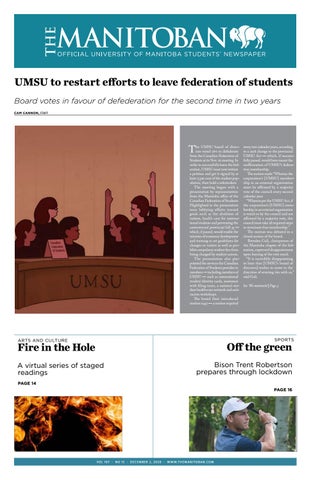
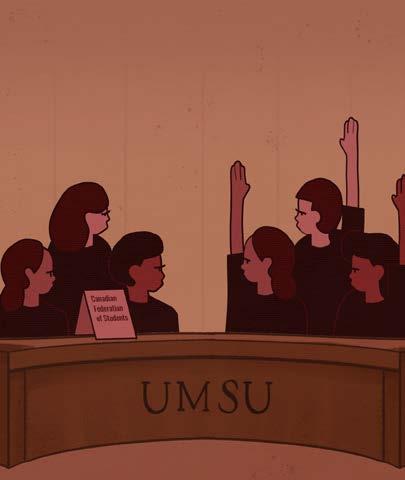
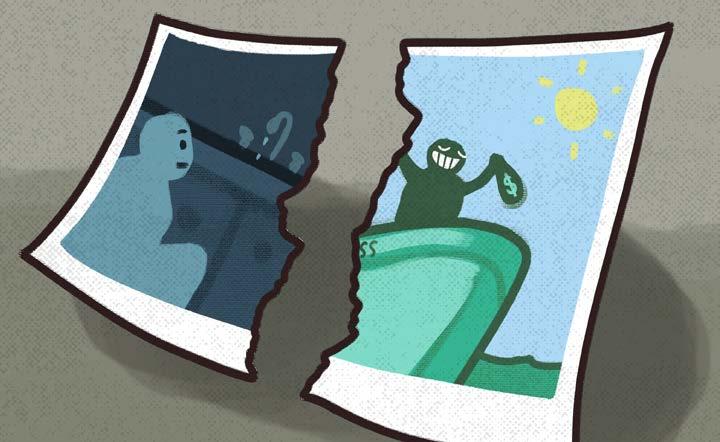
The UMSU board of directors voted 28-1 to defederate from the Canadian Federation of Students at its Nov. 26 meeting. In order to successfully leave the federation, UMSU must now initiate a petition and get it signed by at least 15 per cent of the student population, then hold a referendum.
The meeting began with a presentation by representatives from the Manitoba office of the Canadian Federation of Students.
Highlighted in the presentation were lobbying efforts toward goals such as the abolition of tuition, health care for international students and preventing the controversial provincial bill 33 — which, if passed, would enable the minister of economic development and training to set guidelines for changes in tuition as well as prohibit compulsory student fees from being charged by student unions.
The presentation also pinpointed the services the Canadian Federation of Students provides to members — including members of UMSU — such as international student identity cards, assistance with filing taxes, a national student health-care network and antiracism workshops.
The board then introduced motion 0497 — a motion required
every two calendar years, according to a 2018 change to the provincial UMSU Act — which, if successfully passed, would have meant the reaffirmation of UMSU’s federation membership.
The motion reads: “Whereas the corporation’s [UMSU] membership in an external organization must be affirmed by a majority vote of the council every second calendar year.
“Whereas per the UMSU Act, if the corporation’s [UMSU] membership in an external organization is voted on by the council and not affirmed by a majority vote, the council must take all required steps to terminate that membership.”
The motion was debated in a closed session of the board.
Brenden Gali, chairperson of the Manitoba chapter of the federation, expressed disappointment upon hearing of the vote result.
“It is incredibly disappointing to hear that [UMSU’s board of directors] wishes to move in the direction of severing ties with us,” said Gali.
See ‘We maintain’| Page 4
UMSU board meeting update
Accessibility, advocacy and ‘compassionate grading’ were on the Nov. 26 agenda
CAM CANNON, STAFF
At its Nov. 26 meeting, the UMSU board of directors received presentations from the Canadian Federation of Students and the U of M student senate caucus. The board also defeated a motion reaffirming UMSU’s membership in the federation.
UMSU vice-president advocacy, Kristin Smith, presented to the board on behalf of the student senate caucus about ongoing advocacy efforts to improve student experiences with online learning and to encourage an environment for “student success.”
The caucus is advocating for the implementation of a “compassionate grading scheme.”
If implemented, the university would allow for the possibility of excluding one final grade from GPA calculations in each term, an extended voluntary withdrawal deadline and more compassionate guidelines for authorized withdrawals.
“It’s basically a negotiation process that’s ongoing,” said Smith.
“But we don’t want compassionate grading to be the permanent solution. It’s just simply not a tenable solution.”
The senate caucus has submitted a set of five recommendations to be reviewed by the university’s COVID-19 recovery steering committee which, if enacted by the U of M senate at its next meeting on Jan.
6, would take effect for the winter 2021 semester.
Among the recommendations are a requirement that professors and instructors post recordings of their lectures, or at least annotated slide shows of lectures, on UM Learn to address concerns of inaccessibility for students with poor internet connections.
The second recommendation is adding the requirement that environmental scans — in which the software scans the room a student is taking an exam in to set a “baseline” for the proctoring software — be implemented for Respondus e-proctored exams.
The proposal is intended to reduce student anxiety about false accusations of academic misconduct by providing video evidence that no cheating has taken place.
Smith remarked that this year there has seen an influx of accusations of academic misconduct.
According to Smith, ordinarily students tend to admit to the misconduct they were accused of, but this year, students are maintaining their innocence — many feel the process of appeals is too inaccessible and that they are already “presumed guilty” before an appeal.
Thirdly, the caucus is advocating for professors to allow more time for students to submit assignments online, or to offer alternative meth-
ods of assessment, as students have complained about difficulties associated with poor internet connectivity and submitting assessments.
The fourth recommendation is to have professors review their course outlines and ensure that academic workloads are not above their pre-pandemic expectations.
The final recommendation is to prohibit features on online exams that prevent students from going back and forth between questions.
According to Smith, the proposals have not only been developed in the caucus, but have also worked with the assistance of two professors in the faculty of education and have their full support.
Advocacy activities
The recently launched Manitoba Alliance of Post-Secondary Students (MAPSS) finished up its first lobby week for provincial policy and budget recommendations. The group attended meetings with the Manitoba Liberal caucus and the Manitoba NDP caucus, along with the Minister of Economic Development and Training Ralph Eichler, among others.
Minister of Finance Scott Fielding requested that MAPSS provide a budget submission “containing costed and implementationready solutions,” said Smith. MAPSS is also planning to
launch an advocacy campaign around the new provincial bill 33 — the advanced education administration amendment act — after an upcoming meeting with Eichler set for January or February.
ALC accessibility
UMSU is also making progress on recommendations to make the Active Living Centre more accessible for transgender and non-binary students.
A proposal which includes measures such as adding menstrual hygiene product dispensers to the men’s facilities and the addition of clothing hooks to shower spaces has been received by Douglas Brown, dean of kinesiology and recreation management.
A meeting will be set to further discuss the implementation of these measures.
“I just want to publicly thank students who worked with me on [this] for their time and their leadership […] this could not have been done without them,” said Smith.
Holiday hamper program in full swing
Applicants can receive gift card option rather than food donations
The shape of education and student life is continuously changing over the course of the year, and students of all backgrounds have had to adjust and adapt to different academic circumstances and pandemic-influenced choices made by the province and the university.
Students have been especially vocal in their financial concerns that stem from the university’s tuition increase. It was announced last spring that the 2020-21 academic year would see a tuition raise for undergraduate and graduate students by an average 3.75 per cent.
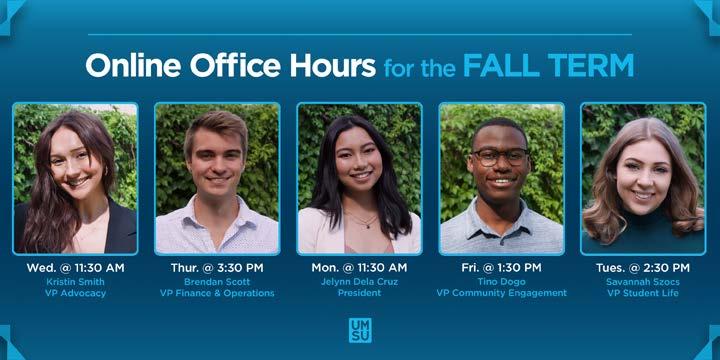
Given the tuition increase, along with mandatory student fees, UMSU vice-presidents Tino Dogo and Savannah Szocs see it as no surprise that students would struggle with food insecurity or being empty handed during the holidays.
“Obviously it’s a bit different this year with [COVID-19],” said Dogo, UMSU’s vice-president community engagement.
In a typical year, Dogo explained, UMSU would collect the toys, food items and other donations that it receives from partners all across campus. Donations would then be sorted into hampers for different sizes of families. In a pre-pandemic holiday hamper program, organizers would try to match a donor with specific hamper to support a family.
“We’re
applicants.
“We’ve been super fortunate this year to have an overwhelmingly large amount of monetary donations from our regular donors, lots of student groups and faculty offices and things like that,” said Szocs, vice-president student life.
situation this year and there’s obviously going to be a lot more people who need these hampers.”
According to Dogo, last year, pre-pandemic, they received about 150 applicants.
“This year, unsurprisingly, the number has gone up.”
just really glad that we could figure out a way to keep it going during [COVID-19], especially because during these times are when people need it the most” — Savannah Szocs, UMSU vice-president student life
This year, UMSU has had to find a way to create the hampers with as little in-person contact as possible.
For the pandemic, the program plans to use monetary donations to offer a gift card option for
UMSU has seen a lot of the program’s regular donors increase their donations and other donors who “normally give physical food items” have given monetary donations instead.
“I think they’ve all recognized that, since we’re in this different
As of Nov. 24, Dogo said the program has received about 180 applications, and he estimates that they may see around 200 applicants for the program this year.
“We’re just really glad that we could figure out a way to keep it going during [COVID-19], especially because during these times are when people need it the most,” said Szocs.
The holiday hamper program is taking applicants until the end of the day on Dec. 2.
‘actively shutting us down’
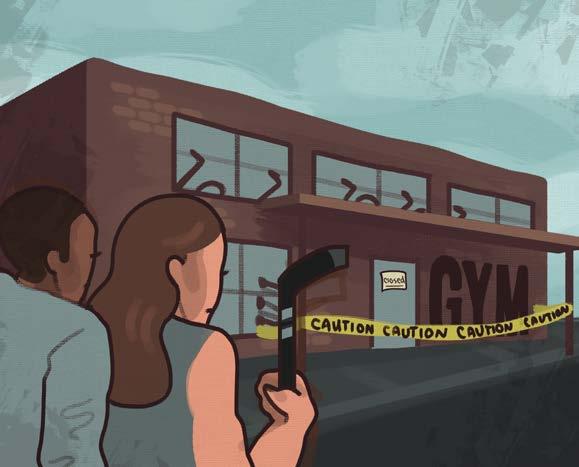
On Nov. 20, UMSU announced that all student clubs will no longer be allotted permanent space in areas controlled by UMSU, including in UMSU University Centre (UC) and the Helen Glass Centre for Nursing, leaving some clubs without a place to call home.
The announcement read “UMSU has made it a priority to enact changes that ensure that all of the 206 student clubs at the U of M receive equal support — specifically when it comes to providing space to meet.”
Club spaces controlled by UMSU will be available for booking under this new system, and no clubs will receive exclusive space. Clubs will also be allocated secure storage space in a separate area under this plan. The change will not be affecting the designated community groups, including Rainbow Pride Mosaic, the University of Manitoba Indigenous Students’ Association, the womyn’s centre and the student accessibility centre.
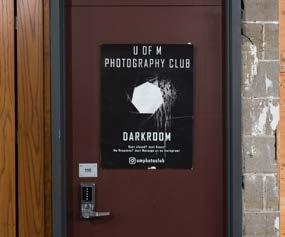
However, this is an unwelcome move to the clubs who will no longer have a space to come back to when campus life is back to normal, including the UM photo club.
Photo club president and computer science student John Baptista said the move — one that his club has been publicly pushing back against for months now — appears to be UMSU “actively shutting us down.” See ‘A loophole’ | Page 5
DAMIEN DAVIS, STAFF
AMIRA TEKLE, STAFF
Petition for lower tuition gains thousands of signatures
Second petition to circulate widely in a month highlights quality of education during pandemic
CAM CANNON, STAFF
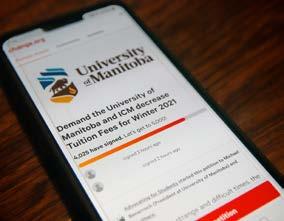
On Nov. 22, third-year faculty of arts student Simranjeet Kaur — under the name “Advocating for Students” — launched a Change. org petition calling on the U of M administration to reduce tuition for the coming winter semester, citing decreased quality of education and lack of access to services on campus. At press time, the petition has been signed by more than 4,000 people.
Kaur’s petition is the second petition demanding a better deal for students facing difficulties amid the COVID-19 crisis to gain traction in the last month.
‘We
The last petition — which called for similar action by both the U of W and U of M — has garnered over 8,100 signatures at press time.
According to the student who started that petition — U of W student Umar Awan — the University of Winnipeg Students’ Association (UWSA) has taken action. The UWSA passed a motion at its Nov. 12 meeting to raise the issues in Awan’s petition to the University of Winnipeg senate as well as to “engage in a proactive campaign to approach faculties/departments directly with the outlined issues of online course-
work” and “engage in additional lobbying and campaigning work with regards to tuition fees during the [COVID-19] pandemic.”
UMSU vice-president advocacy Kristin Smith said UMSU has also reached out to Awan, to no avail.
The most recent petition comes at a time where students have reported dramatic increases in terms of mental health issues.
Additionally, UMSU has seen an increase in hardship fund applications this year, indicating that the COVID-19 crisis has financially impacted a significant number of students.
Kaur said her friend “was suicidal for a couple days” after the university threatened to de-register them for next term because they could not pay late fees on time.
“It’s like the university is treating this as a business but, honestly, if they want to treat this as a business, their customer approval ratings are very low right now.”
“I mean, it’s an educational institution — you should be a little more compassionate with students who are out of jobs,” she said, adding that students are a particularly vulnerable population whose employment is often precarious.
According to Kaur, the petition was first spread by word of mouth — friends telling other friends — but
also through the use of class email lists accessible through the U of M’s online learning management system, UM Learn.
The petition asks that the uni-
“It’s like the university is treating this as a business” — Simranjeet Kaur, petitioner and faculty of arts student
versity “remove charges for services that are no longer accessible to students” and urges the administration to “open up more room for discussion about student affairs, letting everyone have a say so that there is more understanding about concerns of different demographics in the student population.”
Not only does the petition call on U of M president Michael Benarroch, members of the university administration and a number of deans for action on their part, it also warns of efforts toward organizing students to withhold their tuition fees in the
maintain our mandate to support and advocate for students’
Continued from front page
“Our concern […] of course, is the wellbeing of students who, while […] studying and attending classes from home during a pandemic, have also just gone through a stressful period of unease with the looming potential of a faculty strike,” Gali said.
“We maintain our mandate to support and advocate for students, so while this motion has passed and moves in the direction of ‘defederating,’ it will be business as usual for us.”
According to federation bylaws, any member association wishing to terminate membership must first hold a petition for a referendum to be signed by at least 15 per cent of the member association’s membership.
If the petition is successful, there will then be a referendum held in which all members of UMSU may participate. If the referendum ends with a majority vote against continued membership in the Canadian Federation of Students, a vote to ratify the withdrawal of UMSU from the federation will be held at the federation’s next general meeting.
Pending success in all of the above steps, decertification would take effect the following June 30.
Tensions go back years
In 2005, UMSU left the Canadian Alliance of Student Associations (CASA) — a federal lobbying organization for students which rivals the Canadian Federation of Students —
and afterwards joined the federation. A legal drama then unfolded with CASA suing UMSU over unpaid membership fees in 2007. The lawsuit was dropped after UMSU and CASA reached an undisclosed financial settlement.
As far back as 2013, UMSU has made efforts to leave the Canadian
“It is incredibly disappointing to hear that [UMSU’s board of directors] wishes to move in the direction of severing ties with us” — Brenden Gali, CFS-MB chairperson
Federation of Students.
That year, UMSU struck an adhoc committee to review how federation dues collected by UMSU are spent as well as to evaluate whether the relationship was worthwhile for UMSU.
In September 2013, it was revealed that UMSU removed all pages promoting the Canadian Federation of Students from day planners that were handed out annually to students for
free.
During the 2013-14 academic year, the then-UMSU executive refused to pay fees to the federation over an ownership dispute involving an UMSU website. As a result, UMSU was made to pay close to $1 million to the federation in 2016.
In 2016, there were public tensions when then-UMSU president Tanjit Nagra alleged that members of the federation executive verbally harassed her and UMSU demanded a public apology. There was also an incident in November 2016 at the federation’s Day of Action protest in which a then-UMSU executive complained that the federation prevented him from speaking at the rally.
In early 2018, UMSU held a nonbinding plebiscite in which more than 64 per cent of voters voted in favour of remaining in the federation.
That year, UMSU continued to push to leave the organization and it was demonstrably a priority of then-UMSU president Jakob Sanderson. In November 2018, the UMSU board of directors voted against reaffirming membership in the Canadian Federation of Students and Sanderson publicly endorsed the idea of UMSU leaving the federation and becoming a member of CASA instead.
In January 2019, UMSU denounced the federation for its support of the boycott, divestment and sanctions movement citing the divisiveness of such a position.
In February 2019, CASA gave a presentation to the UMSU board of directors just days after UMSU participated in a CASA mental health initiative.
In March 2019, UMSU launched a now defunct website, demandbetter. ca, as part of a marketing campaign toward holding a second referendum on leaving the federation. The campaign centred around the idea that the dues paid to the federation could be put to better use by UMSU.
In April 2019, UMSU budgeted $30,000 for the 2019-20 academic year for a marketing campaign toward leaving the federation, some of which was put toward demandbetter.ca.
At the Oct. 22 UMSU board of directors meeting, UMSU’s vicepresident advocacy, Kristin Smith, voiced the position that the federation is to blame for its poor relationship with the provincial government, calling the federation “incredibly antagonistic.”
Presently, there have been recently renewed efforts marked by UMSU’s board of directors receiving another presentation from CASA in early November, followed by the presentation from the federation and subsequent vote which took place Nov. 26.
A tough nut to crack
The Canadian Federation of Students is a notoriously difficult organization for members to leave — organizations that attempt to leave often find themselves embroiled in
winter semester as part of a “tuition strike.”
The petition reads: “If the University of Manitoba fails to meet these demands or fails to open up a dialogue, we will push for a tuition strike for winter term 2021.”
The last time students successfully went on a large-scale tuition strike in Canada was the 2012 Quebec student protest movement dubbed the “Maple Spring.”
The 2012 strike saw months of mass protests leading to a special election resulting in the provincial Liberal government being deposed and the tuition hikes which the students were protesting repealed shortly thereafter by the new government.
The strike came after a history of direct action by students traceable to the student movement of the 1990s, which took place mainly in Quebec and involved massive rallies against tuition increase and cuts to postsecondary education and financial aid.
“After the petition hit 1,000 [signatures] and over, I had emailed UMSU asking them to back it up,” said Kaur.
“If there are already 1,000 signatures in a day, it seems to be a pretty prominent issue.”
At the time of her conversation with the Manitoban on Nov. 27, Kaur had not yet heard back from UMSU regarding her petition.
lawsuits over membership dues owed to the federation or to get the federation to recognize votes to leave.
In 2008, students at Cape Breton University voted to end their membership in the Canadian Federation of Students. The federation refused to acknowledge the vote but nonetheless their student association stopped collecting dues on behalf of the federation. The federation subsequently sued over unpaid membership fees. In 2015, the Cape Breton University Students’ Union (CBUSU) lost the lawsuit and was ordered to pay roughly $400,000.
Efforts were made toward leaving the federation once again in fall 2015 but ultimately the CBUSU could not, because according to federation bylaws, a petition cannot be recognized if membership fees are outstanding. At one point, the union considered declaring bankruptcy as a result, and the CBUSU eventually reached a court-ordered settlement with the federation. Today, the CBUSU is still a member of the federation.
Over the last decade, there have been a number of similar cases with varying outcomes involving student unions from the University of Guelph, the University of Victoria, Selkirk College and Concordia University, among others.
UMSU did not respond to requests for comment by press time.
PHOTO BY ALEXANDER DECEBAL-CUZA
‘A loophole we wanted to close up’
Continued from page 3
The photo club — which has roughly 50 regular members and provides darkroom services to more — started a petition in May calling for UMSU president Jelynn Dela Cruz, vice-president student life Savannah Szocs, UMSU general manager Thomas Blumer and UMSU service centre manager Leeandra Wren to make efforts to save its original space at 116 University Centre. At press time, the petition had garnered more than 750 signatures.
The photo club’s former space at 116 University Centre was damaged in the fire that took place outside UC March 13. Its space included the last public
PHOTO BY JOHN BAPTISTA
darkroom existing at the U of M and made photography more affordable for students, offering its members free development for black and white photos and $2 development for colour photos and selling film at cost to students.
Baptista said that is no longer a possibility, as construction began to convert the darkroom into a different space began without their knowledge.
Baptista said “the fire prompted UMSU to rethink what they want to do with [its] space.”
“It prompted them to think that they don’t want to give us the space anymore.”
UMSU vice-president finance and operations Brendan Scott said UMSU believes the change is neces-
sary for a number of reasons, including the allocation of permanent space to clubs in exchange for votes by past UMSU executive candidates.
“The fact that […] spaces could be promised to clubs was a loophole we wanted to close up,” said Scott.
“So that in future years of UMSU, there isn’t [executives] or people running saying ‘Hey, if you get your whole club to vote for me, I’ll give you space.’”
Scott also said there is a lack of accountability from clubs, saying that “the fact that there could be damages in there and we wouldn’t find out until the end of the year is kind of [troublesome].”
Scott said a full-time staff member will be assigned to deal with club spaces and bookings once campus life returns to normal.
Baptista acknowledged that student club space isn’t of the utmost importance right now due to the COVID-19 pandemic, but said the club urgently needs storage space — which it had prior to the fire — and that the club will eventually need a darkroom space again when normal campus life resumes.
“We’ve resorted to just keeping [club supplies] in our houses and it’s getting [to be] a lot.”
The photo club was offered a darkroom in the Fitzgerald building by UMSU and the U of M July 30, shortly after the Manitoban published an article July 21 detailing the club’s predicament.
However, after struggling to get in contact with UMSU — and now the
university — for the better part of the year, the photo club is not optimistic about the possibility of moving its operations into the Fitzgerald space.
The U of M staff member given as a contact by UMSU to the photo club has not responded to repeated emails from the club, and Baptista is worried that this new announcement from UMSU will affect the Fitzgerald darkroom arrangement.
Baptista said he is now worried the photo club will be left without a darkroom and be “back at square one” with this new announcement.
“At the end of the day, we’re students, too. So […] I have my [computer science] classes, my physics classes to worry about, [and] now
“Now it just feels like we’re kind of being strung along [by UMSU], we’re being played” — John Baptista, UM photo club president
I have to [worry] about something I thought was fixed, something I thought we were already past,” said Baptista.
Baptista said the changes in plans and lack of communication have left the photo club without proper
direction.
“Now it just feels like we’re kind of being strung along [by UMSU], we’re being played,” he said.
“We’re being hooked onto something, we follow it and then UMSU redirects us and we get hooked on something else and we have to follow that.”
Scott said UMSU found three darkroom options for the photo club — two on campus and one off-campus.
“While the darkroom will not be connected to a space that they may rent out, they still at any point would have access to a darkroom in some form.”
With the club’s history spanning 50 years — making it one of the oldest student clubs at the U of M — Baptista is afraid the photo club won’t survive without a darkroom.
“We can’t not have a darkroom [or else] we’re not going to have a club anymore,” he said.
“If we didn’t have a darkroom […] we can’t let members scan film, they can’t develop film, they can’t print film,” said Baptista.
“If they can’t develop and print film, there’s no point in selling film at that point as well which is a big way of how we keep up our club.”
“With this [change], we might actually have to rethink how our club works.”
“I love this club so much and I’ve learned so much about its history, I would hate for me to be the last president of the club.”
Professor receives CBC Manitoba Future 40 award
Recognition for provincial leadership in virtual health care
SARAH DORAN, STAFF
CBC Manitoba released its list
of the top 40 researchers and educators in the province under age 40 last month. Among the list was Jennifer Hensel, an assistant professor of psychiatry at the U of M’s Max Rady college of medicine, who was included for her pioneering work on virtual mental health care in Manitoba.
Hensel’s passion for program development and improving access to mental health care began during her training and residency in Ontario, where she completed her master’s degree at the University of Toronto’s Institute of Health Policy, Management and Evaluation.
“I was noticing that there were a lot of challenges in providing services, a lot of gaps in access to service, a lot of variability in the services that we provided not only within programs but certainly geographically,” Hensel said.
“I became very interested in how we do that better. I was always interested in research […] but rather than research in drug development or basic science, I became very interested in health services research […] more applied, pragmatic research.
“How do we do things better? How do we develop programs to really meet the needs of the people that are going to be using them? How do we get services to people who need
them?”
Telehealth and virtual care solve a number of problems people face in receiving health care, both in Manitoba and elsewhere.
Hensel mentioned geographical distance as a major barrier in the province, with rural and remote communities often lacking access to mental health care in particular, but also talked about urban complications like public transportation schedules and parking.
Even having to plan around infants and young children can make health care difficult. Telehealth allows patients to receive care when and where it is convenient for them, rather than what works best for their provider.
Although both patients and providers have expressed uncertainty about whether mental health care is as useful virtually as it is in person, Hensel is confident the result is the same.
“There have been a lot of studies that have compared the use of telehealth assessment to a face-to-face assessment showing that you can, in the vast majority of cases, effectively and accurately diagnose and provide treatment and build rapport with a patient,” she said.
An interesting side benefit to making virtual mental health care more
common, she added, is that people who might not otherwise seek treatment are increasingly using technology like apps or online tools to manage any symptoms on their own.
However, not every patient entirely benefits from virtual care or self-management, Hensel said.
“There’s a fine balance between making it convenient and reducing the stress of having to get to the office — there’s a lot of costs associated with that, too, parking and travel and so on — but then balancing that with that person’s need to actually physically get out of the house and challenge their anxiety and challenge their depressive symptoms,” she explained.
Of course, with the COVID-19 pandemic, patients and providers were left without much of a choice.
“I think when [COVID-19] hit, a lot of people had to suddenly shift to virtual care and really didn’t know much about it or how to do it,” Hensel said.
“There was a lot of anxiety about that among physicians, for good reason, but my reaction was, ‘Finally!’ Finally, we have this wide-open landscape to be able to move forward with virtual care. So, [COVID-19] has obviously removed all of the adoption barriers that were there.
“Technology, virtual care, telehealth — this is not a new solution
that people are talking about. It has been touted as a solution for years and years and years, but there’s been a lot of reticence to adopt it into practice that [COVID-19] has effectively
“Technology, virtual care, telehealth — this is not a new solution that people are talking about” — Jennifer Hensel, assistant professor
removed out of necessity.”
Manitoba also had to start from closer to the beginning in shifting to virtual care than other provinces.
“In Ontario, they already had an infrastructure to equip providers with the technology that they needed to be able to provide virtual care fairly quickly,” Hensel explained.
“Manitoba didn’t have that infrastructure. They have a good telehealth system, but for you to access telehealth, you have to go to a clinic that has a telehealth unit […] When I say telehealth, I’m talking about the traditional telehealth assessment
that’s done in a suite. It’s located in a health care clinic, there’s usually somebody from the other end to help facilitate it.
“So, Manitoba has a great infrastructure for that, but they didn’t have any infrastructure for the homebased virtual care where the patient can access it in their home, so they had to quickly come up with some way for us to do that.”
Hensel also acknowledged all the topics that need further investigation. For example, using Zoom or other videoconferencing technology allows for some visual input, which is helpful for mental health practitioners, but much less is known about how effective telephone appointments can be.
Hensel is confident that the rise in telehealth will stick around after the pandemic is less serious, but there are still a number of questions to be answered.
“There’s a lot of things that need to change for [virtual care] to become a permanent solution,” she said.
“Not just provider attitudes, but the infrastructure, the technology, the payment, the remuneration set up. So, I think we’re seeing the government response to the idea that this actually is something that we should probably look at permanently, but I do think we need to really figure out how to do it right.”
PHOTO PROVIDED BY JENNIFER HENSEL
Colloquium discusses Indigenous activism
Pam Palmater,
Winona
LaDuke launch new books
SARAH DORAN, STAFF
The Manitoba branch of the Canadian Centre for Policy Alternatives co-presented a virtual event with the University of Manitoba’s Native studies department Nov. 25. Assistant professor Niigaan Sinclair hosted the event with guest speakers Pam Palmater and Winona LaDuke discussing their new books on Indigenous activism.
The discussion, titled “Indigeneity, Colonialism and COVID: Land Defenders and Water Protectors in a Pandemic Age,” also served as the Native studies department’s weekly colloquium, with five graduate students asking questions.
Palmater, an associate professor at Ryerson University’s department of politics and public administration and an activist with decades of experience in Indigenous issues, just released a book titled Warrior Life: Indigenous Resistance and Resurgence A Mi’kmaw citizen, she is a member of the Eel River Bar First Nation in New Brunswick.
“We often stop at, ‘Oh look, we have a problem’ and have some recommendations without fully understanding what the root cause is or how to translate that into action,” Palmater said.
“So [Warrior Life] is really about action and honouring all of the people on the ground who risk everything to do that for us, despite being vilified, despite being targeted, surveilled, monitored, arrested, threatened, experiencing violence. This is significant work that they’re doing and you don’t get famous from it […] This is about really saving our future for our people.”
LaDuke is a rural development economist and cofounder of Honor the Earth, a non-profit organization created in 1993 to raise both awareness and financial support for Indigenous issues, particularly those related to environmental activism. LaDuke lives and works on the White Earth reservation in Minnesota, where she runs a hemp farm. Her new book is titled To Be A Water Protector: The Rise of the Wiindigoo Slayers and covers a number of recent pipeline standoffs in the United States and Canada.
“I’ve found that in my privilege of travel, back when I used to fly, but also just being on the ground, I got a lot of stories,” LaDuke said.
“So I started writing them […] because the thing is that history needs to be written up. We need to tell our history. We need to tell
these stories because [we’re] who’s doing it […] It’s my trying to collect […] the pieces of myself that I have scattered to the wind into one place, to say, ‘This is the history that I saw happening. These are some people that did pretty amazing things. I’m going to do my best to tell some of their stories.’”
In addition to discussing the two books, the colloquium also touched on the impact of the COVID-19 pandemic on activist groups and Indigenous peoples in general.
Palmater emphasized local groups keeping tabs on shifting environmental legislation and continued protests against industrial projects as proof that Indigenous activism has a place for everyone regardless of skillset.
“It was actually one of the most encouraging things that I’ve seen come out of the pandemic — the way that the Indigenous nations or tribal governments took control over their own borders,” she said.
“The same with First Nations here, with land defenders who, despite all of the restrictions on gathering, made sure that they were still advocating and defending.”
LaDuke agreed, talking about her local community taking advantage
of the pandemic to connect with younger generations and teach them about planting gardens and making traditional medicines.
“We have this moment where we are forced to take a breath,” she continued.
“And in that moment of being
“It’s
not like we haven’t lived through pandemics before”
— Winona LaDuke, activist and author
forced to take a breath […] let us look at where we are going […] It’s not like we haven’t lived through pandemics before. We are the post-apocalyptic people — we’ve lost so many people we don’t even know what we lost. So much loss.
“And so […] we sit here, and in some ways, I think that there is this absolute coherence that happens in this moment of crisis where you’re [thinking], ‘What are you going to do?’”
Both panellists agreed that social movements have seen an uptick during the pandemic. Palmater brought up George Floyd and the racial justice protests sparked by his death in May.
LaDuke mentioned the removal of statues of Christopher Columbus and American Confederate soldiers, as well as the renaming of the Washington Redskins football team.
“The most significant changes for human beings on the planet have come after sustained periods of conflict, what’s perceived as conflict — disagreement, debate, the planting of the seeds of change,” Palmater said.
“And so I actually get really energized from that.
“When I see our people marching in the streets, some people would say, ‘Oh, I wish our people weren’t marching in the streets,’ [but I say] ‘Thank goodness they are. Thank goodness there are still people willing to stand up.’”
PHOTO BY ALEXANDER DECEBAL-CUZA
Editor-In-Chief:
EDITOR-IN-CHIEF Matthew Doering editor@themanitoban.com
BUSINESS MANAGER Alice Teufack accounts@themanitoban.com
ADVERTISING CO-ORDINATOR Diego Castro ads@themanitoban.com
EDITORIAL
MANAGING EDITOR Ty Brass me@themanitoban.com
NEWS EDITOR Amira Tekle amira@themanitoban.com
NEWS EDITOR Gillian Brown gillian@themanitoban.com
COMMENT EDITOR Lucas Edmond comment@themanitoban.com
ARTS AND CULTURE EDITOR Shaylyn MaharajPoliah arts@themanitoban.com
SOCIAL MEDIA EDITOR Colin Ijebor social@themanitoban.com
REPORTERS & ASSOCIATES
NEWS REPORTER Cameron Cannon
NEWS REPORTER Damien Davis
ARTS AND CULTURE REPORTER Kaelen Bell
ARTS AND CULTURE REPORTER Zoë LeBrun
COLUMNIST Grace Gyolai
DESIGN ASSOCIATE Mikaela Warkentin
PHOTO ASSOCIATE Basel Abdelaziz
SOCIAL MEDIA ASSOCIATE Jalene Moman
VIDEO ASSOCIATE Arsalan Saeed
AUDIO ASSOCIATE Tawana Matizanadzo
GRAPHICS ASSOCIATE Dallin Chicoine
COPY ASSOCIATE Aldin Sabic
SPORTS REPORTER Matthew Merkel
VOLUNTEER CONTRIBUTORS
A “volunteer staff” member is defined as a person who has had three volunteer articles, photographs, or pieces of art of reasonable length and/or substance published in the current publishing year of the Manitoban. Any individual who qualifies must be voted in by a majority vote at a Manitoban editorial board meeting. Elected representatives and non-students may be excluded from holding votes as volunteer staff members in accordance with the Manitoban Constitution.
There is room in the labour market for both humans and robots
COLIN IJEBOR, STAFF
GRAPHIC BY DALLIN CHICOINE
Artificial Intelligence (AI) is a buzzword that has infiltrated almost everyone’s vernacular. Writers, media houses and technology sector billionaires like Elon Musk warn of a gloomy, even disastrous, future with AI — a future that is forewarned by popular culture’s fictional fantasies.
The anxiety that robots will annihilate the human race was driven into popular culture after the 1920 Czech play Rossum’s Universal Robots. In the dramatic play, a scientist named Rossum creates the first robots whom he employs as slave-like labourers. As the play progresses, the robots develop emotional capacities and come to dominate their creators. The popular meaning of the term “robot” is actually derived from this play and means “forced labour” in Czech.
While this outlandish portrayal of full robotic domination can easily be disregarded as fiction, there is yet another, perhaps more realistic, fear that is rearing its head as more sophisticated robots are being developed — the fear that they will replace human labour.
AI and robots are used in a plethora of ways and have become a staple of daily life in most parts of the world. AI has been integrated into virtually every industry in one way or another. From your smartphone to Netflix, various industries are starting to utilize predictive and interactive technology that is geared toward improving human lives and making them easier. It is redefining the norm in human-to-human, human-to-non-human and non-human-tonon-human interactions.
Many tasks that were once performed by human beings have become more readily automated too. This has incited worry and fear in people that the continuous development of AI improved robots that are capable of taking on even more specialized roles will eventually devalue human labour as redundant.
In 2019, a Forbes article listed 13 jobs that tech experts predicted would be fully automated by 2030. Warehouse and manufacturing jobs, customer service, banking services and retail checkout were among those listed in the article. Robots and AI have been a popular topic for the last few years, seemingly reinforcing this belief that they are here to take over.
In fact, in 2017, a study published by Ipsos,
a marketing consultant group, found that 58 per cent of research participants believed that technology would contribute to the proliferation
By taking on simple and repetitive tasks, robots have freed people to focus on the more challenging and nuanced ones — leading to a form of human-robot symbiosis
of unemployment.
The COVID-19 pandemic has stirred up these fears even more. Due to the lockdowns imposed in countries around the world, employers have increasingly automated tasks previously carried out by human employees who could no longer go to work.
In northern California for example, about 185 toll collectors lost jobs as tollbooths were replaced by FasTrak tags that track peoples’ toll fees digitally. This rapid deployment of robots was seen across many industries. “Sally,” a robot that makes salads, replaced employees in hospital and university cafeterias. Knightscope security robots were deployed to guard malls and stadiums. And human customer-service agents were replaced by chatbots.
The question is, how valid are the fears of people who think they will lose their job to automation? Various studies have been carried out to determine whether automation will damage the employment rate, but they have yielded mixed results. One study carried out between 1990 and 2007 by the National Bureau of Economic Research in the U.S. showed that the rise in the reliance on robots negatively affected the human-robot employment ratio, as they reduced human employment and wages. Further, a study done by Oxford Economics, a research institute, predicts that up to 20 million jobs will be globally lost to robotics by year 2030.
A 2018 study from researchers at the Massachusetts Institute of Technology and
Utrecht University, however, showed that the use of robots had a positive effect on employment, as robots undertook tasks that complemented human employment in other ways. This is a better way of looking at it. AI should be seen as an enabling technology. Rather than allegedly “stealing” jobs, automated systems should be seen as aiding in the efficient completion of tasks.
The sophistication of the AI technology that is currently available on the market is only able to accomplish specific and clearly outlined tasks. AI does not operate at a human level yet. As a result, AI and robots cannot fully replace people. But, by taking on simple and repetitive tasks, robots have freed people to focus on the more challenging and nuanced ones — leading to a form of human-robot symbiosis. For example, researchers discovered that in factories owned by BMW, a German car manufacturer, when paired together, the company’s labourers and robots were 85 per cent more productive than they were when they were alone.
Additionally, while some jobs are being automated, many others are being created. AI and robots are paving the way for the creation of many new industries. For example, many tech roles have been created in the last few years. Computer scientists and software developers are in high demand. Engineers, architects, construction workers and many other workers are all needed to build artificially intelligent infrastructure. And, people are being trained to develop, operate, maintain and market these systems. Robots and AI should not be seen as adversaries to compete with. Instead, they should be regarded as helpers.
People should learn more about AI and its applications in whatever sectors they work. Workers should be encouraged to improve their skills regularly in order to enable them to work with artificially intelligent systems and companies can organize to assist their employees to achieve this. School curriculums at every level should be updated, and students should be taught about the future of technology. There will continue to be advances in the research and development of AI and robots, so rather than fear it, it should be embraced and harnessed to its maximum potential.
Comment Editor: Lucas Edmond Contact: comment@themanitoban.com
Journalism is intertwined with the act of remembering
The profession is indisputably too important to forget
LUCAS EDMOND, STAFF
Every Sunday morning growing up, I would walk down my home’s green-carpeted flight of stairs to a kitchen enriched by the smell of dark roast coffee and my mom with the morning’s newspaper in her hands. She would either be reading up on current events or working on a crossword she had started — of which, I was often a useless hand of help. I tended to gravitate toward the comics section myself. Nonetheless, newspapers were a central part of morning routines in my household.
But journalism and newspapers are now facing a crisis of validity with various newspapers across Manitoba and North America closing during the pandemic. Since the onset of COVID-19, newspaper revenues have dropped significantly. Due to this unforeseen crisis, 15 newspapers in Manitoba and southern Ontario were forced to close this spring.
Not to mention print papers are slowly, yet surely, fading away due to the digital revolution. People are increasingly receiving their information about the world through social media. By and large, many people are forgetting the value of publishing houses and newspapers. Various calls to defund publicly subsidized
and non-profit news outlets like the CBC exemplify this.
Erin O’Toole, leader of the Conservative Party of Canada (CPC), won significant support within the party after promising to defund the CBC’s federally-funded budget grant.
A move that Daniel Bernhard, an advocate for Canadian broadcasting, has called “extreme.” But Canadians cannot afford to lose more news media outlets.
When a discourse of value takes place about news media, the conversation almost always gravitates towards the needs and utility of the contemporary. To many readers, the value of news expires as time passes. If a story no longer holds relevancy, or perhaps bigger news outlets get a hold of an angle that makes a smaller papers’ story less attractive, the value of the article is perceived as diminished.
In this way, journalists are always chasing the next lede — looking for that next hook that can validate the ever-expiring value of “yesterday’s news.”
But, this mode of thinking is damaging to the profession. Journalism is just as crucial to future generations as it is to contemporary readers.
The value of an article never expires. Instead, it ages like a fine wine, gradually refining itself in a dusty old archive — almost as if it were stuck in time while the world outside was moving in entropic motion, quickly forgetting about it. News articles are
Journalists, whether they intend to or not, are continuously leaving behind intricate pieces of themselves and others for future generations to interpret
snapshots of the past that far outlive us.
Most historians already know this. As one of the Washington Post’s former publishers, Phillip Graham, said emphatically, journalism is “the first rough draft of history.” Stanley
Kutler, the historian who managed to get the Richard Nixon tapes from the Watergate scandal released, interpreted journalism in a similar way, calling it “history with a 5:00 p.m. deadline.” And this is not to mention the value that journalists produce for historians.
Today, it’s pretty difficult to find new primary sources not already utilized by another academic. Instead, the field of history has gradually drifted toward redefining theory and new narrative forms. Considering this, it’s fairly certain that, somewhere down the road, a historian will likely look through and use the archived material that, newspapers and other media outlets keep digitally stored.
To historians, journalism acts as a type of recorded oral history that provides glimpses into the consciousness of various historical actors throughout time.
And because of the sheer volume of material being published, this consciousness can be tracked as it changes, thereby giving historians just one of various avenues that can help make the unfamiliarity of the forgotten past more familiar. Journalists, whether they intend
to or not, are continuously leaving behind intricate pieces of themselves and others for future generations to interpret. This makes the profession of journalism indisputably one of several crucial pillars of contemporary storytelling.
Those who wish to devalue the importance of journalism are simultaneously rejecting its kissing cousin, oral history.
Humans’ unprecedented ability to remember the past through arbitrary symbols such as open-ended language is what makes us unique in this world. Written and oral language helps form identity, convey mysticism and narrative and contributes to the very foundation of culture itself.
Journalism does far more than provide value-expiring news for set periods of consumption — it is a medium through which we record and preserve our past. While it is not the only way to record the past, it remains qualitatively invaluable. With this in mind, doubters of the validity and importance of journalism such as O’Toole and the CPC should be careful, they may end up being remembered not just as the antagonists to the art of journalism but to the practice of remembering itself.
GRAPHIC BY DALLIN CHICOINE
Inequality shining through global lockdown curtains
COVID-19 is a health crisis, but it is also a crisis of privilege
GRACE GYOLAI, STAFF
Elon Musk has long been a skeptic of the severity of the COVID-19 pandemic. When California went into its initial lockdown in March 2020 and local manufacturing was halted, Musk declared on Twitter that Tesla wished to continue production despite the local laws that were applied to all non-essential businesses. He later defied laws, keeping the plant open and firing employees who refused to show up for work.
Most recently, Musk got tested for COVID-19 four times in one day, receiving two negative results and two positive results. In response to this, he again tweeted that something “extremely bogus” was going on, questioning the accuracy of rapid testing.
Musk isn’t wrong. Something bogus is going on, but it is not his questionable results. Who gets tested four times in one day? A law-breaking billionaire who has become richer while millions remain unemployed.
Perhaps Musk thinks he is proving a point by airing his test results, but all I can discern is that the ultra-rich have no conceptual understanding of what life in a global pandemic is like for working people. While millions have waited in line for hours to get tested for COVID-19, receiving their results days later, Musk and his wealthy counterparts can get tested four times in a single day.
Typically, when following wealthy businesspeople or influencers on social media, people look to them for lavish content from their extravagant lives. But what’s happening in the
world now is atypical. Now, when someone like Kim Kardashian goes on vacation in her private jet and posts seemingly hundreds of photos on Instagram, there is a keen sting.
Kardashian said she went on vacation for her birthday to feel some sense of normalcy. Simultaneously, the rest of the world doesn’t even have the luxury of seeing family over the holidays. If the average person makes the decision to have a gathering, there is a sense of real risk and fear that reminds us we are still in a pandemic, still in lockdown and still at risk of contracting COVID-19. The average citizen cannot get tested daily and fly to private islands to pretend things are normal for a brief moment in time like these pretentious elites.
Local politicians are not excluded from this critique. In January and February of 2020, it was reported that Manitoba Premier Brian Pallister had snuck off to his luxury villa in Costa Rica, just as Manitoba was planning its response to COVID-19 and days before the World Health Organization declared the novel coronavirus “of international concern.”
Although this may not have breached local travel restrictions at the time, it proved extraordinarily irresponsible.
And this was not the only instance the Manitoba premier displayed a nonchalant attitude to the health crisis. Even he — a supposed public servant — has been caught breaking COVID-19 protocol.
In July, Pallister was pho -
tographed in Toronto Pearson Airport talking to then-Tory leader Andrew Scheer with their masks down. This was despite masks being required at all times within the airport. This may have been considered a minor infringement of the law, but it becomes harder to swallow when businesses and individuals in Manitoba are being fined for breaking the lockdown rules.
Perhaps Pallister is trying to
Don’t look to your everyday influencer for advice during COVID-19 — chances are, they will have a hard time understanding its social impact
maintain control by threatening his constituents, but COVID-19 cases in Manitoba are still being reported at concerning rates. Dr. Brent Roussin, Manitoba’s chief public health officer, is issuing almost daily warnings that health-care systems will become overwhelmed if cases do not start to decline.
That is the real consequence of seeing public figures and politicians break COVID-19 restrictions — even if they seemed small at the time.
From one side of the spectrum, we see our leaders and favourite influencers going about their opulent lives, not even having the decency to refrain from posting about their vacations.
From the other end, we are being intimidated by politicians who have a poor track record of following rules. Combine that with fatigue after months of lockdown and anxiety surrounding our health, it’s no wonder why Manitoba struggles to significantly reduce daily cases.
It’s hard to live so isolated and, with winter fast approaching, Manitobans won’t even be able to enjoy the simple pleasure of a walk around the neighbourhood, but the reality is that most of us are not multimillionaires.
Most of us can’t afford to travel safely simply because we don’t have the ability to be tested daily or have priority access to state-of-the-art healthcare.
The wealthiest people in the world live completely different lives than the average citizen, and that has become painfully clear over the past year. Recently, we can’t even scroll through our feeds without comparing the sacrifices Canadian workers have made to the jet-setting rich. While millions of Canadians apply for Employment Insurance, there seems to be an array of influencers posting pictures from their vacations to fantastical locations.
Everyone has free will and must assess what level of risk they are will-
ing to take, but remember, people cannot return to the normal life we all miss so dearly unless we continue to do our part as community members to stop the spread of COVID-19.
We can’t look to influencers for guidance, and it has become increasingly clear from Pallister’s irresponsible response to COVID-19 that Manitobans may not even be able to fully rely on our political leaders for accurate and measured restrictions. Look to roommates, to friends or to family.
These are the people we can empathize with, and these are the people who will remind us all why we are isolating in the first place.
Think of it like this: Manitobans are not in lockdown because Pallister is mandating it. Manitobans are in lockdown because it is our civic duty to protect the vulnerable members of our community. Manitobans are in lockdown for the health-care workers who risk their lives to help us, even when hundreds still choose to break the rules.
Don’t look to your everyday influencer for advice during COVID-19 — chances are, they will have a hard time understanding its social impact. When we see billionaires complaining about being tested four times in one day or celebrities hosting outlandish and unprotected birthday parties, try to find some comfort in the fact that we as Manitobans are in this together, and only we can get each other out of this dreary lockdown.
GRAPHIC BY JENELLE MCCANN
Comment Editor: Lucas Edmond Contact: comment@themanitoban.com
Students are concerned about in-person labs
A letter regarding mandatory labs within the faculty of science
KINGSLEY MESZAROS
Iam sending this letter to draw attention to the unfair circumstances currently imposed by the University of Manitoba’s faculty of science on students regarding mandatory labs and travel as COVID-19 increases in severity across the country. I view this as both a public health issue and a violation of student safety. I have been implored by fellow students, family and friends to bring it to the media for inquiry and hopefully support.
In July, myself and numerous other students registered for deferred labs that were set to take place from Jan. 5 to Jan. 15. This lab section was set aside for students who were concerned about possible exposure to COVID-19 in the lab during the fall semester or who were forced to live out of the province due to challenges brought about by the pandemic. As it stands, the only options offered by the faculty of science are to attend the in-person labs, fail or voluntarily withdraw from the course. At the time of registration, Manitoba’s caseload was low, and while I understood that numbers would increase come fall, I did not expect an increase as severe as this.
No other options were presented to us. I care about my university career and obtaining my degree,
however, I care about stopping the spread, keeping my loved ones safe and my own mental and financial health even more.
I have withdrawn from the course and recognize that I will likely need an extra year to obtain my degree. Numerous other students are also being forced to make the same decision.
As I watched case numbers rise, I began to feel incredibly uncomfortable with travelling to Manitoba in early January to complete my labs. Once Canada was placed under a non-essential travel advisory, this discomfort only grew. Not only was I concerned about exposing myself to COVID-19 while travelling, but I was also concerned about exposing fellow travellers and transmitting the novel coronavirus to Winnipeg communities and to my home community in the British Columbian interior. I live in a town that is predominantly populated by people over the age of 60 — including my grandmother, whom I live with.
We have been fairly isolated in regard to COVID-19, and I refuse to risk changing that and bringing it here. In order to get to Winnipeg, I would have to take four flights total, stopping in Calgary, Alta. or Vancouver, B.C. to transfer. With
airline exposures increasing, that was not a chance that I wanted to take.
Before withdrawing from my classes, I wrote an email to my faculty advisor inquiring whether the faculty of science was planning on deferring the labs further or providing alternative options so that students would not have to travel. My faculty advisor then forwarded the email to the dean of the faculty of agriculture, who further brought it up with members of the administration and the faculty of science.
I also helped a fellow student share an email that was sent to numerous deans, the vice-provost, student advocacy and the University of Manitoba Students’ Union. She gathered over 30 signatures from fellow students who shared our concerns regarding the labs. She also gained support from the faculty of agriculture and our course professor. A few students also emailed their MLAs who shared our concerns.
Despite voicing our concerns and gaining support from numerous faculty members and fellow students, the faculty of science maintained that they would be following through with in-person labs during the remainder of the fall term and the January deferred lab sessions.
The faculty claims that student
safety is imperative to them, yet they are disregarding our concerns and have ignored the various alternatives students and various faculty members presented to them.
I would like to clearly indicate that my anger is not directed at my professor, who attempted to advocate for us,
As I watched case numbers rise, I began to feel incredibly uncomfortable with traveling to Manitoba in early January to complete my labs
or at the faculty of science. Rather, I am angry at the fact that the university does not have the resources to even consider student exceptions and concerns due to budget cuts and understaffing, which is a symptom of a much larger issue in the lack of government support and funding for the university.
The faculty’s decision left me with two options: fly to Winnipeg
to attend the labs — which would require me to isolate alone in a Winnipeg hotel for two weeks over Christmas prior to, and during, the labs, and for two weeks again upon returning to British Columbia — or withdraw from the course without a full refund. The university offered me the ability to appeal for a refund for a maximum of $600.
So, I had to choose between either giving up over two months’ worth of lab reports, midterms, dedicated studying and all the related fees or potentially exposing myself to COVID-19.
I am incredibly disappointed with the faculty’s lack of flexibility. As much as I dislike this term, we really are living in unprecedented times, and the university should be prioritizing student and community safety over the completion of lab work.
I understand that in-person labs and the skills learned during them are imperative. However, we must all learn to adapt to the current circumstances as best we can, and the university is no exception.
To demand out-of-province students to fly in and out of Canada’s COVID-19 hotspot right after the holidays is inexcusable and a public health concern.
GRAPHIC BY JENELLE MCCANN
An experimental exhibition in more ways than one
U of M’s school of art grad students tackle contemporary world issues in online exhibit
ZOË LEBRUN, STAFF
Presented by the PLATFORM Centre for Photographic and Digital Arts, 시험/ تست / yeèhdzà / test is an exhibition that showcases four school of art graduate students from the U of M — Casey Koyczan, Mahsa Merci, Hye Yeon Shin and Julianna Zwierciadlowska-Rhymer — and presents some of the work they’ve been creating over the last year.
Artist Julianna ZwierciadlowskaRhymer said, “all four of us are working on different themes within our work, but they are all important themes within our contemporary world and issues we all need to address such as the food system, gentrification, LGBTQ [issues] and Indigenous issues.”
On the unique title of their exhibition, which references the word ‘test’ in each of the artists’ languages, Koyczan said, “I had suggested that title due to the invitation to try out presenting artworks in an experimental way, to basically test out variations of our practice.”
Zwierciadlowska-Rhymer added that this title “shows the diversity among us and the different ideas we bring forward.”
From Yellowknife, N.W.T., Casey Koyczan is a Tlicho Dene artist who works in a variety of mediums. Largely influenced by culture, experimentation and Indigenous futurisms, Koyczan has lived across Western Canada and uses an interdisciplinary approach to bring his ideas to life.
In regard to where he finds inspiration, Koyczan said he is inspired by anything and everything around
him. This is reflective of the ideas that inform his work. Using installations that often take on site-specific roles, virtual reality art, experimental audio and video works and compositions of original music, Koyczan aims to present interactive works that engage in his audience’s bodily senses.
For 시험 / تست / yeèhdzà / test, Koyczan said that his installation is “meant to raise awareness about missing and murdered Indigenous women, girls, boys, men and twospirit people.”
Mahsa Merci, born in Tehran, Iran, uses many mediums in her work as well and believes that “each medium has its own potential to convey the idea in a better way.” Through experimentation, Merci discovers new techniques to bring her projects together and, so far, portraits, collage and the use of hair have been prevalent in her work.
“As a queer artist, the subject of gender, identity and beauty are at the core of my practice,” said Merci. “I am working on these issues to redefine the meaning of beauty and challenge the meaning of gender and identity in our era.”
In Merci’s practice, there is no specific process involved in creating her works — she expresses her ideas in relation to the material she’s using and refines them as she continually learns more about herself.
“I believe this curiosity and the desire of production have been with me since I was a child, and it is still inside me like a great and warm flame,” said Merci. “This flame leads
me to produce art every day, create my own planet and engage the audience with my subject matter.”
Another graduate student featured in 시험 / تست / yeèhdzà / test is Hye Yeon Shin, a South Korean artist who creates assemblage works with found objects that have been discarded by others.
“I think it’s important for us to try and understand one another and I believe art can be the way to open up the conversation without being accusatory” — Julianna ZwierciadlowskaRhymer, artist
“When I was [an] undergraduate [student], I didn’t have any money, so I had to take this method [of using found objects], but it became my philosophy,” said Shin. “Making art with materials discarded by others is a very exciting and thrilling process.”
Shin grew up with a love of observation and began practicing Korean traditional calligraphy in elementary school, which fostered her love
of drawing and, eventually, inspired her to pursue a career in art.
In her work, Shin investigates “the tremendous trauma and negative emotions of humans that come with real estate and housing problems caused by over-developed cities.”
Shin began creating work about this topic when she still lived in Korea but, upon moving to Canada, realized that this was a global issue when she noticed the same circumstances and patterns occurring in Winnipeg.
Last but not least, Julianna Zwierciadlowska-Rhymer is a ceramicist from southern Manitoba who uses techniques such as wheel-throwing, hand-building, press moulds and slip-casting in her practice.
“My current body of work investigates our relationship to food and, more specifically, our disassociation from the production of animal products and our disconnection from animals as food,” ZwierciadlowskaRhymer said. “The disconnect between ourselves and our food system is what drives me to want to create artworks exploring ideas of fragility, extravagance, ignorant blindness and unconscious consumption.”
Much of ZwierciadlowskaRhymer’s artistic process revolves around allowing mistakes to occur in the studio. “I learn a lot from the things that go wrong and, in ceramics, everything can go wrong at any time,” she said. “Usually, my ideas come from the sculpture I built previously, thinking about what I could do differently, how to improve the form, texture, details or the glaze.”
Zwierciadlowska-Rhymer finds inspiration in the world around her, social norms, politics and how difficult and controversial narratives are discussed from various points of view.
“I think it’s important for us to try and understand one another and I believe art can be the way to open up the conversation without being accusatory,” she said. “I don’t have answers for the problems I discuss in my work, but I am here to present these problems and hope this can lead to further discussions.”
The COVID-19 pandemic has impacted these students heavily. With restrictions placed on facility access at the university, working from home studios and transporting their art has proven difficult. It has also impacted their opportunities to display work, as many exhibitions have been cancelled in light of the pandemic — not to mention the fact that they currently have an exhibition up that no one can actually visit in person due to the shutdown of Winnipeg’s non-essential businesses.
Luckily, for those of us stuck at home, 시험 / تست / yeèhdzà / test is currently available for viewing as a virtual exhibition on Tumblr that will be up until Dec. 11. An online panel discussion featuring all four featured artists will take place via Zoom on Dec. 4 at 7 p.m.
시험 / تست / yeèhdzà / test will be available to view online until Dec. 11. For more information, to view the exhibition and to register for the Dec. 4 panel discussion, visit platformgallery.org.
PHOTO PROVIDED BY THE PLATFORM CENTRE & ARTWORK BY HYE YEON SHIN, MAHSA MERCI, CASEY KOYCZAN, AND JULIANNA ZWIERCIADLOWSKA-RHYMER
Editor: Shaylyn Maharaj-Poliah
Creative freedom in a restrictive time
PETRIC’s
guitarist talks about the band’s upcoming album and their growth as a group
KAELEN BELL, STAFF
PETRIC
— Jordan Day, Jason Petric and his brother Tom — are experiencing a bit of cognitive dissonance. After years under an exacting label, they’ve finally managed to make the record they’d always sought to — but it’ll be released to a world more restrictive and controlled than ever before.
Guitarist and songwriter Jason Petric describes the country trio’s upcoming debut full-length, Flashbacks, as an arrival of sorts.
“We really believe in what we’ve been writing, and we really believe in the group of guys that step out on stage with us every night” — Jason Petric, guitarist and songwriter
“We played our own instruments on this record, we sung our own harmonies, we wrote these songs,” said Petric. “We got real drums on it, that was so important to us. We used our own band members.”
Having your own band members play their own instruments may not seem like a big deal, but as Petric tells it, it’s a serious change of pace following years of significantly less creative control.
He refers to the band’s early
years — and the string of EPs leading to its debut — as a learning curve, steered by its former producer and a record label that dictated much of its sound and marketing. “As great of a learning experience as it was, it wasn’t really creatively inspiring for us,” he said. With newfound creative control, Petric said the band knew exactly who they wanted to record with on their debut — Chris Baseford, a producer who’s worked with the kind of Canadian household names that PETRIC seems to aspire to, the likes of Avril Lavigne, Nickelback and Meghan Patrick.
An unironic Nickelback nod is a rare thing, but it speaks to PETRIC’s crossover ambitions — big, slick, mass appeal music that still means something to those making it.
“We really believe in what we’ve been writing, and we really believe in the group of guys that step out on stage with us every night,” he said. “Chris gave us that opportunity, and we’re all pretty happy with how it turned out.”
Since forming in 2014, PETRIC has honed its shiny, broad appeal brand of country, built on the foundational vocal harmonies discovered while singing together live.
“The three-piece harmonies that the three of us would do really, really caught everybody’s eyes — eyes and ears I should say,” Petric said. “All three of us noticed instantly that there was a magic there and that the fans could see it.”
That magic led Jason Petric to
halt his solo work and reconfigure the vision — he and Day on guitar and backup vocals with Tom on lead.
“Tom’s a way better singer than me,” he said, laughing. “It allowed me to focus on things that I was really good at. I’m a really good side guy for music.”
Petric’s supporting role also means he’s the group’s primary songwriter, though all three members have significant input, exercising a control that they hadn’t previously enjoyed.
Even with an album on the horizon, like so many, the trio has begun working on new music virtually. “[It’s] not nearly as fun, but […] I’m glad we’re doing it,” he said. “I know we still have magic and music to be heard [by] people.”
He’s excited by the new material, despite his dismay at the band’s inability to bring it to the stage.
“Touring and getting to perform and play it night in and night out kind of makes that experience a little bit grander. It also makes it last a little bit longer — where now, in this digital age, once you put an album out there, it’s kind of old news after […] a day or two.”
However, he said that once they’re able to bring new music to their fans, PETRIC plans to make up for lost time.
“I promise you, we’re going to perform like it’s our last show every time and I can’t wait to do it.”
PETRIC is set to release its first full length album, Flashbacks , on Jan. 13, 2021.
’Toban turntable
JR Charron — ‘Impression,’ 3/5
KAELEN BELL, STAFF
What do you say about a record like JR Charron’s Impression? Its instant familiarity and countryradio soundalike style is part of the appeal, its lack of innovation a boon rather than a legitimate criticism. It’s classic, nearly old-school radio country by today’s hip-hop-skewed metric with no stilted rapping or programmed drums in sight. Today’s popular country can hold a multitude of voices and complexities, though it still sometimes falls victim to the kind of “beer, chicks and trucks” pastiche that suffocates so much country radio — Impression, thankfully, is not that.
Charron’s musical world is conservative and homegrown — songs about fathers, sons, women and long roads — but it manages moments of introspection, lifting him beyond the lowest end of the blustery country-rock spectrum.
Still, some songs, like fiery opener “This Train,” do little to establish Charron’s voice — it’s a rollicking “my way or the highway” chest-puffer that feels so familiar as to be rendered ambient, music that disappears instantly into the ether. It’s a perfectly solid song, but it reveals the fragility of music like Charron’s — with such standard instrumentation and aesthetic trappings, songs need a clear and individual perspective, a singular voice that can rise above all the burly choruses and tasteful pedal-steel.
Songs like “Broke” and “Thinkin’ Bout Today” fare much better, evidence of Charron’s songwriting chops, chummy humour and vulnerability.
The song’s topics are nothing new — being broke and feeling sad, respectively — but they’re tightly written and true-to-life, personal antidotes to the generalities of “This Train.”
Charron’s greatest moment is “Song for You,” a forlorn tribute to his father that explores the fantasies of reunion following loss — the introductions and ceremonies missed, the words never said. Its specificity and naked feeling are refreshingly intimate, a deeply personal missive.
Charron is good at what he does, and when he manages to stretch the parameters of his musical world, the results are more impressive
Charron is good at what he does, and when he manages to stretch the parameters of his musical world, the results are more impressive. Still, it can be hard not to feel that you’ve heard it before — music like Charron’s isn’t hard to come by, though he reveals enough of himself to make the intense genre commitment mostly work.
Though it’s built in the vision of big tent, festival country, Impression is a bit more than meets the eye.
Presenting a pandemic-friendly festival of student work
The Black Hole Theatre Company’s recurring festival moves online to showcase student talent
ZOË LEBRUN, STAFF
T
he U of M’s Black Hole Theatre Company (BHTC) planned on holding the fourth iteration of its festival of student work, Fire in the Hole, back in April, but were forced to postpone it due to COVID-19 restrictions. Fortunately, Fire in the Hole is back on track and scheduled to begin virtual performances on Dec. 5.
Originally, Fire in the Hole was to feature nine shows with over 50 students involved in the writing, direction and performance as a culmination of the work by the theatre program’s advanced directing class, dramaturgy class and playwriting class.
The project looks slightly different in the reality of COVID-19 — the whole festival’s production and installation are now happening in a socially-distanced manner, with
auditions occurring through video submission, as well as rehearsals and production meetings taking place over Zoom calls.
Additionally, because of the change of format from in-person to digital, the festival has pared down its performance list to 4 shows to begin at 8 p.m. nightly.
The Roommates, written by Lynette Bonin and directed by Emily Stark, is a light-hearted comedy featuring live music about the importance of growth and human connections. You can catch it on Dec. 5.
A Work in Progress is written by Emily Stark and directed by Mike Swain.
Both of the main characters, Emma and Mia, harbour dark secrets that need to come out. These former lovers relive their shared memories
and, eventually, attempt to reconnect.
A Work in Progress will be shown Dec. 9 and is the only one of the four to contain trigger warnings for suicide,
This is a unique opportunity for budding theatre artists to showcase their craft
alcoholism and emotional abuse.
New Year’s Eve, written by Josh Pinette and directed by Lynette Bonin, will be performed on Dec. 13 at 8 p.m.
Set on Dec. 31, 2019, a young
theatre student navigates a nostalgic house party on the last day of the decade, searching for the answer to a timeless question: “what does it all mean?”
Finally, Beach House is written by Emily Stark and directed by Nadine Maranan and will be shown on Dec. 16 at 8 p.m.
Tom and Mary are utterly in love and ready to begin their future together.
Years later, Sam finds himself in the same beach house they lived in, desperate for answers.
In this tale of two love stories, Beach House explores the themes of family and identity.
These shows are staged readings rather than full-on productions, so audience members may notice that actors are not completely off-book —
typically, these performances would include stools, minimal props and movement, as well as music stands to read scripts off of.
This is a unique opportunity for budding theatre artists to showcase their craft — be it writing, acting or directing — and offers students a way to safely connect with their campus community.
While the BHTC hasn’t decided on the platform that it will run these performances off of, more information will be released prior to the first performance.
For more information on Fire in the Hole’s programming, please refer to the festival’s social media pages.
Bison athletes continue to train despite pandemic
Tsai and Adamopoulos looking forward to the start of next season
ISAIAH WAGNER, STAFF
L
ike many other athletes, Bisons Jessica Tsai and Stephen Adamopoulos have had a difficult time continuing to train for their sports, but have continued pushing to remain strong.
Tsai is going into this year coming off of a great rookie per-
“The good thing about being able to work out at home or on your own is that you get to work on whatever you need to improve on, especially the
little things” — Stephen Adamopoulos, Bison athlete
formance for the Bisons women’s soccer team last season.
She finished her rookie cam-
paign with an impressive 22 total points in 16 games played, a great start to her university career. This led her to be named to the 2019 U-Sports women’s soccer all-rookie team.
Training alone can be tough, but Tsai has adjusted very well.
“Since the first lockdown in March and April, I’ve had more time to adjust to training by myself, so creating a schedule for workouts and runs so that I can stay in shape has become easier,” Tsai said.
“Finding the actual motivation to work out has been the hardest part about staying in shape.”
In November, the Manitoba government announced that the province would move into the critical red stage on the pandemic response system, which entails the closure of recreation facilities.
This has forced athletes to stay at home and work out on their own.
“The biggest difference between working out at home compared to the gym is having limited equipment available,” Tsai said.
“Because of that, I’ve transitioned to doing more bodyweight exercises and I’ve increased difficulty by adjusting how many sets or reps
I do.”
“I can always improve in the technical aspect of the game which, fortunately, is pretty easy to work on at home,” Tsai said.
“I think the mental part of the game has also been something I’ve focused on this year, especially with the challenges we’ve had to face,” she said.
“Learning to overcome adversity, adapt to different situations and working on confidence are all aspects that apply to both sport and life.”
Soccer is a team game and no matter how important it is to better yourself, it is just as important to work on things as a team.
“Throughout this whole year, because it hasn’t been a regular competitive season, we’ve been developing our team culture and team mentality,” Tsai said.
“So, as a team we’ve been listening to podcasts and talks about different about different aspects of sports and competition and then we discuss them at weekly team meetings over Zoom.”
Training for soccer is all about working on technical aspects of the game, but Bison football player
Adamopoulos believes that football is different.
“As a football player, I don’t just need to stay in shape — I have to consistently get bigger, stronger and faster,” Adamopoulos said.
“It has been an overall challenge, but my attitude has been great and I’ve seen some improvement in myself.”
“I do a lot of weight training at home, such as bench presses, squats and deadlifts,” he said. “It is also very important to continue to stretch your body out so no injury can occur.”
The second-year defensive back for the Bisons did not see too much action over his first-year dressing for the team last season but was looking to become a regular in the lineup during the 2020-21 season.
Getting stronger, faster and more prepared must be the goal for every team competing for a championship and that trophy is what is in sight for Adamopoulos and the Bisons.
“I was disappointed that there was no season this year due to COVID-19, but it is just going to teach us to be better and we need to start preparing for next season,” Adamopoulos said.
Bisons
golfer prepares for next season during pandemic
South Africanborn Trent
Robertson lives and trains in Manitoba
MATTHEW MERKEL, STAFF
Forstudent athletes, lockdown poses the unique challenge of juggling online school with finding creative ways to train for their sport.
Trent Robertson is a Bison athlete attempting to navigate through the strange 2020 fall semester.
A member of the University of Manitoba’s golf team, Robertson is also a new Canadian, emigrating from South Africa, where he fell in love with the game of golf.
“My grandparents got me playing when I was around 13,” Robertson said.
“I wasn’t always keen on the game, as it can be fairly boring to the eye for most people. I was once one of those people but, strangely enough, it’s [now] a game that I love to play and gain most joy from.”
As a new Canadian, there has been an adjustment period for Robertson — adjusting from hot South African summers to frigid Manitoban winters is only part of the culture shock.
Robertson is hoping the work he’s been putting in during the provincial restrictions will lead to success after
“I enjoy Canada a lot, I have been fortunate to meet some great people here and I look forward to meeting more,” Robertson said.
“Obviously, the weather is a bit of shock for me, I haven’t quite got used to the idea of wearing a jacket in September.”
As Robertson was finishing high school in Manitoba, the process of choosing where to begin his post-secondary education and also play golf began. Attending the University of Manitoba ended up easy decision.
See ‘So far’ | Page 16
GRAPHIC BY JENELLE MCCANN
Sports Editor: Isaiah Wagner
‘So far, it’s been a blast’
Continued from page 15
“I chose to attend the U of M for a couple reasons,” Robertson said.
“I had recently moved to Winnipeg,
so I wasn’t in a position to relocate again for school. I knew the golf team at the U of M was a solid team which had won a national champi-
onship just a few years prior to me moving to Manitoba.
“This, combined with the idea of getting to work with good coaches
and make some new friends who loved the game, was only going to benefit me both on and off the course,” he added.
For Robertson, the decision to study and play golf in Winnipeg has been a positive experience. From his perspective, the Bisons golf team has a great future ahead.
“So far, it’s been a blast,” Robertson said.
“I was fortunate in my first year to get welcomed in by a good bunch of senior guys who made me feel right at home. I didn’t achieve the results I would’ve liked in my first year, but there were definitely some positives that I took and hope to help me over the coming years.”
Robertson, like many athletes, has run into his fair share of challenges this summer. As COVID-19 continues across North America, Golf Manitoba managed to host a few tournaments for amateur golfers this season. On the collegiate side, the Bisons’ golf schedule was decimated by cancellations.
“Unfortunately, our […] golf season took a hit,” Robertson said. “With almost all our events being down in the U.S., we were unable to travel down and play. Our conference championship which is held in [Kelowna, B.C.] was also cancelled.”
This off-season has been particularly difficult for Robertson. In
the winter, he usually practices his swing indoors at Niakwa Country Club and lifts weights at the Active Living Centre. However, under code red restrictions, all fitness facilities have been closed in the province, leaving athletes vulnerable mentally and physically.
“The closure of gyms was a big loss for me, personally,” Robertson said.
“With winter being so harsh and practice being limited, the gym becomes a priority. The off-season fitness is huge not just physically but also mentally as it’s nice to get a break from the game and recharge.”
This tumultuous semester has challenged not only Robertson, but also all Manitobans. With COVID19 restrictions remaining tight heading into December, Robertson knows to keep positive.
Robertson is hoping the work he’s been putting in during the provincial restrictions will lead to success after.
“Personally, I’ve had an up and down year with some very good moments and some pretty low moments,” he said.
“I’m pretty confident that with some good off-season work, I can gain some consistency next year.”
“The Bisons will be ready and I’m sure there is only success to come for us.”