Black students, faculty reaffirm that systemic change is needed to fully address anti-Black racism
Two U of M academics penned an open letter to the university community on Oct. 23 to decry the use of the N-word in post-secondary institutions and express disappointment in the support garnered for the use of the racial slur by academics and politicians.
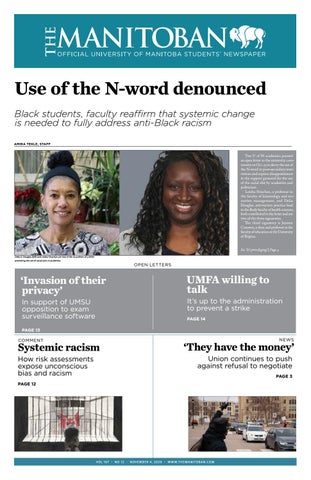
Leisha Strachan, a professor in the faculty of kinesiology and recreation management, and Delia Douglas, anti-racism practice lead in the Rady faculty of health sciences, both contributed to the letter and are two of the three signatories.
The third signatory is Jerome Cranston, a dean and professor in the faculty of education at the University of Regina.
See ‘It’s privileging’ | Page 4
Systemic
AMIRA TEKLE, STAFF
Delia D. Douglas (left) and Leisha Strachan are two of the co-authors of a letter protesting the use of racial slurs in academia.
News
Sustainability month goes virtual
Sustainability office held online events, theme days, contests
DAMIEN DAVIS, STAFF
The U of M’s office of sustainability has been thriving in an online setting thanks to social media.
With October being sustainability month, the U of M’s office of sustainability has shifted to hosting events and activities relating to sustainability and climate change online.
The office has been promoting sustainability month through its social media. It has been reaching students through mediums like Instagram, where it posted daily tips and facts during waste reduction week, which took place from Oct. 19 to 25.
According to the Waste Reduction Week in Canada campaign, waste reduction week is “a year-round campaign focused on the principles of the circular econ-
omy, resource efficiency and waste reduction.”
“Usually we do a lot of in-person workshops or videos or speaker sessions, but this year we wanted to focus it all online because that was kind of the only option we had,” said Christie Nairn, director of the office of sustainability.
“So, we really focused on promoting things on Facebook, Instagram and Twitter.”
Activities and theme days that took place throughout the month included sustainability bingo, meatless Monday recipes, energy efficiency day, contests and an “expert chat” on World Food Day with Marcos Cordeiro, assistant professor in the department of animal science.
Nairn said she felt getting
events up and running online went “pretty smoothly.”
“Anything we kind of want to do on social media, we have a lot of freedom to put out different messages that are related to sustainability,” she said.
“And if anything, not being constrained with a physical event or physical environment might’ve made it a little bit more flexible and we can focus on more topics within the month versus having to physically plan an event, or plan catering, or whatever else goes along with actually planning something on campus.”
With sustainability month over, achieving sustainability is still of vital importance to Nairn.
“Sustainability is still really top of mind for a lot of students and just
because [COVID-19] is happening, it doesn’t mean that climate change isn’t happening.”
“It’s really important to just keep plugging along with all the things that we were doing before. Some things obviously look differently but, trying to be as sustainable as possible while you’re working at home or whatever you’re doing during [COVID-19], and also just being kind to yourself,” she added.
“There’s a lot of anxiety that comes along with a global pandemic, and also with climate change and all that stuff. So, making sure that everyone is being kind to themselves and seeking necessary resources to kind of lower that anxiety, to just feel things in incremental steps.”
New model seeks to grant funds based on performance
Provincial
influence source of concern for some U of M members
GILLIAN BROWN, STAFF
As the provincial government seeks to improve the operation of post-secondary education in Manitoba, the government now plans to adopt a performance-based finance model.
The decision was made after the movement of responsibility for post-secondary institutions from the department of education to the department of economic development and training.
The Tennessee model, named after its state of origin, is what the province is basing its model on, and which was used as that basis after reviewing provinces developing similar practices, including Alberta, British Columbia and Ontario.
The original Tennessee model based funding levels on the numbers of graduations, degrees and credits, rather than just enrolment numbers.
Changes began this year when post-secondary institutions took an additional one per cent cut from their operating budgets, which, though already planned before the pandemic, was placed this year into a Transitional Support Fund of $25.6 million in order to help institutions respond to the challenges posed by COVID-19.
To access the funding, publicly funded Manitoban universities and colleges had to submit a plan to the department of economic development and training by Sept. 15, which outlined how the funding would be used by the institutions.
Plans submitted by institutions needed to demonstrate how the funding would be used to direct programs according to labour mar-
ket demands, and in response to the pandemic, to maintaining highquality education through new online methods and respond to any unanticipated enrolment changes along with any other challenges that may arise.
Universities and colleges were mandated to respond to changing labour markets by adapting academic programs to respond to needed skills along with “ceasing programs that lack responsiveness and value in a modern context and building programs that deliver the skills needed for today and tomorrow,” according to the mandate letter sent to the U of M this August, following the original mandate from December 2019.
U of M president and vice-chancellor Michael Benarroch met in September with Manitoba Premier Brian Pallister along with Minister of Economic Development and Training Ralph Eichler.
In the latest senate meeting in October, Benarroch informed the senate that a plan had been submitted to the government for transitional support funds and, though there have been no tuition or enrolment decreases, the university had reported COVID-19 related costs of nearly $18 million.
The $18 million did not include costs that were supported by the federal government. This included wage subsidies and some costs for research.
He also reported that, recently, the province had indicated a possible change coming to the requirements to access outcomes-based funding: institutions may have
to meet government-established metrics in order to receive entire operating grants.
This proposed change is in accordance with the auditor general’s recent findings that provincial oversight of post-secondary institutional performance was “weak,” and, in order to improve that, recommended “the establishment of results-based performance metrics to ensure oversight of institutions.”
Benarroch also reported that although future discussions with the provincial government would allow institutions to influence government decisions regarding this finance model, the introduction of the performance-based funding model could could potentially create uncertainty about provincial funding each year.
This developing form of provincial funding has been an ongoing source of concern among U of M faculty since its announcement and was addressed in a senate meeting last March.
Michael Shaw, faculty of science senator and now UMFA president, questioned former president and vice-chancellor David Barnard about the university’s involvement with Horizon Manitoba, a project which aimed to bring together post-secondary education with the private business sector and the labour market, without consulting the senate.
Shaw submitted his concerns that “this corporate partnership will directly impact the academic functions of the university.” Barnard responded, saying that the project was approved by himself
and that the U of M’s participation would not affect the university’s autonomy from the government.
The October senate meeting addressed the implementation of the performance-based funding model in other provinces.
During the question period, UMFA assessor Orvie Dingwall asked Benarroch, given that the funding model “will negatively impact the academic freedom of individual academics and the autonomy of Alberta’s universities,” what measures the administration will be taking to prevent that from happening at the University of Manitoba.
Benarroch reassured that the performance of the model in the Alberta government would not be indicative of its performance in Manitoba and that he expects that the government will positively implement the Tennessee funding model in some form, but not in the ways that other provinces have.
He urged members of the senate to look further into the Tennessee model and its accomplishments.
The U of M is waiting on a response to its submission for the Transitional Support Fund from the government.
UMFA votes for potential strike against U of M’s refusal to negotiate wages UMFA’s concerns lie not with wages alone, but with U of M’s use of ‘unconstitutional’ practices
CAM CANNON, STAFF
The possibility of a strike has been growing amongst the University of Manitoba Faculty Association (UMFA), who this weekend voted in favour of a strike against U of M’s refusal to negotiate wages.
There was 85 per cent turnout to vote and 80 per cent of those union members voted in favour of potential strike action. UMFA has called for a protest this Thursday at the legislature.
If the university administration does not either agree to binding arbitration, a process where two parties seek a binding resolution by an agreed-upon third party, or resume negotiations in good faith, UMFA may begin a strike.
In the event of a strike, UMFA members will not be conducting classes or answering student emails. Some teaching faculty may even temporarily revoke access to course content on UM Learn.
Courses taught by sessional instructors — who are members of CUPE 3909, not UMFA — are expected to continue.
UMFA has been re-negotiating a collective agreement since Aug. 20 after a ruling in June that the Public Services Sustainability Act (PSSA) — a 2017 bill which was never proclaimed but was used to freeze the wages of public employees at current levels — was unconstitutional.
See UMSU, UMGSA | Page 5
Editors: Gillian Brown and Amira Tekle
‘It’s privileging the voices of those who are racially dominant’
Continued from front page
The letter was sparked by a recent incident at the University of Ottawa. Professor Verushka LieutenantDuval used the N-word in class. Thirty-four University of Ottawa professors signed a letter in support of Lieutenant-Duval, saying disallowing the racial slur infringes on academic freedom.
Lieutenant-Duval was suspended but has since returned to teaching. Amid mounting controversy and outrage, she has also publicly apologized.
Prominent politicians have also come out in support of LieutenantDuval, including Quebec Premier François Legault and Bloc Québécois leader and MP Yves-François Blanchet. Conservative party leader and MP Erin O’Toole also did not condemn the use of the slur by Lieutenant-Duval, saying it is an issue of freedom of speech.
Strachan said she was unsurprised upon first hearing about the incident but was disheartened by responses from people in the academic community and politicians.
“There’s so many times this word has been used in academic institutions for years and years and years,” she said.
“For me, the larger impetus for the letter was working at my computer at home and listening to the news in the background and the press conferences that then came from the politicians, the Conservative leader [O’Toole] and the Bloc [Québécois] leader [Blanchet] in particular, and their refusal to denounce the use of the word even when asked a super
pointed question.”
Strachan said she began writing the letter after hearing of the wave of support for Lieutenant-Duval and the use of the slur in academia.
“That was it for me,” she said. “I had to stop everything I was doing and start writing something.”
Strachan said she received a positive response from the Black student community at the University of Ottawa, who have been directly affected on their campus.
“I’ve been very heartened by the response from students at the University of Ottawa,” she said.
“After I sent it out, I tagged [on social media] the Black students [association] at U of Ottawa.”
“They’ve been reaching out to me,
“This isn’t a debate, it’s not a controversy. It’s an example of anti-black racism” — Delia Douglas, faculty of health sciences anti-racism practice lead
saying ‘thank you’ for putting it out there.”
Strachan said she believes the N-word should never be used in higher education.
“Its continued use continues to victimize people,” she said. “To me,
there’s just no place for it […] in the higher institutions that we belong to.”
Douglas said the focus on the debate on academic freedom is drawing attention away from the targets of the slur and “privileging the voices of the powerful.”
“This isn’t a debate, it’s not a controversy,” Douglas said. “It’s an example of anti-Black racism.”
Strachan pointed to a line in the open letter that reads, “focusing on intent maintains racial hierarchies, thereby sustaining racism by privileging the initiator.”
“It’s not freedom to oppress,” Douglas said, noting the well-documented underrepresentation of Black and Indigenous people in academia.
“It’s privileging the voices of those who are racially dominant.”
“What that says to me is that the dignity, the rights of Black students, Black staff, Black faculty, Black peoples is irrelevant and that we are just not seen to be of value, we are not seen to be human,” Douglas said.
“We’re constantly fighting for recognition of our humanness, this constant fight to be seen and to be heard.”
“I just thought about the students, the students who complained [and] essentially nothing happened,” said Strachan.
“You subject Black students to racism, and then they are supposed to [do] what? Teach you about it?” said Douglas.
“The message [from the institution to Black students] is ‘You don’t belong, and we’re happy if you leave,’” she said.
In terms of anti-racism policies, the U of M’s Rady faculty of health
sciences approved the first antiracism policy at any post-secondary institution in Canada just this past August. Douglas was instrumental in its creation and implementation.
Strachan said an anti-racism policy could serve as a first step but that more needs to be done.
“We know there has to be more changes in the academy, there has to be more Black people in the academy, more strategic hirings, things that could happen that could support more Black voices in the academy,” said Strachan.
“We actually need to talk very specifically about racial equity,” said Douglas. “Because of the lack of racially different peoples in leadership and senior admin, the vision is narrow.”
Black student leaders say more needs to be done by universities to curb anti-Black racism
Reem Elmahi, the president of the University of Manitoba Black Students’ Union (UMBSU), and Vimbainashe Daisy Gudu, vicepresident advocacy of the UMBSU, were also not taken by surprise by the incident at the University of Ottawa.
“The thing that surprised me the most was the 34 professors who were in favour of the faculty member that did use the word,” said Gudu.
“That alone as a Black student made me personally feel violated that someone else who is not in my shoes [feels] okay to use that word.”
“Regardless of the context [in which] the N-word is used, it should just be completely banned to protect
Black students,” Gudu said. Gudu said post-secondary institutions have a role and a responsibility to publicly denounce the use of such slurs.
“The universities should be at a place where they’re able to denounce any stakeholders that use such terms within the university, and only just to take it upon themselves to make a difference regardless if it didn’t happen to us because we do know we have our own issues.”
Elmahi said it is “disheartening” to see the lack of Black faculty at the U of M and the previous lack of an organization for all Black students.
“I remember specifically [when] me and my friend first joined the U of M, we were looking at all the clubs to join and [thought] ‘we’re going to join the Black student union,’” Elmahi said.
“And then we just looked, and there wasn’t one, and we were so shocked to find that.”
Elmahi said the main aim of the UMBSU is to help make the U of M “more inclusive for Black students,” and that she would welcome the implementation of anti-racism policies.
“Many times, we find that in classrooms, Black students still feel the need to go an extra mile to be seen or to be acknowledged, and I don’t feel like that is right,” said Gudu.
“Putting in that extra effort to denounce racism and make sure Black students feel comfortable in a place of education is really important to us,” said Elmahi.
“Putting ‘Black Lives Matter’ on your university Instagram page isn’t enough.”
Petition asks for tuition cuts, assignment extensions amid labour dispute and post-secondary cuts
GILLIAN BROWN, STAFF
U
niversity students at both the U of M and the University of Winnipeg are signing an online petition for “student compensation” for what the petition says are the problems brought by online learning.
As of press time Monday, the petition has garnered 7,465 signatures, almost reaching the 7,500 goal.
The petition was started by Umar Awan, a first-year political science student at the U of W.
He said the goals of the petition
are to get universities to try and reduce tuition costs and provide more support in completing online assignments.
He wrote in the petition that he believes “professors think that online courses are much easier than in-person classes,” and that they “should be more understanding and give us more upload time than we are already receiving.”
At the same time, U of M professors, faculty and staff have brought
forward concerns regarding their own workload and mental health to the university.
In the latest senate meeting, the University of Manitoba Faculty Association (UMFA) vice-president and assessor Orvie Dingwall said “student enrolment has increased significantly from last year.
“The move to online instruction has created a significant increase of workload for teaching faculty.”
She went on to ask, “what sup-
UMSU, UMGSA vote to support faculty
Continued from page 3
The association and the administration have met eight times for negotiations.
UMFA president Michael Shaw said the main issue is the University of Manitoba’s refusal to “bargain in any significant way with us.”
According to Shaw, the university has not budged on its position on the issue since its first meeting this summer.
“They initially claimed there was uncertainty about fall enrolment, we now know what the fall enrolment is, and they continue to cite uncertainty,” he added.
This fall, undergraduate enrolment at the university is up 3.2 per cent from fall 2019.
UMFA is asking for “a more equitable salary grid, a modest increase to wages for the 2020-2021 contract year and extra supports during the pandemic for those with dependent care responsibilities,” according to an UMFA press release from Nov 2.
The union also asks that the original wage offer that was taken off the table in 2016 after the PSSA be brought back and that the wages denied be paid to UMFA members.
Despite court rulings against the PSSA and provincial government interference, which resulted in a UMFA strike in 2016 — for which the administration was fined by the Manitoba Labour Board a year
later — the provincial government has once again mandated the university administration to offer no wage increase, which, according to the UMFA press release, the U of M seeks to maintain.
UMFA is the first public sector labour union re-negotiating collective agreements since the June ruling against the PSSA.
“We have an obligation to all the other public-sector unions in Manitoba to not accept this zero [per cent offer] because that law is unconstitutional,” he said.
In a message to students sent through email, the University of Manitoba president Michael Benarroch and vice-presidents maintained that administration is “ready to return to the bargaining table at any time.”
They said the priority is the wellbeing of students and that “the universities remains committed ultimately to bring UMFA salaries more in line with salaries at peer universities.”
According to a statement made by UMFA, faculty compensation is currently ranked 13th for professor and associate professors and 14th for assistant professors out of 15 similar post-secondary institutions in the country.
In contrast, the former president of the University of Manitoba, David Barnard, earned a salary of $452,000 in 2016, one of the highest for university administration in the country at the time.
This year, the university also saw a permanent one per cent cut to provincial funding accompanied by a one-time cut of four per cent — the one-time cut accounting for close to $14 million.
In a presentation to the UMSU board of directors at its meeting on Oct. 22, Shaw claimed that, currently, the University of Manitoba has an operating surplus of $250 million — up $150 million from 2015.
“They have the money,” said Shaw in a later interview, referring to the U of M.
“We want to do good with that money.”
Shaw reported that UMFA passed a motion last Monday, declaring that any back-pay dues resulting from collective bargaining will be used to create a bursary for primarily BIPOC students.
On Monday, UMSU held an emergency board meeting to vote on a motion to support UMFA’s request for binding arbitration.
Prior to the meeting, UMSU president Jelynn Dela Cruz said, “remaining neutral isn’t necessarily something that a student union should be considering.”
Students should consider “not only the academic ecosystem and fair treatment but also the quality of learning that we receive as a result.”
“We need to use our influence and our voices in a way that can shift the
ports is administration providing to reduce this strain and prevent burnout?”
For teaching faculty, the university said they provided faculty consultations, along with resources and supports in video editing, recording and course development processes.
Mental health and well-being supports were made available to the faculty.
The petition is circulating at the same time UMFA took a vote to strike against the university’s refusal to participate in the salary reopener of the collective agreement.
Union members are expressing their frustrations with not only a lack of support from their employers but also the legal contract and constitutional violations regarding wages.
After the strike in 2016, UMFA’s rules adhered to the Public Services Sustainability Act (PSSA), which limited salaries for workers in the public sector but, in June, the act was deemed “unconstitutional.”
Since that declaration, the university has granted union members a zero per cent wage increase, which is in line with the provincial mandate released this past August, and is refusing to negotiate on the issue.
All while this is happening, the university had to face a budget cut of five per cent, or $17.3 million, four
percentage points more than was expected this year, related to the pandemic.
In July, deputy provost (academic planning and programs) Todd Mondor, who developed the tuition plan, said the 3.75 per cent tuition increase was necessary as “a last resort” to be able to continue to financially support the university.
Awan’s petition aims to reduce those tuition increases and loosen assignment deadlines to help students’ mental health and emphasizes what he calls the irony that “professors tend to talk about mental health.”
He requests that the presidents “talk with the professors about mental health and then provide us with a solution to reduce our stress and reduce [our] screen time,” and hopes to achieve those goals by the end of the fall term.
So far, he has reached out to both the University of Manitoba Students’ Union and the University of Winnipeg Students’ Association but has contacted no members of faculty or administration at either institution. — with files from Cam Cannon
momentum or the direction that any discussion is going,” she added.
UMSU has released statements highlighting concerns about stress and uncertainty that an UMFA strike would bring on top of the COVID-19 pandemic.
UMSU’s board of directors voted in favour of a motion supporting third-party binding arbitration in an emergency meeting convened Nov. 2. The vote was unanimous and signalled support for UMFA’s push for binding arbitration to settle salary negotiations between itself and the university.
Dela Cruz said UMSU will immediately begin work on a petition with UMFA to pressure the administration into accepting binding arbitration.
This past week, the U of M Graduate Students’ Association (UMGSA) voted to support UMFA’s demands.
Shannon Furness, a political studies honours student in her fourth year, said she feels the university administration is taking advantage of the COVID-19 pandemic — using student frustrations and uncertainty to turn student opinion against UMFA.
“It just gives the administration an opportunity to use students as leverage if students are unaware of the reasons why they should be supporting UMFA, and I think that’s actually a main reason why a lot of students are getting pissed off at this.”
Starting her degree in 2016 — the year that UMFA went on strike for three weeks for reasons similar to now — Furness also recalled the uncertainty of classes taking place, when exams would be and when assignments would be due.
Furness also raised concerns that student-employees — such as teaching assistants and markers at the university — are not being adequately represented in current messaging from UMSU.
“My pay depends on the hours that I put in, and if classes are cancelled, I can’t lead discussions, I can’t mark assignments because those aren’t coming in.”
A lot of students that rely on positions at the U of M, especially during the pandemic, “need them to pay rent, and they need them to pay for food […] and the basic necessities of life,” she said.
In Furness’s opinion, a strike would be “entirely to the fault of the University of Manitoba.”
She went on to say that, if there were a strike, she would hope that the university and UMFA “would come to some sort of agreement, or it would get resolved very quickly, knowing that it’s not in the interests of both parties.”
PHOTO BY BASEL ABDELAZIZ
The hidden layers of sea ice Webinar discusses sea ice formation, climate change
COLIN IJEBOR, STAFF
Sea ice is cool — and not just because of its temperature. It is a habitat for many different animals, including polar bears and seals, and it is a vital aspect of survival in the Arctic.
John Iacozza, a senior instructor in the department of environment and geography as well as the executive director of the Centre for Earth Observation Science, has been studying sea ice around Hudson Bay for the past 26 years.
His research is focused on the formation and distribution of sea ice and snow on a large scale and the understanding of how they relate to habitat.
Sea ice is more than just a solid, static expanse of ice. It is dynamic in nature, moving around, shrinking and enlarging as time goes by.
“It is constantly changing,” Iacozza said in a webinar he gave last week.
“It’s an area of the world that you can look at it at different time scales, from days to weeks to months to years to decades, and it’s always something new.”
Sea ice forms in the fall when temperatures go below -1.8 degrees Celsius, Iacozza explained. The normal freezing point of water is zero degrees, but the salt content of the ocean lowers its freezing point. As the ice freezes, it pumps the salt into the ocean below and continues to grow.
There are two ways sea ice can grow: thermodynamic growth and dynamic growth. Thermodynamic growth is caused by temperature but, by itself, is not sufficient to make very thick pieces of sea ice.
“As it is getting colder, the ice is going to get thicker and thicker and thicker, until it reaches a threshold where it doesn’t matter anymore how cold the atmosphere is,” Iacozza said in an interview.
Very thick sea ice is formed during dynamic growth where, as the ice is moved about by the ocean currents, the pieces break apart and come together. When different pieces become frozen together, the thickness increases.
In fact, dynamic growth can cre-
ate pieces of ice as big as 10 metres thick.
Sea ice can take many different forms, but there are two main types. The first is seasonal ice or first-year ice.
“That’s ice that grows in the fall and winter, and then in the spring, it’ll melt,” Iacozza explained.
Multi-year ice, on the other hand, is ice that survives at least one melt season and does not melt completely in the spring and summer.
Sea ice helps to moderate the temperature of the earth, with Iacozza calling it “the air conditioner of the world,” through the sea-ice-albedo feedback system. The term “albedo” means the degree of reflectivity of solar energy, and sea ice has high albedo because of its bright colour. This allows it to reflect the sunlight reaching the earth, reducing the surface temperature.
The ocean, on the other hand, has a lower albedo due to its dark colour, which causes it to absorb more energy from the sun.
“From a global warming perspective, you can imagine that as we’re
trapping more heat in our system because of greenhouse gases, more heat is going to be trapped at the surface, which causes sea ice and snow
“It’s an area of the world that you can look at it
at
different
time scales
[…] and it’s always something new”— John Iacozza, Centre for Earth Observation Science director
to form later in the fall and break up earlier in the spring, so that period where there’s a white surface is shorter,” Iacozza said. The ocean is exposed for a longer period and absorbing more solar energy, causing higher temperatures.
This sets up a negative feedback loop. If we stop putting greenhouse gases in the environment, the sea ice will recover only after the gases dissipate from the atmosphere, and this may take years or even decades for gases that have a long residence time.
The shortened sea ice season also has serious implications for polar bears and other Arctic animals, as they will have to migrate further away from their natural habitat in search of food.
Additionally, Hudson Bay polar bears may experience reproductive failures and no longer exist in Hudson Bay by the end of the century.
Going forward, Iacozza is excited to continue his study of the Arctic at the Churchill Marine Observatory, a new research facility being built by the University of Manitoba in collaboration with a number of academic, federal and private partners. Iacozza is hopeful it will be fully up and running by next fall.
“It allows us a platform to study the Arctic in the Arctic and really control the environment,” Iacozza said.
GRAPHIC BY JENELLE MCCANN
Father of microcredit criticizes vaccine profiteering Nobel laureate on how
pandemic exposes economic injustice
SARAH DORAN, STAFF
The Arthur V. Mauro Institute for Peace and Justice and the University of Manitoba’s peace and conflict studies graduate program co-hosted a discussion with Nobel laureate Muhammad Yunus on Oct. 29. The event, a collaboration with Rotary District 5550 World Peace Partners and the Conflict and Resilience Research Institute of Canada, included a short lecture given by Yunus, a series of prepared questions from graduate students and audience questions.
Yunus, a Bangladeshi native, was jointly awarded the Nobel Peace Prize in 2006 along with Grameen Bank, which he established in 1983. The name means “village bank” in Bengali and reflects the microcredit principles the bank pioneered.
Microcredit is a type of finance in which small long-term loans are granted with no collateral to people who normally have difficulty obtaining credit, such as impoverished people living in rural or undeveloped areas. For example, the average loan from Grameen is only US$100. Yunus is widely considered the father of modern microcredit after creating
a program in 1976 to help the poor of Bangladesh prior to formally institutionalizing the practice with Grameen.
Yunus turned his extensive experience with studying poverty from an economic perspective to discuss how COVID-19 has influenced widespread economic injustice.
Yunus said the “pandemic has created a situation where we have lots of opportunities for reflection — looking back [to] see what we have been doing, why we’re doing it the right way, the wrong way, what’s up for us in the future.”
“It’s also a good time for observations because [the] pandemic has revealed most of the terrible weaknesses that we have in our system and our society and our thinking. So now this is a good time to observe that because everything became very visual […] how selfish we are in every way.
It’s in a personal way, a national way.
“And when the pandemic came, every nation wanted to go back to their own folks. ‘We have to save these people — forget about what
happens to the rest of the world.’”
He went on to criticize the way the process of creating a vaccine has unfolded so far. Wealthy countries have more access to up-to-date research simply because of their wealth and will very likely be the first to receive an eventual vaccine.
“It shouldn’t be controlled by the
“It’s not a moneymaking proposition here. It’s about the life-saving proposition” — Muhammad Yunus, Nobel laureate
commercial interest,” Yunus said.
“It’s not a money-making proposition here. It’s about the life-saving proposition — how to save life everywhere, no matter which country, which living you [make], you are
protected from this virus, protected from the disease.”
He gave Jonas Salk, the inventor of the polio vaccine, as an example. Salk refused to patent the vaccine, saying it belonged to the people, which made the vaccine easily accessible. When interviewed in 1955, Salk famously said, “There is no patent. Could you patent the sun?”
“It’s particularly striking because [COVID-19] is not something that you can protect yourself [from] without protecting your neighbours, your acquaintances, other people who live on this planet,” Yunus said.
From an economic perspective, Yunus described the cycle of young people in India moving to the city from their rural hometowns being disrupted by the sudden lack of economic activity due to COVID-19. He spoke about the extent to which trying to maximize a business’ profits can severely backfire in situations like the pandemic and how a more personal form of finance — social business, which involves more diverse parts of a given population and is aimed at solving a social cause — can create a more effective safety net in
times of disaster.
During the graduate student question portion of the event, Yunus spoke about his frustration with international refusal to meaningfully engage with climate change. He also expressed his fears about the continued concentration of wealth and the possibility of widespread artificial intelligence driving people out of work.
A major part of his advice for the future involved getting young people involved, whether that includes running competitions for young businesspeople to get involved with rotary groups or simply incentivizing young people to present alternative ideas for society and “build new roads.”
“This is an opportunity which will not be repeated in many generations after us,” Yunus said.
“If you don’t make use of this opportunity, all the generations — if your generation can survive on this planet — they would be blaming us. ‘You had an opportunity. You didn’t take it. You didn’t do it.’
“All I’m saying [is] if we make up our mind, it’s possible. Nothing is impossible for human beings.”
GRAPHIC BY JENELLE MCCANN
International student hopeful for more experiences
Plavan Deka discusses being an international student during COVID-19
JESSE BOILY, STAFF
Plavan Deka’s first winter experience was on Jan. 1, 2020.
His first steps leaving the Winnipeg James Armstrong Richardson International Airport would become his first steps into a journey in Canada that he could not have predicted when he left India — a cold breeze cut through him and it was not as bad as he thought it might be. He was a bit upset that his next few steps would be into a taxi — he wished he could have more time to experience the snowy landscape.
Deka, 26, arrived from Delhi, India. He came to Winnipeg to study at the University of Manitoba and to complete his master’s degree in the school of business.
For Deka, a benefit of being an international student was “to meet new people, to understand different cultures, to see how their lives have been, to understand what they’re thinking or what their beliefs are, to have different perspectives.”
In India, he was told that western universities were massive places with tons of resources. His excitement was high being in Canada, but that would all begin to change in March.
As the virus causing COVID-19 swept across Canada, classes transi-
tioned to online lectures.
“OK, this might be just for two months,” Deka said he thought at the time. Surely his summer classes would be back to normal.
The pandemic continued and Deka saw all his class terms transfer to online learning — first summer 2020, then fall 2020 and most recently, winter 2021.
“It did bother me a lot the day when we received the mail,” Deka said.
“I was angry. I was upset, they could have found a way [to hold inperson classes].”
Deka understands that it’s a difficult time. Universities across Canada have made similar decisions.
“All in all, I would have wished I did not come at this time.”
Deka admits that it is easy to stay in bed during lectures, turn off the camera and mic and want to take a nap during class.
He had to adjust his mindset for online classes and ensure he got out of his bed and took his studies seriously, as he once did in person.
That means not making food or playing on his phone during class — he needed to give his school work the attention he had given it before.
Deka makes an effort to speak to his family every two to three days, but with a time difference of 11.5 hours and a full course load, making time
Life in Canada turned into staying in with nowhere to go
to talk to his loved ones is difficult.
While Winnipeg has a much lower number of COVID-19 cases, back home in Delhi, cases have been rapidly rising.
The impact of COVID-19 has been devastating for the people of India. On Nov. 2 the country faced 46,963 new cases with 470 new deaths. And Delhi is not an exception — the city has recorded approximately 5,000 new COVID-19 cases daily since Oct. 29. Meanwhile for Deka, life in Canada turned into staying in with nowhere to go. His sleep schedule shifted to staying up late and sleeping into the afternoon.
The reopening of the Active Living Centre at the U of M helped
him find routine again, and he started going three times a week.
“It was good news because at least we are getting to go to the university and see it, see people around, while still maintaining the physical distance,” Deka said.
The gym kept him occupied at a time when anxieties weighed heavy.
Various worries have stuck with Deka through the pandemic.
“I was not worried about getting a job or when I would be graduating back in [January and February] as much as I am worried now,” he said.
“Initially, my plan was to complete [the program] in 20 months, but after how COVID impacted the economy, I’m scared to go out […] into an economy that is so affected.”
Deka changed his plans and wants to take an extra four months to graduate now.
He has a friend who arrived with him in January but will have to graduate in April 2021. He only experienced two-and-a-half months of the typical Canadian university experience before COVID-19 shut down the university.
“His whole degree was online, so he is trying to understand how valuable of a degree it was for him,” Deka said.
“He did not get one major experience that he was looking forward to — that international experience.”
Deka hopes he will be able to participate in in-person classes again.
“You never value something until it’s gone,” he said, thinking back to his limited in-class time in Canada.
He also knows some international students that are happy and taking advantage of the online classes by returning home.
He hopes to have the opportunity to learn more about Canada and have the university experience that is typical here.
As for post-pandemic life, Deka thinks people will value human interaction more after restrictions are lifted.
He remembers being with friends who would be on their phones during visits, but he believes, after COVID19, people will pay less attention to their phones and appreciate the company of others more.
Although Deka is disappointed by the first year of his studies at the U of M, he remains hopeful that his situation will improve. As should we all.
“It’s not just me […] Everyone is affected.”
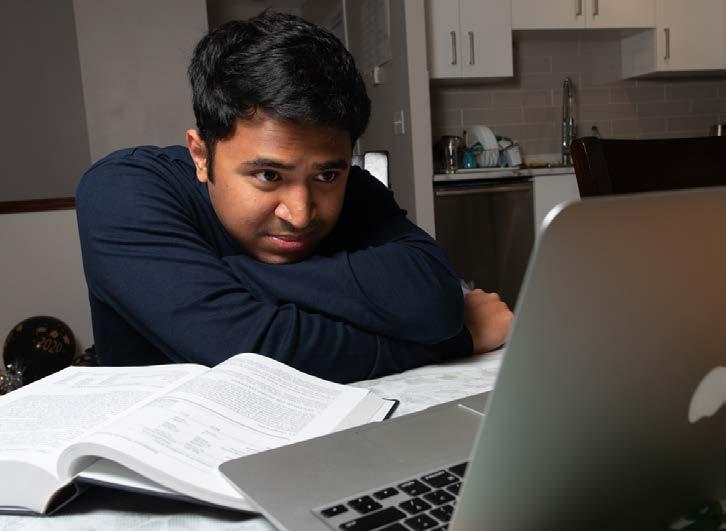
PHOTO BY JESSE BOILY
EDITOR-IN-CHIEF Matthew Doering editor@themanitoban.com
BUSINESS MANAGER Alice Teufack accounts@themanitoban.com
ADVERTISING CO-ORDINATOR Diego Castro ads@themanitoban.com
EDITORIAL
MANAGING EDITOR Ty Brass me@themanitoban.com
NEWS EDITOR Amira Tekle amira@themanitoban.com
NEWS EDITOR Gillian Brown gillian@themanitoban.com
COMMENT EDITOR Lucas Edmond comment@themanitoban.com
ARTS AND CULTURE EDITOR Shaylyn MaharajPoliah arts@themanitoban.com
A “volunteer staff” member is defined as a person who has had three volunteer articles, photographs, or pieces of art of reasonable length and/or substance published in the current publishing year of the Manitoban. Any individual who qualifies must be voted in by a majority vote at a Manitoban editorial board meeting. Elected representatives and non-students may be excluded from holding votes as volunteer staff members in accordance with the Manitoban Constitution.
Streaming could be a possible replacement for traditional cinema
NISH JOSHI, STAFF
The global film industry has been heavily affected by COVID-19. It has virtually halted film productions and has closed cinemas around the world. There is a lot of uncertainty, but with great uncertainty comes great creativity.
Understandably, this is not an ideal situation for cinemas.
Recently, a few significant cinema chains have reported they will be reopening. However, this may not make a massive difference as many people could potentially opt to avoid theatres all together.
Winnipeg reopened its theatres July 26 after being closed for nearly five months. Theatres have been open for meager three months following social distance restrictions, but they will be forced to close again as Winnipeg moves into red restriction Nov. 2 due to a surge in active cases.
Movies releasing in theatres will have to be well worth a trip out of the house
With this in mind, COVID-19 is not over. Policy regarding economic and social activity varies depending on where you are, and the film industry has taken a huge hit. Additionally, numerous health experts have said it is too soon to be returning to cinemas.
Even when the cinemas reopen, venue operators will face a shrinking theatrical window. This means theatres will have less time to run movies and less of an opportunity to screen films in-house. Because movies will be out of theatres much faster, they will be available to be purchased, downloaded or streamed much sooner.
Even when theatres are given permission to operate in a given region of the world, COVID19 measures will still disrupt revenues. Not as
many people will be allowed to attend the screenings and, as a result, time slots will be reduced and the quantity of film an average theatre can screen will diminish.
A lot of studios’ productions have been delayed or halted until they figure out how movies are going to be made while following COVID-19 precautions.
But, given the uncertainty with restrictions, many movies that finished production during the COVID-19 pandemic have been released straight to streaming platforms. For example, Disney chose to put its live-action reboot of Mulan onto its streaming service.
Streaming services were a problem for cinemas before the pandemic. Matthew Ball, a media analyst, claims 15 years ago prevalent movie producers like Warner Bros. Entertainment, Walt Disney, 20th Century Fox, Paramount Pictures, Sony Pictures and Universal Pictures released around 20 to 25 major films annually. Since then, the number of movies they have released has steadily declined each year.
By 2019, those same producers released approximately nine movies total due to the rise of popular streaming platforms like Netflix, Amazon Prime Video and Crave.
These platforms acquire the rights to movies and make movies that are not made by the major studios. By doing so, consumers have access to new movies in the comfort of their homes. According to media reports, Netflix gained around 16 million subscribers in the first three months of 2020, and Disney Plus now has over 50 million subscribers.
Now more than ever, films are going straight to streaming services. Subsequently, this has cut out much of the film industry, satellite rights and movie theatres.
The film industry may be increasingly willing to transition to digital releases due to the restraints the novel coronavirus imposes. This may impact peoples’ view of cinema. By the time theatres are allowed to open at full capacity, audiences will have consumed a significant amount of material from streaming platforms.
Due to the high rates of supply and easy access to movies, audiences may have higher expectations of the movies releasing in theatres. Cinema and filmmakers may have to spend more money to produce content that matches their audiences’ new standard. Movies released in theatres will have to be well worth a trip out of the house.
The atmosphere between a movie at home compared to a movie in the theatres varies greatly. For example, when grand movies like Titanic, Avatar or Avengers: Endgame came out, you could feel peoples’ emotions in the theatre hall.
Unfortunately, this kind of experience cannot be replicated on a streaming platform. The stories themselves can be emanated on streaming platforms, but the intense atmosphere of high-tech sound systems and visuals that theatres provide will be sorely missed.
Although atmosphere is important to average viewers, theatres may have to find ways to make the screening tradition more desirable. If they don’t, online streaming services could take their place after the dust from COVID-19 settles.
This is not the first time people have predicted the death of cinema. Jean-Luc Godard, a famous filmmaker and critic, notoriously ended his film Weekend with title cards that claimed, “End of Film” and “End of Cinema.” Godard was caught in a period of flux in the film industry. His early films that were released in the 1960s had no problem adopting popular culture and using it to his advantage, but as the world and film moved on, Godard remained bitterly stuck in the past, and so did his films.
What Godard didn’t understand was that the film industry works off of popular taste, it partakes in its own creative destruction as the world and culture changes.
The film industry is always evolving. What it is facing now is just a small bump in the road. Filmmakers will continue to produce new stories and there will always be great avenues to enjoy them. Cinema will never die, it simply changes.
GRAPHIC BY DALLIN CHICOINE
Dear 2020 Holiday Hamper Program Sponsors,
Due to COVID-19, we are seeking monetary donations for students in need during the 2020 holiday season. All our sponsors will be recognized and thanked in at least one social media post for their contributions to the program.
If you are interested in donating, have any questions, or need more information please email: scoulthard@umsu.ca
Comment Editor: Lucas Edmond Contact: comment@themanitoban.com
International students not receiving enough support
The university has failed to adequately support international students this academic year
MATTHEW AVERBECK, STAFF
With the U of M approaching the end of the first term of the 2020-21 academic year, there have been discussions surrounding the challenges of remote learning. While this is an important discussion to have, it seems like international students have been left out of the conversation.
International students comprise about 20 per cent of the student body population and pay over three times as much as domestic undergraduate students in tuition. Yet, they have not received much additional support this academic year.
Instead, they have been forced to pay more and are receiving less.
On top of already unfair conditions, the 2020-21 academic year has created significant adversity for those studying abroad. Students have faced uncertain border restrictions, rising tuition costs for a lower-quality education and the option of either living far from family during a pandemic or
attempting to complete the year in a different time zone.
At the beginning of the pandemic, international students faced immense stress and uncertainty in the midst of final exams. Many international students living in student residences were forced to leave their dorms at the end of April despite having nowhere else to go due to travel restrictions.
While the university’s residence director, Barry Stone, attempted to show flexibility — supposedly granting many extensions for students who needed more time to find housing — student residence was unable to accommodate everyone given restrictions that limited university residence’s capacity.
It’s difficult to blame the university for that challenging situation. Still, it is just another example of the added stresses that many international students have faced during this pandemic. And the lack of support from the university has certainly
not helped.
One of the most pressing issues that international students face are the rising tuition fees during an economic recession.
Last academic year, international and domestic students’ tuition rose by 3.75 per cent. Similarly, the U of M rose tuition fees by an average of 3.75 per cent for the 2020-2021 academic year. While these were only a small increases for many domestic students due to already low tuition, it’s a dramatic increase for international students. Especially considering many students reported having difficulties finding work this past summer.
Although many domestic students couldn’t find a job this past summer, many were able to apply for the Canada Emergency Student Benefit (CESB) or the Canadian Emergency Response Benefit (CERB). International students were left out of these programs, and many of their home countries did not supply sufficient wage subsidies during this trying time.
This is just another added cost to what seems like relentless yearly increases of expenses for international students. For example, private health insurance was made mandatory in 2018 due to Premier Brian Pallister and the Progressive Conservatives’ (PC) repeal of a clause that ensured international students were covered under universal health care.
Although the repeal of this clause was reprehensible, the raise of tuition fees during an already tumultuous period in many peoples’ lives displays the U of M administration’s complete lack of empathy.
On top of financial stress, some international students have to deal with remote learning in a different time zone.
These students may have chosen to stay in their home countries for a variety of reasons. Financial stress, anxiety about leaving their families during a public health crisis and travel restrictions — that have only recently been lifted for international students — have all played roles in preventing students from returning to Winnipeg for the year.
This has made learning even more challenging than it already was for international students facing a plethora of difficult restraints on their ability to learn at their full capacity.
The University of Toronto Students’ Union (UTSU) recently conducted a study that found while most students prefer live lectures over a video conferencing app, many international students have reported difficulty taking remote classes in a different time zone.
This lack of support is despite the fact that international students contribute significantly to both the university’s revenue and to the provincial economy.
Prisons continue discriminatory practices
Risk assessments proponent of systemic racism in Canadian carceral system
LUCAS EDMOND, STAFF
There is no doubt that systemic racism exists in the Canadian justice system. There are layers to this problem beyond the frequently discussed police services where, for some, the perpetuation of racism can be unconscious and often difficult to pinpoint.
Deep in the justice system is an engrained bias that resembles biological determinism, associating behaviour of people with their genetics and the complexity of genetic code with a few minor visible traits like skin colour.
One of the most sinister components of this type of racism is uniquely visible in Canada’s prisoner classification system and the pseudoscientific risk assessment tools that help organize it.
After sentencing, every inmate is subjected to a preliminary assessment. These assessments are usually hourlong interviews facilitated by parole officers, but their conclusions have a critical bearing on the next handful of years in inmates’ lives.
The assessments themselves are based off of 12 multiple-choice questions that are then tallied to determine an inmate’s security “score.” Further, the inmate is interviewed about their history and current emo-
tional state to assess the possibility of reintegration.
After a short period in a room with a convicted person, parole officers determine much of inmates’ structural condition in prison, including whether they will serve time in a higher-security and more dangerous prison, their access to rehabilitative programs, whether they will face solitary confinement, visitation rights and when, or if, they receive parole.
The unfortunate truth is that parole officers carrying out these assessments are much more likely to place Black and Indigenous inmates in a higher security classification, which then impedes on their rights in prison.
Further, parole officers consistently assign these demographics worse social reintegration scores, which has a detrimental effect on their ability to leave prison even if they display “good behaviour.”
In fact, according to a study done by the Globe and Mail, Black men have approximately a 24 per cent higher chance to be racially profiled and receive a maximum-security rating than white men. Beyond this, Indigenous men are about 30 per cent more likely to receive the worst reintegration score.
This is on top of an already vast overrepresentation of these demographics in the carceral system.
The Supreme Court of Canada heard a case in 2017 that argued risk assessment tests were discriminatory. Jeffrey Ewert, an inmate that faced life in prison for second-degree murder, argued that the methods used to determine risk and reintegration were unreliable, biased and a breach of people’s constitutional rights.
The court ruled that the assessments are unreliable and declared the appellants argument that the assessments do not afford people “equal protection and benefit of the law” as valid.
Although Ewert won his appeal and the Supreme Court ordered Correctional Services of Canada to stop using the system, nothing really changed in regard to the assessments.
Now, just three years after this groundbreaking trial, parliament has finally taken notice. Roughly a week ago, public safety critic for the New Democratic Party of Canada, Jack Harris, called the government to action and criticized the fact that this issue was discovered by outlying researchers as opposed to internal investigation.
Harris was right to put this issue
at the centre of parliament’s attention. The assessments are radically unfair, unreliable, exceptionally racist and have a startling history.
This pseudo-science was developed in 1928 by sociologist, Ernest Burgess.
Using standardized tests, Burgess attempted to predict the likelihood of criminal reoffence. Included in his methodical variables were hierarchical and racist classifications he called “social types” which were influenced, in his opinion, by the race of the inmate’s father.
These new yet strikingly similar assessments in the modern carceral system are an application of Burgess’s misguided, racist and unscientific beliefs.
But the underlying idea that bolsters both Burgess’s academic study and its application in modern jails has a far older origin. It was the same principle that was used to justify eugenics, genocide, slavery and residential schools — the belief in generalized, inferior and hereditary behaviour.
Unfortunately, there are significant parallels between prisons and these systems of oppression. Fundamentally, they are all influenced by the belief in social
Last year, international students’ fees at the U of M comprised around 40 per cent of total tuition revenue despite making up only about 20 per cent of the student body population. A 2016 study in Manitoba found that international students across the province contributed $374 million to the economy and $69 million to provincial tax revenue.
Considering this, it is perplexing that the university and the province are not doing more to support international students.
The university should be offering additional financial support for international students who are facing hardships. Although some international students qualify for scholarships, they need to do more.
The university could also consider covering the health insurance fees in the second term to provide some monetary relief.
Mandating professors to provide exam accommodations for international students that are currently living in a different time zone would also work to ease some of their stress.
With rising tuition fees, the challenges of remote learning and the added stress of a potential strike this term, international students must be supported.
Otherwise, it has the potential to harm the students, the university’s budget and even the provincial economy.
engineering.
Just as residential schools were established to systemically destroy Indigenous culture and engineer children to fit into the EuropeanCanadian ideal, the prison system makes the same assumptions about race.
At the core of our prisons’ institutional operation is the belief that there are ideal people who maintain their freedom, and there are bad people who are locked up.
Whether conscious or not, when our carceral system disproportionally and unjustly locks up Black and Indigenous people, the state is inherently classifying them as undesirable and bad, inferior and dangerous, placing them in hierarchal observation and keeping members of these demographics circulating through the system.
If we think Canada believes scientific racism is a topic of history, think again.
The tendrils of our racist past exist with us today in a more sinister and less visible way, but nonetheless a way that is equally as violent.
GRAPHIC BY JENELLE MCCANN
An open letter from UMFA to U of M students
A call for the U of M administration to enter into third party arbitration
MICHAEL SHAW, UMFA PRESIDENT
Dear University of Manitoba students,
As you may know, the University of Manitoba Faculty Association (UMFA) and U of M administration have been engaged in bargaining since August. Talks reached a standstill in mid-October, and the administration refused UMFA’s suggestion of binding arbitration. This past weekend, members of UMFA voted 80 per cent in favour of authorizing strike action if necessary. Does this mean that there will be a strike? Not necessarily.
If the U of M administration agrees to give both sides’ proposals to a neutral third party for binding arbitration, there will be no strike. Having a neutral party judge the merit of each proposal and craft a binding settlement is the fairest way forward. We’re willing to have
someone neutral evaluate what we’re asking for to ensure stability at the university for students and for UMFA members.
They were open to it in 2013 — why isn’t the administration open to it now?
You may be asking why bargaining is happening now rather than next year. Since 2016, UMFA salaries have been restricted to zero per cent, zero per cent, 0.75 per cent and one per cent salary increases due to administration’s adherence to the provincial government’s illegal Public Services Sustainability Act (PSSA). In June, the PSSA was declared unconstitutional.
Because of an appendix in our collective agreement, this is the only time that UMFA can seek restitution from the PSSA, which has now been declared unconstitutional. This is our
only chance to try to undo some of the damage caused by the PSSA, and we are the first union affected by the PSSA to be able to try and fight for restitution from our employer. We need to make the employer correct their wrongdoing.
As we all know, we’re in the middle of a pandemic. Many people want to know if the university could even afford to pay faculty more. Undergraduate course enrolments were up by almost 11 per cent this summer, and over three per cent this fall. According to all figures, the U of M is in a very good financial position. Yet, the administration still refuses to offer us a fair deal.
In his open letter on Oct. 30, U of M president Michael Benarroch admitted that UMFA salaries are not competitive. In the group of U15 universities, which is the group of
Canadian medical-doctoral universities against which the U of M measures itself, UMFA salaries rank 13th, nearly last in all categories. Benarroch says that the U of M will “ultimately” pay UMFA members fairly. What are they waiting for?
We know you don’t want us to go on strike. We don’t want to go on strike either, which is why we offered binding interest-based arbitration over two weeks ago. If the administration agrees to binding arbitration, there will be no strike. It’s up to them.
There are approximately 30,000 students at the University of Manitoba. We know, because we teach you. We mentor you, advise you, write reference letters for you, find resources for you, counsel you, meet with you, suggest new directions to you and learn from you. Some of you will become our colleagues,
or teach our children, or provide us with health care, or create the music, art and theatre that is so important right now. We are highly invested in you. It’s time the administration invested in us.
Contact Michael Benarroch at president@umanitoba.ca and ask him to agree to binding arbitration to avert a strike.
Sincerely,
Michael Shaw President, UMFA Senior Instructor Department of Biological Sciences
Do you have questions about what exactly a strike means? visit umfa.ca
For a quick video presentation about UMFA’s bargaining visit UMFA’s YouTube channel.
GRAPHIC BY JENELLE MCCANN
Comment Editor: Lucas Edmond Contact: comment@themanitoban.com
In support of opposition to exam surveillance software
An open letter to the U of M community from faculty members in the faculty of education
In its recent board meeting, University of Manitoba Students’ Union (UMSU) passed a motion to oppose the University of Manitoba’s use of an exam surveillance software program on our campus. A quick scan of Canadian news publications reveals that students at many universities including the University of Alberta, Wilfrid Laurier University, Carleton University and the University of Ottawa have expressed similar concerns with these kinds of programs.
Exam surveillance software can include tools to disable or limit a student’s browser, activate the computer’s web camera, require a student to provide a 360-degree scan of their setting at intervals during the exam and monitor a student’s eye movements as they answer questions.
Students are justifiably opposed to this invasion of their privacy as they complete exams from their homes. Some also wonder about the storage and subsequent use of the video data that is gathered while others worry about the safety of having their browser locked down or question the appropriateness of this software
for students with disabilities. Many describe the enormous stress these tools add to the experience of writing a time-limited exam.
As professors at the faculty of education, we support UMSU in opposing the use of this tool. We are concerned with the intense focus on academic integrity, often narrowly defined, which is increasingly overshadowing other aspects of teaching
Exam surveillance software goes well beyond requiring students to “leave your backpack at the front of the exam room”
and learning in universities. In fact, at the Oct. 5 meeting of our faculty council, a motion that “the faculty of education formalize a stance against using surveillance software on stu-
dents” passed with overwhelming support.
As educational researchers, we advocate for the development and use of fair, ethical and culturally responsive assessment practices that are based on relationships of mutual respect, support the learning process and provide more valid and reliable indicators of each student’s achievement. Time-limited exams administered with the use of surveillance software do not meet these requirements.
We applaud UMSU’s vice-president advocacy, Kristin Smith, who has indicated — at the union’s Oct. 8 board of directors meeting — that she will work with individual faculties regarding their use of surveillance software.
We encourage U of M professors to adopt assessment strategies that do not compromise students’ right to and need for privacy as they learn and that do not undermine pedagogical roles, relationships and outcomes. Fortunately, there is ample research to show that alternate evaluation strategies often have greater validity than timed, closed-book exams
and can more fully assess the critical thinking, reasoning and problem solving capacities at the heart of many university courses.
Exam surveillance software goes well beyond requiring students to “leave your backpack at the front of the exam room.” Rather than exacerbating the inequities already intensified for many students during this pandemic, we encourage professors to share ideas with one another as they learn about and implement more fair, ethical and effective assessment strategies.
Signed,
Faculty of education members in the department of curriculum, teaching and learning:
Martha J. Koch, Assistant Professor; Melanie D. Janzen, Associate Professor; Clea A. Schmidt, Professor; Dawn Sutherland, Professor and Department Head; Lilian Pozzer, Assistant Professor; Joanna Black, Professor;
Sandra Kouritzin, Professor; Francine Morin, Professor and Associate Dean Undergraduate Programs; Wayne Serebrin, Professor; Yi Li, Associate Professor; Shannon Moore, Assistant Professor; Bruno de Oliveira Jayme, Assistant Professor; Frank Deer, Associate Professor and Canada Research Chair.
Faculty of education members in the department of educational administration, foundations and psychology:
Joe Curnow, Assistant Professor; Cameron Hauseman, Assistant Professor; Priya Mani, Associate Professor; Charlotte Enns, Professor and Director Arthur V. Mauro Institute for Peace and Justice; Zana Lutfiyya, Professor; Rick Freeze, Professor; Nadine Bartlett, Assistant Professor; Robert Mizzi, Associate Professor; Merli Tamtik, Assistant Professor; Ee-Seul Yoon, Assistant Professor.
GRAPHIC BY JENELLE MCCANN
’Toban
turntable
Christo Graham — ‘Turnin’,’ 4/5
KAELEN BELL, STAFF
With a voice that shares some forlorn fibre with the king of melancholy Townes Van Zandt — or maybe it’s a lovesick Alex Chilton on the timeless “Thirteen” — Christo Graham is the kind of classic pop aficionado that gives your parents a thrill when you explain that yes, this record was in fact released in 2020.
Graham belongs to a certain class of male quasi-throwback artists — the likes of Andy Shauf, Tobias Jesso Jr. or latter-day Mac DeMarco — songwriters that delight in edgingon-adult-contemporary singer-songwriter fare. They are the decidedly anti-hip — and, therefore, very hip — progeny of James Taylor, Randy Newman and “Brown Eyed Girl”-era Van Morrison. These are songwriters who write songs.
It’s the kind of album that could only be made by a 20-something post-2010
Graham’s latest, the fuzzy, nos-
talgic Turnin’, is a decidedly smallersounding record than 2016’s November Baby — the small flares of funk and synth-rock that coloured his earlier music is gone, replaced by a lo-fi folksiness thanks to a four-track tape recorder that once belonged to his grandmother. The result is an insular, confidently unpolished thing, packed with enough hooks and guitar licks to fill a much flashier record.
It’s the kind of album that could only be made by a 20-something post2010. With the internet dissolving all genre lines or real sense of scene, the idea of what is or isn’t cool has dissolved too, welcoming in a resurgence of sappy, heartfelt ’70s singersongwriter fare devoid of any obvious irony. That’s not to say that Graham is self-serious or rigid — Turnin’ finds a balance between sincerity and a certain psychedelic humour, with songs like “(Please) Don’t Break Up With Me” and “Little Hyundai” finding the middle ground between genuine feeling and knowing goofiness.
The best moments come when Graham leans slightly away from his admittedly strong pop-rock bona fides — the title track’s clippedwavelength guitar solo, the snaking beauty of opener “Lucky Me” and the
’Toban turntable
retro cartoon soundtrack that haunts sprightly closer “It’s Clearly Love” — the album is at its best when some weirdness is allowed to peek through.
Still, it’s hard to argue with tracks as simple and strong as “John is Burning a Hole In My Pocket” — Graham has an undeniable knack
Madisyn Whajne — ‘Save Our Hearts,’ 4/5
KAELEN BELL, STAFF
Recorded live-to-tape, Whajne’s debut is exceptionally warm and deceptively simple. Built from swaths of guitar, bass, drums, the occasional
for pop melody, compact songs that glitter gently like dusty jewels.
The charm of Turnin’ suits Graham better than his earlier, cleaner sound, but the sensation that you’ve heard these songs before begins to wear — those looking for something with legitimate bite should look elsewhere.
But, even when using some of the most well-worn sounds of the last century of popular music, he has found new stories to tell.
Christo Graham’s latest album, Turnin’, will be available Nov. 6.
keyboard and blooms of vocal harmony, its tremendous sunniness is almost overwhelming and belies the heartache and struggle that churns beneath the surface.
A survivor of the ’60s Scoop, Whajne was taken from her home by the Canadian government at two years old and raised with no knowl-
Recorded live-totape, Whajne’s debut is exceptionally warm and deceptively simple
edge of where she came from or who she was. It’s the kind of stain from which a country can never recover — the kind of stain that can change the trajectory of a life, a family and an entire universe of shared connections and histories. Whajne’s story is one of unrest and discovery, but her debut record transmutes all that loss and confusion into something immense and life-affirming.
Save Our Hearts is not a political record, nor is it angry or particularly sad. Instead, it’s a sugary series of love and break-up songs, a glittering collection of jangling indie-pop that applies Whajne’s sense of rootlessness and searching to the human heart.
When Save Our Hearts does get rough and tumble, as on the spiky “Dagger,” the sharp edges are rounded by Whajne’s light-as-air vocals — she sings as though she’s fighting back a smile, with limitless energy and a knack for hummable ’60s pop melodies.
For all its universal feeling, the record can verge on facelessness — specifics are few and far between but, while the stories she tells aren’t complicated or necessarily fresh, they’re performed with a joy that makes them feel brand new.
The record’s first real break in pace comes about two-thirds through, on the swaying organ and cooing vocals of “When Morning Comes,” a meditative piece of balladry that acts as a come-down from chugging highlight “Don’t Walk Away,” whose verses ring like the summery indie-pop daughter of “Sweet Child O’ Mine.”
The record ends on a ripple of memory with its pseudo title-track — as dewy piano chords echo and Whajne’s honey-smooth vocals push toward the light, it’s as if she’s riding off into a sunset of her own making. It’s a quietly sad and ultimately hopeful conclusion to an album that speaks to perseverance above all — a refusal to stop searching and a promise to stand within the feeling.
Madisyn Whajne’s debut album, Save Our Hearts, will be available Nov. 13.
One can imagine the sunlight that must’ve filled the studio as Madisyn Whajne recorded Save Our Hearts — pooling like melted
caramel and casting flecks of gold on every surface, the kind of sunlight that suggests a hidden world just beside our own.
Winnipeg’s premier craft show moves online
Artists of CRAFTED 2020 discuss their work and how COVID-19 has affected their practices
ZOË LEBRUN, STAFF
CRAFTED, Winnipeg’s premier craft sale and exhibition, has moved online this year. The event, which features over 50 artists, was established in 2015 with the primary goal of supporting craftspeople across Canada.
With sales reaching approximately $300,000 annually, the effect on Manitoba’s craft economy would be dire if the show were cancelled, making it an easy decision to switch from a physical exhibition to an online one rather than cancelling it entirely.
With the assistance of organizers from the Royal Bison Art and Craft Fair — a craft show in Edmonton, Alta. that found success online last April — CRAFTED 2020 Online was born.
One of this year’s participating artists is Brook Drabot, a Winnipeg glassblower who utilizes lamp work techniques to sculpt borosilicate glass into works of art.
Drabot finds inspiration in nature as well as the reflection and magnifi-
cation of light. This speaks to her choice of borosilicate glass — most often used for scientific equipment — which allows her to produce fine details and capture sensations of motion and softness in her work. Recently, Drabot
“I know it is very different, but I’m still so happy to see what everyone participating has been working on” — Brook Drabot, artisan
has also been researching chromotherapy and experimenting with how she can work this concept into her glasswork.
Drabot has been a part of
CRAFTED for the last few years and discussed how she loves the event and the way it connects creators from across Canada.
Like many artists who are facing challenges, such as keeping online shops stocked and up to date as well as maintaining an online presence, Drabot said that, for her, “The biggest challenge has been at home. Squeezing in studio time nights and weekends, keeping my boys up with homeschooling and finding time together as a family.”
“I know it is very different, but I’m still so happy to see what everyone participating has been working on,” she said.
Cathie Ugrin, a Manitoban textile artist exhibiting at CRAFTED 2020 Online this year, has also found that COVID-19 has impacted the amount of time she is able to spend on her work. One of the ways the pandemic has affected Ugrin’s practice is the demand for non-medical masks.
“My creative work was put aside
as I became part of the ‘mask brigade’ figuring out which of the many online patterns were best [and] prepping metres and metres of fabric,” she said.
Ugrin has been involved with CRAFTED since it began. She has been making fibre art for 20 years and finds her biggest inspirations in looking at art in a variety of mediums as well as the Prairie sky.
Working primarily with cotton, tulle and batik fabrics, Ugrin creates abstract textile works using techniques she has discovered through experimentation, which she says is “extremely reflective of the time and place [she is] in.”
Last but not least, Terry Hildebrand is a Manitoban ceramicist who works with porcelain, creating unique surfaces that can only be achieved using soda or wood firing processes. As far as he knows, Hildebrand has one of the only soda kilns in the province, meaning that his work is one-of-a-kind across
Manitoba.
Hildebrand, who has also been a part of CRAFTED in the past, is hopeful for the switch to an online exhibition. Apart from less people dropping by his studio and slower gallery sales, Hildebrand’s workday hasn’t changed drastically due to COVID-19.
“I’m probably one of the lucky ones with a studio in the backyard and able to keep making my ceramics,” he said.
As a closing statement, Hildebrand encouraged others to support local artists and businesses.
“Just support local when you can,” he said. “Amazon might be easy, but Jeff Bezos doesn’t need our money anymore.
“Plus, coffee tastes better in a handmade cup.”
CRAFTED 2020 Online will run virtually from Nov. 6 at 12 p.m. until Nov. 8 at 5 p.m. For more information, go to craftedsale.ca or visit them on social media.
The CRAFTED show and sale goes online due to COVID-19
SARAH DORAN, STAFF
I
n the wake of the COVID-19 pandemic, local art fair CRAFTED is shifting to an online format. The sale will run from Nov. 6 to 8 and feature artists and artisans from Manitoba, Northwest Territories and Nunavut.
Tammy Sutherland, director of the Manitoba Craft Council (MCC), said while the loss of CRAFTED’s usual format is not ideal, an online sale was the best option.
“At this point it was go online or no sale,” Sutherland said.
“Many of our members who work with commercial sales and production work, they’re really so dependent on holiday revenues.
“Most of their revenue of sales would come in this period. So if there was nothing to replace it — to us, we just couldn’t entertain that option if there was an option to try an alternative.”
Sutherland also discussed the flexibility the new format offers.
Shoppers are not limited to specific opening hours, artists can reach consumers all over the region instead of just in Winnipeg and the MCC has relished the chance to connect more
closely with artists. Then, of course, there’s COVID-19.
“I think for us it’s really about allowing people that opportunity to buy local and support local craftspeople without feeling like they’re endan-
“It’s given people the impetus to try online sales, and it’s also giving them the support they need” — Tammy Sutherland, Manitoba Craft Council director
gering their health or the health of the vendors,” she said.
In April, the Royal Bison Art and Craft Fair in Edmonton, Alta. successfully made the jump to an online format, and the organizers agreed to partner with Sutherland and the
MCC to assist with technology.
“Neither [the MCC nor the WAG] were set up to do that,” Sutherland said.
“The WAG has their Inuit centre opening, and we have very limited staff at the craft council, so we hired Royal Bison to do the tech. That, for us, has been so seamless and simple because Royal Bison is, and the woman we’re working with there, Vikki [Wiercinski], is so completely skilled and she understands the nuances of Shopify and also is an artist herself and has worked with this kind of sale for the last 10 years.”
With Wiercinski’s help, even vendors with no previous online experience have set up sites to sell their work. Sutherland said CRAFTED is a great opportunity for people who were on the fence or who felt intimidated at the prospect to explore the potential of an online shop with Wiercinski and the MCC ready to offer assistance.
“In a way, it’s given people the impetus to try online sales, and it’s also giving them the support they need,” Sutherland explained.
“And then after the sale, they’ll be able to download the Shopify accounts and use them for their own personal shop if they so desire, so we see it as a little bit of professional development for people.”
Even with all the focus on Shopify and Etsy, Sutherland took a moment to remember how different digital sales used to be.
“When I joined the craft council on staff, they really wanted to go online with a shop and the process was so
onerous that in the end we couldn’t overcome the obstacles,” she said.
“Twelve years ago, when we were trying to do this, the interface was set up […] where literally for each item you added there was 15 pages of documents to go through before checking off. It was cuckoo.
“And so obviously things have changed immensely and it’s amazing how it’s a lot of work, but it’s not frustrating work.”
Shaylyn Maharaj-Poliah
Teaching practical arts during a pandemic
The U of M’s theatre program has taken new approaches to experiencing and assessing theatre during these unpredictable times
SHAYLYN MAHARAJ-POLIAH, STAFF
Like many theatres across Canada and the world, the U of M’s Black Hole Theatre Company (BHTC) has put a pause to its regularly scheduled programming in light of the COVID-19 pandemic.
When the virus first touched down in Manitoba, the BHTC was running its mainstage production of Canadian playwright Judith Thompson’s Capture Me and, to abide by health and safety protocols at the time, implemented a limited audience size to encourage physical distancing.
Regrettably, the production eventually ended halfway through the run after five performances. This wasn’t the only cancellation the BHTC experienced this year — Scene Night, the yearly presentation of chosen scenes from each practical class, and Fire in the Hole, a showcase of new works by student playwrights, met the same fate.
Bill Kerr, an associate professor in the department of English, theatre, film and media and the theatre program coordinator, said this year’s season might look different as the province introduces new measures to combat the spread of COVID-19, but there are plans for it to go on.
“We are planning to mount a form of online staged readings in November […] we hope to bring back as many people as possible from last year,” said Kerr.
“The second show is being writ-
“However, [theatre on film] does not give you the thrilling experience of live engagement […] and that is the magic ingredient that keeps us coming back to the theatre”
— Katrina Dunn, assistant professor
ten by well-known Winnipeg playwright and theatre artist, Debbie Patterson — who taught our student playwrights last year — specifically to be performed online. We intend
this one for January.”
A third mainstage production is also in the works and is slated for March and LunchBHAGGS, the company’s series of one-act shows, is expected to run online, but details are still to be announced.
The U of M’s theatre program is unique in that students in the practical classes — theatrical techniques: backstage and theatrical techniques: on stage — are graded on their participation in the mainstage shows, which meant that there were changes made to last year’s grading models.
“In some classes, grading was switched to other activities, in some, alternate assignments were arranged and, in others, performance presentations continued online,” said Kerr.
But how is theatre being taught, now that there are stricter public gathering and social distancing protocols?
The practical theatre courses, such as the aforementioned on stage and backstage as well as introduction to theatre, have been given special permission by the university to be taught in person.
Katrina Dunn, an assistant professor in the department of English,
theatre, film and media, said that although it is a different experience, it is working so far.
“We are teaching in the [John J. Conklin Theatre] because that is the largest and best ventilated space we have to ensure social distance in class,” said Dunn.
“Even so, the class enrolments are too large to bring everyone in at once, so we have split the class into two groups, and each group comes in once every two weeks instead of once a week.”
“It means that we need to take some of the material we would teach in the studio and assign it to students to work on at home […] While there is less studio time for the students, there is more personal attention when they are in class.”
Dunn laments that this year’s students, especially the first-year students, are unable to experience and be exposed to the authentic live theatre performances that are essential to understanding the craft.
“While we can’t go to [an] actual live performance, the upside of the pandemic is that it has made a lot more recorded theatre universally accessible,” she said.
While there are debates on whether or not theatre on film is still theatre at its core, Dunn believes it is still possible to learn from the theatrical elements presented.
“Take the film of Hamilton, for instance. Here, they have not adapted the stage musical to the medium of film — they are not using realistic locations and live elements have not been rethought. They have simply invested […] resources in shooting the stage version very well,” said Dunn.
“So, while there are close-ups and camera shifts that give you perspectives you would not see from your seat in the audience, you can experience the directorial choices, the choreography, the performances and all of the design elements of the stage show.
“However, [theatre on film] does not give you the thrilling experience of live engagement […] and that is the magic ingredient that keeps us coming back to the theatre.”
For updates on the Black Hole Theatre Company’s 2020-21 season, please visit bhtc.ca or check out its social media channels.
PHOTO BY ALEXANDER DECEBAL-CUZA
Former Bison swimmer turns pro
Hard work proves to be paying off for Kelsey Wog with move to Toronto Titans
ISAIAH WAGNER, STAFF
T
he Toronto Titans, part of the International Swimming League, are Canada’s only professional swimming team.
The team is made up of many athletes from around the world, but it also has many local Canadian talents — one of those talents being former U of M Bisons swimmer Kelsey Wog.
Since joining the Bisons in 2016-17, Wog has set many school records in the water, including all of the best times in women’s breaststroke — 50-metre, 100 and 200.
Wog was also named last year’s U-Sports female athlete of the year, which is quite an accomplishment.
After a successful university career, it was time for Wog to advance her career and go pro to compete for the Titans.
Being a new franchise, Wog will get the opportunity to create a strong reputation with a group of great professional swimmers.
Wog had a successful first time swimming with the team as she competed in match three of the 2020 season.
She finished first in the preliminaries women’s 200-metre breaststroke, second in the 100-metre
breaststroke, third in the 200-metre individual medley and ninth in the match most valuable player standings.
“I have been having such a great time getting to know everyone on my team and having the opportunity to train with a different group of people from all over the world” —
Kelsey Wog, former Bison swimmer
Such a great day of swimming could be in part attributed to her relationship with her teammates and how she has been fitting in on the Titans squad.
“I have been having such a great time getting to know everyone on my team and having the opportunity to
train with a different group of people from all over the world,” Wog said.
With COVID-19 being an ongoing issue in the world, training is difficult with social distancing measures and mandatory mask-wearing.
“Training looks a little bit different now,” Wog said.
“We have blocks of time allotted in the pool and gym and can’t go train whenever we want.”
“Our team is always swimming together, so we don’t have much interaction with the other teams,” she added.
Wog has faced ups and downs in her young swimming career. Being a former Bison does not mean that you are definitely going to become a professional swimmer and be ready to compete day in and day out.
“I don’t think anything can prepare you for this experience other than having done International Swimming League in the past,” Wog said.
“It is a gruelling five-week schedule of training and competing and preparing for each competition is going to be different as I will be at different levels of fatigue for each one.”
Swimming is something that is not for everybody. A strong sense of
hard work must be instilled in your values as a person and as an athlete.
Looking at the Titans roster and their career highlights, it is obvious that these high-level athletes have put in the work and have made sacrifices to be where they are today.
Swimming for the only professional team is a great opportunity for Wog, who plans on competing on an even bigger stage in the future.
“My goals are to compete at Olympic trials and make the Olympic team,” she said.
Being a former Bison athlete, Wog has been through the experience of university and knows what it takes to become a great swimmer and a great athlete.
Young female swimmers should look up to Wog with some advice that she has given.
“Advice I would give would be to trust the process and be yourself,” Wog said.
Sage advice from one who very well may be the future of women’s swimming in Canada.
Bison preps for 2021-22 season playing junior hockey
COVID-19 hockey season being played, football is cancelled
MATTHEW MERKEL,
The COVID-19 global pandemic has disrupted the sports landscape across the world. Amateur and professional leagues have either cancelled or delayed seasons to a later date. This was done in university sports as U-Sports previously cancelled all of its fall and winter championships for this school year.
For many athletes, the cancellation meant that there would be no opportunity for competition and that this season would be dedicated to training in the gym. However, for one Bison athlete, this was not exactly the case.
Breydon Stubbs, a member of the Bisons football team, has the unique opportunity to play another sport
outside of university at a competitive level.
The second-year running back for the herd is also a second-year defenceman for the St. Vital Victorias of the Manitoba Major Junior Hockey League (MMJHL).
Unlike football, the hockey season is still going on in Manitoba. The MMJHL has already begun its season and is hoping to get through the year.
“This hockey season hasn’t really changed from the past year,” Stubbs said.
“We’ve been having practices as well as games since the season started. We were lucky enough to be able to have some competition this year,
especially myself since there was no football season.”
Although Stubbs has played hockey for a long time and has found success on the ice, football is the sport he prefers.
“I [have] played hockey longer than I did football and I love both sports, but football has been the sport I’ve excelled in the most,” Stubbs said.
“Even though I [have] played hockey longer, my development in football has been vastly better than hockey. Honestly, I’m just happy I still get to play both sports.”
Stubbs played football in high school for the Vincent Massey Trojans when the team met the St. Paul’s Crusaders in the high school final in 2018. He had a touchdown in the Trojans’ come-from-behind win over the Crusaders.
After securing the ANAVETS Bowl with the Trojans, Stubbs was named to one of the rosters for the Senior Bowl, an all-star game comprised of the best seniors in the Winnipeg high school football league.
With his short yet extremely successful high school season behind him, Stubbs set his sights on the University of Manitoba. With his freshman season ahead of him, Stubbs’s focus was set on football and school.
As a first-year student, Stubbs
worked on establishing himself on the team and earning himself a future spot. But then hockey came calling back after the football season ended. Stubbs received a call from the St. Vital Victorias’ head coach, Jeff Mitchell.
“By the end of the football season last year, a coach from the MMJHL reached out to me and asked if I still wanted to play hockey, so I’m very happy things worked out,” Stubbs
“I
[have] played hockey longer than I did football and I love both sports, but football has been the sport I’ve excelled in the most”
—
Breydon Stubbs, Bisons football player
said.
Hockey has become a great competitive outlet for Stubbs while he remains focused on training for football. Thanks to the Bisons’ football coaches, a safe environment was cre-
ated for players to train as a team for a prospective season next year.
“This football season, our coaches decided to have scheduled practices like we were to play every week,” Stubbs said. “It was good for the vets to get the reps in as well as the new guys to show them how things work every week. We’ve been doing this for a good four months now following COVID -19 protocols and it [has] worked out pretty good.”
As Stubbs holds down the blue line for the Victorias, he remains committed to his continued development and future success on the field for the herd.
The second-year Bison knows that if he wants to achieve his goals for next year, he will have to make the most out of the 2020-21 season.
“The goal for next football season is to [start],” Stubbs said. “I think I have the opportunity to be the number one guy […] and that’s all I’m thinking about during practices this year.
“I know it will affect me positively being able to practice this year,” he said. “So, that’s all I plan to do is grind this year of practice out and hopefully the results will show next year.”
Make sure you look out for Breydon Stubbs on the ice for the St. Vital Victorias this winter and on the field for the Bisons next fall.
PHOTO PROVIDED BY KELSEY WOG
PHOTO PROVIDED BY BREYDON STUBBS
Desolation, not demolition
Pedestrians pass the Hudson’s Bay Company building in downtown Winnipeg Thursday. The company announced last month that the Winnipeg store, one of the origiinal six Hudson’s Bay stores and opened in 1926, will be closing next year. Winnipeg city council designated it a historical building in 2019 which prevents its demolition and ensures future owners and uses preserve iconic aspects of its structure.