

Small businesses need our support during COVID-19 pandemic

Small businesses need our support during COVID-19 pandemic
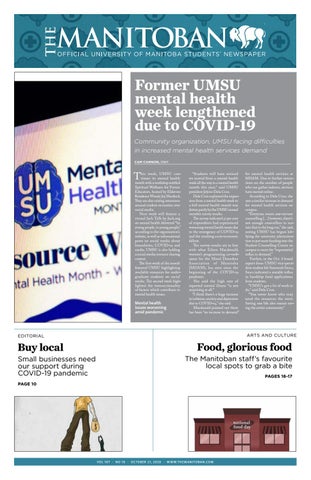
Community organization, UMSU facing difficulties in increased mental health services demand
This week, UMSU continues its mental health month with a workshop entitled Spiritual Wellness for Future Educators, hosted by Elder-inResidence Wanda Joy Murdock. They are also raising awareness around student recreation over social media.
Next week will feature a virtual Jack Talk by Jack.org on mental health delivered “by young people, to young people,” according to the organization’s website, as well as informational posts on social media about boundaries, COVID-19 and media. UMSU is also holding a social media resource sharing contest.
The first week of the month featured UMSU highlighting available resources for undergraduate students on social media. The second week highlighted the intersectionality of factors which contribute to mental health issues.
Mental health issues worsening amid pandemic
“Students will have noticed we moved from a mental health week all the way to a mental health month this year,” said UMSU president Jelynn Dela Cruz. Dela Cruz explained the expansion from a mental health week to a full mental health month was driven partly by the UMSU annual member survey results.
The survey indicated 57 per cent of respondents had experienced worsening mental health issues due to the emergence of COVID-19 and the resulting socio-economic fallout.
The survey results are in line with what Eileen Macdonald, women’s programming co-ordinator for the Mood Disorders Association of Manitoba (MDAM), has seen since the beginning of the COVID-19 pandemic.
She said the high rate of reported mental illness “is not surprising at all.”
“I think there’s a huge increase in isolation, anxiety and depression due to COVID-19,” she said.
Macdonald pointed out there has been “an increase in demand”
for mental health services at MDAM. Due to further restrictions on the number of people who can gather indoors, services have moved online.
According to Dela Cruz, she sees a similar increase in demand for mental health services on campus.
“Everyone wants one-on-one counselling […] however, there’s not enough counsellors to sustain that in the long run,” she said, noting UMSU has begun lobbying the university administration to put more funding into the Student Counselling Centre on campus to meet the “exponential influx in demand.”
Further, in the Oct. 8 board report from UMSU vice-president student life Savannah Szocs, Szocs indicated a sizeable influx in hardship fund applications from students.
“UMSU’s got a lot of work to do,” said Dela Cruz.
“You never know who may need the resources the most. Saving one life also means saving the entire community.”







CAM CANNON, STAFF

During the Oct. 8 UMSU meeting, the board of directors voted overwhelmingly in favour of a motion that signals the abolition of slates from UMSU elections — pending the approval of UMSU’s legal team and a second board vote.
“From this point forward, slates are being phased out,” said Jelynn Dela Cruz, UMSU president.
In concrete terms, the incoming changes mean students can expect the next UMSU election to involve electing independent candidates to
each executive position.
During debate on the motion at the meeting, concerns about the abolition of slates further reducing an already low voter turnout were raised.
“Voter turnout is always something we’ve strived to increase,” Dela Cruz said.
“That issue doesn’t get shoved off the table just because slates are abolished.”
“Regardless, either way we would have the issue of voter apathy,” she said.
“We would need to provide the resources [and] reach students in ways that they haven’t been reached before.”
Dela Cruz said those resources could include “maybe meeting students where they’re at, […] maybe compiling resources into a digestible format and allowing students to really compare policy to policy [and] candidate to candidate may increase the voter turnout.”
The move comes as part of continued efforts to restructure UMSU
— including a re-working of the board structure, executive roles and committees — that were started by last year’s UMSU executive.
The ongoing process sees the governance committee proposing changes and bringing the proposals to the board in the form of motions to be given direction through a vote.
The governance committee then brings the proposals to UMSU’s legal team for approval. Pending the approval, the proposals are brought back to the board as amendments to
“From this point forward, slates are being phased out”
— Jelynn Dela Cruz, UMSU president
vote on before implementation.
Dela Cruz said the amendments —which would be the final step in implementing the proposed changes — are expected to be put to a vote as early as January.
Viktoria Goikhman, a fifth-year student in the Asper school of business, said that making voters do more research on candidates will likely result in lower voter turnout, which will probably lead to higher quality
voting.
“The problem is people don’t really care, and they think that whichever candidate wins will do an OK job and that’s alright,” she said.
“The abolition of slates could be a first step, [a] hard one where you see negative results at first, but maybe later on people will understand it in terms of actually doing research about candidates and voting,” she said.
Dela Cruz said she believes scrapping the slate system will “reduce the barrier to entry” for potential executive candidates.
“Without the slate system, now you may have that bigger scope of all of the candidates or all of the students who really do want to be considered as those.”
According to Dela Cruz, democracy is top of mind when developing this new system for UMSU elections.
“In terms of building a just democracy, you need to be able to know exactly what your options are,” she said.
“You can’t have a just democracy without a fulsome scope of resources and education on exactly what the differences between each candidate really entail.”
“There’s a lot more work to be done to ensure that student elections are as just as they can be.”
GrainViz is designed to detect spoilage in grain as early as possible
GILLIAN BROWN, STAFF

As of last month, 151 Research, a company that sparked from technology developed in a U of M electrical engineering lab, was acquired by AGCO Corporation, a major agricultural equipment company based in the U.S.
After partnering for the past two years, AGCO now owns the rights to GrainViz, a grain imaging tech-
nology designed to detect moisture in grain bins to spot early signs of spoilage.
The technology, developed in 2010 by faculty of engineering professor
Joe LoVetri, along with formergraduate students and now-professors Ian Jeffrey and Colin Gilmore in the electromagnetic imaging lab (EIL), uses what was originally designed to
detect breast cancer. The way it works, LoVetri said, is low-frequency microwaves can detect the tumours based on the amount of blood in the tumour, because tumours have a higher permittivity to allow blood to enter.
Though AGCO owns the right to use the product for grain bin imaging, the university can still use the design
for biomedical work.
Usage of the technology for grain bin imagining was suggested by engineering professor Jitendra Paliwal, who aided with the project.
According to Paliwal, the technology is similar to a CT scan. But
“It’s good for the city, it’s good for the tech community in Winnipeg” — Paul Card, president, CEO and co-founder of 151 Research
instead of using a wave frequency for humans, GrainViz will use larger ones to go through the metal of the grain bins and detect much larger pockets of moisture.
Instead of detecting permittivity of tumours, GrainViz works to detect moisture in the permittivity of the “spoilage hotspots” of any grain.
After the technology was developed, Jeffrey, Gilmore and fellow engineering PhD student Paul
Card formed the company 151 Research, which remains based in the Smartpark on campus and now employs 45 people.
“It’s good for the city, it’s good for the tech community in Winnipeg,” said Card, who remains president and CEO of the firm.
“During a pandemic, it’s hard to attract investment funds, so we’re pretty happy that AGCO acquired us, is retaining everyone and now hiring more people into Winnipeg,” he added.
AGCO has named the the Winnipeg firm its smart grain technology centre of excellence.
Dean of the faculty of agricultural and food sciences Martin Scanlon explained the importance of detecting moisture in grain bins in a noninvasive way.
“If you’ve got a damp spot [in the grain bin], that will start not only going mouldy, but, because there’s very little escape of heat, it can actually turn into a big fire,” he said.
“Anything that can give you that information without disturbing the grain […] is a really good useful tool for farmers.”
AMIRA TEKLE, STAFF
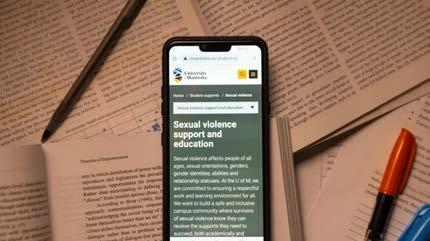
The U of M released its revamped sexual violence awareness course to U of M community members in August.
The course was initially released to students, faculty and staff in March 2019. Since its release, the Sexual Violence Resource Centre (SVRC) opened in January 2020. According to its webpage, the SVRC is a safe
space where staff provide “support, resources, information and referral services for any student, faculty or staff member who has been affected by sexual violence.”
The establishment of the centre was first suggested in an August 2019 report — titled Responding to Sexual Violence, Harassment and Discrimination at the University of Manitoba: A Path Forward — to
university administration detailing recommendations to curb sexual violence, discrimination and harassment at the U of M. Education and programming — including the online sexual violence awareness course — were also themes of the report.
According to the report, “the centre would serve as a single point of contact for all members of the [U of M] community affected by sexual violence.”

The centre would serve as a single point of contact for all members of the [U of M] community affected by sexual violence
“It would be the ‘central hub,’ helping survivors/victims to navigate the sexual violence process, providing information on available mechanisms of support, ensuring that there is appropriate follow-up. The centre would also help facilitate the broader coordination among the multiple [U of M] offices delivering services to survivors/victims.”
The U of M has commissioned multiple reports on sexual violence on campus in recent years — including the report above and another titled The University of Manitoba Campus Climate Survey on Sexual Violence: A
Final Report, released in January 2019. The August 2019 report provided 43 recommendations for improvement regarding sexual violence, harassment and discrimination.
The January 2019 report found “participants have a less favourable perception of the university with respect to how it responds to sexual violence.”
That report also found “targeted educational programming and supports are necessary to respond to the needs of specific groups on campus.”
The online course, available to all U of M community members on UM Learn, has now been edited and changed to reflect the presence of the SVRC on campus.
There are five modules included in the course: video explainers of sexual violence policies and procedures on campus, video explainers on the concept of consent, case studies, myths and the new module on the SVRC.
The SVRC module includes an informational video on the centre’s mission and function, as well as an infographic.
The resource centre is currently open to service U of M staff, students and community members via phone or email.

than 1,800 students registered with numbers growing
DAMIEN DAVIS, STAFF
The importance of accessibility remains a priority for those at Student Accessibility Services (SAS), even amid the COVID-19 pandemic. With the U of M deciding to deliver the winter term remotely, students have had to accept changes to their routines and learning. Not every student can thrive in an online classroom. For students with disabilities attending the U of M, that can be especially true.
One student support continuing
to deliver services — despite the chaos wrought by COVID-19 — is SAS.
SAS is a student service that provides, according to its website, “support and advocacy for students with disabilities such as hearing, injuryrelated, learning, mental health, medical, physical, visual or temporary disabilities.” It provides supports such as a note-taking program, an academic assistant/attendant program and a transcription program.
Campus services have had to make substantial changes to the delivery of programs due to COVID19. However, Shanda Vitt, the senior accessibility co-ordinator at SAS, said the transition to remote services has been “going pretty smoothly.”
Current students can email coordinators directly, call the SAS front desk or book appointments through JUMP, Vitt said.
“We’re still open Monday to Friday 8:30 [a.m.] to 4:30 [p.m.], somebody is answering our phones, we have email,” Vitt said.
“You’re going to talk to a person, not an answering machine when you call us.”
Vitt said SAS has more than 1,800 students currently registered with the office.
According to Vitt, registration volumes with SAS regularly fluctuate, but numbers have been climbing lately.
“I can’t say for sure whether our increase this year is specifically related to the pandemic, it may have gone up regardless of [the] pandemic, so I couldn’t say ‘Yup, definitely we increased because of the pandemic.’”
With courses having largely
shifted to remote delivery, remote learning changes have been delivered
“If students are having additional difficulties or struggles or challenges that they were not experiencing prior to the pandemic, and they’re not really sure what supports [we have] or how we might be able to help them, I would say contact us” — Shanda Vitt, senior accessibility co-ordinator
in the form of ASL-English interpreters, transcriptionists, notetakers and academic attendants attending virtual class with students in order to support them.
SAS is also continuing to aid instructors and students in arranging accessibility accommodations for exams and tests.
Vitt encouraged students to reach out to SAS with concerns they may have about their learning.
“If students are having additional difficulties or struggles or challenges that they were not experiencing prior to the pandemic, and they’re not really sure what supports [we have] or how we might be able to help them, I would say contact us,” she said.
“Contact us as soon as you can, and we can have those conversations.”
“We understand for sure that the pandemic has impacted a lot of people in terms of mental health and well-being, and we’re certainly here to support students, obviously not just students with mental health difficulties but any student with a disability.”
Dr. Forough Khadem Scholarship will support international female graduate students in the biomedical sciences
GILLIAN BROWN, STAFF

Earlier this year, Ukraine International Airlines Flight PS752 was shot down minutes after takeoff, ending the lives of 176 passengers and crew.
Among those passengers was U of M alumna and scientist Forough Khadem.
After her name was announced in the list of those on the plane, the
university established a scholarship with an endowed fund of $200,000 in Khadem’s name, which will go to one international female graduate student conducting research in the biomedical sciences every year.
In her honour, Khadem’s family and her fiancé, Kourosh Doustshenas, donated $100,000 to the scholarship’s endowment fund.
Including that donation, the fund is only about $5,000 away from reaching its goal.
“She really, definitely, stood out as an advocate, and that’s why I think that this scholarship could not be a better tribute to her,” said Louise Simard, acting dean of the faculty of graduate studies.
The scholarship aims to support a
student who “demonstrates leadership,” along with “a desire to have an impact on the world through science.”
After graduating from the program with a PhD in immunology in 2016, she went on to work for Mitacs,
“She really, definitely, stood out as an advocate, and that’s why I think that this scholarship could not be a better tribute to her,” — Louise Simard, acting dean of the faculty of graduate studies
a not-for-profit organization that aims to support research and training initiatives in the fields of math and science.
While conducting research at the U of M, Khadem was recruited and supervised for her PhD by Jude Uzonna, Manitoba Health research chair professor and associate professor in immunology and medical microbiology.
Khadem focused her research on infectious diseases, specifically a
particular strain of leishmaniasis, a parasite which, if left untreated, will cause a person to “almost certainly die from the disease,” said Uzonna.
While researching at the U of M, Khadem was able to identify a potential vaccine for the disease.
When she came from Iran to Canada to pursue her PhD in 2010, Uzonna recalled her fascination with the new environment, coming from a country where women are “very suppressed” and limited to the research they can do.
He said that the scholarship in honour of Khadem, a woman coming from an underdeveloped country to study biomedical sciences, was “just in line with the vision that Forough had in mind when she was here.”
At the university, 95 per cent of scholarships are eligible for all students. Still, only one to three per cent are specifically for those who identify as female.
Though most scholarships are available to international students, Simard emphasized the importance of having awards that are specifically intended for international students, “and this one does.”
“I think what’s more striking about this award is that it actually targets a female-identifying international student and in the sciences.”



SARAH DORAN, STAFF

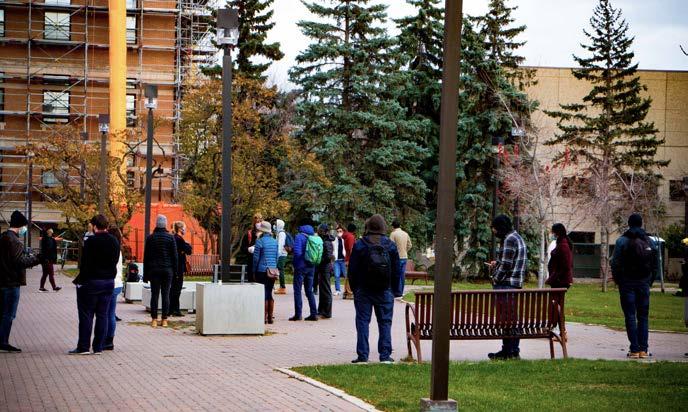
The faculty of agricultural and food sciences launched a new website to share research from faculty and their collaborators on Oct. 7.
The site, called the Manitoba Agriculture and Food Knowledge Exchange (MAKE), is a resource for people in the agricultural industry and general consumers to help explain some of the current research coming out of the U of M.
Annemieke Farenhorst, the faculty’s associate dean of research and a professor in soil science, said the idea for MAKE came up when she first took on the associate dean position.
“I suddenly was present in meetings much more,” she said.
“And so I would be in meetings with other professors and stakeholders and I started to learn about all the great research that we actually do in our faculty.
“I always had some sort of idea
what people were working on, but […] a new world opened up. You start to realize how diverse we are in terms of our research topics, and then also we started to realize what kind of positive impact the research has or could have on society.”
Some of the research topics currently highlighted on the site include food safety and nutrition, crop breeding, animal care, environmental health and sustainability.
In addition to standard articles, the MAKE site also features podcasts to discuss advanced science with experts in a more accessible way for layman audiences than traditional academic outlets.
“When you are a professor, usually one of your activities is to publish, particularly with your students,” Farenhorst said.
“But really, what we publish is written for a very selective group of scien-
tists that are in the field,” she added.
“I think we don’t talk to the general public well enough, and so that’s really also the intention of this MAKE site — we talk about things that are relevant for the general public, and also in a way that everyone can relate to.”
Upcoming plans for the site include downloadable recipes thematically linked to current research activities, a series of infographics to explain research visually and more podcasts and articles.
While the ongoing COVID-19 pandemic means the website will be particularly useful for helping spread knowledge of the faculty’s research, it was not a consideration in the site’s creation.
“This is something that we thought was necessary regardless of the time we are living in now, and it’s something that we have been thinking
about before [COVID-19] emerged
“We talk about things that are relevant for the general public, and also in a way that everyone can relate to” — Annemieke Farenhorst, associate dean of research, faculty of agricultural and food sciences
in our daily lives,” Farenhorst said.
She also mentioned the Bruce D. Campbell Farm and Food Discovery Centre, a working farm located just south of Winnipeg at the U of M’s Glenlea Research Station, as another option for people interested in learning more about agriculture and food science. The centre has begun to feature virtual events and learning opportunities to compensate for limited opening hours. It reopened to the public in July and does educational outreach activities for the local community.
Though the MAKE site is new, the faculty is eager to share its work with the public.
“If people do check out the site, come back again, because we are planning to add more content on a regular basis,” Farenhorst said.
“This is just the start. We’re all very excited about this.”
SARAH DORAN, STAFF

The race to create a COVID-19 vaccine has scientists scrambling all over the world, but the difficult questions the pandemic has raised will not end with a working medication. RJ Leland, an assistant professor at the U of M’s department of philosophy, gave a lecture Oct. 16 about the most ethical way to distribute limited numbers of a vaccine when one is developed.
The lecture discussed the levels of effects the pandemic has had on the global population, ranging from widespread death to economic upheaval, and stressed that the most important consideration for distributing aid — whether vaccines, medical teams or financial assistance — is how much harm it can relieve.
The other two major considerations Leland identified that underpin how to judge harm reduction are prioritizing regions more severely in need of help and treating regions in similar conditions in similar ways.
In addition to deaths caused by COVID-19, the lecture touched on indirect deaths caused by situations like not being able to visit a doctor due to overwhelmed medical facili-
ties or worsening mental health from extended lockdowns. Those who survive the virus are often left with serious long-term health concerns, such as respiratory and cardiovascular issues. Even people who do not contract COVID-19 at all have found their lives upended by public health efforts to combat the virus. Leland defines all of these conditions as forms of harm.
“It’s pretty unusual to have a crisis of health, economics and of social life that is so generalized across the globe,” he said.
“It just seems like a real humanitarian disaster in terms of mass killings of people, massive economic losses — it’s ended people’s lives, but it’s also changed for the worse so many people’s lives.”
Leland proposed a three-phase plan for distributing vaccines in a way that best minimizes premature deaths. In the first phase, a country’s need for aid would be based on how many deaths occur in each of its age brackets. The concept looks at how many years of life will be lost if a person dies and thus prioritizes saving younger populations.
“The idea behind that is to say, on the one hand, […] everybody’s death matters, but it’s a more morally serious thing if a person with a whole life ahead of them dies than if a person at the end of their life dies,” Leland explained.
“It’s pretty unusual to have a crisis of health, economics and social life that is so generalized across the globe”
— RJ Leland
“Both are terrible. One is worse. So, you want to send the doses where you can get a lot of life years. On the other hand, if you just try and get the most actual life years, what you’re going to do is de-prioritize poor countries and prioritize rich countries because the life expectancy in, say, Japan is so much longer than the life expectancy
in Haiti.
“You don’t want to say, ‘Oh, don’t send any doses to the Haitians because they’re a bad investment’ because after all, part of the reason they’re poor is background injustice.”
The second phase of Leland’s plan, which would come into effect when the mortality rate approaches that of the flu, signals a shift in focus from reducing death to mitigating broader societal effects.
“Nobody thinks of yearly influenza as this global catastrophe in the way that they do think about the [COVID-19] pandemic as a global catastrophe,” Leland explained.
“So the thought is that might be a place where a lot of people think this is still terrible the way flu death is, but we’re out of the insane catastrophe mode. Now we can start looking at all the other things that are going to have lasting, profound impacts on people while still paying attention to death.
“So we’re going to still worry about death, but we’re also going to worry about poverty, we’re also going to worry about general loss of productivity, et cetera.”
The third and final phase would take the most straightforward route of focusing on infection rate rather than adjusting for context. At this point, vaccines would likely be widely available worldwide.
While Leland acknowledges there are flaws in this plan, he emphasized the importance of getting everyone to consider the moral questions involved not just in pandemic politics but in everyday life.
“One thing that cases like the pandemic do is they highlight how much high-stakes stuff is up for grabs,” he said.
“It’s very easy to go through your day thinking that most people’s decisions don’t make a very big difference to very many things. Whether that’s true or not in some cases, I don’t know, but in these cases, it really isn’t true.
“It’s really the case that interpersonal decisions that we make can have profound impacts on other people, it’s really the case that policy-level decisions can have massive impacts, and it makes sense to want to do these things in a sensible way rather than a shitty way.”
Editor-In-Chief:
EDITOR-IN-CHIEF Matthew Doering editor@themanitoban.com
BUSINESS MANAGER Alice Teufack accounts@themanitoban.com
ADVERTISING CO-ORDINATOR Diego Castro ads@themanitoban.com
MANAGING EDITOR Ty Brass me@themanitoban.com
NEWS EDITOR Amira Tekle amira@themanitoban.com
NEWS EDITOR Gillian Brown gillian@themanitoban.com
COMMENT EDITOR Lucas Edmond comment@themanitoban.com
ARTS AND CULTURE EDITOR Shaylyn MaharajPoliah arts@themanitoban.com
SPORTS EDITOR Isaiah Wagner sports@themanitoban.com
RESEARCH AND TECH EDITOR Sarah Doran research@themanitoban.com
COPY EDITOR Ursula Chojko-Bolec copy@themanitoban.com
DESIGN EDITOR Joshua Wesey design@themanitoban.com
GRAPHICS EDITOR Jenelle McCann graphics@themanitoban.com
PHOTO EDITOR Alex Decebal-Cuza photo@themanitoban.com
AUDIO EDITOR Tino Hove audio@themanitoban.com
VIDEO EDITOR Nish Joshi
video@themanitoban.com
VISUAL COMM. DEVELOPER Evan Tremblay evan@themanitoban.com
NEWS REPORTER Cameron Cannon
NEWS REPORTER Damien Davis
RESEARCH AND TECH REPORTER Colin Ijebor
ARTS AND CULTURE REPORTER Kaelen Bell
ARTS AND CULTURE REPORTER Zoë LeBrun
COLUMNIST Matthew Averbeck
COLUMNIST Jesse Boily
DESIGN ASSOCIATE Mikaela Warkentin
PHOTO ASSOCIATE Basel Abdelaziz
SOCIAL MEDIA ASSOCIATE Jalene Moman
VIDEO ASSOCIATE Arsalan Saeed
AUDIO ASSOCIATE Tawana Matizanadzo
GRAPHICS ASSOCIATE Dallin Chicoine
COPY ASSOCIATE Aldin Sabic
SPORTS REPORTER Matthew Merkel
VOLUNTEER CONTRIBUTORS
A “volunteer staff” member is defined as a person who has had three volunteer articles, photographs, or pieces of art of reasonable length and/or substance published in the current publishing year of the Manitoban. Any individual who qualifies must be voted in by a majority vote at a Manitoban editorial board meeting. Elected representatives and non-students may be excluded from holding votes as volunteer staff members in accordance with the Manitoban Constitution.
The Manitoban is the official student newspaper of the University of Manitoba. It is published monthly during the summer and each week of regular classes during the academic year by the Manitoban Newspaper Publications Corporation. The Manitoban is an independent and democratic student organization, open to participation from all students. It exists to serve its readers as students and citizens. The newspaper’s primary mandate is to report fairly and objectively on issues and events of importance and interest to the students of the University of Manitoba, to provide an open forum for the free expression and exchang of opinions and ideas, and to stimulate meaningful debate on issues that affect or would otherwise be of interest to the student body and/or society in general. The Manitoban serves as a training ground for students interested in any aspect of journalism.Students and other interested parties are invited to contribute to any section of the newspaper. Please contact the appropriate editor for submission guidelines. The Manitoban reserves the right to edit all submissions and will not publish any material deemed by its editorial board to be discriminatory, racist, sexist, homophobic or transphobic, ableist or libellous. Opinions expressed in letters and articles are solely those of the authors. Editorials in the Manitoban are signed and represent the opinions of the writer(s), not necessarily those of the Manitoban staff, Editorial Board, or the publisher. All contents are ©2020 and may not be reprinted without the express written permission of the Editor-in-Chief.
Before you purchase from online conglomerates, consider whether they deserve your money
JENELLE MCCANN, STAFF

With the holiday season right around the corner, COVID-19 is enticing people to stick to the screens when it comes to gift shopping. In hopes of limiting the spread of the virus, a lot of people are turning to the world’s largest e-commerce site — Amazon.
It is no secret that local businesses are suffering right now, and they need our support more than ever.
E-commerce giants have the advantage of convenience. Their fast and cheap shipping services attract customers, leaving smaller businesses with less demand to survive on.
However, this is not the only reason to shop
With such brutal allegations about the work environment at Amazon and its response to COVID-19, one has to wonder whether we should be supporting them with our business
local.
The CEO of Amazon, Jeff Bezos, is the richest man in the world with a net worth of approximately US$206 billion. Yet, despite the wealth he and the company have accumulated, Amazon employees only earn a median salary of US$36,640 annually.
Recently, Amazon has seen multiple COVID-19 outbreaks at its warehouses. Employees have reported unclear or no communication of the outbreaks. Two Amazon, employees, Emily Cunningham and Maren
Costa, have spoken out. They criticized how the company handled the risk involved with working during the pandemic. As a result, they both lost their jobs.
Regrettably for Amazon workers, this isn’t uncommon. There are numerous examples of workers losing their jobs for voicing concerns over their work environments. Because of this, employees are worried about their safety and job security. This has placed workers in an unfair position — they are afraid to go to work because of the pandemic, but they will not speak up in fear of losing their jobs.
Former Amazon employee Chris Smalls helped to organize a protest at an Amazon warehouse after workers at the warehouse raised concerns about not being provided proper COVID-19 protective equipment.
At the time, Smalls was under orders to quarantine after being in close contact with someone who had contracted the virus. Shortly after the protest, Amazon fired Smalls for putting the safety of its workers in danger. Smalls claims it was more of a power move than a concern for the health of employees. Since this, Smalls has spoken out, pressuring Amazon to protect its employees.
Every year, Amazon hosts its Prime Day — a two-day event where Prime members have access to extreme savings across thousands of products. Similar to Black Friday or Cyber Monday, consumers flocked to Amazon on Oct. 13 and 14 to get in on the deals. For weeks, Amazon workers have been protesting against Prime Day.
Chris Smalls was instrumental during a protest outside Jeff Bezos’s home, encouraging the public to boycott the corporation’s sales holiday.
For shoppers, Prime Day is exciting. For warehouse workers, it is a terrifying spectacle of modern-age consumerism which forces them to work to the bones with little compensation.
Amazon’s internal reports show rates of serious injury almost double during Prime Day in
contrast to other warehouses. Workers claim that the robots used to speed up packaging rates are impossible for humans to keep up with, resulting in accidents and, at times, injury.
Employees have to scan a set number of items and, if they do not reach their quotas, they risk being written up or potentially fired. The pressure of these targets increases during Prime Day and, as a result, warehouse workers feel rushed.
Subsequently, rushed work results in more injuries.
Amazon has not only repeatedly ignored concerns, but the company has also made statements that directly contradict its internal reports. It has denied publicly that injury numbers spike during Prime Day, even though its own reports display the opposite.
With such brutal allegations about the work environment at Amazon and its response to COVID-19, one has to wonder whether we should be supporting them with our business.
To protect themselves and others, consumers are shopping online. It’s great for avoiding contact, especially as the pandemic grows in Manitoba. However, money means more than just a number on a screen. In an age of boycott culture, giving a company your money means you support their actions. And not enough consumers ask themselves whether particular companies deserve their hard-earned money. Amazon and other e-commerce giants hold a majority of the market when local businesses offer the same services. With the holiday season approaching, supporting your community must be a priority at the top of everyone’s mind. Local businesses are suffering, layoffs are common and many businesses are closing permanently. It could be our neighbours, friends or even family members losing their jobs. In light of the recent events concerning Amazon, it is time for the attention to shift toward local businesses that need our support.


DEADLINE FOR SUBMISSIONS: October 21, 2020 @ 4 PM
WINNERS & PRIZES ANNOUNCED: Oct. 30, 2020 (After 12PM)
CHECK OUT @MYUMSU FOR THE FULL CONTEST DETAILS!


Comment Editor: Lucas Edmond Contact: comment@themanitoban.com
LUCAS EDMOND, STAFF

The Green Party of Canada’s leadership race concluded Oct. 3 and Annamie Paul has officially taken the place of the previous Green incumbent, Elizabeth May.
This was a rather narrow victory over Dimitri Lascaris, a provocative candidate who sought to abandon the liberal jargon that the Green party had adopted last election.
May’s attempt at expanding the Green’s support base with the slogan “Not left. Not right. Forward” left voters scratching their heads and ultimately failed to inspire the movement it was pushing for.
Instead, the leadership race witnessed a plethora of strong candidates such Lascaris and Meryam Haddad who were committed to full political transparency. If either of these candidates were elected to leadership, voters knew they would adopt an ecosocialist agenda to combat climate change and democratize the economy.
It seemed that the eco-socialist candidates posed a particular threat to the centrist position the Green establishment had taken since May first assumed leadership of the party in 2006.
For the past 14 years, the Green party has been more inclined to adopt shallow policies to combat the deepening crisis of climate change. Included in May’s plans were policies
like carbon taxes and other marketbased solutions which depend on uncertain corporate co-operation for any real climate change mitigation.
Paul’s stance resembles this pattern of liberal reform within the confines of capitalist bureaucracy, and the Green party may be rendered redundant in the coming election — an election where Canada so desperately needs a party to separate from the pack-and-push-forth radical policy in pursuit of a green-focused agenda.
Perhaps the Green establishment isn’t really pushing to inspire a generation to help mitigate global warming.
If it was, you’d think it’d be in a bit more of a rush.
It’s almost as though the party is trying to appeal to the voting base of the party in power in pursuit of its own ends —maybe catch a few crumbs while the Liberal Party of Canada bites down on the toast.
But you would think separation from one of Canada’s main parties would be desired — after all, the Liberals have precedent and if the Greens are offering similar policy, why vote for candidates in a marginal party?
The Green party would do better to appeal to voters interested in radical solutions. Policies that emphasize systemic change over reformism are popular, but there are little to no
legitimate parties for voters to representatively express this desire with their ballot.
At climate change strikes, all protesters seem to chant is advocacy for systemic change, indicating that the Greens need to open their ears and listen.
One of these two unapologetically socialist candidates could have won and turned the party around had it not been for internal power moves in the race.
Haddad, a Syrian-born bilingual lawyer and candidate for Green leadership, expressed a concern for severe party tampering in the race.
Just weeks before Paul was announced leader, Haddad had been undemocratically expelled from the race for supposedly violating bylaw 1.3.2 of the Green Party of Canada’s constitution. The bylaw cites, vaguely, that contestants may be expelled from the party if they act in any way that could damage its image. In line with this, section 5.2 of the 2020 Green Party of Canada leadership contest rules outlines that contestants can be expelled for violating the party’s constitution — these two clauses essentially provide the party impunity to rid the election of candidates they are not in agreement with.
Haddad appealed this alleged violation by citing a breach of procedural
fairness and was reinstated into the race 48 hours later.
Lascaris also faced restraints from the Green party. After submitting to run, his applications were rejected by the party. After appealing the decision, and help from significant
The Green party would do better to appeal to voters interested in radical solutions
pressures from his supporters, the decision was overturned.
Beyond this, May dedicated herself to fundraising for Paul, leaving other candidates in the dust with political contributions.
Thanks to May, Paul recorded nearly $121,000 in campaign funds, according to a report from the Canadian Press.
The closest another candidate came to this was Lascaris who only received roughly $52,000.
This is especially controversial considering May had claimed she would stay neutral in the race.
After several difficulties with
email balloting for several candidates, it was enough for Haddad to publicly denounce the Green party race and doubt the integrity of the final results. Was it any stretch for Haddad to do so?
I think not.
The Green party is clearly displaying a lack of democratic rectitude, promoting a candidate to fit the agenda that May has promoted for over a decade.
But what this race has clearly displayed to voters, over all else, is that the Green party is internally split. The only thing both sides seem to agree on is that fact that climate change is bad.
Unfortunately for the Greens, this spectacle does not look good. Fundamentally, there is no technical solution for climate change, nor is it borne from a lack of economic resources — at its root, climate change is a political crisis.
There is simply no political will and no solidarity as to how to solve it.
So, I pose this question to the Green Party of Canada: how can we trust you to be the leading voice against the largest crisis in human history if you are unable to internally agree on basic political policy?
‘Take Back Canada’ slogan should raise questions, concerns for
Canadians
MATTHEW AVERBECK, STAFF

W
ith Erin O’Toole’s recent victory in the Conservative Party of Canada leadership race, the party has since adopted “Take Back Canada” as its new unofficial slogan.
O’Toole presents himself as a progressive conservative who supports the right to abortion and LGBTTQ* rights, but his slogan romanticizes the past and has the potential to stoke fear and division.
After the Andrew Scheer-led Conservatives lost to the Liberals in last year’s federal election, it was assumed that the party would choose a centrist leader to take Trudeau on.
Erin O’Toole seems to fit that bill on paper — he has been criticized for being too moderate by some conservatives and two of his leadership opponents, Derek Sloan and Leslyn Lewis, presented themselves as much further to the right than him.
However, O’Toole has stated clearly that he will not bring the party to the centre of the political spectrum.
O’Toole called himself a “true-blue” candidate in the leadership race and his “Take Back Canada” slogan seems to confirm this.
The question on Canadian voters’ minds — who exactly are we taking Canada back from? And where would that leave Canada afterward?
Does he mean the Indigenous people who have lived on the land,
now called Canada, for thousands of years before settler colonialism and have fought for treaty rights?
Or what about immigrants from around the world that call Canada home? Or the women, LGBTTQ* people and people of colour who have all fought for their rights in recent decades?
O’Toole would likely reject those interpretations of his slogan, but the primary problem with it is that it’s extremely vague and can be interpreted in potentially harmful ways.
For example, white nationalists and supremacists could take the slogan as a confirmation of their hateful beliefs.
It is important for clarification to define these two similar, yet distinct beliefs.
White supremacy is the misguided belief that white people are genetically superior to other races. Supremacists suggest they should be given control over the Black, Indigenous and people of colour (BIPOC) community. On the other hand, white nationalists believe that white people should organize the principles and the culture within a nation and enforce segregation. In other words, white nationalists often espouse white supremacist beliefs and vice versa.
A 2015 study found that at least 100
white supremacist groups were active across the country. These groups are highly organized, heavily armed and pose a legitimate threat to the country, especially to the BIPOC community.
To be clear, O’Toole has condemned white supremacy, but it doesn’t matter whether the candidate or the party disavows it. The language of the slogan alone can have an impact on people’s actions.
Unfortunately, this type of divisive language can help win elections.
Anger divides the country by party affiliation. This can be seen in the United States, with its sharp political divisions among the electorate.
Anger has the potential to erode common ground and dehumanize people who think differently than yourself. It hampers democracy as people begin to see those who disagree with them as enemies.
The Conservative party has also already had squabbles with far-right fringe groups within its ranks.
Maxime Bernier, a former Conservative MP and failed 2017 Conservative leadership candidate, broke away from the party and founded the People’s Party of Canada. Bernier has said on the record that Prime Minister Justin Trudeau believes in “extreme multiculturalism” and he has also called for a significant reduction in immigration levels.
Even though Bernier is no longer a member of the party, his secondplace finish in the 2017 leadership race shows that divisive far-right politics can be relatively successful within the Conservative party.
O’Toole is certainly no Bernier — he is far more receptive to immigration and diversity, but his brand of populism has the potential to stoke the flames of white nationalism and
The question on Canadian voters’ minds — who exactly are we taking Canada back from?
supremacism.
O’Toole has also, thus far, backed away from some of his more progressive beliefs. He has publicly stated that gay conversion therapy is wrong and should be banned, yet at the same time asked social conservatives during the leadership race to make him their number two choice.
O’Toole has even recently rewarded social conservatives by allowing them to vote freely on a potential bill banning conversion
therapy.
This raises questions of whether O’Toole will actually be more socially progressive and open than his predecessors or if he’ll continue to give in to the more radical sects of his party.
Beyond the increased division, the slogan “Take Back Canada” distracts from the real issues that this country faces.
Canada is in the midst of a second wave of COVID-19 outbreaks after a mostly well-managed summer. Canada is also dealing with a recession that has shut down thousands of businesses, resulting in an unemployment rate that is hovering around 10 per cent.
The potential issues that come with the slogan seems to be related to O’Toole’s vow earlier this year to protect Canada from “cancel culture” and the “radical left” in his pitch for leadership.
This divisive language will only worsen the political climate at a time when the country must find a degree of unity.
“Take Back Canada” means potentially losing various rights and freedoms that many marginalized groups have fought for. O’Toole, for the betterment of the country, must seek to unify it — that starts with changing his slogan.
Comment Editor: Lucas Edmond Contact: comment@themanitoban.com
JESSE BOILY, STAFF

Never mind the days of playing sports in person — it’s now the time to welcome electronic sports into the world of university sports.
As the pandemic rages on, businesses and organizations have adapted and changed and university sports should consider doing the same.
Restaurants have turned to takeout, grocery shopping has gone online and curbside pickup is at almost every store, yet sports continue to be played in person.
There are plenty of students who may not care if you can bench 200 pounds, but have an interest in how quickly you can run Super Mario Bros. 3 on a Slurpee and Cheetos bender. For some, that’s the world of sports they would rather see.
If 2020 has shown the world anything, it’s that it wouldn’t be the craziest idea for video games to take over a planet that traditional sports once dominated.
I have never been a big sports fan, and when I first heard about esports, I wasn’t sure if it should be considered a sport.
Competitive video gaming can sound like an odd (and to some, silly) idea. Yet video games have shown that they can be just as competitive and have the potential to be as lucrative as physical sports.
Esports is becoming a big enterprise in North America. In the 2016 League of Legends Championship Series Spring Split Finals, over 10,000 people were in attendance and the event had 43 million viewers online.
Teams of players go head-to-head against each other in various games, many of which would be streamed online, resembling the traditional sports we regularly see on cable television.
EA Sports’ NHL 20 could replace our hockey season if it doesn’t pan out and NBA 2k20 could fill the void left from missing basketball.
With the best university gamers competing online, esports could foster a new era of athletes.
Both players and spectators can stay safe in their homes without missing a moment. Beyond this, esports could easily be streamed online without the expensive recording gear and
broadcasting equipment required for in-person sports. This would make competitive sport entertainment that much more accessible.
As I said before, I don’t care for traditional sports, even in videogame form — what would really interest me is a University of Calgary Dinos Mortal Kombat character getting KO’d by a Bisons character.
I would be just as eager to watch a final smash in a game of Super Smash Bros. after a free-for-all match including some of Canada’s best university gamers.
Racing games would be a valuable addition to an esports league as well. Seeing a spiny blue shell whizzing through a track to change the outcome of a professional-level Mario Kart tournament would certainly be an experience that differs from anything offered by traditional sports.
The gaming world has already embedded itself into many of our everyday lives — you would be hardpressed to find someone who hasn’t, at one point in their lives, been interested in playing or watching video games — so, we might as well accept
it for what it is: the burgeoning of a new age of play and of sport.
Imagine this new era — univer-
I want to live in a world where a top-tier athlete could be a Cheetoschomping gamer
sities preordering PlayStations and Xbox consoles so that they can be ready for the next season — a world where video games are no longer “child’s play.”
It sounds inspiring.
Minds over might — our arcadeloving predecessors would be proud.
Esports tournaments could even be more entertaining than most sports — there is a much larger variety of games that could be played.
For example, Rocket League is a soccer-like game but with cars instead of players. It combines the excitement
of a soccer game with a demolition derby.
I want to live in a world where a top-tier athlete could be a Cheetoschomping gamer.
The world is unfolding as an entirely new place with the onset of COVID-19 and sports should embrace this change.
Just as we have begun adapting to the social isolation compelled by the novel coronavirus, we have the technology to continue entertaining in sports. Will U-Sports be brave enough to take on the next generation of athletes with the fastest thumbs?
U-Sports does not have to look far for reasons to do it — with competitive video gaming growing every year it could be a lucrative investment.
Universities should embrace esports with the challenges posed to sports entertainment by COVID-19.

Editor: Shaylyn Maharaj-Poliah
The Manitoban staff recs their favourite local restaurants to celebrate national food days

To celebrate National Food Day and National Greasy Foods Day, respectively on Oct. 24 and 25, the Manitoban staff has put together a list of their favourite Winnipeg restaurants to encourage supporting small businesses during these crucial times. Be sure to hit up these local food joints, safely. Call them directly for pickup or delivery or search them on your favourite food delivery app.
Delicious Vegetarian Restaurant — 1467
Pembina Highway
Ursula Chojko-Bolec, copy editor
This restaurant is perfect for vegetarians that are craving Chinese food but don’t have the patience to sift through a non-vegetarian menu. There are a whopping 91 dishes on the menu, and all of them are vegan. The portions are large and the prices very reasonable — no dish is over $15, which makes Delicious Vegetarian a great option for busy students on a budget.
The best example is the Hong
Kong style chow mein. The takeout box is packed to the brim, and after two large servings, the dish looks only slightly less full as it did when you received it. The smoky, fresh flavour of the noodles and the generous amount of green onion is always my reason for ordering this dish.
The best and most surprising aspect of the menu is the number of dishes that contain plant-based meats. This offers variety for vegetarians and vegans who typically only have options packed with sad, underseasoned vegetables. The vegetarian beef with black bean sauce is one of my favourites — the plant-based beef is sliced thin and works well with the not-too-sweet black bean sauce, my favourite sauce on the menu.
If non-vegetarians aren’t fond of the idea of plant-based meats, there are plenty of other options. I strongly recommend the deep-fried mushrooms with spicy salt — the spicy salt is a delicious touch to the large, crispy mushrooms, making this dish unlike deep-fried mushrooms I’ve eaten before.
With a Google review of 4.6/5 and only one dollar sign, you really can’t go wrong with trying this restaurant at least once.
BMC Market — 722
Osborne Street
Zoë LeBrun, arts and culture reporter
If you’re looking for delicious, authentic Mexican tacos at an affordable price, BMC Market is the place for you.
BMC Market is a local, familyrun business that offers authentic Mexican sodas, candies, salsa, spices and so much more. But above all, BMC Market has the best tacos in Winnipeg. Each bite of these fresh, soft-shell tacos leaves one with a complete understanding of why BMC Market is one of Winnipeg’s hidden gems. The flavour is incomparable — you won’t find tacos that taste like these anywhere else in the city.
Besides serving some of the most delectable, authentic tacos in town, BMC Market is also one of the
most affordable places to eat out on a budget. It is the home of the three for $5 tacos. BMC Market has many times been the saving grace for my friends and I on evenings when we want to treat ourselves without breaking the bank.
My personal recommendation to all first-time BMC Market customers is their three for $5 tacos with chorizo sausage, onion, cilantro and lime. Paired with hot sauce at the intensity of your choice, this menu item is simple but delicious. Cilantro and lime complement the spicy chorizo sausage, adding a freshness to the taco in a way that I never knew could be done. To top it all off, handmade corn tortillas envelope each of these heavenly tacos, and their delicate flavour balances the dish perfectly.
If this love letter to the restaurant doesn’t convince you to try them out, their 4.7/5 rating on Google should.
Corrientes Argentine Pizzeria — 137 Bannatyne Avenue
Shaylyn Maharaj-Poliah, arts and culture editor
Named after one of Argentina’s capital cities, Corrientes Argentine Pizzeria is a family-owned restaurant that brings new and exotic South American flavours to Winnipeg’s historic Exchange District.
Any good meal needs to have a stellar starter and Corrientes has this covered with their handmade empanadas. These flavourful eats are stuffed with a filling of your choosing and are served with chimichurri on the side. With over 10 flavours to choose from, you’re sure to find something to please your palate — my go-to is the lamb empanada, which pairs wonderfully with a glass of red. Now, to get to what the restaurant is really known for.
Corrientes offers unique combinations of toppings that both encompass and challenge everything there is to love about pizza.
Their signature pizza, the

Corrientes, is especially notable, topped with succulent chicken, sweet caramelized onions and smoky roasted garlic. The Chivito Canadiense is a whole feast on a pizza, layered with two types of cheese, bacon, shaved ribeye steak, hard-boiled eggs, ham, onions and banana peppers.
If you’re not a meat eater, there is a loaded veggie pizza topped with roasted zucchini, arugula and peppers, a vegan pizza with artichoke hearts, capers and homemade vegan cheese as well as the Valentino, which has spinach and creamy béchamel sauce. Naturally, they also serve the vegetarian pizza staple, the Margarita. Other vegan and gluten-free options are available as well.
If you have room after all of that, their dessert menu is a chocolate lover’s fantasy as the confection is featured in almost every sweet treat. You can even perfectly bookend your meal with a sweet version of their empanada, though my preferred dessert is the crepe coated in decadent dulce de leche.
The Manitoban staff has put together a list of their favourite Winnipeg restaurants to encourage supporting small businesses during these crucial times
Corrientes Argentine Pizzeria is perfect for foodies who are looking for a new twist on the classic Italian favourite.
Gohe — 595 Notre Dame Avenue
Kaelen Bell, arts and culture reporter
There are few meals as satisfying — both in flavour and tactile eating experience — as a dinner from Gohe. Served with a somehow sci-
entifically perfect quantity of injera, an Ethiopian flatbread, Gohe’s food is stupidly affordable and stupidly delicious. It’s that elusive balance of sweet, spicy, sour and savoury that Ethiopian food manages to hit like no other.
There’s really no wrong way to go with their menu, and vegetarians and meat eaters alike will have no problem finding something. From the misir wot, zilzil tibs, doro wot or gored gored (steer clear of this last one if you’re not down with raw beef), it’s food that has little competition in terms of complex flavour and simple presentation.
It’s a meal best enjoyed with your close bubble, as all meals should be, as part of the joy is in the act of eating itself — it’s strangely comforting, even with the spectre of COVID19 breathing down our necks, to eat with your hands and share dishes across the table. It’s not a necessity for enjoying what Gohe has to offer, but it adds an extra dimension to an already killer eating experience.
Recently featured on the Food Network Canada’s Big Food Bucket List , Magic Bird is a popular fried chicken joint run out of the Handsome Daughter on Sherbrook Street in West Broadway.
The menu is what one might expect from a typical fried chicken restaurant — fried chicken, wings, tenders and sandwiches with sides ranging from addictive, paprikaspiced curly fries to crunchy and creamy coleslaw — all made in-house. But this isn’t a typical fried chicken restaurant. They put their own twist on every dish, making their menu a masterclass in expressing the strange in the familiar.
Overwhelmingly, the menu has an emphasis on spice, but the spice level can be customized for each order of chicken — I prefer their hot chicken, but if you really want to feel the heat and reach for the transcendence of something akin to a jogger’s high, try
the scorcher, which features a dusting of Carolina reapers.
Not to be missed are the variety of in-house sauces — Cold Mike’s hot sauce, which they sell by the bottle and as a dipping sauce has remained my favourite for the better part of the last two years (though at times too hot to eat, it’s made with scotch bonnets and Carolina reapers), and their neon-green honey dill sauce is to die for.
For the more adventurous eater, Magic Bird offers a monthly sandwich feature — this month they’re offering “the Gobbler,” which is a fried chicken sandwich with “crabberry” sauce, sage stuffing, crispy yam and a pumpkin pie aioli. Like the rest of their sandwiches, this option is only available for takeout.
Make no mistake, Magic Bird sets itself apart from the standard fried chicken joint through creativity with excellent execution. It is anything but standard. If you love hot chicken, do yourself a favour and give Magic Bird a try.
Several Winnipeg theatres postpone, cancel seasons due to the rising number of COVID-19 cases
SHAYLYN MAHARAJ-POLIAH, STAFF
To ensure the health and safety of performers and audience members, the Royal Manitoba Theatre Centre (Royal MTC) has announced the cancellation of its reimagined 2020-21 season.
The original season was announced back in January and was set to include classics, like the stage version of The Sound of Music and an adaptation of Alexandre Dumas’s The Three Musketeers, as well as two world premieres and six Canadian plays, two of which were written by Winnipeg playwrights. The season was later postponed, reinvented and renamed Season 2.0 with measures in place to abide by public health guidelines.
Regrettably, with the pandemic situation worsening and restrictions tightening, the curtain has closed on Season 2.0 as well. In a statement, Royal MTC’s artistic director Kelly Thornton said the cancellation was “a necessary step to ensure everyone’s safety.”
“Season 2.0 required artists to travel from across Canada, and the scope and scale of these plays were chosen well before social distancing was a requirement,” the statement
read. “With social distancing, our venues are severely restricted for audience numbers which makes the revised Season 2.0 lineup impossible.”
“With social distancing, our venues are severely restricted for audience numbers which makes the revised Season 2.0 lineup impossible”
— Kelly Thornton, artistic director
Season ticket holders have a number of options regarding their unused tickets including, but not limited to, receiving a refund or making a donation to the Royal MTC.
No matter their decision, subscribers’ seats will be reserved for the 2021-22 season.
Manitoba Theatre for Young
People (MTYP), Prairie Theatre Exchange (PTE) and Dry Cold Productions are in similar situations — the former have both shortened and postponed their respective seasons while the latter has cancelled its production of Leslie Arden’s The Last Resort after two attempts at rescheduling. MTYP and PTE plan to resume in-person performances in the new year, assuming it’s permissible by social distancing and public safety protocols.
Though news of these cancellations and postponements sting, especially after Light Up Live in September — an event meant to raise awareness about the impacts COVID-19 has had on the arts and entertainment industry as a whole — Winnipeg’s local theatre community continues to be committed to the craft.
MTYP is still offering youth theatre and film classes and PTE is set to present Katharsis, a newly commissioned digital work by Yvette Nolan.
Royal MTC is exploring ways to keep the Lawyers Play and its regional touring production safe for patrons and performers and has moved its annual fundraiser, the

Black and White Ball, online. The organization has also announced its first pandemic-friendly live theatre event for audiences to enjoy.
In conjunction with the Canadian Museum for Human Rights, Royal MTC presents Tiny Plays, Big Ideas: A Festival of Human Rights. The festival will feature a series of short, socially distanced plays spaced throughout the museum.
The event is currently sold out, but the Royal MTC is working on sched-
uling additional performance times.
For more information on MTYP’s theatre school and its COVID-19 precautions, please visit mtyp.ca. PTE’s Katharsis will be available to view free of charge from Oct. 29 to Nov. 15. Royal MTC’s Tiny Plays, Big Ideas: A Festival of Human Rights currently runs from Nov. 19 to 22, with more dates and times to be potentially added in the future.
This year’s Western Canadian Music Awards honours Manitoban talent for both onstage and behind-the-scenes work
Manitoba’s music and arts scene can feel like a well-kept secret — our province’s reputation for fierce cold and trouble sometimes skirts the vibrant community of artists that make up its core. However, this year’s Western Canadian Music Awards was proof positive of Manitoba’s growing recognition in Canada’s music scene, as Manitoban artists and music companies brought home awards in 14 categories.
William Prince took home a
The past year has seen a groundswell of support for Manitoba’s flourishing music scene and the province continues to grow a stellar crop of artists
slew of trophies for his deeply felt sophomore record Reliever, including Recording of the Year, Songwriter of the Year and Roots Artist of the Year.
Hometown hero Begonia received Breakout Artist of the Year for Fear, a record that ushered in a new level of
stardom and a run of sold-out, glitterbombed live shows.
Kelly Bado won the Francophone Artist of the Year award for her lustrous swirl of R&B, pop and soul, while the Mariachi Ghost took home Global Artist of the Year and Visual Media Composer of the Year for its complex and always-ambitious multimedia releases. The awards also highlighted the sonic diversity of Manitoban music, with artists across a variety of distinct sounds and backgrounds taking home awards, including Dizzy Mystics, Apollo Suns and Big Dave McLean.
Several local industry players were also winners, including promoters and video and livestream production team the Village Idiots, who received the award in Impact in Music Marketing, while Private Ear Recording’s John Paul Peters — whose studio has worked with the likes of Begonia, Death Cab for Cutie, Tunic and Living Hour, among dozens more — took home awards for both production and audio engineering.
The late, great, Juno award-winning Gerry Atwell — known for an endless list of contributions to Manitoba’s musical culture, including playing the keyboard for Indigenous powerhouse band Eagle & Hawk — was posthumously given the 2020 Heritage Award following his passing in November of last year.

And, in a year that saw both the death of one of its planned headliners in the sorely missed John Prine and the total cancellation of its 47th annual festival, the Winnipeg Folk Festival was recognized with the
Impact in Live Music award — perhaps a bright spot in a dark 2020 for the beloved Manitoba institution.
The past year has seen a groundswell of support for Manitoba’s flourishing music scene and the province
continues to grow a stellar crop of artists from a variety of sonic worlds and lived experiences. This year’s Western Canadian Music Awards was simply a well-deserved reminder of what those living here already know.
ZOË LEBRUN, STAFF
W
innipeg’s Contemporary Dancers (WCD) has announced that it will be moving forward with programming for its 56th season.
In order to prevent the spread of COVID-19, WCD has put new preventative measures in place to ensure that both dancers and audience members are safe while still being able to enjoy the wonderful dancing on display in Winnipeg.
Physical distancing will be enforced both within and outside the theatre, with ushers present to help guide audience members in and out to ensure safe traffic flow. Seating plans throughout the theatre will be physically distanced as well, encouraging patrons to sit in assigned seats in addition to enforcing a limited seating capacity.
WCD is also mandating government protocols such as the use of face masks, hand sanitization and COVID-19 screening tools prior to attending shows.
All shows for the season will be less than an hour in length and will not have intermissions.
Artistic director Jolene Bailie is hopeful for the coming year.
“We are entering the season with vitality, caution and optimism,” she said. “We look forward to collaborating with this season’s artists, their collaborators and the dancers.”
As it currently stands, the 202021 season will include a variety of
programs to suit the interests of all audiences.
The Emerging Artist Initiative,
“We are entering the season with vitality, caution and optimism— Jolene Bailie, artistic director
in association with the School of Contemporary Dancers, is offering a performance called Up Close and disDANCING, which will consist of three works by five emerging dancers who are entering their careers in the midst of COVID-19 and explore all the challenges that come along with this new reality. You can catch these performances Nov. 4 to 7.
The second set of shows WCD is putting on, as part of its subscription series, is a brand new, commissioned work by Jera Wolfe, which will run from Dec. 3 to 6. Wolfe — a choreographer and performer of Métis heritage — will be hosting an artist talk on his work following the Dec. 6 matinee performance.
The subscription series will also contain a new work by Bailie, running April 22 to 25. This work features an ensemble of Winnipeg dancers and collaborations with Susan Chafe

and Hugh Conacher. Bailie is known for creating complex abstract works and will also be giving an artist talk after the April 25 matinee.
Also included in WCD’s subscription series are two self-created solos, by Linnea Swan and Sara Porter, on a shared program. These performances will run May 28 to 30, after which an artist talk will be held by the artists.
Yes, by Swan, is a combination of dance, theatre and bouffon and has

seen success nationwide. In this piece, Swan addresses Yvonne Rainer’s 1965 No Manifesto Porter’s work is renowned for her use of intelligence and humour. In the piece she is bringing to WCD, This Is My Math Dance, Porter uses these concepts in order to navigate the queer identity.
All performances by WCD this season will take place at the Rachel Browne Theatre. Tickets for WCD’s
56th season can be bought online and the company requests that guests purchase tickets in advance as there is a limited seating capacity in the theatre.
Further information on WCD’s COVID-19 protocols this season, its virtual content and its 2020-21 programming can be found on its website, winnipegscontemporarydancers.ca.

OCTOBER 8, 9, 10, 15, 16, 17, 22, 29 • 6:30 PM–MIDNIGHT OCTOBER 11, 18, 25 • 6:30 PM–11:00 PM OCTOBER 23, 24, 30, 31 • 6:30 PM–1:00 AM
Physical distancing is mandatory. We have over 70,000 square feet for everyone to safely social distance. All lines will allow for 2m/6ft distance between each guest/group. Markers will be placed in all lines for mazes, food trucks, merchandise, and at the ticket booth.
ISAIAH WAGNER, STAFF

The women’s Bisons basketball team finished last year with a 9-11 record, placing the team 10th in the Canada West standings, and a chance to improve its standing this year won’t be available with the season’s cancellation due to the COVID19 pandemic.
It’s an unfortunate situation for every university sports team, including the Bisons.
“Without
having games every weekend, we can focus on [our] training and development” —
Lauren Bartlett, Bison athlete
Last year’s basketball team had a number of bright sports, but one that stood out in particular was rookie guard Lauren Bartlett.
After an impressive season, Bartlett was named to the all-rookie team, a huge accomplishment for the beginning of her university basketball career and something that left her feeling proud.
“I felt very honoured to receive the Can-West All-Rookie Team award,”
said Bartlett.
“There were a lot of skilled rookie players in the Western Canada region and I was grateful to be a part of that group.”
Bartlett put up a season-high 20 points for the Bisons in a game against the Mount Royal University Cougars in early January, and her sister, Deidre Bartlett, is also on the Bisons roster.
“I thought my rookie season was a lot of fun,” said Bartlett.
“I really enjoyed playing with my teammates and it was nice playing with my sister again.”
“I also appreciated the support I received from the coaching staff throughout the year. My team improved a lot throughout the season, so being able to see that progress was very rewarding,” she said.
U-Sports announced Oct. 15 that its 2021 winter national championships would indeed be cancelled, confirming the fears of both athletes and fans.
Interim U-Sports CEO Dick White said, “Following consultations with the four conferences, we agreed that student-athlete safety remains our top priority.”
Despite the season being cancelled, Bartlett and the Bisons have been practicing to improve their team for the next school year and to ensure they don’t lose their step for when the season does begin.
“Since the beginning of September, we have had shorter practices with smaller groups five days a week,” said
Bartlett.
“We are not allowed to play with any contact, so we have mostly been doing shooting and dribbling drills. We also have precautions in play to keep our team and others safe.”
After a successful rookie campaign, Bartlett is looking to continue to improve. Whether it be in the gym or on the court, she is very determined.
“I think that this year is the perfect opportunity to improve,” said Bartlett.
“Without having games every weekend, we can focus on [our] training and development.”
“I would really like to work on speeding up my shot and also improving my overall fitness.”
Basketball, in most cases, does not last forever for an athlete, and Bartlett said she is not expecting to play basketball beyond the university level.
“I am really excited for my years to come as a Bison,” she said.
“My goal is to have a successful university basketball career.”
“Currently, I am not planning on playing basketball beyond university. Although, I am not opposed to any opportunities that may arise in the future,” she said.
Bartlett and the Bisons could come back even more robust with the right attitude and the proper training and become a force to play against when playing does resume.
ISAIAH WAGNER, STAFF
U-Sports announced Oct. 15 that university sports would not continue during the winter term due to the COVID-19 pandemic. The organization also said it would not be rewarding national championships.
These sports include men’s and women’s hockey, basketball, volleyball, track and field, swimming and wrestling.
The players have not played a game this year due to the cancellation of the first part of the season during the fall term as they hoped for good news to come from U-Sports.
A callous decision to make, it was decided with the safety of athletes and staff that the board of directors had in mind.
Chief marketing officer Taryn Taylor said, “As the number of cases rises during the second wave of COVID-19, and without an available vaccine, ongoing sports restrictions are required to ensure student-athlete health and safety.”
Olivia Schuster, a rookie Bison last year playing women’s volleyball, stated her disappointment in the
decision but is looking forward to the next time she’ll suit up for the team.
“We are all obviously super sad and disappointed about our season,
“We are all obviously super sad and disappointed about our season, but we are going to try and keep our spirits high and still train for when the time comes that we can compete again” —
Olivia Schuster, Bison volleyball player

but we are going to try and keep our spirits high and still train for when the time comes that we can compete again,” she said. The women’s and men’s Bisons teams