External contractor injured in University Centre incident
Individual fell multiple storeys through ventilation shaft
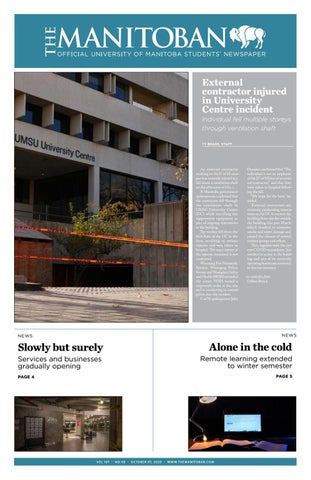
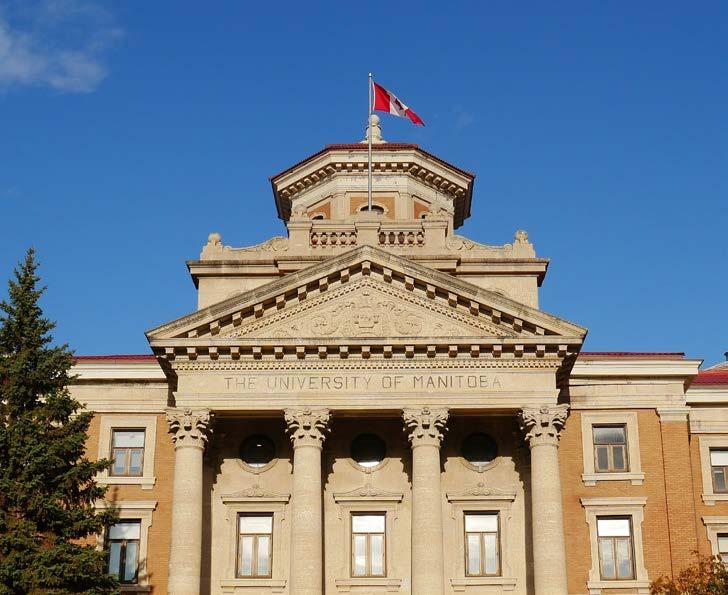
An external contractor working on the U of M campus was seriously injured in a fall down a ventilation shaft on the afternoon of Oct. 1.
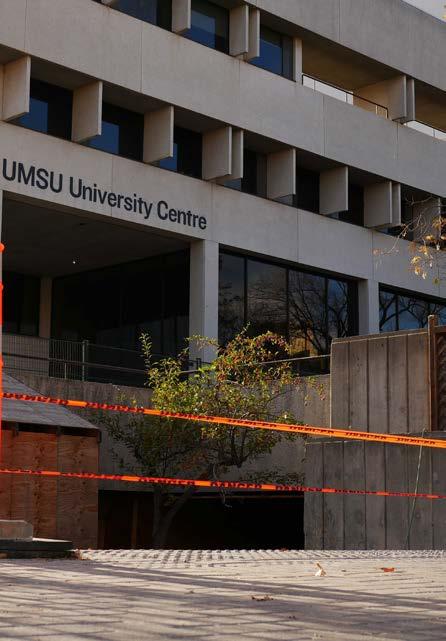
A Manitoba government spokesperson confirmed that the contractor fell through the ventilation shaft in UMSU University Centre (UC) while installing fire suppression equipment as part of ongoing renovations to the building.
The worker fell from the fifth floor of the UC to the first, resulting in serious injuries and was taken to hospital. The exact nature of the injuries sustained is not confirmed.
Winnipeg Fire Paramedic Service, Winnipeg Police Service and Workplace Safety and Health (WSH) attended the scene. WSH issued a stop-work order at the site and is conducting an investigation into the incident.
U of M spokesperson John
Danakas confirmed that “The individual is not an employee of the [U of M] but of an external contractor,” and that they were taken to hospital following the fall.
“We hope for the best,” he added.
External contractors are currently performing renovations on the UC to recover the building from the fire outside the building this past March which resulted in extensive smoke and water damage and caused the closure of several student groups and offices.
This, together with the current COVID-19 pandemic, has resulted in access to the building and any of its currently operating businesses restricted to the east entrance.
— with files from Gillian Brown
TY BRASS, STAFF
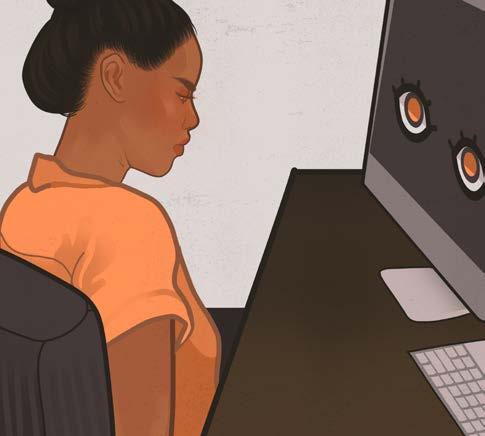
Responding to Respondus

EDITORIAL
MANAGING EDITOR Ty Brass me@themanitoban.com
NEWS EDITOR Amira Tekle amira@themanitoban.com
NEWS EDITOR Gillian Brown gillian@themanitoban.com
COMMENT EDITOR Lucas Edmond comment@themanitoban.com
ARTS AND CULTURE EDITOR Shaylyn Maharaj-Poliah arts@themanitoban.com
SPORTS EDITOR Isaiah Wagner sports@themanitoban.com
RESEARCH & TECH EDITOR Sarah Doran research@themanitoban.com
COPY EDITOR Ursula Chojko-Bolec copy@themanitoban.com
DESIGN
DESIGN EDITOR Joshua Wesey design@themanitoban.com
GRAPHICS EDITOR Jenelle McCann graphics@themanitoban.com
VISUAL COMM. DEVELOPER Evan Tremblay evan@themanitoban.com
AUDIO AND VIDEO
PHOTO EDITOR Alex Decebal-Cuza photo@themanitoban.com
AUDIO EDITOR Tino Hove audio@themanitoban.com
VIDEO EDITOR Nish Joshi video@themanitoban.com
SOCIAL MEDIA EDITOR Kathy Dinh social@themanitoban.com
VOLUNTEER CONTRIBUTORS
Basel Abdelaziz Kaelen Bell Zoe LeBrun
homophobic or transphobic, ableist or libellous. Opinions expressed in letters and articles are solely those of the authors. Editorials in the Manitoban are signed and represent the opinions of the writer(s), not necessarily those of the Manitoban staff, Editorial Board,
Two confirmed cases of COVID-19 on U of M campuses
Steering committee aims to safely recover from ‘dynamic challenges
GILLIAN BROWN, STAFF
So far into the fall semester, U of M has seen at least two confirmed cases of COVID-19.
The first, announced Sept. 21, was on the Bannatyne campus. Close contacts were identified and notified by Manitoba Public Health and self-isolated.
There was one close contact who developed symptoms but was later found to be negative. The university reported that no other positive cases of U of M individuals were linked to the first one.
Members of the Rady faculty of health sciences were reminded by faculty dean and vice-provost (health sciences) Brian Postl to adhere to protocols for physical distancing, hand hygiene and frequent disinfection of commonly touched surfaces.
As of Aug. 24, the Bannatyne campus implemented mandatory mask use while on campus, applying to all faculty members, students and visitors.
In addition, two complimentary reusable masks were issued to fac-
ulty members, staff and students and there are four entrances to the building, all of which require screening to enter.
The second confirmed case was communicated only to members of the school of art on Sept. 25.
Marcia Anderson, one of the vicedeans of the Rady faculty of health sciences, said “The extent of communication in terms of the audience depends on the risk assessment that is done by [Manitoba] Public Health and the actions that need to be taken in the university community.”
She said the two cases were different “in terms of the university public exposures and identification of close contacts.”
The message to members of the school of art, on behalf of school associate director (undergraduate) David Foster, said there was a positive case of COVID-19 in the program and that Manitoba Public Health is leading a case investigation.
An area in the Art Barn that the individual had been in was closed and
sanitized thoroughly and reopened on Monday.
Three days after the first email, acting director of the school of art
“Thankfully, none of the cases that we’re aware of at this point have resulted in a significant risk to other students or to anybody else in the community” — Todd Mondor, chair of the COVID-19 recovery steering committee
Edward Jurkowski sent a message
to the members of the school of art which reported that Manitoba Public Health deemed the situation low risk.
He reminded faculty, staff and students of the importance of using ID cards and signing upon entry in order to trace who is in the building at certain times.
The U of M has created a COVID19 recovery steering committee consisting of university faculty, students and resources in an effort to respond to the “dynamic challenges COVID19 presents to our community.”
The committee has established four teams — academic, operations, research and health and safety — in order to “ensure that the [U of M] is planning and responding to COVID19 in a coordinated and responsive manner,” said committee chair Todd Mondor.
Mondor reported that with the new committee structure, the team of health and safety is led by Anderson, who is a medical officer of health in addition to having her position at the Rady faculty of health sciences.
“She’s very connected to [Manitoba] Public Health and provincial considerations around [COVID-19] and she’s providing a lot of direction and guidance to the university on these issues, so we’re following her advice,” he said.
The university’s committee is largely following Manitoba Public Health directives.
Mondor asks that when students get tested and receive a result, they let their instructor know. He said if there is a significant risk to the community, Manitoba Public Health will reach out.
“Thankfully, none of the cases that we’re aware of at this point have resulted in a significant risk to other students or to anybody else in the community,” Mondor said.
“But it really is a collaboration with [Manitoba] Public Health in terms of us getting information and trying to act on it.”
PHOTO BY ALEXANDER DECEBAL-CUZA
UMFA discontent with lack of work-from-home support
UMFA also supporting picketing Athabasca faculty association, negotiating collective agreement with university
AMIRA TEKLE, STAFF
The University of Manitoba Faculty Association (UMFA) is expressing discontent with the conditions of working remotely from home.
The group has taken to posting photos of instructors’ at-home workstations on Twitter in a bid to draw attention to what they say is a lack of supports.
Biological sciences faculty member and UMFA president Michael Shaw said that while they recognize the ongoing pandemic is a factor, faculty are not getting enough sup-
port from administration for working from home.
“We recognize that there’s a pandemic and we do have that [working from home] ability more than many other workers in the economy,” Shaw said.
“In a time of […] rising tuition fees and rising enrolment in undergraduate credit hours, the university faculty members are working more than ever with very little support from the university,” he said.
“In terms of things like proper chairs, computer resources, internet resources — I’ve had to upgrade my [internet] account so that I can stream to 150 students at a time, and the university has been very unwilling to assist with those sorts of things.”
Shaw also recently issued a letter to the chair of Athabasca University’s (AU) board of governors on behalf of the UMFA in support of the Athabasca University Faculty Association (AUFA), join-
ing the visiting student boycott pledge. AU’s board of governors passed the designation as academic policy Sept. 11, which AUFA said in a post on their website would “give [Athabasca University] a way to carve out approximately twothirds [of] AUFA’s members from the bargaining unit.”
“Precarious employment is a huge issue for universities across Canada, really around the world,” Shaw said.
“And there are some places that people have job security so that they have full and fair academic freedom to state controversial opinions and to really expand on learning for the students.
“And when you take away that academic freedom, when people are moved into a precarious position, it really significantly impacts the quality of the teaching that can occur.”
The faculty associations of the Universities of Alberta, Saskatchewan, Western Ontario and Lethbridge have all issued similar letters condemning the policy and advising AU that members will no longer be recommending Athabasca to students to complete credits if any AUFA members are de-designated.
“We are encouraging our members not to do that, not to use University of Athabasca resources if they continue down this track,” Shaw said.
What’s open on campus this fall term
Most student services largely taking online and phone appointments
A“We can certainly tell our students there are good options at Brandon [University] if you don’t have an option here, there are good options at U of W if you don’t have an option here and there [are] options at the University [College] of the North, so you don’t have to use Athabasca.” UMFA itself is currently talking salary with the U of M.
“We’re in the salary reopener period of our collective agreement,” said Shaw.
“[We’re in] the fourth year of a four-year deal where there is in fact no salary, because of the PSSA [public services sustainability act] and that illegal interference in free and fair collective bargaining by the provincial government.”
The PSSA — provincial legislation passed in 2017 — enacted a twoyear freeze on wages for public service employees following the expiration of their existing collective agreements. It was declared unconstitutional in June of this year.
“That’s what we’re negotiating with the university right now — how to deal with the fact that we were in fact withheld money, [the act of which is] now deemed by the courts to have been unconstitutional.”
is open and taking appointments online for writing and
accepting phone and email inquiries. The Student Counselling Centre is holding counselling appointments over the phone. Spiritual services is also open and taking emails and calls for intake appointments. University Health Services is currently taking virtual primary care appointments.
These student services are open to students from both the Fort Garry and Bannatyne campuses.
Some businesses operating within the U of M have reopened, including UMSU businesses.
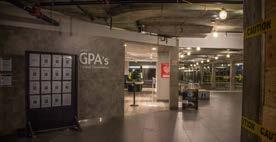
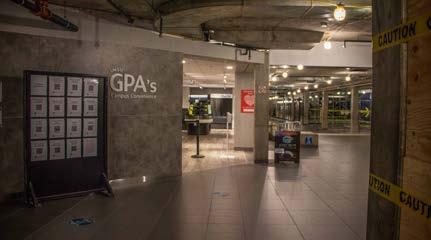
GPA’s Campus Convenience in UMSU University Centre (UC) has reopened and is currently operating weekdays from 9 a.m. to 4 p.m.
The UMSU Service Centre is also open and operating weekdays from 9 a.m. to 4 p.m.
The pharmacy and postal outlet, both located in the UC, have reopened and are operating from 8:30 a.m. to 4:30 p.m. and 9 a.m. to 4 p.m. weekdays, respectively.
The Fort Garry bookstore is currently open for in-person and online shopping with pickup and delivery options. The health sciences bookstore is open for online shopping only.
Recreation centres at both the Fort Garry and Bannatyne campuses are open. The Active Living Centre has reopened and members can book workout time in advance. The Joe Doupe Recreation Centre is also accepting bookings for workouts and workout classes. Users of these facilities are required to self-screen for COVID-19 symptoms prior to entry.
In accordance with current public health restrictions, masks are mandatory on all U of M campuses and buildings, including when physical distancing is possible.
AMIRA TEKLE, STAFF
number of services and businesses are up and running on U of M campuses this fall term, even with most students learning remotely from home.
Several student services offered by the university are connecting with students exclusively via phone and email. The Academic Learning Centre
PHOTO BY BASEL ABDELAZIZ
PHOTO BY MIGUEL YETMAN
UMSU to vote on support of Respondus Monitor
UMSU criticizes the U of M’s ‘poor’ implementation of exam-invigilation software, lists recommendations
AMIRA TEKLE, STAFF

UMSU has come out with a list of recommendations to the university in response to the use of Respondus Monitor in courses.
Respondus Monitor is an anticheating software that uses students’ webcams to record and remotely proctor exams.
UMSU vice-president advocacy Kristin Smith said she first learned about the U of M’s pilot of Respondus Monitor in July.
She said UMSU has several concerns about its use.
“UMSU is concerned with the use of Respondus Monitor because of the poor implementation model being pursued by the university,” she said.
“It is a free-for-all [and] there are no universal standards mandated by the university for the use of Respondus by professors — not so much as needing to provide students [with] a practice exam that would
allow them to become accustomed to the software.”
It is exactly those kinds of standards that Smith is attempting to have the university implement.
Smith and UMSU strategy and research advisor Kyle Hiebert submitted five recommendations regarding Respondus Monitor to Mark Torchia, vice-provost teaching and learning and executive director of the Centre for the Advancement of Teaching and Learning, on Sept. 25.
“As Respondus grew into a greater point of contention, our team pulled the most common themes from student complaints and developed five recommendations in an effort to address those themes,” Smith said.
“The UMSU member survey was also leveraged to gain a wider grasp of student opinions.”
The 2020 UMSU member survey results show that 54 per cent of
respondents received no communication from the university about Respondus Monitor or Respondus Lockdown Browser. Results also show that 37 per cent of respondents said they do not believe “Respondus Monitor provides adequate protection of students’ private information.” 57 per cent of respondents said they did not know enough about Respondus Monitor to answer definitively, while six per cent of respondents said they believe that “Respondus Monitor provides adequate protection of students’ private information.”
The recommendations put forward include: “require that any professor who wishes to use Respondus Monitor issue a practice exam to students that employs the software,” “make environment checks mandatory if a professor is employing Respondus Monitor,” “require that any professor who wishes to use Respondus
Monitor attend a training session offered by Respondus before requiring their students use the program
“As it stands, I do believe that Respondus Monitor is negatively affecting students’ academic performance” — Kristin Smith, UMSU vice-president advocacy
during an evaluation,” “increase privacy protections by making it a condition of the U of M’s contract with Respondus that U of M students’ videos are not to be used to inform research by Respondus” and “ensure that student videos will not be provided to any third party on the authority of the university, even where this is made possible by the University of Manitoba Act and the Freedom of Information and Protection of Privacy Act (FIPPA).”
Smith said implementing these recommendations university-wide is vital.
“Some students may [currently] receive these privileges, but others may not and that is a problem.”
She said there is a “real risk for
false convictions” of academic dishonesty in the way Respondus Monitor is now being used at the U of M.
“As it stands, I do believe that Respondus Monitor is negatively affecting students’ academic performance,” Smith said. “Many students become preoccupied with their on-camera conduct during an assessment when really, they should be concentrating on demonstrating their knowledge.”
“I have spoken to one student so petrified of being inappropriately accused of misconduct that she plans to record herself from behind while taking exams on Respondus, just as proof that she is not cheating.”
Smith also said UMSU has concerns about “data security” and privacy.
She said she thinks students “deserve better” and that she believes the recommendations brought forward by UMSU will benefit students.
UMSU will be bringing the issue to a vote of its board of directors following the university’s response to its recommendations.
“Students across diverse faculties need to weigh in, consider the facts together and let their voices be heard.”
Smith said her own support of the software’s use hinges on the university’s consideration of the recommendations.
“If all the recommendations are met, I will likely motivate the board to endorse Respondus Monitor,” she said.
Remote learning to continue into winter semester
UMSU working on behalf of students to ensure supports
GILLIAN BROWN, STAFF
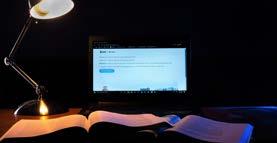
Come winter semester, using the systems established this fall, students will see their courses remain remote with some in-person exceptions.
The decision was made taking into account the rising rate of positive cases of COVID-19 in Manitoba, combined with the increased enrolment of part-time students this term.
U of M president Michael Benarroch said in an announcement Sept. 27 that the university made the decision early on in order to “enable [students] to plan the rest of [their] academic year accordingly.”
UMSU president Jelynn Dela Cruz said the pandemic has made the areas where post-secondary education requires the most progress clear. The union has voiced its support of the decision to “put the health and safety of students, faculty and staff at the forefront while continuing every effort to remain operational.”
UMSU vice-president advocacy
Kristin Smith said that, aside from the decision being the responsible decision in the perspective of public health, it is also helpful for students enrolled in this term to decide whether or not it makes sense for them to enrol in the winter term as well.
She cited a survey of 24,000 undergraduate students conducted by UMSU in September, which revealed that since the start of the pandemic, 57 per cent of respondents said their mental health had decreased.
an opportunity to hold both UMSU and the university accountable in terms of the well-being of students.
UMSU has also taken the responsibility of privacy protection and fairness for students.
Smith said the implications that has for students is “a big [thing] that we’re working on right now.”
“The positive piece of the fall remote term being online is that we’re no longer reacting to unprecedented issues, so we shouldn’t be having the same oversights or afterthoughts when it comes to students” — Kristin Smith, UMSU vice-president advocacy
The union has made October mental health month rather than one week in past years in light of the mental health concerns brought on by COVID-19. According to Smith, COVID-19 is
The survey conducted by the union also demonstrated that more than half of students felt they did not receive communication from the university regarding its plan to allow professors to use the webcam monitoring Respondus Monitor software during remote exams.
An issue that has been concerning student unions this fall is offsetting transit costs for students with the absence of the U-Pass. This semester, UMSU has deferred the typically mandatory U-Pass fees and is providing a subsidy for the post-secondary Winnipeg Transit pass to students who qualify.
Smith said the U-Pass will be deferred to fall 2021. In the meantime, UMSU is looking at expanding the transit subsidy created this fall into the winter term.
In addition to working with the university, UMSU is also lobbying
both provincially and federally to provide more financial supports and recovery plans for students.
“The positive piece of the fall remote term being online is that we’re no longer reacting to unprecedented issues, so we shouldn’t be having the same oversights or afterthoughts when it comes to students,” Smith said.
“Sometimes, when it was March or June, there were aspects that weren’t considered, or people who fell through the cracks.
“I really expect that to happen less, because we know what we’re dealing with and we basically know how to react.”
GRAPHIC BY JENELLE MCCANN
Report links fetal exposure to diabetes with heart disease
Manitoba health records demonstrate higher risk for teens and young adults
SARAH DORAN, STAFF

Anew report from the Children’s Hospital Research Institute of Manitoba has found that fetal exposure to diabetes may be linked to heart disease in teens and young adults.
The report, published Sept. 28 in the Canadian Medical Association Journal, used administrative data from the Manitoba Population Research Data Depository to select nearly 300,000 births between 1979 and 2005.
The team then examined the health records of the chosen population up to age 35, looking for evidence of heart disease or risk factors commonly leading to heart disease, like high blood pressure.
Project leader Laetitia Guillemette, who was a U of M doctoral student at the time, explained that using records made it easier to follow up on such a large number of people because the data needed was already there from routinely documented medical visits over time.
The vast majority of people in the study were not exposed to diabetes in
the womb at all, with 96.1 per cent of the group acting as a baseline.
The remaining offspring’s mothers had either gestational diabetes (2.8 per cent) or pre-existing Type 2 diabetes (1.1 per cent).
Offspring with a family history of heart issues or the genetically-linked Type 1 diabetes were excluded to make sure the report only analyzed people who weren’t already likely to develop symptoms.
exposure to gestational diabetes.
“That’s where the first concept of ‘Hey, what you’re exposed to as a fetus can actually have impacts on your life’ came for me,” she said.
“Things can happen to you very early in life that impact your risk for disease” —
Laetitia Guillemette, lead researcher
“I wondered […] if being exposed to [gestational] diabetes, which is kind of a severe disease as a fetus — it’s a very different environment as a fetus — maybe it also has impacts on your risks later in life, especially if it’s also related to your risks of obesity and stuff like that.”
it, but we can do so much more as a society.”
Moving beyond a strictly medical analysis is a major consideration in Guillemette’s research.
The report is intended to provide useful data about social determinants of health, a concept explaining how the environments in which people live affect their health and quality of life.
The researchers found that people exposed to diabetes in the womb were two to three times more likely to develop heart disease or risk factors for heart disease before age 35 than people who were not exposed. Analysis also showed evidence those issues appeared earlier in life.
Guillemette said the study was partially inspired by her previous work as part of a team investigating connections between obesity and
Guillemette also knew of a landmark cardiovascular study from the 1960s, which focused on mothers in the Netherlands who had been starving at different points during pregnancy in the midst of the Second World War. Many of their children developed cardiac problems later in life.
“Taking those two experiences of my life, gestational baby exposure and the risk for cardiovascular disease that can raise throughout your lifetime, I put them together,” Guillemette said.
Heart disease is the leading cause of death across the world. In 2016, for example, an estimated 17.9 million people died of cardiovascular diseases, 31 per cent of all global deaths that year.
Guillemette said the report shows cardiovascular health is not just a personal concern.
“Right now our medical system is, ‘You personally have a disease? You should personally do something about it,’” she said.
“You take drugs, you exercise, you change the way you eat.
“That is not working. I mean, yes, drugs are good for people who need
“I did not want the message to be, ‘Don’t have diabetes because you’re dooming your child’ — that is not the message at all,” Guillemette said.
“My point is, diabetes is very common, heart disease is very common, and it happens that things can happen to you very early in life that impact your risk for disease, and it’s not your individual responsibility.
“I would like us to have a social responsibility and lower poverty and have more and better housing and housing access so we can reduce the rates of diabetes, and by doing that we will probably prevent and delay a significant portion of heart disease.”
GRAPHIC BY JENELLE MCCANN
3D printing a breath of fresh air for medical research
U of M lab working with plastic and bio-ink structures
SARAH DORAN, STAFF
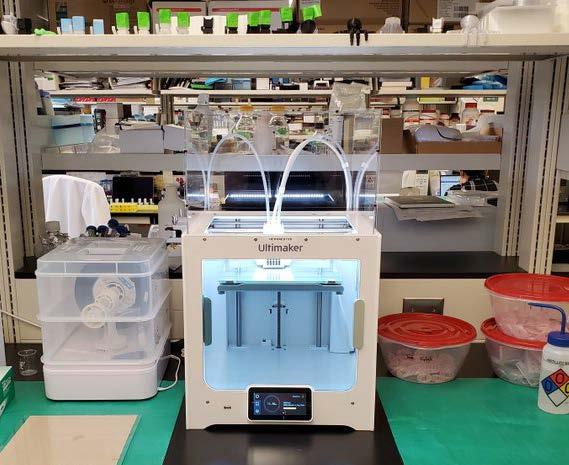
Bioengineering as we know it today has been around for less than a hundred years, but exponential advances in technology have placed the field on the cutting edge of science.
At the U of M, Adrian West, an assistant professor of physiology and pathophysiology in the Max Rady college of medicine, is using 3D printing technology in his lab to study the mechanical aspects of disease.
“Consider a disease like asthma,” he said.
“The whole lung gets much stiffer and, at the organ level, this obviously makes it more difficult to breathe. But even at the microscopic scale of individual cells, the stiffer environment changes the way the cells function.”
But studying cell mechanics in a lab setting means dealing with fundamental problems in execution other biomedical researchers do not have.
“None of the usual strategies are particularly good when you consider diseases with a mechanical component,” West said.
Growing cells under controlled conditions often means a plastic environment, which is very different than conditions in the human body, and human tissue samples are rare and difficult to work with. The sheer size gap between human and animal organ systems also disqualifies animal testing.
However, using a form of 3D printing that works with “bio-ink” that connects existing cells in a structure made of natural and synthetic substances, it’s possible to create layers of material that eventually become large pieces of functional tissue. Changing the bio-ink’s formula and the design being printed allows West to create the kind of mechanical structures created by disease.
West began working with 3D bioprinting in early 2018 after receiving a Canada Foundation for Innovation grant.
During the process of working with the equipment, he realized he needed more specific equipment to manipulate the tissue being printed,
which led to the addition of the regular kind of 3D plastic printer. While not unique — the faculty of architecture has its own 3D printing facility with the same technology — the plastic printer means West can create useful items like test tube setups or organ baths personally customized for his research.
“Bioprinting really represents the next step, both in terms of exciting new technology [and] also in terms of actually building and creating more interesting things,” he said.
“The new supporting technology of 3D plastic printing just amps it up to the next level, making it all easier to implement.”
West has used social media to offer his lab’s custom plastic 3D printing services to other biomedical researchers at the U of M as a way to introduce the technology’s potential in their field.
“The core problem is that there is a real disconnect between the knowledge in different academic communities,” West said.
“People in biomedical research are generally just not well informed about how 3D printing can help their research, and so their expectations
“There is a real disconnect between the knowledge in different academic communities” — Adrian West, assistant professor
are all over the place. […] On the other side, the engineers, designers and artists who understand 3D printing technology do not understand what biomedical researchers might find useful.
“The real challenge, then, is all about marketing realistic capabilities and expectations, to the right people,
using a language they understand. My hope is that, as someone with training in both biomedical research and biomedical engineering, I can help bridge the gap between the communities and try and make things easier for researchers at U of M.”
West’s lab is currently working on projects with airway, cardiac and skeletal muscle, as well as developing airway epithelial cells, which form a lining from the nose and through the lungs.
He also discussed the advantages of bioprinting in other areas, such as neuroscience, to emphasize the versatility of the technology.
“I am sure there are hundreds of possibilities I have not even considered, but just having that conversation with a researcher, in their language, can really highlight those possibilities,” West said.
“These sorts of interdisciplinary collaborations really do remove barriers to research, and [it’s] something I am really looking forward to in the future.”
PHOTO BY ADRIAN WEST
Editor-In-Chief: Matthew Doering
Where should I call home?
Personal reflections on international students and liminality
JOSHUA WESEY, STAFF

W
hat is home? Where is home?
Personally, my definition of home as an international student residing in Canada has evolved in the last couple of years.
In the past, it’s been difficult for me to put into words how being an international student has changed this definition.
It has become clear that although I currently reside in Canada, I am emotionally and mentally in a place of transition — I am in a liminal mental state between Canada and my hometown of Lagos, Nigeria.
Many international students can relate to this feeling.
There is a difference between one’s home country compared to international students’ Canadian home.
Being split between two places that you have established distinct but equally important roles in can make one feel lost in transition.
Frank McAndrew, a psychology professor at Knox College, has defined home as the place where you feel most in control and in line with
your surroundings and schedule.
Liminality, on the other hand, is defined as a transitional period.
When I think of liminality, I remember artwork I saw several years ago by Ruby Onyinyechi Amanze, a Brooklyn-based Nigerian-British artist famous for art which focuses on cultural hybridity. The message from the work was based on Amanze’s inability to identify any particular space as home.
This has influenced my reflection — what were the qualities and features of my home in Lagos compared to Winnipeg?
Growing up, I primarily defined home through the familiarity and family that I found and fostered in Lagos.
Most of my relationships were formed and solidified there. Every niche — the good and the bad, its ins and outs, the streets, struggles, the beauty, the slums, the mystery — it all contributed to my definition of home.
The fact that I was born and bred
in Lagos plays a huge role in my calling it home, though every year I spend away makes it feel more alien.
People have changed and family has grown — over the course of the five years I’ve spent away from Lagos, even my parents have, to a large degree, become new people.
This is a reality many international students have to face — the geographical distance that separates us from our birthplace can also cause rifts in our ability to principally feel home.
My history and the comfort I find in my home in Lagos teases my ability to affirm my place presently.
Although I am physically present in Winnipeg, I am mentally stuck between my past space and my present one.
So, what about Winnipeg? What qualifies it as home?
To me, Winnipeg is a place of empowerment. It is the place I find solace after a long day at work or school. It is the place where I reset.
Although I am also surrounded
by family here, it does not have the same feeling family in Lagos provides.
To an extent, this has solidified a base sense of familiarity, but it stops there.
Every niche — the good and the bad, its ins and outs, the streets, struggles, the beauty, the slums, the mystery — it all contributed to my definition of home
Not being able to commit to these spaces makes international students like me liminal in a sense.
When the space where one is born in is so far away geographically and mentally in relation to their tempo-
rary resident status, it makes home a difficult thing to determine.
There is a certain stigma that accompanies international students that reminds them that they are visitors.
Although for many international students the goal is to become a citizen at some point, for most, that reality hasn’t been fully set in stone. The long road to full citizenship status produces an unease and apprehension when it comes to defining their current space as home.
The long question that I have been ruminating over is whether I can pick one space. Personally, I do not think so. At least not easily. Embedding yourself in a space requires a foundation of legitimacy that is found in citizenship.
It is a long journey to committing to Canada as home, but it’s also difficult to let go of Lagos. I think a lot of international students can relate to this uncertainty.
I hope we can all find a space to hold on to.
GRAPHIC BY JENELLE MCCANN


Comment Editor: Lucas Edmond Contact: comment@themanitoban.com
COVID-19 imposes existential questions for the future
How a health crisis may lead to the change we need
LUCAS EDMOND, STAFF
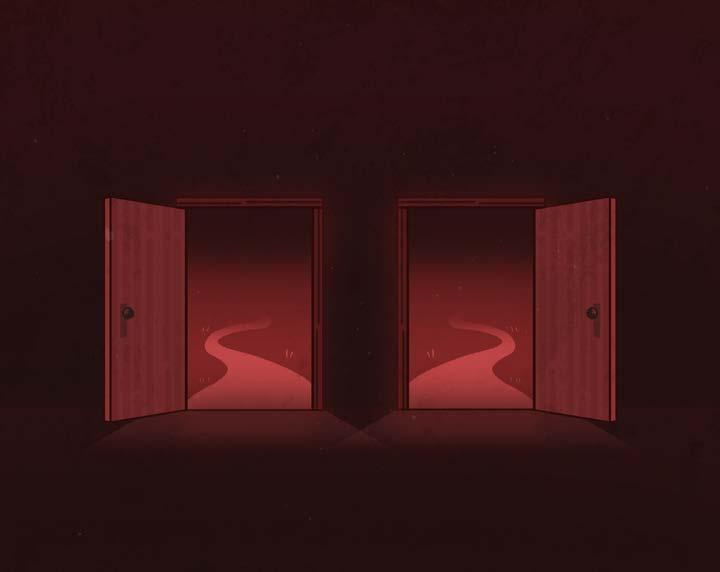
Throughout the COVID-19 pandemic, a popular discourse has defined our motivation to follow the restrictions that were set in place to reduce active cases — a desire to return to normalcy.
I hear it just about everywhere the novel coronavirus is discussed.
The utterance, “I can’t wait until things go back to normal” can be heard everywhere from a walk in the park to roommates shooting the breeze at home.
And this is all understandable considering how uncertain the times are. It is natural for people, when faced with change, to cling to what they are familiar with.
We have all, in our individual lives, been faced with life-changing moments that plunge us into periods of uncertainty and fogginess — a period between what was and what will become. In these times, looking to the past can be the only source of comfort we may have.
This innate feeling that is familiar to most of us is academically defined as liminality.
It is a common position to be in
— we experience liminality in both mundane and extreme circumstances ranging from ritual events such as being legally welcomed into “adulthood” to the adjustment period after the loss of a loved one. But, rarely are we faced with such extreme historical events such as COVID-19 — a crisis so universal that it plunges the world’s population into uncertainty.
Liminality is often associated with internal feelings of danger and anxiety. I think we can all agree that fresh air was tough to come by during the initial shut-down. But what is more remarkable is the level of reflection the crisis has produced.
Around the world, people were picking up new hobbies to fill time, catching up on lost time with family and enrolling in or leaving university to pursue ends that had been put off. All this simply as a means to cope with a new, unfolding world.
The social reflection the pandemic has provoked is shocking — around the world, people are questioning their roles and envisioning what they wish to see in our post-pandemic world.
COVID-19 is not just a health crisis, it is a paradigm-shifting catalyst.
In many ways, this crisis is layered.
First and foremost, we are facing a health crisis, but lying underneath this obvious circumstance we have been forced into an existential crisis felt on a scale large enough to induce an empathic reaction to the term “COVID-19” anywhere you go.
And this isn’t necessarily a bad thing.
Historical events as large as the global COVID-19 pandemic have typically led to new world imaginings, whether good or bad. Take the postwar consensus for example — after the Second World War governments around the world united to adopt policy to raise living standards for citizens.
This period saw the rise of basic government policies we usually take for granted today, such as welfare, the right to unionize and various employment standards.
While not appearing extreme to the contemporary reader, in its historical context these ideas were truly radical — especially considering the
state was mediating rights that it typically repressed in the past.
Shadowing the words of political activist and public intellectual David Graeber — the point is, after the crisis of two grueling world wars, famine, economic devastation and poverty, people came to realize that our social world is something we make ourselves and that it is some-
COVID-19 is not just a health crisis, it is a paradigmshifting catalyst
thing we could just as doubtlessly reimagine and build differently.
Feelings of uncertainty, anxiety, liminality and perhaps even danger are not necessarily bad things when they force reflection on such a universal scale.
Comfort has the ability to keep people docile. But with crises such as
global warming looming and very little time to mitigate the issue, people need to be pushed out of their comfort zones and into a context where they desire a bolder, more equitable and more prepared world for the crises we may collectively face in the near future.
COVID-19 has done just this. The devastation of the pandemic is currently felt everywhere and the existential reflection it has stimulated will soon be, too. It is up to everyone to take the good with the bad and capitalize on events as large as this.
Unfortunately for those who desire returning to our pre-pandemic societies, it is a bit of a pipe dream. One way or another, the world will be irrevocably changed.
We need to keep our eyes to the stars during COVID-19. In the words of the writer Jonathan Feldman, “Basically, if you’re not a utopianist, you’re a schmuck.”
Let’s all be sure to not only reimagine our world but to put those ideas into words and those words into action to build a more empathetic post-pandemic society.
GRAPHIC BY JENELLE MCCANN



Local painters on display in joint art exhibition
Linda
Olzewski
ZOË LEBRUN, STAFF
and David S. Cooper cite the art community and their students as some of their greatest supports
The cre8ery gallery and studio
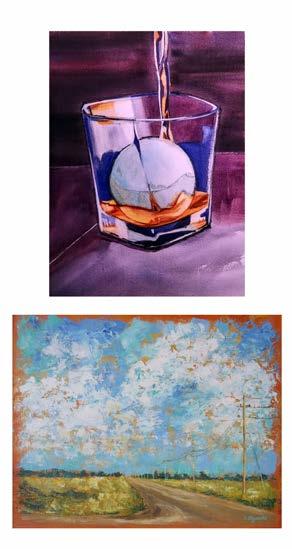
has a treat in store for art lovers this month: an exhibition titled Two Painters: A Visual Dialogue — David Cooper and Linda Olzewski, featuring two Winnipeg-based artists.
The project has been three years in the making and is a multi-media exhibition that draws inspiration from landscape, colour and human form.
This creates a visual language, which explores emotion as well an artistic dialogue of the similarities and differences between Cooper and Olzewski’s work.
While describing the exhibition, Olzewski said, “there is a lot of diversity in our styles and subject matter, but I also think the work is complementary — the pieces speak to each other.”
Cooper found a love of art by using drawing as entertainment as a young boy, saying, “I’d felt like I’d been drawing all my life.”
Primarily self-taught, Cooper’s stick figures eventually turned into cartoons and caricatures, and he took up painting in his mid-20s.
Admiring artists such as Brian Atyeo, Jack Reid, Luther Pokrant and Otto Rogers, Cooper is inspired
by the human form and landscape — Prairie landscapes in particular, as this is where he has lived for the last 60 years or so.
“You have to live on the Prairies to truly appreciate the flat horizon, the blue skies and how you can watch the many changes that take place atmospherically from so many miles away,” he said.
Though he began making art primarily with pen and ink, Cooper has since turned to painting and other media such as collage to help facilitate experimentation in his work.
“I’m looking for a happy accident that will make my brain say, ‘That’s interesting,’ and it takes me down the rabbit hole,” he said.
Cooper has been a part of Winnipeg’s art community for quite some time as both a working artist and a teacher, which has impacted his work greatly.
“All my artwork is the culmination of all the art teachers, students, clients, friends that I have interacted with throughout my art experience […] I give knowledge and direction to my students, but they give back to me the same.”
Olzewski grew up in Saskatchewan, moving to Manitoba

as an adult, and fostered her love of art throughout her childhood in various ways.
“As a kid, I was enamoured with a TV program featuring Jon Gnagy’s drawing lessons. I talked my mom into getting his kit for Christmas and so that was the start,” she said.
In her adult life, Olzewski became an elementary teacher, where drawing and painting became a part of her daily routine which she backed up with lessons from local artists. After retirement, art became her full-time focus.
Some artists who have influenced Olzewski are Mary Cassatt, WilliamAdolphe Bouguereau, Steve Hanks and the Group of Seven. However, her biggest inspirations come from photographs.
“When I see a photo or an idea from another piece of art, I think about how I can interpret that as a painting,” Olzewski said, “I take lots of photos.
“I look for dramatic colour or light or a mood that moves me in some emotional way.”
Like Cooper, Olzewski has been involved in Winnipeg’s art community for most of her life, and it has influenced her work as well.
“Every experience has had some impact on my art,” she said.
“The key word is ‘community’ […] I learn from the art of others, from
“I hope that each piece speaks to our audience. I hope they experience our range of emotions, particularly the joy during this uncertain time” — Linda Olzewski, artist
their comments, critiques and suggestions. I teach classes as well, and I truly think that I learn more than my students.”
Though Two Painters: A Visual Dialogue is a project that has been in the works for quite some time, Olzewski said that in light of COVID-19, they weren’t sure if their exhibition would be able to continue, and most of their planning and dis-
cussions happened this past month.
“We are disappointed that we can’t have an opening reception or take advantage of a First Friday,” she said. “However, Jordan Miller, the owner of cre8ery, has done a terrific job of handling the [COVID-19] situation while presenting our work to the public.
“We are very excited about the show and we hope that visitors will enjoy the ‘eye candy.’”
As a final comment, Olzewski said, “I hope that each piece also speaks to our audience. I hope they experience our range of emotions, particularly the joy during this uncertain time.”
Cooper emphasized the importance of Winnipeg’s art community to artists throughout the city.
“That community of art is there, like all those involved, keeping your arm steady as you paint.”
Two Painters: A Visual Dialogue — David Cooper and Linda Olzewski will be on display at the cre8ery gallery until Oct. 13.
ARTWORKS BY DAVID S. COOPER(TOP) & LINDA OLZEWSKI
’Toban turntable
November Underground — ‘November Underground,’ 4/5
KAELEN BELL, STAFF

Tthe growling children of a 1998 college radio station.
The band’s self-titled debut occupies a universe of slate grey and shadows.
Orvis Thomas and MorrowLitke’s mammoth riffs and the elastic rhythm section, courtesy of drummer
November Underground seems to know exactly what it’s made of, and its confidence makes for a debut both knowingly nostalgic and satisfyingly present
Mark Bannister and bassist Rebecca Gossel, drive these downtrodden songs forward.
sifts through broken relationships and the detritus of the mind, her lyrics are dominated by pressure and isolation, and a darkness colours even the record’s most high-energy assaults. Still, there are flashes of levity.
From the winking song titles — “Burrito Bear,” “Dijon Longjohn,” “Banger eh?” — to the high of “Balls Trippin’,” the band reveals its sense of humour.
The band is able to craft songs that sound both familiar — the opening riff of “Banger eh?” instantly recalls Hole’s “Celebrity Skin” — and so deeply felt as to be totally convincing. November Underground’s nostalgic energy doesn’t feel like shtick, and they’ve got the songwriting chops and clear-eyed verve to reinvigorate a dated sound.
The riffs are big, the solos are electrifying and, in Morrow-Litke, the band’s got a frontperson with a genuine point of view and engaging magnetism.
The sounds may not be new, but they’ve been done far worse and with far less conviction.
November Underground, from Selkirk, Man., is a member of the latter class, a band whose aesthetic sensibility and sound are plucked straight from the radio-grunge wave
here are generally two modes when it comes to decade-specific revivalism: those artists who embody a particular aesthetic ideal without committing fully to the sound — your pop-punk SoundCloud rappers or ’60s glam-rock pop stars — and those who, through uncanny soundalikes or some intangible essence, embody the spirit of a certain scene to a T.
of the late ’90s and early 2000s. From frontperson Kalyna Morrow-Litke’s vocals — which manage to recall Corin Tucker, Eddie Vedder or Scott Weiland, depending on the phrase — to the band’s preferred mode of distorted, rolling riffs and distinct choruses, November Underground is
But beneath all the monochrome crunch and bombast are some subtle complexities.
The fingerpicked quietude that opens “Heartsick” and the silvery, tangled verses of “Blue Papers” lend the album some much appreciated textural variety.
It’s a heavy record, both in sound and subject matter. As Morrow-Litke
November Underground seems to know exactly what it’s made of, and its confidence makes for a debut both knowingly nostalgic and satisfyingly present.

ALBUM COVER PROVIDED BY NOVEMBER UNDERGROUND
’Toban
cornertable
Book
review: Here the Dark
ZOË LEBRUN, STAFF
David Bergen’s short story collection, Here the Dark, tackles moral ambiguity and what it means to find oneself through grace, asking readers to sit with difficult questions and empathize with Bergen’s characters as they each face this challenge of identity and values.
Here the Dark is Bergen’s most recent work in a long list of decorated publications, which includes titles such as The Time in Between, the 2005 Scotiabank Giller Prize winner, and The Case of Lena S., a finalist for the Governor General’s Award for English language fiction in 2002.
Here the Dark has also been nominated for one of Canada’s most prestigious literary awards, the Scotiabank Giller Prize.
Here the Dark consists of seven short stories and a novella, all of which follow contrasting characters who may as well live in completely different worlds.
The short story “How Can n Men Share a Bottle of Vodka?” follows an alcoholic schoolteacher as he transitions into sobriety and a new relationship post-divorce.
In “Man Lost,” our main character is a fisherman who is lost at sea and must find the strength to find his way back to his family.
Bergen’s novella, sharing the title “Here the Dark” with the collection, follows Lily, a young woman living in a sheltered Mennonite community.
Torn between faith and doubt, Lily carves out her own space in the world — living shunned but finding strength in herself, nonetheless.
Bergen portrays these characters, along with the many others in this collection, with perception, honesty and vivid imagery, drawing you into these peoples’ lives and the struggles they face.
While many authors use an indirect gaze when writing difficult events or concepts into their stories, Bergen approaches these subjects head-on, framing them in a tangible setting rather than just an abstract psychological mindset.
Local author longlisted for prestigious literary prize
Bergen discusses Scotiabank Giller Prize nomination
SHAYLYN
MAHARAJ-POLIAH,
STAFF
The situations that Bergen places his characters in are very real and not often spoken about in mainstream media.
By exploring vulnerable, honest and impactful imagery, Bergen is able to illustrate the cognitive processes and behaviours that are involved in the circumstances found throughout Here the Dark in a poignant way, allowing us to walk into a different world and empathize with the characters and question our own beliefs and morals in regard to the situations they find themselves in.
Another point of interest found in Bergen’s writing is his lack of adherence to a strictly linear narrative. While most short stories stick to a straightforward progression of events,
Bergen portrays these characters, along with the many others in this collection, with perception, honesty and vivid imagery, drawing you into these peoples’ lives and the struggles they face
Bergen’s use of a disjointed narrative actually roots his writing even further into reality, as it mimics how our own brains recall and process our own memories and experiences.
This nonlinear narrative combined with Bergen’s active and insightful imagery lends the viewer a sense of recalling lost memories and actively living alongside the characters we become acquainted with in his collection.
Here the Dark allows readers to explore and engage with moral ideas often thought of as binary — such as good and evil — and exposes them as anything but.
Bergen illustrates that these concepts actually exist on a spectrum and that there is value in delving into the questions of humanity that this revelation presents.

Winnipeg author David Bergen’s short story collection, Here the Dark, has been nominated for the 2020 Scotiabank Giller Prize.
The prize recognizes excellence in both long and short form Canadian fiction and is awarded annually to a novel or short story collection published during the year. The winner receives a grand cash prize of $100,000 while each finalist receives $10,000.
The Giller Prize was founded by Jack Rabinovitch in 1994. It was founded in honour of his late wife, Doris Giller, a literary journalist who passed away in 1993 after struggling with cancer.
Their daughter, Elana Rabinovitch, is currently the executive director of the organization.
The Scotiabank Giller Prize is considered to be one of Canada’s most lauded literary awards, having previously honoured the likes of Alice Munro, Margaret Atwood, Michael Ondaatje and Mordecai Richler. In fact, Munro and Atwood still sit on the prize’s advisory board and are two of Bergen’s greatest writing influences.
Other authors he cites as inspirations include Cormac McCarthy, Sylvia Plath, Leo Tolstoy and Anton Chekhov.
“I love the Russian writers,” said Bergen.
Bergen — who grew up in Niverville, Man. and currently lives in Winnipeg — is also a past winner, having received the prize in 2005 for
his novel The Time in Between
This is his fifth time being nominated.
“It’s always surprising and it never fails to amaze and please. I don’t take these things for granted,” he said.
Here the Dark features seven short stories and a novella that shares its title with the collection. It is about a young woman who is shunned by her Mennonite community for rejecting its laws but chooses to remain instead of run.
“It’s always surprising and it never fails
to
amaze and please.” — David Bergen, author
Bergen said the inspiration for the title piece came from an experience he had at “a Holdemann birthday party a few years ago […] I spoke with the men, and I watched the children play, and I knew the young people only had Grade 8 education, and when I asked the man across from me if any young person had ever rebelled, he said no.
“And there was my story.”
When asked about the significance of the collection’s title, Bergen said, “I imagined many things: [dark’s] opposite, light; a finger stabbing and saying ‘Here, here’; the state of oppression in Lily’s community; the trick the mind does in believing
that others are in the dark, and you are not.”
Unlike many writers, Bergen doesn’t believe in writer’s block. Rather, he believes in “failure of ego, where there is a terrific lack of will and the sense that one may never write again.”
To avoid this feeling, his suggestion is to “sit down and aim for a certain number of words per day, good words or bad words, as long as they’re words.”
As for his advice to aspiring writers, Bergen suggests they absorb as much literature as they can and “read, read, read.”
The 2020 Scotiabank Giller Prize winner will be announced Nov. 9. The ceremony will air live on CBC, CNW, the Scotiabank Giller Prize website and its social media channels. The event will be hosted by Canadian singer and author Jann Arden.
PHOTO PROVIDED BY BIBLIOASIS
PHOTO PROVIDED BY BIBLIOASIS
Selkirk Dolphins swim team expands to Winnipeg
Signup available for tryouts every Saturday
ISAIAH WAGNER, STAFF
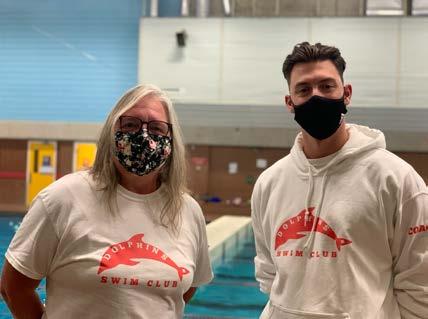
The Selkirk Dolphins Swim Club has expanded from Selkirk, Man.
to Winnipeg. Alex Shogolev, assistant head
coach for the Dolphins, said the move was great way to show how a
club can operate effectively in two different spaces.
Shogolev said the move “will create a spark within the swimming community by showcasing that two locations can act as one unit.”
The move was a great way to show how a club can operate effectively in two different spaces
“We have created a program that includes our non-competitive […] and competitive […] programs,” he added.
Shogolev is a former competitive swimmer with 12 years of swimming experience. He has represented two universities on their swim teams, namely the University of Calgary Dinos and the University of Manitoba Bisons.
Shogolev also represented Canada on its national team.
“I have been coaching and devel-
Laine potential trade destinations
Jets look to fill centre and defensive
voids
ISAIAH WAGNER, STAFF

Patrik Laine, elite right-winger for the Winnipeg Jets, could be on the move this offseason.
Laine has been surrounded by many trade rumours following the end of the 2020 Stanley Cup playoffs.
The Jets could be forced to trade its star player due to the fact that Laine wants to play with centre Mark Scheifele on the team’s first line. The Jets prefer to play Scheifele with Blake Wheeler and Kyle Connor.
Laine put up 63 points in 68 games played last year and is only getting better.
The 22-year-old is heading into his
last year of his $6.75 million contract. When the deal is done, he should be expected to get a significant raise. Although trading the potential future league goal-scoring leader might not be the best idea for the Jets, it may need to be done to fulfil other needs, such as the team’s desperate and ongoing search for a second-line centre for the past couple of years.
The Jets have acquired Paul Stastny and Kevin Hayes as rental players in the past, but have not found its future permanent piece.
The team also needs some defensive help. If it wasn’t for goalie
Connor Hellebuyck’s strong play last year, the team would have been close to the bottom of the league in goals against.
The Jets could use Laine as a potential trade piece to fill these holes. Here is what four teams have to potentially offer in exchange for the star player.
The
Realistic Trade with Philadelphia Flyers
Jets acquire Nolan Patrick, Shayne Gostisbehere and Morgan Frost Flyers acquire Patrik Laine
This is a lot of potential to give up for the Flyers, but it is what the Jets could be looking for in a trade.
Patrick is a Winnipeg-born player who was drafted second overall in the 2017 NHL draft. He did not play last year due to injuries, but a healthy Patrick could be what the Jets are looking for to fill its second-line centre void.
Gostisbehere did not perform up to his standards last year and his trade value is at an all-time low. The defenceman has put up a 65-point season in the NHL and a change of scenery could put him back to his true self.
Trade with the Carolina Hurricanes
Jets acquire Brett Pesce, Vincent Trocheck and Morgan Geekie Hurricanes acquire Patrik Laine and Logan Stanley Pesce is the ideal player that the Jets are looking for and would be the key piece to this deal.
He is a great defenceman who was a plus-35 in the 2018-19 season and would be a great addition to one of Winnipeg’s top two defensive pairings.
Trocheck is also a great player who would fit on the second line for the Jets.
oping age group swimmers for five years,” he said.
Under current circumstances with public health an ongoing issue, safety is key for swimmers and coaches.
“With the current COVID-19 situation, we are following guidelines set by Swimming Canada, Swim Manitoba and the City of Winnipeg to ensure the safety of all of our athletes,” Shogolev said.
“Before every practice, we have ensured to take the participants’ temperatures, sanitize and complete their online self-check waiver.”
Tryouts for the club are going on at Pan Am Pool every Saturday at 2:30 and 3:30 p.m. Children must be at least five years of age and maintain a Red Cross level four or higher. Signup is available on the Dolphins website.
Trade with the Colorado Avalanche
Jets acquire Ryan Graves, Nazem Kadri and 2020 first-round pick
Avalanche acquire Patrik Laine Graves led the NHL this year with a plus-40 rating this past season.
He is a young defenceman who has solidified himself a spot in the league and would fit great next to a guy like Neal Pionk on the Jets’s back end.
Kadri had a great 2019-20 playoffs and could be a guy the Jets look for to solidify its second-line centre vacancy.
The
Unexpected Trade with the Columbus Blue Jackets
Jets acquire Zach Werenski Blue Jackets acquire Patrik Laine
Not often in the NHL do you see a one-for-one elite player swap, but this could be an exception.
Laine is the kind of player the Blue Jackets need and Werenski would fill a top defensive pairing spot on the Jets. Such a trade between the two teams could make for a swap that would shake up the league.
Letting go of Laine can easily be seen as a poor move for the Jets, but with the right offer on the table, it may end up bringing significant positives to the team.
PHOTO PROVIDED BY ALEX SHOGOLEV
GRAPHIC BY JENELLE MCCANN