homophobic or transphobic, ableist or libellous. Opinions expressed in letters and articles are solely those of the authors. Editorials in the Manitoban are signed and represent the opinions of the writer(s), not necessarily those of the Manitoban staff, Editorial Board,
EDITORIAL
MANAGING EDITOR Ty Brass me@themanitoban.com
NEWS EDITOR Amira Tekle amira@themanitoban.com
NEWS EDITOR Gillian Brown gillian@themanitoban.com
COMMENT EDITOR Lucas Edmond comment@themanitoban.com
ARTS AND CULTURE EDITOR Shaylyn Maharaj-Poliah arts@themanitoban.com
PHOTO EDITOR Alex Decebal-Cuza visual@themanitoban.com
AUDIO EDITOR Tino Hove audio@themanitoban.com
VIDEO EDITOR Nish Joshi video@themanitoban.com
SOCIAL MEDIA EDITOR Kathy Dinh social@themanitoban.com
VOLUNTEER CONTRIBUTORS
Basel Abdelaziz Kaelen Bell Anthony Nardella
Stella’s Sherbrook closes dining room following strike
Restaurant
claims union demands were ‘impossible to implement and operate under’
GILLIAN BROWN, STAFF
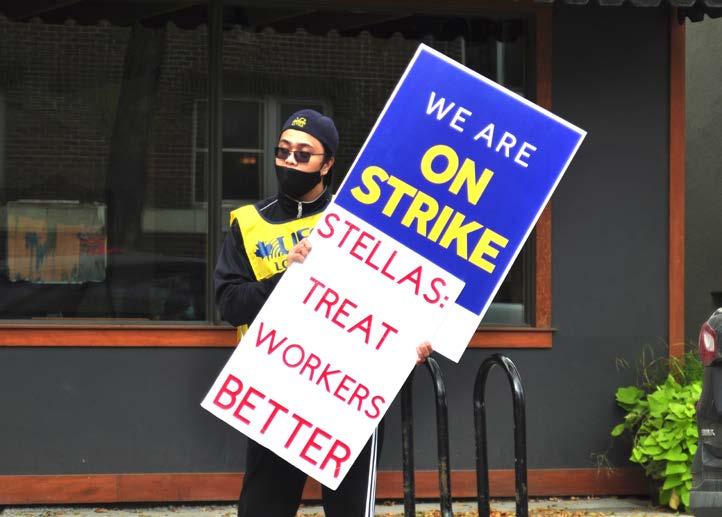
In recent years, Stella’s has been no stranger to controversy, but this Monday, the company closed down its Sherbrook Street location’s dining room after employees went on strike to fight for improved working conditions.
This decision was made after the restaurant group and the union met with a conciliator to renegotiate a contract following the Sept. 20 expiration of the contract imposed by the Manitoba Labour Board, leaving the workers with no condition agreements, said United Food and Commercial Workers International Union (UFCW) local 832 president Jeff Traeger.
The workers started a strike after the union had been negotiating with the company for months, and was “unable to get them to move on any of the issues that were important to our members,” he said.
Stella’s asserted that the union’s demands would have been “completely untenable, especially during a pandemic, with countless restaurants struggling,” in a press release Sept. 24 claiming to clarify “misinformation shared about the current labour dispute this week.”
Though the dining room is closed, the location remains open for DoorDash orders and customer pick-up. The 38 workers at the location organized with UFCW local 832 following the Not My Stella’s campaign in 2018, when former and current employees came forward with allegations of abuse and harassment at work.
The union said that wages, though
one of the demands, were not the main issue of the strike. The key demands had to do with scheduling issues.
Traeger said the strike could have continued on for up to three months, until Stella’s was willing to negotiate a deal.
On Sept. 24, Stella’s maintained their position and added that they have offered to extend the contract imposed by the Manitoba Labour Board for another year and “did not ask for any concessions during this difficult time.”
“Many of the issues that UFCW is proposing at the bargaining table are in relation to scheduling, and to remove the employer’s ability to use the schedule as a weapon against the workers,” the union said in a statement released online in response to Stella’s Sept. 24 statement.
It continued, saying that employees submit their availability, “then the employer is intentionally scheduling workers outside of tha t availability.”
Part-time workers are required to be available all day for four days in total, two days during the week and both days on weekends. One of the union’s demands was to allow that members no longer have to work weekends after one year of service.
The availability requirements meant workers would be “leaving classes early to come to work, and people [are] not being able to pick their kids up from school,” said former employee Alex Dupuis.
Traeger reported that there were about 11 university students that had to quit their job at Stella’s at the
beginning of September. He said students had to “literally choose between work and school, and we don’t think that’s right.”
Dupuis said a shift as a server that exceeds five hours entitles a worker to
“We’re trying to bring the restaurant and hospitality industry into the reality of the new world, and we’re trying to say [that] people who are willing to work and who are going to work should be treated with respect and dignity” — Jeff Traeger, UFCW local 832 president
— and does not allow them to opt out of — a 30-minute unpaid break and a 15-minute paid break. He explained that if a break was scheduled in the middle of a shift, servers were required to hand over their tables that haven’t paid to another server, which meant that a server “basically [makes] none of the money that [they] earned with those tables.”
Michelle Dallmann, another server who worked at the restaurant, said this policy was “heavily enforced,” and if not done, workers would be punished for it.
Dallmann said that, to her, “it just goes to show how much actual value the employees have in terms of their hard-earned money.”
The union aims to restrict this practice from occurring. In the statement, it said that before unionization, table transfers weren’t a common requirement.
Stella’s former and current employees said the company would often fire management and staff. This was done “to basically bring in more people who were complacent and wouldn’t raise a fuss,” said former Stella’s Sherbrook employee Connor Wielgosz.
“Stella’s has a history of doing that,” Wielgosz said.
“They kind of get rid of any of the people who would just ask for common decency, who ask not to be abused in the workplace, whether verbally or, as you saw through Not My Stella’s, physically or sexually.”
Dallmann agreed, saying “it’s just an abuse of [employee] morale, and they’re very ready to do it.”
She said that “one of the ways that [Stella’s] itself kind of keeps that morale and rapport down is by taking managers who have built that respect and move them other places so as to bring in other people who are a lot more detrimental to the best experience of the workers who are here.”
According to Dallmann, since the union was formed, Stella’s cut hours
from employees’ shifts.
The UFCW has also demanded that a 30-hour minimum be granted to the eight senior employees out of the 38 union members.
The final demand the union asks of Stella’s is a wage increase of 25 cents applied to all workers’ current pay, which is currently between $11.65 and $13.25 per hour.
Traeger said Stella’s demands “that you’re available [for] four shifts a week and those shifts might be five hours long, so [workers are] only getting 20 hours [per week], but you have to be available all the time.”
Because of strict availability requirements, workers are unable to pick up another job to make up for the wages.
According to Traeger, in addition to the pay putting employees below the poverty line, the employees also did not get full-time hours. Only a few got any benefits and no employees got a pension plan.
“We’re trying to bring the restaurant and hospitality industry into the reality of the new world, and we’re trying to say [that] people who are willing to work and who are going to work should be treated with respect and dignity, they should be able to earn a living wage, they shouldn’t have to be the working poor.”
Traeger said he thinks the pandemic has taught the public that “people that work in service industries, people who work in retail, are a lot more important than we thought they were before [COVID-19], and I think it’s time that employers step up and recognize that.”
PHOTO BY ANTHONY NARDELLA
School of business commits to ‘education and change’
School of business to introduce task force, orientation session for incoming students
AMIRA TEKLE, STAFF
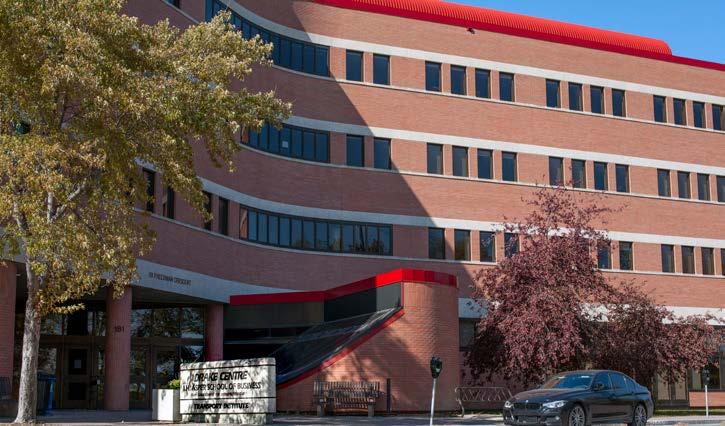
The Asper school of business released a statement affirming its commitment to equity, diversity and inclusion (EDI) on Sept. 15.
The statement was jointly signed by school of business dean Gady Jacoby, Asper Master of Finance Association of Students president Xinran Wang, Asper MSc and PhD Student Association president Zulfiquer Ali Haider, Commerce Students’ Association president Stephanie Kalo and Asper MBA Student Association (AMBASA) co-presidents Abhas Deodhiya and Tyler Phill.
The Rady faculty of health sciences approved the disruption of all forms of racism policy on Aug. 25. That faculty’s policy was created by its EDI anti-racism working group and focuses on education and reporting.
The school of business is now the second unit within the university to take a similar step in recent weeks.
The statement said the school of business is making a commitment to “welcoming, involving and mutually learning from, as well as with, all members of our community.”
“The overwhelming degree to which systemic racism pollutes institutions worldwide has made us, at the Asper school of business, stop and think about what we can do to improve.”
“Students at many Canadian business schools have expressed discomfort with the ongoing management of, as well as the response to, issues concerning equity, diversity and inclusion. It would be naive to think that the Asper school of business is immune to this issue; recently, we
have received some helpful feedback from students and from alumni regarding discriminatory incidences experienced on and off campus,” the statement read.
Jacoby said an article sent to him by a colleague compelled him to investigate EDI issues within Asper.
“I received an article that was published in Vice which was talking about racism in Canadian schools,” he said.
Jacoby noted that while the article did not mention the school of business or the U of M, he still wanted to proactively get ahead of possible racism and EDI issues within the school.
“I made a choice to be proactive and not just let things happen, because [the problem] with letting things happen [is] some people will suffer.”
He said that in his own experience teaching courses, he noticed students would place themselves in homogenous groups for projects.
“So, for years, we’ve been observing that if you allow students to pick their own groups for group projects, international students and domestic students self-select each other,”
Jacoby said.
He said the school is considering taking steps to change that trend.
“One thing I want to consider is to basically make it a rule that at Asper, all groups must be mixed, randomized. If you randomize them, they’re going to be mixed.”
Jacoby noted that some professors already prioritize randomization of groups in their classrooms.
“We do have professors that actually take great care of that — they randomize and even after randomiz-
ing they look at each group to ensure that there is gender and other forms of diversity.”
Jacoby said the school has decided to “introduce a new session at [our] orientation on equity, diversity and inclusion.” These EDI orientation sessions — beginning fall 2021 — will be moderated and 75 minutes long with five diverse panelists that will include alumni and current students. There will also be a talk from R. Y. Abdulrehman, a local clinical psychologist and EDI expert.
Jacoby said he wants students entering the school of business to be aware of the school’s commitment.
“The first thing that we need to do when students come into orientation is to set the stage for them, in terms of what the cultural expectations are,” he said.
“If we don’t tell them, how will they know?”
Jacoby said the school will now focus on education in working with students on the principles of EDI from the beginning of their degrees.
The school will also be establishing an EDI taskforce.
“There will be 22 people on this taskforce,” Jacoby said. “The size is not only to ensure diversity but also to make sure that we have subgroups that work on different things.”
He noted that the group will be tasked with several responsibilities in order to make informed changes.
“The EDI taskforce will be entrusted with conducting focus groups, interviews, surveys and so on to collect reliable data.”
“We will act based on the data that we collect, and we will make
the data public,” Jacoby added. He noted that some institutions choose
“The overwhelming degree to which systemic racism pollutes institutions worldwide has made us, at the Asper school of business, stop and think about what we can do to improve” — Gady Jacoby, school of business dean
not to release such information.
Jacoby said the only way he believes there will be improvement is if the school publicly accepts its flaws and makes changes.
“It’s not going to change anything if you hide the data, it’s not going to change who you are,” he said. “The only way is to accept the reality and then fix who you are and become better, improve […] institutionally.”
“Education is great, we should educate,” he said. “Education alone will not do the job […] to do the job you need education and change.”
He noted that faculty members at the school of business have been very supportive of the EDI initiative.
“I’m lucky to work with colleagues who are amazing, we have a lot of peo-
ple who are actually doing research on equity, diversity and inclusion in a business context,” Jacoby said. “For example, Suzanne Gagnon, she’s the co-chair of the EDI task force with Subbu Sivaramakrishnan.”
Jacoby noted that there is an education and training aspect for staff and faculty, saying “it was important that the school leadership does it first.”
“There will be five sessions at Asper,” he said. “The first one will be for the leadership, so myself, associate deans, department heads, directors […] [and] undergraduate [and graduate] program managers.”
“We will all take leadership training for equity, diversity and inclusion, and the faculty and staff will have […] two separate sessions on equity, diversity and inclusion.”
Student group leaders also support the initiative.
AMBASA co-presidents Deodhiya and Phill said in a joint statement that they are “glad to see the Asper school of business implementing the equity, diversity and inclusion task force with the intent of addressing discrimination.”
“It is our duty, as students and as human beings, to address any behaviour which makes someone feel uncomfortable,” they continued. “Everybody deserves to be treated with respect and dignity.”
“AMBASA supports the initiative and is committed to aligning with its purpose.”
Jacoby said that although there are many decisions ahead that will prove challenging, he remains optimistic.
“It will be a difficult year, but we’re ready.”
PHOTO BY ASHAR KHWAJA
UMSU board meeting update
Board discusses Respondus Monitor, new working group and the U-Pass at Sept. 24 meeting
AMIRA TEKLE, STAFF
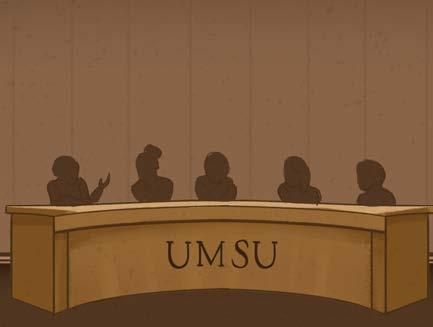
UMSU’s board of directors discussed Respondus Monitor, board restructuring and U-Pass concerns at its Sept. 24 meeting.
UMSU’s vice-president advocacy Kristin Smith reported on her efforts to gain more information about Respondus Monitor from university
administration. In a press release, UMSU stated that “54 per cent of respondents said they had received no communication
from the U of M regarding its plan to allow professors to use webcam monitoring software during exams” in the 2020 UMSU member survey.
According to her report, multiple students have expressed their concerns to UMSU regarding the use of the software in their courses.
UMSU is now calling on the university to address and adjust what it views as problem areas in the implementation of Respondus Monitor.
UMSU wants university administration to implement rules and requirements such as requiring instructors to “issue a ‘practice exam’ that employs Respondus” to allow students to become accustomed to the software, requiring instructors to institute “environment checks” prior to assessments taken using Respondus, mandating instructors to take a Respondus training session before using the software, not allowing Respondus to use students’ videos to collect biometric data and explaining to the student body and student groups such as UMSU how the data and videos could potentially be used.
UMSU’s board of directors will be holding a vote to decide if it will endorse the use of Respondus Monitor by the university in a future meeting.
According to Smith’s report, this will be based on the university’s
response to UMSU’s concerns.
The board also approved a motion to form a board structure working group in response to the Opportunities for UMSU Governance report by consultant Susan Rogers. The report was commissioned by last year’s UMSU board to examine proxy votes, election requirements and ways of working more optimally.
The motion reads that “the purpose of this working group will be to serve as a platform for members of the UMSU board of directors to discuss their feedback directly with representatives from the UMSU 2020-21 governance committee regarding the structure of the UMSU board of directors including (but not limited to) the following: size, representation and composition.”
UMSU president Jelynn Dela Cruz discussed ongoing U-Pass concerns in her report to the board.
“Our areas of concern include the $5 post-secondary pass activation fee and the opt-out criteria for students who reside far from a bus stop.”
Her report stated that UMSU has reached out to city councillors regarding these issues.
UMGSA passes motion to provide bus pass subsidies
The association plans to bring transit costs
GILLIAN BROWN, STAFF A t
U-Pass has been cancelled and students have had the option to instead buy a post-secondary pass from Winnipeg Transit. The association plans to use up to $39,000 from the conference grant
budget line to provide subsidies for students who have bought or plan to buy the transit pass in order to bridge the gap between $200, the price of what the negotiated rate of the U-Pass was, and the $278 cost of
the city’s post-secondary pass.
“The U-Pass is a very basic thing that the students need for their day-
“The U-Pass is a very basic thing that the students need for their day-today transportation” — Silvia Sekander, UMGSA president
to-day transportation,” said UMGSA president Silvia Sekander.
When looking at what could be the cheapest possible option for students this year, Sekander said giving students the $78 subsidy would relieve some of the burdens that graduate students are already facing with the pandemic.
Combined with the collaboration with the faculty of graduate studies, who plans to match the monetary amount that the UMGSA is giving, Sekander said the subsidy could help up to 1,000 graduate students, about
one-third of the grad student population at U of M. Sekander believes there will be a lower number of applicants than there would have been in a typical year because many graduate students, both domestic and international, are doing their research remotely.
The association is still in the process of drafting the forms, but the plan is to provide, over an application period, a form that students can complete. Priority will be given to students facing financial hardships and who use public transportation for in-person academic purposes like lab work.
In order to receive the subsidy, applicants must be able to prove they have purchased or are planning to purchase the Winnipeg Transit postsecondary pass, because the purpose is to bring the costs back down to what a student would have paid had the U-Pass been available.
This subsidy only applies to the fall semester.
Sekander said the association is unsure of what the solution could be in the winter term, but “definitely, we will try to help our students as [much] as we can.”
GRAPHIC BY JENELLE MCCANN
GRAPHIC BY JENELLE MCCANN
Pandemic lifts restrictions on biodiversity research
Citizen science plays big role in continent-wide bird monitoring project
SARAH DORAN, STAFF
While the COVID-19 pandemic has had an enormous global impact, humans aren’t the only ones who found their daily lives disrupted. Two University of Manitoba researchers from the faculty of environment, earth and resources’s Natural Resources Institute have been looking at bird activity during quarantines and how it differs from their usual habits.
Professor Nicola Koper and post-
doctoral fellow Michael Schrimpf are part of a core analysis team along with other academics across North America and scientists at Environment and Climate Change Canada. Using long-term monitoring data from the Cornell University lab of ornithology’s eBird program, they’re comparing baseline activity from 2017 to 2019 with behaviour from March to May of 2020. Bird populations near busy areas, such as
airports or cities, are of particular interest.
Established in 2002 by the Cornell lab and the National Audubon Society, eBird collects data from volunteers all over the world for scientific use.
It’s one of the world’s biggest biodiversity projects with over 100 million sightings added each year.
Koper and Schrimpf both said the combination of COVID-19 quaran-
tines and a global data set made for a dramatic but welcome change.
“It made it way easier in a lot of ways to reach out to anyone who is
“I think anything that allows us to reach out and learn from more people is going to be good for science” — Nicola Koper, professor, Natural Resources Institute
the best expert in the world, because there was no tendency to focus on people who were geographically closer to you,” Koper said.
“Most of the time, I would go out and analyze data that [my students and I] collected, and so by definition we’re going to be restricted in terms of what area we look at. But now, because we were working with this data collected by volunteers from all over the world, all of a sudden it was like — well, why wouldn’t we look at […] a very large part of the continent in order to see what’s going on at really a much bigger scale than I normally would have?”
While their findings have not yet been published, the duo hopes the unexpected benefits of COVID-19 research will continue after the pandemic is less severe. Ever since the internet became widely accessible, the rising popularity of volunteer-based data sites — not just in science, but across many research fields — has become a powerful tool.
“I think anything that allows us to reach out and learn from more people is going to be good for science,” Koper said.
“That’s the sort of comprehensiveness that we just did not have prior to [COVID-19],” Schrimpf said.
“Having that community science, that citizen science involvement, is important to establishing this very large data set.”
For those interested in birdwatching, Koper and Schrimpf recommend the free Merlin bird identification app, also created by the Cornell lab, as a good place to start. eBird is also free and open to anyone who wants to help collect data.
“Moving forward, the pandemic is not over,” Schrimpf said.
“As the respiratory virus season continues and we might have more stringent shutdowns to look forward to — hopefully not, but if that were to happen, or even if people want to go about their lives and feel like they’re contributing a little bit to science, I really encourage them to look into programs like this.”
PHOTO BY ALEXANDER DECEBAL-CUZA
Deeper knowledge requires diversity in education
Work in ethnoastronomy is more than just telling stories
SARAH DORAN, STAFF
Faculty of education associate professor Richard Hechter is currently working on three interrelated projects involving multicultural approaches to science education.
The first, funded by an internal U of M grant, focuses on whether cultural narratives exist around the world that explain how to predict the appearance of aurora borealis, or the northern lights, as a possible complement to scientific data.
While he was unable to find any published examples, Hechter suspects the kind of stories he’s looking for exist in oral traditions rather than in print, and knows he may never hear them.
“The Indigenous stories that are told to me are shared with me with trust and with permission for me to tell again, acknowledging that I am not Indigenous, and I don’t claim to be Indigenous,” he said.
The wealth of knowledge Hechter encountered while researching narratives of the northern lights inspired him to broaden the scope of his work. With two other grants, he is currently working with Arab and Israeli colleagues in Israel, as well as continuing his research with Canadian Indigenous populations, to help develop more diverse forms of science education.
“We need to be teaching science through multiple worldviews, not simply the male-dominated, Caucasian, European version of science,” Hechter said.
“It’s just too simplistic and not
enough, and it doesn’t reflect, really, the world.
“It reflects one version.”
A Social Sciences and Humanities Research Council (SSHRC) grant focuses on creating a framework for secondary science teachers to present ideas from different perspectives to their students.
The combination of Indigenous and non-Indigenous educators from Manitoba with Arab and Israeli educators from Israel allows for multicontinental perspectives at the base level of education.
“What we are doing is generating curriculum in a professional development setting that is of many worldviews and multicultural and is inclusive,” Hechter said.
“My contention in all of this is that if we can teach science this way, we can help mitigate the hate and the othering and the xenophobia that we are experiencing in real life every day.”
A calendar, for example, can be solar, lunar or lunisolar depending on one’s culture even though all three are based on observing the sky. Hechter argued that explaining how different calendars work from a scientific point of view is not a major change but would allow for a much more multicultural discussion.
As a cross-appointed professor in the U of M’s department of physics and astronomy, Hechter is particularly passionate about those topics. The third grant he is currently working on is a collaboration with the Hebrew University of Jerusalem,
studying professional development in physics curriculums.
“Let’s work together to develop this curriculum and this professional development in astronomy, because the night sky belongs to everybody,” he said.
“There are no borders in the sky, and the borders that we have on the land are societally placed and they’re artificial.”
Despite the availability of research funding, the path toward inclusive education is not easy.
“The volume of pushback that I get is ridiculous,” Hechter said.
Some believe that trying to promote non-objective data goes against the principles of science. Others, particularly scientists, claim that cultural narratives are too simplistic to fit alongside discussions of physics. Still, others are skeptical whether a white Canadian man educated in western science knows how to approach the project.
“People think that I’m trying to replace the science content with cultural narratives and stories, and in fact that couldn’t be further from the truth,” he said.
“We’ll still teach the science concepts and phenomena, but punctuate them, highlight them, illuminate them, contextualize them with these cultural narratives, these other worldviews that only enrich the content. I’m not asking people not to teach moon phases and solar phases and seasons, I’m absolutely not.
“I’m simply saying let’s teach them
in a way that is inclusive and a little more holistic to the diversity that we have, because we are a multicultural population — why are we only teaching one version of one idea?”
The most personal form of opposition for Hechter, however, is anti-Semitism. He spoke about an incident last year where a man had to be removed by security after making anti-Semitic comments during a lecture Hechter was giving. He also faces considerable suspicion both at home and abroad simply for being a Jewish-Canadian man with close Arab friends.
All the resistance has only made
“The night sky belongs to everybody” — Richard Hechter, associate professor
or diversity or social justice, because that’s not the place,” he said.
“Those places are usually social studies or English or literature. But why not science? We have the opportunity in science — we just typically don’t go there, and I’m saying let’s go there.”
After all, there are beautiful moments among the struggle. One of Hechter’s favourite anecdotes from his research is from Churchill, Man. where he often works with the Indigenous community. Around 1 a.m. while taking photos of the sky, an Elder approached Hechter and asked why he was so interested in the northern lights.
“I gave the worst answer in history,” Hechter said, laughing.
“As I’m talking, I’m hearing my answer in my head and I’m [thinking] this is the worst answer ever, I’m smarter than this, why am I doing this?
“He puts his hand on my shoulder and says, kind of interrupts me, ‘Son, those are my ancestors. They’re guiding the way for when it’s time for me to go west.’”
When Hechter looked up after fumbling with his camera for a few seconds, the man had disappeared.
“It changed the way I see this. I feel like I have a place and a purpose with this work that I’m doing,” Hechter said.
Hechter more determined to continue his work.
“Science is not typically the place that people look for ideas of equity
“It’s personal and professional now, and that’s a huge deal. That’s a huge deal for me.”
GRAPHIC BY JENELLE MCCANN Research
Editor-In-Chief: Matthew Doering
Contact: editor@themanitoban.com
Visiting small restaurants can make a big difference
Support for struggling local restaurants during COVID-19 needed for their survival
URSULA CHOJKO-BOLEC, STAFF
Seven months have passed since the World Health Organization declared the COVID-19 outbreak a pandemic worldwide. With the reopening of non-essential businesses in the province, many Manitobans have been leaving their quarantine bubble to experience the outside world.
This has brought a sharp rise in in-person restaurant business.
While visiting a restaurant prepandemic required very little planning, like impromptu visits to Earls for happy hour, restaurant visits during a pandemic must not be spur-ofthe-moment decisions.
With COVID-19 adding financial hardship to an already competitive and difficult industry, we must make better consumer choices to help small restaurants.
While it may take more time to research which small restaurants are offering dine-in or takeout services, and we may not be as familiar with the menus, we are choosing to help a small business stay afloat when we choose to spend money at an independently-owned restaurant.
It’s no secret that the restaurant industry has suffered greatly during COVID-19. When the province announced that restaurants could
open their patios in May, restaurants with no patios were out of luck. Even when in-person dining resumed on June 1, this excluded restaurants with small storefronts that do not allow for tables to be arranged six feet apart. As a result, these restaurants were forced to continue offering only takeout at a time when Manitobans were itching to sit down inside a restaurant.
With these restrictions, restaurants that do not offer delivery service suffer even more. When customers pay for convenience, they are hammering a nail in the coffin for small restaurants.
In visiting larger restaurants, many Manitobans may be paying for the overall dining experience — such as the luxury of drinking beers around a table of friends they haven’t seen in months — rather than the quality of the food. This is problematic because “paying for the experience” is exactly what we should not be doing during a pandemic.
Although it may cost more, we should be supporting small businesses and helping to ensure they can stay afloat. This means driving the extra few kilometres to pick up a meal from a family-owned business or spending a few extra dollars on a meal that can be made cheaper at a
chain restaurant.
In taking these actions, we find ourselves in a win-win situation — by not adding another body to an already crowded area, we are helping small restaurants that may have been an afterthought and we get to potentially discover our new favourite restaurant.
Many have already noted that restaurant staff deserve more money during the pandemic and people have responded by tipping servers and waitstaff more.
Let’s not make their jobs harder with crowded and potentially hazardous behaviour.
Our servers are risking their lives to offer us a chance to visit at a restaurant, so they should be compensated more than usual and we should be active agents in helping raise their compensations and keeping them healthy.
This must be emphasized in reference to small businesses.
If we want to show restaurants our appreciation for risking their lives to make us a meal, we need to be willing to pay more upfront to help ensure the businesses survive.
And we shouldn’t be consistently flocking to happy hours or cheap wing nights for our dining experiences — we should pay more to have
our meals cooked in small restaurants by members of our community.
If this argument is not compelling — say, to someone who may justify their reasoning by arguing they are supporting the economy even by vis-
We shouldn’t be consistently flocking to happy hours or cheap wing nights for our dining experiences
iting high-traffic restaurants — the risk of COVID-19 is naturally greater in popular or commercial restaurants.
The more people in a general area, the higher the risk.
In fact, Manitoba has already seen a number of possible COVID19 virus exposures at large restaurants. Choosing these restaurants due to convenience or lower prices compounds the problem.
Small restaurants where customers are in and out within a short time frame — as opposed to lingering for
hours as they take advantage of cheap beers or appetizers — are surely the better option.
By visiting smaller restaurants, we can do our part to keep ourselves safe, keep our community safe and support a business that has no doubt struggled throughout the last few months.
With the city being placed in orange level, restaurants will again face increased challenges.
As we merge back into our pandemic routines, we need to be actively thinking about how our choices impact hospitality establishments. After all, ignoring our artisanal establishments could lead to many small restaurants closing their doors permanently.
Next time you’re craving pizza, consider picking up from Wall Street Slice instead of ordering delivery from Domino’s.
Next time you’re craving a burger and fries, consider ordering from A and V Drive-In instead of visiting Smitty’s or Earls.
Next time you’re craving tacos, consider visiting Sargent Taco Shop instead of Taco Bell.
In order to ensure these Winnipeg gems stay in business, we need to actively do our part and make visiting them a priority.
GRAPHIC BY JENELLE MCCANN
Comment Editor: Lucas Edmond Contact: comment@themanitoban.com
Out of the frying pan, into a union Restaurant staff need to rethink
LUCAS EDMOND, STAFF
kitchen culture to improve working conditions
It is refreshing to see employees from the Stella’s Sherbrook location picketing. While workers claim it is for respect during collective bargaining, they would do well to demand better pay and working standards.
And restaurant workers in kitchens from around the city should take note. Solidarity between kitchen staff is desperately needed.
Working in a kitchen is not an easy job — in many ways, it is the least reimbursed and most uncomfortable of the trades.
With long unconventional working hours, late nights, unreasonable paces, 60-hour work weeks and a hot, uncomfortable environment, workers deserve more.
And employers know it.
It is rare when restaurant employees unionize.
The industry itself has maintained a relative lack of unionization for some time.
Now more than ever, Canadians are eating out.
In the past two decades alone the restaurant industry in Canada has grown 120 per cent.
In 1998, restaurants raked in
almost $31 billion compared to 2017 when restaurants produced nearly $68 billion in sales.
Despite the sharp rise in consumer demand, wages have hovered around the minimum for too long.
Owners are making more but the creative cooks are making pretty much the same as before.
Considering the increase in inequality, it is important to pose a question — why the lack of unionism?
Perhaps it is because a large portion of workers are using the industry as a means to an end — like paying for school — or maybe it is simply because of employment turnaround.
But this would assume the industry is deskilled and that anybody can do it — what about high-end and highly skilled restaurants with some of the best cooks in the world working together?
Sadly, in some Michelin-star restaurants, workers are actually paid under minimum wages in order to gain experience with world-class chefs.
You would think a high-end kitchen would offer high paid jobs, right?
Wrong.
Working in a state-of-the-art kitchen for less than minimum wage and with overtime expected can be, to some big-name chefs, considered a handout for the experience they provide.
Apparently, some people are more important than state-sanctioned human rights.
So, what is the most detrimental factor to workers’ solidarity and their ability to collectively strike for better working conditions, you ask?
Simply put, it is the industry’s work culture and a lack of political leadership from passionate and creative culinary masters.
A hard-nosed, grit and grind, slash and burn, cut and rip, workfor-little, suffer-to-win culture has been embedded into the restaurant industry and nearly universalized in the modern kitchen.
If you are a truly passionate cook, suffering goes hand in hand with culinary distinction.
It is part of the learning curve for many young go-getters in the industry.
But this trope — much like the “suffering artist” myth — is damaging to restaurant workforces and the
creative potential of many cooks.
Many of our most talented culinary geniuses are fighting off poverty while working 14-hour days six days a week in a demanding and tremen-
If you are a truly passionate cook, suffering goes hand in hand with culinary distinction
dously stressful environment with very little room for error.
It would be enough to drive any sane person crazy.
Conditions such as this would be hampering to any creative mind.
We’ve all been there — after a long week at work, the only thing you want to do is sleep and maybe watch an episode of your favourite Netflix series.
Now imagine the stresses workers in these desperate positions are put in on a consistent basis.
No time to hone your craft, no
money to buy new ingredients to experiment with flavour profiles and no motivation to exercise the art you fell in love with — even in the place where it all began for most of us — in the comfort of your home kitchen.
For many, dreams of becoming a distinguished chef are dashed and trampled by the unsupportive conditions of the restaurant industry.
While employers may have their own stresses — after all, restaurants are a high-risk investment and are usually not profitable for quite some time — workers not only need more from their bosses, they also deserve more.
Despite the possible argument for the current norm being a way to weed out the less determined — as many chefs do — it is truly a shame to think of the creative potential of so many young cooks that are lost because their dreams went awry due to a bad business model.
Workers will either prosper collectively or suffer collectively and the choice to unionize is ultimately theirs.
Workplace solidarity and a reformation of kitchen culture has the potential to take kitchen staff off of the knife’s edge.
GRAPHIC BY JENELLE MCCANN
Orange Shirt Day reaffirms that every child matters
Honouring survivors of residential schools and remembering those who
SHAYLYN MAHARAJ-POLIAH, STAFF
E very year, on Sept. 30, many Canadians wear orange in remembrance of the Indigenous children who were victims of the residential school system and to honour the survivors, families and communities that were affected.
At this time of year, thousands of Indigenous children were removed from their homes and forced to attend government-sanctioned residential schools. The purpose of these schools
was to assimilate Indigenous youth into the Eurocentric Canadian culture. Physical and sexual abuse were alarmingly common at these institutions and the student death rate was approximately one in 25, though records remain incomplete.
The first residential school opened in Canada in the 19th century but the last school didn’t close its doors until 1996.
That’s almost 200 years of ongoing
oppression.
The Orange Shirt Day movement officially began in Williams Lake, B.C. in 2013 to create meaningful discourse about the harmful, continuing effects of residential schools in the spirit of reconciliation. Further, it provides the opportunity for all schools to set a yearly precedent of anti-racism and anti-bullying.
Orange Shirt Day is inspired by the story of Phyllis Webstad. In 1973,
never made it home
six-year-old Webstad received an orange shirt from her grandmother to wear to school. Upon arriving at the residential school, the shirt was
At this time of year, thousands of Indigenous children were removed from their homes and forced to attend governmentsanctioned residential schools
taken away from her and she never wore it again.
Many schools in Manitoba organize their own events to commemorate the day, such as assemblies, smudges or visiting former residential school sites. However, due to the pandemic situation, Orange Shirt Day initiatives will look a lot different this year.
The National Film Board of Canada (NFB) has put together a list of films on residential schools to view on its blog. Short films, like Kent Monkman’s Sisters & Brothers, are free to watch while the feature length film We Were Children is available to download or rent for a fee and is purchasable on DVD.
The National Centre for Truth and Reconciliation (NCTR), located at the University of Manitoba, has organized a free online event on Sept. 30, titled Every Child Matters: Reconciliation Through Education. The event provides the opportunity to hear first-hand accounts from residential school survivors and to learn from Elders and Knowledge Keepers.
Though it is geared toward educators and developed for students in Grades 5 to 12, the NCTR invites people of all ages to participate in the event. For those unable to attend the event on Orange Shirt Day itself, the stream will be available for viewing afterward through the NCTR website.
Finally, RisingYouth North is holding a free livestream event called Children are Sacred. The stream is viewable via Facebook Live and will also feature conversations with survivors and Elders.
Other ways to get involved include wearing orange on Sept. 30, sharing Phyllis Webstad’s story, either through YouTube or reading her book, accessing Orange Shirt Day resources and raising awareness about residential schools and their impacts.
For more information about Orange Shirt Day, visit orangeshirtday. org. To learn more about the Every Child Matters: Reconciliation Through Education event and the NCTR, visit nctr.ca. For details about RisingYouth North’s event, visit their Facebook page. To view the films mentioned, visit nfb.ca.
GRAPHIC BY JENELLE MCCANN
’Toban turntable
Rich Aucoin – ‘United States,’ 3.5/5
KAELEN BELL
Like just about every record from Halifax, N.S., pop-maximalist Rich Aucoin’s latest multi-coloured dispatch arrives on the back of a concept.
Even so, the sparkling United
States — with no Disney film-sync or 500-strong list of collaborators — is the most straightforward record he’s ever released.
United States is about, you guessed it, the United States — each song
inspired by a different state, the record is another entry in the long line of pop-as-politics protest records, the snappy arrangements meant to belie the seriousness of the subject matter.
However, Aucoin is smart enough to avoid the sort of clunky, hyperliteral lyricism that can sink a political pop record — the driving “Walls” is ostensibly about the border crisis in Texas, but it could just as easily work as a relationship metaphor. By
With United States, Aucoin has tried to capture America as it is — hopefully its joyous sound is a glimpse of where it could end up
keeping the messaging fluid, the song works as both pop release and sly political protest.
Others, like the stomping “Reset,” are more obvious — its message about gun control is unmissable and noble, but it’s sunk by a too-obvious military stomp and a “woah-oh” chant that tips toward Imagine Dragons territory.
The record is best when Aucoin leans into his disco and dance bona fides, leaving the lumbering rock sounds behind.
The one-two-three punch of “This Is It,” “Civil” and “Trip” is the
record’s high point, three sparkling dance songs that make the most of Aucoin’s knack for memorable hooks and clean, exploratory pop.
Traces of old-school funk and soul, electronic dance music and disco, rock both heartland and surf — the record’s cross-country recording method is mirrored in its kaleidoscopic patchwork.
“How it Breaks” manages to recall Rihanna’s “Umbrella,” the Beatles’ “Come Together” and Tom Petty’s “American Girl” simultaneously, stitching three different decades of popular music into one joyous piece of bombast.
Still, United States maintains a pleasing sense of cohesion — it’s a coming together of sounds that traces, perhaps shallowly, the broad reach of American culture and experience.
United States is a valiant effort, even if its message about joining arms and rising up can sometimes feel overly rosy, a political strategy from a naiver past, but Rich Aucoin doesn’t make music to bring people down.
When things feel so dire, perhaps a sense of hope and togetherness is more meaningful than pessimism. With United States, Aucoin has tried to capture America as it is — hopefully its joyous sound is a glimpse of where it could end up.
New Winnipeg ComicCon pushed to next year
The convention has been postponed amid COVID-19 concerns
SHAYLYN MAHARAJ-POLIAH, STAFF
M
uch to the dismay of pop culture fanatics, the inaugural Winnipeg ComicCon has been postponed due to the coronavirus pandemic.
Despite this unfortunate news, the organization’s co-founder, Scott Péron, said he is optimistic for the future.
“The health and safety of our attendees, guests, volunteers, partners, exhibitors and employees
remain our top priorities,” said Péron.
“As such, we support the measures taken by the different levels of governments and health authorities to deal with COVID-19.”
“We were looking forward to bringing our brand of the ComicCon experience to Winnipeg for the first time this fall, so that makes the current situation especially difficult.
[…] We hope everyone will remain healthy this fall and winter and
[we] look forward to contributing to Winnipeg’s culture, tourism and economy next year.”
ComicCon, which was meant to be a successor to the ever-popular Central Canadian Comic Con, originally took place around smaller comic book exhibitions, but eventually grew to into a pop culture extravaganza that includes science fiction, anime, video games, comic books and everything in between. The organiza-
tion has since hosted events in many places across Canada, including Ottawa, Ont., Quebec City, Que.
“The health and safety of our attendees, guests, volunteers, partners, exhibitors and employees remain our top priorities”
— Scott Péron, co-founder
and Montreal, Que.
Winnipeg ComicCon was meant to host hundreds of activities such as workshops, panels and a massive exhibition hall for fans to do some serious shopping damage.
One of the event’s most popular attractions for fans is the possibility of meeting their favourite stars from film and television to grab an autograph or photo. This year’s guest lineup was set to include John Barrowman, known for his roles in
Doctor Who and Arrow, as well as Lou Ferrigno, who played the title character in the 1977 series The Incredible Hulk. Ruth Connell, best known for playing Rowena MacLeod on Supernatural, was also set to make an appearance.
The event was scheduled in Winnipeg for the first time this year from Oct. 30 to Nov. 1 and was to take place at the RBC Convention Centre. The new dates are Oct. 29 to 31 of next year and the convention is set to be held at the same location.
Though the postponement of the event is a letdown for many, next year’s dates are just about the perfect time for Winnipeg cosplayers to truly strut their stuff, hopefully safely, around the spookiest holiday of the year.
The convention’s climax was even meant to be a massive costume competition — dubbed the Masquerade — on the second night of the event, complete with awards for best cosplay.
In the meantime, ticketholders may keep their tickets and have them still be honoured at the 2021 convention, otherwise they may request a refund through the ticketing agent, Tix123, until Oct. 15.
For more information and updates, please visit comicconwinnipeg.com.
GRAPHIC BY JENELLE MCCANN
IMAGE PROVIDED BY HAVEN SOUNDS
Winnipeg Jet wins 2020 Vezina Trophy
Connor Hellebuyck beats out Vasilevskiy, Rask
ISAIAH WAGNER, STAFF
The
National Hockey League, voted on by the 31 general managers in the NHL
and awarded at the end of the season.
Hellebuyck beat out Andrei Vasilevskiy of the Tampa Bay Lightning and Tuukka Rask of the Boston Bruins for the award. This is the Jets player’s first Vezina Trophy win and his second nomination in the past three years.
Hellebuyck finished the season with a 31-21-5 record, a .922 save percentage and 2.57 goals against average. He finished second in the league in wins and first in the league in shutouts, with six total.
It’s fair to say that at the start of the year the Jets were relying on a big season from Hellebuyck, and it’s safe to say that “a big year” would be an understated way of stating what he delivered.
Not only was Hellebuyck the best goalie in the league this year, he was arguably one of the best players overall.
Many people counted the Jets out this season due to the loss of a number of key players on their back end. Jacob Trouba , Tyler Myers, Ben Chiarot and Dustin Byfuglien were all counted as significant losses that could severely affect the team’s performance this season.
The loss of these players resulted in the Jets placing seventh in the
league in shots against per game and Hellebuyck taking 41 more shots against than the next goalie in the league. If not for him, the Jets would have probably been drafting even earlier.
With the Jets receiving the 10th overall selection in the 2020 NHL draft, the team could look to get Hellebuyck some help.
This assistance could come in the form of defenceman Jake Sanderson of defensive forward Anton Lundell or some other aspiring player, but in whatever form it comes, Hellebuyck would surely be grateful for a bit of relief on the ice for the coming season.
The draft begins on Oct. 6 and the Winnipeg Jets will continue to look for help when free agency opens on Oct. 9.
The team already has the goalie, now it needs the combination of players to go with it.
With the right moves, the team could look to get back into the top of the league come next year.
Kunnas and Bisons optimistic about upcoming season
U Sports decision on 2020-21 season coming by Oct.
8
ISAIAH WAGNER, STAFF
Even with no official announcement yet on the 2020-21 U Sports hockey season, the Bisons hockey teams remain hopeful for the future. Due to COVID-19, it was previously announced that ice hockey will not be able to commence until
January 2021.
An update on the situation from U Sports is set to happen no later than Oct. 8, 2020.
The women’s Bisons team and second-year player Molly Kunnas are preparing for a shorter season.
“We’re all trying to stay optimistic and hope for the best,” Kunnas said.
“Everyone is working hard on and off the ice in hopes that we will have a season this year.”
Kunnas was a rookie last year for the struggling Bisons team.
They finished the season with a 10-18-0 record for a .357 win percentage.
The Thunder Bay, Ont. native only
“Everyone is working hard on and off the ice in hopes that we will have a season this year” — Molly Kunnas, Bison athlete
put up two points in her rookie year, but saw it as a year of growing.
“I really enjoyed my first year as a Bison,” she said.
“I grew a lot as a player and learned so much from my teammates and coaches.”
A rookie year is often tough, but a second year after a long time spent quarantining could be much more difficult.
With ice rinks and less spaces available in gyms, it can be a challenge to stay in game-ready shape.
“Training has been a bit different during quarantine because there are a
lot of rules we need to follow to keep a safe social distance,” Kunnas said.
“It feels good to be back in the gym and [back] on the ice with the team, though.”
Since school has started back up, the team has been safely practicing and working out in hopes of performing better than last season.
“A typical day for the team training-wise will either consist of a workout or a practice on [the] ice,” she said. “We have been practicing on-ice twice a week at a rink off campus and office three days a week.”
Hopefully, this training and consistency is just what the team needs to outperform the 2019-20 Bisons team.
Kunnas has a total of four years left to play for the Bisons, but after that she hopes to continue with her schooling.
“After I finish my undergraduate degree, I would like to pursue a master’s degree in speech-language pathology,” she said.
Kunnas and the Bisons are uncertain about their season but should get a decision from U Sports sometime in the next two weeks.
Depending on where U Sports comes down, we’re in for either an exciting or disappointing time for the Bisons and all of their fans.
2019-20 Vezina Trophy winner is Connor Hellebuyck of the Winnipeg Jets. Each year, the Vezina Trophy is handed out to the top goalie in the