Increases in coverage for clinical psychology, chiropractic, physiotherapy and athletic therapy visits
AMIRA TEKLE, STAFF
UMSU recently revealed a reformed health and dental plan that sees the maximum coverage for certain services increase.
The plan, administered through StudentCare, is now offering increased coverage for visits to mental health practitioners, physiotherapists, athletic therapists and chiropractors.
The maximum coverage for visits to mental health practitioners, such as clinical psychologists, has risen from
$1,000 to $1,250 per policy year, while coverage for physiotherapy and athletic therapy appointments has gone up to $500 per policy year for students on basic or enhanced health plans.
For students on enhanced health plans, maximum coverage for chiropractor visits has increased from $300 to $500 per policy year.
Basic plans are the less expensive option, which provides students with less coverage for a lower upfront cost
of $245 for the year. Enhanced plans provide more coverage at a costlier $345 for the year.
UMSU vice-president finance and operations Brendan Scott said the changes have been on the current executives’ minds since the UMSU elections that took place earlier this year.
“The impetus that caused us to increase the benefits of the health and dental plan came based on an election
promise forged by the slate ‘UMSU For You’ in this past election,” he said.
“We saw a slight lack of coverage when it came to [physiotherapy] and [chiropractic] health coverage that we wanted to improve upon.”
Scott also noted that issues of mental health are becoming more prevalent among the student body.
“Mental health among students is a growing concern and we thought increasing the health coverage on it would be one of many ways to address it” — Brendan Scott, UMSU vice-president finance and operations
“Mental health among students is a growing concern and we thought increasing the health coverage on it would be one of many ways to address it.”
Scott said he found support for the plan in conversations with students.
“From what [executives] heard while tabling in [UMSU University Centre] for the two weeks of [the] election period, there was widespread support for the increase in coverage.”
He said the cost to UMSU for the increased coverage is very little for each increase in coverage.
Scott said the funds for the increases in coverage “comes from the fact that premiums for our plan have slightly declined as well as [the fact that] the plan has taken on 5,000 more students a year since the plan’s inception.”
Scott said he believes the newly changed plan will help students access the care they need.
“Overall, I think this will benefit students greatly,” he said.
“Mental health continues to be a growing problem and I hope by increasing the maximum amount students’ plans will cover, those who need help will be a little less worried about at what point their insurance runs out.
“The same can be said about the increase in physiotherapy and chiropractor coverage, we will see less instances of students’ insurance running out halfway through their [academic] sessions.”
Bison athletes gear up to take part in consent culture workshops
Justice for Women hopes to ‘dismantle some of the rape culture that exists’ on campuses
For the first time, Bison athletes will participate in a consent culture workshop held by the U of M student group Justice for Women with a contribution of $1,000 from Student Affairs.
Justice for Women’s president Marni Russell said sexual violence on campus is most likely to occur within the first eight weeks of the school year. Because of that, the group plans this October to hold nine workshops in total for the sports teams.
The consent culture workshop
program has been ongoing for the past few years.
The upcoming programs, initiated by Bison Sports and co-ordinated by consent culture workshop manager Riley Shannon, plan to cover the legal definition of consent and social expectations of consent. For the Bisons’ workshops specifically, additional topics of human sexuality and gender will also be covered.
“We want people to go above and beyond what is just not a crime when we discuss sexual consent,” said
Shannon.
He stressed the importance for people to have “at least a baseline understanding of consent and how we can dismantle some of the rape culture that exists.”
“If we’re aware of how some of our actions can contribute to that culture, we might be more conscious of that, to change some of those behaviours, but also call out those behaviours in others to create a safer space.”
Shannon said the initial plan was to begin with remote sessions and potentially transition later on to socially distanced workshops in person. However, he said more recently, the current climate “is not allowing for a lot of that to take place.”
“Even through Zoom, we can accomplish a lot,” Shannon said.
All athletes in all sports teams, both male and female, will participate in the program.
Lisa Tinley, associate director of athletics and recreation, said the workshops were initiated because Bison athletes “are seen as leaders on campus and are recognizable.”
“If we can promote the fact that they have taken the workshop, it might also be an incentive for others
to educate themselves on the subject matter.”
Shannon noted that especially in male sports, there’s a culture of masculinity that can “become a bit toxic
“We want people to go above and beyond what is just not a crime when we discuss sexual consent” — Riley Shannon, consent culture workshop manager
and feed on itself.”
He hopes the workshop can help call out that culture and help to eliminate the high rate of sexual violence across university campuses.
“Within Winnipeg these past few months, and especially on Twitter, we saw a lot of people come forward with their experiences, and a lot of those
perpetrators found themselves in that popular, sports-esque clique either in high schools or now in universities, so obviously it’s an issue and we hope to address that,” he said.
Both Tinley and Shannon emphasized the importance of responding to disclosures appropriately.
“Something happens, and if you have someone that reveals to them that there was a sexual assault, I think it’s important that people know the proper steps to go through and where to guide people and to get resources and to make sure everyone is looked after,” Tinley said.
The sexual violence resource centre is open by phone and email for U of M staff, students and community members seeking support regarding an experience of sexual violence.
GILLIAN BROWN, STAFF
PHOTO BY ALEXANDER DECEBAL-CUZA
PHOTO BY ALEXANDER DECEBAL-CUZA
Editor-In-Chief: Matthew Doering Contact: editor@themanitoban.com
Reduced class sizes best bet for in-person instruction
Action should be taken before, not after, number of COVID-19 cases rise
URSULA CHOJKO-BOLEC, STAFF
Less than three weeks after the first day of full-time school for elementary and secondary students in Manitoba, the province has seen a spike in cases of the novel coronavirus in some schools.
Students from kindergarten to Grade 8 have returned full time, while high school students are returning for up to five days a week if physical distancing can be effectively implemented.
Sadly, this was to be expected with the province’s back to school plan.
This unfortunate but anticipated news comes after a cry for help to the Manitoba government from teachers, parents and community members asking for measures to be put in place for a safe return to school.
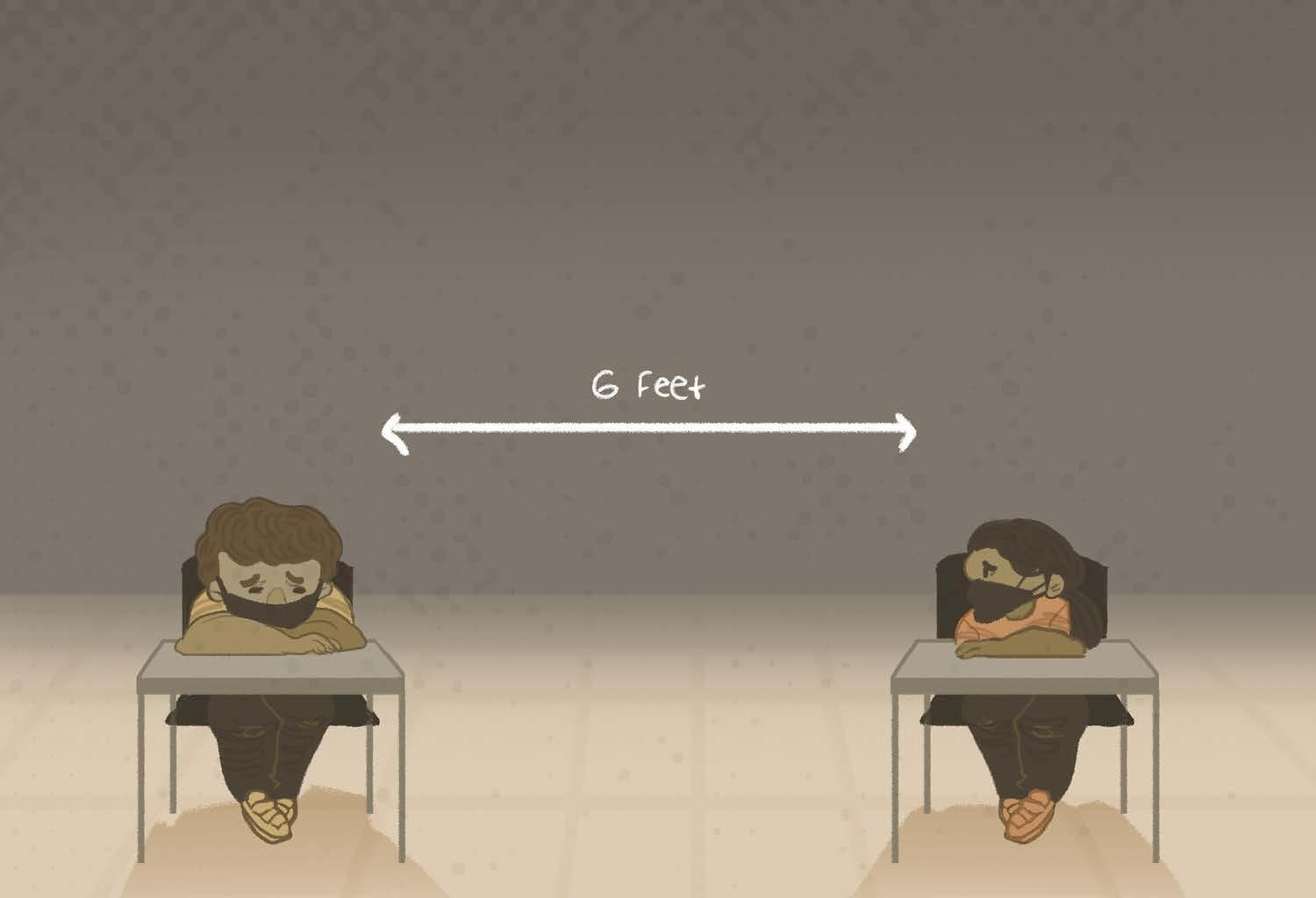
The requests were not unreasonable: mandatory mask use for all teachers, staff and students, reducing class sizes to incorporate physical distancing, assessing and updating ventilation or filtration systems where necessary and providing employees who wish to work from home opportunities to do so.
In other words, the province was simply asked to ensure a safe work environment for staff and a safe learning environment for students.
Premier Brian Pallister — a former teacher — has said that, despite the dangers, “children learn better in schools.”
What he fails to understand is that, if it is true that kids do learn better when physically attending schools, it is only true under optimal circumstances.
Do kids learn better in an environment in which they are likely afraid due to the possible spread of COVID-19?
Do kids learn better from teachers who are under immense pressure to enforce sanitization, physical distancing and mask use?
Do kids learn better from teachers who may feel uncomfortable being at work each day?
To most, these questions answer themselves.
What’s most upsetting is that remote learning is possible — Pallister is simply choosing not to go the safe route.
While some remote learning is to be expected for high school students, online learning is only being used as a last resort at one school that has seen a rise in COVID-19 cases, and only after the cases have been confirmed.
Even then, it is only Grades 6 to 8 and a split class of Grades 4 and 5 students that are switching to a remote learning environment. Beyond this, remote learning will only be used for up to two weeks until it is designated “safe” to return to school.
This is too little, too late. And this won’t be the first time, either.
With the abrupt switches to remote learning and no notice every time a series of confirmed cases occurs, teachers will struggle to prepare materials for online delivery and parents will have to scramble to ensure someone is home with their children during the day.
This could have all been avoided with a plan for remote education — or a plan for shortened and divided in-person learning — from the first day of school.
Although the province took initiatives to close schools back in March, the lack of interest in closing schools now that the risks are much higher is troubling.
While the province did put some measures in place for a safe reopening this fall, the efforts have already proven to be inadequate.
In August, the province made masks mandatory in schools for students in Grades 4 to 12 when physical distancing is not possible.
However, for children who are younger than the aforementioned age groups, it has been left to the discretion of parents to decide whether their children should wear a mask at school or not.
Although all students are required to wear masks on the school bus, this is a requirement that would be difficult to enforce, and considering the number of children using school
buses, proper physical distancing is out of the question.
If mask use on school buses is as “mandatory” as it is on Winnipeg transit buses, we’re in big trouble
Does the government really expect a bus full of kids to not only wear their masks properly, but to keep their masks on at all times, even when out of sight of adults? After all, it’s no secret that children tend to defy rules given the chance.
Further, if mask use on school buses is as “mandatory” as it is on Winnipeg transit buses, we’re in big trouble. Though masks are required on transit buses, it’s rare to see the rule enforced.
Although hand sanitizer placed throughout a school may seem like an active step in the right direction, we must remember that proper sanitization requires initiative from the students.
Can we expect young students to be sanitizing or washing their hands
as frequently as recommended? It isn’t as easy as putting a bottle of hand sanitizer at the entrance to a room. This would require the child to, of their own accord, remember to use sanitizer as often as needed.
Even if all the right precautions for in-person learning are taken, parents simply do not know if their child is sick and transmitting the novel coronavirus if he or she is asymptomatic. This only heightens the risk of bringing the virus causing COVID-19 into schools and, sadly, the only way to avoid this is to adopt further safety measures or to avoid in-person learning altogether.
If in-person instruction is absolutely necessary, children and staff deserve as much safety as possible. This means smaller class sizes and part-time school days so all students are able to return to school with a higher chance that physical distancing is able to be enforced.
Until the province takes control, the number of active cases of COVID-19 will likely continue to rise.
GRAPHIC BY JENELLE MCCANN
Comment Editor: Lucas Edmond Contact: comment@themanitoban.com
Inexpensive ridesharing comes with long-term cost
Welcoming Uber to Winnipeg could mean saying goodbye to unionized transportation
LUCAS EDMOND, STAFF
The notorious tech giant Uber was welcomed to Winnipeg earlier this summer with open arms by the municipal government and customers desiring a more modern and simple way of hailing a ride after a night out.
Uber is well known globally as a middleman-eliminating mobile app which provides effortless access to drivers and payment options to customers at the tap of a button. But besides easy access to a ride, should Winnipeggers really have been so welcoming to Uber?
While people’s affinity for the ease that Uber provides is well documented, so is the company’s blatant abuses of workers’ rights.
Uber markets itself as a proponent of the “sharing economy” — an idea which suggests people use their agency to act collaboratively and flexibly to offer services and fill demand where the formal market cannot — but in reality, nothing could be further from the truth.
Behind the facade of flexibility and agency that Uber hides behind is a powerful force that could potentially end unionism in the ride-hailing industry.
This is shown not only by the way the company manages itself, but through its history and the economic mode of thought that facilitated its creation.
Last year, Uber unilaterally cut
workers’ pay rates by 25 per cent in the U.S. in order to boost its value both in absolute terms and to make its stock more attractive to Wall Street.
Uber drivers from across the country rose with a collective strike but were met with a difficult truth: gig jobs, like the ones provided by Uber, are nearly unorganizable.
While masses of workers decided not to log hours that day, Uber was not fundamentally fazed by the issue and did not budge to the strikers’ position.
Recently, Uber has faced judicial trials around North America which are attempting to force the company to recognize their workers as official employees as opposed to contract workers — a distinction which prevents Uber workers from accessing the same rights that are afforded to “official” employees, rights such as a guaranteed minimum wage, vacation pay and other benefits.
The company has recently responded to judicial hearings being held in California by threatening a capital strike, divesting their money and laying off workers en masse.
Before it could do so, however, courts afforded the company a reprieve to appeal the case after previously ordering an unconditional injunction to force Uber to give its workers rights as employees.
This is typical behaviour of a
company that has the leverage and resources to lay labour movements and state sanctioned decisions to rest in powerful and unrelenting manners. A local cab company placed in a similar situation would never be able to successfully carry out a capital strike.
Although the Supreme Court of Canada has upheld Uber workers’ rights to be recognized as employees in a class-action lawsuit earlier this summer, the behaviour of Uber in the U.S. context, nonetheless, displays their priorities as a transnational company.
Ultimately, this is a force we have welcomed to our doorsteps.
Beyond disrupting Uber workers’ ability to unionize, the company could potentially hurt pre-existing unionized taxi jobs in Winnipeg as well.
This story is not new, it’s the same reason we have seen local corner stores closing when new supercentres open — local businesses simply cannot compete with the overwhelming resources that massive transnationals have at their disposal.
While Winnipeg has made Uber’s access to our municipal market conditional by forcing the company to follow similar regulations as other local cab companies, Uber will likely still be able to offer better consumer prices by maintaining bare-minimum employment standards. This
may force local companies with union presences to put the hammer down and reduce wages and rates or to enforce large employment cuts to compensate for the added
Behind the facade of flexibility and agency that Uber hides behind is a powerful force that could potentially end unionism in the ride-hailing industry
competition.
Either way, workers will suffer.
Beyond hurting taxi companies, Uber has openly asserted it wants to compete with public transportation and so far, it has been successful.
Experts at a variety of universities have found that a large portion of Uber’s customer base would have opted to travel by transit if the ridehailing company had not been available. This means the app could displace our public transportation system.
Bus ridership has already dropped
in numerous U.S. cities and it has been correlated with the growth of Uber and other similar apps.
Winnipeggers cannot allow private conglomerates to dissolve public institutions and unions that are crucial for equitable living standards.
Manitoba Federation of Labour president Kevin Rebeck previously raised concerns about the tech company’s history of deregulation and their reliance on the exploitation of low-income workers.
Uber’s so-called labour “flexibility” that the company claims is at the core of its brand and the way it attracts drivers is simultaneously a large source of its profit margins. Not having to afford employee benefits, vacation pay or a minimum wage on top of low pay rates grants Uber a great deal of its own flexibility in terms of what it can charge customers.
Considering this, expect Uber to do what it can to deregulate its position in Canada.
The position we have placed our transportation sector in is as precarious as Uber workers’ employment. We have opened our doors to a company which may very well offer easier access and cheaper rates for a ride home, but at potentially devastating long-term costs.
If we wish to maintain the labour movement’s legacy, be sure to catch a cab or bus and not an Uber.
GRAPHIC BY JENELLE MCCANN
Chaos The Band creates second music video
ALEXANDER DECBAL-CUZA
Chaos The Band films the yet unreleased music video for their upcoming song “Shopno,” which is planned to be released late September. This will be the second music video for the multicultural band that has written music in English, Bengali, Urdu and Hindi.
Arts & Culture
Arts & Culture Editor: Shaylyn
Maharaj-Poliah
’Toban cornertable Andrew Unger — ‘Once Removed’
EMILY UNRAU-POETKER
Historically, the Mennonite presence in Manitoba has been of some significance but, aside from deserving credit for this province’s excellent agricultural record, what does it mean to have Mennonite heri-
tage in this day and age?
Drawing from his experiences growing up in Steinbach, Man., author Andrew Unger provides a window into rural Mennonite life today through his writing.
’Toban turntable
Unger is the mind behind the Daily Bonnet, a satirical digital publication focusing on Mennonite life in rural Manitoba. Having grown up in a rural Mennonite context myself, Unger’s short articles for the Daily Bonnet made me feel understood and appreciated, even as they poked fun at everything familiar to me.
Once Removed is Unger’s debut novel, which is set against the backdrop of the fictional community of Edenfeld in southern Manitoba.
Timothy Heppner is a frustrated ghostwriter whose prospects appear to be drying up. The mayor is on a mission to modernize, and Timothy’s loyalties are divided between the local Preservation Society and his desperation to keep his job with the parks and “wreck” department, tearing down the very buildings the society works to save.
When hired to write a history of the town, he is caught up in the world of small-town politics and must find his voice in order to tell the story of Edenfeld: past, present and future.
Once Removed makes use of the rural Mennonite context to explore the tension that inherently exists between plain talk and propaganda, personal and professional pressures and progress and preservation.
From the set-in-their-ways church
Figure Walking — ‘Vertical/Horizontal,’ 4/5
KAELEN BELL
F
igure Walking’s 2017 debut, the Big Other, was lean and thrilling post-punk, a seedy dash through crowded city streets and purple alleyways, all steam and flickering streetlights. Its new record, the vibrantly tilted Vertical/Horizontal, is electrifying in equal measure, though it trades
the winding avenues of the Big Other for the transfixing strangeness of an empty sky.
There’s room for the wind to whistle through these arrangements, to shift and rattle against the nervous drums and spidery guitar — the entire record feels on the verge of
collapse, built from white space and held together by some peculiar energetic current. This electric minimalism pushes the record away from the more familiar post-punk of the Big Other and toward something skewed and elusive — by paring the music to its bare essentials, the duo found its
elders to the “assimilated Mennonites” of late, and everything in between, Unger’s portrayal is filtered through a humorous and critical lens with-
Unger provides a broad-strokes depiction of rural Mennonite life, and if you grew up in any Mennonite context, you will find something you relate to
out malice. The food, genealogical obsession and loss of language shared by these characters reminded me of home and family continuously throughout.
Low German, or Plautdietsch, words are used throughout the novel. Thrown into the middle of English sentences, they are often employed to drive a point home and are mostly understandable from context.
Timothy speaks very little low German, as does most of my gen-
eration, and I found the disconnect he felt as a result of this relatable. While I may disagree with Unger as to how some low German words are spelled, and which sides of the river are jantsied and ditsied, even this discord is accurate to the variances in rural Mennonite life across southern Manitoba.
The Mennonite towns of southern Manitoba today are, themselves, once removed from the town of Edenfeld: you will seldom find a housebarn within town limits. Regardless, Unger provides a broad-strokes depiction of rural Mennonite life, and if you grew up in any Mennonite context, you will find something you relate to.
The exposition throughout the novel, however, is not overly explanatory, so if you lack this background you will find there may be gaps in your understanding.
The themes of this novel, progress versus preservation, finding your voice and identifying where your loyalties lie, are universal. Unger addresses them with humour and tact, using the Mennonite context as an effective vehicle.
It’s very much a Winnipeg record, with references to familiar landmarks and feelings
From the chintzy keyboard that dances across opener “Last Dollar (Green July)” to the rolling bass of the hypnotic “Heavy Rain,” there’s something unnerving about the world that drummer Rob Gardiner and vocalist/multi-instrumentalist Greg MacPherson conjure on Vertical/ Horizontal. These songs move in stiff, disorienting jolts, embodying the strange double perspective of the record’s title.
MacPherson’s vocals are conversational and prodding — wordless hiccups and phrases repeated with such fervor that they become unfamiliar. His voice adds further shadow and light to this world of right angles. However, it isn’t all inflexibility and sharp corners. The relative softness of the lovely “Paradise” is a welcome moment of earth-bound
feeling, a beautifully brief piece of alt-rock balladry.
The warmth of “Paradise” can be found woven subtly throughout the record, a certain Springsteenian heft and knack for chest-swelling melody that the duo releases in small, illuminating gasps.
It’s there in the driving one-two punch of “Indonesia” and “In it to Win it,” a taste of the classic songwriting chops that help hold the sharper, stranger side of their sound together.
Vertical/Horizontal contains another echo of the Boss in its specific sense of place — it’s very much a Winnipeg record, with references to familiar landmarks and feelings. Gardiner and MacPherson mine the Prairies not for their homeliness and small-town warmth, but for their expansive strangeness — the outlandish quality of an endless and unbroken sky meeting endless and unbroken earth.
While it may have clear sonic forebears, Figure Walking has created something singular with Vertical/ Horizontal — in clearing space within the songs, the duo has made room for new sensations.
Want us to review your band? Email arts@themanitoban.com today!
alien heart.
PHOTO PROVIDED BY TURNSTONE PRESS
PHOTO PROVIDED BY DISINTEGRATION RECORDS
The Manitoba Arts Council announces award recipient
Alan Greyeyes discusses his contributions to the Indigenous music community
SHAYLYN MAHARAJ-POLIAH, STAFF
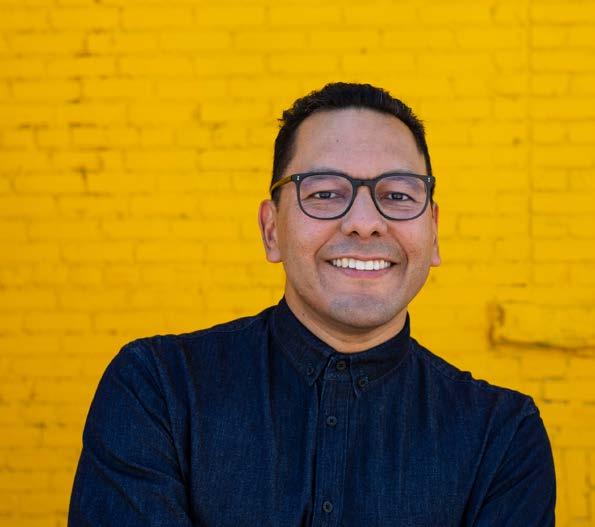
Alan Greyeyes, an Indigenous music promoter and mentor of Indigenous artists, is the 2020 recipient of the Manitoba Arts Council’s award of distinction.
The Manitoba Arts Council, an agency of the province of Manitoba, awards this $30,000 prize every second year to a Manitoban citizen for outstanding artistic accomplishments and contributions to the arts based on
peer review.
Greyeyes has been working exclusively in the Manitoba music industry for almost 15 years.
“I was a big fan of magazine culture and hip hop back in the early ’90s and that made me want to work on the business side of the music industry,” Greyeyes said.
“I started with photography, graphic design, website design and a little editorial writing […] and then built up more project management skills and my grant writing chops. That put me in a good position to compete for a job in the non-profit arts world and when the aboriginal music program coordinator role at Manitoba Music came up, I was able to convince the organization to give me a shot. I spent 12 years there, met some really great people and learned a lot.”
Over the years, Greyeyes established numerous festivals, awards, residencies and other projects to support and showcase the talent within the Indigenous community. He said he especially values the Indigenous Music Residency program where he mentors artists to develop both business and artistic expertise.
“I got to see Indigenous artists take some incredible first steps.”
“I’m not used to being in the spotlight, but I feel like awards help us tell stories that our resumes can’t and I’m excited to see what kind of doors it opens for me in the future” — Alan Greyeyes, award recipient
Among his many accomplishments, one of his favourite projects is producing the annual sākihiwē festival, which has been a launching pad for Indigenous artists, including A Tribe Called Red, Jeremy Dutcher
and iskwē.
This year, to abide by COVID19 health precautions, Greyeyes was challenged with moving the festival online, a difficult transition to make.
“I believe that art deserts have the same negative effects on our mental health that food deserts have on our physical well-being,” said Greyeyes, “which is why the sākihiwē festival takes music to some of the divested neighbourhoods in Winnipeg each year, but we weren’t able to do that this summer so I feel like we let the families in those neighbourhoods and our community partners down.”
However, he continues to look to the future and is currently working with partners in England and France to establish the festival in Europe.
“I’m excited about the idea of extending this role to help new voices build momentum overseas.”
On being the recipient of this year’s award, Greyeyes is excited for what lies ahead.
“I’m not used to being in the spotlight, but I feel like awards help us tell stories that our resumes can’t and I’m excited to see what kind of doors it opens for me in the future.”
Manitoba Rural Northern Juried Art Show goes online
Community voting feature boosts artists’ exposure
SARAH DORAN, STAFF
In the wake of the COVID19 pandemic, the Manitoba Rural Northern Juried Art Show (MRNJAS) has pivoted to an
online format. The show, run by the Manitoba Arts Network (MAN), displays the work of 56 artists from the Central, Eastman, Interlake,
Northern, Parkland and Westman regions.
Participants are usually chosen by winning their regional juried art shows. However, this year the MAN put out a call for submissions instead, selecting several from each region with the help of a three-person board. The results include a range of mediums from painting and photography to sculpture and textiles.
Nicole Shimonek, marketing and visual arts coordinator at the MAN, was enthusiastic about the unexpected benefits of a digital format, including a community voting system.
“The fact that we’re doing this online voting and having a voter’s choice award, we’re really increasing every artist’s exposure,” Shimonek said.
“Artists are getting a lot more people looking at their individual artworks than if they would just be in a gallery, so I think there’s benefits to both having a physical exhibition and then also online.”
Shimonek also emphasized the value in taking advantage of technological expertise to best fulfill the requirements of an art show.
“It was really important for us to work with a professional to deal with the fact that we have a shop, and we have a voting structure, and we have all the regions — six regions on six different gallery pages — and that was all basically the developer,” she said.
“Anybody that would be doing something like this, I think hiring a developer is really worth it — especially because we’re still running all of our programs at the same time.”
Though the online gallery only began because of the COVID-19 pandemic, the MAN will continue
“I think there’s benefits to having both a physical exhibition and then also online” —Nicole Shimonek, visual arts and marketing coordinator, Manitoba Arts Network
using it to showcase artists who do not live in Winnipeg, with Shimonek calling it “a really exciting initiative” for the MAN.
However, moving the MRNJAS online is not the only change the organization has made due to the pandemic.
The annual Manitoba Showcase, which normally takes place in October, has been cancelled entirely
for 2020, though it will return in Gimli, Man. next year. Programs that normally run alongside the showcase are still ongoing, such as the Indigenous emerging artists mentorship intensive and the RBC emerging artist mentorship program, both aimed at musicians.
The MAN has also started a webinar series on Wednesdays for its members, covering a variety of topics and often featuring guests. Other online programming has included livestreamed pitching sessions and one-on-one coaching.
“It’s been really good because a lot of the people we connect with are rural Manitobans, so having the opportunity for rural Manitobans to dial in and have a discussion and learn from different topics that we post on Wednesdays is really valuable,” said Shimonek.
The MRNJAS online gallery is available at artgallery.manitobaartsnetwork.ca until Jan. 4, 2021. Several artworks are available for purchase in the site’s shop. Members of the public can vote for their favourite artworks until Oct. 20 and voter’s choice awards will be announced at the Zoom launch party on Oct. 22.
PHOTO BY ELLA GREYEYES
IMAGE PROVIDED BY CANDACE LIPISCHAK
Lightning take on the Stars in 2020 Stanley Cup finals
Preview and prediction
ISAIAH WAGNER, STAFF
After a long and unique 2020 NHL Stanley Cup playoffs, we have finally been awarded a final.
The Dallas Stars and the Tampa Bay Lightning will be facing off in a best-of-seven series in the Edmonton, Alta. bubble.
The Lightning’s last Stanley Cup win was in 2004, while the Stars have won just one, in 1999, since their founding in 1967.
Here, we’ll take a look at the matchup between these two teams, with analysis broken down into three categories — offence, defence and goaltending.
Offence
The battle between the top lines of each team are going to be a big part of who wins the series. The Stars’s top line Jamie Benn, Tyler Seguin
and Alexander Radulov will have a tough battle against the Lightning’s Ondrej Palat, Brayden Point and Nikita Kucherov.
Kucherov, with 26 points, and Point, with 25, are the league leaders in the playoffs so far.
The Lightning have been the top goal-scoring team in the league in four of the past six seasons, including each of the past three.
Meanwhile, the Stars offence, although strong, is going to have a tough time matching the elite-scoring offensive team in the Lightning.
Advantage: Lightning Defence
Now this is a tough one to call.
The Stars have elite Finnish
The Lightning’s last Stanley Cup win was in 2004, while the Stars have won just one, in 1999, since their founding in 1967
defenceman Miro Heiskanen, third overall pick in the 2017 NHL draft.
Currently, Heiskanen is leading all 2020 playoff defencemen in scoring with 23 points.
Heiskanen is the best offensive player on the Stars, even as a defenceman.
On the other side, the Lightning have stud defenceman Victor Hedman, not only one of the top defenders, but one of the top players in the NHL. Hedman leads all
defencemen in the playoffs with 9 goals.
The defensive advantage all depends on who plays better, Heiskanen or Hedman.
Advantage: Tie
Goaltending
The Stanley Cup final could be known as the battle of the Russian goalies.
Andrei Vasilevskiy and Anton Khudobin have both been difference makers for their teams so far in the playoffs, Vasilevskiy leading with 14 wins and Khudobin a close second with 13.
Despite the nearly even record between the two during the playoffs, Vasilevskiy has been one of the best goalies in the league in the past seasons, and in this matchup, Khudobin doesn’t appear to stand a chance.
Advantage: Lightning
Prediction: Lightning win in seven games
The Stars have been a great story during these playoffs, but the elite forwards for the Lightning and the play of Vasilevskiy might just be what gives the team every hockey player’s ultimate dream.
PHOTO
Sports Editor: Isaiah Wagner
MJHL expands with the Winnipeg Freeze
New team finds a home alongside the existing Winnipeg Blues
ISAIAH WAGNER, STAFF
The Manitoba Junior Hockey League (MJHL) announced on Sept. 4 that they will be expanding. Winnipeg is to be rewarded a second team, later revealed to be named the Winnipeg Freeze.
The team will share its home city with the existing Winnipeg Blues, a staple of the MJHL for over a century.
The Freeze will be Winnipeg’s fifth major men’s hockey team along with the Blues, the Winnipeg Ice, the Winnipeg Jets and the Manitoba Moose. The team is under the ownership of 50 Below Sports and Entertainment, who also owns the Winnipeg Blues and the Winnipeg Ice.
Josh Green, a former assistant coach for both the Winnipeg Ice and Winnipeg Blues, will serve as head coach and general manager of the Freeze. Green’s playing career included time with the Los Angeles Kings, Edmonton Oilers and several other NHL teams over 10 seasons.
“I am extremely excited for the opportunity to be a head coach,” Green said in a statement.
“It’s a great opportunity to work and develop young hockey players
who are looking to forward their hockey careers.”
With the addition of the Freeze, the league will now have 12 teams to compete for the championship.
Expansion can be a tough process, but 50 Below and MJHL commissioner, Kevin Saurette, seem to have a strong relationship.
“The relationship with 50 below Sports and Entertainment is positive as they are a group we have familiarity, confidence and trust in,” said Saurette.
“They have been a good member in standing within the MJHL since they joined the league last season.”
According to Saurette, the idea for the expansion came from both the MJHL and 50 Below.
“It was mutually discussed by both parties before it was brought forth to the MJHL’s full board of governors to be further discussed for approval,” he said.
“Expansion during this environment is obviously very unique, however the benefits far outweighed any negative reasonings and the expansion request was approved accordingly.”
It may be tough to become a popular team in Winnipeg due to the considerable number of major sports teams that are already here, but Saurette does not see that as a problem for the Freeze.
“They have a strong management team that will do a great job with branding and promotion as they enter the MJHL this season as the fifth major hockey team in the Winnipeg market,” he said.
“This season also brings on a unique opportunity for the MJHL brand overall, both in the rural markets and the city, as we may be the only hockey league playing within our province for the foreseeable future.”
Adam Guercio, U of M student and sports fan, voiced his excitement to welcome the Freeze to Winnipeg.
“As a hockey fan, [the] more hockey, the better,” Guercio said.
“With COVID-19 sticking around, it gives people something to look forward to.”
The presence of five teams is a significant accomplishment for any city and is exciting for Manitoban hockey fans.
“The Winnipeg Freeze is a great addition to an already impressive amount of Winnipeg hockey teams,” Guercio said.
Expansion during this environment is obviously very unique — Kevin Saurette, MJHL commissioner
“With Winnipeg being such a hockey city, it is great for people to have more teams to follow.”
Not only is the addition of another MJHL team to Winnipeg good for the city’s hockey fans, but it may be a boon for the University of Manitoba Bisons men’s hockey team.
Last season, 16 of the Bisons’ 25 players had previously played in the MJHL.
“I think it is a great thing for the
Bisons,” said Guercio.
“On their roster, they have many previous MJHL players and another team in Winnipeg should add on to that in the future.”
The Freeze and the Blues will be sharing a home for the next little while, with the new team set to play out of the Rink Training Centre alongside the Blues for the beginning of the 2020-21 season.
The Freeze will make their regular season debut at home against the Steinbach Pistons on Oct. 9, and the team’s first game against the Winnipeg Blues is set for Oct. 23.
Domestic travel restrictions enacted due to the current pandemic won’t be an issue for the Freeze after chief provincial public health officer Brent Roussin’s recent announcement that the province’s ban on travel north of the 53rd parallel has been amended to allow sports teams to attend games.
Saurette is positive on the whole about the league’s expansion and the prospects of the new team.
“The MJHL is excited to welcome the Winnipeg Freeze for the upcoming season.”