



publish any material deemed by its editorial board to be discriminatory, racist, sexist, homophobic or transphobic, ableist or libellous. Opinions expressed in letters and articles are solely those of the authors. Editorials in the Manitoban are signed and represent the opinions of the writer(s), not necessarily those of the Manitoban staff, Editorial Board, or the publisher. All contents are ©2020 and may not be reprinted without the express written permission of the Editor-in-Chief. Yearly subscriptions to the Manitoban are available for $40.
MANAGING EDITOR Ty Brass me@themanitoban.com
NEWS EDITOR Amira Tekle amira@themanitoban.com
NEWS EDITOR Gillian Brown gillian@themanitoban.com
COMMENT EDITOR Lucas Edmond comment@themanitoban.com
ARTS AND CULTURE EDITOR Shaylyn Maharaj-Poliah arts@themanitoban.com
SPORTS EDITOR Isaiah Wagner sports@themanitoban.com
RESEARCH & TECH EDITOR Sarah Doran research@themanitoban.com
JUNIOR RESEARCH EDITOR Mario Mendez Diaz mario@themanitoban.com
COPY EDITOR Ursula Chojko-Bolec copy@themanitoban.com
DESIGN EDITOR Joshua Wesey design@themanitoban.com
GRAPHICS EDITOR Jenelle McCann graphics@themanitoban.com
VISUAL COMM. DEVELOPER Evan Tremblay evan@themanitoban.com
PHOTO EDITOR Alex Decebal-Cuza visual@themanitoban.com
AUDIO EDITOR Tino Hove audio@themanitoban.com
VIDEO EDITOR Nish Joshi video@themanitoban.com
SOCIAL MEDIA EDITOR Kathy Dinh social@themanitoban.com
News
Manitoba post-secondary institutions have already signed on
AMIRA TEKLE, STAFF
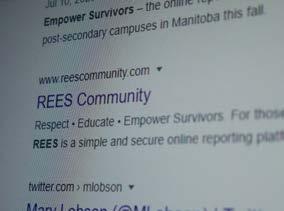
Eleven of Manitoba’s colleges and universities have signed on with Respect, Empower, Educate Survivors (REES), an online sexual violence reporting tool tailored to the needs of post-secondary campuses. The only institution yet to do so is the U of M.
Mary Lobson, the founder of REES, describes the platform as a “social purpose technology company.”
She said they are “creating [a] trauma-informed, survivor-centred online platform for reporting sexual violence.”
REES works by customizing itself to each post-secondary campus it serves, Lobson said.
“It contains within it specific campus information and resources that will contain your specific sexual violence policy […] and it also includes campus-specific supports and resources that are available.”
REES also links users to community supports in their broader area.
“It’s also customized to your specific geographic community,” Lobson said. “So, in Winnipeg we would have community supports as well,
like Klinic [Community Health] [and] Ka Ni Kanichihk.”
Survivors of sexual violence can also send their records recorded through REES directly to a designated person within their institution.
“So in the case of the U of M, if they were to use [REES], there could be potential that it could just go directly to the Sexual Violence Resource Centre in an effort to reduce the number of times that a survivor needs to tell their story.”
Lobson said she doesn’t know why the U of M hasn’t signed on with her platform, and that she has met with university and UMSU officials multiple times.
Joel Lebois — chair of the Sexual Violence Steering Committee (SVSC) and U of M human rights counsel — noted that the independent review released by the U of M, titled “Responding to Sexual Violence, Harassment and Discrimination at the University of Manitoba: A Path Forward,” did not include REES among its 43 recommendations.
Lebois said the SVSC met with Lobson June 17. He said the presentation of REES shown was an “incomplete rough draft or beta version of the system.”
He noted that the U of M had a meeting scheduled with Lobson for
March 18 but rescheduled due to the onset of the COVID-19 pandemic, but said a “group of campus experts” will be reviewing REES to see if it is a fit for the U of M.
“That group will be reaching out to REES in September with further questions, feedback and concerns if any,” Lebois said.
[We are] creating [a] trauma-informed, survivor-centred online platform for reporting sexual violence — Mary Lobson, founder
Laurie Schnarr, vice-provost (students) at the U of M said the university is “very interested” in REES, but did note the incomplete state of REES at the June 17 presentation.
“The committee discussed this project and agreed that there was limited information available given that REES was not complete at the time of the presentation, and that the system cannot be reviewed indepen-
dently,” Schnarr said.
UMSU vice-president student life Savannah Szocs said UMSU supports the launch of the program at the U of M.
“UMSU is displeased with the way the university has handled this opportunity, and we as a student union formally recommended that the university take this program on,” she said.
Szocs noted that no final decisions have been made about whether REES will be implemented at the U of M. She said the SVSC, which she sits on, has formed a subcommittee to explore REES further.
Schnarr said online reporting tools like REES will be important for the future of sexual violence reporting at the U of M but noted that there are some parts of the platform the U of M wants to look into first.
“We need more information in order to assess the privacy impact of the REES project, since it is a thirdparty reporting mechanism that is not controlled by the university and cannot be accessed by the university,” she said.
“This raises questions regarding privacy and data collection, as well as whether the project will meet the university’s accessibility obligations.”

to use the monitoring software in their courses for the fall 2020 term. Respondus, which describes itself
on its website as a “pioneer of online testing applications,” is the software the U of M piloted in order to monitor students taking exams.
Video segments with potential exam violations are flagged for the instructor
The company’s software watches students’ webcams as they write exams and locks students’ browsers so they cannot leave the exam until it is finished.
According to the Respondus website, “powerful analytics are used to detect suspicious behaviours during an exam session.
Video segments with potential exam violations are flagged for the instructor.”
Respondus also uses artificial intelligence to monitor students’ physical movements as well as keyboard and mouse use to detect cheating.
The U of M issues penalties for
academic dishonesty — including cheating on assessments — ranging from failure of the course to expulsion.
In an effort to mitigate academic dishonesty in the faculty of science, dean Stefi Baum said many classes will see “lower-stakes assessments, rather than putting everything into a final or huge midterm.”
She said her goal is to “change the cost-benefit analysis” to ensure students have less incentive to cheat on their exams and assignments.
Dean of agricultural and food sciences, Martin Scanlon, said limiting high-stress situations is a priority of his faculty as well. The fall semester will see grading based on smaller assignments spread across the term instead of having one exam making up a larger percentage of their final grade.
Records of academic dishonesty are kept by the university, and a notation noting any transgressions appear on records and on official university transcripts if a student is expelled or suspended from the university due to academic dishonesty.
— with files from Gillian Brown
SARAH DORAN, STAFF
The University of Manitoba faculty
of arts named Susan Prentice, a professor in the department of sociology and criminology, the new Duff Roblin professor of government on Sept. 1.
The position, an endowed chair named for the former Manitoba premier, is a three-year term that requires the holder to give at least one public lecture a year and organize at least one conference, as well as overseeing the Duff Roblin graduate fellowships at the University of Winnipeg.
As the Duff Roblin professor, Prentice is expected to focus on community outreach and education that will help advance understanding of Canadian government policy. For an academic whose research focuses on the intersection of feminism, families and the economy, with a particular interest in childcare, the new role is a chance to build on decades of past research.
“For a long time, a classical view of politics just said that politicians and professional staff, bureaucrats, were the ones who designed policies,” Prentice said.
“But it’s very clear from mountains of research that social movements, actors in civil society, change political decisions and can promote better policy. […] So, I’ve been very interested in my whole career to think about this relationship between actors outside the state and actors inside the state, and the actual ways in which policy gets made and can be challenged and improved.”
Prentice first grew interested in the topic while working with an activist group concentrating on day-
care as a young woman in Toronto, Ont. Both her master’s degree and PhD examined social movements campaigning for change, particularly around feminism and childcare. Her work led to her appointment as the Margaret Laurence chair in women’s studies.
“It was an absolutely dream job for a freshly-minted academic, because my job for my first three years was to try to make connections between women in the academy and women in the community, and to try to promote greater equity,” Prentice said.
“That was my mandate. So, it wasn’t just what I did, it was actually my job. It was a magnificent way to launch a career, so getting this Duff Roblin position now feels like a lovely continuation.”
Prentice is taking on the role at a critical time for her field. With a national crisis comes opportunity, she said, and suggested Canada’s “impressive” response to the sudden fiscal downturn through financial support for those suddenly without jobs could clear the way to rebuild an economy better than the one before it — one that considers early education and childcare an essential public service.
Prentice said, “150 years ago, if you said ‘Our kids need educating, we need a school,’ people would have given you a fight.”
“But now today we would say, ‘Hey, of course we need to build schools. Who cares if they cost hundreds of millions of dollars to build?’” she continued.
“And we haven’t yet tipped over the same way to think the provision of early childhood care and
education is exactly as essential as physical infrastructure and education infrastructure.
“That’s that tipping point, and I think that this pandemic might have made enough people realize it — that there’s a real chance to invest and create the services that children and families and especially women really need.”
The university community is no exception. About one in 10 university students in Canada is a parent, with much higher proportions of parents among college students. Faculty and staff have childcare needs as well, and all three categories have to navigate around irregular schedules.
Despite this, the U of M has only 138 childcare spaces on campus and the U of W has 96.
Elsewhere, the University of Saskatchewan has 200; the University of British Columbia, just under 600; the University of Toronto, 148; McGill University, 110; and the University of Ottawa, just 49.
“I’ve been part of a campaign to try to expand childcare on campus, and we did grow the system a little bit, but there is a huge amount of work to do,” Prentice said.
“I mean, I think childcare on campus is as essential as libraries. Nobody would say you could have a university without a library. We need books. Well, how do students and staff and faculty work if they don’t have childcare?”
A major theme of Prentice’s work deals with how the issue of accessible and affordable childcare impacts every aspect of an economy, not just individual families. As Canada ponders how to bounce back from a
recession that is disproportionately affecting women-dominated fields, Prentice is adamant that childcare is a necessity for everyone, even people who do not have children.
“The intriguing thing about childcare as a service is, of course, you could say that the children are the clients — the children are the ones
“Early childhood care and education is exactly as essential as physical infrastructure” — Susan Prentice, sociology professor
who attend the program — but so are the parents, because they’re getting the benefit, particularly when they use childcare to work or study,” she said.
“But you could also say so do employers, because they have workers who can come to work.”
The Caring About Care project, which ran from 2016-2019, was Prentice’s second collaboration with a team of colleagues from Brock University and Ryerson University. Research involved extensive interviews with early childhood educators to get firsthand accounts of what kinds of supports are needed in the field, as well as an analysis of the limitations in childcare policies represented by different parties in the 2018 Ontario provincial election.
In addition to a number of academic journal articles, the project also produced a book titled Caring for Children: Social Movements and Public Policy in Canada. Prentice emphasized the importance of doing qualitative research, especially in social sciences, to help provide concrete evidence and data that can be used to help groups lobby for more effective policy.
“The people actually doing the work know a whole lot more than the people at the top, all the time,” she said.
“We’ve done lots of interviews and made a real point of trying to take these insights that we learned and share them with communities of practice.”
Prentice is building on the results of the Caring About Care project in a new seven-year project funded by a Connection partnership grant from the Social Sciences and Humanities Research Council (SSHRC). The official title of the project is “What is the best policy mix for diverse Canadian families with young children? Reimagining Canadian family policies” and research will be divided into three separate streams: employment, parental leave and childcare. Prentice is working in the childcare stream, along with a combination of advocacy groups, professional associations and think tanks that focus on public policy.
“It’s a fantastic team,” Prentice said.
“I am so looking forward to the synergy between this partnership grant and the Duff Roblin chair, and my interest in working on public policy that is women- and family-friendly.”
GILLIAN BROWN, STAFF

This semester in STEM faculties, remote classes are posing challenges for educators and students when it comes to what is typically hands-on learning.
The deans of the faculties of science, environment and agricultural and food sciences say their primary goals are to ensure that the courses maintain their academic integrity and that students’ graduations are delayed as little as possible.
“We want all the students to get out of those courses, as much as is possible, the normal learning outcomes,” said Martin Scanlon, dean
of the faculty of agricultural and food sciences.
To allow for that across all departments, Stefi Baum, dean of the faculty of science, said several lab courses in the faculty have been modified for online learning, with two or three on-campus labs so students acquire “necessary skill sets” for their degree programs.
According to Baum, courses held in-person for the fall semester were chosen by determining which could only achieve the educational outcomes on-campus and which could be conducted according to COVID-
19 safety requirements.
Classes with what Scanlon called “essential in-person components” have been either postponed to the extended fall term from Jan. 5 to 15 or cancelled altogether for the year.
In the faculty of environment, earth and resources, acting dean Andrew Frederiksen said they have had less difficulty moving courses in the department of environment and geography online, but in geological sciences, a few courses have been cancelled.
A modified schedule for “essential courses” in the department with specific technological needs aims to keep one class at a time in the Wallace building for lab work.
Frederiksen said the courses dropped are “nothing that’s actually a required course for a program and nothing that will delay a student’s graduation.”
The biggest losses for the department, he said, are the cancellations of required field courses that would normally be conducted in the spring semester. Students with those requirements unfulfilled will have their graduation delayed.
Frederiksen remains hopeful that the field classes will be able to run in the spring of 2021.
“We’re keeping things going and
just dealing with the situation as it changes on us.”
He said that in geological science programs, degree programs are designed to fit requirements for professional registration under Engineers Geoscientists Manitoba, requirements that dictate which courses must be present, and that
“We’re keeping things going and just dealing with the situation as it changes on us” — Andrew Frederiksen, acting dean of faculty of environment, earth and resources
those requirements include having taken a field course during their postsecondary studies.
In the faculty of agricultural and food sciences, Scanlon said his prior-
ity is that students gain the manual skills needed for practical application in their fields. Because of this, the faculty has needed to cancel one class based in a greenhouse due to the necessity of the environment and the inability to properly socially distance.
In all three faculties, graduate students are still able to continue their research. Labs are running under strict social distancing guidelines, and students have been asked to conduct most work from home.
Students in the faculty of agricultural and food sciences are encouraged to work on their theses from home rather than lab work, Scanlon said.
In the faculty of science, Baum reports higher undergraduate enrolment than before.
She said since classes have moved online, the faculty has been able to accommodate more students.
“We’re putting on more course sections and increasing caps on things, so, in some ways, because we’re not restricted by physical space in a classroom […] we can accommodate more students through this remote approach.
“So, if it works then, at least for science, for this year, we should be OK.”
A s a result of racism allegations, a blackface scandal and an internal human rights investigation, former University of Winnipeg Students’ Association (UWSA) president Jibril Hussein and vice-president external affairs Breanna Belisle have resigned.
After Hussein’s resignation, he released a statement which said, “the UWSA prides itself on standing up for all BIPOC students, staff and community members.
“However, I believe that this is not the case and this institution sadly perpetuates the same pervasive racism and prejudice they claim to actively
be against.”
In his resignation letter on Aug. 5, Hussein referred to the association as the “most toxic” work environment he has ever experienced.
He reported on his Instagram that at the June 16 UWSA board meeting, a board member accused him of “using [his] Blackness as a shield” in response to the allegations against the executive slate weeks prior.
He went on to claim “the association is racist,” and that it called into question his racial identity and remained complacent when violent threats against the executive team
were brought to the board’s attention at a June 12 meeting.
Belisle’s letter backed Hussein’s concern and disappointment with the “continued perpetuation of pervasive racism and prejudice within the UWSA.”
At a June 16 meeting, the executive board was placed on paid leave while an independent investigation of the allegations was conducted by the university’s human rights and diversity office (HRDO). Hussein and Belisle resigned before the investigation’s completion.
This resignation follows com-
plaints against the association’s handling of racism dating back to February, when former executives Noelle Sagher and Mahlet Cuff claimed to be harassed and intimidated on the basis of their gender and race by David Teffaine and Sam Cohn, volunteers working for the current slate’s campaign during elections.
Sagher said her reports to the chief elections commissioner of this intimidation were denied and undermined.
During elections, when the current slate was elected, Teffaine assumed a position with the board as student-at-large on the financial subcommittee.
After allegations in early June, an investigation request was filed on behalf of the UWSA executive and a video was released by the three executives and Teffaine addressing allegations against the executive board and against unnamed members.
The following day, a photo was released of Teffaine in blackface and he was removed from his positions with the association.
After their resignations, both Hussein’s and Belisle’s statements corroborated that the executive board
had been barred from a number of meetings discussing budgets due to what Hussein described as a “potential conflict of interest.”
UWSA vice-president student affairs Melanie William remains on the executive board and is co-operating with the ongoing investigation. This fall, the UWSA will hold an annual by-election to fill seats unfulfilled by the last election.
There have been two other instances where an executive position has been re-elected during a by-election. One in 2005, when there was no candidate on the ballot for what was then the position of vice-president internal and one in 2006, where a full executive slate was elected, but the vice-president internal position was vacated and then re-elected in the by-election.
An association spokesperson said in a statement the board is working with an external consultant to restructure the organization to “ensure the integrity of UWSA democratic processes, to create antioppressive leadership models and to minimize the harm caused to students from underserved communities.”
SARAH DORAN, STAFF

The Canadian Centre for Policy Alternatives (CCPA) released a report Aug. 27 co-authored by Jesse Hajer, an assistant professor in economics and the labour studies program at the U of M. The report, titled “Surviving on Minimum Wage: Lived Experiences of Manitoba Workers a nd Policy Implications,” is an update on a 2001 CCPA study which examined living conditions of minimumwage workers and people living in poverty in Manitoba.
Interviews with workers in Winnipeg and Brandon combined with quantitative analysis from the entire province led Hajer and his
co-author, Ellen Smirl, to conclude that the current provincial minimum wage of $11.65 is inadequate as a living wage, echoing the 2001 report’s findings. Hajer and Smirl recommended a “significant” increase in the minimum wage, as well as mandating advance notice of shift scheduling changes, granting paid time off and the establishment of a comprehensive poverty reduction plan.
“The findings in the sense that the minimum wage is too low are the same, and a lot of the struggles that workers faced trying to make ends meet on the minimum wage were similar,” Hajer said.
“One of the big differences, though, this time around, was that workers
“Workers were very much focused on […] the working conditions under which they were trying to survive”
— Jesse Hajer, co-author and assistant professor
were very much focused on not just the wage, but the working conditions under which they were trying to survive.”
A major complaint was that even if the provincial minimum wage rose to $15 an hour — which the report uses as an example — the new income wouldn’t necessarily mean workers would be able to get enough hours at their jobs to meaningfully improve their lives. Many people working at
or near minimum wage do not have set hours, and sick days — whether paid or unpaid — are very rare. Only one of the 42 workers interviewed reported receiving any kind of benefits from their employer.
Hajer explained that many socioeconomic forces often combine to create what academics call complex poverty, which manifest as “poverty traps” — essentially, the idea that once someone experiences this type of poverty, it is extremely difficult to get back to a less precarious financial situation because one factor often leads to several others.
While the research for the report was completed before COVID-19 hit Canada, Hajer said the pandemic only exacerbated problems that were already there.
“My sense would be that the additional stress and anxiety on minimum-wage workers of the COVID-19 crises is likely significant, both because they’re on the front lines and they have more exposure, they’re at a greater risk, but also because they were disproportionately impacted by the job losses that took place in the pandemic,” he said.
“So, while a big chunk of minimum-wage workers continued to
work, in the restaurant industry, for example, there were huge numbers of layoffs, and a lot of those jobs are minimum wage jobs, too.”
However, Hajer said he wasn’t convinced about the potential of a national basic universal income — the source of a growin g national movement — in solving economic woes for minimum-wage workers. He spoke about the need for jobs in sectors like childcare and climate change being more important.
“There’s a lot of work where we could be hiring people to do this work and paying them to do that work, and on the other hand we have a lot of people who can’t find work, who want to work,” Hajer said.
“I think a basic income can be part of the discussion, but I’m also concerned that the focus on the basic income isn’t going to solve all sorts of other problems that exist, and that are tied really closely to the problems basic income is supposed to solve.
“If we’re really talking about alleviating poverty and creating an inclusive society, I think the best way to do that is to support public services that directly meet other needs that we have.”
MARIO MENDEZ DIAZ, STAFF

T
he University of Manitoba has the potential to become one of Canada’s leading universities studying the health effects of vaping.
Along with two other U of M research projects, assistant professor Chris Pascoe was awarded a research grant from the Canadian Institutes of Health Research to study the effects of vaping on teenagers and young adults.
The knowledge that Pascoe and other researchers will uncover is intended to build the evidence base on which future policies and regulations will address vaping in Canada.
“With the rapid rise in vaping in
Canada, particularly among youth, more research is urgently needed to understand the long-term health effects of vaping,” said Judy Bray, vice president, research at the Canadian Cancer Society.
Much of the current knowledge around the long-term effects of vaping is based on animal models and cells.
“While it’s a good starting point to understand whether there is anything potentially hazardous there, it’s no substitute for what’s happening in people,” Pascoe said.
This is where his research comes in.
Pascoe’s project is a year-long
effort with the goal of characterizing the type of damage happening, if any, in people between 15 and 25 years of age. “We’re not going in there looking for damage, we’re looking to see what the lung is doing and let it tell us what needs to be researched,” said Pascoe. The project’s hypothesis is that vaping creates scarring as well as early signs of disease that would be uncommon in a young person’s lungs.
To achieve this, the research project will primarily look at lung tissue from otherwise healthy young people who may show early signs of future illness caused by vaping. “[The study’s participants] aren’t sick. They aren’t like traditional smokers, they don’t have lung disease as somebody who smokes for 40 [to] 50 years. What we’re hoping is that we can see early signs of disease, because our concern is that those early signs, that damage, that scarring within the lung could be leading to something bigger later on,” said Pascoe.
Acute lung damage, such as the damage caused by illegal or unregulated substances in vaping products that may result in lung injury, is better understood and not within the project’s scope.
History repeating itself?
Pascoe thinks the emerging vap-
ing industry has borrowed value proposals like the ones used for tobacco products in the past. Vaping devices are being marketed toward young people as trendy and in some instances as a health product — an aid to stop smoking.
“At some point we are going to be stuck with a crisis of probably lung disease and people being addicted to these devices”
— Chris Pascoe, assistant professor
“In 20 years’ time if this follows any trend like what we saw with traditional cigarettes […] at some point we are going to be stuck with a crisis of probably lung disease and people being addicted to these devices,” he said.
Health Canada has created new
legislation regulating vaping advertisements. The new rules — which came into effect in August 2020 — aim to protect youth from advertisements which might induce them to try vaping.
Juul, a vaping company, claimed its product is targeted toward adults only. Pascoe and many other experts think otherwise.
“I don’t think you will find somebody who readily admits that they are targeting young people, but with flavours like bubble gum and cotton candy […] these are not marketed to adults,” Pascoe said. “Whether they say they intend to or not, they are definitely targeting children and young people who would want these kinds of flavours.”
Pascoe sees a need for the research he will be undertaking as he believes the amount of information we currently have about the long-term effects of vaping may be insufficient to protect Canadians.
“There [isn’t] a tax or any kind of health warning that we are able to put out right now like we do with cigarettes, because we just don’t have that information,” said Pascoe. “[Vaping] is so new that we don’t understand the full breadth of the negative effects of these things.”

Editor-In-Chief: Matthew Doering Contact: editor@
LUCAS EDMOND, STAFF
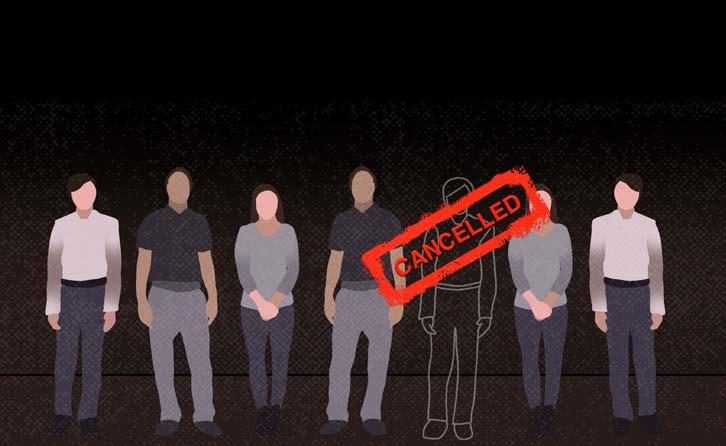
This summer has witnessed an influx of op-eds about a so-called “illiberal” cancel culture growing within leftist movements.
Cancel culture is defined as the practice of withdrawing support for public figures, businesses or institutions for expressing controversial opinions or actions.
Beginning with Harper’s Magazine ’s “Letter on Justice and Open Debate” published earlier this summer, cancel culture has become a bit of a buzz word and, lately, even a way to delegitimize political movements for perceived intolerance of free speech.
But cancel culture is not new or even growing on the left side of the political spectrum — it has always existed as an atomized political expression no matter where one falls ideologically.
For the most part, it seems natural to withdraw support for a public figure with exposed contradictions to an individual’s ethics — so why is the left being attacked for a political expression everyone seems to partake in?
The difference now appears to fall on changing attitudes toward hegemonic cultural practices that have been rooted in intolerance pertaining to race, sex and gender.
With issues such as combating homophobia, transphobia, racism, misogyny or rape culture at the forefront of many progressive social agen-
das, there is little room for promoting powerful individuals that embody and normalize these attitudes.
It seems people in positions of power are uncomfortable with the fact that cancel culture challenges their privileges, which have historically been protected by a society that has bred conformity over embracing social diversity.
It is a response to a changing intellectual environment that no longer lets controversial opinions slide as simply “harmless,” or finds nothing remarkable about a gay couple kissing goodbye at the bus stop or a student reading bell hooks in a literature class.
Although much must still be achieved in the intellectual world to alleviate our ailing racial, cultural, gender and sexual bigotry, the culture of intolerance has met a new impasse for people who have the power to influence through fame or money. hn
And although free speech isn’t a cause the left can afford to abandon, cancel culture does not necessarily restrict people’s right to speak like the letter in Harper’s Magazine suggests it does — it merely provides a way of holding individuals accountable for the things they have expressed or acted on.
In an age where anything you see or hear can be commodified, advertised and sold, having the ability to withdraw your consumption of someone’s music, hot takes or business for expressing a sentiment that directly
contradicts your ethical stance is a perfectly acceptable tactic of protest. And it is not new.
The suffrage, civil rights and labour movements have utilized boycotting support for particular figures, businesses and laws in order to get
The difference now appears to fall on changing attitudes toward hegemonic cultural practices that have been rooted in intolerance pertaining to race, sex and gender
their agendas and points across. It is not a unique development brought on by the Black Lives Matter or the #MeToo movements. It is simply a continuation of the social rights activism that preceded us.
The boycott was originally popularized by Charles Stewart Parnell in 19th century Ireland as a way to protest landlords attempting to raise rents and evict their tenants. It would later be widely adopted by labour unions as a tactic to gain better leverage over employers and
fight for improved working conditions and wages. Similarly, in 1911 the suffragettes of England would stage a historic boycott of the annual government census, transforming the papers into a platform to display their political grievances — writing things like “I will not supply these particulars until I have my rights as a citizen. Votes for women” and “dumb politically, blind to the census, deaf to the enumerator.”
Later, in the 1950s and 1960s, the American civil rights movement would attempt to desegregate the dollar by boycotting businesses that promoted intolerant views in the hopes that companies would gradually reform their policies due to revenue loss.
Instead of being seen as an insidious ploy by leftists to undermine people’s careers, cancel culture should be understood as a method of direct action that transcends punishments sanctioned by the state — making it, in a sense, more democratic.
This point is important both in principle and pragmatically for leftists and progressives.
Reaching to direct action as a mode of protest is crucial in stepping toward a more radical democratic transformation of our society from within.
Relying on the state to transform our cultural institutions would be a direct contradiction of this very principle and cancelling support for public
figures and their platforms provides a course of action that is easy and effective for people with less of a power to influence public perceptions.
To this point, it should always be a priority to attempt to dissuade people from toxic and hateful beliefs. But, in the case of uneven power dynamics between popular public figures with the ability to influence and the average individual lacking a platform, one’s voice may be muffled or go unheard.
In this context, cancel culture seems like a justifiable method of action.
What is the point of having “open discussion,” as Harper ’s letter suggests, when one’s voice can be simply ignored?
It is crucial to understand that there is absolutely nothing unique about cancel culture. It is simply a response to unethical stances of public figures who rely on support from the public for their livelihoods — a reality which many people have decided to exploit to discipline the powerful.
When individuals decry the toxic nature of cancel culture, they are simultaneously speaking against those traumatized by their hateful words and actions.
Cancel culture provides a powerful voice to victims of intolerance and they should not be silenced.

Comment Editor: Lucas Edmond Contact: comment@themanitoban.com
reduced workday
LUCAS EDMOND, STAFF

W
ith the Canadian Emergency Response Benefit coming to its conclusion at the end of September and the COVID-19 pandemic still in full swing, the federal government is reviewing a new benefit that could draw Canada closer to adopting a guaranteed basic income — a policy that has been discussed for several decades.
A guaranteed income would subsidize wages in order to give everybody a base living standard. Unlike welfare, guaranteed basic incomes are unconditional.
Derek Holt, a head administrator at Scotiabank in Toronto, Ont., has said the new economic recovery benefits that will be utilized for the next 12 months could result in a permanent guaranteed income sometime in the near future.
With debates ramping up about a guaranteed basic income, it is time to reflect whether it actually benefits the material interests of the working class and if not, what causes we should be fighting for to advance our interests.
While appearing to be a generous step in the right direction, history has shown that adopting a basic income policy could be disastrous for the working poor — not only would this benefit employers in the long run, but it could rip the carpet from under
the working class with reduced hourly wages and reduced political leverage.
Although appearing to be a paradox — after all, how could free money lead to a poorer working class?
— there is a fairly simple economic logic to this process that can be exemplified by the pre-capitalist English Speenhamland system adopted in 1795.
Speenhamland was adopted by the English government to help alleviate pressures on families caused by the rising price of grain. The state actively subsidized household incomes to ensure every man of a household could afford roughly 25 pounds of bread a week and an additional loaf and a half for each family member. It essentially served as the world’s first guaranteed basic income.
While in the short term this policy worked to alleviate significant economic pressures, in the long run it served to demolish the agency of the working poor and undermine their standard of living.
Karl Polanyi, a prolific historian and anthropologist of the 20th century, wrote that Speenhamland topped up wages unconditionally and, as a result, employers would actively hire workers at below-subsistence wages. The additional costs were then shouldered by the local government.
In essence, Speenhamland allowed employers to exploit the surplus value of workers’ time even further. By extension, this widened the inequality gap.
In time, productivity reduced and so did overall economic output — with the economic deflation, income supports were also reduced and the long-term agency of the working poor was degraded by rampant government paternalism.
When Speenhamland ended in 1834, an even more sinister paternalism took its place to reform the “idle” working poor. The Dickensian workhouse would terrorize the unemployed and impoverished, funneling them into abusive surveillance houses to ensure idleness was stamped out of the population. But idleness was not a problem of personal attitudes toward work, it was merely a problem produced by exploitation and lack of employment.
Now, a similar situation could be on the horizon.
The biggest incentive for a basic income lately has been to ensure a base living standard before machines completely replace human labour. Unfortunately, this is exactly the situation the working class should attempt to prevent for as long as possible. And adopting a basic income
could possibly incentivize this transition.
Without human labour, the bargaining power of the working class would be demolished. It would be forced to appeal to the capitalist class for a subsistence in order to buy products back from those same people. The inequality gap would snowball as the state would essentially be subsidizing people’s livings which would eventually end up back in the pockets of wealthy business owners.
The point of productive policy should not be to diminish the agency and freedom of working people — it should be to empower them and reduce their exploitation.
A reduced workday could serve as an alternative to a guaranteed basic income. It would have the intended effects of a basic income without diluting the working class’ agency. Further, it would come directly from the pockets of the capitalist class in the form of wages instead of jumping through bureaucratic mazes.
Reducing the workday to four hours and maintaining levels of pay with inflation would act as a natural redistributor of wealth. The less of your time employers have to exploit, the less surplus they can extract, thereby costing them more money and saving the working class theirs
— time is money, after all.
Beyond this, a four-hour workday has the potential to eliminate unemployment, opening up a significant portion of positions if employers decide to maintain their original hours of operation.
Although many people may think the four-hour workday sounds like a fantasy, it wasn’t long ago that the eight-hour workday did, too
Although many people may think the four-hour workday sounds like a fantasy, it wasn’t long ago that the eight-hour workday did, too. Now it is hard to imagine a weekday without it.
Reduced work weeks have been championed by labour unions for over a century for a reason. If we want to establish a more equitable world, guaranteed basic income is not the place to look — the future rests with the four-hour day.


Arts
& Culture Editor: Shaylyn Maharaj-Poliah Contact:
DOMINIQUE WIGHTMAN

Sean Garrity’s latest film I Propose We Never See Each Other Again After Tonight is an intimate, authentic and humorous exploration of life and love within Winnipeg and its Filipino diaspora.
Described as “[a] romantic comedy about love, and loss, and winter, and banana sauce,” the film follows a love affair between Iris DelaCruz and Simon Friesen in the midst of a Winnipeg winter.
The relationship is disrupted when Simon, afraid of long-term commitment, suggests he and Iris take a break. Interpreting this as any normal person would, Iris sleeps with another man. Soon, Simon invites himself back into Iris’s life. While their rekindled relationship goes smoothly enough initially, things get complicated once Iris realizes her decision was the result of a serious miscommunication.
Garrity’s previous work has gar-
nered comparison to films by David Cronenberg, Atom Egoyan and Luis Buñuel. His latest film, though, has more in common with the work of Kevin Smith and Judd Apatow, being a mostly-successful combination of raunch and heart buoyed by snappy dialogue.
The film’s best moments are its dialogue sequences, which Garrity refers to as the poetry of the halfsentence. Garrity’s script balances wit with intimacy, allowing lead actors Hera Nalam and Kristian Jordan to express their complete range of emotion.
Nalam, who plays Iris, shines alongside her Filipino co-stars, whose contributions to Garrity’s script enliven a series of emotional and humorous highlights.
Incorporating a pidgin of Tagalog and English — referred to by Garrity as “Taglish” — into Iris’s immigrant home, the film subverts the dialogic
conventions of family drama and comedy of manners in a respectful showcase of Filipino identity.
Garrity’s heartfelt recognition of Winnipeg and its Filipino community helps the film overcome its minor weaknesses.
While not a technical tour-deforce, Garrity’s confident direction creates an effective synergy of form and content.
Andrew Forbes’s handheld camerawork combines with Garrity’s intentionally clumsy dialogue to create an informal authenticity. Forbes crea-
tively navigates the film’s indoor and outdoor locations, proudly displaying Winnipeg landmarks.
Divorced from its significance as a “Winnipeg” movie, the film does have its flaws.
The film maintains a fairly lighthearted, PG-13 approach to sexuality, which effectively contributes to a quirky, lighthearted tone. A sequence where Simon and Iris passionately disrobe their five layers of winter apparel is particularly humorous.
This tone is disrupted in the film’s final 20 minutes by an explicit sex scene, which is more jarring than emotional.
Further, Iris is afforded character development at the expense of Simon.
Iris’s character development occurs within a meticulously constructed nexus between her family life, romantic affairs and personal growth.
Simon’s family, despite the importance of his family history to the film’s
narrative arc, is never introduced. His work life is only explored in a brief comedic vignette and the most important decision he makes in the film is explored entirely in his absence. This would not be an issue if Garrity presented Iris as the film’s exclusive protagonist. However, he establishes Simon in a co-protagonist role, causing this inequality to stand out.
Still, Garrity’s heartfelt recognition of Winnipeg and its Filipino community helps the film overcome its minor weaknesses. The film should serve as a treat for cinephiles seeking an independent alternative to Christopher Nolan’s opportunistic monopoly on summer movies.
I Propose We Never See Each Other Again After Tonight is one of the only new films in Winnipeg theatres. It is currently playing at Cineplex Odeon McGillivray Cinemas and Cinema City Northgate.
The Manitoban staff names games that took up too much of their time during quarantine

With the novel coronavirus pandemic still running rampant in the real world, many have turned to the video game world for comfort and conversation during long hours spent self-isolating, allowing friends to connect and play with each other remotely. In honour of National Video Games Day on Sept. 12, the staff at the Manitoban has compiled a short list of what we’ve been playing over the past few months to celebrate all the things we love about gaming.
Fire Emblem: Three Houses
Shaylyn Maharaj-Poliah, arts and culture editor
Heralding the series’ triumphant return to home consoles last year, Fire Emblem: Three Houses is a tactical roleplaying game with elements of visual novels and social simulators all rolled into one experience that’s not only unique on the Nintendo Switch, but in gaming as a whole.
Three Houses presents an intricate story with colourful characters, a memorable soundtrack and high replay value that features 3D animated cutscenes and fully voiced dialogue for maximum immersion.
The story begins with the protagonist, whose name and gender are determined by the player, rescuing a trio of students from a band of ruffians in a remote village. As luck would have it, the teens are the leaders of the titular three houses, as well as future rulers of Fódlan, the fictional continent where the story is set. They are all eager for the protagonist to join their ranks, but the player can only choose one side to fight for.
Until their next playthrough, that is.
Though Fire Emblem is a longstanding franchise — going on its 30th year in 2020 — the developers at Intelligent Systems managed to keep things fresh by incorporating new gameplay elements into Three Houses, such as exploration, side quests and mini games to supplement the cornerstone combat and social elements that keep fans of the series coming back for more.
Dark Souls Ty Brass, managing editor
Nearly nine years after its release, Dark Souls remains a unique video game despite its strong sales and
enduring popularity. Discussions about the game often focus on its punishing difficulty that provides the backbone for its gameplay, but I find the reason I keep returning to the game — and what sets Dark Souls apart from so many other great games — is its narrative.
Few stories in video games are
Many have turned to the video game world for comfort and conversation during the long hours spent self-isolating
able to justify their presence within the medium, but Dark Souls breaks the traditional mould of video game stories being told through cutscenes and non-interactive dialogue.
Environmental storytelling is present in many other games but rarely, if ever, to quite the same extent and
success as it is in Dark Souls
Everything is deliberate.
Every location visited, every enemy encounter, every item acquired over its roughly 30-hour journey means something, all contributing to a complex and captivating narrative.
Uncovering another piece in the puzzle of one of the game’s many interwoven stories by merely reading an item description or even just examining your surroundings feels rewarding in a way that is impossible in anything besides a video game because it requires the player to act.
While most other video games aim to mimic the language of film, Dark Souls speaks in terms that only this burgeoning medium is capable of when conveying its narrative. It remains unique and it is exactly what other games should strive for.
Silent Hill 2
Dominique Wightman
Revisited nearly 20 years after its initial release, Konami’s survivalhorror magnum opus Silent Hill 2 has stood the test of time.
A ground-breaking expansion of the survival-horror genre in form
and content, Silent Hill 2 provides an engaging combination of combat and puzzle gameplay to express its poignant meditation on guilt and loss.
Incorporating a diversity of aesthetic and narrative influences, Silent Hill 2 challenges the audience with its nuanced and metaphorical approach to difficult subject matter. It manages to operate at the visceral and emotional extremes of the horror genre while retaining a fundamental sensitivity in its storytelling, flawlessly realizing the artistic potential of early 2000s console gaming.
The combat mechanics and graphics are understandably dated, yet ageing graphics pose no problem to the game’s thoroughly constructed atmosphere.
Creative camera angles, inspired level design and Konami’s emphasis on mind-bending and disturbing puzzle sequences in place of combat draws strength from simplicity and is as enjoyable today on next-gen consoles as it was on PlayStation 2.
SHAYLYN MAHARAJ-POLIAH, STAFF
F
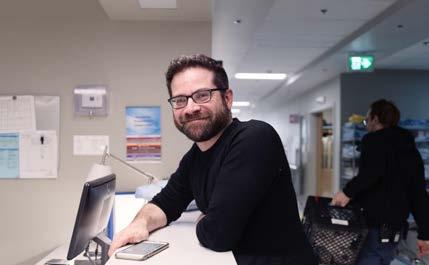
ans of the Canadian medical drama Transplant are going to have to make room in the fandom as the show made its American television debut this past week on NBC. The 13-part series aired Sept. 1, immediately following the live broadcast of America’s Got Talent. It joins NBC’s current lineup of medical dramas, including New Amsterdam and Chicago Med
Transplant first aired in Canada in February and quickly became the most-watched scripted show on television. It sets itself apart from similar shows by incorporating the immi-
grant experience with an ensemble medical drama.
Transplant follows the story of Syrian doctor, Bashir “Bash” Hamed, played by Hamza Haq, and his younger sister, Amira, played by Sirena Gulamgaus. After fleeing their war-torn country and arriving in Canada, Bash must balance building a life for himself and his sister and the demands of his new residency at a busy Toronto hospital.
The cast is rounded out by Laurence Leboeuf, Ayisha Issa, Jim Watson and John Hannah.
Joseph Kay, the creator of the
show, believes this new take on the old classic television genre “has a chance to attract audiences who love medical stories, but to also pull in viewers looking for another way in.”
Kay — who was born in Winnipeg and grew up in the River Heights and Tuxedo areas — also serves as the show’s writer, director, showrunner and executive producer and said the idea came to him after the 2016 U.S. election, when immigration was a hot topic and Canada saw an influx of Syrian refugees.
“I was talking to some producers
about developing a medical drama, and after reading about how hard it is for international medical graduates to qualify for residency spots in Canada, I had the idea about grounding a medical show in the experience of a refugee,” said Kay.
“The market for medical dramas tends to be more soap and melodrama, and I wanted our show to, instead of that, be as grounded and as emotionally honest as possible.”
“We do strive to be a grounded, emotionally honest story of one man’s struggle to start his life over” — Joseph Kay, writer
With the current political climate in the U.S., Kay hopes for the show to play “a meaningful role” in the conversation surrounding the Black Lives Matter movement, the impending presidential election and immigration bans.
“Our show isn’t political, it’s entertainment,” Kay said, “but we do strive to be a grounded, emotionally honest
story of one man’s struggle to start his life over. We hope to give those issues […] a human face and build empathy for his experience.”
In addition to Transplant, Kay’s writing credits include CBC’s This Life and This Is Wonderland, CBS’s Ransom, Netflix’s Frontier, Global’s Bomb Girls and HBO Canada’s Living in Your Car
Kay’s advice for young, aspiring writers is the simple but tried and true adage that practice makes perfect.
“The first draft is always bad,” Kay said.
“Show it to your friends, encourage honest and unmerciful feedback, then rewrite and get better. There’s no such thing as an overnight success, it’s always the product of years of hard work.”
Though fans on both sides of the border may have to wait a while for a second season due to the worldwide pandemic situation, Kay confirms there are definitely plans for one in the future.
“[It’s] being written right now.”
If you missed out on its original run, Transplant is currently rerunning on CTV on Tuesdays at 9 p.m. The full series is also currently available to stream on ctv.ca.

ISAIAH WAGNER, STAFF

With the NHL entry draft on Oct. 9 and 10 set to feature some of the league’s next big talent and the teams they will be playing for, every fan has their own opinions on who will be going where and when.
Here is my mock draft with a little bit of insight on the players and their fit with the team. I have given MyNHLdraft picks as well for an insight on other hockey analysts picks.
1. New York Rangers — Alexis Lafrenière (myNHLdraft — Lafrenière)
The sure number one pick in this year’s draft will be a Ranger. Lafrenière has the size, speed and skill to be an elite player in the NHL for years to come. His outstanding level of strength on the puck and skills on the ice should set him up for success when the puck drops for the Rangers home-opener.
2. Los Angeles Kings — Quinton Byfield (myNHLdraft — Quinton Byfield)
The Kings have plenty of high-calibre prospects in the system. Byfield would add power and skill down the middle and could ultimately be the future replacement of aging Anze Kopitar. Byfield is a mountain of a man standing at 6’4 and 214 pounds and could possibly step in and make an impact in the Kings lineup right away.
3. Ottawa Senators — Tim Stützle (myNHLdraft — Tim Stützle)
Stützle is in competition for the best hands in the entire draft class. The German-born player is perfect for the North American game with his extreme level of skill, speed and his intense competitive spirit.
4. Detroit Red Wings — Jamie Drysdale (myNHLdraft — Lucas Raymond) The Red Wings are in desperate
need of some defensive help. Drysdale is the number one defenceman in this draft and he could provide Detroit with their future top-pairing defencemen. Drysdale is an elite puck mover with the vision and skill comparable to rookie phenomenon Quinn Hughes.
5. Ottawa Senators — Marco Rossi (myNHLdraft — Jamie Drysdale)
Rossi stands at 5’9 but plays way bigger than he is. He is an elite scorer and has an insane hockey IQ. Rossi flew up the rankings this year after his great year in the Ontario Hockey League for the Ottawa 67’s. This junior player would be a great fit for the Senators.
6. Anaheim Ducks — Cole Perfetti (myNHLdraft — Marco Rossi)
With improved skating, Perfetti could turn out to be one of the best players in the draft class. He is a shootout wizard and has a variety of moves in his back pocket to beat the goalies at an NHL level.
7. New Jersey Devils — Lucas Raymond (myNHLdraft - Alexander Holtz)
Another elite scorer is primed to go in the top 10 of the draft. The Swedish forward would be a great fit in the Devils lineup alongside notable previous first-overall picks Nico Hischier and Jack Hughes.
8.Buffalo Sabres — Alexander Holtz (myNHLdraft — Cole Perfetti)
Similar to Raymond, Holtz has a lethal release. The unhappy Jack Eichel could change his mind very quick after the drafting of Holtz.
9. Minnesota Wild — Yaroslav Askarov (myNHLdraft - Anton Lundell)
Askarov is the number one goalie prospect in the draft class. The Wild are in need of a goalie now. Although Askarov is not NHL-ready, he would be a great replacement for Devan Dubnyk and has the potential to be a future top goaltender.
10. Winnipeg Jets — Jake Sanderson (myNHLdraft - Seth Jarvis)
The Jets lost many defencemen last season and never really replaced them. Sanderson is just what the Jets need — he is an elite skater who has a physical presence that can change a game.
11. Nashville Predators — Jack Quinn (myNHLdraft — Jake Sanderson)
Quinn is another prolific scorer in this draft. His offensive abilities are complemented by his defensive presence on the ice.
12. Florida Panthers — Kaiden Guhle (myNHLdraft — Jack Quinn)
As the Panthers blue line ages, the need for young talent becomes desperate. Guhle is the perfect twoway defenceman the team will be looking for.
13. Carolina Hurricanes — Anton Lundell (myNHLdraft — Yaroslav Askarov)
Lundell is a very talented 200-foot centre. This means that he makes elite plays in the offensive and defensive zones of the ice.
14. Edmonton Oilers — Seth Jarvis (myNHLdraft - Dawson Mercer)
Ultimately skilled Jarvis could be exactly what Connor McDavid may be looking for. A strong winger to play with McDavid would be an ideal selection here.
15. Toronto Maple Leafs — Braden Schneider (myNHLdraft — Braden Schneider)
The possibility of losing a few key pieces of their defence core is in play for the Leafs. The hard-hitting Schneider could be a key piece for years to come.
16. Montreal Canadiens — Dawson Mercer (myNHLdraft — Noel Gunler)
The Canadiens continue the search for their number one centre. The addition of defensive forward Mercer would be a great completion for their other suitors.
17. Chicago Blackhawks — Connor Zary
(myNHLdraft — Connor Zary)
The Blackhawks would be getting a very competitive all-around player in Zary. He is a very good playmaker and an above-average defensive player.
18. New Jersey Devils - Noel Gunler (myNHLdraft — Rodion Amirov)
Gunler is a bit of a wildcard pick. He is a good-sized player with elite offensive abilities. His potential is unknown and could end up a steal for the Devils.
19. Calgary Flames — Rodion Amirov (myNHLdraft — Dylan Holloway)
The Russian-born player could be a steal at number 19 for the Flames. He has high offensive talent and a natural goal-scorers touch.
20. Columbus Blue Jackets — Dylan Holloway (myNHLdraft — Jan Mysak-New Jersey Devils)
The big, 200-foot player would be a great addition to the Blue Jackets. His big frame would enhance his puck protection skills.
21. New York Rangers — Jan Mysak (myNHLdraft — Mavrik BourqueColumbus Blue Jackets)
The Rangers could select another forward in this draft with Mysak. He is a very smooth player with soft hands and a quick release.
22. Washington Capitals — William Wallinder (myNHLdraft — Jacob PerreaultOttawa Senators)
The Capitals could get a tall defenceman who is a great puck mover. Wallinder is also a very good skater.
23. St. Louis Blues — Mavrik Bourque (myNHLdraft — Hendrix LapierreDallas Stars)
One of the flashiest players in the draft, Bourque has great hands and could be a very good centre for the Blues in the future.
24.New Jersey Devils — Jacob Perreault (myNHLdraft — Kaiden GuhleNew York Rangers)
The Devils may get an all-around offensive player. Perreault has great vision and an above-average release.
25. Colorado Avalanche — John-Jason Peterka (myNHLdraft - John-Jason PeterkaWashington Capitals)
The hard-working forward is someone who can sit in the minors for the Avalanche and continue to develop his offensive skill.
26. Boston Bruins — Thomas Bordeleau (myNHLdraft — William WallinderSt Louis Blues)
Bordeleau is an all-around great player. He is very offensive and defensive-minded and would fit very well in a Bruins uniform.
27. Ottawa Senators — Hendrix Lapierre (myNHLdraft — Tyson FoersterAnaheim Ducks)
The Senators could get their third forward of the draft. They may take a chance on a skilled forward in Lapierre.
28. Dallas Stars — Lukas Reichel (myNHLdraft — Helge GransPhiladelphia Flyers)
Reichel plays a high-tempo game by creating offensive plays and scoring creative goals.
29. Philadelphia Flyers — Zion Nybeck (myNHLdraft — Zion NybeckColorado Avalanche
The combination of skill and speed makes up for the lack of size that Nybeck possesses.
30. Vegas Golden Knights — Ryan O’Rourke (myNHLdraft — Roni HirvonenSan Jose Sharks)
O’Rourke is a defenceman who is capable of competing game in and game out against the other team’s top guys.
31. San Jose Sharks — Brendan Brisson (myNHLdraft — Lukas ReichelVegas Golden Knights)
The highly skilled centre would be a great fit for the Sharks. Brisson is an elite playmaker and is very competitive.
ISAIAH WAGNER, STAFF

The Canadian Football League (CFL) was planning on playing a shortened season this upcoming fall.
Due to financial complications, it has been decided that the 2020 season will be cancelled and that the league will resume in 2021.
This is hard news for many fans of the CFL, but especially those of the reigning Grey Cup champs, the Winnipeg Blue Bombers.
The Blue Bombers beat the Hamilton Tiger-Cats 33-12 last season to win the 2019 Grey Cup championship.
University of Manitoba student and long-time Bomber fan Devyn Turner is disappointed by the fact that the season is cancelled.
“It sucks to say, but I think it is a
good thing that the season is cancelled,” Turner said.
“With many cases rising, safety needs to be the number one priority,” he added.
Earlier this summer, Winnipeg was chosen as the hub city for all of the CFL games in the event the league and players could reach an agreement.
Winnipeg as a hub city would have meant that every game of the season would be played in Winnipeg and that every player would live there for the duration of the season.
As cool and interesting as that would have been, it also would have brought a lot of people and players to Winnipeg and could have potentially made Winnipeg a hot
“With many cases rising, safety needs to be the number one priority” — Devyn Turner, fan
Many Bomber fans must feel this way, too.
It is important to remain safe. Safety must be the number one priority of the CFL and their fans, no matter how disappointing it must be.
“As a Bomber fan, I feel very sad,”
Turner said.
“I was hoping for a chance to be back-to-back champions, but I guess we will have to wait.”
Turner has decided to not branch off to other activities, but instead he wants to watch more sports.
“Instead of watching the CFL, I will definitely be more focused on other leagues such as the National Football League and the National Hockey League,” Turner said
Bomber fans can now focus their attention to their favorite NFL team or shift over to the Winnipeg Jets later this year.
Although fans will not be able to watch the Jets in the NHL playoffs, the NHL’s regular season should be starting in December.
U-Sports reverses football eligibility rule for the 2021 season
DSTAFF
ue to the COVID-19 pandemic, U-Sports decided they would not change their football player eligibility rule and, as a result, many players would be losing a year of eligibility due to the cancelled season.
The previous rule stated that players who turn 25 years of age this year will be losing a year of eligibility due to the cancellation of the 2020 season.
Recent discussions have decided U-Sports will be switching its decision — it will be allowing 25-year-olds to play in the 2021 season.
This means any players who would have been eligible to play in the 2020 season are still eligible to play in the 2021 season and can continue to remain training this season.
This is great news for the players.
It gives the older players one last chance to win a championship, something they may have thought they were going to lose.
This ultimately impacts eight Bison football players who will be ready to go for the 2021 season.