Responding to the developing COVID-19 pandemic Friday, the U of M announced that it was limiting inperson instruction and moving courses to on-line or remote delivery for the remainder of the term.
Health care professionals have recommended practicing social distancing and are urging people to stay home to slow transmission of the virus.
To that end, this will be the Manitoban’s last print issue of the term. We will continue to report ongoing developments of the pandemic and critical campus news — including the struggle to maintain the U-Pass transit program — through to the end of the term.
The Manitoban’s website will be updated regularly and weekly editions will be published digitally as a downloadable PDF. Stay tuned to our social media networks for updates.
— The Manitoban editorial board
Fundraising camp-out
EDITORIAL
MANAGING EDITOR Garett Williams me@themanitoban.com
NEWS EDITOR Garett Williams garett@themanitoban.com / 474.6770
NEWS EDITOR Ty Brass ty@themanitoban.com / 474.6770
AUDIO EDITOR Joseph Gonzales audio@themanitoban.com
PHOTO ASSOCIATE Alex Decebal-Cuza
PHOTO ASSOCIATE Ally Gonzalo
VIDEO ASSOCIATE Nish Joshi
VIDEO ASSOCIATE Paul Stabell
AUDIO ASSOCIATE Tino Hove
REPORTERS
NEWS Gillian Brown
NEWS Damien Davis
NEWS Amira Tekle
NEWS (INDIGENOUS AFFAIRS) Kayla Lariviere
COLUMNIST Cam Cannon
COLUMNIST Meagan Hughes
ARTS & CULTURE Kaelen Bell
ARTS & CULTURE Zachary Sigurdson
SPORTS Isaiah Wagner
VOLUNTEER CONTRIBUTORS
Campus reacts to COVID-19’s arrival in Winnipeg Classes
moved online, public events cancelled
GILLIAN BROWN AND AMIRA TEKLE, STAFF
As the number of COVID-19 cases in Manitoba climbs, the U of M continues to expand precautionary measures.
Health Canada has issued a number of precautionary measures to control transmission of the virus — including social distancing — and has urged people not to gather in crowds larger than 50 people.
All classes at the U of M were cancelled Monday and Tuesday as administration moved to deliver nearly all courses remotely or online.
Courses are scheduled to resume today with nearly all instruction completed remotely. Only in rare exceptions — which will be communicated directly — will any classes resume on campus.
All non-essential events involving more than 50 people have been cancelled.
On Monday, the university announced that the voluntary withdrawal deadline for the term has been pushed to April 13.
In a letter issued late Friday, U of M president David Barnard said the intention is to keep the univer-
sity as operational as possible and to continue to provide students with “as many essential services as possible under the circumstances.”
“The COVID-19 threat is new to all of us; none of us have dealt with precisely this situation before,” said Barnard.
“We are acting out of an abundance of caution and with the best interests in mind of this and the larger community. We are all dealing with this together. We are committed to doing our best and making the best decisions.”
the week but was unsure if they would re-open given the precautions.
“It’s a really difficult situation,” he said. “I think everyone is doing the best they can. We’re working with the university collaboratively on this.”
students in a way that will set them up for success in their final exams but also to ensure they are getting the proper value they want out of the course.”
“The UMGSA is continuing its advocacy for grad students during these difficult circumstances” — Carl Neumann, president
Sanderson said UMSU is still making arrangements to best manage the “fluid situation” but that his focus remains on students.
U of M Graduate Students’ Association (UMGSA) president Carl Neumann said the association plans to follow the university’s precautions and cancel public events and move all meetings online.
For the time being, the UMGSA office remains open but will be closed to anyone but staff and executives. Executives will remain accessible by email.
Residence services
“normal”
While the university is taking more drastic precautions, residence services director Barry Stone said in a letter to residents that daily life will continue in a mostly regular fashion.
On Monday, all UMSU businesses were closed after a weekend fire outside UMSU University Centre but other businesses, including the campus bookstore, remained open. UMSU president Jakob Sanderson said the union’s businesses will likely be prepared to resume operations later in
“Our number one priority is student safety,” he said, “and then from that, with classes being moved online, how are we ensuring that the course content is being communicated to
“The UMGSA is continuing its advocacy for grad students during these difficult circumstances,” he said.
“Our number one priority is student safety” — Jakob Sanderson, UMSU president
“We are participating in university planning meetings related to COVID-19 and will continue to work along with university staff and UMSU to minimize the problems and uncertainties that students are and will be facing.”
“At this point in time, residence and dining operations will continue to function as normal, with the exception of some larger residence programming events being cancelled or postponed until further notice,” he wrote.
Stone acknowledged that students will face more difficulties practicing social distancing in a communal setting but said students can individually make an effort to wash their hands more frequently and utilize proper coughing and sneezing etiquette to mitigate risk.
Continued Labs | Page 7
PHOTO BY QUINCY HOUDAYER
Students sleep outside to raise cash for homeless youth
Critics laud the effort, question the experience
DAMIEN DAVIS, STAFF
Five U of M students took to the elements last week to raise awareness and funds for local initiatives battling homelessness.
The U of M Commerce Students’ Association organized this year’s annual 5 Days for the Homeless campaign, a fundraiser that universities across the nation participate in to raise awareness and money for local charities.
The fundraiser supported Resource Assistance for Youth (RaY), a non-profit street-level agency that works to support homeless youth up to the age of 29 through a harm reduction approach.
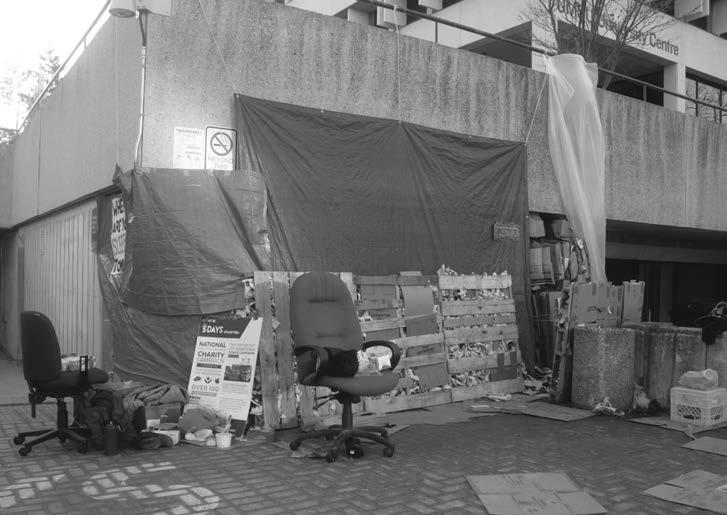
The fundraiser is set up so five to seven volunteer students spend five days living in a camp set up outside UMSU University Centre (UC) and raise money through donations.
Quinn Desrochers, a fourth-year engineering student, said he has been involved with the initiative since his first year at the university.
“I’m in my fourth year now,” he said, “and I’ve been sleeping for three out of the four years and I think it’s just the best way I can help out and give back.”
Ashar Khwaja, a second-year student in the faculty of arts, is an international student who said he
volunteered because he has experienced homelessness first hand. “I was homeless for a week. It was hard for me,” he said.
“It’s a good initiative for me,” he added, “and if it’s helping society, then why not?”
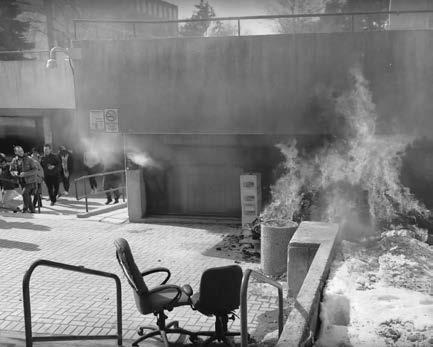
This year’s campaign ended early after the campers packed up Thursday afternoon due to concerns with the developing COVID-19 outbreak. The volunteers left behind several pallets and cardboard that caught fire just before 1 p.m. Friday, resulting in extensive water damage throughout UC.
No injuries were reported, and the total extent of the damage and cause of the fire are still being investigated, but it has been reported that a cigarette likely ignited the pallets.
“We are heartbroken by the fire and damages caused outside of UMSU University Centre,” said a Commerce Students’ Association release signed by three executives.
The association’s president, Tony Quach, said this is the first time there has been an issue with material left behind.
“We have done the 5 Days campaign for the last 12 years now and have never had any issues,” he said in an email.
“Each year, we clean up the sleepers area under UMSU University Centre and leave all pallets and materials in a pile that is then picked up by University of Manitoba physical plant. This was the case this year as well.”
Across campus in the University College Great Hall, facilitators of a Poverty Awareness and Community Action (PACA) workshop Wednesday expressed mixed feelings about the initiative.
Ray Troughton, a community volunteer with the event, lauded the effort to raise funds but said just sleeping outside doesn’t recreate the experience of homelessness.
I think it’s great what they’re doing with [5 Days for the Homeless], but they’re in a group,” he said.
“They still have social inclusion, they still have a social group — and you’re usually very alone when you are homeless.”
“The reality is different, but what they are doing is awesome,” he said.
While he said he didn’t want to attack anyone, he acknowledged the event tends to trivialize his and others’ real experience with homelessness and recalled that one camper was overheard saying they were “really excited about this coming up.”
“You’re not really excited when it’s
really happening,” he said.
Kae Normandeau, a PACA assistant who co-ordinated the workshop, explained how, at age 18, both her parents passed away and she ended
“The reality is different, but what they are doing is awesome” — Ray Troughton
up homeless and was left to couch surf, sleep outside or squat in empty houses.
Normandeau said the fundraiser does amazing things for RaY, but emphasized that “When you’re a homeless youth, people won’t even make eye contact with you, let alone bring you food and water.”
“I think that the fundraising aspect of this is absolutely amazing and I do appreciate that these students are working to build their empathy and try to get some experience that they can use to do so,” she said, “but I don’t want people to mistake this for an actually real experience with
homelessness.”
The volunteers outside UC acknowledged the criticism and Desrochers said the volunteers were lucky so many students brought donations, saying “We’re trying to get a small experience of what [homelessness] is.”
“It’s just a small taste,” he said. “We definitely know we are not at all homeless, we are temporarily displaced and in a good disposition. We have lots of support here.”
Khwaja called the initiative a “small gesture” that he hopes will at least raise awareness of homelessness to students who might not otherwise come across it.
“A lot of people don’t know about [homeless youth] and at the end of the day they turn a blind eye,” he said.
“So, what we do is provide a little bit of exposure, a little bit of friendliness so that the people who are actually passing by know that these things exist and […] you can actually support them.”
The fundraiser has collected $23,431 and continues until the end of March, including a silent auction. Quach said it is too early to consider what will happen with next year’s event but the group will be working closely with the university.
PHOTO BY QUINCY HOUDAYER
Extensive damage following Friday blaze
Water, smoke damage throughout UMSU University Centre
GILLIAN BROWN, STAFF
Afire outside of UMSU University Centre (UC) Friday caused extensive property damage and destroyed student group merchandise.
No injuries were reported in a fire that university spokesperson John Danakas said was likely caused by a discarded cigarette that came in contact with a pallet left behind by students participating in last week’s 5 Days for the Homeless campaign.
Five students lived and slept outside the east entrance to UC — facing the administration building — to raise awareness and funds for local youth homelessness initiatives.
Most of their things were packed up Thursday but several pallets, some with stacked cardboard, were left behind.
The Asper School of Business Commerce Students’ Association, which organized the event, issued a release Saturday saying “We are heartbroken by the fire and damages caused outside of UMSU University Centre. The sleepers and volunteers are all safe as none were present at the time of the fire.”
A spokesperson for the Winnipeg Fire Paramedic Service said crews responded just before 1 p.m. The fire
caught on to one wall of the building but was under control by 1:30 p.m.
“Upon arrival on scene, crews found a number of pallets stacked on the exterior of University Centre engulfed in flames,” reported the spokesperson.
An update posted to UM Today Saturday called the damages “extensive” and recommended that UC be avoided Monday.
UMSU indicated all its businesses will be closed until further notice while water and smoke damages are assessed.
The damage is primarily water
damage from crews suppressing the blaze.
“Poor choices from multiple people led to a lot of damage and ruined many irreplaceable items” — Vatineh Magaji, Justice for Women president
Water made its way through Campo and as far as the tunnel to the Allen Building.
Smoke damage reached all five floors.
“The scale of the impact and damage is extensive,” said the university release, “but efforts are being made to return the building to operations in most areas as soon as possible.”
A building and decorating company has been brought in to help cleanup efforts and engineering and architecture resources will be brought in as needed.
Jakob Sanderson, UMSU president, said Monday that damage to the union’s recently renovated offices was still being assessed but it appeared contained to the boardroom and washrooms.
He said student group offices and potentially food storage for union businesses were more severely affected.
“There might be some significant ramifications but we’re still assessing everything,” he said. “We’re still in conversations with insurance and we
don’t really have much of an update.”
All UMSU businesses were closed Monday. As of publication, it remains unclear when they will re-open given precautionary measures taken in the face of the COVID-19 pandemic.
UMSU chief returning officer Karan Saxena said Friday that much of UC, including his office, was flooded.
He said other offices in the building had been badly damaged.
“A lot of the stuff was soaking, covered in ashes, it was really bad,” he said.
Saxena said the office for student group Justice for Women “took the hardest hit of all of them.”
“I couldn’t see the roof. It was all completely gone.”
The homeless fundraiser had set up camp outside UC, very near Justice for Women’s office.
“It’s a really unfortunate situation and we probably won’t know for a long time why or how it happened but I feel pretty safe in saying it was preventable,” said Justice for Women president Vatineh Magaji in a statement.
“A series of poor choices from multiple people led to a lot of damage and ruined many irreplaceable items.”
The group lost merchandise and items intended for fundraisers with charitable organizations around the city.
“At this point, our group is eagerly awaiting a response from [UMSU] and the organizers of the initiative that is associated with the fire,” said Magaji.
“We’re looking for answers about what steps will be taken to replace what can be replaced in our office and re-homing our group into more suitable arrangements.”
The fire is still under investigation.
UMSU challenges city’s U-Pass numbers
‘The public service presented numbers that were factually incorrect,’ UMSU president
GARETT WILLIAMS, STAFF
UMSU president Jakob Sanderson is questioning the logic of a city committee that unanimously supported a Winnipeg Transit budget proposal that recommends cutting the U-Pass, saying it isn’t working with sound numbers.
“People are voting on stuff that they don’t even know what they are voting on,” he said. “The public service presented numbers that were factually incorrect.”
The public works committee unanimously supported the proposal following a marathon 11-hour session Thursday.
Despite hearing numerous presentations from post-secondary students and leaders in support of the pass — in addition to nearly 20 additional written submissions — the committee passed the budget without amendment.
It now moves to approval from the executive policy committee, which is scheduled to hear public delegations today.
Sanderson questioned transit’s claim that continuing the service into the 2020-21 academic year would cost the city $15 million over four years, saying the department hasn’t made a full breakdown of the cost available.
He presented an alternative to the committee but admitted that, without a fuller disclosure from transit, “it was very difficult to challenge the city’s numbers on this.”
“If I were a member of council, I would have a lot of difficulty, honestly, voting on the budget of public works, or at all, because they are voting with incomplete and incorrect numbers,” he said.
“And it really calls into question the type of process that we have to
craft a budget in this city.”
U of M students voted overwhelmingly in support of continuing the program at a cost increase of nearly $25 per term just last month but were caught off guard when the city unveiled its proposed budget March 6. The service currently runs at $136.25 per four-month term.
The current contract expires in May.
Sanderson said UMSU plans to publish its own costing early this week.
It was not available before publication.
An UMSU board of directors meeting the same day left some students frustrated after it quickly broke into closed session to discuss developments on negotiations with the city. When the session opened up again more than an hour later, no public update was provided.
Sanderson — who remained at city hall and was absent from the meeting — said the board needed to discuss the strategic direction it would take with the city but that he regretted there was no public discussion.
He said the board wanted “to ensure that we are operating at an optimal level in our discussions going forward with the city [and] we made a difficult decision to have to be in camera.”
As of publication, the executive policy committee remains scheduled to hear public delegations in a special meeting today. The meeting has been moved up a day — it was initially scheduled for March 19 — and
Sanderson said he is still organizing to have as many students present as possible.
As precautionary measures in response to the COVID-19 pandemic have seen the U of M move all of its courses out of the classroom and numerous public events have been cancelled or postponed, Sanderson said UMSU has been looking into the possibility of having delegates present through a video link or other alternative measure.
“It really calls into question the type of process that we have to craft a budget in this city”
— Jakob Sanderson, UMSU president
But he said he still intends to be present and it remains crucial for students to be heard.
“We are exploring options to try and do this in a safe way but, at the end of the day, the city does need to hear from us,” he said. “I will be there personally, for sure.”
“Negotiating in bad faith”
Among the number of presentations to the committee from post-secondary students — which included incoming and outgoing UMSU executives, student leaders from the
University of Winnipeg and studentsat-large — U of M Graduate Students’ Association (UMGSA) vice-president academic Tanjit Nagra accused the city of dishonest negotiations.
Nagra — who negotiated the inaugural U-Pass contract as UMSU president — noted that while the city informed graduate students that a summer extension to the U-Pass would no longer be an option for the UMGSA’s own referendum to approve the fee increase, “We were not told at this time that we shouldn’t even bother asking the question.”
“We weren’t even given an email or a phone call prior to the [executive policy committee] meeting last week on [March 6] to let us know that the U-Pass was being proposed to discontinue,” she said in the committee presentation.
“This […] is why I believe us, the students, were misled and why I believe the City of Winnipeg was negotiating with us in bad faith, plain and simple.”
For the time being, the UMGSA referendum remains scheduled for early April, after city council is scheduled to take its final vote on the budget March 26.
North Kildonan Coun. Jeff Browaty voted in support of the budget but agreed students were not treated fairly by the city, telling media last week that “I would feel somewhat betrayed by the way this all played out.”
“I think that was unacceptable and very disgusting on behalf of some of my colleagues on council,” he said.
UMGSA candidates discuss priorities
Milln as a candidate for vice-president academic, only the position of president is in contention, with two independent candidates and a candidate from the Change slate. Independent presidential candidate Gift Amadi was absent due to a “work arrangement.”
In the wake of the city’s proposed budget that will cut the U-Pass, many questions from the audience were related to the pass.
When asked how they planned to have an effective relationship with the city and the provincial government, independent presidential candidate Saeideh Mirzaei cited a lack of any clear lines of communication as a major issue.
“They stopped the U-Pass, they added per-semester passes, they added annual passes for $905,” she said. “They clearly knew what their plan was. The only point is that they
didn’t let us know. So, we should have built a route: for any decision you are making that is going to affect students, you have to give us a notice of at least three months or two months.”
William Dowie, senatorial candidate for Change, answered that both the city and province must be addressed individually by forming political relationships with each, independent of each other.
“It’s a political issue that you’re speaking of. It’s not something that you would go to the legislative assistant to talk to. You need to have some sort of direct communication.”
Asked how the candidates would continue advocacy for the U-Pass, Mirzaei affirmed her plan to continue fighting for the pass.
“We have to show them what the effect of the U-Pass [is],” she said. “It’s not all about money, maybe we can afford $200 more, but it’s not fair —
at the least, they should have told us in advance.”
Change presidential candidate Silvia Sekander said she is “hopeful” about the future of the U-Pass
“It is all dependent on ourselves, how we protest” —
Silvia Sekander
if students make their voices heard. “It is all dependent on ourselves, how we protest,” said Sekander. She suggested students continue protesting not just for the pa ss, but for future issues they care about as well.
Voting for the 2020-21 UMGSA general election takes place March 16 and 17.
general election fielded
and outlined priorities in the
PHOTO BY ALEX DECEBAL-CUZA
PHOTO BY ASHA NELSON
‘Labs are extremely important, and there’s no way to do a chemistry lab online’
Continued from Page 3
He said there are plans in place in case a student living in residence
contracts COVID-19.
“We have established protocols to deal with any resident who might require self-isolation if they have received a health care directive to do
so,” wrote Stone. These protocols remain unclear. Katrina Framst, a student currently living in the Arthur V. Mauro student residence, said that not much
has changed in the residence since the outbreak hit Manitoba, but cleaning efforts appear to have increased.
“There has been a substantial increase in the frequency that the common areas are being cleaned with the cleaners even coming in on the weekend now,” she said.
“Other than that, there are no obvious changes within my dorm.”
Will Scofield, University College Residence Students’ Association publications representative and American international student, acknowledged in a statement the difficulty of maintaining social distancing within tight quarters.
“The challenges of self-isolation and social distancing are made nearly impossible by shared bathrooms, doors, elevators, hallways and dining areas,” he said.
“My fear lies not with contracting COVID-19, but in my ability — and the ability of my peers — to spread this illness to more vulnerable populations.”
Student experience
Leah Handford, a first-year sciences student, said the cancellation of in-person instruction has “greatly affected a lot of classes not only for me but my peers as well.
“Labs are extremely important, and there’s no way to do a chemistry lab online,” she said.
“Honestly, I’d rather them cancel the labs altogether for the rest of the year and take that percentage and put it on our final, because I know so many students who are scared of how the labs will fluctuate their marks if it’s all online,” she added.
In faculties that are so hands-on, students may depend on those labs to understand the course material.
“A big part of a course is group discussion in class, and we can’t exactly do that anymore either,” she said.
“But at the same time, [the university] had to adjust to this super fast so I understand why there’s some holes in the plan.”
THE MANITOBAN IS HIRING
Position: Editor-in-Chief Company: The Manitoban Salary: Contract:
Duties: The Editor-in-Chief (EiC) is responsible for the day-to-day running of the editorial portion of the paper, and has final say over the editorial content within. The EiC is
Qualifications:
Manitoban. They should have a strong understanding of the English language including spelling, punctuation, and grammar, as well as a working knowledge of Canadian Press s employees and working in a non-profit environment will be consid
Position: Company: Salary: Contract:
Duties: s functions of the Manitoban newspaper including accounting, payroll, taxes, human resources, marketin include managing accounts receivable and payable, invoicing, and general administrative duties. Long-term duties include strategy development, marketing, and process pla
Qualifications: accounting knowledge. They have ideally worked in an office sett making role.
PHOTO BY QUINCY HOUDAYER
Matthew Doering
Editor-In-Chief:
Contact: editor@themanitoban.com / 474.6770
U of M’s viral response reveals reactionaries in charge
Absence of direction, cohesion of reccommendations during outbreak frustrates community
MATTHEW DOERING, STAFF
With the COVID-19 virus changing life more every day, society looks to our leaders to find our individual ways forward through the pandemic.
With Parliament suspended and the provincial government quickly developing a strategy to reduce possible transmission in public schools, it is clear that such leadership and quick decision-making is possible.
And when direction is not provided, an uncertain situation becomes unnavigable.
This is where graduate students find themselves: essentially part of the operation of the campus but not employees that would be encouraged to work from home. And if they choose to self-isolate to protect the vulnerable people in their lives, there is no guidance from the university.
From the first message issued by the university March 12, any response the U of M might take had focused on undergraduate classes and social distancing options for staff to work from home. This is most possible for administrative staff.
However, for staff in research positions — whose materials, resources and equipment necessary for doing their jobs are available solely on campus — no provisions were planned at this early stage. Graduate students were not mentioned as they are neither staff nor undergraduate students.
At noon on March 13, the university’s statement on COVID-19 was updated to encourage departments and units to complete the University of Manitoba Business Continuity Plan Template. This creates a plan for the continuity of the university’s operations, dealing with research spaces only to the extent that they affect vendors and clients. Where graduate students fall in this is unclear, though they may conceivably be at some of the points of contact with those vendors and clients outlined in the template to ensure the continuity of university operations.
A later March 13 update provided more clarity for staff, academics and others who planned to work remotely. IST support — for questions related to computing — would be available to them.
The final March 13 update, at 4 p.m., said in-person classes on campus are ending for the 2019-20 academic year. Non-essential events have been cancelled, but the campus
In a climate lacking direction, only the fittest will survive
remains open.
The implication here is that graduate students are integral to the functioning of a research university. But they are not being communicated with. Nor communicated about.
Unlike Manitoba’s other universities, the U of M’s response — 30 minutes before the end of business hours for the week — was obviously rushed. The University of Winnipeg communicated a plan in place for faculty and staff to develop contingency plans for research programs.
Brandon University ensured that students were clear about libraries remaining open during a week-long break. Red River College also implemented, in Friday, a week-long break this week.
These other institutions were more agile and able to to respond faster and more appropriately than the U of M, with even the provincial government apparently able to change its mind on the status of public-school closure more quickly than the U of M on its operations.
At a time when rapid decisions are needed in response to a rapidly changing situation, the University of Manitoba has seemingly reacted based on the actions of the city, the
provincial government and the other large universities and colleges in the province. As the only medical and doctoral university in the province, this was a chance for decisive leadership.
Individual graduate students have sent more reassuring emails to students in their classes than they received on Friday or over the weekend from administration.
Graduate students and instructors are scrambling to figure out a way forward with no clear direction. Some professors are even unclear themselves about when and how classes are being taught, receiving conflicting messages from their department heads and other levels of administration.
While on-campus classes are cancelled, where does that leave research? If university staff begins working remotely, will the university libraries be open? So far, the libraries on campus are maintaining their own set of updates, separate from the broader university updates. There is no cohesive approach to sharing updates with students.
With this complete lack of central direction, everyone is left to make their own decisions. And these decisions are often in stark contrast to each other and only fuel frustration and the fear of the unknown. The unknown of committee meetings and other degree requirements. The uncertainty of paycheques with classes moving online. The lack of communication regarding work expectations.
Over the weekend, some research groups were informed by their principal investigators that they would be completely shutting down, as far as possible, till the end of semester. Others were going to be continuing to operate normally pending university updates. And others seemed to be wrapping up experiments in preparation for a university closure.
Some students are self-isolating
to protect people vulnerable to the COVID-19 virus in their lives. Others are working harder, or packing materials for off-campus work.
Monday’s updates did little to clarify with the faculty of architecture suspending in-person meetings between students and advisors entirely — which by extension means no year-end in-person committee meetings — and the faculty of graduate studies’ stance of video calls allowed, but not mandatory, for those year-end meetings, without which registration will be restricted.
And that weak statement that provided insufficient clarity for students across faculties was dated Thursday,
With this complete lack of central direction, everyone is left to make their own decisions
March 12, with a file creation date of Friday evening. Yet it took till early afternoon Monday for even that bit of information to be circulated to students.
The variety of communications appears due to a lack of communication among administrative levels. The only communication from the faculty of science having been to share the brief faculty of graduate studies thesis defence and committee meeting statements, the research protocol statement having gone to students through the faculty of graduate studies.
In addition to tenure-track faculty, students — at all levels — suffer. In a climate lacking direction, only the fittest will survive.
Students across faculties remain unclear whether incoming salaries and stipends for teaching during
this time — fewer in the case of labs being moved online — or if the time spent away from campus, while paid, will mean more unpaid time in the future. The bits, and inconsistencies, of communication does little to assuage confusion.
Faculty members are feeling the uncertainty as well, with wishful thinking of extensions to graduate programs being readily provided and the winter, spring and summer semesters not counting toward teaching evaluations and research output metrics, including for purposes suck as for promotion.
But all this is temporary. The best-case scenario is the spread of the COVID-19 virus slows, not as many people in the country, in the province, in the city and at the U of M are infected as could have been. Everything will return to normal. And that’s the reason for all the closures and cancellations of large events — for nothing to happen.
So, if social isolation is needed at this point, communication and consistency are also needed.
With about three times as many graduate students as full-time faculty members and about as many graduate students as support staff at the U of M, this is too large a group to not be included in the published planning measures to ensure the health and safety of an entire campus community, and an entire city.
Despite promises made in the sparse communication to graduate students Monday and the 12 bullet points from the vice-president research and international that additional info would be posted on the university’s coronavirus page, the only update was at 4 p.m. to delay the voluntary withdrawal date to April 13.
This approach to responding to a continually changing situation is not one of planned co-ordination. It is one of every faculty, every department, every research group setting policy details for themselves.
GRAPHIC BY EVAN TREMBLAY
Comment Editor: Kenny Ingram
City of Winnipeg should prioritize job creation
Low quarterly hiring rates should be met with municipal solutions
MEAGAN HUGHES, STAFF
Arecent study shows employers in Winnipeg are looking to hire less new employees this spring. Only seven per cent of employers surveyed plan to hire during the second quarter of 2020 — April 1 to June 30 — with three per cent expecting employee cutbacks.
With less available job positions on the market, this information will surely have an impact on people seeking employment in the coming months. If fewer jobs are available, obtaining the available positions becomes more competitive for job
seekers and people will be left without work.
Though Winnipeg’s unemployment rate is currently sitting at five per cent, we may see an increase in this data if opportunities dwindle.
Our municipal government should consider the benefits of making job creation a top priority in our city.
If the City of Winnipeg steps up and makes jobs available for those who are eager to work, we may be able to remedy the issue.
This needs to start with jobs that
need to be done, but currently are not being addressed nearly fast enough.
For years, Winnipeggers have expressed concern over the city’s crumbling infrastructure. From bridges to the infamously holey roads and highways, Winnipeg is in desperate need of restoration and modernization.
If the city were to create more jobs in other areas like infrastructure, we could see a potential decrease in issues like road closures and traffic delays due to more staff working on repairing damaged roadways.
This would be a definite benefit to the many Winnipeggers familiar with the traffic backups and the endless supply of potholes our city seems to have.
But more than just the benefit in job creation and efficiency, as Manitoba Liberals pointed out in 2019, many of these infrastructure projects can have a high return on investment.
Thus, perpetuating a healthy cycle of job creation, efficiency and reaping the benefits of having robust infrastructure.
But public spending isn’t the only way to ensure Winnipeggers are employed.
Allowing more companies to operate in the city — by providing a more favourable landscape for them to operate — will allow the opportunity to create more private-sector jobs.
Uber coming to Winnipeg is another step in the right direction.
Companies like Uber not only contribute to the creation of more jobs, but have the added benefit of diving drivers a flexible work schedule.
According to data from Uber,
nearly a quarter of its drivers in the U.S. were unemployed before becoming drivers for the company.
Having available avenues for ondemand work like driving for Uber is a great way to allow people to work who have scheduling constraints or other issues that may make shift work difficult or impossible.
This could include students as an example due to classes and studying taking up a lot of time, though they may wish to find part-time or casual work.
It also allows students the benefit of being able to take on far more work between semesters, when many other jobs require a longer-term commitment.
If our city shifts their budgeting focus away from cuts and instead toward investing in our citizens — in the form of infrastructure spending or incentive for private business to come to Winnipeg — we could see economic growth and help our city to thrive.
We can hope that those with the influence to make such decisions make the right ones.
Let Uber be a lesson in corporate welfare managment
Large corporations will enter a market regardless of regulation or tax breaks
KENNY INGRAM, STAFF
Two years ago, ridesharing giant Uber threw a tantrum and opted to avoid Winnipeg entirely over Manitoba’s regulations.
Manitoba Public Insurance regulated that anyone using their vehicle to earn money must register the vehicle using timebands — essentially, making people purchase insurance specifically for when they would be driving for a ridesharing company.
And that was one step too far for Uber.
If people can’t be Uber drivers whenever they want and have to
potentially pay between $200 and $400 more each year to be insured as a ridesharing vehicle, operating in Winnipeg wasn’t worth it to the company.
Until this past week.
Yes, after a two-year stalemate, Uber caved and will be coming to Winnipeg this spring according to its head of Western Canada operations — even with the increased regulation.
This shouldn’t be surprising.
Winnipeg is the last major city in Western Canada without Uber, and it’s an incredibly big market for Uber
to draw profit from.
What’s most important is that people learn from this saga so that the next time a large corporation puts pressure on our representatives they don’t cave.
But it’s not just Uber that has pulled this move before.
Just south of the border, in 2016, Fargo, N.D., city council voted to give FedEx tax breaks in order to move a facility to the city — even after a representative from the company admitted the company would come with or without the incentive.
The most public case of this was Amazon, who in 2017, issued a document that basically told major metropolitan cities to submit proposals — essentially, a bidding war between countless municipalities over who could offer Amazon the most in corporate welfare — for a chance to be the city for Amazon’s second corporate headquarters.
If a company really wants into a market like Winnipeg’s, they’re going to come regardless of decreased regulation or tax breaks
After a ridiculous number of proposals from cities across North America, it narrowed the list to 20 cities, including New York City. But after a pushback from representatives over the $3 billion in corporate welfare Amazon would receive if it moved to New York — and the potential threat of the billions of dollars being reduced — Amazon decided against moving its second headquarters to New York.
Except less than a year after the fanfare over losing the opportunity to be Amazon’s second headquarters, Amazon decided to open a 335,000 square-foot office space and create over 1,500 jobs in New York anyway. Companies are constantly playing games with city councils to get more favourable terms — whether it be skirting regulation, tax breaks or both.
But if a company really wants into a market like Winnipeg, they’re going to come regardless of decreased regulation or tax breaks.
Did True North Sports and Entertainment — a company centred in Winnipeg that has the vast majority of its investments within the City of Winnipeg — really have any leg to stand on when it negotiated $16.6 million in corporate welfare from the city and province in 2019? Of course not.
But as long as it maintains the ruse of being able to pull out and move shop out of Winnipeg at any moment, no one blinks an eye when city council hands over millions of dollars.
It’s important that the takeaway from these lessons be that large companies — from Uber to FedEx to Amazon and even True North — will move into markets like Winnipeg regardless of whether they receive favourable legislation and millions in tax breaks or not.
GRAPHIC BY ERNEST ZARZUELA
GRAPHIC BY ERNEST ZARZUELA
Okechukwu
Julia Minarik
Ehsan Tahmasebian
Mahder
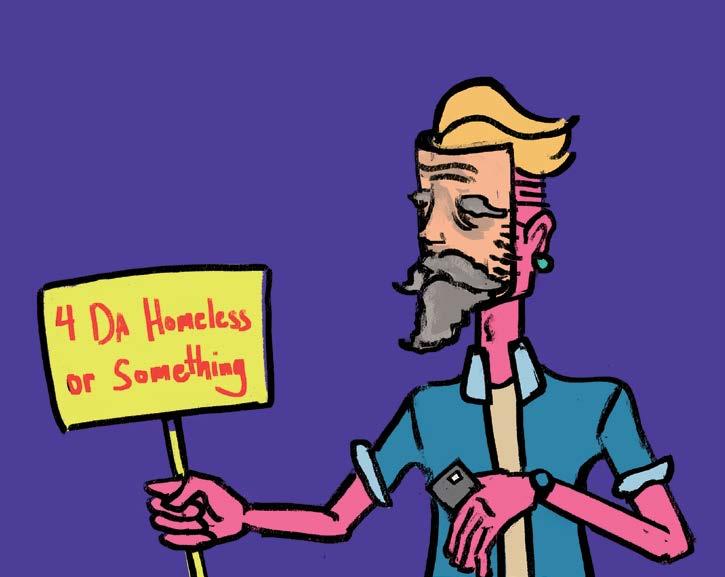
A tone-deaf spectacle that misses the point 5 days performing poverty ‘extremely insulting’
CAM CANNON, STAFF
Last week, from March 8 to 12, a group of students camped outside of UMSU University Centre to raise funds for Resource Assistance for Youth (RaY) as part of a national campaign called 5 Days for the Homeless.
To date, the group has raised $23,431 — over $3,000 more than its original goal for the week.
While putting funds into essential community services like RaY is to be applauded, there are significant issues with this style of charity work or “philanthropy.”
To put it lightly, this campaign is profoundly tone-deaf. It is highly reminiscent of other campaigns such as the CEO Sleepout — performing poverty to raise awareness of it, and funds for organizations that assist these populations.
Students experience homelessness — youth, especially Indigenous and LGBTTQ* youth experience it at disproportionately high rates.
Anyone who has spent any time in an urban setting is made aware of this almost every time they step foot
outside — it’s not exactly an invisible issue.
On the level of ideology, philanthropy is a strange beast. It gives resources to organizations that support under-served populations, but at the same time, it generally presents these issues in an apolitical way. It reduces issues like poverty to essentially being ones of a quantitative lack of resources and leaves the politicaleconomic system that produces such issues completely untouched.
Further, philanthropy tends toward a view of whoever they are trying to help as being monolithic — as being one unwashed mass that’s counting on the generosity of those fortunate enough to have the resources to do so.
Campaigns such as 5 Days for the Homeless demonstrate this well.
The young philanthropists involved in the campaign keep themselves completely separate from the day-to-day struggles of those they are claiming to be helping. Instead of just talking to any of us that have experienced homelessness, they decide to
attempt to experience it themselves to maybe glean some insight into our struggles while raising money.
To this, I have to ask: Why don’t you just talk to any of us? Why do you have to have a simulated experience that not only in concept is extremely insulting to anyone with these experiences? An experience that, to add further insult to injury, makes videos for Instagram giving an almost MTV Cribs-style, tongue-in-cheek tour of your camp?
Poverty is baked into the system.
A general characteristic of any given capitalist society is the guaranteed existence of the proletariat — the working class — simply as a class, not as individuals.
Either find someone willing to hire you, rely on what public assistance is available, rely on the generosity of individuals, or starve.
As individuals, we are regarded as replaceable — there is always someone to take our place, and there is always the threat of being thrown into the cycle of poverty.
Poverty is a product of the violence
that is at the very core of any capitalist society. The issue has never been whether there’s enough to go around
To put it lightly, this campaign is profoundly tone-deaf
for everyone — it’s a political issue.
Millions of homes sit empty while millions of people are homeless. Unsold food is destroyed rather than distributed. It is the system of wage-labour and production for profit rather than directly meeting needs that must be exposed and dismantled. This is what awareness needs to be raised about.
Want to eradicate poverty and homelessness? Engage in an explicitly political project that aims to abolish capitalism, imperialism and settler-colonialism. Anything short is nothing but a performative move to innocence that assuages guilt for playing a role in perpetuating the very
systems that produce these social ills.
Profit is understood by Marxists as being the unpaid wages of the working class, allowing those with property to reap the benefits of the labour of others. The way forward is certainly not in counting on those with the resources to contribute voluntarily, especially when those same people tend to have a vested interest in perpetuating the systems that produce poverty so that they may accumulate wealth.
Most importantly, talk to the people who have experienced poverty. We are aware of the issues and how they are created, we also have ideas about how to better serve us. Direct service provision and integrating into our communities, with a genuine concern for our well-being, will be far more rewarding and better received than starting a poverty live-action roleplay group.
Until any of these things happen, let’s call campaigns like 5 Days for the Homeless and the CEO Sleepout what they are: PR and resumé-padding.
GRAPHIC BY ERNEST ZARZUELA
SubCity Dwellers back together for one weekend
Guitarist Johannes Lodewyks talks reunion shows
KAELEN BELL, STAFF
Johannes Lodewyks always knew SubCity Dwellers would find themselves back together — it was simply a question of when.
“When we broke up eight years ago, we were all still really good friends, and we kind of kept those friendships going for the past eight years,” he said.
“The reason why we kind of disbanded at that point was, you know, when a band goes for a decade, people’s lives just grow in different ways.”
After a decade of playing their high-energy blend of swirling ska, punk and reggae across Canada, SubCity called it quits. Lodewyks said the band members felt as if they were going out on top.
“We all decided, ‘It’s probably the time, we’re going to call it,’” he said.
“We’ve accomplished what we wanted to accomplish with the band way back when.”
However, SubCity was gone but
not forgotten.
Lodewyks said fans were vocal about their desire for a reunion, and 2020 felt like the right time to bring the band’s freewheeling dynamism back to the stage.
“We’ve been asked lots over the last five years if we were going to do a reunion, and so we knew that the demand was there” — Johannes Lodewyks, musician
“It certainly is a bit of fan service,” he said “We’ve been asked lots over the last five years if we were going to do a reunion, and so we knew that the demand was there.”
Lodewyks said SubCity always
seemed to have the power to bring people together — fans have recounted meeting partners and friends at shows, the music’s unruly rhythm becoming a bonding force.
Perhaps even more importantly, the music also brought SubCity together, way back in 2002 and again in 2020.
“There’s certain types of music that just speak to certain people,” Lodewyks said, “and that was the one that spoke to all of us and so we all kind of came together under one umbrella and decided we were going to do it for real and went for 10 years, so, pretty good run.”
“We’ve all played in different bands before,” he said, “and we’ve all played in different bands afterwards, but there was always something special about SubCity.”
The band’s two reunion shows will feature an eclectic mix of Winnipeg bands that Lodewyks said encapsulate the SubCity worldview — strange, energetic and inclusive.
“We wanted to make sure that there was the kind of bands that represented kind of the ethos of SubCity,” he said.
“You know, in 2020, I’d be lying if I didn’t say that it’s very important to have different demographics represented on stage.
“We wanted to make sure that we had women on stage each night, because that’s very important to us. We want to make sure we share the stage with everybody.”
It’s this spirit of connection, of shared experience, that’s bringing SubCity back to the stage, though Lodewyks stressed that it’s a onetime event — a celebration of what was, not the start of something new. It’s a chance for fans, and the band, to bask in what they accomplished all those years ago.
“We’re stoked to bring that kind of energy to the stage and do what we do best.”
SubCity Dwellers were set to play the West End Cultural Centre March 27 and the Royal Albert Arms Hotel March 28. After this article was published online, the band postponed their two reunion shows because of coronavirus concerns. This story will be updated on our online platforms when the shows are rescheduled.
New film a love letter to all things Winnipeg
follows the story of a Mennonite boy and a Filipina girl falling in love, and ends at a wedding social.
Billed as “a romantic comedy about love, and loss, and winter and banana sauce,” the movie’s synopsis humorously reads “Girl meets boy. Girl loses boy. Girl tries out some other boys. Girl gets original boy back, but now she has a secret. Girl loses boy again. Boys suck, girl gets drunk at a party.”
The pair of post-millennial messes meet when pushing a car out of a snow drift.
Their sordid exchange begins with their faces covered by scarves and ski masks.
The lead girl — Iris — is played by Hera Nalam, who is active in Winnipeg’s local theatre community in various Shakespeare productions and the Manitoba Theatre for Young People.
Joining Nalam is University of Winnipeg alumnus Kristian Jordan — a veteran at the Royal Manitoba Theatre Centre, Prairie Theatre Exchange, Manitoba Theatre for Young People and Winnipeg Jewish Theatre — as Simon.
Known best for the awardwinning sex-comedy My Awkward Sexual Adventure — which premiered at the 2012 Toronto International Film Festival — Garrity has made heartwarming and heart-wrenching dramas and romances that have been
released internationally, have been translated into multiple languages and have received numerous awards.
However, after making films in Toronto, Ont., for several years, Garrity — originally from Winnipeg — decided our city was the place to be.
“When I moved home again I wanted to make a really Winnipeg movie” — Sean Garrity, director
“I came back to Winnipeg out of a sense of feeling that this would be a place from which I could tell authentic stories,” he said.
“Any story that I might tell based out of, I don’t know, Toronto, or South America, or anywhere else, would be kind of a story from the outsider’s perspective.”
“When I moved home again I wanted to make a really Winnipeg movie.”
When Hera Nalam was cast as the lead, Garrity was faced with both the privilege and responsibility of having a Filipina protagonist.
“If I’m going to tell a story and it’s going to be her story, maybe I need to get a little more educated,” he said.
“So I started meeting with a lot of Filipino friends of mine, and […] people in the arts community and the larger Filipino community, and just floating story ideas past them, and floating scenes past them and collecting stories that they had of their own from growing up in a Filipino family and then moving in with a white guy.”
With scenes involving Nalam’s character and her family, Garrity took an even lighter touch, allowing their own experience to dictate the scenes, instructing Nalam to take the reins.
“I don’t really think I’m the guy to tell […] Filipinos how a Filipino family interaction would go,” he said.
To see how well Garrity accomplished this will be determined by the reviews, but as far as the trailer goes, it looks as though the film will be a delight.
“I want audiences to laugh, and I want them to be engaged and I want them to walk away having been told a good story,” he said.
“I want them to walk away feeling like they really know my characters.”
I Propose We Never See Each Other Again After Tonight is scheduled to debut March 20 at Cinema City Northgate
PHOTO BY JOEY SENFT
PHOTO PROVIDED BY BED BUGS FILMS
‘Canadian Strain’ full of comedic hits, witty one-liners
New film a hilariously real take on the bureaucracy of cannabis legalization
GRACE PAIZEN, STAFF
What happens when you’re a savvy weed dealer living in Toronto, Ont., and dating a cop, only for the government to legalize cannabis and take your job away from you? Canadian Strain shows the rocky answer to this question.
Written and directed by Geordie Sabbagh, Canadian Strain is a delight. In true Canadian fashion, the film serves as a comedy sprinkled with the brutal realities of real life.
The story revolves around cannabis dealer Anne who is forced to make tough decisions when the Canadian government decides to legalize the substance. Not making enough money selling weed is hard
enough let alone losing your customers, wooed away by “Tinder of weed” apps and Shoppers Drug Mart points programs — “Shoppers is carrying it. I have a points card.”
Unfortunately, Anne’s customers leave her in the dust, but, by the end of the film, they begin to suffer. Anne’s pharmaceutical-level knowledge of cannabis made her the perfect dealer, pairing her customers with the proper strain to curb their pain or increase their focus, or as Anne puts it, “I’m like a good tailor […] I cut to fit.”
The movie is a truly Canadian — and Ontarian — take on the legalization of weed. The film includes
Department
of Psychology
comedic news reel-esque moments to explain the creation of the Liquor Control Board of Ontario (LCBO) and the Beer Store, followed by the film’s humorous take on the Ontario Cannabis Retail Corporation by naming the government-run pot shops in the film the Cannabis Distribution and Control Board of Ontario, or CDCBO.
The humour comes from the blatant exposure of how hilarious the bureaucratization of cannabis in Canada has become. It’s best put by Anne’s grandmother, who says “the government finally did it, they managed to take the fun out of legal weed.”
Needing the money, Anne joins
“the enemy,” and ends up having to work in an overly-conservative blue dress shirt and tie, grinding it out at the CDCBO alongside enthusiastic bureaucrat Judy.
The film is at its best when it focuses on the strange reworkings of Canadian law and order
However, making friends with Judy is the best thing to happen to Anne.
In fact, Judy — played by actress Naomi Snieckus of Mr. D fame — is the highlight of the movie. Snieckus’s comedic timing is perfect from the moment she enters the film, with Anne pleading her case to work for the CDCBO to Judy in an empty room.
When the film gets slow, which happens on occasion, scenes with Snieckus bring the humour and pace back to the screen. It is also a true touch of comedic gold that Judy plays the unlikely hero by the film’s end, Snieckus exiting the screen with the same comedic vigour with which she entered.
Teaching Award CALL FOR NOMINATIONS
The Department of Psychology has established a Teaching Award to recognize outstanding psychology teachers. All academic staff with faculty rank in the Department of Psychology are eligible.
The TTeaching Evaluation Committee of the Department of Psychology invites students and faculty to nominate academic staff for this award by completing a confidential nomination form. Nomination forms are available from outside of the Main Office in P404 Duff Roblin Building or on the psychology website
Nominations are encouraged and accepted year‐round; Those received by April 15, 2020 will be considered for the current academic year
The Psychology Department Teaching Award is awarded in the spring of each year. Last year’s Teaching Award recipient was: umanitoba.ca/faculties/arts/departments/psychology/about/teaching_award.html
DR RYAN GIULIANO
The film is at its best when it focuses on the strange reworkings of Canadian law and order.
By beginning the film with a brief mid-20th century news reel about the Royal Canadian Mounted Police and its job to stop illegal substances from getting into the hands of Canadians, Sabbagh perfectly juxtaposes the turn of events where the government’s weed dealers are now being protected by the same system that oppressed them, as long as the proper paperwork is filed to become a “legitimate” dealer.
It also highlights the bureaucratization of recreational substances and how restrictive our law-abiding forms of consumption really are.
Each member of the cast is perfectly suited to their role in the film and leaves an eerie realty to their lines and the roles they play. Notably, Jess Salgueiro gives a stellar performance as the frustrated Anne, and Canadian screen darling Colin Mochrie is a delight in his heartwarming and heart-wrenching role as Jack, Anne’s father.
For those looking for a laugh or for a not-so-fictional dose of the current Canadian cannabis climate, this film is a must-see and will, at the very least, leave you entertained with its witty one-liners.
Canadian Strain has its Winnipeg premier March 20 at Towne Cinema 8.
PHOTO
U Sports cancels men’s volleyball championship
Emergency meeting results in four tournaments shuttered amid COVID-19 concerns
JASON PCHAJEK, STAFF
On the eve of what for some would have been the pinnacle of their careers, excitement turned to disappointment.
Hours after Bison Sports announced that the 2020 U Sports men’s volleyball national championship would go on as scheduled — though without fans in attendance — U Sports itself convened an emergency meeting.
The final decision was to cancel all ongoing national championships,
including the event in Winnipeg slated to have begun Friday.
“Over the past 24 hours, many things have changed in sport across Canada and it’s a really difficult position to be in as these types of important decisions impact so many people,”
U Sports chief sport officer Lisette Johnson-Stapley said in a statement.
“Our host committees have worked tirelessly for two years on these events and we thank them for their support and the great experience they wanted
to provide for the student athletes, coaches and officials as well as family, friends and fans.”
Bison Sports athletic director Gene Muller said he was heartbroken by the news and disappointed for the teams and families involved.
“We’re just obviously so disappointed and wrapping our head around it,” he said.
“We put a whole lot of time and energy and effort into this, and we’re obviously really disappointed for
the players and the teams that this would’ve been the highlight of the season for them.”
The decision to cancel the championship was made public about six hours after Bison Sports and U Sports released a joint statement announcing the tournament would be played without fans in attendance.
“There was no decision on delay or rescheduling, it was cancelled” — Gene Muller, Bison Sports athletic director
“We had made our arrangements around that,” Muller said.
“And then probably at about 9:30 [p.m.] U Sports […] had decided to cancel all national championships.”
Just after 9 p.m., Manitoba time, U Sports released a statement announcing the cancellation of the
2020 U Sports men’s and women’s hockey national championships.
The cancellation came after the first day of competition for both tournaments had already been completed, and from there the decision was made to cancel volleyball as well.
“The same people who made the decision around hockey made the decision on volleyball,” Muller said.
“So what happened is […] there was a disaster committee meeting that U Sports had gathered. They put together a disaster planning committee and this committee made the decision that we are not going to be having any of the national championships.”
At this point there are no plans to reschedule the tournaments, leaving U Sports without four champions in 2020.
“I think there’s too much uncertainty right now,” Muller said.
“No one really knows how long this thing will run its course.”
“There was no decision on delay or rescheduling, it was cancelled.”
Drake Burgin shows up big in award-winning season
MJHL defenceman of the year looks forward after shortened year
ISAIAH WAGNER, STAFF
Although the playoffs were cut short by the outbreak of COVID-19, the Manitoba Junior Hockey League (MJHL) was able to play out its full regular season.
This left more than enough time for Winkler Flyers defenceman Drake Burgin to take the league by storm and win the 2019-20 MJHL Defenceman of the Year award.
He finished the 60-game season with 12 goals and 41 assists for 53 points — 31 more than in his previous season.
The 19-year-old Winnipeg native is now set to close out his junior
hockey career in Winkler, Man., a town he’s come to love.
“Playing in Winkler is great,” he said. “Our whole coaching staff have been great as well as our trainers and people behind the scenes who don’t regularly get recognized.
“The fan support is amazing and the rink really comes alive during home games.”
Playing junior hockey usually forces players to move away from home at an early age. However, this major change helps them become closer and better friends with their teammates, who often become a sur-
rogate family.
“Junior hockey has had a huge impact on my life,” Burgin said.
“Going into junior hockey, I had joined a team where I really only knew one person. The other guys embraced me quickly and eventually it becomes a brotherhood.”
Winning defenceman of the year is quite an accomplishment at any level of play, but at the juniorA level, it is outstanding — and for Burgin especially so, considering how quickly he’s grown as a player.
Before joining the Flyers, Burgin played AAA hockey with the
Winnipeg Monarchs and Winnipeg Wild, where he accumulated 41 points over two seasons.
He then moved on to Winkler where he scored 75 points in his first two years.
Burgin has improved drastically every year, something he gives the team support staff a lot of credit for.
“I had great teammates, great coaches and family pushing me to work my hardest day in and out and the hard work paid off,” Burgin said.
“The fan support is amazing and the rink really comes alive during home games” — Drake Burgin, Winkler Flyers defenceman
Junior hockey can take its physical and mental toll, as players grow from boys into men.
Games get tougher and the competition gets fiercer, but the hard work Burgin mentioned is all part of his dedication to the game.
“Junior hockey is a whole new experience,” Burgin said.
“Guys are bigger, faster and stronger, so to compete you have to work on yourself off of the ice as well. So, for any young guys who want to play, you really have to dedicate yourself.
“It’s a 60-game season of getting beat up constantly, so you have to be mentally and physically prepared.”
This preparation starts before the puck is even dropped, and most high-end players have a huge pregame routine that they follow every game. Burgin, though, has his own way of doing things.
“My routines are pretty light, I try to have fun and enjoy myself before games,” he said.
“It helps me stay loose and keep a level head while I’m in the game. Of course I have a couple handshakes with the guys, but other than that stuff that’s about it.”
Junior hockey in Canada is meant to prepare players for the next level, whether that’s the college league, a league overseas or, for those lucky few, the NHL. Even though going pro is an uncertain path, Burgin has big future hockey plans — he wants to go to college.
“When it comes to hockey, it’s pretty hard to tell what the future will be like, there are so many minor things that can mess with where you might go,” Burgin said.
“My goal is to eventually play college hockey at the [Division 1] level.”