ARTS AND CULTURE
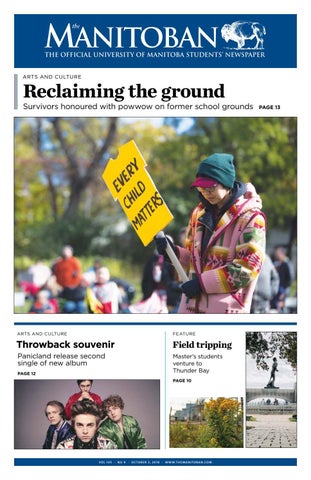
Reclaiming the ground
Survivors honoured with powwow on former school grounds

Panicland release second single of new album PAGE 12

Master's students venture to Thunder Bay PAGE 10 Throwback
Field tripping

EDITOR-IN-CHIEF Garett Williams editor@themanitoban.com / 474.8293
BUSINESS
EDITORIAL
MANAGING EDITOR Malak Abas me@themanitoban.com
NEWS EDITOR Malak Abas news@themanitoban.com / 474.6770
COMMENT EDITOR Jacob Singleton comment@themanitoban.com
ARTS & CULTURE EDITOR Braiden Pergis arts@themanitoban.com
SPORTS EDITOR Jason Pchajek sports@themanitoban.com
COPY EDITOR Matthew Doering copy@themanitoban.com
ASSOCIATE COPY EDITOR Sarah Doran sarah@themanitoban.com
DESIGN
DESIGN EDITOR Kellie Huynh design@themanitoban.com
GRAPHICS EDITOR Evan Tremblay graphics@themanitoban.com
PHOTO EDITOR Asha Nelson photo@themanitoban.com
PHOTO AND VIDEO EDITOR Quincy Houdayer quincy@themanitoban.com
DESIGN ASSOCIATE Ernest Zarzuela GRAPHICS ASSOCIATE Scott A. Ford
REPORTERS
NEWS Tyler Brass
NEWS Shauna Matthews
SCIENCE David Zirangey
COLUMNIST Kenny Ingram
COLUMNIST Rebecca Balakrishnan
ARTS Amin Montazeri
MANITOBAN
109 HELEN GLASS UNIVERSITY OF MANITOBA WINNIPEG, MB R3T 2N2
GENERAL INQUIRIES & ADVERTISING
Phone: (204) 474.6535
Fax: (204) 474.7651
Email: manitoban@themanitoban.com
FREE MEDIA Campus Plus Media Services Phone: 1.780.421.1000 Email: advertise@free-media.ca
A “volunteer staff” member is defined as a person who has had three volunteer articles, photographs, or pieces of art of reasonable length and/or substance published in three different issues of the current publishing year of the Manitoban. Any individual who qualifies must be voted in by a majority vote at a Manitoban staff meeting. Elected representatives and non-students may be excluded from holding votes as volunteer staff members in accordance with the Manitoban Constitution. The Manitoban is the official student newspaper of the University of Manitoba. It is published monthly during the summer and each week of regular classes during the academic year by the Manitoban Newspaper Publications Corporation.
The Manitoban is an independent and democratic student organization, open to participation from all students. It exists to serve its readers as students and citizens. The newspaper’s primary mandate is to report fairly and objectively on issues and events of importance and interest to the students of the University of Manitoba, to provide an open forum for the free expression and exchange of opinions and ideas, and to stimulate meaningful debate on issues that affect or would otherwise be of interest to the student body and/or society in general. The Manitoban serves as a training ground for students interested in any aspect of journalism. Students and other interested parties are invited to contribute to any section of the newspaper. Please contact the appropriate editor for submission guidelines. The Manitoban reserves the right to edit all submissions and will not publish any material deemed by its editorial board to be discriminatory, racist, sexist, homophobic or transphobic, ableist or libellous. Opinions expressed in letters and articles are solely those of the authors. Editorials in the Manitoban are signed and represent the opinions of the writer(s), not necessarily those of the Manitoban staff, Editorial Board, or the publisher. All contents are ©2018 and
Science sculptor visits University of Manitoba
Rebecca Kamen turns the world of neuroscience into art pieces
DAVID ZIRANGEY, STAFF
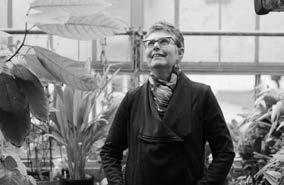
World-renowned artist and lecturer Rebecca Kamen held a series of workshops and lectures at the U of M last week.
Kamen is the artist-in-residence at both the National Institutes of Health neuroscience program and the Computational Neuroscience Initiative at the department of physics and astronomy at the University of Pennsylvania.
Kamen has worked with institutions including the Cajal Institute in Madrid and the Center for Astrophysics at Harvard University. She turns research in the field of neuroscience into artwork.
While Kamen was in Winnipeg, she hosted public lectures on her artistic process and an “art-science workshop for scientists.”
really share scientific discovery with wide audiences,” Kamen said.
“I mean, what good is scientific discovery that all these brilliant people do if it never leaves the lab?”
The rocky road to academia
Kamen said she was not always sure she would continue within academia and go on to teach. She only learned in college that she was dyslexic, after struggling to get into post-secondary institutions.
“When you’re not aware that you’re different or you learn differ-
learning differently is a good thing? It would be boring if we all learned in the same way because we’d all be saying the same thing.”
Kamen added that her message to students who may be struggling with their post-secondary journey is to try and use their skills to uncover opportunities and a fulfilling career path.
“That’s always one of the things that I always like to talk to students about,” Kamen said. “That every obstacle has an opportunity behind it, and sometimes those obstacles make us work a little bit harder to uncover what that opportunity can be.”
“What good is scientific discovery that all these brilliant people do if it never leaves the lab?” — Rebecca Kamen, artist
Kamen’s week at the U of M included visits to both the Bannatyne and Fort Garry campuses. The events were in collaboration with the faculty of science, the STEAM UManitoba initiative, the Manitoba Neuroscience Network and the Manitoba Craft Council.
Her work focuses on connecting the sometimes-inaccessible world of scientific research with the somewhat more accessible world of fine art.
“My gift is not only the discovery, but it’s being able to use my work to
ently, you just keep moving forward," said Kamen.
She added that her learning disability helped her not just in the field of neuroscience, but also to connect with students, some of whom have learning difficulties themselves.
“At first it was an obstacle, it was very challenging and frustrating. But now, at my age, I’m able to look back and realize what an extraordinary gift that obstacle was,” Kamen said.
“And if I was empowered by an obstacle, why can’t I go out in front of kids — who a lot of them do struggle with learning differently — that
Kamen’s unique way of putting together projects and gathering information has proven helpful for the scientists she works with as well.
Dyslexia “has informed the way I view the world,” Kamen said.
“And not only the way that I view the world, it helps scientists when I go to lecture in different communities to help them look at their research through a different lens," she said.
"I always love when I get invited into scientific communities," she added, "because I always know that something extraordinary will be discovered and [I] can partner it up with something else that I know.”
Holding Einstein’s brain
Her event series at the U of M ended with a lecture on Friday titled “Holding Einstein’s Brain,” an address inspired by a time she held a histological slide of Albert Einstein’s preserved brain.
Kamen explained that the director of the National Museum of Health and Medicine in Maryland reached out and offered for her to hold the slide in exchange for delivering a lecture at its Medical Museum Science Café.
Kamen’s interest in Einstein’s work has manifested in her art.
Her 2014 art installation “Portal” was created in celebration of the 100th anniversary of Einstein’s dis-
covery of general relativity.
The installation included a visual interpretation of the tracery patterns of black hole orbits and the gravitational waves of black holes. A soundscape by Susan Alexjander accompanied the installation.
“While I was holding his brain in my hand, I thought, ‘I wonder how his inner space — his brain — impacted his view of his outer space,’” Kamen said, “and that sort of took me into a whole other magical mystery tour and developed into a wonderful art installation that really investigates the dynamics and poets, and poetry of inner and outer space.”
Fewer commuters biking to U of M campuses
Despite statistics, UMCycle sees uptick in visitors
MALAK ABAS, STAFF
T
he U of M community is making more sustainable choices when travelling to and from campus.
According to a survey by the Green Action Centre, while 29 per cent of students, staff and faculty were taking transit to and from their primary campus from September to April 2016, that number jumped to 44 per cent in 2018.
Driving alone as a mode of travel to and from campus subsequently dropped from 46 per cent in 2016 to 32 per cent in 2018.
bringing in their bikes.
“We definitely noticed, between the first summer that we were open, like last summer, and this summer that we did way more business this summer,” Weier said.
“Part of that is because we had much better hours this summer, like we were open Monday through Saturday, and last year we were just open Monday to Friday and [during]
Weier added that the kiosk's busiest months were during the summer term, despite the lower number of students on campus. “A lot of them seem to be cycling,” she said.
The UMCycle Bike Kiosk opened in 2017 and replaced the University of Manitoba Recycling and Environmental Group (UMREG) Bike Dungeon at the UMSU University Centre.
There aren’t a lot of good options in terms of locking up bikes” — Anna Weier, UMCycle manager
Despite this, the survey reported a drop in the number of surveyed people who were biking to and from campus. While five per cent of people surveyed were biking in 2016, only three per cent were in 2018.
However, UMCycle Bike Kiosk manager Anna Weier said even in the past year the kiosk saw a significant increase in the number of people
kind of a short part of the day.”
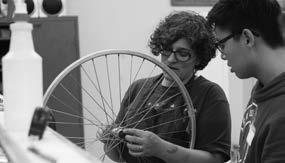
UMCycle, which is operated by UMSU, is a full-service bike repair centre which also provides workshops on bike maintenance. While the service is open to anyone, Weier estimates that over half of the people who bring bikes are students, and another 25 per cent are staff and faculty.
Weier said that the lower number of students cycling may be caused by an issue with city infrastructure.
“A big part of it, I think, is cycling infrastructure in the city,” she said.
“And so the university would have to be kind of a powerful partner and/or lobby group with [the] city to develop city infrastructure. And I’m not sure that they’re really taking that on because I think they see their purview as on campus.”
Weier also referenced the preva-
lence of bike theft on campus as a possible deterrent.
“A lot of people have talked about having [their] bikes stolen, and there aren’t a lot of good options in terms of locking up bikes,” she said.
“There’s bike racks everywhere, which is great, there are the lockers, but there’s only about 15 of them on campus and they’re rented out by
semester, so if you don’t get one then your only options are locking outside, or locking in the parkade lockup, but I’ve also heard a lot of thefts have happened out of the parkade lockup as well.
“And we get a lot of people coming by who say that they’ve lost bikes, their bikes have been stolen, so that’s a huge issue.”
PHOTO BY ASHA NELSON
PHOTO BY ASHA NELSON
Rebecca Kamen was at the U of M last week hosting a series of workshops and lectures on the melding of science and art.
Anna Weier, UMCycle manager, teaches students how to pack hubs during a Bike Maintenance 101 workshop.
Debating downtown revitalization

Focus on building skills and a career will follow
As the labour market evolves, your skills take centre stage
REBECCA BALAKRISHNAN, WORKING LIFE
If you feel lost when it comes to your career, start by building skills.
If you are at the point of being expected to make decisions and answer questions about your career, you might be under pressure to commit to a career path. As you try to nail down your future, consider if identifying a career path is even the right problem to address.
In 2018, your central task is no longer to determine what job you want to do when you graduate, it is to determine the skills you need to make an impact on the world.
The economy is in a state of flux. The Canadian labour market has been forecast to change astronomically over the next decade.
New jobs are being developed and new skill sets will be required for success. This uncertainty favours workers who are flexible and possess transferable skills which can make them successful in a multitude of roles.
The reality is that it might be hard for you to figure out your career
because your future job has not yet been created.
Instead of striving for a singular career goal, focus on building skills like communication and critical thinking. These are interdisciplinary necessities that every job requires.
In fact, RBC’s 2018 report, “Humans Wanted,” forecasts a “skills revolution” in which active listening is projected to be the most important
It might be hard to figure out your career because your future job has not yet been created
and in-demand skill.
In this new world of work, hiring could be based on skill set as opposed to field of study. Tech companies like
Shopify, IBM, Apple and Google are already starting this trend. The Ottawa Citizen recently reported that these companies have moved to competency-based hiring instead of requiring a particular credential.
With this labour market transformation comes comfort for the undecided: there really is no need to choose. You just need to keep learning, growing and building your skills. Simply immerse yourself in the world of work and see where your career takes you.
Every class you take, job you work or volunteer position you take on builds skills and teaches you about who you are as a person and a professional.
No matter how adaptive your uncertainty may be, it can still be exceptionally stressful. When the economy is changing and you can’t envision your place in it, where do you even begin?
Start with what you do know.
You’ve been going to school longer than doing most other things in your life. What subjects do you like? Which make you bang your head against your desk? The areas of school in which you excel hint at the ways you might excel in the workplace. Most occupations are based on knowledge areas, so this is a great place to start.
Next, think about what you are passionate about. While your passions might not exactly translate into jobs, they can be used to infer other options.
You may not be a good enough soccer player to make a living, but your team orientation, understanding of human kinematics and desire to keep moving could be career clues. These are real-world skills that prospective employers will pounce on.
Still, it can sometimes feel impossible to nail down your passions. Find them by stepping outside your comfort zone and gaining experience.
Passions are not found through fantasy. Passions grow over time through extended exposure and mastery. So try stuff. Take risks. And take the time to build the skill required to grow an interest into a passion. This comes with a bonus: while you’re out there experiencing the world on a quest for your passions, you will simultaneously build skills and networks and add to your resumé. Not bad for someone without a clue what they are doing with their life. Still, if you really just want an answer to give next week at Thanksgiving when your aunt corners you about what the heck you’re going to do with your arts degree, perhaps tell her that you’ve embraced the modern, skills-based economy. Choosing a job title is just so five years ago.
Rebecca Balakrishnan works in the U of M career services office. Her column appears weekly.
Winnipeg mayoral candidates discuss their plans for downtown development at a candidates forum Sept. 25.
PHOTO BY QUINCY HOUDAYER