U of M Faculty Association returns strong strike mandate
Over 85 per cent of union members voted in favour of strike action
Garett William S , staff
M embers of the University of Manitoba Faculty Association (UMFA) have returned a strong strike mandate to their bargaining team as the union continues negotiations with the U of M toward a new collective agreement.
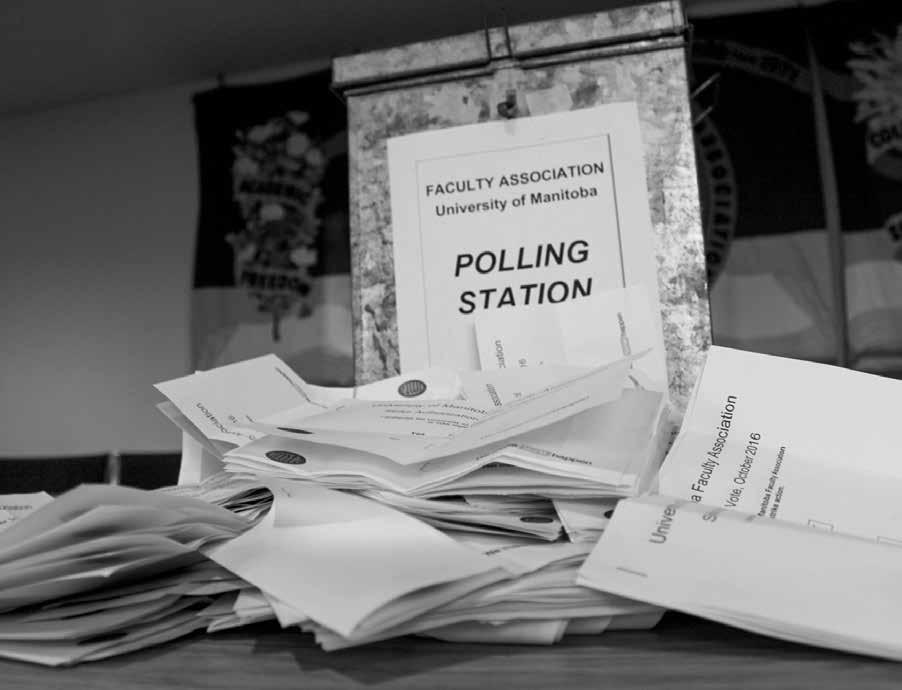
In what the union is calling a historically high level of support, 86 per cent of members who voted over three days last week supported giving the union authority to strike. Nearly two-thirds of the nearly 1,200 professors, researchers, and librarians represented by UMFA cast ballots.
In the last 15 years, UMFA membership has not returned a strike vote with more than 76 per cent support.
“This was actually stronger than we had even anticipated,” said Mark Hudson, UMFA president, adding that negotiations are ongoing and the association intends to give bargaining every opportunity to succeed.
“I think it’s a pretty powerful reaffirmation of the bargaining priorities,” he said.
“Basically, what it tells us is that the stuff that we’re trying to bargain for at the table are, in fact, issues that are of great concern to our members and that they are of sufficient concern that these folks would be actually willing to back it, if necessary, with strike action.”
The vote comes after the university published details of a four-year offer that included a seven per cent salary increase in September. Including existing annual increases and proposed competitive salary bumps to address specific areas of need, the average UMFA member’s salary increase would be closer to 17.5 per cent over the contract’s term.
Hudson said the university proposal fell short of meeting the association’s concerns surrounding work and teaching loads, collegial governance, and teaching assessments.
“What we hope this is, is a signal to the administration team that these aren’t issues that we’re going to pass up on lightly,” Hudson said. “They are issues that have been built from the ground up by our membership and the hope is that that strong of a signal will start to shake things loose a bit at the negotiating table.”
UMFA has countered the university offer with a one-year proposal that includes an average salary increase of 6.9 per cent, which would bring U of M faculty members more in line with comparable Canadian research universities, branded the U15. U of M faculty members are currently among the bottom of the U15 for compensation.
John Danakas, the U of M executive director of public affairs, said the university entered into this current round of negotiations with a more proactive approach to reach a timely agreement and is “committed to the belief that a settlement is best reached
without having to negatively impact students and their learning.”
Danakas noted the administration proposed a less confrontational, interest-based bargaining model in the winter; forwarded a one-year, salary-only offer that included a 1.5 per cent increase in the spring; and presented the union with the fouryear deal with terms similar to those recently accepted by University of Winnipeg faculty all in an effort to reach an agreement without disrupting classes.
The university is “committed to the belief that a settlement is best reached without having to negatively impact students and their learning” – John Danakas, U of M executive director of public affairs
All proposals were rejected by the union or returned with amendments.
“We very much understand the anxiety around the uncertainty that labour action brings,” Danakas said.
“We very much understand that. We knew that going in and tried to do things differently this year and it’s quite clear, given the offers made in a timely fashion – but it hasn’t worked and negotiations are ongoing.”
In July, the University of Winnipeg Faculty Association ratified a 4.5-year deal that includes a 7.5 per cent salary increase over the contract’s term. The University of Winnipeg is not a member of the U15.
Hudson said UMFA is wary of signing on to a long-term, fouryear agreement at a time when the university is preparing to undergo potentially major transformations, including the exploration of a more decentralized budget model.
“Bargaining really is our opportunity to have our voices effectively heard,” he said, adding that the association does not consider a strike lightly.
“There’s some anxiety around the word strike,” he said, “but really, the things that we are negotiating here are of crucial relevance to education at the University of Manitoba.”
The most recent three-year contract between UMFA and the university expired March 31.
Students respond
Some U of M students are rallying behind UMFA, including the U of M Student Action Network, which
began circulating a petition last week and quickly collected more than 400 signatures.
A Students Supporting UMFA Facebook group has also emerged online with nearly 300 followers.
Ian McDonald, a member of the Student Action Network who has been canvassing for signatures, said he supports the faculty’s push to protect quality education and academic freedom but noted there is also a concern about getting more voices at the university’s decision-making table.
“I believe students should start by doing simple things, like signing our petition and not crossing picket lines, but we should be ready to join the picket lines as well”
– Ian McDonald, UMSAN member
“We need to work towards a university where students and workers are collectively making decisions, and it’s not up to just a few people, such as those in the administration, to decide how things are run, whether that's in the case of teaching loads, tenure criteria, or whatever,” he said in an email. McDonald lauded the faculty and students who are standing up to an
administration he accused of promoting style over policy.
“This also speaks to our university's general direction where we get more flash and less substance, more advertisements and less professors, more construction projects and less courses offered, more administrative consultations and less decision-making power,” he said.
“The direction is the direction of neo-liberalist capitalism, and I'm happy our community is finally creating some obstacles.”
He said students have a responsibility to support UMFA’s push for controls on class size and maintaining academic freedom, which directly impacts students.
“I believe students should start by doing simple things, like signing our petition and not crossing picket lines, but we should be ready to join the picket lines as well,” he said. “And I'd go as far as to say we should start talking among our faculties and departments about more serious shows of support like sympathy strikes.”
Tanjit Nagra, president of the University of Manitoba Students’ Union, briefly addressed the dispute at last week’s regular council meeting, saying she remains neutral in discussions and her biggest concern is assessing the impact a strike would have on students.
The UMSU executive issued a release last week expressing disappointment an agreement has not been reached.
“Throughout these labour negotiations, it is vital that both sides remember that the students are the largest stakeholders during this entire process,” the release stated.
“Students are disappointed to see that months of negotiations have still lead to the potential of a strike, especially in a year whereby new academic policies are being implemented.”
“I think it’s a pretty powerful reaffirmation of the bargaining priorities” – Mark Hudson, UMFA president
While U of M faculty have not taken to the picket line since 2001, McDonald acknowledged the idea of a strike is concerning for students but said the ends can justify the means.
“Strikes can be worrying but I think students are aware of why it is coming to this,” he said.
“While some are certainly worried, in general I believe students of our generation recognize that employers still have too much power in bargaining, and that to make gains in this unfair system – gains that serve students in the long run – it’s necessary to take action and strikes have historically proven to be an effective action.”
photo
Mandatory Indigenous credit requirement a positive step toward reconciliation, says UBC professor
Diana Ubok UD om, staff
Integrating Indigenous academic requirements into business school programming represents another step toward Canada’s ongoing reconciliation with its Aboriginal communities, argued University of British Colombia professor Amie Wolf in a lecture at the University of Winnipeg Oct. 12.
Delivering a lecture titled “Real Reconciliation Starts with Fair Economics” as part of the U of W’s Weweni Indigenous Scholars Series, Wolf said Indigenous academic requirements for business schools help move toward economic reconciliation with First Nations.
“From a business perspective, given
the economic losses of colonialism suffered by Indigenous peoples, this is a logical and unavoidably accurate cost analysis," Wolf said during the lecture.
An adjunct professor and instructor at UBC's Sauder School of Business, Wolf worked with the university to indigenize its curriculum, which included developing an Aboriginal joint ventures course in 2015.
Her lecture went on to state that capitalist world views central to modern economies do not reflect Indigenous culture and values, which drives the need to include Indigenous perspectives in Canadian post-sec-
ondary business schools.
She applauded institutions like the University of Winnipeg that have successfully woven a mandatory Indigenous credit requirements into the curriculum and encouraged other institutions to follow suit.
“It is imperative that all post-secondary business schools in Canada also have an Indigenous credit requirement like the University of Winnipeg,” she said.
The University of Manitoba –which hosts the National Centre for Truth and Reconciliation on its Fort Garry campus – put Indigenous education in the front seat of its strategic plan for 2015-2020. The plan calls for every graduate to leave with an understanding of the struggles and contributions Indigenous peoples have made in Manitoba and Canada.
Last December, the university signed a memorandum of understanding with the Treaty Relations Commission of Manitoba to bolster treaty education. The U of M also signed on to the Manitoba Collaborative Indigenous Education Blueprint along with six universities, three colleges, and the Manitoba School Boards Association.
The U of W introduced its mandatory Indigenous credit requirement this fall.
Wolf said in an interview that the under-representation of Indigenous people within government policies leaves their perspectives out of standard course programming.
“There is such an absence of information and sometimes Indigenous people are just written out of the government policies in business textbooks,” she said.
“We are not part of the conversation of fairness in a multicultural sense.”
For institutions like the University of Manitoba, and others that are considering more Indigenous-focused programming, Wolf said it must be implemented properly. The right infrastructures and the right people are needed to ensure success.
Carter Wilson, president of the University of Manitoba Association of Aboriginal Commerce Students, said he believes in the idea of mandatory credits but said it must be introduced progressively.
“The university’s idea is a great one, but it must be gradual,” he said. “People have to be comfortable first and right now they are not.”
Wilson said the waters could be tested by first incorporating Indigenous matters into curriculum before dedicating an entire course to it.
U of M’s BEE/HOUSE/LAB initiative earns sustainability award
He added that the university could also host a speaker series where Indigenous issues are discussed and students earn credits by attending lectures.
“The university can then follow through with these minor steps for up to two years, after which its success is evaluated,” he said. “Depending on student response, a mandatory course can then be introduced or not.”
Wolf, however, said she believes that full potential cannot be realized by simply incorporating small selections of Indigenous history in academic curriculum.
“It's not an option,” she said. “It's not a special topic. It's not an elective.
“This is about waking up to reality. Just rolling it in, short-term, into another course – that’s not really it.” Wolf closed out her lecture by outlining the kind of economic partnership she envisions coming together with a greater understanding of Indigenous experiences within the business community.
“I am promoting relationshipbuilding that is focused on economic reconciliation,” she said, “finding a way to do business that is not a pressure to assimilate [but] that allows Indigenous values to live and breed even in a modern economy.”
Decorative, functional bee house designs leading the way for more sustainable achievements
oS ho Sam U el aD et U nji, staff
T
he University of Manitoba’s innovative efforts to save solitary bees were appreciated with a campus sustainability award presented over the Thanksgiving weekend.
The Association for the Advancement of Sustainability in Higher Education (AASHE) awarded the U of M’s BEE/HOUSE/ LAB international bee house design competition with a Campus Sustainability Achievement Award for outstanding achievement and progress toward sustainability.
The U of M competition, which launched in March, challenged competitors to design houses that can host between 80-100 solitary nesting bees. The pollinating insects are suffering from dwindling populations.
Andrew Konowalchuk, the U of M’s associate vice-president administration, noted that the AASHE only recognized three universities out of more than 220 entrants and said the award “showcases one example of
many great projects being realized by our university community.”
“The bee houses themselves are gorgeous and make our campus even more attractive” – Anna Weier, engagement coordinator, U of M office of sustainability
The U of M was recognized in its category alongside Cedar Valley College in Dallas, Texas and Furman University in Greenville, South Carolina.
Since their inception in 2006, AASHE Campus Sustainability Awards have been presented to educational institutions that promote effective implementation of campus projects that contribute to sustainability.
Anna Weier, engagement coordinator in the U of M’s office of sustainability, welcomed the award.
“It is great to be recognized as a leader of sustainable development by an international organization,” she said. “This project is reflective of the fact that we often work collaboratively with on- and off-campus partners to create innovative environmental solutions.”
The winning designs, announced in April, were fabricated by the U of M’s Fab Lab, the faculty of architecture’s laser cutting labratory. Field testing began in the spring with the installation of 50 bee houses by the U of M Parks Canada Club student group.
Weier said the top designs included both practical and visual features.
“The bee houses themselves are gorgeous and make our campus even more attractive,” she said. “And of course, there is now more habitat for solitary bees on campus.”
Raising awareness
At the end of October, the field test will wind down when the bee houses are collected and their practical designs more thoroughly evaluated, which includes taking a count of how many bees are nesting inside.
Robert Currie, a professor of entomology at the U of M, said the competition served as a showcase for the university’s sustainability office and its efforts on campus.
“I think that the bee house competition will bring an awareness of the university’s roles and [efforts] to make the campus a sustainable environment and also to use the campus
as a living lab,” he said.
Currie, who is actively involved in the field testing of the bee houses, said it is especially rewarding to be recognized by an outside organization.
“I think it is a great honour to receive the award,” he said.
“The project in itself has been a real collaborative project and very multidisciplinary [...] Everybody that has been involved in it has really devoted a lot of time and effort to the project and believed in that project, so it is very nice to receive that sort of award and recognition from outside the institution.”
photo provided by diane poUlin
UMSU council weighs VPSS replacement options
h annah Froe S e, staff
Following the resignation of former University of Manitoba Students’ Union (UMSU) vice-president student services (VPSS) Jessica Smith, councillors discussed options to fill the now-vacant position at their regularly scheduled council meeting Thursday, Oct. 13.
Chairperson of the UMSU governance committee Cole Kubay presented two recommendations from his committee to councillors.
“The governing documents do not mandate that we have to have an election if the position from the executive resigns”
One option presented would be to hold a by-election for the VPSS position, ensuring the VPSS duties would be filled and a full five seats would remain on the executive committee.
For an election to happen this term, a decision on what to do about the vacant VPSS position will have to be made by the next UMSU council meeting, Thursday Oct. 27, said Kubay.
“To call an election, if we did that,
[...] it would have to happen by next meeting or it wouldn’t happen at all,” he said.
According to Kubay, a by-election would take nearly five weeks including the time needed for a nomination and campaigning period.
UMSU could also hold an election next term, at the start of January, when e-voting will be available. In that case, the five-week period to hold the VPSS election would then put the end of the VPSS election at the same time as the opening for the annual UMSU general election.
“It’s really [...] a non-option, because the end of the election would be crossing over with the UMSU general election,” explained Kubay. He said that holding an election in January was “a little bit redundant in my mind and in the mind of the [governance] committee.”
As well, the cost of a by-election would be nearly $25,000, he said.
UMSU vice-president internal
Adam Pawlak said it would be a substantial number, possibly $15-25,000.
“We would find that money from somewhere, if we choose to have an election,” he said.
If an election were held, UMSU would have to pay the cost of the election as well as the remaining salary for the new VPSS.
The second option presented by the governance committee was to leave the position vacant, splitting VPSS duties between the remaining executive members and possibly assigning duties to an office assistant, to be hired.
This office assistant would not have a vote on council and the execu-
tive council would also remain only four members.
“The governing documents do not mandate that we have to have an election if the position from the executive resigns,” said Kubay. "So the position could technically be left vacant until the UMSU general election.”
UMSU president Tanjit Nagra supported this option, indicating that hiring a new staff member made more sense than holding a by-election.
Vice-president advocacy Dara Hallock said student representation for the VPSS position was
New UMSU budget adopted
also important, saying, “It’s not just finances.”
Pawlak agreed with Hallock. “The principle is really important, it’s a big decision [...] it’s not that easy,” he said.
The issue of how leaving the VPSS position vacant could affect the executive quorum was also brought up. Quorum refers to the amount of members that are needed to pass a motion.
The executive council needs a majority to pass a motion and with only four members there could be a tie.
UMSU council approves a revised operating budget at its Oct. 13 meeting
h annah Froe S e, staff
The University of Manitoba Students’ Union (UMSU) passed a new operating budget at its regularly scheduled meeting on Thursday, Oct. 13.
The revised budget, presented to UMSU council by vice-president internal Adam Pawlak, features large cuts and increases to certain areas, including a new budget line for the union’s van expenses, a $60,000 increase to spending on legal fees, and the creation of a $58,000 U-Pass expense.
At this time, $39,000 of the annual budget that was passed in April has been spent on administering the U-pass, which didn't have a specific budget line allocated to it.
“Some things were a little bit shortsighted and we needed to change that, because [the previous budget] just didn’t make sense,” Pawlak told the
Manitoban Areas that will receive increases in the budget include spending for UMSU council meetings and events, which were raised by $1,000, and community outreach, which increased from $15,000 to $17,500.
The marketing budget also increased from $25,000 to $33,000 and packages for students living in residence as well as the budget for socials were both increased by $1,000 respectively.
$40,000 was approved for the Frosh Fest budget and $80,000 was budgeted for the speaker series. Pawlak clarified that these were only allocations – this money may not be completely spent and UMSU is not required to spend all of the money budgeted.
The budget line for office supplies also increased from $15,000 to $22,750.
Spending reductions
The budget also included large reductions to technology, conferences, and postage spending to the sum of $10,000. The budget lines for both fall and winter orientation were also reduced by $9,500.
The ‘Appreciation’ expenditure was also reduced from $8,000 to 6,000.
The budget for UMSU’s audit also increased by $5,000 and repairs and maintenance increased from $7,000 to $15,000.
Pawlak said that before implementing these changes, he “consulted with the people that are most affected by [the changes] and the finance committee also asked a variety of questions and made sure that we were doing this in an appropriate manner.”
Eliminated expenses
Some budget lines have been completely eliminated due to “redundancies and ineffective allocations,” said Pawlak.
Eliminated expenses include professional development – previously budgeted $1,000 – and the budget line for travel, meetings, and conferences.
The budget line for staff training and job vacancies was also eliminated. Spending on job vacancies was redundant, Pawlak said, and UMSU has a separate money line for staff training.
The $10,000 UMSU award was also eliminated.
Legal budget
In the budget passed in April, $25,000 was set aside for legal fees; however, since then $47,888 has been spent. At the council meeting
Thursday, Pawlak said, “The $25,000 allocation was very short-sighted. It’s been a very intensive year, using legal for a variety of reasons like the U-Pass, retail agreements, the contribution agreement, governance reviews, and Frosh Fest.”
“Going forward we are going to be reviewing what types of projects that our legal team is working on that can be essentially shut down for the year or kind of kicked to the side,” he said. “We do understand that it’s not sustainable at this rate, so we are taking steps to reduce that.”
The new legal budget line has been raised to $85,000.
The motion for the new UMSU operating budget was approved by all present: no councillors against, with no abstentions despite the proposed budget being presented to councillors at the meeting for the first time.
UMSU council then entered a closed session, citing a discussion of salary as the reason. No decision has been made on how to move forward with filling the VPSS vacancy.
photo by chantal zdan
Craig Adolphe
Editor-In-Chief:
Contact:
Meaningful sexual assault policy, not politics, should be priority for NDP, PCs
ShaW n Garb U tt, staff
L
ast November, during the dying days of the NDP government, education minister James Allum introduced Bill 3 to Manitoba’s legislature. Then, this past June, NDP MLA Wab Kinew introduced private member’s bill 204. Now, new PC minister of sports, culture, and heritage Rochelle Squires has introduced Bill 15 into the legislature.
What do these bills have in common? They’re all pieces of policy that mandate post-secondary institutions implement policies on sexual assault. While Bill 3 and Bill 204 are identical, Bill 15 was mildly reformulated to include privately funded postsecondary institutions in its scope, domain over cyber crimes, and a strict definition of what constitutes sexual assault.
It’s taken three bills, two readings, and two votes for this piece of policy to add three pieces of new content to the legislation. This legislation has come to represent the worst of bureaucracy and politics. Not only has the process been inefficient and burdensome, but it’s been accompanied by a steady stream of partisan positioning.
History: Bill 3
This piece of legislation set out to implement a framework in which post-secondary institutions would handle cases of sexual assault within an established set of rules and procedures. Allum was quoted as saying the legislation would act to make sure “there are consequences in place when a situation occurs, and that those con-
sequences are clear and transparent in the first place.”
This was a curious choice of words by Allum, considering the content of Bill 3 in regards to those so-called consequences was neither clear nor transparent. The bill itself fails to define the sort of fate that awaits transgressors beyond the public disclosure of the assault, nor does it outline the kind of policies postsecondary institutions ought to be pursuing.
The NDP had already laid out the groundwork of the policy. All the PCs had to do was get it off the ground flying
News of Bill 3 was hot on the heels of a news investigation conducted by CBC in February 2015 that claimed reports of sexual assault on Canadian campuses were too low and indicative of massive rates of underreporting. The NDP ought to be chided for what was clearly a half-baked scheme to score progressive points with a weary electorate. I can say this with confidence because Bill 3 never saw the light of day. In fact, it was hardly even conceived. After passing one of three rounds of readings, the bill was left to rot in the halls of the legislature. This was despite the fact
the NDP government had an entire spring session at the legislature to complete the bill’s assent into law.
To quote Premier Brian Pallister on the night of his winning election, “If you care, you care about results. If you don’t care about results, you don’t really care at all.”
If the NDP had truly cared about the passage of this sexual assault policy, they would have done more than the bare minimum and easily rushed it through a legislature they dominated with a government majority.
The politics behind policy: Bill 204
Presented as a private member’s bill, Kinew brought back Bill 3 as Bill 204 in June of this year. This second attempt to get the legislation passed may seem like a genuine effort by the NDP, but if that was the case, one should ask why the NDP didn’t simply rush the legislation through its remaining two readings the first time it was presented, as Bill 3, last November. Further, one cannot make the argument that this time lapse was used to develop the bill, as several months later the legislation remained unchanged.
As Manitoba’s Progressive Conservatives (PC) hold a government majority in the legislature, the spotlight had passed to them. The fate of the bill was entirely in their hands. Arguably, having already made it through one reading in the legislature, one could make the claim that the proposed policy is sound enough to warrant at least a tabling
of the policy by the government. However, the PCs have expressed no interest in following the NDP’s policy path. When approached by the Manitoban regarding the future of Bill 204, newly minted education minister Ian Wishart merely said in a statement issued from his office, “We continue to listen and engage in meaningful discussions with education and women’s organizations, as well as students, on initiatives to enhance on campus safety in Manitoba.”
There’s an embarrassing lack of direction in the legislation, without any content referring to punitive measures or what exactly the procedural policies should look like
So, by all indications, it seems the NDP were only interested in employing shame tactics against the PCs. The reintroduction of Bill 3 as Bill 204 was just bait for the PCs, meant to be used as political fodder when the government inevitably turned it away.
Moving forward: Bill 15
It is high time the province legis-
lates a strict, substantial policy framework that establishes procedural as well as punitive courses of action for post-secondary institutions to follow when sexual assault is reported on campus. The PC’s Bill 15, although a step in the right direction, is a small one.
Bill 15 expands the size and scope of the legislation to include private institutions, such as religious universities, and the bill issues a substantial, concrete definition of what constitutes sexual assault that extends to cyber-crimes.
That being said, Bill 15 has the same major deficiencies as its NDP predecessors: punitive measures are entirely lacking and its clarity regarding procedural policy is nearly as murky – the province simply hands off the task to individual institutions. The province should be issuing a universal dictate in order to ensure precision, efficiency, and success across the board when it comes to following the legislation.
Whatever benefits are gained from the updates in Bill 15, they could certainly have been enacted sooner if both parties stopped playing politics with this issue. Elected officials of all party stripes would do well to remember that some issues are simply nonpartisan.
photo by levi garber
Weighing in on reserved gym times
j eremiah ko PP, staff
The latest controversial suggestion arising from the more progressive elements of our campus has come in the form of a proposal for exclusive gym hours for women and non-binary individuals at the Active Living Centre (ALC). The argument is essentially that women and non-binary individuals may feel uncomfortable using the space for fear of harassment and therefore should have the option of exclusive times. Since then, there has been a predictable outcry on social media from gym junkies and couch potatoes alike who fervently believe that this is an attack against men.
This is an interesting debate to me, because I go to the University of Manitoba gym five to six times per week and have had nothing but positive experiences. There are friendly, well-trained staff of all genders and I have never witnessed any harassment. By my account, going to the ALC is a great social experience.
The thing is, we cannot make policies based on my experience. Or anyone else’s individual experiences for that matter. Rules in society are not formed through your anecdotal testimony, which serves as a powerful cognitive bias on your views. While my time at the gym has been positive, someone else’s may not have been. This becomes a problem if the people who feel like they are not able to access that same positive experience are disproportionately women and non-binary individuals. That’s called inequality, and it’s not up to you nor I to say whether or not their opinions are valid.
We should all be thoughtful and compassionate enough to realize
that not everyone has the same life experiences that we do. If you do not feel like ‘safe spaces’ are a good idea and that the world is not a dangerous place, that’s great – it means you may not have felt the same level of harassment, intimidation, or danger that others may have. Women and non-binary people are not biologically predisposed to feeling harassed or threatened. This is learned through a society where they are paid less than men, occupy relatively fewer positions of authority, and are disproportionately on the receiving end of physical and emotional abuse, among other things.
A policy that is aimed at making marginalized groups feel safe and comfortable in relation to your more dominant group does not count as discrimination
While most of us do not leer, hover, touch, comment about, or harass other people, it still occurs.
Do all men harass? No. Do all women feel harassed? No. But following this line of reasoning relies on anecdotes and does not reflect the social reality and double standards that women face; it is a fact that one out of four women will be sexually
harassed in their lifetime. In our society, this type of harassment is perpetrated disproportionately by one gender. Hint: it’s not women.
Even if you are not worried about harassment per se, gyms can still be intimidating. Your body is literally on display for everyone to see. For women and non-binary individuals, people who have faced harassment and safety threats, it is not unreasonable to believe that they may simply choose to steer clear of the facility altogether. This is the key implicit argument behind the reserved gym time proposal. It’s argued that discrimination is already taking place, even if it is not immediately obvious. Many women and non-binary people may feel like they cannot use the ALC given that gyms are typically hyper-masculine environments.
To illustrate this point, consider the pay inequity that women face in the workplace. You will never see a written rule that says women should be paid less than men for the same work, but it happens all the time. This type of injustice requires us to read between the lines; it is different, but no less real than formal discrimination.
That is why it is completely erroneous to say that this proposal is sexist or segregationist. A policy that is aimed at making marginalized groups feel safe and comfortable in relation to your more dominant group does not count as discrimination. Yes, there are obviously no rules that clearly prevent these individuals from participating, but that does not make the discrimination less real. So consider this – if you are upset that you may be restricted from coming
to the gym for a few hours per week, how do you think some women and non-binary people feel that they cannot use the gym at all? It deserves acknowledgement simply because
Are your rights so infringed that you cannot sacrifice a few hours a week to people who are telling you that they feel physically threatened?
that is how many people feel.
This proposal speaks to larger social issues but it is even more important within the context of the Active Living Centre. Contrary to the arguments I have seen on social media, the U of M and its gym are not public spaces. It is a workplace, subject to the university’s Respectful Work and Learning Environment policy. Every student pays a gym fee to be able to access that space equally, so this is not the same as if you feel harassed at a park. It is important to note that no one actually knows the extent to which there is demand for this idea or not.
No one, to the best of my knowledge, has taken a statistically relevant sampling of the student population that ascertains whether or not women and non-binary people do in fact feel disproportionately intimidated or threatened by the environment at
the ALC. This should be the first step in the process.
Right now, we have no idea what true public opinion on this issue is. If you look online, this proposal seems pretty unpopular. Although, perhaps that speaks to the issue itself. Maybe the people who are not speaking out are the same ones who hear a sexist comment and think less of the individual saying it, without feeling the need to vocalize their thoughts. At this point, all that has occurred is a significant amount of recoil from those who already feel empowered to speak out publicly.
In the meantime, my hope is that we try and listen to others rather than immediately turning a cold shoulder. If people are telling you that they are fearful, if people are telling you that they’re not comfortable, if people are telling you that they would have an improved quality of life if a policy was changed, perhaps entertain the idea that this is not being suggested to make your life worse but instead to make things more equitable and fair for everyone.
Is this suggestion really that much of a burden? Are your rights so infringed that you cannot sacrifice a few hours a week to people who are telling you that they feel physically threatened? If people are telling us that they feel unsafe, we need to listen.
Late night eats: time for Winnipeg to step up to the plate
ZaC h Flei S her, staff
Ihad the fortune of backpacking across Europe this summer, visiting major cities and cultural centres across the continent. It was a tremendous experience. Visiting historic sites, exploring the dense, vibrant streets, and feeling a substantial appreciation of the culture and history of those areas was exhilarating. One of my favourite elements, though, was the rich availability of late night
food options in those areas – an area in which Winnipeg sadly and sorely lacks.
Across the world, food brings us together in a way few other elements of life can. We break bread over a meal, we toast in celebration, and we offer free snacks as a means to entice people to come to public meetings.
Winnipeg is a city of great cultural value. It boasts a tremendous
arts and music scene and is constantly taking these facets to the next level. One only has to look at events like Nuit Blanche, where thousands of people explored our downtown and core areas to interact with accessible art. Similarly, we’re embracing winter like never before through skating paths and pop-up restaurants during the day.
In my own neighbourhood, it is next to impossible to grab a bite to eat after midnight despite the fact that some of the best eateries the city has to offer are on Sherbrook. As this area hosts an increasingly vibrant nightlife in the city, it’s odd that you can’t find anything other than an occasional slice of pizza, a quick burger, or chips from a gas station to eat in the wee hours of the morning. In other words, what is available simply doesn’t satisfy those late night cravings.
I can’t speak to the suburbs of Winnipeg, but I gather that the offerings of Waverly West are simi-
larly suspect. Beyond the allure of a Tim Hortons or a 7-Eleven, do our outlying areas offer much in the way of imaginative late night eats? Does Charleswood have a sacred gem that I’m unaware of? Admittedly, most of my late evenings are not spent out in the burbs, except on the occasional bike ride through.
While I could wax poetic for hours on this topic, I’m much more inclined to try and move towards a positive solution, namely one that opens the door for an elusive late night snack. In the past few years, I’ve seen our summers come to mean an expansive and still expanding range of options for food trucks on Broadway. Many such establishments now make appearances at our popular music festivals as well. Alas, they disappear in the winter and certainly after 4 p.m. leaving the late night crowd somewhat unsatisfied. I don’t think I am only one longing for something.
Let this stand as a call to action
for Winnipeg’s creative and entrepreneurial class. There is room to imagine on how to address this issue. Certainly, one should think that there is a market demand beyond stale pizza and the drive thru window. I’d like to see it happen, and I’d like to see it come forward as something unique to our city. Winnipeg, are you up to the challenge?
Do you have a favourite late night haunt? Email zach@themanitoban.com or tweet @ZachFleish with your favourite suggestions.
Why Manitobans should care about the Dakota Access Pipeline
Sha D en a b USaleh, staff
T
he Dakota Access Pipeline (DAPL) is a $3.8 billion oil pipeline stretching from North Dakota to Illinois, covering approximately 1,900 kilometers of terrain. Nearly as long as the previously rejected Keystone XL Pipeline, it is estimated that the pipeline will transport about 470,000 to 570,000 barrels of crude oil per day. If built, this pipeline will run through Standing Rock, a Sioux reservation in South Dakota, home to over 8,000 people. What this means is that it would run through sacred Indigenous sites and burial grounds. Additionally, the pipeline would be built under the Missouri River, which is Standing Rock’s main source of drinking water. A leak or oil spill would be catastrophic for their water source and local ecosystems.
We’re only an eighthour drive from Standing Rock, so we cannot distance ourselves from what is happening; and even if we could, we shouldn’t
Through the use of a loophole known as Nationwide Permit 12 – a fast-track permit issued through federal law that does not require projects to undergo rigorous environmental review, tribal consultation, or public input – the Army Corps of Engineers has allowed construction of the pipeline to begin. Although temporarily
halted, construction has resumed on private land in North Dakota.
Protests against the Dakota Access Pipeline have been ongoing since April, but the rest of the world has only recently turned its attention to Standing Rock as other Native American tribes, activists, and even celebrities gathered at Standing Rock, the pipeline construction sites, and courts in Washington D.C. to protest the pipeline’s construction. Peaceful protesters have been pepper sprayed, attacked by guard dogs, and arrested. Just last week, a truck ran over Native American protesters a couple states over in Reno, Nevada who were involved in public demonstrations against DAPL.
Among those arrested are Deia Schlosberg, a documentary filmmaker facing up to 45 years in prison for her coverage on the pipeline protests, and Shailene Woodley, a Hollywood actress who live-streamed her arrest as she was leaving a protest at a construction site and who has since been charged for criminal trespassing.
The protesters’ defiance has evoked America’s ugly racial past and is a reminder of how little has changed in the American government’s relationship with Native American communities. History always repeats itself; the same government is violating the same treaties.
Our planet continues to get warmer; every month in this year has been the warmest month globally, meaning that 2016 will surpass 2015 as the hottest year on record.
This year has also witnessed its share of environmental disasters due to global warming, from India’s recordbreaking heat wave this spring, which
killed hundreds and severely damaged crops, to Hurricane Matthew, one of the most devastating hurricanes in recorded human history due to record-high ocean temperatures that took the lives of over 1,400 people and completely destroyed southern Haiti. Reading about this should leave us terrified and worried about where our planet’s future is headed.
And so, when we hear about environmental protests, or read about Standing Rock, we should not just brush it off and pretend the Dakota Access Pipeline will have no direct effect on our lives since it’s not our water being contaminated or our homes being damaged. Whether or not we notice the repercussions, we will be affected if this pipeline is built.
This is not just their pipeline battle; this is our pipeline battle. People’s lives are at stake. People who have the guts to stand up to multi-national
billion dollar corporations who hire private security companies that sic guard dogs on protestors. This protest is a matter of life and death. The people of Standing Rock are fighting to protect lives: human life, animal life, and plant life. The extraction, transportation and use of fossil fuels is destroying our planet. We too are at risk, so our response to the Dakota Access Pipeline matters. And we can help.
We can contribute by expressing our support, by sending funds, supplies, and food, and by spreading information to others about DAPL. Most importantly however, is increasing our own knowledge about what is happening at Standing Rock. This is essential, and we have an abundant amount of resources that we can look into. There are numerous articles, both news reports and opinion pieces, on DAPL that have
been published. There’s the Standing Rock Sioux Tribe’s official Facebook page which is constantly keeping us updated on what is happening, alongside opportunities at the U of M to learn more about DAPL through the World Opportunities Week happening on campus during the first week of November.
We’re only an eight-hour drive from Standing Rock, so we cannot distance ourselves from what is happening; and even if we could, we shouldn’t.
During World Wise Opportunities Week, you can join the discussion and attend a panel called Water is Life: A Time for Civil Disobedience on pipeline expansion, Standing Rock, and the global movements for change. This panel will be held on Thursday, Nov. 3, from 1:00 p.m. to 2:15 p.m. at 230 University College.
graphic
Science Briefs: Animal Activity Edition
A roundup of the latest news in strange animal traits
m alak a ba S , staff
Arecent study by scientists at Duke University, Kyoto University, and the Max Planck Institute for Evolutionary Anthropology has provided evidence that great apes (bonobos, chimpanzees, and orangutans) have even more in common with humans that previously thought. It’s called “theory of mind,” and it’s the real-world equivalent to mind reading. When you can guess what someone else may be thinking, or assume what they’re going to say next, that’s theory of mind. It’s the ability to assume that other people possess thoughts and ideas, and that they may be different from your own. While this was originally considered to be a specifically human trait, new research shows what looks like a similar thought process happening in great apes.
The great ape experiment was framed similarly. This experiment, which was called a “litmus test” by Fumihiro Kano, the co-leader of the study, uses a greatly simplified version of the human test.
In the ape test, bonobos, chimps, and orangutans were treated to a movie and juice. Using a video monitor, they were shown two separate scenarios. In the first, a researcher in a gorilla suit would wildly attack a human researcher. The “gorilla” would then dramatically hide in one of two hay bales, then move to the other, and the video would make it obvious that the human researcher was aware of this. The researcher would leave, and while the researcher was gone, the gorilla would leave too. The researcher would then return brandishing a stick, searching for the gorilla in the hay bales. There were other scenarios used as well, one involving the gorilla hiding in the hay bales in a different order, and another involving the gorilla-suited character hiding a stolen rock.
With the use of an infrared eyetracker, the researchers were able to track the ape’s eye movements, and used this to concur what they were thinking. In every test, the apes passed, meaning the apes looked at the place where the human researcher last saw the gorilla or the rock. Thus, according to researchers, correctly judging the researcher’s thought process, understanding that the human actor possessed a belief that the ape
knew to be false, and anticipating that the human character was going to search for the gorilla or rock there.
“Great apes didn’t just develop these skills this year, of course, but the use of novel eye-tracking techniques allowed us to probe the question in a new way,” Christopher Krupenye, co-author of the study, wrote for the Conversation
“These findings raise the possibility that the capacity to understand others’ false beliefs may not be unique to humans after all” – Christopher Krupenye, study co-author
“By using methods that for the first time assessed apes’ spontaneous predictions in a classic false belief scenario – with minimal demands on their other cognitive abilities – we were able to show that apes knew what was going to happen.”
The experiment is not without its skeptics, however, with some suggesting that while the ape may realize that the human will look where the human last saw it, this does not necessarily imply that the ape consciously knows that the human possesses a “false belief.”
The authors of the study agree that more research is needed, but are hopeful that this discovery could lead to a heightened understanding of our closest relatives and of our own evolutionary timeline.
“At the very least, in several different scenarios, these apes were able to correctly predict that an individual would search for an object where he falsely believed it to be,” Krupenye writes.
“These findings raise the possibility that the capacity to understand others’ false beliefs may not be unique to humans after all.”
Naked mole rat’s superhuman ability an evolutionary trait
Naked mole rats are an interesting species. They survive in harsh conditions, weathering the dry grasslands of east Africa. They’re the first mammals ever discovered to exhibit eurosexuality, meaning that like bees or termites, they live in immense colonies and have a queen, which is the only naked mole rat to reproduce. Their average lifespan is into their thirties, and they almost never get cancer.
One of their most interesting qualities, however, is their incredible resistance to pain, and new research finally explains why the naked mole rat barely feels pain that would anguish nearly any other animal.
The study, published in the journal Cell Reports, suggests that through evolutionary adaptation, naked mole rats have developed to ability to only feel just enough pain to signal danger, but not much more.
These adaptations, caused by changes in the amino acids in their pain receptors, are the reason why despite the hot weather in east Africa, and the naked mole rat’s nakedness, they do not seem to suffer from the effects of thermal hyperalgesia.
Thermal hyperalgesia, which is basically heat sensitivity, is why it hurts more than usual if you put hot water on a burn, or step into the shower after a long day out in the sun. It occurs when a previous burn causes higher sensitivity in the skin affected by the burn. Naked mole rats get thermal hyperalgesia too – the constant skin-to-skin contact with other naked mole rats only exacerbates this – but they do not seem to feel the pain that we do.
Scientists have isolated the receptor that gives the naked mole rat their heightened pain resistance, called TrkA. This receptor receives something called nerve growth factor (NGF) molecules when the animal host experiences high heat temperatures. This in turn alerts sensory nerves to let the brain know that this level of heat is causing the body pain.
The TrkA receptor works differently in a naked mole rat, however. In this experiment, researchers exposed naked mole rat nerve cells to a chemical found in hot chili peppers, and found that due to the difference in their TrkA receptor’s amino acids, the naked mole rat was not able to feel pain due to heat sensitivity. In fact, it took 10 times the amount of a normal rat’s NGF for the naked mole rat to feel any pain at all.
Gary R. Lewin, professor at the Max-Delbruck Center for Molecular Medicine in Berlin and lead author on the study, believes that these findings could have a great impact on how we treat humans suffering with chronic pain in the future.
“This study is not going to tell
them how to do that,” he said. “But I think it’s cool that 30 million years ago, the naked mole rat figured it all out. Evolution has already done it.”
Poachers suggested to have a direct effect on elephant development
A video posted just last week by the Howard Hughes Medical Institute (HHMI) suggests that more and more female African elephants are not growing tusks – and poachers are to blame.
While tusks are an important part of elephants’ development, and are used as tools by the elephant, around two to six per cent of female elephants never grow them
While tusks are an important part of elephant’s development, and are used as tools by the elephant, around two to six per cent of female elephants never grow them.
Dr. Joyce Poole, who is featured in the HHMI’s video studying Gorongosa National Park in Mozambique, suggests that poaching has caused a sort of rapid natural selection to occur in elephants.
“Tusklessness, just like having tusks, is a natural trait,” Poole said. “And it’s inherited, like bigger ears or smaller ears, like brown eyes or blue eyes. It’s an inherited trait.”
Hunting elephants for their tusks, which are still used today to make ivory, was a large factor in Mozambique’s civil war, which lasted 15 years and ended in 1992. Researchers in Mozambique believe that the civil war changed the elephant population drastically.
“Gorongosa’s elephants are very special,” said Dominique Demille, a research fellow on the Gorongosa Restoration Project.
“The older ones still remember what happened in the past: the war, the soldiers that hunted elephants for their ivory.”
While two to six percent of all female elephants (male elephants need their tusks to fight, and are thus less likely to not grow them) are tuskless, about half of all female elephants that were alive during the civil war in Mozambique are tuskless. This, along with the fact that tusk growth in elephants in inherited, could be signs that all tusk growth in female elephants has been greatly affected by poachers. About a third of younger female elephants in Gorongosa National Park who were born after the civil war are tuskless.
To learn more about the destructive effects of poaching on elephants and other African wildlife, and what you can do to help, visit http://www.awf.org/ wildlife-conservation/elephant
graphic by aldo rios
coMic by scott lercher
Canadian photojournalist to share thought-provoking stories of marginalized animals
e melia Fo U rnier, staff
Twenty years ago, Canadian photojournalist Jo-Anne McArthur realized that she regarded animals differently from the way most people did. While backpacking in Ecuador, she came across a macaque monkey on display and chained up in a window. Tourists were taking photos of the monkey like it was just another curio, but all she could see was an animal suffering and in bondage.
Since then, McArthur has been trotting the globe, photographing and documenting the stories of animals everywhere. She has garnered a name for herself by portraying the world’s ‘invisible animals.’ These animals are absent from the covers of magazines and the shelter of our homes but present on our dinner tables, confined in factory farms, hunted and neglected. Her work seeks to introduce city-dwellers to individual animals and their stories.
Our society allows us to humanize pets and exotic animals. These photogenic animals are featured on the covers of magazines and news feeds worldwide. Whenever they are mistreated, there is an outrage. On the other hand, non-domestic and factory animals are easily neglected and regarded as means of making profits.
Animal activism has allowed for more scrutiny into the way factory
animals are treated. This has led to an increase in demand and appreciation for vegan products. As a result, meatproducing companies are beginning to produce animal-free alternatives as a result. While these are commendable strides, animal activists have more work to do to raise awareness for about animal mistreatments.
That being said, McArthur’s new book, We Animals, tells the stories of individual animals through photographs and anecdotes. The book has been endorsed and critically acclaimed by the likes of Dr. Jane Goodall, Wade Davis of National Geographic, and Joaquin Phoenix.
On Oct. 25, she will be giving a presentation entitled We Animals: Stories of Love and Liberation at the Park Theatre. The presentation will be hosted by the Winnipeg Humane Society’s farm animal compassion committee.
With her presentation, McArthur intends to take the audience on a journey across the globe, introduce them to animals, and help them conceptualize and understand the marginalization that animals face at the hands of human beings. She also seeks to inspire young people to use their skills and passion to change the world, as she did with photography and animal activism.
“It is definitely a tear-jerking talk,
but it is also full of really joyous moments. I am basically sharing stories of rescue, so it’s heart-warming,” McArthur said
With her presentation, McArthur intends to take the audience on a journey across the globe and help them understand the marginalization that animals face at the hands of human beings
When she is not giving presentations or taking pictures, McArthur spends her time working on two upcoming books. The first is called Captive and is a collaborative project with the Born Free Foundation. Slated for an April 2017 release, Captive focuses on zoos around the world and the need for a paradigm shift in terms of captivity.
The second book, Unbound, commemorates the role of women in ani-
mal activism and is expected to be out in 2019. In this book, McArthur narrates the stories of activists including elephant rescuers in Thailand and lawmakers in Canada. For more information on her book project, visit unboundproject.org.
Jo-Anne McArthur’s presentation on We Animals: Stories of Love and Liberation will be held Oct. 25 at 7 p.m. at the Park Theatre. Tickets are $10 and can be purchased online, at the Winnipeg Humane Society’s gift shop, or at the door. For more information, visit www. myparktheatre.com or weanimals.org
Winnipeg Art Gallery provides platforms for artisans to showcase creations
e
melia Fo U rnier, staff
If you are looking to get some early holiday shopping done, the Winnipeg Art Gallery’s (WAG) show CRAFTED might be the place to start. The gallery will host the second annual edition of this enormous craft sale and exhibition Oct. 28 and 29 in collaboration with the Manitoba Craft Council (MCC) and Nunavut Arts and Crafts Association (NACA).
Over 50 artists from Manitoba and Nunavut will be displaying their handmade works, taking up all four floors of the WAG. Each item on display – ranging from clothing to jewelry – is unique and carefully made via traditional artistry. The event merges the convenience of a shopping mall with the cultural richness of a craft fair.
As the shoppers explore, do-ityourself workshops will be going on as part of the show’s programming. The workshops will include interactive sessions on beading, calligraphy, paper marbling, and fly tying.
CRAFTED was created to help
artists overcome their biggest challenge: visibility in the marketplace. Our marketplaces tend to favor commercial and cheap goods. Producers of such items can engage in large scale advertising campaigns and mass distribution. Meanwhile, handmade and crafted products go unnoticed.
This Winnipeg Art Gallery initiative provides a platform for artisans to connect with their audience and showcase their talents and trade
“People are putting a ton of time and energy and money into their craft and it is hard to recoup that
when there is so much competition from cheap goods,” said Tammy Sutherland, executive director of the MCC.
As science and technology advances, people are becoming disengaged from the processes of production and manufacturing. The art of crafting gives artisans the creative experience they need and adds a human touch to the process of producing wearables. that needed creative and innovative experience.
This WAG initiative provides a platform for artisans to connect with their audience and showcase their talents and trade. It gives Winnipeggers the opportunity to connect with the local artisan community and a space to purchase beautiful artworks.
That being said, this is a great opportunity to introduce Nunavummiut artists and their works to Winnipeggers. The WAG has the largest collection of Inuit art in the world and works closely with several Nunavut-based organizations,
including NACA. Due to the success of the inaugural edition last year, the upcoming show has been expanded to feature more artists. Last year’s featured artists made over $100,000 in sales with over 3,500 attendees. This goes to show that artisanal goods ought to be celebrated more.
CRAFTED will be held at the WAG on Friday, Oct. 28 from 12-9 p.m. and Saturday, Oct. 29 from 11-5 p.m. The event is $5 entry, and is free for children under 12. Tickets are available online or at the door. For more information, visit wag.ca/crafted
photo provided by winnipeg hUMane society
photo
Winnipeg to host Canada’s largest spoken word festival
From Oct. 23-30, Winnipeg will be hosting Canada’s largest slam poetry competition. The 2016 Canadian Festival of Spoken Word features 22 teams from across the country that will be competing and participating in poetry and spoken word events that will take place at the Good Will Social Club, the KNNDY, and the Garrick Centre.
committee to create a slam poetry competition that is fulfilling to both the participants and their audiences.
This festival will serve as a pleasant showcase of and appreciation for a literary art that deserves more recognition
The Canadian Festival of Spoken Word had its first festival in Ottawa in 2004 and has since become a national traveling festival. Spoken Word Canada pairs with the host city’s local festival organization
This year, the rounds will alternate between the KNNDY and the Good Will, each with competitors reciting their original works for judges and audiences. The individual poets are scored on their performances and then their scores are put towards the team collective score. The team with the most points advances to the semi-finals.
After semi-final rounds are complete, on the final night, the four
best teams in the country will compete in four rounds of slam poetry and the winners will be crowned the national champions. The night will include performances from Canadian Festival of Spoken Word’s 2016 Poets of Honour, Jillian Christmas and Ian Keteku.
As part of the festival’s programming, other events will be held in locations across the city, one of them being the Folk’N’Word event on Oct. 28 at the Garrick Centre. Graham Hnatiuk, the lead singer of the Winnipeg band Hearing Trees, will pair up with local musicians and poets to create a fusion of music and poetry on stage before an audience.
For all poetry and spoken word artists, readers, and listeners, this festival will serve as a pleasant showcase of and appreciation for a literary art that deserves more recognition.
The Canadian Festival of Spoken Word will be held at various locations, including Good Will Social Club, the KNNDY, and the Garrick Centre, from Oct. 23 to 30. For lineups, schedule and ticket information, visit www.cfsw.ca
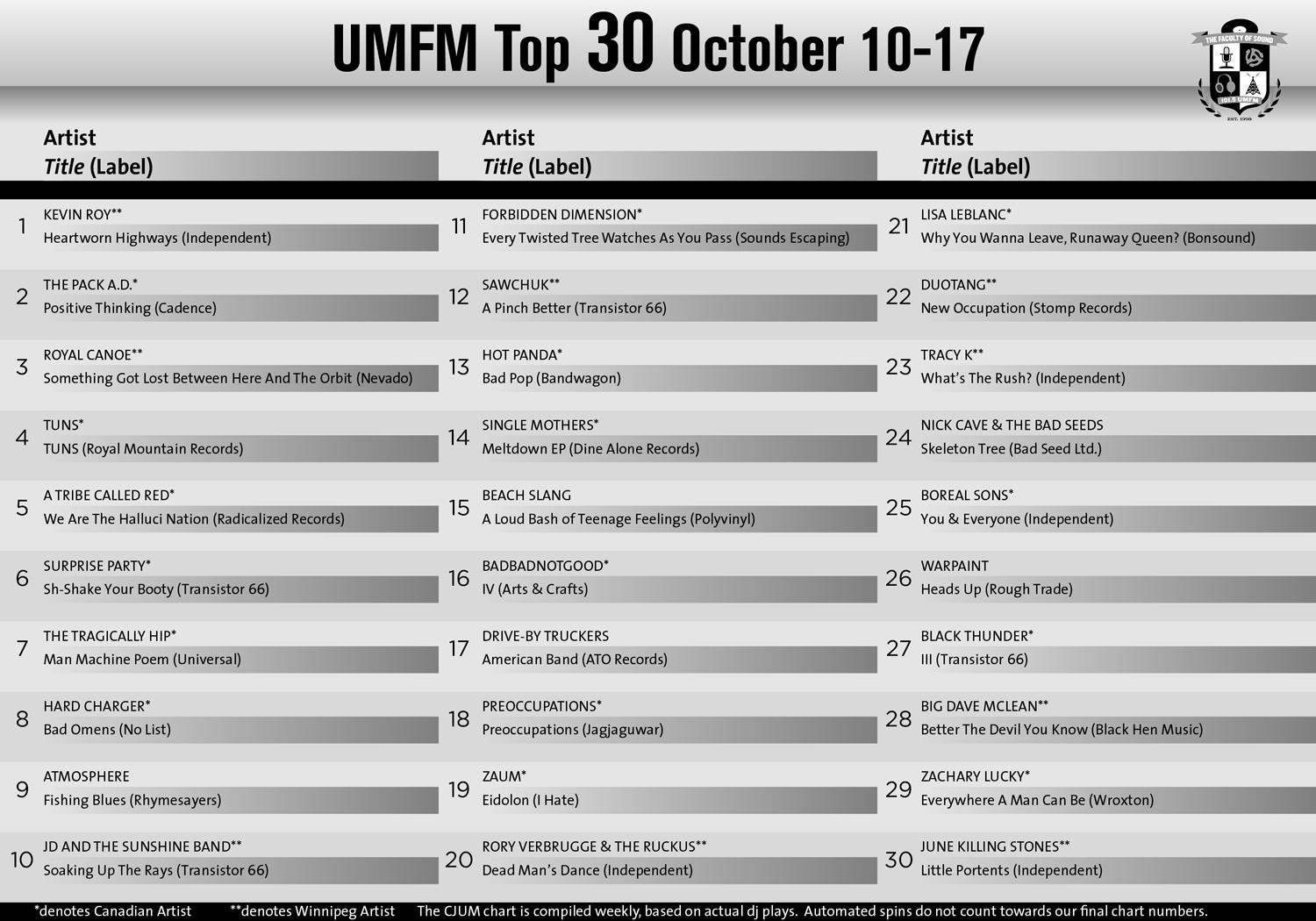
Royal CanoeSomething Got Lost Between Here and the Orbit, 5/5
'Toban turntable - want us to review your band? Email arts@ themanitoban.com today
One of Winnipeg’s favorite indie pop bands, Royal Canoe, is back on the airwaves with a well-orchestrated collection of songs and instrumentations. Each song on their latest album, Something Got Lost Between Here and the Orbit, is finely tuned buttends to twist and turn into brilliant experimental mayhem.
The modern gospel twist in “Walk on the Water” blends well with the lyrics and harmonies to give off a traditional-sounding southern gospel tune with an atypical synthy flair. It is quickly followed by “Living a Lie,” which opens with an organ that lines it up well with its predecessor and makes it evident that the album was inspired by classical R&B music.
“Living a Lie” serves as a welcome
throwback to early 2000’s R&B with a timely touch of soft rock.
One of the most interesting songs of the bunch, “Checkmate,” has a irregular time signature filled with disco-like chorus and bookended with a symphony of warped musical shrieks and what sounds like a bang or clink from every glass, plate, and piece of cutlery in the kitchen. This song’s Bee Geessounding vocals make it stand out as extremely unique.
The last song on the album, “BB Gun,” opens in a similar fashion as “Walk on the Water” and has components of some of the other songs mixed in, most evidently the eerie sounds that can be heard in “Checkmate.” This goes to show how well-coordinated the album’s set list is. “BB Gun” carries violin tunes with grace, alongside trumpet and beluga whale field recordings (yes, you read that right) and closes with the same riff the album starts with.
Something Got Lost Between Here and the Orbit is so beautifully done and thoughtful. It absolutely needs to be listened to from the beginning to end to be truly felt and enjoyed.
o livia m i C halCZU k, staff
o livia m i C halCZU k, staff
photo provided by royal canoe
photo provided by canadian festival of spoken word
Bisons remain undefeated in women’s hockey
Manitoba sweeps weekend series against the Mount Royal Cougars
ja S on P Cha jek, staff
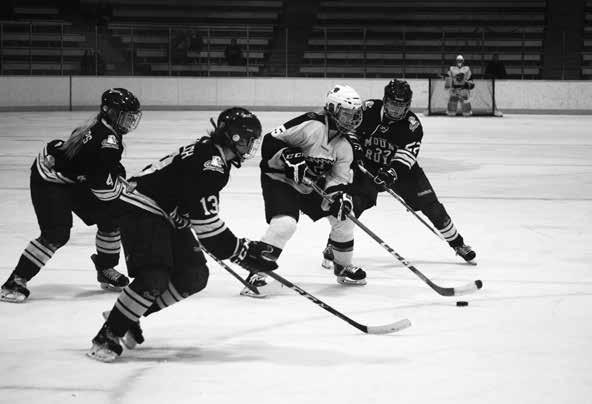
This weekend, the University of Manitoba Bisons women’s hockey team played a two game series against the Mount Royal Cougars. The Bisons maintained their perfect record through four games with a 2-0 win on Friday and a 2-1 win on Saturday.
Friday
In game one of their weekend road trip, the Bisons spoiled the home
opener of the Mount Royal Cougars in Calgary with a 2-0 win.
The game was a back and forth defensive battle, which finally gave way 27 seconds into the third, after Mount Royal’s Jordan Finnie took a hooking penalty in the final moments of the second period. Lauryn Keen notched her second of the season on the ensuing power play, with the assist from Venla Hovi.
The lead was extended three min-
utes later when Keen and Hovi came together again, this time with help from Cailtin Fyten, to give the Bisons a 2-0 lead and Keen her third goal of the season. Hovi was able to push the puck through a crowd, where Keen was waiting to put it in the back of the net.
Cougars’ netminder Emma Pincott managed to keep her team within striking distance, making two cross-crease saves to keep the
Bisons’ lead at two. But it wasn’t enough, as Bison goaltender Rachel Dyck stopped all 20 shots she faced to help her team secure the shutout win.
Saturday
The Bisons continued their winning ways in the second game of the back-to-back, taking the weekend series with a 2-1 win over Mount Royal.
The Cougars got on the board first, with Erin McLean scoring less than two minutes into the second period. McLean pounced on an opportunity, snagging a loose puck and firing a wrist shot over the shoulder of a screened Amanda Schubert.
The Bisons evened it up before the second frame was done. Keen notched her third of the weekend and
Bisons women’s hockey team introduces new team captain, three new assistants
ryan Stelter, staff
T
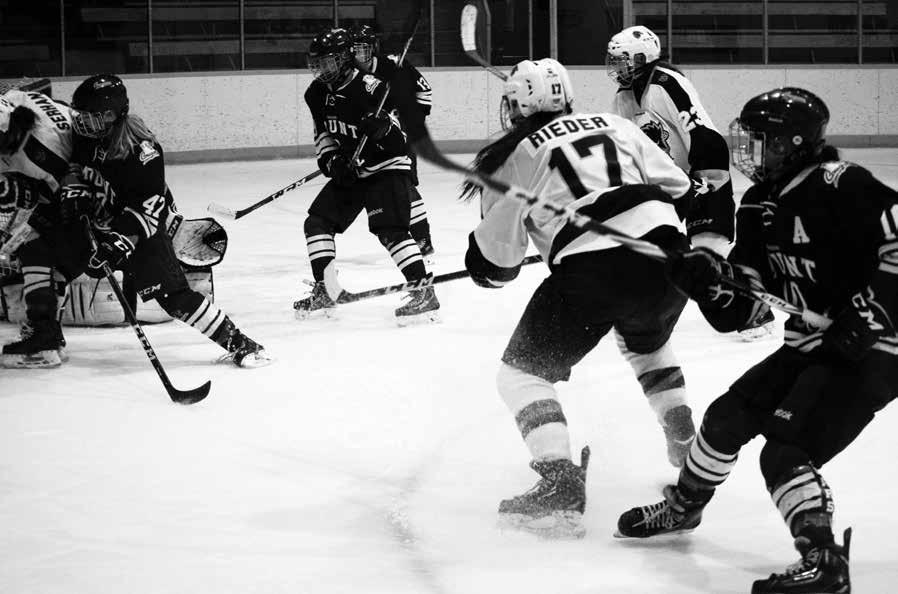
he Bisons women’s hockey team will have a new leader this year, with defenseman Caitlin Fyten being introduced as the new captain. Defenseman Erica Rieder will be an assistant captain, with forwards Alana Serhan and Alanna Sharman rotating as assistants for home and away games.
Fyten, the fourth year rearguard, served as an assistant last year and is humbled to be named the captain and is excited for the season ahead.
“I am very honoured,” she said. “We have a great group of girls here and to step up and lead the team is great.”
With four years of CIS hockey under her belt, Fyten is experienced and will be able to draw on that during her captaincy.
“[My time here] has been really good,” she said. “The Canada West is really close – you never know who is going to beat who on any given night.”
For the past two seasons, the Bisons have made it to the Canada West conference finals, but have had their hearts broken both times. Fyten is hoping to lead the herd back to the big dance this season.
“I think we can do really great things this season,” she said. “I am really looking forward to see how far we can go.”
Along with Fyten, the Bisons will have a returning leader in Rieder, who also donned the ‘A’ for the herd last season.
and is a real energizer for the team.
fourth of the year, once again on the power play. Mount Royal goaltender Zoe DeBeauville initially stopped the shot by Keen; however, it trickled behind her and into the net, tying the game at 1-1.
The Bisons would take the lead off an Erica Rieder goal, early in the third period. The sharp angle shot sneaked through the Mount Royal goaltender. Bison goalie Shubert was credited with the assist, and the Bisons would take the game 2-1. Cougars’ goalie DeBeauville stopped 28 of 30 shots in the loss, while Shubert stopped 17 of 18 for the herd.
The now 4-0 Bisons open up their season at home on Thursday, as they take on the University of Regina Cougars at the Wayne Fleming Arena at 7 p.m.
West championship title.
“Alana is high-energy. She is very vocal,” Rempel said. “She holds people accountable and is not afraid to speak her mind.”
Twenty-year-old forward
“We have a great group of girls here and to step up and lead the team is great” –Caitlin Fyten, women’s hockey captain
Head coach Jon Rempel commented on his ability to work with Fyten in the past and commended her for her ability to communicate.
“She has a strong voice, a very firm decision maker and is well respected by her teammates,” he said. “She has great communication skills, works well with me and I am absolutely 100 per cent confident in having her as our captain.”
“She is an absolute workhorse in the gym,” Rempel said. “On the ice, she is a beast and her work ethic really carries through with the rest of the players. She doesn’t take a shift off.”
Rieder had a successful year last year, potting 11 points (5G, 6A) from the blueline last season, and is leading the Bisons defencemen in scoring with three points in four games.
Serhan will wear the ‘A’ for the first time. The 21-year-old forward is in her fourth year with the Bisons
Sharman will also wear the ‘A’ for the first time. The rookie of the year from 2014-15 is in her third year with Manitoba and is a catalyst on offense.
“She is just a highly skilled player that has accomplished a lot in a short amount of time,” Rempel said. “Super infectious with her positive attitude. She is probably one the best practice players I have ever had here.”
Looking ahead
The herd will want to be able to put together another season like the last one, with hopefully a Canada
“This group is certainly capable,” Rempel said, “The Canada West is the most competitive conference in the country. I think if we do the little things right and stay healthy we have a shot.”
The Bisons had a lengthy preseason, which included a trip to Sweden and Finland. Their regular season is already in full swing, having opened with two successful road series against the Lethbridge Pronghorns and the Mount Royal Cougars.
Manitoba plays their home opening series at the Wayne Fleming Arena against the Regina Cougars, starting on Thursday Oct. 20 with puck drop at 7 p.m.
photos by chantal zdan
Bisons get stomped by Dinos in Calgary
Manitoba fall out of Canada West playoff picture
k ellen tani GUC hi, staff
O
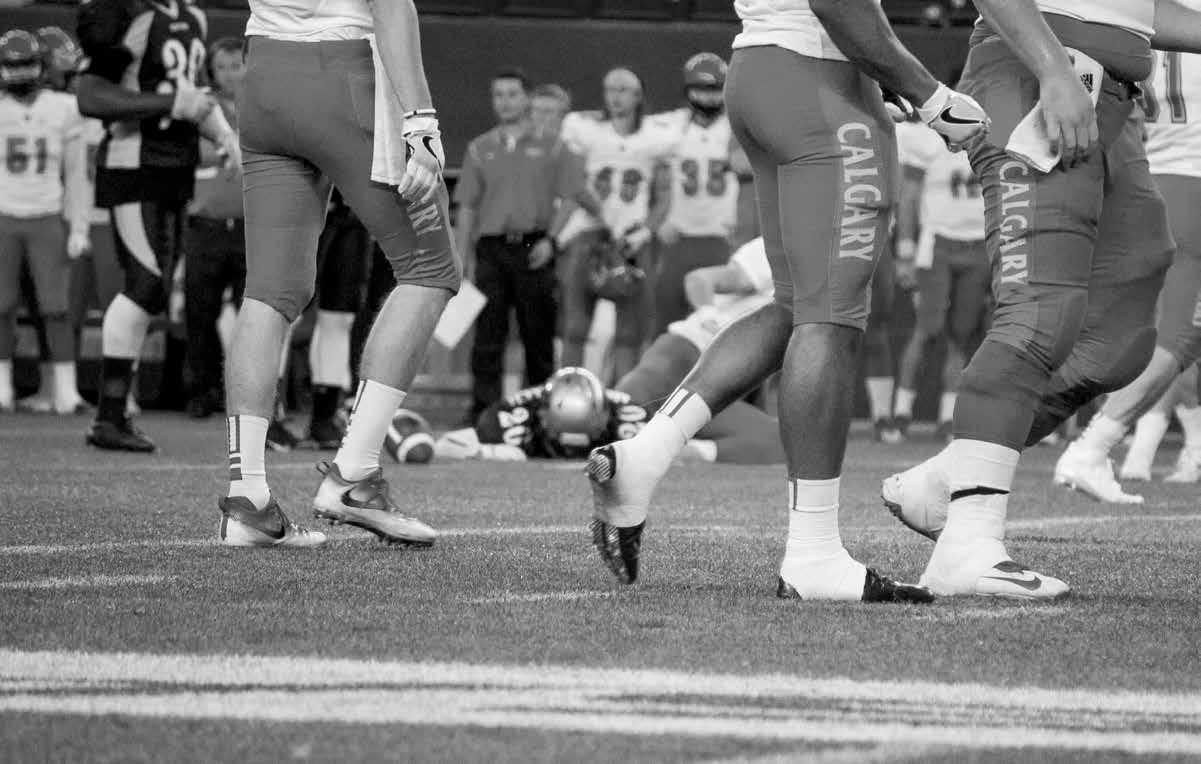
n Friday, the University of Manitoba Bisons football team was dominated by the fifth-ranked University of Calgary Dinos by a score of 63-6. The Bisons were outmatched in every aspect of the game. The Dinos, ranked as Canada West’s number one defense, held the Bisons to just 200 total offensive yards. As well, the Dinos’ offence put up 619 yards total. With the loss, the Bisons are now on the outside looking in at the Canada West playoff picture.
At the end of the first quarter, the Bisons trailed 14-3 after two costly interceptions from quarterback Theo Deezar. The Dinos offence made no mistakes as they capitalized on both turnovers, scoring one touchdown through the air and one on the ground.
After the Bisons were unable to do anything with their first possession of the second quarter, the Dinos took advantage of theirs and put up seven more points. This time, it was Dinos’ running back Jeshrun Antwi catching his second touchdown pass of the game to make it a 21-3 lead.
A few plays later, the Bisons had to punt from deep in their territory due to Deezar fumbling the ball, resulting in a 23-yard loss. Matt Riley’s punt was blocked by Robert Woodson of the Dinos, and the ball was recovered by Hunter Karl who took it to the end zone, pushing the lead to 28-3. The Bisons would add a late field goal by Brad Mikoluff to end the first half, and trailed 28-6.
In the second half, the Dinos put up 35 unanswered points – they could not be stopped. In the third quarter, Dinos’ quarterback Jimmy Underdahl went down with an injury. He did not return to the game, which led to backup quarterback Adam Sinagra taking control of the offence and
extending the already large lead.
On the defensive side of the ball, Dinos defensive back Hunter Turnbull had an interception and returned it 75 yards for a touchdown. It did not seem to matter who was on the field for the Dinos as they ran away in the second half to a 63-6 victory.
Prehistorics air attack
The Dinos were able to put up 365 passing yards. Starting quarterback Underdahl was able to throw for 207
yards and two touchdowns before exiting the game. Sinagra threw for 146 yards and another two touchdowns for the Dinos during his time on the field.
Both players looked unflappable and made big play after big play, as Underdahl averaged 18.9 yards per attempt and Sinagra averaged 24.3 yards per attempt.
Four receivers had over 30 yards on the day for Calgary, but it was receiver Austen Hartley who stole the show. Hartley caught eight passes for
180 yards and a touchdown. Hartley leads the Dinos in receiving for the season, and looked as if he could not be covered in Friday night’s game.
Ground game
The running game was just as effective as the passing game for the Dinos. Lead running back Bryce Harper had 13 carries for 135 yards and two touchdowns. He was finding holes all night, averaging 10.4 yards per carry. Running back Robert Stewart also had a good game, and
had 10 carries for 69 yards. Underdahl also scrambled when necessary, running six times for 42 yards. It was the running that he did that would lead to his unfortunate injury.
The now 2-4 Bisons will be back in action on Saturday, Oct. 22 as they travel to Edmonton to take on the Golden Bears in what will be a must-win game for the herd.
photo by chantal zdan
Bisons women’s soccer lose and draw during their weekend in Saskatchewan
ja S on P C hajek, staff
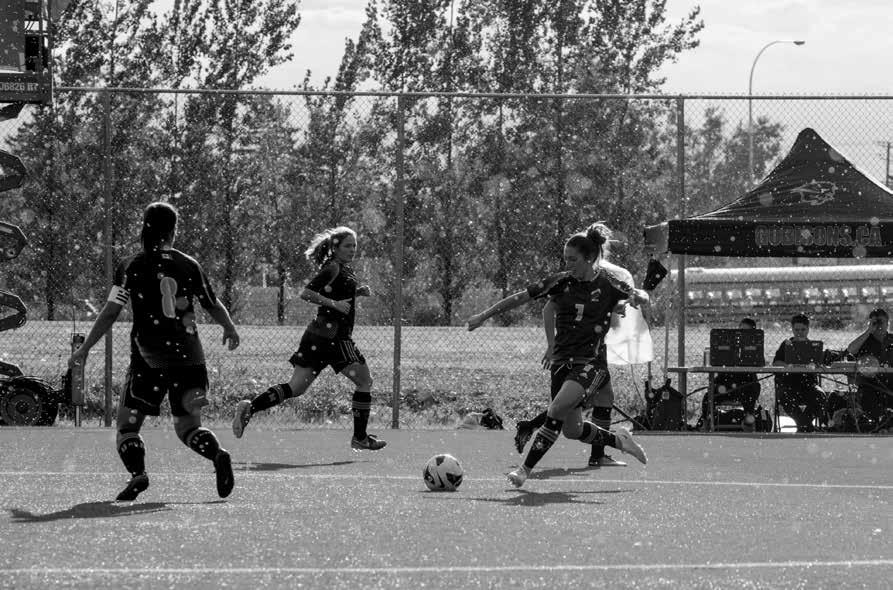
This weekend, the University of Manitoba soccer team was on the road in Saskatchewan. The Bisons opened up with a loss to the Regina Cougars 2-1 on Saturday, and played a goalless draw on Sunday against the Saskatchewan Huskies.
Saturday
Manitoba’s first stop of the weekend was at the University of Regina to take on the Cougars.
The Bisons got on the board first, with a goal in the 30th minute by Sara Schur, assisted by Bruna Mavignier. The lead lasted just 10 minutes, as the Cougars responded with a goal by Racquel Marshall, who deflected a corner by Karlee Vorrieter into the net in the 40th minute.
Vorrieter broke the tie just a minute later, with a goal set up off a rebound by forward Sydney Langen to put Regina up 2-1 at the end of the
first half. Shots were 9-5 in favour of Regina, with the on-goal total sitting at 4-2 for the Cougars.
The Bisons came out shooting in the second recording three shots –two on goal – in the first three minutes. This offensive push continued for both sides, with the goalkeepers making repeated saves for their respective teams. However, the Bisons just couldn’t break through and fell to the Cougars 2-1.
The final shot totals were 16-12 in favour of the Cougars. Manitoba goalkeeper Maddie Wilford made five saves in the loss, while Ashton Lowry made four for Regina.
Midfielder Schur of the Bisons received player of the game honours, with Manitoba’s lone goal, and Marshall of the Cougars was awarded the same honour for her side
Midfielder Schur of the Bisons received player of the game honours, with Manitoba’s lone goal, and Marshall of the Cougars was awarded the same honour for her side.
Sunday
In game two of the weekend, the Bisons were in Regina to visit the University of Saskatchewan Huskies in a foul-filled affair at Griffith Stadium.
Bison goalkeeper Wilford was busy early and often in the first half, seeing nine shots, stopping all four directed on goal. This included a
flurry starting in the 36th minute where three shots were directed towards the goal, though she was only forced to make one save. In response the Bisons took three shots in the first half, but only forced Huskies keeper Kyleigh Vause to make one save.
The Huskies were close to breaking the scoreless tie in the 60th minute, putting five shots on goal in a short period of time, including one off the crossbar. Bison keeper Wilford stood tall, making three saves.
The game ended in a scoreless draw, with shot totals favouring Saskatchewan 18-4, with on goal shots being 9-2 in favour of the Huskies. Twenty-two fouls were handed out through the game: ten to Manitoba and 12 to Saskatchewan.
The Bisons ended the weekend with a 3-6-3 record on the season, with the next two games being at home next weekend. Manitoba takes on the 5-3-4 UBC Thunderbirds on Saturday and the 5-3-3 Victoria Vikes on Sunday, both at 11 a.m. The women will be looking towards creating a gap in the standings, where they currently sit fourth, tied with the University of Regina and the University of Winnipeg.
Bombers end five-year playoff drought
Investors Group Field will see playoff action for
O
n Oct. 9, the Winnipeg Blue Bombers clinched their first playoff berth since the 2011 season. The Bombers’ win over the B.C. Lions, along with losses by Toronto and Montreal, meant that the blue and gold ended their five-year CFL playoff absence. Many things about this Blue Bombers team differ from the previous years, which is what led this team to the postseason.
Upgrade at quarterback
Matt Nichols was acquired by the Bombers last season, and saw the field quite a bit due to the injuries suffered by Drew Willy. Willy opened the
2016 season as the starting quarterback, but led the team to a dreadful 1-4 start.
After the slow start, head coach Mike O’Shea named Nichols as the week six starter, trying everything to get his team going. Nichols came in and won his first six starts, and never let go of his starting gig. The Bombers believed so much in Nichols that they traded Willy to the Argos during the season.
Nichols differs from previous quarterbacks Willy and Buck Pierce in many ways. For example, he has been able to stay healthy for the Bombers while the other two have struggled with that. Nichols also has a better arsenal of recievers to work with this year, with Weston Dressler, Clarence Denmark, and Ryan Smith backing him up.
Most importantly, Nichols has a better awareness of the happenings on the field, and is able to make the quick decisions while under pressure. Nichols has thrown for 3078 yards, 15 touchdowns, and five interceptions over the course of just 15 games. In contrast, Willy started the season by
throwing five touchdowns and four interceptions through five games. In 2014, Willy’s only full season with the team, he threw 16 interceptions in 17 games, almost averaging one pick a game.
Nichols has been able to take care of the ball more efficiently than the previous quarterbacks in Winnipeg, which is a main reason that the blue and gold are heading into the playoffs
Nichols has been able to take care of the ball more efficiently than the previous quarterbacks in Winnipeg, which is a main reason that the blue and gold are heading into the playoffs.
Improved O-line
The offensive line, led by Stanley Bryant and Sukh Chungh, has been another key to the Bombers success this season. Bryant is a CFL veteran in his seventh year, his second with the Bombers, and Chungh is in his sophomore season with the Bombers. Both men are making things happen for their team, including giving quarterback Nichols enough time in the pocket to make his throws.
Running back Andrew Harris is also benefiting from the improved offensive line, as he has run for 816 yards and four touchdowns in 13 games, and is averaging 4.7 yards per carry. This is his first season as a Bomber after five successful seasons with the Lions. Harris has brought his success from B.C. to Winnipeg, and fans love the hometown hero.
Winnipeg finally has a consistent run game in Harris, and he has the improved offensive line to thank for a lot of that.
Rested defense
The defense has been the backbone for the blue and gold for years,
and this season they have gotten better along with the offense. The scoreboard didn’t always reflect how the defense has played in the past, and with the Bombers on the losing end more often than not it was hard to see the defense playing well. The defense was on the field far too often in the previous years, with the offense unable to produce long drives – resulting in them not getting the rest they needed.
Leading the secondary for the Bombers is Maurice Leggett, who is in his third season with the team. He is tied for the league lead in interceptions at seven. With Nichols running the offence, he is able to lead the Bombers on long drives, giving the defense the rest it needs to be productive.
The wait is finally over for Bombers fans, as playoff football comes to Investors Group Field in Winnipeg on Sunday, Nov. 13.
k ellen tani GUC hi, staff
graphic by jUstin ladia
photo by MigUel yetMan
Fastest winger in the West
Soccer is Selina Speranza’s life, and she has made the most of her time with the Bisons
ryan Stelter, staff
I
f you head over to the soccer fields at the U of M when the Bisons women’s soccer team is playing –which you should, by the way – you will be able to witness the brilliance that is Selina Speranza. The five-foottwo forward is a wizard on the pitch. Whether she is dashing through opposing backlines like a hot knife through butter or dribbling past a fullback to drive in a pinpoint cross, she is a thrill to watch.
Speranza has enjoyed a lot of personal success this season, scoring five goals in 11 games and tacking on two assists. She averages 4.64 shots per game and wreaks havoc on any defense she comes up against.
“I think I have been playing better than I ever have. I guess I am in my prime,” Speranza said, laughing.
“I would have preferred to score a couple more goals in the last couple games but I think overall I have been playing well, and I think all the girls really just play for each other.”
Speranza, ever the team player, loves her Bison teammates, going so far as to say that they are her family.
“They’re almost like my first family, because we’re always together,” she said.
In particular, an on-field relationship between Speranza and midfielder Amanda Wong has become a deadly one, as both seem to be in on each other’s goals.
“We trained together in the off season. We just look for each other,” she said. “We know each other’s runs and what’s expected of our positions. Me and Mandy go way back – we have a lot of fun together.”
Speranza’s time with the Bisons is quickly coming to an end, however, as she is in her fifth and final year playing with the herd.
“It’s been my life – everything revolves around soccer,” she said. “It’s probably more than a full time job but I absolutely love it, it’s my life.”
Life after the herd is something
that is becoming real for Speranza and she plans on finishing her bachelor’s degree in psychology but still has soccer on the brain.
“I don’t know about soccer, it’s hard to say,” she said. “I’d love to try out for some teams, but I kind of need to make some money.”
Some of her favourite moments with the Bisons have been emotional ones. Speranza points to every time the Bisons scored a last minute goal as some of the best memories she’s had.
“Those last minute goals really bring us together, they’re pretty emotional,” she said. “That’s been my favourite part, when we pull together as a team and get a late goal.”
Speranza has been a part of two Duckworth Challenges held at Investors Group Field and it has been a great experience for her and the Bisons.
“It was honestly so exciting for us as a team to play at a former World Cup venue,” she said. “We are all pretty
pumped up. It’s probably the biggest game of the season for us.”
Before the Duckworth Challenge, the Bisons each gave a rose to someone who has inspired them not only in soccer, but also in life. This year, Speranza gave her rose to her brother.
“This year I gave it to my brother because he’s gone through a lot,” she said. “We’ve helped each other out the past couple years. He’s always been there for me, especially with soccer.”
There is still a season to be played however, and with two games left,
Speranza is optimistic that the Bisons can host a playoff game.
“I definitely think we will make the first round of the playoffs and then we’ll go from there,” she said. “We have a strong team; we just have to finish the chances that we make for ourselves.”
The Bisons wrap up their regular season this weekend, and whether or not the Bisons make the playoffs, teams in Canada West will breathe a sigh of relief when Speranza walks off the field for the last time at the CIS level.
photo by chantal zdan
Bisons get swept by Cougars in men’s hockey
Manitoba opens up season at home scoring a combined two goals
ryan Stelter, staff
This weekend, the University of Manitoba Bisons men’s hockey team played a two game series against the Mount Royal Cougars. The Cougars took a close game on Friday night by a score of 3-1 and dominated on Saturday afternoon with a massive 5-1 win.
The Bisons are now 0-2 on the year, despite a successful pre-season. Bisons head coach Mike Sirant was disappointed with the way this season started for the herd.
“It’s not the way we wanted to start the season, that’s for sure,” he said after Saturday’s loss. “Preseason and regular season is a whole different ball game, as we discovered.”
Friday
Coming into Friday night’s game, the Bisons had not won a home opener since the 2009-10 season. It started out well for the herd, as they struck first with Justin Augert scoring just five minutes into the opening
frame. Taking advantage of a miscommunication between Cougar defenders, he rushed in alone to put the home team up 1-0.
Power plays turned out to be the Achilles heel for the Bisons, as they found themselves shorthanded seven times in the game. The Cougars managed to get the tying goal on one of their man-advantages in the second period through Connor Rankin.
The second period was riddled with penalties, as both sides took some undisciplined penalties.
Mount Royal jumped ahead late in the third period, again on the power play, off the stick of defenseman Jesse Lees. The Cougars put the icing on the cake with an empty net goal from Cam Maclise in the final minute of regulation.
Sirant talked postgame about the penalties that ended up costing the Bisons the game.
“We took way too many penalties,” he said. “It’s uncharacteristic of us –
we’re a team that plays hard without taking too many penalties.”
The game was close all the way through, and the Bisons managed to generate many chances. Both teams were laying the body early and often.
“We did create some good offence,” Sirant said. “We created some really good scoring chances. We just have to find a way to put the puck in the net.”
Saturday
The Bisons were looking to rebound from Friday’s disappointing loss. The game got off to a lackluster start as both teams looked a bit tired after Friday night’s physical affair. Both teams struggled to get pucks out of their own end, with lots of bouncing pucks and miscued passes.
The Bisons found the back of the net first at the halfway mark of the first period. Remi Laurencelle finished a beautiful feed from Shaq Merasty on the rush.
The Cougars applied some furious
pressure and were rewarded minutes later after they worked a great cycle in the corner that ended with six-footfour forward Bill Marshall burying the puck past Bison goalie Justin Paulic. They added to their lead after Rankin made a dazzling rush into the Bisons’ zone, getting past defenseman Garret Johnston with ease. He then cut across the crease, dragging Paulic with him and, showing great patience, finished top shelf on the sprawling Bison goalie.
It would get worse for the home team, as the Cougars would make it 3-1 late in the first after a 2-on-1 was broken up, and the puck was stuffed in by rookie forward Jamal Watson.
The second period saw a rise in physicality, with Nick Zajac throwing his body around for the Bisons, generating some big hits. Rankin would score his second of the game two minutes into the period after picking up a loose puck at the half wall and taking it to the net, firing
low-blocker side on Paulic.
In the third period, the Cougars would continue to keep their foot on the gas and apply their relentless forecheck. Watson got his second of the night 12 minutes into the third period to put the final nail in the Bisons’ coffin.
“That’s Mount Royal, they work very, very hard,” Sirant said post game. “They don’t take shifts off and they gave our defensemen a lot of trouble.”
The Bisons head out on the road to play the Regina Cougars in a two game series on Oct. 21-22.