More than 60 campuses across Canada have banned smoking on school grounds
TY BRASS, STAFF
The
U of M Fort Garry campus is looking at going smoke free.
The announcement comes after a Sept. 13 report from the Canadian Cancer Society, which showed there are 65 “100 per cent smoke-free” campuses in Canada. That number is up from 30 campuses in 2017, and four in 2007.
The report shows a growing number of Canadian campuses are banning smoking completely both indoors and outdoors and encourages more universities to follow suit.
2006.
The University of Winnipeg implemented a smoke-free policy in 2008, which was updated in 2015 to include vaping and e-cigarettes.
U of M spokesperson John Danakas said a ban is not necessarily being considered. Rather, the univer-
in the coming years.”
Other universities have opted to create designated smoking areas instead of banning smoking outright.
The Fort Garry campus spans nearly three square kilometres. If a student has back-to-back classes, they may have only 10 to 15 minutes to travel from one class to the next.
“I believe if there were regulated smoking areas it would be better than banning it across the entire campus” — Erin Minor
Any smoking restrictions would reportedly not include Investors Group Field events.
U of M Fort Garry campus policy does not allow smoking of any kind either indoors or within eight metres of any buildings, but otherwise students are free to smoke on campus grounds.
The U of M’s Bannatyne campus has been completely smoke free since
sity, following the language used by the Canadian Cancer Society, is considering ways of “creating a smokefree campus.”
Danakas said the conversation is still in the early stages and would not give specifics about what the transition would look like.
While there is no timeline in place, Danakas said “the conversation will include all relevant groups on campus, and with the appropriate support something could happen next year or
That may not be time for a cigarette if they have to leave campus to do so.
Erin Minor, a student and smoker, said that while she did not support a campus-wide ban, designated smoking areas would benefit students.
“I would say I’m against it, just because I know several smokers — especially [considering that] I’m in the fine arts department and there are many smokers among us here," Minor said.
“I believe if there were regulated smoking areas it would be better than banning it across the entire campus.”
U of M instructor calls for president’s resignation
Inaugural Indigenous Scholars Speaker Series event targets campus racism
MALAK ABAS, STAFF
A U of M instructor is advocating for a total overhaul of the university’s faculty and administration — starting at the top.
Barry Lavallee, who teaches in the university’s college of medicine, called for the removal of U of M president David Barnard during a lecture hosted by the university last Thursday.
“I suggest that — I’ll give it six months — that the current president of the University of Manitoba be removed from his seat, nicely, and we put in an Indigenous female in that position, full stop,” he said.
In an interview, Lavallee said a half dozen students have recently came forward to him concerning racism on campus.
The lecture was the first in the Indigenous Scholars Speakers Series, which will run every second Thursday during the fall term.
The lectures will examine
Indigenous issues within academia and feature Indigenous academics from the U of M. Lavallee, a family physician who specializes in Indigenous health and northern practice, discussed in his lecture how Indigenous people navigate the public health system in Canada, before shifting to what he said he believes the university has to undergo to fully represent its Indigenous community.
There are currently 46 Indigenous faculty members, including library service employees, listed on the U of M’s Indigenous Connect website.
A spokesperson for the U of M said a campaign is launching next
be tuition free, in hopes of creating the groundwork for generations-long increased accessibility to jobs and further education.
“This institution will always reproduce itself with the status of white men being at the pinnacle” — Barry Lavallee
“This institution will always reproduce itself with the status of white men being at the pinnacle,” he said.
He recommended administrative staff be shifted to be 70 per cent Indigenous people, to “account for the inequities that are maintained, and the inequities that stem from historical violence and trauma.”
month to “obtain good data” on the level of Indigenous staffing by encouraging non-academic staff to self-declare.
He added that more than 50 per cent of “non-academic management staff” are female.
At a student level, Lavallee also called for the first degree of “Indigenous people who have been impacted by racialized violence” to
Lavallee also referenced the sexual violence and inappropriate behaviour by professors toward students that has surrounded the university in recent months.
“We have to believe our students and believe our faculty. I know it’s difficult, because we don’t even believe women at this university,” he said.
“They’re experiences of oppression. We shy away from it. We hide from it.”
Lavallee criticized the university’s process of reporting and supporting victims of racialized violence, saying there is “no pathway to support Indigenous and racialized people.”
“There are horrendous things that go on,” he said.
“Horrendous little bits and pieces of racial microaggressions that happen on a daily basis. And we have that experience at the school of medicine, with a number of our students coming forward and complaining about the racism that occurs. And the biggest thing is for us to believe them.”
Lavallee went into depth on the “normalization” of racism against Indigenous students on campus and advocated for a zero-tolerance response from U of M administration.
“You should be fired,” Lavallee said.
“Full stop. That’s it. There’s no holding hands, there’s no singing Kumbaya on this action. This action of racism has terminal force on our communities, and we are dying every day because of racism that appears as normalized.
“We’re dying every day.”
PHOTO BY ASHA NELSON
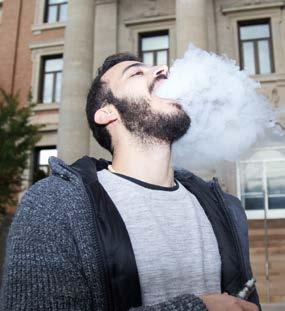
The U of M is considering taking the Fort Garry campus smoke-free.
Fight for $15 and Fairness launches in Manitoba
Demonstrators call for living wage
MALAK ABAS, STAFF
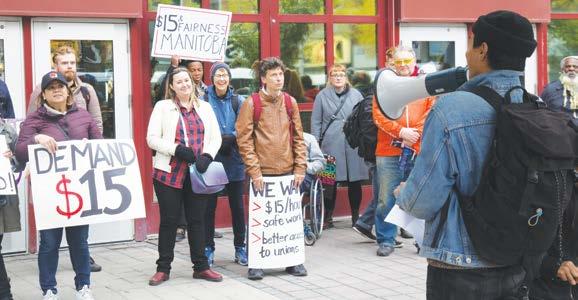
Winnipeggers gathered outside Portage Place Shopping Centre Monday to advocate for raising the minimum wage.
The Fight for $15 and Fairness Manitoba campaign kicked off with speeches and a march in downtown Winnipeg.
"If [students are] not being set up for success, this province is failing itself for its future"
— Brenden Gali, UWSA VP Internal Affairs
The campaign — which advocates for raising the minimum wage to a living wage, along with additional provisions for workers including fairer scheduling of hours and higher standards in work environments — comes at the heels of other similar campaigns across Canada and the U.S.
As of Oct. 1, the minimum wage in Manitoba will increase to $11.35 an hour from $11.15. Some argue that is still not enough.
The Canadian Centre for Policy Alternatives has calculated the living wage in Winnipeg for 2016-17, or the wage one must make to meet their basic needs, to be $14.54 an hour.
Emily Leedham, a member of the organizing committee for Fight for $15 and Fairness Manitoba, said the
campaign is about creating accessible avenues for working citizens to engage in activism.
“I will say also that we are very much inspired by the Fight for $15 and Fairness campaign in Ontario,” said Leedham.
The Ontario campaign “has been very much about community organizing, training organizers as well, people who wouldn’t normally identify as, maybe, activists, or labour organizers, to really provide people with those skills to empower them
to fight to improve their own conditions,” she said.
Brenden Gali, vice-president internal affairs of the University of Winnipeg’s Students’ Association, spoke at the gathering.
“I think we’re in a position with the government and culturally where post-secondary education is nothing like we’ve seen it before,” Gali said.
“Where things like the advanced education act that passed last year allowed for institutions to increase [tuition], so students are paying more
out of their pocket.”
Gali called the state of working students “precarious” and encouraged students to get involved with the fight for a higher minimum wage, along with other workers' issues.
“I think labour issues are directly tied to education issues,” Gali said.
“Especially when post-secondary education is a breeding ground for leaders and future workers in this province. So if they’re not being set up for success, this province is failing itself for its future.”
BY
Other speakers included community organizer Jocelyn Mallette, Winnipeg Labour Council president Basia Sokal and Susan Rodriguez, a member of Migrante Manitoba, a community organization that represents migrant workers.
Fight for $15 and Fairness Manitoba will continue its campaign with volunteer training sessions that will include an in-depth look at the history of the movement in Canada and the U.S. The first session is on Oct. 3.
UMSU developing peer-to-peer tutoring service
App will set up one-on-one tutoring sessions between students
MALAK ABAS, STAFF
The UMSU executive is making good on its promise to introduce a peer-to-peer tutoring platform for students.
The idea was introduced by the Elevate UMSU slate, which went on to sweep the executive ballot, during the 2018 UMSU general elections.
The project, which will connect students with student tutors through an online app, began to take shape in the summer.
In August, UMSU president Jakob Sanderson said there were already more than 100 tutor applicants for the program.
At the Sept. 13 UMSU board of directors meeting, it was announced UMSU hired a part-time staffer to handle the influx of applications and vet potential tutors.
It was also noted that UMSU hoped to have a base of tutors ready for “mid to late September” and would advertise the program to possible tutees then.
UMSU VP student services Carly Mastromonaco said the app will be a chance for students to get help from peers with specific classes.
“This program offers students the opportunity to connect with peers and be tutored one-onone in coursespecific topics,” Mastromonaco said.
tance with assignments, provides support with communication skills and improving students’ grasp of the English language.
According to the Aug. 30 UMSU
an hour.
The ALC tutoring service is supported through fees students remit along with tuition.
Mastromonaco said the UMSU peer tutoring service can be considered a different service from the ALC because of its course-specific options.
“This program offers students the opportunity to connect with peers and be tutored oneon-one in course-specific topics” — Carly Mastromonaco, UMSU VP student services
The university offers a studentcentric tutoring program through he Academic Learning Centre (ALC). Located in the Tier building, the centre is a free service that offers peer writing tutors, peer study skill coaches, online tutoring, writing workshops and more.
The ALC also provides resources for English as an additional language (EAL) students, including an EAL instructor who, along with assis-
board of governor meeting agenda, peer tutors hired through the UMSU program “may earn up to $15/hour” when approved.
Tutors can request a maximum of $15 an hour for their services, which will then be paid by the student through the app.
The ALC writing tutor position and the ALC content/study skills tutor position both remunerate $17
“While providing some coursespecific tutoring options to students, the ALC focuses heavily on general academic writing and studying skills,” Mastromonaco said.
“This program provides heightened accessibility to course-specific tutors, the program helps to facilitate the efficacy of connecting a tutee to a tutor and will hopefully address the overwhelming volume of students looking for course-specific help on
campus.”
The ALC is not the only other tutoring resource available to U of M students.
Many faculties have their own separate systems, including a tutor registry set up by the faculty of engineering, and help centres for math, physics and computer science.
The UMSU tutoring program will operate through the Nimbus tutoring mobile app, which will, according to a Facebook post published by UMSU, allow students to “match with interested tutees, set up meetings and communication and control payment in app.”
When asked about the overall cost of setting up the app, the vetting process of hiring tutors and other fees, Mastromonaco said there were “no numbers available.”
Tutors will also have the opportunity to receive a letter of reference for their services.
PHOTO
ASHA NELSON
Demonstrators gather downtown Winnipeg to kick off the Fight for $15 and Fairness campaign.