A “volunteer staff” member is defined as a person who has had three volunteer articles, photographs, or pieces of art of reasonable length and/or substance published in three different issues of the current publishing year of the Manitoban. Any individual who qualifies must be voted in by a majority vote at a Manitoban staff meeting. Elected representatives and non-students may be excluded from holding votes as volunteer staff members in accordance with the Manitoban Constitution. The Manitoban is the official student newspaper of the University of Manitoba. It is published monthly during the summer and each week of regular classes during the academic year by the Manitoban Newspaper Publications Corporation.
Investigation into former professor's alleged harassment criticized
Process tailored to protect university, not those affected: students
g arett Williams, staff
Students close to a U of M investigation into the conduct of a former professor in the Desautels faculty of music are criticizing the process, saying it was tailored more toward protecting the university than students.
As reported by the CBC in a series of stories beginning last week, two separate university investigations into the actions of Steve Kirby, the once-l auded head of the U of M jazz program, concluded that Kirby's conduct constituted "sexual harassment" and would have created an "intimidating, humiliating or offensive work or learning environment" for female students.
It was reported that K irby was on leave for six months before retiring from the U of M in June and later taking a job at Berklee College of Music in Boston. He has since been placed on leave at that school while it conducts its own investigation. Further reports claim the U of M was approached with complaints against Kirby as far back as 2012.
Kieran Labossière, senior stick of the Faculty of Music Students’ Association (FMSA) between 20152017, said a number of women in the program approached him in the 2016 fall term with complaints regarding Kirby. He said students met with the university administration looking for information regarding the options available to them, saying some feared repercussions if their names were attached to a complaint. He said Kirby is well-known and active not only within the Winnipeg music community but abroad, and students worried having their names included in an investigation would hurt their professional and academic careers.
Days later, Labossière said the students learned that an official investigation had been opened without their direct consent, which he said took away their agency to pursue the complaint on their own terms.
“It is clearly necessary that some action be taken,” he said, “but it was taken out of the hands of the students affected as to what action would be taken, and on what terms.”
“It seemed like the university was initiating this investigation less on the behalf of students, or protecting students, and more on behalf of protecting itself,” he said.
“Because if it was sincerely interested in defending students, it would have consulted with students before and had obtained at least some form of consent, or had made students aware of the fact that the university was going to pursue an investigation process.”
University of Manitoba executive director of public affairs John Danakas said in an email that the university will initiate its own investigation if “matters come to light that are serious in nature, and are of
sufficient importance to warrant an investigation,” noting that participation is voluntary and a person cannot be compelled to be a witness.
“The first and foremost priority for the university is the safety of its community, and particularly students,” he said. “Moving quickly to initiate an investigation demonstrates the seriousness with which the university deals with any issues that potentially pose a threat to the safety of students.”
A recent graduate of the music faculty’s classical program - who testified in the investigation and requested anonymity - said she learned Kirby’s behaviour was well-known within the jazz department after sharing her own experiences with other students.
“The first and foremost priority for the university is the safety of its community, and particularly students” – John Danakas, U of M executive directer of public affairs
While her own interactions with the professor - which included offcolour comments of a sexual nature that she said she would not label as sexual harassment - were limited, she said that “Everyone just knew. They were like, ‘Oh yeah, that’s Steve.’”
“For so many years we were like, ‘There’s nothing we can do. We’re not going to bring it up with the dean because he’s just not going to do anything about it,’” she said.
“The way the faculty of music dealt with the whole thing, they didn’t exactly deal with it in a way that supported the women,” she added. “It dealt with it in a way that was super hush-hush.”
She said her own experiences with Kirby occurred years ago and included remarks about her appearance, both in his office and at offcampus improv jazz sessions the faculty is regularily involved with at a local venue.
“The only time he ever acknowledged me is when he was saying objectifying comments towards my physical appearance,” she said.
“Otherwise, he would act like he didn’t know me because I was in the classical [program].”
Other reports of Kirby’s actions toward students involve inappropriate touching, including hugging.
The recent grad said learning Kirby was back at work at another university was incredibly upsetting and frustrating.
“Steve Kirby almost got off scotfree until the last week-and-a-half,
two-weeks, when all this press came up,” she said.
“He almost just left as if ‘Oh, he just retired and got a job at Berklee and everything’s fine.’ And that’s not OK.”
Labossière also said he was upset to learn not only that Kirby had quietly moved on from the U of M, but that there was no report to the university community on the findings of the investigation.
“I think that every single student in the faculty of music - and the university - should absolutely have had a right to know the findings of that investigation and every student should have been made aware of what had happened,” he said.
The FMSA issued a response to the investigation Monday, lauding the “courageous women who came forward at great personal risk” and saying it is deeply troubled by allegations the university mishandled previous complaints and disclosures.
The association also called for more transparency from the university.
“We do feel the need to clarify that we were not given any advance notice or explanation as to when or
why professor Kirby would no longer be employed by the university,” said the release.
“Everyone just knew. They were like, ‘Oh yeah, that’s Steve.” – recent Desautels faculty of music graduate
“Students are understandably upset and are requesting information; we hope that the university will be more forthcoming, while respecting the privacy of those involved.”
Danakas said privacy legislation bars the university from commenting on an investigation or an individual’s private information, but added that the university “respects and values the thoughts and feelings of any individuals who come forward to disclose information related to behavioural issues.”
“Regardless of whether there might be differences of opinion on the effec-
tiveness of policies and procedures,” he said, “the voices of students and others who show the courage to share their concerns are taken seriously.”
In an email issued to students and faculty Friday, U of M president David Barnard said the university’s policies, revised just last year, are “responsive to the needs of the community.”
“The policies have been tested, and they work,” he wrote, adding that they will be reviewed regularly and feedback from the university community is valued.
Kirby was hired by the U of M as director of jazz studies in 2003. An internationally renowned jazz bassist, he helped recruit world-class instructors to the university.
He was also instrumental in the development of a faculty outreach initiative that connects at-risk youth in Winnipeg’s inner city with instruction from third- and fourth-year students of the jazz program, and served as editor-in-chief of Dig! magazine, a local bi-monthly jazz publication that recently shut down operations after 14 years.
photo provided by matt duboff
Taché Hall Arts Complex officially opens doors
Faculty and students celebrate the opening of a renovated Taché Hall
Valerie Nyamori
The University of Manitoba ofi-
cially opened the Taché Hall Arts Complex Thursday. The 60,000 square-foot complex is equipped with modernized features for the faculty and students.
The announcement was made to a room filled with current students, alumni, faculty members, and donors.
Edmund Dawe, dean of the Desautels faculty of music, announced the Taché Hall Arts Complex open.
Dawe expressed his excitement during the event and said “I am absolutely thrilled to declare this building officially open.”
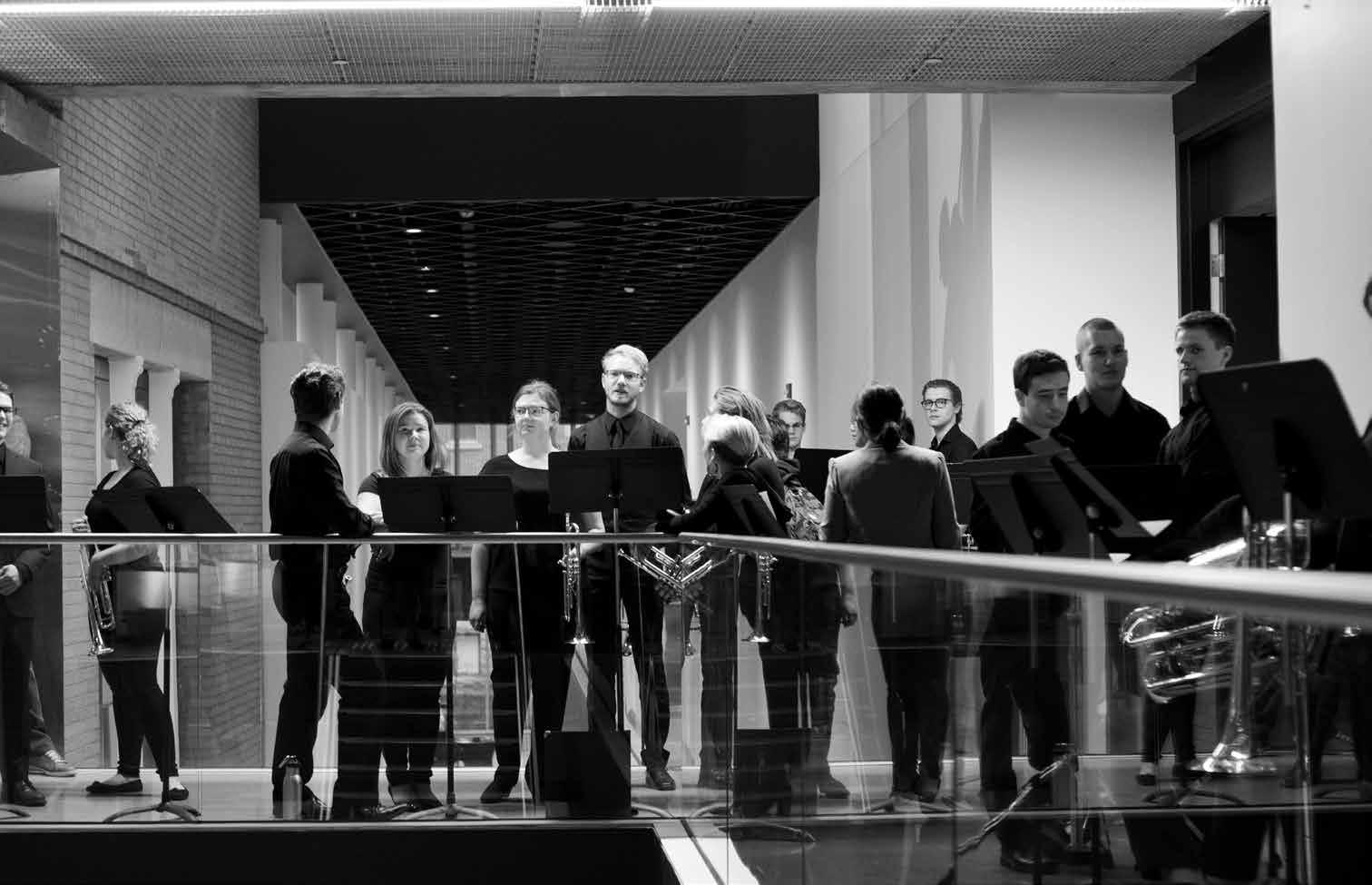
Faculty of music students took to their instruments as they played beautiful pieces composed by professor Richard Gillis from the faculty of music, celebrating a significant day in history of the U of M.
Built in 1911, Taché Hall served as a student residence until 2011.
From hosting the Canadian Armed Forces during the Second World War to being used as a filming location for Shall We Dance in 2004, Taché Hall has a rich history. In 2008, the university began a renovation plan called Project Domino, through which several his-
torically significant buildings across the campus will be retrofitted and restored.
“With the opening of yet another phase of this incredible facility and the announcement of an amazing gift to graduate students it is the beginning of a truly remarkable year.”Emma Johnson, graduate student
The first phase of Project Domino saw the completion of the ARTLab building, which opened in 2012, beside Taché Hall.
The first phase of the project also included the completion of a new music library, office space, classrooms, and practice rooms which opened in
the fall of 2015.
The grand opening celebrated the completion of the second phase of the project.
“This building that we christen this evening is part of a larger project that includes the renovation of our historic Taché Hall,” Dawe said during his speech.
“The final phase of this amazing complex will be the Desautels Concert Hall.”
The concert hall will be used as a space by students for rehearsals and performances.
“The piles are in the ground and the pre-foundation work completed, so we continue our journey with the goal of getting construction started on the hall this year,” he added.
Dawe shared his experience of coming to the university for a job interview in 2006, and discovering “a young saxophone student practicing in the men’s washroom.” Dawe said the student told him there was no other place to warm up before his class.
The building has been outfitted with many special features, including modern walls, floors, ceilings and mechanical systems geared towards isolating and buffering sounds. The
new rehearsal rooms are equipped with recording capabilities, making them flexible spaces for training musicians.
“This building is truly state of the art.”Edmund Dawe, dean, faculty of music
“This building is truly state-of-theart,” Dawe said.
Bonnie Buhler, a philanthropist who spoke at at the event, announced the establishment of a $1 million endowment fund to provide scholarships for graduate students in the faculty.
“It is my hope that when there are students trying to decide whether they can afford their courses or they need to take on a part-time job, that they don’t have to make that sacrifice.” Buhler said.
Emma Johnson, a graduate student in the faculty of music, also gave a speech at the opening event.
“With the opening of yet another phase of this incredible facility, and
the announcement of an amazing gift to graduate students, it is the beginning of a truly remarkable year,” Johnson said.
Students expressed their excitement and relief for finally moving into an all-inclusive new faculty of music complex.
“It’s kind of unreal. It’s such a luxury to have compared to what we used to have.” Elizabeth Sadler, a third-year jazz voice student said.
“It’s wonderful that we can walk just a short distance and make classes on time,” she continued.
Sadler said she now hopes to get “a more enhanced rehearsal experience.”
Paul Klassen, a third-year student said, “The sheer number of practice rooms has been a huge boon by itself.”
“It’s pretty cool,” Cam Denby, a fourth-year student, enthused.
“We’re close. We’re here. We’re not way over there so if we want to go to the library between practicing it’s not 15 minutes it’s two.”
Students of the faculty of music prepare to perform in the U of M's newly opened arts complex.
photo by asha nelson
Concerned Manitobans rally against healthcare cuts
Hundreds gather outside legislature to protest ongoing healthcare restructuring
s hade N a busaleh, staff
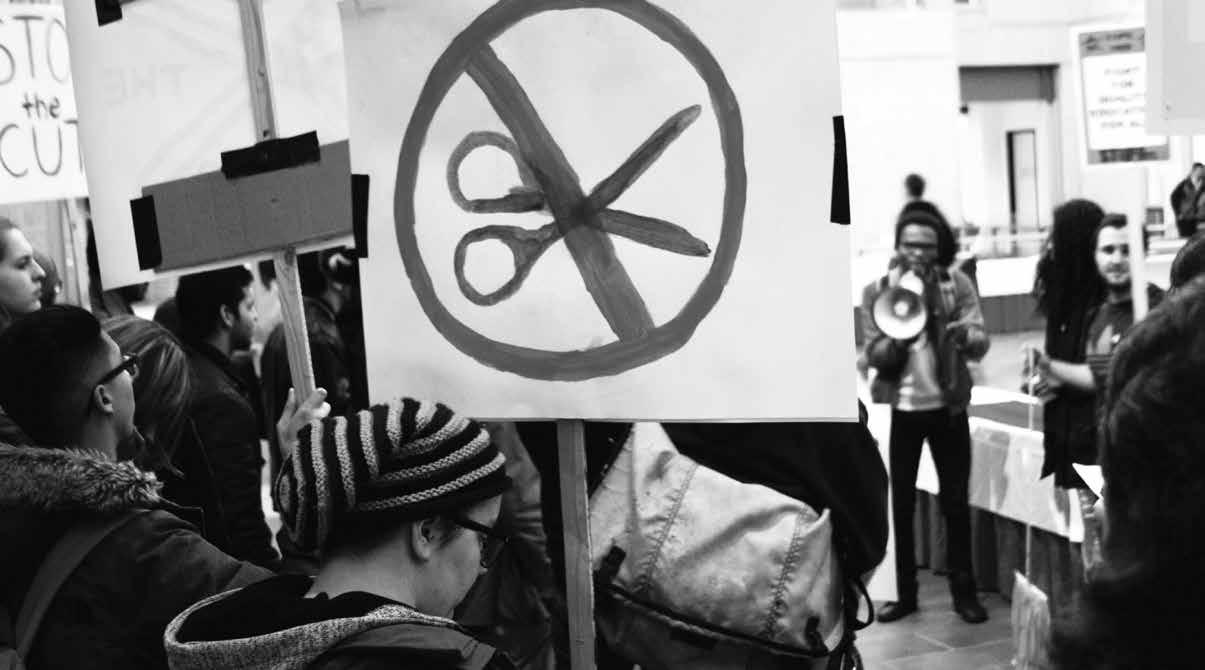
Hundreds rallied outside the Manitoba Legislative Building on Sept. 13 to protest ongoing cuts to healthcare.
The rally was organized by the Manitoba Government and General Employees’ Union (MGEU), which represents 40,000 provincial workers from different fields, including the civil service, crown corporations, universities and colleges, and healthcare facilities, who are directly employed by the province. MGEU is the largest union in Manitoba.
The rally was attended by healthcare workers, concerned Manitobans, and representatives of other unions, including the Canadian Union of Public Employees (CUPE), University of Manitoba Faculty Association (UMFA), and the Manitoba Nursing Union (MNU).
“We have had enough of our provincial government cutting healthcare services,” said Michelle Gawronsky, president of MGEU.
“We are here, asking our government to do the right thing: ‘stop the cuts,’ because care comes first.”
“A year-and-a-half ago, this premier and the health minister promised us that they would protect and invest in public services, and protect those that provide them,” she continued. “But what we’re seeing today is much different.”
Gawronsky spoke of the changes
to the healthcare system that have already been implemented, such as the loss of healthcare jobs across the city, QuickCare Clinic and emergency room closures, and said “we’re starting to see that rural Manitoba is next.”
“This is not what Manitobans voted for and it’s certainly no way to run our healthcare system,” she said to a riled-up crowd.
“This is not protecting health services that our children and our grandchildren need, or rely on. This message, ‘stop the cuts,’ [is] being sent today - and we will continue until it stops.”
Among the speakers at the rally were Elizabeth Ballermann, secretary-treasurer of the National Union of Public and General Employees and Terry Rear, MGEU’s component director of health care support services.
MNU president Sandi Mowat said she is concerned about the impact of these cuts will have on Manitobans.
“Really, it is, I believe, all about money, saving money,” she said, “And nowhere has any of this reorganization been proven to show us it’s going to improve patient care.”
Mowat noted that while nurses try to provide patient care to the best of their ability, they are being “stretched thin” by the ongoing cuts
to the provincial healthcare system, which “are impeding their ability to do good work.”
“I think the people don’t realize that there’s long-term effects of all these things, as well,” she said. “And I hope the public understands that this is not good for healthcare and that they will continue to speak up.”
“This is not what Manitobans voted for and it’s certainly no way to run our healthcare system”Michelle Gawronsky, MGEU president
Mowat spoke to the potential impact that these cuts will have on nursing students, explaining that there is a definite concern about employment and nursing placements.
The Manitoban reached out to the University of Manitoba Nursing Students’ Association for comment, but it is not taking a public position on the cuts.
Healthcare cuts - a quick overview
The provincial government has
ordered the Winnipeg Regional Health Authority (WRHA) to cut spending by $83 million for the 2017/18 fiscal year. The WRHA currently receives $2.3 billion annually to deliver healthcare.
The province’s total healthcare budget for the 2017/18 fiscal year is approximately $6.7 billion . Changes to Manitoba’s healthcare system will have a host of impacts, many of which will have long-term effects.
It was announced in April that three of Winnipeg’s six emergency rooms will be closing.
The Victoria General Hospital and Seven Oaks General Hospital ERs will be shut down and be converted to 24/7 urgent care centres. The ER at Concordia Hospital will be closed entirely. The Victoria Hospital’s emergency department will be closed by October, while those at Seven Oaks and Concordia will close sometime in 2018.
Manitoba’s only 24/7 urgent care centre at present, located at Misericordia Health Centre, will be closed and converted to a community intravenous therapy clinic by October of this year.
Four out of Winnipeg’s five QuickCare clinics will be closed, and the services they provide will be relocated to other facilities that provide primary care by January
2018. Staff and resources will be moved to existing ACCESS centres. Simultaneously, working hours at ACCESS centres will be extended.
These changes will also directly impact services for women. The Mature Women’s Centre will shut down in October, and its services will be redirected to Victoria General Hospital.
The province will also privatize adult physiotherapy and occupation therapy by transferring provision of those services from hospitals to private practitioners, forcing Manitobans to pay out of pocket for outpatient physiotherapy and occupational physiotherapy.
Changes will also be made to rural healthcare: the province will close 18 low-volume emergency medical services (EMS) stations, and will eliminate the Medical Student/Resident Financial Assistance Program - a $4.2 million program that offered incentives to medical students to set up practice in rural Manitoba communities.
Premier Brian Pallister announced last Wednesday that the provincial government is considering introducing health premiums - a form of tax that residents would pay based on income.
photo by asha nelson
MGEU president Michelle Gawronsky addresses a crowd of health care workers and concerned Manitobans gathered at the legislature Sept. 13.
Kinew chosen as new leader of Manitoba’s NDP
Rookie MLA defeats veteran Steve Ashton by a sweeping majority
i mreet Kaur, staff
Manitoba’s New Democratic Party (NDP) selected Wab Kinew as its new leader at the party’s leadership convention in Winnipeg Saturday.
The leadership race between veteran politician Steve Ashton, the former MLA for Thompson who has held various cabinet portfolios, and Kinew, a first-time MLA for Fort Rouge, saw overwhelming support thrown behind the rookie politician.
A total of 987 ballots were cast by convention delegates. Kinew beat out Ashton by a nearly three-to-one margin, collecting 728 votes to Ashton's 253.
Ashton lost his seat representing Thompson, which he held since 1981, more than a year ago when the Progressive Conservatives formed a majority government in 2016. Ashton previously unsuccessfully ran for leadership twice, in 2009 and 2015.
Both candidates spoke to convention delegates before ballots were cast.
Kinew remarked that “Somehow, friendly Manitoba ended up with a mean premier.”
He said that the policies being proposed and implemented by the premier do not reflect the values Manitobans hold dear, including
shared prosperity and affordability of public services, such as hydro and health care.
Earlier this week, Pallister suggested that Manitobans may have to pay health care premiums to control Manitoba’s rising healthcare costs.
“Somehow friendly Manitoba ended up with a mean premier.”- Wab Kinew
Kinew said “Heathcare is an act of love” and that he will repeal the cuts to health care and eliminate the healthcare premium, if implemented.
Knew said he will replace the cuts with a “four-point healthcare plan” that will include investments in “pharmacare, mental health prevention, and reinvesting in acute care.”
He also vowed to grow the economy of Manitoba through the creation of a comprehensive job plan.
“With input from students, labour, business, and community leaders, we will design a jobs plan for the next 30 years,” Kinew said, adding that the
party will develop “an education plan for the future.”
While Kinew shared his vision for the future of the party, Ashton focused his speech on highlighting the past victories of the NDP.
“We brought in Pharmacare in the 1970s,” he said. “Home care in the 1970s. Childcare - universal childcare, you know what, we’re talking about it across the country - we brought it in in the 1980s.”
Ashton vowed to fight the cuts to health care, along with raising the provincial minimum wage to $15 an hour.
On post-secondary education
Speaking to reporters after the event, Kinew promised to help students organize against tuition hikes.
University students in Manitoba will likely experience annual five per cent tuition increases if Bill-31 is passed.
“I think post-secondary education needs to be affordable, and it needs to be accessible,” he said. “So we want to work with students as they organize against the tuition hikes this fall.”
Kinew, who also served as the NDP ’s education critic promised to “continue to pursue that as opposi-
tion leader. I don't think that raising tuition rates is the right way to go.”
Kinew also noted that there are other barriers affecting access to post secondary education.
“With input from students, labour, business and community leaders, we will design a jobs plan for the next 30 years.”- Wab Kinew
“Somebody’s socio-economic standing, for instance, can often make it more difficult to get an education,” he said. “So we want to ensure that the other supports that need to be there to help young people succeed, no matter where they start off in life, are there.”
Kinew acknowledges troubled past Mohinder Saran, an independent MLA for the Maples, ordered copies
of Kinew’s court records that revealed domestic violence charges against Kinew in August. These charges were laid by an ex-partner in 2003. The charges were stayed in 2004. Saran claimed that he was working for the Ashton campaign during the time of the revelation. Ashton denies Saran’s involvement altogether.
During the convention, Kinew reassured the delegates that he is not the man he was when the charges were laid.
“I have apologized and I am sorry," he said. “But apologies are not enough, and that’s why I will continue to prove to you that I am a changed man everyday through my career in public service.”
“I will continue to be an ally for women in our province as they stand up to for their right to live free of violence, harassment, and discrimination,” he added later in his victory speech.
Plans for the party
The newly-minted leader gave a victory speech after the results were declared and said that he is “humbled” by the support he has received.
“It’s a new day for the NDP,” he said. “This is a tremendous honour.”
“I want to say that I will take this role tremendously seriously and conduct myself with the greatest honour, integrity, and honesty,” Kinew added.
He recognized that the party has work to do moving forward, including steps “to rebuild the party.”
“But I think that what you saw in the room today, many long-time New Democrats showing up and also many new members as well, new delegates, people participating in their first convention,” he said. “For us, I think that that’s a great sign that things are starting to pick up for the party,” he added.
Kinew said that as leader, he will focus his efforts on fundraising, signing up new memberships, and candidate recruitment in the coming months.
Indigenous opposition
Commenting on the message his appointment, as an Indigenous person, sends to Manitobans, Kinew said it is an example that society is changing and recognizing diversity.
"One thing that is very important to me is that as a society we are getting closer to day where everyone can reach their full potential, can contribute to their fullest,” he said.
“And that means that we’re all better off because if we can have better public servants, better business people, better community leaders coming from all walks of life, then everyone in our society is better off for that.”
photo provided by joshua bernson
Wab Kinew celebrates winning the provincial NDP leadership at the RBC Convention Centre Saturday.
Summary report reveals details of uncovered CFS bank account
More than $260,000 in unauthorized deposits and disbursements discovered, full audit withheld.
Josie Kao, the Varsity with files from shaden abusaleh, staff
In advance of the Canadian Federation of Students’ (CFS) semi-annual General Meeting in June, the organization released a forensic review summary consisting of a summary report and summary audit of a hidden bank account it operated, which was exposed in 2014. The CFS has declined to release the full forensic review.
The summary, conducted and published by accounting firm Grant Thornton LLP, revealed that a total of $263,052.80 in unauthorized deposits and $262,776.13 in unauthorized withdrawals were made between July 2010 and December 2014.
According to the forensic review summary, the deposits consisted of “funds intended for different parts of the organization.” These include payments for “services and advertising, refunds, return of retainers from law firms and payments relating to the national health plan as well as small payments for International Student ID Cards.”
There were five recipients of the unauthorized disbursements, “two of whom, are former employees of the Federation, a further individual, one law firm and a consulting company,” as the summary states.
CFS witholds audit amid bylaw questions
According to documents obtained by The Varsity, CFS National Treasurer Peyton Veitch wrote to law firm DLA Piper LLP requesting advice on whether or not to release the
full review. The firm recommended that the CFS “ decline to disclose the Forensic Review” for a number of reasons, the foremost of which had to do with a federation bylaw concerning access to information.
The bylaw in question states, “Each member of the Federation is entitled to have access to all information and official documents concerning the operations and activities of the Federation and of the National Executive.” DLA Piper concluded that “the Bylaw is not sufficient to compel disclosure of the Forensic Review.” The firm argued that the audit does not clearly constitute a document that concerns the operations and activities of the CFS.
“It is not a customary or routine document prepared in the course of the operations [...] but rather is an exceptional document prepared for a very specific purpose. As a result it is not the type of information or document reasonably contemplated for disclosure under the Bylaw,” reads the firm’s response to Veitch.
DLA Piper also advised against releasing the full report because it could possibly violate “applicable privacy legislation.”
UMSU responds
University of Manitoba Students’ Union (UMSU) president Tanjit Nagra said that learning the details of the account is “very alarming.”
“Seeing the expenses, it was literally going to benefit ex-staff and some student leaders at the time [that have
been] involved in the organization,” Nagra said.
“I think the fact that there was a hidden bank account even found, I don’t know how that’s even possible,” she added. “To me, it’s very alarming because, at the end of the day, these are student dollars.
“It ’s one thing to not spend them wisely, but for them to be literally going into the pockets of people that are trying to benefit on the backs of students is corrupt and awful” - Tanjit Nagra, UMSU president
“It ’s one thing to not spend them wisely, but for them to be literally going into the pockets of people that are trying to benefit on the backs of students is corrupt and awful.”
Nagra said that with CFS in the past, lively debates have turned into personal attacks against her.
UMSU demanded an apology from CFS in December, claiming that its members verbally harassed
Nagra. The harassment allegedly took place after UMSU brought forward a motion that would amend CFS’s policy on international students.
“I personally feel as though I have been personally attacked by this organization,” she said. “Hence why it is very tough for me as an individual to go into those settings and to try to advocate for m y students because when I do, I get shot down.”
A motion to “continue [the] current relationship with Canadian Federation of Students,” moved by Aboriginal Students’ representative Noah Wilson, was defeated at UMSU’s regular council meeting in August. A further motion moved by the St. Paul’s College Student Association representative to “hold a plebiscite on continued CFS Membership” was referred to the UMSU governance committee.
Nagra said she does not know what UMSU’s relationship with CFS will look like in the future.
“I ’m really looking for leadership from our council at this point,” she said. “I’m here to be a spokesperson for students, but I need them to tell me what to do on this one. I don’t think it’s my job to decide whether or not we’re continuing our r elationship with the CFS.”
Follow the money
The exact origin of the money in the account is unknown. However, the bulk of the CFS’ revenue comes from student fees. In the latest CFS audit, covering the period from July
2016 to June 2017, $4,032,363 of their $4,053,874.45 revenue was credited to “membership dues.”
While it does not go into specifics of the finances and those involved, the Grant Thornton summary does explain that the original purpose of the bank account was to place a “security deposit for a CFS-S subsidiary, Travel CUTS,” which is a travel agency that the CFS used to co-own. The transactions relating to the security deposit concluded on May 6, 2010. The unauthorized transactions began on July 14, 2010.
As described in the summary, former CFS executives interviewed were unaware of the account before receiving a letter from CIBC in 2014, which alerted them to its existence. All known CFS bank accounts have been Scotiabank accounts.
A source close to the matter says that, though some of those involved were fired, it seems that not all of the people responsible have faced repercussions.
Veitch was not available for a full interview on the subject but released a short statement to The Varsity, which said that the CFS “set aside a great deal of time for questions and answers” at the general meeting.
“We’re interested in moving on from this issue and focusing on the campaigns and services that make life better for students,” Veitch said.
Editor-In-Chief: Garett Williams
Contact: Editor@themanitoban.com / 474.8293
Potholes appear on the road to legalization
Laws governing cannabis shaping up to be perverse, draconian
eVa N t remblay, staff
Are you now, or have you ever been, high? If the answer is “yes,” you’re not alone. Statistics Canada estimates that 43 per cent of Canadians have tried marijuana at least once in their lifetimes, and 12 per cent have used it in the past year. Use of marijuana for therapeutic, medical, and recreational purposes is widespread in our country; a whopping seven in 10 Canadians believe it should be not be illegal to blaze.
Acting on their 2015 federal election campaign promise, the Liberals have announced that it will become legal to purchase and consume marijuana by July 1, 2018. The devil, however, is in the details: the picture that is emerging of the legal regimen of marijuana in Canada is of a deeply flawed series of rules, open to abuse by authorities.
First, consider the arbitrary nature of the regulations that will govern the growing of marijuana. Four plants per person seems reasonable, until you realize that it is actually four plants per household. Whether you live alone or in a hippie commune with 20 other people, you will face prosecution for having more than four plants. That seems odd - the purpose of cultivat-
ing plants is personal use, so why is the limit not personal? Passing from odd into the realm of draconian is a legally-enforced limit on the heights of plants - one metre, which is for a plant that can grow up to four-metres tall when left to its own devices.
We will soon live in a country where you can be arrested for letting a plant grow 10 centimetres too tall
The attitude which leads to these kinds of regulations was on full display this past week in hearings held in the House of Commons. Rick Barnum, representing the Ontario Provincial Police, said “it’s impossible” for police to be ready to enforce new marijuana legislation by July 2018. Instead, he siad police need six to eight months of extra time to prepare. Think about that for a second - six to eight months beyond the time already elapsed since legalisation
was announced, to gear up to… stop arresting people?
Set up to fail
Although the goal is to have 150 stores in operation by 2020, Ontario will only have 40 locations where residents can legally purchase marijuana on the date of legalization. Ontario had a population of 13,448,494 people in 2016; on the day of legalization, that works out to just over 300,000 people per outlet.
If that seems like a long lineup, it is worth remembering that purchasing marijuana from any other source would remain a criminal offense. Imagine having to buy alcohol from a store that served 300,000 people. Under the Liquor Control Board of Ontario, which will operate the marijuana dispensaries, there are 872 locations where Ontarians can purchase alcohol.
Other provinces - ours includedhave yet to announce whether retail sales will be private or governmentrun. The premiers, like the police, complain of not having enough time. They have had more than enough time, however, to introduce stiff new penalties for driving while high.
“Our primary concern regarding the legalization of marijuana is the health and safety of Manitobans,” quipped Brian Pallister, whose overhaul of the province’s healthcare system apparently does not see the therapeutic use of marijuana as a cost-saver.
This concern with health and safety - Pallister’s remarks came at the launch of a new Manitoba Public Insurance campaign against driving while high - is shared by police. There is such concern for our safety that it will soon be legal for police to demand a saliva sample if they suspect you of being high while driving. The chemical THC, the main psychoactive compound in marijuana, can indeed be tested for in saliva. But THC can be present in the body days after consumption, and there is no test to determine if a person is high in the moment police accuse them of being high.
The only thing more disgusting than such an unreliable test being enshrined in law is the abuses that are sure to flow from it. Have fun while driving with dreadlocks.
There are plenty of details that are open for reasonable debate, and intel-
ligent disagreements, as we seek to make legal something that has been illegal for 94 years. Rules concerning plain packaging, legal age for purchase, use in public spaces and businesses, and forms in which it can be purchased are all open questions that need answers.
Legislation is slow to change and heavy-handedly enforced once enacted. We will probably live the rest of our lives governed by a new set of laws concerning the use of marijuana that are currently being written. These laws should be just and reasonable, reflecting the position a majority of Canadians hold towards a plant that has a multitude of benefits and long history of human usage. Instead, we will soon live in a country where you can be arrested for letting a plant grow 10 centimetres too tall - and it will be thanks to the prejudices that owe more to the hysteria of Reefer Madness than anything else.
graphic
Going beyond councilling: Address UMSU’s problems with increased democracy
Student
unions need general assemblies, not autocratic executives
a N m ac d o N ald
i
In the Sept. 6 issue of the Manitoban, Levi Garber wrote a piece highlighting an important issue of student governance within the University of Manitoba Students’ Union (UMSU). The article speaks to the rather undemocratic nature of UMSU, taking issue specifically with the way UMSU’s council has been functioning. Garber points out, importantly, that decisions are not made simply by council’s five executives, but that there are 45 or so elected UMSU councillors which share “just as much culpability, for better or for worse, with the five executives ” for the functioning of the union.
Along with this, Garber highlights the social aspects of how council runs. I have no doubt that his analysis is correct when he highlights a culture of sycophants who by and large follow the whims of executives.
However, Garber’s description of problems is a far cry from a diagnosis, and there is little suggested in the way of solving these issues. We can all agree that this culture needs to change, and that councillors need to get their act together, but declarations like Garber’s will simplylike so much else - slip through the vacant tunnel between the ears of sycophantic-councillors.
We must remember why this culture exists within UMSU council. Part of the problem is that UMSU is a breeding ground for aspiring student politicians wishing to weasel their way into the big leagues of legislative and parliamentary politics, think-tanks, and NGOs.
A term which can be applied to many such students is “careerist”those who makes their decisions based on what it does for their future job prospects, rather than making decisions based on principles or the effects they may have for the student population. It is more useful for such aspiring careerists to make - perhaps unspoken - pacts, and to not rock the boat, or at least not the boat on their “side” so as to work their way up the ladder of executive titles, all with the intent of making their resumes stand out. There is an incentive, not officially, but due to careerism influencing social dynamics, to go with the flow rather than against the tide.
The implications of this improper governance has seemingly incredible repercussions to students outside this political social circle. To refer to the example used by Garber, students were generally in quite an uproar over former UMSU president Jeremiah Kopp’s complete misallocation of $14,000 in questionable spending of union funds. Council, however, was not up to the task of holding him accountable, nor to truly speak
on behalf of the politics spreading among students on campus.
Part of the problem is that UMSU is a breeding ground for aspiring student politicians wishing to weasel their way into the big leagues of legislative and parliamentary politics
Addressing the Issues
Whether it is five or 45 people, there is a serious problem with allowing the Stephen Harpers-oftomorrow make all the political decisions which affect us so greatly. While some students may think that we have control of UMSU’s political stances insofar as we vote for these representatives, there is a constant barrage of political moments arising which were not foreseen by the elections.
In other words, shit happens, and executives and councillors react to shit by making decisions which don’t actually represent the political will of students. We all too often don’t get a say.
One way of changing this sad state
of affairs is by switching to a general assembly (GA) decision-making model for our student union. Every member of the union - students filled with passion and opinions - could gather to discuss, debate, and vote on whatever motions come to the floor, to address whatever political situations they face.
These assemblies would be the highest decision-making bodies in UMSU, with the roles of executives becoming the implementation of the popular will, rather than forwarding their own agendas. While the GA model is far from perfect, and careerism would still find a way to plague such assemblies, individual students would have far more power, and the ineptitude or apathy of a council less problematic.
A GA would be a welcome model at the University of Manitoba; held once to twice a year, with perhaps special GAs when important political situations arise, could increase the cession-making power of individual students.
This model could have a great impact on current issues, like the cuts to UMSU community coordinator positions. Someone could bring a motion to the GA floor to reverse these cuts, and students - any and everyone interested - would gather to have their say. Some may persuade the assembly to vote to reverse the cuts by pointing out that they would like to ensure that dedicated members of marginalized community groups possess the resources to ensure such groups’ growth and well-being. Some
may attempt to convince the assembly to vote against the reversal by suggesting that this drop in the bucket of UMSU’s finances is too high of a cost. Regardless, more – all students – rather than less – just executives – would have a say in their union’s governance.
There is a serious problem with allowing the Harpers-of-tomorrow make all the political decisions which affect us so greatly
You may think that the GA model already exists on campus – we have semi-annual meetings referred to as a “general assembly,” where the quorum 200 students, who can pass a motion which becomes UMSU policy. Council, however, has the ability to overturn the decision of AGMs with a two-thirds vote.
What does that say for student power? No one ran on the platform of cutting or keeping coordinator positions last year. Students haven’t had a say on the issue, so how is any politician acting in students’ interest? So, say there was a political situation, like the coordinator cuts, which was not a part of anyone’s platform last year, and so wasn’t one of the reasons why students selected one representative
over another. With the GA model, this wouldn’t be an issue – students themselves would weigh in on what to do. But under the current inept structure, about 30 students, councillors, choose for the entire campus. If we remember Garber’s insights that council follows the whim of execs, then its de facto the case that five Justin Trudeau wannabees could overturn the decision of campus.
Where we’re at
Our current model of student governance is insufficient, and should be replaced by a GA model. while AGMs are still a tool to be used to try to get students back some selfgovernance. We must bring a General Assembly model to the University of Manitoba. Part of this necessitates spreading a new, more democratic political culture on campus, have an AGM meet quorum, and push for progressive motions at this AGM as a first step toward establishings GAs. Democracy is about power in the hands of the masses. While we push for a structure that better recognizes and legitimizes this, steps toward increased democracy must be taken today. We need a wide range of support and participation to work towards GAs, which will in itself be a way to grow student power. Any progressive, radical, revolutionary, or simply democratic student should reach out and get involved. And while our university largely exists as an isolated community in-and-of itself, the conclusion is a general one - all power to the people.
photo by dana hatherly
Bad speech is still free speech
University campuses must remain open to full discussion
darrell m erleau
Icertainly understand the point the author is trying to make in the Sept. 6 editorial, “The so-called free speech crisis on university campuses is a fabrication.” That is, in an attempt to legitimize their despicable message, the neo-fascist alt-right and their ilk are crying that their right to freedom of expression is being trampled in the vociferous and sometimes violent objections to their ability to disseminate their ideas in public fora, including on university campuses.
The author justifies censorship of this type in terms of a legitimate response to protect the interests of the “communities who pay the highest price for the speaker’s so-called free speech,” claiming that this is merely “the community putting limits on what speech is considered acceptable.” In this way, the author sets up the argument that the free speech crisis on campuses “is a power struggle - one to seize the means of speaking freely.”
The author is viewing this issue as a zero-sum, winner-takes-all game
where any group representing “the community” can use whatever means they choose to silence the other in defence of community standards.
When abhorrent speech and ideas are presented, it is our right - and I would say, responsibility - to speak up and rebut them with facts, logic, passion - and superior ideas.
Lost in this discussion and passion is the reality that the fundamental right to free speech is the cornerstone of democracy, and underlays all other democratic rights. Without the right to free speech, you can have no real
freedom of the press, assembly, or association. There is no point in freedom of conscience and freedom of thought if you cannot give expression to your thoughts and conscience.
Speech that expresses hate - saying I hate you, your religion, your race, and so on – is still a legally protected form of expression. What I cannot do is incite others to violence against you, or against any race or religion.
Consider the case of David Ahenakew who, in remarks to a reporter, claimed Jewish people were a “disease” that started World War II. Though a judge called his remarks concerning Jews "revolting, disgusting, and untrue," they did not constitute ”promoting hatred,” and were therefore lawful
The way to test the strength of the author’s argument that censorship is a justifiable community response is to reverse the circumstances, and see if the argument retains its validity. Suppose that neo-fascists were the majority and that minority communities were those espousing democratic
ideals. Would it then be the right of the fascists, in defence of their communities, to silence those promoting democratic ideals and attack the fundamental rights of the minority democrats? Obviously not.
The rights of minorities to speak freely in defence of their situation and ideals is critical to an effective democracy. Without it, there is tyranny of the majority, and democracy cannot survive, for a foundational principle of our democracy is the protection of minorities and their rights. Not just the protection of minorities that agree with the majority, or minorities that agree only with one another, but all minorities. Without these protections, no one is free and no one is safe; you are left with only the rights of the powerful.
Finally, this university and all universities must be a bastion of free expression. Campuses have to be fertile ground for free speech and ideas that have the capacity to change the world. But can they remain so when it is becoming harder and harder to
have a full and free discussion of ideas?
When abhorrent speech and ideas are presented, it is our right - and I would say, responsibility - to speak up and rebut them with facts, logic, passion - and superior ideas.
It is even our right to protest and shout down those that espouse ideas that are anathema to us. In fact, silencing our opponents by shouting them down and ostracizing them is far easier than standing toe-to-toe with them in the arena of ideas. And by arguing with them, we argue in defence of fundamental human rights, liberalism, and democracy.
Yes, I hate what the neo-fascists have to say, and I can’t stand the narrow-mindedness and specious rationalizations of Ann Coulter and her ilk.
But if we are to be the leaders of tomorrow, we have to start by being leaders in fighting for fundamental rights on our own campus, beginning with free speech. To do otherwise is to follow the way of the coward.
Live at the Roslyn thrives while supporting local music
Village Idiots fundraising to up production for their second season of Live at The Roslyn
o li V ia m ichalczu K , staff
Over the past year, The Village Idiots have been working hard to maintain and grow the fan base for their weekly installment of Live at the Roslyn
Every Wednesday, creators Rylie Saunders and Kevin Repay set up their living room in the infamous Roslyn Square building with Facebook Livestream and broadcast local bands for free to anyone who has access to Facebook. Last season was met with tremendous positive feedback, with over 25 episodes of Live at the Roslyn and around 25 episodes of Sunroom Sessions, a new installment that features solo acoustic acts in the sunroom of the same apartment.
The idea behind the show is simple: support local music.
“What we are doing aims to increase the exposure of these bands [and] artists and gives fans a chance to get to know our local artists better, for free and in a convenient way," said Saunders. "Why not idolize someone homegrown with just as much talent, save some money in doing so and help make the next biggest artist in the world be from Winnipeg."
“We've been huge supporters of the Winnipeg music scene for 15 years and are blown away by the talent this city has” Saunders added.
He noted that people don’t always know what local talent Winnipeg actually has and end up idolizing
bigger bands that are featured online and on the radio instead of looking in their own backyards.
“You can see local artists for free or up to $15 and can be up close to the stage and have a much better experience,” he said.
“What we are doing aims to increase the exposure of these bands/artists and gives fans a chance to get to know our local artists better, for free and in a convenient way” –Rylie Saunders , co-creator of Live at the Roslyn
Another thing to note about Live at the Roslyn is the service it provides to people with lifestyle conflicts and accessibility concerns related to viewing live music. People with children, evening and weekend jobs, fans and supporters across the world,
and people that can’t afford to regularly see live shows are all given the opportunity to see what local music has to offer.
A variety of accessibility concerns, including physical access to shows, noise levels, and concerns with large crowds are taken into consideration.
“The comfort with being able to watch from anywhere, on your own terms, is really great,” said Repay.
“There's so many reasons why people can't make it to live venues, so it's nice to be able to offer an alternative, to be inclusive."
The Village Idiots are set to air the first episode of the new season of Live at the Roslyn on Nov. 1, with applications available until Sept. 28 for bands interested in playing a live set. Over 100 bands so far have applied and the Idiots want to make the show as good as it can possibly be by upping their production level game.
“First season started with an iPhone 6, two people, and idea,” said Saunders. It “quickly transitioned to a studio set-up in our living room with seven team members and production equipment making that idea truly come to life.”
New to this season, every band performing on Live at the Roslyn will also be featured on Wheeler in the Morning for a performance and interview.
The Village Idiots are hold-
ing a fundraiser on Sept. 29 at The Pyramid Cabaret to raise money in order to pay for new equipment to create the best quality production for the upcoming season.
Thus far, the show has been entirely self-funded, and the group is hoping to produce a more impressive product to showcase local talent.
“We want to take it to the next level production-wise,” Saunders said.
The fundraiser show will feature Bullrider, Summer Dwellers, The Kindred Crows, The Xanad00ds,
Live at The Roslyn Season 2 starts on Nov.1 and airs every Wednesday at 8pm Tickets for the fundraiser are $20 each or 2 for $30 (in advance) and can be bought from The Village Idiots or online at https://gofundme.com/4c51in4
Skye Callow, Dana Kowalsky, Jamie Buckboro, and White Rhino.
photo provided by joey senft
Dinos stampede Bisons in 76-17 homecoming rout
Manitoba falls to 0-3, still looking for first win of 2017 season
m i K e s till
T
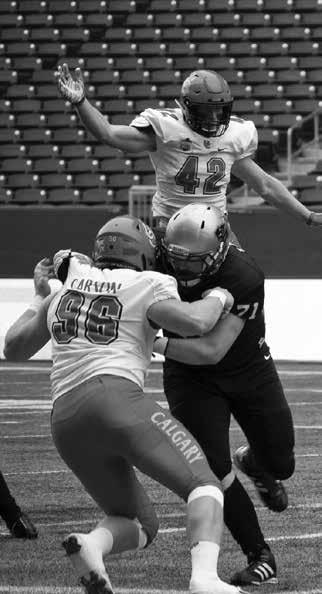
he University of Calgary Dinos spoiled the Manitoba Bisons’ homecoming festivities at Investors Group Field Saturday afternoon, handing the herd a 76-17 shellacking.
The game was essentially over by halftime, after the Dinos turned five Bison turnovers into 28 first-half points.
“They
were such a mature, disciplined, and seasoned team - and a team that knows how to win” -
Brian Dobie, Bisons head coach
The turning point in the contest occurred late in the first quarter. Manitoba had driven the field offensively, and led 3-2.
Bison defensive back Shae Weekes appeared to have intercepted Dinos quarterback Adam Sinagra on the ensuing drive. However, the play was reversed and Calgary continued on to score on the drive with a quarterback sneak. A two-point convert gave the Dinos a 10-3 lead, which they wouldn’t give up for the remainder of the game.
“That interception when we were
hot, getting that take away really, really hurt,” said Bisons head coach Brian Dobie. “That was big.”
The Dinos kept rolling on the following Manitoba drive, forcing a fumble that took a few bounces and was eventually recovered for a major by linebacker Boston Rowe.
The second quarter was the same story, as the prehistorics blocked a Manitoba punt in the opening minute and turned it into a touchdown on the next offensive drive.
Not even two minutes later, the Dinos were on the board again after another fumble recovery set them up at the Manitoba 30-yard line. It took just one play to make the score 32-3 on a 30-yard touchdown pass to receiver Michael Klukas.
Calgary rounded out the half with two more passing touchdowns - one of which was set up by a recovery on an onside kick.
“I thought we played with them physically, I didn’t think that was the issue,” Dobie said. “But they were such a mature, disciplined, and seasoned team - and a team that knows how to win.”
Dinos pivot Sinagra threw just 15 passes in the first half but he amassed 153 yards and two touchdowns, due in part to limited pressure from the Bisons front-four. Klukas was the leading receiver, with 73 yards on just two receptions.
Sinagra finished with 15 comple-
tions on 23 attempts for 263 yards.
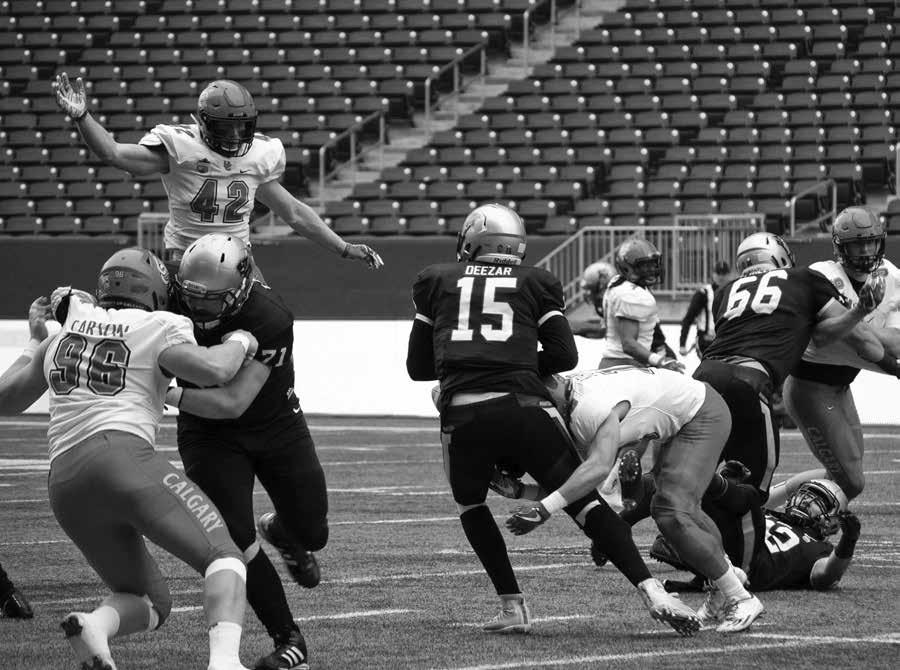
Defensively, Calgary sacked Manitoba pivot Theo Deezar four times in the first half, holding him to just 59 yards through the air.
Despite the score, Bison receiver Mathias Bockru and running back Jamel Lyles were Manitoba stand-
outs, as Bockru collected plenty of yards after the catch, and Lyles pushed for more than 150 total yards from scrimmage - 51 on the ground.
The second half was a wash, as Calgary slowly began introducing their backups into the game. Lyles kept on trucking for the Bisons, and
finished with 179 rushing yards and two touchdowns, to go with 136 combined punt and kick return yards.
The Bisons head to Regina next to play the University of Regina Rams on Saturday Sept. 23 at 3 p.m.
Mau as humble and hungry as ever in 2017
The fifth-year linebacker letting his play do the talking
B
ison middle linebacker James Mau is the type of person who lets his play do the talking.
It’s rare that you’ll find him boasting about his accomplishments as a football player, of which there are many. Perhaps the best example of Mau’s humble demeanour occurred when asking about his high school football days back in Ottawa
“I actually played on three different teams every year in high school. It was pretty intense,” he said.
“I played in the Ontario Varsity Football League summer league, and then I would play in high school and club [in the fall]. I’d have high school practice, and as soon as I was done high school practice, I’d drive over to my club team and practice there. I actually don’t know how I did it, I was just a kid at the time so I was pretty indestructible.”
With that much football in his life, it should come as no surprise that Mau was able to get a few different university offers. He eventu-
ally settled on Manitoba for the 2012 campaign, where he redshirted his first year.
“The first game I made a few mistakes, but I’m definitely improving” – James Mau, Bison linebacker
For the next four seasons, Mau made his mark on special teams as well as on defence, and was an integral part of the 2014 squad that upset Calgary to win the conference championship.
“The Hardy Cup year was really special,” Mau said. “We had a lot of characters on the team, which was pretty cool”
From 2014 to 2016, Mau lived with former teammate and current NFL
defensive lineman David Onyemata, which he said had a big impact on him both on and off the football field.
“His work ethic was pretty crazy. He was the first guy up in the morning, and the last guy to fall asleep,” Mau said. “He was just always working, so that carried on to me.”
Mau said he worked harder than ever this summer in particular, knowing that there were two open linebacker spots available for the 2017 campaign. His dedication paid off, as he earned the starting middle linebacker spot.
“I walked into training camp with a lot of confidence, just knowing that I knew the playbook better than anybody else did because I’m a fifth-year guy,” Mau said. “I really worked hard this offseason, on and off the field and dedicated a lot of time to football.”
While the team hasn’t gotten off to the start it wanted – the Bisons are 0-3 – Mau has shone individually. His 19 tackles leads the team and is ranked third overall in the conference.
He has also collected two fumble recoveries and a sack.
Mau remains humble when talking about his early season success, focusing not on what he has done well so far, but on what he hopes to improve upon.
“At some points, I wasn’t as aggressive as I wanted to be, but there were other points where I was overly aggressive,” he said. “The first game I made a few mistakes, but I’m definitely improving.”
photo by chantelle zdan
photo by chantelle zdan
Bison quarterback Theo Deezar is sacked by a Calgary defender
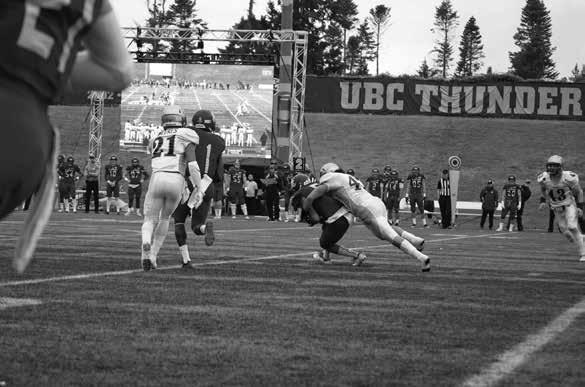
James Mau makes a tackle against UBC
Back on the green and running
Bison women’s golf coach discusses early success of program
Jaso N Pcha J e K
The Bison women’s golf team was back in business this summer, the first year of operation since 2011.
While most students were enjoying the summer months, or catching up on credits, the Bisons golfers were hitting the links. Women’s golf coach Bri-ann Tokariwski said she is proud of the group’s development.
“I think the group of women that are in this program are extremely dedicated to the sport and to the team,” she said. “They are constantly helping each other improve and are always striving to better themselves in the sport.”
Tokariwski was positive about the future of the program, and its role in growing the women’s game.
“With the dedication of these players, as well as their willingness to learn and improve, I believe this program will succeed and thrive,” she said. “These girls are now role models in the community and give the younger girls something to strive for in terms of being a part of the team.”
Tokariwski did not hesitate to highlight contributions and strong showings by all the players.
“I know this is going to sound corny but each of them has had a standout moment since we started,” she said. “Brynn [Todd] won her first tournament as a Bison and was named U of M women’s Bison of the Week.”
Todd took first place at the UJ
Fall Kick Off shooting six over in what was the first tournament for the women’s team since 2011. She was joined in her strong finish by fellow Bisons Marissa Naylor, who took second with a +9, Tianna Slate at 11th with a +18, and Kathlyn Santiano in 17th with a +26, giving the Bisons a second-place finish overall.
“Marissa placed second in her first tournament and tied low Bisons in many of the tournaments we have played, as well as started to hit high shots around the green that she was not comfortable with,” Tokariwski continued.
One of the most recent results, a second-place finish by the Bisons at the Concordia Fall Invitational
tournament, saw strong individual finishes by the five women’s golfers. Naylor and Veronica Vestesnik placed sixth in the field at +19.
That same weekend, the Bisons took part in the Tracey Lane Memorial, held at Bemidji Town & Country Club in Bemidji, Minn. Vestesnik was the top performer for the group, placing 17th with a +20, followed by Naylor at +21, Todd at +23, and Lexie Kopp at +39. The Bisons placed 7th.
Vestesnik’s performance showed she can remain calm under pressure, according to Tokariwski. Slate also reached a milestone of her own during the back-to-back tournaments.
“Veronica has tied with Marissa
and played with grace after her driver broke with five holes left to play in the last tournament,” she said. “Tianna broke 90 last tournament after being super close to breaking 90 all season.”
The contributions of other Bisons on the team were noted by their coach, in particular for battling health issues while competing at a high level.
“Lexie came back from a severe allergic reaction to play really well this past week and Kathlyn played for the Bisons while she was really sick,” Tokariwski noted. “I am beyond proud of each of them and the strides they have made from the summer and even from training camp.”
Coping with the loss of David Johnson
m ichael b ell
D
avid Johnson is gone. Wrist surgery has caused him to be him unavailable until around Christmas. For fantasy football purposes, he is practically done for the year. If he is on your fantasy team, I'm sorry for your loss. If there's anything the faculty of fantasy football can do for you, just let us know. We're here for you in your time of need. I know you're going through a lot right now. I've been there. Having the number-one consensus fantasy pick is a blessing and a curse. While they can achieve
great results, far too many former number-one picks, such as Adrian Peterson and Chris Johnson, have gone down due to injury.
You may be feeling many mixed emotions after a loss of this magnitude. In fact, you may be experiencing what is generally known in psychological circles as the five stages of grief.
Denial: You may have said or thought such things as, "this can't be true," "okay, joke's over now," or "this is fake news."
Anger: You may have fired a foam football across the room. Your random outbursts at the dinner table may have caused family members to look at you with concern. You may have said or thought such things as, "I can't believe this is happening to me," or "how could you do this to me, DJ?"
Bargaining: You may have pleaded to the fantasy gods: "Okay, I promise I won't skip class anymore," or "I'll bring my GPA up" if they bring Johnson back.
Depression: You may be thinking, "What's the point of doing anything?" You may lay around and stare at the wall all day. Even worse, you may not make any free agent transactions for your fantasy team.
Acceptance: This is the final stage of grief, where you have accepted what has happened. You've accepted that David Johnson is gone, and maybe you're going to do something about it.
So now what? Here are a few tips:
If you haven't already, pick up Kerwynn Williams - Johnson's back-up. But it could be the dreaded
RB-by-committee situation in Arizona; Williams is not the same player, and he definitely won't give you the same results. Perhaps the ownership of a Cardinal running back, however, might help with the healing process.
You may be feeling many mixed emotions after a loss of this magnitude
Find a diamond in the rough on the waiver wire. Jordan Howard was a league winner last year, and he was available on the waiver wire. Did you make a good bid for Tarik Cohen or Javorius “Buck” Allen? These waiver wire adds could be a salve for the wound.
Make a trade. Trade some of your assets to acquire a better running back. Maybe you're strong at wide receiver.
Blow up your team. Trade everybody off. If there's a huge hole in your team and it pains you to look at
your roster every week, you can start over again. I did this one year when I hated my team, so I traded most of my starters and started fresh. It was a lot of work and took some fantasy savviness on my part, but I ended up making the playoffs and going all the way to the semi-final.
Do nothing. There's always that. Accept your fate and riding it out. But that's no fun, is it?
A personal note about Thursday’s game
I don't mean to throw around the term “dumpster fire” lightly. But based on Thursday night's performance, Andy Dalton and the entire Bengal offense is a dumpster on fire. The Red Rifle is shooting blanks. I have him on one my teams, and I may be forced to stream the position. Essentially, when you're streaming QB, you're picking up and starting a new QB every week. I will post updates on my progress with the streaming throughout the upcoming weeks.