A “volunteer staff” member is defined as a person who has had three volunteer articles, photographs, or pieces of art of reasonable length and/or substance published in three different issues of the current publishing year of the Manitoban. Any individual who qualifies must be voted in by a majority vote at a Manitoban staff meeting. Elected representatives and non-students may be excluded from holding votes as volunteer staff members in accordance with the Manitoban Constitution.
The Manitoban is the official student newspaper of the University of Manitoba. It is published monthly during the summer and each week of regular classes during the academic year by the Manitoban Newspaper Publications Corporation.
Corporate use of GoSA disappoints members of School of Fine Arts Student Association
UMSU rents out Gallery of Student Art to Bell MTS in place of scheduled student show
Shaden a bu Saleh, staff
During Orientation Week, the University of Manitoba Students’ Union (UMSU) rented out the space of the Gallery of Student Art (GoSA) to Bell MTS, sparking disappointment among members of the School of Fine Arts Student Association (SOFA).
Mathew Lacosse, a fourth-year School of Art student and copresident of SOFA, explained that a show he booked with fellow fine arts student Maya Martinez-Alper earlier this year had to be postponed to accommodate Bell MTS during Orientation Week.
Lacosse said that he and Martinez-Alper were informed of the change in availability of GoSA only a few weeks before the scheduled opening of their show.
“We booked it for the first week of school with the intention of having a show to get people excited about being involved as students,” Lacosse said.
On UMSU’s website, GoSA is described as “a non-profit and non-commercial student-run gallery,” whose mandate is “to promote student art and design work at the University of Manitoba.”
Speaking as to why Bell MTS using GoSA is an issue, Lacosse said that for the space to be used as a means of profit “just boggles my mind and speaks to a much larger issue of corporate takeover of everything.”
“I would just think that something like a students’ union would be able to see an issue with that and have boundaries with their corporate sponsorships,” he added.
“That space should definitely have a boundary set around it.
“It’s a space for students and it
should be used for students, especially in the first week.”
Madeline Rae, a fourth-year fine arts student and member of SOFA has had two solo shows featured at GoSA.
“It was a really great opportunity to show my work in a really public space and gain experience setting-up a show and learning how I wanted my work represented,” Rae said.
Rae said that having work featured at GoSA is an important practical application for an emerging artist's career.
“For me, it was super beneficial to get to actually install my work and then have the feedback from
the public,” she said.
The gallery is “a really, really nice space, it’s really central and it’s a nice way for students from different faculties to kind of interact.”
Rae claimed that Bell MTS began setting up while another student's work was still being featured in GoSA.
Calling the action “disrespectful,” Rae said, “Our work should be taken seriously. The work and expression that’s shown in that gallery should be taken seriously.”
GoSA is “a space for students, paid into by students,” Rae added.
“And I would love to see what can happen with the space and all the
opportunities that are possible with it and not have students feel like corporations are being prioritized over their expression.”
UMSU VP external Wilfred Sam-King said that throughout his years as a U of M student, GoSA has never been available for shows during Orientation Week, but has rather been “used to store day timers, as a staging area for free breakfasts and other such programming.”
Sam-King added that while Orientation Week consists of balancing student opportunities and requests from external organizations, external requests are important as they provide sponsorship funding
which is central to maintaining UMSU’s services.
“I will not get into the specifics of our agreement with Bell MTS, but it is worth noting that the sponsorship from this single week is enough to fund GoSA for the 2017/18 school year,” he said.
Sam-King also noted that the double-booking was a miscommunication on UMSU’s part, and that the union will take measures to remedy the situation with those involved and will consider feedback from the student body in future decision-making.
Faculty ratifies four-year agreement under "duress"
Imreet Kaur, staff
T
he University of Manitoba Faculty Association (UMFA) membership, which consists of approximately 1,200 professors, instructors, and librarians ratified a long term deal Sept. 8.
The agreement, which was ratified subject to the condition compensation was not freely bargained, was reached after an expedited package was sent to the U of M administration before the 2017-18 academic year began. Both teams participated in bargaining sessions over the summer.
UMFA brought four proposals of significant importance to its membership to the bargaining table that were “outstanding from the last round of bargaining,” said Janet Morrill, the union's president.
Morrill noted that “The first [proposal] was improved job security for
librarians and instructors, because they have less protection than professors do against layoffs for financial reasons.”
UMFA also secured provisions surrounding workload protection guidelines for librarians, which were not guaranteed when a short-term agreement was reached following a three-week strike in November 2016. Workload protections were also secured for instructors in the new contract.
Morrill said UMFA remains unsatisfied with the compensation members currently receive, referring to U of M faculty as “poorly paid” compared to other professors at a group of similar Canadian research universities of which the U of M is a member, branded the U15.
Morrill said interference from
the provincial government on salary proposals “significantly hampered the negotiations,” a charge which also appeared on ratification ballots filled out by UMFA members.
Morrill said the provisions with respect to duress were necessary to point out.
“If we accepted the administration’s position without any caveats, it would appear that we were in agreement,” she said.
The increases in salaries will be consistent with the Public Services Sustainability Act (PSSA), a bill introduced in the provincial legislature in March of this year, which aims to “protect the sustainability of public services” in Manitoba by imposing wage freezes on public sector employees as expired employment contracts come up for renegotiation.
Not yet passed into law, UMFA calls this bill “unproclaimed and unconstitutional.”
“The constitutional implications of what the government has done shouldn't be taken lightly,” Morrill added.
UMFA has argued that the terms of the PSSA, applied to emplyees of the university, hampers bargaining in good faith, as monetary items of the contract can't be negotiated freely.
The salary increases for the first three years covered by the contract are zero per cent, 0.75 per cent, and one per cent, respectively.
Salary increases for the fourth year of the contract will be negotiated in the final year.
Morrill said that the faculty and librarians are enthusiastic about the upcoming
John Danakas, the University of Manitoba’s executive director of public affairs, congratulating both teams, said the agreement ensures a stable academic year.
“This is wonderful news for our entire community, bringing with it stability for both students and faculty,” he said.
Faculty have been without a contract since a one-year agreement, which brought to an end a 21-day strike that saw hundreds of classes interrupted, expired at the end of March.
photo by asha nelson
academic year.
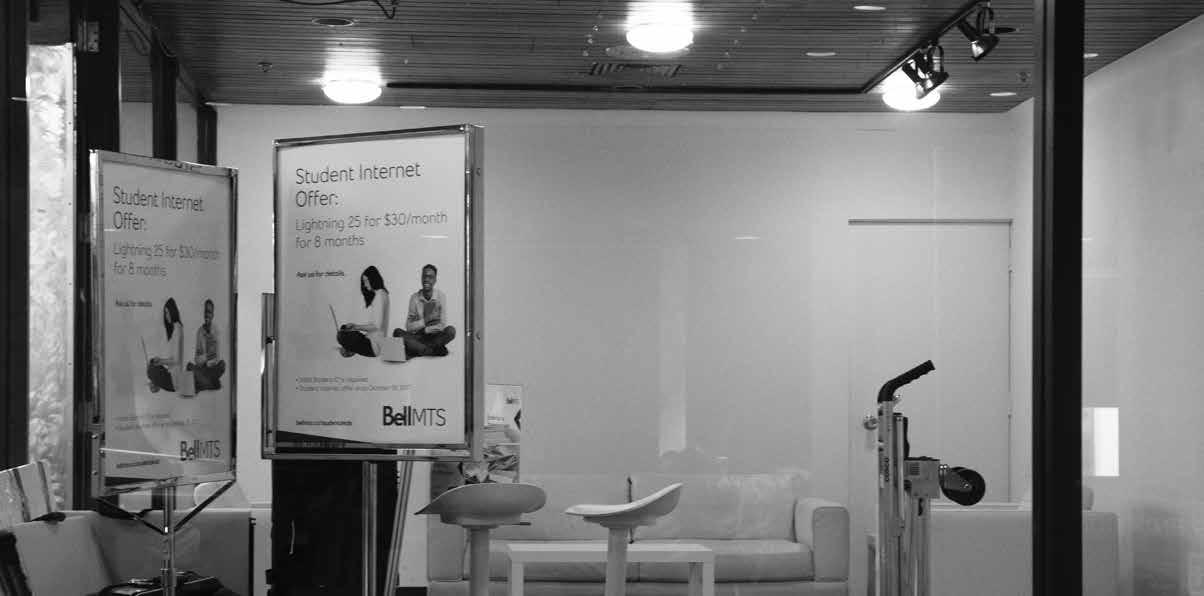
Bell MTS was setting up in GoSA after the space was promised to fine arts students, Matthew Lacosse and Maya Martinez-Alper, for the first week of classes.
Hundreds gather at legislature to protest scheduled rally
Multiple speakers affirm the value of diversity at event hosted by Islamic Social Services Association Inc.
Imreet Kaur, staff
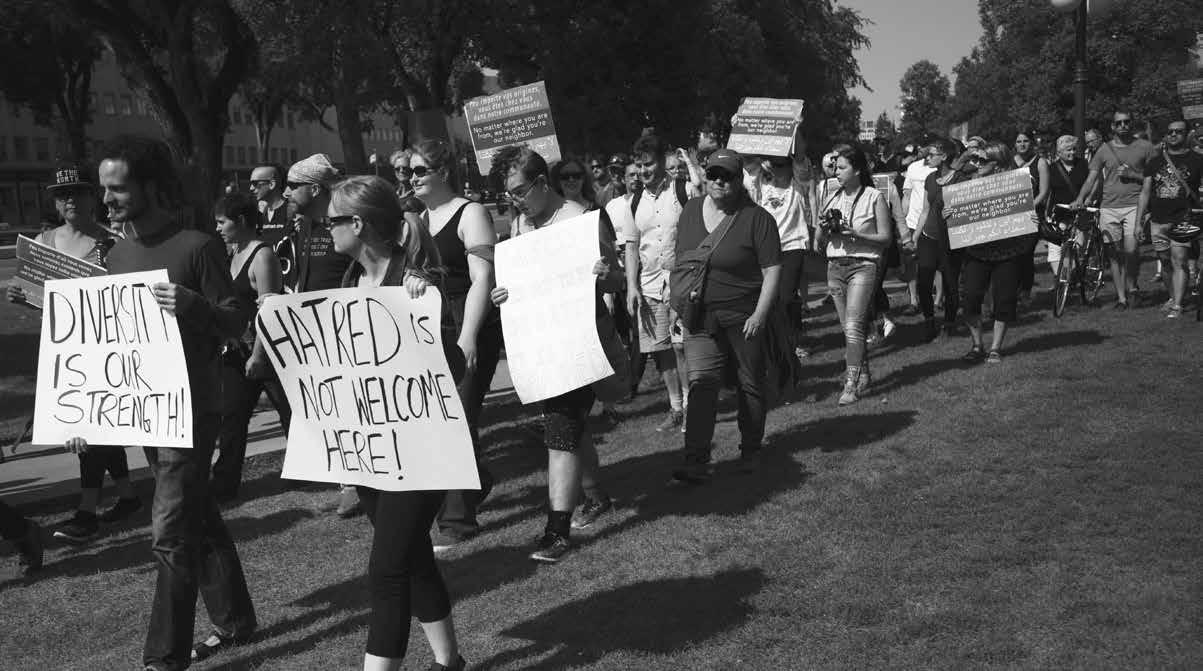
Hundreds gathered at the south steps of the Manitoba Legislative Building on Saturday, Sept. 9, to take part in the Winnipeg Diversity Rally Against Hate, organized in response to a planned gathering by members of the Worldwide Coalition Against Islam who were supposed to hold a rally downtown the same day.
The event was hosted by Islamic Social Services Association Inc. (ISSA) - an organization that works to provide precise information on Islam to the public, as well as working together with other interfaith organizations on human rights issues.
Speaker after speaker reminded the audience of the importance of denouncing hate and embracing diversity.
Emcee Krishna Lalbiharie opened the event by explaining how racist organizations in Winnipeg have
been emboldened by recent events in Charlottesville that resulted in violent clashes between white supremacists and anti-fascist protestors.
“Bigots marched thunderously, mulling hatred and antisemitism and Islamophobia and xenophobia and homophobia and misogyny […] under the rubric banner reading ‘Unite the Right,’” he said.
“In Canada and all over the world we instead unite against the hate with zeal, with intelligence, with compassion, with empathy, and with love. Love trumps hate. Always.”
Shahina Siddiqui, president of ISSA, spoke at the event denouncing hatred against minorities and condemned discrimination against Indigenous peoples in Canada.
“Some may think I am here to talk about Islamophobia, but guess what: I am here to about antisemitism. I am here to talk about homophobia. I am
here to stand with our black community,” Siddiqui said.
“I am here to stand with all those marginalized communities that face racism. I am here first and foremost for the first peoples of this country, of this nation, of this land. Racism against the Indigenous of Canada is shameful, it’s deplorable, and it’s disgusting.”
Siddiqui placed emphasis on her experience immigrating to Canada more than 40 years ago.
“As a grandmother, I want my grandchildren to know that the newcomers who came to this land came through the front door,” she said.
Siddiqui emphasized that immigrants must stand with First Nations communities to fight racism.
Following Siddiqui, Nahanni Fontaine, NDP MLA for St. Johns, also spoke at the event, commending residents of Winnipeg for coming out in large numbers for the rally.
“From where I am standing, it is such a beautiful sight to see so many Manitobans come together in defiance of hate,” she said.
“You are all so beautiful, and so diverse, and I am so proud to be a Manitoban.”
“ In Canada and all over the world we instead unite against the hate with zeal, with intelligence, with compassion, with empathy and with love. Love trumps hate. Always.”
- Krishna Lalbiharie, event emcee
Thanking the organizers, Fontaine said, “I want to first and foremost say Miigwech to the organizers, and more specifically to Shahina who has been doing this for many, many years not only for the Muslim community but for all of us. For our children and the next generations of our children so that we can live in a truly equitable Manitoba.”
In her speech, Fontaine also reflected on what it means to acknowledge the land before starting gatherings. Reflecting on her grandfather’s experience fighting Nazis as a young man and having spent nine months as a prisoner of war, Fontaine
said, “Indigenous peoples will never, ever stand for that on our territories.”
Kevin Lamoureux, MP for Winnipeg North and one of the event speakers, emphasized the value of the diverse fabric of Canada.
“Our greatest asset is our diversity: it is our diversity that makes us the wonderful country we are today,” he said.
“And a part of that diversity is to fight injustices and hatred is one of those injustices that we should not tolerate in society.”
Humaira Jaleel, co-chair of Amnesty International Winnipeg - Group 19, highlighted the importance of such public gatherings.
“I bring my kids to each and every one of them," she said, "because this shows that there are more people who are supportive of our diverse culture, who are supportive of love, not hate.”
Against fascism: same message, different rally
Prior to the rally at the Legislative Building, another rally organized by Fascist Free Treaty 1 (FF1) and Winnipeg Against Fascism, labeled Winnipeg Unites Against Hate and White Supremacy, took place at the corner of Portage Avenue and Spence Street, not far from the University of Winnipeg.
Omar Kinnarath, an organizer for FF1, spoke to the Manitoban about the continued need for events that denounce hatred.
Kinnarath noted that “None of us want to be here."
"None of us, a year ago, would have imagined that we would be organizing against hate groups," he said.
"It is something we have to do, something that we have experience with, and something that we need to get together and do any time that white supremacists even entertain the idea of showing up.”
Over the past few weeks, antisemitic graffiti referencing the Ku Klux Klan has been found in Omand Park and along Wellington Crescent.
“We live in a community that will organize against [racism] every single time," he said.
"We will stand up for each other […] so hate groups do not have a future here,” Kinnarath said.
Observing that, “Racism is not different anywhere, racism is the same everywhere,” Kinnarath added that in order to curb racism, communities must “deny [white supremacists and racists] a platform."
"Don't pay attention to them," he said, "and anytime they show up, crush them with numbers and crush them with love like we saw today.”
photos by asha nelson
Manitoba Hydro could save money while helping the environment
U of M study finds that reduced mowing and herbicide use can save Hydro money and restore habitat for prairie species
Valer I e n yamor I
Researchers at the University of Manitoba have published two articles outlining potential benefits to native butterflies and birds to be reaped from modification of existing mowing and herbecide regimens in utility corridors.
The articles, derived from field observations of 48 Manitoba Hydro right-of-ways in and around Winnipeg from 2007-2009, were published last January and August in Landscape and Urban Planning and Avian Conservation and Ecology, respectively.
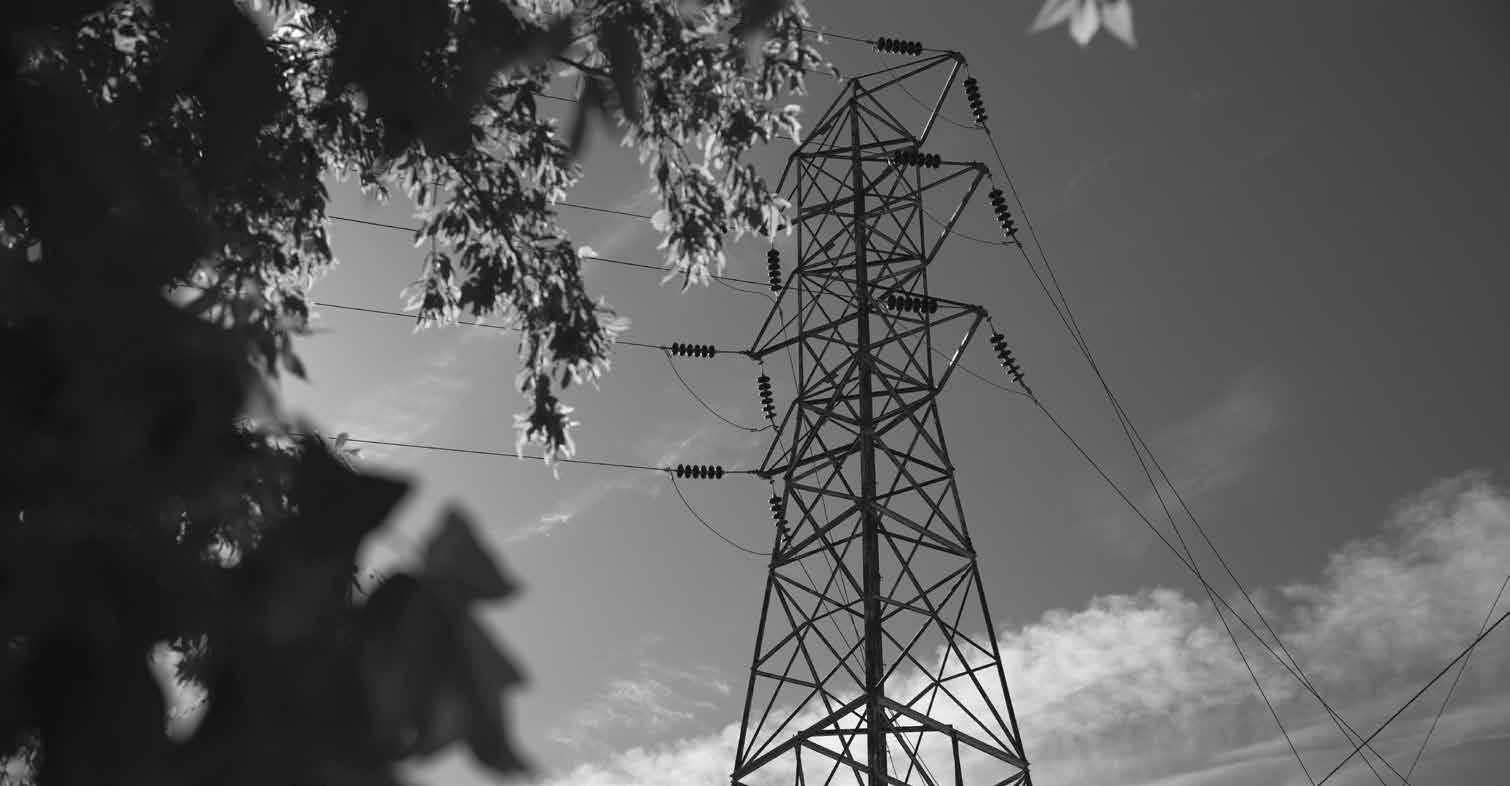
Right-of-ways below transmission lines are generally maintained by Manitoba Hydro through frequent mowing, spraying of herbicides, vegetation and debris clearing in order to control vegetation height, for aes-
thetic appeal, and as a safety measure.
The lead scientist, Lionel Leston, who currently resides in Alberta, was a Ph.D. student at the time of the study.
Leston and his research assistant, U of M professor Nicola Koper, conducted population counts of native bird and butterfly species present, while noting factors such as the presence of native plant species.
“I was interested in how the mowing regime along transmission lines and surrounding land uses - like the amount of urban land - how they interacted to influence the diversity and abundance of species along transmission lines, and whether or not urban transmission lines might be managed as habitat for different species,” Leston said.
The article focused on birds is thought to be the first urban bird study to evaluate different effects of urban landscapes on bird species that looks beyond traffic and noise as potential factors.
There has been a general decline of grassland bird species populations in North America. The authors of the study note that long-term changes in land use, including increases in land devoted to agriculture and urbanization, are all probable causes of grassland bird decrease linked to destruction of habitat.
“We’ve been really concerned about the loss of tallgrass prairie habitat across Manitoba,” Koper said. “Manitoba has lost more than 99 per cent of the tallgrass prairie that was here before.”
The studies suggests that managing urban grassy areas such as those below transmission lines could help alleviate this decline.
“[Professor Leston] found that if you reduce mowing from twice a year to once a year, we got quite an improvement in the diversity of a range of different species,” Koper added.
“And so that's something that could be done that would save Hydro money but could still accomplish their goals: you could keep the woody vegetation down with mowing once a year.”
For birds, counting was done three times every summer from 2007 to 2009 to measure populations.
The study suggests that efforts to increase grassland bird populations in
urban areas should be concentrated on areas with little adjacency to shrubland and forests, on which the mowing regimens can be adjusted.
The study further notes that mowing on the selected lands should be adjusted to suit grassland birds.
Speaking to the potential societal benefits of implementing the study’s findings, Leston said they extend beyond simply cost-saving measures.
“There's the potential environmental benefits of reduced noise pollution,” he said, “because you're not mowing so much, reduced chemical pollution because you're not spending as much money spraying as much herbicide or using as much fuel in mowing and spraying.”
photo by asha nelson
Editor-In-Chief: Garett Williams
Contact: Editor@themanitoban.com / 474.8293
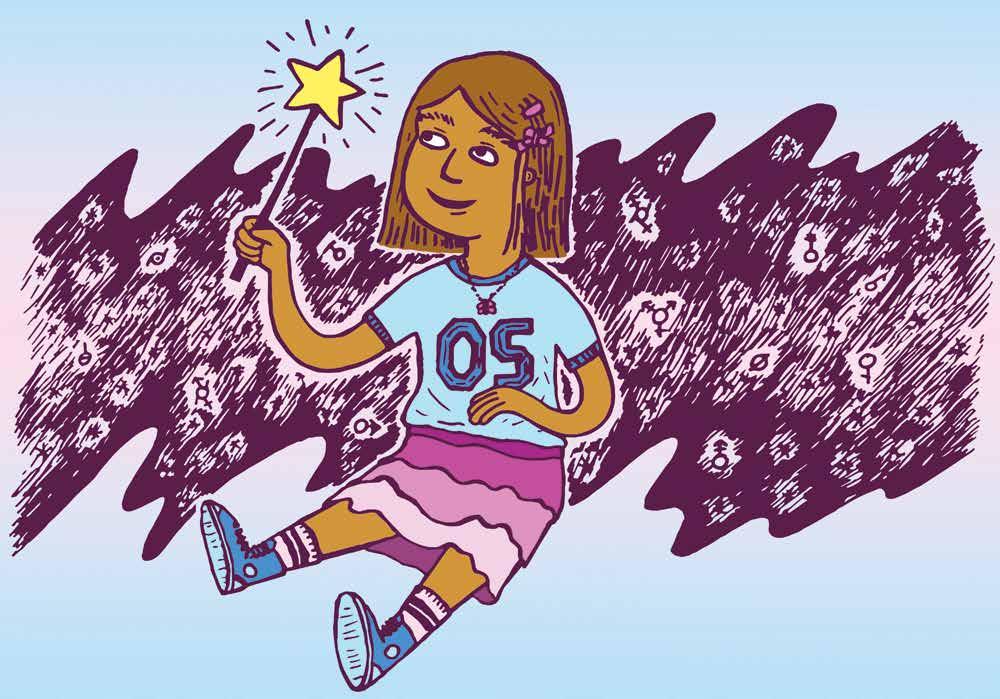
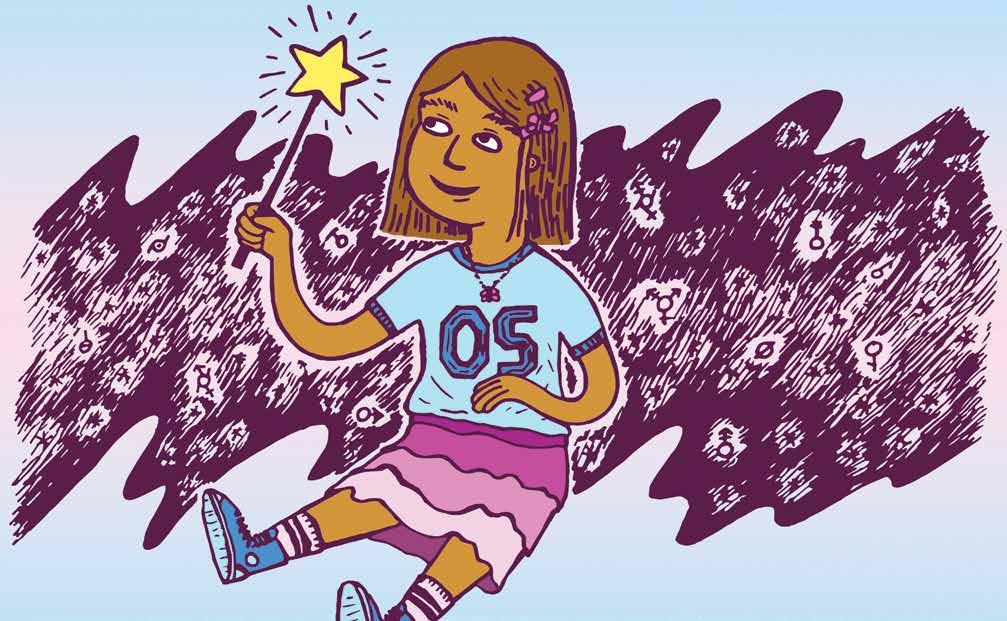
Gender neutrality is common sense
Conservative critics sacrifice compassion for tradition
Shawn g arbutt, staff
Hysterical outburst leapt from the lips of those who label their intellectual opponents “snowflakes’” in times of disagreement when John Lewis, a U.K department store, announced all of its children’s clothes would henceforth be sold with gender neutral labels.
Conservatives reacted to the move with outrage and dismay – as if facing matters of great moral crisis. In this case, visceral reaction is one relating to fears about what is seen as the societal capitulation to political correctness and a widespread loss of common sense, as demonstrated by backlash on Twitter, the words of conservative pundit Piers Morgan, and British member of parliament Andrew Bridgen.
This story parallels recent debates in Canada concerning changes that are underway in Ontario. As early as 2018, the province may offer genderneutral birth certificates. One option for implementation is to follow the federal government’s practice for passports, which would allow parents to mark an “X” for non-binary under the sex category instead of the traditional “M” for male or “F” for female.
While lacking the rhetorical pomp and flair of their U.K. counterparts, Canadian conservatism seems to dominate the discourse on this issue: an Angus Reid poll conducted in July found that 58 per cent of Canadians disagree with the changes.
One prominent objection to the
Ontario changes is that biologically sexed female representation in clinical studies that influence medical practice is severely lacking.
In this case, the logical rationale behind such an activist’s protests against labelling an individual’s sex as gender-neutral is somewhat understandable. However, as this logic is one found almost exclusively in the radical feminist blogosphere, it is unlikely that this is the motivating thrust of Canadians’ objections as recorded in the poll.
There are, of course, important differences between the Canadian and British cases. One has to do with the conflation of sex and gender categories on the birth certificates, while the other solely revolves around stereotyping cuts of clothing.
Still, the arguments against both changes share ancestral roots firmly planted in a tradition of bigotry that targets women and the queer community, be it explicit or implicit.
The opposition drumming up conservative blowback against gender neutrality at large can be summed up by the words of British MP Andrew Bridgen when he took to the airwaves to denounce gender neutrality in children’s clothing. Bridgen claimed there are fundamental biological facts about gender that innately divvies up boys in one column and girls in the other. He asserted that to deny this was not only out of touch but also uneconomical, saying parents
shouldn’t have to waste time “looking to buy a dress for their six-year-old boys.”
Allowing even a minor social license for the expression of gender-neutrality may go a long way in validating children who are experiencing trauma at the hands of the two-gendermodel mafia
Now, if you listen closely, you can nearly hear the whoosh of Bridgen’s words as it zooms past the point. Firstly, if we follow Bridgen’s argument, the question of gender biology becomes moot. Even if gender is biological – and there exists serious science that doubts the very notion –this line of thinking concludes that clothes themselves lack a biology and thus any gender.
Further lacking an intellectually robust account that can explain the alleged necessity of gendering clothes beyond “parental inconvenience,” Bridgen and those who share his position are the only people in
this sad excuse of a debate who are out of touch and lacking common sense. The material risks gender-nonconforming children face have been empirically documented for years.
These comments show a mighty indifference to a serious issue facing gender-nonconforming youth. I would hazard they are unaccompanied by even a single care in the world for the struggles of the historically marginalized communities whose interests are most at stake in this debate.
Not to mention, Bridgen and company’s statements are backed not by any modicum of a reasoned argument but rather their own personal prejudices, those premised on doubting the validity of a way of life at odds with heteronormative standards.
A 2012 article published in Pediatrics , the journal of the American Academy of Pediatrics, found that gender-nonconforming children are at an elevated risk of experiencing physical, sexual, and psychological abuse – and further research finds this is most often at the hands of parents or family friends. Consequently, such children are also at higher risk of developing posttraumatic stress disorder. Importantly, this exists on top of the wealth of data that already shows LGBTTQ* youth are the youth demographic with the highest homelessness rates, bullying rates, harassment rates, and so on.
Note that kids are not making
themselves homeless, nor are they abusing themselves by wearing gender-nonspecific clothes. Rather, it is a bigoted society and its disciples of intolerance – those who find themselves raising children who don’t fall perfectly in line with regressive gender norms – that bring violence into those very children’s lives. Allowing even a minor social license for the expression of gender-neutrality may go a long way in validating children who are experiencing trauma at the hands of the two-gender-model mafia.
Indeed, it takes great delusion, little common sense, and a wealth of cruelty to react to the encouragement of gender-neutral dress in children with scoffing derision. Although limited to superficial reforms, given remedial actions are focused on the effects rather than sources of oppression, actions taken to encourage a climate of gender expression that transcends a draconian gender binary are crucial in creating a society that nurtures and protects vulnerable children.
But all things considered, one is hard-pressed to imagine what there is to be lost in a world that encourages freedom of creative expression. I suppose only the traditionalist tyrants who would bar it from existing in the first place.
U SPORTS and CFL missing an opportunity
There are easy ways to help grow football in Canada
ryan Stelter, staff
Every year for two weeks, football fans in the prairies drop their ohso-Canadian politeness to partake in the greatest rivalry in the CFL. When the Winnipeg Blue Bombers and the Saskatchewan Roughriders take to the field, it can get personal.
Since a young age, I have been raised to dislike the RoughridersSaskatchewan in general - but I will leave my thoughts about The Wheat Province out of this.
This weekend I watched the Banjo Bowl being played out at Investors Group Field (IGF), with the Bombers soundly beating the Roughriders 48-28. I couldn’t help but recall that the University of Manitoba Bisons had done battle with the University of Saskatchewan Huskies in that very stadium a week prior.
Then it hit me: why aren’t the CFL and U SPORTS football teams doing more business together? Everyone knows about the Labour Day Classic and the Banjo Bowl pitting the Bombers against the ‘Riders, so why not add another game to the mix for football fans?
The reason I bring this up is
because I know there are hundreds, if not thousands, of Winnipeggers and Saskatchewanians who travel to Regina and Winnipeg, respectively, to watch their teams play. There could be ticket packages set up to encourage fans to come out a day early and see the Bisons and the University of Regina Rams do battle. It would add another dimension to an already fierce rivalry.
The same could happen with the Banjo Bowl, only this time you could call it the University Banjo Bowl, or something to that effect. The Bisons could host the Rams the day before the Bombers host the ‘Riders.
These games would be more local and a better indication of the football prowess of the two provinces, as many Bisons players are from Manitoba and many Rams come from Saskatchewan. The same could be said about Regina’s provincial rivals, the Huskies.
It has never made sense to me that in a city like Winnipeg, the Bisons can never seem to attract more than 2,000 fans to IGF. Offering tickets at a lower price, and included with
the purchase of CFL tickets, would get more people out to the university games. Can you imagine the atmosphere of 10,000 rabid football fans out? I am sure that number would be attainable, if not beatable, if the right ticket packages were set up.
There are matchups like this all across the country just begging to be spiced up. It would be great for fans to get into their local university team
For all those CFL fans who watched this past weekend’s Banjo Bowl, there were a few former Bisons on the field - Nic Demski and Kienan LaFrance were playing for the ‘Riders, to name just a few. The Bisons have produced two NFL players in the past two seasons in David Onyemata and Geoff Gray, never mind the countless
UMSU and the “ally” falsehood
CFL players Manitoba has pumped out over the years. Why shouldn’t we sell tickets in a way that lets fans see these guys before they make it big?
As Bison football head coach Brian Dobie told reporters after Gray signed a contract with the Green Bay Packers back in April, “People that aren’t coming out to the games are missing out on a great product. I’m not just talking about Manitoba but there’s guys who will be churned out every year to play in the CFL and the odd guy in the NFL.”
This concept doesn’t have to be applied only in Winnipeg and Regina. There are similar rivalry games happening across the CFL. When the Calgary Stampeders and the Edmonton Eskimos play a home-andhome, why not have the University of Alberta Golden Bears and University of Calgary Dinos play the same weekend as well? The Hamilton Tiger-Cats and Ottawa Redblacks also face off, so throw the University of Ottawa Gee-Gees or Carleton University Ravens on the docket to play the McMaster University Marauders at the same time.
This could also open up the chance for a potential television deal with TSN to broadcast those games. I’m just speculating, but I don’t think that’s outside of the realm of possibility.
There are matchups like this all across the country just begging to be spiced up. It would be great for fans to get into their local university team.
U SPORTS football doesn’t get enough credit for how entertaining it is. Having spent years covering these games, I enjoy them more than the CFL or even the NFL. While I can only speak to the Canada West, as I often do not have enough time to watch teams out East, I know they produce some thrilling football games.
I know U SPORTS will do anything to gain exposure – and rightfully so. But I think one of their best opportunities to grow the Canadian game of football is right under their noses.
Proposed changes to community group organizational framework for the worse
Jenn I fer b lac K
I
n response to the Sept. 6 article, "Critics cry foul over UMSU organizational shakeup."
When the Manitoban reported that UMSU has dramatically restructured its service centres - eliminating independent coordinator positions for the Womyn’s Centre, Rainbow Pride Mosaic, Aboriginal Student Association, and Accessibility Centre - in favour of a single coordinator to oversee all four spaces, I was angry but unsurprised.
For now, ignore that this is deeply problematic - assuming, as it does, that the UMSU executive is justified in unilaterally determining the mandate of a service centre as well as whether or not said mandate is being met, all without prioritizing the input of the actual collectives and councils that work out of these centres.
For now, ignore the convoluted logic of claiming to have prioritized the consultation and consent of the elected community representatives relevant to each centre - while at the same time admitting that the coordinators are currently more connected with these communities, as the UMSU executive admits in the Manitoban report on the organizational shakeup.
Ignore the frank absurdity of the notion that replacing four coordinators with one coordinator will somehow create better services and resources at four independent centres.
Ignore all of this because my space here is limited and I have a particular bone to pick.
The UMSU service centres have traditionally been staffed only by those who identify with the communities the centres service: the coordinator of the Womyn’s Centre needs to identify as a woman, trans, or non-binary individual; the Rainbow Pride Mosaic coordinator needs to identify as falling somewhere on the LGBTTQ* spectrum, and so on.
“Allyship” is not a status to be claimed but work to be done
This self-identification matters, not only because the service centres are intended to offer safer spacesmeaning, in part, that if you do not identify with the community that the centre services, you are asked to refrain from using the space - but also because the coordinator role, at its core, is representational.
While there are UMSU community representatives elected to represent community voices on UMSU council, the service centre coordinators represent community voices in the day-to-day operations of the centres. They uphold the community principles of the centres during meet-
ings, office hours, and in the frontline organizational work each centre does with the rest of campus.
Of course, it is perfectly possible for a candidate for the new coordinator position to identify as a member of all four relevant community groups; however, that isn’t the criteria for being hired to this position. As the UMSU executive made explicit, a hireable candidate need only to identify as an “ally” of the relevant communities, and they would receive training to compensate for any gaps in knowledge.
An “ally,” as this sort of discourse understands it, is someone who has learned about oppression, is sympathetic to those who experience it, and has committed themselves to helping those communities overcome oppression. An “ally” puts the needs of people more marginalized than themselves first. An “ally” takes hits for other communities and puts their privilege on the line to create tangible gains. An “ally” understands that knowledge is not equal to the lived experiences of oppression and cedes ground to others who have experienced such oppression in order to amplify their voices.
See the problem yet? To accept this job would mean that you, as an “ally,” believe yourself just as qualified to represent and empower a marginalized group as an actual member of that group. To accept a position that
actively erases space - not to mention employment - for the people you purport to represent and empower is inherently anti-ally.
The position is oxymoronic. It is simply impossible to both occupy the position and also justify your proclaimed “ally” status.
In creating this position, UMSU has inadvertently exposed the inherent problem of “ally” status.
“Ally” is the new accountability cop-out. Rather than signifying a commitment to the safety and wellbeing of others, as the term may be meant to suggest, “ally” now represents a much more insidious, bureaucratically-regulated social scorecard. Anyone can claim status as an “ally” and, all-too-often, people do so to re-centre a privileged subject in a space specifically cleared by and for those on the margins.
Don’t identify personally with a community? No sweat, just assure the community that you’re familiar with the issues they face - heck, take up all the space you can to assure them; take their jobs to assure them, why not?
“Ally” is invincible.
Do something that hurts or belittles a community? No sweat, just undergo a formulaic “ally training” and rejuvenate your credentials as a certified “ally.” Will the appointed candidate need a 1:1 ratio of hours served/hours of “ally train-
ing” to compensate for the violation of taking this job?
For years, queer and trans, black and Indigenous, and people of colour have been telling us that “ally” is not a noun but a verb - that no one should get to claim “ally” as a status but instead should work each day to demonstrate their “allyship.” This framework prioritizes the action of allyship. That is, doing actual solidarity work without demanding reward, amplifying the voices of others instead of simply taking up space, and being critical of any selfcongratulatory rhetoric of “allyship” that allows self-proclaimed “allies” to assume leadership roles in communities that they are not a part of.
This framework insists that “allyship” is active, not static. “Allyship” not a status to be claimed but work to be done. When we refuse to acknowledge these teachings and insist on institutionalizing “ally” as an identity category, the “ally” is exposed as a spectre - the substanceless ghost of an unmet promise to action. And how do you combat a ghost? Well, you can’t. You just have to tear down the house and rebuild.
In this case, UMSU is the house.
Jennifer Black was the 2010-11 UMSU women’s representative, 201213 UMSU VP advocacy, and a former UMSU Womyn’s Centre coordinator.
You have cultivated an incredible support system, don’t forget it. While your September is a whirlwind of new projects and deadlines, remember to keep communication open and fluid. It’s Virgo season - confrontation is necessary but isn’t required to be aggressive (unless you’re addressing TERFS or something). Listen to Crying On The Bathroom Floor by MUNA and rise up to defend yourself. You’ve got this.
Follow your motivation. Follow your spontaneity. Resist the urge to put your emotions in a glass bottle placed precariously on the edge of a shelf - you know better than this. In preparation for the new moon, put on your favourite outfit and listen to I’m In A Mood by Mykki Blanco while you write affirmations on your windows. You have a lot to celebrate and your challenge is to let yourself do so.
Shake off all of the past experiences that are haunting you to Lets Have a KiKi by The Scissor Sisters. You’ve beenx through a lot this year. Doubting your intuition is dangerous, even (especially) when others judge you for your precaution. When Mercury opposes Neptune next week, stick to your truth and boundaries. Spend this month getting to know and love yourself.
graphic by kelly campbell
Herbivore haven coming to Winnipeg
Vegfest taking place this Saturday
Jen d oer KS en
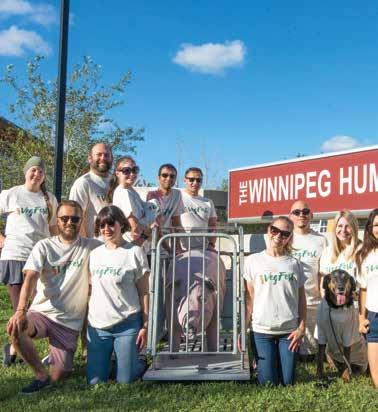
From hobby-horsing to a vegan mac and cheese cookoff, VegFest is the first vegan and vegetarian festival to take place in Manitoba.
The festival will host a number of speakers, cruelty-free food and artisan vendors, and family-friendly activities.
“Winnipeg is one of the last cities in North America to be hosting one,” Jason Hannan, the festival’s lead organizer, said.
A staple of larger Canadian cities such as Vancouver and Montreal, smaller cities including Hamilton and London, Ontario, have begun to host vegetarian festivals as well.
“There’s a large and thriving community of vegans, vegetarians, environmentalists, and activists, and this is a way to bring them all together under one big tent where they can have important, lively conversations, eat good food, participate in vegan fun and entertainment,” Hannan said.
“It’s long overdue and we’re hoping to establish this.”
Stella’s Café and Bakery, Feast Cafe Bistro, and The Velvet Glove are among the vendors set to cater the event.
Stella’s will be premiering a new vegetarian dish – the Whole Bowlthat can be made vegan during the festival.
Koren Thomas-Mueller, catering director for Stella’s for the weekend, said Stella’s vegan dishes are exceptionally popular.
“We find even those who typically eat meat will give our vegan or vegetarian options a try and provide their feedback,” she said.
She said she expects the festival will shed light on vegan meal options already available in Winnipeg.
The festival will host six keynote
speakers from varying backgrounds relating to animal compassion and activism, including Winnipeg’s David Nickarz, vice president of Sea Shepherd Conservation Society - Canada, and Carol Adams, author of The Sexual Politics of Meat: A Feminist-Vegetarian Critical Theory
Nickarz has been a vegan for 25 years and has attended vegan festivals in other cities, including Melbourne, Australia.
“It’s the first one in Winnipeg so it won’t be the biggest, but we’re hoping to get a lot of people curious about it.”
Benjamin Dueck, a University of Winnipeg student and a vegan, is looking forward to seeing Adams speak at the festival.
“She's an academic, but she writes in a way that cuts straight to your emotions without coming off as aggressive or preachy, a stereotype that a lot of animal rights thinkers have to overcome,” Dueck said.
The festival’s organizers aim to make the festival an annual event that could strengthen Winnipeg’s vegetarian and vegan communities.
“This is the first time I’ve seen an event tying together food, ideas and fun, happening on such a large scale,” Dueck said.
He said he hopes it will also serve to bring various communities together.
The first annual VegFest takes place on Sept. 16 at the University of Winnipeg Axworthy Health and Recplex. Doors open at 9 a.m.
photo by jen doerksen
X-Cues’ Café and Lounge still live after five decades on Sargent Ave.
Legendary West End staple thrives with Game of Thrones, open jam nights
X-Cues’ Café and Lounge has been a West End staple for almost half a century.
Formerly known as Enzo’s Sports Bar, it first opened on a bustling of Sargent Avenue in 1969. The brothers Infantino, Gaetano and Enzo, arrived from Montreal shortly after leaving their home in Italy and immediately transformed their business into a home-away-from-home for many Italians.
In 1968, Enzo and his wife took a trip to Winnipeg. When he arrived back in Montreal, he asked his brothers which one was coming back with him to open a café. Gaetano brought his wife and two young children, Franca and Sal, to live in Winnipeg and opened Enzo’s along with his brother in 1968 on Notre Dame Ave. The business relocated to Sargent Ave in 1969, and has remained there ever since. The family-owned and operated business is still run by Gaetano’s children Franca, Sal, and Rosie almost 50 years later.
In their humble beginnings, the big hearted brothers accepted anyone into their family, as they left theirs behind in Montreal to start the new business. When Italian families would arrive in Winnipeg with only the clothes on their backs, taxi drivers would take them to X-Cues’ where they were guaranteed a meal, a place to sleep, and help finding a job in the neighbourhood.
Today, you can still see that customers from a vast number of nationalities and cultures have stayed loyal to X-Cues’ across generations because of the owners' big, welcoming hearts.
When you enter X-Cues’ before noon on any day of the week, you will immediately be greeted by the sound of a few dozen Italian men playing cards. From mutters which crescendo into roars and back down again, the red card room is always packed with generations of card players buying each other Italian coffees. Wives of the men playing cards on occasion still call X-Cues’ landline phone to remind them to come home, and the room clears before dinner.
Food is expertly prepared by Franca and the beloved Tony Lamorte, who has been working in the X-Cues’ kitchen for more than 20 years. Authentic Italian specials like arancini, chicken parmesan, and meatballs are all covered in homemade sauce and cooked to perfection.
Unlike other coffee shops in the city, baristas do not weigh their espresso or measure the milk before making what is arguably the best coffee in the city. When baristas start their shift, the espresso is to be eyed up, watched, and tasted because even the weather can affect the amount of beans to be brewed.
You won’t find a thermometer in the milk for lattes. Workers are taught to listen to the milk and touch the bottom of the metal frothing jug until it is too hot to handle – that’s when they are ready to pour. If the foam is thick enough to watch the sugar slowly fall through, one will be rewarded with a bravo. Workers have a rolodex in their brain of specialty orders, so that regulars just give their server a nod or glance to have their coffee made to exactly their preference.
The walls of X-Cues’ host vintage soccer photographs, and there is a large soccer mural on one of the building's exterior walls. X-Cues’ is a local hub for watching soccer games in the community, no matter which team is playing. The place fills to standing room only when Italy plays; fans old and young to come see their team compete. There's nothing like X-Cues’ during an Italian soccer game, particularily after a goal.
The remaining room on the walls is covered with work by local artists and photographers, and rotates on a monthly basis. Local artists have the opportunity to sell and showcase their art to the café's diverse set of customers. From wildlife photography and landscapes to detailed flower paintings and celebrity-animal hybrid portraits, there are unique artists from across the city using the walls
of X-Cues’ as a gallery for their work.
Over the decades X-Cues’ has operated, the business has evolved due to their open-mindedness towards new projects and ideas. Currently, X-Cues’ is host to many weekly events that bring together people that would otherwise not have the chance to meet and share their passions.
Entertainment organizers Cherise Mitchell and Stefanie Infantino spent countless hours trying to keep up with the ever-evolving city around X-Cues’, and their hard work has begun to pay off.
What started as an apparent flop, the Thursday open mic at X-Cues’ would sometimes have no attendees besides than the host. Infantino and Mitchell stuck with it, and now "Sargent Jam" has become a staple for some local musicians who come every
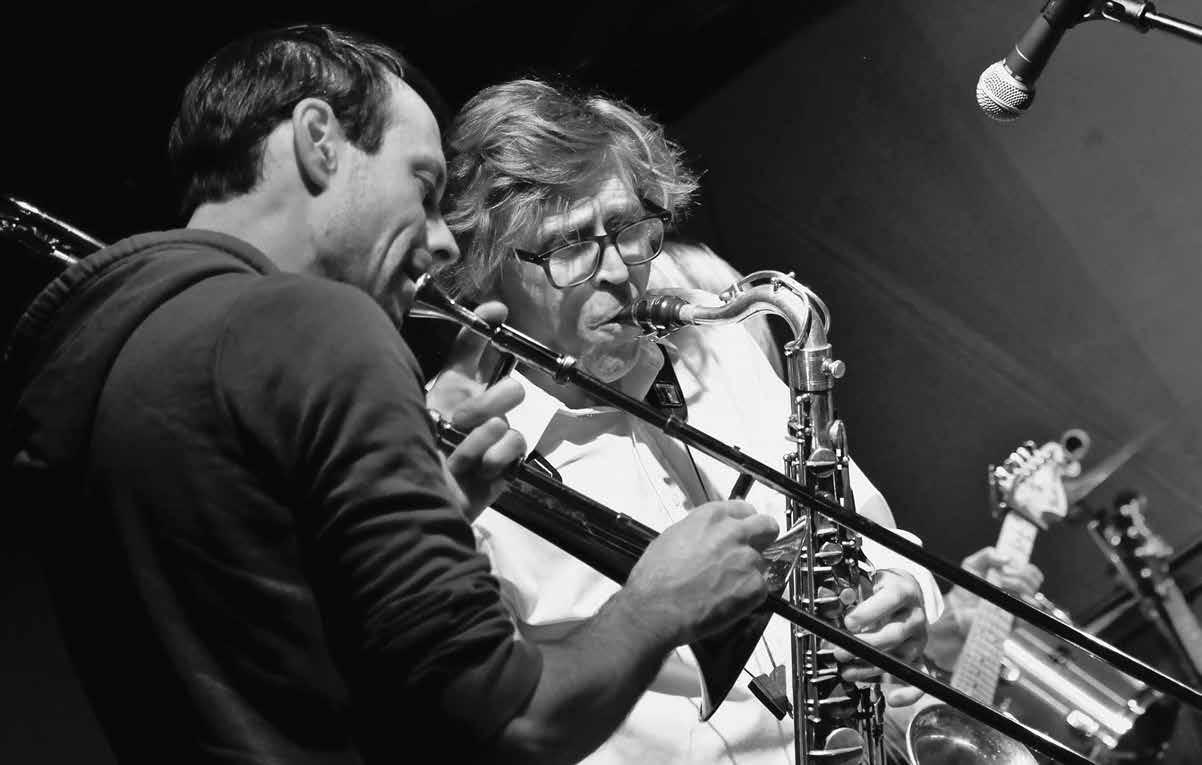
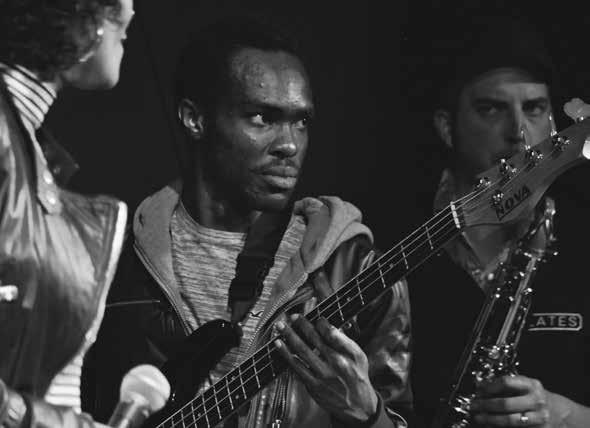
week to expand, network, and share their music with the community. Hosts of Sargent Jam play a set with their band and afterwards, they open the stage to an open mic - jam hybrid where musicians can play alone, with others, or just hop on stage and collaborate with other musicians they have never met or played with before. The experience has left musicians and musicophiles coming back week after week. Generations of music-makers spanning many genres and levels of skill cover and create music that is unique and may never be played the same again.
Mitchell is also the mastermind behind weekly Game of Thrones nights at X-Cues'. Starting in January, X-Cues’ aired two episodes of Game of Thrones every Sunday leading up to the premiere of the show’s seventh season. Mitchell put her heart into having themed skits, props, and a modified version of Cards Against Humanity to share with fellow fans. The first night of season seven was host to a full house, and now over 120 people reserve seats to watch Game of Thrones on six big screens amongst other fans. The season finale had over 150 attendees, and Mitchell is hoping that next season there will be just as many fans coming in to watch.
"Woke Comedy Hour" is one of the newest events at X-Cues’ that strives to create a welcoming and inclusive space. The event is a monthly open mic that showcases women of colour, Indigenous women, and non-binary folk of colour. Mitchell is proud of the success it has become and is hoping that the event continues to expand.
Among the parties, socials, and live music that X-Cues’ hosts, one of the signature events held every year is the annual Christmas Feast. People of the West End that are unable to have a Christmas dinner are treated to a meal prepared with care by the cooks at X-Cues’ and volunteers, served in the café. Hundreds of people line up to sit down and have a Christmas dinner with their families to the sound of live music, and even get free picture with Santa and gifts.
Over the years, X-Cues’ has changed to keep up with the evolving community around it.
Hopefully, X-Cues’ will continue to host events for people in the community as well as become a more competitive music venue in the city during the evenings, while continuing to providing the community with good food and coffee during the day. The small dream of the Infantino brothers to open a café in Winnipeg has become an irreplaceable staple of the West End and an ever-evolving community space that is a second home to many families throughout the city.
photos provided by stefanie infantino
A captain’s courage
Despite two ACL tears, Bison soccer captain Amanda Wong continues to impress on and off the pitch
B
ison women's soccer captain
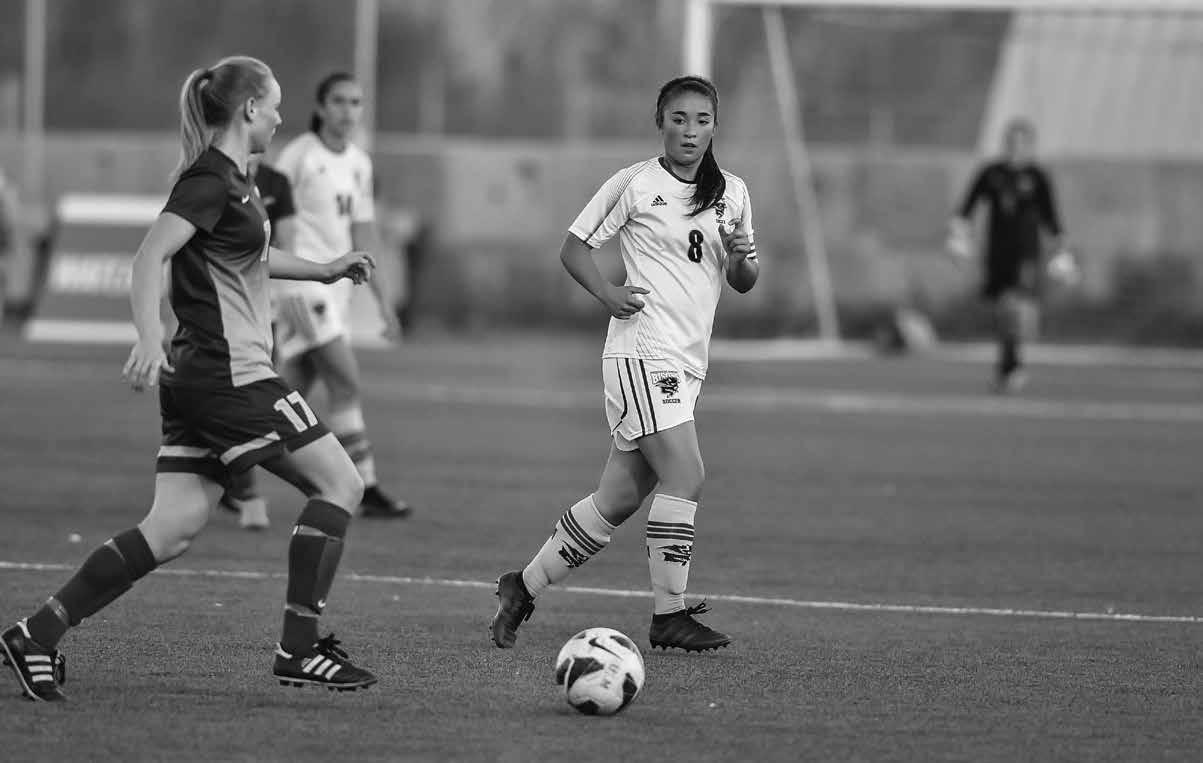
Amanda Wong has had a stellar career up to this point. However, her resiliency during moments of tribulation is arguably what stands out most in her story.
When Wong was 13 years old, she tore her ACL for the first time. It was a difficult recovery process, but she made it through.
Just a few seasons later, she helped lead her club team - FC Northwest - to an undefeated campaign, being named the Manitoba Soccer Association’s outstanding female youth player of the year for that season.
Fast forward to 2015, Wong’s second season with the Bisons and first year as captain. Optimism was high for the talented midfielder, who had started and played in all 12 regular season games the year prior.
But before Wong was able to gather any form of sustained momentum, disaster struck, and she tore the same ACL for a second time just one game into the schedule.
“When it happened, it was obviously super devastating. I kind of had a feeling in my head that that’s what had happened, just because I had done it once before,” Wong said.
“It was really hard to be sitting on the bench for that entire season, and some of the graduating girls I would’ve liked to have played with for another season, which is too bad.”
Having gone through it all once before, Wong knew exactly what to expect from the rehabilitation process though, as she observed, “That didn’t necessarily make it any easier.”
It took roughly seven months for Wong to get back to full contact,
which is to be expected. What she said surprised her was the adjustments she had to make with regards to the rest of her lower body.
The first time she got her hamstring taken out, and the second time she got her quadriceps tendon removed.
“It was different in the sense that I got a different tendon used as the graft,” Wong said.
“It was majorly different actually. It was hard to even activate my quad muscle or lift my leg for a month.
"It was harder the second time and also just because I was older, the body’s not as young.”
Despite the setback, Wong continued in rehab and was back on the lineup for the Bisons’ first pre-season game of 2016.
To put the icing on the cake, she
scored Manitoba’s first goal of the contest.
“That was a huge moment for me and it was super exciting just to know that I had gotten back to the level,” Wong said.
The former standout for FC Northwest was also named captain for the second consecutive year in 2016, and she didn’t disappoint, helping the Bisons make it to the Select
Six for the first time since 2008, while also earning her first nod as a Canada West all-star.
“I guess that was just validation, especially for all the work that I’d put in over the last year,” she said.
“My hard work paid off, and I was really proud of myself.”
Canadian Women’s Hockey League to pay players
Ja S on Pcha J e K
Canadian Women’s Hockey League (CWHL) players will finally be paid, starting in the 201718 season.
The league announced the move on its website Sept. 1, following the approval of a pay structure by the CWHL Board of Directors. The minimum compensation is $2,000, climbing to a ceiling of $10,000. Compensation rates are based on the number of years a player has been with the league.
“It’s great news and something that had to happen and what women deserve,” Bison forward Venla Hovi said. “But we’re still so far from equality and this is just a start to a greater future.”
Hovi, who has built an impressive résumé with both the Bisons and the Finnish National Team, was excited about the future of women’s hockey, and the role com-
pensation would play in it.
“It’s a great chance and dream for girls coming into the sport to know that maybe one day they will be professional hockey players,” she said. “I grew up with that thought myself, until I was old enough to understand that it’s not really possible for women.”
Hovi was quick to point out that compensation is not the sole determinant for women’s hockey gaining legitimacy as a professional sport, but is optimistic about its place within the game.
“Getting money will give women’s hockey more visibility in media and that way the sport will only keep on growing,” she said. “For people to see the sport on TV is a way to understand and realize how skilled and [what] high-level athletes women’s hockey players truly are.”
The announcement of payments for players came a few months after
the CWHL revealed it is expanding overseas to the untapped Chinese market with two new franchises.
The Kunlun Red Star were rolled out with much fanfare back in June, during a press conference held at the Hockey Hall of Fame. The team will join the Kontinental Hockey League’s franchise of the same name, but will play in Shenzen. This will allow the CWHL to not only reach potential fans and players in the Chinese market, but opens up greater sponsorship and broadcasting opportunities for the league.
The second team, the Vanke Rays, saw much less attention given to its rollout. The CWHL did not make any formal announcement, but accidentally tweeted about the team, only to delete the post soon after.
The league has since issued a press release announcing the appointment of Shirley Hon as the team’s general
manager. The CWHL now also has the team’s logo and name on their website, but no other information has been revealed.
Due to the expansion, the CWHL season will be extended from 24 to 30 regular season games. In order to include the new Chinese teams, each CWHL franchise will venture overseas for a three-game series.
Hovi expressed her excitement about the expansion, albeit with some apprehensions.
“Expansion is a good thing as long as they’re building something that’s meant to last,” she said. “I do wish that expansion was happening in Canada and North America and really putting together a league with all the best players from the whole world.”
For young players starting, or continuing, their professional careers with the Chinese franchises, Hovi
tapped into her own experiences as a transplant player to offer wisdom.
“For young players, I would advise them to enjoy this special chance they have and to have an open mind,” she said.
“Not just enjoying hockey but everything that a new culture can offer.”
The two new franchises will be mainly comprised of nationally derived talent, but will also include some North American players. A focus will be to grow Chinese talent in preparation for the 2022 Winter Olympics.
Sports Editor: Ryan Stelter Contact: sports@themanitoban.com