of the Manitoban. Any individual who qualifies must be voted in by a majority vote at a Manitoban staff meeting. Elected representatives and non-students may be excluded from holding votes as volunteer staff members in accordance with the Manitoban Constitution.
Faculty, university administration reach provisional long-term agreement
IMREET KAUR, STAFF
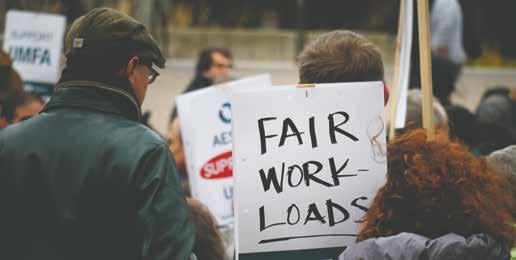
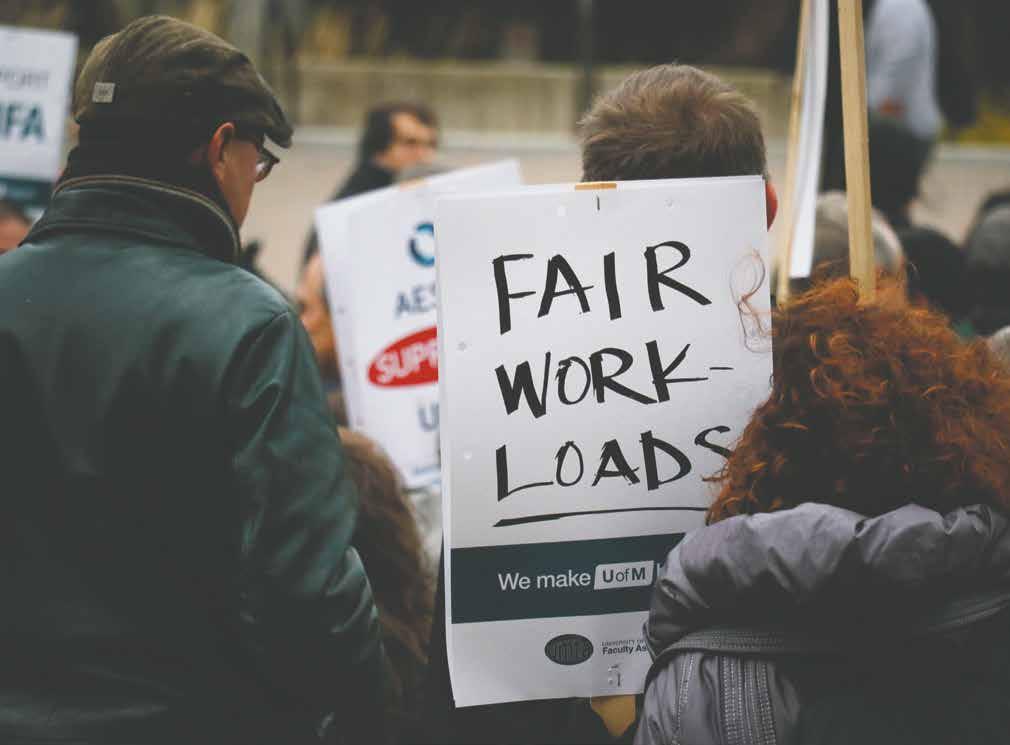
The University of Manitoba Faculty Association (UMFA) and the University of Manitoba have reached a tentative four-year agreement following expedited bargaining sessions over the summer.
The tentative agreement was reached after UMFA sent an expedited offer to the U of M administration outlining four proposals considered most important to members.
The proposals include job security for librarians and instructors, and workload protections for librarians.
A one-year agreement reached after a 21-day strike in November, 2016, saw librarians and instructors receive less protection than professors against layoffs. The agreement also lacked provisions surrounding workload protection guidelines for librarians.
The new proposal also includes staffing agreements and salary increases.
Commenting on the salary proposal, she said “We were asking for modest salary increases, and had provisions to protect us from having those clawed back if the Public Services Sustainability Act (PSSA) ended up being proclaimed.”
"We ended up with a settlement that has increases that are consistent with the PSSA,” she said.
The PSSA, also known as Bill 28, was introduced in March and imposes a two year wage freeze on provincial employees. Several public sector unions launched a court challenge of the legislation in July, calling it unconstitutional and claiming it violates collective bargaining rights.
The first year of the tentative contract will see no salary increase. The second will see a 0.75 per cent bump, followed one per cent in year three.
Salaries for the final year will be negotiated in year four.
Morill added that the salary conditions felt “imposed on” UMFA and that the union will be “challenging the constitutionality of that in court.”
“We wanted assurances that the university would hire [and] would replace any professors that left over the term of the contract, and we wanted some salary increases,” UMFA president Janet Morrill said.
According to Morrill, the discussions were intricate.
“The interference from the government in these negotiations was substantial […]," said Morrill.
“There are always risks in signing a long term deal and it is one of the things you take into consideration” – Janet Morrill, UMFA president
"That level of interference in the last round and this round was something I have never seen before,” she added.
Shortly before bargaining collapsed leading to a three week strike in the fall term in 2016, UMFA and the university issued a joint release critical of provincial interference in
the negotiating process. After faculty had rejected a previous four-year offer that included salary increases, the province directed university administration institute a compensation freeze.
The strike came to an end in late November after the two sides agreed to a one-year contract that did not see a salary increase, but did include workplace protections including workload, job security, and performance measure provisions. That contract expired in March.
Morrill said the current negotiations were “Really efficient, really productive, really cordial,” except for “discussions over salary, and those were just very complicated.”
Tanjit Nagra, president of the University of Manitoba Students’ Union, said she is happy to hear an agreement is at hand.
“I think students made it very clear last year, we’re very in favour of supporting our educators and professors, but I think this time around, seeing the impacts of the 21-day labour action last year, I think students were very hesitant going into the year,” she said.
“And I think this is very good news for them to hear.”
Nagra added that if the membership approves the tentative deal, it will ensure stability for the upcoming 2017-2018 academic year.
Morrill said any long term agreement, especially when salaries are not freely negotiated, has associated risks but they have to be balanced against the gains.
“There are always risks in signing a long term deal and that is just one of the things that you take into consideration,” Morrill said.
“So you look at what you are getting, and then you look at the length of the deal and you decide whether you are comfortable with that.”
U of M president David Barnard said in an email that he was “pleased with the stability that a four-year collective agreement will bring for our students, faculty and entire community.”
The agreement has yet to be ratified by UMFA membership. A date has not yet been set for a ratification vote.
PHOTO BY MEGAN COLWELL
Federal NDP leadership hopeful Jagmeet Singh discusses his platform
New Democrat talks free tuition, the changing workplace, and reconciliation and racism in Canada
IMREET KAUR
F
ederal New Democratic Party leadership candidate and member of the Ontario legislature Jagmeet Singh is not a stranger to Canadians who have been following the leadership race closely. He represents the riding of Bramalea-Gore-Malton in the provincial legislature of Ontario and has focused his efforts on bringing new members under the party’s tent.
The 38-year-old lawyer has become one of the front runners to lead the party since joining the race in midMay. Behind him lays the deputy leadership of the Ontario NDP. What lies ahead is a tough and long leadership race. Online voting for the federal leadership race opens Sept. 18 with first ballot results scheduled to be announced Oct. 1. Second and third ballot voting will continue through October.
Singh visited Winnipeg on Aug. 23 to host a “JagMeet & Greet” and a group cycle tour followed by a fundraiser to talk about issues that matter to Manitobans. During his time in Winnipeg, Singh spoke with the Manitoban about many issues, such as the cost of post secondary education, reconciliation with Indigenous communities, the economy, the environment and more.
MANITOBAN: The cost of post secondary education is at an all time high and continues to increase, leaving students in high levels of debt. Particularly in Manitoba, students are likely to experience a five per cent increase every year in tuition if Bill-31 is passed. How will you best represent the students on the Hill to ensure affordability and access to post secondary education?
JAGMEET SINGH: Many students are thinking twice about going to university because of how expensive tuition fees are and to me that is an incredible lost opportunity. People who are talented and passionate should be able to go to university. There should be no barriers to education in general, at all. What I would commit to is, at a federal level, we actually are in the position to develop an agreement with provinces to actually eliminate tuition fees, to make [post secondary education] tuition free. It's something that’s possible, something that we can achieve and it’s something that I would like to see happen.
“I really wanted to generate, or inspire in others, a courageous sense of self-worth”
And I should also say, not only is it [not] enough to eliminate tuition fees but there are other costs associated with education. There’s living costs, costs of books, other supplies. So we need to also allow for grants to support those who just eliminating the tuition fee isn’t enough, they also need other supports [and] we need to make sure those are available for living expenses, etcetera. On top of that, there are students who have graduated with debt and I think it’s also important to acknowledge that those students who have graduated with debt are facing this very soul-sapping, and something that’s very crushing and makes you feel a
lot of despair knowing that you have this debt – and then it’s increasing because of interest. So I think one of the first steps that need to be done, and something that I have committed to doing, is making sure that we get rid of the interest on that student debt so that you don’t see that debt increasing. And also looking at flexible payment plans to ensure that students who are graduated but are not in a position to pay back that debt have a lot of flexibility with how they can pay back their debts.
M: The millennials are also struggling to find stable job opportunities and are over represented in precarious employment. How will you, as a leader of the federal NDP work, to address this?
JS: The first thing I would do is send a clear message that precarious and unstable work is not acceptable. To do that, what I propose at a federal level is to provide that national leadership about what good work is. I have released a better work agenda and it talks about making sure we have a minimum wage building on the $15 and fairness movement – a $15 minimum wage nationally set. That would apply to federal jurisdiction but it would still be a leadership move to show the direction that Canada should move in.
One specific form of precarious employment that I would like to tackle, just to begin the work on making sure that people get stable work, is temporary job agencies. And these are agencies that are increasing across the country, they are particularly a big issue in Ontario and [British Columbia]. We are seeing a rise of
these agencies across the country but they're also something that specifically is being used a lot at the federal level, in federal jurisdiction. So what I would like to see happen, and what I propose in my agenda, is ending the practice where agencies exploit workers by clawing back up to 40 per cent of their salary. Also, the barriers that exist to getting hired directly, I would remove those barriers so that there isn’t a penalty fee that client companies have to pay to the agency to hire an employee directly.
I would also work to reinstating some of the federal legislation around labour that was excellent legislation that provided for a high standard [that has] been repealed by [former Prime Minister Stephen] Harper. I would like to reintroduce those acts that provide strong labour protection and make it easier for people to organize if they so choose.
M: What does true reconciliation look like? How will you ensure social, economic, and environmental justice for Indigenous people across Canada?
JS: The first step is we have to make sure that we don’t have a government that is denying Indigenous children equitable funding. The Canadian Human Rights Tribunal has issued four compliance orders, ordering Canada to recognize that indigenous children do deserve equitable funding. And our government under [Prime Minister Justin] Trudeau has consistently said ‘No’ and has sent lawyers to appeal the decision, literally sending a message that Indigenous children don't deserve equal funding. That is heinous, particularly for Justin Trudeau, the prime minister who said repeatedly that reconciliation was going be the hallmark of his administration. It’s shameful to me that on one side you talk about reconciliation and on the other end, you’re sending lawyers to challenge Indigenous children getting equitable funding. So that’s one step.
UNDRIP [United Nations Declaration on the Rights of Indigenous Peoples], recognizing the rights of Indigenous people as a nation to have prior, informed consent with respect to energy projects is important. And then economic justice means that we make significant investments in terms of how we can tackle the legacy of genocide, both direct and indirect, that has impacted Indigenous people across the country.
ENVIRONMENT AND THE ECONOMY
M: Let's talk about pipelines and the environment. Why did it take you so long to officially oppose the expansion of Trans Mountain Pipeline in British Columbia and Alberta? What about your stance on the Keystone Access Pipeline?
JS: I have come out clearly against
Kinder Morgan and against Energy East. I made sure that I took time to hear out different positions with respect to what the concerns were in Alberta and took time to hear some of the realities around a province that’s so resource intensive and so resource extraction based. I also wanted to reach out to folks in BC to understand their circumstances. I really wanted to convey that decisions around national policy should be made in a way that we consult with and we hear different opinions. We may not agree and we may have principles and values that don’t align with everybody but we need to make sure we take the time to hear people out. The other key piece is that I didn’t want to release my position on an energy project before I released my entire climate change plan. My climate change plan wasn’t ready and I wanted to have a climate change plan because environmentalists told me that it is disrespectful to the importance of climate change if you release your position on energy projects without actually having a broader position on climate change.
“I really wanted to convey that decisions around national policy should be made in a way that we consult with and we hear different opinions”
M: Will you under any circumstances approve the construction of pipelines and if so, how will that decision be made?
JS: I have put forward three policies, or three principles, when it comes to decisions around energy projects, whatever they may be – whether they’re hydro-electric projects, or any form of project, any sort of energy project. It has to respect UNDRIP, it has to be in line with our climate change goals and it has to create local opportunities. So if it satisfies these criteria – that it respects UNDRIP, it doesn’t contradict our climate change goals, and it creates local jobs for communities that are going to see a benefit [from] them – then it’s a project that would satisfy those criteria, then it would be something we could look at that.
M: What are some of the major concerns you have about the economy? And how do you plan to strengthen and diversify the economy?
JS: That’s the major issue I have, is that we are a resource extraction country and we need to make sure
PHOTO PROVIDED BY GURKIRAT BATTH
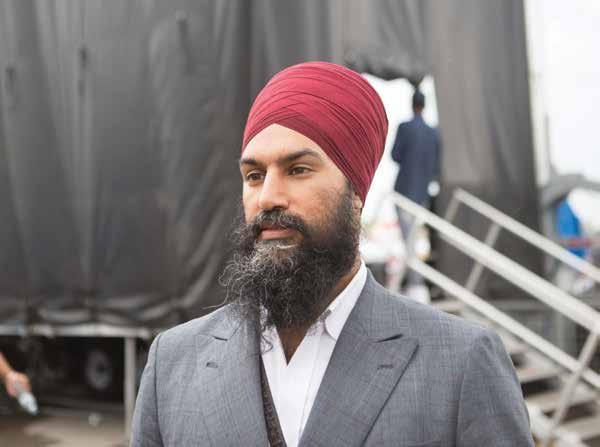
Federal NDP leadership hopeful Jagmeet Signh visited Winnipeg in August to host a “JagMeet &Greet” and drum up support for his leadership bid.
that we diversify our economy. We know that resource extraction-based economies are very susceptible to the ups and downs of the market. If a commodity is doing well in the market, then the economy is doing well, if a commodity is not doing well, then all of a sudden we see a very difficult time economically. We need to make sure that we don't just rely on raw goods as an economy. We have to have value added jobs and we need to have a diversity of our economy. And the other key thing is we need to look at is where the world is headed. We know the world is more and more headed towards the new technology that we’re seeing more and more being used. For example with automobiles [that new technology] is electric vehicles. There is going to be electrification of transportation, which means that there will be an increased demand on generating
electricity. We know that countries are moving towards cleaner energy as a solution to dealing with climate change, air pollution, [and] air quality. So we need to be ahead of the curve on that and make sure we make investments in green energy, green technology, so that we are leaders nationally and internationally on this issue. And we need to make sure that we make those investments so that our economy is in line with the moving times, that we create sustainable jobs that are not just finite and last for a short period of time but are ongoing and sustainable.
RACISM IN CANADA
North America with an increase in white nationalism and hate crimes against minorities. How will you ensure the safety of visible minorities and address this?
“We need to also allow for grants to support those who just eliminating the tuition fee isn’t enough, they also need other supports ”
M: Canada is not immune to racism and hatred that is spreading across
JS: We need to get at some of the root causes of hatred. We know that we need to denounce hatred of any form: hateful policies, government bills, and laws that currently exist that continue to perpetuate this notion of divisive politics, that pit communities against each other. We need to denounce, repeal and get rid of those policies. So things like [the anti-terrorism act Bill] C-51 con-
tinue to be laws that the liberal government has not repealed that target marginalized communities, and create this sense that there is something wrong with, or there is something problematic with different communities in our society. We need to celebrate immigration. Immigration is a foundation of our country. And we need to get rid of this debate whether we need or don’t need immigration. There’s no question about it, we need immigration. It’s built up this country, it’s given us a richness to our society, but it’s also something very necessary economically. We need immigration to grow our economy. So we need to make sure we communicate the importance of
immigration, we communicate the importance of diversity, we celebrate diversity, and we denounce any form of hate – whether it’s in speech or in legislation.
M: As a clear visible minority, how do you navigate the political system? JS: I really wanted to generate, or inspire in others, a courageous sense of self-worth.
I think everyone has to foster that sense of self worth that everyone has an inherent value, that you bring something to our society that’s important, and you need to celebrate who you are. So that’s what I’ve been trying to do – be really unapologetic about who I am and talk about my social justice and social democratic values.
And really showing that you can be confident in who you are and be successful in politics and successful in your life.
Critics cry foul over UMSU organizational shakeup
Four part-time coordinator positions to be replaced by single, full-time opening
SHADEN ABUSALEH, STAFF
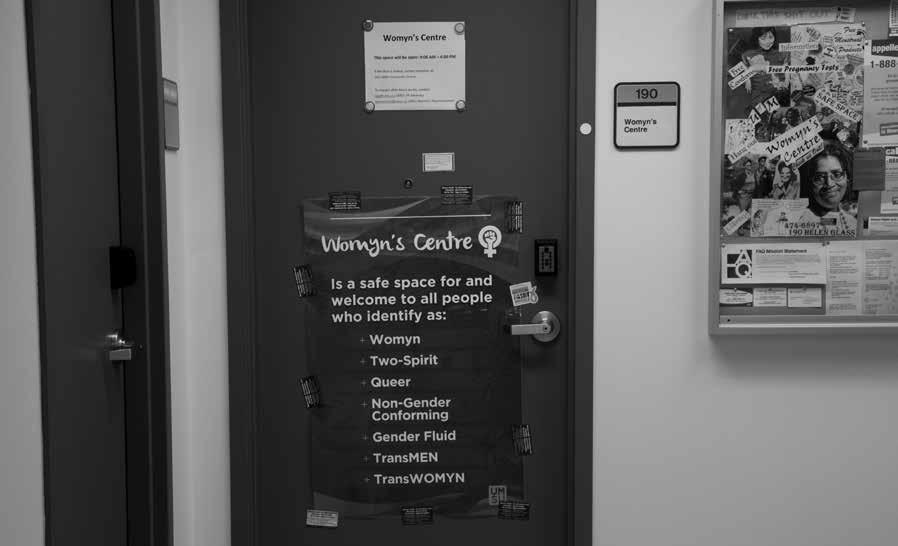
Changes to the organization of the University of Manitoba Student’s Union (UMSU) community groups are being criticized by the Womyn’s Centre Collective, which says the reorganization will “directly threaten our safe space.”
A post published on the Womyn’s Centre Facebook page on Aug. 30 called for the support of the wider community to respond to structural changes coming to the UMSU community coordinator position.
The post was not signed, but published by “the former coordinator of the womyn's centre.”
“UMSU
lied about these changes and went behind our backs to completely change the way our safe space operates” - Womyn’s Centre Collective
Taylor Byrnes was the centre’s coordinator in 2016-17. Byrnes did not respond to requests for comment directly but through a statement released by the Womyn’s Centre Collective.
Under the proposed changes, the union will no longer hire a part-time coordinator responsible for each of the four community groups under UMSU.
Instead, one full-time coordinator position will be created to cover all four groups.
The four community groups include the Womyn’s Centre, the University of Manitoba Aboriginal Students Association, Rainbow Pride Mosaic, and the Student Accessibility Centre.
UMSU president Tanjit Nagra said the organizational changes are
the union’s response to students who said the centres were not serving their intended purpose.
The Facebook post claims the decision was made by UMSU “without the consent or consultation of each community,” and that community members are heading into the school year entirely un aware of the changes.
The post also expressed concern in regards to the increased workload and responsibilities that would be passed along to UMSU community representatives and members as a result of the change.
In a statement sent to the Manitoban signed by the Womyn’s Centre Collective, the group outlined its concerns, saying “UMSU lied about these changes and went behind our backs to completely change the way our safe space operates.”
The Womyn's Centre Collective further accused UMSU of violating its own bylaws by not allowing the university’s community groups to operate independently under their own constitution and claimed the union “infringed on the rights of the many students who make use of these space.”
The statement further notes that UMSU “changed the door code to the centre and created open hours from 9-4, leaving no one to watch over the centre to prevent theft and misuse.”
After the Aug. 30 post was published, a letter was issued to the former coordinator from UMSU legal counsel, who is demanding that no more posts be published and administrator control of the account returned to the union.
UMSU has since created a new Facebook page for the community group.
UMSU president Tanjit Nagra said the union is “not pursuing legal action at this time” and rebutted the charge students were not consulted.
“We actually heard from quite a bit of students that they felt the spaces were unwelcoming,” she said.
“They felt that they weren’t serving the purpose that they were originally created for.”
Calling the change to the community coordinator position “minor,” UMSU vice president advocacy Allison Kilgour said it will “make the centres a lot more accessible since we’re actually going to have someone here to make sure they’re open, regular business hours, always have someone on hand to deal with dayto-day problems.”
Nagra said the push for the change began last year, under the direction of former vice president advocacy Dara Hallock and former vice president internal Adam Pawlak.
“One thing from a governance angle that I really saw and wanted to fix was the disconnect between the elected representative for the community verses the coordinator and the actual folks that go to the centres,” said Nagra.
Nagra added that if the proposed arrangement fails, UMSU will reevaluate and consult again with community members.
Both Kilgour and Nagra agree the change will allow the elected community representative s to focus on advocacy.
“We did make sure that we spoke extensively with all of the elected reps and had their consent and their agreement to this before we went forward” – Tanjit Nagra, UMSU president
“One of the misconceptions, I think, was that that the rep is suddenly going to have a lot more responsibilities,” said Kilgour.
“When really what the job description has always been, in our bylaws, is, you know, to kind of be the face for the community, to kind of lead the initiatives, chair the meetings, and work with the collective.”
Kilgour pointed out that the elected representative is meant to act as the point person for the respective community and that this role has shifted to the coordinator in the past few years.
Kilgour said the job description for the new position outlines that the person must be an ally to each of the different groups, must have an understanding of the issues they face, and, if needed, must be willing to undergo training to address any concerns on those accounts.
“It’s important to know that we definitely really tried our best to involve our community in on these decisions,” Nagra said.
“We did make sure that we spoke extensively with all of the elected reps and had their consent and their agreement to this before we went forward,” she added.
PHOTO BY ASHA NELSON
Study compares access to mental health and addictions care services across provinces
Manitobans have the highest suicide attempt rates amongst youth, better access to care among provinces studied
SHADEN ABUSALEH, STAFF
ACanadianstudy published in July is reporting that adolescents and young adults have the poorer access to mental health and addiction care compared to older age groups.
The study, “Toward Quality Mental Health Services in Canada: A Comparison of Performance Indicators across 5 Provinces,” was published on the website of the Centre for Applied Research in Mental Health and Addiction.
The report compares mental health and addiction service care among five Canadian provincesBritish Columbia, Alberta, Manitoba, Ontario and Québec - through developing six health care performance indicators that collected mental health and addiction care performance data
These indicators include whether an individual with a mental disorder or addiction had ongoing access to the same family physician, whether the first treatment contact was at a hospital emergency department, and whether there was a physician followup after hospital discharge.
The study also compared rates of suicide attempts, rates of death by suicide, and overall mortality among people diagnosed with a mental disorder or addiction.
The study reveals that, compared to four provinces studied, Manitobans fare better in terms of access to family doctors and reliance on emergency departments for
mental health and addiction care but have the highest suicide attempt rates amongst youth.
This study is the first to make a detailed, extensive comparison of mental health and addiction care performance among multiple Canadian provinces.
James Bolton, associate professor and director of research in the department of psychiatry at the University of Manitoba’s Max Rady College of Medicine, was part of the team of scientists that conducted the study by analyzing existing data from the provincial health-care systems.
“This is a very important study and it’s landmark in Canada because it’s the first time that we’ve been able to look with this degree of detail at all these important measures of the quality of mental health services and the outcomes of people with mental health and addictions,” Bolton said.
Bolton said the study proves just how important it is to collect data on the quality of healthcare in regards to mental health and addiction services.
“For several decades, numerous stakeholders have been asking for detailed data on how people do with mental health and addictions issues,” he said, “and for the longest time we haven't had that data.”
“If we’re going to improve the kind care that people with mental illness receive, we need to get a sense of what that care looks like in the different provinces of our country,” Bolton added.
Where Manitoba stands
“It’s very interesting to see how Manitoba compares,” said Bolton. “So, in certain measures of care we do very well, and in others we need improvement.”
“The area of concern in Manitoba is the rate of suicide among Manitobans with mental illness and addiction and in particular among young people”James Bolton, U of M associate professor and director of research psychiatry department.
According to the study, Manitobans fare well in primary care management of mental health and addiction care.
Manitoba demonstrates high rates of physician access for young adults, relative to other provinces, with over 80 per cent across all age groups reporting ongoing access the same family doctor. Additionally, Manitobans rely less
on emergency departments for mental health and addiction care needs,
having the lowest percentage of first contact to emergency departments for mental disorders and addiction in comparison to other provinces studied.
However, suicide attempt rates among Manitobans are higher than the other provinces studied.
“The area of concern in Manitoba is the rate of suicide attempts among Manitobans with mental illness and addictions and, in particular, among young people,” said Bolton
The rate of suicide attempts per 1,000 Manitobans between the ages of 15-24 is above 10 per cent.
Bolton explained that while this study provides an outlook of the data collected, it does not address the reasons why Manitoba experiences such high rates.
“You can begin to think about what some of those reasons might be,” he said.
“We have a large northern rural population that has more limited access to care and we know that there’s high rates of suicide attempts among that population. So maybe that is one of the reasons driving that finding.”
Moving forward
Through observing the quality of mental health and addiction care across these five provinces, this study will act as a critical initial step
to improving the quality of mental health and addiction service systems for Canadians.
“This paved the road ahead for what needs to be done,” said Bolton.
Bolton added that, “For Manitoba, specifically, clearly we need to do something to improve suicide prevention.”
Bolton noted that some of the changes that need to be implemented include providing more resources for young people, to address their mental health care needs before they become life threatening, and improving access to mental care post hospital discharge.
Bolton said he believes that this study can help inform future policy decisions as it provides awareness of the scope of the problems and identifies the areas in need of improvement.
“This study is foundational in terms of informing health policy and the provision of care for the mentally ill in Manitoba,” said Bolton.
“This information is now there for decision makers in health and decision makers in government to be able to forward the agendas of mental health care.
"These are areas where we need to involve stakeholders, work with patients, work with families in order to get better healthcare for those people in that time of need.”
PHOTO BY ASHA NELSON
Although Manitoba fares well in certain measures of mental health and addiction care services, Manitoba has the highest rate of suicide attempts amongst five provinces researched in a study released in July.
Winnipeg group hosts public forum on race and white supremacy
Silence is Violence event draws almost 200 to U of W
SHADEN ABUSALEH, STAFF
Approximately 200 people gathered at the University of Winnipeg’s Bulman Centre Aug. 23 to participate in Silence is Violence, a public forum aimed at establishing a community conversation on race and white supremacy and providing support for those in need to voice their concerns.
The event was hosted by Black Space Winnipeg - a local grassroots organization that aims to encourage dialogue and create safe spaces for people of colour – as a response to a shared concern regarding the events that took place in Charlottesville earlier this month when violence erupted due to clashes between white nationalists and counter-protesters.
Following two days of unrest that included a white nationalist rally at the University of Virginia, protests turned violent when white supremacists were confronted by counter-pro-
testers, resulting in the death of 32 -year-old Heather Heyers after a car was driven at high speed into a crowd of anti-racist, anti-fascist activists.
In Winnipeg, more than a dozen instances of anti-semitic graffiti have been discovered on benches and pavement along Wellington Crescent and in Omand Park in the past weeks, raising concerns among Jewish groups and local residents.
Graffiti referencing the Ku Klux Klan has also been spotted on the pedestrian bridge connecting the Forks and South Point Park.
Adeline Bird, vice president of Black Space Winnipeg and host of the podcast Soul Unexpected said she was not shocked by the graffiti.
“None of this surprises people of colour,” she said.
“I think that’s something the public needs to understand. This has been happening for a long time. Our par-
ents have seen it, our parents’ parents have seen it. This is nothing new.”
“I think [what] we have to understand,” Bird added, “is violence and racism doesn’t always look like graffiti.”
The event started at 6 p.m., and was initially open only to members of the black, Indigenous, and people of colour (BIPOC) community.
An hour later, the doors were opened for others to join the conversation.
Members of the community stood in line to share their opinions, concerns, and stories with the rest of the audience.
Kobra Rahimi, a recent graduate from the U of M’s Robson Hall Faculty of Law, also said the graffiti seen in Winnipeg was not surprising. But she added that she was particularly disturbed when she saw for herself the KKK graffiti at the Forks.
“It makes it more scary, I think, to know that people feel safe enough to voice those hateful comments.”
Rahimi added that constantly comparing Canada to the United States blinds us to seeing the already existing hatred in Canada.
“I don't like that we always compare ourselves to the U.S., where we’re not that bad, where we didn't have people on the streets with tiki torches, you know,” she said.
“Why make that comparison when we do have these [racist] groups?”
A video released in August shows a self-proclaimed Nazi verbally attacking a Calgary teacher visiting Manitoba. In the video, a man tells the woman, Kaniz Fatima, to take her “head towel off” and “go back to your country.”
“When you are raised with a certain ideology that you can get away with xyz - of course you’re going to
stir things up, you’re going to be inappropriate, you’re going to be racist, you’re going to be misogynistic,” Bird opined.
“Whatever ugliness you’re going to choose to be, you’re going to be that because society has given you the permission to be that and do that.”
On what can be done in response to this, both Rahimi and Bird argued that allies and white community members need to take a stronger stance in calling out hate.
“I know it’s time for the white community to really start - this is your guys’ fight now - this is white people’s fight now,” said Bird.
“People are going to be upset, people are going to be pissed, people are going to be sad, mad whatever, but we have to figure this out because we’re killing ourselves.
“That’s all what we’re doing – we are killing ourselves.”
Editor-In-Chief: Garett Williams
The so-called free speech crisis on university campuses is a fabrication
Facing the consequences of hateful rhetoric isn’t censorship
SHAWN GARBUTT, STAFF
Aspectre is haunting Canadian university campuses - the spectre of free speech. All the left powers of Canada have entered into an unholy alliance to exorcise this spectre: postmodernist and protestor, ivory tower academic and cultural Marxist, student radicals and blackclad antifascists.
Or so the Canadian punditocracy would say.
The siren’s horn is being blown from across the political spectrum –but especially from the right - with words of warning on the threat universities allegedly present to freedom of thought and expression.
The argument hinges on a few basic claims: Firstly, that academia is infested by a left-wing hive mind. Secondly, that this hive mind cannot and does not tolerate dissent. Thirdly, that it uses political correctness and critical theory concerning the oppression of marginalized groups as justification for mobilizing protests that shut down debates. Fourthly, that all of this amounts to flat out censorship.
Now, the truth of the first statement is marginal at best. A 2011 analysis of a study conducted in 2000 shows Canadian professors only skew left in small margins.
In fact, the Canadian ivory tower is by and large planted at centre in terms of political leanings.
But even if it were granted that academics were, as a bloc, raging radical Marxists, it doesn’t give profree speech warriors the facts they
need to make a cogent argument. Holding left-wing political views does not translate to possessing the institutional power necessary to issue verdicts in favour of censorship on campus.
Forcing someone to face the social repercussions of their actions does not amount to censorship
Quite the contrary: universities are now more than ever administrations first and schools second.
This, on top of the increasing trends toward extreme precarity in the academic labour market, cripples the organizing power of faculty and leaves administrations as the powersthat-be at any university.
It is quite obvious that academics are no longer the key-holders to universities.
By and large, this leaves administrators as culpable for the charge that universities have abandoned free speech.
Yet this claim is just as much a sophism as right-wing overestimations of the left’s ability to control discourse.
Rarely do administrations shut down events, and in the cases cited
by pro-free speech warriors, events end up cancelled by direct or indirect cause of student protestors.
Importantly, student protestors are not agents of the state.
Rather, they are peers of the organizers whose events get shut down. And these events are getting shut down by the protestors’ own use of free speech.
This is where the argument comes apart at the seams.
So radicals are removing the public platforms of those with whom they disagree, be it University of Toronto professor Jordan Peterson with his specious gender science and hamfisted handle on political philosophy; attorney Marie Henein with her legal practice of character assassination for the benefit of men accused of sexual assaulting multiple women; Ann Coulter and her absurd theories of white supremacy built on paranoia and delusion; or Ezra Levant and his rag of a far-right propaganda machine.
The list goes on. Shall we take a closer look?
Peterson uses his voice to dehumanize and delegitimize the queer community. It was socialist organizers, heeding the words of the queer community, who used their voices to deny Peterson the chance to spread his intolerance at Ryerson University in the summer of 2017.
Heinen uses her voice to gaslight and silence women who charge her clients with sexual assault. It was
organizers championing the fight against rape culture and sexual violence who used their voices to deny Henein the chance to publicly celebrate her twisted legal tactics at Laurier university in the spring of 2017.
Coulter uses her voice to demonize minorities of all stripes. It was those student minority groups, organized in tandem by the thousands, who used their voices to stop Coulter’s public display of moral bankruptcy in 2010 at the University of Ottawa.
Now, allow me to belabour the glaringly obvious: in each of the cases where these individuals were denied a platform, it was primarily by organizations acting in the interests of those communities who pay the highest price for the speaker’s so-called free speech.
Forcing someone to face the social repercussions of their actions does not amount to censorship. Pro-free speech warriors claim a militant left is censoring their idols, of whom each are depraved either intellectually or socially.
What the former fails to recognize is that this so-called censorship is rather an exercise of the community putting limits on what speech is considered acceptable. The wealth of examples free speech warriors point to are by and large incidents in which groups or individuals receive blowback from the consequences of their speech by other groups or individuals exercising their own freedom of expression.
All this talk of free speech misses a fundamental question. Mainly, free speech and the apparent threat it faces is spoken of in the abstract. But what does free speech mean, concretely? Ad nauseam, free speech is said to be threatened. Whose free speech? Who is threatening it? Free speech warriors have a curiously general answer to these questions, one that doesn’t match up with reality.
There is no free speech crisis on university campuses, but there is a power struggle - one to seize the means of speaking freely
The real answer is that the free speech of the rich, powerful, and privileged is being challenged by those who are making their claims to actively participate in civil society known.
Those who have been historically sidelined from the realm of public debate and discussion are coming forward to let society know that the insidious rhetoric which justified their exclusion is no longer acceptable. There is no free speech crisis on university campuses, but there is a power struggle - one to seize the means of speaking freely.
For most of history, this right was reserved for an elite few. The actions marginalized communities are now taking to lay claim to this right and defend their humanity, integrity, and place in society could only be construed as censorship by the deleteriously ahistorical fanatics of an ideal that has never been actualized.
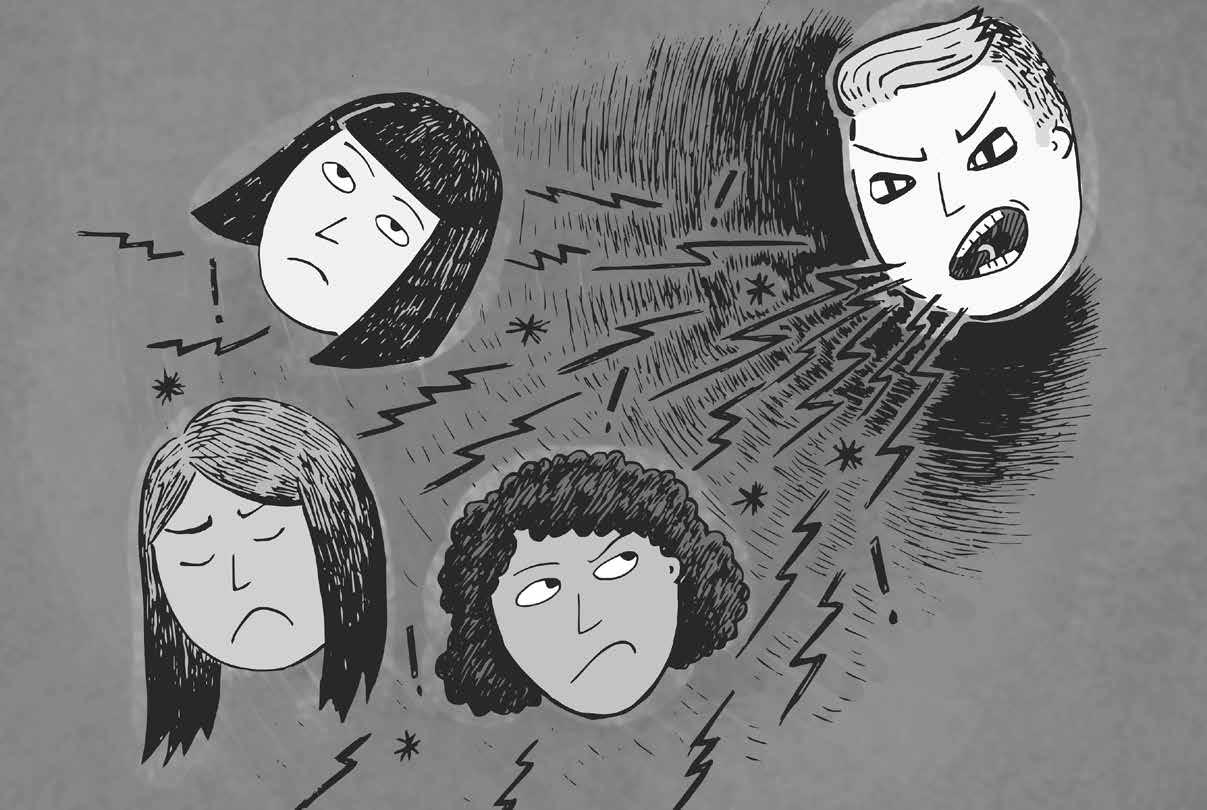
Free speech, in action, is not free. It never has been. There are conditions and responsibilities attached to the freedom that hinge on the contents of the speech. Speech uttered from the serpentine tongues of nascent bigots is especially not free. The cost is simply exacted upon the communities they spit their vitriol toward.
Quite frankly, the whining and wailing of free speech warriors on this matter is akin to the cries of a toddler who has experienced, for the first time, discipline for being naughty.
Free speech does not mean one can say whatever they so please without fear of backlash from – whether they like it or not - their fellow citizens. Rather, free speech simply means the state will not silence you.
This does not mean that the targets of your speech won’t.
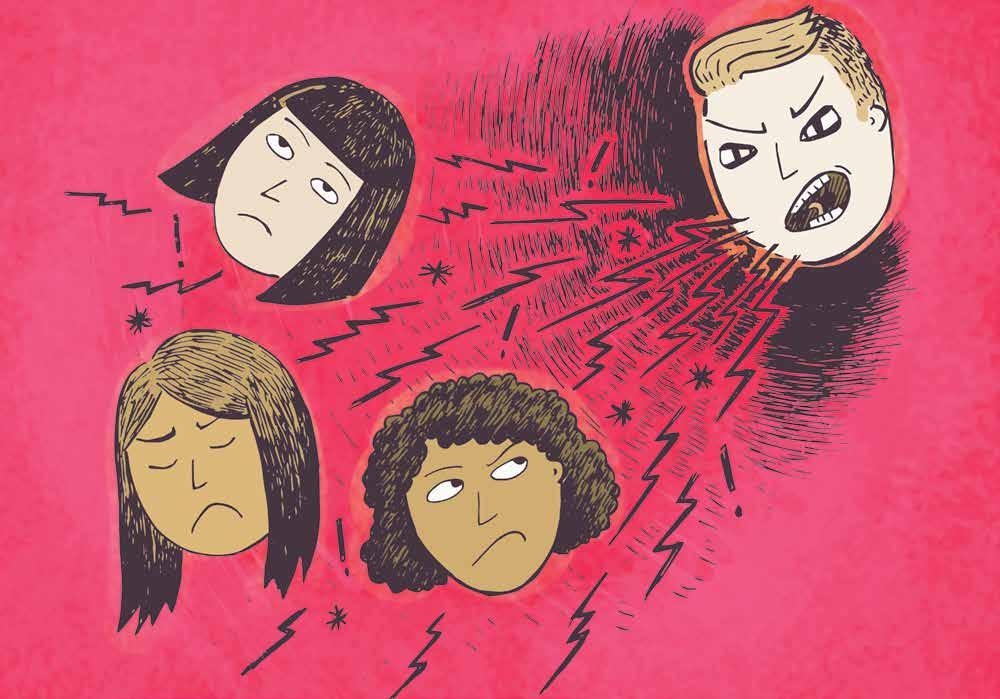
GRAPHIC BY KELLY CAMPBELL
UMSU needs its councillors if the union is to get on track
LEVI GARBER
L
ast year, I attended 14 University of Manitoba Students’ Union (UMSU) council meetings – more than some elected councillors –over nine months reporting for the Manitoban
In that time, I learned quite a bit about the organization that many of us only think of when picking up our U-Passes, avoiding campaigners during student elections, or reminiscing on the fallacy that was the credit card scandal surrounding J eremiah Kopp’s tenure as union president.
After all, who could forget when Kopp racked up nearly $14,000 in unapproved credit card expenses and an audit of his expenses was threatened by UMSU’s then vice president student services (VPSS) Jessica Morrison, who summarily resigned? Fun times.
Early in the year, I began to notice problems I believed needed to be addressed if the union were to act as a truly legitimate decision-making body for the undergraduate population at the University of Manitoba. As the year progressed, these issues only got worse.
This coming year, I again will not be expecting much in the form of serious action or advocacy on behalf of students from council, given that the last few years have been lacklustre on those fronts - at best.
To jog your memories on the year that was, here’s a recap: Just before an UMSU council meeting in September, VPSS Jessica Smith resigned from her position abruptly without offering an explanation to those who elected her.
Councillors did not, nor would they over the course of the year, publicly demand a reason for the executive’s desertion.
In October, UMSU vice president internal (VPI) Adam Pawlak revealed that the union had run
a $690,000 deficit the year before, which he placed blame for on discretionary spending, legal, and engineering costs.
Councillors just nodded their heads and blindly accepted Pawlak’s explanation that he would never let such careless spending continue.
Meeting after meeting, I watched as a group of illinformed sycophants sat back and let the executives pass whatever motions they fancied
In November, as the U of M was thrust into a three-week faculty strike, UMSU initially refused to take a side. Then, after two weeks had passed and most of the damage was already done with regards to students’ classes and exam schedules, council finally voted to support the faculty.
In December, UMSU deepened their feud with the Canadian Federation of Students (CFS) by demanding an apology from the federation’s national executives for the alleged humiliating treatment UMSU executives were subject to at the federation’s general meeting in Ottawa the month before, which they did not receive.
Over the winter break, there was a lack of controversy that didn’t last long.
In February, Pawlak resigned from his position as VPI after it was revealed that he had accepted a job as an aide for the PCs at the provincial legislature, an obvious conflict of interest.
Then came Bill 31 in April and the thawing of a tuition freeze that held increases to the rate of inflation
UMSU did nothing to oppose the legislation and even heralded the fact that tuition hikes wouldn’t start until the 2018/19 academic year as a success for the union. Some victory.
It seemed that following years of mismanagement and petty disputes between self-serving student politicians, last year was par for the course within UMSU’s beleaguered offices. Would it surprise many of you, however, if I said that it doesn’t need to be this way?
UMSU has the ability to raise its head above the waters of fatuousness that have not only made it impossible to get anything substantial done, but have also worn down students’ trust in those who lead the union.
The answer lies with the 45 or so elected UMSU councillors.
It needs to be made clear that responsibility for the decisions UMSU makes does not solely rest on the shoulders of the executives.
UMSU representatives from various faculties and associations share just
as much culpability, for better or for worse, with the five executives.
However, meeting after meeting, I watched as a group of ill-informed sycophants sat back and let the executives pass whatever motions they fancied.
The only times I witnessed any meaningful debate were during the meetings in which taking a position on the faculty strike were discussed or when CFS was dragged through the mud.
UMSU councillors are elected to not only represent the interests of their faculties and associations, but to also sit in those meetings in order to keep the executives in check. They can’t do that if the vast majority of the time council votes unanimously for or against a motion simply because an executive supports or opposes it.
There were members of the union’s council last year that tried to facilitate meaningful debate with their colleagues on issues ranging from event locations to the spectre of tuition increases. But, for the most part, their attempts fell on deaf ears.
Most councillors just didn’t seem to
care, or if they did, they kept silent because they wanted to avoid picking a fight.
That needs to change.
UMSU council meetings should be filled with passionate debates on major issues facing U of M students. Councillors need to show up to every meeting informed on the motions being introduced and ready to stand up for students’ interest, even if that could damage their relationship with the executives.
They must demand answers from the executives, not just accept their excuses.
If the members of council can manage to get their acts together, then it is possible for UMSU to make meaningful change for students.
As another academic year begins and council starts meeting regularly, councillors have a chance to ensure that this year doesn’t end up mirroring past years of misconduct and controversy.
Otherwise, they are just as much to blame for the union’s crumbling credibility as the executives.
PHOTO BY ASHA NELSON
Racism is an integral part of Winnipeg’s history
To chalk up recent racist outbursts solely as responses to American riots is not only wrong, it’s dangerous
MALAK ABAS, STAFF
“I’m a fucking Nazi, bitch! I’m a Nazi! You know what a Nazi is?”
In Seven Sisters Falls, just outside of Winnipeg, a passing connection between two strangers exploded into a one-sided violent confrontation. When Kaniz Fatima, a hijab-wearing Muslim woman visiting Manitoba from Calgary, asked Nick Wadien for directions, Wadien responded by proudly proclaiming that he was a Nazi, and that Fatima should “go back to [her] country” and “take [her] head towel off.”
When the filmed confrontation found its way to news outlets around the world, Wadien used the voice Global News offered to state that his actions were a response to the stress he was facing because “the ‘turbaners’ wouldn’t leave me alone, so I got mad.” He said he actually is not a Nazi, despite his filmed statements pointedly declaring the opposite.
The fabricated word ‘turbaners’ –which disturbingly insinuates that Wadien may have been mixed up on just what religious identity he was so filled with vitriol towards – aside, one could argue that the most frightening part of Wadien’s brief time on our collective radar is just how quickly he went from loudly declaring Nazi status to sheepishly recanting.
So what gives a man in this province the confidence not only to spit racist hate speech, but to expect his deeply idiotic reasoning for doing so to be taken seriously? More importantly, what makes him only one of many?
Cowardly racial taunts seemed to be an especially recurring presence in
Winnipeg’s news circuit this summer: between the pharmacy owner who was harassed by strangers in the middle of his daughter’s birthday party, the anti-Semitic graffiti littered along Wellington Crescent, and the Point Douglas resident who actually invited journalists into his home to see the swastika painted on his wall, August alone was rife not just with racist hatred, but confident racist hatred.
Winnipeg’s long history of protecting racists goes back as early as the 1930s, when the Canadian Nationalist Party (CNP) thrived in the city
The first answer that will come to many a reader’s mind might be the escalating racial tension south of us – Donald Trump’s presidency is seen by many as having been built on a basis of race-based and xenophobic cruelty and the recent “Unite the Right” rally and ensuing violence in Charlottesville, Virginia, is a powerful example of the consequence that comes when racists are given a voice by people in power. And while this is an astute observation, it is one that deftly sidesteps an important facet of our province’s history: Manitoba has
been home to active racists for a long, long time.
Winnipeg’s long history of tolerating racists goes back as early as the 1930s, when the Canadian Nationalist Party (CNP) thrived in the city. The CNP, which advocated for fascism and encouraged its members to harass Jewish immigrants, took notes from Nazi storm troopers, and in fact earned the approval of many.
One fan letter from an American Nazi in 1933 thanked a German citizen in Winnipeg for their “willingness to co-operate with us in establishing Nazi groups throughout Canada.”
The CNP was not just some underground collective, however. Its founder, William Whittaker, was able to procure police protection and support for CNP rallies.
If that itself was not enough to empower these disturbed people, members of the party were given explicit approval from Colonel Ralph Webb, Winnipeg’s mayor at the time,
to use Winnipeg’s army barracks for military training.
Fast forward 80 years.
Stephen Harper, prime minister of Canada at the time, uses public fear to his own advantage when he calls “Islamicism” – another fabricated word – the greatest threat to Canadian citizens in 2011. While Winnipeg’s history of Islamophobic hate is more brief, it is gaining speed at a sickening pace.
A Winnipeg group working to provide employment for Syrian refugees has been forced to remove many hateful messages from its social media profile.
Months earlier, a Muslim man leaving the gym found a slab of meat, presumed to be pork, placed on his windshield.
It could be that the only thing these people know about Islam is that its followers abstain from pork products, because the Manitoba Islamic Association has been anonymously mailed bacon.
While these attempts to frighten
or intimidate people in Winnipeg’s Muslim community may seem mild in comparison to what Muslims in other cities have faced, it is still racism put in action.
On Sept. 9, the hate group World Coalition Against Islam will congregate in Winnipeg. These are the actions of people empowered by the words of Canadian officials.
In 2015, Winnipeg’s long and continuing history of targeting disenfranchised peoples reached an international audience when Maclean’s magazine ran a cover story declaring Winnipeg the most racist city in Canada. The ensuing article included interviews with Indigenous residents of the city that claimed racist taunts were a constant in their lives. One interviewee especially noted that police would use their place of power in our society to mistreat him without reason.
The article made waves in Winnipeg. Mayor Brian Bowman choked up in a press conference not long afterward, stating that Winnipeg had a “responsibility to turn this ship around.”
Later attempts to turn said ship around included a march around the Canadian Museum for Human Rights organized by Bowman.
This province’s history sits on a foundation of racism and violence – the Red River Rebellion, which pitted Métis revolutionary Louis Riel against the white, English-speaking governor Sir William McDougall, was crucial to why Manitoba is a province today.
To ignore that and conveniently point the finger solely at the American alt-right disrespects every Manitoban who has taken direct action to fight back against fascism and hatred, be it the communist-led Anti-Fascist League of the 1930s, or the hundreds of people who attended the “Silence of Violence #WinnipegAgainstFascism” community discussion just weeks ago.
It is dangerous to continue to perpetuate the false notion that Canada is somehow the United States’ “nicer neighbour.” It is perhaps more dangerous to assume that identity and think we have only been tarnished recently by said neighbour.
Instead of patting ourselves on the back for not yet facing a situation like that in Charlottesville, it is more productive to realize that history has proven we are capable of the same hatred and violence.
White nationalist groups continue to survive in Winnipeg, and to continue to collate and fight back against this city’s lowest of the low, one must not only acknowledge this city’s dark past, but also utilize the knowledge gained from past experiences.
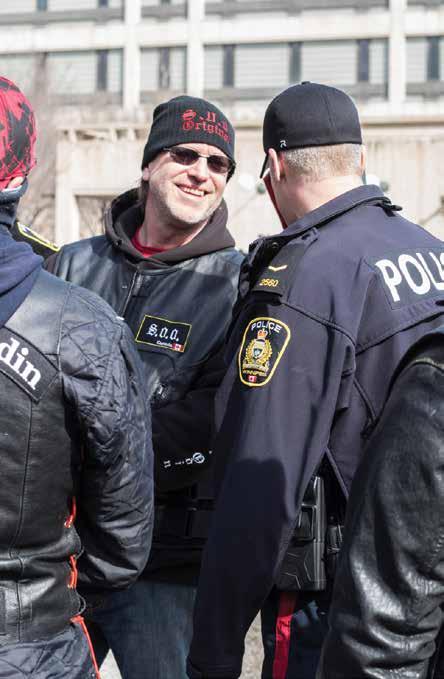
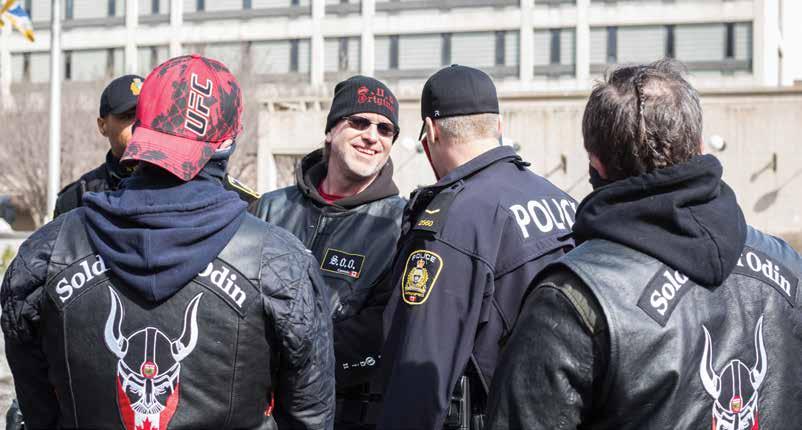
Members of Soldiers of Odin Canada, a self-declared neighbourhood watch group that has been accused of promoting racism, protest motion M103 – a non-binding federal motion condemning Islamophobia and religious discrimination – at Winnipeg city hall in March. Racist organizing in public spaces is nothing new to Winnipeg.
PHOTOS BY GREG GALLINGER
photos by asha nelson
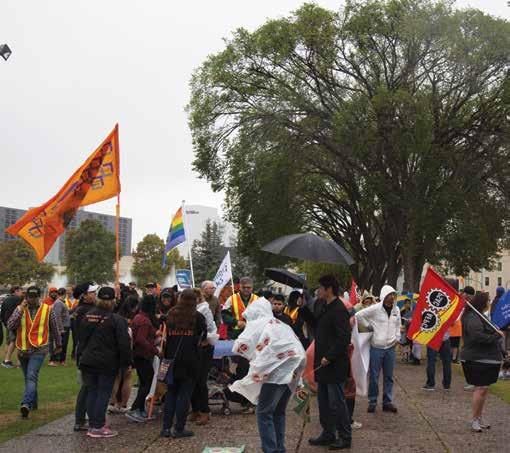
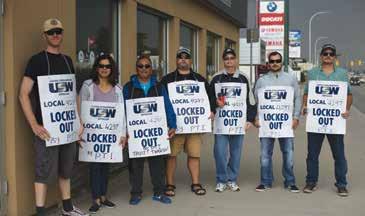
Members of the United Steel Workers, Local 4297 are locked out after failed negotiations with their employer. Workers are worried that the lock out will lead to a drop in to their Defined Contributions Pension and have taken to the streets on Labour Day to make their concerns known.
Left and above: Workers and their families gather in Memorial Park for the Winnipeg Labour Day March despite the poor weather.
September 6 - 12, 2017
Summer Lights Festival returns for second second run
BEN FIGLER
The second edition of Summer Lights Music Festival is set to take over Brandon in early September, and festival prep is kicking in full swing as the days count down.
Taking place at the Keystone Centre on Sept. 9, the one-day festival will feature headlining performances from Royal Canoe, The Zolas, and William Prince.
Rounding out the lineup are JP Hoe, Dave Quanbury, Sweet Alibi, Richard Inman, Lanikai, Shotgun Jimmie, and more.
Organizer Dylan MacDonald encouraged festival goers to show up early to the fest to see some of the great local acts.
"I hope people make a point of getting there early because our daytime artists are incredible,” he said.
“A few personal favourites are Richard Inman, Sweet Alibi, and Shotgun Jimmie."
In its first year, the festival hosted notable performers such as Said the Whale, Joel Plaskett, and Terra Lightfoot
“I hope people make a point of getting there early, because our daytime artists are incredible”Dylan MacDonald, organizer Image:
Two consecutive years of strong line-ups is a great start for this young festival which, with time, should only grow in popularity.
The tickets for the show are inexpensive and in addition to music, the festival offers free camping, good food, and craft vendors.
The fully licensed festival is taking off quickly MacDonald is amped up.
"I'm really excited to have Royal Canoe and The Zolas closing out the night this year, obviously most people know of Royal Canoe, but I feel The Zolas are a great pairing with them,” he said.
“They'll be out from Vancouver and their sound is a little more retro, so I think they're a perfect fit. Will Prince is also amazing - we try to make sure people feel some feelings before they dance their pants off."
With Summer Lights coming up soon, Winnipeggers and Brandonites should start heading over to the many ticket l ocations to snag a few.
Tickets for this show are just $20 for students and $30 for general
admission if purchased in advance. Tickets can be purchased online, at Little Sister Coffee, Thom Bargen
Game Changer: Manitoba’s Idea Competition is an exciting contest that will give all Manitobans an opportunity to identify global problems and work in teams to devise innovative, game-changing solutions.
Coffee, Music Trader, in Winnipeg and Ted Good Music/Fraser Sneath Coffee in Brandon.
PHOTO PROVIDED BY MATT DUBOFF
OLIVIA MICHALCZUK, STAFF
alongside artists Lev Snowe and Charlie Baby. Living Hour will be recording an album at the end of the summer and though they are leaders in their respective genre locally, they are hoping to develop a more mature sound with their upcoming record.
“We have been categorized as dream Pop, shoegaze, psychedelic pop, but with our new album we will be unveiling a much more mature sound in which we have melded a bunch of different influences to create a sonically diverse and unique vibe,” said guitarist Gil Carroll.
“ We are going to be debuting a bunch of brand new songs at this show” he added.
The current line-up consists of Sam Sarty, lead vocals, keyboard, trombone; Gil Carroll, guitar; Adam Soloway, guitar, vocals; Alex Chochinov, drums, trumpet; and Natalie Bohrn, bass.
Sarty’s vocal performance has an operatic style and is perfectly balanced with relaxing and captivating melodies that are precise with intention and instrumentation.
Living Hour has a truly mesmerizing live performance as the roster is filled with talented local musi-
cians that also play in Winnipeg bands like Palm Trees, Odd Outfit, Slow Spirit, and Veneer.
Living Hour’s Winnipeg performances have been limited by extensive touring over the past few years in support of their self titled debut album.
Five US tours, many Canadian tours, one European, and one UK tour later, Living Hour is set to record their sophomore album with Kurt Feldman, a talented producer that has worked with some respected names in music, including Chairlift, Dum Dum Girls, DIIV, and the Pains of Being Pure at Heart.
The last time local fans have been able to enjoy the sweet sound of Living Hour was headlining at Big Fun Festival in January, so the show is sure to be filled with fans itching to get their ears on some new tunes.
“The writing on our new album was a lot more collaborative,” said Carrol, “which has been a wonderful process and has allowed us to write our best songs yet.”
PHOTO PROVIDED BY ANDREA DAVIS
Le Burger Week returns to Winnipeg
OLIVIA MICHALCZUK, STAFF
The beginning of September marked the kick-off of Le Burger Week in Winnipeg, one of the city’s most popular culinary events.
“Today marks the first day of the highly anticipated Le Burger Week and seeing as I have a mere seven days to devour as many of the participant’s creations, I need to choose my burgers wisely,” said The Manitoban ’s burger critic, Taylor Barron.
Running until Sept.7, restaurants around the city will be rolling up their sleeves to make the best burger they possibly can in order to gain votes to achieve one of four awards: “Voted Best,” “Judge’s Choice,” “Most Outrageous,” and “Healthiest Burger.”
This year there is also the “buy a friend a burger” option. You can go online and purchase a burger at your restaurant of choice for someone else, which is unique to Winnipeg and Montreal.
This year, burger critic Barron is trying to make his way through as many of the 109 burgers he can in just one week. Check the Manitoban webpage daily to see what Barron has tried
and graded on a scale from one to five “Crusty Buns.”
Rudy’s Eat & Drink –Southern Surf n’ Turf Burger
The first burger I decided to try is one of the more unique burgers offered this year, the Southern Surf and Turf burger from Rudy’s Eat & Drink.
This burger quickly had my attention with its noteworthy sauce comprised of Cajun shrimp butter, roasted corn, jalapeño salsa and creole mustard. As a lover of both steak and seafood this quickly became a perfect match. The seafood twist to a farm favourite really paid off and paired very nicely. At first, I was unsure as to what I should expect but to no surprise it was delicious. Creamy yet crunchy with the perfect touch of a piece of fried shrimp as a garnish.
The one downside I found that this burger had was it was a little messy but cutting it in half it made it much more manageable.
I would absolutely recommend this and give it four Crusty Buns – Taylor Barron
18 Festival Review: Interstellar Rodeo
BEN FIGLER
Leading up to Interstellar Rodeo, my mind is filled with cynicism.
You guessed it, I am excited to witness Father John Misty's heroically large ego. Really, I can't stop singing his songs. Josh Tillman is a modern poet, perfect for the vulnerable, anxious, self-righteous reflectors of our time. It is with great pleasure that I share my experience at the festival on Misty here, but I can't leave out the obvious music royalty that is Beck, Broken Social Scene, Aloe Blacc, Shakey Graves, and local music labourers Figure Walking
Upon arrival, the atmosphere was quite typical for a music festival: hot sun, blankets on the earth, belly buttons, compostable cups full of local goodness. Bronuts and Pop Cart are casually hanging out just right of the central adult beverage bar. The popsicles may have been my favourite artist to take in.
Situated at The Forks, between the
skate park and the Red River, the festival directly showcased the Canadian Museum for Human Rights and the Provencher Bridge, which extended out above the main stage.
Interstellar Rodeo is an industry festival, catered to music enthusiasts on a large scale, but accessible, brand savvy, and casual enough that the locals who may not have dived head first into Broken Social Scene are still willing to shell out $8.00 for a single, but local, beer. Or $6.00 for an unqualified grower’s premium cider. And take in meals all weekend from the seven or eight hot and ready food trucks at the East side of the grounds.
The festival ’s mantra, "Just be awesome,” seemed to be an adorable way of saying "Don't mess this up for everyone" and it must have worked.
The MC spoke it all weekend, coercing the crowds into doing exactly such, noting that Interstellar makes a larger point than most festivals to
preach safety. Which is pretty awesome of them.
The festival didn’t focus much on the millennial crowd, with a high ticket cost for all three days. A young music lover could experience three locally run smaller scale festivals for about the same cost.
An idea that may help in that area would be adding more of a market for artisanal items and goods, as Winnipeg has no shortage of young entrepreneurs.
The Forks does have these markets available just over the hill but bringing them in could incorporate more of a community feel into their festival vibes.
As someone who has neither witnessed Beck's live show prior, nor really dug into his repertoire of eclectic hits, I can say that Beck mesmerized me. His show was hypnotic. With ear plugs to hear better and sunglasses to combat the insane light
show, I swayed into the illustrious songwriter’s set with unreasonably high expectations.
At 47, Beck put on an incredible performance, full of energy and the kind of aged artistry one would expect from the California born superstar.
Of course, he played 1994's “Loser,” but the new music is what I was happier to experience. Beck made a good point of playing down-tempo folk songs between multiple funk-hip hop masterpieces. The set made for an electric vibe throughout the festival grounds.
Sunday of the three-day music festival may have been my favourite, solely due to the fun-loving, outrageously soulful entity that is Aloe Blacc. Dressed to the nines, a full band of extremely enthusiastic musicians took to the stage with a different mantra. They arrived to funk it up and the audience was ready.
The love was pouring out of Aloe Blacc, who was so gracious and thrilled to be performing, preaching love to all of us through every idiosyncrasy. The keyboardist, a tall, slender, curly-haired individual, guided the band through layers of riffs and downbeat gold. Blacc interacted with the crowd constantly, prompting us to sing every second or third chorus. He even had the entire crowd split in the middle to form an aisle and dance one by one from the back of the crowd to the front of the stage. Hundreds obliged and tried out our most unique moves.
Interstellar went off without a hitch this year, and I am happy to have attended.
While it may not have the grassroots movement or the questionable late nights of other Manitoban festivals, it does have a good local food, central location, progressive logistics and hefty headliners.
PHOTO BY BRIAN GLUCK
Festival Review: Rainbow Trout Music Festival
First time RTMF attendee shares experience of good music, river relaxing, and great people
BLAKE FORTIER
Tucked away on the banks of the Rousseau River, just south of St. Malo, Manitoba, the Rainbow Trout Music Festival (RTMF) takes place in a location unlike any small festival you’ve been to before.
Upon entering the site, you haul your camping gear down into a miniature valley that makes you feel like you’ve walked into a remote oasis filled with everything you could hope for. On one side of the campground is a beautiful river that is always full of festival attendees basking in the sun, relaxing on tubes with a drink in hand. Or both hands.
This was my first time at Rainbow Trout, and I can tell you that having a river to take a dip in right beside the campground is an absolute game changer, a perfect escape from the often overwhelming heat of a mid-August day. Bordering the campground on another side just a minute walk away you have the stage, a beautifully laid out area complete with food vendors – including the delicious Johnny’s Sticky Buns – artisan vendors, a large tent for watching in the shade, and a raised stage with a vibrantly painted backdrop.
On the night of Aug. 18, the ninth instalment of the annual festival started off with a bang, transitioning from the energizing yet relaxing and smooth sound of Ivory Waves, to the beautiful melodies of the female trio Veneer, to the local rap group 3Peat, who never fail to get the crowd’s hands pumping up and down in the air.
After the music ended there was plenty of dancing left to be had as a DJ played a set under the night tent for those who were just having too much fun to settle down.
After waking up and going for a much-needed afternoon swim to cool down in the blistering sun, Saturday brought another day filled with exceptional music. Finding a shaded area in which to watch the stage from, the afternoon crowd was blessed with music from the likes of such bands as The Grey Jays with their upbeat melodies and catchy hooks, and the unique ambient sounds and hypnotic voice of Selc i.
At 5 p.m. there was a break in the music at the main stage as the festival gathered around a small man-made pond for an hour-and-a-half of open mic where attendees could sign up to play a song in front of the whole festival.
This open mic slot is an idea unique to RTMF and it was also absolutely one of my favourite parts of the weekend.
Artists were limited to just one song each. Hearing such a diverse group of artists playing a few minutes of their music, while adults and kids alike were splashing around and having water gun fights in the pond, was
as much fun as it was eye-opening to how much talent the music scene in Winnipeg and the surrounding area has to offer.
Saturday night was a party, to say the least. The fast-paced indie group Slow Spirit took the stage at 9 p.m., right before a drag show called Sunshine Bunch left the crowd with hands either covering their mouths with joyous astonishment or lifted in the air with roaring applause.
The music really took off when the electro-R&B trio ATLAA S rocked the stage into early Sunday morning, followed by out-of-towners The Avulsions and reggae group The
Rastamils, who had everyone on the feet jamming to theie infectious rhythm.
The night wrapped up with the otherworldly Smoky Tiger playing a DJ set that, if you’ve seen Smoky Tiger perform before, you know is an experience that is almost impossible to describe.
As a first-time RTMF attendee, I could not have been more impressed, felt more relaxed, or had more fun than I did at this year’s festival.
With its picturesque location and incredible acts, Rainbow Trout Music Festival is one event that you don’t want to miss.