Transit trouble
Southwest Transitway faces funding roadbloack


Southwest Transitway faces funding roadbloack
MANAGING EDITOR Malak Abas me@themanitoban.com
NEWS EDITOR Malak Abas news@themanitoban.com / 474.6770
NEWS EDITOR Ryan Stelter ryan@themanitoban.com
COMMENT EDITOR Jacob Singleton comment@themanitoban.com
ARTS & CULTURE EDITOR Braiden Pergis arts@themanitoban.com
SPORTS EDITOR Jason Pchajek sports@themanitoban.com
COPY EDITOR Matthew Doering copy@themanitoban.com EDITOR-IN-CHIEF
DESIGN EDITOR Kellie Huynh design@themanitoban.com
GRAPHICS EDITOR Evan Tremblay graphics@themanitoban.com
PHOTO EDITOR Asha Nelson photo@themanitoban.com
PHOTO AND VIDEO EDITOR Quincy Houdayer quincy@themanitoban.com
Fax:
A “volunteer staff” member is defined as a person who has had three volunteer articles, photographs, or pieces of art of reasonable length and/or substance published in three different issues of the current publishing year of the Manitoban. Any individual who qualifies must be voted in by a majority vote at a Manitoban staff meeting. Elected representatives and non-students may be excluded from holding votes as volunteer staff members in accordance with the Manitoban Constitution.
The Manitoban is the official student newspaper of the University of Manitoba. It is published monthly during the summer and each week of regular classes during the academic year by the Manitoban Newspaper Publications Corporation.
The Manitoban is an independent and democratic student organization, open to participation from all students. It exists to serve its readers as students and citizens. The newspaper’s primary mandate is to report fairly and objectively on issues and events of importance and interest to the students of the University of Manitoba, to provide an open forum for the free expression and exchange of opinions and ideas, and to stimulate meaningful debate on issues that affect or would otherwise be of interest to the student body and/or society in general. The Manitoban serves as a training ground for students interested in any aspect of journalism. Students and other interested parties are invited to contribute to any section of the newspaper. Please contact the appropriate editor for submission guidelines. The Manitoban reserves the right to edit all submissions and will not publish any material deemed by its editorial board to be discriminatory, racist, sexist, homophobic or transphobic, ableist or libellous. Opinions expressed in letters and articles are solely those of the authors. Editorials in the Manitoban are signed and represent the opinions of the writer(s), not necessarily those of the Manitoban staff, Editorial Board, or the publisher.
DAVID ZIRANGEY, VOLUNTEER STAFF
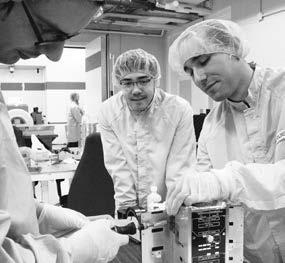
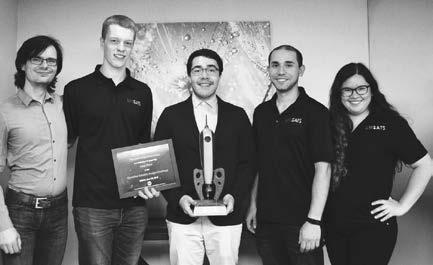
Fishing line, toaster element and measuring tape: three commonly found items, yet invaluable to a student-driven team whose resourcefulness can turn these items into parts of a functioning satellite-deploying system.
Five days before the U of M Space Applications and Technology Society (UMSATS) team was to head to Ottawa for the Canadian Satellite
“We are trying to make it easier for life to survive in space” — Valorie Platero, incoming UMSATS president
Design Challenge (CSDC) — an annual competition that challenges Canadian university students to design and launch a fully functioning satellite — team member Matthew Driedger prepared to dry-test the deployable antenna satellite made from a yellow measuring tape.
“One major challenge for all satellites [regardless of size] is making sure that your deployable systems are as close to 100 per cent reliable as pos-
sible,” said Driedger, a PhD student. “Because you can’t send somebody up there to give it a poke — to make the deployment work. So, the satellite has to be reliable. It has to be able to deploy without any worry when it gets into space.”
The deployable antenna system the team devised is held under tension by ultra-high-molecular-weight-polyethylene plastic line, commercially sold as fishing line.
UMSATS ensured its satellite would be able to deploy its antenna using the same principle as in a toaster.
When the digital command is given, a nichrome wire — a conductive alloy used in toasters and other heating elements — heats up and severs the fishing line by melting it. The antenna instantly unwinds and snaps into an erect position while the solar panels swing open like a pair of wings.
From June 25 to 28, UMSATS was at the Canadian Space Agency’s David Florida Laboratory, where its tiny, cube-shaped satellite was put through testing activities including a vigorous vibration test that simulates a launch into space.
The UMSATS team has not placed higher than second in three previous CSDC competitions — always performing impressively during the preliminary reviews, but
falling just short of the top position during the final testing and reviews.
This year, however, the team beat out competitors including students from the University of Victoria and Concordia University, which came in second and third respectively, to claim first place.
Innovation and accessible learning
Philip Ferguson is a faculty of engineering associate professor at the U of M and UMSATS faculty advisor. The team chose to bring him in last year to provide advice on small satellites.
Ferguson said groups like UMSATS have the potential to make to make the complexity of satellite building, something that may seem out of reach to some, more approachable.
“The ways in which the space industry has evolved over the past five decades, or just over five decades, has been to really make space systems more and more expensive, take longer and longer to develop, and, as a result, then get them out of the reach of groups like small student groups, or Indigenous groups in the North, that could really stand to benefit from space systems research,” he said.
Ferguson, who said he hopes to help make space exploration cheaper
and more accessible through his own research, explained that the students are currently challenging the status quo by pioneering the use of simple, inexpensive items to build satellites for space testing and exploration.
“They’re able to build these satellites on a shoestring budget using commercial technologies, using everyday items, and trying to push some of the kinds of technologies that, up until recently, have been sort of thought to be taboo in the space industry,” he said.
Ferguson added that within the industry it is common to hear criticisms along the lines of “’You can’t make a satellite out of 3D printing.’ You know — ‘What planet are you from? You have to make it out of a solid piece of expensive, machined aluminum,’ right? And so we’re trying to find ways to challenge these assumptions that have been made in the industry.”
The UMSATS team aims to eventually send living organisms into space via satellite with hopes of yielding insights into how to support life in space and on other planets.
In past experiments, the team used microscopic organisms called tardigrades. Because tardigrades are known to survive a host of extreme
conditions including radiation, extreme temperatures and low pressures, they fit the profile for the type of organism that would survive the harsh conditions of space.
“We are trying to make it easier for life to survive in space,” said Valorie Platero, incoming UMSATS president.
The team decided to take a step back this year and start from the most fundamental level of the food chain: the primary producers. They ended up choosing bacteria called Anabaena cylindrica, a photosynthetic cyanobacterium known to survive low-nutrient conditions.
The team plans to expose Anabaena to the harsh conditions of space and see whether the Anabaena will remain viable.
Neither tardigrades nor Anabaena have been sent to space by UMSAT because the satellites need to be further developed and go through more reviews before they are deemed space-ready.
For more information on UMSATS, contact the team at info@umsats.ca.

MALAK ABAS, STAFF
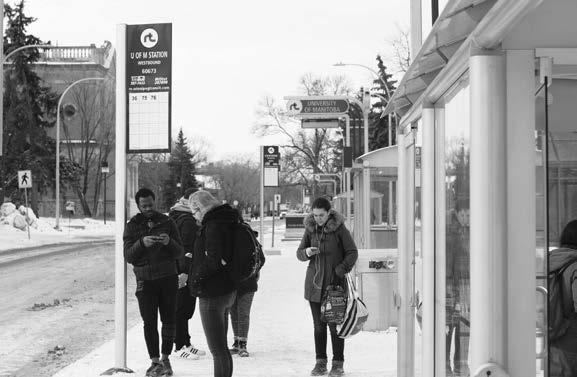
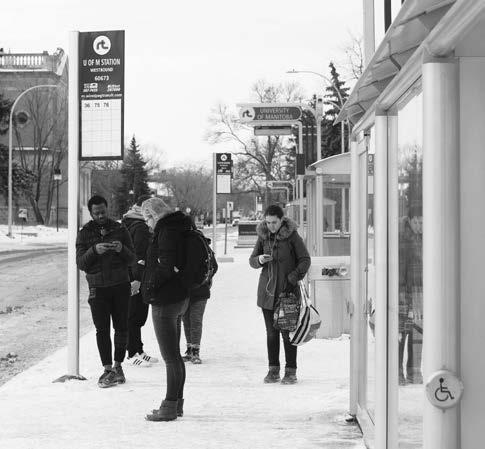
As the city of Winnipeg and the province continue to scrap over transit funding, U of M students find themselves in the crossfire.
Earlier this month, the city issued the province a demand letter threatening legal action if it failed to provide nearly $9 million for the Southwest Transitway, a more than $460 million project scheduled to be completed in 2020.
The Southwest Transitway is a roadway specifically for buses and separated from regular roads.
The first stage, completed in April 2012, runs from Queen Elizabeth
Way and Stradbrook to Pembina and Jubilee.
The second stage, currently under construction, will extend this from downtown to southwest Winnipeg, including the U of M.
The $8.7 million allegedly being held is earmarked to widen Pembina Highway at the Jubilee underpass and to construct a transit corridor.
Bowman first said the province was looking to renegotiate funding in February after the initial estimated cost was reduced from $587 million. The city and province had agreed to pay $225 million each, with the
federal government covering the remainder. The cost was reduced to $467 million in 2016.
A provincial spokesperson told media in February the provincial effort to amend the deal reflects the change in cost.
At an executive policy committee meeting this month, Bowman said he expected the agreement to be honoured, “especially given the fact we're currently building the second phase of rapid transit.”
Despite being in its second phase, there are signs that the transitway’s future is less than clear. Mayoral can-
PHOTO BY ASHA NELSON
didate Jenny Motkaluk recently said her platform may include scrapping whatever remains on the transitway project, including the stop at the U of M.
Southwest Transitway issues affect U of M students who use transit in their daily commute, especially since the introduction of the U-Pass, which provides unlimited transit services to full-time U of M students for a mandatory fee of $134.10 per term.
Julia Minarik, a first-year master’s student at the U of M, uses Winnipeg transit to commute to and from campus, and said more access to transit
throughout the city is a benefit for students.
“As a student who had to sell my car, things like the transit pass have been a lifesaver,” she said.
“In our harsh winters, the last thing we need is less access. I say less access because [over time] I think transit will only become more popular in the city.
"People are trying to be more environmentally friendly and this is one of many ways to do that.”
UMSU president Jakob Sanderson said negotiations for the new U-Pass
“Buses
are so important for a city, especially
for people like students who can’t afford other means of transport” — Julia Minarik, student
contract will begin this fall and are expected to last about a year.
“We believe strongly in the value of the [U-Pass] to make transportation more affordable and promote environmental sustainability,” he said.
“But it is unfair for students to have to pay for a service they cannot use due to poor bus service.”
Minarik said rapid transit will be beneficial to many Winnipeggers.
“Buses are so important for a city, especially for people like students who can’t afford other means of transport or are too scared to bike because there are no bike lanes or it’s winter half the time,” she said.
“So, in short, yeah, absolutely it’s a positive thing.”
QUDUS ABUSALEH
The U of M Students’ Union unanimously approved the creation of two accessible education working groups at its regular Board of Directors meeting June 21.
With sights set on examining student perspectives on the affordability and accessibility of post-secondary education at the U of M, UMSU president Jakob Sanderson said the groups’ efforts will revolve around the cost of course materials, financial aid, tuition fees, health care coverage “and anything else the group wishes to address.”
He said the first meeting will be held early September.
“At that point we will begin to develop questions that we will pose to the student body asking whether or not they feel education is affordable
for them, and in what areas financial constraints are most pressing.”
The working groups will meet on a bi-weekly basis.
All interested union members will be granted voting rights alongside delegates from every faculty association.
In his executive report, Sanderson outlined efforts currently underway to enhance the quality of peer tutoring offered on campus.
students that will also integrate existing tutoring systems of faculty associations.
The program is expected to go into effect Sept. 1.
Sanderson said his executive team
McGill University and Concordia University students, Sanderson said the union will begin “recruiting tutors throughout August and will be able to offer the service to those wanting tutors in September.”
"We will begin to develop questions that we will pose to the student body asking whether or not they feel education is affordable" — Jakob Sanderson, UMSU president
is drawing up plans to help students connect with tutors through a free mobile application.
Work is underway on an online database to connect tutors and
Partnering with Nimbus Tutoring, a tutoring service app created by
Currently, the U of M’s Academic Learning Centre, located in 205 Tier building, offers free tutoring and resources on writing and study skills.
UMSU Act amendments
UMSU Act amendments, passed before the union’s 2017/2018 board in
February, have received royal assent and have been enacted into provincial legislation.
The amendments include giving students the right to vote on any UMSU-related fee increases, making the act gender-neutral and mandating regular council votes on the union’s continued membership in external organizations.
Pointing to the fact that the union is largely funded by student membership fees, Sanderson highlighted the need “to make sure we are as responsive as possible to the students who fund our union and whom we represent.”
The amended Act “allows us to make sure they aren’t paying fees to organizations our board and/or our students feel aren’t in our interest.”

Editor-In-Chief: Garett Williams
@themanitoban.com / 474.6770
Editor
Contact:
EVAN TREMBLAY, STAFF

The recent announcement by Greyhound that it will be ending intercity bus service on all but one of its routes in Western Canada (and that, between Vancouver and Seattle) strikes a major blow to the quality of life of the residents of four provinces. It also exposes the danger of governments relying on private companies to provide essential services.
Although the daily pain of relying on Winnipeg Transit is familiar to Winnipeggers, the rest of the province is not more fortunate. For the elderly, infirm or those who do not have an automobile (or snowmobile in the winter) the options are passenger rail, airplane or bus.
Flying is expensive, and not all small communities have airports, meaning that even if an airplane goes to your destination, you may be on the hook for getting to the airport.
VIA Rail, a crown corporation, offers limited service, and is notorious
for being late (12 hours late on my two last trips), due to structural reasons related to non-ownership of tracks.
The passenger route to Churchill has been out of service for more than 400 days, because the American company that owns it has taken no action to fix damage caused by flooding.
With the loss of Greyhound service, few good options have become no good options.
For decades, the provincial and federal governments have refused to invest in intercity transit, preferring to rely on subsidies to private companies. This has meant that rural populations live at the whims of corporate profits and the province lives at the whim of corporate-decided routes.
Greyhound and Omnitrax do not make decisions about service based on economic opportunities or social needs. Rather than viewing transit as a tool for improving the social and economic fabric of the province, the attitude of the present government has been to imitate this profit-seeking
motive.
This attitude was highlighted by the announcement (since reversed after public outcry) that the province intended to shutter the Pine Grove rest stop on the Trans-Canada Highway, the only rest stop on the busy stretch of highway between Winnipeg and the Ontario border. When initially announced, Minister of Infrastructure Ron Schuler justified the decision by saying “20 kilometres either direction there are gas stations with food bars, where you can get out, stretch your legs."
Similarly, the cuts to funds provided to municipalities for public transit is based on a worldview that is penny-wise and pound-foolish.
Providing a reasonable level of transportation is not rocket science, nor is it some fringe luxury. Upfront investments represent a cost, but one that a government interested in the long-term development of its landbase would find justifiable.
GO Transit, the regional tran-
sit agency in the Golden Horseshoe region centred on Toronto, offers an example of the public good that is accomplished when governments step up and invest in transportation.
Serving an 11,000 square kilometer area and 70 million passengers a year, GO Transit operates a network of rail and bus lines that connect smaller cities to downtown Toronto. This allows residents of a broad area to avail themselves of services that will only ever concentrate in metropolitan centres, as well as making feasible more balanced population growth throughout the region. Commuters can work in Toronto and live in Hamilton, without need for a car to make the journey.
As a personal anecdote, the author of this editorial (who does not posses a driver’s licence) recently went from primaeval forest outside Peterborough to downtown Toronto in two and a half hours — a distance of 112 kilometers as the crow flies — for $18.80.
A system of similar vision in Manitoba would serve to connect currently isolated communities — and when there is no intercity transit, even a community as close to the metropolis as Steinbach is relatively isolated — and make economic and social development of rural areas losing population more feasible.
The system does not need to be similar in scale or mode to GO Transit; it needs only to embrace the same principle – connecting communities.
Manitoba is a province of vast distances, with many communities remote and isolated relative to the one large urban centre where services cluster. It should be a priority of the provincial government to see to the continued viability of these communities by providing adequate transportation.
Greyhound’s decision, though a hardship for Manitobans in the short term, is a gift insofar as it offers a clear call to action.
MICHAEL REDHEAD CHAMPAGNE

O
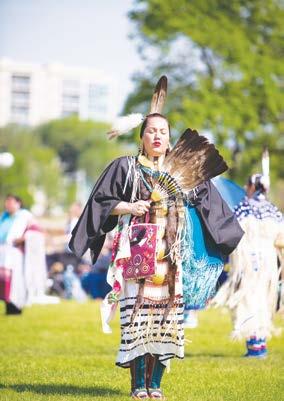
n Saturday, June 23 hundreds of people came together at the Forks in Winnipeg to celebrate National Indigenous People’s Day at APTN’s Indigenous Day Live festivities.
It featured live performances from local and international artists, comedians and visual artists along with local craft displays, informational booths, face painting, food, fireworks and even a powwow hosted by Manito Ahbee. This event happens every year but changes and evolves each time it comes around. This year, Indigenous Day Live happened in three communities concurrently: Ottawa, Toronto and Winnipeg. Highlights of artists who performed here in Winnipeg included Walk Off The Earth featuring the Walking Wolf Singers, William Prince, comedians Sasha Mark and Elissa Blackwolf Kixen and the Norman Chief Memorial Dancers.
home communities and those who haven’t had access to their cultural teachings or language, these events provide various entry points to cultural revitalization and community re-connection.
For those who were privileged enough to have been raised with their teachings, it’s a chance to share with children, youth, other Indigenous folks and, when appropriate, nonIndigenous people too. It also gives everyone an opportunity to publicly
urgent challenges we are also facing. The child welfare system, the justice system, homelessness, education and health all struggle to support Indigenous people. So along with the celebration, we must also stand in solidarity with Indigenous people.
I look forward to a generation of Indigenous and non-Indigenous kids growing up with their various cultures and languages intact; sharing with one another. A future where systems take care of everyone and Indigenous people and families are stronger, healthier and happier.
The child welfare system, the justice system, homelessness, education and health all struggle to support Indigenous people
appreciate and learn about the elements of First Nations, Métis and Inuit culture that make each of them distinct.
This can happen if all of us take every opportunity to celebrate with and stand in solidarity with one another.
Events like Indigenous Day Live give me hope that our communities will soon stand together every day.
As someone whose family has been affected by Indian Residential Schools and child welfare, I feel events like these are so important. For those who weren’t raised in their
Indigenous people can and should use this day to celebrate with one another. For non-Indigenous people, remember it originated as Aboriginal Solidarity Day in 1996 — that concept of solidarity is important. We can’t celebrate the very real successes and gifts present within First Nations, Métis and Inuit people without also acknowledging the very real and very
Michael Redhead Champagne is a community organizer and public speaker from Shamattawa, Manitoba, born and raised in Winnipeg’s North End. He hosted the cultural day stage at Indigenous Day Live 2018 in Winnipeg and is active in various culture and language revitalization initiatives through Aboriginal Youth Opportunities.