Manitoba Labour Board to rule on unfair labour complaint filed against the university by faculty union
UMFA is seeking various remedies, including individual and union compensation for strike costs, and the restoration of a salary proposal that included an average 17 per cent increase over four years
Imreet Kaur, staff
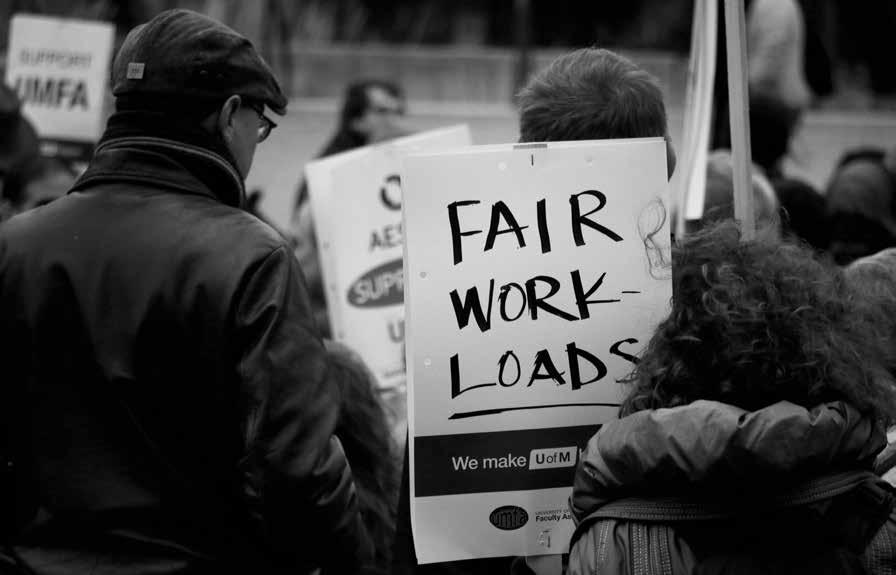
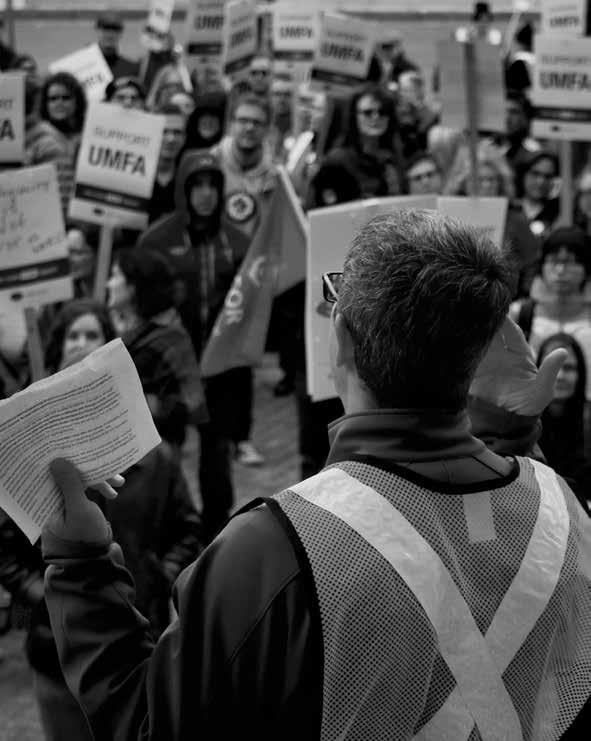
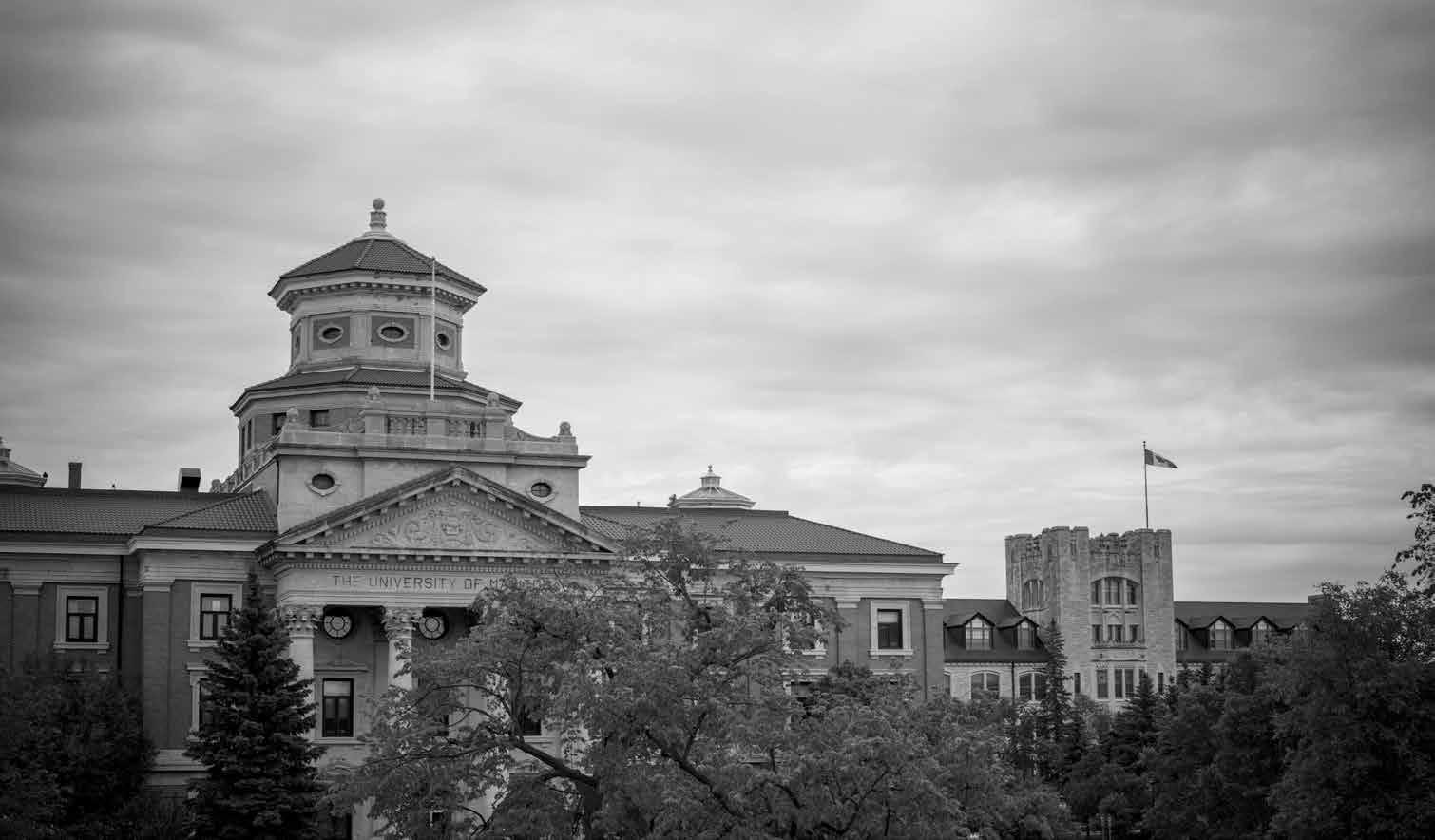
The Manitoba Labour Board heard arguments in May regarding an unfair labour practice complaint filed by the University of Manitoba Faculty Association (UMFA) stemming from the runup to a three-week strike last fall. UMFA, which represents over 1200 full-time professors, instructors and librarians, picketed for 21 days in November after negotiating for months with the U of M toward a collective agreement failed.
UMFA president Janet Morrill, who recently took over the union’s leadership, called the bargaining process leading up to a strike vote in October difficult.
“We were expecting to see accelerated bargaining but we weren't getting many bargaining opportunities and it was frustrating,” she said.
“Instead of both parties feverishly working to strike a deal, the U of M administration didn't seem to be moving very much.”
At the time of the strike, there was no legislation in place to freeze or cut public sector wages.
After the union rejected a fouryear proposal that included an average 17.5 per cent increase because it failed to address issued critical to faculty – collegial governance, job security for instructors and librarians, workloads, and performance indicators – the university took salary negotiations off the table.
Julie Guard,an associate professor of history and coordinator of labour studies at the U of M, said the province forced the university’s hand.
“The U of M had already indicated that they would increase salaries and agree to a multi-year agreement,” she said.
“However, the province directed the employer to retract any money offer – that it was to offer zero in salary increases – and to insist on a oneyear contract.”
The University of Manitoba bargaining team’s retraction of the salary offer, and withholding of information crucial to the bargaining process, constitute an unfair labour practice, according to the complaint filed by UMFA.
UMFA is seeking for various remedies, includ ing compensation for the union and individual members for the cost of the strike, an apology from the U of M administration, and the reinstatement of the final salary offer. The complaint further argues that UMFA's collective bargaining team was not made aware of the communication between the university
and Gerry Irving, secretary of publicsector compensation for the Province of Manitoba.
“The U of M administration had a choice and they chose to side with the government, ” Morrill said.
“UMFA didn't find out that the wages were off the table until mediation which was the weekend before the strike,” she added.
“The University of Manitoba,” she added, “is an autonomous institution and the province of manitoba shouldn't dictate 100 per cent of university’s operations with 45 per cent of the funding contribution made through an annual operating grant.”
Morrill said the provincial government has the right to appoint members to the U of M board of governors and it is through those appointments it exercises oversight over the U of M.
Guard said the university, not the province, is the faculty’s employer and the government should not insert itself into negotiations.
“The government has no direct role in collective bargaining between the employer and the union,” she said.
“The government’s actions were a problem as they were secretive and that it was targeted towards one union” - Janet Morrill, UMFA president.
“In the case of some public sector workers, the province is the employer and, of course, in those cases the province does negotiate. But the U of M is independent from the province.”
Guard said that any interference in the collective bargaining process may constitute unfair bargaining.
“The government ’s actions were a problem,” said Morrill, “as they were secretive and that it was targeted towards one union.”
John Danakas, the University of Manitoba’s executive director of public affairs, said the university was fair throughout the bargaining process.
“We await the conclusion. The university continues to stay confident in its position that it dealt fairly with the faculty association in the recent negotiations,” he said.
Whether the employer’s actions
constitute bad faith bargaining is up to the Labour Board to decide. Both sides are now awaiting the its decision, which is expected to come down sometime this fall.
The two parties eventually agreed to a government-mandated one year wage freeze along with adjustments to non-salary issues such as promotions, workloads, and job security.
According to Morrill, “UMFA made progress on the bargaining priorities.”
Morrill explained that UMFA earned the right for all faculties to develop workload guidelines in conjunction with the deans of respective faculties, and the right for the faculties to approve tenure and promotion guidelines.
“We didn't do as well as we had hoped for when it comes to job security, “ Morrill said.
“We did end up getting a letter outside of the collective agreement signed by members of the administration saying that there will be no lay offs [until] December 31, 2018.”
With regards to performance indicators, Morrill acknowledged that the union secured some language with the formation of a working group responsible for investigating more extensive language around performance indicators.
The most recent contract expired at the end of March. No dates have been set to begin negotiating toward a new agreement.
An UMSU press release published last week calls for “both parties to reach a settlement by midnight on Sept. 19, 2017, to guarantee students
academic stability for this year before the class withdrawal and fee refund deadline on Sept. 20.”
UMSU is further asking the university to offer full refunds and academic amnesty to students for the upcoming academic year if classes are interrupted again.
Responding, Danakas said, “ the university certainly understands the
concerns of the students and continues to try to begin bargaining as soon as possible as the strike was difficult on the entire university community especially the students.”
The provincial government has also indicated that it will seek a 15 per cent reduction in management positions at all post-secondary institutions.
photos by miguel yetman
UMSU opts for layered health and dental plan
Student union adopts multi-tiered plan allowing students to tailor their individual coverage
Changes coming to the University of Manitoba Students’ Union (UMSU) health and dental plan this fall will allow users to individualize their coverage.
At its regular council meeting May 30, UMSU finalized the nearly year-long process of developing a plan that allows students to choose between enhanced coverage, with greater benefits at higher premiums; a basic, more affordable plan with scaled-back benefits; or a combination of health and dental coverage
levels. Students with pre-existing coverage can still opt-out of the program.
UMSU president Tanjit Nagra said the plan allows students to select the level of coverage that most fits their needs.
“With the diverse student population we have, with diverse needs, it makes the most sense to move forward in this direction,” she said.
The enhanced plan will cost students $345 annually. The basic will run $245. U of M students paid $292 for
coverage in the 2016-17 academic year.
Undergrad and graduate students who remain in the program are automatically enrolled in the enhanced program but will be able to opt-down to the basic plan online through the program’s administrator, Studentcare, who will issue a reimbursement.
Individuals can also pair enhanced health benefits with the basic dental plan, or select basic health coverage with enhanced dental benefits to best meet their needs, said Nagra.
The enhanced health plan includes
80 per cent coverage for prescription drugs and vaccinations, $300 per year for MB Pharmacare, and health practitioner coverage of $50 per visit up to $300 per year.
“With
the diverse student population we have, with diverse needs,
it makes the most sense to move forward in this direction”
- Tanjit Nagra, UMSU president
The basic health plan includes 70 per cent for prescription coverage, 70 per cent coverage for vaccinations up to $150, and health practitioner coverage of $30 per visit up to $200 per year.
The basic plan does not include MB Pharmacare coverage.
Both the enhanced and basic plans include 100 per cent psychological coverage up to $600 per year. The enhanced plan includes $90 for eye exams and $200 toward glasses or contact lenses every two years.
The basic plan covers $60 for eye exams and $100 toward glasses or contact lenses every two years.
The enhanced dental plan includes 80 per cent coverage for basic and restorative procedures, 50 per cent coverage of endodontic procedures,
and four units of scaling with a total annual maximum coverage of $750.
Basic dental includes 70 per cent coverage for basic procedures, and 50 per cent coverage for both restorative and endodontic procedures, and two units of scaling with a total annual maximum coverage of $500.
The changes act upon the results of a survey circulated in November 2016 that indicated a majority of students support the multi-tiered plan.
Issued to both graduate and undergrad students, 74 per cent of the nearly 400 responses were positive.
Request for Quotations
At the same meeting, council voted to put off a process to issue a request for quotations to change its insurance provider for another year. Coverage is currently provided through Manitoba Blue Cross Nagra noted that there are no guarantees the quotes will come back with a lower rate and said it is simply easier to roll out the new plan without the added complication of looking at switching providers as well.
She also said that the more flexible plan may boost enrolment which, in turn, may drive down costs when the request for quotes is issued.
“Having more buy-in gives us a good deal, potentially, with different services providers,” she said.
“We are going to see how the plan works with the new changes,” she added.
“Right now, we want to ensure stability for students first and foremost.”
Canadian researchers leaving fundamental research at a rapid pace
m ala K a bas, staff
Arecent survey has found that the number of scientists conducting basic research in Canada dropped from 24 per cent to 1.6 per cent in just 10 years.
The survey was performed by the Global Young Academy, a society of scientists under the age of 35 from all over the world, founded in Berlin.
Over 1,300 Canadian researchers participated in the survey, which found that the Canadian government has sharply shifted its financial support away from fundamental research and toward applied research. Since 2013, basic researchers have seen the amount of funds available per person drop by 35 per cent.
The difference between fundamental and applied research lies in their goals.
Fundamental research generally has no end “product,” and instead pursues a greater understanding of the natural world through research. Applied research is more pragmatic and, when successful, results in a final product.
Global Young Academy argues that by defunding fundamental research, Canada risks destabilizing applied research since without baseline scientific findings, applied experiments have no base to work from.
It also suggests that deprioritizing basic research could result in discouraging a younger generation of scientists, who may turn away from careers in science if they see that more complex long-term research is not getting the funding it needs.
Global Young Academy measured Canada’s research funding by comparing its gross domestic expenditure on research and development (GERD) as a percentage relative to its gross domestic product (GDP) with other countries.
Canada’s GERD has dropped from 1.98 per cent of its GDP - an already relatively small percentageto 1.61 per cent between 2005 and 2014. Canada ranks low compared to other countries, including some developing countries such as Tanzania and Nepal. Canada is also the only G8 nation in the world to have so significantly reduced its GERD, with other G8 members increasing funding.
“Every academic can unequivocally tell you that the landscape of funding for basic research in Canada has been
changed and damaged beyond recognition over the past decade,” said a participant of the study working in the physical sciences.
This is not the first time this concerning drop in funding has been brought to public attention.
In 2014, a report from the French National Trade Union of Scientific Researchers found that Canadian scientists were concerned with government funding prioritizing industrial-based over fundamental research.
One of the consequences of this shift in funding has already begun to take place in Canada, as 88 per cent of the researchers surveyed reported that their research now relies at least partially on the support of external partnerships, which can lead to dis-
proportionate amounts of research based on the influence of external funders.
The survey finishes by suggesting that funding from the Canadian government should be more evenly spread amongst active researchers in Canada, enabling the creation of a more diverse range of researchers in the fundamental field.
It also suggests that the Canadian government invest at least $459 million into fundamental research programs, which would then be used to increase the number of successful grant applications, reintegrate successful researchers who lack funding back into the research community, and to offer more research opportunities to young people just starting out in the workforce.
photo by miguel yetman
Winnipeggers gather to “unsettle”
and acknowledge more than 150 years of Indigenous resilience, determination, and courage
Ottawa’s decision to spend $500 million on Canada 150 celebration “more symbolic than meaningful”
Imreet Kaur, staff
W
hile Canadaians celebrated 150 years of confederation on July 1, a handful of events in Winnipeg were meant to draw attention to this continent’s much longer – and complicated – history.
The Winnipeg chapter of Idle No More organized an event branded “Resilience 150” to acknowledge and honour 150 years of Indigenous resilience. Friends of Shoal Lake 40 hosted their own event, “Unsettle Canada 150,” in the spirit of reconciliation.
Idle No More is a Canada-wide movement that mobilizes to uphold Indigenous rights to sovereignty in order to protect the land and waters. The event aimed to encourage contemplation on 150 years of colonial history and the realities of Indigenous peoples across Canada.
“Shoal Lake 40 is sort of an iconic symbol of what has happened to many of Indigenous communities in Canada” Kathy Moorhead Thiessen
Sadie-Phoenix Lavoie, co-founder of Red Rising Magazine, student at the University of Winnipeg, and speaker at the event, said “for me, decolonizing, as an Anishinaabe, is going back to what it was like before colonization, like in terms of my teachings, my mind, and my spirit.
“It includes unlearning a lot of the assimilation that has happened.”
Lavoie said decolonization within society means learning Indigenous perspectives directly from the Indigenous peoples of Canada, and changing an oppressive system that incarcerates and criminalizes indigenous people for defending the land.
Indigenous groups refer to North America as Turtle Island and Lavoie
said the event was meant to pay tribute to their relationships with the land.
“To respect and to honour what it means to be on Treaty 1 territory, what it means to be on Turtle Island, and decolonizing the way [the government ’s] relationship is with the environment,” Lavoie added.
The Truth and Reconciliation Commission, which investigated Canada’s residential school's colonial legacy, issued more than 90 “calls to action” in 2015 it said are required to move toward reconciliation and build meaningful relationships between indigenous and non-indigenous Canadians.
“It is a huge list but very minuscule if you look at the overall impact of what has over the last 150 years,” said Lavoie.
“I don't think that the government is authentic enough in acknowledging the resilience of Indigenous people across Canada and understanding that they have no power over us – and that there is power with us,” she said.
Lavoie said the government has failed to respect Indigenous rights internationally by failing to implement the United Nations Declaration on the Rights of Indigenous People (UNDRIP).
Ottawa’s decision to spend $500 million on the Canada 150 celebration is “more symbolic than meaningful,” she observed that “it took decades to meet the gap on education funding for indigenous people on reserves."
“It is frustrating because they [the federal government] would rather spend half a billion dollars for one day on celebrating colonialism and genocide rather than uplifting and honouring the relationship with the Indigenous peoples of Canada,” Lavoie said.
Role of immigrants
Lavoie said there is a lot of catching up for new immigrants – and Canadians in general – to do to educate themselves on Canada’s relationship with its Indigenous peoples.
She said they are getting a onesided perspective from the govern-
ment and forming stereotypes around Indigenous peoples as a result, adding that “they need to acknowledge the fact that they are guests here.”
“There are a lot of great things Canada has done – for example, universal health care – but we need to understand that notions of taking care of the community comes from the Indigenous peoples of Canada,” she further added.
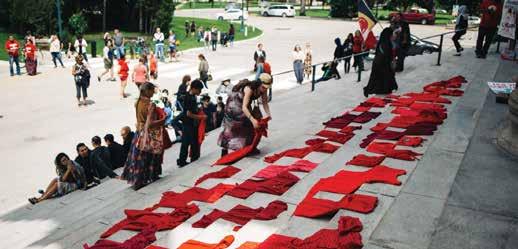
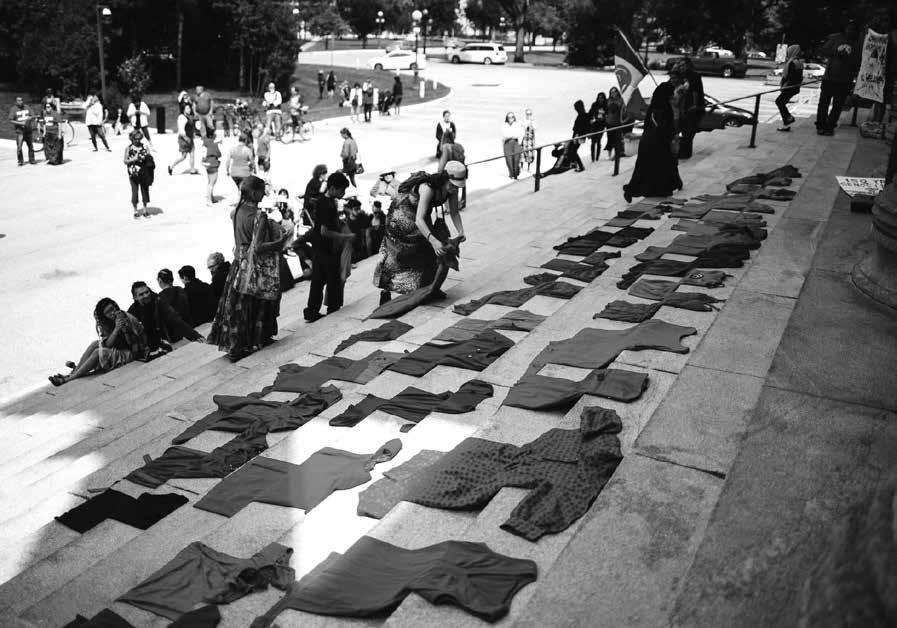
Toward the end of the event, Winnipeggers left red dresses on the stairs of the Legislative Building to commemorate the lives of missing and murdered indigenous women.
A little bit of “unsettling”
Friends of Shoal Lake 40, a collective of students, faith-based groups, community organizers, and nonprofit organizations, hosted an event called “Unsettle Canada 150” in the spirit of reconciliation to explore settler and Indigenous relations through spoken word and digital storytelling at Augustine United Church.
The group displayed artworks
encouraging people to reflect on Winnipeg’s relationship with the Indigenous community that provides the city with its water supply.
Shoal Lake 40 has been under a boil water advisory for the past two decades.
The group tabled educational materials such as copies of UNDRIP and the Truth and Reconciliation Commission’s “Calls to Action,” using Canada Day as an opportunity to educate the public about the impacts of colonialism.
Kathy Moorhead Thiessen, spokesperson for the Unsettle Canada 150 event and a Friends of Shoal Lake 40 member, stated that Canada’s 150th birthday has been highly publicized without a sincere acknowledgement of the history before confederation.
Thiessen said Friends of Shoal Lake 40 aimed to force settler Canadians to think about the indigenous people who have been on Turtle Island for so long, welcomed settlers with open arms, and have been treated brutally since then.
“Shoal Lake 40 is sort of an iconic symbol of what has happened to many of Indigenous communities in Canada," she said.
“It shows how Indigenous people were [made] invisible so that Winnipeg could have its water and it hasn't started to be corrected until almost 100 years later.”
The federal government, along with the governments of Manitoba and Winnipeg, have committed to help fund construction of a road linking Shoal Lake 40 to the TransCanada highway, connecting it to the rest of the country.
Thiessen also questioned the use of resources in spending $500 million on the Canada 150 celebrations.
“I don't know why so much money has been spent on this birthday,” she said.
“It seems like half a billion dollars could have gone into much more important things than one big birthday bash with fireworks where people get drunk .”
photo provided by jen doerksen of red rising magazine
Editor-In-Chief: Garett Williams
Latest UMSU press release misses all the points
Urging negotiations continue while provincial wage freeze challenge before court irresponsible
s haW n g arbutt, staff
One would think that the University of Manitoba Students’ Union (UMSU) had finally woken up from its apathetic slumber, what with the recent executive press release condemning a lack of haste in ongoing labour negotiations between the University of Manitoba Faculty Association (UMFA) and university administration.
One would think wrong.
Alas, UMSU remains fast asleep when it comes to the substantive issues it claims to speak to. This is most apparent in the empty grandstanding found in the union’s statement on negotiations – an issue the organization could hardly articulate a position on during a three-week faculty strike in the fall of 2016.
The union representing 1,200 professors, researchers, and librarians picketed for 21 days in November after months of negotiations failed to reach an agreement. While all classes were eventually completed in full, the disruption affected the remaining academic schedule and left students in uncertainty while negotiations unfolded.
Prior to the strike, UMFA rejected a four-year proposal that included average salary increases of more than 17 per cent, saying the offer did not go far enough to address concerns surrounding governance issues and performance indicators, while
failing to give faculty a stronger voice in guiding university policy.
After the proposal was rejected, it was revealed that the province mandated that the university negotiate a wage freeze, effectively taking salaries off the bargaining table.
The union filed a complaint to the Manitoba Labour Board as a result, claiming the university bargained in bad faith by striking salaries from negotiations. The case was heard in the spring. A decision has not yet been released.
The strike was ultimately settled after the university and its faculty agreed to a one-year deal that took steps toward addressing the union’s concerns concerning governance and performance indicators, but held salaries stagnant. That agreement expired at the end of March.
What is at stake in the latest round of negotiations between UMFA and the administration? UMSU was trivially correct on one thing: a lot.
But UMSU’s call for action – a demand to issue students full refunds if the coming academic term is interrupted by further labour action –spawned the uncertainty it claims to address by standing woefully ignorant of the surrounding circumstances. To speak out on a topic without addressing context is as naïve as it is unbecoming, especially for an entrenched organization geared
toward student advocacy.
Firstly, the claims UMSU made in its release. The union declared the lack of ongoing negotiation between UMFA and the administration intolerable for students. UMSU further asserted that the uncertainty concerning last year’s academic schedule following the strike was bad for students.
Curiously missing is the important fact that the provincial government is currently facing a lawsuit filed by the various public sector unions across Manitoba – including UMFA – which alleges the government’s controversial plan to freeze public sector salaries violates constitutionally enshrined collective bargaining rights.
With proper attention paid, it becomes clear the release misses so many marks that the bullseye, functionally, never existed.
Regardless of whether the government is found legally at fault, its declaration of intent to freeze wages itself has effectively frozen collective bargaining. Management has taken the cue, so to speak.
To be frank, the business of the provincial government has amounted to pulling an emergency brake for labour negotiations. If management refuses to consider, or is mandated to freeze, salaries, then further collective bargaining should await the
court’s decision on the legality of the government’s actions. Otherwise, a major issue for labour is moot before negotiations even open.
The current climate at the U of M calls for organizing union solidarity, not scoring empty political points
To think labour should find this acceptable and proceed regardless is fantastical thinking of the most dangerous kind. UMFA’s members remain among the lowest paid groups of professors in the country.
To acquiesce to the government’s wishes would mean further delegating the University of Manitoba to the back benches of national and international scholarship. Even opponents of last year’s strike - of the financially friendly type - can see how the current situation at the U of M is bad for competitiveness.
The current climate at the U of M calls for organizing and union solidarity, not scoring empty political points. If our student union really cared about students’ interests, then
it would be condemning a privatization-happy provincial government that would see the university sold off to the highest bidder. If our student union really cared about students’ interests, then it would be condemning an administration that continually cuts at the academic underpinnings of our university while pumping millions into marketing and capital projects.
If our student union really cared about students’ interests, it would not issue a press release that paints a false picture by neglecting crucial, relevant facts regarding the current situation at the U of M.
UMFA and the university administration are not similarly situated in current collective bargaining, nor do both parties have the same capacity for massively impacting the students. It is the administration which holds all the cards, but UMSU has presented an erroneous false equivalency in its depiction of events.
Students’ interests will only begin to be realized if the university population – students, faculty, instructors, service workers – band together to face the harsh light of our governance structure’s increasingly brazen neoliberalism.
Student and faculty unions should be working together, not against each other. UMSU’s press release contributes only to the latter.
photo by miguel yetman
Inclusion of queer people of colour in Pride parades is long overdue
Racism continues to be an undercurrent in the LGBTTQ* community
Karan saxenas
O
n June 17, four black protestors – one of whom identifies as transgender – were arrested at the Columbus Pride Parade in Ohio.
The activists blocked the parade and asked for seven minutes of silence, one for each bullet shot at Philando Castile, a black man killed following racial profiling and police brutality. The activists also wanted to raise awareness about the existence of and the hardships faced by queer and trans people of colour. One activist claimed that instead of receiving support, two white women laughed and spat at her as the protestors were being arrested. The question needs to be asked – where is the solidarity for queer and trans people of colour?
Each year, as Pride parades begin to take place across the world, white cisgender people and white allies seem to take up the majority of space, celebrating their sexualities clad in rainbow clothes. But this rainbow lacks the colours that matter most. People forget that many of the most prominent LGBTTQ* activists have been people of colour, such as Marsha P. Johnson and Sylvia Rivera. Despite this, people expressed outrage when a Philadelphia-based group asked for the addition of black and brown to
the current rainbow flag so often seen at Pride, and started a new campaign called “More Colour More Pride.”
More often than we think it is, racism is internalized in the LGBTTQ* community, be it subtle or not
There are a number of reasons why I believe that they should reconsider their opinion. More often than we think it is, racism is internalized in the LGBTTQ* community, be it subtle or not. Queer and trans people of colour have felt excluded from a many aspects of queer celebration. They have faced crude rejection on dating websites, where people are openly racist and employ harsh language such as “no blacks, no Latinos.” When these colours are added to the flag, it is a crucial step in putting an end to a cultural and racial barrier between queer people of colour and queer white people, who together are oppressed for being true to themselves. It is not to say that
racial minorities require their own stripes to be able to identify with the LGBTTQ* community. It does not imply that all queer people of colour face the same kind of oppression. Rather, the move acknowledges and offers solidarity to those who are marginalized because of the colour of their skin as well as their sexuality. When you wave a flag, use it as a sticker or even a button on your backpack straps, you make a statement.
The long road to 2020
The NDP has two very different candidates looking to
Manitoba's NDP will be selecting a new leader in September to replace former premier Greg Selinger, defeated in the province's April 2016 election.
The longest-running candidate in the race to replace Selinger, with multiple endorsements, is the rookie MLA for Fort Rouge Wab Kinew.
Kinew, 35, is well known in Manitoba and across Canada, with a career that has included journalism, music, and university administrat ion.
But he’s no shoo-in. Veteran MLA Steve Ashton recently announced his own bid for the top job in Manitoba's NDP. Ashton is a career politician who lost his most recent bid for re-election after having held his Thompson seat since 1981.
When you tally it up, this will also be Ashton's third bid for the job of leader of the NDP. In terms of policy, style, and experience, there is a distinct difference between the two candidates.
Kinew represents a change as well as an ability for renewal. As a rookie MLA, Kinew is new to the political scene, and has been touring the province and meeting with Manitobans
and the NDP party faithful.
Meanwhile, Ashton represents the past – perhaps the same past voters rejected in 2016.
While Ashton brings a wealth of experience, having served as a minister in both the Gary Doer and Selinger governments, one must remember that a young Doer, then a rookie MLA and seen as a "bridge builder," became the leader of a frail NDP party in 1988. He eventually led the party to three straight majorities, enjoying immense popularity in both rural and urban Manitoba. Whoever is leading the NDP needs to remember that they may have the job for a few elections before the party has a serious chance to form government.
During that time, said leader must work to build bridges within the community. Ashton’s leadership may not be in the best interest of the party if the party is looking to rebuild and seek new paths. Kinew has shown in scrums and in the legislature that he is passionate and willing to rebuild and renew Manitoba's NDP while remaining committed to the issues affecting the province today.
The NDP also needs to remember
You open up a conversation with those around you. The request to add these colours has already opened up the conversation about queer people of colour and the way their identities intersect.
Unfortunately, a lot of people still argue against the addition of these colours, believing that the acknowledgment of someone’s race will create a racial divide within the LGBTTQ* community. However,
lead the party
that it is facing a formidable competitor, electorally speaking.
Brian Pallister received the largest majority in the province's history, and has been given a clear mandate to govern. This, after running on a relatively bare election platform, stating that "there are no sacred cows" when discussing the future of government services in the province. The NDP needs a leader at the helm with a vibrant vision accompanying a strong direction if the party will successfully – and quickly – oust Pallister’s Progressive Conservative party.
Like Ashton, Pallister has a long history in public service as a career politician. A key minister in Gary Filmon's government in the 1990s, and later a member of the federal conservatives in Ottawa, Pallister has remained a social and fiscal conservative for the majority of his political career.
He faced criticism for a reconciliation bike ride where he did not engage with any First Nations people but left his tour to attend a PC fundraiser. A $300 million Cancer Care Manitoba facility, approved by the NDP, was axed by the new PC government.
if we keep avoiding the topics of race and racism, won’t we in turn create a more ignorant society that fails to see the differences between people, paving the way to bigotry by celebrating ignorance? If we really want to work towards achieving a society undivided by race, gender, and sexuality, we need to eliminate the stigmatization attached to various identities by accepting and celebrating our differences.
Regardless of the validity we deem Pallister’s actions to possess, he remains as premier until at least 2020. Pallister is essentially building on the ideology that Gary Filmon left the PCs with after losing in 2000. The difference is, Pallister's government is starting with a sweeping majority whereas Filmon's PC's entered government with a fairly thin minority. The political road is clear for the premier for a few more years at least. The key for the new leader of the NDP is to remember that a great deal
of Manitobans went out to the polls with the intent to vote PC. The next leader of the NDP must understand why that happened and address it. They need to be able to do this while presenting themselves as a new and appropriate alternative to Pallister in hopes of best managing change in the years to come. Whoever leads the party after September will have a big job on their hands, and to have any electoral success, will need to appeal to both new voters and current supporters.
graphic by kelly campbell
photo by levi garber
Grassy Narrows: Learning through action
Native studies students take the classroom to Asubpeeschoseewagong territory
Last month, 22 University of Manitoba students took part in a two-week program that situated them directly in the context of the Anishinaabe of Northenwestern Ontario to develop an understanding of their place as “treaty” people by engaging in the environmental and cultural politics of Grassy Narrows First Nation, also known as Asubpeeschoseewagong.
Some 89 kilometres northeast of Kenora, on the English-Wabigoon river system, Grassy Narrows is one of 28 first nation communities under Treaty 3, which covers more than 140,000 square kilometres in Northwestern Ontario and eastern Manitoba.
The community continues to experience the impacts of Canada’s colonial foundations – enduring over one hundred years of dispossession in their homeland and dishonouring of treaty rights through persistent resilience, determination, and courage.
Grassy Narrows lies within the “land of 10,000 lakes” and is home to the longest running Indigenous logging blockade in Canadian history, stretching back to December, 2002.
In 2014, the Supreme Court of Canada upheld the Ontario government’s right to permit logging on Grassy Narrows’ traditional land.
The case, brought to the Supreme Court by the people of Grassy Narrows, sought to defend their traditional lands from logging in conjunction with the blockade.
Nearly 15 years after it began, the blockade is ongoing and it continues to be an ode to the fortitude of the people of Grassy Narrows.
Learning through action
The “Grassy Narrows Environmental and Cultural Politics” program is a six credit hour summer course delivered through the department of native studies. The travel-study course, created by instructor Ryan Duplassie, attempts to provide a holistic approach in exploring the cultural and environmental politics affecting Grassy Narrows.
“Since my late teens I became really interested and concerned about environmental issues,” Duplassie said.
“My father’s side, we’re Anishinaabe. And so I understood myself as being somebody who has ancestral ties to the land and perhaps that informed my environmental consciousness.”
Duplassie said he hopes to demonstrate to his students the direct link between ecological and social struggles and instil within them an expansive notion of the meaning of “treaty.”
Explaining that “we are all treaty people,” Duplassie said Indigenous understandings of the treaty go beyond political contracts.
“They extend to a commemoration of our understanding of ourselves as embedded in the world in the set of relationships with the water, the insects, the soil, the fish, the fire, the wind, the sun, the moon, our ancestors, and our future generations,” he said.
Reflecting on her experience, Jenna Vandal cited the course’s unconventional teaching style as one of the reasons for her interest.
“I much prefer learning outdoors than in a classroom, especially when in relation to Indigenous knowledge and ways of being, so I jumped at this opportunity,” she said.
“I was internalizing only a small fraction of the neurotoxin that the community was, but I was also internalizing centuries worth of tradition, sustenance, and pride”Jenna Vandal, U of M student
“I’m also a native studies major, and a Métis Anishinaabe [...] so this course has educational and personal significance for me.”
The course consists of a three-day lecture series on campus where the class learns about the history of Grassy Narrows – from the signing of Treaty 3 up to the blockade.
This is followed by 10 days of camping at Grassy Narrows where students experienced living off the land.
Students then write four assignments which including reflective essays and a report.
“Every single person involved in this course was fantastic and committed to positive social change in their own unique way,” Vandal said.
“Meeting my classmates and the community
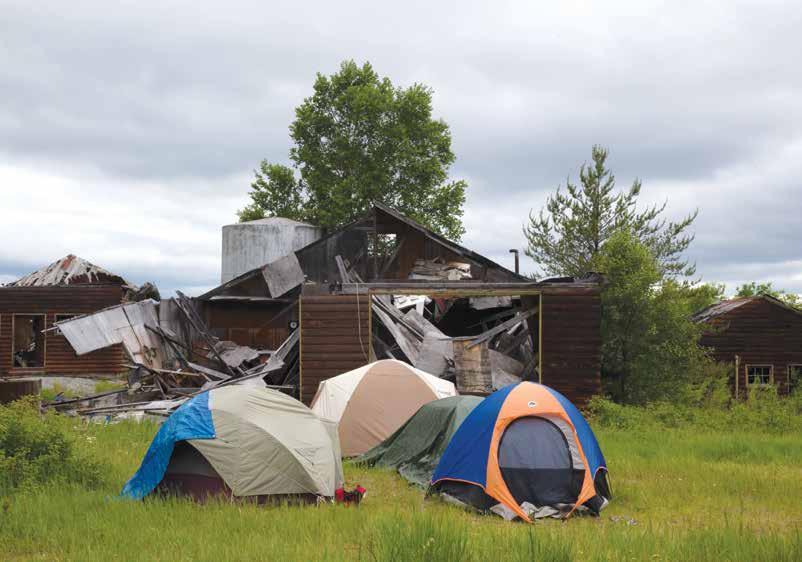
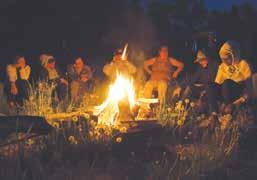
Students camping in the middle of Ball Lake Lodge: once a bustling fishing hub and key employer for Grassy Narrows. The lodge was closed following the discovery of mercury in the English-Wabigoon river system, leading to a dramatic rise in unemployment in the community.
Students were asked to attune themselves to the boreal environment and consider the importance and continued relevance of Indigenous knowledge in today’s world.
s haden a busaleh, staff Photos by AshA Nelso N
members was, without question, the best part of the trip. We spent time in nature, we built, partook in, and disassembled a sweat lodge, we picked medicines, spent the day at the Grassy Narrows community centre playing sports with the community members, saw pictographs, went fishing, and built slingshots, among other things.”
A legacy of mercury poisoning
Between 1962 and 1970, a pulp mill located in Dryden dumped 10 tonnes of mercury, a potent neurotoxin, into the Wabigoon River, contaminating fish stocks and poisoning generations of people for whom the river’s fish provided a staple source of protein.
First identified in 1969, the mercury has never been cleaned up.
Nearly five decades later, the impacts of mercury poisoning are still omnipresent; it is estimated that there are 9,000 kg of mercury in the river’s sediments.
Recent studies have found that 90 per cent of people tested in Grassy Narrows and nearby ndigenous communities have symptoms of mercury poisoning.
A Mercury Disability Board was set up in the 1980s following a court settlement, though the compensation levels – which range from $250 to $800 – have not increased since that time.
The mercury poisoning had a direct impact on the community’s traditional way of life as many continue to suffer the neurological symptoms of mercury poisoning - even people born long after the mercury dumping had ended.
“It is an opportunity for the students to figuratively and literally internalize the implications around mercury poisoning” - Ryan Duplassie, instructorv
Symptoms include sensory disturbances on the limbs, difficulty walking a straight line, difficulty seeing, visual disturbances, hearing impairment, headaches, insomnia, exhaustion, fatigue ,and numbness in the limbs.
“Of course when you’re talking about a landbased people who are traditionally going to be on the land fishing, hunting, trapping, gathering and you have neurological symptoms of mercury poisoning, well, you can’t do those things,” said Duplassie.
“So not only are they dealing with the economic fall out of the mercury poisoning, but they're dealing with the physical and medical fall out as well.”
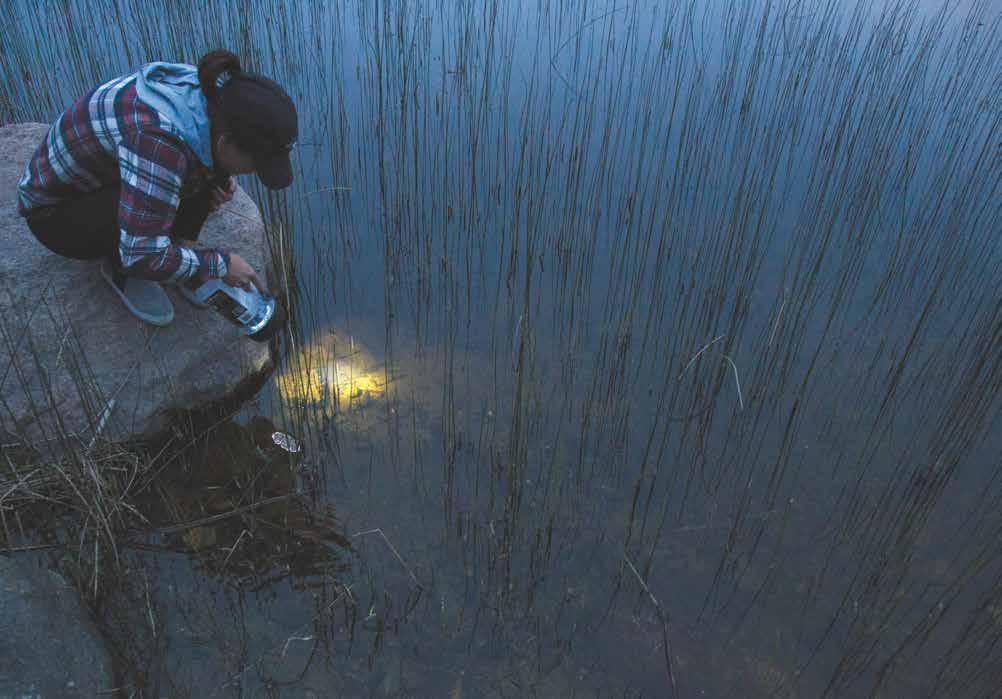
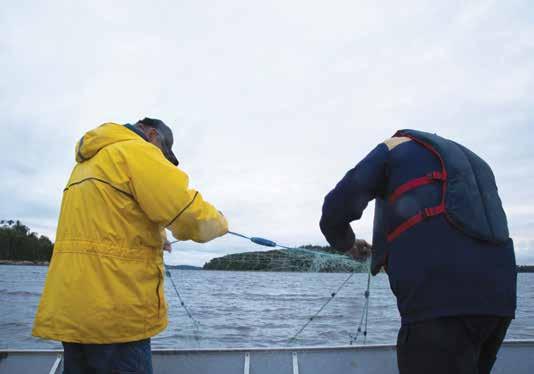
While at Grassy Narrows, students learned to set nets, ate fish, and drank from the water.
“It is an opportunity for the students to figuratively and literally internalize the implications around mercury poisoning,” Duplassie said.
“That, you know, they are eating fish and it’s got mercury in it and so they have to put themselves in a position of crisis, if you will.”
Vandal reflected on her experience fishing and eating from the contaminated river, explaining how drawing from the land connected her with the community.
“ This was a surprisingly healing experience," she
said. “I knew I was ingesting a minute amount of mercury in the water I drank, and in the freshly caught fish we ate, but to me it was a symbolic gesture of becoming closer with the land and the plight of the people who have endured so much more.
“I was internalizing only a small fraction of the neurotoxin that the community was, but I was also internalizing centuries worth of tradition, sustenance, and pride.
“I was happy to do so.”
Glass half empty vs. glass half full
In late June, it was announced that the government of Ontario would spend $85 million to clean up the mercury contamination around Grassy Narrows. Clean-up preparation work will be completed this summer, with remediation starting as early as 2018. An additional $2.7 million has already been set aside to accelerate work underway on the river.
Calling it too little too late, Duplassie gave a glass half empty versus glass half full analysis.
He said that while $85 million is a substantial figure, the river system serving Grassy Narrows is nearly the size of a water shed.
Additionally, as Duplassie explained, as water
flows, the affected sediments move.
This means that the mercury is a moving target. Problems therefore arise when determining where best to start and end the clean-up.
“How are they going to use 80 some million dollars to clean up a water shed of the mercury is beyond me,” Duplassie said. "It’s not to say that they shouldn't try, but I’d be very, very interested to see the details of their strategy.”
However, the positive side, quite simply, is that something is being done.
Duplassie explained that whatever the results of the clean up might be, he hopes it will involve the community members of Grassy Narrows through proper training and employment opportunities.
“I kind of see this as an economic opportunity, as sad as that is,” he said.
“If it's going to be anything, it could bring $85 million to the community, which would be huge.”
Room for hope
Reid Buchanan, another student who took in the course, spoke to the impact the course had on him.
“The knowledge and the experience with the people as a whole has been kind of invaluable to me and having a personal connection there, I think, can help solidify a lot of things that you learn about,” he said.
“It’s important that issues stay at the forefront and that we maintain connection. Its not just land and culture, this is people,” Buchanan added.
“And this is people who are emotionally, culturally and economically invested in their community and we need to do what we can to help them.
"They’re facing a lot of issues, but at the same time there’s so much positivity and so many good things going on there too and I don’t want people to lose sight of that as well.”
Duplassie echoed that there is always place for hope.
“Yes, climate change is real,” he said. “Yes, our water and land and air systems are becoming polluted. Yes, there is deforestation and erosion and desertification and acidification of the oceans and melting polar ice caps, yes – but we’re alive.
“There’s over 7 billion of us on the planet and the fact that we are actually all alive tells me that Mother Earth has the ability to keep us all alive.”
Reid Buchanan taking in a fishing net with the help of Shoon - local fishing guide, story-teller, and respected community member.
Barbra Fobister, prominent activist in the logging blockade, shares stories and lessons learned during her days spent at the blockade.
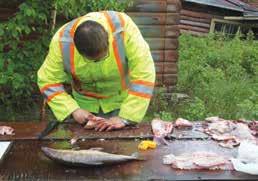
A fishing guide from Grassy Narrows First Nations teaches students traditional methods of preparing and smoking fish
Canada day at the forks
photos by asha nelson
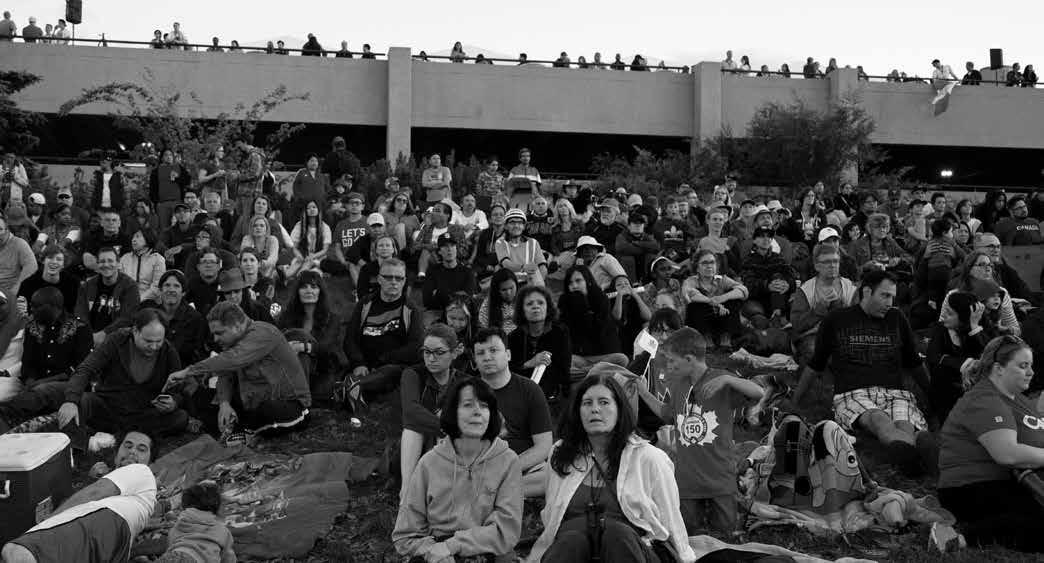
Hundreds of Winnipeggers take in Canada Day festivities at the Forks July 1.
Bison guard Justus Alleyn to represent Canada at Summer Universiade in China
B
ison guard Justus Alleyn is heading to China for the 2017 Summer Universiade that will take place in August.
Alleyn is just the second Bison to represent Canada at the International University Sport Federation games which run from Aug. 19-39. Martin Riley represented the University of Manitoba for the 1977 and 1979 games.
“I was just really excited” Alleyn said.
“I’m going to get to go to China, it’s somewhere that I have never been and the fact that the coaches thought that I was one of the top players in the country and being able to represent Canada at the same time it is just a big honour.”
The six-foot-two guard said he is excited to explore the country and
take in the other sports being played at the FISU.
“It looks like we’re going to have a lot of time to check out other parts of the country,” Alleyn said. “It’s a two-week event and we only play the second week, so we will probably have a chance to check out other sports as well.”
The 2016-17 Bison co-captain averaged 17.4 points per game and was named a Canada West second team all-star last season, as he helped lead the herd to their first nationals birth since 1986.
it all through the University of Manitoba,” Alleyn said.
“Honestly I have no clue what it’s going to be like. I’m just ready to soak it all in because I know it’s going to be one of those experiences I’m going
from a new coaching staff that may be able to help his team next season.
“I’m just ready to soak it all in because I know it’s going to be one of those experiences I’m going to remember for the rest of my life” – Justus Alleyn, Bison guard
to remember for the rest of my life.”
“This was one of the most eventful years of my basketball career and I’m just thankful I got to do
The University of Manitoba men’s basketball team will also benefit from Alleyn’s selection to the FISU games. The veteran is already the leader of the team, and will bring back knowledge
“This is going to be the highest level that I will play at,” he said. “It’s definitely going to help bringing that experience back to the U of M and the other guys on my team and just show them how we got to work if we want to be one of the best teams in the country again.”
Alleyn’s goal for the 2017-18 basketball season is for the Bisons to make a run for the Canada West Championship and secure a birth in a second straight nationals tournament.
“We’re just going to try and get
back to where we were last year at least,” he said. “We got a taste of nationals last year and I think everyone on the team is eager to get back and show that we can do it again.”
A lot of work may need to be done for the Bisons to clinch a nationals birth again, especially with a big chunk of last year’s team graduated. Co-captain AJ Basi, Keith Omoerah, Illarion Bonhomme, and others are no longer on the Bisons roster. However, Alleyn lacks no confidence when it comes to the young guys that will be suiting up for Manitoba this upcoming season.
“One of the toughest things for me to get used to next year is being the older, more veteran guy on the team,” he said. “I’m excited to work with the next generation of guys.”
photo provided by jeff miller
Early offseason moves have multiple Manitoban hockey players changing addresses
Jason Pcha J e K
W
ith the NHL entry draft, Las Vegas expansion draft, and a free agent frenzy, a number of players with ties to Manitoba saw their hockey futures shift substantially.
Nolan Patrick: Drafted 2nd Overall in the NHL Entry Draft by the Philadelphia Flyers
Brandon Wheat Kings centre and Winnipeg native Nolan Patrick was drafted at the number two spot by the Flyers, behind Nico Hischier who was taken by the New Jersey Devils at number one.
Patrick potentially slipped in the draft due to questions about his health. The centre missed considerable time this past season due to a sports hernia and leg injury.
Despite the injury trouble, the forward racked up 20 goals and 26 assists in 33 games for the Wheat Kings, following a stellar 2015-16 campaign where he netted 102 points in 72 games. Patrick will bring his competitiveness, work ethic, puck skills,
exceptional two-way play, and great shot to the Flyers as early as next fall.
Calvin Pickard: Selected by the Vegas Golden Knights in the Expansion Draft
The Colorado Avalanche elected to expose Winnipeg born goaltender Pickard in the expansion draft. The Vegas Golden Knights wasted no time picking up the 25 year-old goalie, who is fresh off his second appearance wearing the red and white for team Canada at the 2017 World Championships.
Pickard posted a 2.98 goalsagainst average and .904 save percentage on an abysmal Avalanche squad this past season. However, while playing for Canada in the last two World Championships, he registered a 0.995 goals-against average and .955 save percentage, flashing his true potential.
Likely to play the backup role behind Marc-André Fleury for Vegas, Pickard has shown flashes of brilliance and will undoubtedly
help the NHL’s newest team be competitive. If the “Flower” should suffer an injury, look for Pickard to grab the starter job and hold on.
Brendan Leipsic: Selected by the Vegas Golden Knights in the Expansion Draft
Potentially one of the best picks by Golden Knights general manager George McPhee in the expansion draft was Leipsic. The Toronto Maple Leafs lost a promising young talent to Vegas.
The Winnipeg native has posted 124 points – 45 goals and 79 assists – in 141 games with the American Hockey League’s Toronto Marlies over three seasons. Stuck behind a wealth of young talent, he was unable to crack the Leafs roster, except for a six-game stint in 2015-16 when he tallied three points.
The former Nashville Predators draft pick seems poised to finally get a full-time NHL roster spot, being a promising young talent for the fledgling Knights squad.
Cody Eakin: Selected by the Vegas Golden Knights in the Expansion Draft
The third Winnipegger taken by Vegas in the expansion draft, Eakin spent the last five years of his career with the Dallas Stars.
Over a 379 game NHL career, he has tallied 154 points - 65 goals and 89 assists.
Eakin will likely operate in the same capacity with Vegas, which boast the likes of William Karlsson, Erik Haula, Oscar Lindberg, the promising Tomas Nosek, and the aforementioned Leipsic at the centre position.
Patrick Sharp: Signed with the Chicago Blackhawks on July 1
Following an underwhelming stint with the Dallas Stars, Sharp will make his return to the Chicago Blackhawks in the 2017-18 season.
The Winnipeg-born winger recorded 28 goals and 45 assists with the Stars
in two seasons hampered by injuries.
Sharp returns to a Blackhawks club that he won three Stanley Cups with.
Sharp will likely slot in behind Brandon Saad on the wing, also returning to Chicago, on the team’s second line with Artem Anisimov and Patrick Kane.
Ryan Reaves: Traded to the Pittsburgh Penguins during the NHL Entry Draft
Looking to add some grit to the Pittsburgh Penguins’ cup-winning roster, the team traded away their first-round draft pick to acquire this Manitoban tough guy.
Yet another Winnipegger, Reaves has spent his entire seven-year career with the St. Louis Blues. Through 419 career NHL games he’s racked up 695 penalty minutes, chipping in 27 goals and 24 assists along the way. Only time will tell how this deal works for Pittsburgh as they flirt with dynasty status, chasing a three-peat in the 2017-18 season.