FREE MEDIA Campus Plus Media Services Phone: 1.780.421.1000
Email:
A “volunteer staff” member is defined as a person who has had three volunteer articles, photographs, or pieces of art of reasonable length and/or substance published in three different issues of the current publishing year of the Manitoban. Any individual who qualifies must be voted in by a majority vote at a Manitoban staff meeting. Elected representatives and non-students may be excluded from holding votes as volunteer staff members in accordance with the Manitoban Constitution.
The Manitoban is the official student newspaper of the University of Manitoba. It is published monthly during the summer and each week of regular classes during the academic year by the Manitoban Newspaper Publications Corporation.
The Manitoban is an independent and democratic student organization, open to participation from all students. It exists to serve its readers as students and citizens. The newspaper’s primary mandate is to report fairly and objectively on issues and events of importance and interest to the students of the University of Manitoba, to provide an open forum for the free expression and exchange of opinions and ideas, and to stimulate meaningful debate on issues that affect or would otherwise be of interest to the student body and/or society in general. The Manitoban serves as a training ground for students interested in any aspect of journalism. Students and other interested parties are invited to contribute to any section of the newspaper. Please contact the appropriate editor for submission guidelines. The Manitoban reserves the right to edit all submissions and will not publish any material deemed by its editorial board to be discriminatory, racist, sexist, homophobic or transphobic, ableist or libellous. Opinions expressed in letters and articles are solely those of the authors. Editorials in the Manitoban are signed and represent the opinions of the writer(s), not necessarily those of the Manitoban staff, Editorial Board, or the publisher. All contents
Tuition fees increase as funding falls
Budget 2018-19 brings cuts to research, rise in fees
MALAK ABAS, STAFF
This fall, U of M students will find themselves dealing with the repercussions of changes initiated by the provincial government — primarily, increased educational expenses.
Both undergraduate and graduate students will see the maximum allowable 6.6 per cent rise in tuition fees. This comes after the provincial government passed Bill 31, the Advanced Education Administration Act, in November, lifting a cap on tuition hikes that had been in place since 2012.
When combined with an expected 0.5 per cent increase in enrolment, the increased fees are expected to generate an additional $9.5 million in revenue for the university.
But the increases follow a provincial budget in March that saw support for universities fall by 0.9 per cent, leading UMSU president Jakob Sanderson to point out that the additional revenue is not entirely what it seems.
“Sadly we need to recognize that there really is not [$9.5] million in additional revenue because the university’s operating grant was cut by the province by a similar rate when adjusted by inflation,” Sanderson said. Sanderson added that if there is additional revenue being generated, he hopes the university will choose to put it toward “improving educational standards.”
Provost and vice-president (aca-
demic) Janice Ristock has referred to $60 million in bursaries and scholarships distributed annually by the university as one method the U of M takes to meet the needs of students.
The province has also reduced 10.4 per cent of its funding for Access grants, an extended education program that provides academic support, personal support and financial assistance to students, with preference given to Indigenous students, students from Northern areas, newcomers to the country and low-income earners.
The recent cuts follow a trend of what critics are calling dwindling provincial support for post-secondary education, including the 2017 nixing of an income tax rebate offered to graduates working in Manitoba.
decentralized stance to fund allocation, and the changes made incentivize revenue growth within academic units. Academic units that partake in activities contributing to the U of M’s net finances receive more in terms of budgeted funding.
The General Operating Fund revenue for the 2018-2019 year is just over $663.9 million, with 53 per cent coming from government grants.
At the faculty level, the majority of revenue is generated by the Rady
Most of the University Fund, $85.2 million, is returned to faculties through a grant-giving process that allocates money based on several factors, including revenue generated.
The Rady faculty of health sciences receives $23.5 million from the fund, which translates to about 12.8 per cent of its $183 million revenue.
The faculty of science receives $848,000, 0.9 per cent of its overall revenue of just under $90 million.
“Sadly we need to recognize that there really is not [$9.5] million in additional revenue because the university’s operating grant was cut by the province by a similar rate when adjusted by inflation” — Jakob Sanderson, UMSU president
Premier Brian Pallister said at the time the program “wasn’t working,” and added “the thing we should be doing with those resources is lowering the barriers to entry in the first place.”
Unpacking Budget 2018-2019
This marks the first year of a new budgetary model at the U of M.
The new model takes a more
faculty of health sciences, with a revenue of just over $183.1 million, with the faculties of arts and science coming in a distant second, with $93.4 million and $89.9 million in revenue, respectively.
Of the total, a portion from each academic unit augments the University Fund, bringing it to a total of $100.8 million. These funds, also collected through taxes on allocated tuition and grant revenues, are invested in the university’s strategic priorities.
The faculty of arts receives $674,000, 0.7 per cent of its revenue of $93.4 million.
The expenses of the Rady faculty of health sciences are similarly disproportionate — 72.8 per cent compared to the faculties of science and arts that devote 42.2 and 49.6 per cent of their revenue to expenses, respectively.
Other allocations for the fund include support for the Senior Canada 150 Research Chair’s research, new faculty member salaries, research start-up funds and $2.1 million to help international students transfer their healthcare plans.
The provincial government also slashed $3 million from funding to Research Manitoba, which provides funding to research in the health,
natural and social sciences, of which the University of Manitoba is the primary beneficiary. This follows a $2 million cut in 2017. A $1.65 million allotment of total funding is going to expenses previously afforded by Research Manitoba.
From the University Fund, $900,000 is being allocated to “continue to support the objectives identified in the agreement between the Truth and Reconciliation Commission of Canada and the University,” and $500,000 is set aside for to the 2018-2019 Indigenous Initiatives Fund, which supports projects relating to Indigenous achievement.
So, what’s next?
Sanderson added that working on contributing to a more sustainable budget plan for next year are goals UMSU will be working to achieve over the upcoming school year.
Sanderson stressed that both himself and Sarah Bonner-Proulx (VP Advocacy) voted against the tuition increase in the board of governors.
Sanderson and his team are planning to work with a student-led accessible education working group, which will be struck at the next board of directors meeting, with the expressed purpose to "implement more open educational resources in classrooms to make course materials freely accessible for students."
PHOTO BY CAROLYNE KROEKER
Regenerative medicine generating research at U of M U of M
prof Mojgan Rastegar and students shine light on rare disorder
VARSHANA LOCKMAN
Ambiguity shrouds the neurological processes of the human brain, despite new research continually being published that connects stem cells to brain health and regeneration.
The U of M's Mojgan Rastegar is an expert in this field. Her work focuses primarily on stem cell differentiation for the purpose of creating cell types that can be used to treat neurological disorders.
Rastegar is an associate professor at the University of Manitoba, and a senior scientist in the regenerative
medicine program in the college of medicine.
The program, launched in 2008, focuses on understanding the nature of stem cells and using them to develop regenerative treatments for a range of health issues. It is the first program of its kind in Western Canada.
“I think within the regenerative medicine [program], we have a very good team of experts on stem cell biology,” she said in a 2017 interview.
Rastegar and her team of research
students focus on a particular neurological disorder called Rett Syndrome, which is caused by a mutation in the MECP2 gene located on the X chromosome.
Rett Syndrome is rare, affects girls almost exclusively and results in a myriad of health issues, including intellectual disability and seizures.
“We are asking 'What is the unique characteristics of these human Rett syndrome brains?'” Rastegar said.
“So basically, what is going wrong at the molecular and cellular level that leads to compromised brain function in a patient with intellectual disabilities? So when we understand where the problem is, then we try to find a cure.”
The MECP2 gene makes a protein crucial for healthy brain development. When the gene is mutated, it is either unable to make the protein or is not able to make enough for the brain to properly function.
The proteins produced from the MECP2 gene exist in two variants, called isoforms E1 and E2, and much of their research focuses on experimenting with these variants.
“The balance between these two [isoforms] is important,” Rastegar said.
“Because if [the expression levels of E1] is up, the cell seems to be okay, if
it is down, it causes Rett syndrome. If this one is down, if E2 is down, [the cell] is okay. But if it’s up, it kills neurons, and it also [has] more oncogenic properties compared to the
“Within the regenerative medicine [program], we have a very good team of experts on stem cell biology” —
Mojgan Rastegar, associate professor
other [isoform].”
Through unique faculties like the regenerative medicine program, the U of M is a leading site for neurological research, and the world is taking notice — Rastegar received one of two awards from the Ontario Rett Syndrome Association in 2016, which included a $25,000 research grant for a study where Rastegar and researchers observed both mouse and human male and female brains with Rett Syndrome mutations. While studies typically use male
International students feeling budget effects
U of M students agree hike in fees kills university’s competitive edge
MALAK ABAS, STAFF
As the provincial government loosens restrictions on tuition hikes and reduces funding supports to public university education, many international students feel they are bearing the brunt of the consequences.
The 6.6 per cent increase in tuition announced earlier this year applies to all undergraduate and graduate students, including those from outside of Canada who pay more than three times the fees of their resident counterparts.
A rise of 6.6 per cent translates to just under $300 for resident students, and just under $1,000 for international students.
Unique to international students, however, is the recent announcement that the province is scrapping their universal healthcare coverage to save $3.1 million. Manitoba is the first province in Western Canada to do so.
Cristina Aliu, an international student from Spain and vice-president of Arts Student Body Council, has already been forced to rethink the way she will approach her studies in the upcoming school year.
“These changes definitely affect my own experience here as an international student,” she said.
“As I will now have to rely more on scholarships to be able to afford
tuition and if I do not receive any, I may have to work extra hours this upcoming year to also afford all my living costs, resulting in less time to be focused on school.”
Chris Otisi, the 2017-2018 UMSU international student’s representative, said the changes will directly affect enrolment of international students.
“Without a doubt, international students compare which school will be best on the basis of tuition and quality of education,” Otisi said.
“With this increase in tuition, the University of Manitoba will witness a decrease in the admission of international students.”
Aliu noted the additional fees put the price of tuition for international students at the U of M closer to that of other Canadian universities, eliminating the low-cost factor that may have attracted many students to the university.
“Our presence in Manitoba greatly influences the economy and diversity for the better, and increasing tuition for international students would likely make it more attractive for some of us to study somewhere else,” she said.
International students make up about 18 per cent of the U of M’s student body.
These same students provide a significant amount of revenue to Canadian universities — Manitoba saw a 5.6 per cent increase in international university student enrolment last year, and overall international enrolment rose 10.7 per cent across Canada.
International students contribute over $8 billion annually to Canada’s
“These changes definitely affect my own experience here as an international student” — Cristina Aliu, vice president Arts Student Body Council
economy.
It has also been argued by some, including NDP leader Wab Kinew, that Canadian universities use the inflated tuition fees of international students to keep domestic student fees low, and losing international
students by removing the U of M’s competitive edge in that regard will eventually cause resident student’s fees to rise even more.
The former NDP government first instituted universal health care for international students in 2012.
The U of M has since included $2.1 million in their 2018-2019 budget to assist international students in the transition from universal to privatelyfunded healthcare.
The budget agenda also notes that the U of M “values international students and is committed to providing them with supports to help them succeed in their chosen programs.”
Aliu said that while these funds will be “very helpful,” she still believes more could be done.
Otisi referred to the funds as “a start.”
UMSU president Jakob Sanderson said that the student union will continue to pressure the provincial government into reconsidering these recent changes.
“We will continue to advocate for more affordable education for international students,” he said.
“And we would warn the provincial government that they risk becoming a far less attractive option for international students if they continue
mice, Rastegar used the grant to research a more parallel link between the mice and patients being studied by also using female mice in her work. Rett syndrome “patients in humans are all females,” Rastegar said.
“Consider the complexity of the brain between mice and humans. So now you’re bringing the pre-clinical studies from the male mice to a female patient that is human. So a lot of results that were done in pre-clinic [were] not really directly transferable.”
Her research continues to be supported by funding both within Canada and internationally, including the recent International Rett Syndrome Foundation Basic Research Grant Award.
Students within Rastegar’s research lab have grasped this opportunity. In May, a master’s student from Rastegar’s lab, who is also the sister of the author of this article, was a finalist in the annual Three Minute Thesis competition, in which she unpacked Rett Syndrome, and described her research, which focuses on understanding the relationship between the mutated protein and DNA.
“I think, overall, the group that we have here is quite a strong group,” Rastegar said.
these types of dehumanizing measures, that will have negative effects on our campus and economy.”
Sanderson added that UMSU is currently involved in finding a healthcare provider that will allow students the highest level of coverage possible.
UMSU has unanimously supported international students’ issues in the past — in March, the students' union council encouraged its members to support petition E-1524, which calls upon Minister of Immigration, Refugees and Citizenship Ahmed Hussen to allow international students to use full-time paid experiential and work-integrated learning experiences toward their residency applications.
Aliu said that while she has yet to receive any direct support in the process of helping her transition to private healthcare, she believes that the UMSU board of directors will provide support to her and other international students during this trying time.
“I know that UMSU will be working hard to make university more affordable for both international and domestic students, through new initiativesand that they will put the students’ interests first as opposed to monetary benefits,” she said.
PHOTO BY ASHA NELSON
Garett Williams
Editor-In-Chief:
Contact: Editor@themanitoban.com / 474.6770
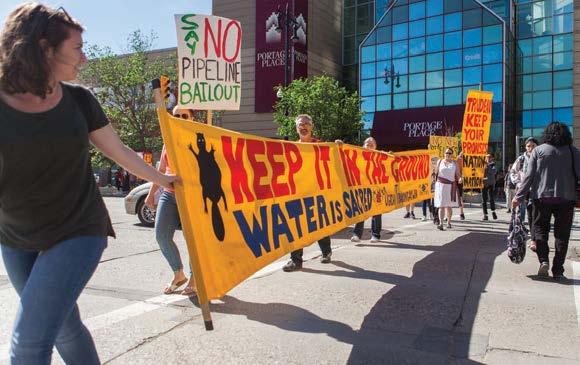
Trans Mountain was not nationalized for all Canadians
Marx’s theory of the class nature of the state as relevant as ever
JACOB SINGLETON, STAFF
Karl Marx called the fate of the Trans Mountain Pipeline system 170 years ago.
The announcement and details of the nationalization of the Trans Mountain pipeline system and expansion project evokes Karl Marx’s analysis of the capitalist state. In 1848 Marx wrote in the “Communist Manifesto” that “The executive of the modern state is but a committee for managing the common affairs of the whole bourgeoisie.”
For Marx, the capitalist state, with all its sweeping powers, was built to guarantee the profits of private industry. Marx’s analysis holds true as capitalist states routinely pay for industrial waste, suppress labour and ensure access to resources across the developing world. The nationalization of this pipeline by this government is a manifestation of Marx’s theory.
The federal government asserted that the expansion of the Trans Mountain pipeline was in the national interest. Ostensibly, an
expansion would lead to thousands of permanent jobs — which it won’t — and, more importantly, it would triple the capacity to transport bitumen to the west coast. Without a doubt, it is in the national interest to ensure that the oil companies roosting in the tar sands triple their profits, if the nation is “but a committee […] for the whole bourgeoisie.”
And it is here that the genesis for the nationalization of Trans Mountain begins.
Even before the nationalization process began, the government was already acting as an arm of private enterprise. Kinder Morgan, the owner of the pipeline, announced that the planned expansion of the pipeline would not go ahead if the federal government had not cleared all opposition to the expansion by May 31.
In response, Minister of Finance Bill Morneau announced the government would “indemnify” the expansion of Trans Mountain against any holdups associated with “unnecessary
delays that are politically motivated.”
This would mean paying Kinder Morgan the theoretical profits they might have made if those unsavoury “politically motivated” Canadians had never interrupted the pipeline business.
The Canadian government will build the expansion no matter the societal, environmental and fiscal cost.
Private enterprise has always had a contentious relationship with democracy.
Kinder Morgan, however, was never going to build the expansion pipeline. At least their actions and finances suggested this. By imposing
PHOTO BY MATTHEW SAWATSKY
a hard May 31 deadline for assurances by the federal government to have a clear pathway for the expansion to go forward, Kinder Morgan asked the government to do the impossible. Legal challenges from B.C. and First Nations could take months. Moreover, Kinder Morgan is burdened with $37 billion of debt and would have needed $5.5 billion of loans from the government to build the pipeline. Kinder Morgan was in no shape to build the expansion and did not want to.
The federal government, as only a good manager could, did not allow the pipeline expansion to die. The Liberals, after all, have the whole capitalist class to look after.
So, Prime Minister Justin Trudeau’s government bought the 65-year-old pipeline from Kinder Morgan for the sum of $4.5 billion on May 29, which they cannot even sell for a profit since they overpaid for the pipeline by at least $1.2 billion. Additionally, costed projections for the pipeline expansion list the price
tag at $7.5 billion more. But, even $7.5 billion is far too conservative when you consider the fact that every inch of new pipeline is going to be met with activism, legal challenges and Indigenous peoples blocking construction on their land.
The Canadian government will build the expansion no matter the societal, environmental and fiscal cost.
What does the Canadian public get for all the cash they will front?
This luxury pipeline exudes the same quality as a 65-year-old moth-eaten fur coat. For example, just two days before the announcement to nationalize Trans Mountain, 4,800 litres of oil spilled from the aging pipeline. And that is just a fraction of the 146,400 litres spilled since 2011.
In terms of revenue, according to rates listed by the Association of Oil Pipelines, the Trans Mountain currently generates in excess of $300 million annually. This could potentially be a solid source of revenue for the federal government. It might fund green energies or expand social programs. Alternatively, the government could use the money to solve the water crisis on First Nation reserves that requires $3.2 billion to resolve — just about a quarter of the cost that will be spent on the Trans Mountain pipeline and expansion.
But a good manager of the affairs of the capitalist class would never allow a slice of the oil industry to be nationalized long enough to harness its economic power for social good.
The federal government, since nationalizing the pipeline, has continually reassured the capitalist class that the pipeline will not stay in the public’s hands for long. Rather, the government will steward the expansion into existence, and then unload it. This doesn’t resemble working for the Canadian people.
This is about ramrodding through the expansion as quickly as possible and then selling the pipeline and extension at a probable loss.
Make no bones about it, the nationalization of Trans Mountain is for the oil companies and capitalist class.
Even after 170 years, Marx has something to say about contemporary Canadian politics.
City subsidizing Jets’ profits a fruitless venture
True North gets the corporate welfare it wants, while taxpayers are on the hook
KENNY INGRAM, VOLUNTEER CONTRIBUTOR
Winnipeggers love hockey and were thrilled when the Jets made the playoffs. Unfortunately, during the weeks and months that Winnipeg remained a contender, it was clear that under the guise of community spirit the real spirit of True North Sports + Entertainment has been one of greed and opportunism.
When our roads need repair, the city’s budget is tight, but when a sports team needs more profits the coffers are full.
Winnipeg Whiteout Street parties promised fun, attracted upwards of 20,000 fans and were arguably accessible — if you had ready access to a computer or mobile device with Internet when free tickets were made available. It is only now in the aftermath that the full cost of the event is coming to the surface. That cost was just shy of $2.2 million.
Remarkably, True North was only required to cover roughly half, while pocketing all $500,000 of beer revenue, and concurrently sticking the City of Winnipeg with a $962,000 bill it will be forced to cover with existing municipal budgets.
This bill is a despicable display of unnecessary corporate welfare.
True North’s Winnipeg Whiteout parties had a simple purpose: to generate hype and fervour for its products — namely being the Jets and Jets merchandise. With the parties’ central focus on stimulating profits for a private franchise, and not on the betterment of our city, the nearly $1 million in taxpayer funds were misused.
This brings to light a recurring
phenomenon in the sports industry, and large industry in general: corporations privatizing profits, while socializing costs.
South of the border, hundreds of millions of dollars in public funds are being used to build gigantic billiondollar stadiums for privately-owned sports teams.
In the fossil fuel industry before the introduction of a carbon tax, oil companies were making record profits yet were nowhere to be seen when their byproduct caused billions in damages in the form of drought, floods and wildfires.
Amazon announced, with a request for proposals that contained the word “incentive” 21 times, it would be looking for a new $5 billion headquarters and 238 cities entered a virtual bidding war over who could provide the most incentives.
In Winnipeg, the Whiteout parties represent only a small chunk of the corporate welfare given to True North. The company already receives about $14 million per year in kickbacks from amusement, property and business taxes, and revenues from government-owned video lottery machines in their sports bar.
When roads need repair, the city’s budget is tight, but when a sports team needs more profits, the coffers are suddenly full.
As it stands, Winnipeg’s elected officials continue to provide gigantic incentives for a corporation that does not require them.
True North has been a Winnipegbased investment firm since its conception, with most of its investments localized to the Winnipeg metropolitan area. There is little evidence to suggest that True North would ever consider moving its franchise to another city. And while the company pockets revenue from tickets, concessions and advertising, it continues to have no issue collecting taxpayer subsidies to further feed its shareholders.
As though to insult every taxpayer, True North executives threatened to stop hosting the events asserting that if someone suggested the responsibility to pay for all the costs was theirs, Winnipeg would see an end to the Whiteout parties.
All coming from a corporation with a multi-billionaire owner of a team that made nearly US$120 million in revenue for the 2016-17 season alone.
The complaints and threats from True North have little to stand on.
The $2.2 million for Whiteout parties and $14 million in incentives are merely a drop in the ocean of profits the company is making with the help of Winnipeggers.
It seems as though it is now the norm for corporations to expect these incentives that were originally intended for economic stimulus.
When taxpayer dollars make up
over 10 per cent of the revenue of a franchise, it is no longer economic stimulation but corporate welfare.
Winnipeg must look into alternative ways of achieving a balanced approach of having an entertaining team the whole city can enjoy, while not allowing taxpayers to be defrauded out of millions of dollars.
PHOTO BY MEGAN COLWEL
Pride month, and the festival and events that happen within, can be a beacon of controversy inside and outside the LGBTTQ* community.
Outside there can be a clashing of fundamental beliefs between differing viewpoints, while within the LGBTTQ* community, there also lie differences and debate, such as questioning the presence of uniformed police officers marching in the parade, the idea that Pride should be kept a protest and worries about the festival’s increased corporatization.
These issues are important for the LGBTTQ* community to discuss and debate. As modern society changes, the various concerns that rise to the surface should be acknowledged.
But there is always something at Pride that gives us hope for the future and serves as a reminder of what lies at the core of this event — the people.
The event may change, societal norms may fluctuate, but the people
are there, year after year, to celebrate who they are and to celebrate each other.
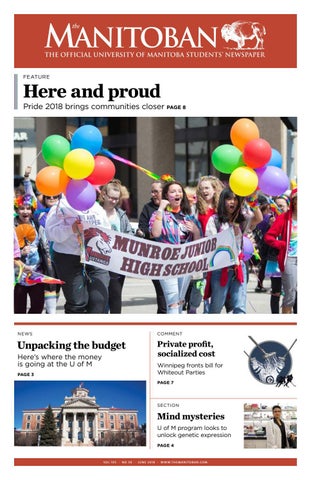
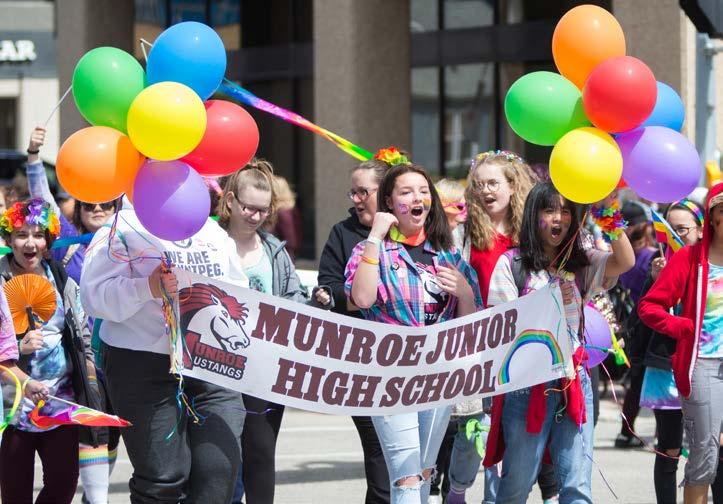
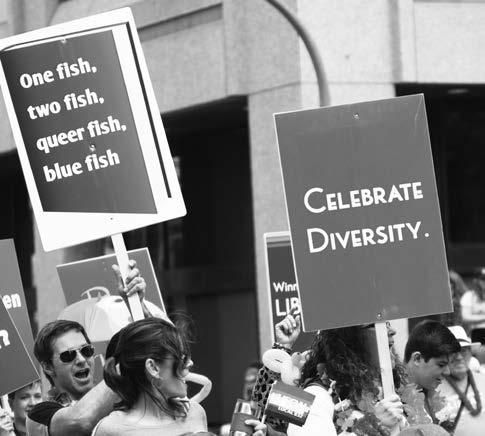
This collection of pictures is from this year’s Pride Parade, the Trans March and Rally and the second annual Two-Spirit Powwow.
These were only a few of the events that went on over the course of the Pride Winnipeg Festival from May 23 to June 3, drawing thousands of people to downtown Winnipeg.
This coming together of a wide demographic of people continues to forge a place for Winnipeg’s LGBTTQ* citizens and works toward establishing representation for groups that may not have always been readily included in Pride’s history.
Pride is more than a parade or a festival at the Forks. Pride is the collection of individuals who endeavour to build and participate in a more inclusive, loving community within this city.
Happy Pride, Winnipeg.
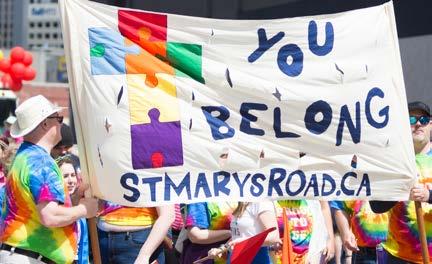
A local United church joins in the 2018 Winnipeg Pride Parade.
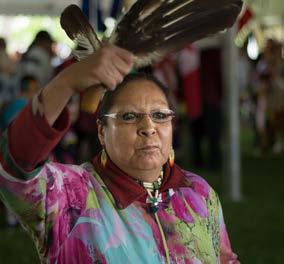
An elder joins in the grand entry of the second annual Two-Spirit Powwow at the Forks.
A couple walks in the parade.
An individual's hat sums up the message of Pride: "We are all human."
A multitude of people came out to enjoy the festivities and different events, including the second annual Two-Spirit Powwow, the Pride Parade and Festival, the Trans Rally and March and more.
Kelly Brown prepares for his role in the upcoming TwoSpirit Powwow.
A new generation of Pride goers represent their community and march in the parade.
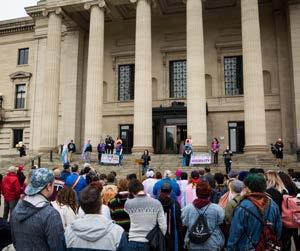
(Right) Members and supporters of Winnipeg's trans and nonbinary community met outside the legislature to reinforce the theme of this year's Trans March, visibility.
(Far Right) Marchers walk down Broadway unfazed by a steady rain as they proceed to the main Pride festival grounds at the Forks.