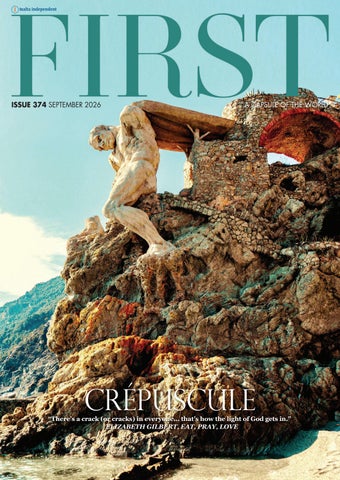
ISSUE 374 SEPTEMBER 2026
A CAPSULE OF THE WORLD
CRÉPUSCULE
“There’s a crack (or cracks) in everyone... that’s how the light of God gets in.” ELIZABETH GILBERT, EAT, PRAY, LOVE
13-14th OCT 2026
EDITORIAL “You need to learn how to select your thoughts just the same way you select your clothes every day. This is a power you can cultivate. If you want to control things in your life so bad, work on the mind. That's the only thing you should be trying to control.” ELIZABETH GILBERT
CRÉPUSCULE
PROMETHEAN appiness is the consequence of personal effort. You fight for it,strive for it, insist upon it, and sometimes even travel around the world looking for it. You have to participate relentlessly in the manifestations of your own blessings. And once you have achieved a state of happiness, you must never become lax about maintaining it. You must make a mighty effort to keep swimming upward into that happiness forever, to stay afloat on top of it.” ELIZABETH GILBERT, EAT, PRAY, LOVE
ON THE COVER: La Statua del Gigante – The Statue of the Giant, Monterosso al Mare, Cinque Terre. Photo Sara Canonici. THIS PAGE: Sunset at Vitaleta Chapel, San Quirico d’Orcia, Tuscany. Photo Clay Banks. SALES AND CREATIVE DIRECTOR SEAN ELLUL SELLUL@INDEPENDENT.COM.MT DESIGNER CONRAD BONDIN CBONDIN@INDEPENDENT.COM.MT PRODUCTION MANAGER ANDRE CAMILLERI ACAMILLERI@INDEPENDENT.COM.MT PUBLISHER STANDARD PUBLICATIONS, STANDARD HOUSE, BIRKIKARA HILL, ST JULIAN’S. TEL: 00356 2134 5888, WEB: WWW.INDEPENDENT.COM.MT FACEBOOK FIRSTMAGAZINE INSTAGRAM FIRSTMAGAZINEMALTA PRINTER PRINT-IT. FIRST IS PUBLISHED AS A COMPLIMENTARY MAGAZINE WITH THE MALTA INDEPENDENT ON SUNDAY AND IS NOT TO BE SOLD SEPARATELY. NO PART OF THE PUBLICATION MAY BE REPRODUCED WITHOUT THE PRIOR AGREEMENT OF THE PUBLISHER. FIRST MAGAZINE SINCE 1993. CELEBRATING 33 YEARS. ISSUE NUMBER 374.
5
CONTENTS
8
LA DOLCE VITA. The Slow Season. Autumn in Tuscany at Castello Di Casole, A Belmond Hotel, where lush landscapes, heritage and the unhurried character of a 10th-century estate come alive. Photo Mattia Aquila, courtesy Belmond.
20
INTERIORS. Inside Ibiza. Far from Ibiza’s famed party scene lies a tranquil side of the island that has drawn creatives, visionaries, and icons for decades. Photo Ricardo Labougle, courtesy Vendome Press.
8
LA DOLCE VITA
The Slow Season. Autumn in Tuscany at Castello Di Casole.
CONTENTS
46
20
INTERIORS
Inside Ibiza. Inside the homes of Architects, Designers and Creatives.
34
FRAGRANCE
COCO MADEMOISELLE CRUSH ABSOLU. CHANEL’S New Captivating Fragrance.
36
TRIBUTE
Dolly Parton in Her Own Words.
44
ARTS &CULTURE
Making Space for Everyone. Maltese Multidisciplinary Designer Emily Vassallo Medici.
46
YACHTING. October’s Mediterranean Momentum. The Cannes-Malta Race and The Rolex Middle Sea Race. Returning for this year’s Rolex Middle Sea Race is Balthasar, the overall winner of the 2025 edition. Photo © RMYC / Andrea Azzopardi.
Mediterranean Momentum. The Cannes-Malta Race and The Rolex Middle Sea Race.
76
YACHTING
55
SPEED MACHINES
86
The Mdina Grand Prix.
58
PENSION PLANNING Risk and Reward. Understanding Investment Without the Noise.
62
HEALTH & WELLBEING
Breast Cancer Screening and the Emotional Architecture of Coping.
74
ALZHEIMER’S AND DEMENTIA
World Alzheimer’s Month 2026. The Earlier You Know, The More You Can Do.
76
GASTRONOMY Heinz Beck and the Roman Table. The German Chef who Reshaped Italian Fine Dining.
86
THIS IS WINE
TASTING NOTES Clos de Tart 2020. Grange des Pères 2021. Leroux Meursault Les Vireuils 2023. Canon 2018.
GASTRONOMY. Heinz Beck and the Roman Table. The German Chef who Reshaped Italian Fine Dining. “0,01%”, a unique creation. The gray, stone-like block in the centre is a tribute to Rome’s iconic, sanpietrini. Photo Janez Puksic.
TASTING NOTES with Kris @FirstThisIsWine. This month: Clos de Tart, Grange des Pères, Leroux Meursault, and Canon.
CONTENTS [ISSUE 374. SEPTEMBER 2026]
7
LA DOLCE VITA “Both pleasure and devotion require a stress-free space in which to flourish...” ELIZABETH GILBERT, EAT, PRAY, LOVE
TUSCANY
THE SLOW SEASON. AUTUMN IN TUSCANY
AT CASTELLO DI CASOLE, A BELMOND HOTEL, TUSCANY, THE PHILOSOPHY OF SLOW LUXURY INVITES TRAVELLERS TO EXPERIENCE TUSCANY THROUGH ITS LANDSCAPES, ITS HERITAGE AND THE UNHURRIED CHARACTER OF A 10TH-CENTURY ESTATE. Photography courtesy Belmond.
This page: Guests can enjoy secluded Etruscan luxury in the two newly opened private villas, Villa Thesan and Villa Usil. Drawing inspiration from the estate’s heritage, both villas embrace Tuscan traditions and offer stunning views of the rolling countryside. (Pictured) Villa Usil – view from one of the bedrooms upstairs. Photo Mattia Aquila. 8
LA DOLCE VITA
9
LA DOLCE VITA
Above left: The statuesque cypress trees that lead to Castello di Casole’s entrance. Photo Mary Quincy. Above right: Castello di Casole’s gardens. Left: A panoramic view of the Tuscan landscape. Photography Riley Harper.
“I
l bel far niente means ‘the beauty of doing nothing’... (it) has always been a cherished Italian ideal. The beauty of doing nothing is the goal of all your work, the final accomplishment for which you are most highly congratulated. The more exquisitely and delightfully you can do nothing, the higher your life’s achievement. You don’t necessarily need to be rich in order to experience this, either,” writes Elizabeth Gilbert in her iconic book Eat, Pray, Love. She continues with “another wonderful Italian expression: l’arte d’arrangiarsi – the art of making something out of nothing,” of turning simple ingredients into a feast or a handful of friends into a celebration. Happiness, she suggests, is a talent available to anyone.
10
LA DOLCE VITA
T
his is Autumn in Tuscany. A time when the hectic pace of summer slows down to reveal a quieter more gentle side of Tuscany, where it’s rolling hills and postcard perfect rolling hills can be enjoyed calmy, where Tuscany can really become your own. This is the very welcome slow season.
This is autumn in Tuscany. A time when the hectic pace of summer slows down to reveal a quieter side of the region, where rolling hills and postcard-perfect landscapes can be enjoyed calmly, and where Tuscany can truly become your own. It’s the welcome slow season, with the countryside bathed in soft light and the simple pleasures of daily life taking on a richer, more grounded charm.
Above: Villa Usil – the living room. Left: Villa Thesan – one of the bedrooms upstairs with private terrace. Photography Mattia Aquila.
12
Prestige • Quality • Effectiveness
MATURE SKIN
Exclusively Distributed by A.M.Mangion Ltd - Tel:23976000 www.ammangion.com.mt frezydermmalta FrezyDermMalta
LA DOLCE VITA
C
astello di Casole, A Belmond Hotel, Tuscany, embraces this moment with an extended season running until 29 November, inviting travellers to experience Tuscany through the lens of Slow Luxury. An hour south of Florence, the 10th-century estate sits within 3,200 acres of unspoilt land, a setting that encourages renewal and reflection as the landscape shifts into autumnal tones. The retreat’s approach to wellbeing is shaped by Essere Spa, where bespoke treatments, mindful movement and sound-based therapies unfold in spaces once used as wine cellars. Meditation hikes and forest bathing deepen the connection to the land, offering a sense of grounding and connection as the landscape transforms with the colours of autumn. Across the estate, activities follow the pace of autumn. Guests can explore the hills on horseback, cycle through woodland paths or join botanical workshops that draw on the estate’s gardens. Truffle hunting and chestnut roasting in the Library bring a seasonal warmth, while hands-on cooking classes introduce the fundamentals of Tuscan cuisine. The nearby village of Casole d’Elsa offers a glimpse into Etruscan history, with its museum providing context for the ancient culture that shaped the region. For those seeking movement, Casole Club offers tennis, padel and pickleball, with personalised coaching available for all levels.
14
LA DOLCE VITA
Facing page: (Top) Essere Spa, housed in the estate’s former wine cellars with barrel vaulted ceilings and restored stone walls. Photo Helen Cathcart. (Bottom) In-room massage. Photo Nuria Val. This page: The history of the estate winds back 2,500 years to the Etruscans, a time of booming trade and craft enlightenment. The heart of the hotel was once a medieval castle, built in 998 to capitalise on the location’s sprawling views. Photo Daniele Ragazzini.
15
LA DOLCE VITA
Above (left and right): Bar Visconti. Photography Letizia Cigliutti. Below left: Chef Daniele Sera is a celebrated Italian chef recognized for his modern farm-totable creations. His philosophy is grounded in the region’s rich biodiversity and culinary heritage. He prioritizes quality, sustainability, and traceability, crafting dishes from seasonal produce grown in the Orti del Castello vegetable garden. With 40 years of experience in Michelin-starred kitchens, his career includes time at Le Jardin at the Hotel Royal Monceau in Paris, Domaine Les Crayères in Reims, and Enoteca Pinchiorri in Florence. Photo Letizia Cigliutti. Below right: Emporio del Castello, a traditional Tuscan restaurant. Photo Federico Ciamei.
A
utumn is also the most abundant period across the estate’s vineyards, olive groves and kitchen gardens. Executive Chef Daniele Sera’s ingredient-led menus evolve each week, guided by what the land provides. Tosca presents a contemporary interpretation of Tuscan fine dining, drawing inspiration from the estate’s produce. Emporio del Castello offers regional dishes in a relaxed setting, while Bar Visconti showcases the flavours of the estate through its Hortus Vitae cocktail collection, celebrating botanicals grown within the grounds.
16
LA DOLCE VITA
T
he property retains the ambience of a private country house, with 39 suites that reflect its medieval origins. Castello di Casole rises from ancient Etruscan soil, indeed its history stretches back 2,500 years. The heart of the hotel was once a medieval castle, built in 998 to capitalise on the location’s sprawling views, later cultivated by the Bargagli family in the 1800s and eventually becoming a seasonal sanctuary for Luchino Visconti, who brought a touch of Hollywood glamour to the estate. Today, as part of Belmond, it remains a luxurious retreat and a working agricultural estate committed to sustainability and local craftsmanship. Etruscan artefacts found across the land are displayed throughout the hotel, most prominently in Essere Spa, where restored stone walls and vaulted ceilings preserve the building’s heritage. The estate’s agricultural identity continues through its vegetable gardens, Orti del Castello, which supply the kitchens with fresh produce. For more secluded stays, the private villas, Villa Thesan and Villa Usil, offer expansive views and a deeper sense of immersion in the countryside. Autumn in Tuscany, offers a season shaped by stillness, abundance and the pleasure of slowing down. It is a place where the Italian art of doing nothing, and of making something out of very little, finds its most natural expression. It is an invitation to seek beauty with purpose, and to embrace magical moments that restore instead of rush. In the words of Elizabeth Gilbert, “I think I deserve something beautiful.” Above: Biking through the “Terra Eroica Castello di Casole” trail. Photo Riley Harper. Left: Sound Healing in the forest. Photo Nuria Val.
18
INTERIORS
20
INTERIORS “This is an island steeped in myths, like the one that identifies the iconic rock Es Vedrà as the place where sirens sang to the hero Odysseus to sink his ship in Homer’s Odyssey” Emma Roig Askari
FAR FROM IBIZA’S FAMED PARTY SCENE LIES A TRANQUIL SIDE OF THE ISLAND THAT HAS DRAWN CREATIVES, VISIONARIES, AND ICONS FOR DECADES
INSIDE IBIZA
IT’S BEEN SAID THAT IBIZA EMITS A POWERFUL ENERGY TO NEW VISITORS. SOME PEOPLE COME FOR A HEDONISTIC ESCAPE, WHILE OTHERS FIND PEACE AND BUILD THEIR OWN IDYLLIC REFUGE ON THE MEDITERRANEAN ISLAND. For the book INSIDE IBIZA, author Emma Roig Askari and photographer Ricardo Labougle capture this private side of Ibiza – showcasing dream homes belonging to such luminaries as architect Daniel Romualdez, designer Miranda Makaroff, entrepreneur Bobby Dekeyser, Eugenia Martínez de Irujo, 12th Duchess of Montoro, and many more. Photography Ricardo Labougle, courtesy Vendome Press.
F
ar from Ibiza’s famed party scene lies a tranquil side of the island that has drawn creatives, visionaries, and icons for decades. Inside Ibiza, the new book by author Emma Roig Askari and photographer Ricardo Labougle, turns its attention to this private world. Their collaboration traces a landscape shaped by centuries of myth, migration and reinvention, and by the individuals who have chosen to build their lives within it. “The Mediterranean island of Ibiza is a place of extremes,” Roig Askari writes. “Its power, appeal, and fascination are captured in the pages of this book, which invites you to look beyond the nightlife and flashy tourists to a magical world that lies in hidden corners of this beautiful land.”
Roig Askari’s introduction glides through the island’s rich history, shaped by years of observing its evolving culture. She recalls the Phoenicians who settled there in the seventh century BCE, bringing with them the goddess Tanit, said to have given the island its distinctive feminine energy. Tanit’s influence “is still felt today, having survived waves of invasion by Romans and Vandals, Byzantines and Muslims, pirates and Catholic conquerors.” Her narrative blends the legends and pivotal moments that define Ibiza’s character: the sirens of Es Vedrà, its role as a sanctuary, and those who sought refuge there during times of political unrest. “It never ceases to amaze me that people focus on the party aspect of Ibiza,” she writes, “ignoring the thousands of years of rich history that came before the arrival of its ‘mega clubs.’”
Facing page: One would be hard-pressed to find a more extraordinary historic finca in Ibiza than this one. The house itself, Es Pouas, was built in 1640, but a cave on the site reveals evidence of human settlement dating back five thousand years, making this one of the oldest inhabited spots on the island. 21
INTERIORS
This page: French architect Victor Esposito revels in contrasts. Parts of Can Pep Beia, the finca he has lived in for the last twenty years, date from the seventeenth century, but the historical style of dark, enclosed buildings suitable for agricultural life lived four centuries ago did not chime with his vision of modern living. Esposito worked with French-Iranian architect Pascal Cheikh Djavadi to create the modern extension to the house.
I
nside Ibiza presents homes belonging to figures such as architect Daniel Romualdez, designer Miranda Makaroff, entrepreneur Bobby Dekeyser and Eugenia Martínez de Irujo, the 12th Duchess of Montoro. Each property reflects a distinct sensibility, shaped by the island’s magnetism and the personalities of its owners. Roig Askari describes them as “the many kinds of diverse visionaries who have fallen in love with Ibiza and decided to build their dream homes there,” ranging from a brutalist structure to an ancient finca with Stone Age bones in the garden, a Roman-era palazzo to a house rendered entirely in pink.
22
INTERIORS
L
abougle’s photographs bring the book to life with a vivid sense of place; his introduction celebrates Ibiza’s stunning geography and timeless allure. “Nature could not have been more generous with this island’s geography and its incredible landscapes,” he writes. Even as Ibiza becomes busier during the summer months, he observes that “tranquility and simplicity
still prevail here in day-to-day life,” with locals and visitors sharing a common desire to enjoy its Mediterranean setting. For him, capturing these homes was shaped by the island’s light, which he describes as “magical and ever-changing,” revealing the individuality of each setting. The houses “reflect the cosmopolitan and sometimes eccentric character of the island, from grand palaces in Dalt Vila to more experimental projects, and of course those where Ibiza’s hippie spirit of the 1970s can still be felt.”
This page: The house Spanish architect Jaime Romano and his wife Roberta Jurado designed for themselves in Pla de Corona balances openness with intimacy, shaped by clean lines, generous light and canary-yellow louvers that temper the sun. Indoors, their eclectic mix of ceramics, textiles and a vast library reflects their shared sensibilities, while outside a wild garden of wisteria, bougainvillea and almond trees brings colour and fragrance to the terraces.
24
Sleep Well,
Live Better
Triq L-Imdina, Zone 1, Central Business District, Birkirkara | T. 2546 4172 Triq L-Imġarr, Għajnsielem, Gozo | T. 2546 4152
INTERIORS
Above: Artist Grillo Demo’s northern Ibiza hideout is a collage of memories, where saints, fashion icons and decades of travel come together in intimate corners. His bedroom reflects the same instinctive layering of objects and stories, shaped by the artist who has spent forty years cultivating a life between his canvases and the jasmine-scented garden that remains his signature. Left: The Ibiza home inherited by Eugenia Martínez de Irujo remains a sanctuary preserved in her mother’s spirit, a simple payesa house overlooking the sea, kept exactly as the Duchess of Alba loved it. Its rooms hold decades of memories, from summers spent painting to long days of escape and freedom, making the finca a place where her essence still lingers. tion of depth throughout the day. Facing page: The couple who built this house, seeking relief from Milan’s winters, found their summer refuge on a site with uninterrupted 360‑degree views. To shape the light that pours in from every direction, they introduced brise-soleils and louvers that soften the sun and define more intimate interiors, creating calm spaces balanced between brightness and shade.
R
oig Askari’s career in journalism has taken her from conversations with Fidel Castro and Francis Ford Coppola to writing features for Vanity Fair Spain, El País, CNN, and Reuters. Her passion for architecture and interiors runs through the homes she has styled in New York, London, Ibiza, and Madrid, influencing how she sees the island’s living spaces. She writes of Ibiza’s many identities – “the island has been given many names by the various cultures that made it their own, the Punics called it Ibosim, the Romans Ebusus, the Arabs Yebisah, and the locals Eivissa” – and encourages readers to reconsider their assumptions. Inside Ibiza offers a portrait of a place defined by its contrasts: ancient myths and contemporary design, refuge and reinvention, simplicity and exuberance. “Take another look at your previous ideas about Ibiza,” she suggests. “I think you may be surprised.”
26
INTERIORS
27
INTERIORS
ABOUT THE AUTHORS. EMMA ROIG ASKARI is a contributing editor and longterm columnist for Vanity Fair Spain. In a journalistic career spanning decades and thousands of articles, she has interviewed the likes of Fidel Castro, Manolo Blahnik, Francis Ford Coppola and Rafael Nadal. She has worked for some of the world’s biggest news outlets such as El País, CNN, Reuters and CBS. Her passions extend across the worlds of architecture, art and interior design, coming together across the houses she has decorated in New York, London, Ibiza, and Madrid. A native of Valencia, Roig Askari is a Fulbright Scholar with a Master of Arts from New York University, as well as a Bachelors in Journalism from Universidad Complutense de Madrid. She currently resides between Spain and London, where she serves as an ambassador at Christies for the UK Chairman’s Office. This page: Architect Daniel Romualdez’s Ibiza retreat was born from a search for sunsets and the view of Es Vedrà. What began as a quest for the perfect vantage point became a home shaped by light, sea and stillness, a place where days end in an hour-long afterglow and mornings begin on dew-covered trails, anchoring his life on the island.
28
RICARDO LABOUGLE has been photographing interiors and portraits around the world for more than 25 years. He is a regular collaborator to publications such as The World of Interiors, Architectural Digest, Vogue, Elle Decor, Vanity Fair, and T Magazine. His books include Vendome’s Inside Paris (2024). His personal work has also been shown at galleries in Madrid, Milan, and Buenos Aires. This page: The house designed by Spanish architect and interior designer Amaro Sánchez de Moya is shaped around a seamless dialogue between indoors and outdoors, guiding the eye from the entrance patio through layered interiors toward the garden and the sea. Niches, travertine floors and oak details create a calm, sculptural atmosphere, while the surrounding landscape is drawn gently into every room.
30
INTERIORS
This page: The Belgian-German entrepreneur Bobby Dekeyser’s Santa Gertrudis retreat blends whimsy with comfort, from terraces shaped for long, sun-soaked days to interiors enriched with global craft. Alpacas roam the grounds, a natural pond anchors the garden, and every corner reflects his instinct for creating a lively, welcoming haven for family and friends.
DANIEL ROMUALDEZ is an AD100 architect and interior designer who has designed homes for clients such as Aerin Lauder and Tory Burch, as well as commercial spaces. He grew up in Manila and now lives in New York. INSIDE IBIZA By Emma Roig Askari, photography by Ricardo Labougle, foreword by Daniel Romualdez. Published by Vendome Press. Hardcover, 328 pages.
32
28.09-03.10 Valletta Malta’s premier design expo, a showcase of creativity where tradition meets innovation! THEMATIC EVENTS Spatial Design
Made by Design
Flavour by Design
Fashion Design
EXHIBITIONS Auberge d’Aragon
Fortress Builders
Our Lady of Pilar Chapel
www.designmt.org
Valletta Design Cluster
FRAGRANCE
COCO MADEMOISELLE CRUSH ABSOLU. Perfumer Creator: Olivier Polge. Olfactory family: intense ambery. Olfactory signature: fruity accord (grapefruit–lychee), floral accord (rose–jasmine), woody ambery accord (patchouli). Facets: vanilla notes, vetiver. 34
FRAGRANCE
“It’s unreal to be the new face of Coco Mademoiselle, I feel an immense sense of pride. I love that Coco is someone who leaves a mark everywhere she goes. Sometimes, I wish I could be more like her.” GRACIE ABRAMS, NEW FACE OF COCO MADEMOISELLE.
CHANEL
COCO MADEMOISELLE CRUSH ABSOLU THE NEW CAPTIVATING FRAGRANCE
“COCO MADEMOISELLE CRUSH ABSOLU IS MORE THAN A FRAGRANCE: IT IS A MAGNETIC FORCE, AN IMPULSE.”
C
Photography courtesy CHANEL.
OCO MADEMOISELLE CRUSH ABSOLU arrives as CHANEL’s latest exploration of modern femininity, shaped through the House’s meticulous approach to perfumery. Every element of its creation reflects the discipline that defines CHANEL’s fragrance craft: the cultivation of select raw materials, patient distillation, and a compositional precision that sets the House apart. Within this framework, the COCO MADEMOISELLE line, first imagined by Jacques Polge in 2001, continues to evolve, embodying the audacious spirit of CHANEL. Crush Absolu extends that trajectory with a heightened sense of intensity, offering a more pronounced expression of the distinctive character that has made COCO MADEMOISELLE a global icon. Olivier Polge, CHANEL Perfumer Creator, brings the identity of the original fragrance into sharper focus. Fruity brightness moves toward a denser, ambery structure, creating a contemporary and voluptuous balance. Grapefruit and lychee introduce a vivid opening, followed by rose and jasmine that lend a supple floral dimension. Vetiver and vanilla add sensuality, while patchouli anchors the composition with depth. The result is a trail that carries presence and distinction, designed to accompany the
wearer with assurance and intention. “COCO MADEMOISELLE CRUSH ABSOLU is an affirmation of the self. This fragrance offers a deeply personal experience that exists only when it is worn. I like to imagine that it accompanies the woman who wears it. It is not about conforming, but about revealing oneself, surprising oneself,” says Polge. This new chapter is introduced by folk singer Gracie Abrams, the House’s latest egerie. Her understated strength and direct, unembellished style align naturally with the COCO MADEMOISELLE universe. A folk singer, Gracie Abrams stands fittingly in the symbolic lineage of Gabrielle Chanel. One emerged during the Belle Époque in a cabaret in Moulins; the other, last year, at a festival on the East Coast. Between them lies a century and a half of free-spirited women, cropped hair and all. However, their connection goes far beyond appearances. There is a certain immediacy in her presence, an instinctive blend of elegance and candour, that resonates with CHANEL’s ongoing pursuit of characterful femininity. In embodying CRUSH ABSOLU, she brings a fresh, contemporary energy to a fragrance designed for women who move with purpose and embrace the full dimension of their individuality.
CHANEL is distributed by Alfred Gera & Sons Ltd. All photography © CHANEL. 35
TRIBUTE
36
TRIBUTE
A SHINING STAR
DOLLY PARTON IN HER OWN WORDS
“ITS HARD TO BE A DIAMOND IN A RHINESTONE WORLD.” A celebration of the music, wit and generosity that shaped Dolly Parton’s extraordinary life.
D
olly Parton’s life traced an extraordinary journey which took her from humble roots in rural Tennessee to becoming a global icon, fueled by her talent, determination, and a natural generosity that left its mark on every stage of her career. Born in 1946 in Sevier County, she grew up in a one-bedroom cabin as one of twelve children, singing in church before performing at the Grand Ole Opry at thirteen. She moved to Nashville the day after finishing high school, intent on building a future through music. National fame arrived through The
Porter Wagoner Show, and by the mid-1970s she had stepped into a solo career that would define modern country music. Over nearly seven decades, she wrote more than 3,000 songs, released 49 studio albums and sold over 100 million records worldwide. She penned some of the most recognizable songs in music history, including “Jolene,” “Coat of Many Colors,” the iconic anthem “9 to 5”, and “I Will Always Love You”. Written by Parton in 1973 as a farewell to Porter Wagoner, the track topped the country charts twice before becoming a worldwide sensation when Whitney Houston recorded her legendary version.
This page: Dolly Parton arrives at the premiere of “Joyful Noise” in Los Angeles, Jan 2012. Photo Matt Sayles, AP
37
TRIBUTE
This page: Publicity shot of American singer Dolly Parton, 1977. Photo RCA Records, source Wikipedia Commons.
H
er influence extended beyond the stage, and her generosity made a lasting impact on education, public health, and the local community. In 1986, she opened her namesake theme park, Dollywood, in Pigeon Forge, Tennessee. It grew into the region’s largest employer, reflecting her deep devotion to boosting her home state’s economy. It also became a centre of community support, offering an environment
where education, healthcare and childcare were treated as essential pillars. The Grow U programme offered fully funded higher-education pathways, professional certifications and debt-free learning for staff, alongside a dedicated healthcare centre, childcare assistance and pay structures designed to support a stable life in the region. Her commitment to her home state was equally evident in the Buddy Program, launched in 1991 to address rising dropout rates in Sevier County. By pairing students and rewarding mutual support through to graduation, she helped reduce dropout levels from 35% to 6%. 39
TRIBUTE
Above: Dolly Parton poses for a photo at her office in Nashville, Tennessee, Aug 2005. Photo John Russell, AP Photo/File. Below left: Dolly Parton, left, Lily Tomlin, center, and Jane Fonda arrive for the premiere of their film “9 To 5” in New York, Dec 1980. Photo Richard Drew, AP Photo/File. Below centre: Dolly Parton, left, and Kenny Rogers rehearse a song for their appearance on the TV show “Live... And in Person” in Los Angeles, Sept 1983. Photo Doug Pizac, AP Photo/File. Below right: Dolly Parton at a party following the premiere of her movie ‘Nine to Five’ in Los Angeles, Dec 1980. Photo Harms, AP Photo/File.
D
olly Parton’s generosity has touched lives around the world. Through her Imagination Library, she’s earned the nickname “The Book Lady” from millions of children, sending them a free book every month from birth to age five. She launched the program in 1995 as a tribute to her father, Robert Lee Parton, who grew up in rural Appalachia and had to leave school early to help support his family, never learning to read or write. Seeing how this affected his confidence, despite his intelligence, Dolly set out to make sure no child would grow
40
up without books at home, regardless of their family’s income. Since its start, the program has given hundreds of millions of books worldwide, fostering early literacy with unwavering dedication. Her $1 million donation to Vanderbilt University Medical Center also helped fund the development of the Moderna COVID-19 vaccine, showing her instinct to step in when it matters most. Dolly Parton passed away on 25th August 2026 at the age of 80, leaving a legacy filled with music, kindness, and an unwavering belief in the power of community. Here is Dolly Parton in her own words.
EFFERVESCENT
A DEFENCE AGAINST WINTER AILMENTS Let your immunity PROTECT you with the right intake of Vitamin C To counteract the first symptoms of colds & flu. Reducing the duration of illness. Effective in improving the immune system. Marvit Vitamin-C 1000MG is a Food supplement in convenient effervescent tablets. Active Ingredients: Vitamin C Zinc 12.5 mg Echinacea 10 mg Selenium 55 Great taste with red blood orange. 1 effervescent tablet daily before a meal.
AVAILABLE AT ALL LEADING PHARAMCIES Exclusively distributed by A.M.Mangion Ltd, T: 23976000
TRIBUTE
Dolly Parton penned some of the most recognizable songs in music history, including “Jolene,” “Coat of Many Colors,” the iconic anthem “9 to 5”, and “I Will Always Love You”. Written by Parton in 1973, the track topped the country charts twice before becoming a worldwide sensation when Whitney Houston recorded her legendary version. This page: Dolly Parton performs during her “Pure & Simple Tour”, June 2016, in Philadelphia. Photo Owen Sweeney, Invision/AP, File.
make jokes about it, but it’s the truth that I kind of patterned my look after the town tramp. I didn’t know what she was, just this woman who was blond and piled her hair up, wore high heels and tight skirts, and, boy, she was the prettiest thing I’d ever seen. Momma used to say, “Aw, she’s just trash,” and I thought, That’s what I want to be when I grow up. Trash.” “I would never stoop so low as to be fashionable.” “It’s a good thing I was born a girl, otherwise I’d be a drag queen.” “I always just thought if you see somebody without a smile, give’em yours!” 42
“I just want everybody to be treated good. I try not to get into the politics of everything. I try to get into the human element of it. I have some of everybody in my own immediate family and in my circle of employees. I’ve got transgender people. I’ve got gays. I’ve got lesbians. I’ve got drunks. I’ve got drug addicts – all within my own family. I know and love them all, and I do not judge.” “If you’re gay, you’re gay. If you’re straight, you’re straight. And you should be allowed to be how you are and who you are. I keep saying, well, if you’re the fine Christian that you think you are, why are you judging people? That’s God’s job. We’re not God. We’re not judges. You know, we’re supposed to love one another. We’re supposed to not judge and we’re not supposed to take vengeance on other people. That’s God’s job. I think we should be accepting and loving. We are all God’s children. We are who we are and we should be allowed to be who we are.” “You’ll never do a whole lot unless you’re brave enough to try.”
“If you try to follow everyone else and be like everyone else, before you know it you’re gone. You’re not going to find yourself again; you’ll just be a version of what you might have hoped to have been.” “If your actions create a legacy that inspires others to dream more, learn more, do more and become more, then, you are an excellent leader.” “I look like a woman but I think like a man. I’ve done business with men who think I’m as silly as I look. By the time they realize I’m not, I’ve got the money and gone.” “I’m not offended by all the dumb blonde jokes because I know I’m not dumb – and I’m not blonde either.” “If you don’t like the road you’re walking, start paving another one.” “The way I see it, if you want the rainbow, you gotta put up with the rain!”
“Find out who you are and do it on purpose.”
“We cannot direct the wind, but we can adjust the sails.”
“Don’t get so busy making a living that you forget to make a life.”
“Books, my friends, are true magic bound between two covers.”
ARTS & CULTURE
Emily Vassallo Medici is a multidisciplinary designer from Malta, currently based in the Netherlands. Her practice moves between interior architecture, furniture, spatial design and collective forms of making, with a particular interest in the relationships between people, space and the ways in which communities work together. Above: Emily’s thesis, An Alphabet of Relation: An Abecedary on Ways of Working Together, began with a simple question: What simple conditions shape the way we work together? Photo Mateusz Sejfryd. Below: Emily Vassallo Medici. Photo Simcha Ziya Moise.
GALLERY ZERO: BUILDING NEW ECOLOGIES For Maltese multidisciplinary designer Emily Vassallo Medici, a graduation project at the Royal Academy of Art, The Hague became an exploration of the relationships between people, space and the conditions that allow collective practice to take shape.
“I
n an institution where everyone has a space, where is the space for everyone?” That question lies at the heart of Gallery Zero, the graduation project developed by Maltese multidisciplinary designer Emily Vassallo Medici at the Royal Academy of Art, The Hague (KABK). Currently based in the Netherlands, Vassallo Medici works across interior architecture, furniture, spatial design and collective forms of making. Her practice is particularly concerned with the relationships between people and space, and with the ways in which communities work together. Over four years studying for a BA in Interior Architecture and Furniture Design at KABK, she began looking beyond the conventional role of the designer, questioning how design might shape not only physical environments, but also the relationships and conditions that exist within them. Her graduation work grew out of this longer period of observing, making and working with
44
others. Rather than beginning with a predetermined object or interior, Vassallo Medici’s final-year research started with a more fundamental question: what are the spatial and social conditions that make collaboration possible in the first place? That research developed into both her thesis, An Alphabet of Relation: An Abecedary on Ways of Working Together, and the spatial project that followed it, Gallery Zero. The thesis begins with a simple question: what conditions shape the way we work together? Rather than treating collaboration as simply the act of working alongside others, Vassallo Medici looks at the often-overlooked conditions that influence collective work, including attention, communication, responsibility, care, conflict, time and space. The research takes the form of an A-to-Z “abecedary”, with each letter exploring a different condition or practice connected to collaboration. Together, they form a vocabulary through which the smaller actions, negotiations and tensions involved in working together can be noticed and discussed.
ARTS & CULTURE
T
he non-linear format reflects an understanding of collaboration as something layered, relational and situational rather than a fixed process with a clear beginning and end. At its centre is the question of what happens when collaboration is treated not simply as a value, but as a practice and discipline requiring attention, negotiation, care and shared responsibility. From there, Vassallo Medici began to think about collaboration spatially. If the way people work together is shaped by their environment, what kinds of spaces can actually support collective life? That question became the starting point for Gallery Zero. Developed as a proposal for a self-organised common space within KABK, Gallery Zero responds to what Vassallo Medici identified as the absence of a shared space within the academy: one that is not assigned to a particular class, department or individual, but can belong to the wider KABK community. Gallery Zero moves away from proposing a finished interior, choosing to function as an evolving framework shaped by its users. Underused spaces, existing materials and waste streams become resources for its development, alongside the knowledge and skills of students, staff, technicians and other members of the academy. The project takes ideas developed through Vassallo Medici’s thesis and tests them through space, materials and participation. Principles such as care, trust, negotiation, shared responsibility and collective memory are no longer only discussed in theoretical terms, but given a physical and social framework. Gallery Zero uses a series of collective acts to explore how those principles might transform an anonymous space into a common place. In doing so, the project also questions more traditional notions of authorship. Instead of presenting the designer as the sole author of a finished environment, Gallery Zero proposes a
Above: The project takes ideas developed through Vassallo Medici’s thesis and tests them through space, materials and participation. Principles such as care, trust, negotiation, shared responsibility and collective memory are no longer only discussed in theoretical terms, but given a physical and social framework. Photo Mirko Pirisi.
model of spatial production that is shaped through collaboration, participation and shared responsibility. This emphasis on process is crucial. Gallery Zero is not conceived as a final graduation object, but as something that can continue to develop after Vassallo Medici’s studies have ended. The proposal is intended to be implemented within the Royal Academy of Art, allowing the space to continue evolving through the participation of the KABK community. The first steps were initiated in 2026 by Vassallo Medici, from the BA Interior Architecture and Furniture Design programme, and Stella Kechagioglou, from KABK’s MA Inside programme. Since then, the project has been shaped through the contributions, knowledge, care and participation of many people within the academy community. That approach reflects the wider concerns running through Vassallo Medici’s practice: relations and frictions, neglected spaces and invisible labour, and the question of how collective initiatives are initiated, catalysed and carried forward. Her graduation project was awarded the Stroom Young Talent Award 2026, recognising a body of work that extends beyond the design of an interior and into the social conditions that make collective practice possible. Vassallo Medici’s four years of study in the Netherlands were supported by the Malta Arts Scholarships Scheme, funded by the Government of Malta. She received the scholarship in 2022, supporting her artistic and professional development throughout her studies at KABK. Gallery Zero leaves no polished object behind to settle the argument. Its value is in the awkward, ongoing business of sharing space: deciding, adjusting, disagreeing, taking responsibility, and making room for someone else to alter what you thought was finished.
Above and below: Gallery Zero is a proposal for a selforganised common space within the Royal Academy of Art, The Hague (KABK). It was developed in response to the absence of a shared space within the academy: a place that is not assigned to one specific class, department or individual, but can belong to the whole KABK community. Photography Mateusz Sejfryd.
Emily Vassallo Medici's four years of study in the Netherlands were supported by the Malta Arts Scholarships Scheme, funded by the Government of Malta. She received the scholarship in 2022, supporting her artistic and professional development while studying at KABK. 45
YACHTING THE ROUTE TO THE ROLEX MIDDLE SEA RACE
MEDITERRANEAN MOMENTUM
With the CANNES-MALTA RACE setting the tone and the ROLEX MIDDLE SEA RACE ready to unfold, October promises a month shaped by challenge, camaraderie and the enduring draw of the Mediterranean. Photography courtesy Royal Malta Yacht Club.
46
YACHTING
47
YACHTING
O
ctober injects energy to the Mediterranean offshore circuit, as crews look to extend their season before winter sets in. This year, the Royal Malta Yacht Club opens the month with the second edition of the Cannes-Malta Race, a 606-nautical-mile passage linking two
storied sailing communities. Starting on 5th October from Cannes, the race forms part of a reciprocal agreement with the Cannes Yacht Club and encourages greater French participation in the Rolex Middle Sea Race. Commodore Mark Napier describes it as “a natural extension of the Royal Malta Yacht Club’s commitment to building meaningful international connections through sailing. Our collaboration with the Cannes Yacht
Club reflects a shared vision – one that goes beyond competition to foster lasting relationships between sailors, clubs, and nations. This race not only offers a compelling offshore challenge across the Mediterranean, but also provides a unique pathway for crews to experience Malta at its finest, culminating in participation in the Rolex Middle Sea Race, one of the sport’s most iconic events.”
Previous page and above: Chief among the returning yachts is Balthasar, the overall winner of the 2025 edition and once again led by Louis Balcaen. At last year’s prize giving, the seasoned crew signalled an intent to defend its title. Photography © RMYC / Andrea Azzopardi. Left: The participation of the Wallyrocket 71 Django 7X from Italy and entered by Giovanni Lombardi Stronati, brings more historical coincidence, with Guillermo Parada competing 30 years after making his debut at the race as a helmsman and tactician on the then line honours winner Alexia. “I’m particularly happy to be racing in the Rolex Middle Sea Race again,” said Parada. “This year I’ll be back aboard Django 7X, together with my friend Vasco Vascotto and some of the other guys with whom I have shared so many sailing campaigns over the years.” Photo © Rolex / Carlo Borlenghi.
48
YACHTING
T
he course carries crews from the French Riviera through the Strait of Bonifacio, past the Egadi Islands and into Maltese waters, offering a demanding early-autumn challenge. Arriving teams will then have the chance to continue straight into the Yachting Malta Coastal Race on 14th October, followed by the legendary crew party on 15th October, a fixture that has long shaped the convivial spirit surrounding the Rolex Middle Sea Race. The prizegiving for the Cannes-Malta Race will be held at the Royal Malta Yacht Club on
12th October, before attention shifts fully to the main event. The Rolex Middle Sea Race begins on 17th October, starting from Valletta’s Grand Harbour, where the boom of the Saluting Battery and the crowds lining the bastions create one of the most dramatic openings in offshore sailing. Now in its 47th edition, the race marks the 30th anniversary of its revival after a 13-year hiatus. The entry list once again reflects its global reach, with crews from over 20 nations preparing for a course renowned for its complexity, beauty and unpredictability. Among the returning contenders is Balthasar, last year’s overall winner, led by
Louis Balcaen. Simon Toms arrives with a new Finot-Conq IRC prototype, aiming to build on consecutive class wins, while Slovenia’s Karpo and Malta’s own Artie, led by Lee Satariano and Christian Ripard, bring seasoned experience to the fleet. Satariano describes the race as a year-round commitment: “This is my passion at the end of the day. I enjoy spending weekends, and even during the week, going to the yard, switching off and working on the boat. Spotting the things that need to be replaced, to be maintained, and improved, the simple things as well as the bigger jobs, there is always a lot to do.” Above: Arkas Sailing Team from Türkiye have participated in the Rolex Middle Sea Race on four occasions times. “In our first participation back in 2015, with the Kerr 40 Arkas Flying Box, we finished first in IRC 3 and tenth overall,” explains Metin Serifhan. “Then, in 2023, we raced a MAT1220 in IRC 4, before transitioning to our current boat, Arkas Blue Moon, a TP52, in 2024 and 2025. We are getting more familiar with this boat each passing year. What we love most about the Rolex Middle Sea Race are the range of weather conditions, the challenge of the course, and the incredible scenery especially the active volcanoes.” Rolex Middle Sea Race 2024. Left: The 46th Rolex Middle Sea Race start, October 2025. Photography © Rolex / Kurt Arrigo.
50
YACHTING
Above: Among the most notable transatlantic entries is Red Ruby, the Sun Fast 3300 skippered by Justin and Christina Wolfe, representing Orcas Island Yacht Club from the San Juan archipelago in Washington State, and making a third appearance. Below left: Within the Maltese fleet, Jonathan Gambin has been a stalwart taking part in every edition since 2008 as skipper/owner of the Dufour 44 Ton Ton Laferla. 2026 will be his 19th lap around the course. “Winning our class last year was fantastic, but in the Rolex Middle Sea Race you can prepare well, sail well and make good decisions, but the weather – and a little luck – will still have the final say.” Ton Ton Laferla, Rolex Middle Sea Race 2025. Photography © Rolex / Kurt Arrigo. Below right: Lee Satariano, Christian Ripard and the crew of Artie are a massive part of the Maltese folklore surrounding the Rolex Middle Sea Race, both collectively and individually. Satariano has won the race on two occasions, in 2011 and 2014 with a previous iteration of Artie. Photo © RMYC / Alex Turnbull.
T
ransatlantic interest remains strong again this year. Justin and Christina Wolfe return with Red Ruby, now racing four-up with Jonathan McKee and Carl Buchan. “The Rolex Middle Sea Race is one of the most beautiful, interesting, and challenging races in the world,” the Wolfes say, recalling their narrow loss to Bullitt in 2023 and the volcanic glow of Stromboli. McKee calls it “unfinished business,” while Buchan looks forward to “a very tactical race with the potential for a variety of conditions and challenges.” Other stories add texture to the fleet: Robert Šarić’s Buri, returning after a 2,300-mile training loop; Sassafras, a Swan 47 on a global racing odyssey; Django 7X, carrying Guillermo Parada back to a course he
52
first raced three decades ago; and Arkas Blue Moon, representing Türkiye with a fully national crew. Each entry brings its own ambitions, shaped by experience, preparation and the lure of the Mediterranean’s shifting conditions. For many Maltese sailors, the race is woven into personal tradition. Jonathan Gambin, preparing for his 19th start, describes it as “part of my year,” while acknowledging that “the weather, and a little luck, will still have the final say.” Crossing the finish line, he says, brings “relief and satisfaction,” followed quickly by the desire to return. The 2nd CANNES MALTA YACHT RACE will start on Monday 5th October, followed by the YACHTING MALTA COASTAL RACE on 14th October. The 47TH ROLEX MIDDLE SEA RACE will start on Saturday 17th October.
enemed.com.mt
SPEED MACHINES
THE MDINA GRAND PRIX
SPEED MACHINES THE MDINA GRAND PRIX RETURNS THIS OCTOBER 1ST - 4TH. Since its origins in 2007, the Mdina Grand Prix has evolved into a refined celebration of classic motoring, set against the limestone walls and sweeping valleys surrounding Mdina. Over four days, Malta Classic presents a programme that blends competition and spectacle, showcasing speed, craftsmanship, and heritage.
T
Photography courtesy Malta Classic.
he weekend opens on Thursday 1st October with the Hill Climb at Mtaħleb, a stretch of cliffside road carved into Malta’s western coast. Drivers race the clock in a format that has defined grassroots motorsport for generations. The ascent offers challenge and drama as vintage machines tackle the incline with precision, a pure adrenaline rush for drivers and a grand opening spectacle. Panoramic views across Filfla and the open sea complement the win and lend a cinematic quality to the event.
This October, the Malta Classic weekend opens with a sequence of events that draw enthusiasts into the island’s landscape, from cliffside ascents to curated displays of pre‑war and post‑war machinery. Mdina becomes the backdrop for a gathering shaped by craftsmanship, heritage and the pleasure of seeing these cars used as they were intended. Photography Malcolm Grima.
55
SPEED MACHINES
T
he following day shifts to Style and Elegance by Mdina Glass, a showcase of pre‑war and post‑war cars and motorcycles set against a historical backdrop. Judging focuses on proportion, presence and period character rather than concours‑level perfection, allowing patina to speak as part of each vehicle’s story. Vehicles will be judged on style and elegance, and points will be awarded for dressattire of participants - indeed period style is encouraged, creating an atmosphere that recalls the early decades of European touring culture. It is a moment of calm before the intensity of the weekend’s racing. The Mdina Grand Prix fuelled by Enemed unfolds over two days on a circuit that winds through terraced hills and vineyards outside Mdina’s fortifications. Saturday’s sessions determine the starting order, with drivers navigating tight bends and long curves that reward accuracy as much as power. Sunday brings the main race, where cars are grouped by era and performance, producing a sequence of heats that highlight the diversity of machinery on the island. The circuit’s unforgiving nature demands focus, drawing out the best from both drivers and their cars. Since its origins in 2007, when Thierry Giovannoni organised the first classic car Grand Prix on Valletta’s ring road, Malta Classic has grown into a fixture that celebrates motoring history and Malta’s landscape. Its move to Mdina in 2011 gave the event a new dimension, pairing vintage speed with one of Malta’s most iconic settings. It’s a winning combination that continues to appeal. The Mdina Grand Prix, 1st to 4th October. Tickets and information: maltaclassic.com
Race day outside Mdina’s walls brings a different energy, as drivers take on a circuit cut through terraced hills and vineyards. The mix of eras and performance creates a vivid portrait of classic motoring, with each heat revealing the precision and character that define the event’s enduring appeal. Photography (top and bottom) Daniel Cassar Alpert, (centre) MXO Photography. 56
€ 3-Year Fixed Term Deposit
5-Year Fixed Term Deposit
with annual rate increasing from
with annual rate increasing from
1.00% to 3.50%*
1.10% to 4.25%*
over 3 years
over 5 years
Year
Interest p.a.
Year
Interest p.a.
Year 1
1.00%
Year 1
1.10%
Year 2
1.50%
Year 2
1.30%
Year 3
3.50%
Year 3
1.50%
Year 4
2.00%
Year 5
4.25%
*Terms and conditions for the EuroXtra apply and are available from all Lombard Bank branches and on our website. Rates are quoted gross of tax and are valid for the duration of the limited time offer.
Lombard Bank Malta p.l.c.
• Interest paid at regular intervals • Maximum Deposit: €200,000 • Minimum Deposit: €1,000 • Capital Guaranteed • No fees or charges
Lombard Bank Malta plc is a member of the Depositor Compensation Scheme established in Malta under the Depositor Compensation Scheme Regulations, 2015. It is listed on the Malta Stock Exchange and is licensed and regulated by the Malta Financial Services Authority as a credit institution in terms of the Banking Act (Chapter 371).
08.26
Head Office: 67 Republic Street Valletta Malta Tel: +356 25581 234 • email: euroxtra@lombardmalta.com
FINANCIAL SECURITY & PENSION PLANNING
“You don’t have to swing at everything. You can wait for the perfect pitch.” WARREN BUFFETT
THE LONG VIEW – PLANNING FOR LIFE, MONEY AND TIME
A MONTHLY SERIES EXPLORING THE DECISIONS, HABITS AND PERSPECTIVES THAT SHAPE LONG-TERM FINANCIAL WELLBEING.
Risk and Reward. Understanding Investment Without the Noise There’s a unique kind of anxiety that comes with the ups and downs of investment markets. A headline warns of a sharp drop, your portfolio takes a hit, or a new opportunity seems to pop up everywhere, and suddenly the urge to act kicks in. Sell before it gets worse. Buy before it’s gone. Shift money to something safer. It’s an understandable reaction, after all, financial choices are tied to something deeply personal: the resources we’ve worked hard to build and the future we’re counting on them to support. Photography this page Birger Strahl, overleaf Nick George. Location Tuscany.
I
nvesting has always meant keeping some distance from the noise. Markets are in constant motion, but long-term financial plans don’t need to follow every twist and turn. Risk is often confused with volatility, though they’re not quite the same. A 10 per cent drop in a
58
share price is obvious and unsettling, but what matters more for a long-term investor is what that drop means for the underlying investment, the time horizon, and the ultimate goal. Someone saving for retirement decades away can handle market swings very differently from someone planning to tap heavily into their investments next year.
Banking built around your business We focus on understanding your operations, your markets, and your ambitions, delivering tailored financial solutions that support real world growth. From cross border trade flows to corporate lending, real estate transactions, and treasury management, our approach is built on expertise, responsiveness, and strong client partnerships. +356 21322100
info@fimbank.com
www.fimbank.com
S I N G A P O R E – S A O PA O LO – N E W YO R K – M U M B A I – M A LTA – LO N D O N – D U B A I – C O LO G N E – C A I R O
FIMBank plc is regulated by the Malta Financial Services Authority and is listed on the Malta Stock Exchange. The Bank’s registered address is Mercury Tower, The Exchange Financial and Business Centre, Elia Zammit Street, St Julian’s STJ 3155, Malta. The Bank is licensed to undertake the business of banking in terms of the Banking Act 1994 (Cap. 371).
FINANCIAL SECURITY & PENSION PLANNING
THE LONG VIEW. “We suffer more often in imagination than in reality.” SENECA In investing, uncertainty can feel urgent even when the goal is still years away. Taking a step back helps you see the difference between a short-term market shift and a true change in your strategy. Investing isn’t about reacting the fastest or guessing every twist. It’s about putting today’s resources to work for tomorrow’s opportunities. The real question isn’t what the market will do next, but whether your choices today still line up with the life you’re building and what you want your future to look like.
T
ime horizon really matters. The more time you have, the better your chances of riding out market ups and downs and letting investments bounce back from temporary losses. That doesn’t make risk vanish or guarantee gains, but it does change how risk feels. Warren Buffett sums it up well: “Risk comes from not knowing what you’re doing.” It’s a reminder to focus less on daily price swings and more on understanding. Knowing what an investment is, why you picked it, the risks involved, and how it fits into your bigger financial picture can make uncertainty easier to handle. The challenge is that investment decisions are rarely driven by spreadsheets alone.
60
Human behaviour plays a big role. When markets rise, confidence can quickly turn into optimism, making people believe recent gains will last forever. When markets fall, the opposite happens, and investors may second-guess choices that seemed perfectly sound just months before. Morgan Housel dives into this behavioural side in The Psychology of Money. “Doing well with money has little to do with how smart you are and a lot to do with how you behave.” This idea feels especially relevant when markets get shaky. Knowledge can explain what’s going on, but temperament often decides how we respond. Emotional investing comes in many shapes and sizes, like the fear of missing out when an asset surges, the urge to quickly recover losses after a downturn, or the habit of comparing
results with friends, colleagues, or people online. These reactions often push decisions based on past events rather than the longterm goals. Market timing is another big temptation. Ideally, an investor would sell before a drop and buy before a rebound, but in reality, predicting both moments consistently is incredibly hard. Missing just a few of the market’s best days can greatly impact long-term returns, while frequent trading adds costs and opens the door for emotions to sway choices. Buffett’s style leans toward patience rather than prediction. “You don't have to swing at everything. You can wait for the perfect pitch.” In personal finance, this mindset can be freeing. Not every market twist demands action; sometimes the best move is sticking with a strategy built around your goals, risk tolerance, and time frame. That doesn’t mean ignoring your investments. It’s still important to review your portfolio, especially when life changes occur. A new job, nearing retirement, shifts in family situations, or big changes in financial goals can warrant a fresh look. The key is knowing the difference between reviewing a plan and reacting to every minor fluctuation. Nearly two thousand years ago, Seneca wrote, “We suffer more often in imagination than in reality.” This idea still rings true for modern investing. A market downturn can spark a vivid sense of loss long before any actual long-term financial impact is clear. The headlines hit instantly, but the true outcome may take years to unfold. There’s also a risk in focusing so much on avoiding losses that opportunities vanish entirely. Cash plays a key role in financial planning, especially for emergencies and short-term needs, but keeping all money out of growth assets can make it hard to preserve purchasing power over time. Inflation is its own kind of risk, quietly eroding the value of savings. The goal isn’t to eliminate risk, but to understand which risks you’re taking, why you’re taking them, and whether they make sense for the life they’re meant to support. Diversifying can spread exposure, a reasonable time horizon can smooth out volatility, and consistent contributions can prevent knee-jerk reactions to short-term market swings. A solid plan can keep you grounded when the news gets noisy. Arguably, the most valuable investing skill isn’t predicting the future but keeping perspective. Markets will rise and fall, economies will shift, and new trends will come and go, but a life-centered financial plan looks beyond those fluctuations. According to Morgan Housel, one of the enduring challenges of investing is “getting the goalpost to stop moving.” Knowing exactly what your money is for helps keep that goal fixed. With a clear objective, the market becomes part of the journey, not the end goal. SUGGESTED READING: The Psychology of Money: Timeless Lessons on Wealth, Greed, and Happiness by Morgan Housel, The Intelligent Investor by Benjamin Graham, and The Warren Buffett Way by Robert G. Hagstrom.
Monthly Investment Plan
PLAN FOR YOUR FUTURE TODAY with a Monthly Investment Plan from €1.66 a day Contact us | infoassetmanagement@bov.com
SCAN HERE
The value of the investment can go down as well as up. Any initial charges that may apply may lower the amount invested and the amount received upon redemption. Investments should be based on the full details of the Prospectus, Offering Supplement and the Key Information Document which may be obtained from BOV Asset Management Limited, and Bank of Valletta p.l.c. Branches/Investment Centres. The investments underlying these financial products do not take into account the EU criteria for environmentally sustainable economic activities. The Product is manufactured by BOV Asset Management Limited and distributed by Bank of Valletta p.l.c. BOV Asset Management Limited is licensed to conduct investment services in Malta under the Investment Services Act (Cap. 370 of the Laws of Malta) by the Malta Financial Services Authority. Issued by BOV Asset Management Limited, 58, Triq San Żakkarija, Il-Belt Valletta, VLT 1130, Malta. Tel: 21227311, Email: infoassetmanagement@bov.com, Website: www.bovassetmanagement.com. Source: BOV Asset Management Limited
HEALTH & WELLBEING “The experience of a cancer diagnosis will live in me. It was difficult. It was also amazing. Amazing in that you are very aware of your body, of the love that’s around you, of your capability, all sorts of things.” KYLIE MINOGUE
62
BREAST CANCER SCREENING AWARENESS
WOMAN’S HEALTH LITERACY
BREAST CANCER SCREENING AND THE EMOTIONAL ARCHITECTURE OF COPING Breast cancer screening has become a key part of many women’s approach to health – an intentional ritual that fits into busy lives. Yet alongside the reassurance and peace of mind screening often brings, there are moments when unexpected news reshapes the days that follow. Knowing how to navigate those first moments, and how to be there for a friend facing the same, is just as important as the screening itself. It’s about staying informed, keeping calm, and leaning on the strength of those who stand with us when life takes an unplanned turn. Photography Priscilla Du Preez.
F
or many women, breast cancer screening is part of a wider move toward health literacy, an intentional awareness of personal wellbeing that fits alongside financial planning, skincare routines, exercise habits, and the general pace of modern life, where things are slotted in, time managed and prebooked. It’s a form of self-care that’s both practical and deeply personal, recognizing that knowledge is not just empowering but also protective. In a fast-paced world, screening offers a moment to slow down, and reinforces the value of caring for oneself. This shift reflects a broader cultural change. Women today juggle busy careers, family duties, social engagements, and the everpresent digital buzz that defines modern life. In this context, breast cancer screening is often viewed less as a medical chore and more as an intentional act of self-care, something that fits into the framework of a well-balanced life and resonates with values like autonomy, clarity, and long-term health. It’s a kind of literacy that goes beyond knowledge, encompassing the emotional and practical awareness needed to make confident choices. Understanding the basics of screening is central to this literacy. Knowing when to begin, how often to attend, and what a routine appointment involves allows women to approach the process with composure. It also reframes screening as something proactive rather than reactive – a steady, annual ritual rather than a response to fear.
The Malta based Action For Breast Cancer Foundation highlights the importance of testing, and also the importance of altering the general negative perception of mammograms, as early detection may save lives. This perspective is especially important in September and October, when many people reassess routines after summer and return to a more structured pace. The US based National Breast Cancer Foundation reports that “Breast cancer screening can detect cancer before signs or symptoms develop. While breast cancer screening cannot prevent breast cancer, it can help find breast cancer in its earliest and most treatable stage. When detected in the localized (early) stage, breast cancer has a 5-year relative survival rate of over 99%, according to the American Cancer Society.” In line with October’s Breast Cancer Awareness month, breast cancer screening is part of a broader commitment to intentional wellbeing. Major health organizations, including the Breast Cancer Research Foundation, recommend average-risk individuals begin regular screenings at age 40, while if you have a family history, genetic mutations (like BRCA1 or BRCA2), or past chest radiation, doctors often recommend starting screenings earlier, sometimes at age 30. According to the Breast Cancer Research Foundation “even though the disease is uncommon in women in their 40s, rates of breast cancer in younger women have been gradually rising since 2000, and by starting regular mammograms, it is estimated that nearly 20 percent more lives can be saved.”
THE MALTA BASED ACTION FOR BREAST CANCER FOUNDATION HIGHLIGHTS THE IMPORTANCE OF TESTING, AND ALSO THE IMPORTANCE OF ALTERING THE GENERAL NEGATIVE PERCEPTION OF MAMMOGRAMS, AS EARLY DETECTION MAY SAVE LIVES. The US based National Breast Cancer Foundation writes that “Breast cancer screening can detect cancer before signs or symptoms develop. While breast cancer screening cannot prevent breast cancer, it can help find breast cancer in its earliest and most treatable stage. When detected in the localized (early) stage, breast cancer has a 5-year relative survival rate of over 99%, according to the American Cancer Society.” 63
HEALTH & WELLBEING
66
BREAST CANCER SCREENING AWARENESS
A
longside the reassurance screenings often provide, there are times when life takes an unexpected turn. A call-back, a vague image, or a phrase that sticks in the mind long after the appointment can be unsettling, even for women confident in managing their health. The first 72 hours after unexpected news often carry a unique emotional weight: the uncertainty, the waiting, and the reshaping of plans and priorities. This is where health literacy expands into emotional literacy, the ability to navigate those early days with steadiness, and to understand that uncertainty is not the same as outcome. For women receiving unexpected results, the most important step is not to move through those hours alone. Reaching out to a trusted friend, partner or family member can help create a sense of grounding. Sharing the information, even in its incomplete form, often reduces the emotional load. It also allows someone else to help manage practicalities: accompanying you to the next appointment, keeping track of questions, or simply being present. This is not about big dramatic gestures, but about calm support and companionship, the kind that steadies the mind and softens the edges of uncertainty. Supporting a friend who’s received unexpected news can be just as important as anything else in life. While modern friendships often show great emotional awareness, many people still feel unsure about what to say or how to help. According to the Breast Cancer Research Foundation (USA), “finding the right words after a breast cancer diagnosis can feel difficult. There’s no perfect phrase that removes fear or uncertainty, but a simple, sincere message can make a meaningful difference. Most importantly, it’s about showing up, acknowledging what
someone is going through, and reminding them they are not alone.” “If you’re unsure what to say, keep it honest and supportive,” suggests the Breast Cancer Research Foundation. “You don’t need to offer advice or solutions – just presence and care.” The most effective support is often simple: acknowledging the moment, offering, and allowing the friend to set the pace of conversation. A message that says, “I’m here whenever you want to talk,” or “If you ever want to talk, vent, or just sit in silence, I’m here,” can be more meaningful than any attempt at reassurance. It respects the complexity of the situation while providing a clear sense of solidarity. The Foundation also suggests that “small check-ins can matter just as much as big gestures. A quick message like “I’m thinking of you today” or “No need to reply – just wanted you to know I care” can help someone feel supported without pressure.” Practical support goes a long way. Tagging along to a follow-up appointment, helping organise notes or questions, or just hanging out with her afterward can make the whole thing feel less daunting. These small acts show emotional awareness, now seen as a key part of modern wellbeing – knowing how to respond with clarity, empathy, and calm. They also remind us that screening, and whatever comes next, isn’t something women have to face on their own. This interwoven experience, balancing personal screening with supporting others, highlights the social dimension of breasthealth awareness. Women often share information informally: a reminder in a group chat, a conversation over coffee, a gentle nudge to book an appointment. These exchanges form a web of care that goes beyond the clinic, shaping how women think about their health and how they handle uncertainty. It’s a kind of community know-how that works alongside the medical side of screening.
WHILE MODERN FRIENDSHIPS OFTEN SHOW GREAT EMOTIONAL AWARENESS, MANY PEOPLE STILL FEEL UNSURE ABOUT WHAT TO SAY OR HOW TO HELP. There’s no perfect phrase that removes fear or uncertainty, but a simple, sincere message can make a meaningful difference. “If you’re unsure what to say, keep it honest and supportive,” suggests the Breast Cancer Research Foundation. The most effective support is often simple: acknowledging the moment and allowing the friend to set the pace of conversation. A message that says, “I’m here whenever you want to talk,” or “If you ever want to talk, vent, or just sit in silence, I’m here,” can be more meaningful than any attempt at reassurance. 67
VOLUNTEER CENTRES
The Malta Council for the Voluntary r Sector (MCVS) Volunteer Centres ry provide spaces and facilities where voluntary organisations can operate, hold seminars, meetings, and organise a myriad of other activities. Valletta
Birkirkara
Rabat
Paola
Xewkija, Gozo
Book a centre now through maltacvs.org.
Malta Council for the Voluntary r Sector ry Volunteer Centre, 181, Melita Street, Valletta, VLT 1129, Malta Tel: +(356) 2248 1110
maltacvs.org
BREAST CANCER SCREENING AWARENESS
U
ltimately breast cancer screening forms part of a modern woman’s understanding of herself and her long-term wellbeing. It’s also tied to emotional readiness: being able to face unexpected news with calm and to support others with grace. In this sense, screening is about more than detection; it’s also about connection and the resilience that runs through everyday life. With October and Breast Cancer Awareness Month around the corner, it’s a chance to pause, reflect, and invest in the future. It’s a ritual of knowledge, an act of care, and a reminder that both practical and emotional literacy are among the most valuable tools a woman can have.
FOR WOMEN RECEIVING UNEXPECTED RESULTS, THE MOST IMPORTANT STEP IS NOT TO MOVE THROUGH THOSE HOURS ALONE. Reaching out to a trusted friend, partner or family member can help create a sense of grounding. Sharing the information, even in its incomplete form, often reduces the emotional load. It also allows someone else to help manage practicalities: accompanying you to the next appointment, keeping track of questions, or simply being present.
71
SEE MORE.
Where advanced breast imaging meets specialised expertise and thoughtful care. Breast cancer is one of the most commonly diagnosed cancers in women. Yet behind the statistics is an important message: when breast cancer is found earlier, there are often more treatment options and outcomes can be better. Breast cancer does not always present with an obvious lump or visible change. Some abnormalities can be very small or subtle, which is why breast imaging plays such an important role.
3D MAMMOGRAPHY:
LOOKING BEYOND THE TRADITIONAL IMAGE Traditional digital mammography produces twodimensional images of the breast. While mammography remains an essential tool for the early detection of breast cancer, breast tissue can overlap on a conventional 2D image. This can sometimes make abnormalities more difficult to see - or make normal overlapping tissue appear suspicious. 3D mammography, or Digital Breast Tomosynthesis (DBT), captures multiple images from different angles, allowing the radiologist to examine the breast in greater detail while reducing the problem of overlapping breast tissue. This can be particularly useful in women with dense breast tissue.
Technology helps us see more. Specialised expertise helps us understand what we see.
A single, flat image where tissue can overlap
Layer by layer imaging provides a clearer view of the breast
BREAST SPECIALISED RADIOLOGISTS Modern breast imaging technology can provide an extraordinary amount of information. It is the radiologist who must interpret that information and determine what is normal, what is benign and what may require further investigation. Our mammography examinations are interpreted by our breast specialised radiologists, Dr. Carla Lapira and Dr. Malcolm Crockford.
AN EXTRA REVIEW WITH AI Our mammography examinations are also analysed with the support of AI technology, providing an additional layer of analysis to support our breast specialised radiologists when interpreting mammographic images. Advanced Imaging + AI Support + Specialist Interpretation
MEET OUR 3D MAMMOGRAPHY TECHNOLOGY
FUJIFILM AMULET SOPHINITY Our clinic is equipped with the FUJIFILM AMULET SOPHINITY, Malta’s newest and most advanced 3D mammography system combining high resolution imaging and low-dose technology. Its thin, compact exposure table and curved detector design are intended to make positioning more comfortable, while its compression system allows the radiographer to make fine adjustments during positioning. For us, that combination is particularly important. Because improving breast imaging should not only mean improving what the radiologist can see. It should also mean improving what the patient experiences.
BECAUSE THE LITTLE THINGS MATTER. We know that having a mammogram can feel daunting. That’s why our radiographers and team go the extra mile to make your experience as comfortable and reassuring as possible.
Warm ultrasound gel
We talk you through it
Your result, on the day
Book when it suits you
A small detail that makes your examination that little bit more comfortable.
Our radiographers explain the mammogram process, guide you through positioning and check with you throughout the examination.
Your mammography result is provided during your appointment, reducing the anxiety of waiting days for your results.
Our online booking system is available whenever you are, allowing you to arrange your appointment at a time that suits you.
DON’T PUT YOUR HEALTH ON PAUSE Book your breast imaging appointment today. 3D Mammography | Breast Ultrasound | Breast Specialised Radiologists
www.theradiologyclinic.com.mt +356 21336267 or +356 21336235 1, Beatrice Flats, Giuseppe Cali Street, Ta’ Xbiex. XBX 1423
BOOK ONLINE
Quick. Easy. Whenever it suits you
ALZHEIMER'S AND DEMENTIA
September marks WORLD ALZHEIMER’S MONTH, a global initiative focused on raising awareness and addressing the stigma that still surrounds dementia. This year’s theme: THE EARLIER YOU KNOW, THE MORE YOU CAN DO: A DEMENTIA DIAGNOSIS MATTERS highlights how timely assessment can open access to treatment, care and practical support, from emerging pharmacological options to established non-pharmacological approaches. When individuals and families understand what to expect, the initial shock of diagnosis is often balanced by a sense of preparedness. More than 55 million people worldwide live with dementia, yet many do so without a formal diagnosis, limiting their ability to plan and to receive appropriate care. Over a quarter of people globally wrongly believe there is nothing we can do to prevent dementia, yet research shows that by responding to 14 modifiable risk factors, up to 45% of dementia cases could be delayed or even prevented. Fear of diagnosis and stigma remain major barriers, often discouraging people from seeking medical advice. An accurate diagnosis can help unlock support that enables individuals to maintain independence for as long as possible. Source: Alzheimer's Disease International. Photo Bita Eskandari. 74
ALZHEIMER'S AND DEMENTIA
WORLD ALZHEIMER’S MONTH 2026
THE EARLIER YOU KNOW, THE MORE YOU CAN DO Recognising the possible signs of dementia and seeking advice early can open the door to treatment, support and informed planning, explains Miriana Buffa, Assistant Director, Dementia Care Directorate.
E
very September, World Alzheimer’s Month brings dementia into sharper focus. It is a time to challenge misconceptions, reduce stigma and deepen public understanding of the experiences of persons living with dementia and their families. One message is particularly important: dementia is not an inevitable part of growing older. While it primarily affects older persons, it is caused by diseases that affect the brain rather than by ageing itself. Recognising possible signs and seeking professional advice at an early stage can make a meaningful difference. Dementia is an umbrella term describing a range of symptoms that affect memory, thinking, communication and the ability to carry out everyday activities. Alzheimer’s disease is its most common cause, accounting for approximately 6070 per cent of cases. Other forms include vascular dementia, dementia with Lewy bodies and frontotemporal dementia. Occasionally forgetting a name or misplacing an object does not necessarily mean that someone has dementia. However, changes that become more frequent, progressively worsen or begin to interfere with everyday life should not simply be dismissed as part of growing older. Possible warning signs may include increasing memory difficulties, confusion, trouble finding the right words, changes in mood or behaviour, and becoming disoriented in familiar surroundings. A person may also find it increasingly difficult to complete familiar tasks, follow a conversation or manage everyday responsibilities. Objects may be repeatedly misplaced in unusual locations, while previously straightforward decisions may become more challenging. Such changes do not always indicate dementia. Similar symptoms can sometimes be associated with other medical conditions, medication, depression, stress or sensory difficulties. This is precisely why seeking medical advice is important: a professional assessment can help establish what may be causing the changes and identify the appropriate next steps.
T
he earlier you know, the more you can do. When dementia is diagnosed at an early stage, individuals can gain timely access to treatment, information and appropriate support. Although there is currently no cure for most forms of dementia, some treatments may help manage symptoms, while practical and psychosocial support can help individuals maintain their independence, wellbeing and quality of life. An early diagnosis also gives persons living with dementia and their families valuable time to understand the condition, explore the services available and prepare for the future. Importantly, it allows the individual to remain actively involved in decisions about their life and care, communicate their wishes and preferences, and plan ahead while they are still able to participate fully in these conversations. This year, Alzheimer’s Disease International’s World Alzheimer’s Month campaign carries the message: “The Earlier You Know, the More You Can Do: A Dementia Diagnosis Matters.” It highlights diagnosis not as an end point, but as a gateway to information, treatment, care and support. Life does not stop following a diagnosis. With the right assistance and an enabling environment, persons living with dementia can continue to enjoy meaningful activities, sustain valued relationships and participate in their communities. Families and carers can likewise benefit from education, guidance and practical help as they adapt to changing circumstances and needs. In Malta, the Dementia Care Directorate within Active Ageing and Community Care provides a range of services for persons living with dementia and their families throughout the dementia journey. These services seek to support not only the individual, but also the relatives and carers who often play a central role in providing day-to-day care. Throughout September, the Directorate has carried out several awareness initiatives, including an information stand in Valletta, an interactive exhibition and participation in the Malta Dementia Society’s annual dementia walk. Through these initiatives, the aim was to encourage open conversations, promote earlier recognition of possible symptoms and ensure that more people know where to turn for help. Recognising the signs and asking for advice may feel daunting, but no one should have to face dementia alone. Early knowledge provides an opportunity to understand, prepare and access support – and, ultimately, to live as well as possible with dementia. For information, guidance or support, contact the National Dementia Helpline on 1771.
75
GASTRONOMY MONTE MARIO, ROME
Heinz Beck and the Roman Table
A LOOK AT THE CHEF WHO RESHAPED ITALIAN FINE DINING THROUGH TECHNIQUE, RESEARCH AND A DEEP RESPECT FOR THE ETERNAL CITY. Heinz Beck’s focus on wellness, technique and ingredient integrity shapes La Pergola’s menu, including three standout creations that capture his culinary thinking. Photography courtesy Chef Heinz Beck and La Pergola, Rome Cavalieri, A Waldorf Astoria Hotel.
76
This page: A certified sommelier, Chef Heinz Beck works closely with wine teams to shape pairings that mirror the precision of his dishes. Photo Antonio Saba.
GASTRONOMY
77
GASTRONOMY
This page: German-born Michelin-starred chef Heinz Beck is known as one of the most notable “Masters” of gastronomy in the world. His unique interpretation of the “Modern” kitchen includes the utmost attention toward the selection of ingredients and their transformation into highly innovative flavours. Heinz Beck has been heralded as a leader in Italian and Mediterranean culinary tradition. Photo Adriano Truscello.
P
erched above Rome on Monte Mario, overlooking domes and terracotta rooftops, La Pergola has become a landmark of precision, creativity, and the unique vision of Chef Heinz Beck. Born in Friedrichshafen, Germany, in 1963, Beck has spent forty years developing a culinary style that blends technical expertise with a deep focus on nutrition. He’s pushed Italian and Mediterranean cuisine
78
into new realms, driven by the idea that food should nourish as much as it pleases. Since 2000, he has collaborated with medical researchers and universities to study how food influences blood pressure, insulin response and long‑term wellbeing, most recently working with Tor Vergata University on nutrition and longevity, and with the University of Teramo on post‑prandial oxidative stress. For Beck, the ideal dining experience leaves guests energised, balanced and fully well the next day.
Ta’ Qali, ATD4000 Tel: +356 2141 3550 • Email: info@meridiana.com.mt
www.meridiana.com.mt Meridiana Wine Estate
CO M E V IS IT US FO R A N
unforgettable experience Reservations for winery visits & tastings by email at events@meridiana.com.mt
TRADE ENQUIRIES
Wine & Spirits Merchants
Stadium Street, Gzira, GZR1301 Tel: +356 2133 0447 • Mob: +356 7909 3197 • Email: info@srausi.com
www.srausi.com
GASTRONOMY
H
is career began in Munich at Tantris in 1985, followed by formative years at Tristán in Mallorca and Residenz Heinz Winkler in Germany. In 1994 he arrived in Rome to lead La Pergola at the Rome Cavalieri, a Waldorf Astoria hotel inaugurated in 1963. Under his direction, the restaurant rose to three Michelin stars, becoming the city’s most celebrated dining room. Alongside his wife, Teresa Maltese, he runs Beck & Maltese Consulting, overseeing a global portfolio of Michelinrecognised establishments. His contribution to Italian culinary culture has been widely acknowledged, including being named Chef of the Year at Identità Golose and co‑founding the Order of the Knights of Italian Cuisine. A certified sommelier, he works closely with wine teams to shape pairings that mirror the precision of his dishes. Two years ago, in June 2024, La Pergola unveiled a transformation that marked its 30th anniversary. The redesign by Patrick Jouin and Sanjit Manku of Studio Jouin Manku introduced a contemporary aesthetic that draws the essence of Rome directly into the dining room. The Palette of Rome, inspired by the city’s sunsets, shapes the warm terracotta tones, soft golds and travertine reflections that define the space. Undulating fabric ceilings, sculpted botanical alcoves and a piano-inspired central console create an atmosphere that mirrors the city’s contours. Works from the Rome Cavalieri art collection, including Gallé glass and selected paintings, add depth to the room, while the panoramic terrace retains its position as one of the most striking vantage points in the capital, overlooking St Peter’s Basilica and the historic centre.
This page: Two years ago, in June 2024, La Pergola unveiled a transformation that marked its 30th anniversary. The redesign by Patrick Jouin and Sanjit Manku of Studio Jouin Manku introduced a contemporary aesthetic that draws the essence of Rome directly into the dining room. The Palette of Rome, inspired by the city’s sunsets, shapes the warm terracotta tones, soft golds and travertine reflections that define the space. Photography Antonio Saba.
80
GASTRONOMY
Above: “0,01%”, a unique creation by Chef Heinz Beck. The title “0,01%” represents the exact, minuscule percentage that humanity occupies relative to the world's total biomass. It is designed as a profound culinary reflection on human environmental impact, circular sustainability, and our relationship with nature. The gray, stone-like block in the center is a culinary tribute to Rome’s iconic, historic cobblestones (known as sanpietrini). It is intricately crafted using freeze-dried tomato water, celery puree, and vegetable charcoal to achieve its realistic, stone-like texture and colour. Below: Lamb on the Ancient Appian Way, Agnello sull'Antica Appia. Photography Janez Puksic.
T
he redesign extended to the table itself. Ceramic vases handcrafted by Madlen Ceramics in Trastevere, Limoges plates by Feeling’s with floral motifs echoed in the silk-lined niches, and Christofle cutlery from the Infini and Jardin d’Eden lines shape a tactile, thoughtful environment. Each element has been chosen to complement Beck’s culinary philosophy, which centres on circular cuisine, healthfulness and the complete use of ingredients to reduce waste. His approach remains rooted in Mediterranean lightness, but the evolution of the menu reflects a deeper exploration of Italian conviviality. Guests begin with an aperitivo-inspired sequence that moves from sea to mountain, served on natural materials sourced from across Italy.
81
GASTRONOMY
Above: Scampo, sweet peppers and green gazpacho. Photo Adriano Truscello. Below left: Tartare di ricciola con mandorle e chufa. Below right: Melanzana in bianco di mandorla. Photography Janez Puksic.
A
mong the standout dishes, the 0.01% Tomato Tribute (“0.01%”-a reference to the percentage of the world’s biomass occupied by humans) presents a geometric composition anchored by an edible sanpietrino, a freeze-dried tomato and charcoal homage to the porphyry bricks of Roman streets. “Lamb on the Ancient Appian Way”, “Agnello sull'Antica Appia”, draws inspiration from the
82
cobblestones of one of Rome’s most beautiful and historical roads, pairing the intensity of lamb with legumes arranged in a pattern that mirrors the historic paving. And Fagottelli “La Pergola”, Beck’s globally renowned liquid-carbonara filled pasta, remains a defining signature. Rather than coating the pasta in a heavy egg-and-guanciale sauce, Beck crafts delicate, paper-thin pockets filled with a luscious, warm pecorino cream. Each bite bursts with the full essence of carbonara, yet feels light, airy, and effortlessly refined.
GASTRONOMY
Above: Perched above Rome on Monte Mario, overlooking domes and terracotta rooftops, La Pergola is blessed with stunning 360 postcard views across the Eternal City. Photo Antonio Saba. Left: Fungo, olio al cardamomo e aceto di caffè. Photo Janez Puksic. Below: Triglia con ciliegie marinate alla verbena e alla rosa turca. Photo Adriano Truscello.
L
a Pergola offers two distinct dining experiences, a seven-course tasting menu that distils Beck’s circular cuisine principles, and a ten-course journey that presents the full breadth of his current creations. It is also possible to order à la carte with options including two, three or four courses, plus dessert. Wine pairings are curated by Master Sommelier Marco Reitano, who oversees the restaurant’s legendary 60,000‑bottle cellar. Three decades after Beck first stepped into La Pergola’s kitchen, the restaurant remains a standout in Rome’s vibrant culinary scene, blending creativity, elegance, and a deep love for the city. Its 2024 refresh cemented its place as one of Europe’s most distinctive dining spots, where architecture, art, and cuisine meet under Beck’s thoughtful direction, framed by 360 postcard views. La Pergola shows that a restaurant can evolve while honoring its origins, with the Eternal City serving as both backdrop and inspiration, and every detail crafted with purpose, beauty, and care.
84
t: 2152 3865 e: info@jcallejaltd.com
THIS IS WINE
THIS IS WINE
Clos de Tart 2020 “If you want the rainbow, you gotta put up with the rain.” Dolly Parton It would not be a total injustice to define Morey’s four grand crus by its neighbours. The savoury musculature of Clos de la Roche as an extension of the Chambertins which it abuts. Clos St Denis’ perfumed silkiness as a good contender for the best Volnay, Clos du Lambray with its fine aromatics and vertical minerality harks to Chambolle just south and lastly Clos de Tart as the benchmark Morey with some semblance to its bordering sibling Bonnes Mares. With one big contrast, writes Kris @ FirstThisIsWine.
T
here the latter is owned by a multitude of domaines all expressing their distinct holdings with a variety of soils, elevations and styles, Clos de Tart is a monopole blend of the whole vineyard. At 7.5 hectares, split into 12 sub climats vinified separately made into one iteration, at least three soil types from differing geologies lie within its walls. From a deeper red soil at the bottom of the slope to brown clays in the middle thinned out to shallower compact whiter limestone at the top. The terres blanches are complicit in making elegantly chiselled focused but lengthy wines, where the terres rouges add a strong entry of diffuse fruit in contrast to the terres brunes’ dense and sometime exotic mid palate heft, a Morey staple. Clos de Tart wines tend to encapsulate the varying degrees of structure, linearity and generosity into one gradated formula with a broad palate of rounded fruit held in check by a crispness aided by judicious whole bunch vinification oaked of late on the lighter side yet with minerals and tertiaries in trail. Clos de Tart 2020 is balsam roses and peonies on the nose. Pit red and purple fruit in an effusive dense attack lead to a mid-palate grace of powdered baked spice, earthy and smoky, animal and forest parting to a saline finish. Lingering in the mouth is wild cherry sorbet lambasted in silky minerals with effusive elements keeping this fun without straying too far from an architecture in the shadows, all sporting a spectrum of tonalities of flavour and shape with depth and amplitude. Startlingly open but this is a solar vintage. Complete, bold and seductive, but also serious. 86
THIS IS WINE
Grange des Pères 2021 “To realise our dreams we must decide to wake up.” Josephine Baker In a quest to leave my comfort zone I was drawn to an estate lauded not just for its technical prowess or critical acclaim or cult status but as a sublime expression of passion in wine history; and if that was Laurent Vaille’s aim; in his words ‘nature gave us a partition of land. It is up to us to interpret it’, then this is vinous paradise, writes Kris @ FirstThisIsWine.
L
aurent honed his skills under Coche Dury, Chave and Trevaillon before dynamite and bulldozing boulder and rock from his plot of choice to create anything remotely able to support vines. Founded in 1989, Laurent hailed as the Mozart of wine reached legendary fame producing highly complex low yield iterations from a harsh climate with poor soils using physically exhausting biodynamic practices under the IGP Pays d’Herault label rather than an AOC due to the use of non-local varieties. Indeed Laurent turned to Chave Hermitage cuttings for his white and red. This southern region of Languedoc is gifted with a gravel pebble scree of well-draining soils with some clay blessed by tough Mediterranean weather kept at bay by the Massif Central mountains’ cool nights. A hilltop one hectare holding of limestone glacial rocks above the village of Aniane where finicky vines have to struggle to penetrate rock with deep enough roots to produce mental anguishing yields on par with Leroy in a bad year. Just over a thousand bottles of white make this rare. This is commando style winemaking. Grange des Peres 2021 is a miasmic bouquet of meadow flowers, truffles, feathered game, incense and Viennoisserie torrefaction bleeding into an entry of guava, quince, melon, peach flesh, apricot skin, citrus zing and touch smokey garrigue herbs all colliding into a crushed stone, gunflint, wood polish, waxed honey finale. There is a heady Northern Rhone dense oiliness wrestling a Burgundian sense of racy energy. An innate complexity wrought out of heroic work attempts to tame wild nature to create an aching visceral beauty. This is a hundred points not because it excels in any one element but because it strives on all fronts to touch the sky. Opulent. Electric. Promethean. 87
THIS IS WINE
Leroux Meursault Les Vireuils 2023 “The limits of my language mean the limits of my world.” Wittgenstein Not all Meursault village wines are created equal. In the premier cru range as soulfully distinct each climat is, all lie within a contoured band you can wave a wand at. But when looking at village plots these are scattered wherever vines will grow; with a diversity of terrain, altitude, sun and wind exposure leading to families of styles even more accentuated when rather than a blend domaines go for lieu-dit specific bottlings often lauded as much as their premier cousins, writes Kris @ FirstThisIsWine.
T
he typicity of your garden variety Meursault is limited to the flat deep marls below the 1re crus south of the village leading to rich wines of classic rounded opulence heavy in the flesh coupled by a buttery soft acidity of warm notes. In the midrange are the sloped hills beyond the village on the way to Volnay where valley breezes and a northern exposure create punchy savoury wines with an aromatic crispness and nutty clay robustness. In direct contrast the high-altitude plots above the premieres sport shallow soils on hard rock known for their structured good energy bright citrus lean flesh high tension wines. The most lauded Les Narvaux has a solar exposure as opposed to the east facing Les Vireuils. In Leroux’s words the plot’s limestone on limestone pebbles thinly lying on chalky bedrock with a coldshouldered flinty shade from nearby Auxey conjure up wines of extreme tension with laser sharp acidity and a chiselled minerality suiting Benjamin’s penchant for accuracy and intuition. Benjamin Leroux Meursault Les Vireuils 2023 is white flowers and orchard fruit on a sharp nose leading to a green apple and white peach attack of severe pure tones cushioned by an underbelly of tart lime rind zest and pith more than flesh. Gunflint, chalk and salt make haven for a subtle buttery heart with a touch of Bourbon vanilla as a reprieve. There is a top of the hill tension; an electric focus with piercing energy. Behold chard unfettered and unchained from its usual marriage to oak unleashing wintry primaries in a grip of arctic aldehydes all held mid air like falling frost. This is pure slay.
88
OFFICIAL PARTNER OF SIEMENS HOME APPLIANCES
THIS IS WINE
Canon 2018 “One touch of nature makes the whole world kin.” Shakespeare St Emilion at the top end provides a variety of heavyweights all loved for different reasons. While Cheval Blanc and Figeac are known for their elegant gravelly sophistication; Ausone, Angelus and Pavie offer differing expressions of the limestone plateau mineral intensity. Within this panoply, in the last decade a number of second tier names have critic and popular ratings often on par with the best. To name but a favourite few: Pavie Macquin for its rich concentration, Beausejour Duffau Lagarosse for its plush opulence, Troplong Mondot for its chiselled complexity, Beau-Sejour Becot for its backboned focus, and of course Canon for its crisp yet silky silhouette, writes Kris @ FirstThisIsWine.
U
nder the aegis of the Chanel owners Canon has come a long way sparing no expense in honing in on calibre, so like many a good right bank we have never been regaled by such great wines as today. At the heart of the estate is its plateau location on asteriated limestone with some clay in contrast to the deeper clayed more oaked muscular houses and resulting in a bright chalky texture balanced by a judicious use of Merlot providing all the mid palate decadence one could wish for. The other main distinguishing trait other than its crisp acidity is that it leans towards the classical rather than fruit forward edge requiring a few years to uncoil even in generously ripe vintages, yet without being too ethereal to be unapproachable even in its midstage. Canon 2018 is heady purple flowers and black truffles on the nose with an inviting attack of multi layered cherry plum and berry of good depth and plush textures in cedar tobacco baked spice and dark chocolate with a mouth quenching acidity and creamy polished hedon finish. Chalk, liquorice, salt, wet earth, all have their home here, but the star feature is elegance coiled, complex, with multiple elements, offering an immediacy of flavour yet assured depth of focus and agility, transparent and precise.
FOR CONSTANT REVIEWS ON WINES FOLLOW FirstThisIsWine ON INSTAGRAM 90
®
©Gar mi nLt d.ori t ss ubs i di ar i es .Al l r i ght sr es er v ed.
4, Ms i daRoa d, Gz i r aGZR1401 21335521-21330147|i nf o@medc omms . c om. mt|ga r mi nma l t a . c om
FI ND USON FACEBOOK
GARMI N MALTA