Rica P. Martin Jolina Antoja
Editor In Chief
Layout Editor
Rensel Sabando Writer
Hannah Nicol
Emmanuel Navarro
Layout Editor
Layout Editor
CONTRIBUTORS Jenny Albason Shella Carasco Aira Dayrit Loraine Fuasan Bien Martinez Mabel Vieron Mark Rey Montejo
1
JANUARY 2021
THE MAGAZINE BRING BACK THE HISTORY WRITTEN BY: RICA P. MARTIN
S P E C I A L P O I N T S O F I N T E R E S T :
•
Know more about their lives
•
Discover their survival of existence through the years
•
Study what they learn through the years in business.
•
The city with it’s own history all the places and dare extraordinaelicacies
I N S I D E T H I S I S S U E :
Editorial Board
1-2
San Bartolome de Malabon
3-4
Old San Bartolome
5-6
La Inmaculada Concepcion
7-11
Old Inmaculada
12-13
San Antonio de Padua 14-15 O
13-14
“Visita” of Tondo on May 21,
“Tambobong” was the former 1599. It remained under this name of Malabon. The name derived from the numerous tambo trees that grow in the city. While the name that survived identifies the bamboo's plentiful tender and edible shoots: "labong" which was one of the original ingredients of the signature dish of Malabon: the Pancit Malabon. The riverside town became a convenient holiday spot for the friars and government officials of the Intramuros in the Spanish Period. It was understood that they would name the place Malabon. "Because of the mud, it was called "mala" that dirtied and ruined their costly leather shoes and exquisite, long robes imported from Europe; and for its restorative, fresh air and excellent cuisine, it was "bon/buen. This was originally called as Tambobong and was founded by the Augustinian friars as a
administrative jurisdiction from 1627 to 1688
May 21, 1599 Malabon was founded by the Augustinians as a visita of Tondo (It was then known as Tambobong).
culty of transacting business and attending religious festivities in the mother town.
January 6, 1906 Navotas was separated from Malabon, through the initiatives of the principales of San Jose and Bangkulasi, due to the diffi-
Malabon is one of the Philippines most crowded cities its
flat ground makes it prone to regular flooding, especially during high tides, heavy rains and the overflow of rivers and dams. Interconnected rivers, one of which is the Tullahan River, are usually influenced by the four cities in CAMANAVA. The river system used to be navigable and the main liveli-
November 7, 1975 Malabon became part of Metro Manila through Presidential Decree No. 824. December 8, 1999 House Bill No. 8868 entitled “An Act Converting the Munici-
hood in the city was fishing. With water quality improvement, the river used to be wider and deeper and used as daily source of different species of fish, a commonly eaten source of foodn for local residents. Through the Philippine Commission Act No. 137, Twentieth Century Malabon became a city of the Rizal Province after the American Revolution of 1896-1898. Via Philippine Commission Act No. 942, it was reunited with the town of Navotas. Six years later, Malabon and Navotas were reestablished as two separate towns on January 6, 1906. Under the Episcopal Seat of Bishop Pablo Virgilo David, Malabon belongs to the Roman Catholic Diocese of Kalookan. This faith is adhered to by about 80% of the people here. There are 8 Roman
pality of Malabon into a Highly Urbanized City to be known as the City of Malabon” was approved on its Third Reading by the House of Representatives. April 21, 2001 Republic Act 9019 was ratified after the Plebiscite.
S
an Bartolome Church Written By: Rica P. Martin
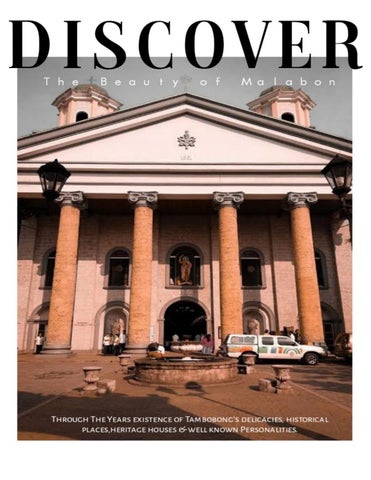
In the historic town of Malabon, in Metro Manila, you can find the oldest parish in the region, the parish of San Bartolome, which is also a landmark in history and the mother church of all the parishes of Malabon. The parish and its titular patron became silent witnesses of the changing yet turbulent past of both the city and the country. The devotion to San Bartolome de Malabon started with its foundation as a former visit of Tondo, and Malabon was founded on 21 May 1599 by the Augustinian Friars. It became an official parish in 1614, with Father Luis Gutierrez as Vicar Prior. When Father Diego de Robles became the prior of managed to slip through the checkpoints of GuarMalabon in 1621, a year later he started building dia Civil only by posing as pilgrims of San Barthe first stone church. It was a gradual construc- tolome. And thus the red cloak of the apostle was also the red cloak of the revolution and its common arms, the Sang Bartolome. The celebrations end with the solemn procession of the image to its domain in Malabon. We saw that the people were forever thankful for the safety of their patron saint as he became a silent witness to the history of the city, and this is manifested in the culture and faith of the people. The Philippine Postal Corp. (PhlPost) yesterday issued a stamp featuring the San Bartolome Parish de Malabon, one of the oldest churches in the country, in commemoration of its 400th anniversary.
tion, as additions were made by the successors of the priests. The people of Malabon have grown to have a devotion to Saint Bartholomew that has been invoked by people in their various needs for centuries to this day. It was a gradual construction, as additions were made by the successors of the priests. The people of Malabon have developed to have a devotion to Saint Bartholomew that has been expressed by people in their various needs for centuries to this day. The long bolo named Sang Bartolome was Katipuneros' favorite tool, and on the eve of his feast, on August 23, 1896, they chose to lift the cry of the revolution now known as El Grito de Balintawak, tear their cedulas and raise their bolos to invoke the blessing of San Bartolome upon them. In addition, the Katipuneros, hurried to join Bonifacio in Caloocan,
La Inmaculada Concepcion de-Malabon Written By: Rica P. Martin
The old Barangay Concepcion, where the miraculous and beautiful image of La Inmaculada Concepcion de Malabon - the Patroness of the City, can be seen, is one of the main places in this city. Inang, as her devotees fondly call her, became a silent witness to the colorful and dynamic history of the city. That the devotion to her has continued to this day. The devotion to La Inmaculada Concepcion De Malabon began when a visita established in hacienda tambobong (now the present Malabon city) in 1600 the beautiful image was carved by an unknown Kapampangan sculptor in 1700’s. The chapel was captured on November 20, 1902, and the Aglipayans occupied it as part of their schism. The privileges of the Catholic population of Malabon have been defended by Archbishop Bernardino Nozaleda, OP. After the dark years of the Aglipayan Schism, the year 1907 turned out to be a year of blessing, since the Archbishop of Manila, His Excellency Jeremias Harty, DD, proclaimed the Immaculate Conception Chapel a parish. Not only because they had their own priest, the group was full of joy, not only because their chapel was raised to parish status, but because the Immaculate Conception Parish was constructed on our Mother's birthday, September 8, 1907. While the earthquake of 1879 destroyed the chapel, the image of the Immaculate Conception was unbelievably unscathed. Immediately, the rebuilding of the chapel began, and a bigger and stronger building was completed in 1886. In an exclusive interview with Bro. Paulo Mangali the church caretaker. During the pandemic they used different social media platforms for atleast spread and share the word of God, through facebook live streaming. But we all know that before pandemic the church uses television for the TV masses as well as radio. Father joey insisted to create and use live streaming as a way to connect with people even with pandemic. The church is now open for the public and now they are reducing the use of live stream masses so people can go back to the church safely . but the administration of the immaculate concepcion prepares and follows protocols and practices social distancing to ensure safety among the
people. “kung kaya natin na pumunta at bumalik sa mga malls at iba pang pasyalan baket hindi tayo magbalik sa simbahan” Bro. Paulo Mangali added. The miraculous image of La Inmaculada Conception de -Malabon has been attributed to various miracles. Due to the various miracles attributed to the Virgin Mary, on December 07, 1986 on the strength og the Papal Bull issued on September 16,1986, the portrait of La Inmaculada Conception de-Malabon receive the honour of Canonical Coronation. Over the years, the devotion to La Inmaculada Concepcion de-Malabon grew and expanded and her intercession was attributed to more miracles. The feast of La Inmaculada Conception is celebrated for three days: the first on her liturgical feast every December 8, the Dalaw Bahay every December 9 and the Araw ng Conception held every December 10. With great solemnity, the Liturgical Feast of La inmaculada Concepcion of Malabon is celebrataed and the Virgin is carried in a solemn procession. This is where the original image of the Virgin is taken from her altar on the Dalaw Bahay day that is held every Deceber 9 and visits every household in Malabon to bless them and the families will give thanks to their patroness in a variety of ways the whole day. Currently, the Concepcion, Malabon fiesta lasts three days from December 8 to 10. December 8 is the nationwide Feast of the Immaculate Conception. Apart from the fact that they did not want to interfere with the importance of the national commemoration, the Pista ng mga Mangingisda (Fisherman’s Festival) is on December 9th. That is why there is a river procession on that day or known as Fluvial Procession or PAGODA.
Photo Courtesy: Jolina Antoja
PHOTO COURTESY FROM: IMMACULATE CONCEPTION PARISH
Immaculate Conception Parish
Photo courtesy : Jolina Antoja
PHOTO COURTESY FROM: IMMACULATE CONCEPTION
San Antonio De Padua Parish Photo courtesy : Hannah Nicol
A LOCAL CHURCH CAPTURED FAITH AND HUMANITY (Rensel Sabando) Anthony of Padua born Fernando Martins de Bulhões 15 August 1195 – 13 June 1231. Anthony of Lisbon (Portuguese: António de Lisboa), was a Portuguese Catholic priest and friar of the Franciscan Order. He was born and raised by a wealthy family in Lisbon, Portugal, and died in Padua, Italy. Noted by his contemporaries for his powerful preaching, expert knowledge of scripture, and undying love and devotion to the poor and the sick, he was one of the most quickly canonized saints in church history. He was proclaimed a Doctor of the Church on 16 January 1946. He is also the patron saint of lost things.
It is situated in the middle of the town and was built in 1857 or six years after the town was established. It is also one of the tourist
JANUARY 14, 2021 On January 31, 2007, the San Antonio De Padua Parish Church was conferred the title of the Archdiocesan Shrine of San Antonio de Padua by thenarchbishop of Cebu His Eminence Ricardo Cardinal Vidal. This conferment made it a pilgrim destination for the faithful seeking consolation since San Antonio de Padua is the patron saint for sailors, businesses, the less privileged, expectant mothers, and lost souls, among others. The San Antonio De Padua Parish Church celebrates the annual feast day of San Antonio de Padua every June 13.
spots of the town due to its cultural and historical significance. The first parish priest of San Antonio De Padua Parish Church was Fr. Prospero Salazar.
SAN ANTONIO DE PADUA
“HERITAGE HOUSES IN MALABON”
MARIO RIVERA HOUSE Photo Courtesy: Jolina Antoja
Mario Luna House
On C. Arellano Street are two heritage houses that stand proudly side by side. One is the MARIO LUNA HOUSE which was built in the 1890s. Just like the Gonzales House, its ground floor has become much lower than street level. But again, I am grateful that the owners are trying to preserve it because the once-peeling-off exterior has been given a fresh coat of paint. The embellishments painted white against the brown background can also be better seen now and makes the facade look charming.
Photo Courtesy: Jolina Antoja
VILLONCO HOUSE
BORJA HOUSE
Photo Courtesy: Hannah N
Raymundo House
Photo Courtesy: Hannah Nicol
“Famous Delicacies in MALABON ”
DOLORS KAKANIN
Mention the name “Dolor’s” and a particular kakanin or rice delicacy instantly comes to mind—sapin-sapin. Neatly placed on a bilao (circular bamboo tray), this rainbow-colored treat is made with glutinous rice flour, sugar, condensed milk, and cold-pressed coconut cream. Each layer of color corresponds to a particular flavor: white for cassava, purple for kalamay ube, red for kutsinta, yellow for maja mais, and brown at the center for biko. Half of the outermost part is a sapin-sapin, divided into three shades of white, yellow, and purple. This soft and gooey treat is typically served with latik (toasted coconut curd) and a generous sprinkling of budbod (toasted coconut bits). Dolores “Aling Dolor” Santos was the breadwinner in a brood of nine siblings. Her natural diligence, curiosity with food, and the desire to make ends meet revealed a knack for entrepreneurship. Armed with the drive to rise from her economic status in her early 20s (back in the 1930s), she took a big chance on meticulously making her own puto and kutsinta, assembling them on a big bilao, and valiantly peddling them in the palengke. With the thought of innovating her product offerings, she gradually added different types of kakanin like kalamay ube, biko,
maja mais, and sapin-spain, which eventually became a sensation, earning a cult following among loyal patrons. Ellen always sticks to the business philosophy of her aunt Dolor: to only choose quality ingredients. For years, the rice would come from Bulacan, the glutinous rice from Palawan, the sugar from Negros, and the coconuts from Batangas and Quezon. She would personally screen the delivery of each grain and agri-product to ensure consistency. Over time, her homemade delicacies yielded such a high demand that she was forced to just sell them at home, investing in a simple counter with several shelves to display her native desserts. Customers would go to her humble shop along Escanilla Street, a narrow alley situated beside the Immaculate Conception Parish Church. Her family members were not only witnesses to her hard work cooking huge orders over a steamer fueled by burning coconut husks but also to her ingenuity and passion, even at her age. With three generations living in a single house, her nieces and nephews oftentimes offered to help, which made for a welcome bonding moment.
ELENITA “ELLEN” JACINTO Pioneer of Dolor’s kakanin
Her 70-year-old niece Elenita “Ellen” Jacinto vividly recalls the intimate conversation with her aunt that sparked the idea of selling all the kakanins they cooked on one bilao. “Para masubukan lahat ng customers ang lahat ng produkto namin sa isang bilao.” And that gave birth to the identity of Dolor’s. Ellen delightedly shares that Dolor’s Kakanin started receiving a different market profile through the late Petra Furagganan (mother of Juan Ponce Enrile, Sr.), who discovered their stall when she was a frequent Mass-goer at the Immaculate Conception Parish Church. With over 80 years in the business, the dream of a young woman has evolved into a well-loved brand. The intention of providing for her family has been fulfilled for the current generation and many more to come. As a Malabon native, Furagganan made it a point to serve the famed homegrown brand at her hosted merienda cena, graced by Manila’s high society. Likewise, she would proudly bring it to the nearby Tropicana Studio, the atelier of the late “Mang Ador,” known as the “Photographer of the Stars” to LVN Pictures artists like Susan Roces, Fernando Poe, Jr., Amalia Fuentes, and Dolphy. It received the nod from the elite and celebrities, and they started ordering as well. Since then, the iconic delicacy has received attention and admiration outside the perimeters of Malabon. As a Malabon native, Furagganan made it a point to serve the famed homegrown brand at her hosted merienda cena, graced by Manila’s high society. Likewise, she would proudly bring it to the nearby Tropicana Studio, the atelier of the late “Mang Ador,” known as the “Photographer of the Stars” to LVN Pictures artists like Susan Roces, Fernando Poe, Jr., Amalia Fuentes, and Dolphy. It received the nod from the elite and celebrities, and they started ordering as well. Since then, the iconic delicacy has received attention and admiration outside the perimeters of Malabon. Aling Dolor never married, and she dedicated her life to running the business and providing for her family. She passed away in 1997. Her legacy lives on through her niece, kitchen assistant, and recipe custodian, Ellen. Aware of her responsibility to pass on the torch to the future generation, Ellen has chosen her niece, Denise “Deedee” Tabije, to be the deserving successor. Denise holds a doctorate in sports science but is empowered to carry on what her grandmother successfully built back in the day. With her aunt Ellen standing close to guide her every move, she has contributed significantly by documenting the recipe and business operations and
eventually expanding retail operations to Manila’s big malls. Her next big move is to ride the digital wave—by making their products available online. Ellen always sticks to the business philosophy of her aunt Dolor: to only choose quality ingredients. For years, the rice would come from Bulacan, the glutinous rice from Palawan, the sugar from Negros, and the coconuts from Batangas and Quezon. She would personally screen the delivery of each grain and agri-product to ensure consistency. The big challenge will always be the produce that is supplied. If the farmers’ crops are affected, it disturbs the production and they have to go through the process of sourcing other suppliers.
One time, they were heavily affected by the “cocolisap” infestation and they had to look for the same variant of coconut elsewhere. It was important that it produced the same creamy texture. The other haunting concern is that other relatives decided to put up a business anchored on the same brand. It has created confusion in the market and product quality is often compared. Ellen keeps mum about it and just tells their clientele to look for the red box with the stamp of “Original” Dolor’s Kakanin. As for bilin from her aunt Dolor, she had this foremost instruction she left behind: “Huwag na huwag mong iibahin ang recipe.” And Ellen has been keeping true to it. With over 80 years in the business, the dream of a young woman has evolved into a well-loved brand. The intention of providing for her family has been fulfilled for the current generation and many more to come.
Source : F and B Report
BALSA SA NIUGAN
|Jenny Rose Albason
Located in a small street a little off San Antonio de Padua Parish Church, it is known as a floating restaurant because you can dine on bamboo rafts, or balsa. I wanted to order the sizzling pork sisig which I heard was its most popular dish, but eventually decided on something a little healthier instead -the tilapia sisig -- to go with pinacbet. Both were delicious and the servings were quite big for me and my husband. Their menu is also quite varied, and with not too many diners by the time we had our late lunch, the overall ambience, as their poster says, was cool and relaxed. According to Nelia Geronimo, whose family owns the restaurant, BALSA SA NIUGAN was established in July 1998. It was originally a fishpond, which they converted into a restaurant. They first started with only four rafts. They have since added pavilions for bigger groups, and more recently they opened a coffee shop. They usually have more diners in the evening.
DAMPA SA PASEO|Mabel Vieron Bulalo is a Filipino delicacy which is a stew made from beef shanks with bone marrow. Its origin is said to be in Southern Luzon in the Philippines. It is a rich lightcolored soup with beef shanks and beef marrow bones as the main ingredient. It is boiled for hours until much of the ligaments and fat has melted into the clear broth. The seasonings vary with some using only salt and black pepper while others add fish sauce (patis), garlic or even corn (which is filling and gives it a distinct taste and aroma that I like). It’s unsurprisingly similar to the Mexican beef stew, Caldo de Res, which Filipinos must’ve learned and developed since the Spanish rule. It was a take-out from “Dampa sa Paseo”, a nice restaurant situated in Gov. W. Pascual Avenue, Catmon, Malabon, Metro Manila. The City has developed significantly in the last five years in my opinion since there are a lot of new businesses and I can see new restaurants thriving. This is one of a number of nice places shown in this screenshot of Google map.
NANAY’S PANSITAN PANSIT MALABON ORIGINAL DELICACY THAT GIVES YOU MORE SAVORY | Rensel Sabando
seafood sampler it is because of the location. Malabon is situated in a coastal area wherein most of the major fish markets are located. The city is Pansit Malabon is a flavor- also a few minutes away ful noodle dish that origi- from the huge fish ports of nated in the City of Mala- Navotas. bon. This dish resembles the Pancit Palabok but the LOCATION : Gov.Pascual Ave.Malabon , Metro Maarray of seafood toppings nila and the traditional tough and thick rice noodles distinguishes this dish. AcThis picture inside happened cording to Nadine Macandog "Who could resist during The New Normal in Nanay’s their ever so famous PanPansitan. cit Malabon? Its thick noodles, bright yellow sauce OUTSIDE OF NANAY’S PANSITAN IN 37 GOV. PASCUAL CONCEPTION and rich ingredients like shrimp, squid, oyster, crab fat and duck eggs are combined exquisitely." Traditional Filipino stirfried noodle dishes. It is prepared with thick rice noodles doused in a flavorful shrimp-infused sauce and usually incorporates various seafood ingredients such as shrimps, squids, or mussels. This dish is often served topped with hardboiled eggs, pork cracklings, sliced cabbage, and fish flakes. As the name suggests, it stems from the coastal region of Malabon, famous for its abundance of fresh seafood ingredients. Like other pancit varieties, this local favorite is also traditionally served on special occasions. The reason why this dish seems like complete
NEW NORMAL
Rody Days | Aira Dayrit Rody Happy Day's Restaurant located in General Luna Brgy. Ibaba Malabon City, Rody Days Jr. A Filipino Business Man who owned Rody Day's Restaurant offer different viand like crispy pasta, breaded chicken, sinigang na baboy, and letchong kawali.Costumer's stay at restaurant because they sell well and it has a low-priced that everyone's afford and delight in the ambiance of the place.
PHOTO COURTESY : PINTERST
Established in 1972, Judy Ann’s Crispy Pata has become a classic go-to local restaurant in Malabon City. Remegio Antonio, the brilliant behind the remarkable recipe of Filipinos’ all-time favorite crispy pata, was a food enthusiast who dedicated much of his time in trying out various food and restaurants. Unsatisfied despite the breadth of his food experience, he figured he should develop his own recipe that would perfectly suffice the need of his own taste buds. The recipe that eventually became perfect for most people. Judy Ann’s Crispy Pata was named after Antonio Family’s youngest child. But, the restaurant’s name was later changed to Jamico’s Restaurant, following the family’s tradition of deriviation from the youngest member’s name. A local family restaurant from Malabon, what sets it apart from the rest of the famous cripsy pata’s? On a Saturday night, I decided to revisit the restaurant along with some friends, to rediscover its magic and to increase my list of food favorites. I have tried Judy Ann’s Crispy Pata several times, but was inspired to blog about it after discovering that it is a favorite of many people whom I know that live far from Malabon. I asked these people why this particular crispy pata landed on their top picks. “Flavorful, but not overpowering.” “Crispy on the outside, yet tender on the inside.” “It is eating something that feels really clean and freshly prepared.” Partner it with either a red sauce/ sweet chili or toyo-suka, to really enjoy the meat. Although personally, I can eat this without any dip at all.
Crispy Pata
MALABON HERITAGE LIBRARY MUSEUM Written By: Aira Dayrit
The museum also contrains dioramas of Malabon’s old houses from its old corps families, the San Bartolome Parish and the steam-powered Malabon tranvia connecting the city to Tondo during the Spanish colonial period.
The museum also contrains dioramas of Malabon’s old houses from its old corps families, the San Bartolome Parish and the steam-powered Malabon tranvia connecting the city to Tondo during the Spanish colonial period.
“Local Stories”
As strong as the Stone, The Foundation of the Church is indestructible| Rica Martin In the historic town of Malabon, in Metro Manila, you can find the oldest parish in the region, the parish of San Bartolome, which is also a landmark in history and the mother church of all the parishes of Malabon. The parish and its titular patron became silent witnesses of the changing yet turbulent past of both the city and the country.
Former visit of Tondo, Malabon was established on May 21, 1599. It became an official parish in 1614, with Father Luis Gutierrez as Vicar Prior. When Father Diego de Robles became the prior of Malabon in 1621, a year later he started building the first stone church. Location: San Agustin, Malabon, Metro Manila, Philippines. Photographer: Jolina Antoja Date: January 12,2020 JPEG FORMAT
Arny dadings Peachy Peachy Famous "Kakanin" of Malabon |Rensel Sabando A little taste of heaven and a greatest pleasures. Introducing one of the Malabon famous delicacies Arny dadings peachy peachy the taste that will satisfy your cravings. Filipino ‘kakanin’ is one of the most common snacks in the country. If you haven’t tried even just a slice of rice cake or a piece of puto or kutsinta, then you’re probably missing a lot. Usually, these snacks either go with shaved coconut or a coconut milk prod-
One of my favorites would be the peachy peachy. I remember always buying some for dessert during celebrations. This tell these yellow treats with the shaved coconut. It’s not everyday that they have it, so make it a point to buy a piece or two everytime they offer it. You've never tried peachy peachy with any other top-
ping, not until malabon introduced peachy peachy store that served your favorite ‘kakanin’ in a different way. You will instantly got hooked. The cheese gave some creaminess to the peachy peachy, but it didn’t overpower its flavor. The peachy peachy had a gelatinous texture which you can liked. It didn’t have that su-
per sweet taste, and that’s where the cheese comes in. It actually helps improve the flavor of the peachy peachy. You will like Arny-Dading’s peachy peachy is that they’re bite-sized, so you don’t have any worries of cheese falling off the floor, it is favourable Element : Fill the Frame and Close up Photographer :Hannah Nicol Date : Jan 14 2021 JPEG FORMAT
Iglesia Filipina Independiente “Aglipayan Church” |Rica Martin Independent Philippine Church, an independent church founded in 1902 as a protest against the Spanish clergy's domination of the Roman Catholic Church after the Philippine Revolution of 1896-98. Gregorio Aglipay y Labayán, a Philippine Roman Catholic priest who was excommunicated in 1899 for his activities on behalf of the revolution. In 1903, Aglipay approved the application of de los Reyes to serve as supreme bishop of the new church, a position he held until his death in 1940. The church tended to observe Roman Catholic forms of worship, but Unitarianism was highly influenced by theology for many years. In 1946, a schism arose, and a unitarian faction left the church. The church adopted a new declaration of faith and articles of worship, which were Trinitarian, in 1947, under Isabelo de los Reyes, Jr., elected bishop in 1946. They’re ‘Catholic’ on grounds that the church proclaimed schism from the Roman Catholic Church and its retained some Catholic celebrations and doctrines in their theology. It must again be noted that though it’s ‘Catholic’ it is independent from Roman Catholicism and the Papal authority. Location: C. Arellano St. Malabon City Name Of Photographer: Jolina Antoja Date: January 12,2020 Jpeg Format.
PHOTO COURTESY : JOLINA ANTOJA
CONCEPCION MARKET
Special Thanks to the following people *Sabando Family *Sponsors *Ms.Emily Bontan (GrandDaughter of Nanayowner of Nanay's pansit Malabon *Mr Paolo Mangali (Immaculate Concepcion church caretaker) *All the members who participated in the fulfillment of this project *Editorial Board
REFERENCES: https://l.messenger.com/l.php?u=https%3A%2F%2Fwww.google. https://sg.docworkspace.com/d/sIOv_3vFFs7mCgAY https://sg.docworkspace.com/d/sIOv_3vFFs7mCgAY https://sg.docworkspace.com/d/sIOv_3vFFs7mCgAY https://l.messenger.com/l.php?u=http%3A%2F%