T H E L O V E T T S C H O O L | 2025 S I E M P R E V E R D E
DIRECTOR’S REPORT
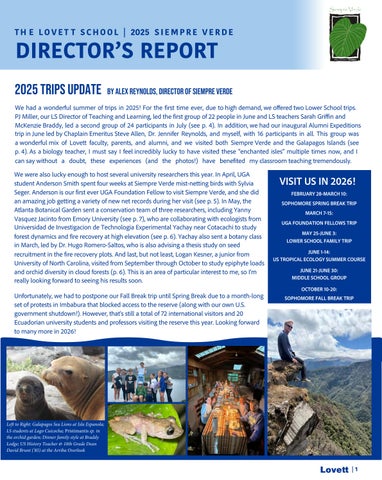
2025 TRIPS UPDATE By ALEX REYNOLDS, DIRECTOR OF SIEMPRE VERDE We had a wonderful summer of trips in 2025! For the first time ever, due to high demand, we offered two Lower School trips. PJ Miller, our LS Director of Teaching and Learning, led the first group of 22 people in June and LS teachers Sarah Griffin and McKenzie Braddy, led a second group of 24 participants in July (see p. 4). In addition, we had our inaugural Alumni Expeditions trip in June led by Chaplain Emeritus Steve Allen, Dr. Jennifer Reynolds, and myself, with 16 participants in all. This group was a wonderful mix of Lovett faculty, parents, and alumni, and we visited both Siempre Verde and the Galapagos Islands (see p. 4). As a biology teacher, I must say I feel incredibly lucky to have visited these "enchanted isles" multiple times now, and I can say without a doubt, these experiences (and the photos!) have benefited my classroom teaching tremendously. We were also lucky enough to host several university researchers this year. In April, UGA student Anderson Smith spent four weeks at Siempre Verde mist-netting birds with Sylvia Seger. Anderson is our first ever UGA Foundation Fellow to visit Siempre Verde, and she did an amazing job getting a variety of new net records during her visit (see p. 5). In May, the Atlanta Botanical Garden sent a conservation team of three researchers, including Yanny Vasquez Jacinto from Emory University (see p. 7), who are collaborating with ecologists from Universidad de Investigacion de Technologia Experimental Yachay near Cotacachi to study forest dynamics and fire recovery at high elevation (see p. 6). Yachay also sent a botany class in March, led by Dr. Hugo Romero-Saltos, who is also advising a thesis study on seed recruitment in the fire recovery plots. And last, but not least, Logan Kesner, a junior from University of North Carolina, visited from September through October to study epiphyte loads and orchid diversity in cloud forests (p. 6). This is an area of particular interest to me, so I’m really looking forward to seeing his results soon. Unfortunately, we had to postpone our Fall Break trip until Spring Break due to a month-long set of protests in Imbabura that blocked access to the reserve (along with our own U.S. government shutdown!). However, that’s still a total of 72 international visitors and 20 Ecuadorian university students and professors visiting the reserve this year. Looking forward to many more in 2026!
VISIT US IN 2026! FEBRUARY 28-MARCH 10: SOPHOMORE SPRING BREAK TRIP MARCH 7-15: UGA FOUNDATION FELLOWS TRIP MAY 25-JUNE 3: LOWER SCHOOL FAMILY TRIP JUNE 1-14: US TROPICAL ECOLOGY SUMMER COURSE JUNE 21-JUNE 30: MIDDLE SCHOOL GROUP OCTOBER 10-20: SOPHOMORE FALL BREAK TRIP
Left to Right: Galapagos Sea Lions at Isla Espanola; LS students at Lago Cuicocha; Pristimantis sp. in the orchid garden; Dinner family style at Braddy Lodge; US History Teacher & 10th Grade Dean David Brunt ('85) at the Arriba Overlook
|1
Why IS ECUADOR IN THE NEWS SO MUCH TODAY? BY ALEX REYNOLDS, PROGRAM DIRECTOR I’ve been working in Ecuador for 25 years now, and I can’t remember another time when it’s been in the international news as much as now. To be fair, Ecuador is a small country of about 18 million people, and it has had a relatively unnewsworthy past compared to its larger and more visibly political neighbors, such as Venezuela, Colombia, Peru and Brazil. But that’s not to say the country hasn’t had its problems. After all, my first visit was literally amidst a coup d’état in January 2000, followed by another in 2005 during my graduate research. Famously, Ecuador had six presidents from 1997-2006, and all were deposed in peaceful revolts. However, all of this instability came to an end with the election of Rafael Correa in 2007, which led of an era of increased governance and stability, though often at the cost of corruption, autocracy, and weakened relations with the United States. Add to the mix Ecuador’s increasing national debt triggering austerity measures just as the Covid pandemic sent shockwaves through the country, and there’s a perfect storm for increased political instability and violence. Which brings us to the present-day news. Since 2019, indigenous groups led by CONAIE (Confederation of Indigenous Nationalities of Ecuador) have led several nation-wide protests which have caused lengthy disruptions that were costly to the national economy. In the meantime, violent gangs connected with the coastal drug trade have flourished causing Ecuador’s murder rate to skyrocket by almost 300% in the last 5 years1. By some estimates, up to 70% of all drugs from Colombia and Peru are trafficked through Guayaquil and other Ecuadorian port cities. So, it’s no surprise that current President Daniel Noboa has looked to the United States for help. A November national referendum included several controversial proposals, such as reopening U.S. military bases in Ecuador and rewriting the 2007 Constitution to allow for harsher treatment of drug traffickers. However, all of the measures failed to pass the popular vote, a public rebuke of the current President’s right-wing reforms. At this point, I think it's worth noting that almost half of all homicides in 2024 (46.5%) were in the coastal province of Guayas alone, and 74.3% were from the five coastal provinces, while the Andean province of Imbabura (where Siempre Verde is located) only accounted for 0.35% of murders last year2. Sadly, while Siempre Verde is physically far removed from all of this political conflict, we’re still affected by it. This October marked the third time since 2019 we’ve postponed a trip due to indigenous protests. Not because of any threat of violence, but because the protests involve road closures that block all access to our property. President Noboa's constitutional reforms also include expanding the mining concessions that threaten practically the entire Intag region and CONAIE ranks antimining and community self-determination high on its platform. After their most recent protests were ended by threat of brute force from the national government, any win-wins are unlikely in the near future. So, when I’m asked how’s it going at Siempre Verde, it's complicated, but my honest answer is: Great! The reserve continues to serve as a sanctuary for both wildlife and the people who visit. I hope as you read this annual report, you’ll see all of the amazing work we’re doing and lives we’re impacting. We’re continuing to do our best to stand by our staff and friends in Intag and I am so thankful we have always had a strong community supporting us, both here and in Ecuador. 1 https://www.statista.com/chart/31557; 2 https://www.statista.com/statistics/1484505
l to r: Cecropia tree backlit by a full moon; Evening shot of Otavalo; Adult group in front of the Presidential Palance; Sunset over the Galapagos
|2
Third Time's The Charm BY Towner Schunk '20, Siempre verde station manager What a privilege and an honor it was to welcome so many researchers, students, teachers, parents, alumni, and friends to Siempre Verde this year! For those of you reading who are unfamiliar with me, my name is Towner Schunk, and I am the new Station Manager to this magical place in the Andes. I am a recent Anthropology graduate from Warren Wilson College located in Asheville North Carolina. I am a Lovett Lifer and the son of Religion and History teacher, Sandra Switzer. I am also a ceramicist! As a Lovett Alum (graduated in 2020), I was fortunate enough to travel to Siempre Verde twice before; once as an Eighth grader (2015), and again as a student in the Spanish Immersion class during my Sophomore year (2017). Through these experiences, Ecuador carved a special place in my heart, and it was a no-brainer when Mr. Reynolds offered the opportunity to return as Station Manager. (And I couldn’t be happier that he did!) This was my first summer as Station Manager, and the first year we’ve had this role at Siempre Verde since 2022. I sought lots of guidance from the previous Station Manager, Sylvia Seger, who was generous enough to share her wisdom and resources with me. With her preparation as well as the help from the Ruiz family, both Mr. and Dr. Reynolds, and of course, the faculty that led this year’s trips, I was able to smoothly adopt this role and responsibility. I give my sincerest gratitude for each and every one of them. With my introduction out of the way, I am proud to share the feats of this summer! When I first arrived, I had the pleasure of meeting Anderson Smith, a student from UGA who was finishing her month of birding research with renowned bird specialist, Sylvia Seger. On top of being inspired by her research, I also gained a friend. Shortly after her departure, I, alongside the Ruiz family, prepared for the arrival of the first Lovett Lower School group in early June. From relaxing games of Mahjong by the fire, to racing up the Arriba trail, this group adjusted quickly and excitedly to Siempre Verde life. While parents enjoyed time to disconnect from their phones, they and their kiddos were able to experience quality time together in nature. From playing imaginative games on the hammocks to card games by candlelight, this group of students made sure to bring the energy.
Top: Towner Schunk with LS group at Rio Toabunchi; Bottom: Towner with Alex and Jennifer Reynolds; Nelson showing off his machete skills at Arriba overlook
The second Lower School group arrived in July and enjoyed much of the same lodge activities as the first. Quiet, relaxing hours flew by as folks read by the fire, while just outside, students (aged 10-11) whooped and hollered as they played together. Just like the first group, the July folks also explored some fascinating places outside the lodge. They bargained in the Otavalo market stalls, visited the equator line museum, and explored the capital city of Quito. Historical landmarks, architectural wonders, and delicious food awaited our travelers. We wrapped the trip up with a lovely and relaxing stay at the Papallacta hot springs, a final day in Quito, and then hit the airport for red-eye flight back to Atlanta. All in all, it was a lovely summer in the mountains! I look forward to growing in this role and adding my own unique flair to it. L to R: Plate Billed Mountain Toucan (Andigena lamnirostris); LS group on the Cascada Trail; LS students holding guinea pigs at Ruiz homestead |3
Alumni expeditions inaugural year BY Steve Allen, Lovett chaplain emeritus In July, 16 of us traveled to Siempre Verde and the Galapagos Islands for our first ever adult trip with Lovett Expeditions. Lovett Expeditions is a new program that invites alumni and friends to explore the world together through experiences that blend adventure, cultural discovery, and spiritual reflection—deepening their bond with Lovett and with one another as lifelong learners and global citizens. We began our trip to Ecuador with a visit to Lovett's cloud forest property at Siempre Verde. We hiked, visited the community of Santa Rosa and enjoyed relaxing evenings around the fire. After that we flew to San Cristobal, boarded the Coral II Yacht and set out for the islands of the Galapagos. Each day we took day trips to the islands that included hiking, snorkeling, kayaking and birding. The sites and sounds of the Galapagos and the bonds formed with our fellow travelers made it a once in a lifetime experience. We are planning to do this trip once again in July 2027. If you'd like more information about how to join us, reach out to Alex Reynolds at alex.reynolds@lovett.org or Steve Allen at steve.allen@lovett.org
Lower School Trip report BY McKenzie Braddy, LS Associate Teacher This summer, we had the privilege of taking two groups of eager Lower School families to visit Ecuador. These fifth graders began their trip excited to learn more about the country’s culture, language, and traditions. Some of them were even adventurous enough to try a traditional Ecuadorian/Andean dish called cuy (fried guinea pig). The fifth-grade adventurers practiced their Spanish while staying at the Braddy Lodge and learned more about native plants and animals during our hikes. We explored the Río Cenepa, witnessed numerous breathtaking waterfalls, and many families hiked to the top of the Arriba Trail to enjoy a beautiful panoramic view of the Andes Mountains. One of the highlights of our June trip was visiting historic landmarks and churches in Quito, followed by enjoying empanadas in the town square. In July, we even got to experience some vine swinging by the river! Although each trip followed a similar itinerary, every group created its own unique and unforgettable experiences.
Above: Steve at El Mirador; Adult group with Galapagos sea lions; Below: adult group at Punta Pitt, San Cristobal
As the granddaughter of Robert and Connie Braddy I grew up hearing the stories of Siempre Verde and its beauty. It brought tears to my eyes to finally see the beauty for myself. Watching students explore and grow during this trip was the cherry on the top of my first Siempre Verde experience and I can’t wait to continue the legacy my grandparents built.
L to R: June LS group at La Basilica cathedral overlooking Old Town, Quito; LS group ready to hike in front of Braddy Lodge; and July LS group at the Equator monument
|4
RESEARCH UPDateS Field report: mist netting in the cloudforest By ANDERSON SMITH, UGA FOUNDATION FELLOW Over the past month, Dr. Sylvia Seger, former station manager, and I used mist-netting to assess avian community assemblages across an elevational gradient at Siempre Verde. We will analyze this data to detect signals of community composition change correlated with elevation, and we hope to publish a completed report in a peer-reviewed conservation bulletin, preferably in English and Spanish. We caught some amazing birds, 16 of which were new net records for the preserve! Favorites of mine include the masked trogon, Andean pygmy owl, and white-booted racket-tail. This data will provide clarity on the ways in which elevation shapes species diversity in critical and rapidly vanishing montane cloud forest habitat. Of course, we didn't spend every moment of the past month in the woods. I developed a close relationship with the Ruizes, who are incredible people devoted to cloud forest conservation. I had the good fortune to attend a handmade fibrecraft demonstration by the Flora del Chocó, a group of women artisans run by Sra. Mari that specializes in cabuya. The resulting goods offer an independent source of income for women in the valley, but this art also protects biodiversity in the region. Harvested cabuya grows back faster, and the artisans forage for wild cloud forest plants used for dyeing the products. Knowledge of the location and distribution of these dye plant species provides important data in the fight against the encroachment of mining interests and deforestation in the region. It was so special to witness an art form that is both so economically and ecologically vital for the Intag River valley, and the Flora del Chocó completely changed my perspective on sustainability. Instead of eliminating human involvement with threatened land, a common conservation strategy across the globe, these women work with the land, using its gifts to support themselves economically while protecting it for future generations.
Top: Anderson Smith holding a Cinnamon Flycatcher (Pyrrhomyias cinnamomeus); Bottom: Russet-crowned Warbler (Myiothlypis coronata) in hand
I cannot say enough about the professional development, personal growth, and immense joy I've experienced at Siempre Verde over the past month. This place is a paradise of biodiversity managed by truly wonderful people. I'm already excited to return!
Anderson holding a Great Thrush (Turdus fuscater); a Blue Winged Mountain-Tanager (Anisognathus somptuosus) in hand; White-Rimmed Brush Finch (Atlapetes leucopis) - a new net record at SV; photo credits: Anderson Smith and Sylvia Seger
|5
NEW REsearch PARTNERSHIPS and Collaborations We’re excited to begin a new research partnership with Dr. Hugo Romero-Saltos at Universidad de Investigacion de Tecnologia Experimental Yachay, just outside of Cotacachi, which is only a couple hours from Siempre Verde. This began through a collaboration between Yachay Tech and the Atlanta Botanical Garden, but when I asked for help with our fire recovery monitoring, Dr. Romero-Saltos and his thesis student Lesly Salvomanos volunteered their expertise. So far, they have set up seed traps to better understand which plant species colonize the burned patch, and they hope to install pollen and spore traps early next year. Which species repopulate burned areas at such high elevation is virtually unknown, so we look forward to their results. It is always wonderful to have local university students work at Siempre Verde, as training the next generation of Ecuadorian scientists is a top priority conservation goal.
Left and Above: Students from Yachay Tech collecting plant specimens along the trails at Siempre Verde
ESTIMATING EPIPHYTE Abundance BY: LOGAN KESNER, UNIVERSITY OF NORTH CAROLINA My time at Siempre Verde, partially funded by The Lovett School, was amazing and incredibly formative to my career. At Siempre Verde, I spent nearly a month collecting data on epiphytes, which are plants that grow on trees. I was studying to see if epiphyte coverage, pertaining to both density and families of epiphytes, changed across the diverse landscape of Siempre Verde at varying elevational plots. With the help of the incredibly kind local family and stewards of the land, the Ruiz family, I was able to complete my project and am currently working through the data! This experience was my first proper field experience in plant ecology, and I know that this is an amazing stepping stone for my future. Thank you to everyone who helped make this possible!
Top: Logan Kesner with Nelson Ruiz at Lago Cuicocha; Bottom left to right: orchid gallery: Sudamerilycaste gigantea, Cyrtochilum macranthum, Pleurothallis gracillima, Cyrtochilum sodiroi, and Govenia sodiroi
|6
Your Dollars at Work....NEW SPECIES ALERTS! Some fun taxonomic news from Siempre Verde. First, a new species, the Clouded Tiger Cat (Leopardus pardinoides), was described last year and we've identified several photos of this species from our trail cameras at Siempre Verde. This adorable species is considered Vulnerable to Extinction by the IUCN, so we’re happy to provide safe haven for it. This makes two of most significant new mammal discoveries in the last 10 years that have range extensions at Siempre Verde, along with the Olinguito (Bassaricyon neblina) discovery in 2014.
Above: trail camera capture of a Clouded Tiger Cat (Leopardus pardinoides); Below: brand new genus of Bush-Cricket, now known as Tectucantus tinnulus.
On a different note, a tiny bush-cricket we frequently see in the orchid garden turns out to be not just a new species, but a new genus, Tectucantus tinnulus. This species is a stand-out for an unusual structure that amplifies its song in a unique way, similar to blowing across the top of the mouth of a bottle (aka a "Hemholtz resonator"). While not as charismatic as the adorable tiger cat, it’s a good example of why I always tell students to keep their eyes (and ears!) open because you never know if you’re looking a new species at Siempre Verde.
ATLANTA BOTANICAL GARDEN Research Projects Researchers from Atlanta Botanical Garden visited again in May and continued their work on monitoring forest structure along our altitudinal transect. The group, led by Emory student Yanny Vasquez Jacinto and ABG Ecologist Loy Xingwen, established new transects and completed their data collection on the 10-year recensus (see 2024 ABG Synecology article and November article on the Lovett website). They plan to publish results next year, but to summarize some preliminary analysis, tree DBH (i.e. trunk diameter) and growth rates are affected by elevation: at high elevations, trees tend to be smaller and they grow more slowly (see graphs below). This study includes comparisons of 750 individual trees between 2014 and 2024 in 23 plots ranging from 2415 meters above sea level (masl) to 3334 masl. The results confirm of some important trends with strong statistical significance and we hope to see lots of additional results as we look at other variables. This is valuable data because very little is known about the dynamics of high elevation cloud forests this close to the equator and they are among the most endangered habitats in the world. These forests are likely to be most affected by climate change in coming decades, so understanding how they change in response to altitude is a major goal.
(l) Atlanta Botanical Garden and Yachay Tech researchers; (r) scatterplot graphs of 10-year recensus data from the altitudinal transect
|7