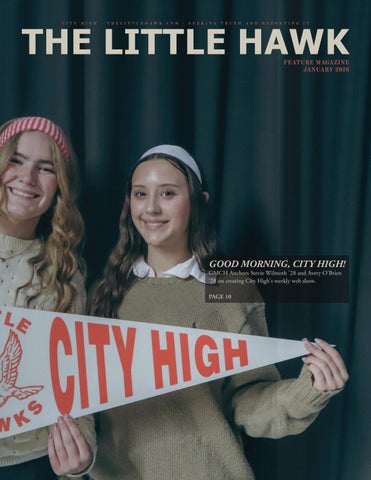
GMCH Anchors Stevie Wilmoth '28 and Avery O'Brien '28 on creating City High's weekly web show.
10
FEATURED PHOTO: Alaina Baxter ‘29 ignites the crowd with her impressive re baton twirling performance during the Homecoming pep rally. PHOTO BY STELLA
CONTRIBUTE
Izzy Brown
Scarlet Carino-Marek
Stella Demarest
Arik Dinkle
Ada Meineke
Rito Perez
Lily Rantanen
Melody Ross
Martha Willard
Tessa Driscoll
DESIGN
Rayan Ahmed
Rito Perez
Lily Rantanen
Jack Rogers
Martha Willard
EDIT
Rayan Ahmed (asst.)
Lily Rantanen
From the Editor
Little Hawks,
It's been a long time coming, but the rst issue of "e Little Hawk Feature Magazine is nally out. "ank you to everyone who contributed their words, photos, or design work. I'm excited to share everything we've created with you.
Within these 24 pages, we've chosen a selection of stories that we think highlight special features of City High. On page 4, you can nd Melody's pro le on english teacher Joe Sloma, who also has a proli c TikTok career. "e Fun Drinks feature (pg. 6) urges the reader to think about the energy drinks they consume, Bon Appetite (pg. 8) highlights an annual cooking competition, and Good Morning City High (pg. 10) introduces anchors Avery and Stevie to the rest of the community.
We've also rounded up the most popular stories of 2025, packaged in a two-page spread for your convenience. "en, you can read Rito's column on college football, the Winter Break Sports Roundup, and pro les on two exchange students.
We have a lot planned for the rest of the year—this magazine is just the beginning.
Lily Rantanen Feature Editor
TIKTOK TEACHER
Story and Photos Melody Ross
Before Mr. Sloma was ever an English teacher at City High, he was a TikTok star who went by the username @squirehaligast at Washington High, creating skits about what it’s like to be a teacher, and what he thinks it’s like to be a student. He’s now continuing that here while he teaches AP Lang and English 10. He has amassed more than 1.4 million followers to date.
“[!e username is] from a book by !omas Pynchon called Mason and Dixon, which is like a postmodern novel that I’ve always particularly liked and there’s a quirky character in there who has that name.”
When coming up with his skits, Sloma tries to think of a con ict based on a recognizable, “universal happening in the classroom.” He has a cast of characters (archetypes) that he’s created over the course of his account’s existence, and when writing the story, he asks himself, “What would characters in this situation do?”
“If it’s a video that goes well, then the script I can write in a couple hours, probably lm in a couple hours, and edit it in a couple hours, so on the low end it’s probably like ve or six total,” he said. “But sometimes, I’ll just have writer’s block, and I’ll just be thinking for a long time and rewriting...so, as far as actual time goes, it can be weeks before I like solve a plot hole or something like that.”
In every one of his videos, Sloma has a whiteboard in the background with a Shakespear quote related to the story from a play he likes to teach called King Leer.
“As far as an overall message I have in the
videos, I think that I want to explore how students and teachers see each other–and themselves–in school, as honestly as possible, if that makes sense, without targeting either with scorn or derision...‘What is school really like for kids if they were given a chance to voice it, and how do teachers actually see that?’”
Despite his popularity, Sloma has only been recognized a few times that he can remember, usually by students or people related to education. He thinks it’s cute that some people brag online about him being their teacher.
“I do [make money]! It’s probably like a couple hundred per video, which–since I only make a video every several weeks–it’s like a decent amount, but it also of course varies on how well the video does...it kind of feels like you’re rolling the dice.”
His most well-known character–the Quiet Kid–was initially created because he was trying to follow a trend, but after it took o , he decided to fully esh them out as a main archetype. “I think that character...hits for maybe a certain section of my audience because that is typically the archetype of student who feels least seen and understood, and so if there is a successful video with
that character, I think the people who see themselves in them really appreciate that or like to feel seen, whereas a lot of the other characters that I make tend to be maybe more bombastic or loud,” he said. “And those are the kids who I think take up more space in a given classroom in a given day, and so representing how they see things isn’t as necessary, it’s not missing from media as much, maybe, as it would be from a quieter kid, so I think when I was making a lot of Quiet Kid videos, I was just really interested in this archetype of student and nding true things about them and what their life might be like in a classroom.”
In 2023, a man named Noah Bradford wrote an article about Mr. Sloma on a website called !e Medium. It’s the only article he ever published. He personally reached out to Sloma via email about it, and he read it, sending a reply telling Noah that he understands him more than he does. “Noah should be writing more,” Sloma said.
Over the past few years, a TikTok ban has been in conversation. For Sloma, this would mean losing his account, and his followers along with it. “I have mixed feelings on the TikTok ban. Obviously I don’t want it to happen, but if it does, I think I’m kind of resigned to it...I’ve had a decent run and it’s been plenty of fun. If I ever felt like the medium was getting stale, it’d be nice to not have to make that choice personally if it went away, but as it stands day-to-day, I sure hope it doesn’t go away. I think that it’s like an awesome place for creators to put themselves out there and like get exposure and tell stories. So…
THE RISE OF FUN DRINKS
Story Izzy Brown, Scarlett Carino-Marek, and Ada Meineke
Graphics Izzy Brown
Fun drinks have gradually begun to make an impact on people and the world around them. In recent years, there has been a drastic increase in the number of people who are ingesting high levels of ca eine daily. Many of the drinks people are consuming have been around for years. Still, recently, doctors, parents, and teachers have noticed signi cant changes in the mental and physical health of young adults whose diet includes ca eine.
From an energy drink in the morning to a soda before dinner, many people are drinking unhealthy amounts of ca!eine.
Ca!eine is a big concern for people of all ages, but especially for teenagers. e recommended amount of ca!eine for an adult to have in a day is 400 mg, while the recommended amount for a teenager is only 100 mg. Recently, there has been an increase in the number of teens and adults who have been hospitalized due to the high levels of ca!eine they are taking in daily. ere areis a variety of brands, types, and levels of ca!eine, but all have relatively similar outcomes. e risks of having excessive levels of ca!eine are usuallycommonly small, including insomnia, shakiness, and headaches, to name a few. e more severe symptoms can range from interference with medications to high blood pressure and heart rate.
While ca!eine and added sugars are typically found in soda, co!ee, energy drinks, and many other products, there are still some bene ts from drinking them. For example, studies have shown that taking in an appropriate amount of ca!eine can actually lead to lower chances of depression, Alzheimer’s disease, and even Parkinson’s disease. As well as helping with mental and physical health, a multitude of City High students mention that drinking an energy drink or a co!ee in the morning gives them something to look forward to.
“I look forward to having my fun drink in the morning because it tastes good, and it gives me energy. I feel a lot happier once I’ve had my energy drink,” Stevie Wilmoth ‘28 said.
Students aren’t the only ones who have been a!ected by the rise of fun drinks. Many teachers
and sta! can be seen around the school carrying cups of Starbucks co!ee or an energy drink.
“Fun drinks, like co!ee, give me a lot of energy. I have three kids, so I really need that extra pump,” City High medical assistant, Ms. Osborne said.
In the past years, more and more teens and young adults have been drinking energy drinks on a day-to-day basis, but most people don’t know just how much sugar, ca!eine, and additives are really in those fun drinks. A typical energy drink has around 200-300 mg of ca!eine in it, and ranges from having 20-50 grams of sugar, some even having up to 80 grams. Long-term overconsumption of added sugars can have signi cant e!ects on the body and mind, especially in young people. e recommended maximum amount of sugar a teenager or young adult should have in a day is around 25 grams, but many energy drinks and sodas exceed this amount. ere are severe side e!ects that go along with consuming too much sugar, such as diabetes, heart disease, and liver problems. A big issue with the drink industry is that many people don’t know how much sugar is in these drinks.
When asked about how many grams of sugar were in their favorite fun drink, an anonymous City High student said, “I don’t really pay attention to how much sugar or ca!eine is in what I’m drinking, so I don’t know o! the top of my head. But if I had to guess, I would say probably more than I should be having.”
Not being fully aware of what’s in the food and drinks that you’re consuming poses a big risk to the health and well-being of people. is has brought up a big question in the medical and scienti c world: Are these drinks doing more harm than good?
BON APPÉTITE
French Club hosts its annual French cooking competition, created by Donna Grundstad
Story Rayan Ahmed and Liyan Elgiseer
Photos Rayan Ahmed
On December 4, City High held its annual French cooking competition. It was rst created by former City High french teacher Donna Grunstadt and later continued by her predecessor, Monsieur Balcean, who learned about the competition during his student teaching with Grunstadt.
“Donna Grunstadt would host this competition for her French students. While I was student teaching with her, I observed that she did it with her students yearly. After she retired, I decided to take over and keep the tradition going,” Balcean said.
"e purpose of the French competition is to encourage teamwork, creativity, and condence while allowing students to enjoy and learn from one another. At the end of the competition, the goal is for everyone to leave happy, even if they didn’t win.
“"e French competition is fun, and it allows anybody in the school to participate, not just French students. It’s inclusive and helps people see that French in uence exists beyond just France,” Jaclyn Ceurvorst, another City High french teacher, said.
"is year, Eleanor Oates ‘29 and Max Sherburne ‘29 won rst place overall for their dish, ratatouille, a classic French Provençal vegetable stew featuring eggplant, zucchini, tomatoes, peppers, and onions. "ey signed up because they both needed a partner and knew each other. "e two signed up together because they realized they both needed a partner and were perfect since they already knew each other.
“"e competition seemed like a fun thing to do, and Sherburne and I both needed a partner, so we partnered up together,” Oates ‘29 said. “Ratatouille is the rst dish you think of in America, especially because of the movie. We worked really well together by splitting the tasks up and completing them quickly.”
Madison Glass ’29 and Lila Maclnnis ‘29 also participated in the French competition, winning rst place for best dessert. "e two signed up together to make madelines, a small, traditional French sponge cake with a distinctive shell shape, known for its buttery avor, light texture, and signature "hump" on one side.
“Since we're in French class, and our French teacher is always talking about the French competition, we thought it would be a good experience for us to get together and bond,” Maclnnis said. My French teacher suggested that we make Madeleines, and I thought it would be fun because there are a lot of di erent ways to make them, so we were able to have fun with di erent toppings and glazes.”
Looking ahead, the French club plans to continue hosting similar events throughout the school year. Another competition in February, where students can showcase their culinary skills, along with many more culinary competitions that are scheduled to take place throughout the year, including a dessert competition and a crêpe-making competition.
“We also want to have another cooking contest with desserts only in February. We are about to set the date for it, and then we usually host a crêpe-making activity in class for the holiday that’s all about crêpes.” Ceurvorst said
In addition to creativity and presentation, preparation plays a major role in students’ success during the competition. Preparation, practice, and con dence are key factors for anyone trying to participate in the French cooking competition.
“We met and practiced together, so we were able to plan out what we were doing and pick out the glazes and toppings that we were using, and make sure everything
worked just before we actually did at the competition,” Glass said.
Sherburne also emphasized the importance of teamwork and organization, explaining that working with the right partner and clearly dividing responsibilities helped the process run more smoothly.
“Whenever you’re choosing your partner, choose someone you like to work with. Dividing up the tasks, making a plan to decide how you want to execute them, and a recipe are really important, too. "at was the rst thing we did,” Sherburne ‘29 said.
Each dish made by the contestants is broken down and evaluated in multiple categories using speci c guidelines to ensure fairness across the competition. As each team presents its dishes, the judges consider more than just taste.
“"ere’s an appearance category, a texture category, an overall avor category, an authenticity category, and then the presentation, how they brought the dishes to us and explained what they were,” Ceurvorst said.
Beyond the competition and judging, the French cooking competition is meant to be an enjoyable experience that builds condence and encourages collaboration among students. It allows students to have fun working their magic, show their cooking skills with con dence, and compete while still bonding with one another.
“My favorite part is always watching students work their magic. Everybody picks something they want to shine at or show con dence in. It’s a joy to watch. "at’s why I’m here, to help people nd things they enjoy doing,” Ceurvorst said.
Over time, the French cooking competition has become a stable tradition of the French club, giving students an opportunity to engage with French culture outside of the classroom.
CITY HIGH Good Morning,
Story IZZY BROWN, SCARLET CARINO-MAREK, AND ADA MEINEKE
Photos LILY RANTANEN
City High’s number one video news source, Good Morning City High, is starting its fourth month of work in the 2025-2026 school year. Head anchors Stevie Wilmoth ‘28 and Avery O’Brien ‘28 have completed sixteen episodes so far, and they hope to continue producing weekly episodes for the rest of this year and until they graduate. According to O’Brien, they have many more tricks up their sleeve, such as conducting more interviews with community members.
“I think someone interesting I'd like to interview would be the mayor, Bruce Teague. I've interviewed him at [journalism] camp, but I would love to interview him for Good Morning City High,” said O’Brien.
Along with capturing the voices and opinions of the Iowa City community, they are also focusing on including their own personalities and voices in the show. ey want to work on more segments that show what student life is like at City High.
“My favorite segment to lm is the intro or the outro. ey really, I think, show our personalities,” O’Brien says.
City High sta and students have played a signi cant role in the
success of Good Morning City High. From helping to edit the episodes to spreading the word about them, O’Brien and Wilmoth have had the support of many people.
“Mr. Bacon is a true supporter who always reposts our videos,” said Wilmoth.
Good Morning City High has had a strong impact on both Wilmoth and O’Brien. It’s taught them helpful life skills such as making deadlines, time management, and e ectively working with people.
“It has also taught us to use Adobe Rush better and learn how to meet a deadline,” Wilmoth said.
O’Brien also noted that it really helped her with time management and procrastination.
Additionally, it’s helped their relationship become stronger. Both co-anchors made comments about how working together has really bonded them. ey both enjoy working on something they care about, especially when they’re working together.
“I think that Good Morning City High has helped me and Avery become closer friends,” said Wilmoth.
OF 2025 TOP 10 STORIES
the top 10 most viewed stories of 2025, based of of data from thelittlehawk.com and compiled by Martha Willard
8. [VIDEO] Local Business Spotlight: Kitty Corner Social Club by Martha
Willard and Lily Rantanen
Nestled in downtown Iowa City is the Kitty Corner Social Club. It opened in late February and was started by Katie Brown and her son.
"We looked at a problem that needed to be solved. We have overpopulation of our animal shelter, too many cats, and our local animal shelter is underfunded..."
10. City High State Champion Matt Gatens Returns to Coach the Hawkeyes by
Ahmed Basheir and Jack Rogers
From a young age, sports have always run through the Gatens household. Matt Gatens' father Mike Gatens was an All-American Basketball player at Iowa City West High before continuing to play at Iowa. Matt’s mother, Julie Gatens, was a cheerleader during her tenure at Iowa...
7. PERFORMER PROFILE: Brody Clarke by Yomi
Hemley
Brody Clarke '25 struggled to tell his mom he broke his trumpet after just one year with the instrument. Instead of facing this confrontation, he decided to take on a new instrument in sixth grade. Because of his prior piano lessons, it was only natural that he should switch to percussion...
9. City Orchestras Hold Annual Mid-Winter Concert by Estelle
Hartz
The City High orchestras performed for friends, City High staf, and family on Tuesday night. The three orchestras have been preparing for their mid-winter concert for nearly three months, improving their pieces with daily rehearsals and at home practice...
Read the full stories and more on thelittlehawk.com, or follow The Little Hawk on Instagram to stay up-to-date with the most recent City High news.
Photo Jack Rogers
Photo Lily Rantanen
Photo Lily Rantanen
Photo Tommy Haines
6. Dancing into Show Choir Season by Yomi
Hemley
The auditorium stage is flled with students who are out of breath. Meeting twice a week for three hours, 4th Ave works tirelessly to practice, clean, and perfect their show. After learning their choreography in June, they must wait until January to fnally perform it for competitions. It is this dedication that is needed...
2. Five Candidates Competing for Three Seats: Interviews with 2025 School Board Candidates by Martha Willard
Interviews with the 2025 ICCSD school board candidates running for the election on November fourth.
5. PERFORMER PROFILE:
Abigail Sigafoose by
Lily Rantanen
Abigail Sigafoose '26 was fve years old when she frst played Twinkle Twinkle on the Hancher stage. She was six when she did it again—seven for the third time—and now, at sixteen, she is about to play Twinkle Twinkle in front of thousands of eager audience members like she has done for ten years in a row...
3. The Bad History of Project 2025 and Why It Matters by Melody Ross
Another four years have passed, and with a new election cycle comes a new government. This government in particular has a conservative majority in all of the major areas, including the House, Senate, Supreme Court, and, of course, the presidential seat itself. This majority weakens the checks and balances in the government...
2.
4. Targeted: New Evaluation System Drops All ICCSD High Schools' Ratings by Lily Rantanen and Tai
Caputo
Iowa City High School "Needs Improvement," according to the Iowa government.
Every year, the Iowa Department of Education Performance Profles rate schools based on how well they meet a set of standards. But in 2024, the standards changed...
1.
1. Eight of the Dumbest Bills in the 2025 Iowa Legislature by Lily Rantanen, Ethan Lalumiere, Martha Willard, and Ben Clifton
In 2024, 187 bills were passed by the Iowa legislature. As the 2025 legislative session comes to a close, we’ll be taking a look at some of the bills introduced by Iowa state legislators that are objectively dumb, stupid, or funny.
Photo Megan Swartzendruber
Photo Lily Rantanen
Graphic Lily Rantanen
Photos courtesy of Jayne Finch, Ruthina Malone, and Jennifer Horn-Frasier.
Graphic Lily Rantanen
COLLEGE FOOTBALL’S
PLAYBOOK
OPINION
MONEY FIRST LOYALITY LAST
This offseason, three power four coaches have already left their long time teams in favor of a higher salary
By Rito Perez
Over the past few years, college football landscape has undergone profound changes. With the addition of the transfer portal, players face essentially no consequences, outside of public image, and transfer as they please. However, it’s not just the transfer portal egging players on to transfer, it’s Name, Image, and Likeness (NIL). In 2019, California passed the first state law involving NIL so college athletes could get paid. Fine, I get it, they’re working their tails off and are getting no money, might as well pay them. However, it has quickly become a virus spreading in the collegiate sports world. Not to say teams weren’t giving players money before NIL became legal, but it certainly seemed a lot more under the table.
Now, players are blatantly making commitment and transfer decisions unscrupulously. For example, Arch Manning, Texas’ starting quarterback is being paid 6.8 million dollars to play college football. Why even go to the NFL? Another example is Bryce Underwood, University of Michigan’s starting quarterback and the number one recruit in the class of 2025. Underwood is being paid somewhere between 10 to 12.5 million dollars according to Front Office Sports. It is not ridiculous to infer players are basing decisions
solely based on money, which completely makes sense, I think most people would. However, transferring due to the amount of money a different school is offering you is completely unfair to your coaches, teammates, and fans. Darian Mensah, Tulane University’s former starting quarterback, left the team when finding out he could make four million dollars a year at Duke. He was previously making zero dollars at Tulane. Understandably, players will want to make money if this is essentially their entire life, but allowing programs to offer players seemingly infinite amounts of money seems wrong. Most recently, Demond Williams Jr. of the Washington Huskies signed a contract of five million dollars to stay with the Huskies. Days later, he announced that he would be entering the transfer portal after being offered six million dollars from Louisiana State. While he ended up staying with the Huskies, his true character has been exposed by this mishap. There are times that this transferring works out better for both parties. The most clear being former Ferris State Quarterback, Trinidad Chambliss. Chambliss won a division two national championship with Ferris State in 2024, making zero dollars in NIL. After that year, Chambliss was offered 650 thousand dollars to come play at Ole Miss. He was the starting quarterback of this years team, leading them all the way to a nail bitter in the CFP semifinals. Now, Chambliss makes money and has found success in Misssippi, and Ferris State now has more players getting recognition to transfer at the divison one level due to Chambliss’ success.
Players are the tip of the iceberg. We’ve recently seen coaches act with zero loyalty to their team and program. Most recently, we’ve seen two power four coaches leave their successful programs in favor of more historically valued programs. The first being Lane Kiffin, the former head coach of Ole Miss (University of Mississippi), the
second being Iowa State University’s Matt Campbell. Kiffin lead the team to their most successful season in years, with a record of 11-1 and the #11 seed in the College Football Playoff (which is a whole different beast). Just after confirming they will be making the playoffs, Kiffin up and left the team for Louisiana State University, an inferior program this year who lost their head coach Brian Kelly midseason. This will undoubtedly be a textbook example of coaches having no loyalty to programs. It certainly was not all because of the history of LSU football, but likely because he will now be making 13 million dollars annually. Kiffin was making an already absurd amount of money at Ole Miss, taking in nine million a year, but his greed has consumed him. Of course, he needs more money! Sam Levitt, the former Arizona State Quarterback, recently followed in Kiffin’s footsteps and transferred to Lousiana State in favor of a higher NIL deal, where he now makes a far greater amount than he did at Arizona State. Yes, Lousiana State is a program that is far better than Arizona State’s, but leaving the program which gave him an opportunity in the first place is just shady. The aforementioned Campbell has gone in an eerily similar direction. Campbell, who has been the head coach of ISU since 2015, left for Penn State University. Penn State is another university with an extremely deep history in college football, and I wish I could say it was just because of that, but alas, it is not. Campbell is now making 8.8 million dollars annually, and 70.5 million dollars guaranteed according to ESPN. Much of his team has also followed him to Penn State, 19 former Iowa State players have committed thus far. This has left Iowa State as a shell of the program it was thought to be a year ago. Campbell was previously raking in five million dollars a year, once again, who wouldn’t want more money? Who needs morals when you have millions?
This is not new to college football, however, this complete lack of principle by seemingly any coach on the Division 1, Power Four Level, has gone too far. It’s become out of control, and it will continue to make it hard for any program outside of the ones with millions of dollars in disposable income to win. Money has made it understandably impossible for players to stay with programs paying them less. Dylan Raiola, the former Nebraska starting quarterback entered the trasnfer portal coming off a season ending injury, and ended up making the quick decision of going to Oregon. However, Oregon’s current quarterback, Dante Moore, decided he would come back to the Ducks for another year despite being a top NFL prospect. Raiola entered the transfer portal again shortly there after, his future once again being unknown. However, this does beg the question, what could a college kid possibly need tens of millions of dollars for? Chipotle? Nice cars? It seems morally wrong for people aged 18-23 getting that much money. It promotes terrible spending habits when the money is no longer there, I will not be surprised when it’s found that many college athletes are broke when they are no longer playing. With these new rules, it seems college football is becoming more and more like NFL free agency. Whoever has the most money, wins. There need to be some more strict regulations in the college football world clearly, or contracts which are more binding, like in the case of Demond Williams Jr.
Graphic by Rito Perez
UFA: THE TRIFECTA
Molly Carlson breaks down her journey as a female athlete playing three sports
By Tessa Driscoll
When someone hears that Molly Carlson ‘26 is a Division I athlete, they don’t blink an eye. The only question is: in which sport? Carlson excels in three.
Carlson’s first love was softball. She has played as long as she can remember, and has always enjoyed it.
Growing up, the senior watched her brother Drew play baseball, and be coached by their father. Naturally, she followed in his footsteps.
“It’s always been special to me because it brought me closer to my family, and was always the sport that just stuck,” Carlson said. “I’ve always had a deeper understanding and passion for what I learned and did in softball, which kept me working at it and wanting to get better.”
Carlson’s father has always supported her passion for softball.
“My dad was one of my first and best coaches, and [he] still is to this day. He’s never too busy to go get in work with me or talk me through a hard time. He’s my rock and understands me so well,” said Carlson.
When Carlson was in eighth grade, she began starting varsity for City High.
“I hit a walk-off home run to beat Jefferson at home. I felt like I did it for my team, [and]hat made me so proud as an 8th grader,” Carlson said. “Being able to pull through and step up like that in a big moment helped me gain confidence as a player.”
In just eighth grade , Carlson was already making an impact on City High softball. As she entered her freshman year , she knew she could do big things for City High sports. Fall of freshman year, she went out
for volleyball.
Carlson went on to play volleyball all four years, and was a starting defensive specialist on varsity her junior and senior years. She continued to play volleyball along with her other sports because of her teammates.
“The community has been amazing. I’ve met so many people and gotten to have unique experiences because I’m an athlete at City High. Playing [volleyball] gives me a little break from the other sports mentally and physically, because my sports are demanding in different ways,” Carlson said.
Two sports was not enough for Carlson, though. Fueled by her competitive spirit, she went out for wrestling freshman year as well.
“[Girls wrestling] was sanctioned in my freshman year. I knew Jeff Koenig, my softball coach, would be coaching the team, and so I gave it a try, and it just felt right. I got a feel for it and just kept with it,” Carlson said.
Carlson is now a varsity 170-lb wrestler, and is looking forward to her last season wrestling as a Little Hawk this winter.
“My coaches and teammates throughout my time at City have allowed me to be a leader for them, and have provided guidance when I need it,” Carlson said. “I’ve also been lucky enough to have some great coaching through wrestling and softball, and have built relationships beyond the field and mat. I can always count on my City High family to be there for me.”
But, no matter how many other sports she played, Carlson always found herself gravitating towards her first love: softball. Going into her junior softball season, Carlson knew she wanted to pursue that love further, at the highest level.
“Division I was a huge goal of mine. I
BOTTOM:
the ball in a volleyball game. Carlson played volleyball all four years at City High.
PHOTOS BY AMBER SEATON & ROSE NKUMO
TOP: Molly Carlson ‘26 swings and hits the ball. Carlson is committed to play softball at Northern Iowa.
Molly Carlson ‘26 prepares to set
wanted to consider myself among the best,” Carlson said. “I hadn’t had many offers going into my junior season. My top choices were the state junior colleges, which have amazing programs and are a very popular route for athletes, but I thought I could do more.”
As her junior year progressed, Carlson’s dreams of reaching her goal never withered. She continued giving her all in each game, hoping that her efforts would be noticed by a coach who could take her to the next level.
“I’ll never forget it. It was a mid-season game at Waterloo West High School. I looked over to the stands, and I saw a man in a purple shirt. It was UNI softball’s head coach Ryan Jacobs. I had one of my best games, even hitting two home runs,” Carlson said.
Coach Jacobs liked what he saw during that mid-season game, and returned to watch Carlson some more throughout the season. What he saw game after game was the pure determination and grit of a player who loves the game.
“Coach Jacobs called me after watching a few games, and invited me on a visit to UNI. I immediately went and told my dad and brother. My dad came with me on my visit,” Carlson said.
“I loved UNI right when I stepped on campus. The team and culture at UNI made it feel like home, and I could just see myself there, and most importantly to me, competing for playing time right away. When it came down to it, other places were reaching out, but something about UNI just felt right.”
Carlson committed on August 5th, shortly after her visit. When looking back on the journey that got her to where she is today, Carlson thinks on how playing multiple sports has helped her accomplish her goals.
“I love to compete and couldn’t imagine giving up any of my sports. Doing multiple sports gives me a sense of accomplishment,” Carlson said. “There aren’t many days when I go home feeling I didn’t do enough. I am always hungry to get better, and so getting
to do that beyond just one sport has been a gift for me.”
As Carlson finishes her last year of high school, she has her sights set on being the City High Softball home run record holder. As for her team, Carlson says she wants to have a run at state.
“I’d love to finally get there and compete in Fort Dodge,” Carlson said.
With her sights set high, Carlson plans to finish her high school career with a bang, and then focus on her future in Cedar Falls.
“I am so excited to be with all my teammates and to have so many new experiences. Already having friends right away will be so nice when settling in next year,” Carlson said.
Carlson says she’d advise female athletes to: “just try. You’ll never know what you are capable of if you never try. Give effort, and push yourself past what you think you can do. Your mind gives up way before your body. Struggle is growing, and nobody’s perfect. Being great isn’t given, it’s earned.”
TOP: Molly Carlson ‘26 goes for a dig in a volleyball game. Carlson is a three sport athlete and has played varsity in the majority of her time. BOTTOM: Molly Carlson ‘26 takes down her opponent in a wrestling match at the Donny Brook Tournament at Xtreme Arena. PHOTOS BY AMBER SEATON & ROSE NKUMO
LITTLE HAWKS AROUND THE WORLD
story lily rantanen and martha willard
In this issue, we highlight three di erent students who have committed to spending their school year in another country. Each of these students has faced challenges in a new environment, but have also learned a lot about a di erent culture. Arik Dinkel is a senior from Munich, Germany attending City High, Charlotte Wills is a junior completing a year in Stockholm, Sweden as an exchange student, and Rui Torres y Torres is an incoming senior taking a gap year in Veracruz, Mexico. Each city and country our Little Hawks have experienced is di erent, and they share their experiences with e Little Hawk.
When Arik Dinkel ‘26 started his exchange year in Iowa City, he expected the worst. Coming from Munich, the third-largest city in Germany, Iowa City seemed like it would be boring in comparison. However, he has found himself pleasantly surprised.
“I thought it would be worse. I thought there wouldn't be so many nice people,” Dinkel said. “ e things you can do, the activities here, are way better than I imagined. Also, the school life is cooler than I imagined.”
Dinkel’s experiences of American High School have mostly been similar to his expectations, with the exception of the teachers' attitudes.
“I thought the expectations are pretty much the same as the reality,” Dinkel said. “I would say that although I knew everything was going to be a bit easier, I feel like the teachers also are very welcoming, and they're making sure you understand everything and making sure you feel welcome.”
Dinkel is taking AP Environmental Science, Economics, Culinary I, US Humanities, and AP Calculus BC.
“I would say the [biggest di"erence is the] size of the school, because in Munich the school I'm at is in the center of Munich, everything's very crowded, and the school is not as big as here,” Dinkel said. “If I were to compare the lessons or general subjects, they're way easier here, but the school in general is bigger and there are more people here.”
ough Dinkel hasn’t found himself as academically challenged as he was at his high school in Munich, he has found it di cult to speak in a di"erent language all the time.
“I would say constantly speaking another language is pretty hard, like understanding people when they talk in slang language or not proper English,” Dinkel said. “Understanding people that speak
very fast, that's been pretty hard.”
One thing that Dinkel didn’t expect was the quality of school life. So far, his main experiences with that have been City High’s homecoming festivities.
“I thought PowderPu" was very cool. In general, the football eld [and] football games were very cool,” Dinkel said. “I really liked the parade.”
To American high school students, who have grown up with a football eld right outside their school, it may seem like an odd thing to note. However, Munich has almost four times the population density of Iowa City. So, there is far less room for a eld of 5350 m% (and a traditional soccer pitch is even bigger).
“[ e biggest surprise was] everything being so spaced out because you have a lot of farm land and in general, land,” Dinkel said. “If you compare the football elds, or in general, the sports centers like Mercer or the Hawkeye Recreation Center. It's like you have more space for everything.”
Charlotte Wills ‘27 decided to spend a year of high school in Sweden for several reasons, but most importantly, she wanted to experience of being on her own for a year.
“Obviously, developing my own sense of independence. I'm the only one who's on that plane. I'm the only one of the people I knew who is in the country. So it de nitely forces you to really develop your sense of independence,” Wills said. “International relations is quite big, so just learning how di"erent countries view the US, how I view another country.”
ough she decided to do an exchange year to gain independence, Wills also had an interest in going to Sweden speci cally.
Munich, Germany
POPULATION: 1.6 million
LOCATION: Southern Germany
LANGUAGE: German and Bavarian
Munich is the capital city of Bavaria and the third-largest city in Germany, after Berlin and Hamburg. Located on the Isar river, it ranks highly in standard of living and is one of the wealthiest cities per capita in Europe.
Munich's main industries are STEMbased, including advanced tecbnology, electronics, bioengineering, and automobile manufacturing. It is home to car producer BMW and technology conglomerate Siemens, as well as a wealth of other international companies.
Munich was the capital of Bavaria from 1506 until World War I and the German Revolution in 1918, when it became part of the Republic of Germany.
Well-known Munich residents include composer Richard Strauss, lmmaker Werner Herzog, Freddie Mercury, and Albert Einstein.
Munich is known for Oktoberfest, an annual festival where participants drink beer, participate in festival games and amusement park rides, and eat traditional Bavarian fair food. It is the largest festival of its time.
Stockholm, Sweden
POPULATION: 2.5 million
LOCATION: Eastern coast of Sweden
LANGUAGE: Swedish
Stockholm is Sweden's capital and the largest urban area in the Nordic countries (Denmark, Finland, Iceland, Norway, and Sweden). It is located on the coast of the Baltic Sea and is the economic, cultural, and political center of Sweden.
Stockholm is home to some of Sweden's most high ranking universities, corporate headquarters of large global companies like H&M and Spotify. It hosts the Nobel Prize ceremony each year.
-
Well-known Stockholm residents include Greta unberg, the band ABBA, and Alfred Nobel.
“I’ve known I've wanted to come to Sweden for about three years now, so my reasons have kind of changed a little bit, but mainly just the culture,” Wills said. “Obviously, they have some pretty nice winters, so skiing and stu like that.”
Wills decided to do her exchange year in Sweden because of the culture, but she has also found some aspects more di"cult than she expected.
“When people say, Iowa nice or Americans are really friendly, you de nitely see that when you come somewhere like Stockholm, everyone feels a little colder,” Wills said. “Everyone's focused on what they're doing, and small talk, that's not a thing here. It's keep your head down, put your headphones in and get where you're going, which has been pretty di"cult.”
To live in Stockholm, Wills prepared by learning Swedish. However, she wasn’t able to prepare for everything, which meant a bit of a learning curve when she arrived.
“[Learning a new language], of course, is a challenge. Coming here, I already knew how to read it, but we don't have anyone who really speaks it, and de nitely not natively,” Wills said. “So hearing it at the speed that native Swedes talk with their accent and everything, it's taking quite a bit
of work, but it's all coming together.”
Living in an unfamiliar country, alone, is a completely new experience for Wills, so had know idea what to expect.
“It's been so much unexpected every day, I feel like you can't really go into it expecting anything, and your expectations have to be pretty low,” Wills said. “Everything is kind of a surprise, and you just [have to] have fun with it.”
Rui Torres y Torres '26 is a senior taking a gap year in Veracruz, Mexico. Next year, he will complete his senior year at City High before attending college.
His decision to move to Mexico was made on a whim.
"I'm a pretty erratic person who doesn't really [care] about anything, [so getting to live with my family and experience new culture and food was enough to justify leaving for a year],” Torres y Torres said."
While in Veracruz, Torres y Torres is attending school, but will come back to City High to repeat his senior year in order to have a full high school experience and complete applications for college.
Arik Dinkel '26 and his host brother, Lukas Schoen '26, pose at the annual senior paint ght. PHOTO COURTESY OF ARIK DINKEL
"I went to school and it was in a di erent language," Torres y Torres said. "I only understood, like, 70% of what people were saying."
Veracruz is a port city on the Gulf of Mexico. With a population of around a million, it's one of the most historically important port cities in the country. Veracruz is known for its Danzon style music and dancing, seafood, and Afro-Caribbean culture.
""e food is way better," Torres y Torres said. "[We eat a] small breakfast, and then a small lunch, and around three, after school, we have comida, which is basically a three course meal."
"e education system is also di erent. A typical day in his Design course starts with a lecture, then students complete an individual assignment based on what was taught.
""e way they teach feels a lot less structured," Torres y Torres said. "It's a little weird at the beginning, but it's starting to come together."
Torres y Torres considered himself to be uent in Spanish before moving to Mexico, but found it hard to switch to speaking Spanish a hundred percent of the time.
"I kind of miss speaking English because it was easier to express myself, but that's just because I don't have enough practice with Spanish," Torres y Torres said. ""e more I try to talk to people, the more practice with Spanish I get, so I'm getting better at it."
Above and Below: Torres y Torres has spent the last six months in Veracruz, Mexico. PHOTO COURTESY OF RUI TORRES
German Cucumber Salad
Ingredients
2 English cucumbers or 4 medium cucumbers
1/2 cup sour cream
1 tbsp white vinegar
1 tsp sugar
1 tbsp dill fresh or frozen
1/2 tsp salt black pepper to taste
Instructions
1. Peel the cucumbers if desired and thinly slice them with a man doline slicer. !e thinner the better! Put them in a large salad bowl.
2, In a medium bowl whisk together the sour cream, vinegar, sugar, and dill. Add salt and pepper to taste.
3. Pour dressing over cucumber slices and toss until combined. Cov er and let chill in the fridge for at least 4 hours or overnight.
4.Serve with a slotted spoon.
!is recipe, picked by Arik Dinkel, is courtesty of Plated Cravings and written by Julia Foester
I think [it is a] German staple….Gurkensalat is one of the side dishes I loved growing up Arik Dinkel ‘26
Cucumber salad is one of Arik Dinkel’s favorite German dishes. PHOTO BY MARTHA WILLARD
The Little Hawk Crossword
By Martha Willard
Across
1. Dual-purpose utensil.
5. Email option.
7. Smell
8. Lynsey ___________, science teacher and basketball coach.
9. Telehealth company partnered with Serena Williams
10. Arthur’s sister on pop. PBS cartoon. 11. In a tizzy.
13. VI- __
14. Permeated with
16. One may get a shot for it in the fall
19. Potential danger characterized by a triangular yellow sign.
Down
1. Internet slang abbreviation used to tell someone to be quiet.
2. Shrek and company
3. Parent company of popular Mac & Cheese and ketchup.
4. Gourmet chocolate brand known for producing tru!es.
5. Friendly cherry treat made by four down
6. It travels in a murder.
12. Cheerleading tool, when doubled.
14. An Iowa City performing and visual arts school.
15. German composer
17. _____error
18. One of the four elements, as described by Aristotle.
FEATURED PHOTO: Stevie Wilmoth '28 and Avery O'Brien '28 have spent their fall producing City High's weekly web show, Good Morning City High. "I think that Good Morning City High has helped me and Avery become closer friends," said Wilmoth. Story on page 10. PHOTO BY