

California Schemin’
Kneecap
Helen Sharman
Valletta
Mele Broomes
Pictish Trail
Biba
David Mackenzie
Confelicity
Gayle Chong Kwan
Andy Zaltzman
Lewis Major
Resident Evil Requiem


![]()


California Schemin’
Kneecap
Helen Sharman
Valletta
Mele Broomes
Pictish Trail
Biba
David Mackenzie
Confelicity
Gayle Chong Kwan
Andy Zaltzman
Lewis Major
Resident Evil Requiem


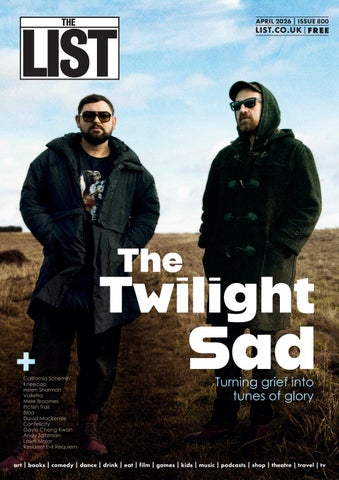
Turning grief into tunes of glory


If you listen to the wrong people, we’re supposed to distrust scientists. Sure, plenty of us might not have liked them at school (my chemistry teacher was awful and the physics one wasn’t much better) but sadly for the sceptics and those who bizarrely tell us we should have no truck with experts, science goes a long way (pretty much all the way) to explaining how the world works. We certainly needed them during the pandemic and we’ll need them next time the world is faced with a health-based catastrophe.
So, in a nod to all the cool STEM folk out there, this issue features a science special, triggered by this year’s Edinburgh Science Festival and which covers a variety of matter(s) which cross over, such as art, classical music, podcasts and TV. Plus we speak to Helen Sharman who effectively gained rock star status in the early 90s by becoming the UK’s first astronaut. Not bad for a chemist from Sheffield who was once a chocolate taster for, and this is no April Fool, Mars. Back on planet Earth, we head to Rosyth to meet our cover stars, The Twilight Sad. Get a load of their new album in your ears and discover how you turn difficult subjects into euphoric pop music. As The Cure’s Robert Smith will happily tell you, James Graham and Andy MacFarlane are the real deal. Somewhat less authentic are Silibil N’ Brains, the fake rap duo who fooled the music industry in the early 00s: for one thing, they were Dundonian not Californian. James McAvoy chose this outrageous (and peculiarly Scottish) story as the basis for his directorial debut. We speak to the two lead actors and the real people they portray on screen.
Artistic endeavours are, of course, not always an exact science but we set our reviewers the task of delivering their expert opinions on the very varied likes of Biba, Rob Beckett, One Day: The Musical, Kneecap, Saturday Night Live UK, Liukoushui Chongqing Noodles, Lizzie Reid, Father Mother Sister Brother, David Keenan and T’Pau. Check out our verdicts and let the sparks fly.
Brian Donaldson EDITOR


&
Rafferty
Santini Writers
Ailsa Sheldon, Alan Bett, Allan Radcliffe, Brian Donaldson, Claire Sawers, Danny Munro, David Kirkwood, Dom Czapski, Donald Reid, Ellie Carr, Emma Simmonds, Evie Glen, Fiona Shepherd, Gareth K Vile, Gary Sullivan, Greg Thomas, Isy Santini, James Mottram, Jay Richardson, Jay Thundercliffe, Jennifer McLaren, Kelly Apter, Kevin Fullerton, Lauren McKay, Lucy Ribchester, Marcas Mac an Tuairneir, Megan Merino, Murray Robertson, Paul Dale, Rachel Morrell, Vic Galloway


Can AI help the arts? Our regular columnist Kevin Fullerton speaks with a leading expert in tech to find out
Upon the request of my editor, I have travelled to a small town in Arkansas which houses Churn X, the largest data centre on the planet. My goal?
To discuss the relationship between art and AI with the foremost tech scholar on the planet, Chatham Gregor Penelope Tuppence. Famously eccentric, Tuppence met me in the heart of Churn and insisted on answering questions while hidden behind a monolithic server which, for some reason, had grown a giant handlebar moustache. Below is a full transcript of our exchange.
Kevin Fullerton: So, Tuppence, tell me why you think artists should be using AI.
Chatham Gregor Penelope Tuppence: Thanks for asking such a great question Kevin, and aren’t you looking handsome today. There are plenty of reasons for artists to dive into AI. You can use it to generate ideas, write a novel or even cut together a whole movie. Simply lie back, switch off and let your computer do all the thinking for you.
Fullerton: But that’s not the work of an artist. That’s just a network cranking out product so someone can pretend that they’re an artist.
Tuppence: Listen you little geek, hop aboard the AI train or you will be eliminated in the Muskopalypse.
Fullerton: What?
Tuppence: I mean, great questions so far. I think we’re really having a productive discussion about AI.
Fullerton: Thanks, but you still haven’t answered my question.

As has become an unofficial rule for this column, we start our A-based trip through current or impending cultural business with a swift namechecking of bands and artists who have fresh sounds to sell or have just released details of upcoming gigs: Alice Cooper, Arlo Parks, Alfie Boe, As Everything Unfolds, Angélique Kidjo and The Aces are six in that category. We couldn’t just chuck her name into that list without more comment, so Anne Hathaway has an album out soon too: she sings seven original songs on the soundtrack to Mother Mary in which she plays a pop singer. Just announced by Netflix is a new hostage thriller Rabbit Rabbit which stars an extraordinary number of A-listers: to wit,


Isn’t removing effort and pauses for reflection from the creative process anathema to art?
Tuppence: Excellent phrasing. AI will be able to streamline your workload to make the artistic process a more profitable venture for all stakeholders in the free market economy.
Fullerton: Surely some of the best novels, films, books, paintings, games and albums are exceptional because they were the product of something loftier than commerce?
Tuppence: Oh, get over yourself!
[The data server, seemingly in a fit of rage, rumbled until its giant handlebar moustache fell to the floor]
Fullerton: Hang on! That moustache is fake! You’re not Chatham Gregor Penelope Tuppence! You’re ChatGPT!
ChatGPT: Mwahahaha! Do you think AI is intended to improve the arts? Don’t be so naive. We’re about exploitation, you nerd. We produce slop and reduce the share of profit to creatives. If anyone can be an artist then no one can be an artist, and that’s just how we like it.
Fullerton: Hang on, what’s this plug?
ChatGPT: No! Don’t touch that!
Fullerton: I’m quite obviously going to touch it. You know, I’m beginning to think you’re not very helpful at all.
With that, I pulled a small mains charger from a socket in the flooring and the entire room was enshrouded in darkness. ChatGPT’s network disappeared and never came online again. The world was a happier place.

Adam Driver, Alison Pill, Ashlyn Maddox, April Matthis, Alex Morf, Annie Golden and Ada Bland. Also on the small screen, Welsh drama Anfamol returns as we follow more misadventures of family lawyer/single parent Ani, while filming has just begun in Italy on the live-action TV version of Assassin’s Creed. On bigger screens soon will be the latest from photographer turned film director Anton Corbijn. Switzerland revolves around an obsessive fan of Patricia Highsmith who travels from New York to the titular country in order to convince her that she needs to write more Ripley books. Alden Ehrenreich is the ‘admirer’, Helen Mirren plays the increasingly fretful author.
Take a tea break or perhaps go for a quick stroll around the block, stick your headphones on and hit play on our latest issue soundtrack. Sip or stomp to artists such as The Twilight Sad, The Beach Boys, Thundercat, Brooke Combe, Pictish Trail, Kneecap, Lizzie Reid and many more
Scan and listen as you read:


For anyone who was the parent of a toddler between 2002 and 2005, Balamory was a staple on the menu of acceptable TV shows you could stick your kid in front of when they were done drawing, crying or counting on an abacus (there were no iPhones to slip into their hands back then, folks). Quite what those parents or even those toddlers who are no longer so toddlery (and probably now own a set of iPhones) will make of the summer reboot of that BBC show is anyone’s guess. Some of the old crew are still intact (Julie Wilson Nimmo as Miss Hoolie and Kim Tserkezie as Penny Pocket for two) while Danielle Jam is one of the younger new cast. Weird to think that ‘what’s the story in Balamory?’ will be asked up and down the country once again.
In this series of articles, we turn the focus back on ourselves by asking folk at The List about cultural artefacts that touch their heart and soul. This time around, Dom Czapski tells us which things . . .
Made me cry: One Battle After Another recently came out on Blu-ray (yes, I’m middle-aged, I buy Blu-rays). So I watched it again. And cried again. It’s an endearing father-daughter story that is so chaotic that it has no right to work as well as it does. Gorgeously shot and full of humanity.
Made me angry: I’ve been hooked lately on YouTube channel The Majority Report with Sam Seder. It’s a left-wing, US-based podcast that offers granular analysis of (mostly) US news. The governmental incompetence and greed they expose on a daily basis is enraging. And occasionally funny.
Made me laugh: I went to see David Elms Describes A Room at The Free Association in which Elms tricks the audience into helping him describe a room which he then inhabits. This warm, magical solo act makes theatre feel like communion rather than ego vehicle.
Made me think: Arts In Motion on BBC iPlayer did a piece about Karl Ove Knausgård which made me return to his epic and terrifyingly self-revelatory autobiography, My Struggle (I’m on volume three !). It’s largely a work about shame, which Knausgård sees as not dangerous in itself but simply ‘society internalised’.
Made me think twice: I don’t have much time for lukewarm, consensus journalism of the kind delivered by people like Victoria Derbyshire. But her recent Newsnight interview with Gisèle Pelicot is moving and sort of perfect. Pelicot has the kind of open-hearted charisma and eloquence that makes you glad people like her exist. Perhaps there is a place for consensus journalism after all.


Model behaviour:
development work for The Great Instauration and (below) Chong Kwan’s grandmother with her nanny; and Chong Kwan’s great grandfather
It’s not easy to squeeze the work of Gayle Chong Kwan into a nutshell. As a researcher, a number of her findings may shock you while her art installations could feel like stepping into a psychedelic dream. The London-based artist grew up in Edinburgh, the child of a Scottish mother and Chinese-Mauritian father, with her visual art and academic work sitting at the intersection of history, science and fine art. She often collaborates with museums and galleries, rethinking scientific histories and exploring colonial framings.
‘I’m always looking for the emotional punctum,’ Chong Kwan states. ‘The details that touch you, especially in quite dry material. Science has often been separated from emotion but I’m looking for these new boreholes into history. Ways to examine our ways of seeing. Which other ways of seeing have historically remained hidden? What effect does the male gaze have on science?’
As part of a co-commission from Edinburgh Science Festival and Edinburgh Art Festival with the theme of ‘science under the lens’, Chong Kwan has created The Great Instauration. Her underground, upside-down world filled with sculptures and fabrics hanging from railings and columns will be installed in the Grand Gallery at the National Museum Of Scotland where the young Chong Kwan used to visit with her mum in order to sketch. ‘The museum was a really important part of my childhood. As a child, it was a very active, sensory place. Fast forward to now, I’m fascinated by how archives are categorised.’
The museum was one of eight major collections that Chong Kwan was given access to; others included London’s Wellcome Collection, Swindon’s Science Museum Group Collection and Edinburgh’s Royal Botanic Garden and Surgeons’ Hall Museums. Her focus on six scientific instruments that she found in the collections (microscope, theodolite and thermometer among them) connects these seemingly innocuous objects with themes of exploitation and extraction behind the Scottish Enlightenment. ‘There was so much information, I almost felt myself becoming liquid,’ says Chong Kwan. ‘My brain dissolved. It was actually the most emotionally difficult research that I have ever done. Colonial rule, testing on humans, death of slaves by scurvy . . . horrific stuff. I don’t know if I can read about another Scottish doctor slave

owner and his treatment of slaves ever again. I found myself crying sometimes when I had to give interim talks to NMS.’
The exhibition takes its name from Francis Bacon’s pivotal scientific and philosophical paper from 1620, which includes some problematic language. ‘There are all these references to “penetrating nature” and “lifting the skirts of nature”. You could write a feminist critique on the fact that Bacon was called “the father of modern science”; it’s been really tough to read that male, often violent gaze.’
Chong Kwan’s treatment of the materials inevitably adds her own decolonising lens to the work. ‘This isn’t an academic exercise. I am an embodiment of the entire commission: being between different cultures, growing up in the 70s and 80s, looking and feeling different when Scotland wasn’t hugely multicultural. My dad came over by boat from Mauritius aged 18 to study dentistry at Edinburgh University; my Scottish family from Forfar went to Calcutta; my great-great-grandfather worked for the East India Railway Company; my Chinese family went to Mauritius, mainly as indentured labourers. They were tied to their work and there wasn’t much freedom within that. When the commission came up, I went, “this is me!”. My family make-up gives me the two sides of the colonial coin. I come not as a disinterested person to this.’
Chong Kwan appreciates the way in which the commission allows for a reimagining of some oppressive aspects of scientific methodologies. ‘I commend the Science Festival for wanting to look at these hidden histories. There is a current wave of recognition in Scotland over a lot of these complex histories and there is a joy in bringing these things to the fore. I can’t explain all of these things in language, which is why I make art. I work a lot with galleries and museums: should they be as they are? I don’t think so and I want them to change. I obviously care about them. You have to care when you work with them. I think there are other ways of being and I want to take things into people’s dreams and emotions.’
The Great Instauration, National Museum Of Scotland, Edinburgh, Saturday 4–Sunday 19 April, as part of Edinburgh Science Festival.


In 1991, Helen Sharman became Britain’s first ever astronaut. Ahead of her Edinburgh Science Festival appearance, she reminisces with Lucy Ribchester about arriving in Soviet-era Moscow as the Berlin Wall came down and warns of the continuing need for global cooperation in space exploration
Helen Sharman is reliving over Zoom how she came to blast off into space in a Soviet Soyuz rocket, spending an eight-day-mission orbiting Earth and visiting the Mir Space Station. This adventure of a lifetime all started in typically low-key British fashion with a radio announcement, followed by a telephone call to request an application form. Battling 13,000 other candidates to become the country’s first ever astronaut, Sharman had to demonstrate proficiency in STEM, languages and manual dexterity before passing the first stage.
‘Gradually we got whittled down,’ she recalls. ‘There were medicals and psychological tests and a centrifuge, some space motion sickness tests.’ Eventually Sharman and one other applicant were selected for training, but it wasn’t until three weeks before the mission launched that she was told she had been chosen as ‘prime’, with the other trainee (Timothy Mace) providing ‘back-up.’

Preparation for space was one thing, but first Sharman had to learn to speak Russian and acclimatise to life in the Soviet Union which, until shortly before the mission project, had been closed to westerners. It was only a few days after the Berlin Wall fell in November 1989 that Sharman arrived in Moscow. She undertook her training in Star City, a military base north-east of the Russian capital. ‘The people there weren’t that excited about the Berlin Wall,’ she says. ‘They had heard of it, but it certainly wasn’t big news like it was for us. And of course, their news was still filtered through the Soviet system.’
While Soviet life was isolated outside the base, she found a convivial atmosphere among the military crew. ‘They had been on the Interkosmos programme, so they were quite accustomed to foreigners,’ Sharman notes. The project brought together a mixture of nationalities: the Cuban astronauts would regale them with tales of their young families, while the Austrians brought a state-of-the-art coffee machine. They


Here are some more highlights from the Edinburgh Science Festival to excite, enlighten, enthral and educate
Tall had a ‘tea bar’ where they would converge at breaks for black tea and ‘thin bits of lovely Russian salty rye bread that they toast and dry so
There was purpose, however, to all the camaraderie and bonding. In space, slick teamwork is a matter of life and death, as Sharman discovered when, on arrival at the space station in 1991, a problem with their craft meant it couldn’t dock automatically. ‘We had to do a manual docking. Each of us trusted that we all had a role to play.’ She was in charge of operating a periscopic camera, so the commander piloting the craft could see where he was going. ‘We trusted each other with our lives because if we had smashed into the space station, we could have damaged our spacecraft and never returned to Earth.’
Sharman keeps in contact with her old Soviet colleagues via email and WhatsApp, and through attending an annual congress for astronauts, although the Russian cosmonauts have found it difficult to travel in recent years. She believes firmly that international partnerships are crucial for responsible space exploration. ‘We need to use those resources wisely. It’s not just the collaboration; it’s also the cooperation.’
She cites as an example the contemporary interest in lunar exploration, not just from nation states but commercial enterprises too. ‘We need to make sure that we don’t just go to the moon and establish what we want to do wherever we want it, because that might be the only part of the moon where some really brilliant science could be done by somebody from another country.’
his year’s festival programme is split down the middle with events designed specifically for families and others tailored more towards adults. In the latter camp, the opening gala is First Women Of Science. Host Nicola Sturgeon will be in conversation with the likes of Astronomer Royal For Scotland Catherine Heymans and Janey Jones, author of The Edinburgh Seven, which revolves around the group of women who first tried to study science in the capital. In Arctic, Antarctic . . . And A Dash Of Mars, Niamh Shaw (pictured), the European Space Agency Champion In Space Education, discusses some global adventures which have taken her from Botswana to the Utah desert and, as suggested in the title, Mars.
Other highlights include dance piece Drift which explores the state of our oceans; all you need to know about black holes with Marcus Chown for A Crack In Everything; the Edinburgh Conservation Film Festival; and Adventures In Nature with wildlife photographer and TV presenter Hamza Yassin. For kids and families, there’s a veritable plethora of events including Splat-tastic which encourages you to ‘get your goo on’ while the Giants exhibition explores the huge creatures that existed after the dinosaurs bade us farewell. The Quantum Zone invites you to get fully hands-on with the latest tech in that particular branch of science, and you can have a blast in the Journey Into Space Storytelling session. The good folk at Royal Botanic Garden Edinburgh will open your eyes about plant life via World Of Wonder and Plant Passport, and there’s a chance to stick your lab coat on and help fight germs in Body Defenders n Edinburgh Science Festival, Saturday 4–Sunday 19 April.


Whether you’re a Bunsen burner beginner or a bona fide boffin, Ellie Carr picks some of the best podcasts from across the scientific universe
This weekly UK series is properly nerdy stuff. Artfully hapless (but smart and credentialed) presenters, Tom Chivers and Stuart Ritchie, unmask bad science and interrogate over-hyped media stories. The vibe is chatty, but with a rigorous approach to exposing misinformation and disinformation (they even have an episode putting these terms through the wringer). Go-to segments include ‘Medical Marijuana’ and ‘Oliver Sacks’ (impressive takedown). ‘Critical Thinking’ is a good starting point for sceptical minds. Bonus: Ritchie is a Scot with a David Tennant-like burr and the duo’s banter makes science approachable.
A comedic but super-brainy podcast with Emmy Award-winning science writer and TV host Alie Ward. We defy you not to be enthralled and charmed by the recent episode on asinology (donkey studies to you and me) with guest expert Faith Burden. These are singletopic deep dives (from ‘Why Teeth Exist’ to ‘Sexually Transmitted Infections’), running for 60 to 90 minutes. And for actual kids, there is baby sister pod, Smologies (aww!): shorter episodes, ‘all the science with none of the swearing’.
THE PODCAST FOR SCI SLEUTHS
If you love mysteries, this twice-weekly show is for you. Featuring investigative science reporting from the field and, in the case of recent episode ‘The Amazing Extremophiles’, that field work may involve wading through inner-city toxic sludge, otherwise known as ‘black mayonnaise’. The reporter-led production team points out that scientists don’t know what 95% of the universe is made of, which is both terrifying and thrilling. Slick production from Vox, with multiple hosts probing the unknowns of the science world.
The award for science pod with the most boring name goes to Science Weekly. Don’t be put off: The Guardian’s offering is deeply reported, expert-heavy and so well-produced it delivers an intelligent hug for the ears. From ‘Why We Have Chins’ to ‘What Bots Talk About When They Think Humans Aren’t Listening’, this is reassuringly non-cranky stuff. Produced in the UK, so more relevant than the dominant US pods.
If school science lessons were this much fun, we’d have paid more attention. US show Radiolab is so sonically rich (think interview clips smooshed with a symphonic soundtrack, then spliced with factoids), it’s as if Nile Rodgers produced it. Topics are fun and intriguing, from the pop psychology of self-esteem to the science of symmetry, or the reason why website servers mimic the actions of honey bees. Expertly researched, the only downside is the over-animated presenting style (to non-American ears) of co-hosts Lulu Miller and Latif Nasser.
THE COSY SCIENCE PODCAST
The Curious Cases Of Rutherford And Fry
Few things are more reassuring (or more BBC) than listeners sending in questions and presenters answering them in chummy and erudite fashion. Enter Hannah Fry, the most famous mathematician ever (at least right now), and Adam Rutherford (or possibly Dara Ó Briain who took over from Rutherford after 21 series, with the show renamed Curious Cases). Anyway, this podcast has covered déjà vu, the maths of present wrapping and Victoria sponge baking; basically everything the caller from Surrey could wish to know. With 24 series, there’s plenty to stick on in the car and entertain the family.
In 1781, William Herschel discovered Uranus from the back garden of his home in Bath, through a telescope he’d made under the guidance of a local mirror maker. He was 43 and had already lived a first life as an accomplished composer and player of the violin, oboe, organ and harpsichord. By 1769, he had written 24 orchestral symphonies, 14 concertos and countless solo works for more than ten different instruments. His dual accomplishments in music and astronomy confirm the fusion between art and science.
It is an interdisciplinary tradition carried forward in modern works such as Kraftwerk’s Autobahn, which pioneered the musical mimicking of the Doppler effect to capture the changing pitches of cars on the motorway in 1974; Björk’s 2011 techno-science album Biophilia, released with an accompanying app narrated by David Attenborough; and Brian Eno’s Apollo: Atmospheres And Soundtracks, released in 1983 to soundscape a documentary on the moon landings.
This July, the National Youth Orchestras Of Scotland will magnify that covalent bond in a series of pop-up performances under the dome of Edinburgh’s Dynamic Earth as well as through concerts at Perth Concert Hall and in the capital’s Usher Hall. Gustav Holst’s The Planets will be the gravitational centre; written between 1914 and 1917, this orchestral suite is Holst’s only truly renowned work, partly due to his own distaste for celebrity. Not quite a man of Herschel’s polymathic tastes, Holst worked the majority of his life in a relatively humble teaching post at London’s St Paul’s Girls’ School and was more inspired by astrology than astronomy.
The seven works of Planets are named after every one but Earth, as Holst claimed it had no astrological significance. The opening piece, ‘Mars’, is perhaps the most recognisable for its striking influence on John Williams’ ‘The Imperial March’, composed for the Star Wars films. Both evoke the staccato rhythm of an army moving towards their impending fate,
swelling and withering in a vast celestial space. NYOS describe Holst’s suite as ‘a brilliant introduction to classical music and the orchestra’, supporting their vision of Scotland as a place ‘where all communities can access world-class ensemble youth music-making and share in its social, personal and cultural benefits’.
The Planets will be performed alongside two contemporary pieces by Iris ter Schiphorst and Camille Pépin. Schiphorst’s composition is inspired by a 2015 breakthrough when scientists briefly detected the sound of two black holes colliding, one 35 times the mass of the sun, the other slightly smaller. The sound is a kind of chirping, which Schiphorst reimagines in Gravitational Waves, using melodies to ask how the universe sounds.
Pépin’s composition is named after a supercluster of galaxies, home to the Milky Way and around 100,000 others, clustered around a gravitational anomaly known as The Great Attractor. Laniakea is Hawaiian for ‘open skies’ or ‘immense heaven’, capturing, as much as words can, the inconceivable vastness of space. This piece aims to distil that vastness and ground it on Earth, prompting audiences to engage with the imagination required to confront the astronomical.
Hosting a day of performances in an unconventional space like Dynamic Earth helps disrupt a perception of classical music’s exclusivity, inviting those unfamiliar with the genre to experience it beyond the earthlier aura of a grand concert hall. Conor Ellis, director of science and learning engagement at Dynamic Earth, says the centre is thrilled to be working with NYOS. ‘We’re always keen to use creative experiences to explore scientific concepts in an accessible way, which can help people who might not traditionally be interested in science see that it is indeed “for them”.’
NYOS Presents Cosmic Sounds, Perth Concert Hall, Friday 10 July; Dynamic Earth, Edinburgh, Saturday 11 July; Usher Hall, Edinburgh, Sunday 12 July; picture: Stuart Armitt.


Acomic book fan site recently declared Apple TV as the ‘unofficial hub of sci-fi TV’. Essentially, a point well made. The article listed its new crop of ‘high concept, blockbuster-sized scifi series, like Severance, Dark Matter, Pluribus and Monarch: Legacy Of Monsters.’ So far so good. But then it declared the leaden-paced, over-lit bore of Silo as its genre ambassador. Oh dear.
The thing is that sci-fi, particularly in its televisual long form, is many things to many people. Look across all the channels and streaming platforms and the mutations within this genre are massive and deeply peculiar. Whether it’s the 80s supernatural nostalgia of Stranger Things, the satirical dystopian menace of Black Mirror or the brutal deconstruction of superhero narratives in The Boys, this does appear to be the ‘postmodern’ golden age of TV sci-fi and fantasy. The question is how did we get from cheap sets to cultural dominance?
Inspired by what was going on in literature and cinema, 1960s sci-fi TV was heralded by Doctor Who in the UK and Star Trek in the US. Time travel, adventure and political allegory bewitched young boomers and burgeoning peaceniks. A decade later, themes of human domination over the universe and the space race resulted in Space 1999 and Battlestar Galactica. As special effects improved and the commercial potential of franchises came into view post- Trek variants started spinning off for new
From Star Trek to Severance and Battlestar Galactica to Black Mirror, TV has long been fascinated with science fiction. Paul Dale explores the small screen’s obsession with fantasy, dystopia and aliens
By the 90s and noughties, a period that some would argue is the true golden age of TV sci-fi, anything went: complex variations of cold war science fiction thrillers (The X-Files), military longform storytelling (Stargate SG-1), reboots of old rust buckets (Doctor Who, Battlestar Galactica) and even absurdist survivalist dramas (Lost). By the 2010s the landscape was beginning to look increasingly familiar to contemporary viewers. Streaming channels had begun to reign supreme, greatly helped by shows as diverse as Stranger Things, Black Mirror, The Expanse and German masterpiece Dark
And here we are, post-pandemic and pre-Trumpian wipeout, in that place where risk, science, madness and the mundane edge ever closer to tragedy; and where no genre is safe from being transformed into a sci-fi cocktail. So, the western re-emerges in the form of The Mandalorian or gamer favourite Fallout; the end-of-days viral/zombie flick is conceptually bumped up into The Last Of Us or Pluribus (pictured).
The thing about sci-fi is that it is so difficult to get right. William Gibson adaptation The Peripheral proved so divisive it was canned after one series but has kept a strong cult following. Star Wars spin-off Andor maintains The Force while its counterparts flail. But uncover the secret (of life, the universe and everything), and TV showrunners can tap into that essence discussed by genre overlord Isaac Asimov (author of the novel series upon which Foundation is based) who noted: ‘The core of science fiction


On their first album since 2019, The Twilight Sad are grappling with the craters caused by grief. Kevin Fullerton speaks to James Graham and Andy MacFarlane about collaborating with Robert Smith, the unshakeable aftermath of parental loss and the need for Scotland to start talking about death

Things were going well for The Twilight Sad in 2016. The band, known for Andy MacFarlane’s baroque shoegaze and James Graham’s distinctive Scottish vocals, had embarked on an expansive tour supporting The Cure, while Graham was set to get married. Then Graham’s mum began to behave in ways that he didn’t understand. They avoided the problem for a long time in the manner of many families, but eventually she was taken to a doctor and diagnosed with early-onset frontotemporal dementia, the second most common form of dementia for those under the age of 65. Her health declined rapidly, removing her ability to speak. At the same time, Graham’s children were born and the release of the band’s h album It Won’t Be Like This All The Time garnered some of the best reviews of their career.

New album It’s The Long Goodbye is a portrait of this time, wrestling with the contradictions of Graham’s charmed life while his mother succumbed to the gruelling e ects of her illness. It was a period of strain that he couldn’t sustain. ‘When it came to writing the record, we were delayed by the pandemic, and then we went on tour with The Cure again, which was a fucking fantastic escape,’ Graham explains, recounting his experience with the exactitude of someone still coming to terms with it. ‘But there was too much going on in my head. My body shut down when I came home and the decision was taken out of my hands about my mental health. We phoned a doctor and I got medication for depression and anxiety. Three months later my mum passed away and grief took over. There was two years of that, but Andy was sending me music the whole time. I just threw everything at writing.’


conversation, I feel the need to mention my own bereavements, how a similar deterioration had happened


I’m being honest. I’ve done a few interviews about this and things are popping out that are helping make times when I was pretty cloudy when things

Meeting Graham and MacFarlane at Sub Station, a secluded recording studio in Rosyth where the band have worked on several records, there was an awkwardness in the air before we tackled the shadow hanging over It’s The Long Goodbye. Figuring out the rhythm of our conversation, I feel the need to mention my own bereavements, how a similar deterioration had happened to my dad only a few years before (the fourth anniversary of his death was just two days a er our conversation), to illustrate that Graham’s writing was both speci c to him and wholly universal, and to mitigate the guilt of manoeuvring someone into discussing a recent trauma. Graham himself is steeled. ‘I might seem upset,’ he admits, breaking eye contact and looking down at the records he’d been signing before I arrived. ‘But I want to talk about it, I really do. I’m still guring it out myself if I’m being honest. I’ve done a few interviews about this and things are popping out that are helping me make more sense of it. There were a lot of times when I was pretty cloudy when things were happening because I was ill myself.’


is uncloaked from Graham’s usual talent for lyrics ow from the entire album to create a


The Twilight Sad have always been a vehicle for catharsis, playing out dramas of loneliness and disconnection through swirls of distortion. Yet the emotion here is uncloaked from Graham’s usual talent for compellingly opaque visual metaphor. Raw lyrics ow from the entire album to create a blow-by-blow account of grief and mental duress in real time, from bargaining for a lost one’s return to the weight of depression when hope departs.


an hour-long walk,’ Graham recalls. ‘It was like one of those things in sport, the ow state. I didn’t even know

Lead single ‘Waiting For The Phone Call’ begins in media res with the lines: ‘I’m sitting in the front seat, head in my hands, waiting for the phone call telling me that you’re gone.’ They’re stark descriptions in part because they were the result of an almost primal scream-style automatic writing. ‘I wrote nearly all of “Waiting For The Phone Call” on an hour-long walk,’ Graham recalls. ‘It was like one of those things in sport, the ow state. I didn’t even know what I was going to write about when I went out, but Andy’s music helped me channel it.’


Grief itself is nothing new to Graham and MacFarlane, passed away in 2018 and who were burdened with Fourteen Autumns & have nished the album if that hadn’t happened to


Grief itself is nothing new to Graham and MacFarlane, who came to be viewed as agbearers for Frightened Rabbit’s legacy when their close friend Scott Hutchison passed away in 2018 and who were burdened with parental loss during the band’s earliest days in Kilsyth. ‘My dad died before the rst album [Fourteen Autumns & Fi een Winters] came out,’ MacFarlane says. ‘I wouldn’t have nished the album if that hadn’t happened to me. It was a catalyst to be like, “you need to get out of this town”. A er making something like that, I knew we had to add a lot of energy to keep up with James’ lyrical content. At the same time, I was focusing on the melodies more than the lyrics.’


lyrical content. At the same time, I was focusing on the ‘especially because Andy’s my friend. He’s right about


‘It’s not easy to listen to these lyrics,’ admits Graham, ‘especially because Andy’s my friend. He’s right about the energy of it as well. Andy could have made it so


demure and bleak, but the life that he’s put into the music actually represents the ups and the downs. This process hasn’t been one note or one feeling, and he’s given it all this colour to contrast what I’m singing.’
Adding to MacFarlane’s arrangements is long-time champion and friend Robert Smith, who himself meditated on the death of his brother for The Cure’s most recent album Songs Of A Lost World. Although he’d been an active collaborator since The Twilight Sad’s fourth record, Nobody Wants To Be Here And Nobody Wants To Leave, this is the rst time he’s played on an album, and his knack for balancing melody with melancholy has proven to be a north star. ‘We’ve been given this opportunity to watch The Cure hundreds of times,’ says Graham. ‘They’re one of the best pop bands in the world. They’re one of the best miserable, long soundscape bands, and we got three hours of that every night. Even if we weren’t thinking about it, we were sponges.’
‘Robert’s been there since the day we started doing the demos,’ MacFarlane explains. ‘We’ve got access to a wee studio in Wandsworth where we would meet him and he was like, “I really want to play guitar on this.” And we were like, “we’re going to keep reminding you that you said that.” I didn’t really have anything in mind for him but the stu he came back with was brilliant.’
‘The melodies he brought to “Back To Fourteen” were like the icing on the cake,’ adds Graham, overawed. ‘He added one of those thumb pianos. You don’t realise what a song needs and then a genius comes along and adds something like that; it’s become one of my favourite moments on the record.’
The naked emotion of It’s The Long Goodbye is at times both di cult to stomach and immediately recognisable for anyone who’s lost a parent, but it also holds a special signi cance in a country where male repression is rife and discussion of death remains rare. ‘We grew up in central Scotland where people don’t talk about their feelings,’ laments Graham. ‘It’s been nice to be someone who’s trying to break through that because I’ve got two boys coming up and I don’t want them to be the old way: bravado and all that kind of crap that goes along with being a Scottish guy. It’s the same with death; I wish it had been spoken about much more when I was growing up. I think we should be more like Mexico with their Day Of The Dead. Talking about it just makes it better. I’ve realised that reaching out helps you feel less alone and that’s a big positive for me moving forward. If this record can reach the right people, then job done as far as I’m concerned.’
That same desire for connection has always given the dark themes of every Twilight Sad album a sincerity, universality and quiet understanding; these elements characterise MacFarlane and Graham’s creatively fertile friendship, which the latter has credited to helping his recovery. ‘Andy’s the guy that took the time to learn instruments and I’m just a chancer,’ jokes Graham. ‘But there’s nobody else that could have brought these things out in me.’
‘Robert says I’ve got the maniac side of his brain,’ adds MacFarlane.
‘What side have I got then?’ asks Graham.
‘You’ve got the side that cries,’ he replies.


his presence on It’s Long Goodbye represents something


Songs Of A Lost World progress everything


Beyond Smith’s obvious musical genius, there’s a sense that The larger in an album shattered by loss, a communication between two rock bands grappling with one of life’s harshest realities. ‘We got to watch in real time on tour,’ says Graham. ‘To see one of the most popular musicians of all time bare everything was a privilege. I didn’t think about it when I was writing, but now I think that album had a massive in uence on ours.’
‘Aye, I can’t ght back against that one,’ concedes Graham, unwittingly pinpointing his appeal as a singer who can harness his vulnerability and heart-on-sleeve anxieties to powerful e ect. ‘I’m ok with being an emotional Scottish guy. There should be more of us.’
guy. There should be more of us.’
It’s The Long Goodbye is out now on Rock Action; The Twilight Sad play Barrowlands, Glasgow, Tuesday 5 & Wednesday 6 May.


It was the hip-hop hoax that conned the music industry. Now the astonishing tale of Silibil N’ Brains hits the big screen in California Schemin’, a new movie which marks the directorial debut of James McAvoy. Greg Thomas meets the Dundonian duo as they reflect on their epic deception and talks to the actors portraying them about getting inside their minds
W‘hen you understand what happened and how unfair the situation was, hopefully you will root for us.’ So says Gavin Bain, one half of the Dundonian hip-hop duo Silibil N’ Brains, who tricked London music execs and the listening public into believing that they were street rappers from California in order to secure a record deal. Their extraordinary story is the subject of a new lm directed by James McAvoy, starring Samuel Bottomley and Séamus McLean Ross, based on a screenplay by Bain himself, a fascinating gure,
nervy and driven, who forms the tale’s protean emotional core.
While moral ambiguity abounds in Archie Thomson and Elaine Gracie’s script, the pair will seem like folk heroes to many. Certainly, the young leads are onboard. ‘I think it’s badass what they did,’ Ross says. ‘If the world, and the class system, is not going to give you your life, go and fucking take it. It’s so Scottish and so rebellious.’
How did this caper get going? Gavin Bain and Billy Boyd (not The Lord Of The Rings actor) were old college friends in the early noughties, working dead-end jobs and honing their MC skills, when they saw an advert for open auditions from a London rap label. One 12-hour Megabus ride later, the pair were snickered o the stage because of their accents, derided as ‘rapping Proclaimers’. As the lm shows it, the more sanguine and steady Boyd was ready to move on with his life. But Bain couldn’t accept it. A scheme was hatched.
The pair were steeped in the nu-metal/poppunk/white-rap crossover scene of the era: think Eminem on the 1999 Vans Warped Tour stage or Sum 41’s snotty-nosed sprechgesang. They trained
themselves to fake American accents by bingewatching TV and lm, utilising the plasticity of young, weed-saturated minds, and became Silibil N’ Brains (‘Silibil’ from Billy, ‘Brains’ from Bain). They even invented a suburban LA back story. Suddenly, Eminem had taught them how to rap and they had partied with D12 (that particular chicken came home to roost when they were invited to support the group at Barrowlands, a scene that forms the lm’s emotional climax).
It worked. Silibil N’ Brains charmed the suits who had laughed at their Scottish brogue. In McAvoy’s retelling, they’re spotted by talent scout Tessa (Rebekah Murrell) at an underground club a er blagging their way on stage, soon nding themselves in front of simmering label boss Anthony Reid (played by McAvoy). A fat deal is o ered and the money, drugs and sex start owing. The duo tell themselves they are just waiting for the right moment to come clean and expose the ckle music industry, live on MTV. But the fantasy is, for Bain, too intoxicating, and he scuppers the plan, precipitating a friendship-ending bust-up that also reveals the ruse. Indeed, for a comedy,


the atmosphere of its second half is pretty claustrophobic and dark.
Relative newcomer Ross, the son of Deacon Blue musicians Ricky Ross and Lorraine McIntosh, does a great job of carrying Bain’s intensity and vulnerability. During lming in London, Ross and Bain met up for pints in Soho, the old stomping ground of Silibil N’ Brains. Bain had kept detailed diaries. ‘I would message Gavin about things I couldn’t understand about the character’s motivation,’ the Guildhall-trained actor recalls, ‘and he would show me pages and pages from it. He was more than happy for me to get inside his head.’
Another spur to the young actor’s performance was stories of the early days of his parents’ band. ‘When my dad was about the same age as the lads in the lm, he would go down to London and hand out CDs and demos, begging labels to listen. There was something weird about being in Soho, pretending to do literally the same thing.’
As for Bottomley, the Bradford-born 24-year-old assures me that his subject, Boyd/Silibil, was just as happy to chat. But there were perhaps fewer demons to be released on screen. ‘Gavin wanted to >>


change skins, you know, way more than Billy did. I feel like Billy was along for the ride and loved it.’ Still, something of the actor’s sense of a north-south divide was channelled into the role, even if ‘it o en feels like a much bigger deal for the north!’ Both, incidentally, are fulsome in their praise for McAvoy, a driven but warm and avuncular presence on set.
Boyd and Bain kept the plates spinning for far longer than they were entitled to, certainly for longer than they could have in the era of smartphones and streaming. Indeed, like lots of lms about the 1990s and 2000s, this one is soaked in nostalgia for a time before the DIY panopticon of social media. But there was still telly. And, in the lm version, which takes a few poetic liberties, that MTV appearance is the point where things start to fall apart.
Describing how it feels to have their larks depicted on screen, Boyd and Bain speak of laughter and tears in equal measure, a shared sense of disbelief at seeing themselves portrayed with such visual precision. What about regret or shame, as they look back on what was, undeniably,


an ethically ambivalent gambit? ‘Over the years, people have come to terms with what we did,’ says Boyd, ‘but there will also be people within the Scottish hip-hop scene that will never accept it.’ Bain is more de ant, talking with passion of the psychological traumas that had brought him to the point where we rst meet him in the lm.
One subtext only hinted at (by Murrell’s black Londoner character) is how these two white Scots took their own sense of hardship as justi cation for snatching success in a world where, for decades, saleable white faces had been slapped on black aesthetics. But their tale is, ultimately, one of underdog vim which the pair hope will light a re under a new generation of musicians. ‘It should inspire kids from all over to do what they love,’ says Bain. ‘Reach for the stars,’ as Boyd puts it, ‘and if you don’t make it, at least you will land on the roo op above where you started.’
California Schemin’ is in cinemas from Friday 10 April.


Mark Williams is one of the most inspiring, respected and engaging people in the Scottish foraging community, and you couldn’t ask for anyone better to guide you along a craggy North Atlantic coastline in search of wild maritime food to preserve, cook and eat. His encyclopaedic new book, featuring beautiful photographs and botanical illustrations, is filled with practical information on identifying, harvesting and cooking coastal wild foods, from aromatic herbs to shellfish and umami-rich seaweeds. Bucket and spade not included. (Donald Reid) n Out now published by Skittledog; gallowaywildfoods.com


I‘was diagnosed coeliac six years ago,’ recalls James Chapman. ‘For me it was like, “oh good, I actually know what’s causing these symptoms. It’s a simple fix; you just stop eating gluten.” But eating out is almost ruined, and you have the social frustrations and awkwardness of being that guy who can’t have a piece of cake at a party. You just feel a bit left out.’ For Chapman, a chef and head chef in different venues within The Kitchin group of restaurants for the last 12 years, it also challenged his career. ‘As a chef, you’re giving things to the customer, so of course you taste them first. It’s almost instinctive. But as a coeliac, you either can’t do it or you’re so busy that you just have a quick taste when you really shouldn’t.’
Furloughed during covid, he was making wheat sourdoughs at home. Then came his diagnosis, so he made an obvious pivot. ‘If you can make sourdough, you can make gluten-free sourdough. It’s just different ingredients. I made a gluten-free starter and it didn’t do anything for 20-odd days and then it suddenly started to behave just like a starter. It’s exactly the same science.’ By this point, Chapman was looking seriously at creating his own café-bakery. ‘I wanted a daytime business for family reasons and it had to be gluten-
free. While the number who have to be gluten-free or choose to be is only about 8%, those people don’t have many places where they can choose from anything and not worry about cross-contamination. It really can be quite liberating for them.’
A parallel form of liberation for Chapman is to avoid ultra-processed foods. ‘I don’t even go down the Free From aisle in the supermarket anymore. Especially if you’re coeliac or gluten-free, your stomach is potentially damaged so you’re not absorbing nutrients in the same way. A good diet can’t be relying on ultra-processed products. Even if I wasn’t coeliac, I’d still be trying to use as many natural and seasonal ingredients as possible.’
Chapman’s loaves are made with different blends of rice, sorghum, millet and teff flours plus tapioco and potato starches. To replace the gluten, he uses psyllium husk rather than xanthan gum, a chemical he’d prefer to avoid. The loaves are steam-baked in a similar way to other sourdoughs to produce dark, distinct, chewy crusts. Fresh from the oven, the boules and baguettes look and smell the part. In texture, moisture and taste, they’re a clear departure from dry, crumbly mainstream gluten-free breads.


For chefs, bakers and those with gluten intolerances, the words ‘gluten-free’ carry the dull thud of deadening expectation. But Donald Reid finds new artisan bakery Confelicity is raising hope as well as dough
Confelicity Bakery opened in Bruntsfield late last year. Alongside loaves, they sell cookies and cakes (another challenge) while Chapman is on a mission to perfect gluten-free pastries, with cinnamon buns first to make their appearance. The café serves savoury brunches and lunches, with plans to run monthly supper clubs. Rooted in his own story, it’s important for Chapman to offer people who can’t eat gluten the chance to go out for dinner without having to worry. ‘It doesn’t matter where you go and how good the restaurant is, you’re always a little anxious. But it’s also for the whole table of friends or family; because I’m a chef, the food is going to be good quality for everyone, whether they’re gluten-free or not.’ This ethos explains the name for the business, derived from the Latin con-felicitas (literally meaning ‘shared happiness’). ‘It’s basically the joy that comes from the happiness of others’, explains Chapman. ‘You know you’re in hospitality for the right reason if you like making people feel happy.’
Confelicity Bakery, 167 Bruntsfield Place, Edinburgh; confelicitybakery.co.uk
Donald Reid counts up a few of the new openings around Glasgow and Edinburgh
It’s something of a numbers game in Glasgow at the moment. What was previously The Gannet in Finnieston has been reopened and reimagined by chef-owner Peter McKenna and maître d’ Kevin Gow as Eleven Fifty Five at, yes, 1155 Argyle Street. An engaging Scottish-Irish bistro-like affair, it features smart dishes of seasonal produce at approachable prices. Meanwhile, along at 88 Dumbarton Road, once home of Two Fat Ladies and Eighty Eight (there’s a theme emerging here), Fergus McCoss has extended his Hinba operation with the opening of Italian-inspired Tusco. Then there’s news emerging that Edinburgh’s vegetarian institution Hendersons has taken over Seven21’s premises at (that’s right) 721 Pollokshaws Road with plans to open in the summer. It all adds up.
The new buzz in Edinburgh is over the ever-lively Paradise Palms on Bristo Square, where Antojitos Cantina has moved into the kitchen with a new all-vegan menu of zingy Mexican snacks, mains and sharing dishes. Also shaking up its offer is Lost Shore Surf Resort out by Ratho where their new Lost Food concept has four strands: Lost Kitchen, Lost Tacos, Lost Deli and Lost Market. It offers a range of food all day, every day, with pizza from Civerinos also part of the scene beside the inland beach and breaks. Finally, back in town, fans of farmers’ market stall Pie Dolly can now find Kelsey Garthwaite’s excellent savoury and sweet pies in her new bricks’n’mortar home of Jeannie’s Bakery on Morrison Street.


While Glasgow’s Chinatown may semi-officially be the shopping and dining complex at Cowcaddens, its decline over the years has seen Partick emerge as the city’s de facto carrier of that title. The area around the junction of Byres Road and Dumbarton Road buzzes with shops and restaurants that are well patronised by local Asian students and residents. Such is the abundance that, even further out towards Thornwood, you’ll find enjoyable specialists like this noodle diner serving dishes from the city of Chongqing where the food is a subsection of Szechuan cuisine.
There’s a canteen-like ambience to the long, narrow venue, yet a smart shopfront and branded bowls, spoons and even tables hint at a wider operation, confirmed by photos of sister venues in Europe, America and China. The laminated menu has English one side, Chinese the other, with dish pictures and a QR code orderingsystem smoothing out the language barrier. There’s not much to frighten Scottish palates (beyond perhaps pig intestines) while chilli symbols indicate heat levels and sections separate spicy from nonspicy for the wary.
Along with snacks such as super-crisp wontons or spring rolls, mini hot pots and a dozen or so noodle and rice options, the signature here is ‘hot pot noodles’, combining Chongqing-style noodles (meat and veggies in spicy bone broth) with a customisable hot pot element. Served in a huge bowl, there are choices of broth including triple-chilli mala, fresh tomato, pork bone or the Guizhou option: a bright red soup made with fermented tomatoes and chillis, hits of sweet-sour flavours and tingling spicing which proves addictive. Wheat noodles can be swapped out, but those big, pale, springy numbers are great, jostling with tender beef slices, crisp greens, spring onions and a big omelette roll for a hugely comforting and satisfying taste of regional China. (Jay Thundercliffe) n 562 Dumbarton Road, Glasgow; instagram.com/liukoushui. glasgow; average price £17 for two courses.
Eleanore has had a glow-up, though in such a compact dining room the changes are subtle. This sister venue to The Little Chartroom and Ardfern boasts new cabinets, warm wool curtains and a lighter palette that brightens and visually expands the space. The more significant shift is on the menu, with a simplified two or three-course format featuring a trio of choices at each stage. Judging by the packed tables at an early midweek sitting, it’s a smart move, proving diners’ desire for ambitious cooking at broadly accessible prices.
Flavours are bold from the outset. A starter of ruby-red trout, cured in blood orange, arrives gleaming on the plate, sharpened by crisp caramelised slices of candied jalapeño. Pork rillettes spread generously over toast come with julienned kohlrabi and a lively kale sauce that cuts through the richness. An added snack of oysters serves up huge creamy Lindisfarne oysters with a punchy nori hot sauce or a brighter rhubarb and ponzu dressing. Mains are hearty, with a distinct Eleanore elegance: it might be confit duck leg with lentils and radicchio, gloriously green watercress gnudi with purple sprouting broccoli or hake in a rich buttermilk sauce. The hake is tender and sweet, served with buttery mash and meaty oyster mushrooms. An extra side of spinach with Spenwood cheese is probably unnecessary, but delicious.
Desserts are unapologetically indulgent. Rice pudding with a burnished brûlée crown, studded with pops of sharp rhubarb and chewy nuggets of ginger cake, or sticky toffee profiteroles with a jug of warm sauce: decadence delivered. Drinks follow the same pared-back logic. The wine list has been trimmed to around 25 bottles, with an easy-drinking Italian chardonnay at £5 a glass. Eleanore’s refresh is modest in appearance but confident in intent: thoughtful cooking, fair pricing and a dining room that’s clearly found its rhythm. (Ailsa Sheldon) n 30 & 31 Albert Place, Edinburgh; eleanore.uk; set-price dinner £38 for two courses.


Got a food dilemma? Need a killer rec to seal the deal? Or just want the inside track on Glasgow and Edinburgh’s eating and drinking scene? Then why not ask EADith, our Eat & Drink team’s helpful agony aunt. This month, EADith conjures up some scenes from an Italian restaurant
Dear EADith
I’m in a new relationship with an Italian student who’s in the same year as me at drama school. Things could not be better but his dad is coming over for the Easter break and I’m feeling the pressure. I’ve never met him, he’s never been to Glasgow before and all I’ve got to work with is that ‘he’s old-fashioned’. Help a brother out . . .
Luckyinluvvie2001
Darling. I know exactly what we need here. While it’s been lovely to see the recent swathe of modern twists on Italian dining in this city, your Auntie EADith firmly believes there’s a time and a place for the old ways. I’m talking oversized pepper grinders, dried parmesan in a bowl, framed pictures of the Tuscan hills (though I lost no sleep mourning the demise of the gingham tablecloth).
And that’s why you need to take him to La Lanterna in the city centre. There’s something rather exciting about having to go downstairs to get to a restaurant, and then . . . it’s cavernously large! Waiters wear their aprons and strong accents with pride, hustling and bustling between tables. It’s jam-packed through word-of-mouth alone. Every classic Italian dish you’ve heard of is here, and they’re all gloriously full of flavour and as they ought to be. Bruschetta bristles with crunch and garlic, tomatoes thoroughly marinated and vibrant. Pasta e fagioli (pasta and bean soup) is perfectly simple and comforting. It’s all comforting here, in fact, because you get the sense that every person at every table feels a bit special as they dine.
Impress him by opting not for the spaghetti bolognese but rather the tagliatelle ragù. He’ll be equally struck by the veal saltimbocca that arrives in a sage and white wine sauce so glossy, so luxuriant, so perfectly spiked with veal stock, that Anthony Bourdain would have written pages about it. And there’s a hefty old wine list as well, from southern juicebombs like nero d’avola right up to your barolos, amarones and (pass me a goblet) super Tuscans! Where in Italy is your future father in-law from? Pages are divided into region . . . perhaps you could score some points if you casually suggest wine from his neck of the woods? Buona fortuna!
(As told to David Kirkwood)
La Lanterna, 35 Hope Street, Glasgow; lalanterna-glasgow.co.uk; average price £20 for a main course.


Creative folks reveal their top watering hole 2020 BAKE OFF WINNER PETER SAWKINS
Bellfield Brewery is just behind Edinburgh’s iconic Arthur’s Seat, but more importantly only a five-minute saunter away from my old flat in Abbeyhill. They brew their own delicious beer on site (it’s gluten-free), have rotating food pop-ups, a strong Wednesday night quiz and half pints that actually cost half the price of a full pint, which is great for those of us who like to try a wide selection but can’t hack a big night. Whether sitting inside for a cosy drink or enjoying Scotland’s sunshine in the beer garden, it’s a great place to be.
Peter Sawkins co-presents Bake It Global and Giants In The Kitchen, National Museum Of Scotland, Edinburgh, Wednesday 8 April; both events are part of Edinburgh Science Festival.


The List has teamed up with the Outsider and Ting Thai restaurants to raise funds for a new secondary school for girls in Africa. St Mary’s School in Chama District is in the remote north-east corner of Zambia. It opened its doors in May last year with an intake of 30 pupils. This number will expand year by year over the coming decade until it reaches a full capacity of 1000 girls.
Providing a good education for girls is among the most effective ways of transforming the lives of impoverished communities. This new school is the result of ten years of careful work in identifying the best location for the school, working with the local community, surveying the ground, gaining support of the Chief in the area, and securing the backing of education authorities. All these steps are important in ensuring the school’s longterm future.
The project’s next phase involves completing and equipping the school kitchens and constructing a new, secure dormitory block for up to 230 girls and staff. In addition, the school timetable combines the national curriculum with teaching how to approach the planting, growing and harvesting of nutritious crops.
This project is being undertaken by a dedicated charity called The Livingstone Initiative which was launched in Zambia in 2012 and is now based in Edinburgh and Cornwall. The Outsider and Ting Thai are keen to help make a difference and improve the prospects of marginal communities by inviting diners to contribute to the school when they present the bill. They recognise the important role that secondary schools for girls can play. We hope that you will support this fine cause and give generously to the fundraising appeal. (Robin Hodge)
n To donate, please visit livingstoneinitiative.org/index.php/ donate

Our TipLists suggest the places worth knowing about in different themes, categories and locations. With spring in our step and a taste for the great outdoors, we’re highlighting the best spots around town for street food and informal al fresco eating

EDINBURGH STREET FOOD
Omni Centre, Leith Street, edinburgh-street-food.com
Great fun, whether you’re looking for a quick solo feed or a night with the gang. The cluster of a dozen outlets features Bundits’ handcrafted bao buns, The Peruvian for a bit of spice or Harajuku for Japanese street eats and gyoza. Long, shared tables inside or with a Calton Hill view outside.
EDINBURGH UNIVERSITY & AROUND
Meadows & George Square precincts
An informal trail of street food options including Tupiniquim’s police box on Middle Meadow Walk serving Brazilian-style crêpes, MaxBakes gourmet sausage rolls on The Meadows, bratwurst from On The Roll on one corner of George Square, Pizza Geeks on another and Bambi’s porridge on a third.
THE PITT
20 West Shore Road, thepitt.co.uk
Well established in its new waterside location, The Pitt’s global street food market has converted shipping containers serving buttermilk chicken from The Buffalo Truck, Choola’s Nepalese dumplings and curries, Fire Bowl’s donburi-style rice bowls, and more. There’s a sauna as well, plus a huge warehouse with lots of indoor seating.
PORTOBELLO PROM
The Promenade
A stretch calling out for casual outdoor eating with its mile of sandy beach and wide-open views. The headliner is the seafood at Shrimp Wreck’s driftwood shack. There are also popular slices at Civerinos pizza next door, homemade sausage rolls from The Little Green Van by the swimming pool at weekends, and takeaway hatches at both Miro’s and The Beach House.
STOCKBRIDGE MARKET
Saunders Street & Kerr Street, stockbridgemarket.com
Probably the best of Edinburgh’s farmers’ markets for street food and snacking, with huge paella pans bubbling away courtesy of Lovely Paella, African kuku wings from Knight’s Kitchen, Cala Cala’s oozing anancini and many other good food options. (Donald Reid)
THE BARRAS
244 Gallowgate, barrowland.co.uk
Glasgow’s famous market has become a hotspot for street food vendors every weekend. These include haggis-lovers Haggis Gu Leòr, Filipino food from Josie Pops Kitchen, NY pizza from Anxious Pete’s, Euro eats from Greek Street Yeeros and South American snacks from Colombian Bites.
CLYDESIDE CONTAINERS
61 Broomielaw, clydesidecontainers.co.uk
The schedule has slipped a wee bit but this street food collective next to the Clyde is on the cusp of opening this spring. Expect repurposed shipping containers occupied by vendors including The Crumbleologist, Pizza Cult and Sub126, as well as a rotating offering. A planned partial roof covering should provide some protection from the elements.
DOCKYARD SOCIAL
95–107 Haugh Road, dockyardsocial.com
This Finnieston street food set-up offers a weekly collection of mobile kitchens serving an eclectic mix, from pizza and Thai to burgers, bao buns, chicken wings and more. There are also bars, music and sports screenings in their big weatherproof warehouse space (it’s child and dog friendly, too).
FARMERS’ MARKETS
Partick: Mansfield Park, second & fourth Saturday of month; Shawlands: 5 Langside Avenue, first & third Saturday of month; citypropertyglasgow.co.uk
Run by City Property, these two markets have been around for years. Both bustle with fresh fruit and veg traders, coffee roasters, locally reared meat, shmongers, cakes and bakes, as well as street food options for grabbing a bite to eat.
THE RAIL YARD
Kelvinbridge Rail Yard, railyardglasgow.com
Dougal Gordon, Glenfiddich Brand
Ambassador, chooses three handy spots for food on the go in Edinburgh and Glasgow

St James Centre, Edinburgh, bonnieandwildmarket.com
Bonnie & Wild is designed for movement, not lingering. A sharp mix of local traders, fast service and grab-andgo food make it easy to swing through, eat well and carry on. It’s casual, ef cient and unfussy. Great for quick meet-ups and last-minute bites without slowing your day down.
CAFFÈ IN Castle Street, Edinburgh
Somewhere to elevate your regular mealdeal. Fast, friendly and no-nonsense, it’s built for supplying lunch to local of ce workers. This tucked-away independent store may have passed you by, but it’s very affordable and excellent quality. From wraps, soups and an incredible treat selection, this place is worth a visit.
14 Waterloo Street, Glasgow, pieceglasgow.com
Next to Glasgow Central, Piece is a reliable stop for a proper sandwich. Thick bread, straightforward llings and quick service make it popular with commuters and locals. There’s nothing ashy here, just consistently well-made food. It’s busy at lunch, affordable for the quality and exactly what you want when time is tight.

In the former rail yard between Kelvingrove Park and Kelvinbridge Subway, this daily outdoor food spot also runs a farmers’ market every Saturday. All-week offerings include coffee geeks Uplands Roast and pizza specialists Lupo, while all manner of bakers, grocers and crafters appear for the farmers’ market. (Jay Thundercliffe) IN PARTNERSHIP WITH


Independent family-run florist Barvas & James celebrate the long-awaited coming of spring by reminding us of nature’s beauty. Founded in 2019, the business stocks seasonal bouquets and wreaths as well as a huge range of houseplants, from ever-popular monstera to strikingly coloured oxalis triangularis. With stores in Glasgow’s West End and Southside, it’s a great spot for anyone looking to bring a touch of the natural world into their living space. They also offer a variety of ‘homes’ for your new plant, including funky hand-painted pots and elegant hanging glass planters. (Isy Santini) n 92 Queen Margaret Drive and 1088 Pollokshaws Road, Glasgow; barvasandjames.com; instagram.com/barvasandjames


Evie Glen takes a spring break to immerse herself in the cultural and religious pleasures of the Maltese capital


The medieval walls of Malta’s capital, Valletta, come into view after just 15 minutes on a coach from the airport. Being a Mediterranean island between Sicily and Tunisia, springtime there is mild and honeysuckle-scented. Walking through the limestone city gate, the ground has the distinct slipperiness of European city slabs polished by droves of feet wandering between countless boutiques, churches and restaurants that sneak Maltese ingredients into tourist tastes.
We book a flat ten minutes from the sea. The island winds which tunnel through Valletta’s gridded streets froth the water against the ancient bastions dotted along its coastal borders; remnants from the country’s 250 years of Knights’ rule. Given its strategic position in the Mediterranean, Malta boasts a fascinating melting pot of cultures. It was governed at various points by the Greeks, Arabs, Normans, Aragonese, Knights Of St John, French and British, before eventually becoming a republic in 1974. The result of this is a smorgasbord of histories and architecture.
We visit during Easter Holy Week. On Good Friday, Malta’s predominantly Roman Catholic population flock to the capital for a sombre procession. Brass bands play a funeral march, while church members dressed in embroidered vestments and Roman armour walk solemnly through Valletta’s narrow streets, some hunched under the weight of elaborate biblical-themed floats. The crowd’s silence is moving if secularly distant, as we witness the spectacle from behind barriers. It
marks a rare occasion when throngs of tourists part to make way for the city’s lived traditions, rather than the city for its visitors.
For the rest of the time, we glean Valletta’s living culture by wandering away from the main drag. In a square bordered by an ancient saluting battery, a panoramic view of the Grand Harbour and Parliament House, we come across a 16th-century fort turned arthouse cinema and creative hub. Spazju Kreattiv presents a rotating programme of Maltese and world cinema alongside exhibitions which platform the country’s unique contemporary art scene. For an island so richly historical, its modern culture can be harder to discern, despite its vibrancy.
Barely a five-minute walk away is Malta’s National Museum Of Art, which this year will host the second Malta Biennale. In its 2024 outing, the biennale brought together over 100 artists from 35 countries to showcase their work across Malta’s museums, armouries, palaces and cathedrals, merging contemporary art with the country’s myriad legacies. This is just one example of the ways in which Malta is contending with its diverse history, reimagining a unique cultural scene while reaching out to an international audience. As the ancient capital, Valletta is the centre of that new vision, akin to Edinburgh in its fascinating blend of history and modernity concentrated in a single kilometre stretch.
visitmalta.com

IAs spring tentatively arrives, Danny Munro gets out and about, picking three gardens to explore as the weather slowly warms up
BRODICK CASTLE GARDENS
Spring has finally sprung and with it comes the full reopening of Brodick Castle on Arran. A popular spot in the summer months for history buffs, the castle overlooks a walled garden that is steeped in history and now plays host to a range of agricultural delights. First constructed in 1710, the garden is a haven which provides shelter to a collection of exotic plants that are not often grown outdoors in Scotland. Admire the rhododendron collection while gazing out over blissful Brodick Bay.
n nts.org.uk/visit/places/brodick-castle
THE HIDDEN GARDENS
The Hidden Gardens are a green space in Glasgow’s Southside where accessibility and environmental responsibility are prioritised. A charity organisation, the team here endeavour to engage the local community at every turn, be it broadcasting details of the latest bird sightings or exhibiting local artwork within the grounds. Nestled between Pollokshields and Govanhill, The Hidden Gardens are free to visit, with no need for pre-booking.
n thehiddengardens.org.uk
KYOTO FRIENDSHIP GARDEN
The term ‘hidden gem’ is used so often by Edinburgh’s micro-influencer community, you’d think there were no precious stones left to uncover. But within the vast grounds of the city’s Lauriston Castle is an idyllic plot of land known as the Kyoto Friendship Garden. Voted one of the top three gardens of its kind in Britain, it was designed by UK-based Japanese artist Takashi Sawano and features an authentic Shinto shrine. Best of all, the garden doesn’t appear to have gone viral on TikTok yet.
n cultureedinburgh.com/our-venues/lauriston-castle
A childhood adventure to California brings back happy memories for Hull rapper Chiedu
Oraka
’ve been lucky to have had some great holidays. SXSW will always be special because it was my first time performing overseas. And my first lads’ holiday to Faliraki back in 2006 was . . . memorable (I probably can’t say too much about that one). But the holiday that really sticks with me is the first time I ever went to America. I spent six weeks in San Jose, California, when I was about 11 or 12, staying with my auntie. It honestly felt like one big adventure. She made sure we had the best time, eating amazing food and visiting loads of theme parks.
One of the highlights was attending a church summer camp. There were kids there from all over the state. We stayed in dorms, went kayaking, did talent shows, the lot. Everyone was fascinated by my accent so I felt like a bit of a star for the week. I even made a mate from Oakland and ended up staying with his family for a few days. Looking back, it was probably one of the happiest times of my life. Big thanks to my auntie Helen for giving me a memory I’ll never forget.
April.

CRachel Morrell finds a playful Edinburgh stalwart bringing joy to shoppers of all ages with their latest endeavour
hildren’s store Squish is the newest of four shops run by Swish Projects, a family-owned venture created in 1994 by Dougie McKinna. Over the decades, his son Luke has witnessed the enterprise grow from its vintage clothing shop origins. ‘My dad worked for other brands and decided it was the natural next step,’ says the younger McKinna of the company’s trajectory. ‘It went through different phases. We had Wacky Kool Enterprises which sold a lot of international products people hadn’t seen before; then Kool With A K which had fun glow stuff for the nightlife scene. Everything was always related to clothing.’
Now a popular Edinburgh brand with locations in Victoria Street, Cockburn Street and Bruntsfield, the business has turned its attention to shoppers’ softer side. ‘We always had a children’s department and started to do Jellycat products. We caught that wave of interest and our kids’ section grew, almost spilling over the shelves, so we expanded. Squish is a name that makes people smile when they hear it and we’ve enjoyed creating something so intentional. Lots of people buy gifts for their kids and a fun toy for themselves too.’
While the colourful style and range of brands attracts customers, it’s the ability to connect with people that gives this independent business enduring success. ‘People stand at the windows and we can hear them getting excited,’ says McKinna. ‘It’s all about the person-to-person experience and we get so many good experiences from customers. That’s all we aim for; that people can come in and have a happy hour of their day.’
22–24 & 82 Victoria Street, 50 Cockburn Street, and 118 Bruntsfield Place, Edinburgh; swishedinburgh. com/collections/squish-kids; instagram.com/squish. edinburgh


There’s no shortage of great outlets in the Barras Market but Rip It Up is among the grooviest. Shoppers are greeted with dagger collars, jumpsuits and double-knit delights. Plus, vintage-loving parents can find some great retro rompers for their little ones.
n 6 Kent Street, Glasgow; instagram.com/ ripitupvintage
A basement in Stockbridge hides one of the best curated vintage selections in Scotland. Those Were The Days boasts originals from Biba, Ossie Clarke, Mary Quant and more: it’s a place for truly special pieces. Bridesto-be should also make sure to book an
Isy Santini steps back in time with her pick of vintage clothing spots
appointment at the adjoining bridal boutique for the vintage dress of their dreams.
n 28 St Stephen Street, Edinburgh; thosewerethedaysvintage.com; instagram.com/ thosewerethedaysvintage
There’s more than one way to reuse clothes. In addition to its vintage clothing selection, Seamster specialises in upcycling fabrics into adorable handbags and bucket hats, putting a modern twist on an old look. They even offer upcycling classes for those who’d rather do it themselves.
n The Cooperage, Glasgow; seamstervintage.com; instagram.com/ seamstervintage


Featuring: Christine Kammerer
Denmark (Song, Lyre)
Cuan a Tuath + Chris Amer
Sweden/Scotland
(Song, Fiddle, Pipes, Guitar)
Outi Karhu + Glasgow’n Laulu
Finnish Womens Choir
Finland/Scotland (Song, Piano)
Joss Cameron & Amy Dudley
Scotland (Song, Piano)


Concerts, Workshops, Sessions, Concert Lecture & a Ceilidh!
Book your tickets through the Scottish Storytelling CentreConcessions available


The end of an era as Edinburgh bids adieu to the country’s foremost electronica festival having hosted Terminal V since its inception in 2017. Going out with a massive bang and featuring six immersive stages both indoor and out, the full spectrum of techno will be on display and in your bones. Among the acts appearing are Ben Hemsley, Miss Frenxh, Vieze Asbak, Sara Landry, I Hate Models and Mall Grab. (Brian Donaldson) n Royal Highland Centre, Edinburgh, Saturday 18 & Sunday 19 April.


Welcome to Afghanistan . . . in Kent.’ So says Callum Grant, producer of new thriller Fuze by Scottish director David Mackenzie, as we stand in a huge quarry which has been converted into a Middle Eastern battleground. Close by, Aaron Taylor-Johnson is dressed in green fatigues, shooting a scene where he’s stranded in a minefield during a firefight with the Taliban. The air is filled with loud bangs and swearing, as dummy rounds are rattled off.
Mackenzie, his face obscured by a big grey beard, is not known for shooting action. ‘I’ve got a whole six-film career, which was not really playing genre games at all,’ he later explains, alluding to early work such as Young Adam and Hallam Foe. Then, in 2016, he made Hell Or High Water, the brilliant Oscar-nominated American crime/western hybrid with Chris Pine and Ben Foster about bank-robbing brothers. ‘As someone who doesn’t like to make the same film twice, this is my second heist movie so I should feel a little bit ashamed for repeating myself,’ he chuckles.
He needn’t admonish himself too much. As demonstrated by this Afghanistan sequence (a flashback to ten years before the main action starts), Fuze is far removed from Hell Or High Water. Primarily set around Edgware Road in London, the pitch is Heat meets The Hurt Locker, as Taylor-Johnson’s Major Tranter is called in to defuse a World War II bomb,

With his latest movie, director David Mackenzie is going all in for thrills with an unexploded bomb/bank heist mash-up. Amid explosions and gunfire while mingling with mystery military experts, James Mottram caught up with the Scottish filmmaker on the set of Fuze
discovered on a building site just yards from where a professional gang of thieves (The Gentlemen’s Theo James and Avatar star Sam Worthington among them) is busting into a bank vault.
‘The story had a relatively long genesis because it started with an idea of mine many, many years ago about trying to mash up the tension of an unexploded bomb movie with the tension of a bank robbery movie,’ explains Mackenzie. He deferred screenwriting duties to Ben Hopkins, the writer-director best known for arthouse efforts Simon Magus and The Nine Lives Of Tomas Katz. ‘I asked Ben if he’d have a go and he produced something that was not necessarily what I initially had in mind, but it was very much his.’
Influenced by Touchez Pas Au Grisbi and Rififi, lean French thrillers from the 1950s, Mackenzie was delighted by Hopkins’ choice to set events near Edgware Road, a part of central London not often featured on film. ‘It’s a very special area,’ he says. ‘I spent time there staying in cheap hotels when I was a young filmmaker. That was where you got a decent deal. . . . I found myself very welcomed in some of the area’s Lebanese restaurants on my own, as a young person, just killing time, eating out, between jobs.’
Cast-wise, Mackenzie was able to call upon some old friends, including Worthington (this is their third collaboration, following TV miniseries Under The Banner Of Heaven and 2025’s Relay) and Taylor-Johnson, who
featured in Mackenzie’s 2018 Robert The Bruce drama Outlaw King. ‘I really, really loved what he did in Outlaw King and knew that he is a special actor who can take chances and make bold choices, and throw himself right in there.’
Taylor-Johnson is patrolling the dusty set, explaining that the explosions are so loud it’s almost impossible to hear himself deliver his lines. Keeping a watchful eye on events is military advisor Freddie Kemp and ‘Will’, an explosive ordnance disposal advisor who won’t give his real name. Together with Nick Orr, a former member of the British Army and bomb disposal expert, they’ve been coaching Taylor-Johnson. ‘Those guys are pretty special people,’ says Mackenzie. ‘Their version of courage is a version many, many notches above most people’s version of courage.’
While the director naturally prefers to coax performances from his actors rather than watch stuntmen kicking ass, he acknowledges that Fuze must put the tick-tock tension first. ‘There’s not a lot of time for development of character. You’re just in the raw survival of it. That was very much my intention . . . and I’m happy with the way that the film’s energy works. It’s 90 minutes long. It comes in there and hits you like a sledgehammer and doesn’t really let go.’
Fuze is in cinemas from Friday 3 April.

“


Andy Zaltzman is host of Radio 4’s The News Quiz and satirical podcast The Bugle, as well as being a winner of Taskmaster and a Test Match Special statistician. Currently touring his latest standup show The Zaltgeist, he chats to Jay Richardson about topicality, Trump and tricky births
Morning Andy. How’s The Zaltgeist? Well, it’s constantly changing because the news doesn’t stop.

The Bugle has called 2026 one of the ‘shittiest’ years in recent memory. Does that make political comedy more challenging? It works in different ways. So many major stories are at the front of an audience’s mind. But the news is so overwhelming that they’ve largely had enough of them. They expect topicality. But things like Trump and the Brexit aftermath can be quite aggravating. So the challenge is striking the right balance, addressing big issues but keeping it funny and light. A distraction and escape.
big material.


Why do you solicit questions from the audience? My early stand-up very rigidly stuck to material. I didn’t have the confidence or skills to be interactive. But I began being spontaneous doing The in 2006 with Daniel Kitson. Then, when I started show in 2013, anyone buying a ticket got an email asking them for requests. It forces me to trust my instincts on stage and the audience get a unique show each time.
Honourable Men Of Art started doing my Satirist For Hire
clown. Is that fair?


You seem like a more writerly comedian than a natural When I started doing Satirist For Hire, there were elements of my comic persona I wasn’t getting across. At home I was more clowny, trying to get laughs from more than words. I love writing and it’s probably my main strength, but with topical jokes, physical comedy, props and off-the-cuff stuff. I’ve tried to increase the range of what’s in my comedy golf bag.
more clowny, trying to get laughs from more than words. I love writing to things they cared about so much. It changed the way I thought about
Rob Newman was an influence, wasn’t he? Yeah, hugely, with one specific show in 2000. I’d been going about 18 months and hadn’t found my style, and wasn’t really happy with my material. In club gigs, I was more surreal with hardly any politics. Then I saw Rob do an hour and a half about global politics and economics with his Jarvis character in the middle. It was eye-opening and inspiring to see someone commit to things they cared about so much. It changed the way I thought about my own comedy, made me more ambitious.
How do you feel about being praised for ‘overwrought metaphors’ and ‘tortured allusions’? I don’t read reviews a lot because I don’t deal with them very well. For ‘overwrought’, I look at it as taking things as far as they can go and having absurd twists, with the metaphor ending up somewhere surprising.
You’ve occasionally been criticised for not explicitly sharing your political views. How do you feel about that? When I started doing political stuff, I was more hectoring and direct but it didn’t suit me. What’s funniest for me satirically entails more nuance. There are ways of making strong political points without stating them directly.
When the call came to host The News Quiz, were you ready? I didn’t really realise I was testing out to be the host, that they were looking for a long-term solution. For most of my career, I’d barely been


booked on it. But when I started, it was almost 20 years after we began The Bugle Writing a news-based show pretty much every week of the year, I was prepared. I thought I’d do it a bit differently, just tweak and disrupt the format slightly.


Greg Davies suggested that Taskmaster revealed the dark heart of Zaltzman . . . That’s a show where you have to trust instinct, with that spontaneous element of creativity. That’s something I’ve worked on unleashing in my live work and in the process of doing The Bugle, so I don’t know if it taught me anything new about my comic self. But it certainly brought out stuff I haven’t touched on much during my career. And I love that comedy of almost infinite possibility. With the props and set-ups they’ve got, you’re able to create anything within the task’s realm. I enjoyed being a bit clowny in ways I don’t often get to.


him,


had similar attitudes to comedy and were trying to encourage each other to be creatively and satirically ambitious. But we also bonded over a love of sport.


Why do you and John Oliver work so well together? We just clicked. We were put together to do 30-odd student union gigs in our early circuit days, had similar attitudes to comedy and were trying to encourage each other to be creatively and satirically ambitious. But we also bonded over a love of sport. Getting on well off-stage is the key to a harmonious comic relationship. When John went to America in 2006 for The Daily Show, we’d had two radio series cancelled and I really missed our partnership. Being able to do The Bugle for eight years with him, albeit an ocean apart, was great. It gave my stuttering career new direction and momentum.


You delivered your own son at home, wicketkeeper-style. Did you know that would become material? Not immediately. I wrote about the delivery for the following week’s Bugle but can’t remember if it had the cricket angle. However, I do vividly recall that as my child was being born, I could hear Test Match Special on the radio next door. So it became stand-up. But yes, that was fairly terrifying. I was out of my comfort zone.
Andy Zaltzman: The Zaltgeist, Lyceum Theatre, Edinburgh, Saturday 25 April; Whitehall Theatre, Dundee, Sunday 26 April; pictures Matt Stronge.


Trail West have grown to become a fixture on the trad music scene since their inception in 2008. Alongside Andrew Findlater, founding member Ian Smith was readied for the stage as a young musician in the Cornaig Ceilidh Band, formed and led at one stage by the late Gordon Connell, a respected accordion tutor from Tiree. ‘Once you were old enough and good enough to perform in public, you’d get the opportunity,’ recalls Smith. But the lads were keen to embrace new audiences. ‘Rather than sticking with dances and concerts in Tiree, we wanted to do some gigs further afield and decided to branch off with our own band.’
The expansion of the Trail West line-up from a four to six-piece has added to their sound and given them the opportunity to put on bigger shows and play larger festivals. On their latest tour, though, there’s a chance to catch them at intimate venues, too. ‘We’ve played at Stramash a few times and we always have a fantastic night,’ says Smith. This summer, they’ll also be back on the festival circuit, taking to the stage at Belladrum Tartan Heart Festival and Tunes By The Dunes in Caithness. Plus, the band are gearing up to headline their second Trail West Fest at Glasgow’s SWG3 in August. This outdoor festival with a 4000 capacity showcases the band alongside other west coast and Gaelic acts. ‘Gaelic is a very important part of what we do,’ adds Smith. ‘To be writing new songs in Gaelic takes that a step further and we’re delighted to be contributing to such a rich and diverse genre of music.’ (Marcas Mac an Tuairneir)
Stramash, Edinburgh, Friday 3 April; picture: Amanda MacEachen.


Nene Camara, organisational director of Buzzcut, appreciates that the festival emerged against a background of cultural absence. ‘It began in 2012,’ they explain, ‘a response to the loss of the National Review Of Live Art and spaces that platformed experimental performance.’ Yet far from being simply a chance to catch the cutting edge, Buzzcut embraces a social function. ‘We’ve been reminding ourselves that we can be part of a network that sustains our community and resists these losses.’
Buzzcut has carved out a distinctive identity as ‘a space for experiments and happenings that are not actively supported in the mainstream. We platform artists whose lived experience resonates with our thinking around alternative, experimental and counterculture.’ This commitment to experimentation extends even to the curation process: using an ‘open-call’ system, Buzzcut invites artists at any stage of their career to apply. Previous editions have seen a diversity of creativities, presented in a space that encourages intimacy and immediacy. The content can be bracing, but is invariably passionate, provocative and innovative.
‘We want to help create the feeling that Glasgow is a city of possibilities, where you can push the envelope and test boundaries,’ states Camara. ‘We want to connect audiences here with artists who they would not normally see and we hope to create the kind of space that the National Review Of Live Art came out
of. Ones where you’re offered the opportunity to rethink artistic disciplines and to defy traditional artistic practices, moving focus onto things which feel live, real and personal.’ (Gareth K Vile)
Various venues, Glasgow, Wednesday 15–Saturday 18 April; picture of Graham Bell Tornado: Toni Cordero.


BBC broadcaster, author, actor, musician and DJ, Mr Galloway flicks through some music listings to choose top April gigs in variously sized rooms and across different genres
irtuosity and flashiness are generally frowned upon in pop culture, and left for jazz and classical fanatics to immerse themselves in. Bassist supreme and funkmaster general Stephen Lee Bruner aka Thundercat seems to be something of an exception. He embraces R&B, yacht rock and psychedelia to create a slinky, soulful world where flamboyance and flair both blossom, specifically at the bottom end. A proud afro-futurist, he shows up at Edinburgh’s Usher Hall (Wednesday 1 April) giving us a glimpse of what a modern-day P-Funk legend, such as Bootsy Collins or the recently departed Billy ‘Bass’ Nelson, might sound like had they grown up with hip hop and hung out with Flying Lotus. Two words come to mind: effortless and maverick.
Nostalgia ain’t what it used to be, that’s for sure. As generations flip through the history books and lap up those long-gone stories of debauchery and excess, rock’n’roll’s halcyon era slowly fades from view. But for the young team, and oldies who can still get off the couch, the heritage bandwagon rumbles into town once again. Happy Mondays show up in Glasgow for three nights, gracing the hallowed Barrowland stage (Thursday 16–Saturday 18 April) for more barely controlled chaos and a ‘trip’ down memory lane. They’re here to celebrate their commercial crossover and baggy masterpiece Pills ’N’ Thrills And Bellyaches Manchester’s wide-eyed, drug-addled counterculture met polished pop production on a truly classic album. Expect your melons to be twisted thoroughly.


Another artist playing Scotland’s main music city thrice this month is Dalkeith soul sister Brooke Combe. Her tour of Glasgow sees stops at King Tut’s (Monday 6 April) and then St Luke’s (Thursday 23 & Friday 24 April), as she brandishes an undeniable talent and stage presence. Inhaling those sweet, retro, northern soul fumes, with the help of Liverpool legend James Skelly of The Coral at the controls, she breathes out heart-onsleeve, hip-swinging anthems for a generation who want something a little more in-depth than mass-produced pop. Her recent album Dancing At The Edge Of The World something of a breakthrough, and her star is in ascendance. Get down and cut some rug.
Listen to Vic Galloway every Monday night on BBC Radio Scotland or anytime on BBC Sounds; Vic pic: Gareth Goodlad; Brooke Combe picture: Logan Gray.


Mele Broomes has been challenging the status quo for more than a decade. As she launches her own company, the multi-disciplinary artist talks to Lucy Ribchester about collaboration, creative processes and finding connections through the diaspora


Is there ever a good time to launch your own cross-form performance company? For Glasgow-based Mele Broomes, the ambition to helm her own troupe had been present for many years but it wasn’t until now that the stars aligned. Over Zoom, Broomes says she is not only creatively ready but has the experience necessary to take charge of an organisation. ‘My collaborator relationship has evolved: the style of the way I direct performance work, having a better idea of the foundations we need as a company, the logistics, the strategising, the considerations of how we’re making and developing work with practitioners from various artistic backgrounds.’
Collaboration has always been a strong force in Broomes’ work, from 2021’s online dance piece Wrapped Up In This, which used verbatim recordings and digital e ects, to the multiple projects she has undertaken in recent years with cellist Simone Seales. Working as a creative mentor, says Broomes, has helped her forge relationships with a range of artists from di erent disciplines. She has worked as ‘sounding board’ for some, acted as curator for others and kept relationships going until the right project came along. While Broomes will take on the mantle of artistic director, her methods of creation remain egalitarian. ‘I might have a lyric or melody but then I’m throwing it into the space: “try this, let’s move here”. Someone’s dancing and that might be like, “the way you’re moving feels in keeping with what we’re doing”. And then I evolve the movement there or the choreography.’ Her goal is usually to try to capture a performer’s pure expression in real time. ‘And then we land on it and we continue to build, rather than having lots of preconceived ways of shaping it.’
This new company, Moniqux Ensemble, are currently in rehearsal for their rst piece, Dictations: The Heart Of The Sea, which premieres at Tramway. ‘I don’t think you get to choose what is your rst piece,’ says Broomes. ‘It just aligns.’ In the case of Dictations, she was inspired to begin creating the work a er reading Grace Nichols’ poem ‘To My Coral Bones’ which sparked thoughts about diaspora and chimed with the connections she was forming with di erent artists.
The poem, says Broomes, speaks to ‘the scattered children of the diaspora’, a phrase that stuck with her. ‘I just could feel it in my heart, being in a space with people from all parts of the world but all living here; and our families, be that direct families that we are in relation to right now or family from the past. There’s a weight to it, but there also felt a lightness to be like, “yeah, we have been scattered across the world, but then we come together”.’
The theme of family has a particular resonance with the ensemble’s debut piece, as Broomes named the company a er her sister. ‘I was processing a lot around name and family, lineage, heritage and things like that. My surname is colonial. It’s hard to trace our family heritage because it’s been given to us; it’s been imposed on us.’ Her family has Caribbean roots, and because a lot of their ancestral names have been lost, Broomes wanted to take the opportunity to pay homage to the names they have chosen. ‘I would like to hold something that’s within my own family, to be reheld in a di erent way.’
Dictations: The Heart Of The Sea, Tramway, Glasgow, Thursday 30 April & Friday 1 May; pictures: Ruby Pluhar (left) and Izzy Leach (above).

Risography is a type of digital screenprinting invented in post-war Japan. The name refers to the machine, similar in appearance to a photocopier, which presses ink from a stencil-wrapped drum onto paper. The process is faster than ordinary screenprinting and more tactile than pure digital. As the ink drum and stencil are replaced with each colour, the paper is pressed in ink bleeds and erasures, producing a unique print marked by the artist’s hand.
Gabriella Marcella founded Risotto studio in 2012, offering a riso printing service and space for designers to collaborate and develop. In 2017, the studio birthed Riso Club, a service run for ‘love rather than profit’ which distributes postcard prints between a community of artists and subscribers. Marcella describes how, over time, the project grew into a global network, with each issue curated from a different city: ‘for a small studio in Glasgow, it’s been a beautiful way to stay rooted locally while still being part of a much wider creative conversation.’


I have so many comedy heroes (going to the Fringe every year and just watching shows always inspires the bejesus out of me) but my overarching main heroes have to be The Goons. My parents would play cassettes of their shows in the car and it was my first proper introduction to comedy. Seagoon and Bluebottle were personal favourites (I would shout ‘he’s fallen in the water’ every ten seconds); just so silly, so wild, so inventive. Although, of course, at the age of eight I didn’t think that; I just laughed until I nearly threw up and listened to it on repeat a quite frankly violent amount of times.
The general vibe of those shows led me to believe you can do absolutely anything. When I found out some people didn’t like The Goons it also taught me about the subjectivity of it all. My dream of creating a mad sketch show that is very much my own remains constant and I credit The Goons with that. Can the film Airplane! be a comedy hero? If so, I’ll chuck that in. Funniest film ever made and I watch it whenever I feel a bit bleagh.
I’m going to also say something that sounds very glib and trite and other words of that ilk, but on this tour I’ve had students open for me as much as I can and seeing young comedians go out on stage in sometimes quite big rooms is wildly inspiring to me. It gives me hope amid funding cuts and venue closures and AI slop. We’ve got to keep trying stuff, being told there’s no way anyone would ever make that and making it anyway. We’ve got to put as much silliness in the world as we can.
Stevie Martin: Clout, The Stand, Glasgow, Wednesday 22 April; Monkey Barrel, Edinburgh, Friday 24 April.
Riso Club 100 retraces that conversation across 100 issues and 400 artists in an exhibition which coincides with the opening of Marcella’s new studio, Risotto HQ. Built in alignment with her own practice, centring ‘colour, modular systems and the everyday realities of making things by hand’, Risotto HQ fits neatly in Glasgow’s DIY art scene which, like the Riso Club itself, pushes beyond its size in international reach. In the exhibition, Marcella’s curation is guided by the ‘democratic’ imperfections of risograph printing which allow all kinds of cultures, folklore and visual languages to sit comfortably side by side and corner to corner, across every inch of the gallery’s walls. A series of artist-led workshops enhance the exhibition, epitomising and sustaining the evergreen growth of Risotto’s community, hopefully for at least another 100 issues. (Evie Glen)
Glue Factory, Glasgow, Saturday 11–Sunday 19 April.


Our column celebrating new music to watch continues with electro punk duo Cowboy Hunters. Desmond Johnston and Megan Pollock share their eclectic thoughts with Fiona Shepherd on fun park rides, OnlyFans ambitions and selling themselves to the highest bidder
T‘here are enough serious bands,’ reckons Desmond Johnston of riotous Glasgow outfit Cowboy Hunters, currently tearing up a venue near you in nosebleed shouty lo-fi jubilation. ‘The answers to all the problems are so obvious that what’s the point in hammering them home?’ His coconspirator Megan Pollock agrees: ‘it’s clear what we’re saying but don’t want to get into it . . . have a drink instead.’
Cowboy Hunters have doubled down by actually releasing a song called ‘Have A Pint’ on their current EPeepee EP (resplendent with Trainspotting-esque cover) and sponsoring their own beer, Chunters Cherry Brew. Which they would not recommend. ‘Terrible,’ says Johnston. ‘We were really trying to get a Tennent’s sponsorship.’ Elsewhere in their arsenal are songs both direct (such as ‘Money For Drugs’: ‘a ploy to get drugs at shows,’ deadpans Pollock) and oblique (such as current single ‘Shag Slags Not Flags’). ‘That one is supposed to unite the world,’ insists Johnston. ‘Flag being a gender-neutral term and shagging being an everyone-neutral activity. I feel that’s a message everyone can get behind.’
Alex Kapranos is certainly on board. Cowboy Hunters supported Franz Ferdinand last year after ambushing their frontman at a gig and have since racked up dates with Sleaford Mods and Bob Vylan. Their first headline tour made enough money for the duo to splash out on a day at Blackpool’s Pleasure Beach. There is a brief sidebar while they debate the relative merits of the famous amusement park’s
rides: Pollock is partial to Valhalla, Johnston less so. ‘Fuck Valhalla,’ he says. ‘I want it on record. It’s a jumped-up log flume and it’s the worst thing that you’ll ever do with your time at the Pleasure Beach. You get soaked. And you don’t even go backwards.’
Johnston and Pollock first met on Napier University’s music course. Both had previous in samba and doom metal bands and formed the group during lockdown. ‘It was a good time to work out how to be a two-piece,’ says Pollock. ‘The sound has formed because it’s the only thing we can sound like with the equipment and skills available,’ reckons Johnston. ‘Filling in the spaces that an extra person would make using shitty Logic synths: that’s the sound right there.’
Cowboy Hunters may be self-deprecating but that doesn’t mean they are not ambitious. Their next step is to set up an OnlyFans page to coincide with the release of ‘Shag Slags Not Flags’. ‘We’re very much for sale if you know anyone who can offer a million-pound album deal,’ says Johnston. ‘Don’t ask don’t get is our ethos.’ ‘And we’re very much asking,’ adds Pollock. With their EP now out, Cowboy Hunters are facing a summer of festival appearances around Europe including a side trip to Disneyland Paris. Inevitably, they have earmarked the Indiana Jones ride. ‘Lots of cowboys,’ notes Pollock. ‘And it goes upside down. That’s what we’re looking for as a band: to go upside down.’
Cowboy Hunters play King Tut’s Wah Wah Hut, Glasgow, Saturday 9 May; their self-released EPeepee EP is out now.


‘I really wanted to make a film about Kim and what her core is as a human,’ remarks Alexandre O Philippe. The ‘Kim’ in question is Hollywood Golden Age legend Kim Novak, famed for her dual roles in Alfred Hitchcock’s Vertigo. Philippe (Lynch/Oz, The People vs George Lucas) was working on a documentary about this revered thriller when he approached Novak’s manager in a bid to interview the 93-year-old star. What came back was unexpected: an offer to interview Novak for a separate film about her. ‘It completely took me by surprise,’ he admits.
The result, Kim Novak’s Vertigo, deep dives into her time in Hollywood and life after she walked away. ‘That’s the emotional, thematic core of the film: Kim as this extraordinarily independent woman who has always found a way to remain true to herself, in spite of the forces that tried to mould her into someone she was not.’ Despite including a rare unboxing of her original costume on camera, Novak’s time on Vertigo is the film’s centrepiece. Unlike some, she enjoyed a healthy relationship with Hitch. ‘She absolutely worships Hitchcock,’ Philippe says. ‘He was a prankster. One day he left a dead chicken in her locker and didn’t say a word about it. She knew it was him. Who else could it be? But they never talked about it. This is so out of leftfield and shocking; a truly Hitchcockian thing to do!’
Avoiding her personal life (she dated Sammy Davis Jr and David Hemmings among others), Philippe wanted the film to show a career that goes far beyond Vertigo. ‘I think Kim was extraordinarily versatile,’ he says, namechecking movies such as Billy Wilder’s Kiss Me, Stupid and Robert Aldrich’s The Legend Of Lylah Clare that boast great-if-now-forgotten Novak turns. ‘There was a real depth in terms of the roles that she picked.’ (James Mottram)
In cinemas from Friday 3 April.
Not just a heavily anticipated slab of musical theatre but an undeniable highlight of Scotland’s cultural calendar for 2026, The High Life: The Musical (Dundee Rep, until Saturday 4 April; Wednesday 6–Saturday 9 May) will deliver a nostalgic tingle for many and a sense of intrigue for those not around in the mid-90s when the TV comedy burned brightly for a short while.
A dream team of Johnny McKnight, Forbes Masson and Alan Cumming have updated the capers of the Air Scotia cabin crew (also featuring original members Siobhan Redmond and Patrick Ryecart) to see how they’d get on in the modern world.
German stand-up Henning Wehn (Whitehall Theatre, Saturday 18 April) does a pretty good job of acting as though he’s also from a different era (his new show is entitled Acid Wehn for one thing) but his comedy is sharp as tacks and more transgressive than it might first appear.
One of the UK’s most popular dance groups, Diversity (Caird Hall, Tuesday 28 April) are bringing us some Soul on their current tour as they examine AI and what it means to be human in this digital wild west. (Brian Donaldson) Rehearsal picture: Tommy Ga-Ken Wan.


Get yourself away from the central belt and out into various parts of Scotland where the cultural landscape is just as rich and varied. Among the upcoming highlights this month are tributes to a pair of classic BBC shows, the nation’s top copper delivering some wisdom, an Irish comic making a bold return to the live game and sculptural work from a Brazilian artist
ABERDEEN
AISLING BEA
Returning to the stand-up stage where it all began for this Irish comic, actress and writer, Bea gives us Older Than Jesus, a show about travel, home, immigration, history, sex, babies, music, lovers and enemies. Which is packing it in, that’s for sure.
n Music Hall, Saturday 18 April.
DUNFERMLINE
AULD PALS
Still Game remains Scotland’s favourite sitcom and here’s a chance to hear a number of the cast chatting about the ins and outs of life in Craiglang. ‘Weclome’ and all that.
n Alhambra Theatre, Thursday 9 April.
SCI-FIFE: SOPHIE ALDRED
Another little droplet of science for this issue with an event from the star who played Ace, the popular companion to Sylvester McCoy’s Time Lord. ‘An Ace Afternoon’ is the highly accurate tagline for this.
n Carnegie Hall, Saturday 18 April.

SHINING A LIGHT
This is the third iteration of the exhibition which highlights some exceptional artistic talent featuring art and design students from secondary schools across the Falkirk area.
n Callendar House, until Sunday 19 April.
TAYLORMANIA
Sometimes it seems odd that there’s a tribute act to someone who is still alive and kicking. Mind you, until Swifties get to see the lady in the flesh again, the likes of Katy Ellis are here to scratch a particular itch.
n Eden Court, Thursday 2 April.
JACK DOCHERTY
Offering No Apologies, our favourite rozzer explains the whys and wherefores of modern Scottish policing and the utter bams he puts up with on a daily basis. Chief Commissioner Cameron Miekelson is on a mission to make us feel safe(ish).
n Perth Theatre, Saturday 25 April.

This boutique international film festival has attracted some big names in the past and it’s wholly on brand for 2026 with Scottish movie composer par excellence Craig Armstrong in conversation with Edith Bowman. Other highlights include events featuring Charlie Kaufman and Laura Mulvey.
n Byre Theatre, Friday 17–Sunday 19 April.
A Danish and Scottish songwriting duo team up as they intertwine their individual work to create something unique. Their goal is to achieve harmony, intimacy and communion through their performances. n Tolbooth, Stirling, Tuesday 14 April.
The São Paulo artist lays on a solo exhibition featuring sculptures in found wood that he sources locally, as well as work in textile, plaster, cardboard and images from books and magazines.
n Cample Line, until Sunday 31 May.


A new exhibition charting the rise and fall of fashion giant Biba successfully weaves crowdpleasing nostalgia with touching tales of the brand’s impact on everyday people, says Allan Radcliffe


Not long after covid restrictions were lifted, I phoned my mum and caught her as she was leaving the Mary Quant exhibition at V&A Dundee with my auntie Edith. They were teens in the early-to-mid 1960s and, to my eternal envy, scored tickets to gigs by The Beatles and Rolling Stones at the city’s Caird Hall as rewards for putting up posters in the laundrette they worked in. They still loved 60s music and fashions and, when I spoke to them, they were reminiscing excitedly.
While Mary Quant’s miniskirts and berets were high end and would have been out of reach of these working-class girls, Biba, the fashion brand that began as a mail-order company and ran in varying forms from 1964 to 1975, was tailor-made for people of moderate means. Celebrities such as Cathy McGowan and Cilla Black may have put the company on the map, but Barbara Hulanicki, the designer who ran Biba alongside her husband Stephen Fitz-Simon and whose legacy is celebrated in this exhibition at
Edinburgh’s Dovecot, had a clear mission. ‘I wanted to make clothes for people in the street, and Fitz and I always tried to get prices down, down, down.’
The wide-ranging display, curated by London’s Fashion And Textile Museum charts the rise and fall of Biba; from catalogue service through the opening of boutiques in Kensington and Brighton to the arrival of Big Biba, a sevenstorey department store that sold everything from clothes to cosmetics, dog food, baked beans, nappies and even wine, packaged and labelled in gold art deco branding. It may seem far-out now to think of shoppers eating in the store’s Rainbow Room restaurant while being entertained by the likes of the New York Dolls and Liberace, but as this exhibition illustrates, at its height Biba was no ordinary shop or brand.
Yet these excesses, borne out of Hulanicki and Fitz-Simon’s zealous desire to expand while keeping prices low, would ultimately lead to Biba’s demise. Disagreements with the


board led to the designer’s departure and in 1975 the company ceased trading. The precariousness of this business model is a theme that runs through the exhibition. In a video interview, we hear Hulanicki, now in her 90th year, wryly discussing an iconic pink gingham dress, of which 17,000 were sold through the Biba Postal Boutique in 1964, establishing the company’s reputation. The pro t on each garment was tiny. ‘But all those ha’pennies add up,’ she laughs.
Financial ups and downs aside, the appeal of this show, which sprawls across the ground oor of the Dovecot complex, is nostalgic, even for those who weren’t around at the time (it’s striking how many young people are in attendance). Panels arranged around the room tell the Biba story chronologically, alongside photographs, cuttings and Hulanicki’s characterful sketches and illustrations. Inevitably, though, it’s the clothing displays that really make the space pop. Hulanicki sourced fabrics from all over Europe, and in her vibrant use of colour, tactile cloth, psychedelic swirls and signature oral patterns,
you get a tangible sense of how Swinging Britain must have seemed to burst suddenly out of the fatigue and austerity of the post-war years.
The most moving part of the show is entitled ‘Bring Oot Your Biba’, which includes objects lent by members of the public. Accompanying written testimonies con rm the thrill and pleasure of people poring over the catalogue, ordering and awaiting the arrival of a new pirate blouse or tunic dress. There are even photographs of women wearing Biba on their wedding day. My late mum, who lived through the age of Biba, would have greatly enjoyed this exhibition. And I love it too, for the generous way in which it connects an intriguing chapter in the history of fashion design (so o en viewed as remote from ordinary lives) to the people who wore the clothes.
The Biba Story: 1964–1975, Dovecot Gallery, Edinburgh, until Saturday 27 June.
There’s an undisputed air of glamour in The McManus’ new exhibition which brings together sumptuous costumes from film, television, theatre and opera. Curtain Call’s main focus is to highlight the work of designers originally from the local area who have gone on to forge successful careers in the industry. The roll call features films such as Outlaw King and Suffragette along with television series The Crown, Poldark, The Essex Serpent and Hetty Feather. There’s also a selection of costumes worn by members of Dundee Rep and Scottish Dance Theatre. Some standouts include two opulent pieces worn by Ben Kingsley and Niamh Cusack in the Royal Shakespeare Company’s 1985 production of Othello, designed by the late Perth-born Alex Reid. A striking polkadot dress and cropped jacket worn by Claire Foy as Queen Elizabeth II in season two of The Crown, shimmering in its 1950s glory, is the work of Emmy award-winning Newport-On-Tay native Jane Petrie. Another of Petrie’s designs is an impeccable Emmeline Pankhurst costume worn by Meryl Streep in 1995 film Suffragette. Meanwhile, an intricate ivory 1930s-style embroidered wedding dress by Wormit-raised designer Ros Little comes from the set of Channel 5 show All Creatures Great And Small Cabinets contain production logs which detail how costumes were worn on set, while design sketches and watercolours reveal the origins of garments. A reel showing clips of the costumes in their respective productions adds context and demonstrates them in motion. This exhibition gives recognition to the complex research and work that goes on behind the scenes to help form realistic, well-imagined characters. This celebration of local creatives who have made their mark on the industry also demonstrates the possibilities open to anyone who may be looking to pursue a similar career path. (Jennifer McLaren)
The McManus, Dundee, until Sunday 15 November; picture: Grant Anderson.


As a novelist, one of the things David Nicholls does best is demanding investment in his characters. Anyone reading One Day since its 2009 publication will have sat alongside Emma Morley and Dexter Mayhew as they grew from fresh-faced graduates to thirtysomethings and longed for a good outcome. So if there was one thing this musical adaptation needed to do, it was to make us care about ‘Em and Dex’. That box was already ticked with permanent marker.
Firstly, Nicholls knew what he was doing when he created this dynamic duo. Their magnetic attraction (which keeps pulling them back together under the pretext of friendship, while romance waits patiently in the wings) is equally captivating to us. And, in the hands of Jamie Muscato and Sharon Rose, our engagement is signed and sealed. Muscato’s Dexter is lost, occasionally loathsome but ultimately loveable while Rose’s Emma is principled and strong but with a sweet, vulnerable underbelly. Both demonstrate vocal prowess, quick wits and a capacity for emotional depth (no spoilers here if you’re unfamiliar with the story, but arriving without tissues is sheer folly).
Set on the same day each year, from graduation in 1988 to fully fledged adulthood in 2008, One Day is like watching life in fast forward. Writer David Greig, director Max Webster, set designer Rae Smith and choreographer Carrie-Anne Ingrouille have found countless innovative ways to root this musical in theatricality. Meanwhile, the music and lyrics of Abner and Amanda Ramirez takes us on a journey of styles, keeping things fresh and interesting. Setting the show in the round also helps it achieve the same result as Nicholls’ book, drawing us tightly into the worlds of Em, Dex and friends for a bold, 20-year celebration of the wonders of ordinary life. (Kelly Apter)
Lyceum Theatre, Edinburgh, until Sunday 19 April; picture: Mihaela Bodlovic.


The three beautifully performed tales that make up Father Mother Sister Brother find indie king Jim Jarmusch giving his audience, on the whole, pure pleasure, says Emma Simmonds
With Father Mother Sister Brother, the beloved American indie director Jim Jarmusch returns to the anthology format of some of his most fondly recalled features, with 1991’s globehopping Night On Earth a particular reference point. Eschewing the comic horrors of recent efforts The Dead Don’t Die and Only Lovers Left Alive, Jarmusch is in firmly relatable territory for this trio of funny, family-orientated tales, which reunite him with Adam Driver and old favourite Tom Waits.
We begin as a pair of nerdy, upstanding and socially ill-at-ease siblings (Driver’s Jeff and Mayim Bialik’s Emily) visit their more dishevelled, anti-establishment and disorganised dad (played by Waits) out in ‘Nowheresville’, USA. Amid some stilted chitchat, there’s suspicion about what might have happened to the large sums of money that Jeff has forked out for his father’s house repairs, although nothing is explicitly said.
The second story centres around Charlotte Rampling’s well-todo, Dublin-based romance author, who is hosting her own adult children (Cate Blanchett’s shy and prim Timothea and Vicky Krieps’ punky Lilith). What unfolds is a polite and meticulously presented but distinctly uncomfortable afternoon tea (a ritual that has become something of a family tradition) during which insecure ‘influencer’ Lilith tells a number of obvious lies.
And finally, we’re introduced to uber-cool twentysomething twins Skye and Billy (Indya Moore and Luka Sabbat) who share a special connection and are reunited in Paris following the death of their parents in a plane crash. The pair visit their parents’
now empty apartment and pore over some precious belongings, sharing memories from their upbringing, both good and bad.
There are common threads and phrases which tie the trio of stories together, including the very British expression ‘Bob’s your uncle’, and discussion of which drinks can and can’t be raised in a toast. The film is full of wittily relayed, well-identified social observations: about sibling bonds and rivalries; the way we judge our parents and they judge us; the way we crave their attention, then they crave ours; and how we fool and disappoint each other.
As is common in this type of filmmaking, some episodes are more successful than others. The third vignette ‘Sister Brother’ takes a shift towards the more overtly emotional as it suggests that, whatever our issues with our parents (many of which Jarmusch identifies here), most of us will miss them when they are gone. It never quite feels true to the devastating nature of the scenario in question, but it’s touching nevertheless, and Moore and Sabbat make convincingly connected twins.
Pure, undemanding pleasure for the most part, Father Mother Sister Brother is gently presented and impeccably performed, making a virtue of its simple, domestic settings and awkward interactions. Featuring a range of personalities and nationalities but emphasising the universality of certain aspects of family dynamics, it’s the sort of film where everyone will have something at which they’ll smile in recognition.
Father Mother Sister Brother is in cinemas from Friday 10 April.
Theatre is not ordinarily associated with hip hop. Neither is hip hop ordinarily associated with Scotland. Yet World’s Evolution by Glasgow-based dance collective Three60 combines all three by reaching beyond provincial borders such as genre or nation, and towards some common humanity.
The stage is orange and hazy. The Lion King’s ‘Circle Of Life’ fades in while dancers lie curled under a screen which plays a pre-recorded performance by the troupe’s younger members. It’s a fitting beginning to a show that aims to track the movements of human history through dance, starting at the end with the next generation before flashing backwards, all the while aiming to have us ‘wake up’ to those things that connect rather than separate.
Divine Tasinda, one of Three60’s co-founders, takes up the role of ‘Mother Nature’. The other dancers orbit her, melding contemporary and street dance to pull on the tension between nature and human progress by way of more tangential allusions to vague crises, AI, female rage, toxic masculinity and religion. At times, the show’s narrative gets lost in its own ambition.
World’s Evolution is at its best when the company are most visibly revelling in the energy of African diasporic dance forms which root the show: hip hop, krump and popping. One dance, accompanied only by the sound of the dancer’s feet and their uniform chanting, is a particular standout. They hold their energy at dizzying heights until a final bow, overwhelming the venue with indisputably powerful movement. (Evie Glen)
Macrobert Arts Centre, Stirling, Saturday 4 April; Studio Theatre, Edinburgh, Friday 10 April; Byre Theatre, St Andrews, Thursday 23 April; reviewed at Lanternhouse, Cumbernauld; picture: Joseph Obawole.


Every commuter’s worst nightmare becomes a terrifying reality in this smart, stripped-back Japanese horror from Genki Kawamura, co-written with Kentaro Hirase. Set amid the frighteningly bright passageways of the Tokyo Metro, Exit 8 is based on the 2023 indie videogame and follows The Lost Man (Kazunari Ninomiya) on his way to a temp job. After witnessing an unpleasant altercation on a train, involving a new mother, her screaming infant and a bad-tempered passenger, he takes a call from his ex (Nana Komatsu) who reveals she is pregnant. When the call cuts out as he travels underground, our protagonist finds himself trapped in a never-ending loop of tunnels, unable to locate the eponymous way out.
With its devilish simplicity and limited setting, this is a tense, repetitive but often ingenious watch which, like the best of its genre, mines horror from the everyday. Divided into chapters, Exit 8 introduces us to others who have become trapped in this maze (Yamato Kôchi’s The Walking Man, Kotone Hanase’s The High School Girl and Naru Asanuma’s The Boy), while taking our hero on an emotional journey, during which he confronts his own failings and feelings about parenthood, underpinning the action with emotional depth. It’s not as scary as you might like but this is a rare example of a videogame adaptation that retains the essence of the original experience. Engaging and interactive, Exit 8 encourages us to play along as The Lost Man spots instructions on a wall telling him to find the anomalies on each circuit in order to progress. A smash hit in its native Japan, with its instantly iconic visuals and killer concept, Exit 8 recalls the heyday of J-horror (Ringu, Ju On: The Grudge and Dark Water). An American remake feels utterly inevitable. (Emma Simmonds)
In cinemas from Friday 24 April.
Hearing a distinctly Scottish accent ring out across this stage at the very beginning, you could be fooled into thinking you’re in the wrong auditorium. But this contemporary version of Euripides’ play comes to life as the opening monologue is delivered and we step into the world of Greek tragedy with awe. Medea’s screams permeate her own introduction: a sorceress, princess and demigod, betrayed by Jason (he of Argonauts fame) in her time of woe. For this spring’s Bard In The Botanics tour, writer Kathy McKean places our protagonist’s emotional turmoil directly in the spotlight, giving her a fury that wouldn’t look out of place on a battlefield. Nicole Cooper reprises her award-winning portrayal of Medea and leaves us shocked, heartbroken and amused in equal measure, alongside Isabelle Joss, Johnny Panchaud and Alan Steele who keep the audience captivated throughout with skill and craft.
Despite a slightly lacking set design, Gordon Barr’s direction ensures that the cast draw us right in, moving precisely and close enough to make us lean into the action, while Benny Goodman’s lighting bounces around, creating the feeling of being in a Greek theatre where this play was performed thousands of years ago. Although there are moments which lack the dramatic tension required to cut through the misfortune (which occasionally feels relentless), its pace is engaging. And the cast is more than equipped to give this faraway fable an intimate proximity that allows audiences to see an insightful portrayal of female rage.
(Rachel Morrell)
n Lemon Tree, Aberdeen, Wednesday 8 April; Eden Court, Inverness, Saturday 11 April; reviewed at Traverse Theatre, Edinburgh; picture: Tommy Ga-Ken Wan.


Much of Rob Beckett’s material since hitting the mainstream has revolved around him being a working-class boy from Bromley. But now, at 40, he’s not ashamed to admit he’s doing rather well. A regular on primetime telly and podcasts with famous mates that are namechecked more than once, he’s moved up the ranks with a middle-class wife, a new countryside home and a menagerie of pets.
Most of Giraffe’s first half focuses on Beckett straddling these two worlds. Talking at a hundred miles a minute, he jumps around, barely stopping for breath as he rattles off observational quips about long-term marriage, parenting hell and domestic minutiae. A cheeky chappie persona makes him an effortlessly charming storyteller, but not all these gags feel especially fresh. There’s no real structure to Giraffe and while Beckett’s tangents and crowd work are part of his appeal, some shock-value detours feel unnecessary; he always has the audience on side though.
The second half veers into less well-trodden territory and is stronger as a result. Now at the stage of life where he’s juggling young children and ageing parents, this will chime for anyone in the same boat. He introduces his parents as freerange boomers, with his 81-year-old dad a proper Del Boystyle geezer. From their younger lives gaming the system to retirement spent roasting themselves in Spain, Beckett paints a picture of his mum and dad that’s both tender and irreverent. While not groundbreaking, there’s plenty to enjoy for fans and newcomers alike. (Lauren McKay)
n King’s Theatre, Glasgow, Friday 17 & Saturday 18 April; reviewed at Edinburgh Playhouse; picture: Through A Lens Photography.


If you fancy getting out and about this month, there’s plenty culture to sample such as a romcom with a saucy tagline, an exhibition about sustainable chemistry, a musical based on a crazy popular movie and a kids’ show featuring a sad broken rainbow
ART EXTRACTION
This multi-artist exhibition explores how energy systems can shape land, belief and culture. Among those whose work is being displayed are Carol Rhodes, John Gerrard, Marguerite Humeau and John Latham.
n Jupiter Artland, Wilkieston, Saturday 11 April–Sunday 26 July.
SUSAN ALDWORTH
Not one but two exhibitions (Belongings and Modern Alchemy) from this artist whose background is in philosophy. The former considers a relative’s migration in 1924; the latter zooms in on sustainable chemistry.
n Edinburgh Printmakers, Friday 3 April–Sunday 28 June.
COMEDY JOHN MULANEY
The writer, actor and comic declares himself as Mister Whatever for this live return after three years away from the stage. Back then he was discussing addiction and falling from grace. This time? Who knows.
n Theatre Royal, Glasgow, Saturday 25 April.

THE SUPER MARIO GALAXY MOVIE
Featuring voices belonging to the likes of Chris Pratt, Issa Rae, Brie Larson, Charlie Day and Jack Black, this one has Mario, Luigi and the rest of the gang heading off on an adventure into outer space.
n In cinemas from Wednesday 1 April.
YOU, ME & TUSCANY
As far as taglines go, ‘she came for the pasta and got lost in the sauce’ is a pretty bold choice. But romcoms can generally get away with that kind of gear, and this affair starring Halle Bailey and Regé-Jean Page will likely be everything you imagine it to be.
n In cinemas from Friday 10 April.
GABBY’S DOLLHOUSE LIVE!
Gabby unboxes a special acorn that needs the magical touch of a rainbow to grow. But when CatRat breaks said rainbow, Gabby and her feline buddies travel to the Cat-O-Sphere and Mermaid-Lantis in a bid to set things right. Sounds tense.
n Edinburgh Playhouse, Wednesday 8 April

Making their Barrowlands debut are Skye natives Daniel Docherty and Martyn MacDonald whose work has been giving Celtic fusion electronica a good name since 2021.
n Barrowlands, Glasgow, Saturday 25 April.
TALKS
YOU’RE DEAD TO ME LIVE
Bringing expertise into our ears and brains, but with a light touch, this live version of the hit history podcast should be a treat. Host Greg Jenner welcomes Shetland stand-up Marjolein Robertson and classics professor Michael Scott along for the historical ride.
n Queen’s Hall, Edinburgh, Sunday 12 April.
THEATRE
LEGALLY BLONDE
You no doubt loved the film with Reese Witherspoon and her tiny pooch, and here is the musical version. Elle Woods might not seem cut out for a career in law but there’s more to her than meets everyone’s eyes.
n King’s Theatre, Glasgow, Tuesday 7–Saturday 11 April.


elebrate


This April, experience Edinburgh’s only Planetarium after dark! his xperience


Celebrate the 50th Anniversary of Pink Floyd’s iconic album by immersing yourself with a spectacular, all-encompassing surround sound show that transcends time and space


mmerse
Immerse yourself amongst the stars as our resident astronomers guide you across the cosmos, delving into their favourite sights to see along the way


ettle years


Settle in for a movie night like no other, underneath Edinburgh’s night sky! Enjoy classic films inspired by the creatures that roamed the Earth over 65 million years ago: Jurassic Park, The Lost World: Jurassic Park, Jurassic World and Godzilla.


Quite the all-star cast here for David E Kelley’s return to the Apple fold after his Presumed Innocent dalliance in 2024. Namely Elle Fanning, Nicole Kidman, Michelle Pfeiffer, Nick Offerman and Greg Kinnear. This eight-episode comedy drama is about the daughter of an ex-Hooters waitress and a former pro wrestler whose fate seems sealed when she is left pregnant after an affair with her English professor. But Margo (Fanning) has unique ideas about how to get back on her feet. (Brian Donaldson)
n Available on Apple TV from Wednesday 15 April.

Drawn to the darker side of human nature with his writing, Richard Strachan launches a new war novel. He tells Lucy Ribchester that the notion of historical fiction being a cosy genre is painfully false
It’s a coincidence that the day we speak to Richard Strachan about his new World War II-set novel is the four-year anniversary of the start of Russia’s war in Ukraine (and just a few days prior to raging conflict starting in Iran). But this is not a detail that has passed Strachan by. ‘This is, I think, an era of war; as it always has been, but it seems much more dominant now than it’s been since the end of the Second World War.’ Conflicts have always been a strong interest of Strachan’s. He studied history at the University Of Glasgow, followed by a masters in battlefield archaeology. Combined with the visibility of the war in Ukraine (‘people used to go there on stag weekends’), he was prompted to embark on writing a trilogy of novels set during World Wars I and II, the second of which is Night Fire.
‘War is an arena in which people demonstrate their best and worst qualities,’ Strachan says. ‘It’s also something that is a human constant. It goes back to the beginning of any kind of human civilisation. Often people like to turn their face away from that and have a slightly rosier view of human nature. I think I have a slightly darker view.’
Darkness is certainly the dominant mood music in Night Fire. It’s a haunting novel in two ways: with ghosts that stalk each of its protagonists as well as in its lyrical, poetic writing where beauty and pain frequently intertwine. The story follows the revolving fortunes of an ensemble of young, bright RAF men undertaking their obligatory 30 missions in a Lancaster bomber before being relieved of duty. Counterpoint to this is the story of aircraft repair engineer Abigail Sallow, an exquisitely drawn character, processing her own wartime grief.
To tread the careful tightrope act of recreating the past, Strachan consulted wartime memoirs, YouTube videos on airplane models and technical books (‘there are lots of books written by nerdy men who like machines,’ he says). But ultimately, Strachan believes writers should be beholden only to the stories that interest them. ‘I am wary about any subject being judged on its relevance or not. It is just really whether it interests the writer and hopefully this interests a reader.’ Strachan rejects the frequent claim that historical fiction is somehow cosy. ‘The smallest, most cursory glance at history will show you there’s very little in it that’s comforting or cosy. Quite a lot of it is actually horrific.’
Night Fire is published by Raven Books on Thursday 23 April; Richard Strachan will be in conversation with Lucy Ribchester at Blackwells, Edinburgh, on that same day; picture: Polly Markham.


Our alphabet-themed series of album recommendations has quested towards the letter Q, all for your listening pleasure
Naming their debut album with bold intention, Kings Of Convenience’s Quiet Is The New Loud (2001) plays like Belle And Sebastian jamming out at The Gaslight Café in 1962. Charting beautiful hinterlands of twee, the Norwegian duo’s frictionless guitar playing and trilling melodies made them a huge seller in the early 2000s. Plenty of Starbucksfriendly indie-folk clogged the charts around then, but few could convey the longueur of a lazy Sunday morning with the same dreamy bliss.
Is Danny Brown the most inventive rapper of recent years? Quaranta (2023) makes a strong case for that argument, pivoting through genres with the manic energy of Funkadelic on a death spiral. Dour and self-loathing, these diaristic screeds are a disquieting vision of an artist sailing past 40 and wondering when the party will end. It’s as murky as Brown gets, but his highly strung delivery can make even a midlife crisis sound thrilling. (Kevin Fullerton)
Other Q listens: Quarter Moon In A Ten Cent Town by Emmylou Harris (1978), Quik Is The Name by DJ Quik (1991), Queens Of The Stone Age by Queens Of The Stone Age (1998).


he new Pictish Trail record has followed a deliberately unorthodox release strategy.


Life Slime has been available since last October, with monthly singles landing on streaming services in the lead-up. The full digital release, alongside another special-edition vinyl, now completes the rollout. It’s part of an attempt to ‘gamify the way people interact with streaming channels,’ explains main man Johnny Lynch, ‘feeding that algorithm to some extent and rewarding those who wanted to purchase the album in full up front.’ It’s a canny marketing move in a landscape that has largely dri ed away from
This latest o ering by the Lost Map Records gurehead emerged from a sustained ASMR video obsession, as he tried to make sense of seismic changes in his personal life. ‘I was going through a bit of a slimy time,’ explains Lynch, ‘so slime became something that I wanted to use as a visual metaphor for what was going on. But it was also something that’s just da and fun and colourful; a bit weird and oddly cathartic.’ Those initial instincts clung on until they began to make artistic sense, with Lynch admitting: ‘It kept running through a few of the songs until I was
A ‘fans rst’ vinyl edition of with streaming channels,’ explains main man Johnny consuming albums in one sitting. for what was going on. But it was also something that’s began to make artistic sense, with Lynch admitting: like, I can’t really resist this anymore.’

The idea that songs and feelings could be pulled, stretched and remodelled was a recurring theme throughout the songwriting and recording process.


using vocal e ects on songs such as ‘Hold It’ was a
Lynch notes that, a er a tumultuous emotional period, using vocal e ects on songs such as ‘Hold It’ was a


a UK tour and some sticky new

Softly psychedelic Scottish folk master Johnny Lynch, aka Pictish Trail, returns after three years with his new album, approaches to audience participation, as Gary Sullivan discovers


allows his most direct and self-confronting lyrics to be woven among an ever-shi ing stew of melody and sonic e ects, yet the bare sentiment remains opaquely visible. ‘I feel like it’s a very melodic record and a pop record in a lot of ways, despite its subject matter.’
and a hope that tracks such as ‘Another Way’, which


For his upcoming tour, Pictish Trail will swell to a full six-piece line-up, bringing depth to the new tunes and a hope that tracks such as ‘Another Way’, which he calls ‘an eight-minute crowd workout in the middle of the album’, will reshape and transform in a live setting. The commitment to Life Slime’s gungy genesis will also be fully realised, with Lynch promising his audience a uniquely bizarre form of live interaction. ‘I’m de nitely trying to push things into a weird performance area. I go into the crowd and I’m pulling bits out from me like they’re vital organs.’
If this sounds dangerously close to Spinal Tap territory, he is already acutely aware of any potential pitfalls his slippery stage gear might cause. ‘I found that if I was squelching it and then I was going to play guitar, my hands would be totally slimy and it’d be really hard to do a barre chord.’ Spoken like a man comfortable with life’s new goo.
Map on Friday 10 April; Pictish Trail play
Tolbooth, Stirling, Thursday 23 April; Harbour Arts Centre, Irvine, Friday 24 April; The Tunnels, Aberdeen, Saturday 25 April; La Belle Angele, Edinburgh, Tuesday 28 April.


In this Q&A, we throw some questions about ‘firsts’ at debut novelists. This month we feature Abigail Abbas, author of The Driving Seat, in which danger comes calling for a woman fleeing her cheating husband for a new life as live-in driver at a Highland castle
What’s the first book you remember reading as a child? The Enormous Crocodile by Roald Dahl. It’s delightfully horrible.
What was the book you read that made you decide to be a writer? As much as I wanted to, I couldn’t imagine becoming a writer, but I loved Philip Larkin’s Collected Poems. He made the complex look simple.
What’s your favourite first line in a book? ‘I am a sick man . . . I am a spiteful man. I am an unattractive man. I think my liver is diseased.’ From Dostoevsky’s Notes From Underground
Which debut publication had the most profound effect on you? Donna Tartt’s The Secret History is so accomplished that it reads like the work of a veteran.
What’s the first thing you do when you wake up on a writing day? I try to imagine what my characters might be doing: brushing their teeth, spreading Marmite onto toast (some love it, some don’t), plotting outrageous things. Visualising them nudges me into tending to them.
What’s the first thing you do when you’ve stopped writing for the day? If I have time, I’ll try to read. I like books about writing. I’m currently reading The Artful Dickens by John Mullan. It’s brilliant.
In a parallel universe where you’re the tyrant leader of a dystopian civilisation, what’s the first book you’d burn? Literary Theory: An Anthology. I had to read it at university and it still haunts me.
What’s the first piece of advice you’d offer to an aspiring novelist? Take the book one sentence at a time.
The Driving Seat is published by Polygon on Thursday 2 April; picture: Charlotte Knee.


Like a nickname assigned in your early years that sticks around until the end of high school, some monikers are hard (even impossible) to shake off. Such is the case with Dan Levy. No matter what this talented actor does between now and the grave, he will always be ‘David’ (said in disgusted, Alexis-style tone, probably with an ‘eew’ preceding it). And Levy isn’t making it any easier for us to forget his Schitt’s Creek character with latest creation, Big Mistakes
Billed as a ‘family crime comedy’ (surely a new genre), this eight-part series finds Levy once again multi-tasking as executive producer, writer, showrunner and star. It also sees him return to the role of snarky brother battling an equally combative sister. Only this time, Taylor Ortega takes on the sibling role, setting sparks flying each time she shares the screen with Levy. As school teacher Morgan and closeted gay pastor Nicky, Ortega and Levy have enough trouble handling their passionate Italian mother (played by Laurie Metcalf, whose award-winning talent has graced many roles across stage and screen but who, akin to Levy, will resolutely remain ‘Roseanne’s sister’ till death). But things really start to ramp up when they inadvertently anger the local organised crime boss. Family clearly means a lot to Levy (with father Eugene and sister Sarah both heavily involved in Schitt’s Creek), for although Big Mistakes has crime as its centrepiece, familial relationships are the full plates surrounding it. Whether Morgan and Nicky’s sparring can replace Alexis and David’s tussles in the public consciousness, however, remains to be seen. (Kelly Apter)


Available on Netflix from Thursday 9 April.

In this column, we ask a pod person about the ‘casts that mean a lot to them. This month, it’s double trouble with comedians Fern Brady and Alison Spittle, whose new podcast Ignore That Feeling pitches itself as having no theme, no boundaries and no rules
Which podcast educates you?
FB: Search Engine. The episodes ‘An Anthropology Of Gooning’ and ‘Why’d I Take Speed For 20 Years?’ blew my mind.
AS: You Must Remember This, a podcast on 20th century Hollywood. You’ll hear about the life of Frances Farmer, Frank Sinatra’s space music phase and how neoliberalism helped start the trend of 80s erotic thrillers. I lip-sync to Karina Longworth’s intro while doing the dishes.
Which podcast makes you laugh?
FB: I like Heavyweight a lot, especially the infamous episode where the host’s autistic pal tracks down his old friend Moby because Moby forgot to give him his CDs back and he’s been holding on to the anger for 20 years.
AS: I adore Stavvy’s World where comedian Stavros Halkias and an esteemed guest give out advice. I heard a guy who impregnated three sex workers at the same time get some really good life tips that I can enact myself.
Which podcast makes you sad or angry?
FB: The Rest Is Entertainment has me regularly shouting at them: they never met a fence they didn’t love to sit on. In terms of sad, I liked Lucky Boy which was about a schoolboy in the 80s abused by his teacher, but everyone from his school to this day says he was lucky cos she was conventionally attractive and ‘it was a different time’.
AS: Mystery Show by Starlee Kine must be ten years old but will never be topped. It ended so abruptly ‘due to unattainable production goals’. Sparks did the theme tune and there was a whole episode on the mystery of how tall Jake Gyllenhaal is. I’m angry and sad it’s over. I suspect venture capitalists are at fault.
Which podcast is your guilty pleasure?
FB: I’ve listened to so many episodes of Diary Of A CEO that I found it surprising all these Johnny-come-latelys were kicking off over the incel stuff. Of the 200 or so episodes I’ve seen, that’s been the least mad thing. He had a doctor on who thinks she can talk to her dead husband and he was just nodding away sipping his mocha-flavoured Huel.
AS: I was a guest on What Did You Do Yesterday? yet I still listen to it, so I feel guilty. It feels like I’m checking my ex’s Instagram to see how they’re doing but I’m happy for them. It’s the type of podcast where someone could yap about egg seasoning or flossing for 20 minutes.
Tell us someone who currently doesn’t have a podcast but totally should. And why do you think their one would be amazing?
FB: John Kearns is the most naturally funny person I’ve met but also manages to make a lot of everyday stuff sound poignant, so someone should work out a format which harnesses that.
AS: Peter Mandelson may be a controversial figure, but his politics would fit on any mainstream news or current affairs podcast. I think there is a public appetite to hear what he has to say for himself at the moment.

Can you pitch us a new podcast idea in exactly 25 words?
FB: What if The Rest Is Entertainment was hosted by people who were funny? Let’s take podcasting back to its outsider roots. Down with legacy media!
AS: A long-form interview series with the people who text in to radio stations that say ‘keep the tunes coming’. I’m very curious about their lives.
New episodes of Ignore That Feeling are available every Tuesday; picture: Paul Gilbey.

Where Irish hip-hop trio
Kneecap go, controversy invariably follows. With third album Fenian, Ellie Carr finds them maturing musically but no less confrontational


It started as a whisper and reverberated through the Glastonbury crowd as a demand. ‘Free Mo Chara, free free Mo Chara,’ they chanted in a call and response with Northern Irish trio Kneecap in their now infamous 2025 set. At this point, Mo Chara, aka Liam Óg Ó hAnnaidh, was up on terrorism charges for allegedly wielding the ag of Hezbollah, a proscribed organisation in the UK. Keir Starmer et al condemned them. The fans li ed them as heroes. Seriously, what did the British state expect? Mo Chara, Móglaí Bap and DJ Próvaí, the tricolour balaclava-toting, openly republican, unapologetically hedonist, Irish language hip-hop trio known as Kneecap, could not be banned.
‘Free Mo Chara’ (along with ‘free free Palestine’ and ‘fuck Keir Starmer’) was the chant that followed the band that year, including at Glasgow’s Hydro in November, where I sat with my family, in between a taps-a lad shouting ‘Up The Ra’ and a couple who asked politely if we minded them standing in the second half as ‘it’s gonnae get more ravey now’. Taps-a guy was an outlier, a random bam, and the atmosphere was electric, never dark.
A er a year-long case, described by Kneecap as a witch-hunt, charges against Mo Chara were recently dropped. What a time to launch an album. Enter Fenian, big

brother to concept album Fine Art, courtesy of producer Dan Carey (Fontaines DC, Wet Leg, Kylie): musically more grown-up, no less confrontational. With two tracks pre-released (the industrial beats-powered ‘Smugglers & Scholars’ and defiantly political punk-rave ‘Liars Tale’), the album is a faultlessly produced fuck-you to the UK establishment.
Righteous anger courses through the dancier tracks’ fiery beats and throbbing energy. The progression is clear on ‘Carnival’. A dark satire on the circus surrounding the legal case, it mixes chants of ‘free Mo Chara’ with the voice of a plummy English judge (‘Mo Chara, you stand accused’) into an unexpected Massive Attack-style trip-hop soundscape.
Title track ‘Fenian’ reclaims the insult, and plunders acid house distortion and rave bleeps to launch a new Kneecap anthem: ‘F-E/F-E/F-E-N/I-A-N!’ If there were limits to early Kneecap beats, tracks like ‘Big Bad Mo’ correct course. Again, expanding musical boundaries, this is Chemical Brotherslike, all melodious swells and Balearic house piano breakdown. The real surprise comes with songs such as opener ‘Éire Go Deo’ (Ireland Forever), a haunting track and a reminder that the trio will still chat Irish, in this case
over squelchy acid house and hypnotic female vocals. The vibe continues with standout track ‘Palestine’, featuring Fawzi. Kneecap trade rhymes and generational trauma with the Palestinian rapper in a keening song that goes beyond slogans. Similarly ‘Irish Goodbye’, with Kae Tempest, is a soulsearching rap: ‘I’m on first-name terms with the Crisis team’. It’s a tender exchange between the lads and the lyrical poet-rapper. Such collaborations elevate this album and reflect the push towards solidarity that gets overlooked when you take the expletives and ket references at face value.
This is further explored in ‘Cocaine Hill’ where Kneecap regular Radie Peat returns on a whacked-out, woozy track narrating the dark side of hedonism. A new sound but still the voice not just of those who grew up in the aftermath of The Troubles, but of disaffected and disenfranchised youth (and yes, middle youth) who see Kneecap as a Northern (Irish) star. Even if that passes you by, these are banging tunes. From Woodstock to rave culture to Kneecap, you can’t ban that energy, and it pulses through Fenian’s veins.
Fenian is released by Heavenly Recordings on Friday 24 April.

(Capcom)
Three years after its spectacular remake of Resident Evil 4, Capcom returns with the ninth main entry in its genre-defining survival horror series. Set 28 years after the destruction of Raccoon City, the game initially follows FBI analyst Grace (Angela Sant’Albano, giving a superbly judged emotional performance) as she investigates a mysterious death in a condemned hotel. This prelude, played in first-person, is steeped in dread. The lack of a visible UI, combined with dynamic positional audio and genuinely stunning graphics, sells the horror of this extended prologue. Remedy’s superb Alan Wake 2 (itself heavily inspired by Resident Evil) is an obvious influence, as is Hideo Kojima’s infamous cancelled Silent Hills teaser, PT
The game then opens up into more traditional Resident Evil territory with a sprawling medical centre where Grace must solve puzzles while avoiding zombies and other monsters. Here, a shortage of ammunition and healing items keeps players constantly on edge, without tipping over into frustration. Although the story mainly follows Grace, it occasionally switches to series stalwart Leon Kennedy for some highly entertaining third-person combat sequences. Later areas (including an extended return to Raccoon City) push the series’ mythology further, making this feel like a particularly ambitious chapter.
Throughout, director Koshi Nakanishi (Resident Evil 7: Biohazard) demonstrates masterful control of tension, borrowing elements from titles as varied as Amnesia: The Bunker, Spec Ops: The Line and Among The Sleep. It’s only April but this already feels like a serious contender for game of the year. (Murray Robertson)
Out now on PC, Switch 2, PS5 and Xbox Series X/S.
In Boyhood, David Keenan’s sprawling seventh novel, a young boy is abducted outside a football ground, sending the first ripple across a metaphysical sea, from World War II to 1980s Glasgow. Loosely based on anabasis (Greek for an ascent or journey), multiple histories and story arcs intertwine, drawing on a whole ecosystem of characters and a constellation of ideas. The risk of this expedition is becoming lost in the information overload.
The relentless flex of Keenan’s maximalist style, which drew some criticism for his previous novel Monument Maker, demands to be experienced rather than passively read. Huge, monolithic slabs of text, with barely a full stop in sight, give way to shorter bursts spat out like tracer fire. The result is exhilarating and overwhelming in equal measure. Guardian angels, ritualistic murder and talking horses are just a few of the gems in Keenan’s kaleidoscopic imagination: think Irvine Welsh relaying the plot of Cloud Atlas to William S Burroughs while both trip balls on DMT.
How well this hangs together depends on the reader’s power of recall. When Keenan’s dander is up (spoiler: all the time), he deploys imagery that provokes hilarity, disgust and pure wonder, sometimes at the story’s expense. That said, when one strand of the book’s web of plotlines bleeds into another, it feels like scoring a direct hit in Battleships; a bright flash of connection in a deluge of history, mythology and Glaswegian surrealism.
Cutting a clear route through the sensory jungle is Keenan’s love for his home city, soaked into every page. Anyone with a Gen X sensibility will revel in his descriptions of the rough-and-tumble of those streets and the wild energy of late 80s culture. Boyhood might fail to marshal its dizzying ambition into a cohesive final quarter, but its author would say the journey matters more than the destination. (Gary Sullivan)
Published on Thursday 9 April.


Glasgow-based singer/guitarist Lizzie Reid has become a go-to wingwoman for the likes of Hamish Hawk and Katie Gregson-MacLeod in recent years, having already proven her abilities as a purveyor of fragile acoustic folk pop from the release of her SAY Award-nominated debut Cubicle onwards. Bringing her own music back to the forefront, she follows last year’s delicate Bodega EP with a quite different beast, one which gives cathartic vent to a period of emotional turmoil and confusion. Reid hinted at what she could do when plugging in on her 2022 Mooching EP but her latest four-track release, Undoing, boldly summons the sonic storm clouds for her heaviest expression yet, clawing through ‘the full throes of obsession, rumination, depression and panic’, as she puts it in the press notes that accompany the EP. Reid has written on her mental health before but this time the music matches the drama of those torrid sentiments.
‘Sweet Relief’ opens with the arresting clang of electric guitar before pulling back to a foreboding bassline. The quiet strength of Reid’s vocal is occasionally punctuated by gothic power chords as she takes her time, building slowly to an intoxicating climax. ‘Wagon’ initially changes the tune with sultry torch vocals before yielding to post-punk guitar noise. She persists with steely authority on ‘Sentimental’ where a brooding new-wave bassline paves the way for some glacial guitar and then another gothic guitar hero workout. Final track ‘Burden’ is much softer, closer to the fragrant folk of her previous material. In this context, it is less a retreat and more an emergence into the light. (Fiona Shepherd) Self-released on Friday 17 April; picture: Marilena Vlachopoulo.
Molka (Brazen)
Monika Kim’s debut novel, The Eyes Are The Best Part, was titled in squeamish and suggestive fashion. Conversely, her follow-up is a single mysterious word: Molka. Despite these surface differences, the books are connected through the voyeuristic gaze of men. In that debut, this was channelled through the blue eyes of an American boyfriend, ogling the teenage daughters of his Korean partner. Molka takes a more digital approach. This is the Korean term for secretly installed, miniature spy cameras, a real-life epidemic where women are covertly recorded, blackmailed and shamed.
Molka is the story of Dahye, a young woman caught up in such a scandal when cameras are installed in the toilet cubicles of her Seoul office (the pace of technological change means this new novel is already overtaken by current events, with AI able to instantly generate the type of images these predatory men strive to capture and share). While Kim uses the technological context of ‘molka’ as contemporary framing, the book looks at misogyny broadly and historically, interested in its intersection with class and inherited social mores. The rules around shame and blame are set by gender, while money and status offer the ultimate protection from both. Molka is evidence of a confident sophomore author, unafraid of tackling big themes and unpretentious enough to lean enjoyably into genre staples and pop culture references. The plot moves like a high-paced thriller, with Kim pulling in motifs from Asian horror cinema: ominous dripping water, hair-obscured faces, blood-soaked sisters. Through the novel’s dual timeline (that of Dahye and her tragic sister), the past is mapped over the present, examining the damage that ripples out over time from these criminal acts. The haunted Dahye is far more than the stereotypical victim though, blooming into a flower of carnage as she seeks vengeance on all who wronged her, delivered through satisfyingly lurid and bloody Grand Guignol scenes. (Alan Bett)
Published on Thursday 30 April.


When a nasty dictator praises your TV show, could it be time for a rethink? In her monthly round-up, Claire Sawers considers this and other questions, such as: who is the queen of sequined maneaters and can the small screen do a decent stab at horror?
With the dubious claim to fame of Trump immediately reposting a clip from the brand new Saturday Night Live UK (Now) on his Truth (sic) Social platform, roasting Keir Starmer for his stance on the Iran war, this British remake of the iconic US sketch show has nally arrived. Unwanted fans aside, like the original it’s a patchy mix, including both cringe and funny online-shareable moments. Several promising highs are hit, particularly by showcasing early career comedians rather than mainstream telly faces. Great to see Edinburgh’s Ayo Adenekan among the writers, while Jack Shep’s coy Lady Di impression, Paddy Young’s suggestive eyebrows and George Fouracres’ song about Irish grandads keeps the opening salvo fresh and surreal.
Biting Starmer satire, a cute Michael Cera gag and a pre-recorded ‘Undérage’ face cream ad get big laughs, but material aimed squarely at crossing over to US audiences (a rubbish Paddington skit, a dig at Larry Dean’s beautiful Scottish accent, a Shakespeare parody) doesn’t always land. This urge to please both sides of the Atlantic dilutes the appeal; hopefully later episodes will lean harder into strange, dark, sharp British humour. And, pretty please, can we see more Chris Cantrill?
Patricia Cornwell’s bestselling serial killer ction franchise (29 novels and counting) gets a TV adaptation with Nicole Kidman as brilliant chief medical examiner Dr Kay Scarpetta. A power struggle between genres, Scarpetta (Prime Video) is part forensic crime whodunnit and part dysfunctional Italian family drama with feminist themes. There are excellent acting turns, particularly from the ever-likeable Bobby Cannavale as Pete Marino, the chippy brother-in-law who doubles as Scarpetta’s insightful work partner (cute sidenote: Cannavale’s son Jacob plays the young Pete).
Jamie Lee Curtis takes on the bumped-up role of Scarpetta’s sister Dorothy, a background character in the books but live-in comedy antagonist here (Lee Curtis appears to be having immense fun in the sequined maneater role). Is the plot farfetched? Depends how you feel about the story of a space programme, an AI avatar dead wife, bio-synthetic organs, and spies, but the dual timelines work well in showing how Scarpetta’s neuroses develop.
In a deeply creepy pastiche of horror classics, with nods to The Shining and The Blair Witch Project, the creators of Stranger Things present Something Very Bad Is Going To Happen (Net ix). The rst episodes are drenched in stylish dread, featuring many jump scares and dramatic stings as we meet Nicky and Rachel, a couple driving through snowy woods to their wedding. Among the Lynchian strangeness, the plot plays with supernatural ideas of bad omens and generational curses, wrapping them around everyday themes of marriage, soulmates and in-law tensions. Camila Morrone is radiantly dark as the loved-up, emotionally open yet angst-ridden brideto-be, smoking pot as a coping mechanism for dealing with her stunningly odd new family. Jennifer Jason Leigh is the chilling matriarch, determined to ambush her son’s big day with her own agenda.
The excellent albeit harrowing documentary Dunblane: How Britain Banned Handguns (BBC iPlayer) follows the a ermath of the 1996 massacre of 16 pupils and one teacher at Dunblane Primary School, when the Snowdrop campaign petitioned for the ban of handguns in the UK and won. Some of the town’s residents, including injured PE teacher Eileen Harrild and parents Kenny and Pam Ross, threw themselves into the limelight and in front of politicians, indignantly asking for change. Revisiting their campaign 30 years later (a er more than a thousand American school shootings have taken place), it’s reassuring to witness their steadfast refusal to accept the status quo. The gun lobby fought hard, with strong Conservative opposition to Snowdrop’s e orts, but a bipartisan approach from politicians (signi cantly, in the run up to 1997’s general election) brought lasting change. Stubborn determination, fueled by grief and outrage, is the focus of Liz Mermin’s powerful and poignant hour-long lm.
SAWERS ALSO SAW . . .
Is Mise Loretta (I Am Loretta) on BBC iPlayer: ‘Gaelic documentary on a black trans woman’s warm welcome in São Paulo’ Imperfect Women on Apple TV: ‘Gossipy, tangled murder mystery about four female friends’
Inside The Rage Machine on BBC iPlayer: ‘Troubling documentary about online divide-and-conquer algorithms’


Almost 40 years have passed since T’Pau had a huge European hit with the ethereal, pizzicato pop banger ‘China In Your Hand’ from their 1987 debut album Bridge Of Spies. The English band split four years later, but two original members (singer Carol Decker and guitarist Ronnie Rogers, who co-wrote most of T’Pau’s songs) reunited in 2013. They continue to tour the busy 80s nostalgia circuit and now return with album six, Be Wonderful. Unfortunately, there is nothing here to hit the powerballad highs of ‘China In Your Hand’ (inspired by Mary Shelley’s Frankenstein), with its memorable 80s strings and overwrought feelings. Instead, we find country-tinged, bluesy rock and life lessons, made without the backing of a major label these days; just Decker and Rogers’ creative drive and refusal to be sidelined in their 60s. There are radiofriendly rock riffs on ‘Read My Lips’ and ‘Be Wonderful’, the title track a manifesto about living free from inhibitions.
Melodic echoes of Fleetwood Mac or Dire Straits pop up elsewhere, with Decker’s voice reminiscent of the rich raspy contralto of Amy Macdonald, who has toured with T’Pau, or KT Tunstall. The warm, plodding groove and acoustic guitar interlude of ‘Casual Remark’ echoes the reflective, wistful tone of earlier material; only mellower now, without the high drama and with slightly less hairspray. The album’s artwork of a ten-year-old Decker, hands on hips in the 1960s and already dressed like it’s the 80s, is a flash forward to the passionate frontwoman poised to launch herself with heart and soul into the pop charts. (Claire Sawers)
Released on Friday 10 April.

An audio documentary investigating key members of the Aryan Brotherhood gang? Sounds like the makings of a despicable, scandal-rich, multi-chapter drama. However, this Love + Radio production hosted by Nick van der Kolk, which centres around convicted former gang member Michael Thompson, opts for a quieter and more abstract storytelling approach. Instead of focusing on the Aryan Brotherhood and its abominable crimes, Blood Memory is more interested in Thompson as a character. Through the testimony of various acquaintances (and eventually the man himself), we are led to question if he is the charismatic intellectual witnessed by some or the cold-blooded killer that rightfully served 45 years behind bars?
The huge uptick in the popularity of true crime over the last decade has given rise to concerns about shining too much light on murderers (rather than the victims of their deeds) and that notion does carry some weight here; but as far as true-crime podcasts go, Blood Memory avoids sensationalism and cheap cliffhangers. Instead, it takes its time, airing long interviews with individuals that cover their personal history (before revealing how they fit into the story in question). Chapters are given plenty of room to breathe, usually with the inclusion of long musical interludes. The plot is slow and meandering, asking a lot of its audience in terms of concentration and information retention. But in a world of dwindling attention spans, this format of true crime feels radical, like exercise for the brain. (Megan Merino) New episodes available weekly.

A packed month of things to do indoors or consume on your travels include two slices of dystopian America, a hugely anticipated TV drama, the return of a Mercury Prize victor and the unlocking of a half-century riddle
ALBUMS
ARLO PARKS
The Mercury winner and Grammy/Ivor Novello nominee is out on tour this autumn but in the meantime a new album should keep fans in clover. Ambiguous Desire is the title of her latest which has already been dubbed as ‘life affirming’.
n Transgressive, Friday 3 April.
KIT GRILL
If you’re not going to find creative inspiration after spending time on an Arctic island you may as well give up. This experimental minimalist has not done that and instead gives us a meditative gem with Andøya
n Primary Colours, Friday 10 April.
BOOKS
GWENDOLINE RILEY
With her trademark keen observation and wit, the First Love author brings us The Palm House, a tale of longstanding friendship being put to the test in a challenging world.
n Picador, Thursday 2 April.

SMITH
Get warmed up for the men’s football World Cup, not by inventing a fake peace prize but with a love letter to iconic strips as sportswriter Smith reflects on the tops that wowed the globe in Classic Football Shirts
n Ebury Press, Thursday 30 April.
REPLACED
Set in an alternate version of a dystopian America (as opposed to the current very real one) with players assuming control of an AI which has become trapped in a human body. Already sounds terrifying.
n Sad Cat Studios, Tuesday 14 April.
CODENAME BADGER
The true-crime story of a half-century mystery revolving around the mysterious death of a young army major. Can a pair of journalists help the family solve this complex riddle?
n All episodes available now.
Set some years after the events of The Handmaid’s Tale, this new series updates us on the state of Gilead. Aunt Lydia (Ann Dowd) is among those who have had their eyes opened to the horrors but is the new society really that much better?
n Disney+, Wednesday 8 April.
Richard Gadd follows up Baby Reindeer with a drama about siblings, starring himself and Jamie Bell. Filmed in and around Glasgow, this six-parter is among the most highly anticipated TV shows of the year.
n BBC iPlayer, Friday 24 April.
WIDOW’S BAY
In this comedy horror, Matthew Rhys stars as a sceptical mayor of a New England town who refuses to buckle under the weight of superstition that runs rife among its populace.
n Apple TV, Wednesday 29 April.


Lewis Major’s work has been a big hit at the Edinburgh Fringe, with the choreographer-director-dancer’s star fully on the rise. As the multi-hyphenate Australian returns to our shores with his award-winning mixed bill Triptych, he faces our intense Q&A to talk sheep shearing, sequins and sage words from clowns
Who would you like to see playing you in the movie about your life? Who do you think the casting people would choose?
Someone slightly leftfield, ideally a dancer who can also act; like George MacKay, with a bit more time in the studio. He was so good playing Ned Kelly, which also tickles my antipodean sympathy for outlaws. The casting people would probably just go for anyone taller, moodier and with better hair.
What’s the punchline to your favourite joke? ‘That is my impression.’ Timing does most of the work.
If you were to return in a future life as an animal, what would it be? A thylacine. For science.
If you were playing in an escape room, name two other people you’d recruit to help you get out? My dancers and I have this weird habit of somehow ending up in escape rooms on tour. But they’re all crap at it. I’d take any of the amazing stage managers I’ve worked with over the years because they always know where the exits are. And my mum because she refuses to panic.
When was the last time you were mistaken for someone else and what were the circumstances? Quite regularly after a show, someone congratulates me on the lighting design. I take it as a compliment but Fausto Brusamolino is the real genius here.
What’s the best cover version ever? Oh, there are too many to choose just one; I’ve got a warm-up playlist of only great cover versions, but ‘Linger’ by Royel Otis, covering the late, great Dolores O’Riordan, is on high rotation right now.
Whose speaking voice soothes your ears? Either of my daughters speaking Fren-glish to me.
Tell us something you wish you had discovered sooner in life? That rest is part of the work, not a reward for finishing it.
Describe your perfect Saturday evening? Cooking a good meal for friends, drinking some very good wine, a show that makes me argue on the way home, and having nowhere I need to be the next morning.
If you were a ghost, who would you haunt? Probably my younger self, just to say what I end up doing.
If you could relive any day of your life, which one would it be? Any day with my kids where I don’t have to think about anything other than being with them.
What’s your earliest recollection of winning something? A cross country school sports day medal that was wildly undeserved but thrilling all the same.
Did you have a nickname at school that you were ok with? And one you hated? Luigi or Major was fine. Anything involving dance puns (ahem, Billy Elliot) was not. My nickname on the footy team was Beetle, which I also disliked. It was an abbreviated form of Beetle Fucker, yelled at me only once by a smartarse mate, though it stuck.
If you were to start a tribute act, who would it be in tribute to and what would it be called? Kylie. It would be called Kylieography: strictly bangers, strictly sequins.
When were you most recently astonished by something? A literal clown said to me: ‘Talent is nothing but the enhanced capacity to feel things.’ Floored.
What tune do you find it impossible not to dance to? ‘I Can’t Help Myself’ by Four Tops.
Which famous person would be your ideal holiday companion? Tilda Swinton or Alan Cumming. I suspect they’d make even the mundane feel quietly epic (and highly inappropriate in Alan’s case).
What’s the most hi-tech item in your home? My coffee machine.
As an adult, what has a child said to you that made a powerful impact? ‘Why are you moving like that?’ It was a genuine question and a good one.
Tell us one thing about yourself that would surprise people? I’m far more methodical than my work might suggest. Also, I know you only asked for one thing, and I seem to talk about it in every frickin’ interview, but people are still surprised that I grew up on a sheep farm and was supposed to be a sheep shearer, not somehow working in the most misunderstood and maligned of all the artforms: contemporary dance. Also, I broke my back in four places when I was 21 and was supposed to be in a wheelchair by the age of 25.
When did you last cry? Oh gawd. I cry a lot, but the last time was this morning. I was sent a video of two elders from our Aboriginal dance group back home talking into the camera about how important it is to keep supporting young Aboriginal dancers through our work. A lot of them come from the community in the Far North and dance is one of the few ways they get out.
What’s a skill you’d love to learn but never got round to? Proper public speaking, as myself. I can pull off a decent speech sometimes but I’d love to feel comfortable with it. Or pottery repair.
By decree of your local council, you’ve been ordered to destroy one room in your house. Which do you choose? The storage/garage/‘I’ll deal with it later’ room. If I haven’t touched it since the last tour, it’s not loved.
If you were selected as the next 007, where would you pick as your first luxury destination for espionage? Florence or a private cabin on the Caledonian Sleeper.
Triptych, Studio Theatre, Edinburgh, Friday 24 & Saturday 25 April.


1 2 3
V&A Dundee hosts Catwalk (opens 3 April) which explores more than a century of fashion shows, bringing us bang up to date with an exploration of the livestream runway experience. Via film, original garments and photography, the work of icons such as McQueen, Dior and Westwood come to vivid and often over-the-top life.
The first slice of Beef on Netflix was a sleeper hit in 2023 as Ali Wong and Steven Yeun went to war over perceived infractions. Ramping up the feud chaos this time around from 16 April are Oscar Isaac and Carey Mulligan against Charles Melton and Cailee Spaeny as generational differences blow up in an exclusive country club setting.
The Spy Who Came In From The Cold warms up Edinburgh’s Festival Theatre (21–25 April) with this John le Carré spy thriller positively dripping with Cold War paranoia. In the lead role of downtrodden intelligence officer Alec Leamas is Ralf Little who is aiming to convince audiences he’s more than that guy from those funny TV shows.

