VOL. 43 ISSUE 3 Newton South High School· Newton, MA.
Est. 1984· September 11, 2026
Principal Brown Takes the Lead at South Goodwin dean Caitlin Brown steps in as interm principal following former principal Tamara Stras' exit. news | page 2
Letters to the Underclassmen New year, new grade. We've got you covered! Here's your not-so-secret guide to conquering high school. opinions | page 8
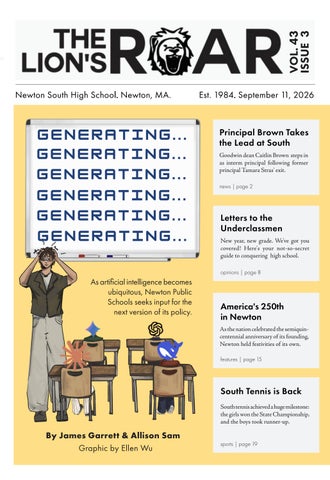
As artificial intelligence becomes ubiquitous, Newton Public Schools seeks input for the next version of its policy.
America's 250th in Newton As the nation celebrated the semiquincentennial anniversary of its founding, Newton held festivities of its own. features | page 15
South Tennis is Back South tennis achieved a huge milestone: the girls won the State Championship, and the boys took runner-up.
By James Garrett & Allison Sam Graphic by Ellen Wu
sports | page 19
page 2
September 11, 2026
NEWS issuu.com/thelionsroar
Volume 43, Issue 3
Summer in Review photo courtesy of Kids Against Cancer
By Abby Miller I thought it’d be really cool to get the South community involved in a fun event where it’s so easy to give back. Julia Skabeev Kids Against Cancer President
Kids Against Cancer holds fundraiser Participating in this event was very meaning-
ful to me because so many of my peers and classmates came together to support such an important cause that I feel really passionate about.
On June 11, the Kids Against Cancer club hosted its second annual Locks of Lions event in the student center. The fundraiser was organized to benefit Children with Hair Loss, a nonprofit that provides hair to children and adolescents with hair loss, and proceeds were donated to The Jimmy Fund at Dana-Farber Cancer Institute. Nine volunteers cut or donated their hair in support of the cause.
[Linda Plaut] came to love living in Newton. It is a reminder to us all to do what we can to bloom where we are planted. Julie Plaut Mahoney Daughter of Linda Plaut
Arts and Culture Building Opens The Newton Arts and Culture Department opened The Linda Plaut Arts and Culture Center in Newton Highlands on June 14. Linda Plaut was Newton’s Director of Cultural Affairs and pioneered Newton’s cultural efforts by starting events such as festivals, children’s classes and performances. Named in her honor, the building was renovated using funds from the Community Preservation Act, as well as money donated from fundraisers.
photo courtesy of WBUR
Meryl Kessler Director of Newton Arts and Culture Department
photo by Abby Miller
A designated Arts and Culture building – like the creation of a new Department of Arts and Culture – elevates and recognizes the importance of arts and culture in Newton.
Molly Otis Kids Against Cancer member
graphics by Ellen Wu
We have about 16 [detection and warning systems] fully installed and undergoing testing … we have another 46 that are planned. Jonathan Gulliver MassDOT Highway Administrator via WCVB
Plan Created to Stop Crashes By investing in new technology, stronger On June 17, Gov. Maura Healey announced that after a string of fatal wrong-way crashes, Massachusetts is currently working on new infrastructure to prevent these occurrences. According to AAA, there have been more than 5,700 wrongway crashes in Massachusetts between 2018 and 2025, resulting in 143 deaths. The new infrastructure includes more pavement markings and wrong-way signs, as well as thermal sensors to alert police when a driver is driving the wrong way.
safety measures and targeted infrastructure improvements, we’re working to prevent these crashes before they happen. Maura Healey Mass. Gov. via MMA
news | page 3
issuu.com/thelionsroar
Principal Brown takes the lead at South News editor
Serena Liu
Sophomore Valentina Guerra said that she thinks there are certain attributes that shape a leader. “Feeling respected and supported helps students succeed in every way,” she said. Murphy Ferguson said that she has observed Brown’s ability to work collaboratively with the South community. “She grounds her work with students and colleagues in our core values,” she said. Brown said that she believes her experience as a dean, where she worked closely with students not just from Goodwin, but from all houses, will prepare her for her new responsibilities. “As a dean, I get to work a lot with the students,” she said. “Having that student perspective in leading the school will be really helpful.” Vice Principal Jason Williams said that adjusting to a school’s unique culture and dynamics can be one of the challenges of a leadership transition. “Every school is different,” he said.“Every school has its own internal situation.” Looking beyond the transition, Williams said that strong relationships are the foundation of effective leadership. “Building relationships are key,” Williams said. “If people trust you and know who you are, they're willing to do a lot more to help support you.” Junior Ryana Nair said that she appreciates Brown’s contributions, both to her person-
photo courtesy of The Newton Beacon
Goodwin House Dean Caitlin Brown has been selected to serve as South’s interim principal for the upcoming 2026-2027 school year. In May, former South principal Tamara Stras announced that she would be leaving South to take on the role of Assistant Superintendent of Secondary Education at Cambridge Public Schools. Brown said that her path to education included developing a passion for teaching, as well as working with students. “I realized the best part of my day was working with kids,” she said. “I took a chance, and here I am.” World Language Department Chair Suzanne Murphy Ferguson said that she is enthusiastic about the decision to appoint Brown's as interim principal. “I was delighted,” she said. “She listens thoughtfully, asks great questions and appears to really love the work she does every day.” Brown said that she is very excited about the new role, as she appreciates the South atmosphere. “I love the community, the students and the staff,” she said. “I was really excited and honored to get this opportunity.” Sophomore Sloane Ghoshhajra said that she believes having a leader who enacts change and listens is valuable. “I am hoping for someone to listen and act to make a positive change in school,” she said. “Get to know the students; don’t just be a name they read in emails.”
ally and to the South environment. “Ms. Brown is very warm and is always there to listen and support me,” she said. “She is also the advisor for my club.” Brown said that she is looking forward
to the new school year and to begin her new position. “Every day, I feel lucky to walk through those doors and see our students and the people that care for and support them,” she said.
Standardized homework policy approved News reporters
Rebecca Telio & Audrey Wang This past June, the School Committee voted in favor of creating a new standardized homework policy affecting grades 4-8. This policy would implement standardized durations of nightly homework — tailored by grade — across all schools. The main issues this policy aims to address are inconsistencies in the level of assigned homework for students in different grades, standardizing homework both vertically and horizontally. Jason Bhardwaj, vice chair of the School Committee, said that vertical and horizontal alignment help tailor homework by grade and amount. “Horizontally, if you are a student at [any] elementary school in, say, fifth grade, you should have a relatively similar amount of homework [to your peers],” he said.“Vertically, it's important that this not be a roller coaster ride … you might have a lot of homework in sixth grade, but then … [in] seventh, you might have far less.” Victor Lee, co-chair of the School Committee’s policy subcommittee, said that this policy came after Memorial Spaulding’s proposed removal of all homework. “Memorial Spaulding was going to not have homework at all in the coming year for grades four and five,” he said. “That, frankly, concerned a lot of parents who reached out to me and other folks.” Bhardwaj said that this policy establishes a specific nightly duration of required, highquality homework. “[The policy’s range of minutes] was …
in line with widely established literature that, in general, around 10 minutes per grade level per night. So if you're in fifth grade, that would be 50 minutes per night.” However, Lee said that the policy has become increasingly adaptable. “We backed off from a more stringent initial draft and decided to provide room for that
said that having a set, timed amount of homework increases the potential that students will simply receive busywork. “For a lot of people, already the homework wasn't taking that long. So if they did want to reach this number, then they would have to probably put [in] some busywork,” Hu said. Another concern is the discrepancy graphic by Ellen Wu
flexibility. As a compromise, [we] invite[d] our principals to come up with these new proposals based on the feedback we get.” Despite this built-in flexibility — which gives each school leeway to adapt the proposal based on community feedback — attempting to limit the drawbacks of this new policy, problems still remain. Lucas Hu, a freshman at Newton South,
between the workloads of students with more extracurriculars and those with less. Genevieve Erikson-Garceau, a sophomore at Newton South, said that having too much homework can cut into the free time of busier middle school students. “Too much [homework] can be really stressful … for people who have sports and
other activities, [homework] can take up a lot of their time, and then … they have to choose, ‘do I finish my homework or do I go do this thing that I love?’” However, eighth grader Aaron Telio is skeptical that the policy will be regularly enforced. “The teachers don’t really follow policies that they feel are dumb, like the hall pass policy … the teachers don’t enforce that because they don’t care, and I feel like [it will be] the same with the homework,” he said. Even with these concerns, many students understand the importance of homework and, in turn, the potential value of the proposed policy. Erikson-Garceau said that homework has fundamentally helped her education. “I found when I really don't understand something … or I don't feel confident about doing it, [I rely on] my homework. So having no homework, … [students] are not going to be able to keep up.” Sophomore Esther Li said that she agrees with the policy’s goal. “Honestly, … I feel like that would be really hard … to instill on a districtwide level, but I do think it would help.” In order to successfully implement this policy districtwide, Bhardwaj said that he hopes to have a smooth transition. “I really hope that it is a migration and not sort of a rigid change,” he said.“I think it would probably be hard for everyone if it were just,‘we need to turn on the light switch in September.’ I hope that's the spirit that everyone takes it in.”
page 4 | news
the lion's roar
NPS appoints first Mental Health Director News reporters
Tenley Miller & Natalie Moore On July 1, Jesse Krotick started his new role as Newton Public School’s (NPS) first director of mental health and well-being. Krotick had previously been the NPS coordinator of social work and social emotional learning across elementary schools since 2018. Krotick said via a ParentSquare press release informing the community of his pro-
motion that he is excited for the new position. “I am honored to take on this role and grateful for the opportunity to continue working alongside our dedicated educators, clinicians, families and community partners,” he said. NPS parent Kirsten Lahey said she is excited to see more focus around mental health. photo courtesy of Fig City News
“I’m happy to see NPS supporting mental health because it is a growing need for students,” she said. Similarly, Yakinton Shavelsky, a clinical psychologist and NPS parent, said that in recent years, the desire for expanded mental health resources has become elevated. “Student mental health needs have increased over the past few years, especially since COVID,” she said. “I think teachers need help dealing with bullying and dealing with trauma. So I think there's definitely a great need and it has increased in the past few years.” Brendan Amedio, a guidance counselor and the assistant department chair of counseling at Newton North, said that he observed Krotick’s support during the pandemic. “I already know that he has done a lot in the elementary school in his former role,” he said. “I think he was very instrumental in a lot of mental health support during COVID.” South interim principal Caitlin Brown said that she is excited that the new position will help unify mental health departments across all NPS schools. “[I hope the role brings] support so that we are all on the same page about what's happening in elementary school, what's happening in middle school and what's happening in the high school.” Amedio said that he is confident in Krotick’s abilities. “He sees things from a very macro level. What I mean by that is he can take a step back and think about it from how it's affecting
someone in the pre-K, to [someone in the] 12th grade,” he said. “If people are able to learn and develop skill sets and coping strategies when they're pre-k to 5th grade to 8th grade, they might have a better time in high school.” Superintendent Anna Nolin said that she believes there are benefits to having a department head solely for mental health resources. “Mental health staff need a department head and something to unify them,” she said. Junior Eve Kosto said that she hopes that Krotick will allow for individuals to voice their concerns. “The biggest thing is probably listening to what people's concerns are because I think that's the best way to find problems,” she said. While Shavelsky said that she feels generally positive about Krotick's new role, she has some concerns. “[I want] to make sure that the focus is really on student mental health as opposed to expanding administrative bureaucracy,” she said.“Balancing mental health support in school with having parents involved in making their own decisions about their students' mental health. So those could be some concerns, but in general, I think it's a great thing that [NPS] created this role.” Amedio said that he is looking forward to the change Krotick will enact in the district. “He's super skilled as a clinician, and he has really good things to say,” he said. “The fact that he'll be able to spread his wings and meet more mental health staff within the district is a really positive thing.”
New Mass. cell phone policy to be enacted
Louisa Younkin
This past spring, the State Legislature passed a bill that, if enacted, would implement a public school cellphone ban from bell-to-bell. While the House and Senate have yet to agree on the final details of the legislation, there is a high likelihood that state leadership could implement the ban sometime this school year. The Newton Public Schools’ (NPS) current cell phone policy dates back to 2024 and states that high school students must put their phones in designated pouches during class time, while middle school students are required to put their phones in locked pouches for the entire school day. Assistant Superintendent Eugene Roundtree said that a lot of thought went into crafting the current policy. “A lot of the research on the adolescent developing brain and cell phones and learning really spells out the negative impacts cell phone use can have, both during the school day and in the pre- and post-school hours … I think a lot of [NPS] policies and practices are informed by what research tells us, but also what anecdotal experience tells us.” However, South senior Henry Fu said that in his experience, not only do students disregard the current policy, but teachers also fail to enforce it. “[There is] low compliance as people learn that their teachers don't really care,” he said. “I saw three people with their phones during my math final. Right now, [with] what we have, the implementation isn't working.” South freshman Stella Chang, who experienced the Yondr pouch system in middle
News reporter
school, said that poor administration has tive] purposes and functions,” he said. “[State limited the program’s effectiveness. leadership] can host conferences that might “I think the current policy is not very enable multiple districts to get together and well-enforced, which means that there are figure out what's working in one school versus many kids who aren't using another, how these different their pouches and are not environments learn from following certain rules,” each other … There is she said. “I think [the a potential role from Yondr system] could a knowledge and skill be effective if it was sharing, or at least a enforced properly.” convening, kind of Karen Spilka State Senate Presperspective.” ident Karen Spilka said H o w - Mass. State Senate President in a press release that the ever, Superintendent legislation aims to impleAnna Nolin said piloting to see how [the policy] will work, they're ment strong, consistent that she believes not sequencing the pilots before the legislation standards across the a state-mandated affects everyone,” he said.“So to me, it should go commonwealth. policy may not be the other way around: let's start with the pilot “ Ma ss. ha s a able to accommo- and then inform the legislation accordingly.” proud history of supdate school systems’ Nolin said that she believes the legislaporting and uplifting unique needs. tion is an unfunded mandate, meaning the state K-12 public education “A Newton is implementing regulation without providing for our residents, but a Public Schools set the funds necessary to enact the change. device small enough to of challenges and a “Generally with a state mandate, there fit in a pocket presents Framingham Public should be funding with it to implement [it],” a profound challenge Schools set of chal- she said. “We don’t have any extra money lying to ensuring student lenges are very dif- around to manage kids’ cell phones.” success,” she said. “This ferent,” she said. “We Bhardwaj says that it may be difficult [new] legislation … builds should be given latitude to implement the policy as quickly as the state graphic by Kristine Lee on the Senate’s mission of to decide [our policy] within wants to see it enforced. creating a statewide education system that our community.” “The draft says [the policy will go into continues to promote learning and growth.” School Committee Vice Chair Jason effect] this fall. From my perspective, that would Ward 8 School Committee member Vic- Bhardwaj said that the current legislation risks be very challenging because these things are not tor Lee said that he thinks state leadership has implementing practices that haven’t yet been simple,” he said. “I'm hopeful that [the timing] an important role in shaping education policy. proven effective. of their legislation will change, and that we'll “The state can serve multiple [posi“While contemplating very appropriate have at least a year to address this.”
This [new] legislation ... builds on the Senate's mission of creating a statewide education system that continues to promote learning and growth.
issuu.com/thelionsroar
news | page 5
Honoring Chrysolite Fitzgerald Community members fondly remember math teacher Chrysolite Fitzgerald.
By Chloe Carrano
F
ew teachers can brighten a classroom’s atmosphere and leave it illuminated in their absence. Yet many believed that Chrysolite Fitzgerald, a Newton educator for over 12 years and leader of Newton South’s Calculus Project chapter, had a changemaking voice of advocacy, warmth, flexibility and inclusivity in bringing together students from all walks of life. Known affectionately by students as “Fitz,” Fitzgerald passed away on Friday, July 24 after battling a brief illness. Hayley Donati, a coleader of The Calculus Project alongside Fitzgerald, said that she had a positive attitude and deeply enjoyed her job. “[She was] very creative, very gowith-the-flow … she constantly tried to make math more accessible and more fun, using projects, art and technology as tools to [enhance] her teaching.” South alumna Grace Santos said that Fitzgerald always prioritized her students. “[She was] quick to ensure that the needs of every student in her class [were met] and that the material they were learning was interesting. She always made sure that everyone was getting something out of the lesson.” In addition to noting Fitzgerald’s teaching style, many students’ memories center around her welcoming nature. Robbie Jones, a 2024 graduate, said that they remember joining Fitzgerald’s class late in senior year due to a scheduling mixup. “My first impression was that [Fitzgerald] was a very warm person, right off the bat, incredibly nice. Even though I came in late, I still felt like I was a part of the class community, and that was in large part due to her,” they said. As a teacher across multiple levels and
grades of South’s math curriculum, and a leader of affinity and academic support groups such as Black Student Union and The Calculus Project, Fitzgerald connected with students from varying backgrounds. Former South math teacher Ryan Normandin said that Fitzgerald was friendly and passionate. “[She was] someone who embodied being extremely welcoming to everybody … She always had groups of students where she became their‘person,’ and she cared so, so much
about them – they were really lucky to have her as their teacher.” Santos said that she noticed early on how reliable Fitzgerald was. “She was a safe place for a lot of BIPOC students. A lot of people felt like they could talk with her, and be honest with her. That’s what I noticed right away when I started her class,” she said. Leslie Quattrini, one of Fitzgerald’s colleagues, said that she noticed how Fitzgerald focused on making her classroom a supportive environment. “She had empathy for everyone, no matter what. Students immediately recognized, when they came into her room, that they were allowed to try. And if they were wrong, they weren’t going to get criticized – she would try
to make them understand without making them feel judged or behind for having said the wrong thing,” she said. Many of South’s educators and students echoed that one of Fitzgerald’s defining characteristics was her willingness to stand up for her beliefs – in South’s math curriculum and beyond. After authoring the content for Math 618, South’s senior non-AP calculus class, Quattrini said that Fitzgerald was the first to implement her concepts in a classroom setting.
Normandin said that, across those roles, Fitzgerald was outspoken about the things she cared about. “[She was] a fierce advocate for both students and teachers. She wasn’t shy about sharing her opinion, and she did a good job of cutting through [the noise] that was often omnipresent in teacher meetings.” Wendy Armagost, another of Fitzgerald’s colleagues, said that she was consistently positive. “She was an educational powerhouse, and she approached everything with kindness and joy,” she said. Fitzgerald’s impact on the South community extended past the classroom, as she knew many students and teachers personally. Armagost said that she remembers going out to celebrate Fitzgerald’s birthday just days before she passed. “We went to play mini-golf and had a lot of laughs. We always laughed when we were together,” she said. Donati said that she remembers messaging Fitzgerald to confer about parenting advice photo courtesy of The Newton Beacon throughout her time “Throughout [teaching the class], she at South. was bouncing ideas off of me; she was just the “She was a mom of three, and so when most creative person. She was not afraid to try I’d talk about any issues that came up with [my new things, and introduced me to project-based kids], she would reassure me. I could tell she measures of understanding rather than just tests always cared, and even when she was having a … she pushed me a lot as a teacher,” she said. tough time, she was always still so positive. I When discussing recently proposed will never forget that.” changes to South’s math curriculum, SuperinA celebration of life for Fitzgerald took tendent Anna Nolin said that Fitzgerald was place on August 3 at the Larz Anderson Park devoted to what she believed in. Shelter in Brookline. “[She] was able to bring out voices that Quattrini said that the community may have not been as confident to speak out. showed up to honor Fitzgerald. When she needed to aggressively advocate for “People from [game nights] at my something, she did so passionately.” house 13 years ago – who haven’t seen her As South’s union building representative, since – showed up to be there. Ms. Fitzgerald’s and a member of multiple faculty councils across celebration of life was a testament to who she South and the Newton Teachers Association, was … a wonderful person. She was special to Fitzgerald was said to ‘wear many hats.’ everyone who knew her.”
page 6
the lion's roar
September 11, 2026
EDITORIALS issuu.com/thelionsroar
Volume 43, Issue 3
It's time for AI education, not just policy NPS must move past mere syllabus warnings and implement real instruction.
Walk into an exam at South, and you might spot it. Fake phone — or straight-up calculator — in the phone holder. An actual phone under the desk, generating answers to the test in a matter of seconds, all while the teacher sits at the front of the room. In today’s classroom, some students have weaponized artificial intelligence (AI) into a covert shortcut to circumvent learning. From getting quick test answers to generating essays, outsourcing one’s critical thinking is easier and more widespread than ever. In the same building, however, many other students are using AI much differently: as a round-the-clock math tutor, concept explainer or practice question generator. Although often done without the required teacher approval, these efforts reflect an honest desire to use AI for learning rather than cheating. Newton Public Schools’ current AI policy, last updated in July 2025, begins to acknowledge this complex landscape. While it stresses that explicit teacher permission is paramount, it also recognizes the importance of AI literacy — defining it as understanding “the limitations and appropriate use cases of AI.” It charges students to evaluate content for “bias and factual accuracy” and“understand how AI systems process data and produce results.”
The guidelines are purposefully vague, allowing specific schools, departments and teachers to enforce their own specific practices. The policy is sufficiently nuanced. However, the district must follow up the policy with more action. We live in a time where AI usage, academically honest or dishonest, has become the undeniable elephant in every classroom. Classrooms have begun shifting back to in-class assignments and paper-and-pencil exams to eliminate access to technology entirely. South has already adopted policies that outline specific consequences for AI infractions, demonstrating a consensus that AI’s capabilities can hinder authentic learning. However, relying solely on punitive rules and access bans is not an education strategy. The only formal AI instruction students receive is in brief beginning-of-year slideshows, a single section of a syllabus or the occasional menacing lecture about the dangers of AI. NPS has done remarkably little to teach students the very AI literacy skills — like evaluating bias and understanding data — that its policy highlights as essential. Moreover, while AI should understandably be kept out of certain educational settings, schools have an obligation to prepare students
for the real world, where AI is now ubiquitous. Workforces are increasingly seeking candidates with AI skills. Whether AI’s omnipresence is good or bad, schools must equip students with the skills to navigate an environment where AI is more than a means of academic dishonesty. As NPS leadership prepare to refresh its AI policy with input from students, teachers and the community, they must supplement any policy revisions with concrete actions to put into practice the literacy-forward AI approach that it promotes on paper. First, build a concrete, systematic AI curriculum. A lack of formal AI instruction undercuts the district’s purported goal for students to “develop AI literacy.” NPS must extend its approach to AI beyond punitive measures and actually teach students how to analyze and leverage these tools ethically. True literacy means moving from passive warning labels to active, hands-on evaluation; dissecting real-world outputs, testing datasets for factual errors and bias and discussing the privacy and environmental tradeoffs of large-scale computation. Expecting students to develop genuine AI fluency and critical evaluation after a 10-minute syllabus presentation or even a single assembly is unrealistic at best. Second, actively build systems to encour-
age open dialogue. Currently, NPS’ policy lists “promoting transparency” as one of its guiding principles for AI use, and it states that determining when AI can be appropriately used “is a societal question that our school communities must also address.” Touting transparency on paper sets the right tone, but when talking about AI in the classroom becomes taboo, students don’t stop using it. Instead, opacity drives AI usage underground. When students are terrified to ask whether using AI for research outlines crosses the line, they don’t stop; they just hide their screen tabs and hope they don’t get caught. The road to academic integrity begins with allowing honest questions, and the district should create dedicated spaces for teachers and students to discuss their AI usage without immediate suspicion or fear of repercussions. AI is today’s most consequential technology, and NPS has already begun to take its capabilities and implications seriously. But a policy without education is just empty posture. Now, it needs to give us the hands-on education required to navigate AI ethically in school and in the workforce beyond. By committing to true AI literacy, NPS can ensure that students graduate not as passive technology leaders, but as thoughtful, responsible leaders in a digital world.
Volume XLIII The Lion’s Roar Newton South High School’s Student Newspaper 140 Brandeis Road Newton, MA 02459 ss.lionsroar@gmail.com
Editor-in-Chief Grace Yang
Bethesda Yeh
Managing Editors Seyoon Byun
Abby Miller
Section Editors
Editorial Policy
The Lion’s Roar, founded in 1984, is the student newspaper of Newton South High School, acting as a public forum for student views and attitudes. The Lion’s Roar’s right to freedom of expression is protected by the Massachusetts Student Free Expression Law (Mass. Gen. Laws Ann. ch. 71, Section 82). All content decisions are made by student editors, and the content of The Lion’s Roar in no way reflects the official policy of Newton South, its faculty, or its administration. Editorials are the official opinion of The Lion’s Roar, while opinions and letters are the personal viewpoints of the writers and do not necessarily reflect the opinion of The Lion’s Roar. The Lion’s Roar reserves the right to edit all submitted content, to reject advertising copy for resubmission of new copy that is deemed acceptable by student editors, and to make decisions regarding the submission of letters to the editors, which are welcomed. The Lion’s Roar is printed by USA Today Co. and published every eight weeks by Newton South students. All funding comes from advertisers and subscriptions. The Lion’s Roar's policy on journalistic ethics strictly forbids any use of artificial intelligence (AI) in the reporting, writing and editing process. The Lion’s Roar reserves the right to reject pieces offered for publication that are found to be in violation of this policy.
News
Chloe Carrano Leah Fiadjoe Serena Liu
Features
Opinions
Centerfold
James Garrett Allison Sam
Leena Choi Denis Eraslan Ezra Lewis Andrew Petrilla
Photo Managers Lev Navisky Kinneret Rosen
Kaylee Da Anastasia Karpova Sophie Lu
Sports Margot An Clara Borus Ella Chung
Humor Columnist/ Buisness Manager Adam Ransbotham
Faculty Advisor Ashley Chapman
Graphics Managers Ellen Wu
issuu.com/thelionsroar
editorials | page 7
You had to be there ... or, at from the EDITOR least, watch it LETTER
Grace Yang Editor-in-Chief
There’s something comforting about discovering that everyone is watching the same thing. I was reminded of this thought when I started going back to the movie theaters this summer, after years of mostly watching films wherever they happened to be available: on a laptop, on a TV, sometimes on my phone when it was most convenient (as Nolan intended). I saw “Spider-Man: Brand New Day” and “The Odyssey,” and found myself enjoying not only the movies but the fact of the theater itself – the dimmed lights; the previews; Nicole Kidman’s AMC monologue; the collective laugh; and the moment when everyone goes quiet at once. There’s an almost strange happiness in being surrounded by strangers who have chosen to live the same two hours. I had missed being one person among many, experiencing another’s art. So, after years of feeling slightly out of tune with the romantic comedy, I let myself fall down the rabbit hole this summer, starting with “How to Lose a Guy in 10 Days.” I followed with “She’s the Man,” then “A Cinderella Story,” “27 Dresses,” “When Harry Met Sally … ” and “13 Going on 30.” I ended August by watching “The Notebook,” which contains very minimal‘com,’ but it now comfortably sits at number one in my Letterboxd Top 4
anyway. (The others – for now, since I still have a considerably long watchlist – are Joe Wright’s “Pride and Prejudice," "27 Dresses" and “Before Sunrise.” I don’t usually think about movies in the context of genres, but you could probably draw some conclusions about my preferences. Make no mistake, though, my other favorites that I've watched this past year include – almost unfortunately so, depending on whom you
some act of staying current, but the genre I discovered I loved is really a centuries-long conversation about the same things. “She’s the Man” is Shakespeare, and “A Cinderella Story” is, well, Cinderella. People have always misunderstood one another. Timing gets in the way as often as pride complicates desire. Eventually, someone makes that humiliating or cheesy declaration of love, reminding us
I ... found myself enjoying not only the movies but the fact of the theater itself ... There’s an almost strange happiness in being surrounded by strangers who have chosen to live the same two hours. I had missed being one person among many, experiencing another’s art. ask – James Cameron's "Avatar"; "Parasite"; the 2010 Ayrton Senna documentary; and "Project Hail Mary." A cinephile contains multitudes.) There was something wonderfully comforting about encountering these rom-coms now. Their references had seeped so thoroughly into the culture that I knew the shape of the story without knowing the story itself. If you had asked me to do so a few months ago, I probably would've already been able to recite the last line of Harry's monologue to Sally (#poser?). I had justified my movie marathon as
of what all this living is for, even if the secondhand embarrassment momentarily feels like too much. Our obsession with the ridiculousness of falling in love is nothing new. On Letterboxd, watching a movie isn’t even half of it. You also rate it, review it and, if you’re feeling up to it, rank it against everything else you’ve seen. You look at what other people loved or hated, and reconsider your own opinion. It’s an acutely digital way to participate in culture, turning taste into a public archive and a kind of diary, but I adore it.
Letterboxd, along with Goodreads and Spotify Wrapped, reminds us of memories that otherwise fade. A movie from an ordinary Tuesday night can bring back that post-theater feeling; a book you read three summers ago can resonate even if you’ve forgotten the author’s name; a song you played obsessively for one month can resurface as evidence of who you were then. Having a record of what we liked and what we abandoned is, in many ways, reassuring. These digital records preserve our individual histories as much as they reveal how our memories are tied to things we encountered together. Monoculture gives us somewhere to begin. You watch “The Odyssey,” and someone tells you that Nolan’s best film is “Interstellar,” so you rewatch it. You love “27 Dresses,” and suddenly you’re listening to ’70s music again because the two leads drunkenly sing “Bennie and the Jets” at a bar. You’ll eventually revisit Jane Austen in your Lit class (and maybe you’ll finally watch the BBC adaptation of “Pride and Prejudice”). Another modern retelling will catch your attention because it reminds you of another project you loved, or of someone in your life. The joy of a shared culture isn’t knowing exactly who you are, but knowing that someone else might recognize where you’ve been. And, yes, this article is your sign to watch all the aforementioned films, including “The Odyssey.” (I’m no adaptation purist.) Now, if you’ll excuse me, an AMC Stubs A-List subscription is calling my name …
Sep 6, 2026
page 8
OPINIONS
Letters to ... issuu.com/thelionsroar
Volume 43, Issue 3
the Underclassmen New year, new grade. We've got you covered! Here's your not-so-secret guide to conquering high school.
graphic by Yuehan Liu
What I would tell my sophomore self By Kaylee Da
E
very morning, the walk to class felt like being herded into a not-so-secret mousetrap. Every Monday, a not-sosurprising pop quiz would be waiting around the corner. Sophomore year was extremely rough for me. Here’s the advice I wish I had before entering what can only be described as my villain origin story. First: claim your territory. Every school should have a comfort corner that feels like an exhale after a long day of school. It can truly be anywhere — the corner library table or that patch of grass outside a classroom window. My secret hideout was the ceramics room.
Whatever you do, though, do not host a party in the bathroom when there are only two stalls. Second: start calendaring. If you have not moved on from listing your tasks on a random bookmarked Google Doc, this is your sign. There will be weeks where you’re wrestling mountains of quizzes at once, and it is objectively better to see them coming beforehand than to clench your jaw begging for a retake after class. Third: figure out how you procrastinate. Everyone has a signature move: doomscrolling, waiting for the clock to hit midnight or simply reorganizing your whole bedroom. Once you know yours, make it harder to reach the habit. That might mean throwing your phone in another room, locking yourself in a study room or treating yourself with a cookie after a completed task. Fourth: believe in your ability to learn. I took a few honors courses, and there were times when I believed my brain had reached its limit to master a certain unit. Sometime in the year,
I started believing that I wasn’t smart enough to keep up. That unhealthy mindset led to days where I gave up studying because I thought all the material was beyond my capabilities. I regret not having realized that this discomfort allowed my brain to continue growing. Avoid trapping yourself in similar self-sabotaging situations. Fifth: do at least one completely useless thing every day. If every hour of the day is optimized for a certain goal, your brain never gets to take a break. Doing something with a zero payoff is the only off switch you have. Every day, you should have a reminder that you are still a person, not a robot executing tasks for
it’s going out with your friends on a stay on track with different commitments Soph-secrets to not whether Friday night or just getting Starbucks after and that nothing slips through the cracks. Third, find something in school You need to have a life outside of school. Soph-secrets to school.Second, suffering in school good organization will save you. you enjoy. While school can be stressful year, you might have been able to get and a lot of work, there are activities not suffer in school Freshman away with keeping everything in your head, but in the building that aren’t. For you,
By Ariel Hollander By Ariel Hollander
S
Every morning, the walk to class felt ophomore Slump sounds scary, but like being herded into a not-so-secret mousesophomore year can be the best year of trap. Every Monday, a not-so-surprising pop high school – depending on how you quiz would be waiting around the corner. look at it andyear whatwas yourextremely prioritiesrough are. Even Sophomore for though I took challenging classes, my me. Here’s the advice I wish I had sophomore yearwhat wascan stillonly very before entering fun, so here is some advice to be described as my villain make your year memorable, origin story. too (inFirst: a good way)! claim your terriFirst, prioritize tory. Every school shouldnonhave academic is a comfortthings corneryou thatenjoy. feelsItlike easy to get caught up in schoolan exhale after a long day of school. work, studying, etc. Make that It can truly be anywhere —sure the corner you plan at least one or two things a week,
sophomore year is going to make that much harder. I recommend setting up a page and profile with Notion, an allin-one digital workspace that keeps track of your daily tasks. On Notion, I have multiple pages including a to-do list, a calendar and a daily planner. Having these organizational systems ensures I
it could be eating lunch outside, doing art or talking to your friends in the library. For me, my favorite place in the building was the ce-
graphic s by Ril
ey Cabre ra
futureyo u ’s benefit. Now, if you found this letter helpful, tipping would be highly appreciated!
ramics studio, where I could work on projects during free periods. School shouldn’t just be a horrible place that you dread, and there should be things that make you actually want to show up for school. Lastly, make the most of your weekends. Your weekends are the two days where you don’t have to spend the whole day at school, so use them wisely. I recommend using one day to catch up or get ahead on homework. The other day can be for resetting mentally and physically by cleaning your room, doing laundry and planning for the upcoming week. Also, on either day, you should plan a fun activity like going shopping, having dinner with your friends or spending time outside. I hope this advice helps. Have a great sophomore year!
opinions | page 9
issuu.com/thelionsroar
Whatever happened to the concert? By June Henry
Lights are flashing, speakers are booming, crowds are cheering, and you are … miserable. Despite spending $300 on tickets you got after waiting behind 10,000 other people in the queue, your nosebleed seat barely gives you a view of the stage. If that wasn’t bad enough, the post you made about the concert on Instagram only seems to attract comments saying you’re not a “real fan” and therefore don’t deserve your tickets. Would it have been better not to go to the concert at all? Nowadays, music lovers everywhere seem to be asking themselves the same question. With absurd ticket prices, highstakes lines and internet mania galore, concert culture has shifted from a fun night out with friends to a status-proving, stress-inducing event out of reach for everyone but the wealthy — and the trend is worsening. According to Reader’s Digest, the average concert ticket price in 1996 was $26. Accounting for inflation, prices today should average around $54. Instead, the average in 2025 was a whopping $133. One factor in rising concert prices is how streaming platforms work. In general, listening to music is much cheaper now than in the past, with free versions of streaming services like Spotify. However, many of these services pay artists minimally. Spotify pays artists as little as $0.003 per stream, meaning 1 million streams
would only yield around $3,000. Since music listening is becoming less lucrative even for the most popular artists, many have turned to concerts as a main source of income, leading to prices as high as $5,000 for some shows. These insane prices have essentially
eliminated the concept of the“casual fan,” unless that fan is extremely wealthy, because no one outside of the highest income bracket is going to spend hundreds of dollars on an artist they only casually enjoy. But even the superfans don’t seem to be
having fun. The Berkeley Beacon writes of fans facing hours-long lines, preparing for excessive prices – only for the remaining seats to barely have a view of the stage. Even people who are willing to pay high ticket prices don’t get their money’s worth in the end.
desired 30-second clip for a post. In the K-pop industry, influencers hire people to attend and record performances so that they can pretend they were there. However, the need to prove attendance to an online audience isn’t just for influencers – it’s affecting normal fans as well. Nowadays, it’s common to look out into the crowd at a concert and see not the faces of fellow fans, but rather thousands of iPhone cameras blocking your view. Concerts were intended to be an experience to enjoy music at a deeper level than when you’re just listening at home, but the need to include any lived experiences in an Instagram post is changing concerts into a search for the perfect photo op. Not only are concert prices keeping out anyone without massive amounts of disposable income, but the people who do attend are either influencers who don’t actually care about the music or people glued to their phone screens instead of the stage. So what needs to happen? Primarily, streaming services need to pay their artists more, so they don’t have to graphic by Ellen Wu rely on concert profits. Other than that, So who’s occupying the good seats that internet culture has such a strong grip on all of the superfans are vying for? More often than our lives that it’s unlikely the other issues will not, the culprit is wealthy influencers. People be resolved anytime soon. Magazine reports numerous instances of frontIf you do find yourself one of the lucky row seats packed with influencers partnered few to secure a ticket, try to put your phone with brands, ready to leave after getting their down and live in the moment.
My months of reading and relaxation By Julia Ding
“Wait, we had summer reading?!” I sat up in bed and ran to Amazon a week before school started because – once again – I had forgotten all about summer reading. We all remember being assigned Rainbow Rowell's “Eleanor & Park” the summer before freshman year, and most of us disliked it – just like any other summer
u llen W
ic by E graph
reading assignment. To many, “reading” and “summer” in the same sentence equals an absolute nightmare. Summer is meant for relaxation. The thought of picking up a book feels like another dreaded homework assignment for a diagnostic (that isn’t even graded). And well, that was also my philosophy for longer than I remember, if my last-minute “readathon” hadn’t been enough proof. But that quickly changed with my discovery of “BookTok” and “Bookstagram” in February – both being portmanteaus of “book” and the social media platform the communities can be found, like TikTok or Instagram. “Ten books every teen girl should read.” Scroll. “Swoon-worthy romance book quotes.” Hmm, scroll. “Books you need to run to the bookstore to buy!” You get it. Perhaps the algorithm saw the inner reader in me. So I finally picked up Lynn Painter’s internet-favorite rom-com “Better Than the Movies.” It felt like opening a door to a brand new world: oh my god, I actually found a book that didn’t feel like torture! I even chose Liz and Wes’s story over my phone for hours after school. I kept reading after finishing “Better Than the Movies,” but when I reached the last book of Karen M. McManus’s mystery trilogy, “One of Us Is Back,” I hit my first reading slump. The book was collecting dust on my shelf, and I felt guilty seeing the little portion
that I had read. Eventually, I finished the book and ended up enjoying it a lot – to the point where it inspired my short story for English class. Turns out that set off a domino effect, igniting an inner reader I didn’t even know I had. Online book platforms drew my attention, creating an urge to read more books – and yes, my fear of missing out (FOMO) definitely did not help! Many people would accuse me of having BookTok taste, to which I have nothing to say: I did, in fact, finish reading the Shatter Me series by Tahereh Mafi in under a month. Then I read the recent BookTok favorite, Lauren Roberts’s “Powerless” trilogy, which is currently facing backlash because of plagiarism and the use of artificial intelligence. Later, I read the“romantasy” BookTok favorites: the“Caraval” series and the“Once Upon a Broken Heart” series by Stephanie Garber. Having fallen in love with the former, I couldn’t wait to jump into the “Once Upon a Broken Heart” trilogy. Yet after I picked up the first book of the highly anticipated series, it was quite hard to get into. However, forcing myself to finish it paid off: the cliffhanger ending had me on my knees for the next book, “The Ballad of Never After” – which actually destroyed me. This second book – my new favorite – and the third book are the first books I finished for the summer reading challenge. If you wish for a whimsical tale with curses, prophecies, and true love, look no further. The challenge continued with“Heartless” by Marissa Meyer, a retelling of the tragic
backstory of the Queen of Hearts from “Alice in Wonderland.” I picked up this book because of the reviews on BookTok, claiming the ending to be truly heartbreaking. And though it had indeed been painful, much of it was spoiled for me – thanks, internet! My eyes had been mostly dry while reading the acknowledgements at 2 a.m. The final series that completes the internet’s classic “big three” is the young-adult political fantasy “The Folk of the Air” series by Holly Black, which even had a French fan film produced for fans of the beloved trilogy. Aside from the film, the series has a “spin-off,” so my FOMO will likely have me reading all of Holly Black’s books. Upon finishing the “big three,” I returned to young-adult contemporary romance and rom-coms for the rest of summer for the ten-book challenge. From reading absolutely zero books to having read ten in a single summer and working toward a fifty-book reading goal – oh, and did I mention starting a Bookstagram account and writing my debut novel? – reading has become a large part of my identity. This change has convinced me that reading is for everyone, but only if given the right book. Reading should give you a jittery feeling in your stomach, urging you to find out what happens next. Reading does not have to turn into an entire personality – or even a hobby – but all it takes is ten pages before bed and the right book … and perhaps the summer reading pizza party will be yours!
page 10 | opinions
the lion's roar
When Nobody Wants to Want To love is to risk, but fewer of us are following through on that philosophy. Are we fundamentally scared of being vulnerable?
By Ana Ciric & Ella Hulburd
W
hen was the last time you pulled the whole friend group together to debate whether you were in a “situationship,” stuck in the “talking stage,” or just vibing in an “eye-contactship”?. Many relationships have shifted from slow-burn romance to casual encounters where we reduce love to a swipe on a dating app. Have relationships become less valuable, or have they simply changed? Modern dating culture feels full of contradictions. Many of us have heard relationship rules such as "don't text first," "wait a few hours before replying" or "don't seem too available." These supposed strategies are meant to make someone appear more desirable, but they ultimately encourage emotional distance. We fear that responding quickly to texts will make us appear“vulnerable,” creating a loss of interest rather than showing interest. At the same time, we want to have genuine connections while acting ingenuine. Instead of rewarding openness and honesty, dating now favors playing it cool – playing hard to get to keep the ball in your court. Consequently, people spend more time analyzing others’ words than actually communicating. Nowadays, one extra letter in the “hey” text could lead to hours of overthinking and hyperanalyzing. The increased use of technology has undoubtedly reshaped dating as well. While dating apps have expanded opportunities to
meet new people, they also encourage a transactional approach to relationships. When every swipe introduces another potential match, it's easy to develop the mindset that someone "better" is only another swipe away. Psychologists sometimes call this belief the "paradox of choice,” more options do not always make us happier; they can make us less satisfied with the choices we make. Despite this rise of casual dating, romance continues to occupy a central place in modern culture. Movies, music and social media celebrate engagements, anniversaries and this idea of finding "the one.” We’re conditioned to aspire toward having a successful romantic relationship. Yet this ideal conflicts with modern dating norms, which overemphasize emotional distance, uncertainty and nonchalance. Society encourages people to pursue an impossible ideal of lasting love – all while rewarding behaviors that make it difficult to create genuine connections. These broader trends are reflected in today’s teenage romance. Teenagers are learning how to navigate relationships in an environment where every text, Snap score or Instagram like is overanalyzed for hidden meaning. Despite the association between casual intentions and dating apps, these platforms may actually decrease a relationship’s superficiality. In a world where most relationships are formed purely by circumstance, it may be
healthier to meet someone through the screen, especially when you have common interests. As of 2025, a Forbes study shows that 53% of people aged 18-29 use dating apps, with 35% of users seeking a serious relationship. While there is a common association between dating apps and a rapid rise in hookup culture, most people on these platforms are looking for something beyond casual dating. Perhaps the question isn't whether relationships have become less valuable, but whether modern dating has changed the way we protect ourselves from getting hurt. If you expect rejection, investing less can seem like a way to avoid disappointment. Yet that same instinct often makes it harder to begin building the trust and vulnerability that allow meaningful relationships to grow. The way people meet and communicate will inevitably continue to evolve, and so will dating culture. But healthy relationships have never depended – and should never depend – on perfectly timed text messages or hundreds of arbitrary rules. Actual, lasting relationships are built on communication, consistency and mutual respect. Maybe the most honest thing someone can do is be genuine: sending the first text, saying what they actually mean and treating others with kindness even when things don't work out. Choosing to build genuine connections may be the most meaningful choice of all. graphic by Ellen Wu
Adam Ransbotham
Humor Columnist & Business Manager
For the Love of ... the LARP I’m back. Shocking as it is, Senior Staff hasn’t replaced me. Yet. And it only seems fitting, as I LARP any sort of experience or expertise when it comes to newspapers, to talk about my favorite methods of larping for the new school year. The key to seeming experienced on the first day of school is to pretend to know where your classes are. No one actually knows where the 6000s are, nor would they like to know, but you can’t let that stop you from acting like you know where Spanish is. The biggest issue is that your confidence will radiate and people will begin to ask you how to get to their classes — for lack of a better answer, you will say “down the hall and to the left” before crossing your fingers and hoping that they don’t remember faces. Now, I don’t know why you can’t drive, but I can’t seem to pass the permit test even though I’ve been studying for months. If you find yourself in this situation, relax. Take a deep breath. You’re going to be OK. Then you need to hope your bus driver doesn’t take a wrong turn somewhere along your morning route and drop you off in Timbuktu (true story, BTW). If you’ve managed to get to school, walk to the first car on Brandeis, take a selfie, caption it “been here since 4:23 a.m. #iheartmymomssubaru,” post it and just wait for the street cred to accumulate. Everyone understands that the real heroes aren’t just the lactose intolerant, but also everyone whose life revolves around a parking spot. The ultimate LARP is using LinkedIn. An Indonesian mountain goat put me onto this method. No one actually uses LinkedIn – it’s just a conspiracy theory – but you can pretend to by making an account. Bonus points if you include where you went to middle and elementary school. Now, from here, the goal is to connect with everyone. People no longer serve any value to you beyond being another connection. You are now a highly important person, and all 37 of your connections need to have constant life updates – whether you got hit by a bus or you finally got a job that has a 2-hour shift once a week, which you doomscroll for half of. Though, the only things that really matter are your LinkedIn game scores. Just like my idol and mentor (Curious George) says, “No one is going to believe those cupcakes are real unless they have frosting”.
issuu.com/thelionsroar
opinions | page 11
Stuck Working & Wrung We’ve been taught to treat every hour as an opportunity to be useful. Maybe it’s time to take some of them back.
By Anastasia Karpova
I
n order to be “useful,” we need to wring ourselves of all our energy. Or so is the expectation. Is there any way to resist this pressure, or is it woven too deeply into society’s framework? From the moment we enter kindergarten, we’re exposed to a system that remains largely unchanged: a school system that teaches us how to be “helpful” to society. It has a similar framework to most real jobs: come in during the morning, leave around four, and follow a supervisor. In the school system, we comply to learn. When we enter the workforce, a large chunk of us will settle into a white-collar nine-to-five, where we comply with supervisors in order to be useful. This system wants us to dedicate all our time to being useful. Is resting, then, a form of resistance? And, since we’re already part of a system that views time as a commodity, is there any way to resist the system, or is it too late? The answer isn’t so simple. First, what counts as rest? Free time is defined as the time we aren’t working. With work culture now, it seems that free time interrupts our continuous stream of work. You can be useless. The question now, though, is whether that counts as resistance. The art of doing nothing shows us the culmination of all of the pressures that society has placed on us because there are so many ways to interpret what that means while doing practically nothing. In a society that demands we be useful every second of our lives, taking time for yourself is revolutionary. Perhaps even sitting on your phone can be a form of resistance. This is especially true for people still in the school system, like high schoolers. A large number of people in high school try to help their chances of getting into a good school and landing a good job by maximizing what they do, whether that’s internships, sports, test prep, and more. If the goal of spending all of our free time is to create the most profit in the end, then stepping back and taking time for yourself can help. Using time for
things that we truly enjoy, such as hobbies, crafts, talking with friends and other activities not focused on profit, can be a form of resistance. But, on the other hand, engaging in activities in our free time can also mean complacency with society. When we rest or do hobbies, we become acutely aware of other societal pressures. What’s “in” right now? Are these the hobbies my friends are doing? Should I do this or that? Even at rest, expectations tug at us. When society is this oppressive, there’s little we can do to attack such a fortified system. Doomscrolling does even less to help. Sitting on our phones has been predisposed to be a convenient mode of relaxation, but the habit doesn’t do much in terms of progressing toward a better system. The action of doing nothing, well, doesn’t do anyth i ng .
There is harm in overworking ourselves as a part of productivity culture, but there is really no change when we don’t overwork ourselves. We know that society pushes and tugs at us constantly. What else can we do to end this system, other than being useless? On March 28, 2026, a collection of protests happened around the country on what was called“No Kings Day.” The peaceful, large and widespread protests aimed to call out current policies by President Trump, such as the excessive force of Immigration and Customs Enforcement, the war in Iran and overall authoritarian governance. While the protests made a huge impact c u l t u ra l l y,
bringing people across the country together, it did little to truly bring systemic change. Why? The answer is astonishingly clear when you consider what day of the week it happened on: a Saturday. Even in the largest protest this nation has seen in recent years, it still has roots in compliance within this system. The large majority of American workers don’t work weekends, so a Saturday is one of the most convenient times, baked in comfort. But change doesn’t come from comfort. Protests, like boycotts, create change when they force oppressors to notice them. They should disrupt daily life, and although nonviolent, they can create unavoidable problems like road blockages and closed businesses for the day. Unfortunately, our work system has forced us to be so useful to the point that stepping away from the system is dangerous. The issue is that people cannot afford to step into discomfort. Missed work can mean layoffs, and layoffs can mean homelessness, which is notoriously difficult to bounce back from. People do not want to risk their jobs for an outcome that leaves them uncertain. When everyone is afraid to step out and threaten the system, that means it’s working. When the roots of capitalism run so deep, simple things like doing nothing in your own time do little to attack the framework of what keeps us here. So what does? Realizing our power in numbers does. Minneapolis was a city that participated in No Kings, but they took it further. They had boycott days in which entire neighborhoods operated as one to bring change. People dared to be uncomfortable, and they created real change. When everyone has that courage, we can begin to chip away at the system that maybe isn’t as rigid as it seems, and we can reclaim our time as our own. gr ap hi
cs by E
lle n
W u
page 12 | centerfold
the lion's roar
centerfold | page 13
issuu.com/thelionsroar
As artificial intelligence becomes ubiquitous, Newton Public Schools seeks input for the next version of its policy.
By James Garrett & Allison Sam
F
or schools, the rise of artificial intelligence (AI) has created a complicated question: Is it better to teach students how to use this pervasive tool that can write essays, solve math problems and generate artwork. Or should schools instead ban AI completely to preserve the development of students’ critical thinking skills? Students at South have not simply sat back and waited for administrators and teachers to decide. Instead, some students have taken AI into their own hands to develop innovative technologies to improve their education. Senior Lev Smolsky created Coi, a collaborative AI-based platform where users can speak with AI, which then creates learning materials such as flashcards and practice tests. Smolsky said that his platform was specifically designed to use AI to accelerate his peers’ learning process. “The school can't stop people from using ChatGPT, but on the other hand, Coi is encouraging students to actually learn,” he said. “It is perfectly aligned with the school policy, because rather than prohibiting something which the school inherently can't prohibit, it's actually pointing users in the direction that is best for them.” Similarly, senior Nika Presayzyn sought to fill the gap she sees in AI education by founding her nonprofit, Say Hi to AI. Presayzyn said that she wanted to combat the idea that AI is only detrimental to learning. “[Teachers] are hammering this idea that AI is bad, but not explaining why, which is causing us these tensions with our teachers as well,” she said.“This is partially why I started the nonprofit, because I wanted to make sure kids understand the usage of AI to help them, not to do the work for them.” Although some teachers may only see AI as negative, others have found ways to use AI to aid their teaching. World Language department head Suzanne Murphy Ferguson said she has used AI to adjust the reading levels of texts to meet individual students’ needs. “AI can help us create a ver-
sion [of a culturally important text] that's appropriate to the level that the student is currently at,” she said. “Whereas this one text might be inaccessible if we try to use the original format, we can use AI as helpful in terms of saying, can we modify this text to put it at a level that will be more accessible to the students?”
While students like Smolsky and Presayzyn approached AI as a tool to enhance learning, others do not share that perspective. Senior Dima Rozghon said that AI allows students to bypass the learning process. “It's easy to use AI to larp being smart, but at the end of the day, you feel better when you're not using it,” he said. Data backs Rozghon’s sentiments. In a study by the Massachusetts Institute of Technology on the effect of language learning model (LLM) usage on the brain, researchers found that cognitive activity scaled down in relation to LLM use. Additionally, LLM users underperformed compared to participants who used only search engines or no external resources. Because of the well-researched toll of AI on cognitive health, senior Olivia Bianchi said she is aware of the negative effects that come with relying on AI for assignments. “Critical thinking and writing skills are two of the most important things you'll ever use in your life,” she said. “I'm a big believer in
thinking for yourself and using your own brain because we wouldn't be at school learning if we weren’t gonna use our own brains.” Likewise, Murphy-Ferguson said she fears that the rise of AI will rob students of school's challenging but rewarding learning process. “Part of what we do in school is value the struggle it takes to learn and to get to a certain point, and I think that in some w a y s , working with AI, there's this understanding that everything should be perfect,” she said, “I worry about AI in terms of losing connection with the process of learning itself.” While Spanish teacher Alexandra Van Buren also fears the dangerous impact that AI can have on students’ learning, she said adults need to recognize that it is their responsibility to ensure that adolescents are left with necessary analytical thinking. “I really worry that we're going to be left with a generation of people who were not given ample opportunity to develop [critical thinking] skills,” she said. “As adults, we have to take that very seriously … In reality, parents are responsible for this. Teachers are responsible for this. You can't blame kids for acting a certain way in a society that the adults created.” Not only does AI affect students’ learning, but it can also impact their relationships in school. English teacher Emily Glickman said that after spending every day in class talking with her students, it is easy for her to notice discrepancies in their writing, and she feels angry that students think they wouldn’t get caught using AI on assignments. “I'm mad that people cheated in my class. Because you cheat yourself. You cheat yourself of learning, and it's disrespectful to think that I don't know you at all, to think that I wouldn't notice,” she
said. “Come on. I know you. How would y o u
relationship is really important,” he said. “The core of education is that you believe in kids and you root for them.” However, freshman Walter Fu said that his middle school math teacher made him realize that ethics surrounding AI is more about the person using it rather than the technology itself. “Mr. Shoemaker would always say, ‘the calculator is only as good as the person using it,’” he said.“It’s just
another tool that can be misused, so it’s really about the person and not about AI.”
graphic by Ellen Wu
think that I wouldn't?” Similarly, English department head Brian Baron said he has also found issues surrounding AI to be taxing on studentteacher relationships. “I don't want to be the person who's always reading kids' work with a suspicion that they're trying to cheat. [AI has] created a dynamic where we almost have to, and that is hard because the student-teacher
To combat the use of AI in academic settings, South’s administration has tried to set boundaries around AI usage on assignments. South’s policy states that students should be aware that the use of AI technologies in completing academic work should only be done with teacher approval and consultation. The use of AI technologies without teacher consent may be considered a violation of Academic Honesty. South’s policy was created by the superin-
tendent, School Committee members, district attorneys and the IT department. However, Superintendent Anna Nolin said she acknowledges the nuances and difficulties surrounding making an effective AI policy. She said she understands both the positives and negatives of implementing AI into the Newton Public Schools. “It’s a really hard moment we're in right now, of wanting you to be competitive in the marketplace and not leaving innovation on the table. But still being a critical thinker, and having this learner's mindset on your own, not just asking an AI bot to do the learning for you,” she said. Wh i le generative AI only b e came
mainstream four years ago, the world language department has been dealing with such technologies since Google Translate was launched in 2006. Murphy Ferguson said that in the past, she would demonstrate to students the flaws of using Google Translate by translating a text from English to French, and then back from French into English. The final text would be laughably clunky to the point that students would know the ineffectiveness of such tools. Such strategies have been deemed ineffective by AI’s increasing competency. Instead, Van Buren said she tried to combat students’ internet usage by updating her teaching style. She said that she is going to make assessments that require students to perform in the moment. “There are so many kids that talk the same way in class every day, and if they're going to write something down, it looks totally different,” she said. “If you can't do it on a daily basis, there's no way you can just pull that out right now.” Despite efforts from teachers like Van Buren to ensure the validity of students’ work, some students are still demanding more clarity regarding acceptable AI use. Presayzyn
said she wants clearer directions from all of her teachers. “Teach us how to use it with your approval,” she said. “You want it used in a certain way? Give us guidelines.” However, junior Rira Hakimelahi said that even with the proper boundaries, she thinks students will find a way around
restrictions. “There's like a million ways I could think of how [the policy] could be done, but the issue is how effective will they be? People are tricky. I've seen this [at Brown with the Yondr pouches],” she said. “There's never a way to fully be able to tell if someone used AI or not.” Even though some students are discontent with the current AI policy, others have more positive feelings towards it. Sophomore Joshuah Tunik said he appreciates the policy’s strictness, but wishes it was less one-sided. “I think [South’s AI policy] is good because of their very low tolerance for cheating and just generating things,” he said.“But I don't think it's stressed enough that though you can't cheat, you can still ask AI to help you learn.” In light of AI’s continued advancement, Nolin announced that NPS will introduce a new district-wide policy in 2027. The policy will take into account student perspectives in hopes of alleviating confusion surrounding the rules.
The AI debate does not end at school, as the workforce is leaning into AI to improve productivity and efficiency. According to Forbes, 72% of businesses have adopted AI for at least one business function. One example is senior software engineer and NPS parent Qi Wang. She said that AI has been replacing the entry-level job market. “Especially for engineering, we don't hire entry-level people. The AI can do a much better job,” she said.“The AI code — it's definitely much better than a single person.” Van Buren said she worries for students’ futures because it’s diminishing their basic social skills. “Can you have an intellectual conversation or participate in a discussion confidently? Or you can't write really well because you've been overrelying on AI or other tools.” With an overreliance on AI to do thinking for you, Glickman said she shares a similar sentiment because she is concerned that society will shun creative individuals and become similarly opinionated instead. “You have to sit and think, ‘Why do I think what I think or why do I believe what I believe?’ Maybe there's validity to what they're saying,” she said. “That's what makes us more tolerant as people too. When you hear people who have different beliefs than us. I'm just worried that it's gonna make us all these monotonous, boring creatures that don't put any effort in.” Despite criticism from teachers and students alike, Presayzyn said that AI can be a useful tool if people teach themselves and use it the right way. “If someone is educated on AI, they have a little more wiggle room [to criticize it], because they understand everything and how it works,” she said.“[People] have this power to apply it to make their life easier. But I don't think everyone has that right, or that skill quite yet.”
page 12 | centerfold
the lion's roar
centerfold | page 13
issuu.com/thelionsroar
As artificial intelligence becomes ubiquitous, Newton Public Schools seeks input for the next version of its policy.
By James Garrett & Allison Sam
F
or schools, the rise of artificial intelligence (AI) has created a complicated question: Is it better to teach students how to use this pervasive tool that can write essays, solve math problems and generate artwork. Or should schools instead ban AI completely to preserve the development of students’ critical thinking skills? Students at South have not simply sat back and waited for administrators and teachers to decide. Instead, some students have taken AI into their own hands to develop innovative technologies to improve their education. Senior Lev Smolsky created Coi, a collaborative AI-based platform where users can speak with AI, which then creates learning materials such as flashcards and practice tests. Smolsky said that his platform was specifically designed to use AI to accelerate his peers’ learning process. “The school can't stop people from using ChatGPT, but on the other hand, Coi is encouraging students to actually learn,” he said. “It is perfectly aligned with the school policy, because rather than prohibiting something which the school inherently can't prohibit, it's actually pointing users in the direction that is best for them.” Similarly, senior Nika Presayzyn sought to fill the gap she sees in AI education by founding her nonprofit, Say Hi to AI. Presayzyn said that she wanted to combat the idea that AI is only detrimental to learning. “[Teachers] are hammering this idea that AI is bad, but not explaining why, which is causing us these tensions with our teachers as well,” she said.“This is partially why I started the nonprofit, because I wanted to make sure kids understand the usage of AI to help them, not to do the work for them.” Although some teachers may only see AI as negative, others have found ways to use AI to aid their teaching. World Language department head Suzanne Murphy Ferguson said she has used AI to adjust the reading levels of texts to meet individual students’ needs. “AI can help us create a ver-
sion [of a culturally important text] that's appropriate to the level that the student is currently at,” she said. “Whereas this one text might be inaccessible if we try to use the original format, we can use AI as helpful in terms of saying, can we modify this text to put it at a level that will be more accessible to the students?”
While students like Smolsky and Presayzyn approached AI as a tool to enhance learning, others do not share that perspective. Senior Dima Rozghon said that AI allows students to bypass the learning process. “It's easy to use AI to larp being smart, but at the end of the day, you feel better when you're not using it,” he said. Data backs Rozghon’s sentiments. In a study by the Massachusetts Institute of Technology on the effect of language learning model (LLM) usage on the brain, researchers found that cognitive activity scaled down in relation to LLM use. Additionally, LLM users underperformed compared to participants who used only search engines or no external resources. Because of the well-researched toll of AI on cognitive health, senior Olivia Bianchi said she is aware of the negative effects that come with relying on AI for assignments. “Critical thinking and writing skills are two of the most important things you'll ever use in your life,” she said. “I'm a big believer in
thinking for yourself and using your own brain because we wouldn't be at school learning if we weren’t gonna use our own brains.” Likewise, Murphy-Ferguson said she fears that the rise of AI will rob students of school's challenging but rewarding learning process. “Part of what we do in school is value the struggle it takes to learn and to get to a certain point, and I think that in some w a y s , working with AI, there's this understanding that everything should be perfect,” she said, “I worry about AI in terms of losing connection with the process of learning itself.” While Spanish teacher Alexandra Van Buren also fears the dangerous impact that AI can have on students’ learning, she said adults need to recognize that it is their responsibility to ensure that adolescents are left with necessary analytical thinking. “I really worry that we're going to be left with a generation of people who were not given ample opportunity to develop [critical thinking] skills,” she said. “As adults, we have to take that very seriously … In reality, parents are responsible for this. Teachers are responsible for this. You can't blame kids for acting a certain way in a society that the adults created.” Not only does AI affect students’ learning, but it can also impact their relationships in school. English teacher Emily Glickman said that after spending every day in class talking with her students, it is easy for her to notice discrepancies in their writing, and she feels angry that students think they wouldn’t get caught using AI on assignments. “I'm mad that people cheated in my class. Because you cheat yourself. You cheat yourself of learning, and it's disrespectful to think that I don't know you at all, to think that I wouldn't notice,” she
said. “Come on. I know you. How would y o u
relationship is really important,” he said. “The core of education is that you believe in kids and you root for them.” However, freshman Walter Fu said that his middle school math teacher made him realize that ethics surrounding AI is more about the person using it rather than the technology itself. “Mr. Shoemaker would always say, ‘the calculator is only as good as the person using it,’” he said.“It’s just
another tool that can be misused, so it’s really about the person and not about AI.”
graphic by Ellen Wu
think that I wouldn't?” Similarly, English department head Brian Baron said he has also found issues surrounding AI to be taxing on studentteacher relationships. “I don't want to be the person who's always reading kids' work with a suspicion that they're trying to cheat. [AI has] created a dynamic where we almost have to, and that is hard because the student-teacher
To combat the use of AI in academic settings, South’s administration has tried to set boundaries around AI usage on assignments. South’s policy states that students should be aware that the use of AI technologies in completing academic work should only be done with teacher approval and consultation. The use of AI technologies without teacher consent may be considered a violation of Academic Honesty. South’s policy was created by the superin-
tendent, School Committee members, district attorneys and the IT department. However, Superintendent Anna Nolin said she acknowledges the nuances and difficulties surrounding making an effective AI policy. She said she understands both the positives and negatives of implementing AI into the Newton Public Schools. “It’s a really hard moment we're in right now, of wanting you to be competitive in the marketplace and not leaving innovation on the table. But still being a critical thinker, and having this learner's mindset on your own, not just asking an AI bot to do the learning for you,” she said. Wh i le generative AI only b e came
mainstream four years ago, the world language department has been dealing with such technologies since Google Translate was launched in 2006. Murphy Ferguson said that in the past, she would demonstrate to students the flaws of using Google Translate by translating a text from English to French, and then back from French into English. The final text would be laughably clunky to the point that students would know the ineffectiveness of such tools. Such strategies have been deemed ineffective by AI’s increasing competency. Instead, Van Buren said she tried to combat students’ internet usage by updating her teaching style. She said that she is going to make assessments that require students to perform in the moment. “There are so many kids that talk the same way in class every day, and if they're going to write something down, it looks totally different,” she said. “If you can't do it on a daily basis, there's no way you can just pull that out right now.” Despite efforts from teachers like Van Buren to ensure the validity of students’ work, some students are still demanding more clarity regarding acceptable AI use. Presayzyn
said she wants clearer directions from all of her teachers. “Teach us how to use it with your approval,” she said. “You want it used in a certain way? Give us guidelines.” However, junior Rira Hakimelahi said that even with the proper boundaries, she thinks students will find a way around
restrictions. “There's like a million ways I could think of how [the policy] could be done, but the issue is how effective will they be? People are tricky. I've seen this [at Brown with the Yondr pouches],” she said. “There's never a way to fully be able to tell if someone used AI or not.” Even though some students are discontent with the current AI policy, others have more positive feelings towards it. Sophomore Joshuah Tunik said he appreciates the policy’s strictness, but wishes it was less one-sided. “I think [South’s AI policy] is good because of their very low tolerance for cheating and just generating things,” he said.“But I don't think it's stressed enough that though you can't cheat, you can still ask AI to help you learn.” In light of AI’s continued advancement, Nolin announced that NPS will introduce a new district-wide policy in 2027. The policy will take into account student perspectives in hopes of alleviating confusion surrounding the rules.
The AI debate does not end at school, as the workforce is leaning into AI to improve productivity and efficiency. According to Forbes, 72% of businesses have adopted AI for at least one business function. One example is senior software engineer and NPS parent Qi Wang. She said that AI has been replacing the entry-level job market. “Especially for engineering, we don't hire entry-level people. The AI can do a much better job,” she said.“The AI code — it's definitely much better than a single person.” Van Buren said she worries for students’ futures because it’s diminishing their basic social skills. “Can you have an intellectual conversation or participate in a discussion confidently? Or you can't write really well because you've been overrelying on AI or other tools.” With an overreliance on AI to do thinking for you, Glickman said she shares a similar sentiment because she is concerned that society will shun creative individuals and become similarly opinionated instead. “You have to sit and think, ‘Why do I think what I think or why do I believe what I believe?’ Maybe there's validity to what they're saying,” she said. “That's what makes us more tolerant as people too. When you hear people who have different beliefs than us. I'm just worried that it's gonna make us all these monotonous, boring creatures that don't put any effort in.” Despite criticism from teachers and students alike, Presayzyn said that AI can be a useful tool if people teach themselves and use it the right way. “If someone is educated on AI, they have a little more wiggle room [to criticize it], because they understand everything and how it works,” she said.“[People] have this power to apply it to make their life easier. But I don't think everyone has that right, or that skill quite yet.”
page 14 | jump
the lion's roar
page 15
September 11, 2026
hello thehello lion's roar
FEATURES issuu.com/thelionsroar
Volume 43, Issue 3
As the nation celebrated the semiquincentennial anniversary of its founding, Newton held patriotic festivities of its own.
By Bethesda Yeh
D
ecked out in red, white and blue, crowds gathered around Newton on July 4 for a day of food, festivities
offered red, white and blue sprinkles alongside its classic flavor lineup. “We enjoy giving back to the community and doing any event we can,” he said.“But because this is the 250th, it makes it more special.” The team of volunteer ice cream scoopers included numerous local elected officials.Among them was State Representative Amy Sangiolo, a volunteer for the past 10 years, who said that
and fun. The city-sponsored celebrations began with a Kids’ Morning event at the Newton Centre Bowl before moving to Albemarle Field. The afternoon portion featured a carnival with amusement rides, business vendor booths, a handmade craft fair and live music, and the graphics by Simona Wang & Ellen Wu day ended with a show of fireworks. Mayor Marc Laredo kicked off the action-packed day with remarks on the Newton Centre Bowl. In an interview, he said that coordinating such a large-scale, intricate celebration was the handiwork of countless city officials. “I am really proud and grateful to everyone who works for the city for pulling this all off,” he said. Paula Gannon, Newton’s Director of Community Events & Programs, said that the annual Independence Day celebration is the largest one-day event hosted in Newton with city staff. As the lead organizer, her department is constantly planning for it all year long. Gannon said the task list is long and varied: collaborating with other city departments and various stakeholders; assembling vendors, crafters, food trucks and businesses; plus handling permits for a carnival, fireworks and safety. “That is the trickiest part,” she said. “Being organized with exactly what those components are for each of the activities during the day, and then really drilling down to every single little detail.” Then, on the Fourth of July, the big day finally comes. This year’s event, falling on the 250th anniversary of the nation’s founding, was as lively as ever. At the Kids’ Morning celebrations, as temperatures topped 90 degrees, families waited in line for a fitting she enjoys serving ice cream and meeting summer treat: free scoops from Cabot’s people at the event. Ice Cream. “The turnout has been fantastic,” she Joe Prestejohn, former owner and current said. “We had extra ice cream, and now we still ice cream ambassador, said that Cabot’s has have more.” been a part of Newton’s celebrations for over 20 The Kids’ Morning boasted a wide range years since the event’s inception. This year, for of kid-friendly activities, including crafting staAmerica’s milestone birthday, the local creamery tions, a photo booth with historically dressed
actors and an emergency vehicle exhibition, where the public was invited to explore the inside of an ambulance and firetruck. Attendee Ilana Kluberg said that, in addition to cooling off with a scoop of chocolate ice cream, she enjoyed making an Americathemed wand at the crafting station. “I used ribbons, the skewer and the stars,” she said.
“All of the ribbon that you see and the pieces of crepe that you see were all cut by hand,” she said. This year’s event also featured several sponsors, including first-time sponsor Celebree School of Newton, who tabled at the Kids’ Morning. Assistant School Director Ashley Snyder said that, as sponsors, the school attends every city-run event. “We're here to really support the community, and then we just get our name out as well,” she said. “So it's a partnership … which is really awesome.” The afternoon event showcased more local businesses as dozens of vendor tents filled the grounds. Tim Randall of Timber Carving Creations said that his stall displayed handcrafted creations for his Holliston-based chainsaw carving company. “It's really cool to see how people's faces light up when they see this type of art here because what I do is pretty unique,” he said. Tabatha King came with her family from Hyde Park, Boston, bringing folding chairs to lounge and soak in the various diversions. She said that the event is great for young kids and adults alike. “It's just cool to have everything in one spot. You get the food trucks, you get the fireworks, you can get all the Fourth of July vibes,” she said. “One of the things that we like so much about it is seeing all the little local shops, the local food trucks. It just enhances the experience.” From both a logistical and community standpoint, Gannon said that this year’s installment of the annual festivities proved to be a success. “People were very, very happy and joyful, from what I saw and the feedback that I got from the community,” she said. photos by Bethesda Yeh Ultimately, Gannon said she hopes Besides the festive commotion surround- the celebrations embody a spirit of welcoming ing the booths, a small track lined the heart of that extends beyond city borders. the Bowl, hosting kids, adults and pets as they “I hope people see the diverse activities paraded along to patriotic tunes. Lisa Rucinski, that we have planned and the way we try to Program Manager at Newton Community support all ages,” she said.“We welcome [neighEvents & Programs, said that volunteers were boring communities] to come and join us in our vital to setting up the space — even hand-crafting beautiful open space on Albemarle to share that the parade course decorations. sense of community that is in Newton.”
page 16 | features
the lion's roar
The Roar follows four seniors with different interests as they navigate the college application process. Their identities will be revealed as they make their decisions.
By Leena Choi, Denis Eraslan & Ezra Lewis
G
N
aturally drawn to words, stories and histories, Mary* is most in her element with the humanities. Now, hoping to take that passion to the collegiate level, she’s interested in pursuing majors in English, classic literature or history. While many students prefer to choose their own electives, Mary said it was the required core curriculum at South that deepened her appreciation for the humanities. “The world history classes that everyone takes freshman and sophomore year, I really enjoyed those,”she said.“Getting to take APUSH [junior] year and having a more rigorous curriculum furthered my interest in it.” Mary said that South’s English classes
rowing up, Miles* has always been surrounded by science and the wonders of life, as both of his parents work in biology. Taking junior-year biology only solidified his interest in the subject, so much so that he decided to enroll in a molecular biology course over the summer. “I love science,” he said.“That was definitely really cool to … understand the interactions that go on in our body and why stuff happens.” Over the summer, he also spent time in an immunology lab. He said that the experience has given him a glimpse of possible future career paths. “I still have a lot to learn before I fully understand what's happening there,” he said.
“It's really cool to see all these people aspiring to be doctors or [working] in a lab.” As he looks for a college where he can pursue his fascination for biology, Miles said that the school’s campus is very important to him. “I probably don't want the college to be too big or anything,” he said. “I'm not too into cities.” Miles’ school list currently includes some Massachusetts schools, including Boston University, Boston College, Tufts and UMass Amherst. Other schools include Bates, Bowdoin, University of Quebec, University of Toronto, as well as some California schools. However, he said that he's especially drawn to Tufts for its breadth of research opportunities. “It's always fun to do stuff outside the
have likewise given her a solid foundation. “I've also always loved English,” she said. “I really liked the poetry unit in sophomore year English class, and getting to analyze verse in a deeper way ... resonated with me.” Mary’s current top schools include Boston College and Tufts University. Preferring to remain close to her family, and being fond of the region, Mary plans to stay in the Northeast. Otherwise, Mary said that her criteria for a college lie in its campus and learning environment. “I really like gothic-style architecture … [and] I really value academics and having passionate professors that are genuinely interested in teaching undergraduate students,” she said. Even at the beginning stages of the college
application process, Mary said she’s already felt the heat from South's intense academic environment. “I definitely feel there is a pressure to apply to highly selective schools and also to invest your entire being into excelling academically. Having the utmost leadership positions in extracurriculars, clubs, teams,” she said. “That can definitely sway people in terms of where they choose to go afterwards after school.” In spite of these expectations, Mary said that she’ll look for the right school to nurture her growth, all while staying true to herself during her final year of high school. “I hope that I will have had fun and know that I did my best and was very dedicated during my last year at South," she said.
T
U
nwilling to choose between her love of art and love of STEM, Gwen* decided instead to pick both at once by pursuing architecture. Since taking the course at South, she said that she’s fallen in love with the field. “I have to do a lot of designing, selfevaluation and remodeling,” she said. “That kind of process is what I love most about art and STEM: seeing a finished piece be born out of a long-winded and sometimes arduous process.” Gwen has also cultivated each passion individually, taking art classes every year and joining da Vinci, South’s STEAM program that offers an interdisciplinary courseload. “It gave me more chances to be creative, and I could cooperate with others more,” she said.
rack wasn’t Peter’s* first sport, or even his first choice of sport. Until ninth grade, he played soccer. Then, left without a sport when freshman soccer ended in the winter, he decided to join indoor track and field as a distance runner. “I was actually never really much of a runner at all,” he said.“[ Joining the team] really started to ignite my passion for the sport, just because there was a great community that was very welcoming.” Since then, he’s been consistent, running track and cross country for the past three seasons. But Peter said he hadn’t considered running track at the collegiate level until the start of his junior year. “I looked up the standards at some point
for Division III recruitment, and I was surprised to see that I wasn't far off,” he said. At the same time, academics remain a priority for Peter when looking at a school. He said that he’s currently interested in pursuing mechanical engineering, a field that has long sparked his interest. “I've always been interested in the kind of qualities and values that go into engineering since I was a kid,” he said.“I always had a passion for math and science.” Since coming to South, Peter has been working his way through the school’s engineering courses. Beyond the classroom, he has also participated in various internships, including one where he helped 3D-model a mouse skull.
Besides academics, Gwen said she is active in South’s Science Team as its outreach manager, a varsity competitor and the event coordinator for Boomilever. “Boomilever is a wooden structure that hangs off a wall. You're trying to get it to be as light as possible while still holding a ton of weight,” she said.“It's making a wooden structure with my hands, which is a lot of what I'm probably going to do in college for architecture. I really liked it.” Gwen is looking for schools with a fiveyear Bachelor of Architecture degree so she can pursue licensure immediately after graduation. Although few institutions offer this program, it offers a faster route than obtaining a traditional bachelor’s followed by a Master of Architecture.
Her top schools include Cornell, Carnegie Mellon, Penn State, Rhode Island School of Design, Syracuse University and Cooper Union. Balancing a rigorous lineup of several AP classes with the college application process won’t be easy, but Gwen said that she’ll rely on her trusty planner to get herself through. “I just take the year one step at a time,” she said. “[In] my assignment notebook, I put everything that I have due upcoming that week. I'll try to do as much as I can in one day, and if not, it rolls over. That's a good strategy I can use this year, where I can try to get as much done as possible, but let it roll over so I don't get burnt out.” *Names changed to protect students' identities
classroom,” he said.“Personally, [working in the classroom is] my least favorite part. I like to go out and do stuff myself.” Miles said he made it a priority to start his applications over the summer so he can enter his final year at South stress-free. “I'm having a set schedule,” he said. “[I’m] waking up earlier and trying to get stuff done in the morning and really getting off my phone, too.” Looking ahead, Miles hopes that wherever he ends up for college allows him to retain the same encouraging community that he has now. “I definitely hope to see myself surrounded by a similar group of friends that are supportive, … hopefully have similar goals in life, [and] want to be successful,” he said.
Peter said that his top schools currently include Caltech and Carnegie Mellon University, both Division III schools, where he’s already started talking to track coaches for recruitment. “These institutions, in particular, are very good academically, and they have strong running programs. That's ideal for me because I'm primarily going to go to a college for academics,” he said. “[But] I would really be thankful if I were to have the opportunity to also run at the school while still having the best education possible.” In the upcoming months, Peter said he hopes to gain more clarity on his future. “I'm really just hoping that I will have a better sense of the college application process and have a sense of where I'm going," he said.
graphics by Ellen Wu
issuu.com/thelionsroar
South Summers! As school resumes, students and staff share their stories of summer.
By Ana Fitzpatrick Mr. K
J
eff Knoedler, South’s technical director, spent his summer busy with a variety of activities. Every weekend, he drove two and a half hours to his in-laws' lake house in Connecticut. “[The summer] is a good time for us to see all of the cousins,” he said. Later in July, Knoedler returned to Beaver Summer Camp to lead Peak and Paddle, a canoeing and hiking day-trip camp. “I traveled with [the] younger kids this summer,” he said. But his favorite moments came from the Animal Rescue League, where he also volunteers during the school year. Each morning, he opened the barn to care for all sorts of animals. “We have chickens, hens, roosters, a couple [of ] ducks, a pig and we just got five new goats that were rescued,” he said. Knoedler said he has fun working with the animals. “They are so sweet,” he said. “[The animals are] a highlight of my day, each day.”
Isabel Laguio
E
ven with the end of the exhausting school year, rising sophomore Isabel Laguio remained academically active over summer — teaching, learning and checking off her own bucket list. Laguio taught online marine biology classes through the Newton Summer Science Program (NSSP), hoping to gain and expand teaching experience. “I've been mostly tutoring for the last few years, and I want to know how to teach,” she said. Over time during the program, Laguio noticed her room for improvement and said if she were to teach for the program again, she would make some changes. “I might do some in person, and I'll probably cut [the lessons] down to 30 to 45 minutes,” she said. Beyond teaching, Laguio devoted her time to working on a personal project: a YouTube channel for Minecraft tutorials, learning viola and reading zombie horror books from her parents’ library.
EJ & Eliza Hubbard
S
iblings Eliza and EJ Hubbard participated in various individual and family activities. Together, the Hubbards visited Acadia, Mass. “We did a lot of boating,” Eliza Hubbard said. “We got to see a bunch of different views in Acadia.” Separately, EJ took drivers’ education and went to an architecture camp alongside his friends. “It's something different I haven't done before,” he said. Eliza Hubbard also worked as a counselor-in-training at her camp, Chestnut Hill School Summer Camp. “Next year, when I'm still 15, I can get a job as a counselor there,” she said. “[CITing] sets me up to get a job.” Eliza has made meaningful memories as a camper herself. “I've been going to that camp since I was young,” she said. “I want to make sure that each kid is making bonds with other kids and enjoying their time there.”
Eliza (left), EJ and their brother Max (right)in Acadia Park. graphic by Ellen Wu
gra ph ic b yE
lle nW u
Esme Zannis & Avery Lu
photo contributed by Eliza Hubbard
T
his summer was full of soccer for freshmen Esme Zannis and Avery Lu, who ran Learn to Love the Game. “It's a clinic that we run for younger kids, to help them get into soccer a little bit,” Zannis said. “Once they're into soccer, we help them hone their skills.” At the clinics, they run simple drills to teach the basics. “We do a lot of fun games because they need to stay engaged,” Lu said. As soccer players themselves, they enjoyed sharing their love for the sport with other kids. “I always like playing with my younger sisters,” Zannis said. "It's a nice learning experience for the kids.” Lu said she liked the idea of helping younger kids. “When I was younger, I didn't have anyone to teach me or anyone that I could look up to that was playing soccer,” she said. “I want to be that person for those kids.”
graphic by Kristine Lee photo contributed by Alan Reinstein
Mr. Reinstein
E
nglish teacher and restorative practice coordinator Alan Reinstein devoted time to personal projects.As a published singer-songwriter, Reinstein said that he worked on his new upcoming album. “A friend of mine has a recording studio,” he said. “I made all the recordings with him [in July].” Reinstein said that no art form is out of his range. “My father took a lot of slides, pho-
tographs,” he said. “I'm digitizing those.” Additionally, Reinstein was a counselor at Beaver Summer Camp along with other South faculty. “I'm there to supervise the kids and check in on them and help them to do their best work," he said. Reinstein said that he enjoyed having time off from work. “I used to feel guilty about missing summer, coming back to school,” he said. “I love my job, but I [also] love summer.”
features | page 17
The Restorative Corner Alan Reinstein
English Teacher
Turn, Turn, Turn
W
elcome back to both students and staff. For the almost 30 years that I’ve been a classroom teacher, my back-to-school Song of the Week has been “Turn! Turn! Turn!” (usually the Byrds version; go ahead and listen). Its lyrics come from the Bible’s Book of Ecclesiastes and include “To everything there is a season and a time to every purpose under heaven. A time to be born, a time to die. A time to plant, a time to reap. A time to kill, a time to heal. A time to laugh, a time to weep.” The end of summer and return to school serves as a reminder of the natural ebb and flow of life’s easy and challenging moments. I play the song in June also for the same reason. It’s natural for students to see summer as the“time to laugh” and the school year as the “time to weep,” which is the way I usually think of them, too. At the end of summer, no one really wants to go back to school. However, there’s laughter and joy, too, during the school year, and sometimes there is weeping in the summer. The song understands the balance of every day of the year — of any day, of any hour. There was weeping this summer when, on July 24, South lost one of its fine teachers, Chrysolite Fitzgerald, who, in the words of one colleague, was "a bright light who brought so many people together.” The sudden loss of someone with whom we had laughed and learned just a month earlier was a painful reminder of life’s lack of guarantees. And then in the memorial service that followed on a Monday morning not long afterward, when colleagues, family, and friends gathered together to celebrate her life, there was joy also, in the stories her family told and in the reminder of the strength of community: “a time to heal.” I saw joy also in another memorial service this summer, not long before the death of Chrys Fitzgerald, for another Chris, in fact — Pastor Chris Sumner, the husband of former longtime teacher and counselor Katani Sumner. At the Jubilee Church in Mattapan, appreciation for Pastor Sumner’s life and a swell of love for family and community coursed like a warm wave over the pews. There was sadness and joy together. The world of high school is welcoming to the highs and lows of living as an adult. The English Department’s reading offerings for freshmen, for example, include (no spoilers, trust me) the death by suicide of two teenagers, the death of another teen’s 10-year-old sibling by cancer and the painful evacuation of a Japanese family during World War II. There’s no rest from sadness for upperclass readers either, in works that explore humanity’s darkest events, giving readers opportunities to consider life’s most severe moments. Ecclesiastes’ wisdom is that both pain and joy represent the fullness of life and sit in companionship alongside each other. Restorative Practices, which emphasizes reducing or repairing harm by strengthening community connections, is built on this “time to be born, time to die, time to laugh, time to weep” way of thinking by seeing compassion and empathy as bedrock values in any thriving community. To our freshmen, welcome to the serious adult world of high school! To our upperclassmen, welcome back to it! To my colleagues, incoming and returning, I love this community, and I’m glad you’re here when I need you.
page 18 | features
the lion's roar
Asian supermarket opens in Newton
Jonathan Cheng and Audrey Wang With the distinct aroma of fresh seafood and the vibrant display of colorful Asian produce, the new Newton Asian Mart is bringing more than just convenient groceries to the heart of the city. For many in Newton’s Asian community, it’s bringing a taste of home. In June, the store opened its doors to the public in Newton Centre. Its opening was highly anticipated, with construction having been delayed for months beforehand by building permit issues. Michael Fang, the owner, had previously owned the C-Mart supermarket in Boston’s Chinatown. With Newton Asian Mart now being the only specialty Asian grocery store in Newton, Fang said he chose the new store’s location because of a lack of Asian supermarkets in the area. For those in Newton looking to buy Asian ingredients, he said, they now have a more accessible option. “We're always looking for more locations to serve the community … Most Asian markets are near Chinatown, Quincy or other cities,” he said. “[People] save a lot of time [now].” Seventh grader Ellie Wang said that without nearby Asian supermarkets, her family had to rely on online options such as Weee! and FreshGoGo. She said that Newton Asian Market has been a boon to her family’s grocery shopping. “It's so convenient,” she said. “We just come here once a week to get what we want.” Senior Aylin Liang said that by providing classic Asian goods, Newton Asian Mart
immediately evoked a sense of nostalgia for her. “When you walk in, there's that classic, raw … live fish smell,” she said.“It's very distinct [to] my childhood.”
Features Reporters
However, Newton Asian Mart is Newton’s first and only specialty Asian grocery store. Now, the market provides easy access to people’s favorite childhood snacks — Liang
photos by Bethesda Yeh
Kay Kastner, a regular customer at Newton Asian Mart, said that smell is uniquely impactful. “Smell is the strongest sense memory,” she said. “People have early memories about smelling their mom cooking.” In the past decades, Newton’s Asian population has grown exponentially, nearly tripling in two decades from 7.65% to 17.5%.
loves sweet haw flakes, while sophomore Tait Srinath said she that loves canned boba and all types of mango. Srinath also said that the market’s opening is significant because food is so crucial to culture and identity. “Food can tell a lot about a place. Eating is a social thing to do,” she said. “Every culture has different foods, but then also different
manners [and] different ways to eat.” Liang also said that she is glad that more people are getting to know her culture. “Because of how vastly different cultures approach food … [certain flavors] associated with Asian culture. I'm really happy a lot of people get to try food Asian cultures share,” she said. “It's just … a shared language.” Junior Jayden Vegma, an employee at the Newton Asian Market, said the opportunity to try new flavors is a welcome result. “Food [is meant] to be shared,” they said. Kastner said that the Newton Asian Market marks another huge step in continuing the integration of the Asian community into Newton. “The feeling that I get is that [Asian food] is still a foreign thing,” she said.“Having a local supermarket, not a novelty supermarket, really ties [the Asian] community to Newton’s community, rather than a socially separated group.” Reducing stigma around differing cultures involves increased exposure and exploration, which Srinath said is happening because of this market. “People are discovering new Asian foods,” she said, “because it's right there in Newton Centre.” After all, Fang said, despite fancy names and different ingredients, food remains a language everyone speaks. “Asian or Caucasian, you know, what's the difference? You tell me!” he said.“Those apples, bananas, potatoes, tomatoes and carrots, [is it] Chinese food or American food?”
1 in 2000: Su Jeong, "joy and happiness"
Bethesda Yeh
Balancing loaded course schedules with numerous extracurricular activities, students at South choose sparingly from the school’s over 100 clubs. Act in the play, or compete in Science Team? Sing a cappella, or dance in K-pop club? For senior Su Jeong, the answer is straightforward: all of them.Nurturing passions in each of these areas, however, stems from a life defined by constant transition. Once the new kid herself, she now strives to give back the communities that have shaped her. Su is used to being a newcomer; s h e said that s h e lived in three different countries and moved five times before com-
photo contributed by Su Jeong
Editor-in-Chief
ing to Newton to start her freshman year at South. “It was a big reset button every two years of my life, which at times, sure, it kind of sucked,” she said. “But overall, that's made me a lot more adaptable.” In every place that she calls home, Su is quick to build tight-knit communities. Junior Ji Jeong, Su’s younger sister, said that even as a freshman, Su stepped up to run for class office, a seat she still holds as a senior officer. “I thought that was really ambitious because class office is very much based on how many votes you can get from your friends,” she said.“Su really wanted to run just because she really likes being in class office.” Su’s interests span multiple disciplines: STEM, performing arts, athletics and community involvement. However, she is perhaps best known for her active role in South Stage, South’s theater program. Moving from place to place helped cultivate that interest. In her last year of elementary school, after establishing herself as a sports kid, Su moved schools yet again.At her friend’s urging, she auditioned for the school play. “Something I noticed about all theater communities is that everyone is so collaborative rather than competitive like sports," she said."As someone who's moved so many times, [that] was so refreshing to see.” A member of South Stage since freshman year, Su has quite literally done it all: actor, scenic designer, merch designer, usher, fight captain, dance captain, tech volunteer and fundraiser. Paige Perkinson, Su’s theater teacher and South Stage theater director, said
that Su’s character elevates her talent. “Her thoughtfulness is one of the things that give her an edge in her acting,”she said.“People think, ‘Oh, I need to be loud [and] entertaining.’ But actually, good acting is when you're listening, you're really caring and you're really present with the people who you're on stage with. And Su really is like that.” Perkinson said that Su is meticulously organized and indispensable; as the fight captain for “Hamlet,” Su’s habit of pacing the rehearsal space with her laptop to refine every move of the choreography quickly became an affectionate running joke among the cast. Yet despite her relentless drive for perfection, Perkinson said that Su remains consistently warm and approachable. “If you've ever been in dance or sports, those types of coaches can be really tough on you … And Su’s not like that,” she said.“Even though she really cares and she really wants it to be good, she's still really kind and really patient.” Beyond theater, Su serves as a president of the K-pop Club and the Newtones a cappella group. Senior Matthew Gaddipati,Su’s Newtones groupmate, said that when the group needed a beatboxer, Su stepped up to learn the skill, later winning Outstanding Vocal Percussion at a competition in less than a year. “[It] really shows how much effort and dedication she puts into her work,” he said. While accomplished in the arts, Su also nurtures a deep love for biology. Biology teacher Sally Rosen said that Su’s interest reflects her personality as a constant learner. “She takes such joy and happiness in learning, and really everything from every day,”
she said.“She's just so curious about everything.” Su is a leader In typical Su rigor, her biology-related involvements include Science Team, Newton Summer Science Program and South’s USA Biology Olympiad (USABO) team. Senior Lillian Zou, a fellow USABO leader, said that Su remains supportive to those around her, even in competition. “She's always considering how to make the members more engaged,” she said. “She's really considerate of other people.” Senior Rebecca Ingerman,Su’s close friend, said that Su’s involvement in various school communities at South allows her to serve as a natural bridge-builder across South. “Because everybody knows Su, then they get to know each other,” she said. “She's one of those people that connects everybody.” Fueling Su’s relentless roster of commitments is an authentic sense of fulfillment. Ji said that when Su attends K-pop conventions to gather inspiration for her own club, her reaction speaks for itself. “She genuinely looks so proud of herself. I'm like, hey, good for you,” she said. “She puts in so much, but the happiness that she receives from everything that she does is also a lot.” Hoping to continue pursuing her passions in theater and biology, Su said she feels indebted to the supportive community at South for shaping who she is today. “If you tell me when I first came into freshman year, I'd be a tap-dancing, beat-boxing class officer, I don't think I'd believe you at all,” she said.“Seeing how much help that I've received motivates me to be that help for somebody else.”
page 19
September 11, 2026
SPORTS issuu.com/thelionsroar
Volume 43, Issue 3
South Tennis is Back
South Tennis achieved a huge milestone: the girls won the State Championship, and the boys took runner-up.
By Ayelet Dorfman Benjamin
T
his spring, tennis at Newton South reached incredible heights. The girls team won the Division 1 State Championship for the first time in almost 50 years, and the boys team finished as runner-up after reaching the finals for the first time in 27 years. Girls coach Noura Guermazi said that the team learned a lot from past years of coming close to the finals. “There is a saying, ‘you need to lose to win,’” she said. “Two years in a row, we made it to [the] semifinals. We were that close to the finals, and then we didn't make it, but I feel like the girls really learned a lot from those two years, and this year they were ready.” Matt Timmins, the boys coach, said that
team maintained a mentality that they could and would win the state championship. “We did it,” she said. “Nobody's taking this title away from us. We're doing it this year. This is our year.” Senior Manel Guermazi said that the girls team had been dreaming of winning the state championship, and the feeling of doing so was indescribable. “It was otherworldly. I've never experienced that kind of joy in my life,” she said. “It’s genuinely not comparable to anything else. I was floating.” Olivia Whitaker, a captain and senior on the girls team, said that there were incredible moments besides their wins in the past season. “The obvious one is winning the cham-
photo courtesy of south boys tennis team
pionship. That was super cool and [was] a huge goal for us, but I also think some of the highlights were just hanging out with everybody, having dinners,” she said.“Practices were always really fun.” Senior Sienna Solorza said that the friends she has made on the team make practices feel fun. Boys team huddles up before their match against St. John's Prep. “It just doesn't their successful outcome validates all the hard feel like work or like a chore to come to practice work everyone on the team does. every day,” she said. “To have the success in the playoffs after Noura Guermazi said the one goal she working so hard for three months was very achieved as a coach was to have the girls have rewarding,” he said. fun and be happy on court. Senior Nika Presayzen, who played third singles on the girls team, said that t h e
photo courtesy of Olivia Whitaker
“I'm 100% with the girls,” she said. “I listen to them, I hear them, I coach them, I guide them, and I support them, mainly, in whatever they need.” Solorza said that she thinks it is important that she doesn’t put too much pressure on herself when playing. “I play a lot better when I'm just having fun and staying Girls team celebrates with their MIAA champtionship trophy. loose,” she said. with each other,” she said.“And we just genuinely Whitaker agreed with Solorza. “There enjoyed each other's company. Tennis is an was a lot on our shoulders, but I feel like that individual sport, but we really made it a team, made us all closer.” and we made it at home.” Senior Benjamin Hong, next season’s Despite tennis being an individual sport, boys tennis captain, said he worked to take Timmins said that the team loves to spend time a deep breath and not focus on the negative. together every day. “When I started just having fun and “I feel like the camaraderie and the playing, I was able to actually begin winning,” companionship really was what carried us he said. “And that's how we got so far.” through,” he said. Noura Guermazi said the highlight of the Timmins said that the boys team has season was the practices and the camaraderie many returning players who know what it takes among the girls. to win for next season. Manel Guermazi echoed that team “We're going to continue to practice as dynamics helped the team succeed. well as we can, keep our bond with the girls “It was nice to just learn from each other team, and make sure that we enjoy each other's and understand that this team is bigger than company and we stay together,” he said. just us,” she said.“It's bigger than our success or Noura Guermazi said that as long as the our position on the team. It's about how we're girls have fun and stay healthy and committed going to uplift each other.” to the tennis team, that would be a huge sucWhitaker said that the close bonds cess for her. between each team member made the atmoFor the upcoming season, Solorza said sphere uplifting. that the girls plan to stay the course. “I think our whole team is really close “I don't know if we're going to be able to live up to the new expectation,” she said. “But we're obviously going to try our very best.” graphic by Seyoon Byun
page 20 | sports
the lion's roar
Shooting for unity: 2026 World Cup review Sports Reporter
Hannah Alexander
At 3 p.m. Eastern time zone on Sunday, July 18, around 62.8 million people across the world turned on their televisions simultaneously. Why? To watch the World Cup Final. For those of us in the United States, this World Cup has been particularly special because, for the first time since 1994, the U.S. was one of the host countries. Several games were hosted at the socalled “Boston Stadium” (real ones know that it is called Gillette Stadium), and there were countless watch parties in downtown Boston as fans from all over the world traveled to the United States to catch a game. A particular highlight in Boston was the arrival of the Scottish fans, who dressed in kilts, played bagpipes and put traffic cones on statues.“No Scotland No Party!” was the Scots’ catchphrase, which many people (including myself ) have been unable to get out of their heads ever since. Boston was more alive than it has ever been with fans from all over, and the energy was unmatched. Unfortunately for both the Scots and their fans in Boston, Scotland was eliminated after the group stage and returned home, but because of the connection between Scots and Bostonians, Glasgow and Boston were declared sister cities. The bond between Boston and Scotland was only one of the many connections formed during this World Cup. From fanfests for everyone where people rooting for opposing teams celebrated together, to social media posts by
people touring the U.S. for the first time, people increased from 32 to 48, which prompted the from all over the globe came together to have inclusion of countries such as Curacao and Cape fun and celebrate their shared Verde, with a population of love of football — or about 530,000. what we call soccer. The 40-yearThese fanold Cape Verdean fests are in stark goalie Vozinha, contrast to how who worked for fans from different years as an electricountries have precian and began proviously interacted; fessionally playing on several occafootball when he sions, there was was around 25, so much fighting was the star of the that perimeter show in their firstfences had to be ever match against installed at watch Spain, making parties. seven incredible This World saves and ending the Cup served as a match in a draw. unifier, bringing Cape Verde together peowent on to beat Uruple from differguay, tie Saudi Araent countries bia and advance to and cultures, and the Round of 32. it has been beautiTheir final match ful to witness. was against ArgenIn addition to tina, the 2022 World the unifying aspect of Cup Champions, and graphic by Seyoon Byun the World Cup, the games Cape Verde continued to defy were tremendously exciting. Countless games everyone’s expectations. They tied the game went completely differently than how people up twice, and only just lost in overtime. Pretty expected. much the entire world (minus Argentina fans) One impressive team was Cape Verde. was disappointed. This World Cup, the number of teams was Another highlight was Norway’s Er-
ling Haaland, a brilliant striker who helped his country make it all the way to the quarterfinals, only to lose to England — the team of his friend and former Borussia Dortmund teammate Jude Bellingham, another very strong player who led his team to many victories. Speaking of England, the Three Lions had a tremendous run this World Cup, led by captain Harry Kane, and many fans (especially me) dared to hope that it was, in fact, coming home. Unfortunately, they lost to Argentina in the semifinals, and after Spain beat France, it was Spain and Argentina in the final. Spain dominated the entire match until the end and absolutely deserved the win. Argentina’s goalie, one of three Martinezes on the team, played an incredible game and blocked shot after shot from Spain. Finally, in the 106th minute, Ferran Torres scored, and several minutes later, Messi’s final game and the World Cup were all over. Ironically, the match for third place was much more exciting, with 10 goals scored in total, including a hat trick from England’s Bukayo Saka. France was trailing 4-0, but had an incredible comeback. England held onto the win, ending the game at 6-4. Now it is time to say goodbye to the World Cup, as well as goodbye to the many players whose final World Cup it is, including Ronaldo, Messi, Modric, and (potentially) Kane. And perhaps it is also time for the many of us who binge-watched the World Cup to find a new hobby. (The Premier League has already started!)
Newton Sailing: more than just another club
Naomi Koganov, Abigail Lee & Maven Mceachern The Newton Sailing Club brings together students from both Newton South and Newton North to practice, compete and improve their sailing skills. This past spring season, the sailing club did a phenomenal job in their competitions. Coach Kate Myler said that they not only left with trophies, but also greatly improved their sailing skills. “They did amazing. They got second in one of their fleets and third in another fleet. So they went from not doing that well last year to doing amazing this year, leaving with trophies,” she said. Senior Megan Curran said that despite these accomplishments, many students are unaware sailing club is an option. “Anytime I tell someone I'm on the sailing club, they are shocked that we have one,” she said. Ho p i n g t o gain more recognition, club members said they want to emphasize that all skill leve l s a re w e l come. Myler said that
the club is already very diverse in skill levels and is inclusive of anyone willing to try. “[The club] ranges from people who have basically never sailed before to people who race all the time and have been racing for years,” she said. For some members of the club, sailing is a new sport they tried out for fun. Rising North senior and captain Luca Musselli-Bardwell said that his journey on the club started out as picking a sport at random. “My friends and I were gonna do it just for fun,” he said. “We didn't know [what] other sport to do, so I just chose sailing.” North sophomore Rehyan Bekiroglu said that because the sailing club welcomes students with little sailing experience, it also serves as an avenue to learn and commit to the sport. “I started getting into sailing in sixth grade, but I really hardcore got into sailing this spring.” As the sailing club continues to grow, members said they want to transform their club into an official team. North sophomore Linnea Goksor said that becoming a varsity sport would graphic by Seyoon Byun
Sports Reporters
photo courtesy of the Newton Sailing Team
The Newton Sailing Team poses for a group photo to celebrate their spring season. come with many added benefits. higher-ups. “I hope that we can become an actual Though they might not be getting the school team as opposed to just a club because recognition they deserve at this very moment, that would get us more awareness and fund- the value of the sailing club extends beyond ing,” she said. wins, recognition and funding — building Curran said that club leaders have been a community that has given them support, working towards this goal. friendship and a sense of belonging. “We tried this year; we tried to make Bekiroglu said the essence of the joy that it an official team,” she said. “Even though we comes from being part of the club is ultimately competed against other actual teams, it didn’t the club members and the bonds they form end up working out.” through sailing. According to senior Freddie Streich, “It’s genuinely always a fun environment. the sailing club was an official varsity team We’re all super caring toward each other and pre-COVID, but was then downgraded due make sure everyone is okay if someone gets hurt; to budget cuts. The club is striving to get back We genuinely enjoy each other's presence, and to that title, despite facing challenges from we all love sailing.”
sports | page 21
issuu.com/thelionsroar
No Summer Slacking By training throughout the summer, these South athletes have prepared themselves for a successful fall season.
by Sienna Lee
by Clara Borus
Cross Country M
y summer training revolves around having a superiority complex. There is nothing quite like showing up to my summer camp and getting to tell people I woke up at 6 a.m. and ran five miles. I get to strut around feeling accom-
plished and know that I am better than my 7-year-old campers. To accomplish this undeniably impressive feat, I set an alarm on my phone for 10 minutes before I want to start my run and put it on the other side of my room. When it starts blaring, I am forced to get out of bed and sprint to turn it off, so that I don’t wake up the rest of the people in my house. I then change into running clothes and shoes, and wait for the GPS on my watch to be ready (if you don't have evidence of your run, did it even happen?). Once I am out the door, I complete the run my coaches have assigned for that day, which varies between four-to-six mile runs and interval workouts. Unfor-
tunately, runs are I occaconm y join
most of these just me, but sionally can vince one of brothers to me by dragging
them out of bed and bribing them to come. Although these runs are not necessarily fun, they are essential because t a k e s to get in strong
i t around six weeks shape and build a base in running. Completing them means that when cross country preseason starts, I am not actively wishing I was doing literally anything but running. Additionally, it means that instead of spending the majority of the season getting in shape, I use it to get faster.
Volleyball A
s a student-athlete, I use the majority of my free time during the summer to prepare for the girls volleyball season in the fall. I get nervous during tryouts, so I use the summer to improve my skills as much as I can before the season starts. I also train to be a competitive player, setting myself up for success during the season. During the school season, I practice six days a week, except for when we have games. I really enjoy the volleyball season because I get to play with friends and meet new people from other grades and schools in Massachusetts. Spirit days and team bonding at Pressed Cafe are also a fun addition to the
grap hic by
Sey oon
Byu n
season
and a way for the team to g e t closer o f f the court. In the summer, I put more of my time into volleyball by going to different camps and clinics, sometimes playing eight or nine hours each day. I wake up at 6 a.m. to drive to a volleyball camp, which lasts for six hours. There, I focus on specific skills for my position as a setter. Afterwards, I rest. Then, at 6 p.m., I leave my house to attend a different volleyball clinic, which lasts another two hours. Although it is tiring, I can see my skills improve drastically during the summer. To prevent injuries and increase my vertical (40 inches, by the way), I participate in strength training year-round. Additionally, I go to captains’ practices that are held throughout the summer to have fun and to get to know the captains and other players at Newton South.
page 22 | sports
the lion's roar
Brown & Maye or Garrett with the Rams? Sports Reporter
Ariv Saxena
Imagine telling a fan a few years ago that reigning Defensive Player of the Year Myles Garrett would be playing in Los Angeles or All-Pro wide receiver AJ Brown would be wearing a Patriots jersey. After an aggressive offseason, the time of slowly rebuilding teams is over. Some would say these flashy trades on paper don’t immediately translate to a Super Bowl win; however, this year, it could be different. As the 32 teams head into the upcoming season, these massive trades from the LA Rams have them surging as the No.1 pick to take home the Championship this season. But among all the teams, the Los Angeles Rams stand out as the team most likely to win the Super Bowl. Last year they lost to the Seattle Seahawks in the NFC Championship, and it was clear their defensive line was weak. However, with the new acquisition of defensive end Myles Garrett, the Rams have become one of the most daunting defenses to play against. With not one but two star defensive linemen, other teams will be having a hard time protecting their quarterbacks. In addition to a formidable defense, the Rams are certainly not lacking on the offensive end with quarterback Matthew Stafford and wide receiver Puka Nacua. Stafford won the NFL MVP last year, throwing 46 touchdowns and only eight interceptions. Nacua is going into his third NFL season, but already looks like a receiver who has been in the league much longer.
Last season, Nacua was third in voting for the Offensive Player of the Year award. He led the league in receptions and was second in receiving yards. With these pieces of the Rams healthy, a Super Bowl win for them is highly probable. In the AFC, the Cincinnati Bengals got three-time Pro Bowl defensive tackle Dexter Lawrence from the New York Giants, creat-
ing a potent d e fensive line.
On the offensive side, the Denver Broncos acquired dynamic wide receiver Jaylen Waddle in a trade with the Miami Dolphins, giving Bo Nix a powerful new weapon to help boost his touchdown numbers.
Among all the trades, the most important one was between our hometown New England Patriots and the Philadelphia Eagles: superstar wide receiver AJ Brown to the Patriots for just two picks. With 1,000 receivi n g
yards in six of his seven years graphic by Seyoon B yun in the NFL, Brown has been considered a top-five wide receiver in the NFL for the majority of his career. Prior to Brown being traded to the Patriots, he played four years for the Eagles and was a key piece in their 2025 Super Bowl win. With Brown, Drake Maye now has a new wide receiver number, No. 1 in New England,
and their combo creates a dangerous duo, making them a playoff threat. Though getting Brown gives fans (including myself ) much to look forward to, in a competitive AFC, the Patriots need patience. Hopes are high that Maye and Brown can become a top duo in the NFL and win the Super Bowl. However, the reality is that putting a superstar into a new offense means taking a season for the quarterback and receiver to build chemistry. I still believe that they can be a contender to win the Super Bowl, but to make it a reality, they need time, and it will be difficult for them to be as good in the AFC as the Buffalo Bills. This eccentric offseason showed us that teams want to win now and that the time of slow rebuilding is over. We are now where teams are ready to trade picks for the future if it means getting a star now. Whether these risky trades turn the Rams into Super Bowl winners or help the Patriots’ offense improve significantly, this upcoming season will be extraordinary. As a Patriots fan, hoping for a Super Bowl is reasonable with Maye leading the charge with Brown as his wide receiver No. 1, but they need one full season to build chemistry. As Vince Lombardi famously said,“Individual commitment to a group effort — that is what makes a team work.” This offseason gave teams star power, but this season will reveal who can come together to win it all.
issuu.com/thelionsroar
new faculty | page 23
Meet South's Newest Faculty! Photos by Abby Miller
Nicole Adamowicz
John Coyne
Julie Avery
Spanish Teacher
Chinese Teacher
Julia Gombos
Michaela Henry
Adjustment Counselor
Career and Technical Education Teacher
Helga Kenney Math Teacher
John Lochhead Special Education
Brian Forbes
Biology Teacher
Spanish Teacher
George Jenkins
Lauren Jones
Adjustment Counselor
English Teacher
Liz Roddy
Chemistry Teacher
page 24 | back
the lion's roar
FOLLOW THE ROAR Keep your local snews updated!
nshslionsroar
The Lion's Roar Pawdcast
Digital Copy on Issuu
JOIN THE R AR DM @nshslionsroar on instagram or email ss.lionsroar@gmail.com to sign up for our mailing list & learn for more information
Photos
Graphics
Writing
Improve your technique by shooting sports games, school events and staged illustrations.
Conduct interviews, report on compelling topic or write about your own opinions.
Draw, paint or use digital techniques to create pieces that accompany printed articles.
issuu.com/thelionsroar DM @nshslionsroaror on instagram or email ss.lionsroar@gmail.com for more information.