Newton South High School · Newton, MA Est. 1984 · December 19, 2025
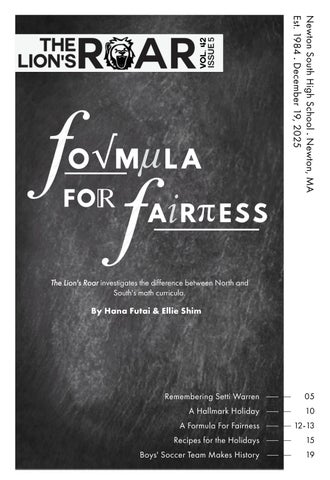
The Lion's Roar investigates the difference between North and South's math curricula.
By Hana Futai & Ellie Shim
Remembering Setti Warren
05
A Hallmark Holiday
10
A Formula For Fairness
12-13
Recipes for the Holidays
15
Boys' Soccer Team Makes History
19
page 2
December 19, 2025
NEWS issuu.com/thelionsroar
Volume 42, Issue 5
November in Review photo courtesy of The Heights
By Linnea Astala & Abby Miller
Swatting Incident at South
Ty Burr West Newton Cinema Adviser
We !nally got funding, and we're starting with repairing the roof and heating system. In January, we'll have more visible changes. Elizabeth Donskykh Assistant Manager, West Newton Cinema
graphics by Emily Cheng
A lot of people were texting me,and I was scared and nervous for my friends. I texted my mom !rst. I had never experienced a lockdown that wasn't a drill. June Henry Class of '28
West Newton Cinema Restoration Newton’s Community Preservation Committee, which allocates funding to select local projects, recently awarded $1.97 million for the restoration of the historic West Newton Cinema. The money, which will pay for about half of the !rst phase of renovation, comes as a major victory for the theater’s supporters following a two-year fundraising period to prevent demolition. The cinema will remain open during renovations, which are slated to include roo!ng, insulation and interior work.
photo courtesy of The Boston Globe
If we can invest in a new West Newton Cinema … It can become the anchor for a new vision of an old neighborhood.
Ezra Levy Class of '26
photo courtesy of WBUR
On Nov. 21, the Newton Police received a call about a potential hostile event at South. Administration instructed students and faculty to begin lockdown procedures. The Newton Police swept South and deemed the campus safe. Afterwards, the Newton Police determined that the call was an incident of swatting, which is the term used when somebody makes a prank call to emergency services to send many police officers to one location. Nobody was injured, and classes commenced after 30 minutes.
I think [the lockdown] was really hard to handle because it was during WIN ... but there could've been a better protocol. I know in some of my friends' WINs it wasn't taken very seriously.
House Passes New ELA Law
On Oct. 29, the Massachusetts House of Representatives unanimously passed a bill that will require school districts to use research-based reading and writing curricula for grades K-3. The Department of Elementary and Secondary Education will provide teachers with the training necessary to implement this policy. The bill arose as a response to the general decline in English Language Arts scores following the pandemic, in addition to a widened score gap for students in low-income areas and students with disabilities.
Having the Legislature dictate a particular curriculum ... undermines the professionalism of our educators who are working with a diverse student body, trying to address their needs as best as possible. Max Page Massachusetts Teachers Association President
These approaches are grounded in research and results, strategies that help all students learn to read and write wherever they live, regardless of their circumstances. Ron Mariano Speaker, Massachusetts House of Representatives via WGBH
issuu.com/thelionsroar
news | page 3
Cooper Center for Active Living opens Bethesda Yeh Features Editor
On Dec. 5, the City of Newton opened the Cooper Center for Active Living in Newtonville. The 33,000-square-foot facility will serve as Newton’s new senior center as well as a community hub for people of all ages. The building, which features a gymnasium, lounges and various activity spaces, will also be the new home of Newton’s Older Adult Services (OAS) department. Crowds gathered inside the gymnasium for the ribbon-cutting ceremony. Delivering on a central campaign promise to build a new senior center as she nears the end of her mayoralty, Mayor Ruthanne Fuller said that building the Cooper Center has been a community-wide e"ort to help Newton’s older adult population. “Today, we are celebrating what all of us can do when we come together and invest in a dedicated, supportive, permanent home for our older Newtonians,” she said. “This is a place to gather, connect and thrive.” The e"ort to build a new senior center in Newton began over a decade ago, when the Newton Senior Center was housed in the Newtonville Branch Library. Feeling that the building was insufficient for the center’s needs, many began to advocate for the construction of a new one Having joined the Senior Center 10 years ago, Bea Goldsmith said that she felt compelled to get involved in the project by joining the Senior Center Building Committee. “I felt so horrified when I first walked into the [old] Senior Center at how the people
that were working there were so wonderful within this structure that was so horrible,” she said. “This is something that the seniors who have been investing in Newton for so many years deserved as well.” Joan Belle Isle, president of the Newton Council on Aging, was another early supporter of the project. After unexpectedly being diagnosed with lung cancer, she said that the community at the Newton Senior Center helped keep her spirits high. Now, she hopes that the Cooper Center will do the same for others.
everyone, young and old, to get involved. “This is an opportunity for the community to participate in the programs and services o"ered … It's also an opportunity to give back to the community through volunteerism,” she said. Josh Morse, Newton’s public buildings commissioner, oversaw the Cooper Center’s planning, design and construction. Having done the same for several of Newton’s schools, he said that the excitement surrounding the opening is no di"erent. “The funny thing that I've come to realize graphic contributed by the City of Newton
The City of Newton opened the Cooper Center for Active Living in Newtonville. “I would like the Cooper Center to be a giant hug for all of the people who have already begun to age, who will be aging in the future — that safe place where they can share their experience,” she said. OAS deputy director Ashley Shaheen said that the Cooper Center has a place for
throughout doing the Cooper Center Project [is] that we're all just kids at heart,” he said. “People are a little older physically, but they're still all kids at heart. To see them get excited and come into this new building … it's just going to be incredible.” The Cooper Center is named after the
late Audrey Cooper, who was an active member of the Newton community. Cooper’s involvement spanned from chairing the Newton Free Library’s Board of Trustees to establishing the Senior Fund, the Senior Center’s fundraising arm. Marion Pollock, Cooper’s daughter and vice chair of the Senior Fund, said that her mother was the ultimate volunteer. “She was just always a doer,” she said.“She cared about people in a way that was and is rare.” Last year, when Fuller announced the building’s name, Pollock said that she and her family were overwhelmed with pride. “My oldest grandson's name is Cooper. He goes to North, and he will walk by that building every day,” she said. “The legacy that my mother has left for the city is not just for our family, but for all families in the City of Newton.” Charles Intha, a regular participant in OAS programs, said that he appreciates the building being open seven days a week and thinks it will help combat isolation among older adults. “When you have a facility that opens seven days a week, you can really manage that loneliness better,” he said. Belle Isle said that the Cooper Center is an achievement of the entire city that will benefit Newton for years to come. “It took an enormous number of people investing an enormous amount of time and energy to get it to happen,” she said. “It's the whole city that managed to accomplish this, and we all should be celebrating that we made it happen.”
Nolin backs Dudley Road housing project Roger Lu
News Contributor During a press conference on Sept. 10, Newton Public Schools (NPS) Superintendent Anna Nolin urged the City of Newton’s leadership to approve a proposed residential project on Dudley Road. The proposed complex would create 71 new units of housing across 26 di"erent buildings on the 13 acres of free land between South and Dudley Road. City Councilor and Chair of the City Council’s Land Use Committee Andrea Kelley said that the proposal would create a complex spanning almost the entire distance between Dudley Road and South. "It is a series of buildings, like the shape of a lasso, that is dotted on both sides with clusters of townhouses, [which include] two to four units each. Each of those units ranges in size between 3,500 and 4,500 square feet," she said. Nolin said that the project would help create a safer walking environment for students on Dudley Road. "This project has indicated that it would actually address some traffic issues on Dudley Road, which is a concern we have [now] because it is not the safest space for students to walk," she said. The project would also make the wooded path between South and Route 9 safer, Nolin said, by making it brighter and more accessible. "There is a wooded cut through, where students walk over to South on [the Dudley] property, and this [project] would actually improve that area [by] making it more lighted and visible,” she said.“Sometimes, we have weird interactions there [where] students meet other strangers, [so] we think a more lighted pathway
would benefit everybody." History teacher Lillian Robinson said that she believes the decline in student enrollment is another factor influencing Nolin's viewpoint. "We often hear that Newton is a school system with declining enrollment. There aren't as many young families moving to Newton, most likely because they cannot a"ord it,” she said. “I think [that] Nolin is really pushing for an insurance policy to make sure that our schools remain open, enrolled and have a diverse population." Other than the indicated benefits that the
system to say that [South] may need some adjustments made at the expense of this project," she said. Currently, South is plagued by staffing shortages and an aging building, among other issues. Junior Benjamin Xiao said that he believes all school departments are not receiving adequate funding to maximize student learning. "I don't think departments are getting enough funding, especially the elective departments, like fine arts [and] consumer sciences," he said. Robinson said that, regardless of the project's impact on student enrollment, South graphic by Ellen Wu
Proposed blueprint for the residential proeject backed by Nolin on Dudley Road. proposal plan details, Nolin said that another reason for her support was her hope that South could receive some funding from the project to fix the many issues it faces. "I [sent] the letter [urging the proposal] to put our hand up as a neighbor and a school
would need to upgrade its facilities. "We need money to fix our facilities,” she said.“I think that's a primary issue. I also think that if we have more kids, we're going to need to get those facilities updated faster." However, given the uncertainty of the
project's implementation and finances, Nolin said that funding would be difficult to secure. "We are just one consideration in the project," she said. "There are lots of other neighborhood considerations, and every neighbor has their own concerns." To add to this uncertainty, Kelley said that there is still too much unaddressed community feedback for the City Council to approve the project at this time. "I've heard from other city councilors as well as [from] the conservation commission letter that there are too many questions that are still unanswered and plans that are not complete for this project to be approved at this time," she said. Kelley said that most of the feedback she has heard from the community has been negative and against the construction of the complex, with many citing environmental concerns as a major reason for opposition. "I mostly hear pushback against the development," she said. "I think that when you totally re-engineer a site in terms of grading and drainage and [cut down] over 1,900 trees, that is a disadvantage to the environment, ecosystem and biodiversity.” Kelley said that for approval to be considered, the project’s developers should review feedback from the Land Use committee, other commissions and the community to create a more reasonable design that addresses both housing shortages and environmental concerns. "The development team could benefit from some more time to incorporate the feedback they've received from these groups and come back in the next term with a revised proposal," she said. "I [hope to see] a proposal that could address both of [our needs] — preservation and restoration of open space [combined] with some more housing."
page 4 | news
the lion's roar
Overnight parking ban to remain after vote Julia Ding
News Contributor In 2021, South graduates Jeremy Freudberg and Peter Klapes founded a campaign to repeal the City of Newton’s overnight parking ban, which prohibits drivers from parking on streets between 2:00 a.m. and 6:00 a.m. from December to March. The ballot question went to voters on Nov. 4. Ultimately, the measure failed to pass. Newton’s overnight parking ban will remain in place. Klapes said that he started the initiative to advocate for change, which was inspired by his own personal experiences as well as those of other Newton residents. "I had a neighbor who had a stroke several years ago, and the neighbor had an overnight nurse, and I watched that nurse … get a ticket almost every single night," he said. Soon after the repeal campaign began, the City Council voted 21 to three in favor of keeping the parking ban. After collecting more than 10,000 signatures from Newton residents who supported their campaign, Freudberg and Klapes succeeded in getting the question of whether or not to repeal the ban added as a ballot measure during this year’s municipal elections. As the campaign progressed, some City Councilors began to endorse it. Rick Lipof, Ward 8 City Councilor-at-Large, said that he believes the parking ban is no longer necessary given the lack of snow.
"[The parking ban] is antiquated … It came into existence in the 1930s … Since then, what has changed? Weather patterns have changed. We don't get as much snow as we used to,” he said. Ward 5 City Councilor-elect, Julie Irish endorsed the repeal and said that di"erent villages have di"erent parking demands. "[The ban] was really a one-size-fits-all [solution], and that is not the case in Newton. We have so many di"erent neighborhoods and villages with varying parking needs," she said.
roads and streets,” he said. Math teacher and Newton resident Sarah Deitch said that she is also worried about the potential need for snowplows. "My opinion on the ban is pretty nuanced … I live on a street that's extremely narrow and is supposed to be two-way, but e"ectively, it becomes one way with parked cars on both sides, which would be a nightmare if a
plow needed to get through on graphic by Louisa Younkin
However, Ward 2 City Councilor Tarik Lucas said that he believes the ban is beneficial, and would like to keep the current policy in place. “It helps limit cars in Newton. It also helps make sure the streets stay clear during the winter months, so that plows can plow
a snowy day," she said. History teacher and Boston resident Rachael McNally said that she doesn’t think the ban accounts for the di"erent size of Newton residents’ driveways. "If I lived in Newton, and I had a household that had three cars and a tiny driveway, that would really be a problem," she said. Ultimately, voters were split on the issue
at the polls. However, the NO vote, which supported keeping the parking ban, won with 48 percent against the YES vote at 47.7 percent. The vote did not end the debate, however, and both YES and NO committees — and their supporters — have since begun pushing for a compromise. Lipof said that implementing specific rules for parking during snow emergencies could solve the problem. "We have cities like Boston that put up signs that say you will be towed and ticketed if you park on the street during snow emergencies, and that's what we should do,” he said. “We should have a rule for when it snows." Klapes said that the repeal committee has been working hard to find a solution. “We had our first meeting with the opposition about a week ago, and we plan to continue having those meetings, and we plan to continue talking to city councilors,” he said. Ward 6 City Councilor-elect Sean Roche said that he has also observed progress. “The two groups are coming together to say we need solutions … They’re providing political will to say to the City Council, ‘Do something about this,’” he said. Lucas also said that he believes the City Council will play a major role in finding a solution. “It’s going to come down to the City Council to come up with a better plan so that folks can park in Newton overnight during the winter months … I’m ready to get to work on this next term,” he said.
Decision 2025 See the results of this November's contested municipal elections.
City Council
School Committee
Ward 4 Councilor at-Large
Ward 2
Josh Krintzman Cyrus Dahmubed John Chaimanis
11870 9343 8581
Ward 6 Councilor at-Large Lisa Gordon Sean Roche Ted Gross
10972 8720 4916
Ward 5 Councilor Julie Irish Garry Miller
Linda Swain Christine Fisher
Mayor 9457 6302
Ward 5 Ben Schlesinger Jenna Miara
9607 7578
Ward 6 Jonathan Greene Mali Brodt
9720 6930
Ward 8 1561 1023
Victor Lee Jim Murphy
11427 5382
Marc Laredo Al Cecchinelli
17833 3111
Looking for all the data? Scan this QR code to see the full results.
issuu.com/thelionsroar
news | page 5
Remembering Setti Warren Teachers, parents and students reflect on the legacy of former Newton Mayor Setti Warren and his commitment to unity, empathy and service.
By Allora Chaudhari & Amelia Nincic
O
n Nov. 2, former Mayor of Newton Setti Warren passed away in his home at the age of 55. He is survived by his wife, Elizabeth Tasker “Tassy” Warren, and their two children, Abigail and John. Warren attended North, where he was class president all four years, and then attended Boston College. He then worked in various White House offices during the Clinton administration. He was the regional director of New England’s Federal Emergency Management Agency from 2000 to 2001 before becoming a fundraiser for Boston College, and joined the United States Naval Reserve in 2003, while also working for Senator John Kerry in several capacities. While serving in Iraq as a Naval intelligence director in 2007, Warren announced that he would run for Mayor of Newton. He served as mayor from 2010 to 2018, making him Newton’s first mayor of color. History teacher Jamie Rinaldi said that Warren rose to the position of mayor at a particularly challenging time in Newton’s history. “The city was in a pretty difficult financial position,” he said.“That was partly true because we were coming out of the Great Recession, and every municipality was struggling with city finances.” History teacher Katherine WildmanZinger said she admired Warren’s ability to unite people with conflicting views, despite the turbulent atmosphere of the city at the time. “He was a person who was really interested in helping people learn to speak to each other even when they had opposing views on a subject,” she said. “I think a lot of people felt that, regardless of what side they were on, he was on their side.” English teacher Devin Bernhard said that they were impressed by Warren’s dedication to the city. “It felt like he had a real investment in the city and in the schools,” they said.“He was of Newton and cared about all the people and institutions in Newton.” Outside of his position as mayor, Warren was a well-known and loved member of the Newton community. Carolyn Fertig, a special education teacher at North, said that she knew Warren
through North’s preschool, where both of them sent their young children. “When I would see him picking up his son, I was kind of starstruck, because he was such a celebrity in our town,” she said. “He always took time to really get to know people, and I just felt that connection in that one year where I got to
know him as a parent.” WildmanZinger said that she also knew Warren
as a parent. Warren’s children went to elementary school with her son, and their sons played on a baseball team together. “I admired how he was good at [helping people bridge differences] in the city,” she said. “I would also see him do that even with people he would gather to talk around him on the sidelines of a children's baseball game.” Warren was also known for his relationships with teachers. Rinaldi said that he knew Warren through the Newton Teachers Association (NTA), the union of teachers in Newton. “I respected his ability to bring divergent voices together into a space and try to reach some decision or outcome that every party could accept,” he said. “There's no way that we're going to settle on the teacher contract … in a way that everyone is going to champion … But I think that he engaged in a process that made sure that more people were going to feel like they had been listened to.” Bernhard said that beyond his political success, Warren’s spirit had a profound effect on people.
“I think a lot of people felt that regardless of what side they were on, he was on their side.”
Joy Chou Class of '29
“He was real, very approachable, very down-to-earth and just warm,” they said. Rinaldi said that he admired Warren’s enthusiasm for community engagement; specifically, working towards the improvement of Newton. “I had immense respect for Mayor Warren’s eagerness to be in the room,” he said. “He was willing to roll up his sleeves and get involved in trying to solve the city's problems, even if that specific problem was under the purview of somebody else.” Fertig said that the number of people who commemorated Warren shows how much he meant to the Newton community. “When I went to his wake, it was a three and a half hour wait,” she said. “That says a lot about a person.” Wildman-Zinger said that she hopes the community will carry Warren’s positive pho to c our tesy legacy with them. of Th e Bo ston “[I hope people remember] Glo be his smile and his warmth and his sort of extravagant welcome of all people,” she said. “I hope people remember that spirit and carry it forward.” Fre sh m a n Jo y Chou said that she hopes the unity that Warren created in Newton will withstand his passing. “I hope people will … remember his missions to unite everyone and not start fighting again because he's not there,” she said.“Hopefully, that will strengthen the bonds between people, because he was the one who brought them all together, and now they should work on it to honor his death.”
page 6
December 19, 2025
EDITORIALS issuu.com/thelionsroar
Volume 42, Issue 5
What MassCore can do for public education In recent years, the future of the Massachusetts Comprehensive Assessment System (MCAS) has become a hot-button issue. Last November, Massachusetts residents voted to eliminate the test as a high school graduation requirement, which has sparked a larger statewide conversation about graduation requirements in our public schools. Currently, the Commonwealth has some of the least rigorous graduation requirements in the nation. Following the passage of last November’s ballot question, Massachusetts has no standard assessment to evaluate a student’s competency. Additionally, the Commonwealth is one of just four states that does not set minimum credit requirements for graduation. !e latter point has not received the publicity that it deserves. On Dec. 1, the office of Governor Maura Healey issued a new statewide graduation framework that was developed in collaboration with the state’s K-12 Statewide Graduation Council. !e 108-page document that her office released — “Reimagining High School, Reimagining Readiness” — recommended statewide graduation requirements in three areas: program of study; demonstration of mastery; and college, career and civic readiness. !e document contains a variety of proposals that have drawn close scrutiny from
a variety of stakeholders. But what many news articles seem to have missed is the issue of credit requirements, on which the report made several recommendations. It’s an issue that deserves as much careful thought as the MCAS has received. If implemented correctly, credit requirements could serve as a crucial element of strong, effective and fair statewide graduation requirements. To be clear, the state must introduce mandatory, robust minimum credit requirements for all students. Leaving this important issue to the discretion of local school districts, as it currently does, is not sufficient. Currently, the Massachusetts Department of Elementary and Secondary Education (DESE) recommends, but does not require, that all local school districts implement a program of study it calls “MassCore.” !is program of study includes four English Language Arts classes; four math classes; three lab-based science classes; three history/social science classes; two world language classes; one arts class; physical education as required by law; and five additional core classes, which could encompass other additional subject areas or any of those previously listed. !is common-sense framework should be implemented as a mandatory program of study for all Massachusetts high school students.
It’s an idea that is widely accepted across the nation: 46 states require that students take four years of English, 40 states require three or more years of math and history/social science and 39 states require three or more years of science. A majority of Massachusetts high school students — 84 percent, according to the Graduation Council’s report — complete MassCore by the time they graduate, but only two-thirds of all public high schools in Massachusetts actually mandate completion of the framework. According to DESE, 84.7 percent of Newton high school graduates completed MassCore in 2024. However, the standard must be that all students — not 84 percent — complete this baseline program of study. !e Graduation Council’s framework largely endorsed MassCore as the foundation for a statewide coursework requirement. However, it also raised several “key considerations,” one of which it calls “expanded flexibility.” “Given that many schools have master schedules that afford students 24 units of coursework during the school day over their four years of high school, MassCore as it currently exists leaves little room for variation,” the report argues. Yet !e MassCore program of study takes up only 22 units of coursework, five
of which are reserved for “other additional coursework” or any additional classes in the major subject areas. MassCore does not compromise student autonomy; rather, it serves to strengthen the depth of the education that students receive. “Further, the high bar for coursework in certain subject areas (i.e., four years of Mathematics including Algebra II and a Math course during senior year) means that when a student fails a course in that sequence there is little space to make it up without impacting their ability to meet the other requirements,” the report continues. However, DESE must hold all students and school districts to high standards. A high school diploma should signify more than the fact that a student attended high school for four years; it is a demonstration of competency. Particularly in a state that no longer has a standardized test to measure student skills, we must maintain a focus on academic excellence in our public high schools. Massachusetts ought to follow the example of nearly every other state in strengthening existing baseline frameworks like MassCore, not weakening them. As the Graduation Council continues its discussions, it must keep this crucial idea of high, common standards at the forefront of its vision.
Volume XLII !e Lion’s Roar Newton South High School’s Student Newspaper 140 Brandeis Road, Newton, MA 02459 ss.lionsroar@gmail.com
Editors-in-Chief Andrew Feinberg
!eo Younkin
Managing Editors Ava Ransbotham
Editorial Policy
The Lion’s Roar, founded in 1984, is the student newspaper of Newton South High School, acting as a public forum for student views and attitudes. The Lion’s Roar’s right to freedom of expression is protected by the Massachusetts Student Free Expression Law (Mass. Gen. Laws Ann. ch. 71, Section 82). All content decisions are made by student editors, and the content of The Lion’s Roar in no way reflects the official policy of Newton South, its faculty or its administration. Editorials are the official opinion of The Lion’s Roar, while opinions and letters are the personal viewpoints of their writers and do not necessarily reflect the opinion of The Lion’s Roar. The Lion’s Roar reserves the right to edit all submitted content, to reject advertising copy for resubmission of new copy that is deemed acceptable by student editors and to make decisions regarding the submission of letters to the editors, which are welcomed. The Lion’s Roar is printed by USA Today Co. and published every eight weeks by Newton South students. All funding comes from advertisers and subscriptions. The Lion’s Roar’s policy on journalistic ethics strictly forbids any use of artificial intelligence (AI) in the reporting, writing and editing process. The Lion’s Roar reserves the right to reject pieces offered for publication that are found to be in violation of this policy.
Sarah Schwartz
Section Editors Features
News
Seyoon Byun James Garrett Abby Miller Sanjana Tewari
Opinions
Centerfold Hana Futai Ellie Shim
Angela Tao Emily Wang Grace Yang
Photo Managers !ayer Bialek Lev Navisky
Laura Feng Andrew Petrilla Allison Sam Bethesda Yeh
Sports
Clara Borus Owen Halberstadt Mitchell Lookner
Humor Columnist Matteo Lee
Business Manager Adam Ransbotham
Faculty Advisor Ashley Chapman
Graphics Managers Clare Cho Ellen Wu
issuu.com/thelionsroar
editorials | page 7
LETTER from the
EDITOR Andrew Feinberg Editor-in-Chief
“You mean your school still prints their newspaper?” my mother’s friend asked me in disbelief. “Yes,’ I replied enthusiastically. “I thought print newspapers have largely disappeared,” she continued.“I miss them, so I’m glad to hear there are still some out there.” This conversation got me thinking about the value of what I and many other students at South pour our hearts and souls into each week. Before coming to South, my experiences with a printed newspaper was limited mostly to my visits to my grandparents’ houses, where several newspapers often sat open on the kitchen table. I would often sit alongside my grandfather looking at the sports section or discussing a news article. It was a refreshing change from my house, where computer and phone screens seemed to be the primary source of news when the evening news had not yet started. Aside from a few professional journals, printed materials were not a common sight. At my grandparents’ house, however, the newspaper served as a source of connection and conversation, and a place where my family came together and learned to listen to each other's perspectives. At school, The Lion’s Roar has been a similar source of connection and fosters a community that is built from the hours of completing multiple rounds of edits, laying out
The Art of a Print Newspaper
designs and developing graphics. And nothing compares to what follows the late nights of send-up: meeting as a group early before school starts to take a stack of the printed papers and pass them out around school, where we interact with members of the whole school community. A print newspaper also provides a break from social media that so many of us need. After the pandemic, when we were completely immersed in online activities, moving back to in person activities became especially important. At South, as well as at many other high
own former Editor-in-Chief BJ Novak and Reporter John Krasinski. While online news sources can be great, the experience of swiping my phone cannot be compared to that of flipping the crisp pages of a paper. Online news can definitely help with the rapid dissemination of news; however, it has a number of shortcomings. When one of my friends recently exclaimed, “The University of Michigan football coach was just arrested,” I immediately scrambled to find my phone to see if the news
Nothing compares to what follows the late nights of send-up: meeting as a group early before school starts to take a stack of printed newspapers and pass them out around school. schools across the country, resuming a printed newspaper was the perfect way to return to a sense of community. According to the owner of a school publications printing company in New Jersey, there are now more printed papers than before the pandemic. A similar phenomenon is documented in the new documentary series The Paper, in which an Ohio newspaper is trying to rebuild itself and become popular again — the follow-up series to and spinoff of The Office, which starred The Lion’s Roar’s
was true. Suddenly, I found myself scrolling through Google, Twitter and Yahoo. Each had its own short, unique commentary on the event. With each new headline and brief blurb I read, it became clearer to me that something wasn’t right. How could such a pivotal moment be summed into a headline and a 10 word synopsis in just a matter of seconds? After scrolling for what seemed like
two hours, it occurred to me that while online sources may be the fastest way to receive information, many lack the proper credibility that a print newspaper can provide. The danger of listening to a single story and false information becomes even more amplified when information is spewed out faster than the actual news has developed. Online news, now more than ever, cares more about getting clicks and views rather than creating a coherent and accurate article by listening to diverse perspectives and working to ensure that their facts are correct before making a post. Matters get worse when you take into consideration that websites and online news sources often create algorithms to make readers keep scrolling on their site and feed their narratives, without providing balanced perspectives. While some may argue that a print newspaper is harmful to the environment, a recycling policy can mitigate those concerns. After all, what would our art classes do without the extra papers? And on the flipside, for those who want to save a piece of history, there is no modern day equivalent to flipping through albums of newspaper clippings like the ones my grandparents saved of important personal and world events. Years from now, when the online news has long disappeared, I hope to show my grandchildren the yellowed copies of The Lion’s Roar filled with years of memories of our special community at South.
GRAD ADS Celebrate your senior in our graduation issue! Our special section devoted to the Class of 2026 will be distributed to students, parents and everyone who attends the graduation ceremony on June 4th, and we would love to include a tribute to your child’s graduation from Newton South. We offer full page, half page, quarter page and eighth page advertisements. Our staff would be happy to design your ad for you at no additional cost.
Interested? Contact us at ss.lionsroar@gmail.com, and we'll send you more information.
page 8
December 19, 2025
OPINIONS issuu.com/thelionsroar
Volume 42, Issue 5
The Lion's Roar presents: What we listened to in 2025
I
n early December, Spotify released its yearly Wrapped, and with its arrival followed an excited rush of listeners eager to view their yearly stats. !e annual excitement (or dread) of seeing a summary of one's listening trends is always a fun way to close o" the year. My year in music amounted to 37,541 minutes, or 26 days, of listening. Tyler, the Creator led as my top artist for the fourth year in a row, and I was in the top 0.9 percent of his listeners. My top song, “Fingerbib” by Aphex Twin, might not be exactly representative of my music taste, but it’s still a good listen — especially
when you’re looking for something to play on repeat all day, as I did once, reaching a total of 72 streams. Wrapped this year changed an awful lot compared to the disappointing AI-generated output from last year, which assigned obnoxious labels like “Pink Pilates Princess Strut Pop” or “After Hours Football Rap” to our listening habits and called it a day. We now have collaborative sharing options and assigned listener“Clubs” that make Wrapped feel more special. !e Clubs are a fun new addition that I've already seen people use as bragging rights on social media. Personally, I fell into the Cosmic
Stereo Club, with three percent of Spotify listeners all sharing similar favorites like Cocteau Twins and !e Smiths. My favorite new feature is definitely the Wrapped Party, which allows you to compare and show o" all your top stats with your friends. You’re able to see who has the most listens and who listened to the nichest song. !e year goes by fast, but it’s always nice to have Spotify Wrapped as an reminder of what's changed — and what hasn't.
by Leah Fiadjoe
I
'm so lucky that Spotify Wrapped isn’t a person. If it were, I’d be judged to my core. 75 listens of “Fade Into You” by Mazzy Star and 48 listens of “Lover, You Should’ve Come Over” by Je" Buckley. !at’s not just casual listening. It’s my two types of emotional crashout in a cycle. Yet somehow, after 244 playlists, 37,323 minutes and 60 music genres, Spotify calculated my“music age” to be 85. This feels absurd to me, because I’m pretty sure no 85-yearold would listen to their favorite graphics by Grace Yang
genre — “Bedroom Pop” — for 25 straight days. But I guess age is just a number, right? But the more I opened my “wraps”, including this year’s new feature "Listening Archive”, the more I came to the conclusion that this year’s Wrapped was a personal attack from Spotify itself. Calling my music chaos “biggest music day,” Spotify exposed my mood changes: Deftones at 1 a.m., Ariana Grande’s Christmas music at 10 a.m., oldies and art rock in the afternoon, and late night jamming to Steve Lacy — 443 minutes, 142 tracks, 109 artists, all in a single day. My “most energetic day” was
really just me, half-asleep at 12 a.m., running on pure Celsius, bingelistening to Sabrina Carpenter new album “Man’s Best Friend” and PinkPantheress “Fancy !at” to fill my playlist review chart. Spotify probably thinks I have 12 di"erent personalities, and I think that’s the whole point. Because looking at my fruitful Wrapped this year, I was reminded of how much music sits in the background of everything, even when I don’t notice it. In the end, Spotify Wrapped might judge me, but at least it knows me better than I ever consciously will.
by Kaylee Da
issuu.com/thelionsroar
opinions | page 9
For the people: A democratic comeback By Isa Folch & Anastasia Karpova In a time when our nation is so politically divided, it’s natural to be concerned about how our parties are becoming increasingly polarized. However, following Election Day, several key Democratic victories re!ect a breath of fresh air. After campaigning on affordability, universal childcare and rent freezes, Zohran Mamdani won the New York City mayoral election. Despite Independent nominee Andrew Cuomo’s Islamophobic rhetoric and billionaires as well as Super PACS spending tens of millions of dollars in an attempt to buy the election, Mamdani won, setting a new precedent for the Democratic Party. Mamdani demonstrated that a platform built on "ghting for the working-class majority can win, even despite the in!uence of money. His victory is amazing, showing that real democracy can exist in a time when power can manipulate so much of our politics. Another notable Democratic victory came from Virginia’s Abigail Spanberger, who is the "rst woman elected as the state’s governor. This change demonstrates that in Southern states, women are becoming increasingly involved in a system that has restricted them for so long. Having campaigned on a$ordability and quality of life for the working class and less privileged, Spanberger promised to strengthen schools, secure reproductive rights and increase a$ordability across the state. In other words, she is serving as a beacon of light. Her principles do not stray too far from
Mamdani’s; like the mayor-elect of New York, she has focused on uplifting marginalized groups and the middle class. Since both groups form an overwhelming majority, we could likely see more candidates like Mamdani and Spanberger winning elections. They represent a shift away from repression. The outgoing Virginia governor, Glenn Youngkin, vetoed the Right to Contraception Act, which
graphic by Clare Cho
would have secured rights to contraception in Virginia. Spanberger has promised to amend Virginia’s constitution to secure these rights. Now, what does her victory mean for Virginia and America? Virginia, which has shifted left since the previous gubernatorial election, is on track to become a safe space for reproductive healthcare in the South. Spanberger’s win is exciting, but access to contraceptives for those in the deep South remains a challenge. There is still more to
improve on. Spanberger’s views on a$ordability, along with Mamdani’s, could shape the Democratic party into one that truly aids the middle class — a group that has been su$ering for so long because of the negligence of both parties. Another governor-elect, Mikie Sherrill served in
Congress for nearly six years before winning the New Jersey governor’s race in November. Her service actively shapes her career and campaign: Sherrill served in the Navy, worked as a federal prosecutor and is a mother. Sherrill is a voice for New Jersey families, working on a service-driven and structural approach that sets her apart from other politicians. Most importantly, Sherrill is determined to take down the corporate powers that exploit citizens. Developers and speculators are driv-
ing New Jersey families out of the real estate market: the cost of housing in the state is at a record high. Sherrill’s win is great news for both New Jersey and American families: it shows a deliberate focus on a$ordability, infrastructure and quality of life. It exempli"es how a citizen-focused campaign outshines partisan extremism and pandering to the ruling class. In a society where the ruling class pro"ts from the exploitation of the lower and middle classes, these victories are a sign of change and of class equality. They won’t come without a price. Such changes could increase the political rift. As the Republican Party reacts, these wins could create an even bigger divide. Partisan extremism has taken control of our nation and led to legislation that bene"ts very few. But it’s all the more evidence that a change had to be made. These victories come in the wake of extreme policies from the Trump Administration: ICE raids, massive tari$s and illegal deportations may have given the U.S. a new perspective — that our country needs real help from people we can trust. So now, more than ever, such victories show us that policies that support the real majority can defeat others simply backed by money to support the 1 percent. They can make the United States a country in which we can see ourselves.
OpenAI's Sora is rendering fakes nearly real By Sophie Lu & Kiril Zhdanov Let me paint a picture: It’s 11 p.m., and I am in my bed, under the covers, my phone held a couple of inches from my face. The blue light from the screen displays a clip I was not expecting to see: macho boxer-in!uencer Jake Paul coming out as gay in a full face of makeup. However, before I can fully digest what I just saw, I recognize the watermark in the corner. The video is AI-generated. OpenAI, the $500 billion company behind ChatGPT, and its new app Sora are largely responsible for these hyper-realistic AI deepfakes. While some of these videos a r e easy to spot — like those depicting pets exploding on doorsteps or beds made of sushi — celebrity deepfakes like Jake graph Paul’s are harder to ic by Ellen Wu identify. What were once practical jokes have
now begun to seriously threaten our understanding of the truth; technology like Sora will only exacerbate the rampant misinformation online as well as the severity of crimes like identity fraud. Since ChatGPT’s launch in 2022, the Federal Bureau of Investigation has reported over 4.2 million fraud cases, totaling $50.5 billion lost. If any video or photo can be generated with a snap of a "nger and a two-sentence prompt, scammers can go beyond celebrity deepfakes and create clips of anyone — even personal acquaintances — doing or saying anything. It’s unsettling, to say the least. T h e scariest t h i n g about these AI tools isn’t just that they fool us with fake realities; it’s that they make us doubt the real ones. As deepfakes become commonplace on the internet, anyone can exploit this erosion of trust to dismiss real footage as
another AI fake. This phenomenon is called the “liar’s dividend,” and there is an increasing worry that public "gures are beginning to dismiss authentic videos that might be disadvantageous to them as fakes. By blurring the line between truth and fabrication, AI has become a convenient scapegoat for actors and politicians alike to dodge accountability. We’e already seen glimpses of the “liar’s dividend” in action in recent months, from President Trump dismissing the viral TikTok video of an object being tossed from a White House window as fake news to Venezuelan authorities claiming footage of a US military strike was arti"cially generated by the US government. AI o$ers grounds to doubt anything and brings an end to the concept of visual fact. If AI can easily produce highly deceptive digital materials, how can we tell what is real and what is fake? It’s hard: The Association for Computing Machinery found that the probability of humans distinguishing between AI-produced and human-created content is almost the same as tossing a coin. 51 percent. Although social media platforms are implementing mechanisms, such as watermarks, to !ag AI-generated content, researchers still "nd that these techniques can be easily evaded or stripped out. Given the absence of cohesive legislation at both state and federal levels, AI technology is developing faster than lawmakers can wrap
AI technology is developing faster than lawmakers can wrap their minds aronud it. The internet remains a messy place beyond holistic control, breeding mistrust. their minds around it. The internet remains a messy place beyond holistic control, breeding mistrust. But the AI-deepfake question extends beyond simple matters of truth and "ction. Interestingly enough, many of the AI-generated videos I’ve seen aren’t deepfakes trying to appear real, but rather content creators replacing themselves with an AI version of themselves. Mukbangers swap places with glossyeyed copies that crunch on soft food, and company social media accounts create blatantly AI-generated advertisements. In a world where AI can synthesize new vaccines or "gure out the overhead prices of a business, we instead use it to do the things that make us human: creating content, making art and writing novels and papers. Perhaps that is the scariest part of this situation. When AI has taken the joy from every task we love, we will be left to "gure out how to tape the world back together.
page 10 | opinions
the lion's roar
A Hallmark graphic by Simona Wang
What's more festive than the classics?
By Serena Liu
S
O
nly one word can truly capture Chris Columbus’s Christmas classic, “Home Alone”: timeless. More than three decades after its release, the "lm hasn’t aged in the slightest; instead, its legacy grows brighter and warmer with each passing holiday season. What starts purely as a childish wish quickly transforms into a story of independence. Kevin McCallister, an eight-year-old boy, is forgotten at home while his family goes on a vacation to Paris. Forget surviving — Kevin thrives in his empty house and takes complete and utter control over his home and fears.
ome movies perfectly represent the Christmas spirit ... and then there’s“Elf.” !is classic features a grown man dressed in green, adorned with elf ears and jingling shoes, roaming New York City in search of his long-lost father. During his journey in the human world, Buddy the Elf uncovers new friendships, builds deep connections and "nds himself with increasingly chaotic results. Will Ferrell’s performance as Buddy is the soul of the movie. Without Ferrell,
“Elf ” collapses in the "rst 10 minutes. His performance walks a "ne line: too ironic and Buddy becomes annoying; too sincere and the "lm turns saccharine. However, Ferrell’s performance maintains a genuine innocence that still feels clever. Before you realize it, you’re smiling like an idiot at Buddy eating spaghetti with syrup. !roughout the "lm, Buddy confronts various paradoxes: joy and misery, childhood and adulthood, fantasy and reality. Buddy grew up in the North Pole, a frosty wonderland "lled with candy canes and child-like wonder. Eventually, he "nds himself in New York City, where people move with cold precision, burdened by adult responsibility.
Even then, the movie never paints Kevin as rash or irresponsible. Instead, it exhibits how Kevin learns to take care of himself, support his needs and "nd his own way of living — from going grocery shopping with coupons to taking pride in using soap and showering. All of these actions reveal his immense growth over the course of the movie, from a dependent child to an independent young man. Growing up is something everyone will go through, and Kevin symbolizes this perfectly. And then there are the Wet Bandits, Harry and Marv, two burglars who have taken it upon themselves to rob the McCallisters’ house. !rough this plot point, the "lm intricately
laces in comedic relief. Kevin’s booby traps are a masterpiece of creativity and humor. Of his 14 genius creations, three stood out to me the most: Paint cans swinging from the stairs and hitting the burglars' faces, sharp piercing nails laid out strategically to penetrate bare feet and stairs frozen to the point that they are impossible to walk on. Beneath it all lies the "lm’s true heart — a reminder that family, even with all its noise and frustration, is irreplaceable. Kevin’s journey allows him to feel a longing for the family and people who annoyed him most.
W
ho is the Grinch to you? To most, he is a villain. To others, he is a grump. Well, to me, he is a big sweetheart. “How the Grinch Stole Christmas,” a movie adaptation of a Dr. Seuss' book, tells the story of the Grinch, a social outcast living on Mount Crumpit (a mountain atop the "ctional town of Whoville), enveloped in bitterness and a coat of neon green fur. But why? Why did he withdraw from society? Why does he despise Christmas with such "ery passion? Cindy Lou, a curious girl who sought to understand him and had a willingness to see past his furrowed
brows and cold demeanor, is who draws the Grinch out of his isolation. Within a society that celebrates perfection and emphasizes chaos and excess, the Grinch is a victim of mockery and cruelty. Whoville is a small town garnished with bright lights that holds an overwhelming passion for Christmas, the very thing that drove the Grinch away. Further depiction can show Whoville as a community with a cult-like and materialistic obsession with the holidays. A nuanced setup and writing gives the “bad guy,” the Grinch in this case, emotional depth and understanding. !rough the "lm’s flashbacks and comedic gags, we see the Grinch not as a monster, but as someone who was deeply misunderstood.
As these two worlds collide, Buddy’s resolve doesn't break; instead, he learns to balance contradiction. Instead of erasing the world's harshness, Buddy disarms it. Buddy gave me a sense of comfort in a world that is not always kind. Buddy lives in my heart and in my daily life; I can hear his jingling bells and warming laugh. To me, he is a reminder that sometimes, it's ok to laugh while the world is burning down. “Elf ” is a rare Christmas movie that captures earnest joy and comes across as both chaotic and sincere. It shouldn’t work, but it does, beautifully.
Jim Carrey’s performance as the Grinch is no doubt iconic, breathing so much life into the movie. Every sarcastic word, savage snarl and exaggerated movement feels handcrafted by Dr. Seuss himself. Carrey transforms the Grinch from a character in picture books to a complex, hilarious and realistic creature in the flesh. In this "lm, Christmas is not about perfection or gifts; it’s about feeling compassion and choosing to let people in, no matter the risks. From loneliness to forgiveness and rediscovery of joy, “How the Grinch Stole Christmas” is vibrant, sentimental and meaningful.
issuu.com/thelionsroar
opinions | page 11
A New Health
s i s i Cr
Why RFK Jr. and the MAHA public health crusade fall short
By Chloe Carrano MAHA is the right solution? %ere have been multiple attempts to address chronic diseases like diabetes, obesity and heart disease in the United States. Early community-based prevention programs, such as the CDC’s “Steps to a HealthierUS” (active from 2003 to 2010), shared MAHA’s objective of addressing treatable chronic diseases. However, the program failed due to budget cuts, shifts in funding priorities and a lack of political support. The MAHA movement could be doomed to fail just like its predecessors, its downfall brought on by internal administrative conflicts and grant disruptions. In the MAHA Commission’s o$cial “strategy” document, the Commission pledges to “[advance] critical research to drive innovation,” studying mental health and addiction as well as screen time use in adolescents — at a “gold standard” level. However, all outgoing federal research grants were frozen from October 1 to November 12, 2025, due to the federal government shutdown, resulting in little progress towards funding the projects MAHA initially laid out. Additionally, many of MAHA’s proposals target youth. %ese proposals seek to implement new !tness guidelines in public schools, increasing student awareness of chronic disease and reinstating the Presidential Fitness Test (which was in effect from the 1950s to 2013). %is move would impact students at South, as they would be subject to such regulations. Considering the strong pushback against the restrictiveness of South’s current physical education requirements, which currently do not have a formal “test” system in place, the implementation of a mandated assessment could spark heated debate in our community.
graphic by Em ily Wang
A
s with any medicine, a prescription for healthy living can have harmful side effects: dizziness, clouded judgment and blurred vision. Similarly, a set “dosage” of questionable guidance, administered by a select few, can distort one’s perspective — as illustrated by the Make America Healthy Again (MAHA) movement. Members of the federal government’s MAHA Commission, which is led by Secretary of Health and Human Services (HHS) Robert F. Kennedy Jr., have prescribed health information for the American public based on sources of varying reputability. Followers of the MAHA movement, as well as the American public as a whole, should exercise caution by identifying misinformation and separating fact from !ction. Kennedy, who spearheaded the political movement and popularized its slogan, is widely viewed as its !gurehead. He has made his goal clear: MAHA seeks to address our country’s chronic disease crisis. However, since taking office, Kennedy has received considerable backlash — mainly from members of the Democratic party, as well as health experts and scientists — for his approach. %ese leaders have accused him of platforming pseudoscience and anti-vaccine conspiracies. As reported by the Centers for Disease Control and Prevention (CDC), approximately six in 10 Americans live with a chronic disease (a health condition that lasts for longer than a year), and about 90% of the country’s $4.1 trillion health care expenditures go to chronic disease management and treatment. Clearly, there is a problem with the prevalence of these diseases and the high care costs their treatment re q u i re s , but how d o we know if
As someone who’s struggled with scheduling electives and core classes due to South’s one-quarter wellness requirement, I think that the Presidential Fitness Test would be an unnecessary burden for students who already have a lot on their minds.
Politics and health shouldn’t intertwine, but there are disturbing signs that the movement has already been reduced to a political tool to influence future campaigns. %ere is a noticeable overlap between some of MAHA’s initiatives and the unconventional opinions that Kennedy has expressed, particularly regarding vaccine-related health issues and the presence of fluoride in drinking water. Many of Kennedy’s claims have been made without signi!cant, credible scienti!c evidence. For a movement aiming to help the American public, with a particular focus on some of its most vulnerable members — the youth — Kennedy’s personal politics shouldn’t come into play. MAHA is politically polarizing, leading most voters’ views on the movement to remain within party lines. %is polarization has, as a result, undermined bipartisan health reform. Politics and health shouldn’t intertwine, but there are disturbing signs that the movement has already been reduced to a political tool to influence future campaigns: MAHA bears obvious similarities to President Trump’s well-known MAGA slogan. Th e t i e between the two abbreviations is directly related to the tie between the politicians involved in their creation: since President Trump appointed Kennedy to the position of HHS Secretary, one cannot help but wonder whether the naming of MAHA was motivated by existing political alliances. When it comes to public health, politics and voter quotas should take a backseat. After all, no matter our political alignments, we all have the same goal in mind: a healthier, happier society.
Matteo Lee
Humor Columnist
College Decision Coping Strategies
T
he other day, I was working on !nalizing my application to Hogwarts when I felt two eyes staring into the back of my head. It was the Jonny G., so I guess it was technically four eyes. “What school are you applying to at Hogwarts?” questioned Jonny G. I then had to explain to him in great detail that you don’t get to choose because the sorting hat makes all the decisions. I started to explain to him that I really wanted to get into Hu"epuff, but he interrupted me. “What if you don’t even get in though?” said Jonny. I paused. Jonny’s question really got me thinking: What if I don’t even get into Hogwarts? What if I don’t get into Clash Royale University, Karate School or ObiWan’s Jedi Council? Will I have to spend the rest of my life in the Dale? I started to spiral, but then I realized that many kids my age are probably feeling the exact same way as me right now. I started to brainstorm ways to cope with the stress of waiting for college decisions. Here’s my o$cial list of Dos and Don’ts: DO ask people where they applied. People love to talk about this. If kids don’t want to, they're probably just a little shy. Press them, pry them and force them to tell you every last school they applied to. Once you know where they applied, make a list of the schools so you can check back in later to see if they got in or not. Tell them this as well; it’ll help relieve their stress. DON’T forget to remind kids of how important the process is. Kids love to be reminded of how crucial the college process is for the course of their life. Some of my favorite one-liners are “Your entire life only depends on this one thing!” or “If you don’t get in, you’re dunzo!” or “%ere’s always next year — wait a minute, no there isn’t!” Reminding kids of the importance allows them to have a newfound appreciation for the process. DO communicate with others applying to the same schools. If you get into a school ED and other people don’t, print out a copy of your acceptance letter and share it with them. Leave in their car, physically hand it to them or break into their house and leave it in their bed. %is will make them feel thankful that at least one of their peers got into the school. If they were the only one that didn’t get in, tell them that they should be thankful because their experience is one of a kind, unique or not like anyone else’s. DON’T hide your excitement. When you get in, tell the whole world. Everyone deserves to know. It doesn’t matter where you are: class, sports, dinner, when you !nd out you got in, tell everyone in the immediate area. Show up to school the next day and let everyone hear it. If you’re not the center of attention, you’re doing something wrong.
page 12 | centerfold
the lion's roar
The Lion's Roar investigates the difference betw
By Hana Futai
I
n 2024, AP test reports for Newton high schools revealed disparities between North and South’s calculus programs. These disparities are part of larger discrepancies in math curricula across the Newton Public Schools (NPS), which Superintendent Anna Nolin proposed an eight-year plan in September to address. At South, 97 percent of students earned a 3-5 AP test score in the highest level of calculus that NPS offers — AP Calculus BC (BC) — with just 3 percent receiving a 1-2. At North, scores were lower: only 75 percent of students earned a score of 3-5, and 25 percent
scored either a 1 or a 2. These performance trends mirrored those in AP Calculus AB (AB), with 85 percent of South students scoring a 3-5 on the exam and only 53 percent of North students earning scores in the same range. Underpinning these differences in test scores is a contrast in enrollment levels between schools, particularly in BC. Only 62 South students took the AP BC test in 2024, compared to 134 at North.
Students in Newton should be able to count on a consistent educational experience, regardless of ZIP code or random lottery.
To explore these discrepancies, South senior Yoni Shavelsky and North senior Aanya Vishwanath discussed the math pathways at their respective high schools. After looking at the 2024 AP test data, Shavelsky said that the rigorous environments cultivated in BC classes could contribute to South students’ higher scores. “"ey have built this sort of culture: it’s pretty sink or swim,” he said. “"e people that have lasted [have] all figured out how to get the problems and find a way to solve it.” South senior Wes Moore enrolled in BC
graphs by Ellie Shim
Alex Kraus South Math Department Head
at the beginning of the year but moved to AB in mid-September. Moore said that an unspoken pressure to take BC drove his initial decision. “I feel like I would have felt behind if I didn’t [take BC]. I felt like I needed to,” he said. Shavelsky said that the class’s challenging reputation attracts an exclusive group of students, which deters many of his capable former honors precalculus peers. “It’s not like all the kids in BC are smarter than the AB kids,” he said. “I know they can handle the curriculum. I’ve seen what they're doing.” Vishwanath said that while navigating North’s math pathways, pursuing challenging classes felt more accessible. “We just don’t have that kind of culture surrounding BC,” she said. “I would say they use those scare tactics for AP Chem and for [AP] Physics, but definitely not for BC.” Three North and South BC teachers declined or did not respond to requests for an interview to explain the discrepancies. North Math Department Head Jennifer Letourneau said that pinpointing the factors behind test results is difficult. “I feel really strongly that those tests are what a student does on one given day, and we have to be careful, too, about that component,” she said. “We’ve also seen some of our strongest students not taking the test, which also contributes to some of the scoring.” Letourneau said that North’s math department has worked to increase student engagement at all levels, which could explain North students’ varying performances. “When students want to challenge themselves, we support them as best we can. "at’s been true in our AB and our BC calculus classes [and] in AP Statistics, where we have tremendous participation and a lot of success,”
she said. “When you have populations that are more heterogeneous, you’re going to have performance that’s more mixed.” Ultimately, following his conversation with Vishwanath, Shavelsky said that their contrasting math experiences indicate immense opportunities for improvement. “"ere are two extremes, from what I’m hearing, of South and North,” he said. “I think Newton needs to find a balance.”
In an effort to move toward that balance, Nolin proposed an initiative to unify the K-12 math curricula across NPS over eight years. Newton teachers will use the Department of Elementary and Secondary Education’s “Curate” Rubric for instructional materials and input from other school districts to evaluate new resources provided through this initiative. "en, the district will have to choose between implementing an Integrated Math model and a Traditional Pathways model: an Integrated Math model would have algebra, geometry and statistics be taught together in one course as opposed to a Traditional Pathways model, which would teach these topics in separate courses.
issuu.com/thelionsroar
ween North and
centerfold | page 13
South's math curricula.
& Ellie Shim Furthermore, Nolin has a plan for a revamped district-wide math pathways system, which seeks to offer students robust and relevant math courses based on their future goals. It would include the implementation of math benchmark assessments in ninth grade at both high schools and embed Algebra 1 or Integrated Math 1 into the eighth-grade curriculum. It would also offer a variety of advanced pathways for students performing at high levels.
To evaluate students’ math performance, this pathway plan identi"es trends in math MCAS results. For example, scores reveal that sophomores struggle particularly with data analysis and interpretation skills, earning, on average, only 65 percent of possible points. The plan states that these patterns reveal alarming variations between teachers and schools for higher-level math and postsecondary opportunities. Because of these foundational differences between North and South, NPS PK-12 Director of Mathematics Jennifer Shore said that students could face obstacles when it comes to accessing future coursework. “When two high schools within the same district use different content, structures or assessments, students can have very different learning experiences,” she said.“Over time, this can unintentionally create gaps in opportunity, uneven expectations and variability in course
readiness.” In their junior year, Vishwanath and Shavelsky shared challenging honors precalculus experiences, but they indicated different causes for their struggles. Vishwanath said that her honors precalculus class cultivated a reliance on memorization instead of promoting a deep understanding of the curriculum. “I took a unit circle quiz and got a 9.5 out of 10. Then we had a retake, and I got a three out of 10 because I didn’t understand it conceptually; I was just memorizing what it was,” she said.“I struggled more in precalculus than in BC because there was less of an emphasis on conceptual understanding.” North senior Norah Boyle said that through conversations with South students, she has noticed g aps i n her learning material. “South graphic by Ellen Wu goes more into depth into concepts, because I don’t remember ever learning stuff that South students talk about,” she said.“I was de"nitely confused how our curricula could be so different.” On the other hand, Shavelsky said that South’s honors precalculus class brought in problem-solving aspects, pushing him to attain an explanatory skillset. “Starting in junior year, it was more talking with students about the topics. You have these exams where you have the tools [to solve], but it is not straightforward, and you have to connect a lot of dots,” he said. “I think that type of learning is really bene"cial.” South Math Department Head Alex Kraus said that there should be fewer disparities in student experiences across NPS. “Students in Newton should be able to count on a consistent educational experience, regardless of ZIP code or random lottery,” he said.
Assistant Superintendent for Secondary Education and Special Programs Gene Roundtree said that consistency across the district is the ultimate goal. “We want to be able to say we can take for granted that there will be a certain level of excellence that students get access to, no matter which school [and] no matter which teacher,” he said.
Kraus said that South’s math curriculum is currently structured to give students quantitative and spatial reasoning skills that they can utilize in any future they pursue. “We pride ourselves on something that doesn’t just build a procedural fluency, but de-
The strength of the system we have right now is that it really allows us to tailor the content to the students who are in front of us. Ryan Normandin NTA Second Release Officer
velops a real, meaningful conceptual understanding that is deep and rich,” he said. “I’m hopeful that our curriculum allows students to "nd insight into how mathematics is applicable and connects to the world beyond the classroom.” Nolin’s new curriculum would also strongly emphasize life skills in a mathematical context. Additionally, new advanced student pathways would include dual enrollment courses, a "nancial literacy class and a continuation of AP Statistics. However, Newton Teachers Association Second Release Officer and former South honors precalculus teacher Ryan Normandin said that the current system allows teachers to tailor lessons directly for their students’. “The strength of the system we have right now is that it really allows us to tailor the content and tailor the instruction to the students who are in front of us and be able to adapt it for what they really need,” he said. As a teacher, Normandin optimized this flexibility by shifting the direction that honors precalculus traditionally takes. “We wanted to make the class about skills, so we changed what we did in the class, we started changing the tests,” he said. “Over time, it turned into what it is today: a really good vehicle to explore what real math looks like and being able to work on concepts and problem-solving.” As a result of these changes, Normandin said that students’ attitudes and mindsets toward the subject began to shift for the better. “The number of students who discovered
page 14 | jump a love of math, or at least a deep appreciation for math, because math was something different than what they thought it was, really increased,” he said. Reflecting Normandin’s observations, Shavelsky said that the way Normandin, his math teacher last year, framed honors precalculus pushed him to see math through a di"erent lens. “Last year was the first year I felt really, really challenged by South math. The honors precalculus class with the curriculum by Normandin was di"erent than anything I've ever experienced,” he said. “At the same time, junior year math class was the greatest course I've ever taken as a student. It was super interesting, and it’s helped me the most.”
Nolin’s plan aims to create math pathways that support a range of learning paces and levels, focused on students’ academic development. Kraus said that to successfully support students’ unique pathways, increasing resources should coincide with these additions. “I’d like to see an expansion of our ability to diagnose and prescribe solutions for students who are in need of additional support or in need of additional challenge,” he said. South senior and math team captain Jared Mi moved to sophomore honors as a freshman, and took BC in his junior year without taking a placement test. Mi said that despite previous exposure to concepts, his classes at South still pushed him. “I wasn’t expecting to be super challenged by my math classes at South even after I skipped,” he said. “But I was definitely surprised in a good way with my teachers and the course content.” Mi said that although South provides challenging math courses, it is crucial that they are accessible. “South o"ers math classes that are rigorous enough for all students who are looking to be challenged,” he said.“It’s really important for students who want to be challenged, who are
the lion's roar ready to make that jump, to have this option to jump ahead.” Overall, Kraus said that introducing new pathways for students will allow them to reach their greatest potential. “I hope we continue to broaden our offerings as much as is feasible, to make sure that we’re meeting every student’s both interest and level of mathematical competency in a way that best serves their needs,” he said.
To evaluate schools’ current curricula, NPS administrators have been piloting programs with select math teachers, which will continue throughout the 2025-2026 school year. Shore said that transparency with teachers during this shift is crucial, as they are the
primary educators of students. “The ‘how’ belongs to teachers, their professional judgment, instructional creativity and the relationships they build with students,” she said. “Teacher autonomy and professional expertise are critical to bringing the curriculum to life in ways that meet students’ needs.” In piloting new curricula, Normandin said that some teachers have faced challenges, as the new “box curriculum” fails to seamlessly match current lesson plans. He said that curriculum resources should have been more closely discussed with teachers.
The Lion's Roar takes on
“Teachers [from North and South] should get together; they should collaborate on their courses and try to come to alignment on standards, as we did several years ago,” he said. “Through that process, [they’d] identify gaps, as opposed to what’s happened.” Roundtree said that consistent communication and feedback from teachers will hopefully ease the process. “Change sometimes can feel like loss, and that’s true, in a lot of di"erent ways,” he said. "We’re trying to have a collaborative process where the teacher’s voice is a major part of how these decisions are made.” After conversing with educators on the curriculum review committee, Normandin said that many teachers believe their input has not significantly shaped this initiative. “Overwhelmingly, the sentiment has been disillusioned. [Teachers] got into this thinking [they’ll] be able to have some input. By the end, they [believe] this is performative.
Roundtree said that teachers’ autonomy when it comes to supplemental materials and lesson delivery will not be left behind. “I don’t think that the e"ort to engage in adopting curriculum is to make sure that every teacher is teaching the exact same thing on the exact same day,” he said.“It’s to make sure that all classrooms have grade-level standards aligned.”
It’s box-checking,” he said. “It’s a way for the central office to say they’re getting input.” Normandin said that because every teacher has their own style of teaching, when that ability is taken away, it can hurt students’ learning. “We all teach a little bit di"erently, and that doesn’t mean any of us is better or worse, but the moment you have a district that gives that up, you’re stripping away one of the district's greatest strengths,” he said.“You’re doing a disservice. Not just to the teacher, but you’re doing a disservice to the kids.”
While NPS’s Office of Teaching and Learning plans to present curriculum suggestions in April 2026, approval of any changes will be required from the School Committee and the Mayor. Additionally, Shore said that funding for this new math program is the biggest request that Nolin plans to make for next year. “We’re hopeful, but a lot of these changes do depend on funding,” she said. “So Dr. Nolin is out there spreading the message that if we want these pathways to be incorporated and successful, then we need to put the support in place to make that happen.” When questioned about where the funds would come from, Shore had no answer. Shore said that consistent collaboration between the high schools is underway to create a more well-rounded math experience for students. “It’s complex and thoughtful work, and it won’t be completed overnight,” she said.“But educators across Newton are committed to building a coherent, equitable and high-quality math experience for all students that honors both consistency in opportunity and the unique strengths of our teachers.”
Teacher autonomy and professional expertise are critical to bringing the curriculum to life in ways that meet students’ needs. Jennifer Shore PK-12 Director of Mathematics
Nashville
page 15 December 19, 2025
FEATURES issuu.com/thelionsroar
Volume 42, Issue 5
Recipes Holidays for the
With the food-filled festivities of winter fast approaching, South community members share their favorite dishes.
By Leena Choi
Blinis
B
linis, traditional Russian pancakes, can be paired with a multitude of flavors, from blueberry jam to smoked salmon. Senior Aleeza Amitan said that this versatile dish is a delicious staple for her family. “They taste doughy, so it really depends on whatever you put on it,” she said. “They're basically just a vessel.”
Although Amitan has never made blinis, she plans on eventually learning how to make them, using her father’s recipe. He uses almond milk, water, eggs, flour, sugar, oil and a pinch of salt. Amitan said that blinis are no t
considered an everyday food, but they’re a must-have for every holiday or special occasion.
Peach Cake
Chicken Salad
H
istory teacher Julia Warmund said that she fondly remembers her childhood weekends with her grandmother, !lled with baking and family. “When I was little, we would go to my grandparents’ house every other weekend. It would be me and my younger sister and my grandmother in the kitchen making whatever we were making,” she said. One weekend, Warmund and her sister Libby made their grandmother’s peach cake together. The recipe includes flour, sugar, baking powder, canned peaches, eggs and butter. Warmund said that she had the responsibility of looking after the mixer. “I'm having such a big kid moment, because I'm in charge of the stand mixer,” she said. “And I turn around and my sister has shoved her entire head inside the can of peaches.” After getting new canned peaches for their cake and taking her sister’s face
“It's pretty time consuming, and it makes a big batch. Usually you get around 30,” she said. “[I have it] on special occasions, like on birthdays, or if I really ask my dad, ‘Please, please, please, can you make some?’” Amitan said that blinis are as equally appetizing as they are important to her. She said that they make her very happy whenever she gets to eat some. “It's always a really good surprise, going downstairs and seeing that there's a massive stack of them on the table,” she said. “It's the best breakfast I could have.”
out gr ap of the hic by Kr can, Warist ine Le mund said that, e while she proudly served the !nished dessert to the rest of her family, the story didn’t end there for her sister. “The funniest thing about this entire mess is that two years later, Libby ends up horri!cally allergic to peaches,” she said. “Maybe it was sticking [her] entire face in the peach container that did it.”
W
hen freshman Ella Chung eats her mom’s chicken salad, she said that memories from her childhood come flooding back. “I feel really nostalgic, because I've eaten it since I was about !ve,” she said. Chung’s mother learned the recipe from one of her friends back in her college days, who called it“Chinese Chicken Salad.”
Chung said that the rest is history. “My mom has been making this for my family for 18 years because she just loved it so much,” she said. To make Chinese Chicken Salad, combine lettuce, soba noodles, mandarin oranges, bell peppers, grilled chicken and sauce. Chung said the dish is a combination of Asian and American influences. “It's not quite a Chinese dish, [but] it has Chinese and Asian flavors,” she said. Chung said that she associates this delicious and unique blend of flavors with her mother. “I'm Korean, but my mom and my dad lived and grew up in North America,” she said. “It just reminds me of my mom, and I think her personality seems to match the dish a lot.” Like her mother, Chung said that she intends to share this beloved recipe with others. “My mom will give me the recipe and everything, and I'll de!nitely teach others, make it for my family when I grow up,” she said.
page 16 | features
the lion's roar
Newton Free Library celebrates 150 years Charis Luk
Features Reporter On Nov. 8, the Newton Free Library celebrated its 150th anniversary with exciting events, including concerts and a scavenger hunt. From displaying artists' work to conducting read-alouds for kids to being a reliable study space, the Newton Free Library has established itself as a community staple where all are welcome. !e Newton Free Library has come a long way from its humble beginnings 150 years ago. Originally, there were only about 7,000 volumes in the library’s collection. Now, the library owns over 366,000 print books and 183,000 non-print and digital items. Manager of Programs and Communications Lily Weitzman said that the library has needed to evolve its technology and processes many times over its 150-year history. “!ere were different locations around the city, and there was a point where [the library was] actually using horse and buggies to transfer books from place to place,” they said. “!en in 1916, there was a delivery truck replaced by the horse and buggy.” Weitzman said that the library continues to expand and create more programs to better serve the Newton community. “!ere's the stereotype of libraries being silent places where there's just studying happening … but it's definitely not the only thing that's happening in the library,” they said. “We have a really big and bustling children's room [and] a really big and wonderful English lan-
guage learning program for adults that's really, really popular.” !anks to its many programs, the library is able to meet people where they are. Junior Jiayi Cui, who has been going to the library since third grade, said that the library has always adapted to fit her needs.
his artwork at the Newton Free Library since 2015, said that the library’s popularity makes it a great place to increase awareness about his art. “!ey have a lot of different programming, especially for kids. Just because of their extensive programming, I think that's the reason they get such great foot traffic. It has a
u nW lle
yE ic b ph gra
“In elementary school I went just to get books, but then later, in middle school, I went to hang out with friends and play video games in the teen section. And now I go during my crash outs and study nights when I actually need to lock in,” she said. In addition to its own programs, the library also gives artists the opportunity to showcase and sell their art. Ashland-based artist Barney Levitt, who has been displaying
great reputation,” he said. During junior Karuna Tarafdar’s first time leading her crochet program at the library, she said that library staff was very supportive and provided her with the resources and space she needed. “!e first time I reached out to set up the crochet summer program … I didn't have a huge idea of how payment was going to work, how many kids could go or how often
we could do it,” she said. “But [the staff was] very welcoming to the idea.” !e library not only supports studentled programs, but it also has become a communal place for students to study and spend time together. During the weeks leading up to finals last year, the library offered Teen Study Nights, extending its opening hours and providing refreshments for students. Sophomore Mana Sasaki said that these kind and thoughtful gestures had a major effect on her end-of-year experience. “One of my favorite things is probably coming here with my friends during finals,” she said.“Because we were all really stressed about finals, the pizza [that the library provided] really boosted our moods.” Senior Boston Bulis said that the library can often foster moments of unexpected collaboration and connection. “My favorite memory [at the library] would be working on problem sets with friends, struggling and finding my friends randomly in the library, and being like, ‘Oh, my God, want to work together?’” they said. As the library reflects on150 years of serving the public, Tarafdar said that its impact on the community is immeasurable. “I feel like nowadays, with the internet and all this technology, it's so much harder to meet people outside of work and school,” she said. “So the fact that the library is still here, and we're still doing activities, and … kids can still come here after school and just hang out, that's so amazing.”
1 in 2000: Ira Singh, a "caring personality" Ella Chung, Denis Eraslan & Ezra Lewis Features Contributors
d by photo contribute
Ira Singh
Senior Ira Singh has spent her time in high school enriching the community. She is the captain of South’s Science Team and leads South's Physics Club. She also TAs for the AP Physics C: Electricity and Magnetism (E&M) course. Apart from STEM, Singh is a Junior Olympian in synchronized swimming. Singh said that she has loved math for a long time and has always been interested in its applications, so when she reached freshman year, she was naturally drawn to physics. “I fell in love with that subject and how you can use math to describe what happens in the world around you,” she said. “I feel like everything I look at, I just see physics everywhere.” Singh said that one of her goals is to help teach others about the world of STEM, and she believes that all students should have the opportunity to learn about it. “It's a really big deal to me that a lot of kids
are ushered away from doing math at a young age … People say, ‘Oh, I'm a math person [or] I’m not a math person,’ even though that's not a real thing,” she said. “It's always been really important to me for my whole life to not just engage with my love of math, but share that love with other people.” Singh said that she joined the Science Team her freshman year with the goal of finding a home for her interests in STEM. “I was really looking for a community of people who I could be f r i e n d s w i t h and w h o would support each other,” she said.“I really found that in Science Team, and that's why I love that club so much.” Singh said that she enjoys forming connections with other members of the team and values the responsibility of being named captain. “All of us care about th e te a m so much. It's a huge honor to have been elected and chosen to ser ve in
this position to represent over 100 people as captain,” she said. “It's a responsibility to take really seriously, but also something I care a lot about, and I'm always trying to do my best.”
graphic by Chloe Lee Last year, Singh and her AP physics classmate Ethan Qian-Tsuchida founded South’s Physics Club. Singh said that she wanted to create an accessible community that shared an interest in physics. !ey created a program called Finding Physics, the goal of which is to teach physics in a creative way to kids in fifth through seventh grade. “We fundraised to buy materials … before the program so that we can make sure that it's free for everybody,” she said. After taking the E&M class herself as a junior, Singh said that she wanted to help others through the class that she had enjoyed so much. Brandon Schmidt, Singh’s E&M teacher last year, said Singh has a knack for both learning and teaching physics. “She would turn and gently explain things in a nice, easy-to-follow manner. She was able to articulate complicated ideas smoothly to other peers,” he said. “If she didn't understand something, she would make an effort to learn it.” Junior Karuna Tarafdar, a member of Physics Club and student in the E&M class
that Singh TAs for, said that Singh is a distinguished leader. “[Singh] leads with a lot of passion because she loves what she does, and that's really contagious,” she said. English teacher Michael Kennedy had Singh in his junior honors class last year. He said that she greatly contributed to his class with deep insights. “Every day was wonderful in class because it was just clear that she cared about her work and she cared about the environment,” he said.“She helped others think things through.” Senior Ariel Lin, Singh’s friend since kindergarten, said that Singh also has a playful side. She remembers a time when the two of them went “cow hunting” for sculptures in Boston a few years ago. “We just walked around for eight miles throughout Boston and we found 40 cows,” she said. “I love how she's always down to do weird things.” Singh is also a three-time Junior Olympian in synchronized swimming. She said that her experience competing in the Junior Olympics has been inspiring and eye-opening because it was an important goal of hers. “!is had always been a dream of mine, to be there and be around the best synchronized swimmers in the country, … to compete on the national stage like that,” she said. Singh’s friend and teammate Annabelle Taghinia, a senior at North, said that Singh embodies the immense coordination and connection between teammates that the sport requires. “She always goes out of her way to establish personal connections with all of her teammates,” she said. “I don't think there's a single thing Ira does that she doesn't talk about with love and passion, and that's really unique.”
issuu.com/thelionsroar
features | page 17
The Roar follows four seniors with different interests as they navigate the college application process. Their identities will be revealed as they make their decisions.
By Andrew Petrilla
H
aving decided against submitting an Early Decision application to avoid being bound to one school, Kate* submitted her Early Action applications to the University of Vermont, Oberlin College, UMass Amherst and Clark University, as well as a regular application to UW Seattle. Kate said that she was relieved to get everything submitted in time, and now, with one acceptance, she feels hopeful. “[With] submitting the Early Decision, Early Action stuff, at least something went somewhere,” she said. “And [it’s] very relieving too. It's like, ‘oh my God,’ at least if I screw everything else up, I got in.” When Kate started her college applica-
“Right now, it's just about really trying to picture yourself at these places that you may end up and just being honest with yourself about where you're going to be happy,” he said. As a student athlete hoping to get recruited, Mark had to assemble a video to send to college coaches showcasing his skills. Putting together his season highlights was enjoyable for him, but an injury this year made obtaining footage from the fall season more difficult than anticipated. Adding to his stress, Mark said that his family has put a lot of pressure on him to do well. “It's been difficult with my family because they have such high expectations for me,” he said. “Sometimes it's been more stressful than it has been helpful because they don't fully
tions, she was not completely sure what she was looking for in a school, but as she worked on her applications, she said her priorities for college became clearer. Originally, she had been attracted to smaller colleges, but doing more research made her realize that size was not as much of a dealbreaker as she had thought. “I discounted a lot of larger schools, because I was like, ‘Oh, I've never been to one,’ and I assumed I wasn't going to like it as much,” she said. “Then I did some tours over the summer, and I realized there are tons of bene!ts to going to schools that are on the larger side.” Another change was that a flexible curriculum shifted from just something that many
of her top choices happened to have to one of her main priorities. “I really value open and flexible curriculums in a school, especially for me, because I'm not totally sure what I want to do yet,” she said. “Being able to explore my options has become much more important to me.” As senior year progresses, Kate said that she !nds herself spending more time worrying about her future than in previous years. “I'm going to go to one of these schools. This time next year, I'll be somewhere else, and I don't even know where,” she said. “I'm not worried it's not going to happen, it's just the uncertainty of not knowing where that place is going to be.”
D
T
hanks to months of hard work and training, Alice* is almost !nished with her applications to West Point and the US Naval Academy. Alice said that completing her physical and medical tests, !nishing the applications for the academies’ congressional nominations and !nalizing her supplements feels like a weight has been lifted off her shoulders. “It's honestly amazing,” she said. “Just knowing that basically I'm at the end of the tunnel is really nice.” Reflecting on the process so far, Alice said that senior year has not been as stressful as anticipated. She said that she feels fortunate to have been able to maintain a good balance in her life.
avid Rosemberg, previously known as Liam*, said that he received an email at 4:02 p.m. on Dec. 11 alerting him that his NYU decision was available. “I was in rehearsal, so I couldn’t look at it until 5:30,” he said. “I came home and had a bunch of little good luck charms next to me that I was holding. Then I open it, confetti, ‘Congrats, you’ve been admitted to the Tisch School of the Arts.’” New York University’s (NYU) Tisch School of the Arts, Rosemberg’s Early Decision school, perfectly !ts the city campus and rich social scene that Rosemberg said that he had been looking for. “I tried my best not to apply to schools
that were in [the] middle of nowhere,” he said. “I wanted a school that had an urban life.” Rosemberg opened the acceptance letter surrounded by his family. He said that, although he was happy when he received the acceptance letter, it took a while for him to process. “I wasn't crying, I was just smiling, staring at the screen,” he said. “My mother started bawling. And then my dad started dancing. And I had my brother on FaceTime. It was great.” Previously, Rosemberg said that the competitive environment surrounding college applications at South had made him hesitant to widely share where he had applied. “People are very territorial about their colleges, especially their [Early Decisions],”
“I've de!nitely had a lot of time for my social life and whatnot,” she said. “And even though I'm taking relatively hard classes, it never feels like I'm drowning in anything, so this year has de!nitely been easier than I was expecting.” For Alice, the pressure that she felt to excel was mostly internal. She said that she credits her friends and family for giving her the help she needed and lessening that stress. “It's been my own pressure I've been putting on myself,” she said. “Everyone's been super supportive, and it's de!nitely the reason that I'm done with it.” Alice said that her parents’ encouragement was instrumental in helping her get through the college process. “My parents have been just so helpful,”
she said. “They've been really helping me prep for the physical test, which I'm so thankful for, and I truly don't think that I would have been able to do the application without their support.” Although the application process was not devoid of any stress, Alice said that overall, it was a good experience. She said that applying to military academies has pushed her out of her comfort zone, both physically and mentally, in ways that might not manifest in traditional college applications. “No matter if I get in or I don't, it's been such a cool journey and such a different application process than other colleges would provide,” she said. “I've learned so much and met so many cool people through it, so I'm very grateful for it.”
understand the situation. They obviously want what they think is best for you, but they don't always know the full picture.” As Mark has worked through his applications, the qualities he looks for in a school have shifted. He said that as he progressed through the process, he noticed a contrast between the schools that people think they should go to and the schools that would actually be the most bene!cial for them. “Instead of necessarily looking for the best possible school, it is more valuable to !nd a school that's as best as possible a !t for you,” he said. “At the end of the day, it's about being happy, enjoying yourself wherever you go to school and having the ease of mind that you're doing the right thing for yourself.”
he said. “People feel that if they call dibs, that it’s their college, and it can create animosity among people.” However, Rosemberg said that he was met with an overwhelmingly positive reaction. “Everybody was so supportive,” he said. “People I haven’t talked to in a while reached out. It was so nice.” Already being put in group chats with his future peers at NYU, Rosemberg said that meeting new people is what he’s most excited for at college. “That’s what really made me excited about South coming from a private school, there were going to be people from all over. And college is going to be that times ten,” he said.
ng Emily Zha graphics by
H
aving submitted his Early Decision application to Bowdoin in midNovember, Mark*, a prospective college soccer player, is turning his attention to his other applications. He said that this stage in the process has been more stressful than he originally anticipated. “It's de!nitely good just to have that done,” he said. “But honestly, I think this is the most stressful part even though I'm not doing too much, but just because it's such a big waitand-see-type moment now.” While he waits for a response from Bowdoin, which he will receive sometime in December, Mark is continuing to work on his Regular Decision applications, which are due in January.
page 18 | features
the lion's roar
The Restorative Corner
s by C graphic
ee
Alumni Jazz it up
Alan Reinstein
English Teacher
Thoughts on the Lockdown !ese are the elemental questions of restorative work, which are used to chart a path of self-reflection and repair: What happened? What were you thinking or feeling at the time? What are you thinking or feeling now? Who else was affected? What do you need to help you move forward? What happened? I was with English department colleagues in our weekly professional WIN Block when we heard, “We are now in a lockdown. !is is not a drill.” Nine of us crouched in silent harmony, inhaling and exhaling, with the rest of the school. What were you thinking? I thought the same thought I’ve had during every annual Safety Day since I began working here: What if, after the classroom door is locked, a student whose voice I don’t know pounds on it and begs to be let in? !e protocol says not to let anyone in, but I don’t know what I would do. For 30 long minutes, we all thought different — or, perhaps, the same — things. You’re remembering now what you were thinking then. !e unimaginable is now imaginable for many of us. !ere’s no need to share details. What are you thinking now? And who else was affected? In the afternoon, I opened my G-block class with an invitation for students to share thoughts about the lockdown before I gingerly introduced a discussion into the early chapters of “!e Catcher in the Rye,” a novel about a teenager, Holden Caulfield, who struggles with the recent death of his younger brother and with the fear of impending adulthood, and its absence of safety nets. For both students and adults — and for Holden and the readers of his story — the awareness of the limits to which adults can keep children safe from the unprepared-for sicknesses of the world is an unhappy but healthy moment of clarity. Although this does not mean that both adults and the young people who lean on them are helpless, there is a small surrender to the possibility that bad things may happen in the world that is the necessary awareness of adulthood. To the students reading this: Welcome to this world! It’s not awful, even though there’s some awfulness in it. To the adults: Welcome them in. What do you need to help you move forward? Knowing that our community kept their heads about them throughout the lockdown is an encouragement that helps me to move forward into a future that will surely hold other unpleasant moments, if not the most terrible of them. And knowing that I am part of a community whose members reached out to me in the hallways and who accepted my own eager gestures of solidarity and connection is another true reason to be encouraged. I didn’t know that I needed to see or feel this, but I do now. Of course, what I ultimately need to help me move beyond the lockdown experience is to know that there will only be drills in our future, or better, a day when there is no longer a need for them.
hloe L
Alumni return to South for the annual Holiday Jazz Concert.
By Ella Chung & Janie Rosenberg
Y
ears after graduating, many South alumni still return every year to play a tune. Dec. 22 will mark the seventh annual South Alumni Jazz Holiday Concert, featuring the current jazz ensemble as well as returning alumni. Over the years, the internationally recognized jazz ensemble has won numerous awards at prestigious festivals. Behind these accolades is a welcoming and tight-knit community that the accomplished musicians have worked hard to create. Not only is that environment the foundation of their success, but it’s also the reason these busy alumni make the special trip back to South to perform with their former bandmates and meet the new members of the group. Jazz conductor and band teacher Lisa Linde said that she and a group of seniors started the annual concert in 2018 with a shared desire to keep the jazz community together post-graduation. “We had gone to Essentially Ellington,
I miss being in a band and playing with my friends. I know a lot of my friends are coming back too, so it'll be nice to see them. Mehmet Evrenk Class of '25
[a jazz competition in New York City], that May, and it was such a profound experience for all of us. We felt so close, and I know that we had lived through something so powerful that we didn't want to leave each other,” she said. “I told all the seniors, ‘Come back and we'll do a nighttime concert’… So we've been doing it ever since.” Junior Leila Mostaghimi is the concert’s lead alto saxophonist this December. Mostaghimi said that the South jazz community, consisting of both current students and alumni, is close-knit. “It feels like a place where you can be a genuine version of yourself and be accepted,” she said. “We participate in so many competitions and festivals together as a jazz ensemble throughout the year. We become almost like a unique sort of family.” Senior and trombone player Eli Scharf said that he admires the way the South jazz community allows people to express themselves freely. “We've all been new at some point, so we all know what it's like,” he said. “We all really make a point to support each other, and we all end up becoming close with each other. It's super fun.” Bennett Frost, a senior and drummer, said that he appreciates the alumni coming back for the concert to both play with and teach current students. “They've completed their education, but they still come back,” he said. “!ey're showing us everything that's going on, what they believe to be the true responsibilities of a rhythm section.” Junior and saxophonist Emily Han said photo contributed by Lisa Linde
Linde directs jazz ensemble members at last year's Alumni Jazz Holiday Concert.
!at's part of why the alumni network is so special ...We've all learned something from the people who are older than us. Leila Mostaghimi Class of '27 that she enjoys the concert’s community aspect, especially getting to see graduated friends. “!at's a pretty cool experience, just getting to play with people who are really experienced, but also have been through the same position that you are in,” she said. Mehmet Evrenk ’25 is returning to play the tenor saxophone in the concert. Evrenk said that the jazz ensemble’s community aspect is what drew him in and what compels him to come back post-graduation. “I miss being in a band and playing with my friends. I know a lot of my friends are coming back too, so it'll be nice to see them, see what the band is like now,” he said. “[I come back] for old time's sake.” Mostaghimi said that she values the experience of learning from the jazz alumni. “!at's part of why the alumni network is so special,” she said.“We've all learned something from the people who are older than us.” Additionally, Mostaghimi said that music has been a form of expression for herself and that she believes it can be the same for others. “Music gives me purpose, the freedom to express myself in a more genuine way than I can in any other aspect of my life,” she said. “Particularly, jazz has an emphasis on individuals’ voices and finding your own unique artistic voice.” Mostaghimi said that she’s inspired by Linde, who provides a multitude of opportunities despite the limited resources available. “We're a public school and we aren't one of those art schools that invest a tremendous amount of money into their music program every year,” she said. “Yet, we're able to accomplish a lot, and go to a lot of festivals.” Linde said that she cherishes the experience of directing this uniquely intimate concert. She said that she believes music can build a sense of community. “I would love to see more of the Newton community know about this and attend,” she said. “It's one of the best jazz bands in the country.”
page 19
December 19, 2025
SPORTS Boys' soccer team makes history issuu.com/thelionsroar
Volume 42, Issue 5
The boys' soccer team reached the Final Four for the first time in school history through talent and teamwork.
By Margot An, Tenley Miller & Isabella Starkman
T
he lights were bright, the air was crisp and the student section was on their feet on Nov. 19 as the boys’ soccer team stepped onto the Woburn High School !eld in South’s !rst ever Final Four appearance for a chance to play in the state championship. Five years ago, head coach Floyd Butler walked into tryouts ready to turn the Lions into champions. Now, he has led the team to victory on and o" the !eld. In 2022, they won their !rst ever Dual County League (DCL) championship, and in 2024, they achieved a ranking of number one in the state. Butler said that the team went into this season with big goals, aiming to build on the success from last season. “We went into [this year] saying no, we want to win the DCL, we want to be top eight in the state going into the playo"s,” he said. Butler said that the fluid roster and an environment of accountability reinforced the team, rather than damaged it. “Inevitably, you have to refer to the JV roster every week and the varsity roster, because they are di"erent guys, but we train together 75 percent of the time. We are one team,” he said. “If you're going to work hard day in day out, you're going to get rewarded for it, and nothing's guaranteed. You're not entitled to anything.” Junior Charlie Gomes-Casseres said that the team created a special and close-knit bond that translated to the !eld. “We like to say that we're not a team, we're a family,” he said. “It does de!nitely help us to play better on the !eld as well, because we all trust each other.” Senior captain Callum Morgan echoed this sentiment and said that the team’s group chat plays a large role in the connection that the players share. “We’re always talking in the group chat, even if it's not about soccer,” he said.“Whether it's about some professional team or what happened at school, we're always talking.” Freshman Nathan Morrison said that the best word to describe the team would be community. ”Everyone’s supporting each other,” he said. ”They welcomed me pretty quickly. They are very inclusive, very nice, but obviously, since they hadn't really seen me play I had to earn their trust and prove myself to them.” Junior Ethan Lavelle said that everyone had a strong desire to build camaraderie within the team.
“It's everyone putting in e"ort,” he said. “We have team dinners, and we all talk to each other. We show up to the same sporting events. We've made a huge e"ort this year to really connect with each other more.” Although they were ranked !rst in the state last year, they failed to bring home the DCL title. Butler said that this loss only motivated the team to work harder. “[It] de!nitely lit a !re under us in the o"season,” he said. “We decided to prioritize league games more, because we [didn’t want to] put ourselves in that situation again.” The Lions accomplished this in a tight battle against Waltham. With four minutes left, Lavelle scored o" a free kick, and the Lions were DCL champions for just the second time in school history. Going into the playo"s, the team had some demons to conquer. Last season, they were ranked number one in the state, only to be knocked out by Ludlow in the second round of playo"s. Easily defeating Central Catholic in the opening round, they faced Arlington in
the round of 16. After Arlington scored in the !rst half, South was looking to tie the game up. In the 74th minute, senior Jonathan Mathew said that he was able to !nd the back of the net. “I had one of my other teammates make a really great e"ort to prevent the ball from being cleared, and when I shot it, I was just hoping it had enough curve to eventually !nd the net. And that was a big moment of relief for me when it went in,” he said. Lavelle said that the goal was a whole team e"ort. “There was a lot of stu" leading up to the goal that you could point back to the whole team, and the fact that we only let up one goal. Everyone did their part, and [ Jonathan] is someone that stepped up,” he said. After a nail-biting round of penalty kicks, in which all !ve South players scored and senior goalie CJ O’Toole made a clutch save, the Lions moved onto the quarter!nals for the !rst time in program history. After defeating Framingham 2-1 in the
quarter!nals, the Lions reached the Final Four. The Lions prepared for a tough matchup against Natick, a team they had beaten earlier in the season. But the Lions had never been in this position before, and on the biggest stage, anything can happen. Mathew said the team had a very focused mentality leading up to the big game. “[The team] had a great foundation built throughout the season,” he said.“Heading into playo"s, it was more just staying focused and locked in and not really adding too much volume to our practices, just being mentally dialed in.” Although the team fought valiantly, they conceded two goals and fell short of their championship hopes. Even though this was a disappointing end, the Lions defended the den with pride, raising the standards for the future of the program. Morgan said that community played a big role in the team’s success. “Things might not always go your way, but with the right group of people and the right mentality, things can become successful,” he said. photo by Harry Venter
Boys soccer advanced to its first Final Four appearance in school history after a a 2-1 victory over Framingham on Nov. 13.
page 20 | sports
Chronicles of an XC race Claire Bonner-Stewart Sports Contributor
A
Nordic race — everyone is lined up and ready to start. I bounce up and down with the toe of my boot locked into the skis. I try not to totally freak out. I think to myself, I got this! I can ski! But maybe my skis will slip out from under me, maybe I’ll forget how to move properly, and then — !e gun fired! !e race just started, time to start moving. Pole, pole, pole — what if my pole gets stuck in the ice and I fall? Ah, don’t think about that! It might manifest itself into existence! I follow the motions in my head: pole, glide, pole, glide, pole, glide… Ok, first hill — we do this all the time in practice, it’s fine. I just have to get to the top. I can match the rhythm of someone ahead of me. Ok, we're over! And going back around, turning this way…huh. Why are we going this way? Interesting choice… Oh, people are cheering! I consider saying hi to my friends, but I am struggling too much to actually respond right now. Around the cones, quick turn, quick turn! Hop, hop, hop! I probably look like a frog right now, but it’s fine. Coming up on the next hill — why is the snow already so messed up? Oh well. Down the slope, and thank goodness this part is flatter. Turning the corner … Back up the same hill!! Damn you, logical elevation! Ok, again! Up, up, up! Pole, glide, glide, pole, glide, glide … Wait a minute! !at’s V1! Stop it! Go back to V2! We’re ok, nothing but a little wrong turn. Eugh, I can’t see. !ere’s definitely snow clumping on my eyelashes. !anks a lot, snow machines. I can’t feel my fingers. Going down the big hill! Tuck poles! Turn the corner. First lap done, and now I have to do it again. Joy. !is first hill must have gotten longer. And definitely steeper. Did someone secretly pile snow on it after the first lap? My limbs are tired. And my brain! Time to do it all again … Wait a minute. I’m almost done! !e last hill! Tuck your poles! Be aerodynamic! Pole, glide, pole, glide… Sprint, sprint faster! I see the end! !e poorly spraypainted finish line is right in front of me! And by God, I think I see the light! !e red LEDs of the time display! Pole, glide, pole, glide, pole, glide, And FINISH! Oh thank God it’s over. My arms are on fire. My legs are definitely shaking. Is it noticeable? Probably.
u llen W ic by E graph
the lion's roar
Girls volleyball serves up playoff success The girls' volleyball team reached the Final Four during a playoff run filled with thrilling upsets.
By Leah Chin, Sarah Schwartz & Isabella Yu
O
n Nov. 4, down two sets to none against number one-seeded Chelmsford in the round of 16, South’s girls’ volleyball team found themselves on the brink of elimination. Looking to save their season and upset previously undefeated Chelmsford, the Lions rallied, leaning on their trust and support for one another, and delivered a stunning reverse sweep to win the match 3-2. Senior captain Annabel Kohler said that she was proud of how the team stepped up in an intense atmosphere on the road. “!e game was a super high-level, highenergy game, and everyone was really on their A game,” she said. “[It was] super surreal because we came in as the underdogs, the number 16 seed, and then we fought our way back up to the top.” South went on to knock o" Brookline 3-1 in the quarterfinals to advance to their first Final Four appearance since 2022. Senior captain and libero Natalie Huang said that she went into each game leaving everything out on the court. “Every round it's like, ‘!is might be the last, so I'm just going to put it all out there,’” she said. “If the season ends tonight, I just want to be able to say that I did everything I could this season and did the best possible.” Senior captain and outside hitter Quinn Adams said that the team’s mindset as underdogs throughout the tournament allowed the group to play freely and advance through the playo"s. “We said it to the team, and our coaches said it like, ‘No one is expecting you to be here. So just go out and have fun ... and make the most of it.’ !at kind of pushed us more to work as a team and do it for each other and not for an outcome. !at's what helped us actually go further than we were seeded.” Adams said that the group’s love for one another helped serve as fuel and motivation to extend their season. “Everyone really wanted to keep going, even though it was such a long season. People just wanted to keep going because it was such a nice team to be around," she said. "Mainly we just wanted to win for each other so we could still have that." Head coach Lucas Co"een said that deep connections are vital to finding success in volleyball. “It's such an intense team sport. You can't dribble down the court or the field alone and score. You need three contacts to do something e"ective in volleyball. And you
have to be able to communicate and coordinate with your teammates when the ball is up in the air. Every little edge of interpersonal connection that you can get as a team really helps,” he said. “It may not seem like it when you're just spending time hanging out, having a breakfast together as a team that it’s impacting the team's performance, but it really is. !e big thing that I was really impressed with that this team did extra on their own was the connectivity.” Co"een said that the team’s tight-knit and special bond o" the court helped the group in moments on the court, as well. “What made them stand out was how close and how supportive they were of each other. !ey spent a lot of time together, even o" the court,” he said. “So, whenever we faced challenges on the court, they were a group that really pulled together and supported each other.” Adams, who recorded an efficient hitting percentage against Chelmsford, said that the group’s trust and encouragement for one another allowed her to play with confidence in the biggest moments. “I knew that even if I did make a mistake, no one was mad at me — just shake it o" on the next play, and that carried throughout the game,” she said. With six senior captains, the group worked to foster a collaborative environment — one in which all players felt like they had a say. !ey ran captains' practices in the summer,
held team dinners, got meals in between practices and did fun activities like tie-dying shirts. Huang, who achieved the milestone of 1,000 digs during the Round of 32, said that the team’s relationships made it a special group. “I'll definitely miss the really strong sense of family,” she said. “We bring a lot of di"erent personalities, and there's a lot of fun and goofiness, and it's a really great group of people to be around and hang out with every day that I'm really going to miss.” Freshman Sienna Lee said that the team’s close connection goes beyond the sport. "Not only does volleyball unite people, but it makes the school a better community, it's so beautiful and welcoming. It unites people no matter how di"erent they are,” she said. !ough the group’s playo" run came to an end in the Final Four against Franklin, who would go on to win the state championship, the team formed memories and bonds that they will continue to cherish. Junior outside hitter Bella Promuto said that her teammates made this season one she will never forget. “!is was the best year of volleyball in my life,” she said. “I've genuinely never felt this close to a team in my life. I'm definitely going to miss some of the seniors. !ey really do mean a lot to me, and they just made me play the best. !ey brought out the best in me on and o" the court.” photo by Julian Pek
16th seeded girls' volleyball advanced to the Final Four after defeating Brookline 3-1.
issuu.com/thelionsroar
sports | page 21
Girls hockey glides with Wayland, Weston Mariela Weiss Sports Reporter
New jerseys. New teammates. A new coop. For South’s girls’ hockey team, this season will look very di"erent from years past. !e days of North playing alongside South, united by one Newton banner, is over after eight years. Instead, South’s girls’ hockey team will be taking the ice this season with Weston and Wayland. Athletics Director Keith Davie said that because state rules prevent schools with more than 15 players from joining a co-op, the change wasn’t optional. “North was mandated that they needed to disband the co-op and run their own program,” he said. With South suddenly left without a partner school, the team faced uncertainty. Options going forward included forming a new co-op, adding younger players or folding the program entirely. For weeks, players and families were unsure whether girls hockey would even exist at South this winter. Sophomore Margaret Gormley said that she remembers the moment she heard the news. “Shocking,” she said. “We had all just assumed, ‘Oh, we’ll just go back and do the same thing next year.’” Similarly, senior Ollie Rice said that the
first days after the announcement were chaotic. “At first, it was a little challenging,” she said.“We didn’t know if we were actually going to have a team.” After considering geography, ice time and compatibility, Davie said that the athletics department ultimately decided that joining forces with Wayland and Weston o"ered the most sustainable
priority is clear: encouraging the chemistry that last year’s co-op had time to develop. “Chemistry is huge in any sport,” he said. “It has to grow organically, but you can create the atmosphere hoping it will grow. We were trying to get the girls to a college hockey game together and have team dinners. It can’t be forced; it can be encouraged.”
graphic by Clare Cho
path forward. “!is makes a lot of sense,” he said. “We wanted a co-op that was functional, positive and doable.” South head coach Kevin Flynn said that, while the move away from North was difficult for everyone, the team is embracing the challenge. “You have to move on and make the best of the new situation. I’m hopeful and positive that it will be a good experience for the girls,” he said. Much of that hope centers around building a new team identity. Flynn said that the early
Echoing that sentiment, Rice said that building relationships will be a key focus this season. “I’m hoping that we can form a tight bond,” she said.“It’s really important to get to know your teammates and trust everyone.” But this chemistry won’t develop overnight. Sophomore Eve Kosto said that the merger comes with its own social challenges.
“Weston and Wayland previously have been [a] co-op, so [we’re] trying to figure out where we fit into that,” she said. “Hopefully we’ll switch from being Weston and Wayland and South to being all [one unit].” Players from other schools are equally optimistic. Lauren Morsilli, a player from Weston, said that she has had a positive experience so far combining with the other towns. “We already had a bunch of captains' practices,” she said. “It's been a really good dynamic and everyone is really nice and outgoing.” However, Kosto said that looming behind this change is a larger, long-term goal: establishing South as an independent girls’ hockey team. “I think Wayland and Weston could be a good stepping stone towards eventually having our own South program,” she said. While the creation of a South girls’ hockey team ultimately depends
on having enough players, Davie said that the hope for a dedicated school program remains strong. “We have a set of uniforms downstairs that’s waiting for a girls team,” he said.
Drake Maye: Boston's undisputed GOAT Tyler Germain & Connor Schofield Sports Reporter & Sports Contributor
What would you get if you combined Tom Brady’s leadership, pocket presence and throwing accuracy; Josh Allen’s mobility and rocket arm and LeBron James’ sheer dominance and good looks all into one player? If you asked me that question, I would say with 100 percent certainty that it’s the man leading the second coming of the Patriots’ dynasty and the rightful heir to Tom Brady’s throne: the future MVP and Greatest of All Time, Drake Maye. !ere is truly something di"erent about the way Drake Maye plays football. It isn’t about his perfect spiral or mechanics or the way he elegantly glides around the pocket; it's the calm of his face while doing it. !e man does things with grace. He can be throwing a 50-yard touchdown or ordering a co"ee, and it will be smooth and e"ortless regardless. I’ll admit, when he runs one in for a touchdown and jogs o" the field with his helmet tucked under one arm, hair still somehow perfect, my heart flutters and I forget to breathe. His footwork is poetry, his arm can launch satellites and his smile can make your week. Watching Drake Maye play football is like watching a painter in real time — every throw an expert stroke on the canvas. He is Bob Ross without the happy accidents. He is your favorite quarterback’s favorite quarterback, and the stats back it up. In college he dominated at the University of North Carolina, throwing for 8000 yards and 70 touchdowns in two years as the starter. But that was just the beginning… After being drafted by the struggling Patriots, he’s blossomed into a star. In his rookie
year, after winning the starting job over Jacoby Brissett, he showed clear signs of his unwavering potential. In his 12 starts, he nearly eclipsed 2,500 yards, with a 15/10 touchdown/interception ratio and completing 66.6 percent of his passes, and his passer rating of 88.1 was third among qualified quarterbacks under the age of 25. His sophomore season has o n l y
gra ph ic b yE
been better. As of Week 15 of the NFL season, my glorious king is the MVP front-runner, and the Patriots, with 11 wins, have already exceeded their win total from 2023 and 2024 combined. Maye has 3,412 all purpose yards, with 23 total touchdowns and a 71.5 percent completion percentage, sitting j u s t behind t h e NFL
llen
Wu
record of 74 percent on a season. Patriots haters attribute the team’s success to their easy schedule, but can the schedule throw a perfectly-placed laser beam of a deep ball on the run for a touchdown? It’s clear that I’m not the only one who loves Drake Maye; the whole world does. At the tender age of 23 years old and in only his second season, he has already made lasting impacts o" the field. From participating in charity events and going to Celtics games with teammates to running players-only meetings in the o"season, Drake Maye is the ultimate leader. Given the work of art that he is, his humility is honestly impressive. Will Campbell interrupted a recent Drake Maye press conference to say “Drake ‘Drake Maye’ Maye,” a nickname that has become a rallying cry of Patriots Nation. In the same press conference, Maye deflected the media’s attention to the fans’ MVP chants and instead directed the praise towards rookie running back TreVeyon Henderson for his breakout three-touchdown game. Every Patriots postgame locker room meeting ends with Maye bringing the team together to say “Pats on 3, Pats on me.” His humble yet confident leadership style has made the team fun, which is part of why he is beloved by both players and fans alike — but nobody loves him more than I do. Drake Maye isn’t just the future of football, he IS the future. His talent, poise and impossible perfection make it clear that he will change football and capture my heart forever. If Drake Maye has a million fans, then I am one of them. If Drake Maye has a hundred fans, then I am one of them. If Drake Maye has one fan, then that fan is me. And if Drake Maye has no fans, that means I am dead.
page 22 | sports
PREDICTION Aria Chitty
Sports Reporter
F
ollowing the final week of the college football regular season, the Associated Press (AP) News ranked the top five teams in order from first to fifth: Indiana, Ohio State, Georgia, Texas Tech and Oregon. Of these teams, only Indiana, holding the current Heisman frontrunner in quarterback Fernando Mendoza, remained undefeated in the NCAA Division 1. Ohio State has been led by Heisman hopeful quarterback Julian Sayin, and the Buckeyes were uncontested in every regular season game they played. However, having only beaten one top 10 ranked school during their season, there is some question as to how well they will perform when challenged by stronger teams in the playoffs. Indiana had a very exciting regular season, steadily moving up through the rankings and setting a new school record by reaching their first 11 plus win season. Although they entered the season as a wellestablished contender in college football, the Hoosiers’ unexpected wins against top-five ranked Oregon and their recent defeat of top-ranked Ohio State in the Big Ten Championship Game solidified their status as a dominant team. Seventh-ranked Texas A&M has been dominant as well. One of their most notable moments was their 28-point comeback win against South Carolina, setting a record for the biggest comeback in school history. They rallied back from a 30-3 deficit, winning the game with a score of 31-30, but faced a brutal loss to Texas in week 14 that has set them back in their race for a National Championship. Looking around college football at other contenders for the National Championship, SEC teams ninth-ranked Alabama and third-ranked Georgia stand out as other opponents that could make some noise. Alabama has had a strong season, bouncing back after an early season upset loss against Florida State University, and Georgia has played well against a tough series of opponents. As a fan of the Hoosiers and the Dawgs, my biggest hope is that either Indiana or Georgia will win the college football playoffs. Although the Dawgs have a trend of doing well in college football, the full potential of Indiana’s team is still something of a mystery. I have loved watching how the Hoosiers have grown as a team over the past two years, and I am extra hopeful that this year, they will finally be able to get over the hump. However, if I had to look beyond my personal favorites, I would have to say that Ohio State and Oregon are strong championship contenders based on their past performances and dominance.
the lion's roar
Changing seasons
As the air gets colder, athletes switch from fall to winter sports and navigate the changes the season brings.
By Hannah Alexander & Idahlia Brown
S
outh offers a multitude of sports, resulting in many athletes who participate in more than one sport. From cross country runners who do Nordic skiing to field hockey players who play ice hockey, many students participate in both fall and winter sports. The team communities, dynamics and mindsets of the players often vary from sport to sport, and while there are many benefits to being a multisport athlete, there are some potential drawbacks as well. Junior Eliza Franklin, a member of the girls’ soccer team in the fall and alpine ski team in the winter, said that some of the skills the team practices and works on in soccer, particularly conditioning and fitness, translate to skiing. “In order to be a strong skier, you need to have super strong legs and a powerful core,” she said. Senior Oiva Helenius, a cross country runner and Nordic ski captain, said that the training necessary for cross country is beneficial for his Nordic season. “ They’re both very cardiobased,” he said.“[Cross country] gives me that baseline fitness to be able to perform in Nordic skiing.” Senior Hannah Leese, who does cross country in the fall, Nordic skiing in the winter and track in the spring, said that what she focuses on in Nordic skiing depends on how things went in her previous season. “I try to focus on things that I think went well in the running season and that I’m happy with,” she said. “Then, [I] use the things that didn't go well as motivation for the Nordic season.” Leese said that doing two sports has helped her maintain balance and prevent injuries. “Running all year would just be too much for me,” she said. “By the end of the cross country season, sometimes I'm tired of running, but then I'm excited for skiing, and then when track season comes, I'm really excited to run.” However, junior Erin Vahey, who does cross country in the fall and is a sprinter for track in the winter, said that some challenges that come with being a multisport athlete include losing the progress made during one season. “Say I do distance [in the fall], and I build up all my running progress, but then I have to switch to sprinting [in the winter], and then I lose all my stamina [needed for distance],” she said. Leese said that she always wonders if she would be better at running if that was her
only sport. “Taking the whole winter off, you are still training your cardiovascular system, but it's different, so it does take away from your speed training,” she said. Additionally, Leese said that it’s hard to train for both cross country and skiing in the summer. “ I want to be ready for cross country preseason, but the summer is when you get a lot of ski training in,” she said.
Vahey said that the team dynamic changes between seasons as well. “You're a distance runner, a sprinter [or] a thrower,” she said.“Then there's groups divided within the big team, whereas cross country, it's basically everyone [doing the same thing].” A member of the Unified basketball team in the fall and the indoor track team in the winter, junior Rachel Rhein, said that one of her favorite parts of playing two different sports is having different experiences from season to season. “It’s fun to be in one environment and then adjust to the next one,” she said. Ari Kenyon, who coaches girls junior varsity soccer in the fall in addition to indoor and outdoor track in the winter and spring, said that a common thread between sports is building community and helping her students grow not only as athletes, but as people as well. “One of the greatest lessons [they can learn] is having the courage to not be perfect,” she said. Kenyon said her main goal as a coach to focus on each athlete remains the same through her different seasons. “A similarity is that you do have to get creative with your practice planning to make sure you're meeting the needs of your athletes,” she said. “For soccer, my offensive players and defensive players get slightly different things to work on. In track, we’re making sure we’re giving everyone, no matter their event, opportunities to get the level of coaching that they deserve.” Rhein said that her team communities in both the fall and winter were incredibly welcoming. “I'm not much of a runner, but I definitely feel like I'm part of the track team community,” she said.“And it's the same [both ways], anyone can join the Unified basketball team.” Similarly, Franklin said that both of her teams are extremely supportive. “For soccer, because we spend so much time together and… competing together every day and… working with each other at practices, [we have] a tighter knit community,” she said. “[For alpine], everyone’s very supportive of each other and wants everyone to do their best.” Helenius said that ultimately, the common thread between his fall and winter sports is that both teams help bring people together. “You have a place to have people to debrief [with] and have nice people to talk to every single day,” he said.
grap hic b y
Rile y
Cab rera
issuu.com/thelionsroar
CROSSWORD!
fun page | page 23 Happy holidays from the Lion's Roar!
Today's puzzle brought to you by the ghost of crosswords past...
ACROSS
4) Yours might be Cosmic Stereo or Cloud State Society, according to Spotify Wrapped (pg. 8). 5) Final ____, playoff round that both the boys soccer team and the girls volleyball team made it to — boys soccer for the "rst time in South's history (pg. 20). 6) Handsome, talented, effortless king whose footwork is like poetry? (pg. 21). 10) One of the two towns, along with Weston, that South's girls hockey team is combining with (pg. 21). 11) Making a prank call to deploy emergency services to a speci"c address; what South experienced on Nov. 21 (pg. 2). 14) Sport of Michael Phelps or Katie Ledecky — or senior Ira Singh, if it's synchornized! (pg. 16). 15) Make America _____ Again, presidential initiative spearheaded by RFK Jr. (pg. 11) 16) Room to be added as part of a controversial White House renovation.
DOWN
1) Don't be one! Or the "rst word of a popular TV show that will have its series "nale drop on New Year's Eve. 2) Home country of 2025's Nobel Peace Prize winner María Corina Machado. 3) Kids movie featuring talking animals (including a speedster sloth) that got a sequel this November. 4) What's orange and sounds like a parrot? A ______! 7) Former students of a school; group who will be returning for an annual jazz concert at South (pg 18). 8) Home of honky-tonk, the Grand Ole Opry and this year's NSPA high school journalism convention. 9) Beloved former Newton mayor who passed away on Nov. 2 (pg. 5). 12) "Feliz _____," certain holiday greeting in español. 13) Subject at the center of an eight-year plan to unify curriculum across NPS (pg. 12).
ANSWERS: Stranger, Venezuela, Zootopia, Club, Carrot, Four, Drake Maye, Alumni, Warren, Wayland, Swatting, Navidad, Math, Swimming, Healthy, Ballroom
Today's Roaroscope — HOLIDAY EDITION —
k l a b
Aquarius (Jan. 20-Feb. 18): Take a break this winter break. !ose essays can wait — happiness can't.
Pisces (Feb. 19-March 20): Carols on full blast this year, you hear? We want to feel the cheer from here.
Aries (March 21-April 19): !ere's still time before the Olympics! We heard "gure skating has an open spot ... Taurus (April 20-May 20): Don't be afraid to be magical — mystical, even? Go frolic in that beautiful snow.
c d e f
Gemini (May 21- June 20): Get your festive on! We're talking tinsel, ornaments, lights — the whooole fruitcake cookie.
Cancer (June 21- July 22): Spend time with loved ones this holiday season. Spend the rest of it binging cheesy holiday movies.
Leo (July 23- Aug. 22): !e weather outside might be frightful, but you're delightful. *Wink wink.*
Virgo (Aug. 23- Sept. 22): Gingerbread house decorating is a competitive sport. Ice that baby like there's no tomorrow.
g h i j
Libra (Sept. 23- Oct. 22): 'Tis the season ... for a new hobby! Find some time for your creative side this winter.
Scorpio (Oct. 23- Nov. 21): Beware of holiday baking this year ... It'll taste good, but will it be worth the smoke?
Sagittarius (Nov. 22- Dec. 21): "Home Alone" is a work of "ction. Please, please don't get any ideas ... Capricorn (Dec. 22- Jan. 19): We know you're excited about your awesome gift, but the keyword in "Secret Santa" is secret.
Follow @nshslionsroar for 10 years of good luck — it’s your cosmic destiny!
page 24 | back
the lion's roar