THELEAVEN.ORG | VOL. 47, NO. 31 | APRIL 17, 2026
WALKING THE WALK
PHOTO BY WESLEY WALSH
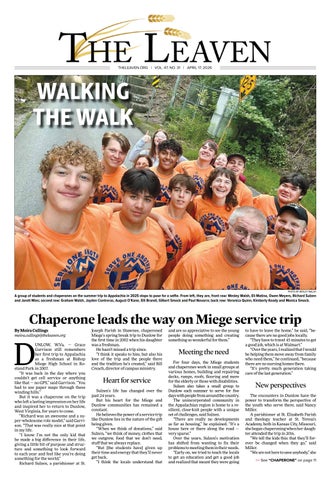
A group of students and chaperones on the summer trip to Appalachia in 2025 stops to pose for a selfie. From left, they are, front row: Wesley Walsh, Eli Matina, Owen Meyers, Richard Sulzen and Jarett Mies; second row: Graham Walsh, Jayden Contreras, August O’Kane, Elli Brandl, Gilbert Smock and Paul Navarro; back row: Veronica Quinn, Kimberly Keady and Monica Smock.
Chaperone leads the way on Miege service trip By Moira Cullings moira.cullings@theleaven.org
D
UNLOW, W.Va. — Grace Garrison still remembers her first trip to Appalachia as a freshman at Bishop Miege High School in Roeland Park in 2007. “It was back in the day where you couldn’t get cell service or anything like that — no GPS,” said Garrison. “You had to use paper maps through these winding hills.” But it was a chaperone on the trip who left a lasting impression on her life and inspired her to return to Dunlow, West Virginia, for years to come. “Richard was an awesome and a super-wholesome role model,” said Garrison. “That was really nice at that point in my life. “I know I’m not the only kid that he made a big difference in their life, giving a little bit of purpose and structure and something to look forward to each year and feel like you’re doing something for the world.” Richard Sulzen, a parishioner at St.
Joseph Parish in Shawnee, chaperoned Miege’s spring break trip to Dunlow for the first time in 2002 when his daughter was a freshman. He hasn’t missed a trip since. “I think it speaks to him, but also his love of the trip and the people there and the tradition he’s created,” said Bill Creach, director of campus ministry.
Heart for service Sulzen’s life has changed over the past 24 years. But his heart for the Miege and Dunlow communities has remained a constant. He believes the power of a service trip like Dunlow lies in the nature of the gift being given. “When we think of donations,” said Sulzen, “we think of money, clothes that we outgrew, food that we don’t need, stuff that we always replace. “But [the students have] given up their time and energy that they’ll never get back. “I think the locals understand that
and are so appreciative to see the young people doing something and creating something so wonderful for them.”
Meeting the need For four days, the Miege students and chaperones work in small groups at various homes, building and repairing decks, ramps, roofs, flooring and more for the elderly or those with disabilities. Sulzen also takes a small group to Dunlow each summer to serve for five days with people from around the country. The unincorporated community in the Appalachian region is home to a resilient, close-knit people with a unique set of challenges, said Sulzen. “There are really no developments as far as housing,” he explained. “It’s a house here or there along the road — very sparse.” Over the years, Sulzen’s motivation has shifted from wanting to fix their problems to meeting them in their needs. “Early on, we tried to teach the locals to get an education and get a good job and realized that meant they were going
to have to leave the home,” he said, “because there are no good jobs locally. “They have to travel 45 minutes to get a good job, which is at Walmart.” “Over the years, I realized that I would be helping them move away from family who need them,” he continued, “because there are no nursing homes there. “It’s pretty much generation taking care of the last generation.”
New perspectives The encounters in Dunlow have the power to transform the perspective of the youth who serve there, said Nancy Miller. A parishioner at St. Elizabeth Parish and theology teacher at St. Teresa’s Academy, both in Kansas City, Missouri, she began chaperoning when her daughter attended the trip in 2016. “We tell the kids this: that they’ll forever be changed when they go,” said Miller. “We are not here to save anybody,” she >> See “CHAPERONE” on page 11