5 Wired Right
10 Pro Tips
78 Pop at 100
Fall 2025
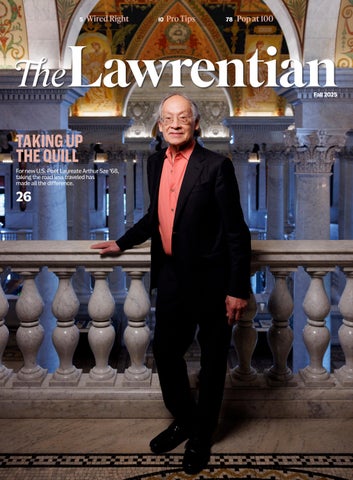
TAKING UP THE QUILL For new U.S. Poet Laureate Arthur Sze ’68, taking the road less traveled has made all the difference.
26
F R O M the H E A D O F S C H O O L
On Leadership
Stephen S. Murray H’54 ’55 ’63 ’65 ’16 P’16 ’21 The Shelby Cullom Davis Class of 1926 Head of School
FOCUS OF THE FUTURE
During the spring semester, dozens of Lawrenceville alumni returned to campus for Career Day, offering students varying career journeys, tips for securing internships, and perspectives on professional success.
W
hen I was a young teacher, I used to lead student trips to France, staying in rural, hardscrabble parts of the eastern provinces — quite close to the battlefields of World War I. One such locale was in Burgundy, where we stayed in an old, partially restored 16thcentury château — a damp, old stone structure. Abandoned for much of the 19th century and left to the elements, parts of it had been dismantled by local farmers over the years, scavenging for stone. American soldiers leaving battlefields of World War I bivouacked there briefly, and their graffiti was still discernible on walls up in the attic. By candlelight, we could make out the name of a young corporal from St. Louis, Missouri. The date was December 18, 1918. The guns had finally fallen silent on those battlefields just weeks before. He was far from home at Christmastime, and as he sheltered in the old hulk of a building, I had to wonder what he had seen, what he had endured, what images haunted his sleep. Because vestiges of World War I surrounded us in this region, we dug into the local history. But the old battlefield sites, with green grass neatly trimmed, now bucolic, evoked little of that tragic war. So, we tried a different approach to help our students gain a perspective. Each time we entered a village in our travels, I asked them to locate in the town square the inevitable memorial to those who had lost their lives in La Grande Guerre, as the French say. They were to count the number of villagers killed in the war, and then consider the overall village population. Thirty-six men died in a village of 135. Fifty-five lost in a small town of 250; fourteen lost in a rural hamlet of sixty-five people. The old photos in our history books allow us to distance ourselves from the horrible reality of war. Somehow, standing in a forlorn village common, not far from the actual battlefields, the cold simple numbers seemed to have a far more immediate, wrenching, and powerful effect.
One afternoon on one such trip many years ago, to spark some reflection on their part, we said to our students, “Your ticket to dinner this evening is a poem in French that is somehow inspired by something you did or saw today.” At the conclusion of our evening meal, we went around the table, and the students read their poems. Then it was Valerie’s turn. Valerie was a Nigerian girl from New York City. Her poem was written in the first person, and as she read slowly and clearly, she situated her narrator alone in front of a hearth late at night, staring at the dying embers. The room was dark and bleak and empty, and it emerged that the narrator was an aging French peasant woman, recalling the loss of her son, decades earlier, in some battle whose name she could not recall, in a war she could not understand. She had lived many, many such sad lonely evenings, and even at this advanced age, she was reliving the pain and loss quite vividly each day. We were all deeply struck by the sad beauty of her poem, but even more so, by her ability, through empathy and insight, to travel across generations and cultures. With her mesmerizing imagery and beautiful words that evening, without even seeming to try, she had us all in the palm of her hand. I find Valerie’s extraordinary insight to be a source of hope and optimism that we can bridge the issues that divide us — that we can understand the pain of others — if we choose to. This human capacity to see into and understand the lives of others, when we choose to exercise it, is the basis for real leadership. Leadership, after all, is not a title, or a position, or a role — it’s a mindset. When you can demonstrate the ability to create connection with others, and to believe in their good will, people will trust and will go with you. And I believe we all have it in us; we simply have to recognize it, and to act on it. — Adapted from the Baccalaureate address, spring 2025 Sincerely,
t he law re nt ia n.law re nce v ille .org
|
1
I NSI DE T H E GAT E S
A SIDEWAYS GLANCE
SNEAK PEEK
Heading out into a polarized world, the Class of 2025 considered all the angles and left ready to “meet these challenges with a deep and abiding hope for the future,” according to Head of School Steve Murray.
THE LINEUP VOLUME 89 | NUMBER 2
>
FALL 2025
26
COVER STORY
The Bard Sublime
Arthur Sze ’68 was named the 25th U.S. poet laureate by the Library of Congress in September.
FEATURES
30
Seems Like Old Times As the calendar turned to June, generations of Lawrentians, particularly from the classes of the 0s and 5s, returned to campus to celebrate their connections to each other at Alumni Reunion Weekend 2025.
DEPARTMENTS QUOTED
❝ In an advanced calculus class, I suddenly began to write a poem. After class I kept writing and didn’t stop.” Arthur Sze ’68, who was named the U.S. poet laureate by the Library of Congress in September. (See page 26)
2 | FA L L 2 0 2 5
T H E L AW R E N T I A N
4 10 16 18
Inside the Gates Noteworthy Table Talk Take This Job and Love It 20 Go Big Red! 24 Encore
36 Lawrentians 78 Ask the Archivist 80 The Big Question
F R O M T H E B A S E M E N T of P O P H A L L
EDITOR
Sean Ramsden H’65 DESIGN
Bruce Hanson / EGADS Landesberg Design NEWS EDITOR
Lisa M. Gillard H’17 STAFF PHOTOGRAPHER
Paloma Torres
CONTRIBUTORS
Andrea Fereshteh P’28 Ronald Mangravite ’68 P’18 Sarah Mezzino Nicole Stock PHOTOGRAPHY
Lisa M. Gillard H’17 Shawn Miller/Library of Congress Danielle Rappaport Eric Swanson David Teng ILLUSTRATION
Joel Kimmel
PROOFREADER
Rob Reinalda ’76 HEAD OF SCHOOL
Stephen S. Murray H’54 ’55 ’63 ’65 ’16 P’16 ’21 CHIEF ADVANCEMENT OFFICER
Greta Morgan
DIRECTOR OF COMMUNICATIONS AND EXTERNAL RELATIONS
Jessica Welsh
The Lawrentian (USPS #306-700) is published three times a year by The Lawrenceville School, P.O. Box 6008, Lawrenceville, NJ 08648, for alumni, parents, grandparents, and friends. Periodical postage paid at Trenton, NJ, and additional mailing offices. The Lawrentian welcomes letters from readers. Please send all correspondence to sramsden@lawrenceville.org or to the above address, care of The Lawrentian Editor. Letters may be edited for publication.
POSTMASTER Please send address corrections to: The Lawrentian The Lawrenceville School P.O. Box 6008 Lawrenceville, NJ 08648
T
he first time I wrote one of these notes from the editor, it was exactly ten years ago, for the fall 2015 issue of The Lawrentian. As thrilled as I was to take the helm of this publication, I was also a bit apprehensive about being the mediator of the many stories that emerge from Lawrenceville, both on campus and from our alumni. I had a lot to learn in a short time. I’ve always said that it was to my advantage that my first cover story was a profile on Lawrenceville’s new head of school, Steve Murray H’54 ’55 ’63 ’65 ’16 P’16 ’21. I say that because although I wasn’t yet steeped in Lawrenceville’s past and present, I was able to present a subject not many of you knew much about, either. And by the time the next issue was published, I had my sea legs under me. I sensed early on that Lawrenceville was a welcoming community, and I’ve certainly seen that reveal itself again and again over this past decade. What friends I’ve made! What fascinating people I have met, interviewed, and written about! It’s all been better and more rewarding than I imagined — and my expectations were pretty high! I’m a lucky guy. This has been an interesting year. For one thing, I’m struggling a bit to type this out, with my right arm in a bulky abduction sling as I recover from shoulder surgery. It’s a bit awkward, but it’s also temporary. More permanent was an honor I received this past spring when the Class of 1965 welcomed me as an honorary member during its 60th reunion at Alumni Reunion Weekend. Although I questioned the class members’ selectivity, I also commended the class for camouflaging me behind a group of truly worthy inductees that includes Jacqi Haun H’65, our senior archivist, with whom I’ve worked closely to present the “Ask the Archivist” section in every issue; Pete DeVine H’65 P’22, our chief operations officer who has shepherded the physical transformation of our campus; and my former colleague Liz Casey H’65 ’66 ’92 P’21 ’24, who is as “Lawrenceville” as just about anyone. It was also extremely gratifying in July for The Lawrentian to receive two golds from CASE, the Council for the Advancement and Support of Education, which sets the standard in this business, in its annual Circle of Excellence Awards. Our magazine was one of just eight finalists for CASE’s Robert Sibley Magazine of the Year honors, across all levels from independent schools to universities worldwide. In my very first letter to you ten years ago, I concluded by saying, “With your help, I look forward to steering The Lawrentian into a very engaging future.” Right from the start, you have answered that call, and I am in your debt. Thank you. All the best,
©The Lawrenceville School Lawrenceville, New Jersey All rights reserved.
Sean Ramsden H’65 Editor sramsden@lawrenceville.org
t he law re nt ia n.law re nce v ille .o rg
|
3
Inside the Gates 5Q4
Joel Kimmel
5
questions for Jonathan Geller ’87, psychologist in the Health and Wellness Center, who shares what might have become his profession if only he had the “drive” … and the short game
House Call What made you most proud of your House this past year? Why? Heads of house and assistant heads of house responded to this issue’s end-of-year question.
4 | FA L L 2 0 2 5
T H E L AW R E N T I A N
What do you remember most about returning to the School? I would like to say that I was less scared when I returned in my current role than when I arrived as a student, but I’m not totally sure that is true. Do you think having been a student here makes you more relatable to today’s students? I do not know if it makes me more relatable, but it does allow for me to have great understanding for how hard our students work. I think I worked harder my freshman year at Lawrenceville than I did in college or graduate school.
If you could be part of a Harkness discussion with any three figures from history, who would you choose? Sigmund Freud, Bruce Springsteen, and Larry David. I love the way all three capture what it means to be human, and I would like to hear them exchange their perspectives. What never fails to make you laugh? That’s easy: my 12-year-old daughter. I think she is hilarious! If you hadn’t chosen psychology, what other career path might you have taken? I would have become a professional golfer. I have the desire, just not the talent.
Winning L-Factor after not having much of a performance plan 24 hours out, the House came together and created an awesome performance! Lauren Gold STANLEY HOUSE
Hearing the names of the boys called during the Underform Awards Ceremony and seeing how our House stood and applauded enthusiastically for each Clevie was a proud and affirming moment. E.J. Hernandez CLEVE HOUSE
Club Hopping Lawrenceville 101
Introduction to Electrical Engineering SC561
In Introduction to Electrical Engineering, if you aren’t failing, you aren’t succeeding. Projects rarely go right the first time, so science teacher Shinae Park challenges students to embrace failure as an essential part of learning. “We’re really focused on the process,” Park explained. “How are you thinking through the engineering you’re doing?” This unique course serves as both an introductory and an honors-level class, and levels of experience vary widely. “Wherever you begin,” Park says, “the goal is to keep learning and growing from there.” Park and Nicki Selan, assistant chair of science, guide students through the basics of electrical engineering before diving into hands-on group projects, such as building a robot. Along the way, students learn essential technical skills like soldering, coding, working with microcontroller boards, and building and testing circuits. But there’s more than that. “A lot of the engineering process isn’t just mechanical or electrical,” Chris Bai ’25 said. “It’s about collaborating and providing feedback on each other’s projects.”
Lawrenceville Film Crew
Clubs as creative outlets have thrived for well over a century at Lawrenceville, and the evolving media landscape provides fresh opportunities for students to express themselves. The Lawrenceville Film Crew enables students to create up to five film projects per academic year with the intention of entering them into such national competitions as the All-American High School Film Festival, or AAHSFF. “It’s a way to engage with the student body and other people who are interested in the same things you are,” says Nico Romero-Durand ’27, adding that in the end, members have a chance to create work “that you’re really proud of.” AAHSFF submissions range across genres, including comedy, drama, experimental, and “micro movies” of a minute or less, and club members write, act, film, and edit every film, a whirlwind they fit in where they can. “We shot from 5 p.m. all the way to 3 a.m.,” says Alex Li ’27, “and then the next day I had to edit everything.” Condensed from an L10 report
Old School
Always Room for One More The overloaded station wagon pulling away from a dormitory in June is a familiar sight in any boarding school. One enterprising mother of a boy in Raymond House went it one better last June, though. Knowing that her Third Form son had more than a station wagon load of gear to be taken home for the summer, she came prepared — with a delivery van rented from Hertz. From Echoes of the Campus in the summer 1965 Lawrentian. Sixty years later, large SUVs have inherited the heavy-hauler mantle around the Circle, Crescent, and Bowl.
I was proud of the determination the boys showed in always giving their best, winning the house basketball championship or earning an improved grade on a really hard ICPS test. They supported each other and tried to do their best.
The students planning a senior spring invitea-friend. They set up lawn games, borrowed speakers, made a playlist, set up the food, and then hosted the event. I could feel the House unity as everyone soaked up the good weather and the even better friendships.
I was most proud of how students supported each other quietly and consistently. Their small acts of kindness and steady presence helped many in the House feel more seen, valued, and connected throughout the year.
Paula Clancy P’11 ’13
Melissa Verhey
STEPHENS HOUSE
DICKINSON HOUSE
RE YNOLDS HOUSE
Photo by Francine Orr/Los Angeles Times/Getty
Kennedy was a great place to be this year, full of talent and camaraderie. The young men of Kennedy showed out and showed up for each other!
Watching our girls become independent, confident, and community-oriented young women over the course of their first year at Lawrenceville.
Alex Kocar
Hazel Baldwin-Kress
KENNEDY HOUSE
DAWES HOUSE
Hugo Caraballo Anderson
t he law re nt ia n.law re nce v ille .o rg
|
5
I NSI DE T H E GAT E S
One 2 Watch
A Girl for All Seasons
Lexie Koch ’25
Athletically speaking, Lexie enjoyed what anyone would consider a dream year. The fall saw her earn first-team All-Mid-Atlantic Prep League and All-New Jersey Independent Schools Athletic Association Prep A honors in field hockey, and she was just getting warmed up. The chill of winter didn’t do anything to cool Lexie off. As a member of the girls’ indoor track and field team, she bested her own individual school record in the in the 60 meters at the Penn Relays Winter Showcase, clocking in at 7.99 seconds, just days after setting another as part of the sprint medley relay team at the Tsai Relays at 4:08.59. Once again, her team captured the M.A.P.L. and N.J.I.S.A.A. titles. And, as accomplished as she was in each, you could make the case that field hockey and track weren’t even Lexie’s “good” sports. The springtime saw the midfielder explode on the lacrosse field, eclipsing the ten-year-old all-time Big Red record for goals when she tallied her 245th score against Kent Place on May 8. And, as has become her custom, she was named to the AllM.A.P.L. and N.J.I.S.A.A. first teams, as well as to the All-M.A.P.L. Academic team. For Lexie, who earned twelve Major Ls, it was the culmination of a career that saw her total more than a hundred goals as a Second and Third Former, sustaining the sort of excellence that earned her a spot on the 2025 New Balance All-America Lacrosse Senior Game. FAST FACT
Lexie, who earned the Melissa Magee Speidel Best Female Athlete Award in May, will continue playing lacrosse at Harvard.
House Call continued We are a caring and friendly House. With the assistance of our amazing House Council, we were able to hit all marks including House points, milkshake sales, and we welcomed back a successful SEGA dinner this spring! Charise Hall H’82 P’12
How they connected as a group and made the House feel that is was a place for everyone. They came together to make Stanley a home and it showed through our different feats of winning L-Factor and Larrie Cup but also in the daily acts of kindness.
MCCLELL AN HOUSE
Nicole Stock
6 | FA L L 2 0 2 5
T H E L AW R E N T I A N
STANLE Y HOUSE
3
things we learned producing this issue of The Lawrentian:
Per a report in the December 4, 1924, issue of The Lawrence, architectural plans for Pop Hall called for a “vestibule that will connect the building to Memorial Hall, so that it will not be necessary to go outside to go to and from these buildings.” It also noted that funds “have not been subscribed as yet.” When Arthur Sze ’68, the new U.S. poet laureate, left Lawrenceville for M.I.T., it was with the intention of studying chemical engineering, not poetry. But he began writing before visiting poet Denise Levertov urged him to pursue the craft at UC-Berkeley. Aldo Leopold Award winner Roger I. Glass ’63, who was honored for his work in the field of medical science, is also a longtime amateur radio enthusiast who also speaks six languages: French, Spanish, Russian, Portuguese, Bengali, and English.
They Said It ❝No matter how many clothes an individual buys, their ideal self can never be achieved though mere appearance. Instead of developing a genuine personality through cumulative experiences and relationships, viewers [of short-form video content on social media] find more comfort in developing an identity generated by sellers who feign sincerity and brands that promise authenticity while profiting off conformity.”❞ From “On Social Media and the Human Interior: How False Realities Have Warped Our Focus” by Emily Zhang ’27, which appeared in the May 9, 2025, issue of The Lawrence.
What’s Cookin’? Summer Catch “Salmon being one of
our most popular dishes, we’re always trying to develop new recipes to keep it current, and chipotle-rubbed roasted has proven to be a new campus favorite,” says Gary Giberson H’11 ’18 P’10, the founder and president of Sustainable Fare, which keeps Lawrenceville well fed. “The smoky, spicy, salty-sweet flavors go so well with salmon and the easy preparation makes it a winner all around.” Giberson recommends this dish served over a fresh salad or bowl of rice for an easy summer meal Chipotle-Rubbed Roasted Salmon Yields four 6-ounce portions Ingredients Four 6-ounce salmon fillets, preferably wild-caught or Marine Stewardship Councillisted (msc.org/en-au)
1 tablespoon ground cumin Cilantro lime sauce 3 tablespoons chopped cilantro
2 tablespoons olive oil
½ teaspoon kosher salt
Spice mix
¼ cup extra virgin olive oil
1 tablespoon kosher salt 2 tablespoons light brown sugar 2 tablespoons chipotle morita chile powder
2 tablespoons of fresh lime juice (about 2 limes) 1 tablespoon sliced chives
Procedure • Preheat oven to 400 degrees. • In a small mixing bowl add all dry ingredients and mix well. • Place salmon fillets on baking sheet pan or ovenproof cooking pan in a single layer and coat all sides with 2 tablespoons of olive oil. Then rub with spice mix, set aside. • In a medium mixing bowl place cilantro, salt, and olive oil, and stir in lime juice. • Place salmon in hot oven and roast for 10-14 minutes or until cooked to your preference. Serve with cilantro lime sauce.
t he law re nt ia n.law re nce v ille .o rg
|
7
I NSI DE T H E GAT E S
8 | FA L L 2 0 2 5
T H E L AW R E N T I A N
Photo by Paloma Torres
The Big Picture
One More for the Road As the faculty donned their academic regalia and the Commencement procession loomed, Head of School Steve Murray paused for one last selfie with members of the Class of 2025.
t he law re nt ia n.law re nce v ille .o rg
|
9
Noteworthy Pathways and Possibilities
Dozens of Lawrentians returned to campus to share their professional journeys with today’s students at Career Day.
Jim Fessler ’87 P’19 ’22 ’25, professor and clinical vice chair of neurology at Washington University School of Medicine, talked to students about his career in medicine at Career Day in April.
10 | FA L L 2 0 2 5
T H E L AW R E N T I A N
FOR SCOTT ALAND ’07, being back on campus on a Saturday morning in the spring, “surrounded by the bustle of students, faculty, and peers,” was like a direct shot of nostalgia. Unlike his student days, however, Aland wasn’t dreaming about his future. This time, the Philadelphia-based real estate sales professional was there to share with students where he’s been and the winding road that led back to Lawrenceville. More than sixty Lawrentians returned on April 5 for Career Day, a collaborative event hosted by the School’s Alumni and Development Office and the Dean of Students Office. The program featured six large panel discussions, followed by individual breakout sessions on topics ranging from alumnae success in underrepresented fields and unexpected career paths to practical tips and advice, varying career journeys, tips for securing internships, and perspectives on career success.
HEADLINES
Meera Nathan ’90 P’24 ’24 shared how she recently shifted from the pharmaceutical industry to developing a nonprofit for women’s health. “All the experience I got over these many years, both in my medical education as well as in pharma, is really going to help me develop my organization,” Nathan said. “That’s something that’s really fulfilling and shows you the ebb and flow of your career, and the ability to pivot if you really want to, the opportunities are there.” Students eagerly absorbed the wisdom their predecessors imparted. “Career Day offered valuable insights into fields I’m interested in and gave me the chance to connect with people who were once in my shoes,” said Sofia Swindell ’25, who now attends the University of Pennsylvania. “I’m grateful I had the opportunity to hear advice from alumni and learn about the paths they took to build their careers.” Aland, who discussed career pivots and unique career paths, believes he took as much from Career Day as the students did. “I left feeling enriched not only by being able to reflect and share my story with a burgeoning army of young alumni,” he said, “but by the fellowship felt with faces old and new who have charted parallel paths and painted them with different colors.” Career Day is an extension of ongoing programming through which alumni regularly return to campus to participate in classroom discussions, student club meetings, Form meetings, and all-school gatherings. “Alumni are consistently eager to say ‘yes,’ and we’re thrilled to incorporate these moments into our broader alumni engagement efforts,” said Maria Bolis, director of alumni engagement, who added that Lawrenceville launched such career events following a request several years ago from the Student Council. That appeal led to regular alumni career panel events held on topics including STEM, media and entertainment, law and government, real estate, military and first responders, health care, arts and entertainment, and more. “These interactions are not only valuable for students, but incredibly meaningful for alumni as well,” Bolis said. “They serve as a powerful reminder of what makes Lawrenceville special, offering tangible ways to give back. These opportunities provide alumni with a compelling way to stay connected – each experience builds stronger ties to the community and reinforces their lifelong bond with the School.”
See more photos from Career Day at: https://bit.ly/49q9ZsZ
5.19.25
The Community Reach Out club recently delivered a $20,000 check on to HomeWorks Trenton, a free, community-based, after-school residential program led by Natalie Tung ’14 and embracing the goal of “changing the world, one girl at a time.” Funding was generously provided by Bridge Stuart ’66.
5.6.25
Jeffrey Rosen, president and CEO of the National Constitution Center and host of the We the People podcast, was the featured speaker at the 2025 Weeden Lecture, which for 26 years has hosted some of the most prominent names in U.S. national conversations about history.
4.26.25
Lawrentians gathered for Community Day, an annual all-School event established in 2013 to share the diverse interests of its community. “Community Day embodies the core values that make Lawrenceville special,” said Cameron Brickhouse, dean of of community and belonging.
3.6.25
Lawrenceville and the Lawrence Hopewell Trail (LHT) officially reopened the section of the trail that runs through the School’s campus using a new, signposted route. The LHT, a mix of paved and crushed stone surfaces, is one of New Jersey’s premier trails for walking, cycling, and running.
Read the latest news stories at: lawrenceville.org/news
t he law re nt ia n.law re nce v ille .o rg
|
11
NOT EWORT H Y
Mr. Big Shot YUSHI KAMISAKU ’26 got his call to the big leagues in May, seizing the opportunity to photograph the action on the field at Yankee Stadium during the Bronx Bombers’ win against the Texas Rangers. Kamisaku’s invitation came from Ariele Goldman Hecht ’97, the Yankees’ senior photography editor and chief photographer. The two photojournalists were connected by Mike Goldenberg H’94 ’96 ’97 P’05 ’10, Lawrenceville’s athletic trainer, who has remained in contact with Hecht since he was a member of the Stanley House duty team. An avid student sports photographer who has studied filmmaking and created images for Big Red athletics, particularly for the football and boys’ lacrosse teams, Kamisaku shadowed Hecht as she shot the Yankees’ pregame warmups, then joined professional photographers in both the right- and left-field media boxes through the seventh inning. The experience, Kamisaku said, was “simply unforgettable.” “I’m forever grateful to Ms. Goldman. She went beyond what I was expecting, not just stopping at providing me on-field access, but also lending me equipment and introducing me to countless members of the Yankees organization, players, and employees,” he said. “This opportunity completely transformed my horizon, allowing me to have a glimpse of what professional photography as a career can look like.”
On-field action between the Yankees and Rangers captured by Yushi Kamisaku ’26.
12 | FA L L 2 0 2 5
T H E L AW R E N T I A N
Striking Gold The Lawrentian captured two golds in the annual Council for Advancement and Support of Education (CASE) Circle of Excellence Awards competition. THE LAWRENTIAN RECEIVED gold in the category of Magazines — Alumni/General Interest (Independent and International Schools), where it shared top honors with the Williston Northampton Bulletin and the Sidwell Friends School Magazine. As a gold-award winner, The Lawrentian was one of just eight finalists for CASE’s Robert Sibley Magazine of the Year, which lauds the very best school and alumni magazines at any level, including colleges and universities, that publish more than twice annually. The publication also won gold in the Magazines – Publishing Improvement category, the only independent school magazine to earn recognition at any level in this division. The Lawrentian shared gold with Northwestern University’s Kellogg Magazine and South Magazine from the University of South Alabama. This recognition follows the publication’s cover-to-cover redesign that debuted with the spring 2024 issue, done in partnership with Landesberg Design of Pittsburgh. The CASE Circle of Excellence Awards are the premier honors competition in education advancement and communications. This year, CASE received 4,460 entries from 33 countries, with a total of 477 winners carefully selected by a panel of 525 volunteer judges.
‘That’s When Everything Changed’
The Big Red Race is a popular annual fundraiser to benefit local agencies and organizations that bolster education.
The Class of 2025 struggled and collaborated its way toward deeper understanding. A QUARTER OF the way through the 21st century, the Class of 2025 departed Lawrenceville into a polarized world, where the winds of change blow in a way that seem more directed toward differences in people than on our shared commonality. But the School’s 208 newest alumni emerged from their time on campus buttressed by their shared experience around the Harkness tables and in their Houses, inspired to seek the best for all. “What makes this moment so reassuring to me – even inspiring – is that as you head out to meet those challenges I described and many more that certainly are in store,” said Head of School Stephen S. Murray H’54 ’55 ’63 ’65 ’16 P’16 ’21, referencing his earlier Baccalaureate address, “you will do so with the good will that we have seen in you, with the belief that character and integrity matter, and that kindness and empathy are not signs of weakness, but rather are key to navigating a complicated world. And you will meet these challenges with a deep and abiding hope for the future – qualities in you that have emerged during your time here and that are simply part of who you are.” Murray presented the Edward Sutliff Brainard Prize, given annually by the faculty to the Fifth Form student whom it holds in the highest esteem, to Nathan Muchai ’25. On behalf of the Board of Trustees, Murray also presented the Trustees’ Cup, recognizing that student who has most influenced the School for good, to Kathlynn Yao ’25. He also recognized the members of the class set to attend service academies in the fall: Alina Diaz Ferreira ’25 and Owen Eldridge ’25 were appointed to the U.S. Naval Academy; Graham Mahoney ’25 received an appointment to the U.S. Coast Guard Academy; Macyn Hattman ’25 is attending the University of Notre Dame on a Navy R.O.T.C. scholarship; and Ray Taft ’25 is
Blake Eldridge ’96 H’78 ’12 P’25, assistant head of school for student life and dean of students, celebrated with outgoing School president Eli Lacey ’25 and his successor, Sienna Kulynych ’26.
enrolled at the University of North Carolina on a Navy R.O.T.C. scholarship. In her valedictory address, Sophia Liu ’25 reflected upon her realization that the deepest learning at Lawrenceville is what comes after confusion and collaboration. “It turns out that confusion isn’t a sign we’re failing. It’s just the first step in learning something real. More often than not, the thing that got me through wasn’t a textbook. It was someone sitting next to me, praying with me,” Liu said. “That’s when everything changed. Because in those vulnerable moments, instead of trying to be smart, we try to be human: curious, collaborative, occasionally overwhelmed humans who just wanted the sentence to make sense.”
t he law re nt ia n.law re nce v ille .o rg
|
13
NOT EWORT H Y
‘Take Science Where the Problems Are’ Roger I. Glass ’63, recipient of Lawrenceville’s Aldo Leopold Award, encouraged students to find their paths and make a difference. RENOWNED PHYSICIAN SCIENTIST Roger I. Glass ’63, M.D., Ph.D., was awarded The Lawrenceville Medal this spring. The medal, presented by the Alumni Council and also known as the Aldo Leopold Award, is the highest honor the School may grant, conferred upon an alum who has demonstrated “brilliant, lifelong work in a significant field of endeavor.” But Glass, who formally received the medal at a dinner on May 15, was not on campus strictly to be fêted. He also spent the day speaking to Lawrentians in classrooms and at the final School Meeting of the academic year in the Kirby Arts Center. “My English class at Lawrenceville taught me you have to take the path less traveled – that’s what I did,” he said. “Find your path and think about making a difference as you go forward.” Glass spent more than four decades in global health, including leadership roles in public service, research, capacity building, and international collaboration. His nearly 17 years heading the John E. Fogarty International Center is the longest tenure for any director of the organization, part of the National Institutes of Health, which supports international medical and behavioral research and to train international researchers. His time at Lawrenceville changed the trajectory of Glass’ career, he said. After completing his bachelor’s, master’s, and medical-school requirements at Harvard, Glass earned a doctorate from the University of Gothenburg in Sweden. His subsequent career experience took him to underserved areas around the globe. After taking a role with the Centers for Disease Control and Prevention, Glass and his wife, Barbara J. Stoll, M.D., a distinguished professor in the medical sciences and professor of pediatrics, and former dean at McGovern Medical School in Houston, went to work in Bangladesh at the Diarrhoeal Disease Control Center. “It was an eye-opening experience and changed our careers,” Glass said. Describing his contributions toward developing a cholera vaccine, Glass underscored the importance of vaccine science for global health effectiveness.
14 | FA L L 2 0 2 5
T H E L AW R E N T I A N
“When our kids were children, they received seven different vaccines,” he said. “Today, there are more than 30 that have been developed, and it’s a terrific advancement of science.” Noting that his work in virology, immunology, and genetics all influenced his path to develop and implement vaccines in low- and middle-income countries, Glass also described how a strong partnership with the Gates Foundation helped lead to equity in vaccine availability throughout the developing world. He encouraged students them “take science where the problems are and follow your passion. “I never thought I’d be working on enteric diseases, but having experience in the world and working in poor, developing countries is important,” he said. — Andrea Fereshteh
Roger I. Glass ’63, M.D., Ph.D., was honored with The Lawrenceville Medal by the Alumni council on May 15.
BOOKMARKS
Paging Through New Works from Lawrentians Literary Lawrenceville alumni examine ancient life between the Tigris and Euphrates, a firsthand account from the Almighty, and the promise and perils of the world’s biggest AI platform.
Moudhy Al-Rashid ’01 Joel Kimmel
Edwin Núñez Named Dean of Enrollment Management EDWIN R. NÚÑEZ joined Lawrenceville as its new Shelby M.C. Davis ’54 Dean of Enrollment Management on July 1. As a member of the school’s senior staff and a direct report to Head of School Steve Murray H’54 ’55 ’63 ’65 ’16 P’16 ’21, Núñez leads all aspects of Lawrenceville’s approach to student recruitment, admission, and retention, as well as scholarship aid. Núñez is a seasoned leader with a record of success in independent schools, guided by data-informed decision-making. He brings extensive experience from his role as director of enrollment management at The Pingry School, where he led transformative initiatives that not only set a record for the number of applications but also achieved a record high in the number of families choosing to enroll. At Pingry, Núñez implemented a Student Impact Score across academics, arts, athletics, and leadership to help evaluate the effectiveness of admission criteria as a predictor of a student’s long-term success. He enhanced ninth-grade recruitment by launching an Early Action admission process and refining the admission visitor experience. “I am eager to bring my experience and energy to the School, confident that together, we can elevate Lawrenceville to new heights,” Núñez said after his appointment. “I look forward to helping set bold new standards for admissions and, in doing so, enabling every student to unlock their fullest potential.”
Between Two Rivers: Ancient Mesopotamia and the Birth of History Thousands of years ago, in a part of the world we now call ancient Mesopotamia, people began writing things down for the very first time. Here, Al-Rashid, an honorary fellow at the University of Oxford’s Wolfson College, reveals what these ancient people chose to record about their lives, allowing us to brush hands with them millennia later.
Bob Maguire ’68 P’96 ’00 If I Were God: How I Would Have Done It
Narrated by God Himself, this is a laugh-out-loud, edgy, yet kindhearted exploration of the beliefs of major world religions that will appeal to atheists, agnostics, and believers of all stripes, including religious philosophers, apologists, and others interested in the interplay of religious studies, sociology, and science.
Karen Hao ’11
Empire of AI: Dreams and Nightmares in Sam Altman’s OpenAI Naked power finds the ideology to cloak itself; no one thinks they’re the bad guy. Deeply reported with intimate access to Altman’s OpenAI from the beginning, this is an eye-opening account of what might be the most fateful tech arms race in history, reshaping the planet in real time, with a focus on the company driving the frenzy. Read more about it on page 36.
t he law re nt ia n.law re nce v ille .o rg
|
15
TA BLE TA LK
Unraveling Lincoln By Lisa M. Gillard H’17
hree times a week each winter term, teacher Regan Kerney H’49 ’95 ’98 ’99 ’03 ’11 can be found in a corner classroom of the Noyes History Center, preparing for his succinctly titled course, Lincoln. With a well-worn copy of Abraham Lincoln: The Selected Speeches and Writings in hand, Kerney reviews the day’s syllabus for the course he has taught since 1998-99. America’s 16th president, he explains, is a “mythological creature,” and it’s crucial for students to strip away the legend to uncover something real. “You can have heroes,” Kerney explains, “but understand that heroes have flaws.” The best way to do that? Examining Lincoln’s own words rather than relying on what has been said about him. Kerney’s text is filled with margin notes and Postits as he leads students through Lincoln’s life, from his early letters to the Emancipation Proclamation, and from wartime correspondence with generals to letters written to everyday citizens. Even with close readings, Kerney reminds young Lawrentians that parts of Lincoln will always remain unknowable. “One of the dangerous tendencies we have is to fill in the gaps. Students have to be comfortable knowing there will be gaps in their knowledge,” he says. “Lincoln never sat down after the war to write his reflections […]. He never gave a lecture series on his experiences.” Students are often surprised to see Lincoln as a work in progress over the three decades under examination. His capacity for change, Kerney says, is one of the most important takeaways from the class. “Between 1858, when he debated Stephen Douglas,
16 | FA L L 2 0 2 5
T H E L AW R E N T I A N
and 1865, when he was assassinated under the weight of the Civil War, he changed enormously,” Kerney says. “Not his personality, but his beliefs – particularly about race. He grew up a lot and kept changing. So, there’s hope for us all if you can still keep growing when you’re that old.” Kerney revisits the entirety of Lincoln’s collected works every few years, his understanding deepening with each pass.
Students have to be comfortable knowing there will be gaps in their knowledge. Lincoln never sat down after the war to write his reflections. “I sit down and read them again just to see if there’s something I missed. And every now and then, you find something really great in there,” he says. “But it takes time. Part of this for me is about how you teach a course. As my thinking keeps evolving, I’m trying to be like Lincoln. I’m trying to grow.” Kerney hopes his students leave with a method of inquiry they can apply to any historical figure. “I want them to know they can do this with anybody,” he says. “They can get into someone’s life and really know that person. This class is an example of how you would do it.” Underlined passages, notes scrawled in the margins, and tagged pages reflect history teacher Regan Kerney’s ever-expanding insights into the texts of Abraham Lincoln.
Stripping the Myth from the Man
A close study of Lincoln helps students make sense of contemporary America. “[In his 1855 letter to George Robertson, Lincoln] expresses a moment of pure human emotion that often isn’t discussed in talks of his legacy. This moment is when he confides in his friend that ‘the problem [of political division in the nation] is too mighty for me.’ This is not the competent optimist that many Americans think Lincoln was, but instead it shows his humanity, and that you may doubt yourself from time to time, but you can still harness your effort and bring great changes to the world if you are committed to the challenge.”
Tommy Morris ’25
“I don’t give you a lot to read. I give you things to read carefully. Read it slowly, savor it. Maybe read it twice. Because to be honest, it doesn’t make as much sense until you’ve read it about 20 times. You’d be amazed what happens the 20th time you read the Gettysburg Address.”
Regan Kerney H’49 ’95 ’98 ’99 ’03 ’11, history teacher “[The course is especially relevant] because of the level of polarization we’ve reached in recent years. It’s important to study how political leaders in the past have handled a nation that is so divided. Lincoln talks a lot about the Constitution and is more concerned with upholding democracy than he is with power.”
Nell Bunn ’25
“I really like taking a history class that revolves around one figure because you can learn so much about U.S. history in the process of studying him, especially because of how complex he is.”
Nell Bunn ’25
t he law re nt ia n.law re nce v ille .o rg
|
17
T A K E T H I S J O B and L O V E I T
For Hannah-Marie Garcia-Ladd ’15, building bridges between the Indigenous and scientific communities in Alaska is at the core of her work.
Conservation through Collaboration By Barbara Horn
18 | FA L L 2 0 2 5
T H E L AW R E N T I A N
Ecology, global politics, research, diplomacy, education, project management. Trying to define what Hannah-Marie Garcia-Ladd ’15 might do on any given day is like playing Whac-A-Mole. “I’ve always known what I wanted to do, but it was an ecology class at Lawrenceville that solidified it for me,” says Garcia-Ladd, the director of the Indigenous Sentinels Network (ISN) Program of the Aleut Community of St. Paul Island Tribal Government in Alaska. “A lecture [former science teacher] Jim Serach P’10 gave on population dynamics — on how you can’t just focus on ecology or wildlife but need to consider the human component and how it all ties together — was my ah-ha moment.” Backed by her bachelor’s degree in environmental studies and anthropology and a master’s in marine policy, Garcia-Ladd describes herself as “an environmental and social scientist.” Building bridges between the Indigenous and scientific communities is at the core of her work, and helping to protect a native culture that relies on St. Paul’s natural resources is where Garcia-Ladd’s work intersects with science, government, and community outreach. St. Paul Island is located in the middle of the Bering Sea, a 42-square-mile piece of land 300 miles from the Alaska mainland and 800 miles southwest of Anchorage, the nearest urban center. St. Paul is one of two inhabited islands in the five-island Pribilof chain, sometimes called the “Galapagos of the North” for its biodiversity. The islands are populated by fur seals, arctic foxes, sea lions, reindeer, and, during the warmer months, some 300 species of migratory birds. It is a fisherman’s paradise. The Aleut Community of St. Paul first began monitoring wildlife species and environmental conditions in the Pribilofs in the early 2000s, developing specialized software for data collection and establishing the Bering Sea Research Center. Garcia-Ladd guides tribal communities statewide in launching similar surveys by leveraging the St. Paul software to implement their own monitoring programs. The long-term environmental and economic impact of these initiatives has far-reaching implications for the residents of Alaska’s remote communities and, potentially, the rest of the Arctic region. “Visiting researchers will base their recommendations on a single season’s worth of data without regard for the input Building bridges between the Indigenous and scientific communities is at the heart of work for Hannah-Marie Garcia-Ladd ’15, who describes herself as “an environmental and social scientist.”
of the community or the local culture,” says Garcia-Ladd, explaining the need to play liaison between the scientists and the Indigenous communities. “With the scale of what we’re witnessing, we need all sources of information. There’s a lot of trust-building involved.” Based in Cordova, an Alaskan coastal city of 2,300 accessible only by plane or boat, and with an office in Anchorage, Garcia-Ladd makes the trip to St. Paul once or twice a year, staying one to two weeks and typically traveling with an intern, a staff member, and a research scientist. They gather data on weather, contaminants, and conservation efforts, and Garcia-Ladd leads education and outreach sessions with the local residents. The flight to the island might take from six to ten hours, including a stop to refuel. “We were in the middle of COVID when I first moved up here,” Garcia-Ladd says. “I asked how going virtual was affecting what they did, and they laughed. They said their work is always like that because of the distances.” In the meantime, Garcia-Ladd’s job continues to grow and evolve. In June 2024, the Aleut Community of St. Paul and ISN announced a $2.3 million grant from NOAA, the National Oceanic and Atmospheric Administration. Garcia-Ladd was instrumental in securing the grant, which seeks to leverage the partnership between ISN, the Bering Sea Research Center, and Iḷisaġvik College, Alaska’s tribal college, to support “climate resilient workforce development.” The funds will be used to expand Indigenous-led climate monitoring programs. Calling the NOAA grant her “greatest accomplishment” so far, Garcia-Ladd credits opportunities like Lawrenceville’s Open Door Society with giving her the confidence to approach Alaska’s senators for their support. “I wear a lot of hats – community outreach, presenting at conferences, meeting with funders, networking, collecting data, connecting with Fish and Wildlife – and operating in all these spaces requires a certain comfort level in having these conversations. Lawrenceville gave me that,” she says. A grant to develop a one-credit course with the University of Alaska at Fairbanks, teaching ISN’s data collection methodology, is taking Garcia-Ladd in yet another direction, and in 2023 she joined Indigenous leaders in New Zealand for the signing of declarations to protect the rights of whales and to use Indigenous ancestral knowledge for the betterment of future generations. Acknowledging the value of ancestral knowledge alongside the contributions of western science has been significant for Garcia-Ladd on a personal level, as well. “I am constantly looking at how others are utilizing the space they call home and seeing how that factors into identity,” she says. “That’s led to me recognizing my own identity [Hispanic and Native American] and the cultural practices that have been lost in my own family.” Garcia-Ladd says it took a move to the 49th state for her to feel like she was home. “It’s not for everyone, but I loved it immediately,” she says. “I crossed the [state] border and began crying. I just knew this was where I was meant to be.” t he law re nt ia n.law re nce v ille .o rg
|
19
Go Big Red Their Cup Runneth Over An unlikely hole-in-one may have created good vibes for a record-setting performance by boys’ golf.
Big Red Roundup
20 | FA L L 2 0 2 5
Boys’ lacrosse earned its third-consecutive national prep championship with a 12-4 win over Salisbury and finished the season ranked No. 4 nationally among all high schools by InsideLacrosse.com. Nick Voultos ’25, Brock Getson ’25, and Sawyer English ’25 were selected to the New Balance All-America Senior Game. T H E L AW R E N T I A N
Girls’ lacrosse captured the Mid-Atlantic Prep League title and won the Wooden Stick. Lexie Koch ’25 (see page 6) was chosen to the New Balance All-America Senior Game, and she and Dani Caldwell ’27 were named to the N.J.I.S.A.A. All-Prep A team.
MAYBE THINGS WERE just supposed to work this way for the boys’ golf team this past spring. The team, coached by Etienne Bilodeau H’01 ’20 ’21, was already feeling good after capturing the Mercer County Tournament and the N.J.I.S.A.A. championships in 2024, and the team was off to another strong start to the 2025 campaign. Still, any experienced golfer will tell you that a little bit of good fortune goes a long way. And so it went when Ethan Lee ’27, who wasn’t originally scheduled to compete for the Big Red varsity on March 31, stepped in for a teammate who was unavailable for the match at Golden Pheasant Golf Club in Lumberton, N.J. What happened was what Lee calls his “greatest sports moment ever.” Playing at Golden Pheasant Golf Club in Lumberton, N.J., Lee hit a pitching wedge from 137 yards on the par-3 second hole. The ball sailed through a strong left-to-right wind, landed three feet from the pin, and spun toward the hole. “While I knew it was close, the ball appeared to have stopped right on the edge of the hole, so I picked up my tee and was content to have a good look at a birdie.” But Lee’s tee shot wasn’t just close. It was in the cup. “My teammates and players from other schools that I was playing with all got excited and ran towards the hole to check,” Lee said of the ace, believed to be the first by a Lawrenceville golfer since 1977. “I was so excited and thrilled.” For the team, the good vibes from the hole-in-one carried through the spring just like Lee’s shot off the tee. On senior day, at which captain Quinn Mulhearn ’25 and Harrison Emery ’25 were honored, seven golfers headed to Mountain View Golf Course in nearby Ewing, Big Red’s home course, to compete in the second leg of the coveted Leibovit Cup. The cup is named for Jeffrey Leibovit ’73, who won four New Jersey prep state championships for Lawrenceville and led the squad as its captain for two seasons. An attorney, Leibovit died of cancer in 1991 when he was just 36. Lawrenceville and Peddie School compete annually for Surrounded by his teammates, captain Quinn Mulhearn ’25 holds the Leibovit Cup trophy after boys’ golf set a team low-score record for Mountain View Golf Course to defeat Peddie in the May 8 final.
Boys’ and girls’ track and field won their respective N.J.I.S.A.A. championships on May 2. The girls added a Mid-Atlantic Prep League title a week later, adding a slew of School records along the way: Jael Gaines ’26, Sofia Swindell ’25, Yasmin Willie ’28, and Rhianna Scott ’25 in the
Harrison Emery ’25 and captain Quinn Mulhearn ’25 discuss strategy on the sixth tee during the Leibovit Cup final against Peddie.
the Leibovit Cup in an 18-hole home-and-away (nine holes at each school’s home course) stroke-play contest in which the best five scores of the seven competitors from each team are counted. Big Red headed into the May 8 final with a narrow 196-199 lead from their previous match three weeks prior. This time, the margin was not so close. Mulhearn exploded in the final, carding a 5-under par 37, in leading Lawrenceville to a 183-205 win over Peddie. The 183 strokes represent Big Red’s lowest all-time score at Mountain View, and 16 strokes better than their previous best this spring. Emery, the other outgoing senior, also reached a personal best in the final. According to Bilodeau, Emery had never broken 40 in a 9-hole match but shot a 39 against Peddie while paired with Mulhearn. “In many ways, this season has been truly magical given the fact that we had graduated five out of eight seniors,” Bilodeau said. “We also have had a number of different golfers step up when needed this year. From a statistical perspective, I don’t recall seeing such a narrow difference in stroke-play averages for the season between our No. 1 and eighth golfer.” Lawrenceville followed its win in the Leibovit Cup, which raised its record to 17-2, with a successful defense of its N.J.I.S.A.A. title the following week. They also retained the Crooked Stick after topping The Hill School. “It’s been fun to watch them play!” Bilodeau said. “I am extremely proud of the boys and all of the time that they have invested in elevating their game and representing Lawrenceville this season.”
4x400m; Swindell ran the 100m in 11.88, good for No. 2 in the state; Jesslyn Bentum ’25 hurled the discus 117-7 at the N.J.I.S.A.A. Relays; Scott ran the 400m in 56.08; and Blair Bartlett ’27 won the girls’ 3000m at the Penn Relays.
Boys’ and girls’ crew both won the Brown Cup in the spring. Big Red’s overall record in the spring was 131-52, winning 72 percent of its games, matches, and meets.
t he law re nt ia n.law re nce v ille .o rg
|
21
G O BIG R E D
Getting Their Kicks The founders of the Karate Club returned to campus to recall its humble origins and celebrate its 50th year. IT ALL BEGAN with synchronicity, according to Tom Meseroll ’77. He and classmates Marty Picco ’77 and Rick Purcell ’77 were already studying Shotokan with Sensei Katsuya Kisaka in Trenton, and along with Bill Manieri ’77, they wanted to bring karate to Lawrenceville. At the same time, Cameron Hunt, a first-degree black belt from the Shin Karate Institute in Trenton, reached out to the School to offer his services in the punching- and kicking-based martial art that developed in what is now Okinawa, Japan. Meseroll recalls the administration being reluctant to embrace an “outsider coming in and teaching” — especially for physical education credits — but still, the possibility was posed to him and his friends. “It got down to us, and we were like, what?” he recalls. “That’s exactly what we want.” With English teacher John Magee H’73 ’75 serving as their official adviser, the Karate Club was up and running. This past spring, Meseroll, Picco, and Purcell joined a half-century’s worth of like-minded Lawrentians to celebrate the 50th anniversary of the Karate Club with a demonstration and reception inside the Tsai Field House multipurpose room. That’s where today’s iteration trains under Spanish teacher and coach Elizabeth “Eli” Montes P’28. The club is a registered studio in the World Tang Soo Do Association, and students test for official belt ranks at the end of each trimester. It is open to all students, regardless of experience,
22 | FA L L 2 0 2 5
T H E L AW R E N T I A N
Founders Marty Picco ’77, Rick Purcell ’77, and Tom Meseroll ’77 returned to Lawrenceville to celebrate the 50th anniversary of the Karate Club.
who develop strength, coordination, and mental and physical endurance as they learn forms from Okinawa, different hand and kick techniques, as well as self-defense. Meseroll recalls the club’s humble origins, which saw him and his peers train on rough cement in a steaming-hot basement next to a boiler room with pipes running through from ceiling to floor. “It was like a prison,” he says. But the group of eight students also wrote a set of bylaws that still serve as a constitution for the club today. That “core four” lost track of the club as they went off into the world, and it wasn’t until their ten-year reunion that they learned that their honorary classmate, teacher Joel Greenberg H’77 ’13 P’93, had taken over as club adviser. The enduring appeal of the Karate Club is grounded in the self-discipline, humility, and mutual respect associated with the martial arts. But the student founders don’t pretend they weren’t also moved by the cultural influences of the mid-1970s. “I think one of the great inspirations of the whole thing was Enter the Dragon,” Picco says, referencing the iconic 1973 feature film starring martial arts expert Bruce Lee. “Oh, yeah!” Purcell exclaims. However, their interest transcended a cultural moment or a fad, and they’re proud of what they began at Lawrenceville, the lessons that began with their original, handwritten charter — an artifact present at the 50th anniversary celebration. “It’s just amazing,” Meseroll says. “and just the difference it’s made on so many people’s lives now.”
Save the Date! May 29–31, 2026 Welcoming back the classes of... 2021 • 2016 • 2011 • 2006 • 2001 • 1996 • 1991 1986 • 1981 • 1976 • 1971 • 1966 • 1961 • 1956 • 1951 Mark your calendar for Alumni Reunion Weekend! Reconnect with classmates, visit your favorite places, and relive the Lawrenceville spirit that connects us all. Whether it’s been 5 years or 50, your House, your class, and your School are ready to celebrate with you. We can’t wait to welcome you home!
Registration opens January 30, 2026. Scan here for more information and to book your accommodations.
Encore
Alum’s Exhibit Reveals NYC’s Sandhogs EARLY IN HIS CAREER as a photographer, Tom Grimes ’78 worked in New York as an assistant to several notable fashion lensmen. Even once he became established on his own, Grimes’ work remained very much on the glamourous side, shooting for such glossy publications as W, Seventeen, and Harper’s Bazaar. Eventually, Grimes’ eye for beauty moved him toward photographing architecture, which remains his primary focus. But in his latest exhibit, “Sandhogs,” Grimes turned his lens underground, toward what might be the antithesis of glamour in New York City: the workers behind the city’s bridges, tunnels, and underground systems. His photographs offer a rare and
24 | FA L L 2 0 2 5
T H E L AW R E N T I A N
“Tunnel #3,” from 1997, was part of the black-and-white photography exhibit “Sandhogs,” featuring the work of Tom Grimes ’78.
striking glimpse into the lives of those who’ve helped build the city from below. “Sandhogs” was on display at Lawrenceville’s Hutchins Galleries from September 11 through November 14, revealing in stark black-and-white the lives of the workers who make their livings some five hundred feet below street level. In the image titled “Tunnel #3,” we see the portrait of a grim-faced, helmeted workman pausing from the seemingly endless task of boring a new 60-miles water-supply tunnel for the city’s system. The timeline of the project is a literal lifetime; work began in 1970 and is not expected to end before 2032. In that time, twenty-three sandhogs and other workers have lost their lives to the effort – a disheartening figure reflected in the countenance of the 1997 photo’s subject.
Creating Sets, Building Skills Foundations of Theatre offers more than an introduction to the stage. It’s a space to build skills, confidence, and connection. AT LAWRENCEVILLE, THE Foundations of Theatre class isn’t merely about learning lines and stagecraft so much as it is a transformative journey of self-discovery and creative exploration. Spanning two terms, the course delves into the fundamental elements of theater, blending theoretical insights with practical skills that resonate far beyond the stage of the Kirby Arts Center, or KAC. Led by performing arts teacher Jamie Cuthrell, the class begins by studying Aristotelian theory and progresses through guideposts of theater and elements of design. These frameworks deepen students’ understanding of dramatic storytelling and empower them to apply these principles practically. From analyzing plot dynamics to creating immersive stage designs, every lesson integrates theoretical knowledge with hands-on experience. Offstage, students immerse themselves in the design process, making decisions on scenic, costume, and prop choices with an artist’s eye. “They each design their own set for a scene in the play She Kills Monsters by Qui Nguyen, drawing ground plans and elevations,” Cuthrell said. “They’re thinking about how space shapes storytelling — what’s onstage, what’s not, where the entrances are, how the environment supports the action.” Students also engage in creating physical design elements, such as mood boards and 3D models. “Some of them bring in cardboard or clay or even use Lego to build out their designs. It’s tactile and thoughtful,” Cuthrell explained. “Design is just as expressive as acting. It’s asking: What story are we telling, and how do we show it without words?” The class embraces Lawrenceville’s Harkness
Foundations of Theatre students show off their diorama-style set designs they created under Performing Arts teacher Jamie Cuthrell.
approach, relying on discussion, observation, and constructive feedback. Students critique one another to move beyond empty praise to meaningful insight, fostering a culture of trust and collaboration that mirrors Lawrenceville’s ethos of Harkness learning — where every voice matters, and every perspective enriches the collective experience. Luke Pometti ’25 recalled Foundations of Theatre as one of his favorite classes during his four years at Lawrenceville. He credits the course — and its teacher — with boosting his confidence and preparing him for performances in Second Form Shakespeare and WinterFest. “Theater at Lawrenceville is associated with joy, fun, and excitement, largely due to Mr. Cuthrell and his Foundations of Theatre class,” Pometti said. “He’s a teacher who not only wants to teach the subject but wants to teach it to you — and you want to learn from him in return.” Beyond artistic merits, the Foundations of Theatre class equips students with invaluable life skills: confidence in self-expression, resilience in facing challenges, and empathy in understanding diverse perspectives. It’s a curriculum that not only prepares them for future theatrical pursuits but also nurtures their growth as individuals. J.C. Clemons ’28 applies the skills learned in class to life outside the KAC. “Communication and building relationships with peers during acting helps you become better acclimated to your community and improves compatibility with peers,” he said. For Xinxin Yang ’28, the class has nearly cured her stage fright. “I’ve gained confidence in performances. Even when I forget a line, I can now quickly improvise and save the moment,” she explained. “Theater is where you can feel free to express yourself — be loud and proud. What’s the fun in theater if you don’t pour your heart into it?” — Lisa M. Gillard H’17 t he law re nt ia n.law re nce v ille .o rg
|
25
26 | FA L L 2 0 2 5
T H E L AW R E N T I A N
Arthur Sze ’68 was named the 25th U.S. poet laureate by the Library of Congress in September.
The Bard Sublime BY Sean Ramsden H’65 AND Ronald Mangravite ’68 P’18
R o b e r t F r o s t fa m o u s ly w r o t e : Two roads diverged in a wood, and I— I took the one less traveled by, And that has made all the difference. Frost, whose talent and renown earned him a berth as the U.S. poet laureate in 1958-59, used “The Road Not Taken” to convey an idea about making choices in the moment, the life such decisions reveal, and the other possibilities that are forsaken in the process. In a way, young Arthur Sze ’68 could see his own path unfolding before him. As a college freshman, he was enrolled at the Massachusetts Institute of Technology and studying chemical engineering — the very subject his father, Morgan C.Y. Sze P’64 ’68, transferred from Tsinghua University in China to M.I.T. to study in 1937. Science was important to the Sze family — a way of life, really.
Photography by Shawn Miller and Eric Swanson
t he law re nt ia n.law re nce v ille .o rg
|
27
“My parents were from Beijing and came to the U.S. for college. They spoke Mandarin at home but wanted us to focus on English during school years,” Sze told Ronald Mangravite ’68 P’18 in 2014 for The Lawrentian. “At Lawrenceville, I was strong in math and sciences, but a literature class with James Waugh [H’67 ’68 ’72 ’74 ’81 ’85 ’88 P’68 ’70 ’72 ’74 ’76 GP’12 ’14] introduced me to modern poetry.” Sze began to realize his calling not long after when, during his first semester at M.I.T, he took what he called “an unexpected detour.” “In an advanced calculus class, I suddenly began to write a poem,” Sze recalled. “After class I kept writing and didn’t stop.” He never did, and that choice made all the difference to Sze, who was named by the Library of Congress as the 25th U.S. poet laureate for 2025-26 in September, following in the footsteps of Frost, as well as William Carlos Williams, Gwendolyn Brooks, Stanley Kunitz, Louise Glück, and many other luminaries. “As the son of Chinese immigrants, and as a sophomore who decided to leave M.I.T. to pursue a dream of becoming a poet, I never would have guessed that so many decades later I would receive this recognition,” Sze said after his appointment. As the U.S. poet laureate, Sze inherits the mantle that began in 1937, when Joseph Auslander was tapped to become the consultant in poetry to the Library of Congress. A 1985 Act of Congress revised the description to “poet laureate consultant in poetry to the Library of Congress,” or, more colloquially, U.S. Poet Laureate. Sze is the 25th person appointed under the revised title (Frost served under the previous appellation), which is credited with elevating the profile of the post. The laureateship is also a paid role. According to the Library of Congress, the poet laureate is given the freedom to shape the position based on their interests and inclinations. Some have assumed highly visible roles as a national advocate for poetry; others forgo the spotlight to focus on their writing. During his term as poet laureate, Sze, who lives in Santa Fe, N.M., plans to have a special focus on translating poetry originally written in other languages. He published an expanded collection of Chinese poetry translations, The Silk Dragon II, in 2024. “His poetry is distinctly American in its focus on the landscapes of the Southwest, where he has lived for many years, as well as in its great formal innovation,” said Robert Randolph Newlen, acting librarian of Congress. “Like Emily Dickinson and Walt Whitman, Sze forges something new from a range of traditions and influences — and the result is a poetry that moves freely throughout time and space.” Sze’s journey as a poet was buoyed early by the arrival at M.I.T. of poet Denise Levertov, whom he had studied at Lawrenceville, as a guest lecturer. Levertov recognized Sze’s poetic potential and advised him to transfer to the world-class literary program at the University of California, Berkeley. There, Sze continued writing and took advanced Mandarin to be able to study and translate the classic poets
28 | FA L L 2 0 2 5
T H E L AW R E N T I A N
of the T’ang Dynasty. Legendary professor/poet Josephine Miles mentored him, having him read Rainer Maria Rilke and Pablo Neruda, and encouraged him to publish his work. After graduation, Sze traveled to Santa Fe, where he accepted a position in the Poetry in the Schools program, taking him all over the state, working with students, Native Americans on reservations, and prisoners in maximum security — with one on death row. “My job was to help people to express themselves,” Sze told The Lawrentian in 2014. “I would sit on the cold concrete walkways in front of the prisoners’ cells, listening as they read their poetry. I worked in this program for 10 years.” A long stint followed as director of the creative writing program at the Institute of American Indian Arts in Santa Fe, where Sze remains a professor emeritus. He was also the first poet laureate of Santa Fe. Native American and Asian cultures influence Sze’s poetry. Time and transformation are basic themes. Once, on a visit to the city of Chengdu in China, Sze encountered old
We live in such a fast-paced world; poetry helps us slow down, deepen our attention, connect, and live more fully.”
men in a park at dawn painting on flat, black rocks. “I discovered they were painting with water, writing out entire T’ang dynasty poems, which would evaporate as the sun rose.” This experience inspired Sze to write “Water Calligraphy,” part of his 2019 book Sight Lines, which won the National Book Award for Poetry. “I am intensely aware of time passing and the brevity of our existence,” he told The Lawrentian in 2014. “I have a need to describe events and moments, to name them.” Sze is the author of twelve collections of poetry, most recently Into the Hush (2025), as well as the prose collection The White Orchard: Selected Interviews, Essays, and Poems, which were both published in 2025. Poetry has been Sze’s sole career, garnished with a long list of honors: Guggenheim Fellowship, American Book Award, Lannan Literary Award, two NEA writing fellowships, and the Jackson Poetry Prize. His ninth book, Compass Rose, published by Copper Canyon Press in 2014, was a finalist for the Pulitzer Prize.
“The compass rose is the map symbol that helps geographically orient the reader,” Sze explains. “I am trying to identify the yearning for spiritual centering, to locate, to root ourselves.” Succeeding Ada Limón, Sze officially began his laureateship on October 9 with a reading of his work in the Library of Congress’s historic Coolidge Auditorium in Washington, D.C. In the days leading up to the event, he was filled with a sense of duty to foster engagement with the art that has defined his adult life. “As laureate I feel a great responsibility to promote the ways poetry, especially poetry in translation, can impact our daily lives,” Sze said. “We live in such a fast-paced world; poetry helps us slow down, deepen our attention, connect, and live more fully.” Portions of this story first appeared in “Writing with Water” by Ronald Mangravite ’68 P’18 in the winter 2014 issue of The Lawrentian. t he law re nt ia n.law re nce v ille .o rg
|
29
2025
Seems like old times
M
ore than a thousand Lawrentians from the past three quarters of a century and their guests and families returned to campus for Alumni Reunion Weekend in early June. Although many in attendance had not seen each other in years, the time seemed to melt away once the alums hit the dance floors, shared meals, and collapsed in laughter together. The Big Red Food Truck Picnic and Festival made the Circle the place to be on Saturday afternoon on a weekend that was also highlighted by dinners for the classes of the 5s and 0s, the Grand March, the Alumni Awards presentation, a Big Red Farm Tour, and the opportunity for alums to tour their old Houses. The Class of 1975 celebrated its 50th reunion, while twenty-two new honorary class memberships were conferred and the Alumni Association bestowed its prestigious Distinguished Alumnus Award upon Matthew Dominy ’65
30 | FA L L 2 0 2 5
T H E L AW R E N T I A N
for his longtime commitment and service to the School. The robust program also saw the Harkness Award presented to longtime Russian teacher Timothy Doyle ’69 H’79 ’99 ’09 P’99, and the Big Red Award given to Kevin Huang ’05 and Jay Ottinger. Lawrenceville also welcomed its newest alumni trustee, Ian Rice ’95, who joins Rajib Chanda ’93 as the latest additions to the board, under the leadership of newly appointed president Celeste Mellet ’94 P’27 and vice president Bob Zochowski ’82 P’13.
Make plans to join us for Alumni Reunion Weekend 2026 on May 29–31. For more information visit: www. lawrenceville.org/alumni/reunion. See many more photographs from this year’s event at Lawrenceville’s alumni Flickr account.
Harkness Award Timothy Doyle ’69 H’79 ’99 ’09 P’99 History Teacher, Golf Coach
• After undergraduate studies at Franklin & Marshall and Princeton and earning a master’s degree at Yale, Tim returned to Lawrenceville in 1975 to begin a 44-year teaching career in the History Department that shaped generations of Lawrentians.
Timothy Doyle ’69 H’79 ’99 ’09 P’99 accepted the Harkness Award from outgoing Alumni Association President Heather Elliott Hoover ’91 P’20 ’23 ’24 and Kris Schulte H’92 P’15.
•
A scholar of Russian and East European studies, he also taught the Russian language, U.S. history, and economics, bringing a depth of knowledge, intellectual rigor, and unmistakable wit to each.
•
•
A chair of the History Department, Tim was also an assistant head of Cleve and Woodhull Houses; and head of Thomas, Upper West, and Reynolds, often alongside wife Kathy Doyle P’99, who worked in the School library.
Advised multiple student publications, supported various clubs, including the Radio Club and Herodotus, organized student trips to Russia, and led the varsity golf team for more than two decades.
•
•
Chaired the Students for on Coeducation Transition to Coeducation Committee in the 1980s and served as dean of students from 1999 to 2004, with several stints as head of the Fifth Form.
Before retiring in 2019, he exemplified the Harkness tradition buy directing students, including son Brian Doyle ’99, toward a greater understanding of history and language, mentorship in the House, and coaching them on the golf course.
New Alumni Trustee Ian Rice ’95 New Alumni Trustee Selectors Meghan Smith Harrison ’92 P’29 Ned Weihman ’67 Big Red Awards Kevin Huang ’05 Jay Ottinger
Kevin Huang ’05 and Jay Ottinger received the Big Red Award from outgoing Alumni Association President Heather Elliott Hoover ’91 P’20 ’23 ’24.
New Honorary Class Members The Class of 1965 Elizabeth Casey H’66 ’92 P’21 ’24 Peter DeVine P’22 Jacqueline Haun Sean Ramsden The Class of 1975 Ginnie Chambers H’54 ’58 ’59 ’60 ’61 ’62 ’66 ’67 ’68 ’71 ’73 ’79 ’80 ’89 P’77 Miranda Townley Christoffersen P’14 ’18 W. Graham Cole H’77 ’78 ’80 ’83 ’85 ’86 ’87 P’91 ’95
Edith Baird Eglin H’52 ’65 ’66 ’67 ’70 GP’19 John A. Magee H’73 José L. Marti H’84 ’87 ’95 ’08 P’91 ’95 ’01 Ronald J. Megna ’67 Mary Weeden Winants H’61 ’64 ’65 P’77 ’79 ’87 The Class of 1990 Jim Brown H’99 Margot Brown Clayton Marsh H’93 P’15
The Class of 1995 Emilie D. Kosoff H’88 ’94 ’96 ’00 ’18 ’20 P’19 The Class of 2000 Miguel Bayona P’12 ’18 Sandra B. Rabin H’01 ’08 P’00 Mark Schoeffel H’97 ’02 ’05 ’06 The Class of 2015 Manish Bhatia P’12 ’15 ’21 The Class of 2025 Julio Alcantara H’24 P’28 Scott Barnard
t he law re nt ia n.law re nce v ille .o rg
|
31
2025
32 | FA L L 2 0 2 5
T H E L AW R E N T I A N
t he law re nt ia n.law re nce v ille .o rg
|
33
A Friend Indeed
Deeply grateful for an experience that he says transformed him, Matt Dominy ’65 has become a tie that binds his classmates. WHEN PEOPLE SPEAK of someone who is a “friend to Lawrenceville,” it’s often a shorthand reference for the good and generous work they do on behalf of the School. And it’s true enough: Friends will be there to do the hard things just as soon as they will be there for the good times. And sometimes, the description extends well beyond the reciprocal relationship of an alum who repays the School for the transformative experience they derived from their time there. Sometimes, a friend of Lawrenceville is also the sort who will stop by your office or send an email with a funny or encouraging word, telegraphing that they are, indeed, just a regular old friend, too. Matt Dominy ’65 is one who can be aptly described in any of the ways mentioned above. He has done the laborious work for the School, serving as a class agent for more than ten years, as well as on multiple reunion committees and on the Alumni Council. He’s given more than his time, too, as a member of the Red & Black Leadership, 1810 Loyalty, and John Cleve Green societies, and as the naming benefactor of the Matthew Dominy ’65 Prize for Music, presented annually to a graduating Fifth Former who has made the greatest impact on musical life at the School. Dominy’s Lawrenceville bona fides are unmistakable, which is why he was this year’s recipient of the Distinguished Alumnus Award, presented at Alumni Reunion Weekend 2025 at a ceremony inside the Kirby Arts Center. The prestigious accolade is conferred annually by the Lawrenceville School Alumni Association to a Lawrentian in recognition of exceptional efforts to promote the best interests of the School. “When you have a job that you love, it’s not work,” Dominy said, “and that’s exactly what I can say about the last ten or twelve years.” Dominy also does the work that doesn’t show up on a recitation of his good deeds and magnanimity. He is that friend who is one of the first to send off a congratulatory email when he hears you have accomplished something notable. He is also that friend who extends himself personally to make you feel a part of his community. A man in possession of a great laugh and a keen sense of humor, he brings you in on the laughter and lets you know he appreciates you. He is that kind of friend who counts many of his own. “I’m so grateful for the education I got at Lawrenceville and for the friendships, some of which have lasted sixty years,” he says, reflecting a sentiment that is shared with so many others. — Sean Ramsden H’65 Matt Dominy ’65 is the 2025 recipient of the Distinguished Alumnus Award.
34 | FA L L 2 0 2 5
T H E L AW R E N T I A N
Most members of the Alumni Council for 2025-26 at Alumni Reunion Weekend in May. From left: Alex Iannaccone ’04, Mike Kasperzak ’72, president Greg Melconian ’87 P’25 ’27, immediate past president Heather Elliott Hoover ’91 P’20 ’23 ’24, first vice president Emily Wilson Elipas ’05, second vice president Dwight Draughon ’04, Monty Montenecourt ’87 P’26 ’26, and Barry Gonzalez ’82. (Not pictured: Sophia Caronello ’92, Johanne Chu ’10, Julia Minnetian ’13, Monty Montenecourt ’87 P’26 ’26, and Dan Nunn ’72)
A New Era Begins
Lawrenceville’s Alumni Council will be communicating more with each individual class in order to stir engagement and improve communications between alums and the School. By Greg Melconian ’87 P’25 ’27
IT IS A great honor to step into the role of president of Alumni Council and to have the opportunity to serve our vibrant Lawrenceville community. I am grateful to Heather Elliott Hoover ’91 P’20 ’23 ’24 for her dedication and leadership as president, and I hope to build upon the legacy she and my other predecessors have established. Having served Lawrenceville for more than thirty years and the last decade on the Alumni Council, I have seen firsthand how our beloved School and our alumni body continue to evolve while remaining united by our common bond. In the year ahead, my focus is on strengthening engagement by establishing improved communications with each class and finding ways to create excitement around our School. Whether at reunions, regional gatherings, on-campus programs, affinity groups, or virtual events, these touchpoints are vital to keeping the Lawrenceville spirit alive. I believe the Alumni Council is at its best when we focus our efforts, doing fewer things but doing them well. Engagement and nominations will remain at the heart of our work, as will our commitment to increasing awareness of the Alumni Council across the School’s community: our 16,000-plus alumni, the administration, faculty and staff, students, and the Board of Trustees. The Alumni Council is the governing body of the
Lawrenceville Alumni Association, supporting alumni engagement, selecting recipients of important awards and distinctions, and nominating alumni representatives to the Board of Trustees. As we carry forward this important mission, we welcome your thoughts, ideas, and feedback. All responses are reviewed by members of the Alumni Council. Please use the QR code provided to share your input and join us as we continue to strengthen the connection between Lawrenceville and its alumni for generations to come. Greg Melconian ’87 P’25 ’27 began his term as president of Lawrenceville’s Alumni Council this past summer.
Alumni Council 2025-26 Officers Greg Melconian ’87 P’25 ’27 President gregmelconian@gmail.com Emily Wilson Elipas ’05 First Vice President ewelipas@gmail.com Dwight Draughon ’04 Second Vice President dwight.draughon@ gmail.com
Committee Members Sophia Caronello ’92 Johanne Soeun Chu ’10 Barry Gonzalez ’82 Alexander Iannaccone ’04 Mike Kasperzak ’72 Julia Minnetian ’13 Marcus “Monty” Montenecourt ’87 P’26 ’26 Dan Nunn ’72 Faculty Liaison Kris Schulte H’92 P’15
Use this QR code to share your thoughts and feedback with the Alumni Council.
t he law re nt ia n.law re nce v ille .o rg
|
35
A SK T H E A RC H I V IST
A Radical Transformation The Fathers Building, which celebrated its centennial in 2025, enjoyed a sweeping refurbishment a dozen years ago. But the edifice also was fundamentally altered barely a decade after it first opened. BY Sarah Mezzino
This 1926 aerial photograph shows a newly built Fathers Building. Note the circular parking areas near the structure’s two front corners and the excavated area in front that would become The Bowl. (Library Company of Philadelphia)
78 | FA L L 2 0 2 5
T H E L AW R E N T I A N
T
he Fathers Building — the stately Georgian Revival structure that stands at the head of The Bowl — celebrates its centennial this year. And while many Lawrentians recall its complete 2013 renovation, the venerable “Pop Hall” was barely a decade old when it underwent its first makeover following Lawrenceville’s adoption of the Harkness method of classroom pedagogy. Over the course of eighty-eight days in 1936, Pop Hall’s original 1925 interior, which included a student milk bar, was gutted and reconfigured to accommodate “Conference Rooms.” Each room measured 17 by 23 feet, each with two closets, a built-in bookcase, and an 11-by-7 elliptical West Virginia soft maple table weighing 950 pounds. Spurred by the generous philanthropy of Edward Stephen “Ned” Harkness, this conversion enabled his revolutionary method of instruction, now intregral to the School’s mission, to become a hallmark of Pop Hall’s rich century-long history. Constructed in 1925 after three years of intense fundraising by the Fathers Association, Pop Hall was designed by William Adams Delano of the Class of 1891 in a “Colonial style” and officially named “The Fathers Building” in honor of the progenitor of today’s Parents@Lawrenceville. The building was made from brick and incorporated steel joist construction, which was an emerging architectural support method. The building boasted classrooms, administrative offices, three separate lounges – one for faculty, one for alumni, and one for parents – a bookstore, a printing room, three student publication offices, a faculty billiards room,
and two lavatories. Although sumptuous and functional, Pop Hall’s initial design would soon prove unsustainable for the School’s future. When Allan V. Heely H1927 was appointed head master in 1934 — nine years after Pop Hall was erected — the School was in the midst of navigating the Great Depression and a rapidly changing college admissions process. Regardless of these challenges, Heely was determined to elevate the academic standards set by his late predecessor, Mather Almon Abbott, as well as to address deferred maintenance on campus buildings. Heely immediately engaged in fundraising efforts but was reluctant to contact renowned philanthropist and Standard Oil Co. heir Ned Harkness for support. Harkness formed strong opinions on education after graduating from both St. Paul’s School and Yale University, where he experienced regimented schedules packed with formulaic lectures. He believed that American institutions needed to “adapt the curriculum and the physical plant in such a way as to encourage the redevelopment of a close student-teacher relationship.” His solution was to adopt elements of progressive British pedagogical methods – namely the use of circular tables, which first appeared at Cuddesdon College in the 1850s, in place of desks. “[Students] could sit around a table with a teacher who would talk with them and instruct them by a sort of … Conference Method,” Harkness said. Although Harkness’ pedagogical technique was radical, Heely knew that Phillips Exeter Academy successfully implemented Harkness’ Conference Method in 1930. He also quickly surmised that if Lawrenceville executed the Conference Method with Harkness’ support, his goal to address deferred maintenance and achieve academic excellence was within his grasp. After six months of correspondence, Harkness agreed to fund Heely’s comprehensive proposal on June 1, 1936. The agreed-upon plan included the creation of an administrative building, an endowment to hire additional faculty, and renovations to the academic buildings to accommodate conference-like classrooms. Just twenty days later, the Matthews Construction Co. began to work on both Memorial Hall and the Fathers Building under the oversight of Delano, who was rehired to reimagine the structures’ interior spaces. Prior to its 1936 renovation to accommodate the Harkness Method, students used to enjoy the milk bar in the basement of Pop Hall.
Prior to sweeping renovations to Memorial Hall and Pop Hall, classrooms were organized in rows of desks, where students sat through lectures. This one was on the first floor of Memorial Hall, directly beneath today’s Heely Room.
Construction in Pop Hall was extensive: Walls were repositioned, floors were replaced, mechanical systems were updated, and the beloved milk bar was removed. In addition to closets and a built-in bookcase, an assortment of arches and pediments were added to each conference room as architectural accents to avoid visual monotony. Mohair curtains and paint colors, notably similar to those in Harkness’ Connecticut residence, were selected by Heely’s wife, Pattie H’55, in concert with Delano for the building. Once the faculty began to move into the building, the interior design of Pop Hall changed even more, as they were encouraged to accent their teaching spaces with collectibles, artwork, and books that reflected both their academic discipline and personal tastes. The resulting eclectic-yet-uniform nature of Pop Hall’s conference rooms was casual in comparison to rows of desks facing a chalkboard. “[S]tudents … have felt and enjoyed the informality …. They have taken part more freely in group discussions, have asked more questions, [and] have carried discussion more frequently beyond the classroom walls,” Heely said. “The Harkness gift has given Lawrenceville a limitless opportunity.” Heely’s goals had been achieved. Pop Hall’s 1936 renovation remained largely intact until 2013, when the building was renovated and updated for a second time. Although the building underwent a few significant changes, such as turning the basement into a technology hub and updating mechanical systems, the essence of Harkness and Delano’s influences remained. With more than just a nod to environmental sustainability, the renovated Pop Hall earned LEED Silver certification from the U.S. Green Building Council in 2014. Not all of Pop Hall’s historical throughlines are of the architectural variety. Mort Fuller III ’60 P’89 ’01, whose grandfather was a leading member of the Fathers Association that funded the building’s construction in 1925, played a key philanthropic leadership role in its 21st-century refurbishment; his father, Mortimer B. Fuller ’28, was one of the first to enjoy the original edifice as a student. A full century after it first rose behind what is now Woods Memorial Hall, the Fathers Building is poised to remain at the center of Lawrentians’ essential search for truth around the Harkness table. Sarah Mezzino is the curator of decorative arts & design for The Stephan Archives. This article was inspired by research conducted for the exhibit “Canceled Culture: First Day Covers and Historic American Stamps,” on display in Bunn Library through 2026.
t he law re nt ia n.law re nce v ille .o rg
|
79
T H E BIG QU E ST ION
Q: Who at Lawrenceville made a difference in your life? Why? Easy answer: My wrestling coach, Tom DeGray H’67 ’69. I wrestled in Pennsylvania before coming to Lawrenceville and I struggled to make JV. But at Lawrenceville, under Coach DeGray for only one month, I went back to my former high school over Thanksgiving break, and as a result of his positive and supportive approach, I literally was able to whip those back at my old school … so much so that my former coach asked me what I did to improve so much! It was a powerful lesson to learn, the power of positive thinking, for yourself and the importance of instilling it in others.
Two people at Lawrenceville changed my life for the better: One was Norval Bacon H’49. He was the admissions director who plucked me out of my local public high school in the middle of my ninth-grade year. I was the son of an Air Force officer; Lawrenceville was not in the family budget, but the School gave me a scholarship. Totally changed the trajectory of my life. And the other was A. Graham Down H’60 ’62 ’63 ’64 ’67, American History teacher and House Master of Upper. He respected his students, set high standards of performance, and expected his students to meet them. I never wanted to disappoint “Daddy Down.”
Charlie Terry ’69
Wallace Murfit ’64
I was fortunate to have Henry Woods ’40 H’59 ’62 as my English teacher in both Second and Fifth Forms. Under his tutelage I grew to love Shakespeare and English poetry, culminating in winning the School writing prize at graduation. Henry’s inspiration led me to become a classroom teacher and newspaper reporter/columnist. I am ever in his and the School’s debt
Robert Burkhardt ’58 P’07 ’09
My freshman year adviser [mathematics teacher Noelle Niu] has been the most meaningful mentor I’ve had in my life. From the beginning, she made Lawrenceville feel like home, where I genuinely felt cared for. Whether we were baking Christmas cookies as an advisory or grilling burgers and hot dogs together in the spring, she brought joy and warmth into our everyday experiences. Beyond those traditions, she also became an important part of my daily life, especially during winter and spring terms, when swimming and crew had me spending time with her almost every day. Our exciting chats on the bus ride home from crew every day were small but brought great joy to my day. Her guidance, humor, and kindness have shaped me deeply, and I truly hope she continues to bring her kindness to the Lawrenceville community. She has made Lawrenceville feel like home. Isabella Jin ’26
Tell us your answer to “The Big Question”
We will occasionally pose a “Big Question” to you, and then run selected responses in the next issue of The Lawrentian. So, put on your Harkness hats and let us know: Please send your answers to
80 | FA L L 2 0 2 5
T H E L AW R E N T I A N
“When did you first realize you were truly educated?”
Sean Ramsden H’65, editor of The Lawrentian, at sramsden@lawrenceville.org.
ON E MOR E T H I NG
Reflections of Another Year Once Commencement had passed, students departed for the summer, and the remains of Alumni Reunion Weekend were packed up, this moment of reflection on June 10 was a picture of peace on campus. Photo by Danielle Rappaport
USPS no. 306-700
The Lawrenceville School Lawrenceville, New Jersey 08648
Parents of alumni: If this magazine is addressed to a son or daughter who no longer maintains a permanent address at your home, please email us at contactupdates@lawrenceville.org with their new address. Thank you!
Tell us your answer to “The Big Question” We will occasionally pose a “Big Question” to you, and then run selected responses in the next issue of The Lawrentian. So, put on your Harkness hats and let us know:
“When did you first realize you were truly educated?”
Please send your answers to
Sean Ramsden H’65, editor of The Lawrentian, at sramsden@lawrenceville.org.