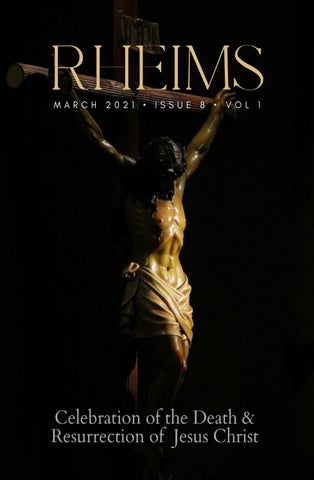
RHEIMS SPECIAL: MARCH
NEWS
WEDNEDAY, MARCH 31, 2021
COVID-19 cases on exponential rise
Duterte declares ECQ on NCR Plus by Dave Domingo
Photo from: Rappler
President Rodrigo Duterte placed National Capital Region (NCR), Cavite, Laguna, Bulacan, and Rizal, also known as the Greater Manila area, under the stricter enhanced community quarantine (ECQ) due to the spike in new COVID-19 cases. In his regular public address on March 29, Duterte said that the ECQ will be effective starting from March 29 until April 4. Furthermore, the president announced the new quarantine classifications, listing that Santiago City in Isabela will be placed under modified enhanced community quarantine (MECQ) from April 1 to 30, while Quirino Province will be under MECQ from April 1 to 15, 2021. He furthered that the entire Cordillera Administrative Region (CAR); Cagayan, Isabela, and Nueva Vizcaya in Region II; Batangas; Tacloban City (Visayas); and Iligan City, Davao City, and Lanao del Sur (Mindanao) will be placed under general community quarantine (GCQ) until April 30. Additionally, the remaining areas will be placed under modified general community quarantine (MGCQ) for the month of April.
Meanwhile, Presidential Spokesperson Harry Roque mentioned that all mass gatherings, including religious gatherings that were previously allowed to up to 10% capacity, are now prohibited. Malacañang retracted its earlier statement on religious gatherings, saying they will no longer be allowed even during the Holy Week celebration. Public gatherings such as weddings and baptism ceremonies may only have a maximum of 10 attendees. Indoor gatherings with persons outside of the immediate household will be prohibited as well. “The areas will be under a 6 p.m. to 5 a.m. curfew with exception to authorized persons outside of residence (APOR), cargo vehicles, and public transportation. Persons below 18 and above 60 years old, pregnant women, those with immunodeficiencies, comorbidities, and other health risks should remain in their homes at all times,” Malacañang said. In addition, travel passes are not required and exempted workers will only need to show their identification cards. The following are considered APOR: 1. Essential workers (must present IDs showing place of work and place of residence)
2
2. Health and emergency frontline services personnel 3. Government officials and government frontline personnel 4. Authorized humanitarian workers 5. Persons required to travel for medical and humanitarian needs 6. Persons en route to airports for essential travel abroad 7. Persons crossing cities and towns to get to their place of work/business or their residence 8. Returning overseas Filipinos (ROFs) and overseas Filipino workers (OFWs) Furthermore, Malacañang mentioned that public transportation and some priority construction projects will continue to operate subject to guidelines that will be provided by the Departments of Transportation and Public Works and Highways. The Palace furthered that only healthcare facilities, emergency frontline services, manufacturers of medical supplies and equipment, and services under agriculture and delivery of essential goods, will be allowed to operate at full capacity. Meanwhile private establishments, but only for essential goods and services, media establishments, and workers accredited by the DOTr may work at 50% operational capacity. In addition, only essential stores like groceries, pharmacies, and hardware are allowed to remain open in malls. Restaurants may only provide take-out and delivery services. The below industries are only permitted to operate with a skeletal workforce under ECQ 1. Other medical, dental, rehabilitation, and optometry clinics, pharmacies, or drugstores 2. Veterinary clinics 3. Banks and money-transfer services 4. Telecommunications companies, internet service providers, and cable TV providers 5. Manufacturing companies and suppliers of construction materials such as cement and steel 6. Funeral and embalming services 7. Security personnel 8. Real-estate activities limited to leasing 9. Capital markets 10. Water-supply and sanitation services and facilities 11. Energy and power companies 12. Airline and aircraft maintenance, pilots and crew, and employees 13. The Philippine Postal Corporation, PSA, BPOs, export businesses, and printing presses 14. Humanitarian assistance personnel from civil society organizations, NGOs, UN humanitarian country teams 15. Pastors, priests, rabbis, imams, or such other religious ministers for the conduct of necrological or funeral rites 16. Repair and maintenance of machinery and equipment As of March 29, the Department of Health reported 10,016 new COVID-19 cases summing up to 115,495 active cases. The Philippines has recorded 731,894 total cases since the start of the pandemic, 603,213 recoveries, 13,186 deaths.
The Lasallian Rheims
facebook.com/Rheims2020 @Rheims2020
RHEIMS SPECIAL: MARCH
NEWS
WEDNESDAY, MARCH 31, 2021
Holy Week vacation plans were ceased due to ‘NCR plus bubble’ by Jade Magno
Families from Metro Manila, Laguna, Cavite, Rizal, and Bulacan who are planning to have a vacation outside their city are prohibited to exit from the NCR plus bubble as it is not considered essential travel as defined by the ECQ regulations. Due to the turbulent vacation, numerous families who would have headed to Boracay, Palawan, Puerto Galera, and other tourist attractions in the Philippines are upset. According to Tourism Secretary Bernadette RomuloPuyat, those who lost their flights will be able to rebook. “Nakausap ko na ang lahat ng airlines, sinabi naman nila puwede mag-rebook nang walang penalty, ang hotel, and restaurant associations, puwede mag-rebook nang
walang penalty,” she added. According to the Manila International Airport Authority, domestic flights will proceed, and “essential travelers” will still be able to fly. Passengers who are returning from sightseeing or vacationing but are unable to fly due to the constraint may enter the Ninoy Aquino International Airport. “Humingi ang mga doktor kung puwede timeout muna. Nakakalungkot pero siyempre kailangan mapagbigyan ang mga doktor. Sabi naman nila 2 weeks lang pero nakakalungkot kasi bumubuwelo na tayo, Holy Week madaming aalis,” Puyat said. In response to travel restrictions caused by the COVID-19 pandemic, Israel invites Filipinos to vis-
it the e-Wailing Wall since travel to the Holy Land is restricted. Israel’s Tourism Ministry has created an online portal that will allow Filipinos to leave notes at Jerusalem’s Wailing Wall. “With travel currently restricted, we want to make this unique Israeli experience accessible for the Filipinos this Holy Week, so we created a portal for them to send their notes.” Israel Ministry of Tourism director for India and the Philippines, Sammy Yahia, said. Yahia added that the people who are unable to physically visit the Wailing Wall can send e-notes to a website, which will be imprinted in Jerusalem and displayed in the cracks of the 2,000 years old wall.
Duque considers diverting unused COVID-19 vaccines to regions much affected by the virus by Jade Magno
Health Secretary Francisco Duque III stated that he considers borrowing unused COVID-19 vaccines from regions with low-infection rates and divert them to areas hit by infection surges. “Ito’y hihiramin lang, hindi babawiin. Hindi mawawalan sila. Ito ay para makatulong makumpleto ang bakunahan ng ating priority group A,” Duque conveys to the reporters. Due to a large count of cases in those regions, he recognized the National Capital Region, Cordillera Administrative Region, CALABARZON, Central Luzon, and Central Visayas as possible recipients of vaccine supplies. “May mungkahi si (Marikina City) Mayor Marcy Teodoro na kung puwede ang mga bakuna sa mga lugar na mahina ang uptake (of vaccine) o mababa ang cases, baka pwede dalhin dito sa NCR, 4A, 3, 7 at CAR,” he said. Duque also stated that low vaccine turnout was observed in some regions’ hospitals. He claimed that readjusting the vaccine supply would prevent wastage. “May mga hospital na mababa ang uptake. Una, hindi ito sapilitan. Voluntary. Ang iba ayaw pa. Hindi puwedeng maghintay tayo, masasayang ang bakuna. AZ (AstraZeneca) expiry period is May 31. Dapat nang ipagamit,” Duque added. However, the League of Philippine Provinces (LPP) has spoken out against the suggested vaccine redeployment. “Hindi pa buo ang aming posisyon, pero ang pananaw namin, kailangan din namin ang mga bakuna. Kung talagang hindi gagamitin, itanong ang mga LGU if they want to return their vaccines,” LPP president Marinduque Governor Presbitero Velasco Jr said. According to Velasco, some local governments are still convincing their health care workers to get vaccinated and the vaccine supply in the provinces is already limited. Before implementing such a plan, Velasco encouraged facebook.com/Rheims2020 @Rheims2020
the national government to consult with local officials. “Kakaunti lang din ang binigay na supply sa amin eh, so kulang na kulang pa ‘yun. Pero sa iba na may sobra, tanungin na lang sila if they are willing to let go of the vaccines,” he added. Even so, Duque stated that he will try his best to plead to the LPP to consider giving their untouched vaccines to other regions, especially NCR where half of the cases are located in the region. “Papakiusapan ko. I will try my best, ‘yung mga mabababa ang active cases. Papakiusapan na lang na mataas talaga ang kaso sa NCR, nasa kalahati ng total cases natin,” he said. On the other hand, Vaccine Czar Secretary Carlito Galvez stated that approximately 2.3 million doses of the COVID-19 vaccine will arrive in the country at the end of March or early April. “We have 400,000 coming this coming March 24, and then we still have 1 million coming this coming March 29. So, we have 1.4 million and then we have 979,200 AstraZeneca from COVAX coming,” Galvez said. According to Galvez, the upcoming 2.3 million doses of the vaccine will be used to vaccinate the 1.7 million government-targeted health workers. Others on the priority list, such as the elderly, will receive the next batch of vaccines.
The Lasallian Rheims
3
DOH SecretaryFrancisco Duque III (Photo from: MSN, Presidential Communications)
NEWS
RHEIMS SPECIAL: MARCH
WEDNESDAY, MARCH 31, 2021
Students have spoken
51% dissatisfied on Duterte Admin by Renz Bautista and Dave Domingo
51.4% of ASJ high school students are dissatisfied with the Duterte administration with 14.7% completely dissatisfied, 19.1% dissatisfied, and 17.6% somewhat dissatisfied. In a survey of 68 high school students, only 27.9% are satisfied with the Duterte Administration, ranging from somewhat satisfied (16.2%), satisfied (7.4%) and completely satisfied (4.4%). Meanwhile, 20.6% of respondents rated the Duterte Administration as 4 which means they rated the current performance of the administration as average. On the other hand, only 1 (1.5%) of the respondents an-
swered that they were in favor of political dynasties. While 28 people (41.2%) answered that they are not in favor of political dynasties, 25 people (36.8%) answered that they are not sure, and 14 people (20.6%) abstained from answering. Regarding the probable person for presidency for the
2022 PH elections, 55 responses or 80.9% either did not answer, abstained from voting, or had no answer on the question. 4 people (5.9%) answered Isko Moreno, 4 people (5.9%) answered Sarah Duterte, 1 person each answered Leni Robredo, Bong Go, Bongbong Marcos, Chel Diokno, and Rodrigo Duterte.
Students recall their experiences before ECQ by Renz Bautista and Dave Domingo
When asked about the last food they ate in the canteen before the March 2020 quarantine, students said that they ate selections of food, mostly from Ate Cristy, such as fishball, fried chicken, siomai, fried rice, chow fan, and some from Ate Gina, such as iced tea, biscuits, and ice cream. In a survey conducted on March 15 – 17, 2021, some students did not answer the question because of two reasons: (1) they have packed food
Mojica, Salaguinto clinch top spots in BFP Contests by Lance Crisostomo Two of ASJ’s artists bagged awards in the Digital artwork and Photography contest of the Bureau of Fire Protection held online last March 6. John Czar Salaguinto won second place in the Digital Artwork contest while Al Andre Mojica was hailed champion in the Photography contest of the said event. In an interview, John Czar stated that he felt pressure due to the fact
4
for that day, or (2) they already forgot what they ate in the canteen. Additionally, students shared their last experiences in school, listing activities like simply chatting and studying with friends, reviewed for the DELASSAT, practiced for their moving up or graduation, doing projects, playing with their friends, or eating in the canteen. The survey was conducted to mark the first-year anniversary of the COVID-19 lockdown in the that they didn’t have time to prepare and there was a short amount of time provided but luckily, the time was just enough for him to have his sketch. “Okay naman yung laban, nakakapressure kasi biglaan at walang preparation pero buti nabigyan ko ng time ang pagssketch ng initial output na ipapasa ko. Nagulat ako kasi kahit onti lang yung time span na binigay,” Salaguinto stated. He also added that he felt the satisfaction when he was announced as a winner because everyone who competed were really talented and he thanked ASJ for the opportunity to compete. “...di ko expect na manalo kasi mabibigat din yung mga kalaban ko from other schools so ang laking satisfaction yung nadama ko nung inannounce na kasama ako sa winners, saka thank you sa ASJ
The Lasallian Rheims
Philippines. The scope of the survey are the junior and senior high school students. There were 68 respondents ranging from grades seven to twelve. Of the respondents, 52.9% are male and 47.1% are female. With regard to grade level, 19.1% belong to Grade 7, 11.8% belong to Grade 8, 10.3% belong to Grade 9, 27.9% belong to Grade 10, 14.7% belong to Grade 11, and 16.2% belong to Grade 12. sa pagsali sakin dahil may tiwala sila sa abilities ko,” Salaguinto said. Salaguinto commended Andre Mojica for his win due to the fact that he is able to grab the championship in the short amount of time to take the photos and create a caption for his entries. “Ang magsasabi ko sa pagkapanalo niya is tulad den ng sakin which is unexpected kasi onti lang yung time na nabigay at sa mismong day pa ng submission siya nakapagtake ng picture para ilaban, nakakagulat na nagchampion kasi di din namin expect dahil nga alam niya ding magagaling yung mga kalaban niyo nung binigay list ng mga kasali,” Salaguinto added. The event was held as part of the Fire prevention month activities with the theme: “Sa Pag-iwas sa Sunog, Hindi ka Nag-iisa”. facebook.com/Rheims2020 @Rheims2020
RHEIMS SPECIAL: MARCH
NEWS
WEDNESDAY, MARCH 31, 2021
Gawad Alab culminates its Webinar Series with three successive Plenaries by Dave Domingo
Gawad Alab hosted three Plenaries in one week, featuring Mr. Xian Lerry Lozares, Prof. Xiao Chua, Annabelle Mcdonnell, Daphne Villanueva, Hidilyn Diaz, and Br. Dennis Magbanua FSC, to complete its Webinar Series. On March 22, Mr. Lozares discussed News Literacy and Responsible Netizenship, while Prof. Xiao Chua answered the question: “How can we use the rich Philippine history and culture to create meaningful contemporary artworks and writings?” on March 24. “It is indeed the last Gawad Alab Webinar and you know how the saying goes, we saved the best of the best for last. This is not just a webinar but ‘the’ webinar that even made me jump out of my seat as soon as I knew about it. Sit back Lasallians and let us all learn from not just one speaker but three great speakers that will be with us today,” stated Lance Crisostomo, co-host of the Plenary titled Exemplifying excellence in various art forms - The Lasallian Way on March 26. According to Senior Editorial Board Chairman Marcus Mugol, the judging phase has already concluded for all contests. Furthermore, he announced that Gawad Alab’s Premiere Night has been scheduled on April 9. Meanwhile, Gawad Alab participants described their experiences in a series of interviews. Gawad Alab participant Leicorina Abillon shared that Gawad Alab was a new experience and opportunity for her that led her into discovering herself. “Madami akong natutunan sa mga speak ers sa Webinar. Madami rin akong na-apply sa mga contest na sinalihan ko. And most importantly nag-enjoy ako,” she added. Abillon furthered that she didn’t view Gawad Alab as a contest but rather an opportunity to showcase her abilities, and learn from the guest speakers.
Grade 10 student Fiona Tabi discusses her experiences in Gawad Alab last March 24.
“I was able to freely express myself, my authentic self, wherein napakita ko kung sino talaga ako bilang isang tao, bilang artist, bilang director, bilang creator, bilang kaibigan,” another Gawad Alab participant Samuel Robles aired. Similarly, Gawad Alab participant Gillian Rueco shared that she and her friends who participated with her had fun making the outputs for the contest. “Overall, it was a very memorable experience to have. I am glad na I participated in this contest. Madami akong natutunan from that experience and I was able to improve [my] filmmaking skills,” she added. Rueco noted that if the contest were to happen again, she would join “for sure.” “I had a pleasant experience. It gave me an opportunity to exercise my skills and it challenged me to do the best that I can to produce an excellent output,” answered Fiona Tabi when asked about her Gawad Alab experience.
ASJ students won places in ASMEPPS Nationals by Lance Crisostomo
Four high school students and one grade school pupil battled their way to victory in the first-ever Online National Battle of Math and Science Champions of the Association of Science and Math Educators of the Philippine Private Schools (ASMEPPS), March 6. ASJ garnered a total of seven places combined for both Science and Math Quiz Bee in which the results were announced on the official Facebook page of ASMEPPS. According to Aaron Barcelita, grade 10 Science Quiz Bee champion who is now a back-to-back champion, the nationals this year and last year had a fair share of similarities and differences which made him confused and surprised but the thrill of joining contests out stood all of these. “The Nationals last year and this year have their own similarities and differences. The shift to online has definitely made me surprised and confused, and that is only one of the changes I’ve seen. Another change is the stricter implementation of rules and regulation. But the only thing that remained the same for these two different experiences, is that the thrill was still there. For me, it was the thrill of joining such facebook.com/Rheims2020 @Rheims2020
contests that made me agree to join,” Barcelita stated. Barcelita added that he didn’t expect to win two national championships due to the struggles brought by the current situation but in the end, he felt happy and thanked God for it. “I feel happy that I got to be the back-to-back champion in ASMEPPS for the past two years. I honestly didn’t expect that I would still be the champion this year, because of the struggles I had to deal with, and because of the current situation. But still, thank God that I was able to win,” Barcelita said. SCIENCE: Amber Zabene Barlas - 5th place Grade 4 Aaron John Barcelita - CHAMPION Grade 10 Christian Theniel Matro - 4th place Grade 10 Renz Adrian Bautista - 3rd place Grade 11 MATH: Christian Theniel Matro - 4th place Grade 10 Lance Jerson Crisostomo - 4th place Grade 11 Renz Adrian Bautista - 8th place Grade 11
The Lasallian Rheims
5
RHEIMS SPECIAL: MARCH
NEWS
WEDNESDAY, MARCH 31, 2021
PH adds Navy ships to the West PH Sea
by Jade Magno
AFP Chief of Staff Lt. Gen. Cirilito Sobejana has ordered the deployment of more Navy ships to the West Philippine Sea to strengthen the country’s maritime sovereignty patrols in the region. “By increased naval presence in the area, we seek to reassure our people of (our) strong, unwavering commitment to protect and defend them from harassment, ensure they enjoy their rights over the country’s rich fishing grounds which is their source of livelihood,” AFP spokesperson, Marine Maj. Gen. Edgard Arevalo said. More Navy ships were deployed as China’s maritime military fleet remained at the Julian Felipe Reef (Whitsun Reef) amid increasing international demands for it to be recalled. The reef is also located within the Philippine Exclusive Economic Zone (EEZ) and continental shelf, over which the Philippines has exclusive rights to exploit resources such as fish, oil, and natural gas. According to the AFP, they are unable to send their Navy ships to the reef since China’s maritime militia vessels are allegedly civilian. They pointed out that sending a warship could be seen as hostile, prompting China to send its own, stronger Navy. “China’s People’s Liberation Army (PLA) rep-
resentatives reiterated their government’s assurance that those ships were not manned by militia and that those were constrained to seek shelter in the area when inclement weather hampered their fishing activity,” he added. However, according to the National Task Force, although the weather was calm at the time, the Chinese vessels gathered at the reef showed no signs of fishing and had their full white lights switched on at night. “In consonance with the Philippine commitment to the United Nations Convention for the Law of the Sea (UNCLOS), the Government shall continue to peacefully and proactively pursue its initiatives on environmental protection, food security, and freedom of navigation in the West Philippine Sea as part of its overall national security policy,” the task force said. The presence of the militia vessels has caused deep concern in the United States, Japan, Australia, and Canada, which have described the movement as a challenge to regional and global stability. China’s interference into the country’s EEZ, according to the Philippine Council on Foreign Relations, is a “significant concern” not just for the Southeast Asian region, but for the entire world. Photo from: ABS-CBN News
GenTri Mayor orders health protocols to prevent spike in COVID-19 cases by Dave Domingo
Gen. Trias City Mayor Antonio “Ony” Ferrer issued Executive Order No. 8 (s. 2021), imposing Stringent Public Health Protocols to prevent further increase of new COVID-19 cases in the city. In a public announcement on March 15, Ferrer said that the reason behind the EO was the increase in new COVID-19 cases for the past four weeks reported by the City Epidemiology Surveillance Unit, combined with the order from the Department of Interior and Local Government to strictly enforce health protocols. Furthermore, Ferrer declared that wearing of face masks and face shields in public places and all establishments shall be mandatory. “Curfew hours for 16 years old and above shall be from 10 p.m. until 5 a.m. Only Authorized Persons Outside of their Residence (APOR) are exempted from the curfew provided they present proper identification at control/checkpoints; curfew hours for 10 to 15 years old shall be from 6 a.m. until 7 a.m.,” he added. In the same announcement, the mayor publicized that minors below ten years of age and senior citizens above sixty-five years of age are strictly prohibited from going out of their residence unless during cases of medical emergencies. In addition, the city government implemented a liquor ban for one month. According to the EO, all forms of pub-
6
lic, mass or social gatherings including weddings, birthdays, funerals, entertainment activities and the like shall be limited only to ten (10) persons or fifty percent (50%) venue capacity whichever is lesser. “Bisita Iglesia of non-residents is prohibited,” Ferrer furthered. Meanwhile, if the cause of death is not COVIDrelated, funeral wake shall be limited to five days. “Otherwise, if the cause of death is COVIDrelated, immediate internment shall be mandatory. Funeral processions shall be prohibited,” the EO stated. On the other hand, Ferrer noted that all returning residents and Overseas Filipinos shall be required to report to the Barangay Health Emergency Response Team (BHERT) upon arrival at the city for recording and initial medical evaluation. He noted that only symptomatic individuals shall be required to undergo fourteen (14) days facility-based quarantine but asymptomatic returning residents and Overseas Filipinos will not be required to take RT-PCR Swab Tests. “The use of StaySafe.PH application or any form of contact tracing shall be mandatory for all establishments,” the mayor added. Ferrer also mentioned that the City Health Office, General Trias Component City Police Station, and Barangay LGUs shall oversee the implementation of the abovementioned health protocols.
The Lasallian Rheims
facebook.com/Rheims2020 @Rheims2020
Photo from: City Government of General Trias
RHEIMS SPECIAL: MARCH
NEWS
WEDNESDAY, MARCH 31, 2021
CHED approves select institutions to conduct limited face-to-face classes by Dave Domingo
The Commission on Higher Education (CHED) has allowed 24 higher education institutions (HEIs) to hold limited face-to-face classes starting the second semester of School Year 2020-2021. The institutions given approval by CHED are: 1. Mariano Marcos State University - Batac (Region I) 2. St. Louis University (Cordillera Administrative Region) 3. Our Lady of Fatima University - City of San Fernando (Region III) 4. Ateneo School of Medicine and Public Health (National Capital Region-NCR) 5. University of Santo Tomas (NCR) 6. University of East Ramon Magsaysay (NCR) 7. Our Lady of Fatima University - Quezon City (NCR) 8. Our Lady of Fatima University - Valenzuela City (NCR) 9. Manila Central University (NCR) 10. University of the Philippines-Manila (NCR) 11. Adventist University of the Philippines (Region IV-A) 12. De La Salle Health and Medical Science Institute (Region IV-A) 13. University of Perpetual Help - Don Jose (Region IV-A) 14. Our Lady of Fatima University - Sta. Rosa (Region IV-A) 15. Naga College Foundation (Region V) 16. West Visayas State University (Region VI) 17. Central Philippine University (Region VI) 18. Cebu Institute of Medicine (Region VII)
19. University of Cebu School of Medicine (Region VII) 20. Iloilo Doctors’ College of Medicine (Region VI) 21. University of Iloilo (Region VI) 22. Blancia Foundation College, Inc. (Region IX) 23. Xavier University (Region X) 24. Liceo de Cagayan University (Region X) In a statement on March 25, CHED noted that selected allied health-related degree programs such as Medicine, Nursing, Medical Technology or Medical Laboratory Science, Physical Therapy, Midwifery, and Public Health were prioritized. According to CHED, this would enable students to achieve key learning outcomes on specialized laboratory courses and hospital-based clinical clerkship/internship/practicum, as well as to provide additional manpower to the country’s health system. Meanwhile, CHED Chairman Prospero de Vera III announced that the colleges and universities have passed stringent retrofitting and have fully complied with the guidelines of the Department of Health and the COVID-19 Inter-Agency Task Force for the Management of Emerging Infectious Diseases (IATF-EID). "They can now bring their 3rd and 4th year students for hands-on training and laboratory classes in a limited faceto-face system. CHED will continue to monitor these HEIs and I am confident that they will provide safe and healthy spaces for their students in the coming months,” he added.
DENR alerts LGUs about healthcare waste in the ocean by Jade Magno
The Department of Environment and Natural Resources (DENR) has issued an alert on local government units (LGU), following the discovery of medical waste, such as face masks, entangled in the coral reefs of Anilao, Batangas. “The recent discovery of disposable face masks, plastic face shields, and other household healthcare wastes in our reefs is alarming. These wastes will harm both marine life and divers,” DENR Secretary Roy Cimatu said. He stated that while following health and safety procedures is critical in combating coronavirus disease (COVID-19), it is also critical to be mindful of one's environmental responsibilities. “We have coordinated with the Philippine Coast Guard to ensure that all international and inter-island vessels, and even fishing vessels, have placed yellow bins for the proper disposal and storage of generated COVID-19 related healthcare waste such as, used face masks, gloves, cotton, tissue papers, and testing kits,” Environment Undersecretary for Solid Waste Management and Local Government Units (LGUs) Concerns, Benny D. Antiporda said. Antripoda added that the DENR is also coordinating with the Department of Interior and Local Government (DILG) on proper management of domestic healthcare wastes, cleaning of esteros, and reminding those living near waterways not to dump wastes directly into bodies of water. He further stated that tracking the management of healthcare wastes generated from homes is more complex than monitoring waste collected by hospitals and quarantine facilities. “These (quarantine and medical) facilities are required to put up a treatment facility and get a hauling permit, so monitoring medical wastes come easy with these sectors,” he said. facebook.com/Rheims2020 @Rheims2020
Antiporda announced that the DENR, along with its partner agencies, would continue to explore successful strategies in the coming days to resolve the "global crisis" of household healthcare wastes ending up in oceans and other bodies of water. Laban Konsyumer Inc., a consumer advocacy organization, and EcoWaste Coalition have urged the government to fix the country's increasing plastic pollution by enacting legislation banning single-use plastics (SUPs). “We need a strong policy in the form of a Republic Act that will provide a general framework, direction, and timeline toward phasing out SUPs on a national scale within a reasonable period,” President of Laban Konsyumer and a full-time member of Consumers International, Vic Dimagiba, said. The two groups described key policy opportunities that could lead to a change in the country's packaging and distribution systems to be more environmentally friendly. The first is the implementation of national legislation prohibiting SUPs by the 18th Congress. The second is the publication of a list of non-environmentally acceptable products and packaging (NEAP) in compliance with Republic Act (RA) 9003, or the Ecological Solid Waste Management Act. “The adoption of such a law will support and strengthen the efforts by national government agencies, local government units, industries and businesses, civil society groups and consumers to address plastic pollution in an effective and united manner,” Dimagiba added. In honor of World Consumer Rights Day, both organizations released the joint statement, with the theme "Tackling Plastic Pollution" chosen by Consumers International, a global association of consumer groups.
The Lasallian Rheims
7
RHEIMS SPECIAL: MARCH
NEWS
WEDNESDAY, WEDNEDAY, MARCH 31, 2021
Remulla: I shall run again as Governor by Dave Domingo
Cavite Governor Jonvic Remulla (Photo from:Philippine Lifestyle News)
Cavite Governor Jonvic Remulla dismissed the assumptions that he is aiming for a national post, declaring that he will run again as Governor of Cavite in the 2022 PH Election. In a Facebook post last March 25, he stated that he has no intentions of aiming for national posts and the reason he has been discussing national-related topics on social media is because said issues do affect Cavite. “My work for Cavite is not yet finished. Most importantly, I am not the type to abandon my people,” he added. As an example, Remulla cited that the Basic Wage Structure of Cavite is significantly lower than Manila’s despite the price of goods, transportation, electricity, water, and internet service being relatively similar. “So why the disparity in minimum salary? Eh ang Cavite ay kadikit lang naman ng Metro Manila.
Hindi ba’t ang pamamaraan ng batas ay sadyang outdated na at hindi makatarungan sa ating mga probinsyano?” he added. According to the Department of Labor and Employment, the minimum wage of Non-Agriculture is approx. PHP 317-400, Agriculture is approx. PHP 303-372, and Retail & Service is approx. PHP 303. In contrast, the Basic Wage Structure of Manila is as follows: 1. Non-Agriculture is at PHP 537 2. Agri/Retail/Manufacturing is at PHP 500 “Let’s consider the Equal Protection of the Law: We do not demand absolute equality among our locals; we just want consideration for our people to be treated alike, under like circumstances and conditions both as to privileges conferred and liabilities enforced. After all, Cavite contributes heavily to the economic growth of the country,” Remulla added.
DUTERTE TELLS ROBREDO TO ‘JUST MAYBE SHUT UP’ ON THE HTAC REVIEW OF CORONAVAC by Dave Domingo
President Rodrigo Duterte rebuked Vice President Leni Robredo for “sending the wrong message” about CoronaVac, March 8. In his weekly prerecorded briefing, Duterte accused Robredo of creating doubts about the vaccines by backing the Health Technology Assessment Council (HTAC) to review CoronaVac. HTAC is an advisory body created under the Universal Health Care Act which reviews the cost and the ethical and community impact of health technol-
8
ogies, i.e. medicines, vaccines, or health devices, that will be introduced to the public. “She did not read the law that says the HTAC is just recommendatory. Now, we are fighting because time is of the essence. We were fighting against the tide of nonbelievers. Let’s not be afraid,” Duterte stated. Duterte also mentioned that instead of helping, the VP muddled up everything, creating an uncertainty and doubt in the minds of the people. “I hope next time, if she has nothing good to say, she just
The Lasallian Rheims
maybe shut up… I did not get irritated [napikon]. I got angry at you because I said: What is this? Time is running out to convince people,” he added. Furthermore, Health Secretary Francisco Duque III noted that the HTAC had already given CoronaVac a positive recommendation. “What I was told was that to buy Sinovac they needed to give their positive recommendation — which they did. We will be paying for it based on the supply agreement,” Duque added. facebook.com/Rheims2020 @Rheims2020
NEWS
RHEIMS SPECIAL: MARCH
WEDNESDAY, MARCH 31, 2021
P1 AND P3 DETECTED, COVID-19 SITUATION WORSENS by Lance Crisostomo
The threats of COVID-19 worsened as the Department of Health (DOH) confirmed the detection of two new variants and cases of such variants in the country in the process of the department’s continuous biosurveillance. According to DOH’s statement, the department has confirmed cases of P1 variant or the Brazil variant and P3 which others call Philippine Variant since it was first detected in the Philippines. As of March 20, there are six additional cases of the P3 variant, four of which were local cases while the other two are under verification, and one case still of the P1 variant which was detected from a returning Overseas Filipino Worker (OFW). DOH stated that P3 can’t be considered yet as the Philippine Variant but more appropriately described as a variant first reported in the Philippines. “The World Health Organization discourages the use of places to identify variants. The so-called UK and South African variants were tagged so because these variants were first reported in these countries,” DOH stated. In addition, Philippine Genome Center (PGC) Executive Director Dr. Cynthia Saloma said in an interview that P3 is locally developed because it is a local variant of the origin. “We have not seen that in the
600,000 deposits in the database. So, we believe that it developed locally,” she stated. In the March 20 press release of DOH, it stated that P3 is not yet a variant of concern since there is insufficient data that will state that this variant will have significant public health implications. With P3 and P1 added to the variants in the Philippines, there are now four variants that are under study and detected in the country including the UK variant and the South African Variant. Still, DOH implied that the public should strictly follow public health standards and safety protocols and that the public should stay home unless it is extremely necessary to go out. In addition, DOH encouraged the public to practice religious activities at home and avoid large gatherings since Holy Week is coming. “The DOH urges the public to stay at home unless extremely necessary and remember to avoid the three C’s (Closed spaces, Crowded places, and Close contact settings). With the upcoming Holy Week, the DOH encourages everyone to avoid large congregations and practice religious activities at home. Strict adherence to the minimum public health standards in all private and public settings is strongly emphasized to minimize COVID-19 transmissions and avoid further mutations.”
GenTri City Police GenTri City Gov’t houses 31 families affected by catches 107 offenders infrastructure projects of health protocols by Dave Domingo
General Trias City Government gave 31 informal settler families from the Barangays of Bacao I, Pinagtipunan and Santiago houses in Santiago through the Kalinga Village housing project. The project which is an initiative of Mayor Ony Ferrer, Cong. Jon-Jon Ferrer, Vice-Mayor Morit facebook.com/Rheims2020 @Rheims2020
by Dave Domingo
Sison at Sangguniang Panlungsod Members wished to provide proper and safe homes for the aforementioned families. According to the public post of the City Government of Gen Trias, the families include those who were affected by infrastructure projects or living in flood prone areas.
General Trias Component City Police Station apprehended 107 individuals who weren’t following the mandatory wearing of face mask and face shield from March 22-27. According to the report, 42 violators came from Genstar Market (Manggahan), 31 from Manggahan Intersection, 22 from
The Lasallian Rheims
Pamilihang Bayan (Poblacion), 7 from Talipapa - Tropical Village (San Francisco), and 5 from Talipapa Parklane Subd., Sunny Brooke 1 and 2 (San Francisco). In a public post on Mar 28, the City Government asked the public to comply with the health protocols to decrease the cases of COVID-19.
9 Photo from: City Government of General Trias
Editor-in-Chief: Christian Dave Domingo Associate EIC: Lance Jerson Crisostomo News Editor: Jade Magno Editorial: Seann Carpizo Renz Bautista Features: Mitzen Sotelo Poem: Justine Benedict Yalung Cover: Allexandra Pascual Comics: Adrianne Meigh Gonzales Marcus Railey Buhain Layout: Marcus Diego Mugol Adviser: Mr. Kent Bryan Colocado
WE ARE OPEN FOR
CONTRIBUTORS! Submit your work at
rheims@academyofsaintjohn.edu.ph
10
VACCINATIONS OFF TO A GOOD START INSIGHTS Seann Carpizo
For the past few months, the government has been working on getting a hold of vaccines for the country. According to VOA News, the Philippines is the last Southeast Asian Nation to receive a supply. But after long months of struggling and hardships, it was a major step that many people had looked forward to achieving if we ever plan to have a shot at getting out of this predicament. And sure enough, just this March we have finally received the first few batches of COVID-19 vaccines. February 28 and March 1, it was estimated that we will be receiving from two suppliers; one from SinoVac donated by the Chinese government and then AstraZeneca, a British-Swede pharmaceutical firm. SinoVac had arrived on February 28 as planned, while AstreZeneca was delayed up until March 4. With now a total of around roughly a million doses of available vaccines in our disposal, we’re on track towards a nationwide coronavirus inoculation campaign. As per the Duterte administration, they aim to vaccinate a number of 70 million Filipinos across the country. The elephant in the room here though is that there is still a large number of people who are
The Lasallian Rheims
unwilling to be given shots. But according to a WHO official, once more public information is disclosed, doubt and distrust will lessen amongst the citizens. After all, not everyone is on the same page when it comes to awareness of the news and information that is broadcasted or posted online every day. However, credit is where credit is due. The government was able to enact the nationwide campaign almost immediately after the vaccines had arrived in the country this March 1. Granted, the response and reactions of President Duterte to the pandemic was severely late, but they have been able to act quickly and on their feet with the vaccines as they came to realize its importance and the vision of what mustbe done for the country and the people. Not to say that the administration completely made up for their mistakes, but they’ve done a good job on handling the vaccinations so far, with results to boot. In a report made this March 9, since the start of the program, it is estimated that 44,000 people have already been vaccinated against COVID-19 according to Secretary Carlito Galvez Jr. in a prerecorded briefing with President Duterte. If the country is able to keep up this pace, then we may stand a fighting chance against this crisis, and perhaps in a few months, things can start slowly going back to normal again. facebook.com/Rheims2020 @Rheims2020
Art by: Seann Carpizo
March COVID-19 Surge: Who is to blame? EURUS Lance Crisostomo
March has been a shock to the Filipinos as the number of COVID cases spikes wherein there are several days where cases passed the 5,000 mark even reaching 8,000 last March 22. Even though
vaccines have already arrived and are starting to be placed for use, it is evident that there is a breach in the response system of the country. But the question remains, who is to blame for all of these? The palace has already released its statement that the government mustn’t be blamed for the surge that happened. SEE PAGE 10
Will killing be the SOP of law enforcement? GHOTI Dave Domingo
March 5, President Rodrigo Duterte has ordered the military and police forces to ‘finish off’ and ‘kill all communist rebels in the country. “Forget about human rights. facebook.com/Rheims2020 @Rheims2020
That’s my order. I’m willing to go to jail, that’s not a problem,” he added. March 7, CALABARZON was hailed with bullets as nine people were shot dead across the provinces of Cavite, Laguna, Batangas, Rizal, and Quezon. With six being in Rizal, two in Batangas, and one in Cavite. SEE PAGE 11
The Lasallian Rheims
11
RHEIMS SPECIAL: MARCH
EDITORIAL
WEDNESDAY, MARCH 31, 2021
Continuation from Eurus, March COVID-19 Surge: Who is to blame? According to Presidential Spokesperson Harry Roque, the virus continues to mutate and for that reason, there are new variants that are discovered and is one of the reasons for this surge. He added that the government wasn’t sloppy at all. As a matter of fact, he stated that the government had an excellent rating in terms of handling the situation. He also pointed out that this surge may also be brought about by the complacency of the public, people who don’t coordinate, and the decrease in the number of contact tracers due to illness. On the other side, the medical frontliners are pleading to the government to stop blaming the people. Health professionals are already pushing for safety measures so as to control the surge happening currently. According to Dr. Antonio Dans, internal medicine specialist and epidemiologist, the people are already getting tired as they are doing everything that they can to comply. In addition, Healthcare Professionals Alliance Against COVID-19 (HPAAC) has stated that this surge was brought about by poor sustenance of safe environments and suggested ways on how to act on it like following APAT or Air circulation, Physical distancing, Always wear a face mask and face shield, and Thirty-minute interactions or less. Was the government’s handling really excellent? No. There are no grounds to support such a claim but there are grounds that would definitely go against it. Can we really call it excellent when the Philippines belong to the top 40 countries with the highest number of cases all over the world?
RPTD Renz Bautista
Happy Anniversary, but to what?
Anniversary, a word that means a day of commemoration or recognition because of something worth remembering, and usually a cause for celebration, or even declared a special day on the likes of birthdays, and events such as the EDSA people power revolution and Bonifacio’s death, which were declared holidays in the Philippines. One year ago, the Philippines went under the Enhanced Community Quarantine (ECQ). However, as time went on, things got worse. Our COVID-19 situation today is so much worse - so much that all the progress we made last year, regressed back to square one. The question is, what happened last year? It was during March 12, 2020 when President Duterte first imposed the biggest pandemic restriction in the Philippines, particularly in the National Capital Region (NCR). It was implemented on the first minute as soon March 15, 2020 struck. The Enhanced Community Quarantine lasted for 2 months, easing the quarantine regulations and protocols the following months. For the first two months wherein, everybody was obliged to stay-at-home, except those who are working in “essential industries,” skeletal work in offices, public land, air and water transportation was shut down, and mass gatherings were prohibited. It was a deteriorating experience for everybody. Many rushed to the airports, and terminals as soon as Duterte’s declaration was broadcasted. Panic buying also occurred, supply of rubbing alcohol and other essential goods diminished quickly. There was also a requirement of a socalled “quarantine pass”, where holders of the said pass can only go out of their homes and can bypass police and military checkpoints for only selected reasons: for working or buying essential goods, which had strict requirements. Curfew times were also imposed, which were questioned by many. One year after the lockdown; as of this writing, the new COVID-19 cases have reached record-breaking numbers starting March 25. It is safe to say that the quarantine produced no effect on the reduction of COVID-19 cases, especially when quarantine measures are eased from the General Community Quarantine (GCQ) to a modified version.
12
There are certain actions and certain mistakes done by the government that led to this situation. Even government officials themselves in the likes of yours truly, Harry Roque is positive for COVID-19. The taking of this virus lightly during the first phases and middle phases of the pandemic is now baring its fangs through the current surge. On the other hand, there is no denying that the people also have a part in this. Since the quarantine protocols were less strict and everything seemed to be back to normal, people went back to their old ways of having gatherings and neglecting health standards set by the Department of Health (DOH). And as tourism and the economy started to open their doors once again, people have already started to forget about the pandemic. With that, the virus had the perfect opportunity to transmit and mutate leading to the current situation. The golden question remains, who is to blame for everything? Everyone has a fair share of the blame for the current COVID-19 situation of the Philippines. It is not just the government who had their lapses but the people as well. It seems like it is the government who is to blame for everything since their mistakes are televised and reported through publications but the people also have their mistakes which are observable in their daily lives. Instead of asking and arguing on who is to blame, let the nation focus itself on two important questions, What do we do now? How do we do it now? As a nation, there is a possibility of rising up once again, one step at a time.
The Philippines was featured in international news outlets such as TIME stating that the Philippines has one of the longest lockdowns, which reached 377 days according to ABSCBN, as of this writing. The Philippines is also the country highest in the Western Pacific in terms of active and new COVID-19 cases. Hospitals and quarantine facilities are in critical capacity, reaching 80% the past days and are continuing to rise. I feel amazed at how Presidential Spokesperson Harry Roque still has the guts to say that the Philippines, despite (1) the high positive rates reaching 115,495 active cases as of March 29, (2) the unstable economy with national debt reaching more than Php. 10 Trillion, (3) the presence of multiple COVID-19 variants, and (4) the slow acquisition of vaccines, have done “very well” in the COVID-19 situation, no wonder that the Philippines is experiencing many hardships during the lockdown. Prioritization of unrelated projects such as the Manila Bay Dolomite White Sand, the confusing and questionable policies and movements made by the government, and corruption also added to the problem. In a survey about the status of the COVID-19 quarantine conducted to high school students of Academy of Saint John in which there are 68 responses, 28 people (41.2%) reported that they are completely dissatisfied, and there were no responses in which they felt completely satisfied. The survey also asked for a rating of the national government COVID-19 response, the average rating of the students was 3.174 (average leading to dissatisfaction), 11 of the responses said that they were completely dissatisfied, 4 answered that they were slightly satisfied with the government response and 18 gave a neutral answer. We are still experiencing the hardships provided by this long lockdown. We may not enjoy the freedom other countries are experiencing, we should still do our part to reduce the transmission of COVID-19 in the Philippines. As much as possible, do not go out (except for essential reasons), always wear your face masks and face shields, disinfect, and observe social distancing. These actions, although little, can still make a big impact to make our society a better place.
The Lasallian Rheims
facebook.com/Rheims2020 @Rheims2020
RHEIMS SPECIAL: MARCH
EDITORIAL
WEDNESDAY, MARCH 31, 2021
Continuation from Ghoti, Will killing be the SOP of law enforcement? The Philippine National Police (PNP) claimed these acts to be legitimate security operations. A day after, March 8, Calbayog City Mayor Ronaldo Aquino was shot together with his driver, a municipal police chief, and three others. The PNP asserted that it was a ‘shootout’ with a police team. In the ‘police shootout’, witnesses described the perpetrators as wearing bonnets to conceal their identity. In the ‘police shootout’, the police did not cordon off the area to preserve evidence. In the ‘police shootout’, there was no attempt to save the lives of anyone who might’ve been caught in the crossfire. No, in the ‘police shootout’ passersby were able to approach the van and discover the mayor dead inside. Frankly, the supposed police encounter looks more like a crime scene than a legitimate operation. Are these really police operations for the safety of the country or brazen and brutal murders? March 12, the Armed Forces of the Philippines (AFP) and Commission on Human Rights (CHR) signed a memorandum of understanding (MOU) to work together to respect human rights. The MOU stated that the AFP and CHR would work on education, training and advocacy, “foster increased education and training, information sharing and referral of cases”; improve monitoring and reporting of cases of human rights violations and “solidify coordination” to prevent human rights abuses. I find this ridiculous. Shouldn’t the dates be reversed? The memorandum was signed at the end of the week of murders. The move happened right after the cases of human rights abuses. According to Investigate PH, an international coalition of civil, political and legal organi-
zations, the Philippines is in a human rights crisis. They said that the human rights situation in the Philippines has only gotten worse since the UN Office of the High Commissioner for Human Rights first flagged brazen abuses in the country in June last year. Additionally, they added that these abuses were compounded by the police and military being the perpetrators themselves of grave violations, and the government’s counterinsurgency task force orchestrating “political repression and militarizing governance.” Philippines’ recent history is written in red. These murders aren’t even covert. They are in the light of day. Brazen and Brutal. It cannot be refuted. The culture and trend of the Philippine Law Enforcement is kill, kill, kill. In Cushman, Gray, Gaffey, and Mendes’ (2011) book titled “Simulating Murder: The Aversion to Harmful Action” they asserted that there is a basic human aversion to physically harming others. The idea that harming others is wrong is engraved in instinct. But why aren’t these issues being tackled with urgency, importance, and seriousness. Following the report of Investigate PH, Presidential Communications Operations Office Secretary Martin Andanar labeled it as malicious. Why? Andanar debunked the allegations, saying “the country has functioning accountability mechanisms and rule of law and its authorities are competent to address allegations of impunity within national administrative and legal institutions and processes.” Can we trust that? Knowing that the Philippine government is not a bit transparent? Sure they can tag these reports as malicious like the way they tag critics of the administration as terrorists. But they cannot refute that these are false. The Philippines has a human rights crisis. It is true and we need to do something about it.
Face-to-Face Classes: When will they return? by Seann Carpizo
One of the bigger changes throughout the country since the start of the coronavirus pandemic is the shift of the education system from face-to-face classes towards online learning via learning management systems (LMS). The entirety of the current school year has been carried out through the internet and a bunch of screens, and for the most part many students weren’t able to adapt to this change very quickly especially during around the beginning of classes last year. According to a survey, the majority agrees that distance learning has been inherently more difficult to put up with compared to face-to-face sessions. 87% for those in Luzon, 92% in Visayas, and 88% percent of those in Mindanao who were interviewed had agreed to this notion, especially students themselves. At this point, a lot of people are waiting on and expecting news as regards to the status of back-to-school classes during this time of pandemic. In one of the Palace’s statements, President Duterte has denied the proposal of resuming physical classes until at least the situation is more under control. Palace spokesperson Roque said that in-person learning may possibly resume by August of 2021 if the vaccination campaign has already undertaken and seen good results. But he mentioned that it would apply facebook.com/Rheims2020 @Rheims2020
only to areas where COVID-19 cases are low first. One of the proposals as well is the half-day rule for face-to-face classes, either in the morning or afternoon, which was suggested by DEPED Undersecretary Nepomuceno at a Senate hearing. He claims that if FTF classes will be implemented, a half-day should be the maximum allotted time at best. Another thing mentioned in the hearing is that the number of classes at any given point in time for a school is also limited, with only one class per grade level at smaller schools, three for medium schools, and a maximum of five for the large universities. Considering the state of our country in terms of the pandemic, you can imagine how and why it’s so important to think of all these details in implementing such policies. There’s a lot of factors that need to be considered in physical classes if we want to ensure that there are as few as possible chances for transmission within the students. It’s a problem that will only further be defined by the coming months as the vaccination campaign unfolds to us what may or may not be possible for the near future ahead of us. Do you think that face-to-face classes should even be considered for now? If you are tasked with creating the policies, how would you implement them?
The Lasallian Rheims
13
Spaniards:
CONQUISTADORES OR CO by Renz Bautista
In a Twitter post last March 14, Pope Francis greeted the Filipino nation on the arrival of the Christian faith to its shores, “Dear brothers and sisters from the #Philippines, five hundred years have passed since the Christian message first arrived in your land and you received the joy of the Gospel. And this joy is evident in your people. Thank you for the joy you bring to the whole world!” | twitter.com/pontifex While most Filipinos acknowledged the significant role of Christianity as an institution in the Philippines, many still have mixed feelings towards the religion’s overall impact in the country. As Professor Xiao Chua said, in one of his essays, “Why celebrate the 500
years of the arrival of Christianity? Isn’t it celebrating colonialism?” This ambivalence that some people have towards appreciating Christianity may be rooted to the controversies that the Church has often been involved, both historically and in contemporary society. It is the same church that is humble enough, however, to admit that it is always in need of purification (semper purificanda), when St. John Paul II, in the turn of the millennium, delivered the most sweeping papal apology ever, repenting for the errors of his church over the last 2,000 years. Should we really celebrate the 500 years of Christianity in the Philippines? Netizens have a multitude of reactions about this.
“It is we Philippines is the the world that ce humiliation throu by Western power disguised as ‘spre ty.’” | twitter.com/ “500 years o colonization—I th commemorate tha if Christianity is PH history. Toda still searching fo the aftermath of imperialism. God | twitter.com/longc “We celebrate the monstrosity t the past. Aside fro also a call to do c you are knowle
ONVICTS?
eird that the e only country in elebrates national ugh colonization rs that was poorly eading Christiani/iskonglasalista of religion-based hink it’s best to an celebrate it as the best thing in ay, Filipinos are or its identity in assimilation and bless everyone!” cakeHigad the faith and not that happened in om the faith, it is charity. I just hope edgeable enough
photo from: Medium.com
about the charity arms of the PH Church.” | twitter.com/enselucis “Today marks the 500th Anniversary since Magellan landed on our shores. As much as we reject colonization that he brought, we cannot deny that there is a gift that is worth to celebrate, the gift of FAITH! The birth of Christianity in the Philippines!” | twitter.com/JLMaanggay Answering his question, Xiao Chua said, “The past five hundred years not only saw Philippine Catholic Church History as the story of Padre Damasos and Padre Salvis, but of people like Bishop Domingo de Salazar, OP who exposed the abuses to the indios committed by fellow Spaniards, of people like Fathers Pelaez, Gomez, Burgos and Zamora, who fought for
the right of Filipinos to have a hand in directing our local church…” The past 500 years may be a long epic ride of hardships and persecutions, of prejudice and injustice, and of greatness and triumphs. The conquistadores may have had used the Christian faith to expand their colonial interests, disputing our right and liberties; but one cannot subdue the fact that it is the same faith that makes us survive every calamities and vicissitudes, that same faith that sustained the people in the ’86 revolution, that same faith that defines our identity as Pinoys. Perhaps, we may change the question: How can we not celebrate 500 years of Christianity in the Philippines?
RHEIMS SPECIAL: MARCH
FEATURE
WEDNESDAY, MARCH 31, 2021
Balancing the scales by Mitzen Sotelo and Lance Crisostomo
At birth, humans are classified based on biological attributes, usually as either male or female but once a person steps into society, humans go by their gender, the socially constructed role a person identifies him/herself to be. It maybe male, female, transgender, gender neutral etc. But in a society composed of different genders, it also has many issues such as gender stereotyping, gender inequality, sexism, etc. Which is why there is gender and development (GAD). Developed in the 1980’s, Gender and Development (GAD) is a development perspective that’s free from violence and respectful to human rights. This process helps empower and sustain one’s capabilities and brings out human potential regardless of a person’s gender. The GAD is made as an alternative to the Women in Development (WID) approach, because unlike the WID that empowers women, GAD gives concern to both men and women in the act of stopping gender inequality. This development ensures that equality among men and women may be achieved. It wipes out the idea of gender stereotyping or the labeling of certain genders with certain characteristics or traits that are socially believed to be attributed to that gender alone. It also eradicates the hierarchy of genders, to be more specific that males are
16
more dominant than females. GAD provides people with the view that both genders are equal and are special in their own ways. There is no delimiting factor now to who a female is and who a male is. That is what GAD is trying to imply. GAD proves that skills, hard-work, confidence are 3 of many other determinants one needs to achieve success in our society, and gender isn’t a basis. We citizens are given a chance to be who we are, who we want to be, regardless of whatever gender you’re entitled of. Gender equality cuts the lines that divide people from the possibilities of what they could do. Males can do what females do and vice versa. Males can have the same amount of opportunities as females receive and vice versa. No one may dictate who you are as a person. No one may dictate your expression of your self. No one may every define the skill sets and opportunities that you may attain. No one must put you down because of your gender. Let us always remember, it is us who define ourselves. It is by the power of our will and dedication that our skill sets may grow and develop. We are the masters of our lives. It is us who create our identity, our future, and our path. “A gender-equal society would be one where the word ‘gender’ does not exist: where everyone can be themselves.” -Gloria Steinem
The Lasallian Rheims
facebook.com/Rheims2020 @Rheims2020
photos from: Human Rights and Justice Group International and Philippine Commission on Women
The Missionary Mandate Continues Online by Lance Crisostomo
Photo from: Manila Bulletin
The Catholic Church has been gravely affected by this pandemic. It was forced to stop all activities which are in-line since last year. Masses were not feasible. Gatherings for feasts and celebrations were not allowable due to the threats of the virus. Everything seemed to be in a blur to the point that whether or not the faithful could be able to hold and partake in the traditions and activities of the Church would happen sometime soon. “If there’s a will, there’s a way” - that’s how a famous saying goes. The Catholic Church found a way to be able to reach out to people. Parishes utilized the internet, specifically Facebook to hold masses so that the spiritual nourishment of the believers shall continue. Bishops and parishes also utilized Youtube and Facebook live to be able to give seminars, retreats, reformations, and talks that would complement the Gospel messages from the eucharistic celebration. On the other hand, one Parochial Vicar recently took the internet and news platforms by storm. Parochial Vicar of the Immaculate Conception Parish in Balibago, Angeles City, Pampanga, Father Fiel Pareja utilized the internet in fashion as he entered the world of TikTok to preach and share the good news of Salvation. His contents were about prayers, verses, reflections, and special messages from God. Who would have thought that TikTok, which is the origin of new trends, dances, and challenges that people do, will be utilized for such a purpose? In his statement from the Manila Bulletin, Fr. Pareja said that he was hesitant to use TikTok because people might be surprised that a priest is using the platform. “I was hesitant, having in mind baka magulat sila nagti-Tiktok ang pari (they would be surprised when they see a priest joining TikTok) so I [disregarded] her persuasion. However, she [insisted]. So, I gave it a try,” Fr. Pareja stated. The believers received him warmly. They have embraced him and appreciated his efforts to fulfill his missionary mandate. There were even people who were asking for prayers and pieces of advice
facebook.com/Rheims2020 @Rheims2020
from him. “They are thankful that even if they are not physically present in the Church, they can still afford to hear God’s Word. Many were saying: ‘Nararamdaman ko pong hindi ako pinabayaan ng Panginoon (I feel that the Lord has not forsaken me),’ ‘Salamat may ganitong (Thank you because there’s this) avenue to nourish our relationship with the Lord,’ ‘Susuko na sana ako pero andiyan pala si (I was about to give up but I felt the) Lord through your preaching,” Fr. Pareja said. With all of this, Fr. Pareja was given names such as millennial priest and Father TikTok. People loved him so much that he has already reached 1.3 million followers in TikTok. Fr. Pareja considered social media is a gift from God that became a way so that he could be able to reach believers and proclaim the Word of God. It is vital during this time of crisis to continue his vocation and for the people to have companions in their lives and have spiritual nourishment. “Social media plays an important role during this worldwide health crisis. Through it, we can reach out to one another and can assure each one that they are not alone in their journey. The Word of God is not only to be proclaimed on the pulpit or during the Mass. It must be preached everywhere in season or out of season and social media can facilitate rapidly this proclamation,” Pareja ended. The ability to conform to the changes and challenges brought about by time and the pandemic is really a major leap for the Church. It shows us how devoted and firm the Church is to its mission of new evangelization, particularly the new evangelization of the Filipinos. Changes and challenges may be tough but the Church will find ways to reach us and bring us back to God. Fr. Pareja has found a special way to do so. He used TikTok as his way of reaching out to the people. This is a foreshadowing of the endless ways that the Church can bring out its mission and its ability to conform to changes. No pandemic nor modernization will stop the Church from reaching the people and proclaiming the good news of salvation.
The Lasallian Rheims
17
What will you Sacrifice? by Mitzen Sotelo
Derived from the Old English word Lencten meaning spring season, Lent begins on Ash Wednesday, or known as the day of ashes where the priest marks us with ash symbolizing death and repentance of our sins, marking the start of the Lenten season. It is a 40-day period of fasting and preparation for the coming of the Lord’s resurrection on Easter Sunday. Approximately six weeks before Easter Sunday, Christians do the 40-day fasting in imitation to Jesus Christ’s 40 days in the desert. To continue this practice, the church has stated the universal fasting norms indicating that on Ash Wednesday and Good Friday, Catholics over the age of 14 abstain from meat and those whose age are over 17 and under 60 fast in a way that they limit themselves to one full meal and two small meals. Fasting is an essential practice in our spiritual life which is most commonly done during the liturgical season but most especially during Lent. This practice makes us Christians withhold something good or things we enjoy for some time so that we could focus and depend more on God. This practice is also said to be a way for us to follow Jesus to the dessert and just like Christ, we fight the devil and harness spiritual discipline. While celebrating Lent, Christians make it a habit of shaking off sinful habits and we take time to repent for all the sins we’ve committed. One of the most cliché things people give up during lent is food such as chocolates and soft drinks, since the majority of people are fond of these things. Another one is looking at the reflection, human as we are, we tend to be vain at times, that is why some people give up looking at their reflection as their Lenten sacrifice. Through giving up vanity, people learn the value of self-love and the value of life without worrying about one’s appearance and by comparing oneself to other people.
Cutting oneself off from social media is another sacrifice. In modern day society, social media is one of the most used platforms that people find enjoyable. Some people sacrifice their social media accounts and cut themselves off from the online world, to take a break and focus on more important things such as family, nature, etc. People claim that by doing this, they realize the beauty of the simple things in life that lie right in front of them. Other Christians choose to practice temperance, by giving up alcoholic beverages. Most people give up their favorite foods and choose to become vegetarian as their way of sacrifice. While most people give up their hobbies, others use their time in building their spiritual self. People have many different things to give up as their Lenten sacrifice, all with one goal which is to leave what they are fond of behind and use the time to get closer to the Lord. Because of these practices, we learn how to control ourselves. And when Easter comes, not only can we rejoice and return to the things we love but we’ll realize the new life lessons we’ve harnessed and the stronger relationship we’ve formed with God. That is why through Lent, we are given the chance to change, reform, and become a better version of ourselves with the help of God’s grace as we await and welcome the coming of Easter. It’s a matter of what you’re willing to give up, what you want to change, and what you want to become. By this, we find ourselves returning to God, and this is the true meaning of Lent, amidst all the twists and turns of life, we find God again. So, for this Lenten season, what are you willing to sacrifice? “There is something about it, Lent. You give something up and everything’s more joyful.” -Elaine Stritch
photo from: Desiring God
Brutal Bliss Beyond Empty Defeat
Once white, inebriated blight Twice black, a beaten track Thrice over, an autumn clover Call my name forever Petty lines of white noise Drowning minds Losing control But the music doesn’t stop Your name is ethereal Blazing on my tongue Your figure is eternal Fleeting on my touch Punished for mortal sin My name is no longer mine Who are you, girl in red Calling my name forever - Justine Benedict Yalung
That friend That friend who knows the way you think and feel; He who knows but the perfect word to say. That friend whose mood - not jaundiced and not teal. Removed, for he is but a shade of gray. That friend who uses guilt to pull you down; He who displays machiavellianism. That friend whose kindness bears semblance, a clown’s, That ‘he,’ whose plumes exude narcissism. To take, but take is a dark empath’s style. In other’s err, he finds the greatest joy; But finds it ill at ease to feign a smile. Have you ever fallen for such a ploy? - That friend who speaks and acts, full of pretend, I ask, “have you ever had such a friend?” - Dave Domingo
Wala
Mayroong laman, Kung nagpasa ka sana. Ngunit wala pa.
-Marcus Mugol