The
![]()

The
independent student voice of Ohio State University since 1881.
Two fraternities are currently under interim suspension. What can happen next?
Reegan Davis Lantern Reporter
Alcohol, hazing and endangering behaviors continue to be an issue for Greek organizations at Ohio State and across the country.
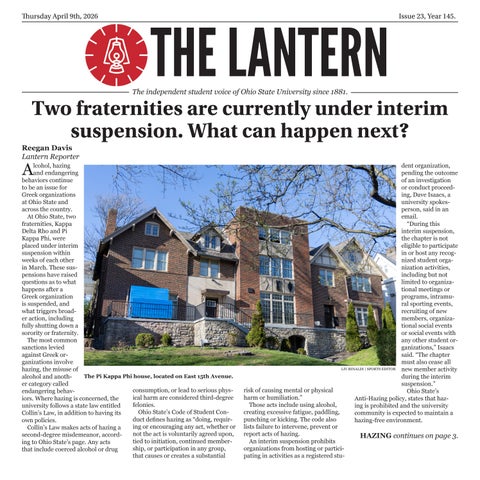
At Ohio State, two fraternities, Kappa Delta Rho and Pi Kappa Phi, were placed under interim suspension within weeks of each other in March. These suspensions have raised questions as to what happens after a Greek organization is suspended, and what triggers broader action, including fully shutting down a sorority or fraternity.
The most common sanctions levied against Greek organizations involve hazing, the misuse of alcohol and another category called endangering behaviors. Where hazing is concerned, the university follows a state law entitled Collin’s Law, in addition to having its own policies.

consumption, or lead to serious physical harm are considered third-degree felonies.
Collin’s Law makes acts of hazing a second-degree misdemeanor, according to Ohio State’s page. Any acts that include coerced alcohol or drug
Ohio State’s Code of Student Conduct defines hazing as “doing, requiring or encouraging any act, whether or not the act is voluntarily agreed upon, tied to initiation, continued membership, or participation in any group, that causes or creates a substantial
risk of causing mental or physical harm or humiliation.”
Those acts include using alcohol, creating excessive fatigue, paddling, punching or kicking. The code also lists failure to intervene, prevent or report acts of hazing.
An interim suspension prohibits organizations from hosting or participating in activities as a registered stu-
dent organization, pending the outcome of an investigation or conduct proceeding, Dave Isaacs, a university spokesperson, said in an email.
“During this interim suspension, the chapter is not eligible to participate in or host any recognized student organization activities, including but not limited to organizational meetings or programs, intramural sporting events, recruiting of new members, organizational social events or social events with any other student organizations,” Isaacs said. “The chapter must also cease all new member activity during the interim suspension.”
Ohio State’s Anti-Hazing policy, states that hazing is prohibited and the university community is expected to maintain a hazing-free environment.
HAZING continues on page 3.

On page 3 On page 5 On page 7
Fraternities suspended on campus
New local ice cream and coffee shop Ruby Remati’s journey
Josephine Pajemola Lantern Reporter
Growing up in small towns across Ohio, a career spent delving into East Asian studies was far from a young Mark Bender’s goals.
When he started his undergraduate degree at Ohio State in the ‘70s, Bender said a single course on East Asian art unveiled an unconsidered realm for him. Now a professor in the Department of East Asian Languages and Literature at Ohio State, Bender’s achievements in mentoring graduate students helped earn him the Kenneth Goldstein Award for Lifetime Academic Leadership from the American Folklore Society.
The award “recognizes outstanding abilities and achievement by a living scholar in academic leadership relating to folklore,” according to the American Folklore Society website.

When he first got the email notifying him of the award, Bender said he at first thought he hadn’t paid his membership dues. When he opened a follow up email, he said he was caught “flat-footed” by the honor.
“I was totally surprised,” Bender said. “And I still don’t understand why it was awarded to me.”
How he won was no mystery to Ziying You, a former graduate student
of Bender’s and associate professor of Comparative Literature and Intercultural Studies at the University of Georgia. She helped lead a letter writing campaign to nominate him for the award.
“Professor Bender has been a brilliant role model for all of his students. He’s a brilliant teacher, scholar, researcher, mentor,” You said. “He cultivated a generation of amazing scholars.”
Bender advised You during her Ph.D. candidacy in East Asian Lan-
guages and Literature at Ohio State. Currently serving on the American Folklore Society board, You has published four books and is currently advising her own students.
“I’m trying to imitate Professor Bender’s style in teaching, in mentoring students in doing research,” You said. “He really tried to teach us how to stay current.”
Obtaining a bachelor’s degree, a master’s and a Ph.D. in East Asian languages and literature from Ohio State, Bender spent many years in southern
China. He moved abroad for a year to a university in Wuhan and spent the rest of his time at Guangxi University in Nanning, China, Bender said.
Bender was later chair of the Department of East Asian Languages and Literature at the university for 12 years and has contributed significant research in many fields, specifically ethnic minority literature in China, according to his online bio.
Bender said his proudest achievement is the graduate students he produces.
“They’re all at the cutting edge of folklore studies right now,” Bender said.
You said Bender is currently contributing a chapter surrounding Asian folklore studies to an upcoming project in collaboration with her and other scholars in the field.
Bender said that though his award is for a lifetime of achievement, that doesn’t mean he’s about to stop teaching and mentoring.
“I’m not planning on retiring anytime soon,” Bender said. “So I’m hoping that this is just an acknowledgment of stuff so far.”

Continued from page 1.
“The Ohio State University is committed to promoting a safe and healthy campus environment, where students are free from hazing,” the document states. “Hazing impedes
the university’s vision of being the model 21st-century public, land grant, research, urban, community-engaged institution.”
The interim suspension remains in effect until the vice president of student life, or the vice president’s appointee, ends the suspension, or the
Greek organization successfully requests the removal of the suspension, according to a university website.
If a student organization’s status gets revoked due to violating the Code of Student Conduct, it no longer is recognized as a student organization and it is no longer affiliated with the
university, according to the Office of Student Life.
Pi Kappa Phi was placed on interim suspension after a student was hospitalized following a fraternity event on March 25, per prior Lantern reporting. The fraternity was placed under suspension the next morning.
At the time of publication, details of Kappa Delta Rho’s status remain unclear. It was placed on suspension March 3.
In 2017, the university completely suspended all activities for fraternity chapters after 11 chapters were investigated in the fall semester of that year, with the majority of the investigations involving hazing and alcohol, per prior Lantern reporting.
This was nearly a decade ago, and was the result of a unique set of circumstances, including an extremely high number of investigations that semester, Isaacs said.
The last time a Greek life chapter’s status was completely revoked was in February 2025. Fraternity Alpha Tau Omega and sorority Zeta Phi Beta were separately suspended for hazing violations, according to prior Lantern reporting.
According to a hazing report website, Ohio colleges have had 147 reported hazing incidents from 2018 to February 2025. Ohio State has held the most reported cases in the study with 41, with Bowling Green State University and Ohio University following with 13 reports each.
Mariam Abaza
Lantern TV Special Projects Reporter


On page 2 On page 8
Mark Bender’s award Ohio State’s dodgeball club
Madeline Bradshaw Lantern Reporter
Mountaineers pave new paths and overcome obstacles to achieve a goal, often braving rock and ice to reach the summit.
It’s in that spirit that the university’s largest outdoor student organization, Mountaineers of Ohio State, will host Cat Runner, a professional rock climber, transgender athlete and advocate and winner of HBO’s 2023 rock climbing reality show “The Climb” on Thursday, according to Audrey Williams, publicist of Mountaineers at Ohio State.
“I’ve learned a lot of things in my climbing that I can apply to my everyday life and just wonderful gifts that I’ve been given through it,” Runner said. “I firmly believe that anyone who wants to try it or engage in the sport should have the ability to do so.”
Runner will discuss his climbing experiences and belonging in the outdoors from 7:30–8:30 p.m. in the Ohio Union Great Hall Meeting Rooms 1 and 2.
“[Runner’s] work is centered around lowering the barriers to entry and making climbing more accessible to underrepresented groups,” Williams, a third-year in communications and English, said. “He will share how climbing and identity can align and shape each other.”
Runner said he got back into climbing around a year after beginning his medical transition.
“It was really wonderful to get to navigate this new space also in this new presentation, in this new body, and really get to use the movement

practice as a way to mend my relationship there,” Runner said. “There’s a whole bunch of reasons why people will come into the climbing space and why they stay.”
Williams said the event is free and does not require registration. Runner will also discuss his experience on “The Climb” and answer questions from the audience.
Preston Myers, a fourth-year in
chemistry and president of Mountaineers at Ohio State, said the organization strives to make the outdoors as accessible as possible while having fun.
“We have about 300 members, and we do all sorts of outdoor trips, pretty much anything you can think of,” Myers said. “We do climbing, backpacking, bikepacking, canoeing, white water rafting and caving.”
Williams said Mountaineers at Ohio State advocates for environmental accessibility in addition to adventuring.
“We’re working to introduce our members to others in the outdoors community and show that everyone can belong outside,” Williams said. Myers said he appreciates how Runner challenges physical stereotypes of athletes.
“He’s big on how you don’t have to be some super jacked and fit dude to go climb a wall,” Myers said. “Anybody can get into it. Everyone starts at a different level. The outdoors and climbing specifically are something that everyone can do and enjoy, and we should be welcoming to all types of people who want to do those things.”
Myers said Mountaineers at Ohio State improves accessibility in two ways: lowering costs and inviting people from underrepresented communities to explore the outdoors.
“We have a gear closet, and for a $20 deposit people can rent out the gear they would need to do almost any outdoor activity,” Myers said. “We have ice axes for mountaineering, backpacks, sleeping pads and sleeping bags that can be rented out for a trip.” If all of the gear is returned and in good condition, Myers said the deposit is returned to the member who rented it.
MOUNTAINEERS continues on page 6.
Siena Kessler Lantern Reporter
Anew Upper Arlington shop is drawing Ohio State students and local families alike in by combining two everyday staples — coffee and ice cream — under one roof.
Coffee + Cone at the Mallway, just three miles from campus, opened in January and was created by owner Alyssa Litzinger after she said she saw a gap in her neighborhood.
“My family and I live in the neighborhood, and we have five kids that go to the local schools,” Litzinger said. “We just saw a need for something not only for the kids but also for adults. The idea came to me in February of 2025 … so it was a full year from start to finish.”
The decision to serve both coffee and ice cream was intentional, Litzinger said, allowing the shop to appeal to
a wide range of customers.
“Ice cream just is something that everyone can enjoy — kids, adults, everyone in between,” Litzinger said.
“Coffee for the adults especially, but a lot of junior high and high school kids locally get coffee drinks a lot too.”
The shop partners with One Line Coffee and offers a rotating menu of specialty drinks and other seasonal items, according to Litzinger. Since opening, she said several options have quickly become customer favorites, particularly among Ohio State students.
“Our strawberry matcha has been really popular, along with our pistachio latte and pistachio matcha,” Litzinger said. “We also do a housemade honey whip topping that goes really well on cold drinks.”
The menu recently expanded to include ice cream sundaes with a variety of toppings, from cookie dough to a housemade turtle sundae with pecans, sea salt and chocolate sauce.
Litzinger said she designed the space to be small and efficient, prioritizing quick visits over long stays.
“It’s a very small space so it is more of a grab-and-go style, but we wanted it to be something unique that people can build into their routine,” Litzinger said.
Still, she said Coffee + Cone has become a regular stop for many students and community members, especially as the weather warms.
“In the mornings, it’s a lot of Ohio State students and young professionals coming for the coffee,” Litzinger said. “After school, it’s a lot of students, and then the weekend is a totally different demographic.”

Despite its small size, Angelina McGinty, a fourth-year in architecture who started working at Coffee + Cone shortly after it opened, said students still find ways to spend time in the space.
“Inside space is limited, but during the day it is a good time for students to come in,” McGinty said. “I do see people bringing their laptops and hanging out for a while.”
As business picked up,
Litzinger said the team quickly learned how to manage the shifting crowds.
“At first, we were just learning all of the audiences,” Litzinger said. “We figured out quickly how to prepare for all of the rushes and which audiences to be prepared for.”
McGinty said the variety on the menu is what sets it apart from other shops.
“I think the variety we have with the coffee, matcha, chai and also having ice cream, you definitely see people coming in for both,” McGinty said.
McGinty said the shop has maintained a steady flow of customers, with especially busy periods in the afternoons.
“Typically, I feel like we are always steady, it’s a nice vibe,” McGinty said. “After school, it gets a bit crazy with the kids, but it’s always exciting.”
Social media has also played a major role in the shop’s early success, bringing in new customers and building a base of loyal visitors, Litzinger said.
“When we first opened, we had some food influencers and some of their posts went kind of viral in Columbus,” Litzinger said. “We’ve had a lot of repeat customers from that.”
Looking ahead, Litzinger said the shop plans to continue expanding its menu with new options.
“We are going to start doing a dairyfree option for soft serve soon, and we are going to start with strawberry,” Litzinger said. “We’ve had a lot of requests for that … and then we’re going to start a blueberry lemon muffin latte soon for spring.”
For Litzinger, she said the response so far has exceeded expectations.
“We’ve been overwhelmed,” Litzinger said. “Not only Upper Arlington, but just such support in central Ohio and beyond.”

Continued from page 4.
“It’s essentially free for all of our members to use our gear to accomplish whatever outdoor activity they want,” Myers said.
Myers said lowering the barrier to entry through affordable trips allows more students to try an outdoor sport for the first time.
“We have free trips a couple times a year, and most of our trips are much cheaper than a normal trip to the outdoors,” Myers said. “One of our spring break trips — normally nine days long with travel and housing — is usually around $300 for a week, which is very cheap compared to what most people would
do on their own.”
The organization also has a student officer focused on improving the organization’s diversity and inclusivity to be more representative of the community.
“We are aware that we are a mostly white club, and we try to help people who might not fit that description feel more welcome by making an effort to reach out and making sure they feel safe,” Myers said.
As for Runner, he said while climbing and the representation of it in the media is very homogeneous, there is still diversity within the sport.
“In general, climbing is still very white,” Runner said. “It’s very male-dominated, but there is wonderful diversity in the community. I have
a foundation of climbing that was built in my youth, but I say that I didn’t become a climber until 10 years ago, because there is, to me, a lifestyle and approach shift in how I engage with the movement.”
Runner said he is the founder of Queer Climbers Network, which connects queer climbers and builds an inclusive climbing community, as well as the co-founder of Trans Climbers Belong, a grassroots movement of transgender climbers that advocates for the inclusion of transgender people in competitive climbing. Additionally, he works on the board for the Red River Gorge Climbers Coalition, which promotes access and environmental protection for climbing sites.
Grayson Newbourn Managing Arts & Life Editor
The biggest rock festival in Columbus history is aiming to break last year’s record number of attendees — with 175,000 people showing out — by bringing a stacked lineup of headliners and up-and-coming acts in the rock and metal genres.
Sonic Temple Art & Musical Festival, presented by live entertainment company Danny Wimmer Presents, will return to the Historic Crew Stadium May 14-17. The festival will feature more than 140 artists, alongside immersive art installations and experiences.
Some headliners for this year’s event include My Chemical Romance, the defining emo band of the 2000s; The Offspring, the punk rock band behind the hit song “You’re Gonna Go Far, Kid”; Megadeth, the thrash metal band currently performing on their last ever tour; Tool, the four-time Grammy Award-winning progressive metal band; and Bring Me The Horizon, the genre-bending band that has progressed from hardcore death metal to a blend of metal, electronic, rock
and pop music.
Other notable acts include the Ohiobased acts Mushroomhead and Hawthorne Heights, along with multiple album anniversary performances from Flyleaf with Lacey Sturm, DragonForce and The Red Jumpsuit Apparatus, who will all celebrate the 20th anniversary of their respective works, according to a press release.
The environment of the festival is aimed to be a “living, breathing gallery experience,” the press release states, which is achieved through large-scale and interactive art installations, including the Art Boutique, Art Towers and Art Walls.
Additionally, contemporary American painter Terry Urban, whose work is characterized as vibrant, emotional contrast and the dark side of human nature, and Jay Howell, the cartoonist behind the animated TV series’ “Bob’s Burgers” and “Sanjay and Craig,” will contribute visuals to the festival space as well, the press release states.
Lead singer Maynard James Keenan of Tool will bring selections from
Caduceus Cellars and Merkin Vineyards for the Caduceus Wine Garden, and The Dive Bar will return again this year, giving fans a chance to relax, hang out and enjoy pop-up perfor mances and appear ances by artists.

photo
Single Day and four-day GA, GA Plus, VIP and Premium Experiences are available for purchase on Sonic Temple’s website. Prices currently range from $199 for a Single Day GA Stadium pass to $2,318 for the Columbus Owners Club fourday pass.
A student offer is available this year as well, allowing students with a valid university email address to purchase a
Single Day GA Stadium Pass for $123, fees included. Student tickets can be purchased through FEVO. Nurses, military, firefighters and police can purchase specially priced passes after verifying their eligibility through GOVX.
Jack Diwik Managing Sports Editor
Ohio State’s duet stood poolside, waiting.
Ruby Remati and Kiana Hunter had just finished their final routine together, a four-minute performance set to “Sign of the Times” by Harry Styles. Now came the hardest part: waiting for the score.
Outside the pool, head coach Holly Vargo-Brown tried to keep her composure. She usually does.
This time, she couldn’t.
“I’ve never seen my head coach cry like that,” Remati said.
In that moment, it felt like everything had come together.
Remati and Hunter scored 264.0933 to win the duet national title March 29 at the U.S. Collegiate Championships in Stanford, Calif. Remati also won the A figure event, marking the first time an Ohio State athlete swept both titles at the same meet since she did so in 2023 alongside Emily Armstrong.
For Remati, an Olympic silver medalist, the moment felt like a fitting close to a career that had taken her to the sport’s highest level and back.
“I would personally consider her one percent of Buckeyes at Ohio State,” Vargo-Brown said. “Our program is different because she came here.”
Born in Sydney, Australia, Remati moved to Andover, Mass., as a child. She discovered artistic swimming at a local YMCA when she was five, initially drawn in by the sport’s sparkly costumes. What began as curiosity quickly turned into commitment.
By 14, she had earned a spot as the youngest swimmer on the U.S. senior national team, but the opportunity came with a decision. Remati and her family left Massachusetts and moved to California so she could train full-time. Her
days became structured around the sport: training from 7 a.m. to 3 p.m., followed by online school, with little room for anything else.
She quickly developed into one of the top artistic swimmers in the country and a highly sought-after recruit. She could have chosen any of the 35 schools that offer the sport at the collegiate level. She only applied to one.
“My granddad was a Buckeye, so growing up he was always talking about how amazing it is here,” Remati said. “Once I came on my visit, I could feel the energy of it, and I just knew this was where I wanted to be.”
Remati arrived in Columbus and made an immediate impact. As a freshman in 2022, she helped Ohio State win a national championship in
front of a home crowd in Columbus. She won again as a sophomore in 2023, taking the duet title alongside Armstrong.
Then came another major decision.
After her sophomore season, Remati stepped away from the Buckeyes to pursue the 2024 Paris Olympics. She had narrowly missed the previous cycle, qualifying the duet event but ultimately serving as the alternate. This time, she was going back with one goal.
“I wanted to see how far I could go,” she said.
Nothing was guaranteed. Athletes were evaluated constantly, and roster spots could change at any time. Remati did not know if she had made the Olympic team until about a month
before the games. Her parents were still asking whether to book flights when she told them she honestly was not sure yet.
She earned her spot on the roster and helped the United States win a silver medal in Paris, a result she said she had not even let herself think about before the Games began.


with Greek life Mountaineers club’s discussion Sonic Temple returns
For many, the sport of dodgeball can usually be attributed to two things.
The famous Vince Vaughn film, or the game in gym class where bullies rained down on their peers.
Yet, on the courts of the Adventure Recreation Center, the Ohio State Dodgeball Club is erasing that stigma. While it embraces the aggressive nature of the sport to thrive against opponents across the country, the club has also created an inclusive environment for former high school athletes who long for more competition.
“Coming from high school—playing sports—and then it’s just gone, I wanted to do something to stay competitive,” said Colson Bond, a third-year in finance.
It was students like Bond and Jakob Puritz, also a third-year in finance, who came across the club’s table at the Ohio State Involvement Fair their freshman year, and were immediately interested in the chance to compete again. Although, Puritz said it was also the relationships he has made that keep him coming back weekly.
“I went to my first tournament, and [with] the competitive aspect and atmosphere—I just loved it,” Puritz said. “The friendships and competition is what really keeps me around.”
The club competes from September to April in the National Collegiate Dodgeball Association, where it squares off in tournaments against other college teams from around the country from once to twice a month.
As one of the top-ranked teams

in the country, the club has found a balance in keeping practices competitive, while also welcoming to new members.
The success of the club in the NCDA drew attention from Barstool Sports, who in December invited the team to play in its Pros vs. Joe’s dodgeball tournament in Chicago. It was a dream experience for the group, who
had the opportunity to play against internet stars like Tate Moore.
“They were really hospitable and allowed us to have so much fun, but then really brought us into our competitive nature when we’re on the court again,” Flis said.
The club wraps up its season on April 18-19, when it travels to Ohio University for nationals.
It is during these competitions the club trades its hospitality for a more aggressive approach and looks to gain an edge over its opponents.
“We are definitely the bully team of the league,” Puritz said. “We like to apply pressure and make the other teams nervous.”