
THE LANTERN
The independent student voice of Ohio State University since 1881.
Will Les Wexner’s name be removed from Ohio State campus? Here is what university policy says
Reegan Davis Lantern Reporter
Ohio State has received nearly 300 requests to review and remove Les Wexner’s name off of campus buildings as of Feb. 18.
Introduced in 2022, Ohio State has a portal to formally submit requests to review the names of university buildings through a Qualtrics form, Chris Booker, a university spokesperson, said in an email.
Wexner, founder of L Brands and chairman of the Wexner Medical Center, has been under public and judicial scrutiny for his longstanding ties with sex offender Jeffrey Epstein.
So far, Ohio State has consistently rejected any attempts to remove Wexner’s name off campus.

In a January interview with The Lantern, Ohio State President Walter “Ted” Carter said he does not have plans to remove Wexner’s name from campus buildings.
“I don’t want to speculate because we don’t know what’s coming or what’s going to happen, right?” Carter said. “There is a process for any kind of name changes. So we’ll follow all the processes that we have, but I don’t
anticipate anything there.”
Ohio State also denied Steve Snyder-Hill’s request to remove Wexner’s name from the football complex in the Woody Hayes Athletic Center. He is an Ohio State alumnus and a plaintiff in a class-action lawsuit against Ohio State for its handling of sex abuser Dr. Richard Strauss.
Snyder-Hill has since resubmitted his request in documents obtained by
The Lantern.
The last time people called on the university to remove names from campus buildings was in 2020 during the rise in the Black Lives Matter movement.
Ohio State received a request to remove William Oxley Thompson’s name from the Thompson Library for the leading role he played in segregating Columbus schools, per prior
Lantern reporting. This request remains in the portal to this day.
Originally issued in 1992, Ohio State most recently revised its renaming policy in 2020, besides a few minor edits after.
“If at any time the university determines that the continued naming of a space or entity may compromise the university’s integrity or reputation, the university may amend or remove the name, upon approval by the president and Board of Trustees and notification of the donor, if possible,” said article four of the policy.
Here is the current process.
After a request is submitted, the university follows a five-step process to determine if a name will be modified or removed, according to a university website.
LES WEXNER continues on page 2.
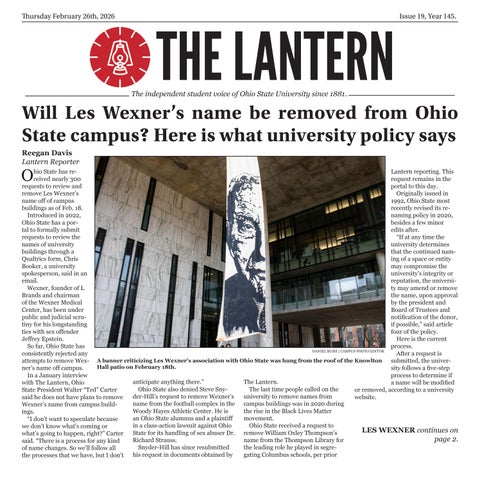
A banner criticizing Les Wexner’s association with Ohio State was hung from the roof of the Knowlton Hall patio on February 18th.
DANIEL BUSH | CAMPUS PHOTO EDITOR

CAMPUS
On page 4
page 6
Ohio State places at Deloitte Buckeye football diets
What it takes to remove a name
Continued from page 1.
The request is first sent to a Standing Advisory Committee for the Review of University Space and Entity Names to determine if the request provides evidence of “misconduct or other inappropriate behavior harmful to Ohio State’s rep utation for excellence and its values of integrity and inclusiveness,” according to the website.
After this first review, the request is then evaluated by Ravi Bellamkonda, the university provost, who will determine if the request should advance to further review.
If the request advances, the committee will look at all of the facts surrounding the name to determine if the request should advance in the review process. In this stage, the committee decides if the reviewed name will be removed, modified or if any action will be taken. They will then issue a recommendation to Carter, according to the website.
the President decides to remove a name or otherwise modify it, the matter must be advanced to the Board of Trustees for approval,” according to the website.
Finally, the Board of Trustees will make the decision to modify or remove the
they would like to call for the removal of Wexner’s name from Ohio State University’s spaces, entities and structures,” said Alexis Wade, a fourth-year in political science and USG senior director of communications.
Wex-

Megan Kafka, an Ohio State alumni, submitted a request for Wexner’s name to be reviewed on Feb. 11. She said she provided substantial evidence and quotes to show how the situation is hurting Ohio State’s reputation.
“When I saw that there’s a way to officially talk to the university and not just shoot an email into the void, I thought that this is a way to make my voice heard,” Kafka said. “Hopefully other people are doing this too, and we can all make our voices heard.
Les Wexner, founder of L Brands and chairman of the Wexner Medical Center, has donated $200 million to Ohio State over 30 years.
Carter will review the recommendation with Bellamkonda to determine the decision of request.
“The President’s decision is final, except that if
On Wednesday, the Undergraduate Student Government passed a resolution to remove Wexner’s name from university spaces, branding and official communications.
“The student government’s perspective on it is parallel to most of the student body, if not all. Basically, just saying that
ner’s name appears on Ohio State’s medical buildings, including around Ohio, the Wexner Center of the Arts — which is named after Wexner’s father, Harry L. Wexner — and the Wexner Football Complex within the Woody Hayes Athletic Center. He has donated over $200 million to the university over 30 years, according to the medical center.
Kaleb Duarte, a third-year in architecture, helped design and drop the banner in front of Knowlton School, featuring Wexner’s image that read “oust Wexner” and “Wexner is in the files 1,322 times.”
Duarte said that names carry meaning, and that students want to feel a sense of pride in their school.
“Students want their values to be reflected in the university,” Duarte said. “Names are a very powerful way to do that.”
PHOTO COURTESY OF TNS
Waiting for a donor: What goes into organ trans‑ plants, waitlists and donations at Ohio State
Audrey Coleman Managing Editor of Design
Three days a week, Ed Kottenstette sits through dialysis treatment, watching his blood filter through a machine that does the work his kidneys no longer can.
Kottenstette spends over 12 hours a week receiving treatment. Until a donor is found, this will be his routine for the foreseeable future.
For now, every session is a reminder of the same reality: there is no guaranteed timeline, and every day is a waiting game.
“In our area, I tell people around a four-year wait time to get a deceased organ,” said Dr. Liza Cholin, a nephrologist who specializes in patients’ care after receiving a kidney transplant. “It also depends on your blood group and other typing factors that can make people’s waits go even longer than that.”
There are roughly 123,000 Ameri-
cans waiting for an organ, with over 101,000 in need of a kidney, according to the National Kidney Foundation.
“In the course of going to dialysis down in Circleville, Ohio, there are four people that I’m aware of that are on the waitlist,” Kottenstette said. “Two that are desperately needing kidney transplants, and one’s going to take place in early March.”
Some candidates will spend years looking for a donor, either within their families or beyond.
“We encourage the patient, family members or friends to ask around in their community,” Cholin said. “Once somebody has expressed interest in being a living donor, we give them our contact information, and we’ll start the evaluation process.
For Kottenstette, his time on the waitlist has only been around a year, after receiving the diagnosis of end-

stage renal failure in April 2025.
“You can see the difference in the timeline for people, which is based on blood type,” Kottenstette said. “Somebody who has AB negative might be waiting six, seven, eight years versus someone who’s O positive. I’m B positive, which is why I’m roughly five years out.”
Getting on the waitlist requires extensive testing between previous diagnoses, bloodwork and questionnaires that are gathered to be presented before a selection committee at the transplant center.
“There’s a large group of people of all different backgrounds that discuss my case, or anyone else’s case,” Kottenstette said. “They determine the status, or your viability. ‘Can you accept a kidney?’ ‘Will the kidney work?’ ‘Will it last?’ There’s a lot that goes into it.”
Once approved for the waitlist, the challenge becomes finding an organ.
Living donors tend to be more encouraged because of the quality of the organ and how it functions once transplanted, Cholin said. Organs that came from someone who died can vary in longevity, timelines after transplantation and recovery.
“There’s a lot more variability in the type of organ you’re going to receive. If you were receiving an organ that traveled from far away, there’s usually a delay in the kidney waking up and starting to work,” Cholin said. “The way that the overall recovery process looks afterwards can be substantially different in the recipient of a deceased organ versus a living organ.”
When searching for a donor, the database isn’t just for central Ohio hospitals — in fact, it spans far beyond Columbus.
“The whole transplant system has morphed into something a little bit better,” Kottenstette said. “It really didn’t matter if I signed up for other
facilities, because Ohio State is made aware of available kidneys that are coming up.”
If someone chooses to be a living donor, Cholin said that the evaluation process is similar to that of the receiver’s.
“There’s initially a screening questionnaire that we’ll have them fill out, and then afterwards, there’s a series of tests that we have them go through just to make sure that donating would be at minimal risk for them in the long term as well,” Cholin said.
Throughout this entire process, there are multiple different specialists, like Cholin, who work with candidates on their journey. Kottenstette referenced his own team of people and how they’ve been influential in his time receiving care.
“It’s like going up a staircase,” Kottenstette said. “Every step I take, I’m always connected with a new care coordinator who follows my journey. You’re never left wondering, ‘Who do I need to call if I ever have questions?’”
Although the transplant system is becoming more connected and advanced than ever, there will always be a waitlist, with people like Kottenstette remaining on it until the needed organ becomes available.
“There are a lot of different groups and societies that are trying to utilize these organs as much as possible and improve preservation techniques. Even working on artificial kidneys, but a lot of those things are still very much in the basic stages,” Cholin said. “So for now, the donors that we have are simply the most important thing that we can utilize to help people in their lifetime.”
More information about organ donation and Ohio State Wexner Medical Center’s Living Donor Program can be found at The National Kidney Foundation or the medical center’s website.
The Wexner Medical Center’s new University Hospital tower.
PHOTO COURTESY OF THE WEXNER MEDICAL CENTER
Ohio State places second at Deloitte FanTAXtic Case Competition
Navya Chauhan Lantern Reporter
Earlier this month, Ohio State placed second at the annual Deloitte FanTAXtic case competition.
Composed of a team of accounting majors, five students first competed against over 80 teams in a regional competition before advancing against the top 20 schools in Westlake, Texas at Deloitte University.
“The Deloitte FanTAXtic Competition provides an opportunity for students from accounting programs across the country to gain real-world experience through participation in an interscholastic competition,” according to the Deloitte website.
Sami Ibrahim, a second-year in accounting and real estate, was a part of the team representing Ohio State.
“You are given a real-life scenario that professionals would get on a daily basis at Deloitte, and our job is to essentially role play as these Deloitte tax professionals,” Ibrahim said.
Students could compete only if they had less than a year of experience within the field, Ibrahim said.
“This is meant to get your feet wet in the world of tax,” Ibrahim said. “So no one really has any formal experience.”
The team was guided by their mentor, Kathy Wantuch, a senior lecturer in accounting and management information systems. Additionally, Deloitte provided accounting professionals to further assist the team, including two Ohio State alums: Pedro Tula, an international tax consultant, and Evan Heiser, a senior international tax manager.
Wantuch said she was proud of the team because of how much effort it takes.
“It’s just so impressive to see that they’re able to take a subject that they have very little exposure to and do so well in it,” Wantuch said.
The first phase of the tax case competition is the virtual regional competition, in which teams compete to

advance to nationals, Wantuch said.
The national competition is hosted over two days, during which students have to apply their technical knowledge and present it to Deloitte professionals.
UCLA won the competition and received $10,000 to the university and $2,000 per team member for the feat, according to the Deloitte website.
The award for winning second place was $5,000 to the university and $1,000 per team member, according to the website. The last time Ohio State made it to the national Deloitte FanTAXtic Case Competition was 2015 where they placed third.
When asked what was the key to Ohio State’s excellent result, Ibrahim said the competitors have to explain well enough for a client to comprehend the information.
“You have to be able to kind of communicate your findings in a simple enough sense that the client can understand, and also you need to add more than what they’re asking,” Ibrahim said. “It’s a little nerve wracking, but I think once we started we had prepared very well.”
At first, Ibrahim said the team was nervous to be presenting in front of the Deloitte professionals.
“Once we started going, it felt just as
natural as the rehearsals and practice run,” Ibrahim said.
Wantuch said experiences like this benefit students outside of the classroom.
“This is a great example of what Fisher is really pushing: experiential learning for students,” Wantuch said.
Wantuch said she motivates students to participate in similar experiences.
“I would always want to encourage this as much as possible,” Wantuch said. “Just do it. It’s worth it.”
Ohio State accounting students accept their $5,000 reward for winning second place in the Deloitte FanTAXtic National Competition. From left: first-year Muse Said, second-year Noah Pehr, fourth-year Clinton Do, third-year Mia Zamora and second-year Sami Ibrahim.
PHOTO COURTESY OF KATHY WANTUCH

ARTS & LIFE
On page 2 On page 6
Ohio State’s name removal policy Adam Paddock’s return to Cbus
One year on the track: Mario Kart Band’s anniversary show Friday
Mia Ross Lantern Reporter
It’s rare to be in control of the concert setlist.
However, at Mario Kart Band’s first anniversary show at Rumba Café Friday, the audience will pick the course as the band launches the music live.
Originally formed by saxophone player Colin Davis, Mario Kart Band devotes their setlist entirely to the Mario Kart 8 Deluxe soundtrack. Davis said he became inspired after seeing a viral TikTok of the Australian band, Mario Kart Live, executing the idea first.
After contacting the band and receiving permission to develop the idea into something of his own, Davis assembled a purely Ohio roster — with some members even embracing the Buckeye title.

“I have an appreciation for video game music — I think it’s a part of video games that gets overlooked,” Davis said. “When I saw the video online, I was like, ‘Well, this is something I can actually probably do.’”
Doors open at 7 p.m. with the evening commencing at 8 p.m. There will be a Nintendo Switch set up with four controllers and groups will be given a list of about 30 songs the band can play. Whatever the players choose, determines the soundtrack of the night. In addition to songs, the band will also
play the sound effects as if the volume was turned up on the TV, Davis said.
“We’ll play the title theme at the top, [and] we’ll play some other non-Mario Kart, but Mario tunes at intermission and at close,” Preston said. “Groups of four come up — they request whatever track they want to play or hear.”
Davis said the Friday show is a milestone for the group.
“The show we’re doing on the 27th is kind of like an anniversary show,” Davis said. “Our first show in Columbus was about a year ago at the same place.”
In 2023, Davis assembled the original group while studying music at Youngstown State University. He said he recruited fellow music students and played only two shows before moving to Columbus in 2024. Upon arriving in Columbus, Davis said his hunt for members began.
“It ended up turning out really well, and I made a lot of good connections and good friends from it,” Davis said.
“It took a long time, but the hard part’s over, now it’s just the fun part of
the music.”
From initially hanging posters in Weigel Hall to recruiting via Facebook, Davis developed the nine-piece band consisting of himself, Samantha Vann, Deed Vann, John Heino, Russell Preston, Bobby Lucas, Alex Adams, Gabriel Coffing, Seth Alexander and Nikki Lucas.
Russell Preston, a second-year in zoology and the band’s trombone player, said surrounding himself with music educators has created an optimal experience to help him learn. Additionally, he said he loves seeing people come together with a similar interest.
“I like the community — there’s regulars who come to a lot of shows,” Preston said. “It’s fun to see the repeating faces.”
Tickets are $18.75 and can be purchased on the Rumba Café website. For attendees not interested in playing, the event functions like any other concert.
“The people who wrote the music at Nintendo are fantastic musicians, so playing the music itself is just really fun,” Davis said. “I think it gives an appreciation for the music to hear it live, as opposed to just in the background on the video game.”
The Mario Kart band will perform at Rumba Café Friday at 8 p.m.
PHOTO COURTESY OF RUSSELL PRESTON
Adam Paddock returns to Buckeye Nation for the fourth annual “Columbus Against The World” concert
Mia Ross Lantern Reporter
Pop-rock singer and proud former Buckeye Adam Paddock will return to his roots to host the fourth annual “Columbus Against The World” concert March 7 at 8 p.m.
Paddock said his time as a Buckeye provided him confidence and invaluable networking, but primarily introduced him to what he needed most — his band. While some artists have a so-called “big break,” Paddock’s career was built from small, deliberate wins that catapulted him from busking outside of Jeni’s and recording in his DIY studio, to headlining for big-name artists and hosting “Columbus Against The World” at Newport Music Hall.
“I kind of focused on my day-today being, little wins, little wins, little wins,” Paddock said. “And then you look back and suddenly you’re standing on a mountain of a million little wins.”
Paddock said his inspiration for making music began early on with his mother, a teacher and poet. During his childhood, he said he wrote poems in order to gain screen time. This system introduced him to his first form of a creative process — embracing all ideas, good and bad.
“That kind of taught me how to write effectively and creatively, and not be afraid of a bad idea,” Paddock said. “Oftentimes, you have to get through the bad ideas to get to the good ones.”
The now Nashville-based artist attended Ohio State from 2018 to 2022, during which he studied strategic communications with a minor in Spanish and vocal performance. His time as a Buckeye mirrored that of many students, as he was a member of Ohio State’s Crew Club and worked as a resident advisor.
In 2020, his experience veered from traditional to unprecedented as he and the rest of the university were sent home due to COVID-19. While at home, Paddock said he created a
DIY studio in his dad’s basement and became more comfortable with music-making.
“I kind of learned how to not suck there,” Paddock said.
studio recordings.
During his first week at Ohio State, Lew said he peeked into Paddock’s room and noticed a plethora of music equipment such as a microphone, guitar and monitors. From there, a music-centered conversation began be
of headliners playing The Basement, A&R Bar, and then that all accumulated to playing at the Newport and stuff annually,” Paddock said.

Upon returning to campus, Paddock put a dormspin on his studio it into Bowen House. From there, he met his band and began working towards the success he has today.
Paddock’s band is made up of Max Lew, Adrian Oliver and Caelan Quigley. Lew was one of Paddock’s residents in 2021 and now swings between guitarist, live-mixer and dabbler in production. Paddock and Oliver connected through Crew Club and their relationship fostered Oliver’s role as the drummer and live engineer who brings the pop-rock, folk-inspired sound to life. Quigley is Paddock’s trumpet player, who is featured on all
only companion ship.
“He would ask me to come over to his dorm room or just record guitars on my own,”
Lew said. “[When] second semester rolled around, I co-produced one of his songs for him.”
Paddock and his crew have tackled tremendous gigs for big-name artists since their union. They opened for Waka Flocka Flame and MAX at the Ohio Union Activities Board’s Welcome Back concert in 2021, from which Paddock was able to branch out and establish his own vein of headline gigs.
“I kind of strung together a bunch
Paddock also opened for alternative-rock band, Wallows, on Oct. 3, 2025 in Harrisonburg, Va. and put on an electric performance to conclude their “Model and More Tour.” It was Paddock’s first arena performance.
March 7, Paddock will invite “Columbus Against The World” attendees to a concert with performances from Paddock, Douglas Katula and Sunday Driver — all former Buckeyes.
Lew said he’s looking forward to the event, not only because of the work Paddock has put in, but also because of his personal connection to Sunday Driver’s frontman, Owen Baker.
“[Paddock’s] been putting in his all,” Lew said. “I’m really excited for the openers, Sunday Driver and Douglas Katula — [Baker’s] a good friend of mine and plays in another band that I play in, Vitruvian Soul … so I’m really stoked for that.”
While “Columbus Against The World,” exists as a title, the name embodies the pure essence of the event as a whole. In addition to the artists being Ohio State alumni, Paddock said every single aspect of the show — from merchandise to production — has been sourced directly out of Columbus.
“I get all local vendors to do the trading cards, the graphic design, the T-shirts, the posters and everything,” Paddock said. “It’s all coming out of Columbus. That’s the goal.”
To get fee-free tickets, attendees can send a direct message to any of the bands to avoid the additional costs on Ticketmaster, according to Paddock.
“When it’s cold in Columbus, wouldn’t you want to get warm with 1,000 of your best friends, jumping around to, definitely some cover [songs], but also some new favorite originals?” Paddock said.
Adam Paddock will host “Columbus Against The World” concert March 7 at 8 p.m.
PHOTO COURTESY OF ADAM PADDOCK
Fueling the Buckeyes: Inside the science behind Ohio State football’s nutrition program
Jason Moore Lantern Reporter
Editor’s note: This inside look at the Ohio State football team comes from Jason Moore, a defensive lineman on the Ohio State football team. Moore is also a third-year journalism student at Ohio State.
On a typical weekday morning inside the Woody Hayes Athletic Center, workouts may not have started, but the work already has.
Smoothies are blending. Protein portions are weighed. Hydration levels are being checked. While fans focus on touchdowns and tackles, the real work for the Ohio State Buckeyes football team begins hours earlier in the fuel zone in the Woody.

“We don’t just feed football players,” team nutritionist Kaila Olson said. “We fuel performance.”
Olson, alongside assistant nutritionist Sarah Takach, oversees customized nutrition plans for more than 100 athletes. Every detail, from calories to carbohydrate timing, is carefully calculated based on position, workload and body weight goals.
An offensive lineman maintaining 310 pounds has dramatically different needs than a defensive back focused on speed and explosiveness, and Takach said there is no “one-size-fits-all” plan.
“Calories, protein intake, hydration [are] all individualized,” Takach said. “We look at their training phase, their recovery, even how much they’re sweating in practice.”
Players regularly undergo body composition scans and hydration testing.
Even slight dehydration, Olson said, can affect reaction time and muscle recovery. In a sport where fractions of a second matter, nutrition becomes a huge competitive advantage.
For defensive back Inky Jones, adjusting to the program changed his understanding of performance.
“When I first got here, I thought eating more was enough,” Jones said. “But it’s really about what you’re eating and when you’re eating it.”
Jones, now a senior, follows a structured meal plan designed to help maintain weight. Heavy training days require increased carbohydrate intake for energy. Recovery days shift toward muscle repair and the control of inflammation.
“It’s strategic,” Jones said. “I feel the difference.”
Sophomore defensive back Miles Lockhart experienced a similar wakeup call.
During his high school days, Lockhart admitted to eating whatever he wanted, but that changed once he stepped foot on campus.
“Here, they broke down exactly how much protein I need to build muscle and stay lean,” Lockhart said.
One of the most visible parts of the program is the fueling station that is stocked daily with recovery shakes, fruit, lean proteins, yogurt and complex carbohydrates. After practice, players don’t have to guess what to eat. It’s already planned and prepared.
“It makes it easy,” Lockhart said. “You finish practice and you know exactly what your body needs.”
But beyond the meal plans and protein shakes, Olson and Takach emphasize education. They want players to understand the science behind their plates.
“Our goal is that they leave here knowing how to fuel themselves for
life,” Olson said. “Whether that’s in the NFL or in another career.”
Part of the learning experience is having players take health quizzes every week and having a PowerPoint on the TV screens all over the Woody at all times.
Nutrition staff members also collaborate closely with strength coaches and trainers. GPS tracking during practice measures workload and exertion levels. If data shows increased strain, post-practice nutrition can be adjusted immediately.
“It’s constant communication,” Takach said. “Nutrition is part of the performance team.”
The payoff, players say, often shows up late in games.
“Fourth quarter used to feel like survival,” Jones admitted. “Now I still feel fresh and explosive.”
The Woody Hayes Athletic Center, where Ohio State athletes train.
MARISA TWIGG | LANTERN FILE PHOTO

On page 3 On page 5 On page 7
How organ donation works The Mario Kart Band Ohio State athletes nutrition
More than a timeout: How sponsorships shape Ohio State’s game‑day experience
Donovan Locklyn Lantern Reporter
When the timeout buzzer sounds at the Schottenstein Center during a game, most fans take a breath and pause.
Allie Kenny gets to work.
Kenny, Ohio State’s senior partnership services coordinator, oversees the activity that fills breaks in play like LED board takeovers, public address announcements, half-court contests, T-shirt tosses and sponsored promotions designed to keep fans engaged in between breaks in a game.
Kenny’s job is to turn sponsorship contracts into fan-focused moments that unfold in less than two minutes.
“In a sponsorship group, I’m on the activation team,” Kenny said. “When it comes to any sponsorship we have with Ohio State Athletics and brands, I make sure everything that was agreed upon gets execut ed.”
That execution begins long before game day. Kenny works with corporate partners to finalize promotion details, including arena graphics, announcer reads and giveaway logistics. She then coordinates with the marketing staff to ensure each activation fits smoothly into the game script and can be carried out by
interns running on-court elements.
“On game day, I’m there making sure the client is happy and gets to see the promotion,” Kenny said. “After the game, we recap with the partner to talk about wins and what we could do better next time.”
While fans see polished entertainment throughout the season, planning begins months in advance.
“About 90 days before the season starts, we know which partners have season-long activations, which have single-game promotions and what
keting interns drop cow plushies with gift cards attached from the rafters, for example, runs at only five games each season.
“We have to be strategic about which games we choose,” Kenny said. “Chick-fil-A isn’t open on Sundays, so it doesn’t make sense to run a promotion at a Saturday game if fans can’t redeem coupons the next day.”
For Ohio State Athletics, these in-game promotions serve a larger purpose than fulfilling sponsorship agreements. They are de
purpose and is fan-engaging.”
The goal, she said, is to make promotions feel like part of the game-day atmosphere rather than interruptions.
“We try to keep fans at the forefront of what we’re doing and why,” Kenny said. “If fans enjoy it, the brand is viewed positively and the message has a better chance of being received.”
Luke Strine, who works as a brand promotion intern, said the relationship between sports and sponsors benefits both sides.

“Brand promotions and sports are mutually beneficial,” Strine said. “Sports are one of the biggest economic drivers today, and there’s no better place for companies to promote their brand than in front of thousands of fans.”
Those activations also help create stronger connections between fans and the program.
“These promotions give us an opportunity to build relationships with fans, whether through giveaways or in-game activities,” Strine said. “We’re able to highlight the brands we work with while creating memorable experi-