8
w w w. t h e l a n d y. c o . u k
News
Issue 156: Sep 2026
Products
Vehicles
Adventure
Workshop
Buyers
Landmark name returns as Land Rover looks back to early days of Discovery
T
he Discovery 5, remember that? It hasn’t gone away, even if almost everyone who would once have had one is buying a Defender instead now, and Land Rover has just rejigged the model line up – which now ‘offers three distinct specifications to make the most of family adventures, showcasing the best that Discovery has to offer.’ The range now starts with the Discovery S. Well, it already did but this now features a panoramic roof, 21” diamond-turned alloys, Meridian audio and more driver aids and safety systems than ever. The seats are trimmed in a choice of Ebony or Light Oyster leather and you get wireless phone-charging, up to nine USB points
and plenty of hidden stowage options to go with a large cubby box.’ Perfect for everyday family excursions,’ says Land Rover, which we don’t doubt one bit even if the everyday family might wonder where they’re supposed to find £69,540 for a car. Next up comes the Tempest. This is ‘the pinnacle of luxurious family exploration’ and ‘the most comfortable and highly-specified Discovery ever created.’ Now available with the exclusive option of Borasco Grey, this comes with a matte protective film wrap as standard and features a copper finish to the badging and accents around the body, wheels and towing point covers. Inside, the options list gains new Light Oyster and Caraway leather seat co-
lours, accentuated by Ebony and Light Oyster detailing respectively. Finally, we have the Landmark. An old name for a new model, this comes with an exclusive Tasman Blue paint finish chosen to echo the Clearwater Blue used on the first Discovery at launch back in 1989. That’s not all, either, as the front tread plates, centre console, B-pillar inserts and puddle lamp projectors feature a mountain peak logo inspired by the graphics on the old Disco 1. Somewhat differently to the original, the Landmark rolls on 22” alloys as standard. Nine alternative wheel designs are available, including a smaller 21” for if you want to run dumper tyres. The vehicle’s exterior gets dark
IN LAST MONTH’S ISSUE OF THE LANDY, we brought you the story of a Series IIA which was being offered for sale by Land Rover Classic with a lifetime of patina still intact. A welcome change from the steady diet of showroom-standard early Series I models most people associate with Solihull’s official heritage operation, we commented – and now here’s further proof that it wasn’t a fluke and they really do understand the value of character down JLR way. This time it’s an 80” Series I from 1950, complete with the original early-type semi-floating back axle and, crucially, all the scrapes, rubs and worn and faded paint built up over three quarters of a century and counting. You’re probably looking at it and thinking oh yeah, another one from Australia, but in fact this particular 80 has only ever been as far as Devon. It was bought new by an army officer down there and he must have liked it because he didn’t sell it again for another 55 years. And that was to his son. It finally left the family in 2014, by which time it has survived the cut-’em-up-and-trial-’em era and, with its original 1.6-litre engine and just 69,912 miles under its wheels, was destined always to be a cherished classic. Your cherished classic, if you so wish and have £69,950 to invest. You could spent it worse.
grey grille and vent accents, while the interior features matching brushed aluminium. Standard equipment includes a sliding panoramic sunroof and centre console fridge. Oddly, considering the sky-high equipment list on all models throughout the range, the Discovery has only now been updated to run Driver Attention Monitoring. This uses a camera which constantly watches your face and alerts you if you get distracted from the road; it been commonplace on new vehicles for a while now, so something of a surprise that the Disco has only just gained it. Something it did gain some time ago was a range of accessory packs whose contents allow you to tailor the vehicle
for dog carrying, cycling, road trips and adventures at the beach or in the snow. These are ‘curated’, which is Land Rover speak for they exist, and are available on all models. Best of all, the Discovery continues to be available as a commercial vehicle. So if you don’t need a second (or third) row of seats, you can run one as a company car while sticking it royally to The Man. All models are powered by Land Rover’s D350 diesel engine and can tow 3500kg, with prices for the Landmark starting at £71,395 (Commercial) and £75,860, and for the Tempest at £73,745 and £83,940. There’s also a Commercial SE model priced at £64,785, which to us looks like the pick of the bunch.
BEAUTY & THE BEAST WE RECENTLY SHIPPED A 1999 LAND ROVER FORWARD 100 BEAUTY & THE BEAST TO SAN JUAN, PUERTO RICO FOR CLIENT HUGO
EXPEDITION READY WE RECENTLY SHIPPED A 1999 LAND ROVER 100 PICTURES BELOW SHOWING THE BEAUTY OFFORWARD PUERTO RICO TO SAN JUAN, PUERTO RICO FOR CLIENT HUGO PICTURES BELOW SHOWING THE BEAUTY OF PUERTO RICO
Most people who find Sonoran Rovers have been thinking about a Defender for a long time. Not casually. Not impulsively. They have admired these vehicles quietly, often for years, and waited until the idea felt earned. Sonoran Rovers grew from that same place. We are built out of a love of desert exploration, public lands, camping and old trucks that were designed to be repaired, understood and used. Living and driving in the Southwest shaped how we think about vehicles. Distance matters. Heat matters. Reliability matters. When you are far from help, you want something honest beneath you.
Sonoran Rovers • Tucson, AZ 85713 • Tel: (001) 520 307 3852 • Web: sonoranrovers.com
4 X 4 TY R E S . CO. U K
THE UK NEW DEFENDER SPECIALISTS Hunters Prestige is a specialist destination for premium Defender styling, retrofit upgrades, and trade-ready product solutions. Born from the launch of the new Defender over five years ago, the company was built from a genuine passion for the vehicle and a vision to push its design and functionality beyond factory standard. With a focus on craftsmanship, clean aesthetics, and quality-first execution, we help customers create vehicles and product solutions that feel elevated, distinctive, and built to last. From carefully engineered styling enhancements to specialist retrofits and in-house installations, every detail is designed to integrate seamlessly and maintain an OEM+ appearance. Trusted by Defender owners and trade partners worldwide.
RETAIL CODE
HPLANDY10 10% OFF ONLINE PRODUCTS & BOOKINGS
SIGN UP ON WEBSITE FOR
TRADE ACCOUNT TRADE PRICING AVAILABLE ON REQUEST
You may have already seen us at the Great British Land Rover Show at Bath & West, and we’ll also be showcasing at Newark this year. You can also find us at a number of other major events throughout 2026, including the Land Rover Owner International Show at Belvoir Castle, Simply Land Rover at Beaulieu, Goodwood Festival of Speed, and of course our very own dedicated new Defender event — The Defender Gathering at Elveden on the 15th of August. Find out more and secure your tickets now via our website. Lorem Ipsum
THE UK’S LARGEST SUPPLIER OF NEW DEFENDER PARTS Hunters Prestige gives you the freedom to customise your Defender exactly how you want it — built around your vision and tailored to your lifestyle. From lighting upgrades, styling enhancements, interior and exterior accessories, and expedition-ready equipment, to wheels, genuine retrofits, and world-exclusive engineered products only available at Hunters Prestige, every product is selected or developed with quality, fitment, and design at the forefront. Whether you are creating a refined OEM+ daily driver or a fully equipped expedition build, our range is designed to elevate every aspect of the Defender experience.
DISCOVER YOUR PERFECT BUILD www.huntersprestige.com Unit 4, Mundford Road, Thetford, Norfolk, IP24 1NB sales@huntersprestige.com +44 01842 267890
18
w w w. t h e l a n d y. c o . u k
Issue 156: Sep 2026
News
Products
Vehicles
Adventure
Workshop
Buyers
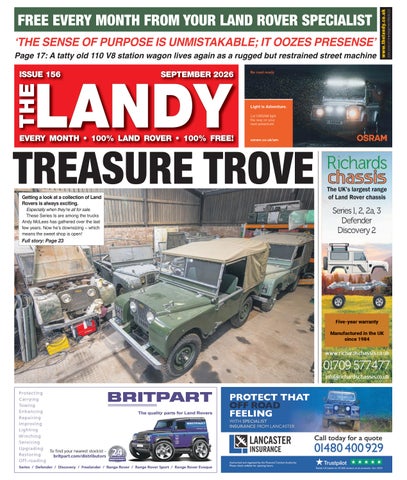
This is what arrived at the Legacy Overland workshop back at the start of the project. Defintiely rugged, but not very urban. It looks pretty good from the outside, but the cabin was a bit of a state – we’re big fans of gaffer tape, and the old-school four-spoke steering wheen from before the Defender era does have a certain charm, but you’d be struggling not to look at this and see an interior that’s ripe for reimagining. Which is of course what the company does so well snorkel and exo cage (or alternatively a factory paint colour and standard wheels) would set if off. But the sense of purpose in its four-square stance gives it more than just off-road credibility. It’s one hell of an imposing sight on the road, too – which, you can’t help but feel, is where its new owner is going to want it to excel. Just to clear up any misunderstandings, though, when they describe the 110 as being ‘unstoppable on the streets,’ this isn’t a reference to its brakes. These have been upgraded to discs at the rear, with the calipers painted red to prove the point, so the vehicle is set up to stop the way later ones do.
Giving it some motion for the calipers to bite on, the 3.5-litre Rover V8 was completely rebuilt. It runs on carbs rather than fuel injection, keeping it nice and simple for the future, and it’s mated to a five-speed LT85 Santana gearbox and LT230 transfer case – both of which have also been rebuilt. All good and original, then. The driveline is admirably standard, too, with the emphasis having been on refurbishment rather than replacement – though at the end of the axles, those big 33” tyres are wrapped around a set of 16” Sawtooth alloys. What were we saying about standard wheels…? Plenty of work done so far, then, but not too much in the way of major mod-
ifications. Yet this is a Defender that bristles with presence. An SVX grille helps here as do a galvanised steering guard and a powder-coated front bumper with daylight running lights. At the back, meanwhile, there’s a NAS bumper and a full set of LED tail lights. The body cappings are painted black, as is the rear door – which is very much part of the overall colour scheme. Continue upwards and you get to a black roof, while the bonnet is this colour too – all of it contrasting with a nice Anvil Grey body. Urban rugged, yeah? Inside, it looks nicely classy but as with the rest of the vehicle it’s good and rugged too. Legacy Overland
describes it as ‘a hand-crafted interior in high-resilience black leatherette with white accents’; highlights include custom white-faced gauges, a Momo wooden steering wheel and a charcoal grey alcantara headliner. There’s no small amount of tech in the vehicle, too, including a Sony double-DIN Bluetooth media receiver with Apple Car Play, a 160-watt Pioneer subwoofer, USB charging and a centre console carrying a range of Carling switches. At a slightly more immediate level, the old 110 has been upgraded with electric front windows and a custom air-con system which, unlike the typical units fitted on Defenders, is able to blow both hot and cold.
This isn’t a Land Rover that you’d say blows hot and cold in any other sense, though. You might look at it and see a level of off-road intent that it wasn’t really built for, but the sense of purpose is unmistakable. Mainly, it just oozes presence. Of course, there’s no such thing as a meek Defender. No, not even an early 90 on 6.00x16 tyres. Some are a lot more imposing than others, though, all the same. This often comes from being built to go off-road, but here’s proof that it doesn’t have to be. There’s classic, there’s rugged, there’s Urban Rugged – and there’s Land Rover rugged. And then there’s this 110. Which is all four at once…
24
w w w. t h e l a n d y. c o . u k
Issue 156: Sep 2026
News
Products
Vehicles
Adventure
Workshop
Buyers
Left: Tucked away in the far corner of their storage barn, next to a restored 1949 80 in sage green, is an 86 which Andy describes as being ‘unmolested, straight and original.’ It needs a bulkhead, but he’s got one, and the engine and box are ‘lovely.’ Doesn’t sound like a nightmare project Above: Of his 14 Land Rovers, Andy has a dozen Series Is. That leaves a much later model in the shape of a chipped Range Rover Sport TDV8, and this early Series II fire engine. It’s lost its pump and so on, which is a shame, but it has a tiny but believable 6600 miles on the clock Landy fan who likes to roll their sleeves up – not a bunch of pristine show cars buta group of real-life old trucks you can make your own. Andy gave us a tour of one of his workshops, where 11 short-wheelbase Series Is range from a couple that are fully restored down to one that’s basically a donor car. Behind them, parts sit neatly on racking by the back wall; it’s the sort of scene you blink at when you first see it then, as the roller shutter opens fully to let in the light, you realise the full wonder of what you’re looking at. The potential in what he’s got really is something to be marvelled at. As is often the case, there’s less to say about the complete ones than those still in bits. The most obviously restored Land Rover in the pictures is a usable turn-key classic from late 1950, though with a 1954 engine it’s not all-original. Nestled behind it sits a sage green ’49 with overdrive and, key to the early ones’ charm, the all-important lights behind the grille. You’ll find the real stories in some of the Series Is sat to either side of these two, though. Our eyes went straight to a Hard-Top to our left; not so much rare as hens’ teeth, more like rare as a hen with false teeth riding a unicycle and singing Ave Maria while balancing a stick of rhubarb. ‘I bought three Land Rovers in the late 1970s,’ says Andy, ‘including one that had been used by a shoot at Staunton Harold. My friend insisted that I sell him the hard-top from it and I finally let him have it. ‘He kept it stored carefully in a hedge for about 40 years and then eventually I bought it back from him… for several times more than he’d paid me for it!’ With friends like these, and all that.
The roof now lives on a vehicle that was one of a batch brought home from Australia; Andy admits that after all this time, he couldn’t remember how to fit it, but by a stroke of luck he found another Hard-Top for sale and the guy was decent enough to let him come for a look so he could figure it out. Moving along the line from the Aussie one, there’s a pair of lights-behind 80s ‘with lots missing’. Then, hidden away in the corner, an 86 which Andy describes as ‘nice old thing – unmolested, straight, original.’ Sales talk? Well yeah, buyer beware whenever you’re looking at an old motor, but Andy comes across as an enthusiast who doesn’t flinch at the idea of telling it like it is about his own stuff. ‘The bulkhead’s horrible. But the engine and box are lovely.’ He goes on to say that the gearbox crossmember wants doing but the chassis is otherwise good, and that he’s got a bulkhead to go with it anyway. As well as a truck-cab, should you want it. On the other side of the unit, there’s a pair of Series Is that definitely don’t look either unmolested or original. One, says Andy, came from a guy in Devon whose wife was from Uruguay. Her family had owned it from new but getting parts for it had turned out to be impossible, so over time it gained more and more ‘local’ repairs. The engine is still factory-original, though, and the chassis is ‘repairable.’ Not that you might need to, because behind it is part two of a cunning plan. This one came from Cornwall; we took one look and thought it came on like an old RTV motor. We may or may not be right but what Andy does know is that the guy he bought it from had built
it himself out of parts left over from other projects. ‘I bought it because the chassis is mint,’ he says. ‘But there’s no logbook and one digit is missing from the plate, so I can’t get one. It’s got the wrong engine, the wrong box and possibly Series II axles.’ Now, that’s definitely not sales patter. But his idea was to combine the two by rebuilding the ex-Uruguayan one on the chassis from the bitsa to get one good truck with a bright future. Which is exactly what he’ll do if these aren’t among the ones that sell – though we suspect most Land Rover fans would head straight for them. He’d expect to sell them as a pair, he confirms – before mentioning that one of the lightsbehind-the-grille ones could be bought in conjunction with a pair of 80s he’s
got sitting outside. Whether they’d all go together to make one complete one, who knows, but when did you last get the chance to buy three early Series Is, all with logbooks, for ten grand? As this illustrates, Andy’s not out to wring every last penny out of his collection. It’s about space, not money. Rather than putting a price tag on everything individually (which suits us, because this is meant to be a story, not a sales brochure), he just says £3500 to £25,000, depending on the vehicle. He could sell you a full project or a turn-key classic, or most things in between, but he’s not after having your trousers down. Not that he’s giving stuff away. As we’re turning to leave, almost as an afterthought he points to another
Landy in the corner by the roller door. ‘I bought it with the two that are outside,’ he says. ‘It’s on a new Richards Chassis and new bulkhead, and the engine’s part-way through being reconditioned.’ Almost like buying a kit car, we muse. ‘Yes. But with what it’s got on it, it won’t be cheap.’ What you can take this to mean is that Andy is eager to hear from you if you’re for real… and that if you’re not, he’ll find you out pretty quickly. His collection is housed somewhere between Leicester and Coventry – and if you’re interested in taking on one or more Series Is, a very early Series II fire engine or even that Range Rover Sport, the man himself is on 07773 407192. Give him a shout and who knows what you might end up going home with…
26
w w w. t h e l a n d y. c o . u k
News
Issue 156: Sep 2026
Products
Vehicles
Adventure
Workshop
Buyers
The Landy Buyer
All the information you need – in one place – to buy your perfect Landy Series I (1948-1958)
The Series I, particularly in its 80” guise, is the most sought-after of
all Land Rovers. Its engineering and design give it real charisma, but parts aren’t readily available. Restoration projects require deep pockets, but see it through and the result will be worth mega bucks. Gone are the days where you could use a Series I as an actual Land Rover. Because with restored examples changing hands for mil-
Series III (1971-1985)
The Series III wasn’t too dissimilar to the Series IIA in mechanical
terms, keeping the same 2.25-litre engines throughout the length of its production run. In 1980, the engines switched to a more durable five-bearing crank rather than the old threebearing setup. The transmission also received syncromesh on all forward gears to make it easier to live with.
Lightweight (1968-1984)
These military vehicles can easily be distinguished from regular Land
Rovers. To mimic the civvy Series machines, the Series III model built from 1972 onwards, also had its headlights switched out to the wings. Lightweights add an extra dimension to owning a Land Rover. Their military history and details mean you get a truck with more stories to tell – and that stands out from the
90/110 (1983-1990)
This is Land Rover at its best: a no nonsense workhorse that can also
take you just about anywhere in the world. Early 90s and 110s are starting to be a real collector’s item. But you’ll likely be searching far and wide for a pristine example. These Land Rovers had coilsprung suspension, new engines and a world-beating level of rugged off-road capability.
£5000-£85,000 Series II/IIA (1958-1971) much of that early charm. Prices seem to have peaked now, however they still remain strong for good examples. A 2.25 petrol 88” would be our pick, as the diesel engines were underpowered and rather noisy. The Series II/IIA has a wider stance than its predecessor and adds an extra (thin) layer of
refinement. While the engines have excellent longevity, they need to have been maintained properly. Be thorough in your checks, both under the bonnet and underneath the body. Pros: A sound investment to restore – and enjoy Cons: Bulkheads and chassis rot, springs prone to seizing
£2500-£35,000 Series IIA/IIB FC (1962-1971)
£2500-£15,000
rarity – with all the cachet, pride and immense awkwardness that comes with this status. By ‘rare’, we’re talking about less than 2500 Series IIA FCs in total. And they tended to have a very hard life, so not many have survived to tell the tale. Forward-Control models differed from everyday Series IIs by having
heavy-duty ENV axles, but engine-wise they had the familiar 2.25 petrol and diesel lumps. So, don’t expect performance – but do expect to be given an ‘interesting’ time in the workshop… Pros: A Land Rover like no other, if that’s what you want Cons: Especially brutal to drive, and to find parts
lionaire money, preservation is the aim of the game. The earlier the vehicle, the more it will be worth. The sky’s the limit – but can you really put a price on such an icon? Pros: Heritage, charm, a true classic, the original Land Rover Cons: Availability of parts, price tag on early 80s
They still carry the simplicity of earlier Land Rovers, but the Series III remains the most affordable way into owning a leafer. Pros: Most affordable route into Series ownership. Still has the Series pedigree. Parts still widely available Cons: Not yet as desirable as the earlier Series models
The Series II/IIA is more affordable than a Series I, yet it still carries
Forward Control Land Rovers are a cult within a cult. They’re a real
£3500-£22,000 101 (1972-1978) crowd. They’re a rare breed, though – so if you’ve got one, it’s worth keeping hold of. Pros: Not like all the other Land Rovers out there. Military background. Lovely 2.25 petrol Cons: Appearance isn’t to everyone’s taste. Exclusivity over regular models means they command a price premium
Only ever sold to the Army, the 101 became a cult vehicle when
£7500-£26,000 the time came for demob. They were flogged off at very low prices and turned into off-road toys – not something you’d do with one today, given the rarity and classic value they’ve taken on. Compared to the IIA/IIB FC, the 101 is more fun thanks to its V8 engine. It’s still a military tool, though – some still have fixtures and
£2500-£30,000 127 (1985-1990) Don’t be fooled by high prices. Values have dropped in the last two years, and only a real rarity in pristine nick is worth the money that used to be commonplace. Pros: Excellent parts availability. Easy to work on. Unlimited potential for mods and restos Cons: Puny engines (V8 apart) Not many left in good condition
The 127 was built on a special production line in Solihull which took
The Tdi engine, which arrived with the Defender name, can last for
The LT77 gearbox in the 200 Tdi is more truck-like than the later R380, and these vehicles didn’t come with bling. Just be sure it’s an original Tdi you’re getting, not an old Discovery conversion. Pros: The perfect combination of tradition and modernity Cons: Lots of horrible and/or deceptive ones around
When Land Rover introduced the Defender name, it was actually the
fittings from their Army life, which adds interest. This is a vehicle for enthusiasts, though, with costs that are sky-high even by Land Rover standards. Pros: Master of the road. Lovely V8 soundtrack. Everybody who sees one loves it Cons: Monumental running costs. Expensive to buy, too
£5500-£24,000 110 chassis and stretched them. It was designed for military and commercial users and came as a high-capacity double-cab. These days, it’s very rare to find a 127 that hasn’t been hammered, restored and/or converted, or all three. People looking for a work truck tend to go for a later 130, so the 127 is more of an enthusiast’s
Defender 200 Tdi (1990-1994) £3000-£32,000 Defender 130 (1990-2016) decades if it’s looked after. And with prices having dropped recently, they’re more affordable than they have been for many years. The good thing about the earlier 200Tdi is that it’s simpler than the later 300. What you gain here you lose in refinement, but this is seen by many experts as the best Defender of them all.
£2500-£40,000
130 that changed the most. That’s because unlike the old 127, it was built on a chassis of its own rather than a stretched 110 frame. The advent of the Tdi engine was the making of the 130, too. At last, Land Rover could make them pull properly without returning single-figure fuel economy by using a hard-worked V8.
motor. It’s popular for home-brewed overland conversions, too. Almost all 127s have had an engine conversion by now, too. Lots to be wary of, then – but it’s a hell of a lot for your money. Pros: Enormous size means limitless potential and character Cons: Unwieldy. Sure to have had a colourful life
£12,500-£35,000 As a result, you’ll find many more original(ish) 130s than 127s. Some are even still in service with the utility companies they were built for. If you want a Defender for overlanding, look no further. Pros: A proper truck with huge capabilities in every area Cons: It’s a big lump if you don’t actually need that much size
To advertise in The Landy, call our team on 01283 742969 w w w. t h e l a n d y. c o . u k
Issue 156: Sep 2026
We’re on Facebook: www.facebook.com/thelandyuk
Defender 300 Tdi (1994-1998)
The 300 Tdi engine is very different to the 200 unit it replaced, though
£3500-£40,000 Defender Td5 (1998-2007)
the two are related. It’s much more refined and smoother to drive, though there are more electronics involved so later versions in particular are less of a DIY fix. The arrival of the 300 Tdi also brought with it the R380 gearbox. This used to have a terrible reputation for relability, but most have been put right by now and they’ve
Defender TDCi (2007-2016)
The last Defenders gained modern 2.4 and 2.2 TDCi engines and
The Td5 engine is arguably Land Rover’s most reliable unit and it’s
smooth six-speed gearboxes, They still had phenomenal off-road ability and were even okay to sit in. Famously, this was the Defender that actually had a dashboard You can find special editions and boutique conversions to TDCi models that cost obscene amounts of money. You will pay a premium for any these late
Defenders, however the era of skyrocketing prices seems to be over and TDCis have dropped further in value than the Td5. So a good 2.2. could now be quite a shrewd investment. Pros: Efficiency, creature comforts, off-road prowess Cons: Price, electronics, TDCi engine is unloved
If the subject of the new Defender comes up in enthusiast circles, try
£3000-£35,000
a strong performer. It does lend itself to being tuned though, so watch out for abused ones and knackered examples that have been pushed beyond the limit. As with all Defenders, you’ll need a rear crossmember sooner or later – or even a new chassis. Despite having more electronics than the Tdi, a Td5 Defender can
£6500-£275,000 Defender (2020-on)
Freelander (1997-2006)
The Freelander 1 is a cheap gateway into Land Rover ownership.
become sought after for their light clutch and better shift action. It was during the Tdi era that Defenders started getting things like alloys, too. You might even find one that’s not been off-road… Pros: Strength and simplicity. Perhaps the definitive Defender Cons: Sure to be very different to when it left the factory
more robust, but a late diesel is your best bet. Even these can go calamitously wrong, though. This was a more complex car than it needed to be, and buying one for sweeties now doesn’t change that. Pros: Cheap to buy, no big rust issues, surprisingly able off-road Cons: All sorts of things can go wrong, some very expensively
The Freelander 2 was a massive improvement on the model
to steer it away on to something safer. Like Brexit, for example. Much as it may infuriate purists, however, the Defender is actually a very wonderful thing. It’s kind of like an old one, only with space, comfort and equipment. The big difference is that you can’t work on it yourself. This goes for maintenance and, crucially,
it replaced. It’s a refined and affordable SUV with a strong engine, good equipment and a decent level of practicality. It’s become one of the most reliable Land Rovers out there, too. But do be aware of the rear diff and Haldex unit for costly outlays. The 2.2-litre diesel engine is a strong performer, though for a
Range Rover Classic (1970-96) £2500-£225,000 Range Rover (1994-2002)
The original Rangey is a classic you can use everyday – and there
are people who do just that, preferring to invest new-car money in a restoration than spending it on a current model. It’s a smart policy, too. An early two-door can cost mega money, but any Classic will appreciate in value if kept in good condition – and sought-after rarities like the CSK and LSE can be a gold mine.
Range Rover (2002-12)
The Mk3 Range Rover hit new heights of luxury and was more re-
The fifth-generation Range Rover takes its position as a luxury car
A Mk2 Rangey in good working order is still a sensational car to
own, even today. The problem is that they’re very complex and very, very good at going wrong. Air suspension failure is the norm. Head gaskets can let go. Electronics are laughably flaky. And parts can cost the earth – as will the labour bills. Perhaps worst of all, nowadays it’s very hard to find one you can be sure hasn’t
£2200-£24,000 Range Rover (2012-22)
liable than the P38. It’ll still cost a lot to run, however, and drivetrain faults and underbody corrosion are not unknown. The TDV8 engine is sublime, but you’ll pay more to get one – especially the 4.4, though the 3.6 has all the power you need. The V8 petrol, on the other hand, is temptingly cheap. Guess why…
Range Rover (2022-on)
An awful lot of Rangeys have been neglected and/or abused, and you can still buy they cheap. But if you’ve got the skills, and access to parts, restoring one would be the ultimate hobby that pays. Pros: Most usable classic Land Rover, V8 power, ride quality Cons: Rust, availability of parts for early models
This isn’t a DIY motor, but it certainly is a Range Rover, with brilliant off-road and towing skills. It relies a lot on electronics, but they work wonders – and the deepdown engineering is very robust. Pros: Great off-road, luxury, image, TDV8 powerplants Cons: Very complex. Huge running costs
The fourth-gen Range Rover is a majestic 4x4. All the engines in the
still be a DIY machine. Parts are in plentiful supply, as is specialist knowledge – and it’s one of the best Land Rovers ever. Pros: Off-road capability, power, overall reliability. Very well suited to being modified Cons: Rear chassis, premium prices, monstrous road tax on later vehicles
£45,000-£185,000
£500-£5000 Freelander 2 (2006-2015)
It’s also a notable classic in its own way, as it heralded the start of the company’s modern era. It has its issues, though. The viscous coupling is expensive to replace and can be upset simply by running mismatched tyres. The 1.8 petrol used to be notorious for head gasket failures. Today’s replacements are much
27
range supply copious amounts of power, and its road manners are absolutely impeccable. It’s startlingly capable off-road, too, even if getting one muddy would feel like bad form. Most that leave the tarmac probably do so only when their owners are in the mood to blow some grouse out of the sky.
making modifications – a market Land Rover wants to take back and have for itself. It won’t hold its value long-term the way an original-shaper does, either. But this is still a superb vehicle. Pros: Comfort, capability, rugged fitness for purpose Cons: Not cheap to buy. Lacks the old one’s basic charm
£2000-£15,500 bargain search out one with the unpopular 3.2 petrol unit. Either way, it’s a fine SUV to drive. Prices have fallen since the production ended, too – £15,000 now gets you a late one on tiny miles. Pros: Reliability, refinement, economy of diesel engine Cons: Transmissions can wear quickly if used for towing
£1000-£29,000 spent at least part of its life being worked on by idiots Still, you’ll get a classy motor with proper off-road and towing skills. It’s becoming a classic, too, and prices are still tiny considering everything you get. Pros: Luxury, price, a Land Rover that doesn’t rust Cons: Electrics. Be very afraid
£15,000-£75,000 Inside, the Range Rover’s cabin is superb, with sumptuous trim and cutting-edge equipment. Prices are, of course, as immense as the vehicle itself. But if you can afford it, so too is the presence a Rangey will give you. Pros: Class, luxury, engines, vast all-round capability Cons: Price
£99,000-£220,000 Range Rover Sport (2005-2013) £2000-£17,500
to greater extremes than ever, with lavish equipment and endless opportunities for personalisation. It’s a supreme lifestyle wagon for the rich: to many of Land Rover’s traditional fans, on the other hand, it’s the supreme irrelevance. If you can afford one, few cars could be as pleasing. However if you can afford one and you love
Land Rovers, you’re likely to be thinking about how many real ones you could buy with this sort of money. It wouldn’t make a bad way to tow your collection about the place, though… Pros: Immense prestige, and sublime both to be in and drive Cons: To at least 99% of people it’s utterly divorced from reality
The Sport is mechanically similar to the Discovery 3 – meaning it’s
a supreme off-roader as well as being a funky road ride. It doesn’t handle like a sports car, but is agile enough for an SUV. A Discovery of the same era is far more practical, however, while a full-fat Rangey has more class. The Sport is still a massively able tow barge, though, in addition to all its other virtues.
You’re looking at a car which many people associate with rich chavs and criminals, however. And being based on the Discovery 3, it can’t help but share that vehicle’s reputation as a money pit. Pros: Decent performance and all-round dynamics Cons: A Disco 3 is more usable. Expect horrific running costs