8
w w w. t h e l a n d y. c o . u k
Issue 157: Oct 2026
News
Products
Vehicles
Adventure
Workshop
Buyers
Down Under and into the wild: New Zealand gets ready for its first ever Land Rover show
f you ever needed proof that the Land Rover spirit knows no borders, look no further than a small town in the heart of New Zealand’s King Country – where two mates with a shared obsession and a patch of land decided to do something that had never been done before. The Land Rover Show, New Zealand’s first-ever weekend event dedicated entirely to Land Rovers, is coming to the Taumarunui A&P Showgrounds on 23-26th October. And if the response from the Land Rover community is anything to go by, it’s going to be something rather special. The story behind The Land Rover Show is a very Land Rover kind of tale. No boardroom decisions, no corporate strategy. Just two blokes who love Landies with a good idea and the guts to make it happen. ‘It started over dinner one evening,’ explains co-organiser Simon Henley. ‘I said to my partner, “we’ve got the land, we’ve got the community around us, and between Andy and I we’ve got enough Land Rovers between us to start a small dealership. Why not put on a show?”’ Andy Leaning didn’t need much convincing. ‘He said yes before I’d finished the sentence,’ laughs Simon. What followed was months of planning, outreach, and the kind of grassroots determination that Land Rover owners will recognise immediately. The show is entirely self-funded by Simon and Andy, with no investors or financial backers –and no profits being made. Instead, every single dollar raised will go directly to the Taumarunui Food Bank and the town’s two local fire departments. ‘This isn’t a business venture,’ says Simon. ‘It’s two mates who love Land Rovers and love their community.’ Set against the stunning backdrop of King Country, one of New Zealand’s
I
most rugged and beautiful regions and the perfect location for Land Rovers, the show promises a full three days of everything a Land Rover enthusiast could wish for. Over the weekend, visitors can expect a swap meet and auto jumble, displays from Land Rover clubs across New Zealand, live demonstrations, trade and sponsor stalls, food vendors, a kids’ area and on-site camping from Friday evening through to Monday morning. The team is also finalising a series of guided off-road runs, designed to be accessible and enjoyable for all experience levels. ‘We want this to be a weekend for everyone,’ says Andy. ‘Whether you’ve got a 1958 Series I that’s been in the family for three generations, or you’ve just taken delivery of a brand new Defender, you’re welcome here.’ The response to the show has been extraordinary. Taumarunui Mitre 10 has stepped up as the Presenting Sponsor, joined by local businesses including Absolute Meats, who will be firing up the BBQ on-site all weekend. Land Rover clubs from Auckland, Rotorua, Northland and beyond have already expressed interest in attending, and international Land Rover social media communities have thrown their support behind the event. ‘The support has been humbling,’ says Simon. ‘We’ve had people reaching out from all over New Zealand and beyond. It tells you everything you need to know about the Land Rover community – when someone does something for the right reasons, people get behind it.’ For those unfamiliar with New Zealand’s geography, Taumarunui sits in the heart of King Country on the North Island’s central plateau, a region of rolling farmland, volcanic landscapes, native bush and rivers that cut through gorges of breathtaking beauty. It is, in short, exactly the sort of place where a Land Rover belongs. ‘When people get here, they’re going to understand immediately why we chose this location,’ says Andy. ‘Drive in on a Friday evening with your Landy packed up, kids in the back and camping gear on the roof and you’ll know you’re in the right place.’ New Zealand’s Labour Weekend, the equivalent of a UK Bank Holiday, runs from Friday 23rd through to
Monday 26th October, giving attendees a genuine long weekend to make the most of the trip. With tickets available at $50 per vehicle for full weekend camping and the show free to attend for day visitors, the organisers hope to welcome several hundred Land Rover enthusiasts and their families through the gates over
the weekend. And if whispers of a very significant raffle prize prove to be true, it could be a weekend that changes someone’s life. ‘We want people to drive away on Monday morning and say “that was the best Labour Weekend I’ve ever had,” says Simon. ‘That’s the goal. Everything else is just detail.’
The inaugural Land Rover Show takes place at the Taumarunui A&P Showgrounds, King Country, New Zealand, over the Labour Day weekend of 23-26 October 2026. For more information, visit @the_landrover_ show_ on Instagram or The LandRover Show on Facebook, or email landrovershow@gmail.com.
14
w w w. t h e l a n d y. c o . u k
Issue 157: Oct 2026
News
Products
Vehicles
Adventure
Workshop
Buyers
Next Range Rover: it’s a car All-electric Range Rover GT promises to be a grand tourer like no other but looks for all the world like a Rover rather than a Land Rover
EIGHTY YEARS AFTER ROVER CREATED THE LAND ROVER, Land Rover is going to be building a Rover. The all-new Range Rover GT, the fifth member of the Range Rover family, has been officially revealed behind a light pastiche of a disguise, with the low, coupe-like shape of vehicle designed for the road. Land Rover describes the vehicle as ‘a new expression of the grand tourer formula, created to deliver peerless long‑haul comfort, effortless performance and signature Range Rover breadth of capability.’ It can therefore be expected to offer some element of off-tarmac ability; Range Rover boss Martin Limpert talks of ‘capabilities no conventional GT can match.’ However in an era when even the Discovery no longer has low range as standard, nobody will be expecting more than a modest, electronics-led effort at being able to tackle gentle tracks.
To be fair on the vehicle, this alone would be enough to stand out in the GT segment. And a precedent for a premium 4x4 crossover does exist, in the shape of Porsche’s Taycan Cross Turismo – an all-wheel drive estate version of the company’s hugely successful electric executive car. Like the Taycan, the Range Rover GT will launch as a fully electric vehicle. However in an apparent roll-back from the move away from fossil fuels, Land Rover also intends to add hybrid options in later model years. This in spite of it being the first vehicle developed on JLR’s new EMA platform – which it will share with the first models in Jaguar’s controversial rebirth as a luxury EV maker. The first of these, the Type 01, is expected to start at around £120,000 when it goes on sale, which might be taken as a pointer towards the new Rangey’s position in the market. Certainly, luxury is very much to the fore in the GT, whose interior has also been revealed – as an almost zen-like environment which is gently reminiscent of the Velar’s but goes further still in its minimalism. A new single-screen layout in the centre of the facia is paired with a smaller dash-top display, almost in the heads-up position, which
takes the place of a traditional instrument panel, while a full-width air-con vent runs the entire way from door to door. Rather than leather or plastic, the whole structure is wrapped in a woven textile finish. It Land Rover’s words, ‘the interior of Range Rover GT is shaped by the same reductive principles that define its exterior proportions: purity, precision and quiet modernity. Every element has been considered to create a sanctuary of calm, with a focus on reduced visual and acoustic noise and natural conversational access to more vehicle functions than ever before.’ Just like a Series III, then. ‘The Range Rover GT will redefine the grand‑touring segment with the ability to deliver beautiful and engaging GT poise, proportions and long‑distance refinement while offering capabilities no conventional GT can match,’ said Limpert. ‘We have spent the last few years working obsessively on the fundamentals of the GT formula, reinterpreted in a sophisticated, uniquely Range Rover way. The result is the most car‑like, yet unmistakably capable, Range Rover ever created. Its blend of effortless EV performance, first‑class long‑haul refinement and
all‑terrain capability is pure Range Rover; while its calming interior previews our vision of a modern grand tourer.’
A real Range Rover, or a real Rover? Time will tell – but, hard as it may be to believe, it is real either way.
22
w w w. t h e l a n d y. c o . u k
Issue 157: Oct 2026
News
Products
Vehicles
Adventure
Workshop
Buyers
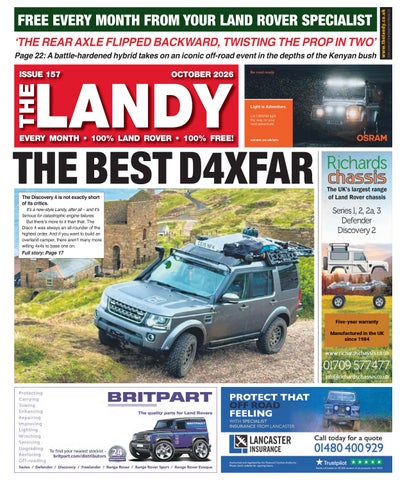
A cast of millions Thousands of people and plenty of Land Rovers descended on the Kenyan bush for the 37th Rhino Charge, raising millions for conservation charities in the process – and putting themselves through what is one of the toughest one-day off-road challenges anywhere IF YOU HAD STARTED IN NAIROBI AND TRAVELLED TO THE 37TH RHINO CHARGE AT THE END OF MAY, the journey alone would have required more than just a bit of planning and effort. The venue was more than 300 kilometres north of the capital on tarmac roads, followed by a further 83 kilometres on a set of very dusty dirt roads in Samburu’s Ngilai Community Conservancy. This is a landscape of plains dotted with acacia trees, steep-sided valleys and rocky ridges split by mostly dry river beds. You go here to camp: there are assuredly no hotels! It’s not uninhabited but it’s very remote. Very remote and very, very harsh. So just getting there is a serious undertaking with a strong element of off-road adventure to it. But notwithstanding all of this, more than 4000 organisers, entrants, supporters and spectators made the journey – and were treated to one of the most spectacular locations in the Charge’s long and storied history. Here, 65 teams battled it out to visit 13 checkpoints within the allotted 10 hours while covering the shortest possible distance. It sounds simple but there are no roads here and if you do use any of the few tracks, you are penalised if the GPS trackers fitted to each vehicle detect that you have stayed on it for more than 10 seconds! Crews are given the map references for the checkpoints the evening before the Charge, so there is no time for reconnaissance. Instead, they sit in their camps plotting the best route late in to the night with the aid of laptops, tablets and a basic map supplied by the organisers, while being aided by the flying insects attracted to their lamps and head torches. They head off to their allotted starting points before dawn and the true nature of the terrain starts to become apparent as the sun rises. This year had some spectacular hill climbs and descents as well as rocky river beds, some of which actually had water flowing through them thanks to recent heavy rains.
To advertise in The Landy, call our team on 01283 742969 w w w. t h e l a n d y. c o . u k We’re on Facebook: www.facebook.com/thelandyuk
The checkpoints are laid out with difficult terrain between them. There’s always a way round, but that will add to your overall distance covered. The skill is in balancing the terrain you take on to keep your distance down with the extra time it will take you; there are no prizes for finishing first but if you don’t make it to all 13 checkpoints, you’re not in the running. Thus there is always a fine line to be chosen between going for a brave, direct course and erring on the side of caution, common sense and self and car preservation. Competitors’ vehicles fall into three classes. The monster 4x4s in the Super Modified class, some of which would easily fit in to a Mad Max film, are allowed portal axles, 40” tyres, twin motor high-speed winches and pretty
much anything else. Then there’s the Modified class, which bans portals and limits tyres to a maximum of 37” diameter but is otherwise unrestricted. Finally, Unmodified is more keenly regulated; vehicles must basically resemble their original form, with only smaller, sensible and mostly safety related modifications allowed. Each team can have up to four runners, who ride in the vehicle when they can but are always ready to run ahead to find the best possible route, secure winch cables and spot their drivers over boulders. The runners communicate via short wave radios plus a lot of shouting; keen ones can cover a marathon’s worth of distance during the day, picking up scratches from thorn bushes in the process, in addition to numerous
other injuries, while gaining a liberal coating of dust and sweat along the way. With the slopes and boulders, the Super Modified and Modifieds have a clear advantage over the Unmodifieds, so in this class teamwork and navigation become extra important. The originally named Team Car 9, brought out from the UK by John Bowden in 2000, arrived at this year’s Charge having won the Unmodified class five times in a row. This year, there were 13 other teams competing against them, including a variety of Defenders and Land Cruisers plus a lone Jeep. There were also a number of Range Rover Classics and even a Series I, but purists had better look away now as these were no show ponies! Team Car 9 set themselves an
Issue 157: Oct 2026
ambitious route, aiming for another win and a top ten overall placing. These big boys included the likes of Team Huzi in their mongrel of a home built Supermodified, a cross between a Unimog and a Land Cruiser, who blasted and winched their way round by brute force, often on only two or three wheels, and the Modified Team 57 in their battered and fearlessly driven Suzuki SJ based special, who bounced and rolled their way to the finish. The Unmodifieds like Team Car 9 had to tread a slightly more careful but still competitive path, giving their runners plenty of work to do. That said, this year’s driver, Van Ballard, gave the spectators a few exciting moments. Sadly, on the final section they had to climb over a mas-
23
sive boulder and crunched the nearside rear radius arm so hard that it snapped, allowing the rear axle to flip backwards, twisting the rear propshaft in two, dislocating the nearside rear spring and allowing the rear wheel to jam up under the rear of the wheelarch. They were doomed to struggle the last kilometre in front wheel drive. This was a disaster and by the time they had relocated the rear spring and ratchet-strapped the rear axle roughly back in place, they ended up being too late to complete the section in time – despite the sporting efforts of Alasdair Keith and his Charging Hippos team, who assisted with a tow, as competitors are allowed to help one another if they so wish. This misfortune allowed the Bushbabes, the all-female team of Petra
Planning ahead is crucial to success on the Rhino Charge. Teams are only given the checkpoints’ locations the night before; it’s up to them to plot a route visiting all 13 in 10 hours while covering the shortest possible distance
24
w w w. t h e l a n d y. c o . u k
Issue 157: Oct 2026
News
Products
Vehicles
Adventure
Workshop
Buyers
A snapped radius arm and rear prop put paid to Team Car 9’s chances on the final section – ratchet straps kept them moving but only in frontwheel drive, the result being that they went over time. The Series I of the team Girls in Pearls didn’t break but struggled with the hills and only made it to two checkpoints Somen and Sabine Kontos, who may have chosen a less ambitious route, to beat them and come in 13th overall this year. This was not too galling, as a mechanical misfortune had robbed them of victory a couple of years before. Anthony Stow and his Kifaru Kwanza team also lost their Discovery’s rear propshaft but luckily had a spare, which they fitted with only a couple of bolts before zipping past rally ace Ian Duncan – whose Land Cruiser had been stuck in the super tough Gauntlet section for four hours. To finish first, first you have to finish, and if Car 9 had been able to do so they would probably have covered a short enough distance not just to top their class but to be in the top ten overall. In the end, though, they had to be content with second in class and 16th overall. The Defender 110 of Tim Carstens finished 19th and ensured that Land Rovers claimed all the top three Unmodified places, proving that if you prepare one with a few sensible modifications it is amazing what you can do! If you are wondering, this year the Series I entered by the Girls in Pearls struggled with the slopes somewhat and ended up driving 65.4km to reach just two checkpoints, while the winners, Team Huzi, used 29.1km to visit all 13. The second placed team of Gurmeet Mehta in their 110-like special were close behind and only covered 500 metres more ground on 30.4km. Third was Patrick Garner with 31.1km. In all, more than 30 Land Rovers, Range Rovers and Discoverys entered, with the second highest charity fundraiser Mark Glen in Team 48’s highly modified and battle hardened Range Rover Classic coming in 4th overall and just ahead of highest fund raiser Adil Khawaja in his very well equipped Supermodified 110. This
beast was built and modified to order in the UK by Off Road Armoury. Adil had a bang on his head while wearing a helmet and had to leave his car for the crew to drive while he had a medical assessment but having been given the all-clear, he was able to rejoin them. Other entries included Toyotas, Nissan Patrols and the very novel Kenya-built EV Explorer which was entered for the second time. It is still in the development stages but having this vehicle in the event is a major first for the Charge and for Kenyan motorsport. The Rhino Charge is run annually, at a different venue each year, in aid of
Rhino Ark Kenya Charitable Trust, and this year it raised a magnificent 365 million Kenyan shillings – equivalent to £2.09 million ($2.8million). These funds will be used to further the charity’s work protecting Kenya’s critical water towers and ecosystems as well as the local people and enabling their motto of “Humans in Harmony with Habitat and Wildlife” to be fulfilled. Many teams have been competing for years; some, like Team Ole Choda and Graham McKittrick’s Team 5 have been in it from the beginning in 1989. Some have the same leaders, while others have passed the mantle on to
the next generation – and now even have a third on board too. Above all, as well as being a highly effective fundraiser, the Charge is an annual rendezvous for friends, colleagues and families in the middle of pretty much nowhere. In Kenya, the event is held in such high regard that President Ruto actually flew in to speak at the prizegiving ceremony the day after the Charge! Most crews who take part come from Kenya. However if anyone fancies shipping a vehicle in or borrowing one, they would be welcome to take up the challenge of what has to be one of the
toughest one-day events anywhere in the world. From the results, it is clear that experience, a good team and a strong, reliable car are pretty essential for a good position. But the main thing about this event is that it is a magnificent adventure in a stunning part of the world, all in aid of a very effective charity. The team of volunteers who run it should be very proud of themselves. See rhinocharge.co.ke and www. rhinoark.org for more info on the event and charity; contact info@rhinocharge. or.ke if you fancy taking part
26
w w w. t h e l a n d y. c o . u k
News
Issue 157: Oct 2026
Products
Vehicles
Adventure
Workshop
Buyers
The Landy Buyer
All the information you need – in one place – to buy your perfect Landy Series I (1948-1958)
The Series I, particularly in its 80” guise, is the most sought-after of
all Land Rovers. Its engineering and design give it real charisma, but parts aren’t readily available. Restoration projects require deep pockets, but see it through and the result will be worth mega bucks. Gone are the days where you could use a Series I as an actual Land Rover. Because with restored examples changing hands for mil-
Series III (1971-1985)
The Series III wasn’t too dissimilar to the Series IIA in mechanical
terms, keeping the same 2.25-litre engines throughout the length of its production run. In 1980, the engines switched to a more durable five-bearing crank rather than the old threebearing setup. The transmission also received syncromesh on all forward gears to make it easier to live with.
Lightweight (1968-1984)
These military vehicles can easily be distinguished from regular Land
Rovers. To mimic the civvy Series machines, the Series III model built from 1972 onwards, also had its headlights switched out to the wings. Lightweights add an extra dimension to owning a Land Rover. Their military history and details mean you get a truck with more stories to tell – and that stands out from the
90/110 (1983-1990)
This is Land Rover at its best: a no nonsense workhorse that can also
take you just about anywhere in the world. Early 90s and 110s are starting to be a real collector’s item. But you’ll likely be searching far and wide for a pristine example. These Land Rovers had coilsprung suspension, new engines and a world-beating level of rugged off-road capability.
£5000-£85,000 Series II/IIA (1958-1971) much of that early charm. Prices seem to have peaked now, however they still remain strong for good examples. A 2.25 petrol 88” would be our pick, as the diesel engines were underpowered and rather noisy. The Series II/IIA has a wider stance than its predecessor and adds an extra (thin) layer of
refinement. While the engines have excellent longevity, they need to have been maintained properly. Be thorough in your checks, both under the bonnet and underneath the body. Pros: A sound investment to restore – and enjoy Cons: Bulkheads and chassis rot, springs prone to seizing
£2500-£35,000 Series IIA/IIB FC (1962-1971)
£2500-£15,000
rarity – with all the cachet, pride and immense awkwardness that comes with this status. By ‘rare’, we’re talking about less than 2500 Series IIA FCs in total. And they tended to have a very hard life, so not many have survived to tell the tale. Forward-Control models differed from everyday Series IIs by having
heavy-duty ENV axles, but engine-wise they had the familiar 2.25 petrol and diesel lumps. So, don’t expect performance – but do expect to be given an ‘interesting’ time in the workshop… Pros: A Land Rover like no other, if that’s what you want Cons: Especially brutal to drive, and to find parts
lionaire money, preservation is the aim of the game. The earlier the vehicle, the more it will be worth. The sky’s the limit – but can you really put a price on such an icon? Pros: Heritage, charm, a true classic, the original Land Rover Cons: Availability of parts, price tag on early 80s
They still carry the simplicity of earlier Land Rovers, but the Series III remains the most affordable way into owning a leafer. Pros: Most affordable route into Series ownership. Still has the Series pedigree. Parts still widely available Cons: Not yet as desirable as the earlier Series models
The Series II/IIA is more affordable than a Series I, yet it still carries
Forward Control Land Rovers are a cult within a cult. They’re a real
£3500-£22,000 101 (1972-1978) crowd. They’re a rare breed, though – so if you’ve got one, it’s worth keeping hold of. Pros: Not like all the other Land Rovers out there. Military background. Lovely 2.25 petrol Cons: Appearance isn’t to everyone’s taste. Exclusivity over regular models means they command a price premium
Only ever sold to the Army, the 101 became a cult vehicle when
£7500-£26,000 the time came for demob. They were flogged off at very low prices and turned into off-road toys – not something you’d do with one today, given the rarity and classic value they’ve taken on. Compared to the IIA/IIB FC, the 101 is more fun thanks to its V8 engine. It’s still a military tool, though – some still have fixtures and
£2500-£30,000 127 (1985-1990) Don’t be fooled by high prices. Values have dropped in the last two years, and only a real rarity in pristine nick is worth the money that used to be commonplace. Pros: Excellent parts availability. Easy to work on. Unlimited potential for mods and restos Cons: Puny engines (V8 apart) Not many left in good condition
The 127 was built on a special production line in Solihull which took
The Tdi engine, which arrived with the Defender name, can last for
The LT77 gearbox in the 200 Tdi is more truck-like than the later R380, and these vehicles didn’t come with bling. Just be sure it’s an original Tdi you’re getting, not an old Discovery conversion. Pros: The perfect combination of tradition and modernity Cons: Lots of horrible and/or deceptive ones around
When Land Rover introduced the Defender name, it was actually the
fittings from their Army life, which adds interest. This is a vehicle for enthusiasts, though, with costs that are sky-high even by Land Rover standards. Pros: Master of the road. Lovely V8 soundtrack. Everybody who sees one loves it Cons: Monumental running costs. Expensive to buy, too
£5500-£24,000 110 chassis and stretched them. It was designed for military and commercial users and came as a high-capacity double-cab. These days, it’s very rare to find a 127 that hasn’t been hammered, restored and/or converted, or all three. People looking for a work truck tend to go for a later 130, so the 127 is more of an enthusiast’s
Defender 200 Tdi (1990-1994) £3000-£32,000 Defender 130 (1990-2016) decades if it’s looked after. And with prices having dropped recently, they’re more affordable than they have been for many years. The good thing about the earlier 200Tdi is that it’s simpler than the later 300. What you gain here you lose in refinement, but this is seen by many experts as the best Defender of them all.
£2500-£40,000
130 that changed the most. That’s because unlike the old 127, it was built on a chassis of its own rather than a stretched 110 frame. The advent of the Tdi engine was the making of the 130, too. At last, Land Rover could make them pull properly without returning single-figure fuel economy by using a hard-worked V8.
motor. It’s popular for home-brewed overland conversions, too. Almost all 127s have had an engine conversion by now, too. Lots to be wary of, then – but it’s a hell of a lot for your money. Pros: Enormous size means limitless potential and character Cons: Unwieldy. Sure to have had a colourful life
£12,500-£35,000 As a result, you’ll find many more original(ish) 130s than 127s. Some are even still in service with the utility companies they were built for. If you want a Defender for overlanding, look no further. Pros: A proper truck with huge capabilities in every area Cons: It’s a big lump if you don’t actually need that much size
To advertise in The Landy, call our team on 01283 742969 w w w. t h e l a n d y. c o . u k
Issue 157: Oct 2026
We’re on Facebook: www.facebook.com/thelandyuk
Defender 300 Tdi (1994-1998)
The 300 Tdi engine is very different to the 200 unit it replaced, though
£3500-£40,000 Defender Td5 (1998-2007)
the two are related. It’s much more refined and smoother to drive, though there are more electronics involved so later versions in particular are less of a DIY fix. The arrival of the 300 Tdi also brought with it the R380 gearbox. This used to have a terrible reputation for relability, but most have been put right by now and they’ve
Defender TDCi (2007-2016)
The last Defenders gained modern 2.4 and 2.2 TDCi engines and
The Td5 engine is arguably Land Rover’s most reliable unit and it’s
smooth six-speed gearboxes, They still had phenomenal off-road ability and were even okay to sit in. Famously, this was the Defender that actually had a dashboard You can find special editions and boutique conversions to TDCi models that cost obscene amounts of money. You will pay a premium for any these late
Defenders, however the era of skyrocketing prices seems to be over and TDCis have dropped further in value than the Td5. So a good 2.2. could now be quite a shrewd investment. Pros: Efficiency, creature comforts, off-road prowess Cons: Price, electronics, TDCi engine is unloved
If the subject of the new Defender comes up in enthusiast circles, try
£3000-£35,000
a strong performer. It does lend itself to being tuned though, so watch out for abused ones and knackered examples that have been pushed beyond the limit. As with all Defenders, you’ll need a rear crossmember sooner or later – or even a new chassis. Despite having more electronics than the Tdi, a Td5 Defender can
£6500-£275,000 Defender (2020-on)
Freelander (1997-2006)
The Freelander 1 is a cheap gateway into Land Rover ownership.
become sought after for their light clutch and better shift action. It was during the Tdi era that Defenders started getting things like alloys, too. You might even find one that’s not been off-road… Pros: Strength and simplicity. Perhaps the definitive Defender Cons: Sure to be very different to when it left the factory
more robust, but a late diesel is your best bet. Even these can go calamitously wrong, though. This was a more complex car than it needed to be, and buying one for sweeties now doesn’t change that. Pros: Cheap to buy, no big rust issues, surprisingly able off-road Cons: All sorts of things can go wrong, some very expensively
The Freelander 2 was a massive improvement on the model
to steer it away on to something safer. Like Brexit, for example. Much as it may infuriate purists, however, the Defender is actually a very wonderful thing. It’s kind of like an old one, only with space, comfort and equipment. The big difference is that you can’t work on it yourself. This goes for maintenance and, crucially,
it replaced. It’s a refined and affordable SUV with a strong engine, good equipment and a decent level of practicality. It’s become one of the most reliable Land Rovers out there, too. But do be aware of the rear diff and Haldex unit for costly outlays. The 2.2-litre diesel engine is a strong performer, though for a
Range Rover Classic (1970-96) £2500-£225,000 Range Rover (1994-2002)
The original Rangey is a classic you can use everyday – and there
are people who do just that, preferring to invest new-car money in a restoration than spending it on a current model. It’s a smart policy, too. An early two-door can cost mega money, but any Classic will appreciate in value if kept in good condition – and sought-after rarities like the CSK and LSE can be a gold mine.
Range Rover (2002-12)
The Mk3 Range Rover hit new heights of luxury and was more re-
The fifth-generation Range Rover takes its position as a luxury car
A Mk2 Rangey in good working order is still a sensational car to
own, even today. The problem is that they’re very complex and very, very good at going wrong. Air suspension failure is the norm. Head gaskets can let go. Electronics are laughably flaky. And parts can cost the earth – as will the labour bills. Perhaps worst of all, nowadays it’s very hard to find one you can be sure hasn’t
£2200-£24,000 Range Rover (2012-22)
liable than the P38. It’ll still cost a lot to run, however, and drivetrain faults and underbody corrosion are not unknown. The TDV8 engine is sublime, but you’ll pay more to get one – especially the 4.4, though the 3.6 has all the power you need. The V8 petrol, on the other hand, is temptingly cheap. Guess why…
Range Rover (2022-on)
An awful lot of Rangeys have been neglected and/or abused, and you can still buy they cheap. But if you’ve got the skills, and access to parts, restoring one would be the ultimate hobby that pays. Pros: Most usable classic Land Rover, V8 power, ride quality Cons: Rust, availability of parts for early models
This isn’t a DIY motor, but it certainly is a Range Rover, with brilliant off-road and towing skills. It relies a lot on electronics, but they work wonders – and the deepdown engineering is very robust. Pros: Great off-road, luxury, image, TDV8 powerplants Cons: Very complex. Huge running costs
The fourth-gen Range Rover is a majestic 4x4. All the engines in the
still be a DIY machine. Parts are in plentiful supply, as is specialist knowledge – and it’s one of the best Land Rovers ever. Pros: Off-road capability, power, overall reliability. Very well suited to being modified Cons: Rear chassis, premium prices, monstrous road tax on later vehicles
£45,000-£185,000
£500-£5000 Freelander 2 (2006-2015)
It’s also a notable classic in its own way, as it heralded the start of the company’s modern era. It has its issues, though. The viscous coupling is expensive to replace and can be upset simply by running mismatched tyres. The 1.8 petrol used to be notorious for head gasket failures. Today’s replacements are much
27
range supply copious amounts of power, and its road manners are absolutely impeccable. It’s startlingly capable off-road, too, even if getting one muddy would feel like bad form. Most that leave the tarmac probably do so only when their owners are in the mood to blow some grouse out of the sky.
making modifications – a market Land Rover wants to take back and have for itself. It won’t hold its value long-term the way an original-shaper does, either. But this is still a superb vehicle. Pros: Comfort, capability, rugged fitness for purpose Cons: Not cheap to buy. Lacks the old one’s basic charm
£2000-£15,500 bargain search out one with the unpopular 3.2 petrol unit. Either way, it’s a fine SUV to drive. Prices have fallen since the production ended, too – £15,000 now gets you a late one on tiny miles. Pros: Reliability, refinement, economy of diesel engine Cons: Transmissions can wear quickly if used for towing
£1000-£29,000 spent at least part of its life being worked on by idiots Still, you’ll get a classy motor with proper off-road and towing skills. It’s becoming a classic, too, and prices are still tiny considering everything you get. Pros: Luxury, price, a Land Rover that doesn’t rust Cons: Electrics. Be very afraid
£15,000-£75,000 Inside, the Range Rover’s cabin is superb, with sumptuous trim and cutting-edge equipment. Prices are, of course, as immense as the vehicle itself. But if you can afford it, so too is the presence a Rangey will give you. Pros: Class, luxury, engines, vast all-round capability Cons: Price
£99,000-£220,000 Range Rover Sport (2005-2013) £2000-£17,500
to greater extremes than ever, with lavish equipment and endless opportunities for personalisation. It’s a supreme lifestyle wagon for the rich: to many of Land Rover’s traditional fans, on the other hand, it’s the supreme irrelevance. If you can afford one, few cars could be as pleasing. However if you can afford one and you love
Land Rovers, you’re likely to be thinking about how many real ones you could buy with this sort of money. It wouldn’t make a bad way to tow your collection about the place, though… Pros: Immense prestige, and sublime both to be in and drive Cons: To at least 99% of people it’s utterly divorced from reality
The Sport is mechanically similar to the Discovery 3 – meaning it’s
a supreme off-roader as well as being a funky road ride. It doesn’t handle like a sports car, but is agile enough for an SUV. A Discovery of the same era is far more practical, however, while a full-fat Rangey has more class. The Sport is still a massively able tow barge, though, in addition to all its other virtues.
You’re looking at a car which many people associate with rich chavs and criminals, however. And being based on the Discovery 3, it can’t help but share that vehicle’s reputation as a money pit. Pros: Decent performance and all-round dynamics Cons: A Disco 3 is more usable. Expect horrific running costs
28
w w w. t h e l a n d y. c o . u k
News
Issue 157: Oct 2026
Products
Vehicles
Adventure
Workshop
Buyers
Range Rover Sport (2013-22) £13,500-£65,000 Range Rover Sport (2022-on) £80,500-£145,000
The second-generation Range Rover Sport is 400kg lighter than
the original, meaning it’s almost economical to run. It feels really nimble and agile on the road, too, and it comes with a range of engines giving it a brisk turn of pace. Some won’t like the flamboyant posture, while others will love it. Either way, inside the cabin it’s very nearly as luxurious as the full-house Range Rover.
If you can afford the SVR model, you’ve got a super-SUV with rap star image. In every case, though, running costs will be vast. Parts don’t get any cheaper because you bought it second-hand… Pros: Performance, refinement, handling, glorious interior Cons: Marmite image. Pricey to buy and run
When the Evoque was launched, it signalled JLR’s intent on hitting
the masses. Given that it was the company’s fastest-selling vehicle, they clearly hit the brief, even if it wasn’t for the traditional Land Rover owner. It’s actually still a capable thing off-tarmac – but it’s definitely more at home on the road. Nevertheless, it is economical by Land Rover standards and
because there are so many out there, used prices are tempting. There’s a Convertible model, too, as well as three and five-door tin-tops. We say stick to the latter, and be sure to get one with 4WD. Pros: Economy, handling, iconic concept-car image Cons: Cramped rear seats, not as practical as a Disco Sport
Hilariously, this is what counts as the affordable way in to owning a
new Range Rover. The Sport is less about being chauffeur driven and more about lording it over other aspirational school runners, but once again it’ll be lovely to drive. Like the full fat Range Rover (a phrase which has never felt more appropriate), the Sport is available with an old-school V8 engine that gives you racecar performance in
return for NASA-level emissions. Most UK customers with opt for an altogether healthier plug-in hybrid, but they’ll still get a vehicle that’s brutally fast a well as being able to do the normal Range Rover stuff. Pros: Smooth, refined, comfy… and game for a laugh, too Cons: Still hasn’t quite shed its proceeds-of-crime image
Most Range Rovers all look the same at the front now, but the new
Evoque has adopted a similiar back end to the larger Velar. It’s not just the exterior that mimics the looks of the larger vehicle, however, as the Evoque has gained the latest Touch Pro Duo tech and a hike in quality. The main highlight of the new Evoque is the fact the majority of the range is made up of mild
hybrids, available with diesel and petrol engines combining to an electric motor. Only the base D150 Evoque escapes the electrification, and we’d avoid it as it doesn’t have four-wheel drive. Pros: Feels like a proper Range Rover inside Cons: Petrol engine is poor on fuel economy, even as a hybrid
Range Rover Evoque (2011-19) £4500-£31,000 Range Rover Evoque (2019-on) £20,000-£65,000
Range Rover Velar (2017-on) £22,500-£85,000 Discovery (1989-1998)
The Velar a competent cruiser and has received numerous accolades
because of its particularly handsome exterior. It’s based upon the same architecture as the Jaguar F-Pace but has greater off-road ability and is available with a wide choice of engines, most of which combine good economy with usable everyday performance. The interior was Land Rover’s most advanced cabin yet when
Discovery 2 (1998-2004)
The Disco 2 is powered by the Td5 engine, one of Land Rover’s most
most reliable units ever. It drives well, too – mated to a manual box it has more guts even than the V8 option, which is surprisingly bland but predictably thirsty. Whereas the Disco 1 was prone to body rust, the D2 is fine here. Instead, its chassis rots like a carrot, especially towards the back end. Also at the back, seven-seat
Discovery 4 (2009-2017)
Somewhere between a facelift and a whole new model, the Disco 4
is basically an evolution of the 3. It looks similar and is still a practicality monster, as well as being hugely impressive on and off-road and a hero in front of a trailer, but despite being only subtly tweaked inside feels far more luxurious. That hasn’t prevented it from suffering all the same issues as time has gone on. You need to
Discovery Sport (2015-19)
The Discovery Sport packs seven seats into a Freelander-sized
body and dishes up an appealing all-round blend of comfort, kit and general driving manners.The third row of seats is only suitable for little ‘uns, though, and off-road it’s a Discovery in name only. It’s a more practical proposition than the closely related Evoque, and you won’t need to live with the fear of Posh Spice jokes.
it came out. It was very much designed to be a trend setter. But is there a whiff of style over substance? Well, it’s a very good SUV. But you don’t half pay a premium for those suave looks... Pros: Stylish design, chic cabin, excellent tech features Cons: Feels like an indulgence, especially at such a high price
The original Discovery was based on the Range Rover of the time,
with the same 100” wheelbase and a slick body containing a spacious, flexible cabin. It was well equipped and refined, and it came with the wonderful Tdi engine. Over time, the Disco’s epic ability meant almost all of them were hammered at playdays. Lower body rust is a big killer, too. So it’s rare to find a good one now,
£1000-£10,000 Discovery 3 (2004-2009) models had air-suspension, with all the horrors that brings. Mainly, D2 owners will tell you about rogue electronics. And leaky sunroofs. They still love their trucks, though, which says a lot. Pros: Td5 power and reliability, great all-rounder, lots of choice Cons: Chassis rust, electronics, leaky sunroofs, air suspension
The Disco 3 is an astonishing allround vehicle. It’s good on the road
and capable off-road, genuinely luxurious and a giant of a tow truck, and as well as being able to seat seven adults it can be turned into a van with a totally flat rear load area. But it was also astonishingly complex, and these days it has a reputation as a money pit. Air suspension and electronic
£6000-£30,000 Discovery 5 (2017-on) start off by buying the best you can possibly afford – and at the top of the market, they don’t come cheap. Get it right, though, and this is as good as a modern Land Rover has ever been. Pros: Most LR fans’ idea of what a Range Rover should be like Cons: Still a potential money pit, and the best are expensive
£600-£22,000 There are some tidy deals to be had on late high-spec examples now – though if you do a search for ‘Ingenium reliability’, you might end up deciding to buy something Japanese instead… Pros: Seven seats. Practical, and capable enough off-road Cons: Back seats only for kids. Reliability worries over engines
The Discovery 5 is a versatility monster. It’s still a workhorse if
you want it to be – but it’s much more luxurious than anything else short of a Range Rover. All the engines in the range are refined and flexible, and its chassis is remarkably supple for such a big vehicle. There’s no end of electronics working away in the background, but the effect is very convincing indeed.
Discovery Sport (2019-on)
The second-generation Disco Sport came along only four years
after the first. That’s because once again, it’s related to the Evoque, which was ready for a full new model in 2019. The Sport is a premium midsized SUV with seven seats and a decent level of off-road ability. It’s a massively popular choice for the school run – and, with the arrival of a plug-in hybrid a few year
£800-£15,000 and when you do they tend to be priced with a lot of optimism. Very early ones in tip-top condition are full-on classics, too. For a sound one to own, we’d look for a tidy 300Tdi. Pros: Price, practicality, parts availability. Epic off-road ability Cons: The body rusts like it’s been doused in sea water
£1000-£16,000 handbrakes are big sources of woe, cam belts are a body-off job to change and rust is becoming more of an issue. Get a good one, though, and it’s all the car you’ll ever need. Pros: Good at everything. Lots of accessories available now Cons: The phrase ‘money pit’ crops up time after time
£13,500-£77,000 One in five Disco sales go to the commercial model, which is available as a high-spec luxury tax buster. But every model is a supremely able, flexible all-rounder for work and play. Pros: Immense blend of class, comfort and practicality Cons: Feels more like a softroader than a proper Discovery
£21,000-£62,000 back, as a company car. Quality has taken a step up from the first model – it’s now a convincing premium vehicle, and the range offers enough choices to suit anybody with the means to buy one. Pros: Classy and practical cabin, all-round good to drive Cons: You can get a Defender for the price of some models