8
w w w. t h e l a n d y. c o . u k
Issue 158: Nov 2026
News
Products
Vehicles
Adventure
Workshop
Buyers
Attention-grabbing Defenders pull in the crowds for Hunters Prestige at Great British Land Rover Show
T
he Great British Land Rover Show, which takes place three times a year at Stoneleigh, Newark and Bath and West, has long been a melting pot for every kind of Landy – from classics to comp safari, from off-road to overland. And it has also witnessed the rise and rise of the lifestyle Land Rover – as illustrated to perfection by the new-shape Defenders exhibited at this summer’s Newark event by Hunters Prestige. ‘Our “Blue’tiful” wrapped Defender OCTA features some subtle exterior enhancements,” says the company. “But it’s what’s going on inside that makes this one particularly interesting.’ And what would that be? Well, it’s a van. An Octa van. That got your accountant’s attention, didn’t it? ‘This is the first Octa Commercial Van
to be fully converted,’ they continue. ‘It has a factory-style finish, including a bespoke bulkhead and flat load floor. ‘From the outside, you’d have absolutely no idea it started life as a van. And once you step inside, you’d be hard-pressed to believe it wasn’t built this way straight from the factory. ‘This truly unique Octa build showcases how far we can take a Defender and was the perfect vehicle to show off at the Great British Land Rover Show in Newark.’ Also on the Hunters stand at Newark was another new-shape Defender, this one wrapped in Citrus Fury. Like the Octa, it was originally built as a Commercial – but while it’s not unusual to see 4x4s and SUVs being converted into vans, this one has gone in the opposite direction.
‘We’ve converted it into a full passenger vehicle,’ says Hunters, ‘retrofitting the rear seats from an Octa and removing all evidence of its previous life as a van. The goal was to make the conversion as close to a factory finish as possible, and we think the result speaks for itself. ‘But that’s not all. We also used this Defender to launch two of our latest seat retrofits, bringing the Massage Seats and Body and Soul Seats from the Octa into standard Defender models. These are exclusive retrofit options available through Hunters.’ To finish it off, the company gave the Defender a head-to-toe kit-out with the full range of Hunters Accessories, including its own-brand gloss black exterior upgrades. ‘The contrast against the Citrus Fury wrap really makes the colour pop and gives the whole build an even more aggressive look,’ they comment, and unless you’re viewing in black and white you’ll be able to see the results for yourself in the pictures here. ‘This was our second time exhibiting at the Great British Land Rover Show, having previously joined in Bath, and we’ve absolutely loved being part of it again,’ comments Hunters. ‘It’s been
great having so many people come over to the stand, ask questions and take a closer look at the builds. A lot of the visitors have been genuinely amazed by the lengths we’ve gone to with these Defenders and the level of detail that goes into making them what they are.
‘It’s always great to meet fellow Defender enthusiasts, share what we do and, of course, hear what everyone thinks of the builds,’ they conclude. ‘This definitely won’t be the last time you see Hunters at The Great British Land Rover Show — it’s a fantastic day out for any Land Rover enthusiast!’
14
w w w. t h e l a n d y. c o . u k
News
Issue 158: Nov 2026
Products
Vehicles
Adventure
Workshop
Buyers
Heritage 1948 offers package pricing on soft-top conversion kit for 88” Series II/III
Price: From £1049 inc VAT | Available from: www.heritage1948.co.uk
A
few issues back, we told you about Heritage 1948’s hood stick kits for the 88” Series II and III. The company also does the hoods to go on them, of course – and right now it’s got a special price on offer if you buy the whole lot as a full conversion package.
This includes the hood itself, traditionally manufactured and available from stock in a choice of colours, as well as the full stick kit to support it. Promising to contain everything you need to turn an 88 into a Soft-Top, the latter are shaped by hand-operated tooling in the same process by which
the original parts were manufactured back in the day. ‘We have selected a high-quality steel and low-volume galvanising to produce the most accurate, period-correct Land Rover hood stick sets on the market,’ says Heritage 1948. ‘Our kits include everything you need for the
conversion, right down to nuts, bolts and washers.’ And you’re supporting British industry here, too: ‘all of our hood sticks are manufactured right here on Exmoor, Somerset, UK.’ The parts included in the kit are a front screen rail, front, rear and interim support hoops, horizontal tie bars, drain channels, rope hooks and stick clamps, webbing staples, stick clamp arms and all the brackets, nuts, bolts and pot rivets required for the installation. Heritage 1948 has a minimum 12-month standard warranty on everything it makes, so you can be sure it’s all good stuff, and the same goes for the canvas you’re going to be wrapping around it. Your choice of colours here is between sand, khaki and, if you’re feeling radical, black. The former is available with or without side windows, while black comes exclusively with them and khaki exclusively without. All have a windowed back panel as standard and are made from 610gsm, 18oz Moorland cotton canvas, chosen for its durability and colour-fast properties. The hoods are treated to protect against rot, fungus and UV damage and fitted with real brass buckles, tips and eyelets. Rot resistant thread and
Got a 90? Then Heritage 1948 has got you looked after, too From £647.50 plus VAT | Available from: ww.heritage1948.co.uk HERITAGE 1948 IS ALSO CURRENTLY HOLDING EXCELLENT STOCKS OF ITS HOOD STICK KIT FOR THE LAND ROVER 90. Suitable for all original-shape models from 1985-2016, this is of the same high quality as the company’s Series kits and comes fully galvanised. All the company’s parts are available individually – and they promise to be the most accurate and period-correct on the market so if you’re just mending or restoring an original, they should be idea. If you’ve got a
Truck-Cab or Hard-Top, on the other hand, and you want to convert it into a ragtop, the full kit contains: • Flat-type front header rail • Front hoop • Rear hoop • Interim support hoop • Horizontal tie bar (2 off) • Over door drain channel (left and right-hand, one each) • Side of door drain channel (left and right-hand, one each) • Rear rope hooks / Hood stick clamps (2 off)
• Rope hook, side of body (left and right-hand, one each) • Webbing staples (2 off) • Hood stick clamp arms (4 off) • Pack of nuts, bolts and pot rivets The canvas itself is extra, however Heritage 1948 offers plenty of options in this area too. There are many very similar parts available on the wider market so the company encourages you to refer to the parts diagrams on its website and, if in doubt, contact it for advice on what’s right for your Land Rover.
heavy-duty saddlers cotton webbing are used throughout. ‘Following our efforts to increase canvas production over the summer,’ says Heritage 1948, ‘we now have almost all Series II/III hoods in stock and ready for dispatch – avoiding the usual 8-12 week lead time for canvas products. We also currently have hundreds of hood stick kits in stock, allowing us to dispatch most complete packages the same week.’ And best of all, you can get the package from as little as £1049 plus post and packing. Side windows only add £40, too, which sounds like pretty good value when you consider the extra work involved. It’s all while stocks last, though, so you know what to do next.
TERRAFIRMA TM12000 TWIN MOTOR WINCH
terrafirma4x4.com
The TM12000 combines exceptional pulling performance under heavy loads with line speeds more than twice as fast as conventional ‘in line’ winches. Two powerful 6.6hp 12v motors ensure fast recovery even under extreme loads, pulling harder for longer. The huge drum holds over 160ft of super strong red synthetic rope, again saving time on those long pulls back to hard ground. The rope is guided onto the extra wide drum by an equally large alloy fairlead, and a RED Terrafirma XL Tactical safety hook easily connects to straps and anchor points. Part Numbers Shown: TF3360 TM12000 Twin Motor Winch / TF0028 TRED Winch Bumper Contact the Terrafirma team on enquiries@terrafirma4x4.com for product information or to find your local stockist, or visit terrafirma4x4.com/find-a-stockist
To advertise in The Landy, call our team on 01283 742969 w w w. t h e l a n d y. c o . u k We’re on Facebook: www.facebook.com/thelandyuk So, we have a man with a vision of his ideal challenge truck and the drive to see the project through. A good combination. And what did that vision involve? After all, when you’re starting with just a bare chassis the world is pretty much your oyster. Well, the chassis was in good nick, so Paul didn’t have to start by repairing it. He did, however, still need to show it the hot end of his welding kit. That’s because his big plan involved shortening it by 6” at the front and 8” at the back. He put his grinder through the dumb irons and tied the main rails together using a Gwyn Lewis winch tray, while at the back he trusted the same job to a challenge style crossmember. You’ll have sussed from this that Paul’s not scared of doing a bit of fabrication. If you haven’t, take a look at the roll structure and you’ll get the idea. He made the whole thing himself, using a Sealey tube bender and bolting it through spreader plates to the chassis.
‘The cage was designed to be a tight fit and make the truck look that little bit mean!’ says Paul. It was also designed to include challenge style tubular front wings and protect as much else of the body as possible, and when it comes to strength it’ll stay up through anything short of a tank driving over it. The body it protects is made up from a bobtailed 90 tub, Series II Land Rover doors and a Defender bulkhead, windscreen, roof and back panel. Paul cut out and tubbed the wheelarches to prevent his Fedima Siroccos from fouling them when the suspension flexes and shortened a Defender bonnet to go with the tubular wings. The flimsy little sill panels made way for a set of box-section rock sliders and tubular nerf bars, and then he added ‘some nice chequer plate to finish it all off.’ Turning into quite the concoction already, isn’t it? Well, there’s more to come. Those Siroccos are turned by a 300 Tdi Discovery engine, which
Issue 158: Nov 2026
21
24
w w w. t h e l a n d y. c o . u k
Issue 158: Nov 2026
News
Products
Vehicles
Adventure
Workshop
Buyers
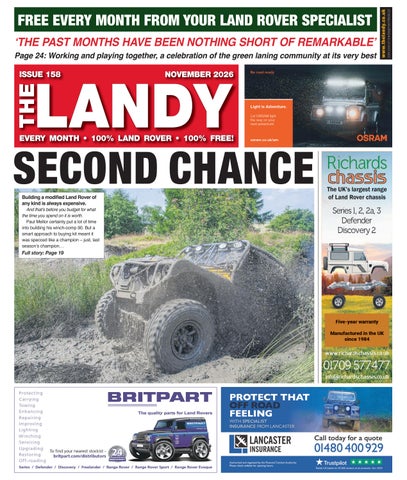
All work and no play… Green Lane Association reps tend to have a lot on their plate. So it’s good to see that getting a group together and going out to actually enjoy the lanes is all part of the job too…
THE LIFE OF A GREEN LANE ASSOCIATION REP normally seems to be a procession of meetings with the council, meetings with landowners, meetings with fellow stakeholders, organising volunteer work groups and so on. Or in certain parts of the country, trying to get the local authority to talk to you, trying to get the local authority to talk to you, trying to get the local authority to talk to you and so on. So it’s always good to hear about it when they manage to get some time away to actually do some green laning. Ian Bosher, who’s the North York‑ shire Rep for GLASS, got out and
about with some fellow members earli‑ er this year on what he describes as ‘a northern gathering to remember.’ This saw a very varied group of vehicles take on a very varied group of lanes in the Lake District – and they came from Nottingham, Northumbria, Cumbria and Lincolnshire, so quite an impressive variety of home counties, too. ‘The weekend kicked off in style with more than 20 of us sharing a fantastic Friday evening meal at the Sun Inn in Pooley Bridge,’ says Ian. (That would be the same Sun Inn that we used as a starting point for one of our roadbooks in the recent past.) ‘From there, we
split into smaller groups and headed out on a mix of challenging and scenic routes making something for every taste and every vehicle. ‘Sunday brought a real highlight: a warm welcome at the magnificent Dalemain Historic Mansion where Jane Hassel, whose family has owned the estate since 1679, greeted us personally. With special permission granted, we were able to drive around to the front of the house for a group photograph that will no doubt become a treasured memory. ‘Afterwards, we headed back out in smaller groups for another day of su‑
perb laning, taking in some of the UK’s most iconic routes, including Breas‑ thigh and The Fox. The weather, the scenery and the company combined to create a weekend that will be talked about for a long time.’ And that, ladies and gentlemen, is exactly what green laning should be all about. Getting together to visit a beautiful part of the country, spending some money with local businesses, making friends with each others and your hosts: it really is that easy. Ian describes the group as ‘a community growing stronger every day.’ And how right he is. ‘Perhaps the
most uplifting part has been the sense of connection that has grown across the group,’ he says. ‘New friendships were formed in the Lakes and they’ve continued to flourish through our lively WhatsApp community. The support network is stronger than ever, the en‑ thusiasm is infectious and there’s a real buzz around everything we’re doing.’ And what are they doing? Going laning, as you’ve seen – but a whole lot more besides. ‘The past two months have been nothing short of remarkable for our green laning community,’ says Ian. ‘What began as a push to review every queried lane in the county quickly grew into a showcase of teamwork, persis‑ tence and genuine passion for protect‑ ing and enjoying our countryside. ‘A dedicated group of volunteers rolled up their sleeves and set about checking every lane with an outstand‑ ing query. It was no small task, there were plenty to get through, but the out‑ come has been incredibly rewarding. ‘Thanks to the team’s efforts, Trail‑ wise2 (GLASS’ interactive database of rights of way covering the whole country) has now been updated to re‑ flect several lanes that are open for use once again, despite previously being thought closed. ‘A huge part of this success comes down to the excellent cooperation from North Yorkshire County Council. Their response times have been outstand‑ ing, with replies landing within 14 days every time. Whether it was a clear answer or a promise to investigate further within the next fortnight, their commitment has been invaluable. ‘They also deserve a special mention for reacting so quickly to help get one of our region’s best lanes repaired after the winter weather took its toll. It’s a brilliant example of what can be achieved when authorities and respon‑ sible users work together. ‘From lane checks to repairs, from cross‑county collaboration to unfor‑ gettable weekends away,’ concludes Ian, ‘the last two months have shown exactly what makes our community so special. Passion, teamwork and a shared love of the great outdoors. Long may it continue!’ And amen to that.
26
w w w. t h e l a n d y. c o . u k
News
Issue 158: Nov 2026
Products
Vehicles
Adventure
Workshop
Buyers
The Landy Buyer
All the information you need – in one place – to buy your perfect Landy Series I (1948-1958)
The Series I, particularly in its 80” guise, is the most sought-after of
all Land Rovers. Its engineering and design give it real charisma, but parts aren’t readily available. Restoration projects require deep pockets, but see it through and the result will be worth mega bucks. Gone are the days where you could use a Series I as an actual Land Rover. Because with restored examples changing hands for mil-
Series III (1971-1985)
The Series III wasn’t too dissimilar to the Series IIA in mechanical
terms, keeping the same 2.25-litre engines throughout the length of its production run. In 1980, the engines switched to a more durable five-bearing crank rather than the old threebearing setup. The transmission also received syncromesh on all forward gears to make it easier to live with.
Lightweight (1968-1984)
These military vehicles can easily be distinguished from regular Land
Rovers. To mimic the civvy Series machines, the Series III model built from 1972 onwards, also had its headlights switched out to the wings. Lightweights add an extra dimension to owning a Land Rover. Their military history and details mean you get a truck with more stories to tell – and that stands out from the
90/110 (1983-1990)
This is Land Rover at its best: a no nonsense workhorse that can also
take you just about anywhere in the world. Early 90s and 110s are starting to be a real collector’s item. But you’ll likely be searching far and wide for a pristine example. These Land Rovers had coilsprung suspension, new engines and a world-beating level of rugged off-road capability.
£5000-£85,000 Series II/IIA (1958-1971) much of that early charm. Prices seem to have peaked now, however they still remain strong for good examples. A 2.25 petrol 88” would be our pick, as the diesel engines were underpowered and rather noisy. The Series II/IIA has a wider stance than its predecessor and adds an extra (thin) layer of
refinement. While the engines have excellent longevity, they need to have been maintained properly. Be thorough in your checks, both under the bonnet and underneath the body. Pros: A sound investment to restore – and enjoy Cons: Bulkheads and chassis rot, springs prone to seizing
£2500-£35,000 Series IIA/IIB FC (1962-1971)
£2500-£15,000
rarity – with all the cachet, pride and immense awkwardness that comes with this status. By ‘rare’, we’re talking about less than 2500 Series IIA FCs in total. And they tended to have a very hard life, so not many have survived to tell the tale. Forward-Control models differed from everyday Series IIs by having
heavy-duty ENV axles, but engine-wise they had the familiar 2.25 petrol and diesel lumps. So, don’t expect performance – but do expect to be given an ‘interesting’ time in the workshop… Pros: A Land Rover like no other, if that’s what you want Cons: Especially brutal to drive, and to find parts
lionaire money, preservation is the aim of the game. The earlier the vehicle, the more it will be worth. The sky’s the limit – but can you really put a price on such an icon? Pros: Heritage, charm, a true classic, the original Land Rover Cons: Availability of parts, price tag on early 80s
They still carry the simplicity of earlier Land Rovers, but the Series III remains the most affordable way into owning a leafer. Pros: Most affordable route into Series ownership. Still has the Series pedigree. Parts still widely available Cons: Not yet as desirable as the earlier Series models
The Series II/IIA is more affordable than a Series I, yet it still carries
Forward Control Land Rovers are a cult within a cult. They’re a real
£3500-£22,000 101 (1972-1978) crowd. They’re a rare breed, though – so if you’ve got one, it’s worth keeping hold of. Pros: Not like all the other Land Rovers out there. Military background. Lovely 2.25 petrol Cons: Appearance isn’t to everyone’s taste. Exclusivity over regular models means they command a price premium
Only ever sold to the Army, the 101 became a cult vehicle when
£7500-£26,000 the time came for demob. They were flogged off at very low prices and turned into off-road toys – not something you’d do with one today, given the rarity and classic value they’ve taken on. Compared to the IIA/IIB FC, the 101 is more fun thanks to its V8 engine. It’s still a military tool, though – some still have fixtures and
£2500-£30,000 127 (1985-1990) Don’t be fooled by high prices. Values have dropped in the last two years, and only a real rarity in pristine nick is worth the money that used to be commonplace. Pros: Excellent parts availability. Easy to work on. Unlimited potential for mods and restos Cons: Puny engines (V8 apart) Not many left in good condition
The 127 was built on a special production line in Solihull which took
The Tdi engine, which arrived with the Defender name, can last for
The LT77 gearbox in the 200 Tdi is more truck-like than the later R380, and these vehicles didn’t come with bling. Just be sure it’s an original Tdi you’re getting, not an old Discovery conversion. Pros: The perfect combination of tradition and modernity Cons: Lots of horrible and/or deceptive ones around
When Land Rover introduced the Defender name, it was actually the
fittings from their Army life, which adds interest. This is a vehicle for enthusiasts, though, with costs that are sky-high even by Land Rover standards. Pros: Master of the road. Lovely V8 soundtrack. Everybody who sees one loves it Cons: Monumental running costs. Expensive to buy, too
£5500-£24,000 110 chassis and stretched them. It was designed for military and commercial users and came as a high-capacity double-cab. These days, it’s very rare to find a 127 that hasn’t been hammered, restored and/or converted, or all three. People looking for a work truck tend to go for a later 130, so the 127 is more of an enthusiast’s
Defender 200 Tdi (1990-1994) £3000-£32,000 Defender 130 (1990-2016) decades if it’s looked after. And with prices having dropped recently, they’re more affordable than they have been for many years. The good thing about the earlier 200Tdi is that it’s simpler than the later 300. What you gain here you lose in refinement, but this is seen by many experts as the best Defender of them all.
£2500-£40,000
130 that changed the most. That’s because unlike the old 127, it was built on a chassis of its own rather than a stretched 110 frame. The advent of the Tdi engine was the making of the 130, too. At last, Land Rover could make them pull properly without returning single-figure fuel economy by using a hard-worked V8.
motor. It’s popular for home-brewed overland conversions, too. Almost all 127s have had an engine conversion by now, too. Lots to be wary of, then – but it’s a hell of a lot for your money. Pros: Enormous size means limitless potential and character Cons: Unwieldy. Sure to have had a colourful life
£12,500-£35,000 As a result, you’ll find many more original(ish) 130s than 127s. Some are even still in service with the utility companies they were built for. If you want a Defender for overlanding, look no further. Pros: A proper truck with huge capabilities in every area Cons: It’s a big lump if you don’t actually need that much size
To advertise in The Landy, call our team on 01283 742969 w w w. t h e l a n d y. c o . u k
Issue 158: Nov 2026
We’re on Facebook: www.facebook.com/thelandyuk
Defender 300 Tdi (1994-1998)
The 300 Tdi engine is very different to the 200 unit it replaced, though
£3500-£40,000 Defender Td5 (1998-2007)
the two are related. It’s much more refined and smoother to drive, though there are more electronics involved so later versions in particular are less of a DIY fix. The arrival of the 300 Tdi also brought with it the R380 gearbox. This used to have a terrible reputation for relability, but most have been put right by now and they’ve
Defender TDCi (2007-2016)
The last Defenders gained modern 2.4 and 2.2 TDCi engines and
The Td5 engine is arguably Land Rover’s most reliable unit and it’s
smooth six-speed gearboxes, They still had phenomenal off-road ability and were even okay to sit in. Famously, this was the Defender that actually had a dashboard You can find special editions and boutique conversions to TDCi models that cost obscene amounts of money. You will pay a premium for any these late
Defenders, however the era of skyrocketing prices seems to be over and TDCis have dropped further in value than the Td5. So a good 2.2. could now be quite a shrewd investment. Pros: Efficiency, creature comforts, off-road prowess Cons: Price, electronics, TDCi engine is unloved
If the subject of the new Defender comes up in enthusiast circles, try
£3000-£35,000
a strong performer. It does lend itself to being tuned though, so watch out for abused ones and knackered examples that have been pushed beyond the limit. As with all Defenders, you’ll need a rear crossmember sooner or later – or even a new chassis. Despite having more electronics than the Tdi, a Td5 Defender can
£6500-£275,000 Defender (2020-on)
Freelander (1997-2006)
The Freelander 1 is a cheap gateway into Land Rover ownership.
become sought after for their light clutch and better shift action. It was during the Tdi era that Defenders started getting things like alloys, too. You might even find one that’s not been off-road… Pros: Strength and simplicity. Perhaps the definitive Defender Cons: Sure to be very different to when it left the factory
more robust, but a late diesel is your best bet. Even these can go calamitously wrong, though. This was a more complex car than it needed to be, and buying one for sweeties now doesn’t change that. Pros: Cheap to buy, no big rust issues, surprisingly able off-road Cons: All sorts of things can go wrong, some very expensively
The Freelander 2 was a massive improvement on the model
to steer it away on to something safer. Like Brexit, for example. Much as it may infuriate purists, however, the Defender is actually a very wonderful thing. It’s kind of like an old one, only with space, comfort and equipment. The big difference is that you can’t work on it yourself. This goes for maintenance and, crucially,
it replaced. It’s a refined and affordable SUV with a strong engine, good equipment and a decent level of practicality. It’s become one of the most reliable Land Rovers out there, too. But do be aware of the rear diff and Haldex unit for costly outlays. The 2.2-litre diesel engine is a strong performer, though for a
Range Rover Classic (1970-96) £2500-£225,000 Range Rover (1994-2002)
The original Rangey is a classic you can use everyday – and there
are people who do just that, preferring to invest new-car money in a restoration than spending it on a current model. It’s a smart policy, too. An early two-door can cost mega money, but any Classic will appreciate in value if kept in good condition – and sought-after rarities like the CSK and LSE can be a gold mine.
Range Rover (2002-12)
The Mk3 Range Rover hit new heights of luxury and was more re-
The fifth-generation Range Rover takes its position as a luxury car
A Mk2 Rangey in good working order is still a sensational car to
own, even today. The problem is that they’re very complex and very, very good at going wrong. Air suspension failure is the norm. Head gaskets can let go. Electronics are laughably flaky. And parts can cost the earth – as will the labour bills. Perhaps worst of all, nowadays it’s very hard to find one you can be sure hasn’t
£2200-£24,000 Range Rover (2012-22)
liable than the P38. It’ll still cost a lot to run, however, and drivetrain faults and underbody corrosion are not unknown. The TDV8 engine is sublime, but you’ll pay more to get one – especially the 4.4, though the 3.6 has all the power you need. The V8 petrol, on the other hand, is temptingly cheap. Guess why…
Range Rover (2022-on)
An awful lot of Rangeys have been neglected and/or abused, and you can still buy they cheap. But if you’ve got the skills, and access to parts, restoring one would be the ultimate hobby that pays. Pros: Most usable classic Land Rover, V8 power, ride quality Cons: Rust, availability of parts for early models
This isn’t a DIY motor, but it certainly is a Range Rover, with brilliant off-road and towing skills. It relies a lot on electronics, but they work wonders – and the deepdown engineering is very robust. Pros: Great off-road, luxury, image, TDV8 powerplants Cons: Very complex. Huge running costs
The fourth-gen Range Rover is a majestic 4x4. All the engines in the
still be a DIY machine. Parts are in plentiful supply, as is specialist knowledge – and it’s one of the best Land Rovers ever. Pros: Off-road capability, power, overall reliability. Very well suited to being modified Cons: Rear chassis, premium prices, monstrous road tax on later vehicles
£45,000-£185,000
£500-£5000 Freelander 2 (2006-2015)
It’s also a notable classic in its own way, as it heralded the start of the company’s modern era. It has its issues, though. The viscous coupling is expensive to replace and can be upset simply by running mismatched tyres. The 1.8 petrol used to be notorious for head gasket failures. Today’s replacements are much
27
range supply copious amounts of power, and its road manners are absolutely impeccable. It’s startlingly capable off-road, too, even if getting one muddy would feel like bad form. Most that leave the tarmac probably do so only when their owners are in the mood to blow some grouse out of the sky.
making modifications – a market Land Rover wants to take back and have for itself. It won’t hold its value long-term the way an original-shaper does, either. But this is still a superb vehicle. Pros: Comfort, capability, rugged fitness for purpose Cons: Not cheap to buy. Lacks the old one’s basic charm
£2000-£15,500 bargain search out one with the unpopular 3.2 petrol unit. Either way, it’s a fine SUV to drive. Prices have fallen since the production ended, too – £15,000 now gets you a late one on tiny miles. Pros: Reliability, refinement, economy of diesel engine Cons: Transmissions can wear quickly if used for towing
£1000-£29,000 spent at least part of its life being worked on by idiots Still, you’ll get a classy motor with proper off-road and towing skills. It’s becoming a classic, too, and prices are still tiny considering everything you get. Pros: Luxury, price, a Land Rover that doesn’t rust Cons: Electrics. Be very afraid
£15,000-£75,000 Inside, the Range Rover’s cabin is superb, with sumptuous trim and cutting-edge equipment. Prices are, of course, as immense as the vehicle itself. But if you can afford it, so too is the presence a Rangey will give you. Pros: Class, luxury, engines, vast all-round capability Cons: Price
£99,000-£220,000 Range Rover Sport (2005-2013) £2000-£17,500
to greater extremes than ever, with lavish equipment and endless opportunities for personalisation. It’s a supreme lifestyle wagon for the rich: to many of Land Rover’s traditional fans, on the other hand, it’s the supreme irrelevance. If you can afford one, few cars could be as pleasing. However if you can afford one and you love
Land Rovers, you’re likely to be thinking about how many real ones you could buy with this sort of money. It wouldn’t make a bad way to tow your collection about the place, though… Pros: Immense prestige, and sublime both to be in and drive Cons: To at least 99% of people it’s utterly divorced from reality
The Sport is mechanically similar to the Discovery 3 – meaning it’s
a supreme off-roader as well as being a funky road ride. It doesn’t handle like a sports car, but is agile enough for an SUV. A Discovery of the same era is far more practical, however, while a full-fat Rangey has more class. The Sport is still a massively able tow barge, though, in addition to all its other virtues.
You’re looking at a car which many people associate with rich chavs and criminals, however. And being based on the Discovery 3, it can’t help but share that vehicle’s reputation as a money pit. Pros: Decent performance and all-round dynamics Cons: A Disco 3 is more usable. Expect horrific running costs
28
w w w. t h e l a n d y. c o . u k
News
Issue 158: Nov 2026
Products
Vehicles
Adventure
Workshop
Buyers
Range Rover Sport (2013-22) £13,500-£65,000 Range Rover Sport (2022-on) £80,500-£145,000
The second-generation Range Rover Sport is 400kg lighter than
the original, meaning it’s almost economical to run. It feels really nimble and agile on the road, too, and it comes with a range of engines giving it a brisk turn of pace. Some won’t like the flamboyant posture, while others will love it. Either way, inside the cabin it’s very nearly as luxurious as the full-house Range Rover.
If you can afford the SVR model, you’ve got a super-SUV with rap star image. In every case, though, running costs will be vast. Parts don’t get any cheaper because you bought it second-hand… Pros: Performance, refinement, handling, glorious interior Cons: Marmite image. Pricey to buy and run
When the Evoque was launched, it signalled JLR’s intent on hitting
the masses. Given that it was the company’s fastest-selling vehicle, they clearly hit the brief, even if it wasn’t for the traditional Land Rover owner. It’s actually still a capable thing off-tarmac – but it’s definitely more at home on the road. Nevertheless, it is economical by Land Rover standards and
because there are so many out there, used prices are tempting. There’s a Convertible model, too, as well as three and five-door tin-tops. We say stick to the latter, and be sure to get one with 4WD. Pros: Economy, handling, iconic concept-car image Cons: Cramped rear seats, not as practical as a Disco Sport
Hilariously, this is what counts as the affordable way in to owning a
new Range Rover. The Sport is less about being chauffeur driven and more about lording it over other aspirational school runners, but once again it’ll be lovely to drive. Like the full fat Range Rover (a phrase which has never felt more appropriate), the Sport is available with an old-school V8 engine that gives you racecar performance in
return for NASA-level emissions. Most UK customers with opt for an altogether healthier plug-in hybrid, but they’ll still get a vehicle that’s brutally fast a well as being able to do the normal Range Rover stuff. Pros: Smooth, refined, comfy… and game for a laugh, too Cons: Still hasn’t quite shed its proceeds-of-crime image
Most Range Rovers all look the same at the front now, but the new
Evoque has adopted a similiar back end to the larger Velar. It’s not just the exterior that mimics the looks of the larger vehicle, however, as the Evoque has gained the latest Touch Pro Duo tech and a hike in quality. The main highlight of the new Evoque is the fact the majority of the range is made up of mild
hybrids, available with diesel and petrol engines combining to an electric motor. Only the base D150 Evoque escapes the electrification, and we’d avoid it as it doesn’t have four-wheel drive. Pros: Feels like a proper Range Rover inside Cons: Petrol engine is poor on fuel economy, even as a hybrid
Range Rover Evoque (2011-19) £4500-£31,000 Range Rover Evoque (2019-on) £20,000-£65,000
Range Rover Velar (2017-on) £22,500-£85,000 Discovery (1989-1998)
The Velar a competent cruiser and has received numerous accolades
because of its particularly handsome exterior. It’s based upon the same architecture as the Jaguar F-Pace but has greater off-road ability and is available with a wide choice of engines, most of which combine good economy with usable everyday performance. The interior was Land Rover’s most advanced cabin yet when
Discovery 2 (1998-2004)
The Disco 2 is powered by the Td5 engine, one of Land Rover’s most
most reliable units ever. It drives well, too – mated to a manual box it has more guts even than the V8 option, which is surprisingly bland but predictably thirsty. Whereas the Disco 1 was prone to body rust, the D2 is fine here. Instead, its chassis rots like a carrot, especially towards the back end. Also at the back, seven-seat
Discovery 4 (2009-2017)
Somewhere between a facelift and a whole new model, the Disco 4
is basically an evolution of the 3. It looks similar and is still a practicality monster, as well as being hugely impressive on and off-road and a hero in front of a trailer, but despite being only subtly tweaked inside feels far more luxurious. That hasn’t prevented it from suffering all the same issues as time has gone on. You need to
Discovery Sport (2015-19)
The Discovery Sport packs seven seats into a Freelander-sized
body and dishes up an appealing all-round blend of comfort, kit and general driving manners.The third row of seats is only suitable for little ‘uns, though, and off-road it’s a Discovery in name only. It’s a more practical proposition than the closely related Evoque, and you won’t need to live with the fear of Posh Spice jokes.
it came out. It was very much designed to be a trend setter. But is there a whiff of style over substance? Well, it’s a very good SUV. But you don’t half pay a premium for those suave looks... Pros: Stylish design, chic cabin, excellent tech features Cons: Feels like an indulgence, especially at such a high price
The original Discovery was based on the Range Rover of the time,
with the same 100” wheelbase and a slick body containing a spacious, flexible cabin. It was well equipped and refined, and it came with the wonderful Tdi engine. Over time, the Disco’s epic ability meant almost all of them were hammered at playdays. Lower body rust is a big killer, too. So it’s rare to find a good one now,
£1000-£10,000 Discovery 3 (2004-2009) models had air-suspension, with all the horrors that brings. Mainly, D2 owners will tell you about rogue electronics. And leaky sunroofs. They still love their trucks, though, which says a lot. Pros: Td5 power and reliability, great all-rounder, lots of choice Cons: Chassis rust, electronics, leaky sunroofs, air suspension
The Disco 3 is an astonishing allround vehicle. It’s good on the road
and capable off-road, genuinely luxurious and a giant of a tow truck, and as well as being able to seat seven adults it can be turned into a van with a totally flat rear load area. But it was also astonishingly complex, and these days it has a reputation as a money pit. Air suspension and electronic
£6000-£30,000 Discovery 5 (2017-on) start off by buying the best you can possibly afford – and at the top of the market, they don’t come cheap. Get it right, though, and this is as good as a modern Land Rover has ever been. Pros: Most LR fans’ idea of what a Range Rover should be like Cons: Still a potential money pit, and the best are expensive
£600-£22,000 There are some tidy deals to be had on late high-spec examples now – though if you do a search for ‘Ingenium reliability’, you might end up deciding to buy something Japanese instead… Pros: Seven seats. Practical, and capable enough off-road Cons: Back seats only for kids. Reliability worries over engines
The Discovery 5 is a versatility monster. It’s still a workhorse if
you want it to be – but it’s much more luxurious than anything else short of a Range Rover. All the engines in the range are refined and flexible, and its chassis is remarkably supple for such a big vehicle. There’s no end of electronics working away in the background, but the effect is very convincing indeed.
Discovery Sport (2019-on)
The second-generation Disco Sport came along only four years
after the first. That’s because once again, it’s related to the Evoque, which was ready for a full new model in 2019. The Sport is a premium midsized SUV with seven seats and a decent level of off-road ability. It’s a massively popular choice for the school run – and, with the arrival of a plug-in hybrid a few year
£800-£15,000 and when you do they tend to be priced with a lot of optimism. Very early ones in tip-top condition are full-on classics, too. For a sound one to own, we’d look for a tidy 300Tdi. Pros: Price, practicality, parts availability. Epic off-road ability Cons: The body rusts like it’s been doused in sea water
£1000-£16,000 handbrakes are big sources of woe, cam belts are a body-off job to change and rust is becoming more of an issue. Get a good one, though, and it’s all the car you’ll ever need. Pros: Good at everything. Lots of accessories available now Cons: The phrase ‘money pit’ crops up time after time
£13,500-£77,000 One in five Disco sales go to the commercial model, which is available as a high-spec luxury tax buster. But every model is a supremely able, flexible all-rounder for work and play. Pros: Immense blend of class, comfort and practicality Cons: Feels more like a softroader than a proper Discovery
£21,000-£62,000 back, as a company car. Quality has taken a step up from the first model – it’s now a convincing premium vehicle, and the range offers enough choices to suit anybody with the means to buy one. Pros: Classy and practical cabin, all-round good to drive Cons: You can get a Defender for the price of some models