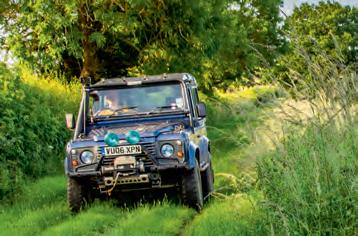
ROADBOOK Say hello to the sun on Northants’ summer-only green lanes




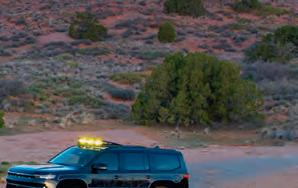

Jeep’s latest crop of concept off-roaders celebrate 60 years of the Moab Easter Safari

































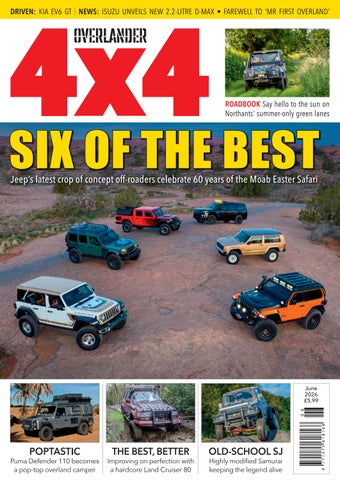
ROADBOOK Say hello to the sun on Northants’ summer-only green lanes
Jeep’s latest crop of concept off-roaders celebrate 60 years of the Moab Easter Safari
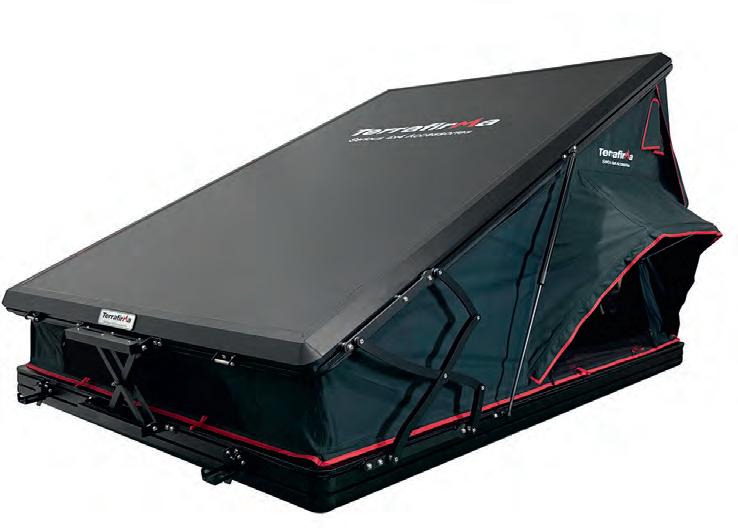
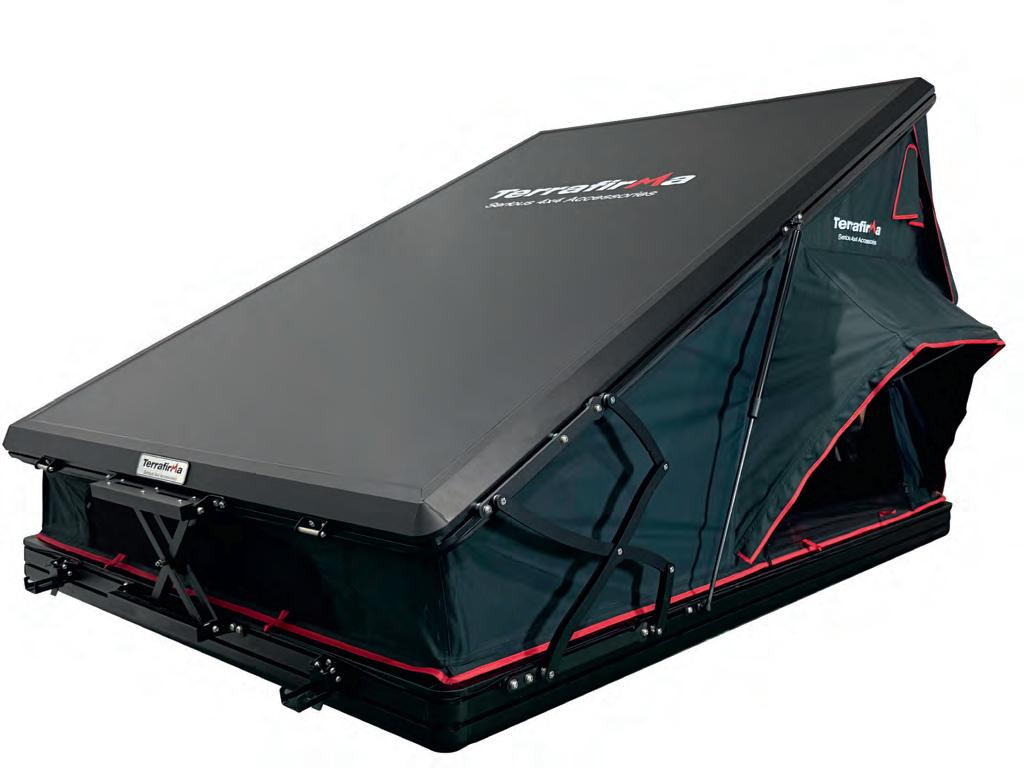
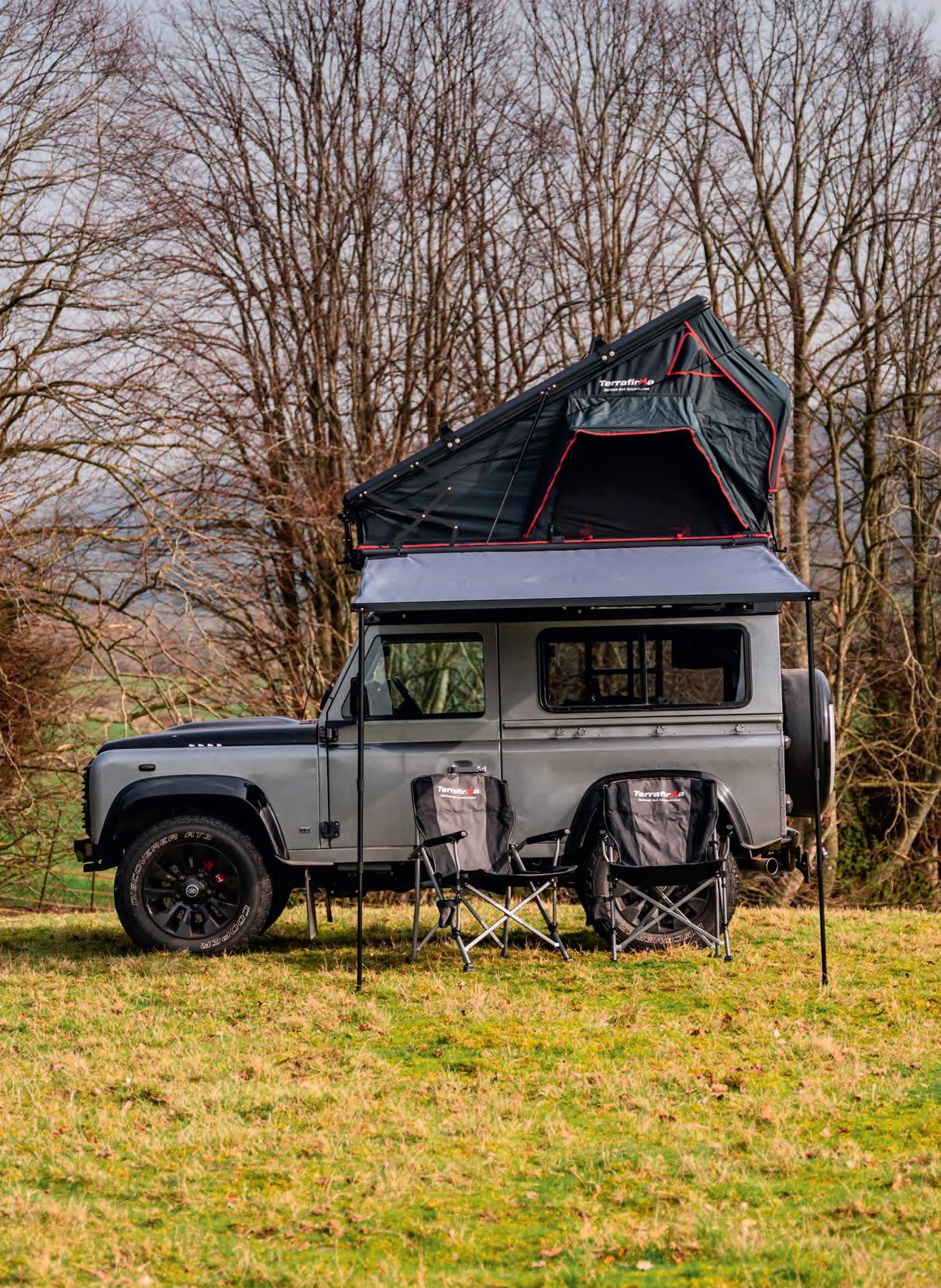
The Terrafirma X-Hinge Roof Tent is a strong, lightweight, and practical roof tent designed for 4x4 and overland vehicles. It combines fast setup, a spacious sleeping area, and a slim, low-profile design that is ideal for everyday driving and long-distance travel.
Perfect for touring, camping, and off-road adventures, this roof tent provides a safe and comfortable place to sleep wherever your journey takes you.
The innovative X-hinge opening system allows the roof tent to open smoothly and evenly, creating excellent internal space while keeping the structure stable and secure.
The hinge position is carefully designed to prevent the tent fabric from becoming trapped when opening or closing, making setup quick and hassle-free even after a long day on the road.
When closed, the roof tent measures just 200mm in height, helping to reduce wind resistance, road noise, and fuel consumption.
The low profile also keeps overall vehicle height to a minimum, making it suitable for daily use as well as long overland journeys.
A large entrance makes getting in and out of the tent easy, while the soft, fabric-covered mattress ensures a comfortable night’s sleep. The generous internal space allows pillows and blankets to remain inside the tent when folded, saving valuable storage space in your vehicle.
A built-in dual-colour LED light and integrated charging station provide added convenience when camping, whether you are reading, relaxing, or charging devices.
Perfect for touring, camping, and off-road adventures, this roof tent provides

Contact the Terrafirma team on enquiries@terrafirma4x4.com for product information or to find your local stockist.
Innovative X-Hinge Opening System
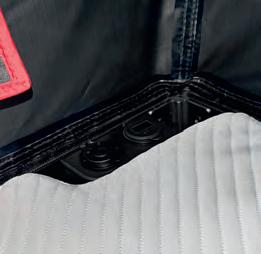
Built-in charging point
>Third rear X-hinge for added stability
>Two large side windows and a skylight
>600D ripstop canvas (280gsm)
>Waterproof rating: PU3000
>Sleeps two adults
>Built-in 70mm “cool feel” mattress with fabric cover
>Built-in dual-colour LED light
>Integrated charging station
>Exterior clip-on boot bag and interior storage pockets
>Pillows and blankets can be left inside when folded, saving vehicle space
>CNC airflow design in the bottom shell to help reduce condensation
>T-slot system channels allow brackets (TF5547) to attach accessories such as awnings
>Compatible with Terrafirma (TF5546) roof bars
Built-in 70mm mattress
system channels
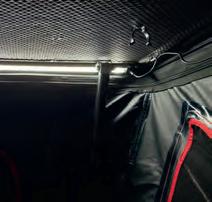
Built-in dual colour LED Light
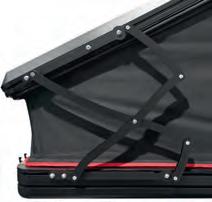
Unique, sturdy X-Hinge system
provides a safe and comfortable place to sleep wherever your journey takes you.


Tel: 01283 742969
Email: admin@pistonpublications.co.uk
Web: www.totaloffroad.co.uk www.4x4i.com
Online Shop: www.toronline.co.uk
Facebook: www.facebook.com/totaloffroad www.facebook.com/4x4Mag
Editor Alan Kidd
Design Ian Denby-Jones
Contributors
Mike Trott, Gary Martin, Olly Sack, Dan Fenn, Gary Noskill, Paul Looe, Mark Fraser, Kenny Tucker, Tom Alderney, Will Crotchley
Photographers
Richard Hair, Vic Peel, Harry Hamm
Advertising Sales
Colin Ashworth
Tel: 01283 742969 colin.ashworth@assignment-media.co.uk
Subscriptions Agency
WW Magazines, 151 Station Street, Burton on Trent, DE14 1BG Tel: 01283 742970
Publisher Alan Kidd
Email: editorial@pistonpublications.co.uk
To subscribe to 4x4, or renew a subscription, call 01283 742970. Prices for 12 issues: UK £42 (24 issues £76); Europe Airmail/ROW Surface £54; ROW Airmail £78
Distributed by Marketforce; www.marketforce.co.uk
Every effort is made to ensure the contents of 4x4 are accurate, but Piston Publications accepts no responsibility for errors or omissions nor the consequences of actions made as a result of these. When responding to any advert in 4x4, you should make appropriate enquiries before sending money or entering into a contract. The publishers take reasonable care to ensure advertisers’ probity, but will not be liable for loss or damage incurred from responding to adverts
Where a photo credit includes the note ‘CC BY 2.0’ or similar, the image is made available under that Creative Commons licence: details at www.creativecommons.org
Overlander 4x4 is published by Piston Publications Ltd, PO Box 8830, Burton on Trent DE14 9QW
© Piston Publications Ltd, 2026
overlander4x4.co.uk









Pay quarterly by direct debit and you can get Britain’s only all-marques 4x4 magazine delivered to your door – for less than half the price on the front cover!
4 News
Isuzu D-Max gets a new 2.2-litre diesel engine and KGM’s electric Musso gets or the full government EV grant, while the world of expeditions mourns the passing of First Overland’s Tim Slessor
10 Motorsport
Ticking the Safari Rally off an epic bucket list
14 Rights of Way
How the Green Lane Association works behind the scenes to keep rights of way healthy
16 Products
A jump-starter that’ll fire up almost anything, a topnotch awning for travel trucks and brand new replacement engines for Disco 4s that need them
28 Subscribe
Get Overlander 4x4 delivered for a fraction of the cover price
64 Next Month
Raising the Defender rebuild bar still higher
20 Kia EV6 GT
As fast as a Lambo but without the emissions; Kia’s super-SUV is a performance bargain
22 The Moab Mob
An extra-large group of concept off-roaders from the 2026 Easter Jeep Safari
30 Improving on Perfection
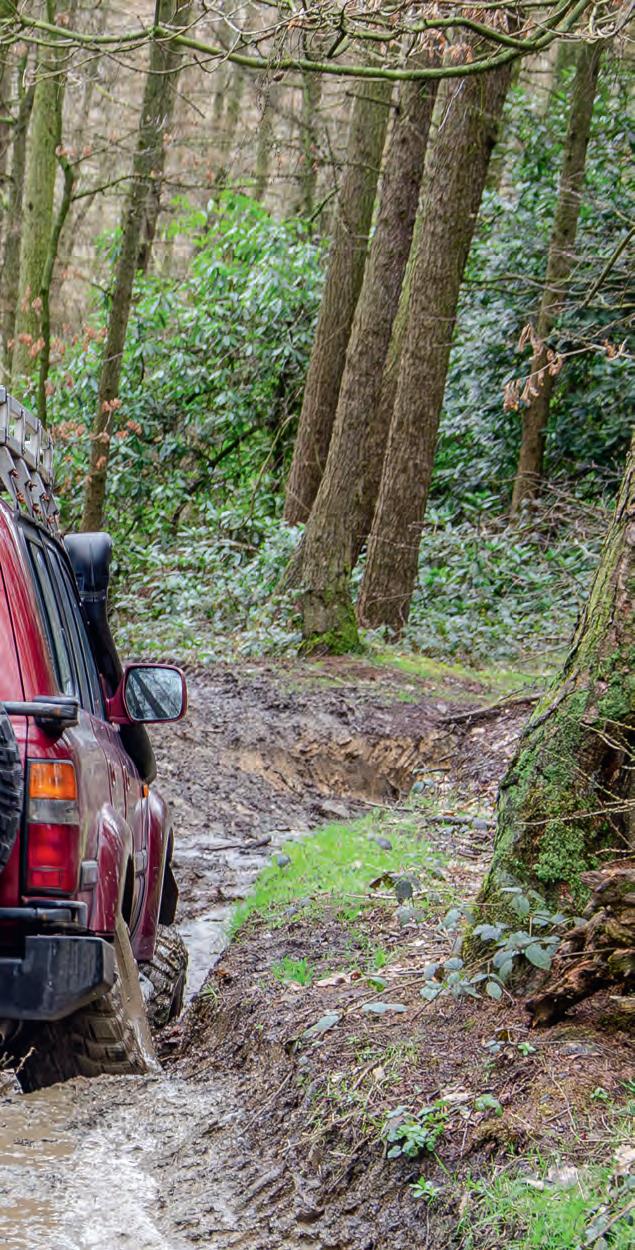
The Land Cruiser 80-Series was many people’s idea of the best vehicle ever. Here’s how to make it better than ever
38 Range Rover with a Twist
Twisted builds its first Range Rover – and, surprise surprise, it’s a millionaire-spec motor
42 Play it Again, Sammy…
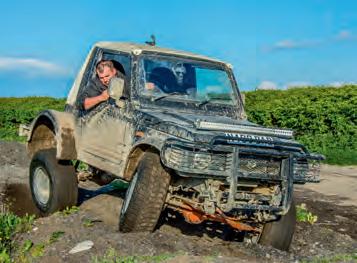
The Suzuki Samurai might feel like last generation’s 4x4 but those that have survived until today serve as a reminder of just how great a truck it was
46 Just Popping Out
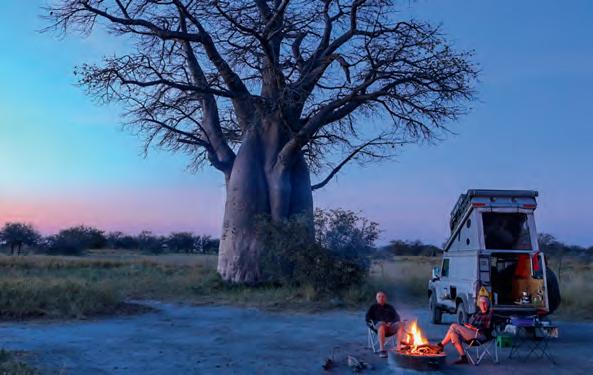
Converting a brand new Defender 110 into a poptop overlander and heading off to see the world sounds like a definite case of living the dreamt
54 ROADBOOK West Northants
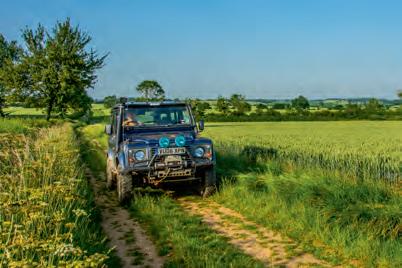
Summer’s here at last and in a county where most lanes have been shut since autumn, a fine time awaits amid the lush Heart of England landscape

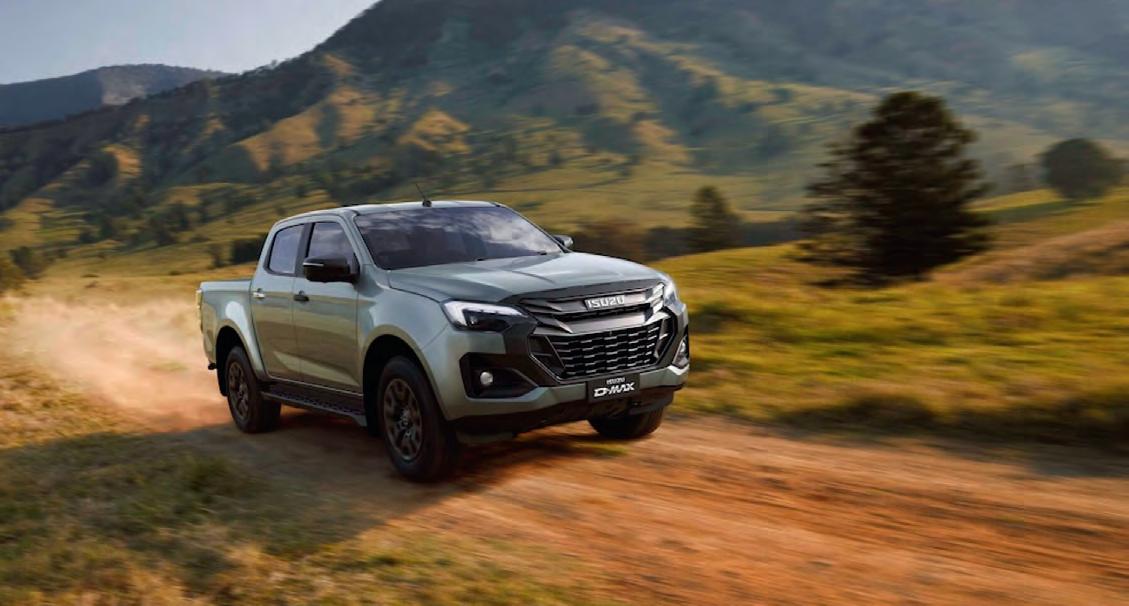
Isuzu has unveiled the D-Max 2.2, a revised version of our former Pick-Up of the Year – which, as the name suggests, is now powered by a larger engine. Due to go on sale in July, the vehicle gains a 2.2-litre turbo-diesel whose 163bhp is backed up by 295lbf.ft of torque – up from the 265 produced by the current 1.9-litre unit, which it will replace.
The extra torque doesn’t equate to extra load capacity, but the minimum payload limit of 1010kg is retained. Crucially, so too is the all-important 3500kg trailer limit.
Displacing 2164cc, the new engine is mated to a choice of gearboxes – the
familiar six-speed manual and a new eightspeed automatic. The two-speed, part-time transfer case is retained, with a shift-onthe-fly function allowing four-wheel drive to be engaged and disengaged at speeds of up to 62mph. The rear diff lock that was introduced when the current D-Max was new has since become standard across the range – as is Rough Terrain Mode, which was added with the previous facelift at the start of last year.
Talking of facelifts, the new model does get one but it’s so subtle you’d be forgiven for not noticing. A new radiator grille is the main giveaway, though if you
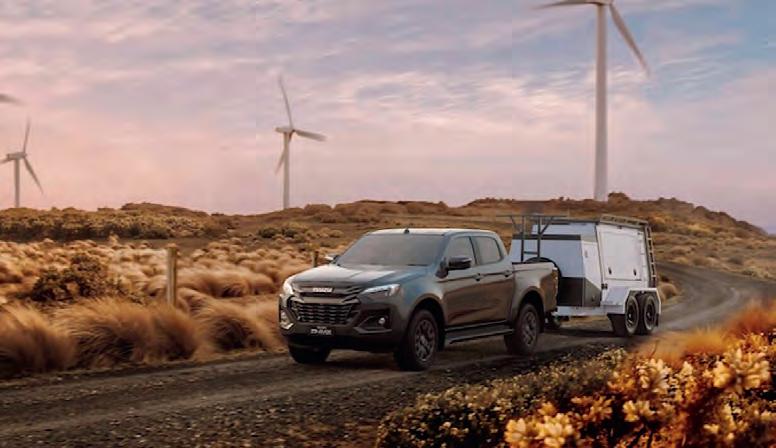
have an unhealthy interest in fog lamp and rear camera bezels there won’t be any fooling you. Higher-spec DL40 and V-Cross models get revised side steps as well as the inevitable new alloy wheels, the latter also extending down to the DL20. Wrapped around these are new 265/60R18 Dunlops whose revised rubber compound allows lower rolling resistance – which Isuzu credits for a 7% improvement in both fuel efficiency and grip on wet roads.
Inside, a further update on the DL40 and V-Cross is a 360-degree Surround View Camera system. These models get a new design for their leather seats, too, as does the DL20 for its cloth trim.
The D-Max range has been revised somewhat to coincide with the arrival of the new engine, too. The entry-level Utility model is available in Single and Extended Cab form, while the DL20 comes exclusively as a Double Cab. The DL40 can now be ordered as an Extended Cab and Double Cab, while at the top of the range the V-Cross is offered as a Double Cab only. By definition, this means that so too will the AT35 when this joins the range, as it traditionally does a few months after launch.
As before, the D-Max 2.2 comes with a five-year, 125,000-mile warranty. Prices start at £33,495 and climb to £42,995, in each case on the road but before VAT.
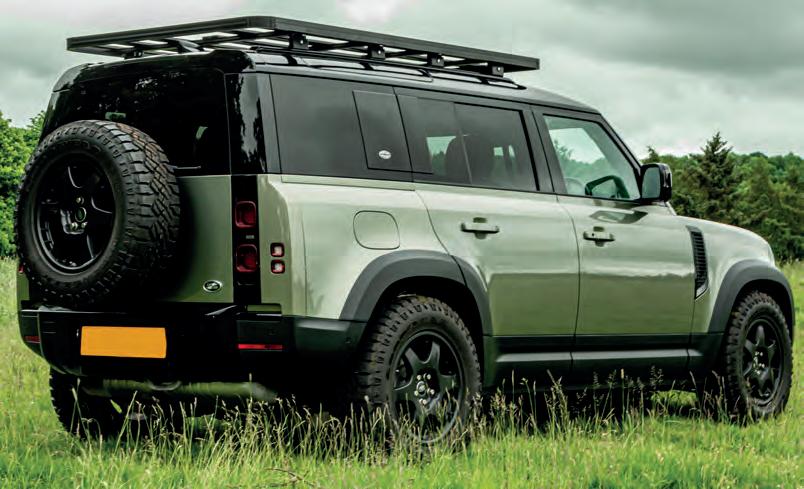
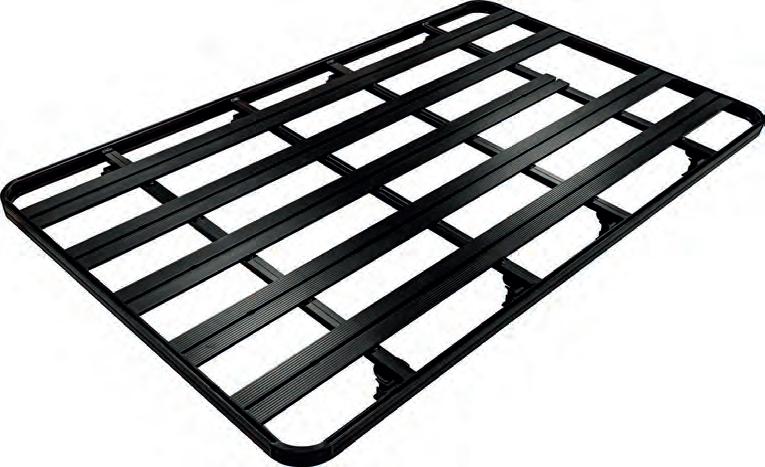
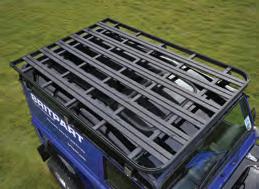
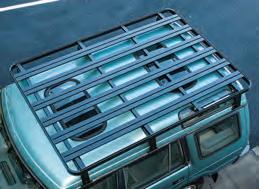
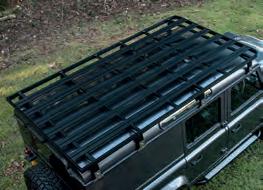
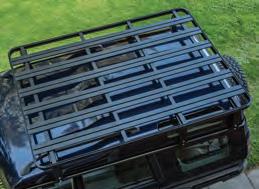
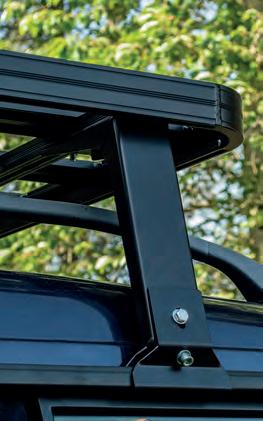
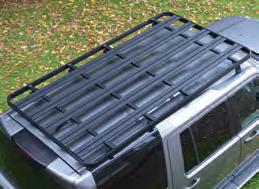
These roof racks are manufactured from aluminium with a smart black powder coated finish. Fully welded, they are extremely strong, versatile, with a low profile and are easy to use. The floor plank profiles are orientated longitudinally which results in a reduction in wind noise. There are nut channels on all the extrusions to allow for easy fitment of 3rd party accessories.
DA2901 NEW
Defender 2020 - 110
4 feet per side / Weight - 22kg
2,100 long x 1,260mm wide
Vehicle gutter to top of rack - 110mm
More images and video at www.britpart.com/DA2901
DA3072
Defender 90
3 feet per side / Weight - 32kg
2,050mm long x 1,500mm wide
Vehicle gutter to top of rack - 265mm
DA3070
Defender 110
4 feet per side / Weight - 38kg
2,750mm long x 1,500mm wide
Vehicle gutter to top of rack - 265mm DA3269
Defender 110 Double cab pickup
Defender 130 Double cab pickup
3 feet per side / Weight - 27kg
1,600mm long x 1,500m wide
Vehicle gutter to top of rack - 265mm DA6529
Discovery 1 & Discovery 2 - without roof rails
3 feet per side / Weight - 26kg
2,050mm long x 1,500mm wide
Vehicle gutter to top of rack - 265mm DA6629
Discovery 1 & Discovery 2 - with roof rails
3 feet per side / Weight - 27kg
2,050mm long x 1,500mm wide
Vehicle gutter to top of rack - 340mm DA6537
Discovery 3 & Discovery 4
4 feet per side / Weight - 23kg
2,300mm long x 1,260mm wide Roof to top of rack - 120mm
Note - May need roof rail kit (CAB500120PVJ or CAP500090) to be fitted to vehicle prior to roof rack installation.

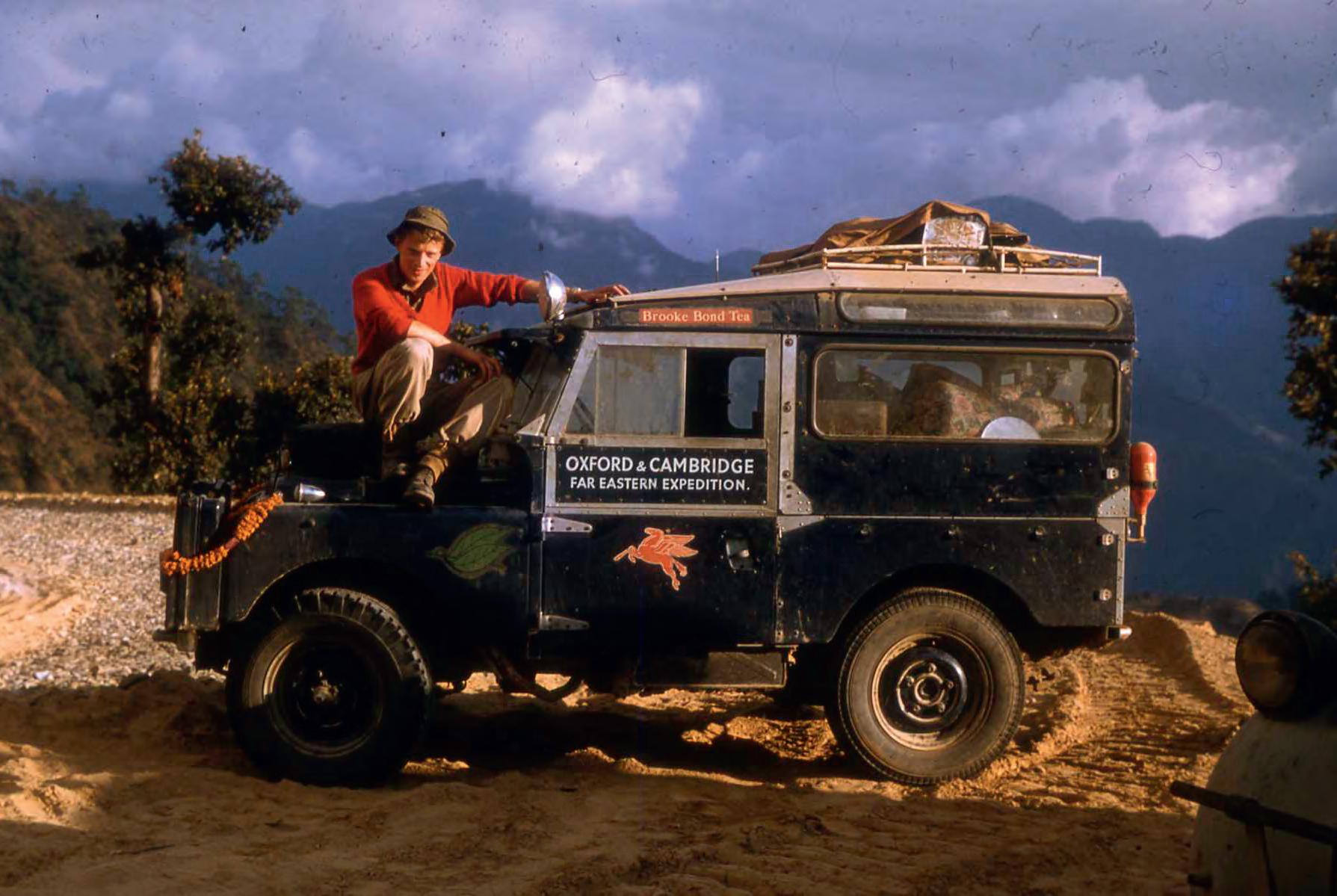
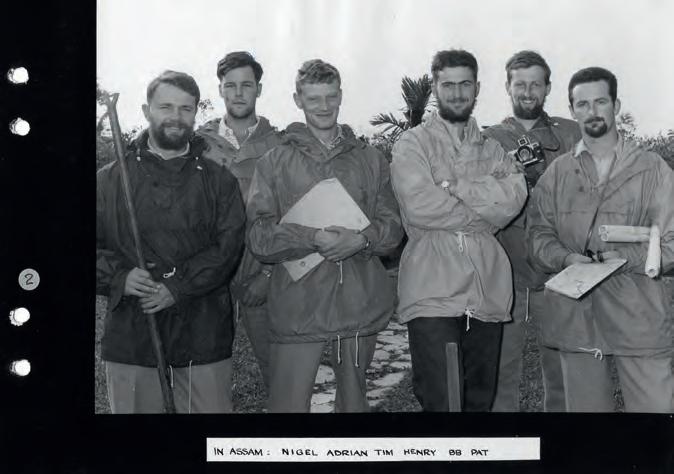
TThe Land Rover and overlanding worlds were united in mourning on 5 April, as news broke that Tim Slessor had died at the age of 95. An award-winning film maker, he will forever be remembered as the author of First Overland – the seminal book about the Oxford and Cambridge Far Eastern Expedition of 1955-56.
Born in 1931, Slessor was educated at Malvern College and, following military service, Cambridge University. By the time of his graduation in 1955, he had gathered together a group of friends with the aim of becoming the first people to drive from London to Singapore. The First Overland expedition, as it became known, saw two Series I Land Rovers travel some 12,000 miles through Europe and Asia via

a route including Syria, Iraq, Iran, Afghanistan, India, Nepal, Burma and Thailand.
The expedition listed Slessor as ‘scribe and assistant cameraman,’ the latter experience helping him gain a position with the BBC in 1957 as a trainee film maker. Over the course of the next 33 years, he rose to become a presenter and director, and ultimately one of the corporation’s senior executives. His specialism was always in documentaries with a geographical theme, with his most noted works including landmark series on Australia and the USA.
Despite retiring from the BBC in 1990, Slessor continued his prodigious output with further film making in every corner of the word. He also wrote two further books to go with First Overland – which remains in print to this day.
In 2006, the surviving members of the First Overland team met up to celebrate the 50th anniversary of the expedition by reliving its final leg from Kuala Lumpur to Singapore. Famously, a 2019 expedition led by modern-day film maker Alex Bescoby then sought to retrace the steps of the original as closely as possible on the way back to London. Called Last Overland, it featured one of the Series Is that had made the trip all those years ago, this time supported by a number of more modern Land Rovers; Slessor himself was all set to drive, at the ripe old age of 88, until health issues on the say of departure led to him appointing his grandson Nat George to go in his place.
The Last Overland route differed greatly to the first, crossing the Himalayas in Nepal to travel through Tibet, Kyrgyzstan, Uzbekistan and Turkmenistan before transiting across northern Iran and into Turkey. In doing so, of course, it avoided Iraq and Syria; even since then, this route has become impossible thanks to the malign influence of global politics, something that is the bane of all overlanders’ lives.
Tim Slessor was perhaps fortunate in that he lived in a time when driving overland from London to Singapore was even possible. However until he and his friends did it, that it was possible at all had never been proved. The two Series Is and their crews from Oxford and Cambridge changed the world of overlanding forever with their exploits – and with his words, Slessor brought that world to life in a way no-one had ever seen before. His likes will not be seen again.

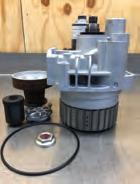
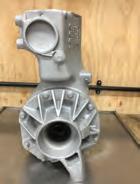
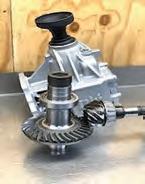
Here at FreelanderSpecialist.com, not only will we fix the problem but we will look to determine why the problem occurred and discuss with you how you can avoid it happening again in the future.
Our di erential units are uprated, making them stronger than the originals.



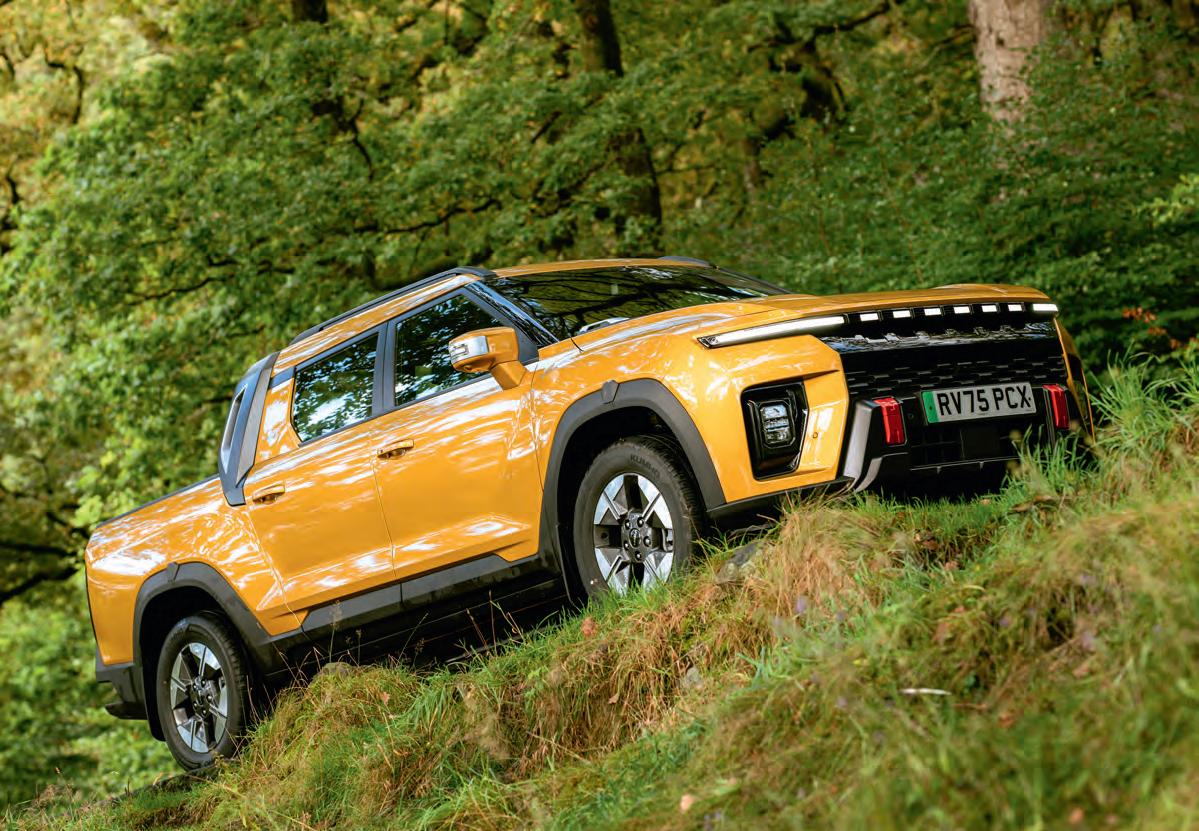
Electric double-cabs have been getting closer and closer to reality for some time now, and KGM’s Musso EV is very close indeed.
The Korean 4x4 specialist’s UK importer has announced that the first examples will be arriving here in May for customer test drives, with availability to follow through participating dealers.
The Musso won’t be the first electric pick-up in the UK. However it will have fourwheel drive as standard, provided by front and rear 152.2kW motors rated to 207bhp and 250lbf.ft An 80.6kWh battery pack allows a range of up to 240 miles, with a 31-minute charge time from 20-80% when using a 300kW fast charger.
That range will of course be brought down by heavy towing or carrying, just as it is an a diesel-powered vehicle. The
Musso can do both, however, with a 690kg payload capacity and 2300kg braked trailer limit. Load-sensitive and self-levelling suspension is included to help it handle either kind of work, while vehicle-to-load functionality allows you to keep tools and equipment charged from the truck.
Styled with the same design language as KGM’s Torres and Actyon SUVs, the electric Musso looks more modern than its diesel namesake. However it promises the same roomy and particularly SUVlike cabin as its namesake, with features including heated seats all round, vented front seats with 8-way electric adjustment and a panoramic dashboard screen including a 12.3” digital cluster and a similarly sizes infotainment display. KGM says passengers in the back will get ‘classleading legroom and reclining seats.’

The Musso’s chassis is made from 78% high-tensile steel, which promises an overall feeling of robustness and stability. It’s at the heart of the vehicle’s safety offerings, too, which also include eight airbags and a suite of driver assistance systems including adaptive cruise, autonomous emergency braking, lane keeping assist, and blind spot detection. In addition, there’s a 3D surround-view camera system to aid visibility during lowspeed manoeuvres.
The vehicle in the picture is resplendent in Blazing Gold, one of the six colours in which the Musso EV will be available. With the £5000 Plug-in Van Grant taken into account, you’ll pay £39,995 including VAT – before settling down to enjoy a benefitin-kind tax rate which, at just 4%, is the lowest for any current UK pick-up.

























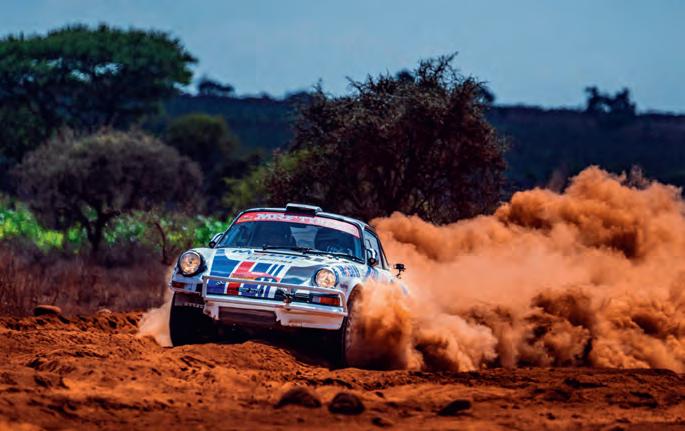
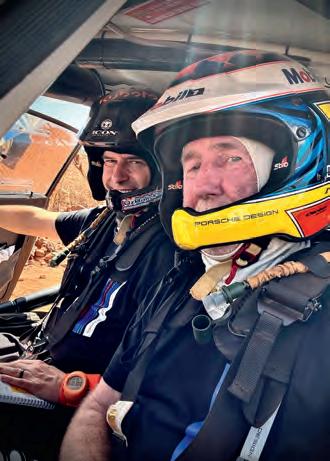
One of the most iconic vehicles from the early days of the ParisDakar was the Porsche 953 and 959 in which René Metge twice won the event in the mid-80s. But in the days before the Dakar, indeed going all the way back to its inauguration in 1953, the Safari Rally in Kenya was regarded
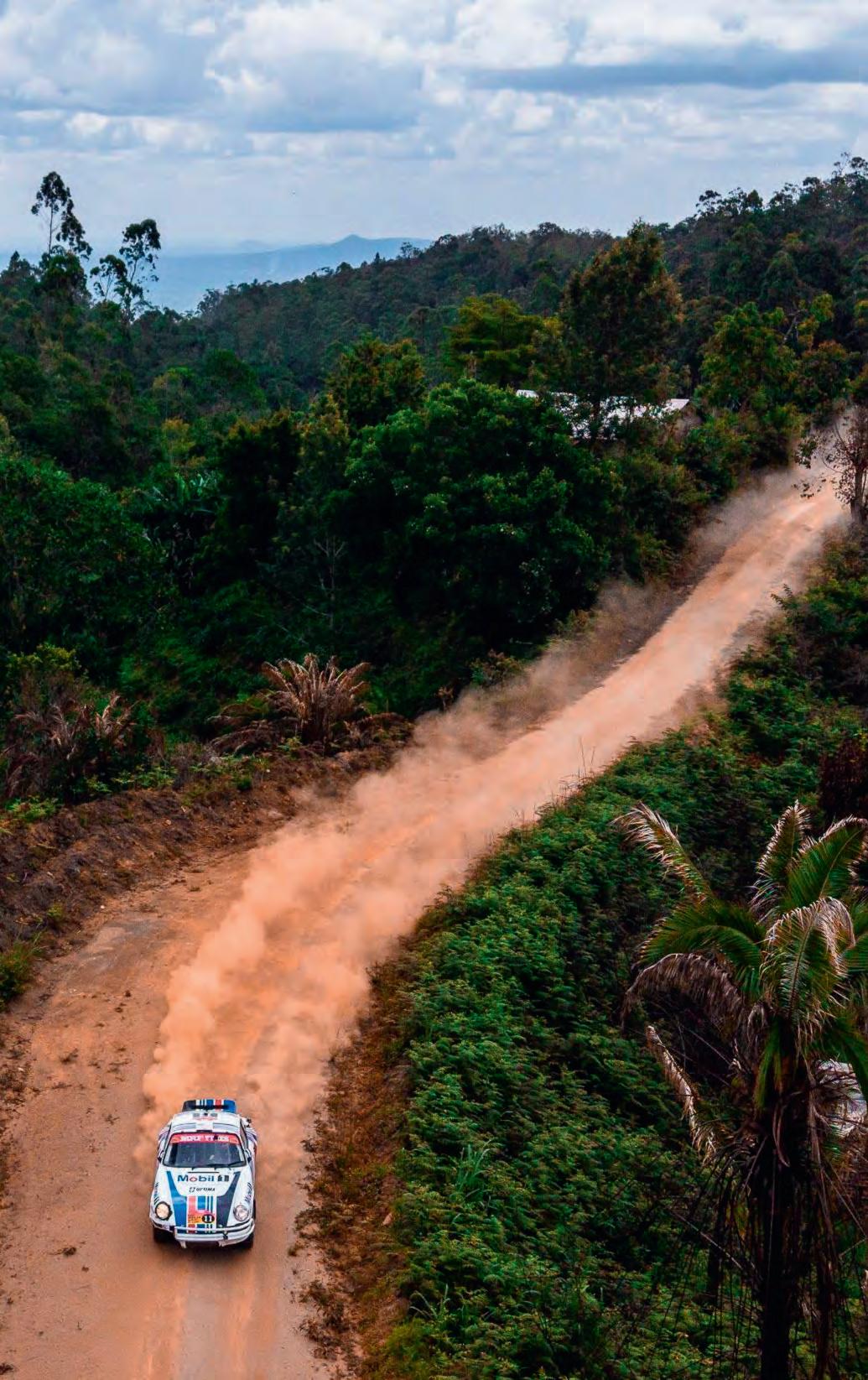
as the toughest automotive even in the world – and its historic stablemate, the East African Classic Safari Rally, was completed late last year by another Porsche dating all the way back to the early seventies.
The F-Series 911 dates from the 1973 model year – back when Porsches were

The East African Safari Classic Rally traces its roots back to 1953, when the East African Safari Rally was created to celebrate the coronation of Queen Elizabeth II. It crossed Kenya, Uganda and Tanzania and pushed competitors to the limits, with mile after mile of savage terrain subjecting man and machine alike to relentless punishment.
still air-cooled. Jeff Zwart, meanwhile, dates back even further to 1955 – but that wasn’t going to stop the 70 year old American film maker and serial Porsche fan from scratching a lifelong itch and taking part in an event that had been lurking on his bucket list for in excess of half a century.
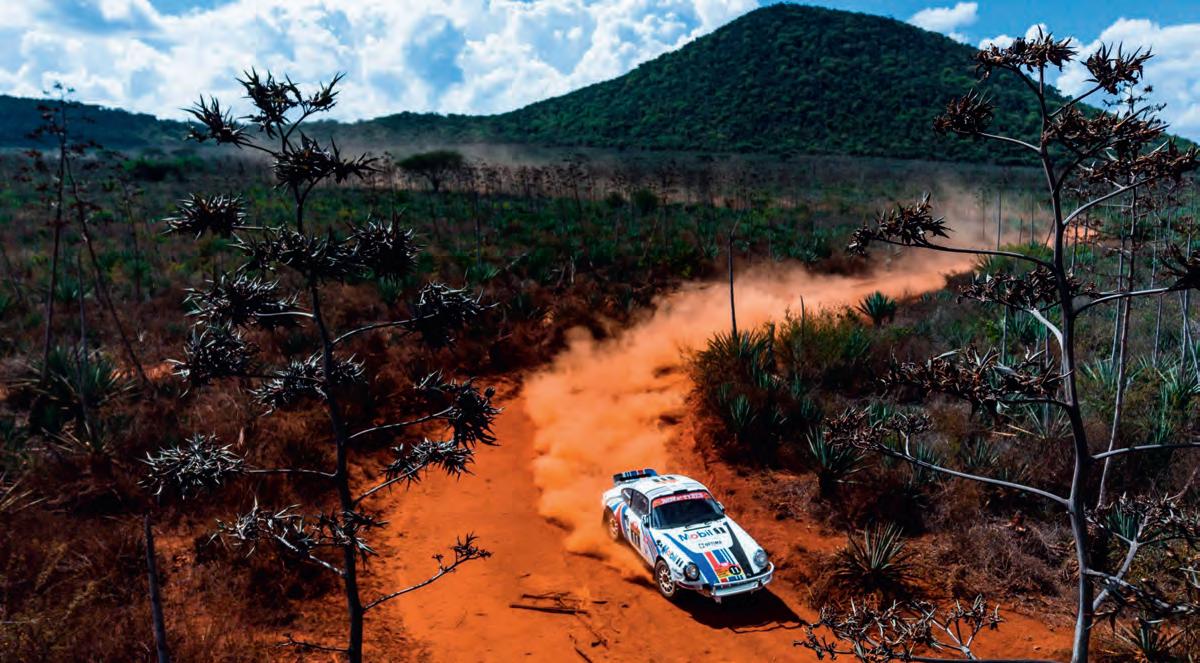
The event was adoptd as part of the World Rally Championship from 1973 to 2002. It returned in 2021, however in the meantime the parallel Classic version had been introduced for the historic market. Running every two years, it confronts teams with nine days and more than 3000 miles in rough, sandy and muddy terrain among iconic African landscapes – this year’s course explored Diani, Voi and Amboseli, against the breathtaking backdrop of Mount Kilimanjaro. It’s not off-roading in the sense we normally understand it, but it pits everyday vehicles against the sort of terrain which normally sees little else other than Toyota Land Cruisers.
‘I read about this race while I was in high school and I’d always hoped that I’d one day do it,’ says Zwart. ‘So to be able to compete here in a car from the same
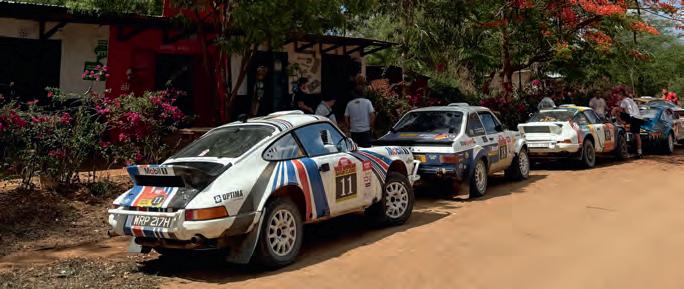
era as my school days has made this whole experience feel even more special.’ Alongside co-driver Alex Gelsomino, he finished 17th from a starting field of around 60 cars – more than half of which were also classic 911s.
An award-winning film maker who lives on a Colorado range with a collection of classic Porsches, Zwart has taken part in many a marathon rally. Where did this one rank? ‘Probably the hardest event I’ve ever done.’ Almost half of those 3000 miles were made up of competitive stages and the combination of mud, dust and standing water came amid a climate of ever-present searing heat. There was the constant hazard of roaming wildlife to be wary of, too.
But people don’t do events like this because it’s going to be easy. It’s all about the adventure, the challenge and the endurance, and coming home having done something that few others ever will.
The rough terrain made its presence felt early in the event when the car suffered suspension damage, however with the aid of the organisers’ tech team it was back out for the following stage and kept running sweetly – right up until the second to last day, when gearbox trouble left Zwart having to drive some 25 miles out of a stage using just first gear. ‘It was super rough and super fast, with lots of wild animals on the course,’ he said. ‘But the scenery has been unparalleled, the other competitors and all the support
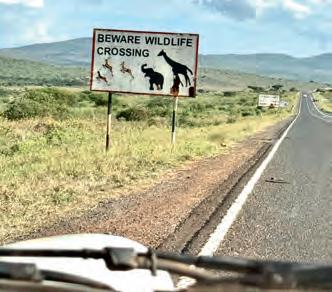
crew have been fantastic and being in a classic 911 just feels like home to me.
‘Every day, the 911 surprised me by how well it handled things. The team looking after the cars has done an extraordinary job and there was a superhuman effort from everyone involved.’
‘I remember a conversation with Ken where he told me how incredible this rally was,’ says Zwart. He said “Jeff, you’ve got to do it.” And so to be able to come here with Alex as my co-driver has felt a little like coming full circle. He has been awesome – and at times it has been pretty emotional for us both.’ It may not be off-roading as we know it, but the human connection to the car and the landscape alike was just the same.



Cynghordy Llandovery Carmarthenshire, SA20 0NB
Tel: 01550 750274



e-mail: info@cambrianway.com www.cambrianway.com
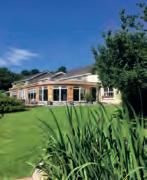
Family run guest house and self catering cottages with spectacular views, en-suite bedrooms, comfortable lounge bar and excellent home cooked food. Pressure washer, drying room, map room with local lanes marked, on-site 4x4 course, guides and GPS hire available.
A very popular venue for both individuals and groups of 4x4 enthusiasts







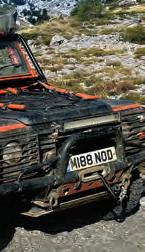


WINTER HAS BECOME A QUIET TIME FOR GREEN LANE USERS AROUND THE COUNTRY , with so many areas now affected by seasonal TROs and a general understanding of the need to be cautious when the ground is wet. But the need to look after the lanes never goes away, and it takes many forms.
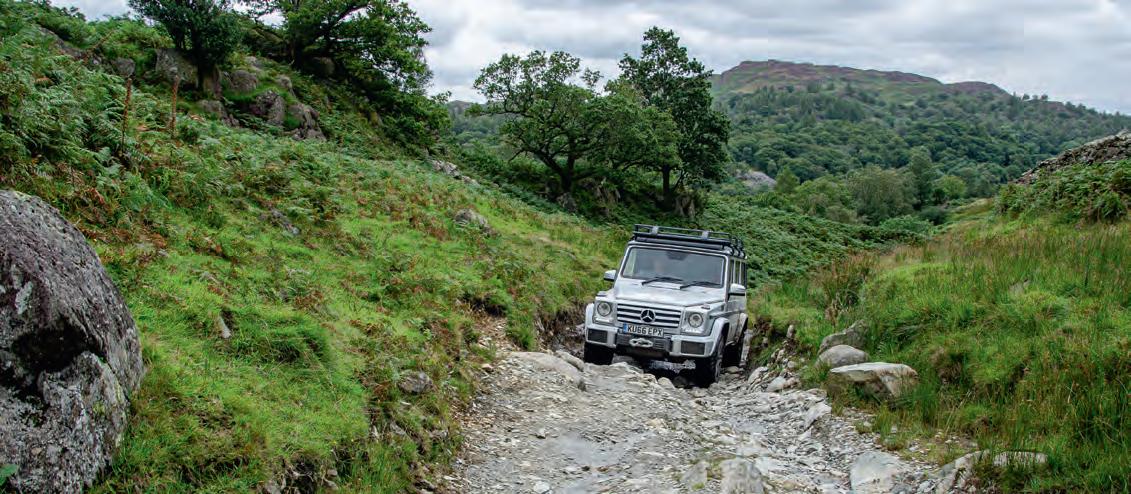
So it was that late in January, local reps from the Green Lane Association attended a meeting in Coniston as part of the Tilberthwaite Partnership Management Group (TPMG). Tilberthwaite is a celebrated unsurfaced road in the Langdale area of the South Lakes whose scenery is up there with the best in the country, though for many years it has been a target for anti-vehicle fanatics whose machinations have seen its natural surface smashed to pieces by heavy machinery and levelled into a gravel track in a bid to spite drivers who enjoyed the challenge of tackling the rocky terrain it offered.
‘Representatives from all interested parties met to discuss the route and its management,’ reports the GLASS Cumbria reps team’s Peter Apps. ‘Notable absentees were Westmorland and Furness Highways and the National Trust. The
lack of cooperation with these two bodies forms the main stumbling blocks to getting any real maintenance work done on unclassified lanes.’
It’s not uncommon for larger public bodies to ignore their duties as stakeholders in Britain’s rights of way network. This may or may not be wilful, and of course the reasons will differ from case to case, but the damaging effects are there for all to see.
‘Tilberthwaite may not be the lane we once loved,’ continues Peter. ‘But it’s worth remembering that the extensive work done there was designed to counter the huge pressure that the National Park Authority was under from a very well orchestrated public noise created by the anti brigades.
‘The antis may have gone quiet in recent times but rest assured, their aim remains a crusade against motorised users on all unsealed lanes.’
• ELSEWHERE IN THE SOUTH LAKES, late last year a very narrow gate was installed without warning at the southern end of a lane near Skelwith Bridge, a few miles east of Tilberthwaite. ‘This is reportedly only just wide enough for an old style Defender to get
through,’ says Peter, ‘so we have questioned it with Westmorland and Furness Highways.’ Yes, them again.
‘When reporting a problem (to GLASS),’ continues Peter, ‘it is essential to note as many details as possible. The exact location, either with a grid reference or WhatThreeWords, the full nature of the problem and photographs showing what the issue is.
‘It is also worth finding out who the local Highways Authority are and using their portal to report the problem yourself. Our Councils are by now fairly used to the Cumbria team reporting problems, so having other people report issues on unsurfaced routes may result in a response and even some actions taken. We live in hope!’
Peter advises that a number of 4x4s have been through the gate since it was first reported, so it is usable, however those he’s aware of were all travelling south-north and coming to it straight from the road.
Approaching from the north, a steep offcamber section combined with a washout means reversing would be as good as impossible, so you’d be well advised to walk it first.



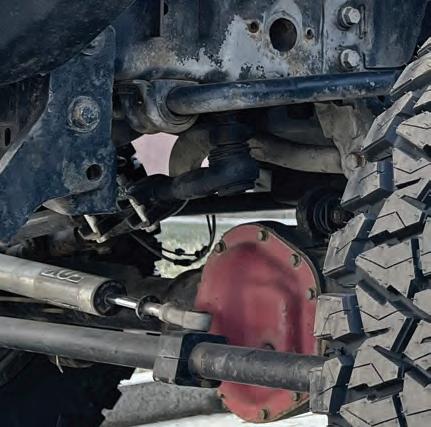
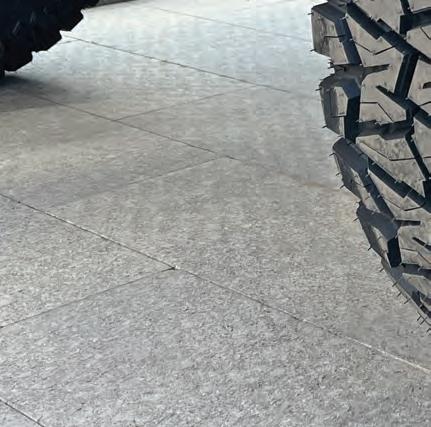
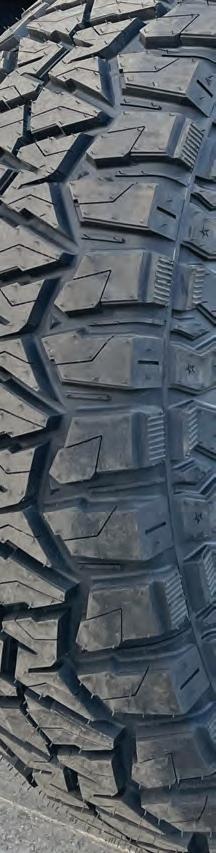
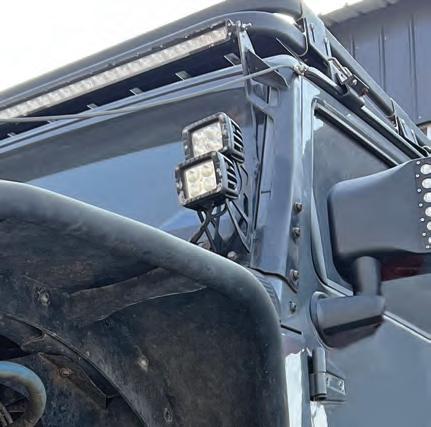
Delivering mud terrain performance with all-terrain manners
CF9000 RUGGED TERRAIN
• Anidealfitmentforworking and leisure conditions
•Sidewall design enhances the extra climbing ability

•Pattern design reduces road noise
•Optimised tread design increases wear and puncture resistance





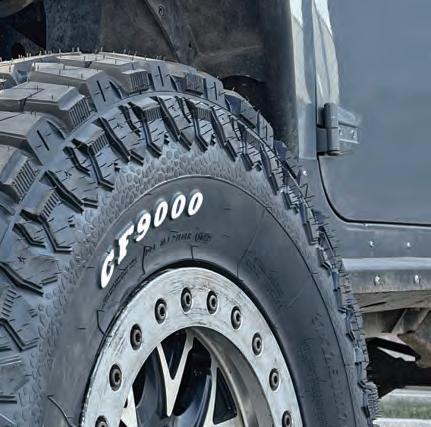
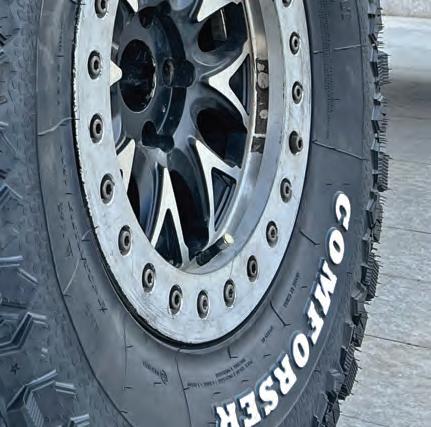

The Wheel and Tyre
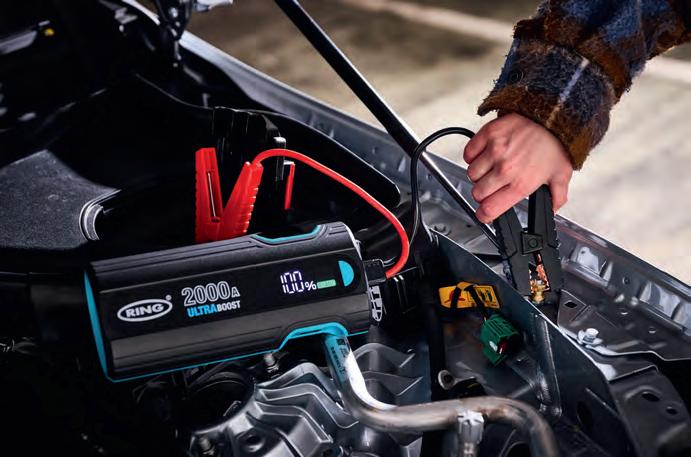
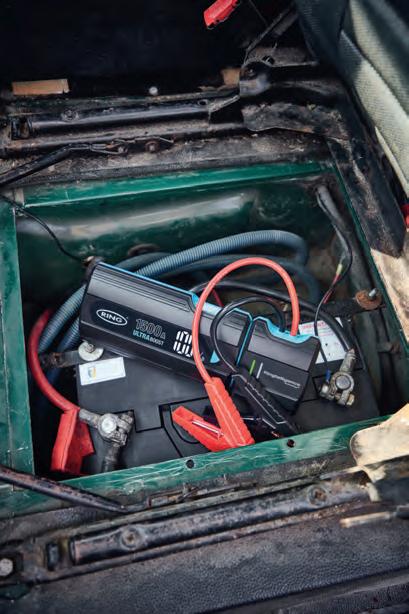
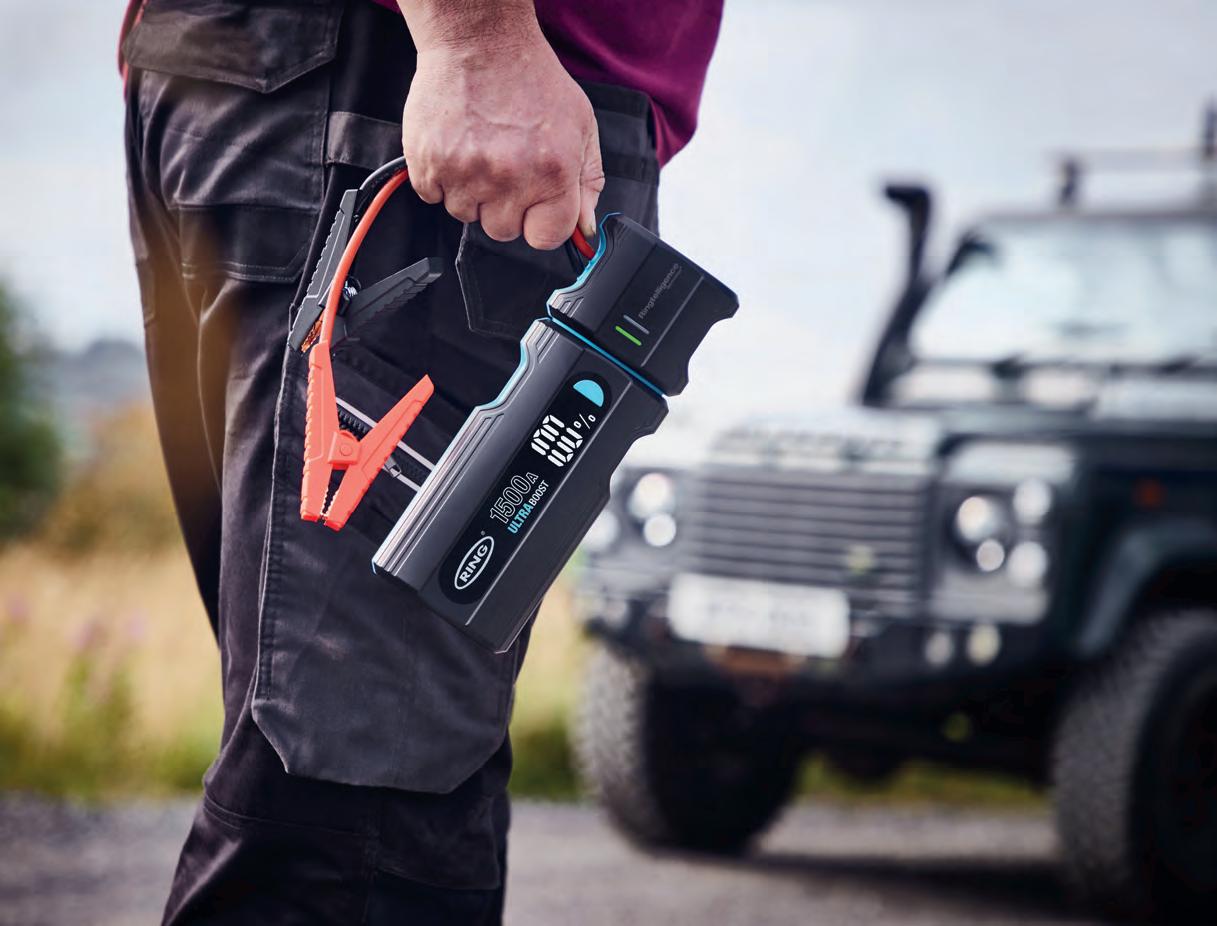
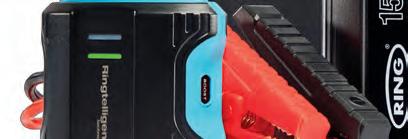
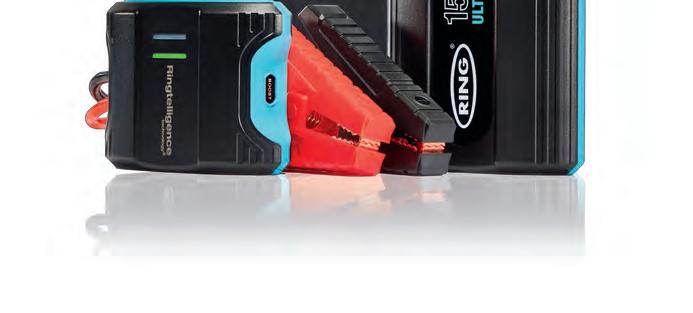
RING’S ULTRABOOST RANGE OF JUMP STARTERS has been around for a while, but the latest addition to the line-up takes it into new territory. The new Ultraboost 2000A is the most powerful of its kind yet, boasting the ability to start petrol engines up to 8.0 litres in size – as well as diesels of up to 4.0 litres. Despite being small enough in size to fit in your glovebox, the Ultraboost 2000A promises
to get you fired up within 60 seconds even when your vehicle’s battery is as flat as a pancake. It comes with long cables for convenience and has a Boost button to spark up totally dead vehicles, as well as a large screen whose colour bars make is easy to check the health of your battery.
The screen also provides clear instructions which will hold your hand throughout the
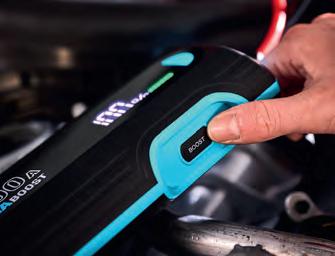
jump-starting process. These include a green star to indicate that you can turn the engine over, a red warning light for when you’ve triggered the unit’s built-in reverse polarity protection and an orange ‘low’, meaning the battery’s power is insufficient for a jump start and the Boost button should be used. In addition, the screen has ‘in’ and ‘out’ signals to show if it’s recharging or being used to charge another device.
What devices might these be? Phones, tablets, laptops – the Ultraboost 2000 has an integrated power bank, allowing it to juice up any of these. There’s an integrated LED light in there, too. Whatever you use your 4x4 for, it sounds like a pretty worthwhile thing to have stashed away among your kit.
Price: ca £13,500 including VAT | Available from: www.britpart.com
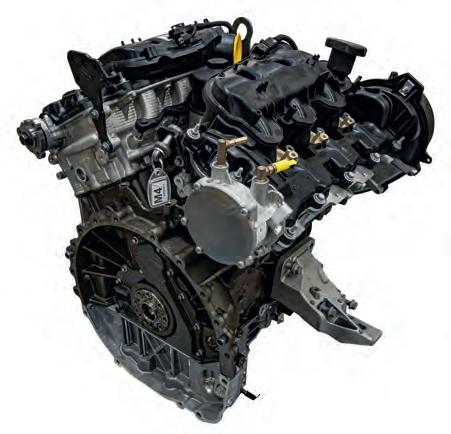
THE 3.0 SDV6 ENGINE IN THE LAND ROVER DISCOVERY 4 (and the Range Rover and Range Rover Sport) was a lovely thing. But sometimes even lovely things do stuff that’s not lovely at all, such as failing very disastrously indeed in the crankshaft department.
We won’t get into why it happens, whose fault it is and all that kind of thing, because that guy who shouts loudest on social media is always right about this kind of stuff. What matters here is that yours has let go, your vehicle is worth too much to scrap and you want to know what you’re supposed to do now?
Chances are your precious Disco 4 is currently sitting outside your chosen independent Land Rover specialist. And your independent Land Rover specialist may be about to let you know that a new stripped engine is available through the Britpart network. They can get it delivered, rebuild it with the ancillaries from your old one and bingo, it’ll drop into your Disco’s engine bay all ready to get it back to work.
There’s no shortage of remanufactured engines out there, some of them from companies that are very good and extremely reputable, and a new one will cost you an easy twice the price. If that newness is what you want, though, there’s no substitute.
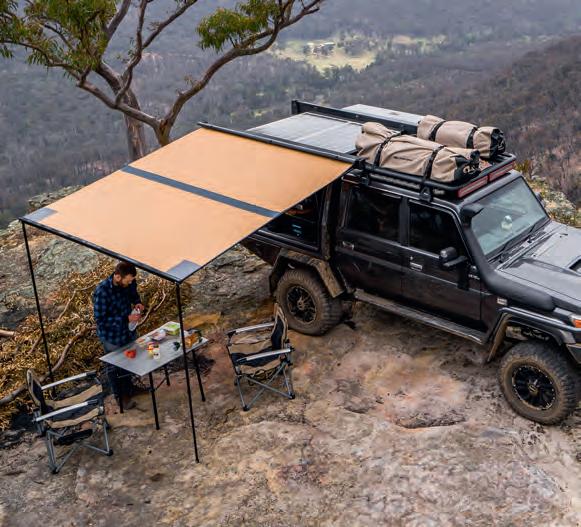
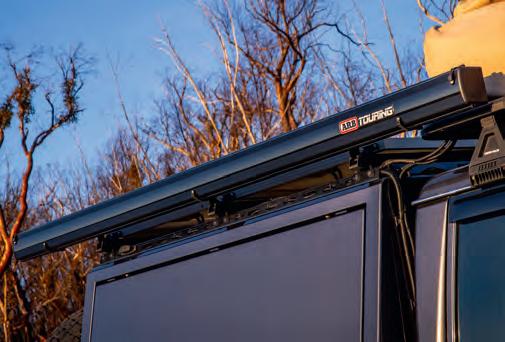
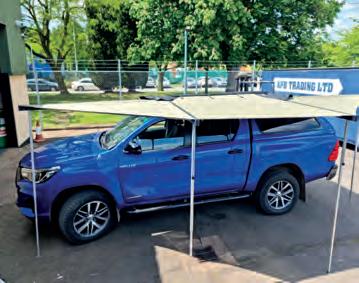
THERE ARE MANY ON-VEHICLE AWNINGS IN THE WORLD, and indeed many ARB awnings. This 2.0-metre unit has a black powder-coated aluminium case and comes equipped with LED lights, the latter offering dimmable control as well as warm and cool temperature otions.
The awning is made with durable protection and wear points (‘anti-wear,’ actually), and shelters you beneath a 300 GSM PUcoated polycotton rip-stop canvas screen. It comes complete with pegs and guy ropes and is supported by three-stage aluminium twist-lock poles. Further features include tough, flexible nylon cuff joins, UV-protected marine-grade shock cord loops and easy nozipper access.
The awning comes with integrated sail track rails for ARB’s own accessories, and has PVC abrasion pads to protect its corners when rolling up and in transit. It’s waterproof and UV-protected for cover from the elements, and the last surprising thing you’ll read today is that it’s compatible with ARB’s BASE Rack awning brackets.






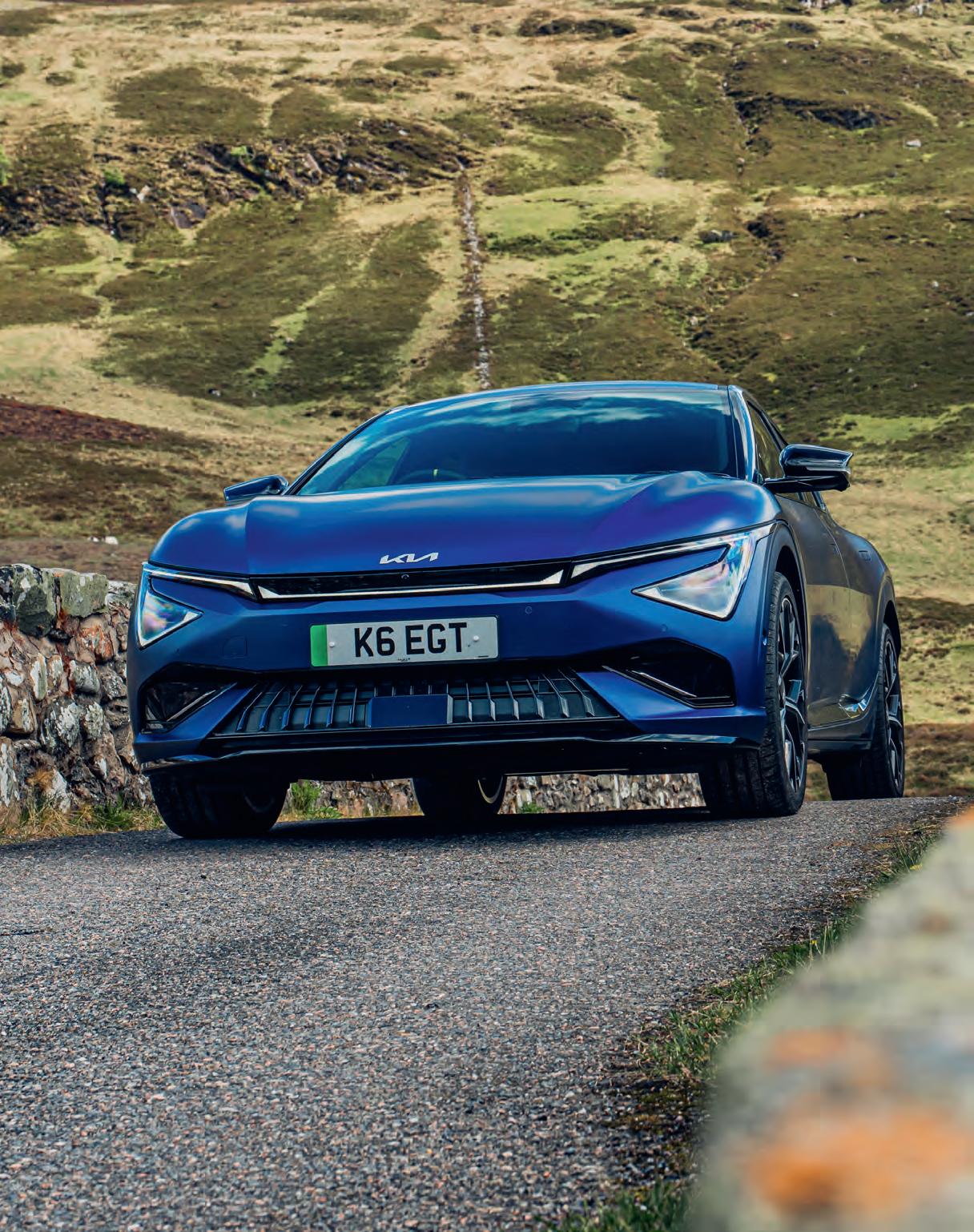
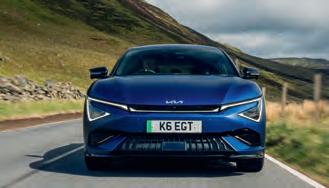
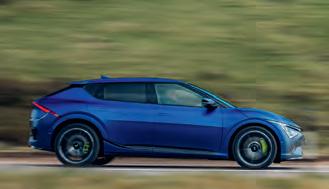

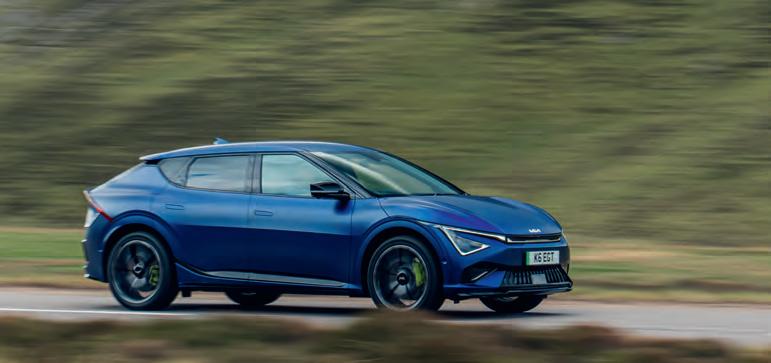
Electric 4x4s are nothing new any more, and nor are electric vehicles that are stunningly fast. But there’s still a lingering feeling among keen drivers that however good an EV might be, they still struggle to match the qualities of the best petrol and diesel machines.
There have, for example, been plenty of electric performance cars that go like stink but don’t have the dynamics to match. The weight of all those batteries has a lot to do with it; this is a work in progress on an industry-wide scale, however, and the pace with which technology has come on since the first EVs started hitting the road promises great things to come.
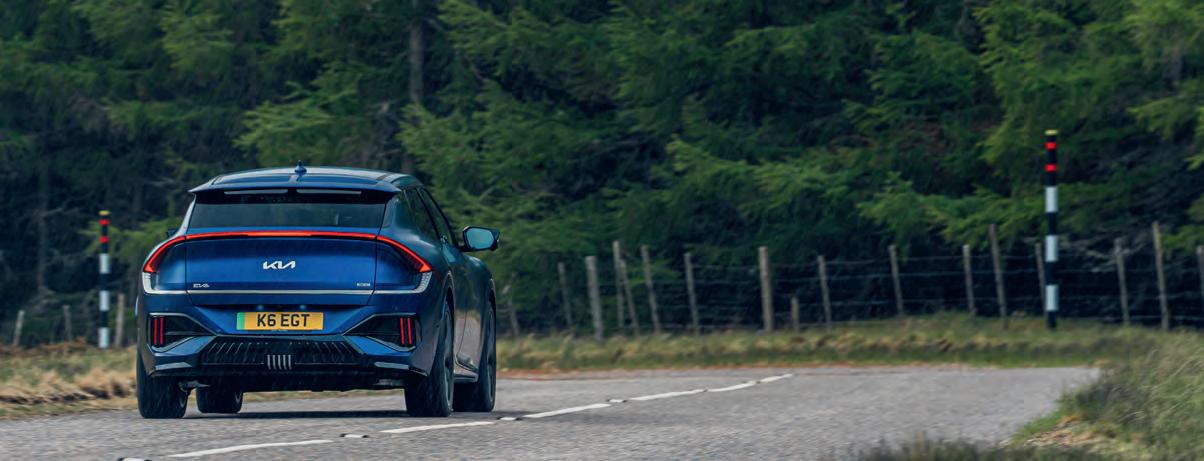
For now, what we have is a crossover SUV with 641bhp and a kerb weight of 2200kg. Put those figures into Google and it might come back with the Lamborghini Urus, but in fact it’s the Kia EV6 GT.
The Urus is a wonderful thing with Athena-poster styling, a hearty V8 bellow and a 0-62 time of around 3.4 seconds. And a price tag, when we last tested it, of £211,000 (you can do a lot more on one now). The GT6 costs less than a fifth of that, being currently listed at £60,035 OTR, and you’re less likely to see one on a teenage boy’s bedroom wall, but at 3.5 seconds it’s barely any slower. Even without the V8 soundtrack, and with a top speed of ‘only’ 161mph, that’s hefty pace for your pounds.
But does it have the dynamics to match? That’s the big question.
The big answer is that it handles. It really handles. We’re done with comparing it to the Urus now, because that would just be stupid, and we’re taking it on its own. On a fun B-road, obviously pure speed is not an issue but what matters is being able to brake with
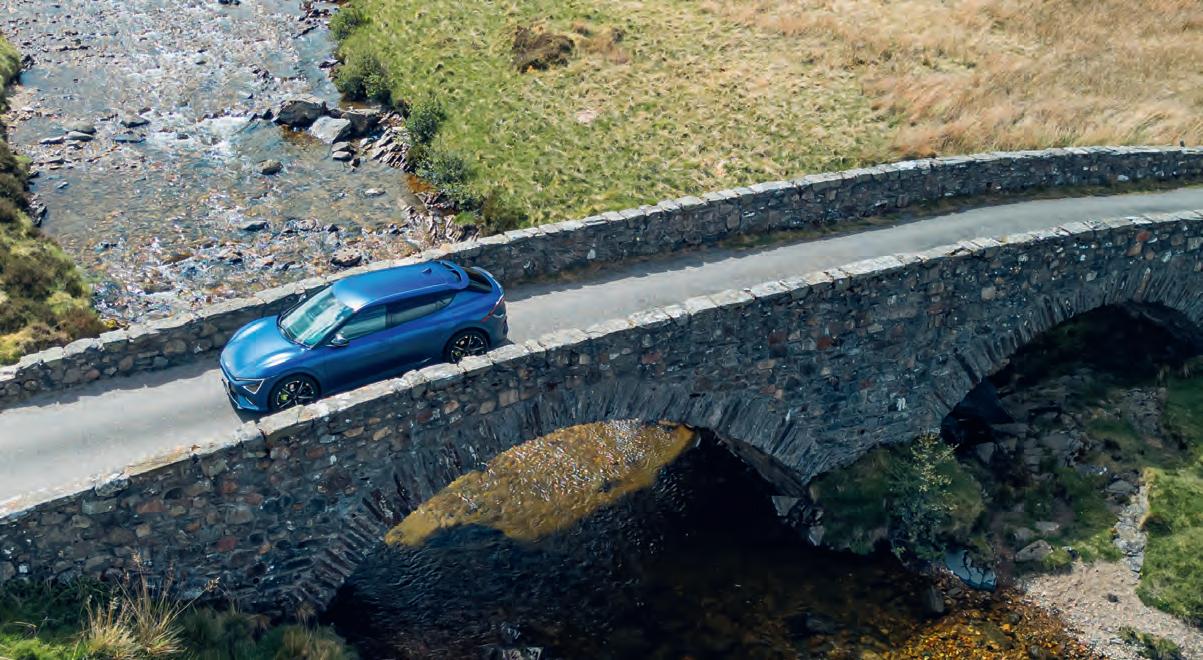
confidence into the corners and get back on the power as early as you can on the way out. In each case, it lets you do it smoothly and doesn’t get upset however hard you go in. It doesn’t dive or squirm under heavy braking, it turns in precisely and with plenty of feel, its body stays taut and flat on the way through and when the throttle goes
back down the response is immediate. Corners aren’t so much taken as dismissed, polished off – it’s very, very entertaining and always feels like there’s plenty in reserve.
If you like the feeling of being on the ragged edge, maybe you could say it’s missing the rawness of a traditional hot hatch. Truth to tell, it’s more of a GT car, with
all the composure that brings, but certainly there’s not a lot to challenge it on the public road. Trackdays would be an interesting prospect; there’s more than enough about it that only a closed circuit would properly unlock, for sure.
Talking of tracks, the drive mode palette has a Snow setting which enhances
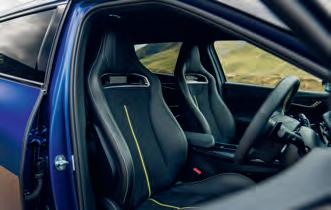
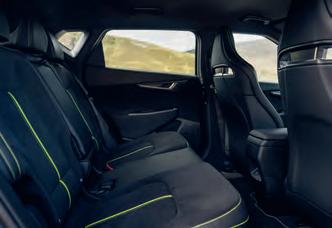
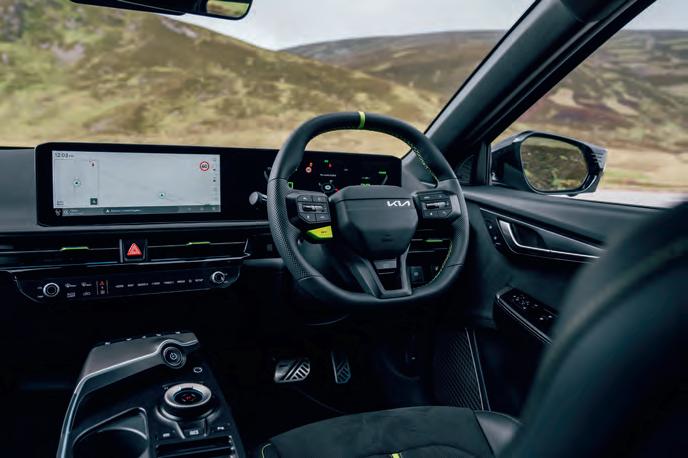
The cabin is as good as we’ve come to expect from Kia, with superb materials and rock-sold build quality. Sports seats up front hold you in place while you’re enjoying the EV6 GT’s undoubted performance car skills but on long motorway hauls they could do with more support in the lumbar area. The rears have plenty of legroom for tall adults and are set usefully higher than those ahead, meaning the view out is excellent even if there’s only just enough headroom
tractability on loose surfaces. It won’t make an off-roader of the vehicle but it will help keep it planted on gravel and dirt; as always in a crossover, ground clearance will be the limiting factor, though highly road-biased 255/40R21 tyres won’t be any great help on the grotty stuff either.
They do keep things nice and quiet on the motorway, however, and between them and the suspension they’re surprisingly good at drawing the sting when the wheels crash into sharp, jagged pot holes. Where the vehicle doesn’t do so well is on generally rough or corrugated surfaces, where there’s a constant pattering and fidgeting that never really settles down, and this would be the biggest concern for us. It’s a very likeable car in lots of ways but its ride is always hard – particularly in town, though even at cruising speeds there’s still a brittleness to it that put us off.
One other criticism that’s particularly relevant on longer journeys is that the seats, sculpted and supportive though
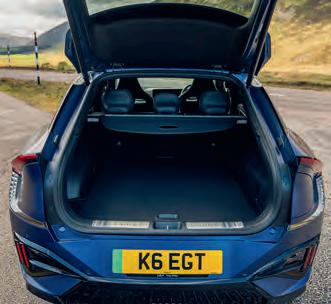
There’s plenty of volume in the boot, whether with the seats up or down. They don’t go entirely flat in the latter position but the load bay is plenty long and though the tailgate is sloped at the back, a low floor means it’ll still accommodate big, chunky items
they are, could do with more support in the lumbar area. They’re sports seats, so it’s not adjustable; we found ourselves shifting around in a bid to stay comfortable after an hour or two behind the wheel, which isn’t really what you want on a GT car.
Otherwise, the cabin is superb – as we’ve come to expect from Kia. It has the company’s usual rock-solid build quality and is laid out around its signature full-width curved glass screen, which starts as a digital dashboard in front of your face then becomes a large and extremely crisp media display in the centre of the facia.
Beneath this is another Kia special, a row of haptic buttons which toggles between controlling the stereo and the heating and climate. Further still and you get to the floor console, which combines a huge lower tray with a big cubby box up top and the usual combination of cup holders and contactless charger ahead of it. The door pockets aren’t huge and the glovebox is taken up mainly by the handbook (which is a brick of a thing) but if you can’t find places to stash all your bits you need to declutter your life.
It’s pretty good for carrying big stuff, too. The rear seats don’t fold completely flat and the tailgate has a bit of a slope to it but there’s a good bit of both volume and length there and the boot floor is nice and low, so loading is easy. The recently launched EV5 beats it for overall practicality but it’ll still swallow a lot of kit. And better still, one sixfooter can sit behind another with neither
of them wanting for legroom; pronounced stadium seating means those in the back are tight up top, but the upside of that is an excellent view out.
Heading to the front again, the driving position is very good and it’s easy to get comfortable. You’re quite low down by SUV standards, though, and for us the whole of the bonnet wasn’t visible. The A-posts are quite bulky, too, and the view over your shoulder is such that you reverse entirely using the cameras, beepers and surroundview monitor – all of which are very good, so no problem.
Overall, it’s built and equipped like you expect from a modern Kia, it looks cool like you expect from something premium and it goes like you expect from something with a Ferrari badge on it. It calls itself a GT though we’d say it’s more of a driver’s car than that, made for attacking B-roads rather than crushing continents beneath its wheels.
Eyeball-peeling pace is all very well but a fast car needs more than that. Of course, most people who lease an EV6 GT will be doing so because of the compelling tax reasons to go plug-in – but beyond that, it’s a crossover you’d choose over the opposition because you don’t want to compromise on the fun you’ve spent your life having in hot hatches. If that’s you, the good news is that the EV6 is an outstanding SUV – and in GT form, it’s an outstanding SUV that can put a smile on your face all day long.
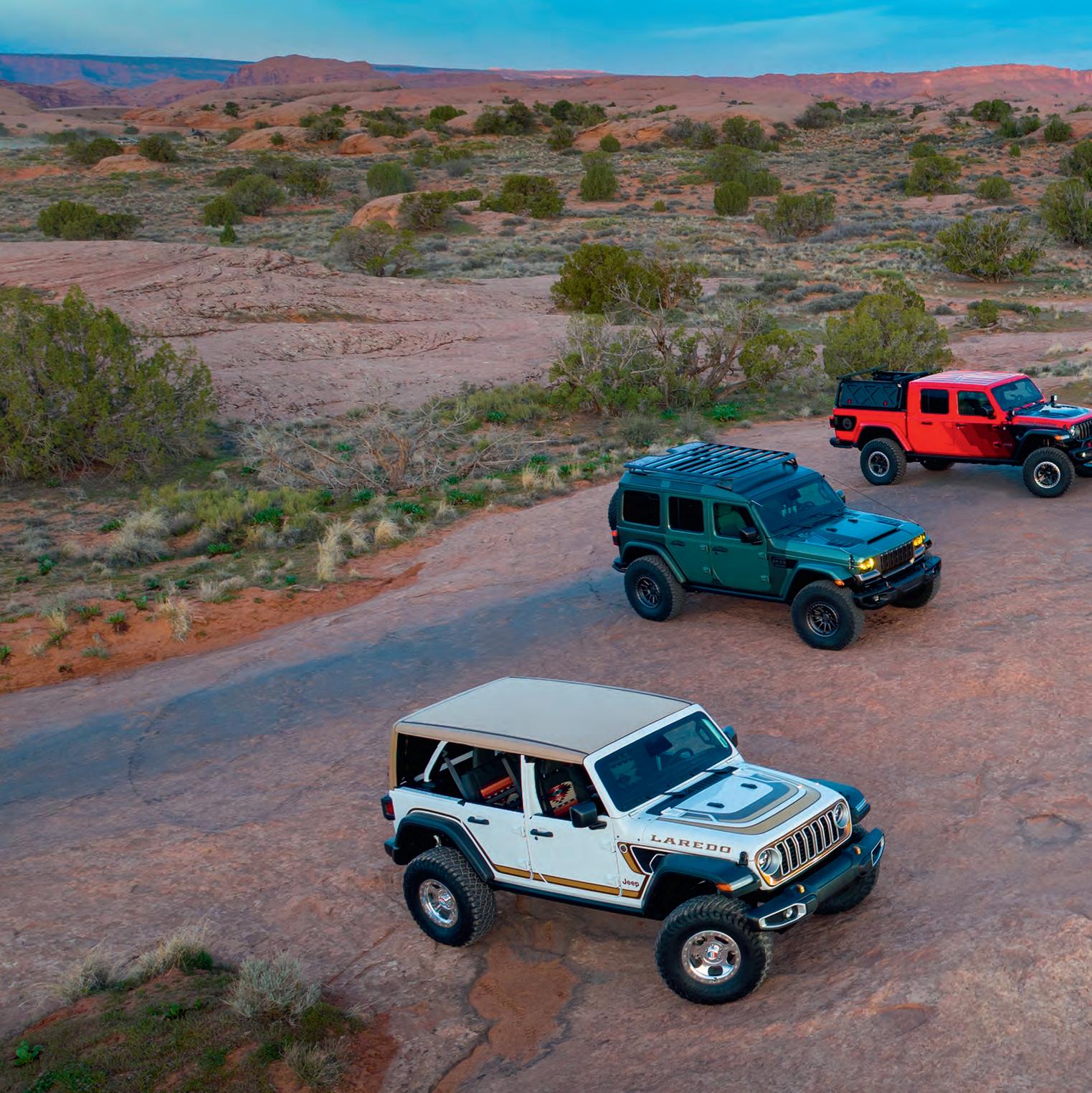



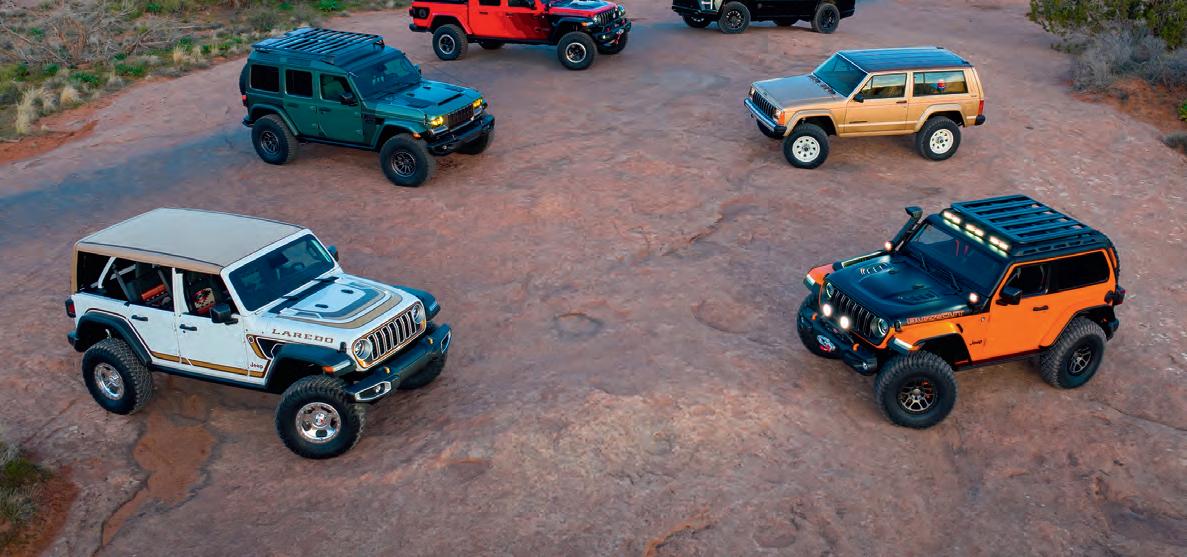
This year’s Easter Jeep Safari in Moab was the 60th of its kind. Jeep marked the occasion with an array of nine different concept vehicles from across the off-road spectrum
This year’s Easter Jeep Safari in Moab, Utah, was the 60th running of an event that has become something of a cultural icon in the off-road world. Moab’s unique landscape, characterised by the red sandstone mountains of the Arches and Canyonlands National Parks, is punctuated by some of the best trails in the whole world – whether you’re exploring them on foot, by pedal power or in a 4x4. Hosted by Red Rock 4-Wheelers, despite its name the event is
open to any kind of 4x4 with low range and good ground clearance, though that has never stopped Jeep itself from embracing the opportunity to endorse what is one of the biggest gatherings of its products and customers anywhere in the world.
The safari offers nine days of mainly day-long trail rides, from SUV-friendly to extreme. By extreme, the club stresses that vehicles need to be seriously modified –and that even then, the potential for breakages and body damage still exists.
Convoys are led by club members, following routes which mainly use old roads left over from the mining boom the area experienced in the 1950s.
Don’t be fooled by the word ‘roads,’ though. Even by the standards of the most technical green lanes we have here in Britain, the terrain in the mountains overlooking Moab is brutal. Unlike here, however, the ground is composed of slickrock – parched sandstone which, so long as it remains dry, provides boundless
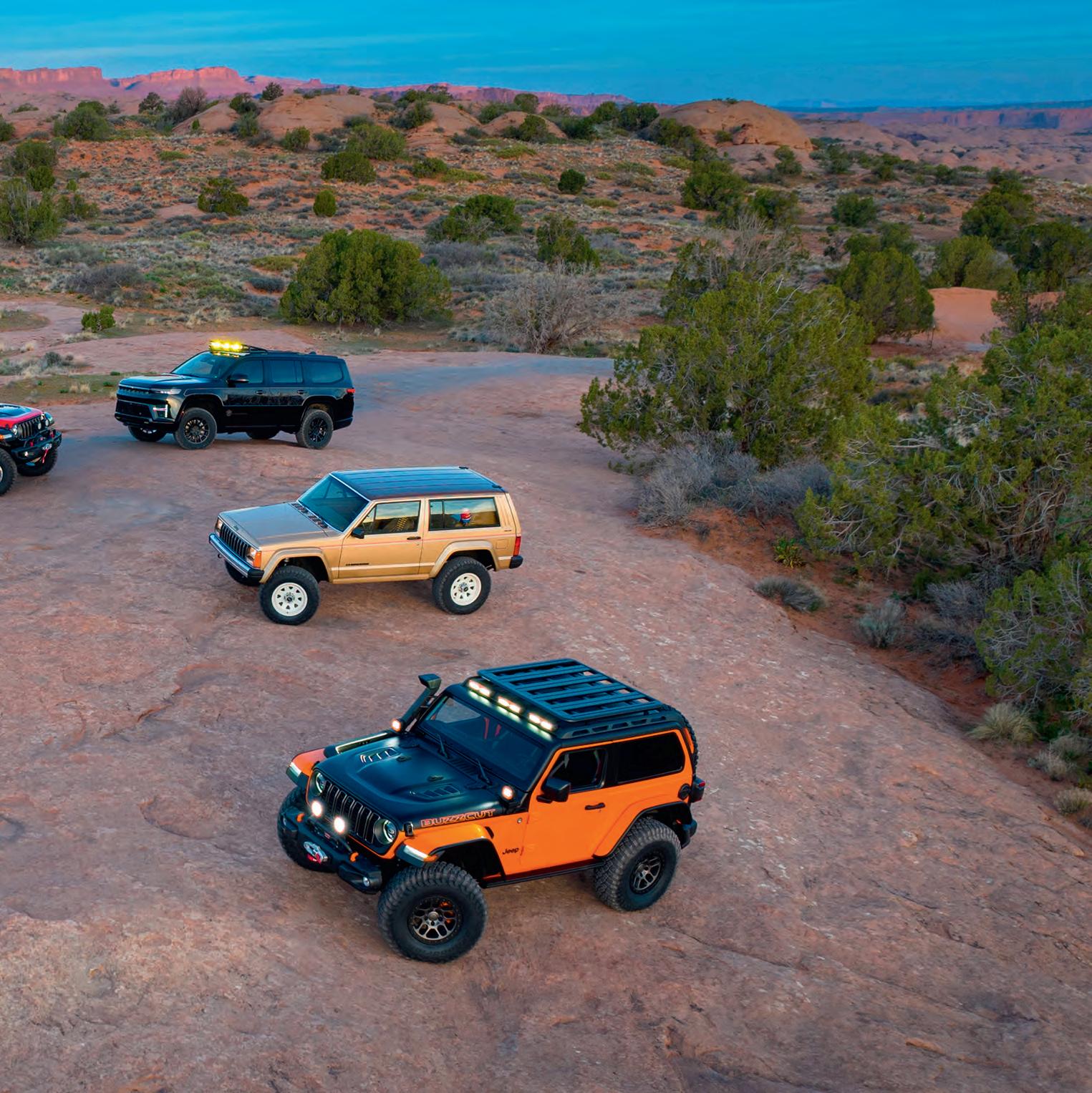
grip for a 4x4 on aired-down tyres. This means the limits truly are set by what the vehicle can achieve rather than what its tyres can hang on to – making it possible to get into some truly extraordinary positions. Perfect for exploring the limits of what your suspension can do – which is one reason why Jeep keeps coming back every year to support the event.
‘Moab isn’t just a place we visit,’ says Jeep brand CEO Bob Broderdorf. ‘It’s a proving ground we honour and safeguard,
a landscape we continually reinvest in and a community we’re proud to call our second home. Easter Jeep Safari has shaped the Jeep brand for decades, fuelling the evolution of our 4x4 vehicles and strengthening our bond with the community and the thousands of passionate Jeep enthusiasts who return year after year.’
And each year, Jeep brings a set of one-off concept vehicles to display at the Safari. At their best, down the years these have included some true masterpieces,
blending engineering and creativity with a deep understanding of Jeep’s past and the purposes for which its customers use their vehicles – not just for extreme off-road fun but everything from adventure travel to everyday hard work. Jeep doesn’t just use this as a way of selling cars and accessories, either – that certainly is part of it, however a major purpose of its concept car programme has always been to tell the story of the brand’s history by restoring and modernising classic trucks from its past.
This year, perhaps in recognition of the Safari’s big birthday, Jeep took a bumper crop of nine different concepts to Moab. These included a throwback to one of the most popular budget off-road machines the world has ever seen, in the shape of the XJ Cherokee, reborn as the Pioneer concept.
There were concept vehicles based on this year’s new Cherokee too, as well as the Gladiator, Recon and Grand Wagoneer –and of course the Wrangler. A depressing number of real Jeeps there that you either haven’t ever been able to buy in the UK or soon won’t be able to, but a stellar reminder of the true off-road ability the brand stands for – and the capacity for being modified that puts the Wrangler head and shoulders
above every other recreational off-roader in the modern world.
Talking of leadership, an annual feature of the Easter Safari is a maintenance operation in which volunteers from Jeep, Red Rock 4-Wheelers and the Bureau of Land Management work together to clean up a chosen trail. This year, the spotlight fell on Fins and Things, a 9.4-mile route with a 5/10 difficulty rating – and, for now, a lot less litter to spoil the scenery.
This will hopefully have you nodding your head in appreciation at the efforts of America’s off-roading community, even as you shake it at the lack of care some less responsible individuals put into cleaning up after themselves. Not everyone who goes
into the mountains has a 4x4 to carry home their trash, though, bless them. You can learn a lesson from it, though, for your own green laning activities back home; some laners already make a habit of carrying a bin bag in their vehicle and picking up any litter they find, and if all of us do it the countryside will be that much healthier. Doesn’t matter that it’s someone else’s fault it was there in the first place.
In the meantime, have a look for Fins and Things on Google Maps and you’ll want to up sticks and head straight for Moab. First, though, join us in a look at the nine new concepts Jeep brought to the Easter Safari this year. It won’t make you want to go there any less, sorry…
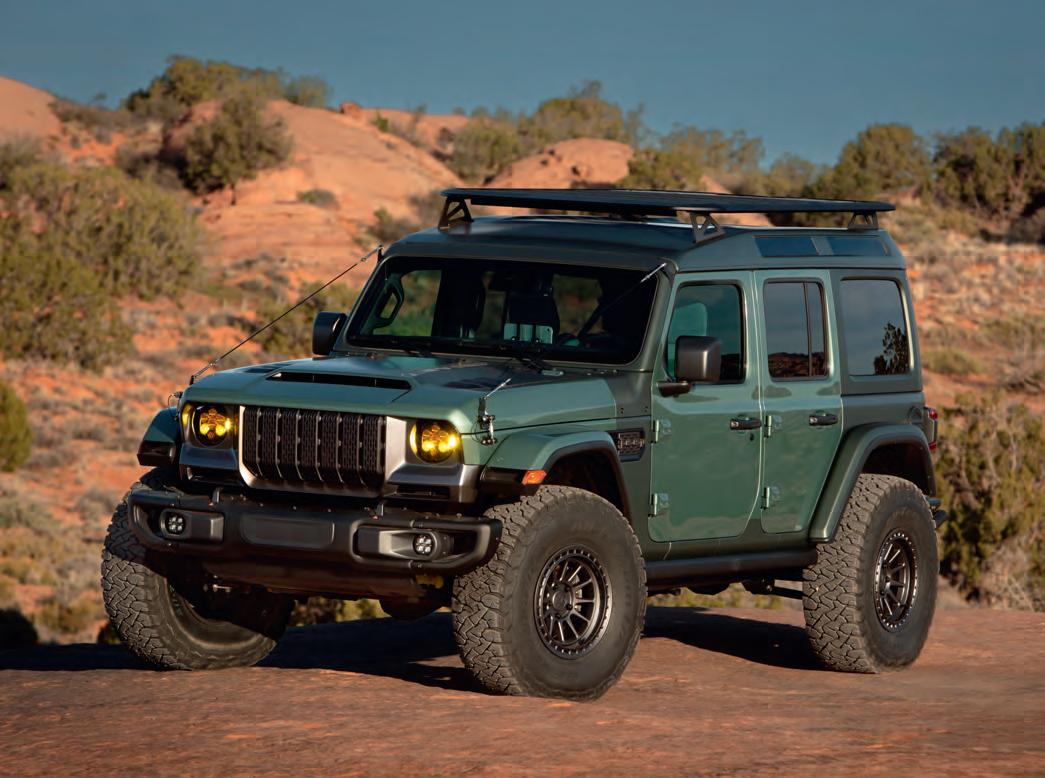
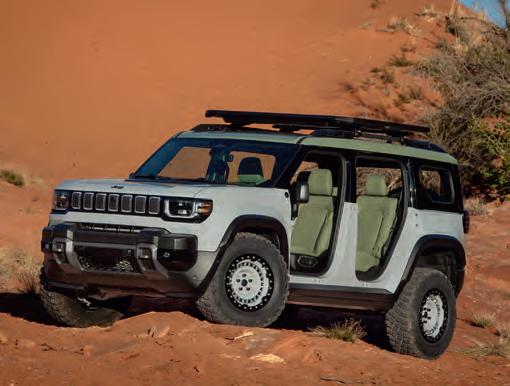
Jeeps may be a top choice for recreational off-roading but for long-range expedition travel, the world’s overlanders are still more likely to choose a Toyota. The Anvil 715 would have them think again: in Jeep’s words, it ‘extends the overland narrative first introduced with the Bug Out concept (featured in our September 2025 issue), evolving it into a more refined, boundary‑pushing expression.’
What this means in practical terms is a fixed roof containing skylights and an integrated cargo rack. The vehicle is equipped with heavy duty front and rear bumpers as well as on board air, with quick‑disconnect fittings for airing up and down on the trail and a range of auxiliary lights facing both forward and back. Unusually for a long-range expedition vehicle, it’s powered by a 6.4-litre V8 engine, and even more unusually its styling has been customised with a ‘face’ that harks back to SJ-Series Jeeps of the 1960s.
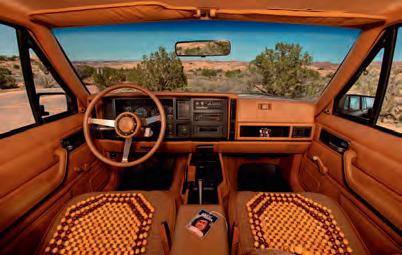
The original-shape Cherokee was the vehicle that brought Jeep back to the UK when the brand made its triumphant return to these shores in 1992. It went on to become a monstrous success, selling in big numbers – which in turn made it a popular choice with off-roaders as it filtered through on to the used market.
It didn’t take much to modify a standard XJ into a seriously capable off-road machine, and the Pioneer concept contents itself with a 2” lift. Its inner arches have been trimmed too, though, adding a virtual lift which allows the use of 33” all-terrain tyres. Rock rails are added, too, to protect its sills from damage.
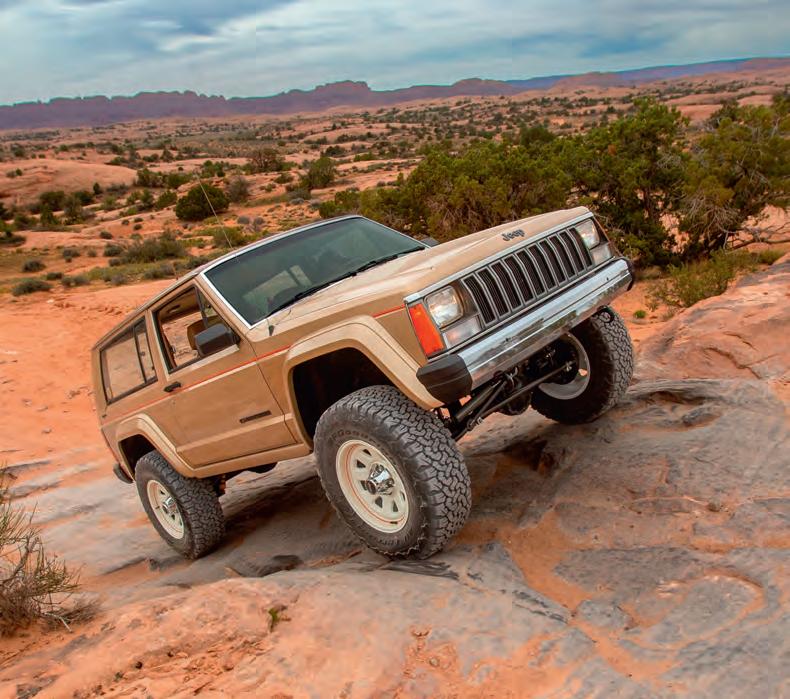
Jeep has just brought the Cherokee name in its home market, so it’s no surprise that the original got in on the Moab act this year. In typical concept style, its cabin is full of period details from 1984, when the XJ first saw the light of day; Jeep describes it as ‘a cultural time capsule infused with a bold, unmistakable ’80s attitude inside and out.’
Below left: Due in the UK later this year, the Recon is touted as the electric equivalent to the Wrangler. Jeep is very keen to emphasise its off-road abilities and the Overwatch does just that, adding a 2” suspension lift, beadlock wheels and 34” BFG all-terrain tyres and protecting it with steel rock rails and underbody skid plates.
Named after a Moab trail famous for its tight clearances and technical terrain, the Overwatch also features extensive carbon fibre to help manage its weight. It runs without doors, too, but gains a low-profile roof rack, while its interior has been retrimmed in durable, hard-wearing materials. ‘Exploring the outdoors means embracing the elements,’ says Jeep, ‘and the Recon Overwatch concept is built for exactly that.’
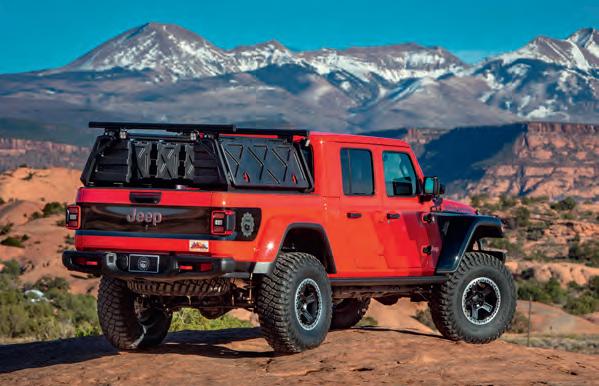
Below rightt: The Easter Safari is run by the Red Rock 4-Wheelers – and what better way to celebrate the club’s stewardship of the event than by dedicating a vehicle to its members? Better still, the Gladiator Red Rock was built to be a workhorse, with the ability to support year-round trail maintenance and clean-up operations, and Jeep donated it to the club to use in the efforts it makes in exactly those areas.
Modifications include a 3” suspension lift, 37” BFGoodrich KM3s, a steel bumper mounting a Warn electric winch, various auxiliary LED lights, on-board air and a sliding cargo tray. The truck carries a tool kit and off-road recovery equipment and features heavy-duty flooring to allow for quick and easy hose-outs.
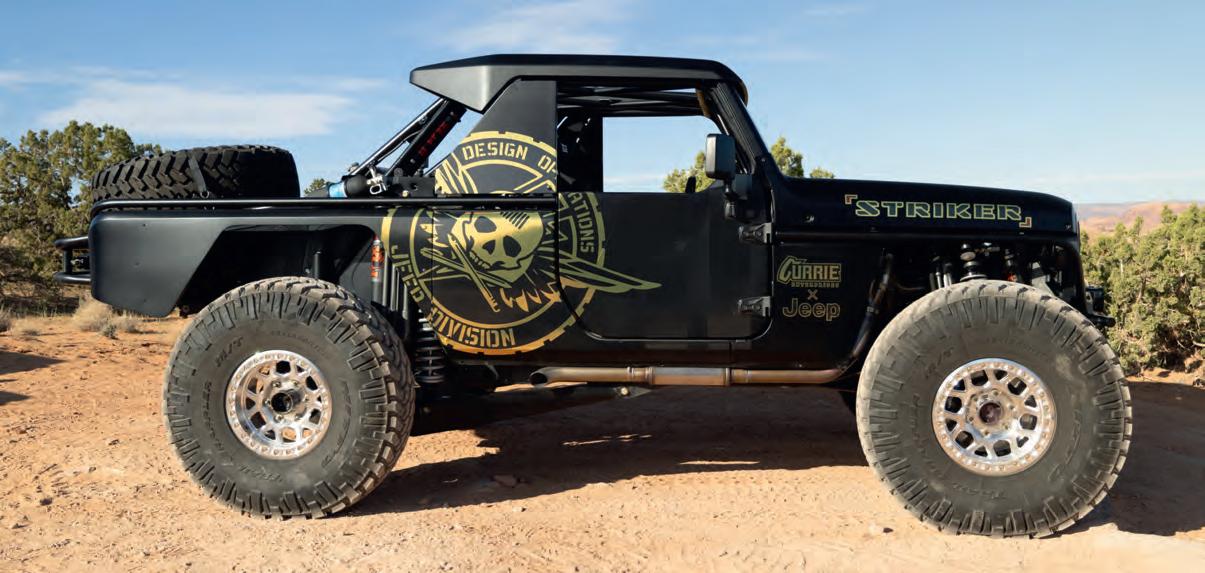
Safe to say you’re going to be reading more about this one in a future issue of Overlander 4x4. The Striker is a Wrangler concept created in collaboration by Casey Currie, a pro off-road racer and multi-time competitor at King of the Hammers. It was built by hardcore off-road specialist Currie Enterprises on a custom chassis, with heavy-duty axles and high-travel suspension, and it’s powered by a 707bhp Hellcat crate engine.
Really, this is more of a prototype rock buggy than a modified Jeep, but its bolt-on panels give it the appearance of a Wrangler – albeit one on a lot of extremely effective steroids. Talking of which, there are tyres and then there are 42x13.50R17 Nitto Trail Grappler M/Ts. It’s capable of high-speed desert racing and technical rock crawling alike, and with top-end lighting it’s capable of doing either by night or day.
‘This extreme, non-production concept pushes far beyond the boundaries of the current Jeep lineup, exploring what’s possible when capability is taken to its absolute limit,’ says Jeep. ‘Engineered with a “race-ready, door-slammer” mentality, it blends cutting-edge desert racing hardware with unmistakable Jeep DNA, built not just to survive the most extreme terrain but to dominate it.’
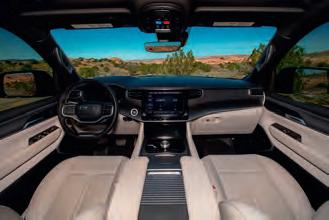
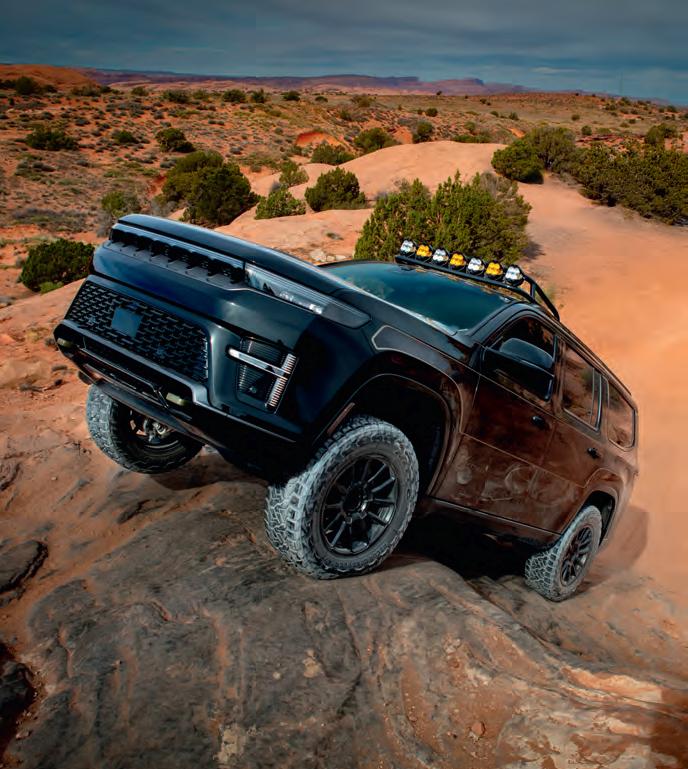
Designed for owners ‘who demand more, whether that means stand-alone capability or towing a dedicated wheeling rig into extreme environments,’ the imposing looking Grand Wagoneer Commander sits on 35” all-terrain tyres and features protective skid plates as well as a custom roof rack with integrated spotlights. ‘The Wrangler may be one of the most supported off-road platforms in the aftermarket world,’ comments Jeep. ‘But now that the Grand Wagoneer proudly carries the Jeep name, it’s time to view the flagship vehicle through a new lens of upfits, capability and mission-ready versatility.’
Laredo has traditionally been Jeep parlance for a back-to-basics trim level, and this take on the Wrangler strips it down to the essentials – ‘then turns the intensity back up.’ Its 3.6-litre V6 engine is mated to a manual gearbox and it’s fitted with halfdoors beneath a custom hard-top with a custom ‘Sky Slider’ hatch.
As is so often the case with Jeep’s Wrangler concepts, a 2” suspension lift is mated to 37” tyres, however unlike some of the others here there’s less in the way of off-road hardware. Inside, though, it’s all cloth trim and vinyl floors, creating a feel which Jeep says is ‘purposeful, rugged and unapologetically analogue.’
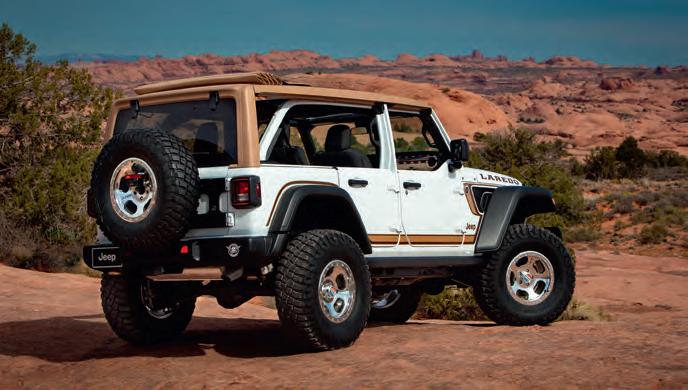
Based on the current Willys model (a lowish-spec Wrangler not available in the UK), the concept hints at a future production version… which of course, with the Wrangler no longer being made for this country, also won’t be available in the UK. ‘Raw, driver-focused and intentionally analogue, the Laredo concept embraces a “fewer features, more feel” philosophy,’ says Jeep. ‘It proves that sometimes the most exciting step forward is reconnecting with the fundamentals.’
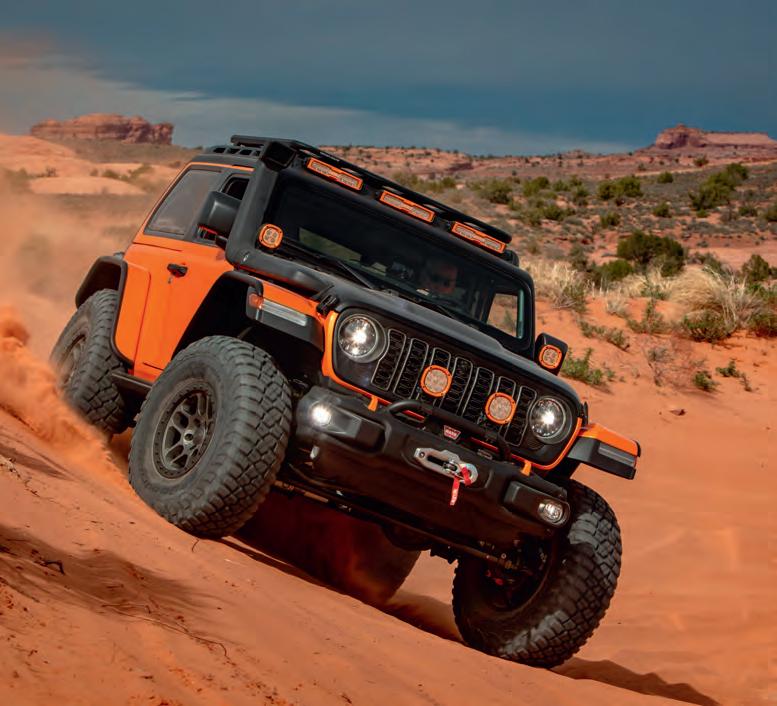
You normally associate roof chops with hot rods, not off-road adventure vehicles. But the Buzzcut combines just that with +2” suspension and 37” mud-terrain tyres to give it serious capability as well as what Jeep describes as a ‘rebellious, squatted profile’ beneath its lowered fastback-style roofline. It’s all given added punch by a bright orange paint job – as well as a set of hugely flared flat wheelarch extensions to cover those big tyres.
Steel bumpers carry a winch up front, along with a set of LED spotlights, and the tailgate is reinforced to carry a full-size spare wheel. The rock rails are all steel, too. Up top, that lowered roof is home to a RhinoRack cargo platform – as well of course as yet more LEDs – and a snorkel routes serves the 2.0-litre petrol engine via a cold air intake.
‘Mopar designers set out to create a sporty two-seat adventure machine with extreme capability and expanded storage for longer excursions,’ says Jeep. ‘Rooftop and interior storage enhancements make this sportster concept the perfect choice for any extended trips.’
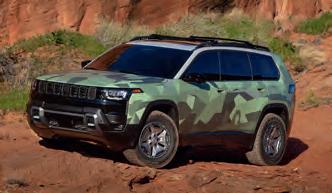
The Cherokee Upland is all about looking fit for purpose. With a custom off-road-spec front fascia, conceptual roof rack, functional recovery hooks and 31.5” all-terrain tyres on bespoke 18” wheels, it provides ‘a more expressive, adventure-forward vision’ for the modern Cherokee. ‘Its exterior treatment amplifies presence and purpose with a more technical, planted, exploration-ready feel,’ says Jeep. ‘With a bolder stance, sharper character and rugged capability cues, it invites drivers to push beyond the pavement.’














You can argue all day long about the best 4x4 of all time. But if you ask people from all around the world, there’s only going to be one answer. And the best thing about the best is that you can make it even better…
Words Paul Looe Pictures Harry Hamm







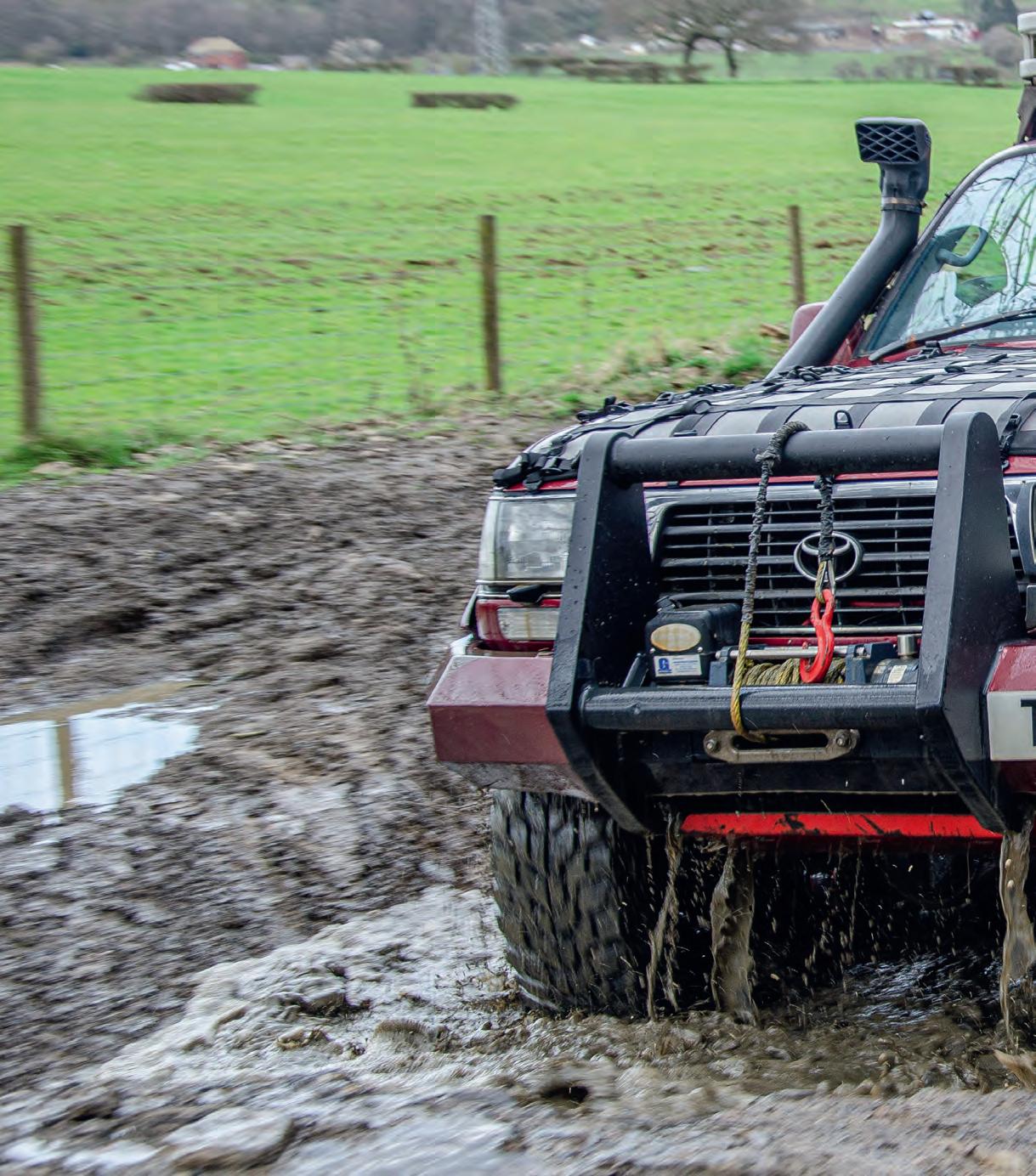

The best 4x4 ever built? Ask that question all the way around the world, and it probably won’t be anything with a Jeep or Land Rover badge that wins the vote.
Chances are that it’ll be a walkover, too. Across Africa, Asia and Latin America, not to mention Australia and most of mainland Europe, the Toyota Land Cruiser is like the Beatles, Jesus and Manchester United rolled into one. And of all the many vehicles to have carried the name (at least, of all those to have been available in Britain), the 80-Series is the definitive example.
This was the last Cruiser to come here with live axles. Each of them had a diff-lock in it, too. And up front was one of the best diesel engines ever made.
Even today, when the last ones are knocking on for thirty years old, you still see 80s changing hands for strong money. They tend not to be restored, either, just maintained; there’s no such thing as an everlasting car but this is pretty much as close as human invention has come. They just go on and on – and there’s no shortage of ways in which you can modify them.
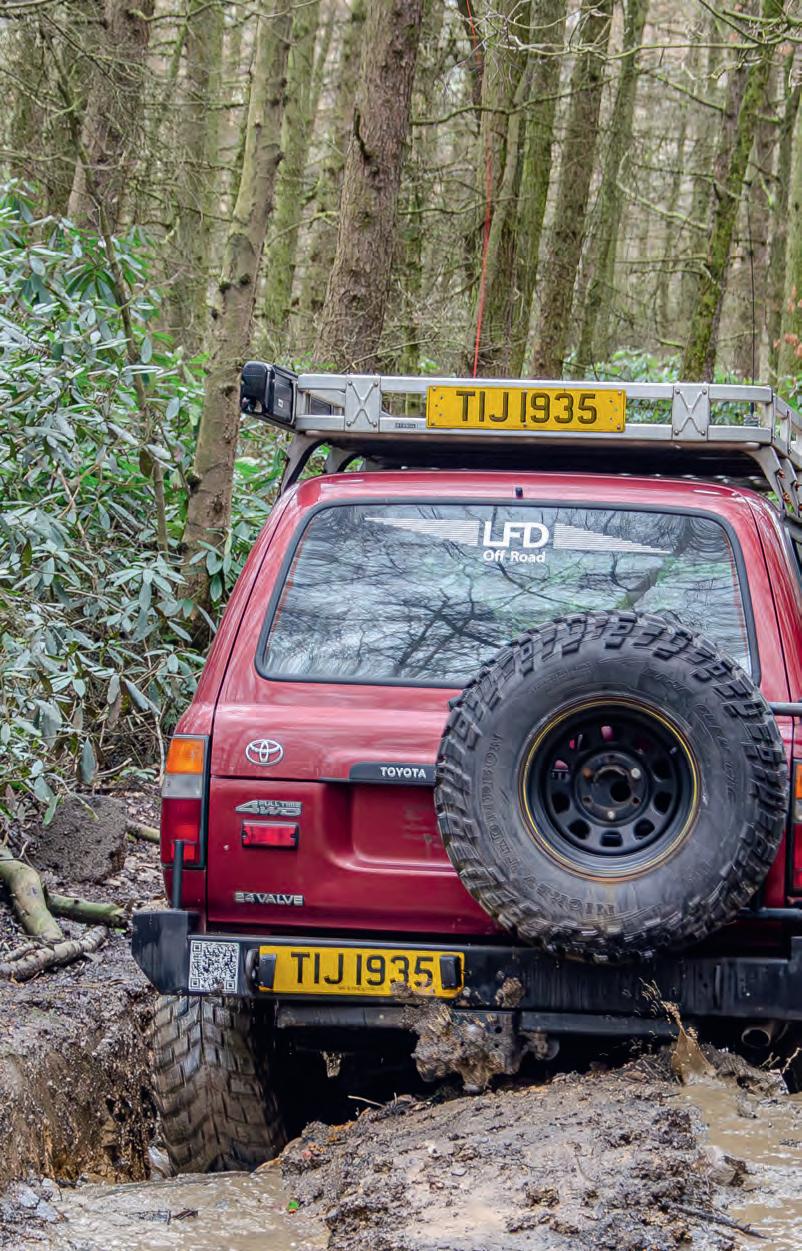
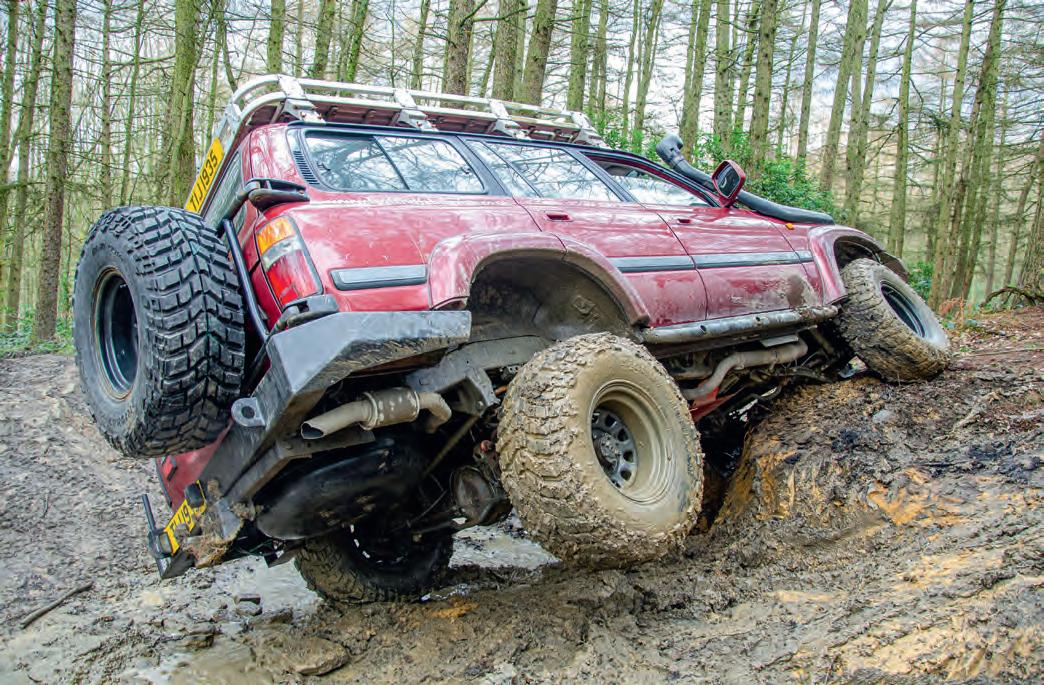
This here 80-Series is a very fine example. We photographed it in the hands of Kev Martin, looking very tidily modded and even more tidily maintained – and










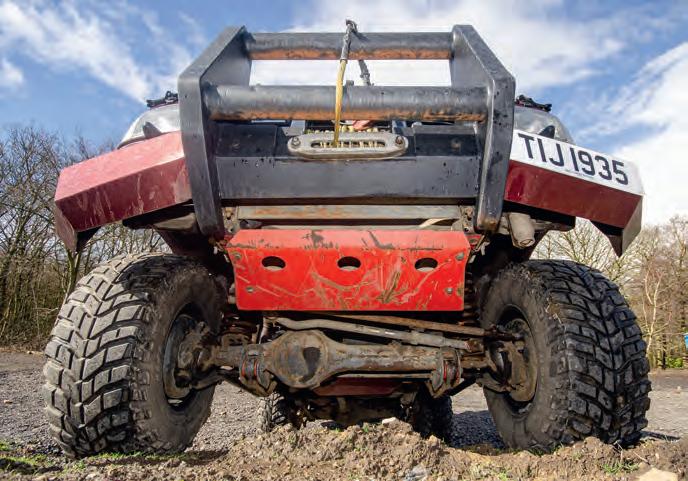
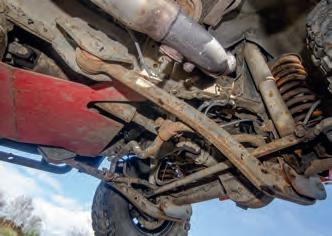
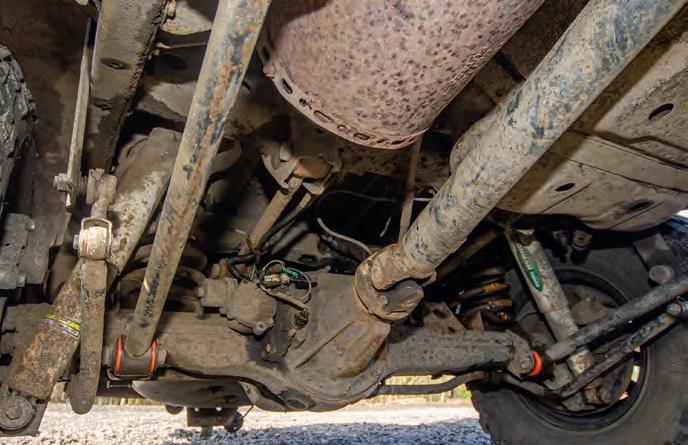
Above: 80-Series axles are ‘pretty tough,’ to use Kev’s own gently understated words. ‘The standard stuff seems to handle 35s okay,’ he continues, though in the course of his time with the truck he’s replaced the CV joints and wheel bearings up front and the diff actuator at the back, in each case using OE-quality parts
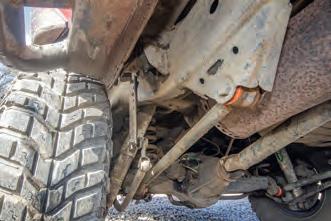
Above right: Ironman is an A-list name in the Cruiser modding scene and the Aussie company’s suspension kit is responsible for a +4” lift on Kev’s 80-Series. As well as springs and shocks, the kit includes adjustable panhard rods and castor correction plates; Kev says he ground away some metal on the latter to gain sufficient adjustment, but his overall verdict is very positive
definitely getting used the way a legendary 4x4 should.
Let’s go straight to the heart of the matter. As we were saying, the 80-Series had one of the best diesel engines even made. This one doesn’t, though.
If you look at 80s for sale, you’ll see that the cheapest tend to be the ones with the
smooth but brutally thirsty 4.5-litre straightsix petrol engine. Having once owned one and had the pleasure of trying to keep up with its truly award-winning to empty its fuel tank, we can confirm that most of the time, you feel as if bankruptcy lurks around the very next corner. It’s so expensive, even going by train starts looking like an option.
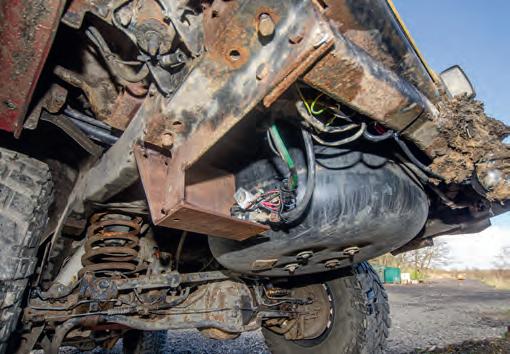
That’s why many of them have been converted to run on LPG, and this is one of those. In fact, it’s been converted twice. The first system was too small for the the engine – and besides, it had leaks, which doesn’t sound like anything good could come of it.
Even on gas, Kev admits that it’s still a pricey old bus to keep fuelled. You wouldn’t
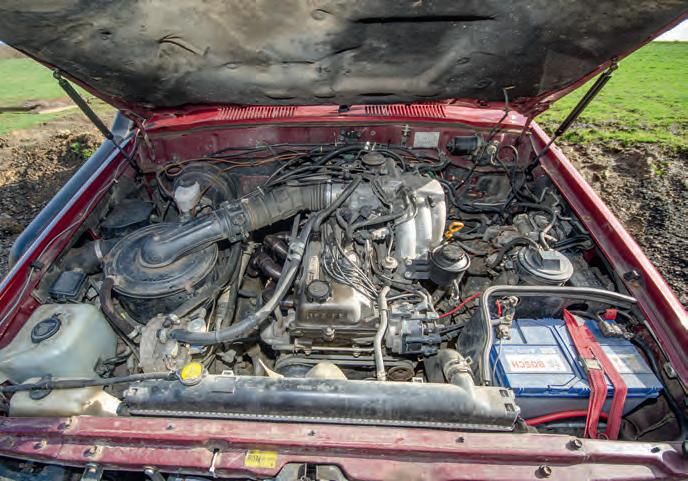
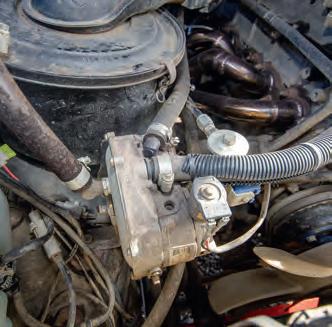
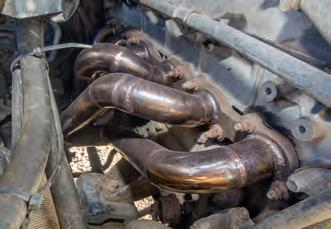
Above: Most of the 80s that came to the UK were diesels, and what a gorgeous engine that is. But don’t be fooled into thinking it’s light on fuel. Not that the 1FZ-FE petrol unit is any better, though with LPG installed the 4.5-litre six-pot is at least tolerable
Top right: The gas system the engine runs on now is the second it’s had, as the original was too small for the engine, and a bit of work was needed a couple of years back after a muddied-up radiator led to some overheating trouble
Above right: This isn’t something you see every day on a modded off-roader, but it’s definitely all kinds of funky. If you want to get a bit more out of an engine, making sure if can breathe is pretty much the first step – and a performance exhaust manifold and downpipe from CX Racing in California is as eye-catching a way of doing that as you’ll ever see
want it as your daily drive, and it’s not – but you’d love it as a toy for playdays and laning, and it is.
When he bought it, the 80 was more or less standard. ‘It wasn’t in bad shape,’ he says.
‘But it hadn’t really been looked after or regularly maintained.’
That was about to change, without delay and very much for the better. ‘I fitted the lift kit and 35” tyres pretty much straight away. The rest of the mods have been completed over the years.’
That lift was a 4” job from Ironman, and Kev reckons it’s spot-on with the 315/75R16 tyres he fitted. ‘I wouldn’t go bigger on the tyres due to risk of damage to the CV joints,’ he says. ‘Same goes for the lift – I think 4” is enough. I’m pretty impressed with the onroad handling this kit provides – I don’t get
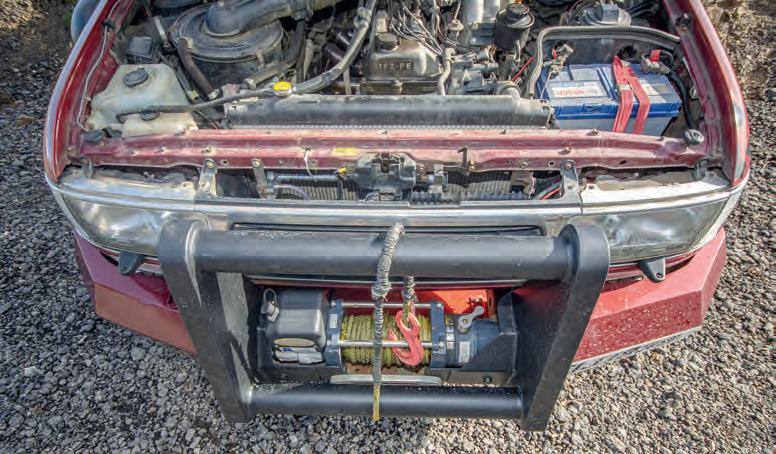
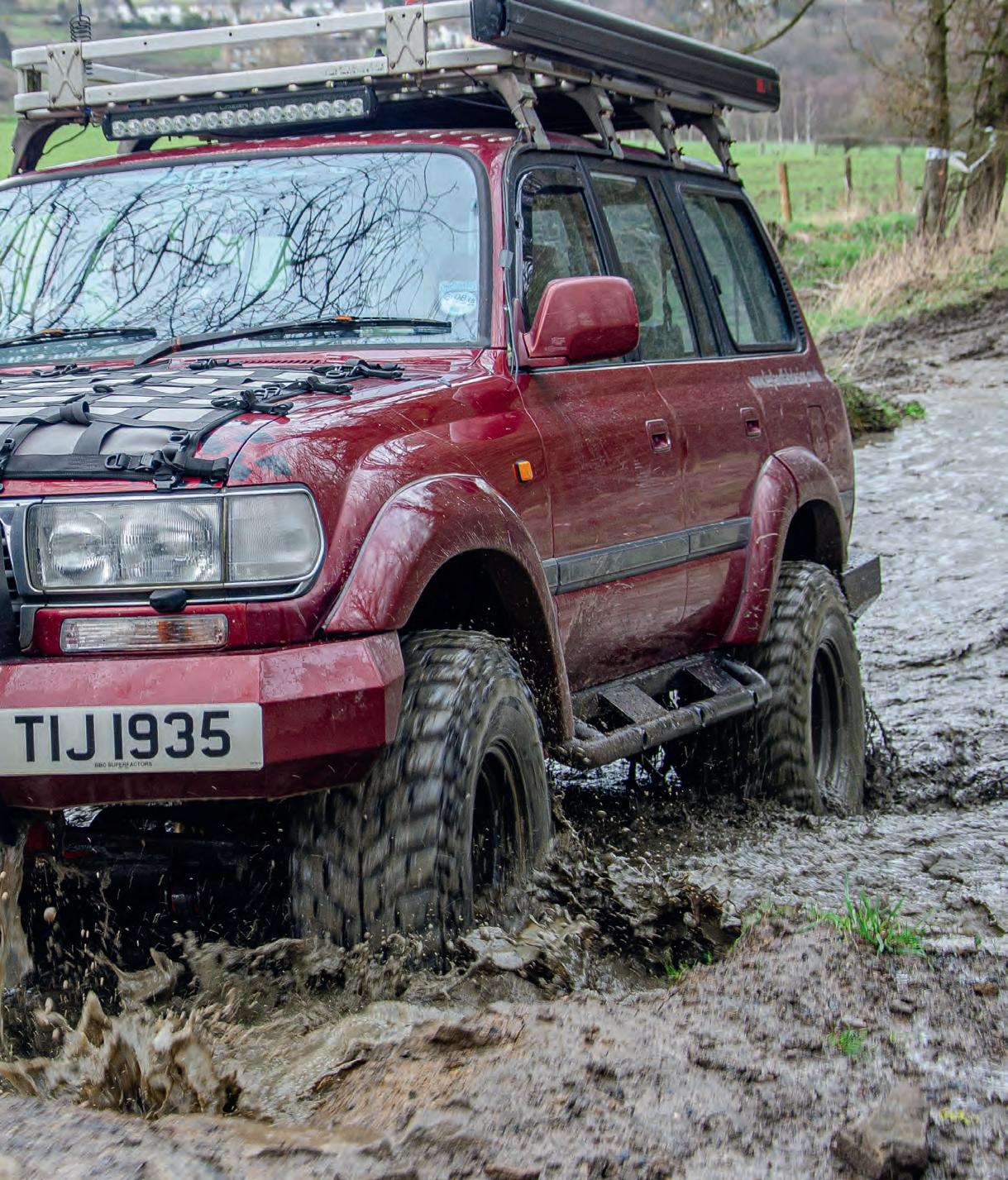
Above: The 80-Series is already a solid looking bit of kit in standard form, but this one takes it to a whole new level. A handy family connection meant all the hardware was made by Leyland Fab Design, a company you’d have struggled to hear anyone say a bad word about back when it was still doing this kind of work. The steel front bumper includes an A-bar and winch cradle, in which a 12-volt, 9500lb Goodwinch unit is spooled with 100 feet of 11mm synthetic rope
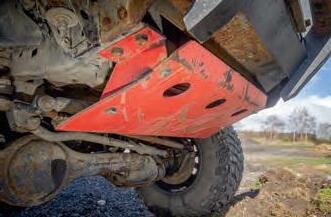
Top right: Also from Kev’s brother is this steering guard – which, judging by the state of it, has guarded the steering more than once. Despite this, it appears to have taken the brunt of an 80-Series without being deformed, which takes some doing – though when you look at the thickness of it, you can see where its strength comes from
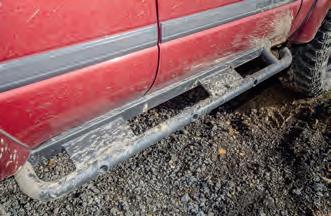
Above right: The original sills were removed to make way for heavy-duty lengths of steel box. These are the anchor point for a set of rock and tree sliders that double up as high-lift jacking points (and, just as practically, steps for clambering aboard)
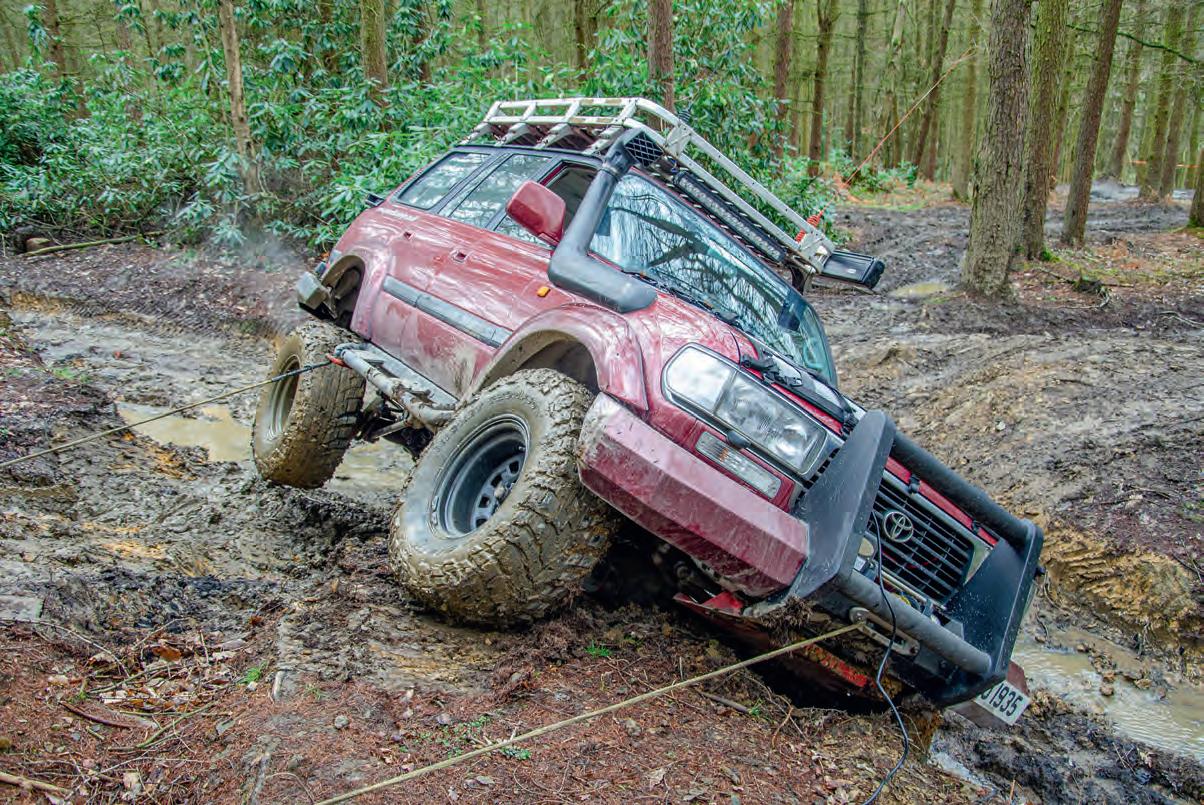
Even with a
much body roll at all when cornering. Any higher and it would ruin that.’
For the same reason, Kev decided against using a body lift as a way of making room for bigger tyres. ‘I think the car is high enough. Besides, we’d get into issues of having to extend the gear stick, steering column and so on.’
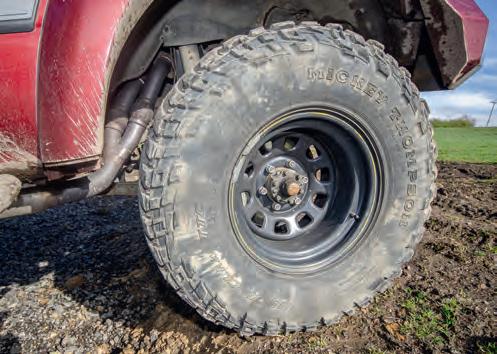
As it is, a set of 35” Mickey Thompson Baja Claws looks just right under the Cruiser’s arches. ‘The tyres weren’t cheap,’ says Kev, ‘but I’m happy with both their on
and off-road performance – not too much road noise, and they grab pretty well on the looser stuff.’
The first thing you notice about this Cruiser, though, isn’t so much its height off the ground as the spectacular set of bumpers and rock sliders that are visible from pretty much any direction. These were the work of Kev’s brother Chris, who used to run Leyland Fab Design (LFD) – a company noted among off-roaders for building bespoke items.
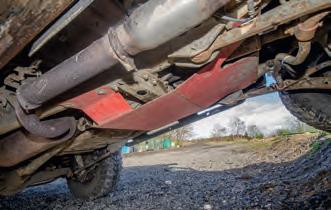
out is a concern with such a long wheelbase. This fabricated tranny guard means it’s a bit less so
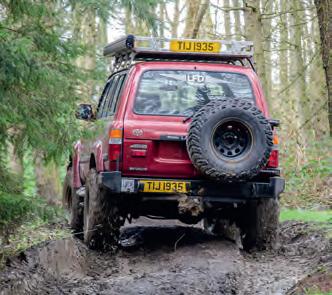
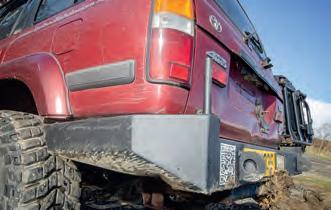
Centre: The back bumper is yet another piece of heavy-duty metalwork by Kev’s brother. The recovery eyes look like you could use them for mooring an aircraft carrier
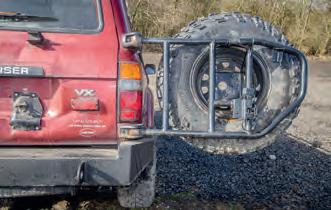
Right: The original spare wheel mounting point on the 80-Series is under the back bumper, which is vulnerable if you’re going to be off-roading it properly – and as much use as a concrete parachute when you’re replacing the tyres with 35-inchers. Enter stage right a fabricated swing-away carrier – this picks up on the lower tailgate when stowed, but the fact that this much weight can hang off the rear corner shows how strong the Land Cruiser’s body is
Before you go looking the company up (and, unbelievably, a website for it does still exist), Chris moved away from the fabrication side about a decade ago. Basically, he found that there’s more profit in everyday garage services.
‘I’d like to thank Chris and his employee Nick for keeping the truck maintained over the years,’ says Kev. ‘I do some of the smaller jobs, generally just the maintenance stuff like draining and refilling the diffs, gearbox and engine oils after playdays. I have done some open heart surgery on engines previously, but my brother looks after that now. I’d rather repair computers than engines these days – my hands don’t get as dirty!’
Fair enough. Though he’s definitely not scared of getting his truck as dirty as it takes to make the most of it off-road, so it’s just as well all that protection is in place –as is a fairly fresh layer of underseal.
As you can tell from all of this, Kev’s the kind of off-roader who set out to buy the right truck in the first place and, rather than chopping and changing every couple of years, has been patiently enhancing it
ever since. Not just as an off-roader, either – while the mods you see here have made a massive improvement to what was already an exceptional machine, most of us could learn a lot from the diligence with which he’s maintained and indeed enhanced the everyday stuff.
The braking system, for example, found itself being completely stripped out and renewed. Why? ‘We found a number of leaks,’ Kev explains. ‘We replaced all the brake lines with extended braided hoses, but when we looked at it we found the standard system was overly complex.
That’s one area in which it’s a work in progress, then. Another is the exhaust –though as you may already have spotted, the progress has already started.
In place of the original manifold and downpipe, the Cruiser now sports a groovy looking six-branch tubular job from CX Racing in California. ‘We need to finish
‘It wasn’t in bad shape when I bought it. But it hadn’t really been looked after or regularly maintained’
‘We removed the ABS unit and the rear load sensing valve due to leaks. All the brake calipers have been replaced with OE parts – after a few years of off-roading, the seals were leaking and the pistons and slider pins were corroded on the previous ones.
‘I do think actually it could do with being on bigger discs and calipers, with having the 35” tyres. So far I’ve not found anything suitable though.’
off the exhaust to give it a full 3” system,’ Kev told us. ‘We just need to get the 3” tooling for my brother’s hydraulic pipe bending machine!’
What else is on the list? Kev reckons the steering damper is about ready, and in addition to the Lazer LED bar already on the roof rack he’s got a couple more waiting to go on. He wants to make a few adjustments to the front winch bumper, too, which you
suspect is going to mean asking Chris to put his fabricating hat back on, and talking of winches (sort of) he’d like to go to a dualbattery system with split charging.
Most of which doesn’t count as everyday stuff, of course, because it’s distinctly off-road orientated, but this certainly does: ‘I’ve removed the air conditioning
system, as the compressor had a dodgy seal and bearing and the condenser was gunked up, restricting air flow to the engine coolant radiator. I’ve had the compressor reconditioned (at great expense) so I’d like to get around to refitting it all one day.’ Incredibly, back when this Land Cruiser was built not all 80-Series models came
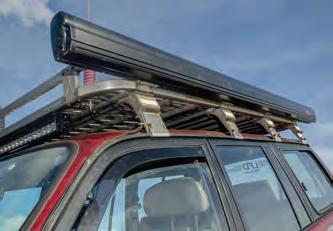
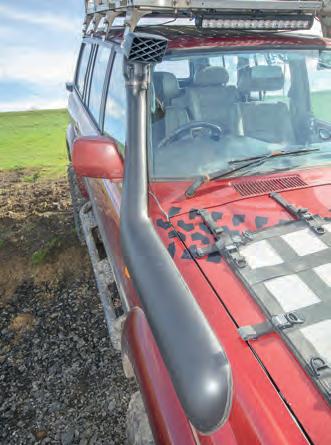
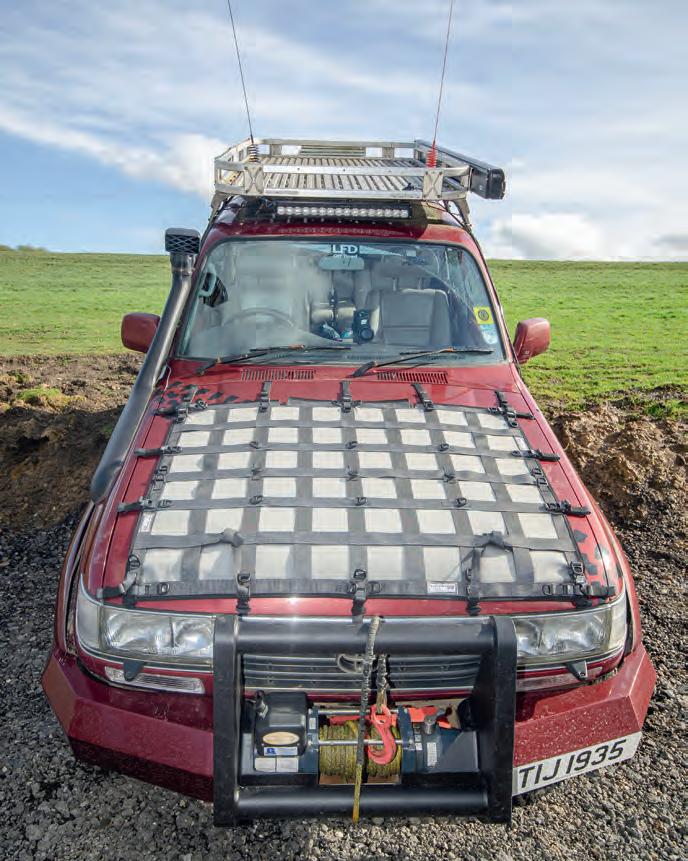
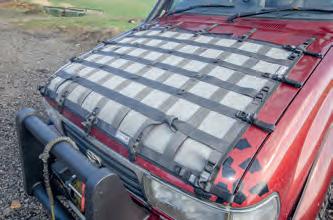
No shortage of cool stuff to see here. For starters, it’s a big bonnet – so why not make the most of it? One of Rock n Road 4x4’s Blunt Force cargo nets certainly does that. Up top, you’ll see a nice looking roof rack – or actually, you won’t. A single one wasn’t going to be big enough, so Kev cut and shut two into one. Still, if you can see the join you’re doing pretty well. Permanent fixtures up top include a Fiamma wind-out awning, which has somehow survived all the playdays and laning trips Kev’s done, and a Lazer T-16 LED bar
with air-con as standard – but if you’ve ever been sat doing a steady 5mph through the woods on a sticky summer’s day, you’ll know how uncomfortable it can get when all you achieve by opening the windows is a cabin full of flies.
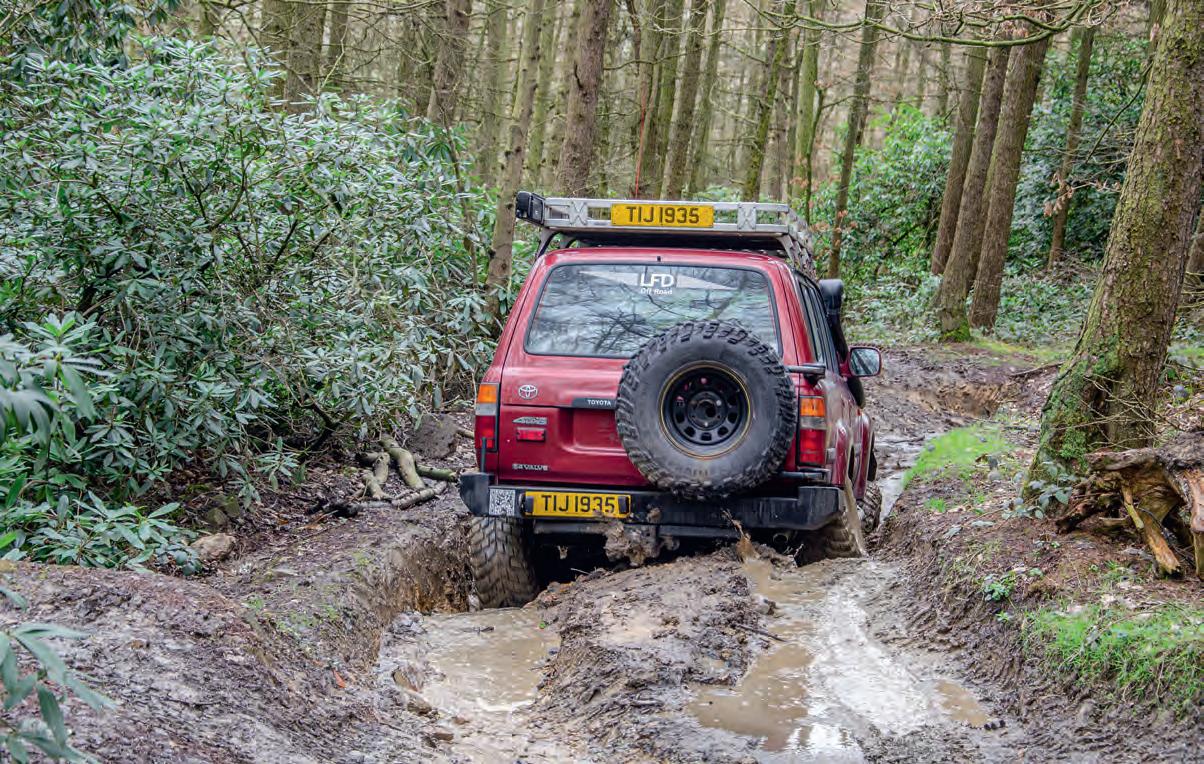
And crawling through the woods, or anywhere else that’s fun, is definitely what
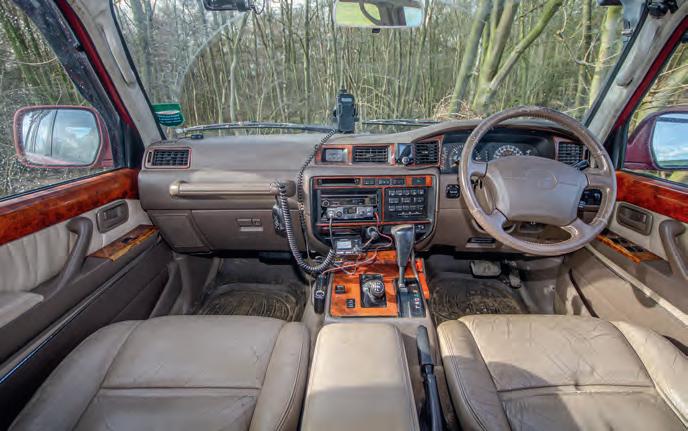
It was the last word in luxury back when it was new – and though time has moved on, the Cruiser’s early-90s’ cabin is still a very comfortable place to sit whether you’re chuntering along on the road or easing your way over rocks and roots. It’s more a story of accessories than mods here – Kev’s replaced the interior lights with LEDs and fitted stuff like a CB and up-to-date Pioneer stereo with sat-nav, as well as a dash cam (which keeps going beep when he’s off-road, because every time the front wheels hit a bump it thinks it’s been in an accident…)
this truck is about. For many years, Kev’s been taking the truck to playdays around the M62 corridor at sites like Cowm, Tong, Kirton and Briercliffe, as well as enjoying our nation’s green lanes. He’s also a volunteer for NW 4x4 Response – if you’ve been cut off by snow or flood waters, seeing a sorted 80-Series coming to the rescue can hardly help but be reassuring.
We often feature vehicles here whose owners have had loads of other 4x4s before them and profess to be on the lookout for something else already. Nothing wrong with that if you just love having a project on the go, of course, but constant development is the key to creating a truly sorted machine. And the fact that even after getting it this far, Kev’s still thinking in terms of what to
improve next suggests that his Cruiser will forever be getting more and more sorted.
The best truck ever built? No room full of random off-road enthusiasts will ever agree on that one, but 4x4 drivers across the world have been putting their trust in the Land Cruiser for decades. The 80-Series is the best we’ve ever had in Britain – and this one’s better still.







Twisted Automotive has become synonymous with top-end luxury Land Rover Defenders. Now, the company has turned up the dial on its first ever Range Rover
Words Mike Trott Pictures Twisted Automotive


For more than 20 years now, Twisted has been a leading name in the boutique Defender market. The company first became known for its Gale Force Td5 upgrade before moving on to full rebuilds using Chevrolet crate engines, and in 2015 it famously bought a fleet of 110s from the last few months of production to use as base vehicles.
In all that time, however, it has never done a Range Rover. Other equally high-end outfits have grown up to serve that market, some with more stickability than others, but Twisted has kept its eye on the Defender. Until now.
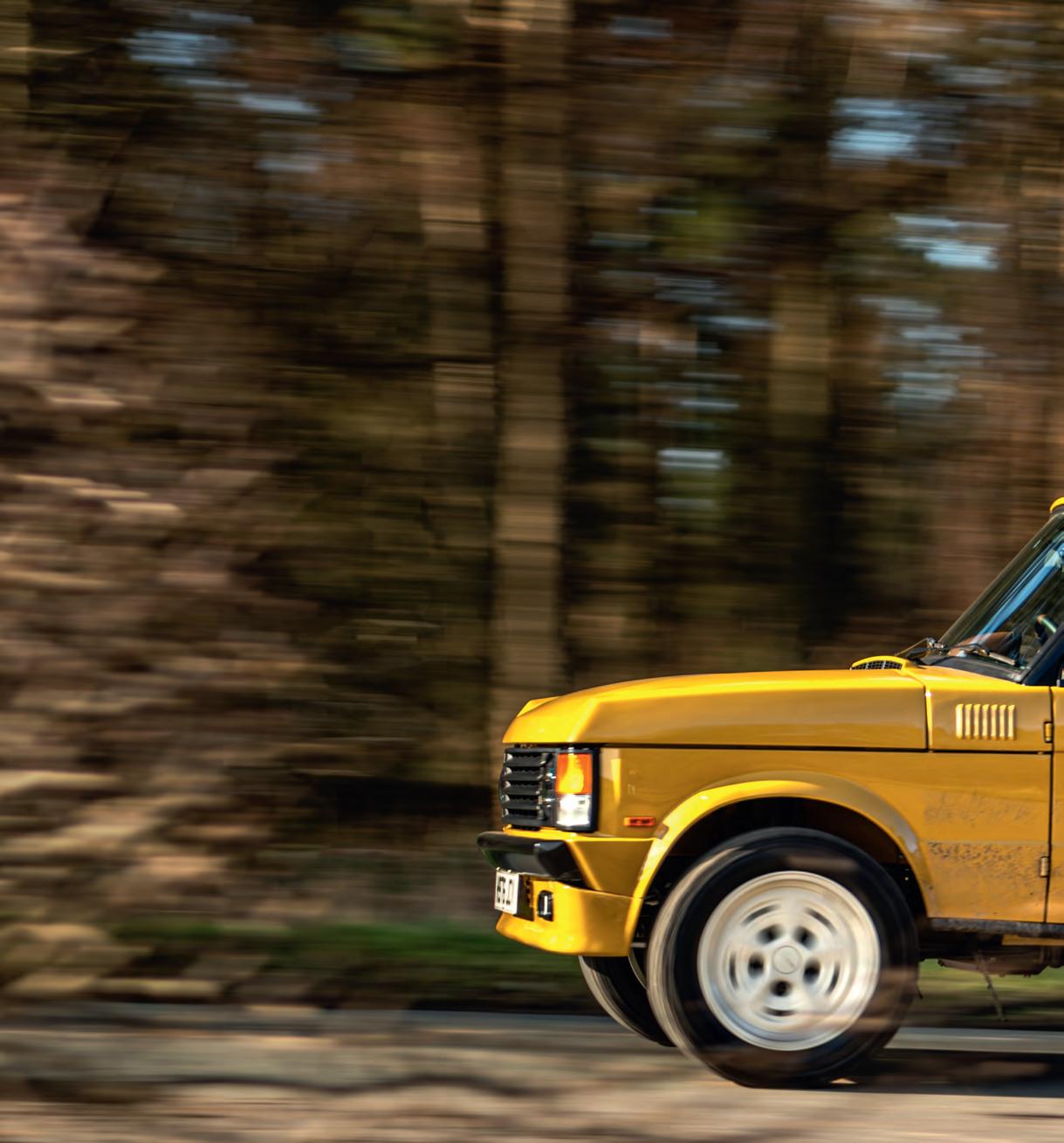
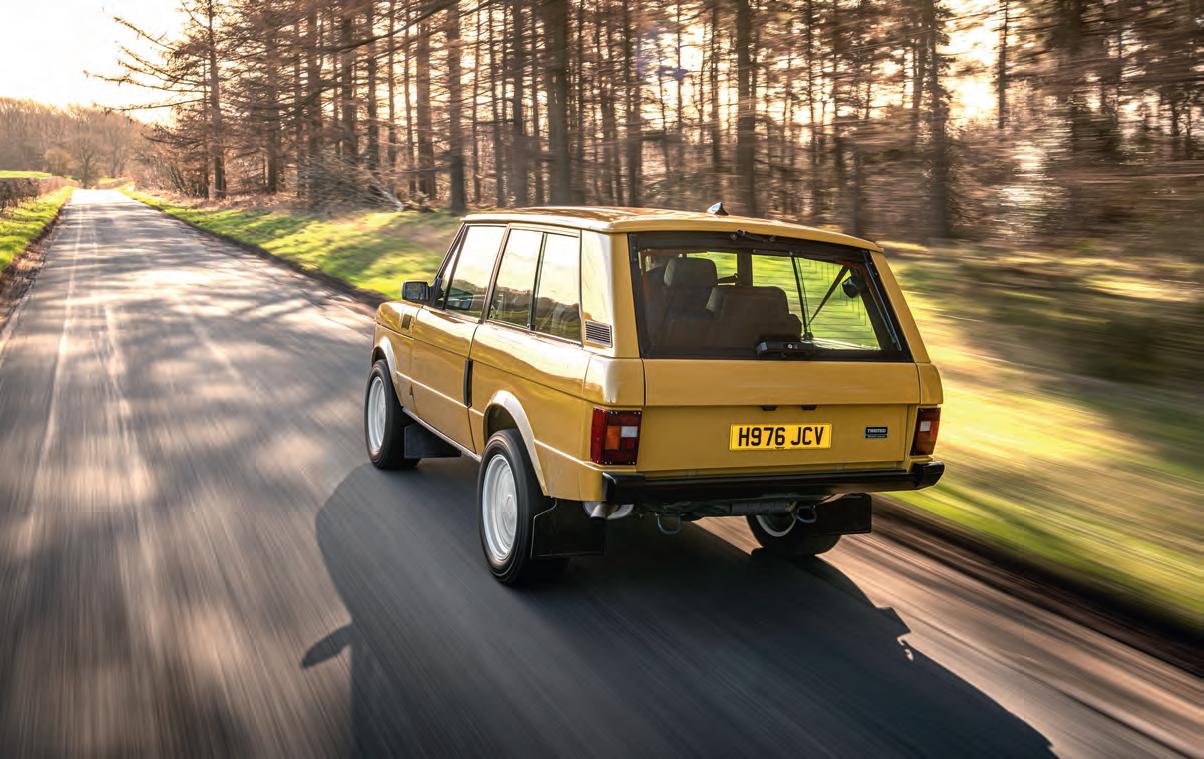
Introducing the TRRC. Inspired by Twisted founder Charles Fawcett’s childhood memories of his father’s old
two-doors, this is a ‘high-performance reimagining of the Range Rover Classic’ featuring a 500bhp LT1 V8 mated to an eight-speed automatic transmission.
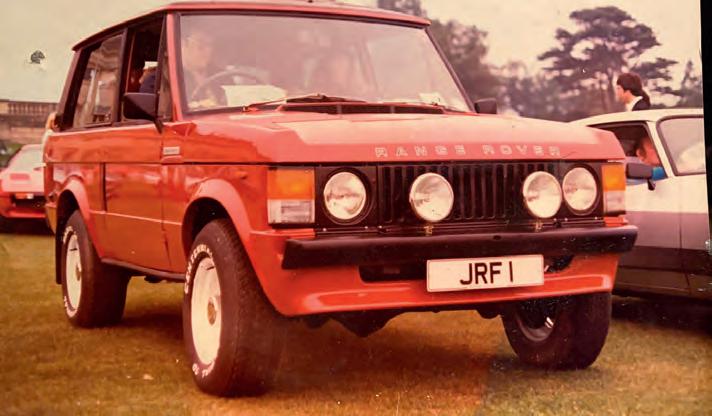
‘When I think back to the 1980s,’ says Fawcett, ‘my father always seemed to have a two-door Range Rover, and there was one particular one that stood out. It was terracotta brown with fibreglass extended
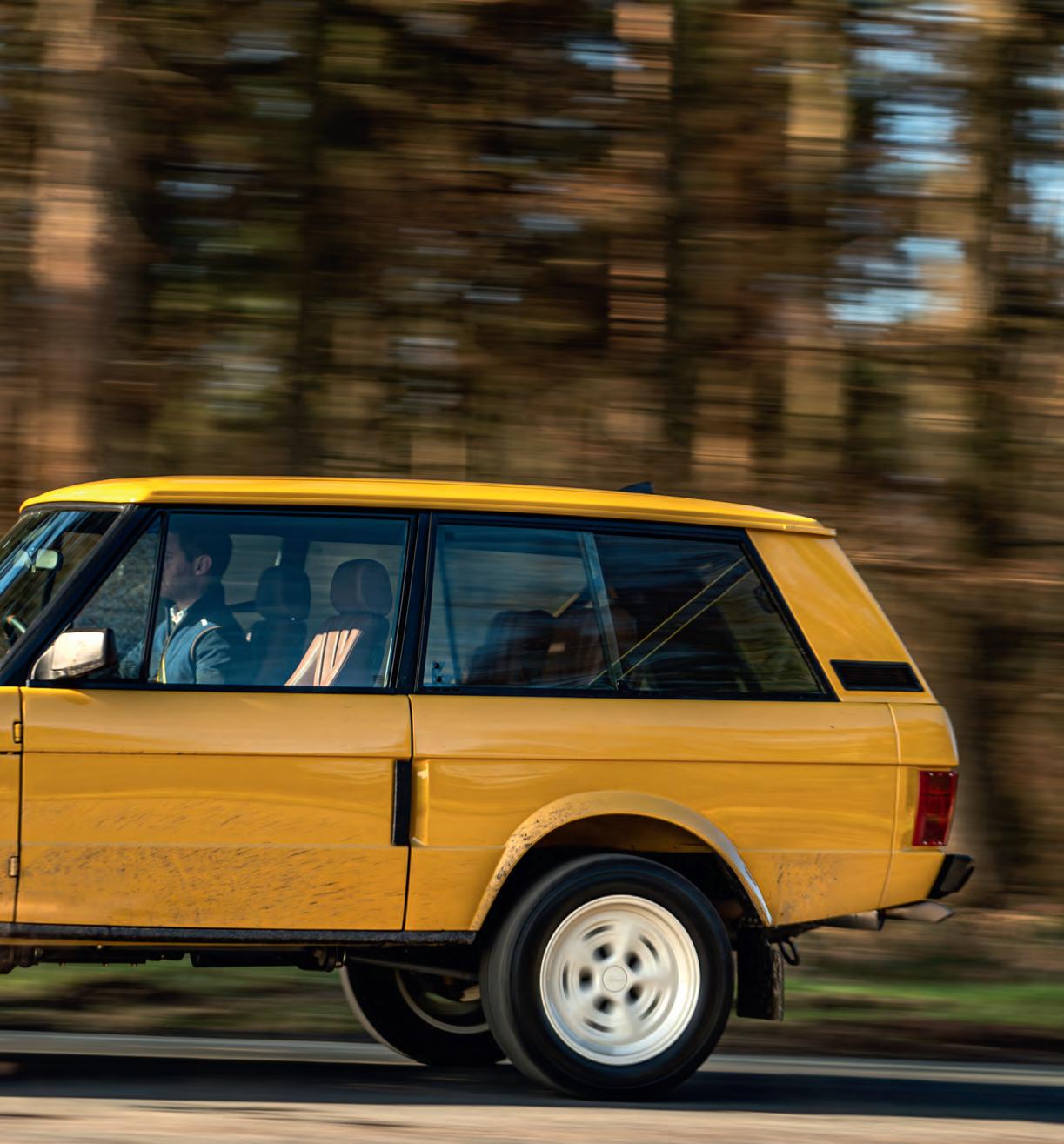
wheelarches and white eight-spoke wheels shod with General Grabber tyres. On the front, he’d fabricated a valance out of an MGB GT spoiler. To me, it was just iconic.
‘Today, the Twisted Range Rover Classic exists out of unapologetic nostalgia, recreating something I remember from when I was a tiny boy. I think many customers will relate to that feeling.’
There’s no shortage of classic car restorers in the world who earn a living from taking vehicles back to the way they were when they were new, but that’s not what Twisted is about. Borrowing our least favourite word from Land Rover’s own corporate lexicon, it describes its eimagined Range Rover as ‘a curated mix of the best eras of the Classic, blending a 1970s’
front bumper with a 1990s’ style grille and headlight surrounds.’
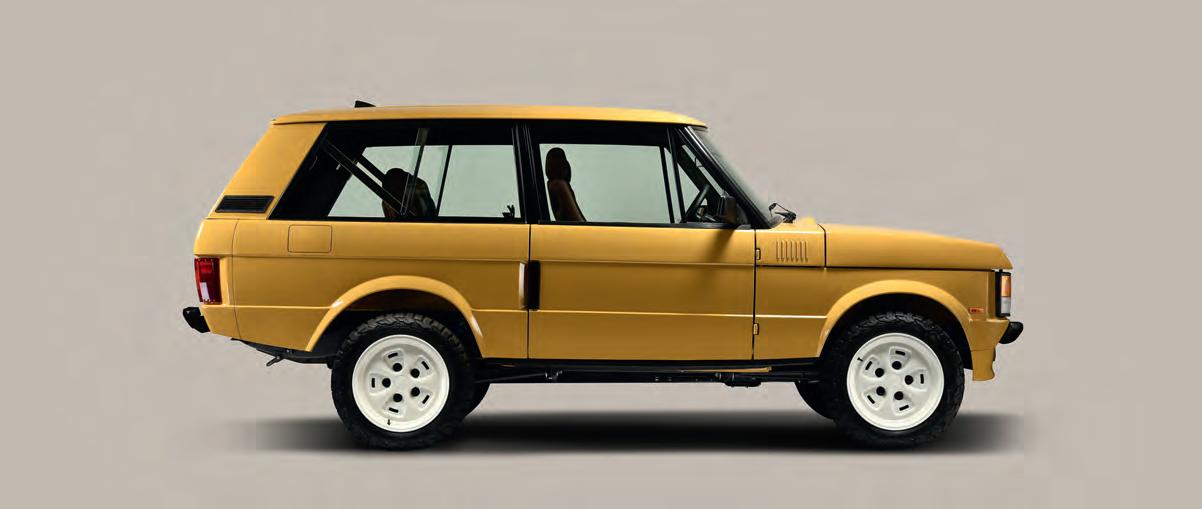
The vehicle’s handmade bodywork is hammer-formed throughout, using bespoke tooling designed specifically for the job to create panels which are unique to Twisted. These include front and rear rolled arches, while up front there’s a colour-coded splitter with high-output driving lights. Panel gap
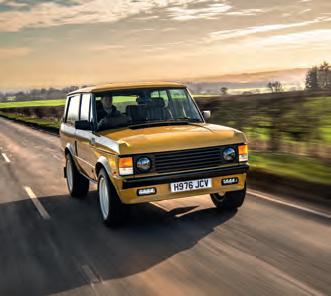
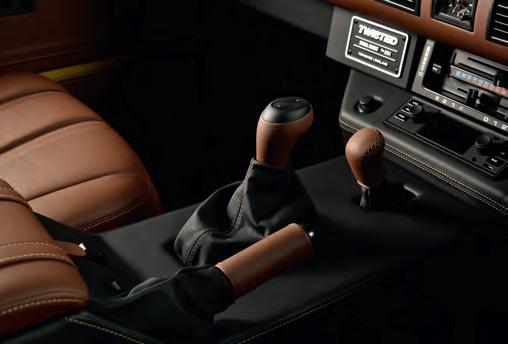
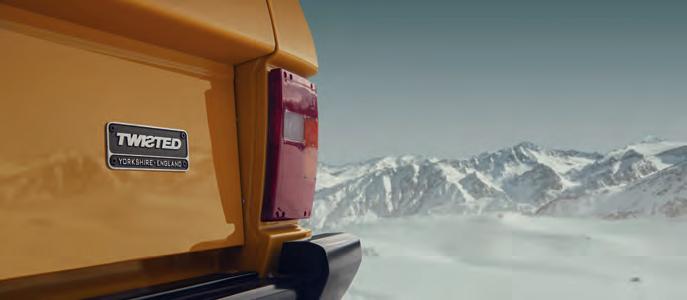
“The Twisted Range Rover Classic exists out of unapologetic nostalgia, recreating something I remember from when I was a tiny boy. I think many customers will relate to that feeling”
The inspiration for the Twisted Range Rover came from a vehicle the company’s founder Richard Fawcett remembers his dad owning back when he was young. One of many twodoors the family went through, it had GRP arches, eight-spoke wheels and an air dam fabricated from an MGB front spoiler
tolerances are ‘obsessive’ (as opposed to the original, which was more like ‘offensive.’) Rather than the traditional ‘floating’ roof, customers can opt to have the C-post painted in body colour to accentuate the vehicle’s two-door silhouette.
Beneath it all, the TRRC is based on a chassis and axles which have been stripped, blasted and e-coated in a protective satin black finish. Of course, its 500bhp engine means it will be much faster than any Classic ever to leave a Land Rover showroom, but that would mean little without the handling to back it up. With progressive springs and upgraded bushings, Twisted says the vehicle drives similarly to its re-engineered T90 and T110 Defenders – but that its dynamics have been specifically tuned to suit the Range Rover’s character. ‘We spent an age tweaking the bushings so that you got something that was sharp and super drivable but not too harsh,’ explains Fawcett. ‘A Range Rover needs to be supple.’



Twisted’s pictures show the Range Rover on significantly lowerprofile tyres than standard, and the vehicle’s ride hide has been adjusted so that its nose sits slightly lower ‘to suit the Classic’s profile.’ Its differentials have been upgraded, as have its brakes, with six-pot front and four-pot rear calipers fitted as standard.


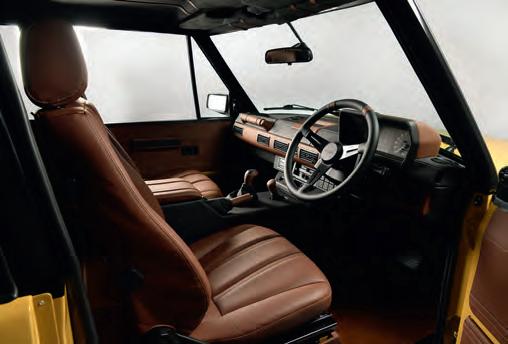
the pristine paintwork or even leave the rear inner arches uncarpeted to fully appreciate the metalwork.’
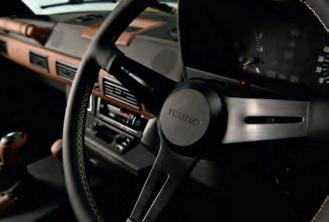
Inside, the seats are set lower than original. Twisted explains that this is so that the driver’s eye line is directed at the upper half of the windscreen, ‘making the most of the vehicle’s legendary glass-everywhere visibility.’ Beneath your feet, soundproofing material is attached to the carpets rather than the floor – ‘a small, obsessive detail synonymous with Twisted, allowing customers to peel back the carpet to see
Well, the customer is always right. And with production limited to just 12 vehicles a year, priced from £350,000 each, being right is something these customers will be used to. Even if you’ve got that sort of money to spend, however, don’t get too excited: every build slot for the rest of 2026 is already taken, and 2027 is filling up quickly too.
‘The Range Rover Classic is a British icon,’ concludes Fawcett. ‘It’s not for everyone, and that’s the point. As with all Twisted products, not everyone will want one – and of those who do, not everyone will get one.’




Words and Pictures Dan Fenn

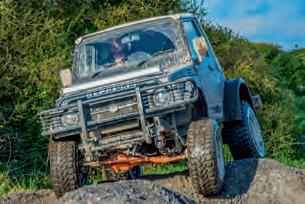
There was a time when almost every vehicle you saw at an offroad playday, if it wasn’t a Land Rover, would be a Suzuki SJ. The forerunner of the Jimny was a tough little thing, and it was unbelievably agile straight out of the box.
Time has taken its toll, however, and there aren’t as many SJs and Samurais around anymore. They rust, for one thing – and for another, an awful lot of those old playday toys have simply been beaten to death by now. But those you do still see around tend to be rock solid. Not a lot to look at, maybe, but when they last, they really last. And of


There aren’t too many Suzuki SJs around any more. But those that have made it this far are set to last forever


course they’re still absolute giant-killers off-road.
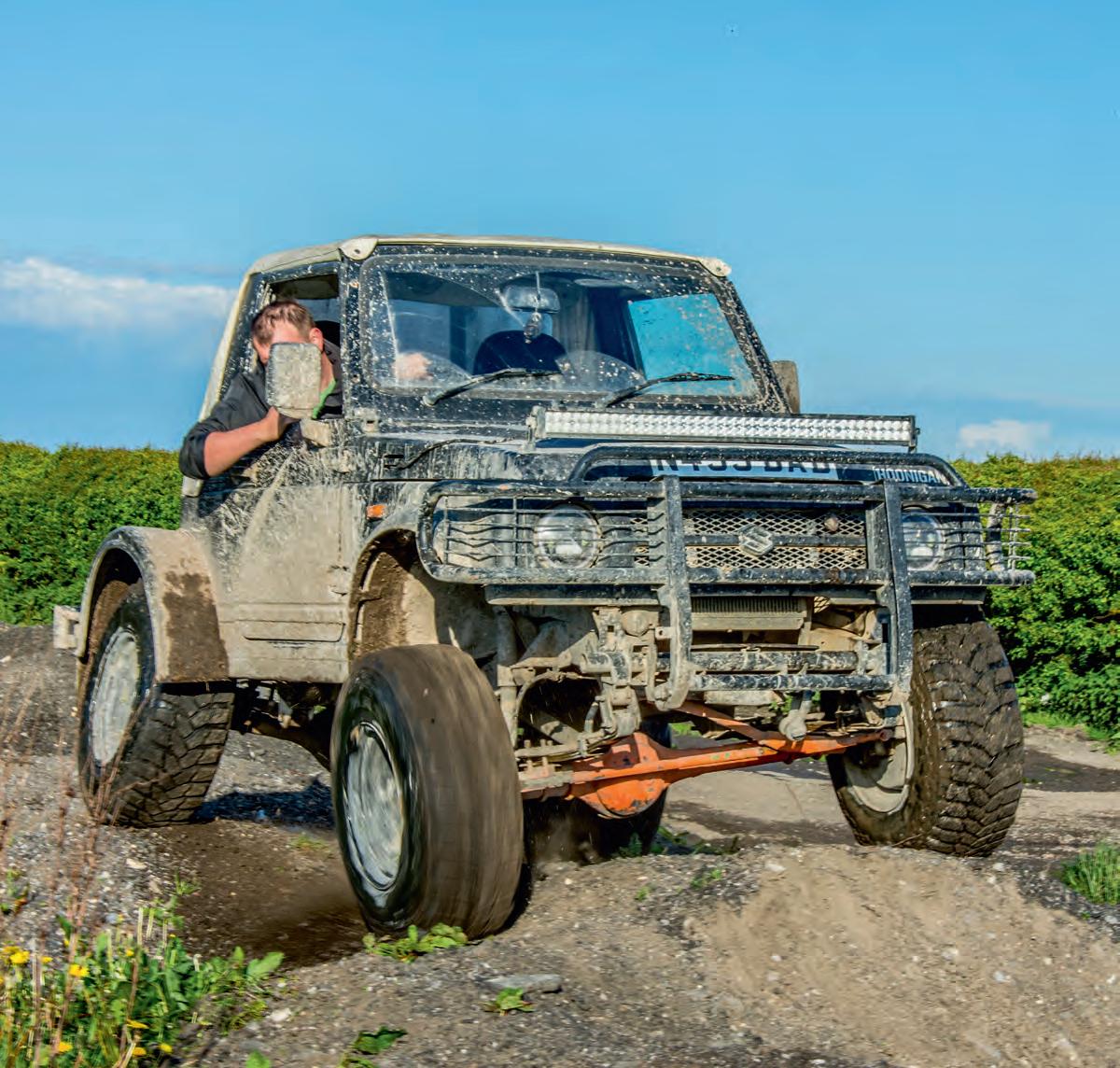
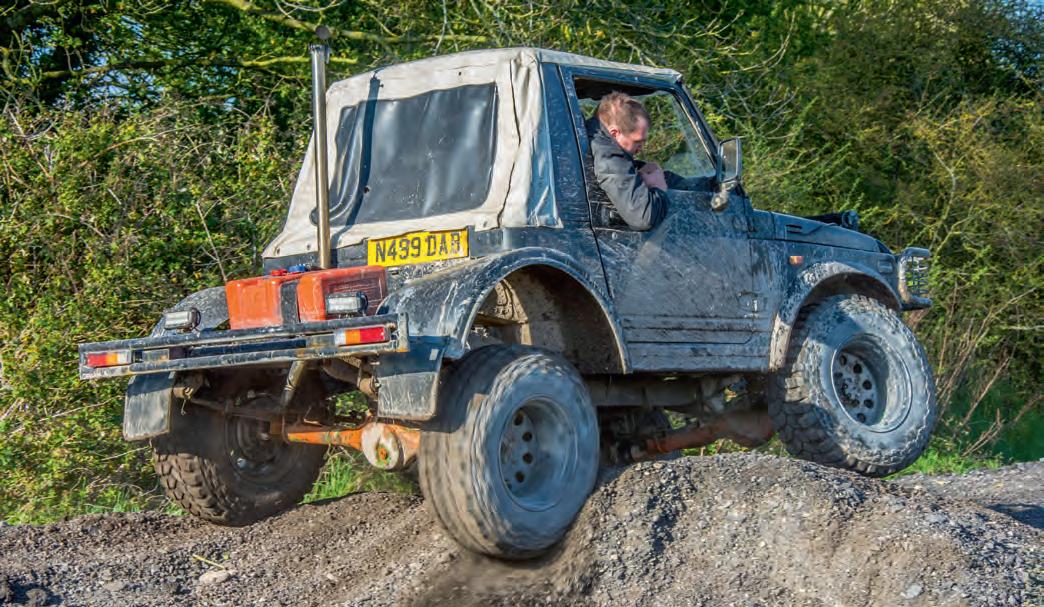
For evidence of the SJ’s longevity, look no further than the SJ413 Samurai Sport which Dave Pearson built for himself. It lived the first 13 years of its life on a farm, ‘most likely doing the work while the Defender was broken down.’
In this way, its early life mirrors that of Dave himself. ‘I grew up on a farm,’ he says, ‘playing in tractors. I must have done thousands of hours in the fields and yards for free. The idea someone would pay you to thrash tractors around never occurred to me at the time.’
That was then, though, and this is now. The SJ has seen plenty of life, but it’s still more original than it looks. Despite having had its body hacked about in every direction you can think of, it’s still sitting on the same chassis that rolled out of the factory when John Major was Prime Minister.
How hacked about are we talking? Well it’s been bobtailed and traybacked, with a new fuel tank where the back seats would have been and a custom rear bumper and crossmember fabricated out of steel tube. The rear arches are from a 7.5-tonne truck and there’s a (very) high-level exhaust pipe exiting behind a custom soft-top.
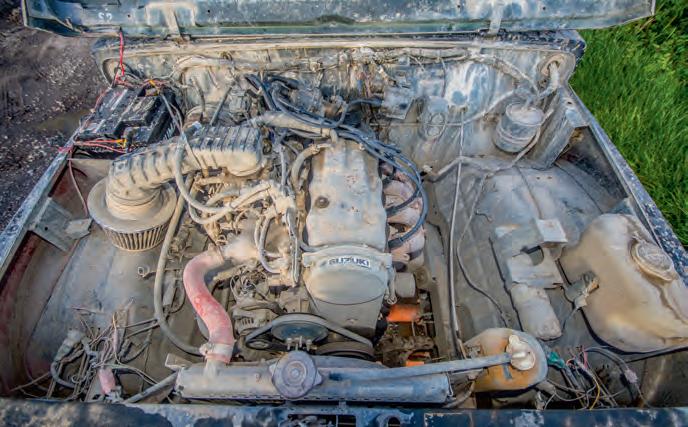
Above left: The latest chapter in the SJ’s life began half a decade ago, when this 1.6-litre Vitara engine went in. There are some cars now that are barely designed to last that long in total. The engine, which is mated to an SJ413 gearbox and SJ410 tranny, was treated to a new head gasket at the time of the instal –though now it’s due to come out again, with an Isuzu 1.7 diesel and Vauxhall Carlton box set to take over
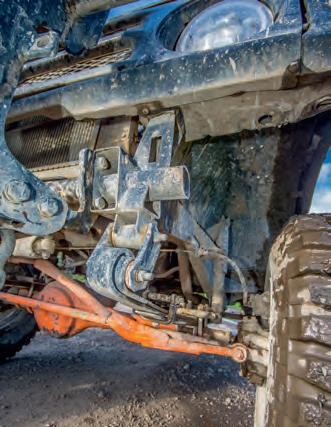
Above right: Spring-over-axle conversions get a lot of bad press, but Dave reckons this is one of the best mods he’s made. It’s been on the truck for eight years now and he says it’s always seen him right
Up front, the original arches have been cut and re-welded to achieve a virtual lift, and the sills have been remanufactured using 3mm steel box. So it’s lean, it’s strong – and Dave could fit bigger tyres under it without needing to go spring over axle.
So what did he do? He went spring over axle, obviously. Because while bigger tyres are good, even bigger tyres are better. And he rates it as one of the best things he’s done, too: ’Everyone badmouths this mod, but I’ve had it on there for eight years and never considered reversing it. Under-rated, under-appreciated!’
Between the virtual lift, a SPOA conversion and +2” leaf springs, the SJ has enough space under it to accommodate 31x10.50R15 Maxxis Trepadors on its 10Jx15R banded steel rims. These run on standard Samurai axles, whose mounts were re-welded to bring their pitch back in line following the suspension work. They’re turned by a 1.6-litre Vitara engine, which went in five years ago and spins the wheels via a standard clutch, SJ413 gearbox and SJ410 transfer box. The rear prop is mounted with a 20mm spacer and the brake lines have been extended, but that apart it all hangs together without having needed any major adaptations.
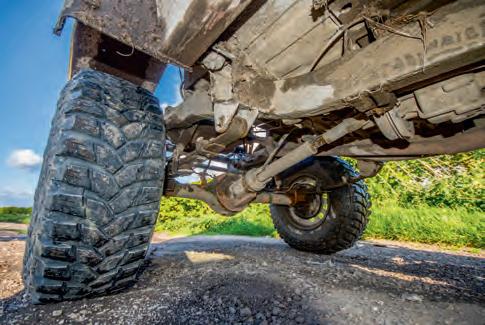
Talking of the brakes, however, those on the back axle have been converted to discs. So too has the handbrake on the transfer box, and an adjustable brake bias valve has been fitted. All good, sensible stuff; a Z-bar has replaced the original drag link to take care of the much greater drop on the steering, some earth cables have been remounted for a better connection and the head gasket was replaced when the engine went in, but hero-level mods are not what Dave is about. As he puts it, ‘I’m very much a home-grown make-do-and-mend kinda guy.’
Similarly, the interior is ‘easier on the pressure washing.’ Which means it’s been completely stripped out other than the dash
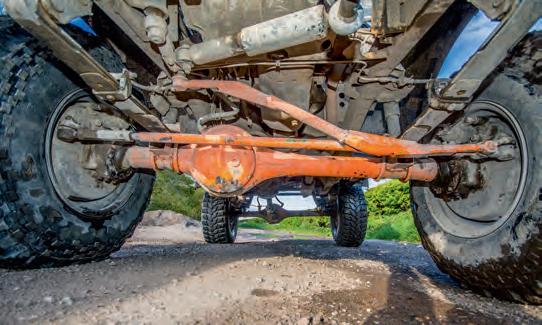
Above left: Replacement leaf springs with a +2” lift combine with the SPOA conversion and virtual lift to make was for 31” Trepadors. There’s a 20mm spacer in the rear prop and the sills have been replaced with steel box. Note also the disc brake conversion on the rear axle
Above right: All the extra space beneath the vehicle means the steering has to drop down a lot further to reach the axle line. Hence this Z-bar, which replaces the original drag link in a bid to eliminate bump steer and keep the ball joint angles within the realms of common sense
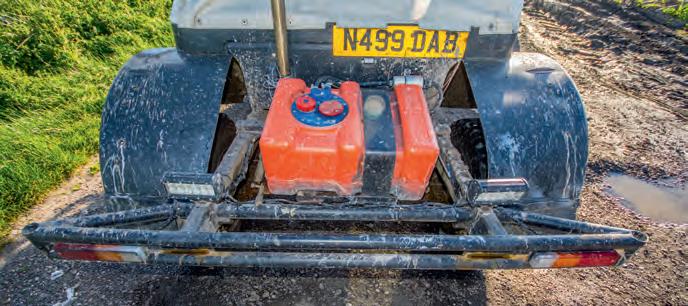
When the back body was removed, the chassis was cut down and finished off with a brutally strong tubular bumper-cum-crossember. The wheels were covered by arches from a 7.5-tonner and a new fuel tank was mounted above the main rails
and fitted with a couple of generic bucket seats. And both ends carry shackle winch mounts, because there’s no need to shell out grand after grand on fancy kit.
Having said that, Dave tells us that a proper winch bumper is on his list. So too is a diesel conversion ‘to help with the swimming’, using the tried and trusted combination of a 1.7-litre Isuzu engine and Vauxhall Carlton gearbox.
That apart, Dave’s main plan for the future is ‘to cause yet more mayhem.’ Sounds like there might be a story in that… Sure enough, there is. ‘Where we play, there’s a track either side of a small lake.
It was a hot day. A Vitara to one side, a Shogun to the other. I ploughed through a tree and nailed it into the lake. I displaced so much water that the Vitara, which was four feet higher, had two feet of water in it.
‘The owner was so impressed with the execution, he wasn’t even upset. The four guys looked like wet dogs and smelt about the same. Also, the Vitara was a convertible and the wave broke through the canvas roof.’ Told you it was a play truck…
And as always with the best off-road projects, it’s a social thing. Even if Dave sometimes keeps unsocial hours. ‘Quite often it’s a 2am job. You start at 8pm and then next thing you know its the small hours and it’s still in bits. Those are great nights!’
‘The thank-you list would be too long to include. With the number of people who’ve helped me out with the vehicle, it would be endless. Everyone loves the SJ, and they rope themselves into it. Honest! I have never paid for an entire job in ten years.
‘That being said, I do a lot of maintenance myself. It’s a hobby and a girlfriend.’ Crikey. What would he have done differently? ‘I would have never met any of my exgirlfriends, and spent more time on the SJ. It’s always a great day out. Even when you break down during a live firing event at the tank range on Salisbury Plain.’ Again, crikey.
He’s not one to be troubled by the small stuff, though, is Dave. Though he certainly is one to embrace opportunities. Like the SJ itself – which started out as just a lift kit and new clutch but ended up turning into a monster
‘You never intend these things,’ he shrugs. ‘The best days of your life are never planned.’ Which sounds very sanguine, and which could indeed be a good reflection on the way the Suzuki SJ as a model started out as a cheap, fun little motor and ended up as the 4x4 that broke Land Rover drivers’ hearts in a thousand RTV trials. The time when you saw them all over the place has passed – but those that are still around are set to be here forever. And this is a perfect example of that.











Many people dream of turning an old 4x4 into an expedition truck and going off to see the world. Doing it in a brand new one, on the other hand – that really is living the dream

Being able to cut up a brand new vehicle is a luxury most of us can only dream of. But back in 2013, when it was just a few months old, James Wright’s Defender 110 went under the knife and became the sort of Land Rover which, well, most of us can only dream of.
The skilled surgeons were the team at Ex-Tec, a German company which specialises in expedition prep – and, in particular, pop-top conversions for
Words Tom Alderney Pictures James Wright

Defenders. That’s conversions plural, because it has a range; the 110, which is a 2.2 TDCi Hard-Top, was treated to its SpaceTec system with View-Tent sides, giving it awning windows all round.
This was done at the behest of the truck’s first owner, but when James saw it for sale it was ideal for what he had in mind. Between him and his wife, they’ve been the second and third names on the logbook –switching it between them was a handy

trick to make life easier on the carnet de passage front while travelling, which they spent a year doing in Africa before taking the 110 back to Ex-Tec in 2025 for a general spruce up.
This involved replacing the sides with new ones as well as adding blackout blinds, thermal sheets and mosquito nets. At the same time, Ex-Tec also installed folding seats for the camper compartment in the back of the vehicle.
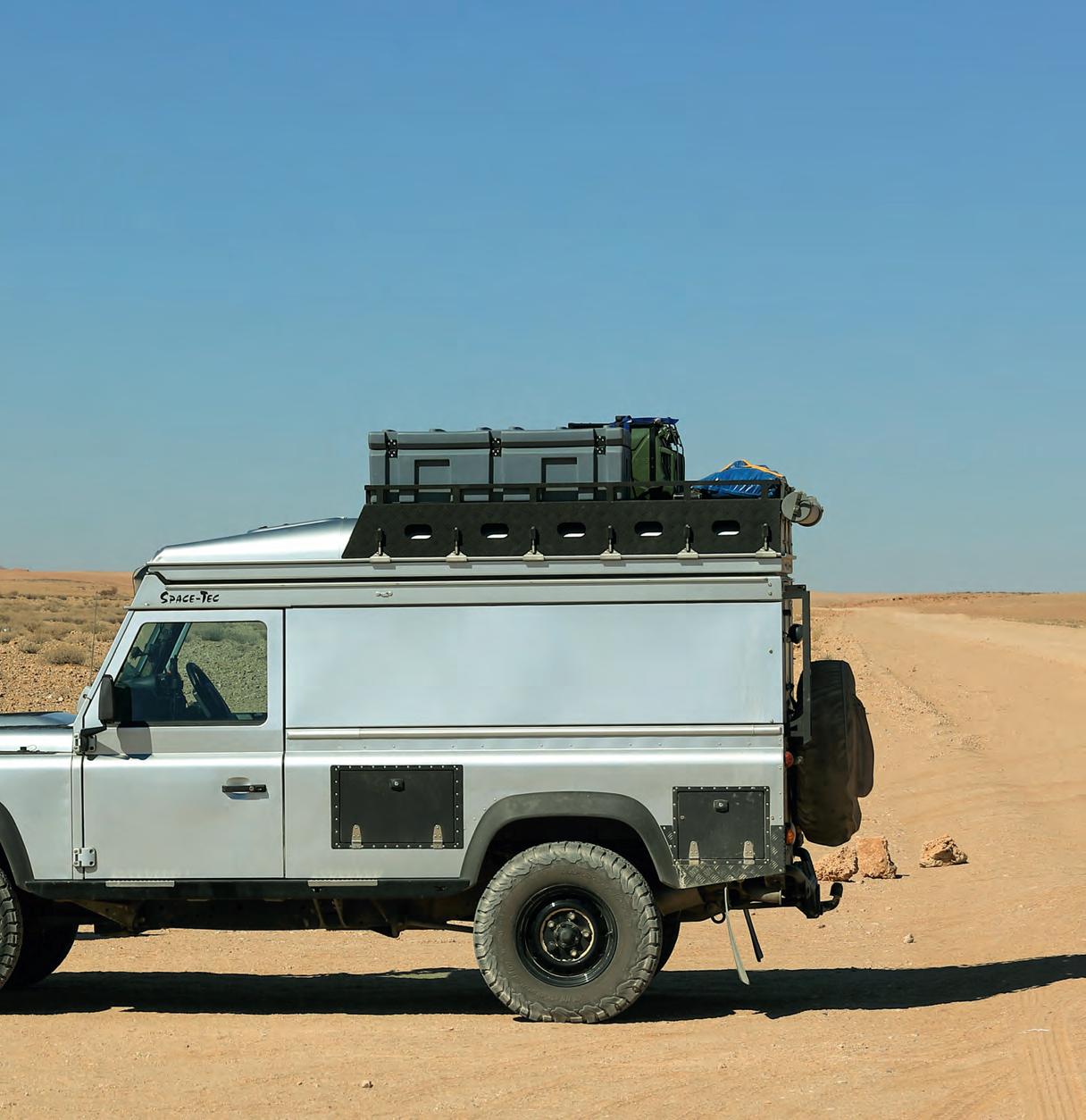

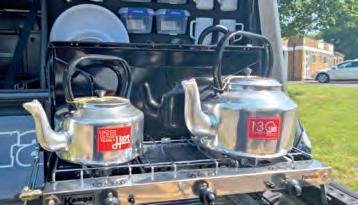
That’s on top of the kit it got first time round, which is nothing if not comprehensive. The vehicle is equipped with a 35-litre Engel fridge, pressurised 80-litre freshwater tank with heating, sink, chemical toilet and Webasto diesel heater. A full set of Ex-Tec’s own aluminium and marine ply cabinets is installed, along with an air-compressor and 10-litre tank, and a rear tent allows for cooking in the rain. Up top, an expedition roof rack can



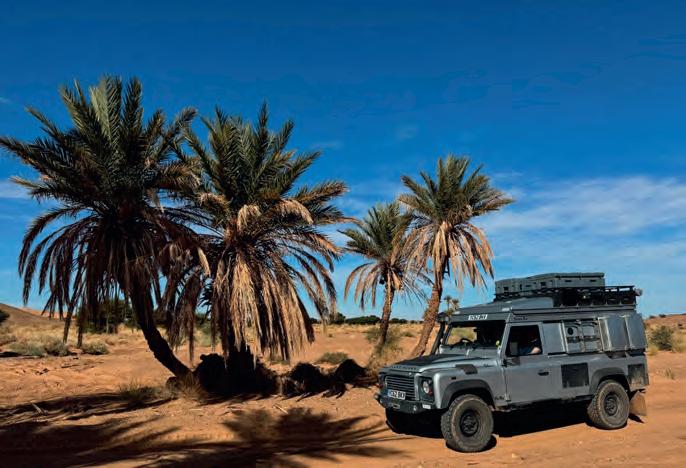

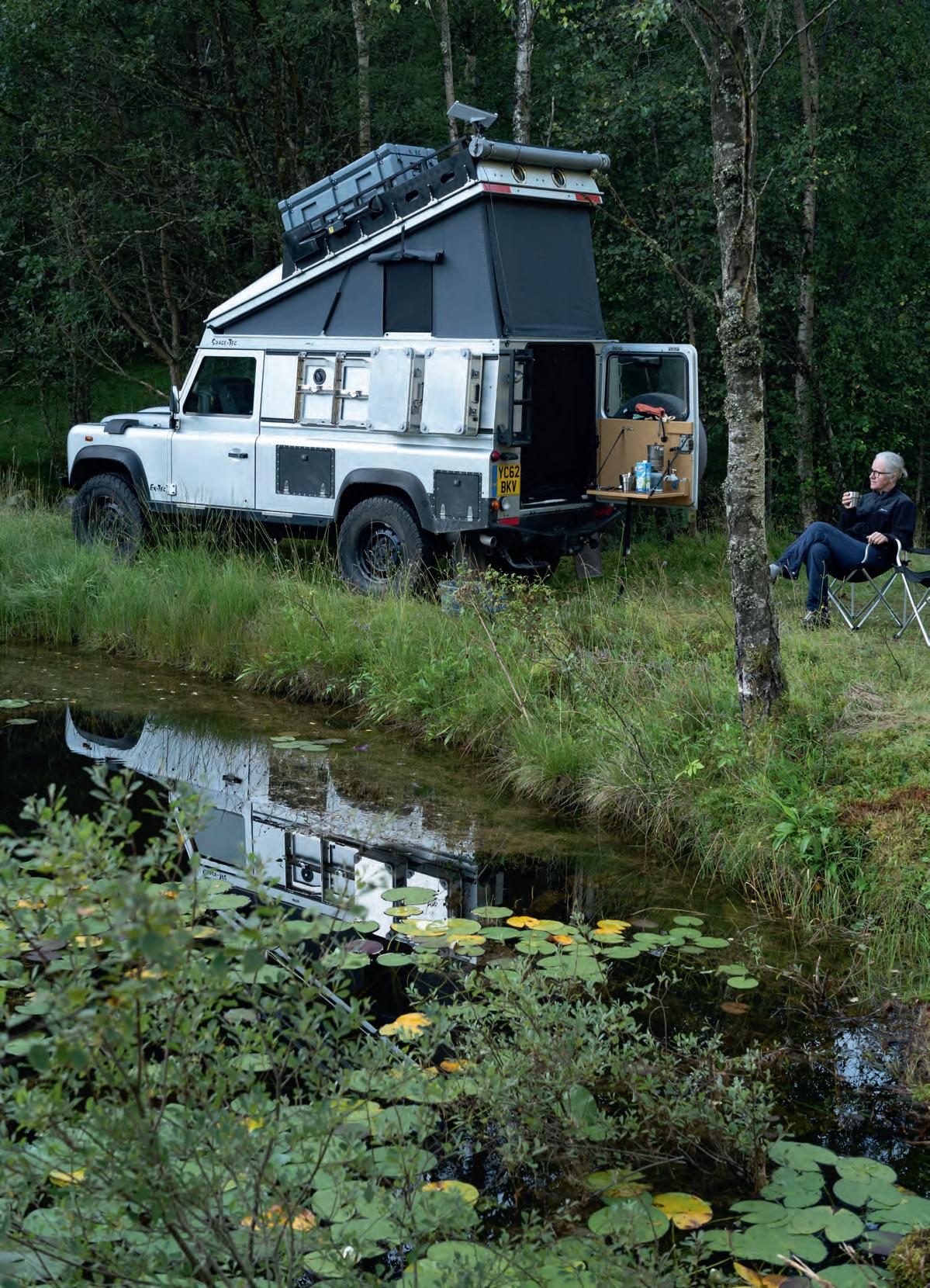

accommodate two roof boxes, two jerry cans, a second spare wheel and wood for the camp fire, and this also supports dual side awnings.
Enough to be going on with? You might think, but the vehicle also carries a SunWare solar system, with a portable panel to get best angle on the sun’s rays, a Gild hot water shower drawing heat from the engine, seven




different USB outputs, Zarges aluminium side stowage boxes and, including those on the roof rack, a total of five jerry can mountings – bringing the vehicle’s total range up to more than 1000 miles.
These come on top of a twin-tank system which mates the standard unit to a 45-litre flow-through auxiliary with a Hardi drain pump. That puts 120 litres on Hardi drain pump. That puts 120 litres on


board, with the five jerries offering another 100 between them. Probably best not to calculate what they’d all cost to fill up in Britain at the moment…
In terms of upgrades to the vehicle as an off-roader, as is usually the case with good expedition vehicles these are about robustness and protection rather than increasing its ability. The suspension, for









• Escape Gear
• ...and many more!


• Aluminium canopies
• Roof tents and roof racks



• Off-road fridges and 12v gear
• Drawer systems and slides







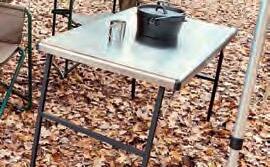


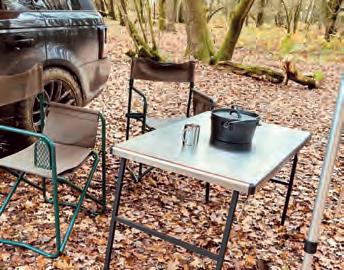

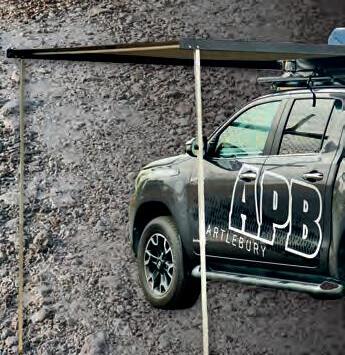


• Bumpers, side steps and vehicle protection
• Campsite essentials, tables and chairs



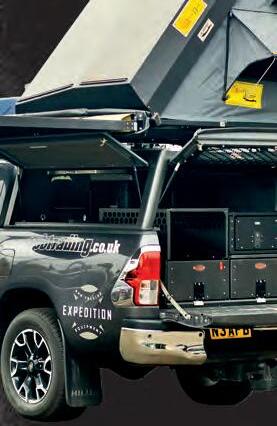
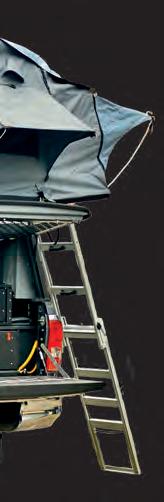











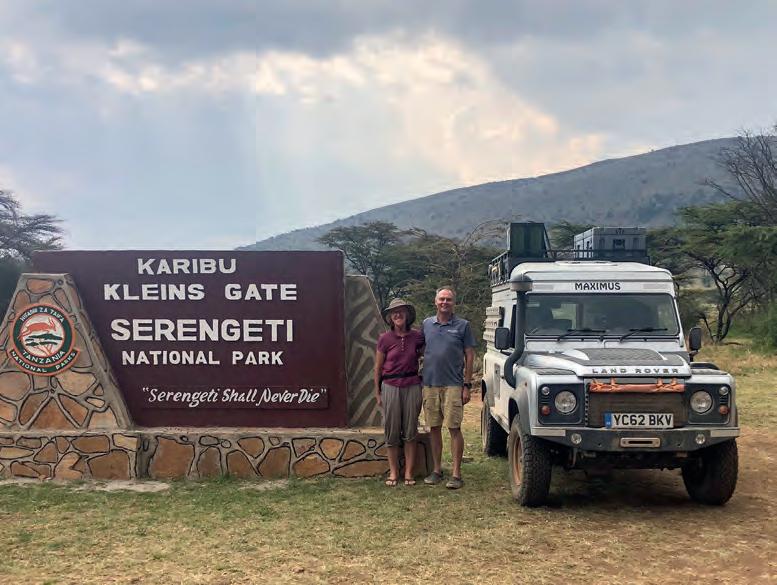
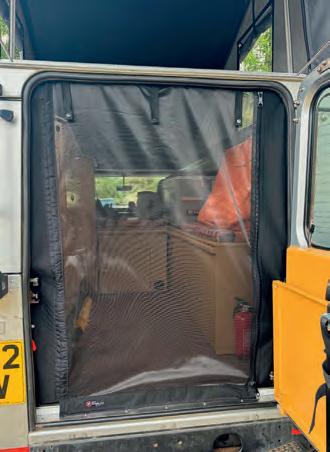
“James and his wife have been the second and third names on the logbook – switching it between them was a handy trick to make life easier on the carnet de passage”
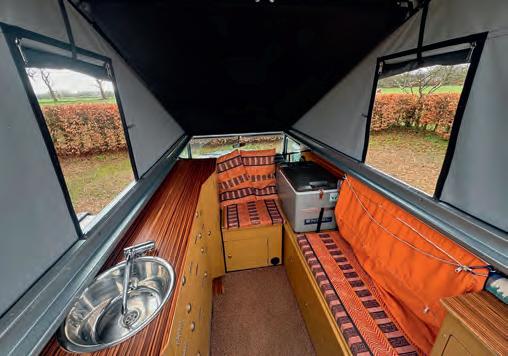
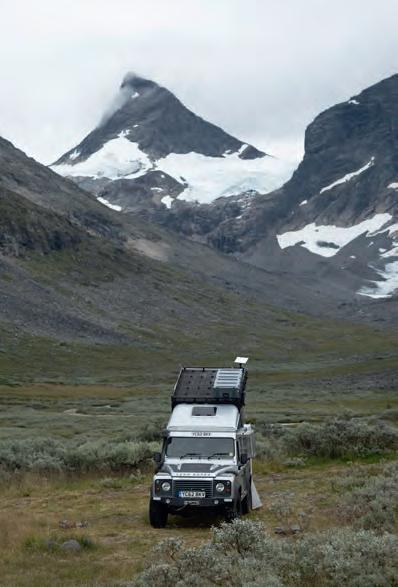
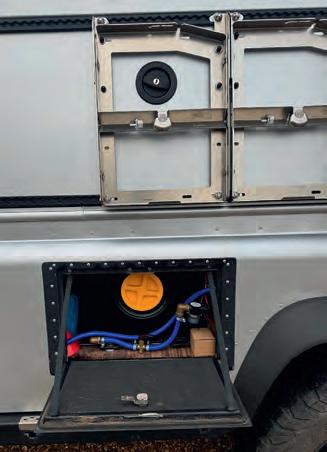
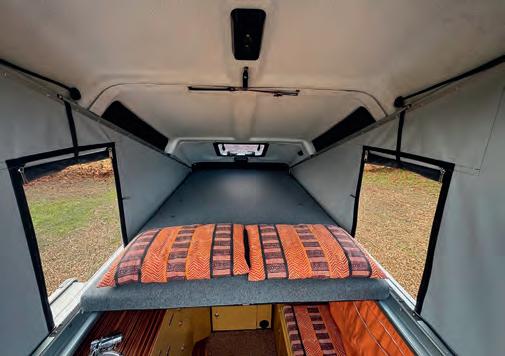
example, has been upgraded using heavyduty front and rear shocks, as well as rear springs; it’s not about adding height and all about shrugging off the punishment of overland life. Similarly, the clutch has been upgraded to a heavy-duty version and an Ashcroft intermediate shaft has been installed in the transfer box as a permanent solution for output shaft wear.
General protection comes from underbody bash plates, rock sliders and an Ex-Tec custom bumper, the latter mounting a Warn winch and a set of spotlights. Ex-Tec was also responsible for the snorkel, which is topped off with a cyclone pre-filter whose plexiglass insert was renewed in 2025. Land Rover’s factory air-con was specced from new, which is obviously a bonus, and the electrical system is enhanced with dual Optimas with jump start access and kill switches for shipping. Down below, a set of BFGoodrich All-Terrain tyres is mounted on Wolf rims – strength and longevity once again to the fore there.
Despite having been around a good chunk of the world, to date he 110 has still only covered 66,600 miles in its 14 years on Earth. So, while most of us would probably sooner do it in a Tdi than a Puma, there’s clearly no end of potential there for it to
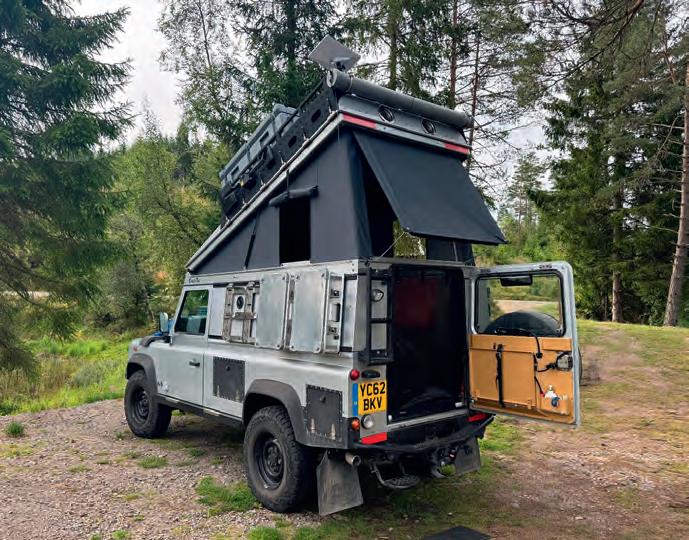
get out and go round the world a whole lot more. It won’t be doing it in James’ hands, however, as he’s after something bigger and has put it up for sale, but a legacy of his travels in Africa is that it’s going to come with ‘petrol stoves and spares, water filtration system, four jerry cans, spare tyre mount, BBQ grate… all the equipment you need to drive off around the world.’
Including, would you believe, a Nanocom ECU reader for monitoring engine and security issues. We’re definitely not in Series
IIA territory any more… but then, as we were saying, being able to cut up a brand new vehicle is a luxury most of us can only dream of. Though with James’ 110 on the market, one phone call could be enough to turn the dream into real life.
The 110 is currently for sale, with an asking price of £58,000. It’s based in Berkhamsted, near Watford; if you’re interested in buying it, email us at editorial@pistonpublications. co.uk and we’ll pass it on
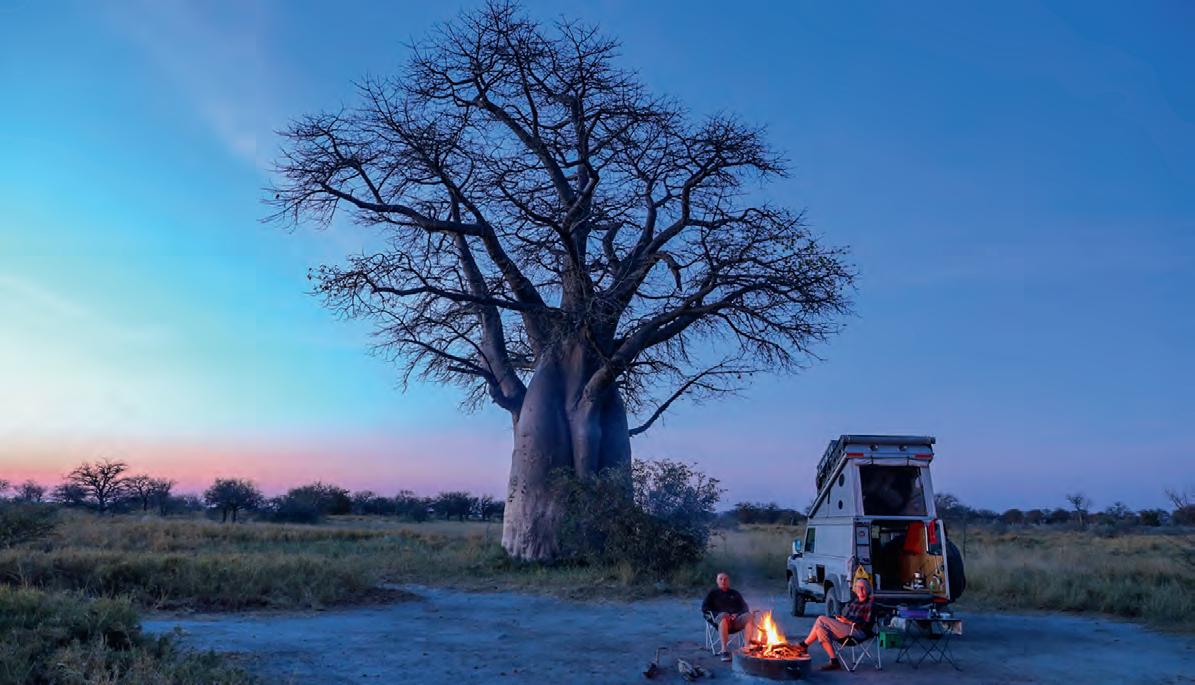


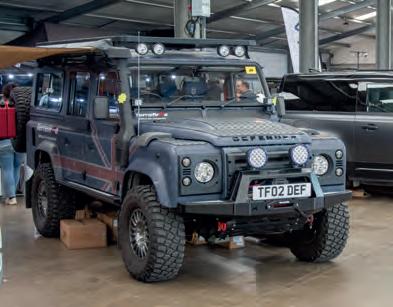

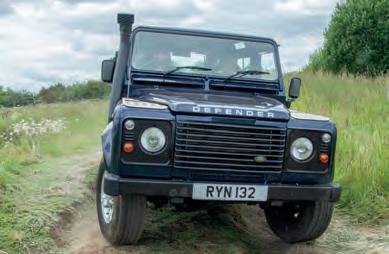
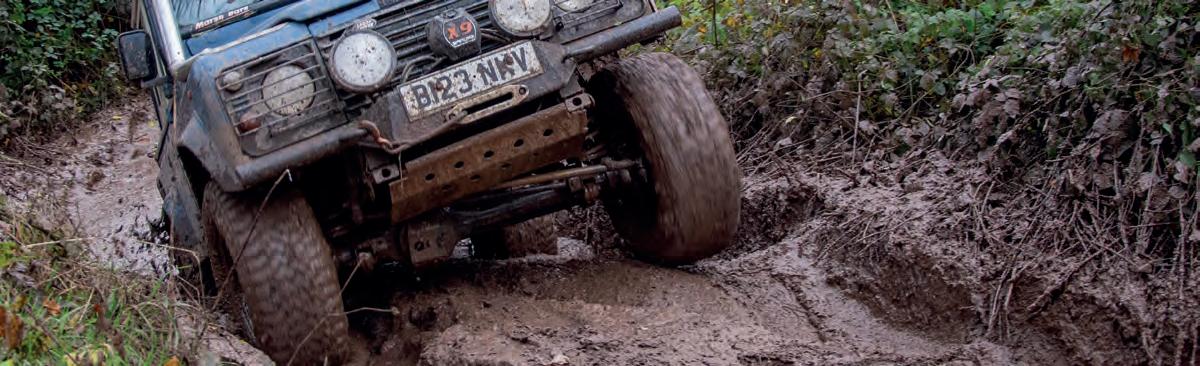




Land Rovers are returning to Newark Showground this August!
Exhibitors old and new will join us, selling everything from parts & accessories to tyres, clothing and toys. Talk to overland adventure specialists about your next trip, discuss modification options with companies with the know-how and other experienced Land Rover owners.
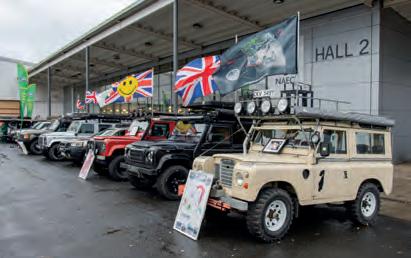
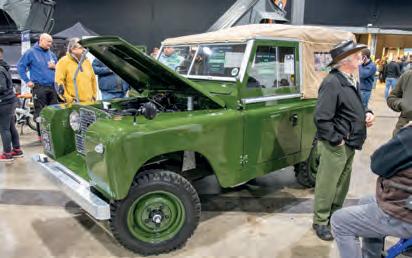
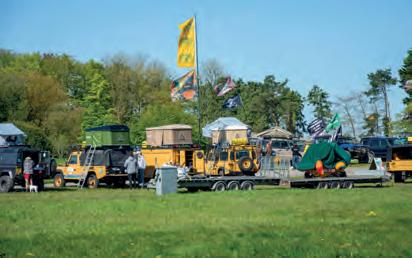
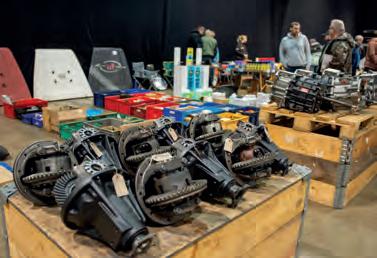
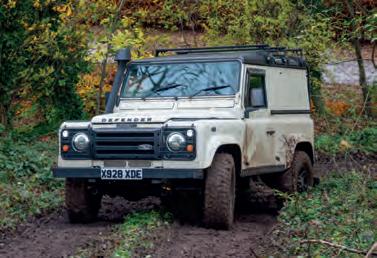
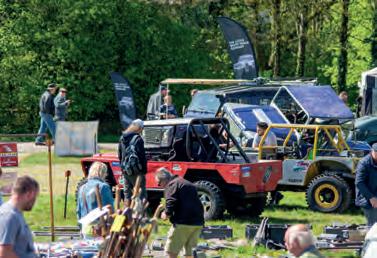
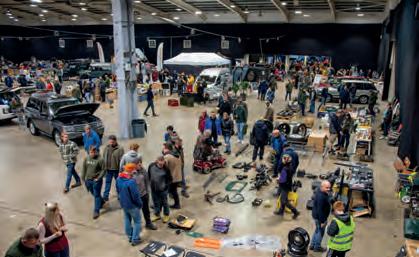
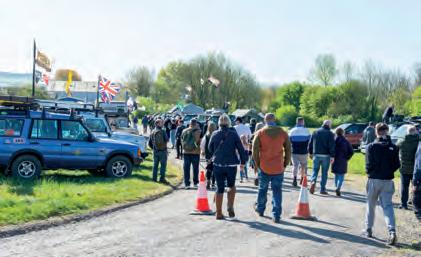
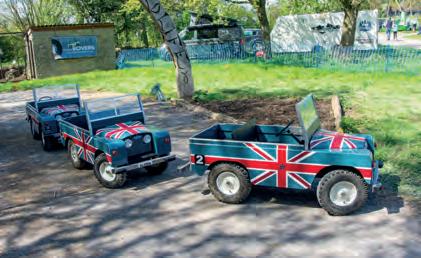
Our roadbooks guide you through the countryside on a mixture of surfaced and unsurfaced roads. The tracks we use are public rights of way, either Byways Open to All Traffic or Unclassified County Roads, all commonly referred to as green lanes.

We’ve deliberately made it as easy as possible to follow the route, using a mixture of instructions, tulip diagrams and grid references. We normally only include junctions at which you have to make a turning or don’t have right of way, so stay on the main road or continue straight ahead unless we tell you otherwise.
Elsewhere, let common sense and courtesy prevail. Keep your speed down, be ready to pull over for others and show the world that we are decent people just like them.
Anti-4x4 bigotry does exist, but it’s less common than you’d think. By and large, it’s limited to organisations which just want to get the countryside all to themselves.

You’ll find a guide to using grid references on the legend of any OS map. Our aim is for you to be able to do the route without maps, whether paper or online, but you should certainly take a set with you.




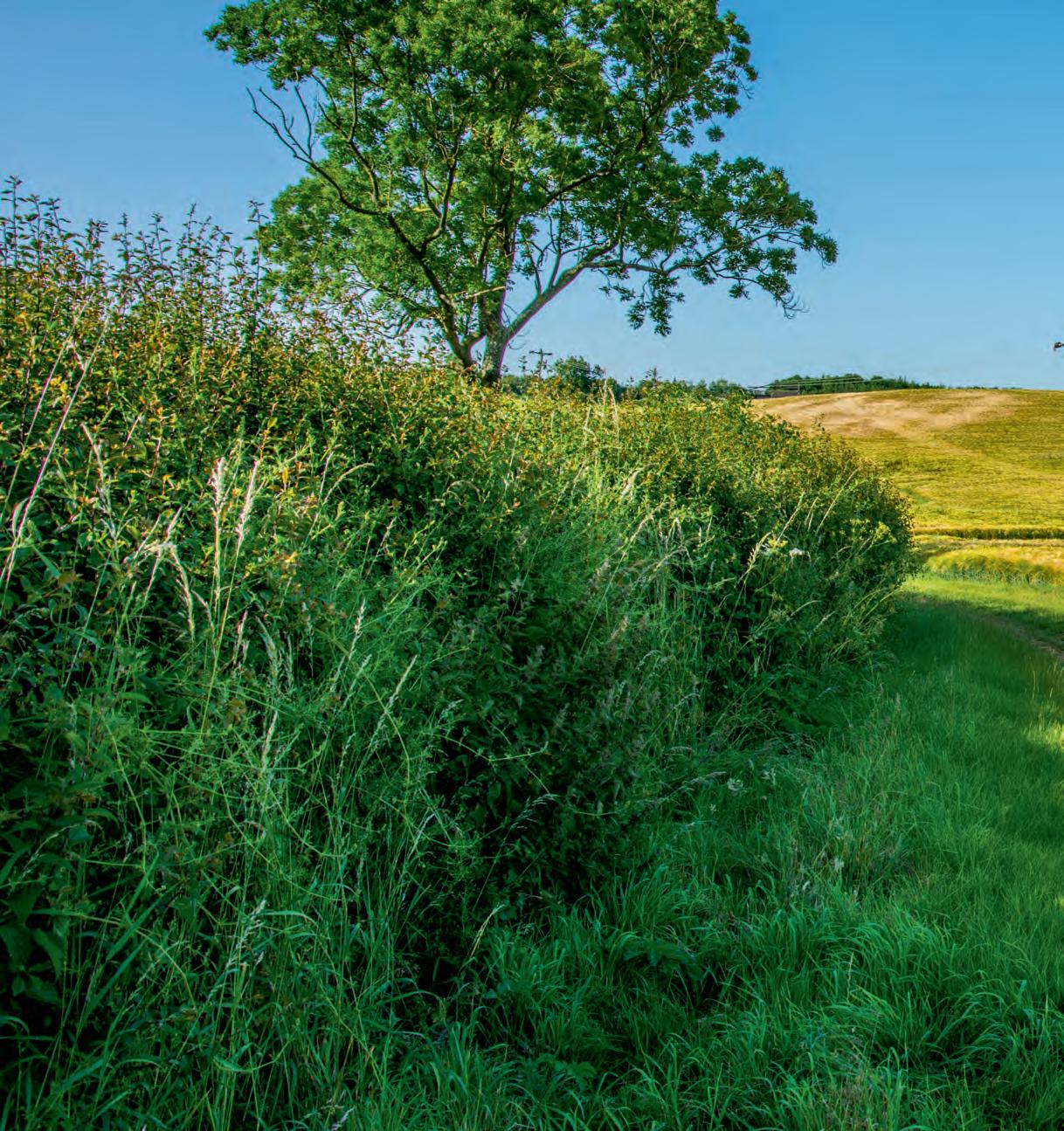
These organisations are beyond being reasoned with, but it’s rare to encounter real hostility even from their rank-and-file members. If you’re friendly towards the people with whom you share the countryside, the vast majority will respond in kind. There are always bad apples, but no more so than anywhere else.

Likewise, most local residents will accept your presence if you’re driving sensibly. What suspicion you do encounter is likely to be from farmers worried that you’re there to steal from them, so be ready to offer a word of reassurance. Once satisfied that you’re not after their quad bikes, their mood will lighten.

The notes on thee pages advise you of how suitable the route is for your vehicle. These are just guidelines, however. We’ll warn you of any hazards or difficult sections, but the nature of any green lane can change quickly. Wet weather can make a huge difference to the conditions underfoot, and what’s wide open in winter can be tightly enclosed and scratchy in summer. The responsibility is yours! Our roadbooks are designed to be safe to drive in a solo vehicle. We do recommend travelling in tandem wherever possible, however. The risk of getting stuck can be greater than it appears – and even the most capable of vehicles can break down miles from anywhere.
• Keep your speed right down
• Pull over to let walkers, bikers and horse riders pass
• Leave gates as you found them
• Scrupulously obey all closure and voluntary restraint notices
• Ensure you have a right to be there. We research the routes on our roadbooks very carefully, but the status of any route can change without notice


• Be prepared to turn back if the route is blocked, even illegally
• If you find an illegal obstruction, notify the local authority
Irresponsible driving is a big and serious issue on green lanes. In particular, you must always stay on the right of way. Never drive off it to ‘play’ on the verges or surrounding land, even if you can see that someone else has; doing so is illegal and can be tremendously damaging.
• Stick scrupulously to the right of way
• Always remember that you are an ambassador for all 4x4 drivers
DON’T…


This kind of illegal off-roading is a key reason why green lanes get closed. If you see others doing this, they are NOT your friends. They’re criminals, and you are their victim. If it’s safe to do so, film them in the act and pass it to the police.
• Go in large convoys: instead, split into smaller groups
• Drop litter. Why not carry a bin bag pick up other people’s instead?

• Go back to drive the fun bits, such as mud or fords, again
• Cause a noise nuisance, particularly after dark
• Get riled up if someone challenges you. Be firm but polite, stay calm and don’t let them turn it into a fight



The area where Northamptonshire, Leicestershire and Warwickshire meet is a gently rolling area of mixed farming and quaint villages. It’s criss-crossed by a network of byways and unsurfaced roads, most of which are suitable for any 4x4 with decent ground clearance, and despite the lack of proper hills there are some great views to be had as you explore. This route is only usable between 1 May and 30 September, however, due to the widespread use of seasonal closures which, heavy-handed though it may seem, has helped keep some quite sensitive lanes in a good, driveable condition

NB Due to seasonal closures, this route can only be used between 1 May and 30 September
START Walcote (SP 567 836)
FINISH Napton on the Hill (SP 646 618)
HOW LONG? 57.7 miles / 5-6 hours
TERRAIN Gently rolling woods and farmland
HAZARDS Farm vehicles; Occasional mild ruts; Low traction when wet
OS MAPS
Landranger 140 (Leicester)
Landranger 141 (Kettering and Corby)
Landranger 151 (Stratford-upon-Avon)

IS IT SUITABLE?
TYRES

All-terrain pattern likely to help. Not ideal on low-profile tyres
WEATHER Avoid when very wet
LOW BOX Not required
SOFT- ROADERS Mainly suitable, but not without recovery to hand
SCRATCHING Infrequent and mainly mild


1


DRIVING Important to pick the right line in places. Some tricky navigation. Millions of gates to open DAMAGE No need for it to happen



















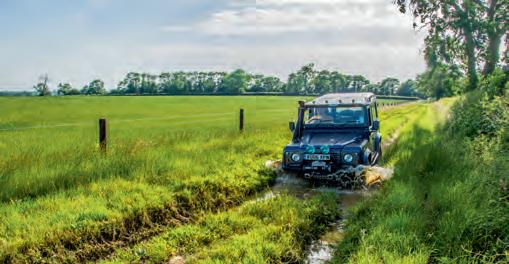














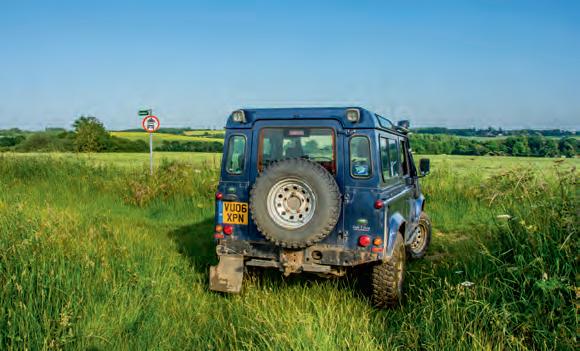

Caution – as you go from one field to the next, you cross a very narrow bridge over a deep culvert. There are no barriers, nor any sign of the hazard until you’re right on top of it


















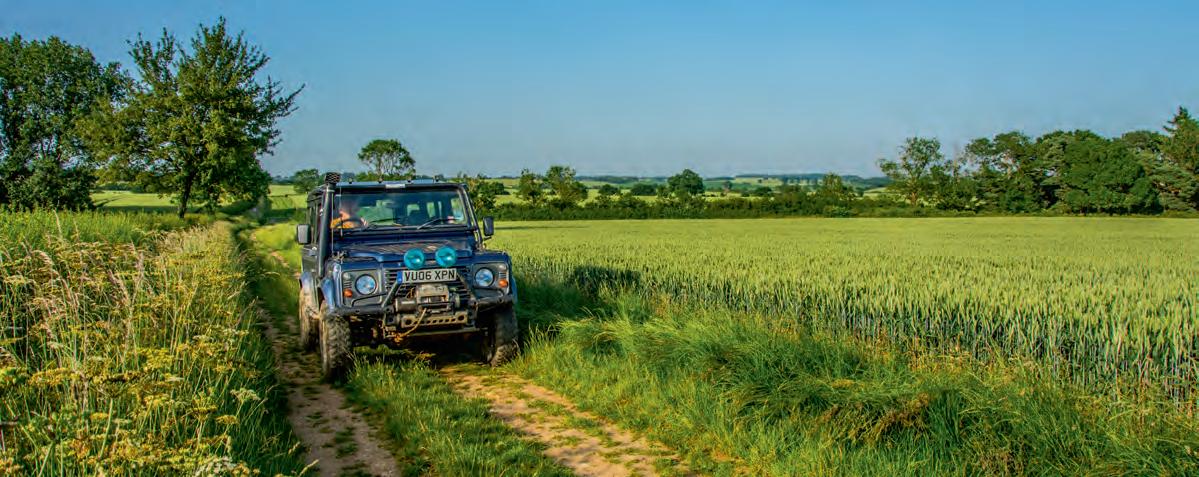
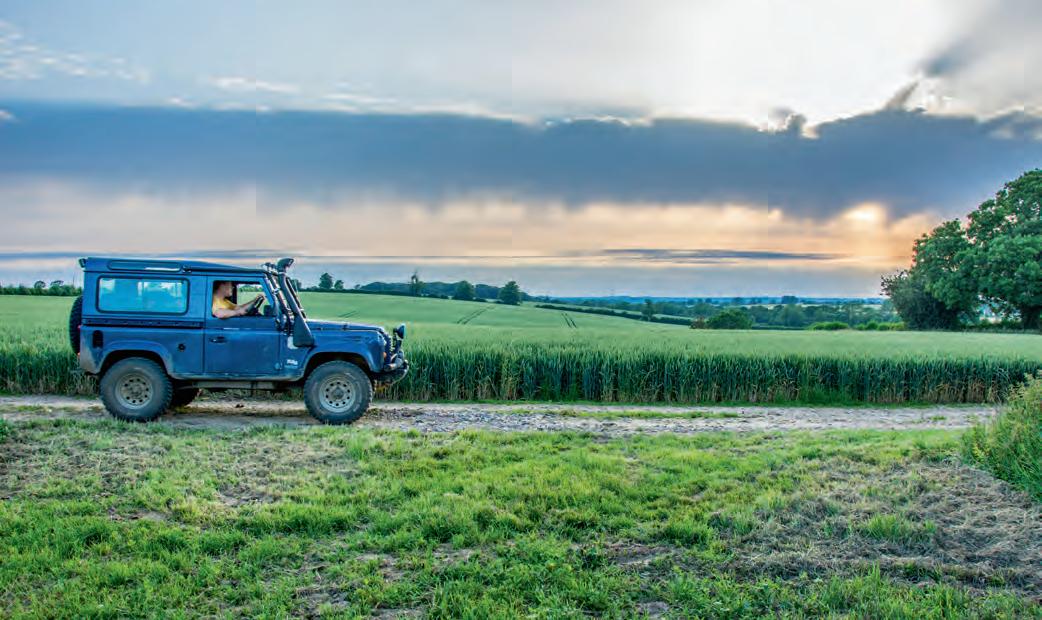



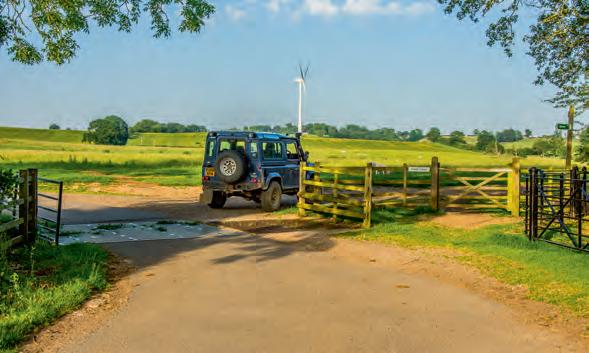
















Extreme caution – this is a pig of a junction on a very busy main road. If you’re going in convoy, you’ll need to take it one by one and regroup when you reach Step 62. Turn right on the A5 then immediately left again for Clifton under Dunsmore
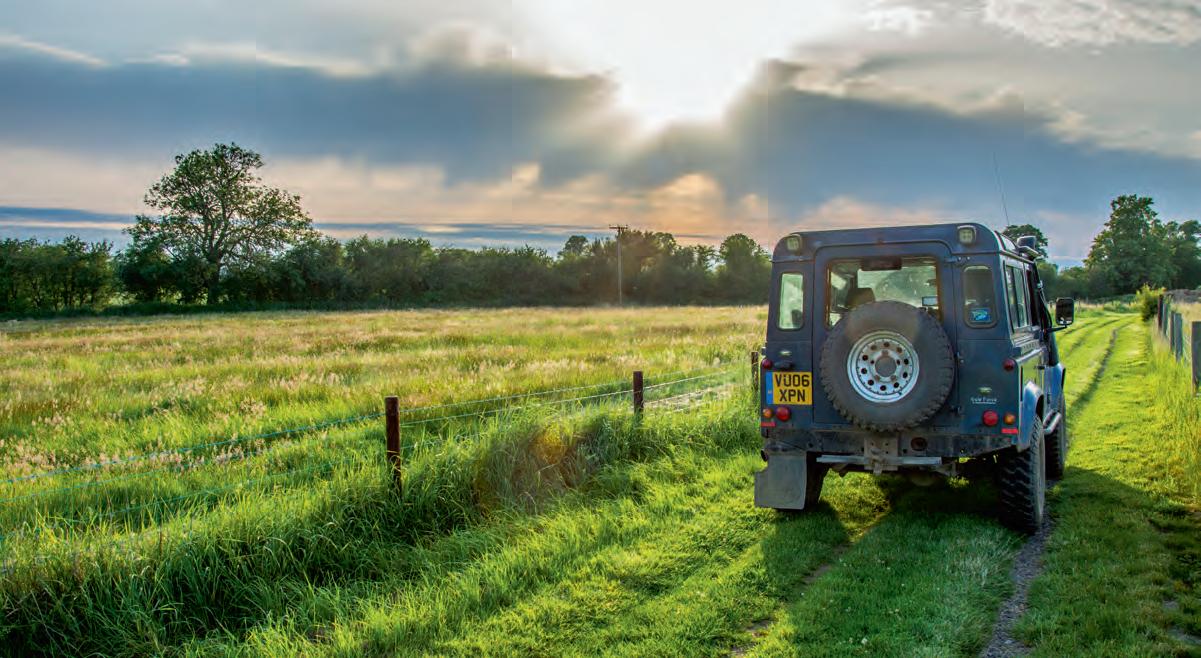


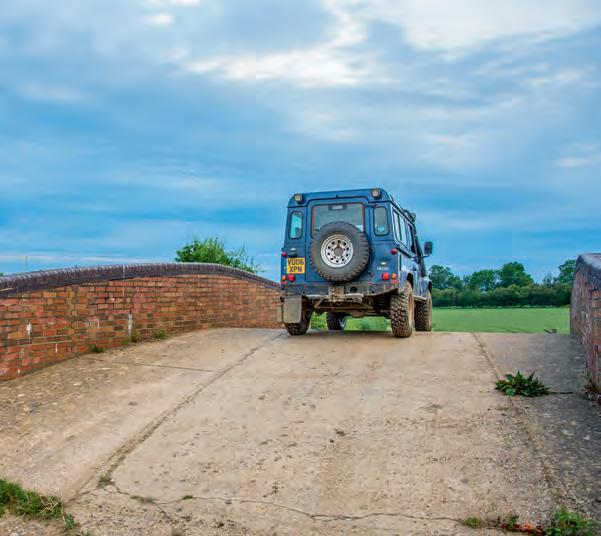






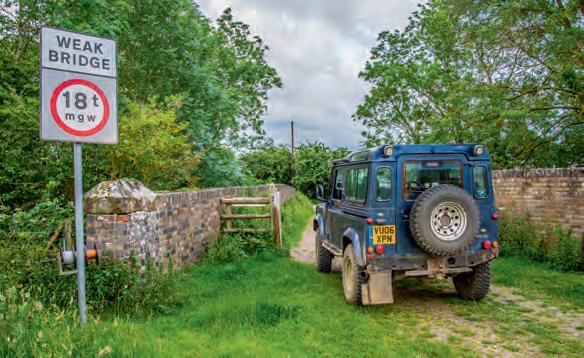
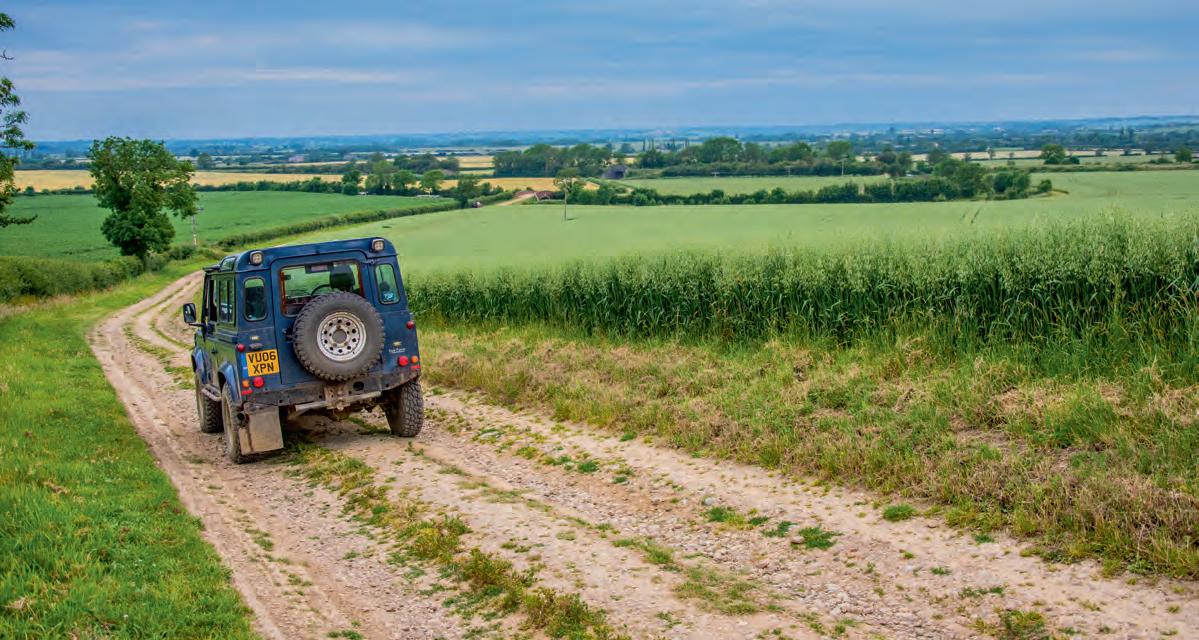







Shuckburgh
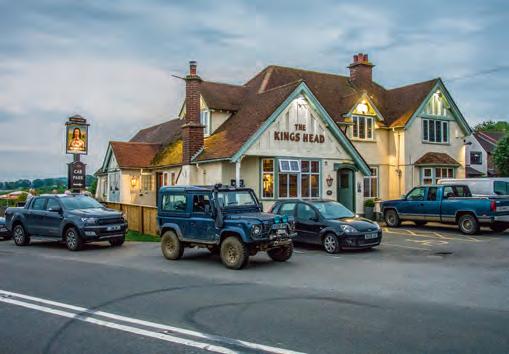





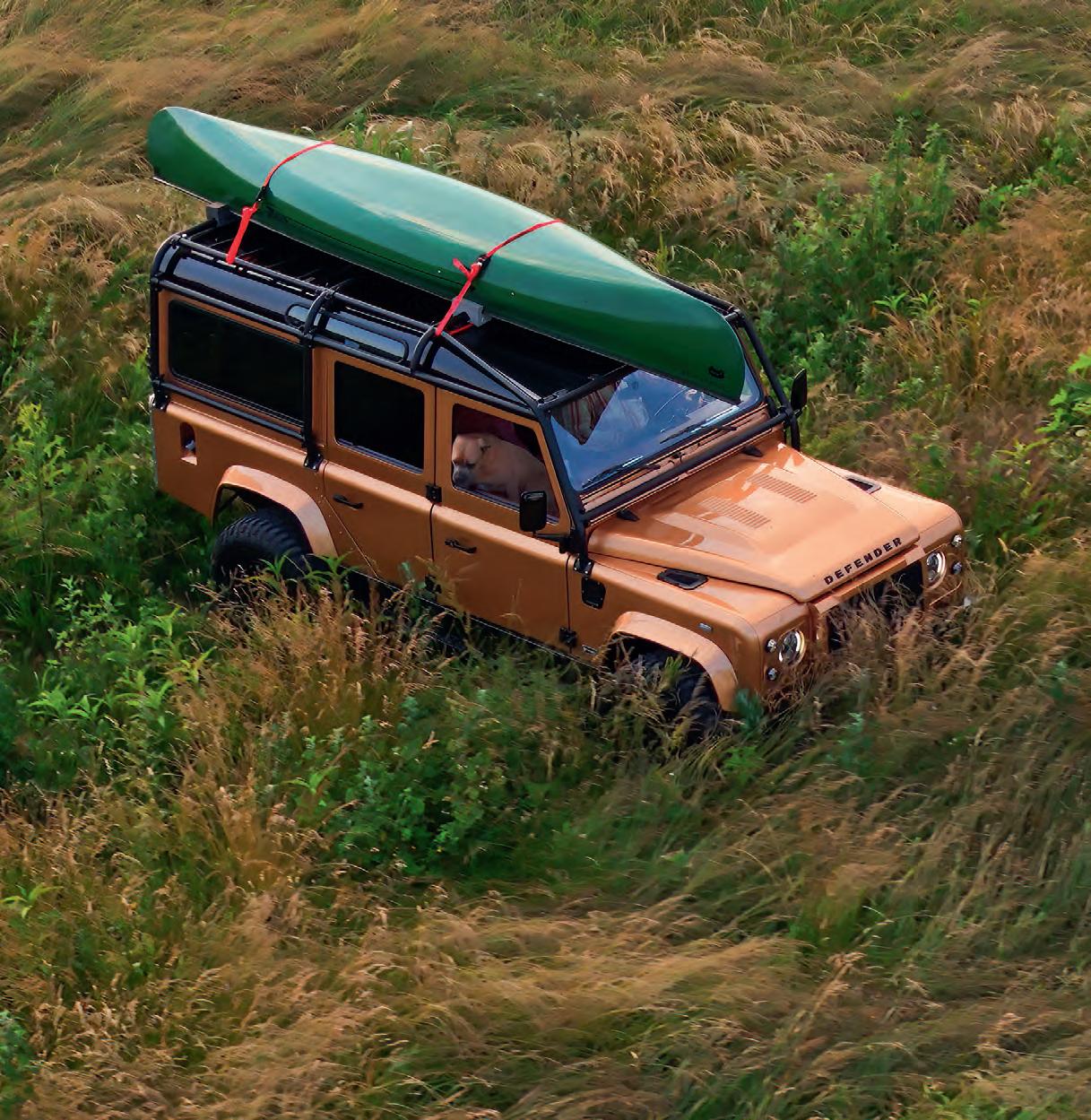

Helderburg’s stunning remanufactured Land Rover.
Don’t know about gold but you’d sure need a lot of brass…
Driven: Porsche’s petrol powered Cayenne


Jeep Wrangler Anvil 715: Retro, modern and cool Green lane roadbook at the top end of England
JULY 2026 ISSUE: ON SALE 4 JUNE


































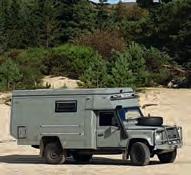

Kent Heritage Works introduces The Admiral – a 1976 Series III rebuilt as a unique best-of-everything classic


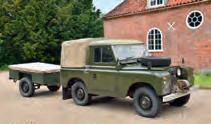




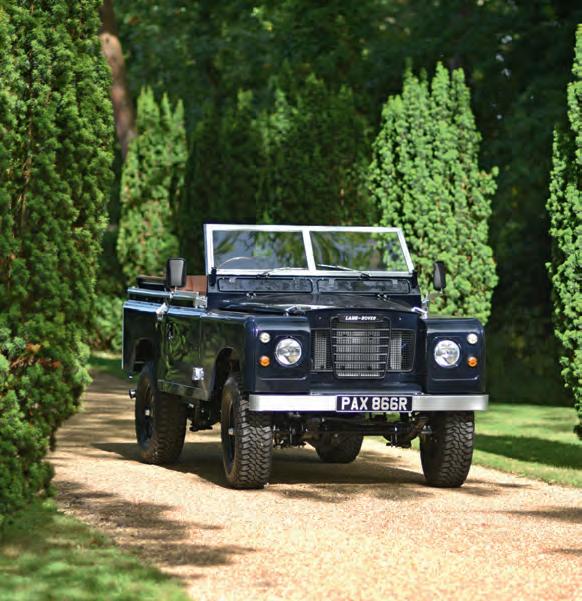
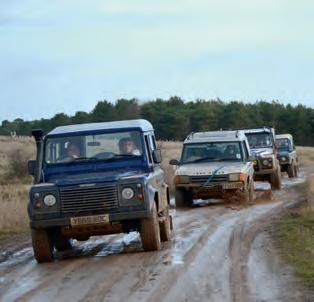


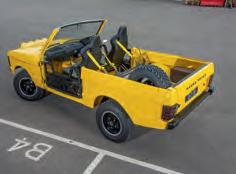




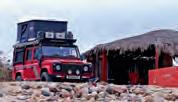


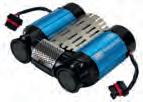


Remember the good old days, when magazines were big and thick and there was loads and loads of great stuff in them to keep you reading for hours? Remember when there were no fake pictures… no AI nonsense… no comments sections full of people ranting at each other about VAR, small boats and which toilet you should use if you’re transsexual?
Well, the 2026 Land Rover Yearbook is a good old magazine, just like they used to be back then. It’s 132 pages long, printed on good quality paper and packed full of great stuff to read. It’s a compilation of the best stories from the last year and in some cases beyond – great vehicle builds in detail, overland expeditions to dream of, a huge 10-page products round-up and the news from behind the news coming out of the factory and around the Land Rover scene.
The 2026 Land Rover Yearbook makes a perfect Christmas present for the Land Rover fan in your life – especially if that Land Rover fan is yourself! It’s a great read – all year round!





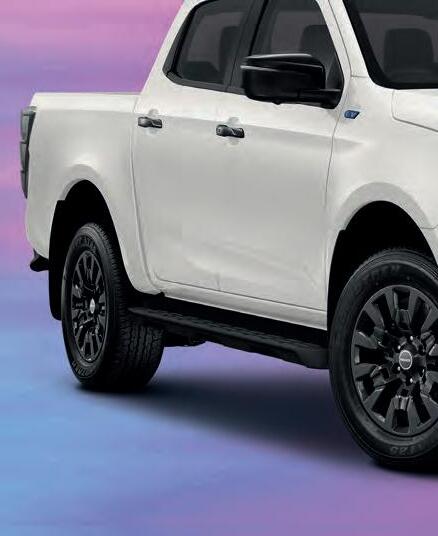










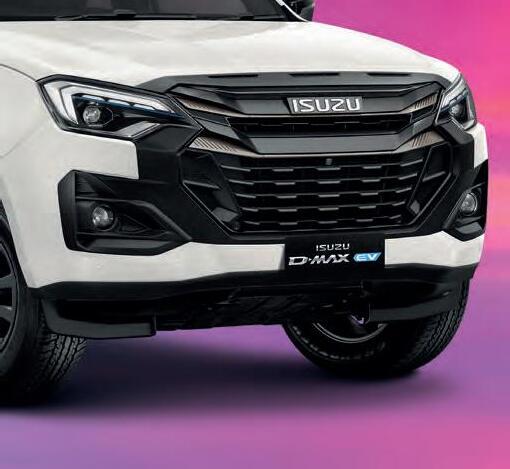
No trade-offs, no half measures. It’s the complete package. Fully electric, compliant and efficient, with all the payload, towing power and 4x4 performance you need.
Introducing the new Isuzu D-Max